
“Somatic Symptom Disorders in Primary Care”
CB
Published · 31 slides · 0 views

1 / 1



Description
Somatic Symptom Disorders in Primary Care Symposium - East London NHS Foundation Trust - May 6th, 2016 Classification of bodily distress syndromes Peter Henningsen Dept of Psychosomatic Medicine and Psychotherapy University Hospital
Related Topics
Share
Embed code
Download this presentation From Below
"“Somatic Symptom Disorders in Primary Care”" is the property of its rightful owner. Permission is granted to download and print the materials on this website for personal, non-commercial use only, and to display it on your personal computer provided you do not modify the materials and that you retain all copyright notices contained in the materials. By downloading content from our website, you accept the terms of this agreement.
Presentation Transcript
01
“Somatic Symptom Disorders in Primary Care”
Symposium - East London NHS Foundation Trust - May 6th, 2016
Classification of bodily distress syndromes
Peter Henningsen Dept of Psychosomatic Medicine and Psychotherapy University Hospital rechts der Isar, Technical Univsersity of Munich<br>
Classification of bodily distress syndromes
Peter Henningsen Dept of Psychosomatic Medicine and Psychotherapy University Hospital rechts der Isar, Technical Univsersity of Munich<br>
02
Overview Bodily symptoms and their overlap: a clinical perspective
A stroll through the classifications of bodily distress Somatic Symptom Disorder (DSM-V) ! Bodily Distress Disorder (ICD-11 - Mental Disorders) ? Bodily Stress Syndrome (ICD-11 - Primary Health Care) ? Chronic primary pain (ICD-11 – General Symptoms) ?
Conclusions<br>
A stroll through the classifications of bodily distress Somatic Symptom Disorder (DSM-V) ! Bodily Distress Disorder (ICD-11 - Mental Disorders) ? Bodily Stress Syndrome (ICD-11 - Primary Health Care) ? Chronic primary pain (ICD-11 – General Symptoms) ?
Conclusions<br>
03
A clinical perspective on distressing bodily symptoms 90% of all people suffer from bodily distress of one form or another
(pain, dizziness, bowel problems, fatigue etc.) during any given week
this is not illness, to be able to deal with it is part of human health
People turn into patients when they seek help for their bodily distress help seeking is influenced by many factors (severity of symptom, health anxiety, gender etc.)
> 25% of all patients in primary care have so-called “non-specific, functional or somatoform symptoms” (NFS)
Outpatients in some specialities also have rates of NFS of > 25% e.g. neurology, gastroenterology etc.<br>
People turn into patients when they seek help for their bodily distress help seeking is influenced by many factors (severity of symptom, health anxiety, gender etc.)
> 25% of all patients in primary care have so-called “non-specific, functional or somatoform symptoms” (NFS)
Outpatients in some specialities also have rates of NFS of > 25% e.g. neurology, gastroenterology etc.<br>
04
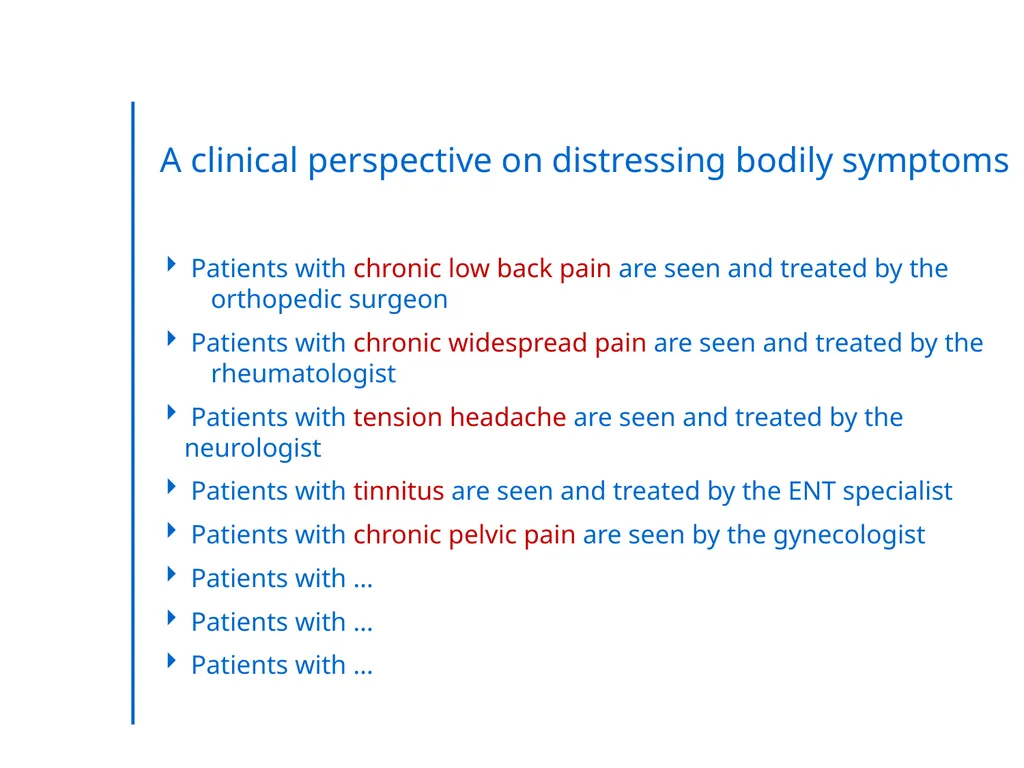
A clinical perspective on distressing bodily symptoms Patients with chronic low back pain are seen and treated by the
orthopedic surgeon
Patients with chronic widespread pain are seen and treated by the rheumatologist
Patients with tension headache are seen and treated by the neurologist
Patients with tinnitus are seen and treated by the ENT specialist
Patients with chronic pelvic pain are seen by the gynecologist
Patients with …
Patients with …
Patients with …<br>
Patients with chronic widespread pain are seen and treated by the rheumatologist
Patients with tension headache are seen and treated by the neurologist
Patients with tinnitus are seen and treated by the ENT specialist
Patients with chronic pelvic pain are seen by the gynecologist
Patients with …
Patients with …
Patients with …<br>
05
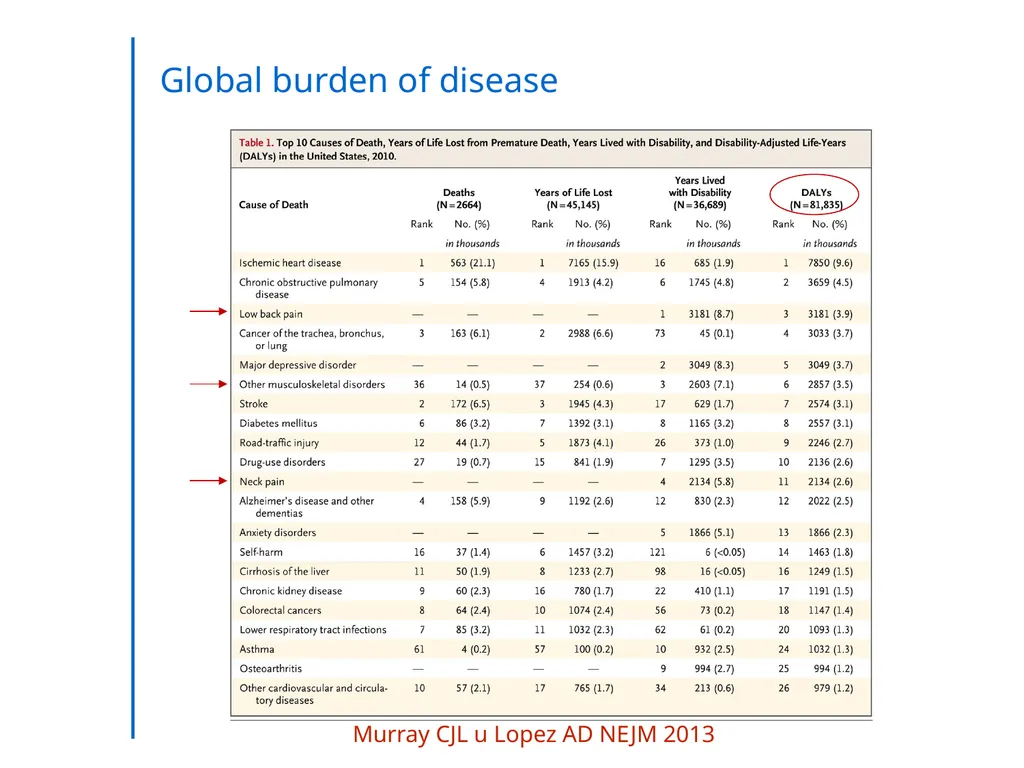
Global burden of disease Murray CJL u Lopez AD NEJM 2013<br>
06
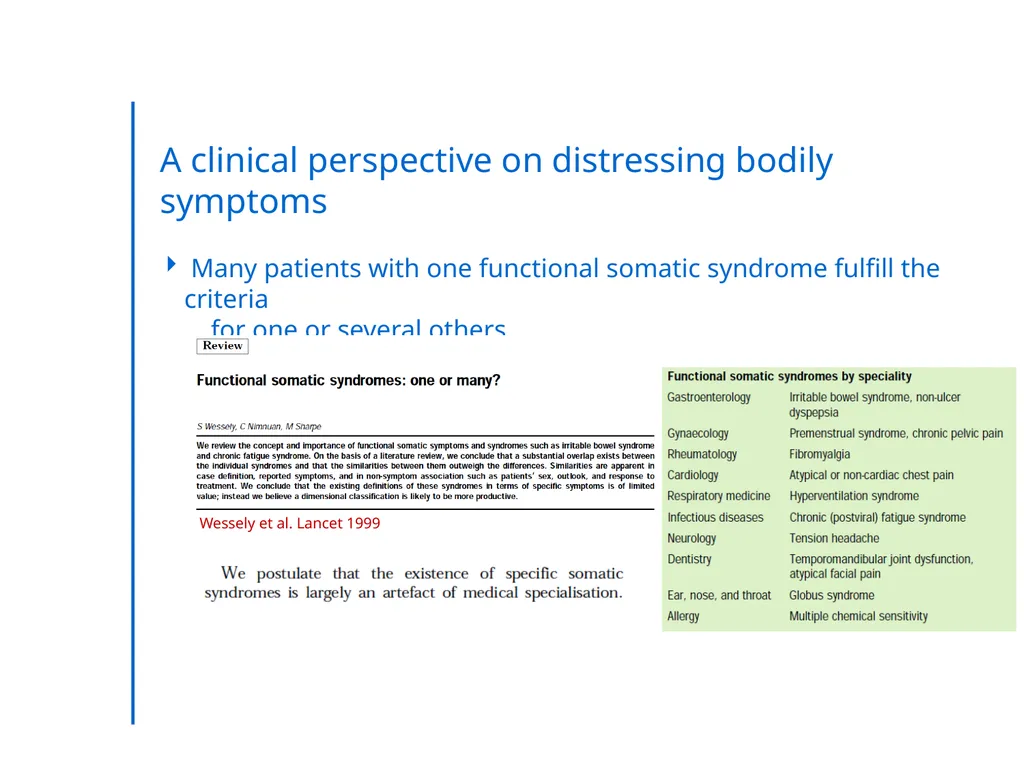
A clinical perspective on distressing bodily symptoms Many patients with one functional somatic syndrome fulfill the criteria
for one or several others…<br>
07
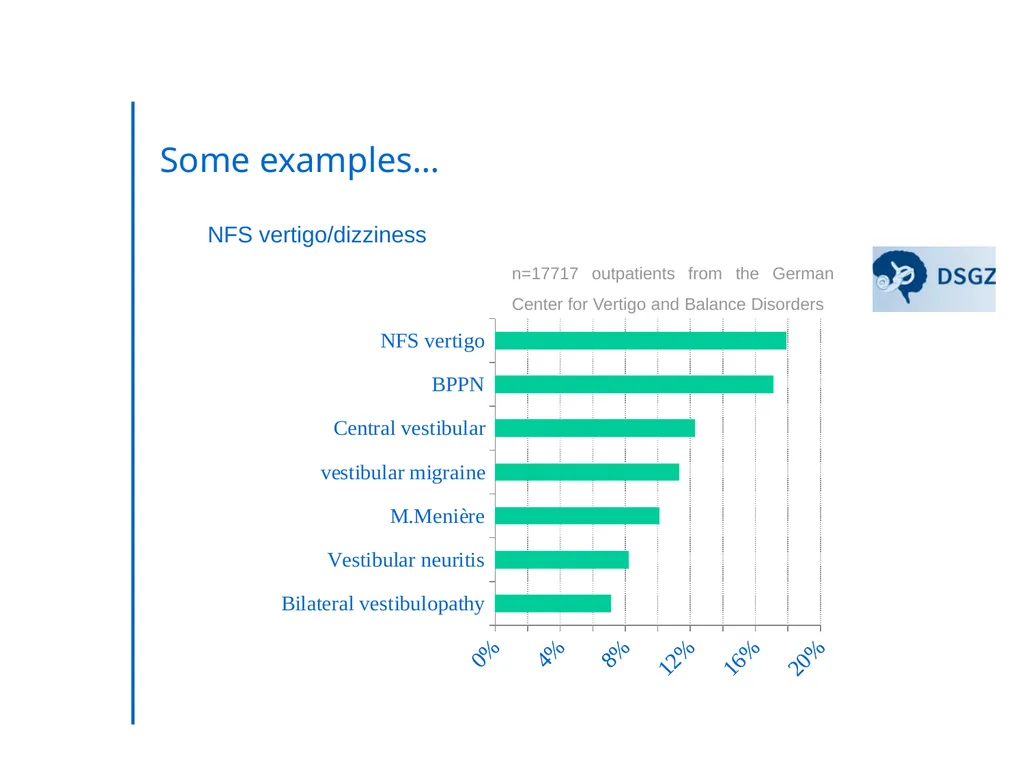
Some examples… NFS vertigo/dizziness n=17717 outpatients from the German Center for Vertigo and Balance Disorders<br>
08
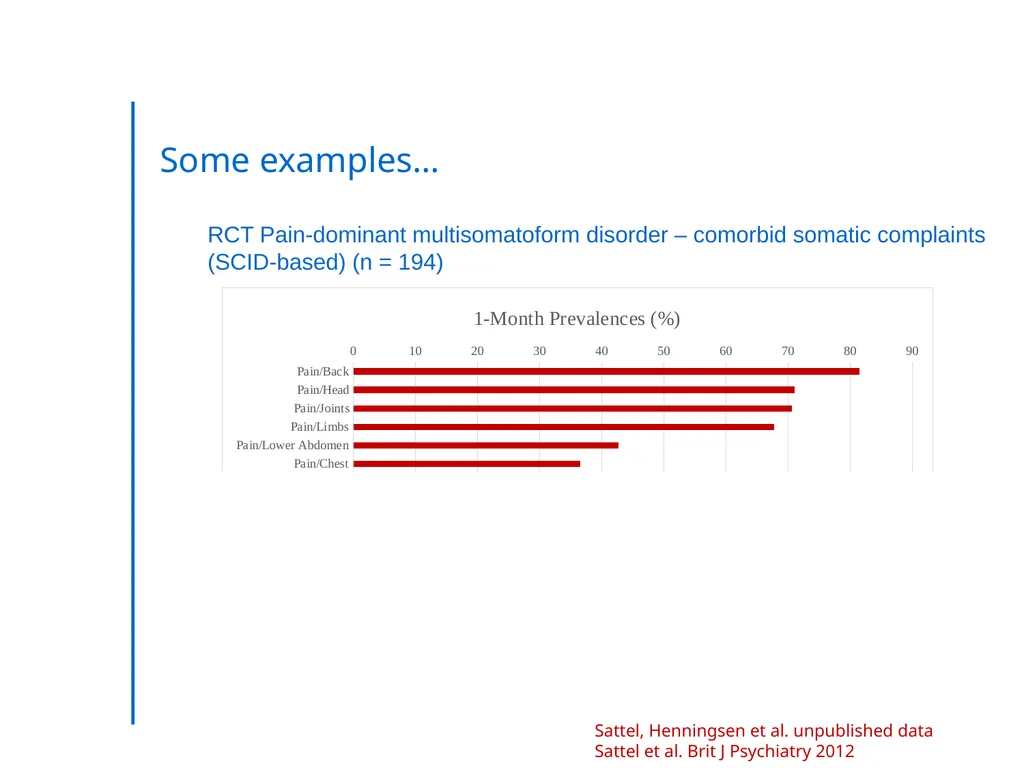
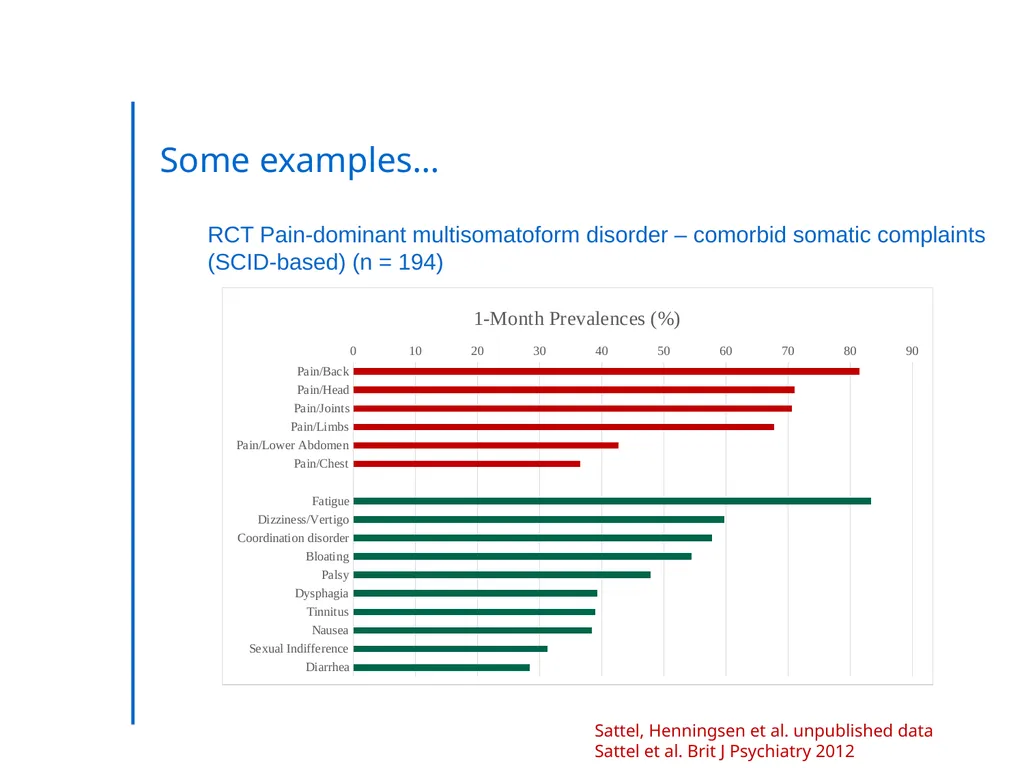
Some examples… RCT Pain-dominant multisomatoform disorder – comorbid somatic complaints (SCID-based) (n = 194) Sattel, Henningsen et al. unpublished data
Sattel et al. Brit J Psychiatry 2012<br>
09
Some examples… RCT Pain-dominant multisomatoform disorder – comorbid somatic complaints (SCID-based) (n = 194) Sattel, Henningsen et al. unpublished data
Sattel et al. Brit J Psychiatry 2012<br>
10
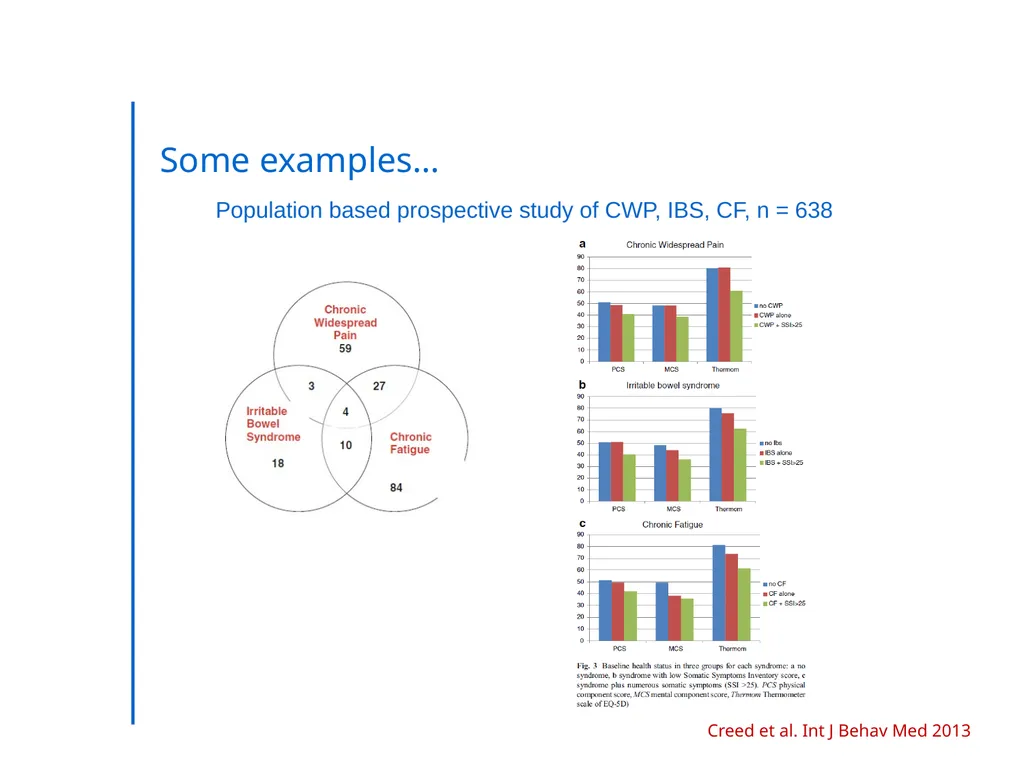
Creed et al. Int J Behav Med 2013 Some examples… Population based prospective study of CWP, IBS, CF, n = 638<br>
11
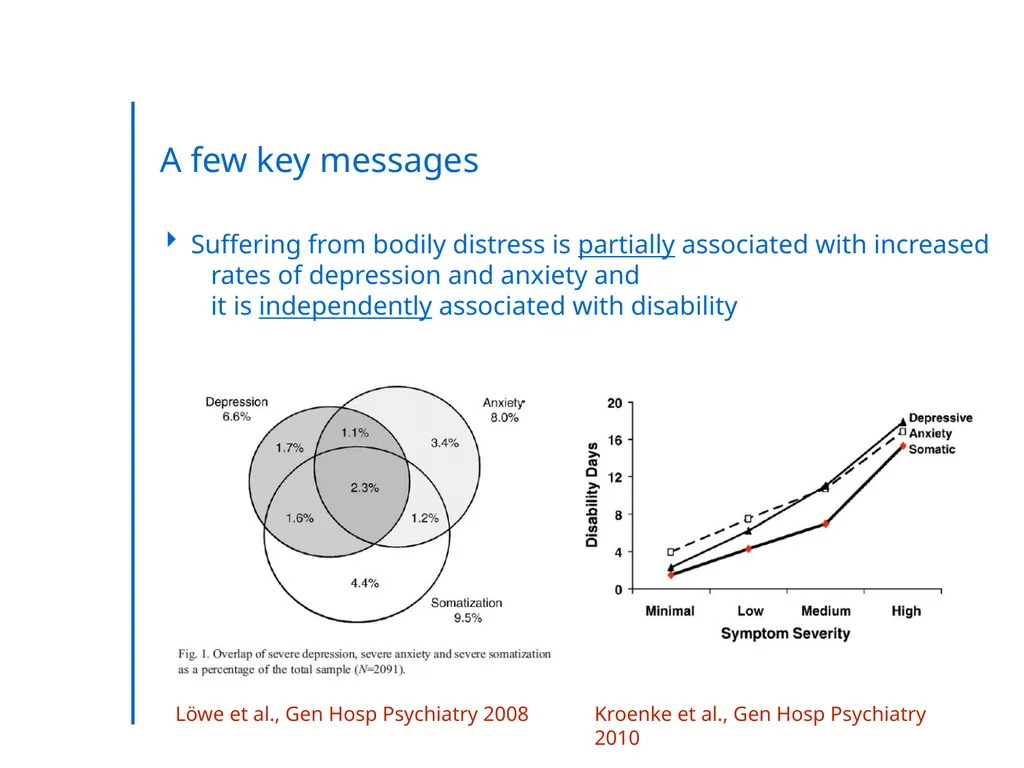
A few key messages Suffering from bodily distress is partially associated with increased
rates of depression and anxiety and
it is independently associated with disability Löwe et al., Gen Hosp Psychiatry 2008 Kroenke et al., Gen Hosp Psychiatry 2010<br>
12
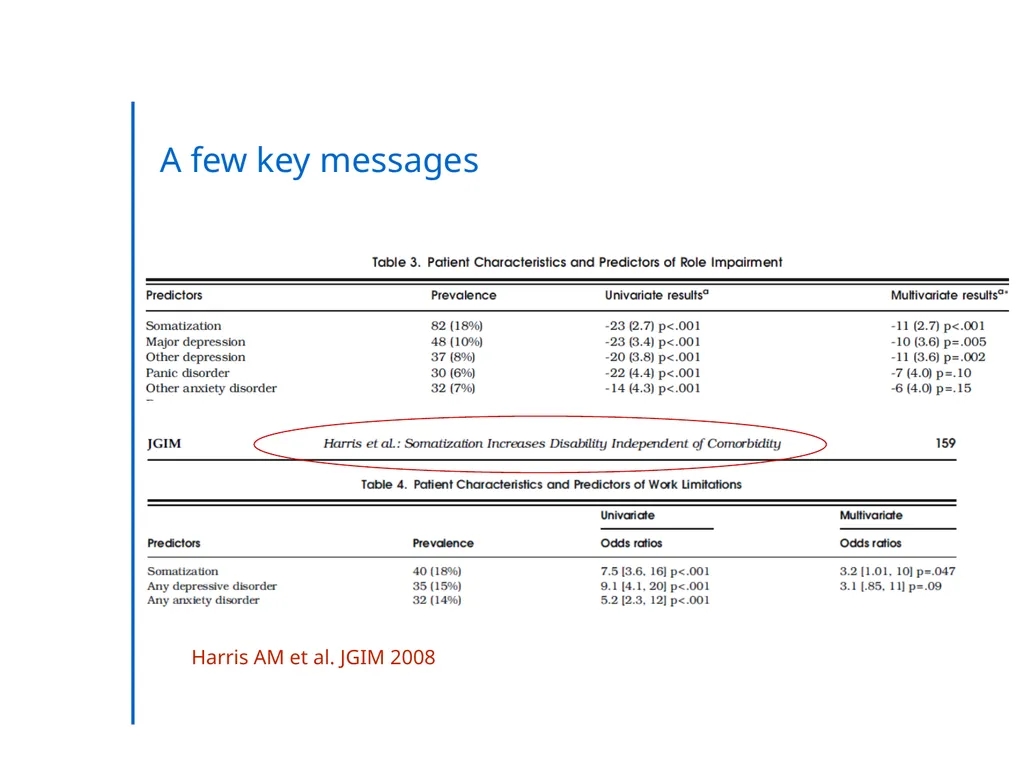
A few key messages Harris AM et al. JGIM 2008<br>
13
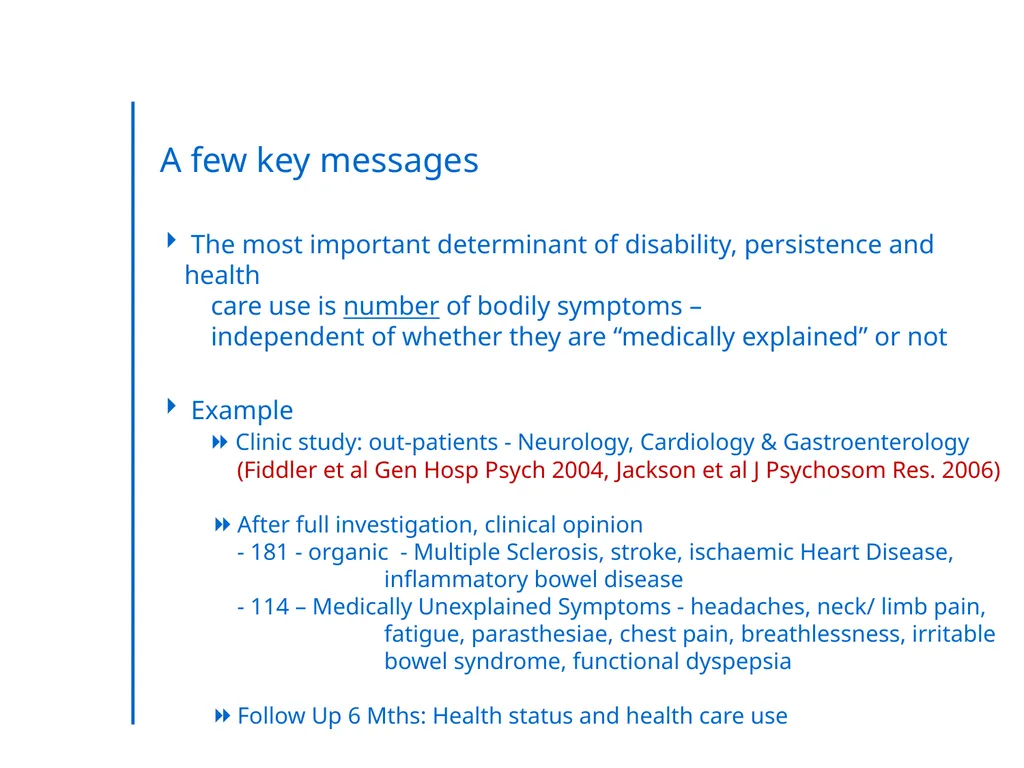
A few key messages The most important determinant of disability, persistence and health
care use is number of bodily symptoms –
independent of whether they are “medically explained” or not
Example Clinic study: out-patients - Neurology, Cardiology & Gastroenterology (Fiddler et al Gen Hosp Psych 2004, Jackson et al J Psychosom Res. 2006) After full investigation, clinical opinion - 181 - organic - Multiple Sclerosis, stroke, ischaemic Heart Disease, inflammatory bowel disease - 114 – Medically Unexplained Symptoms - headaches, neck/ limb pain, fatigue, parasthesiae, chest pain, breathlessness, irritable bowel syndrome, functional dyspepsia Follow Up 6 Mths: Health status and health care use<br>
Example Clinic study: out-patients - Neurology, Cardiology & Gastroenterology (Fiddler et al Gen Hosp Psych 2004, Jackson et al J Psychosom Res. 2006) After full investigation, clinical opinion - 181 - organic - Multiple Sclerosis, stroke, ischaemic Heart Disease, inflammatory bowel disease - 114 – Medically Unexplained Symptoms - headaches, neck/ limb pain, fatigue, parasthesiae, chest pain, breathlessness, irritable bowel syndrome, functional dyspepsia Follow Up 6 Mths: Health status and health care use<br>
14
Number of bodily symptoms by patient diagnostic group Means (sd) 7.7 (3.0) 7.5 (2.8) medically unexplained (n=114) expl. by organic disease (n=181) Fiddler et al Gen Hosp Psych 2004<br>
15
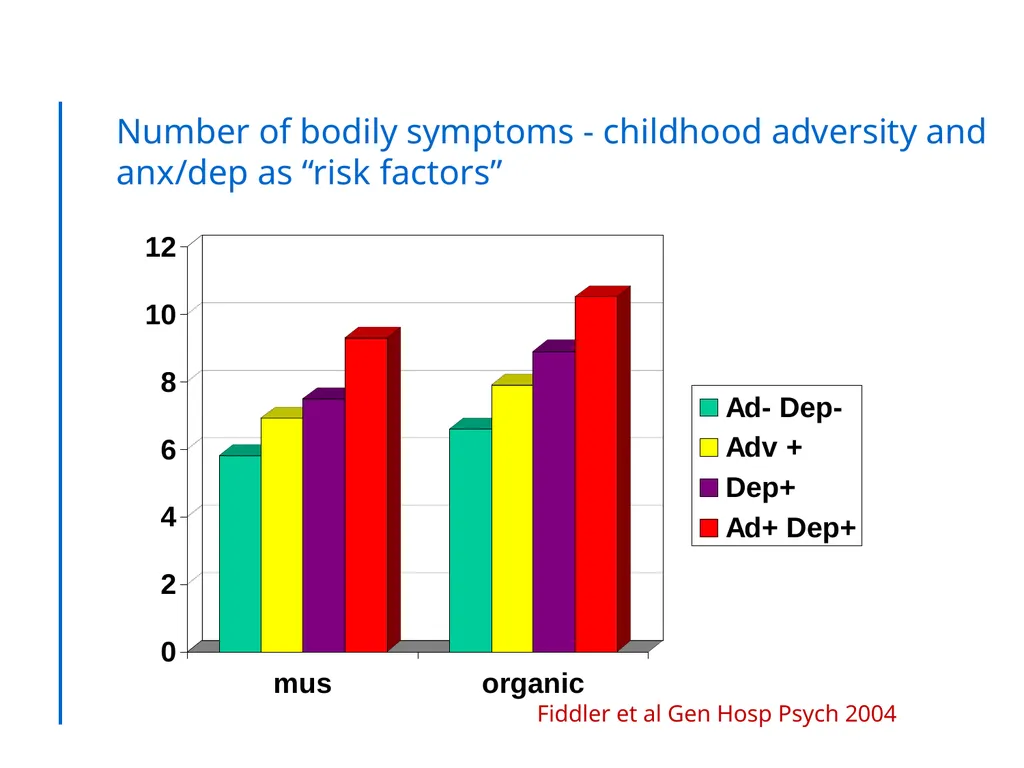
Number of bodily symptoms - childhood adversity and anx/dep as “risk factors” Fiddler et al Gen Hosp Psych 2004<br>
16
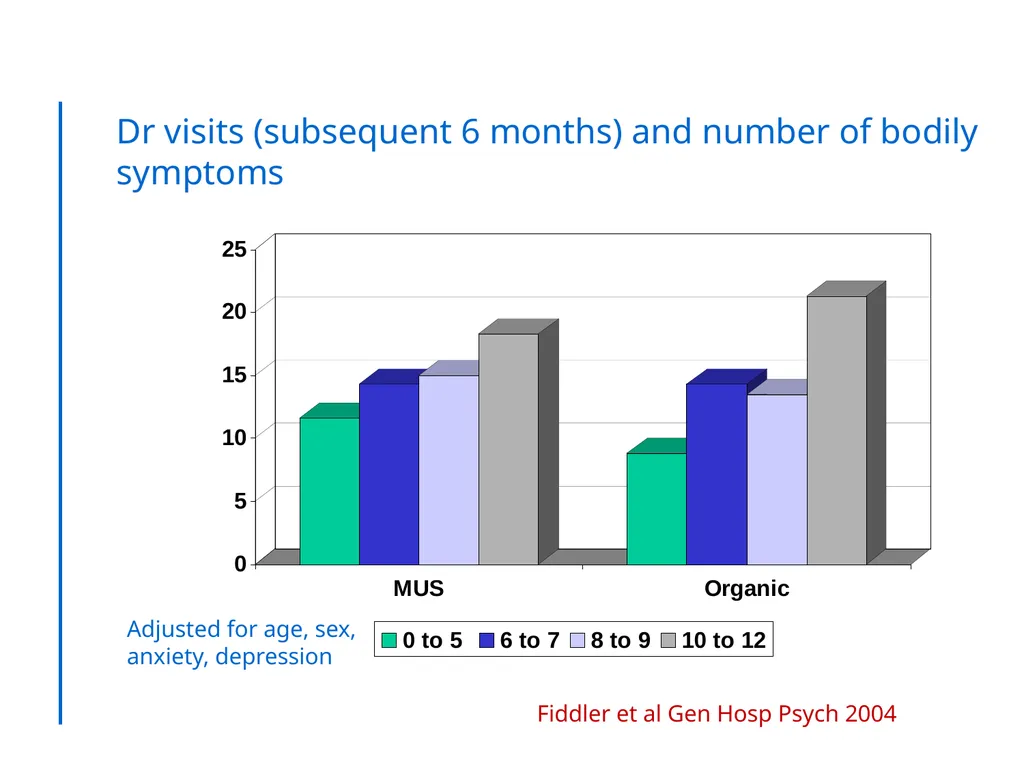
Dr visits (subsequent 6 months) and number of bodily symptoms Fiddler et al Gen Hosp Psych 2004 Adjusted for age, sex, anxiety, depression<br>
17
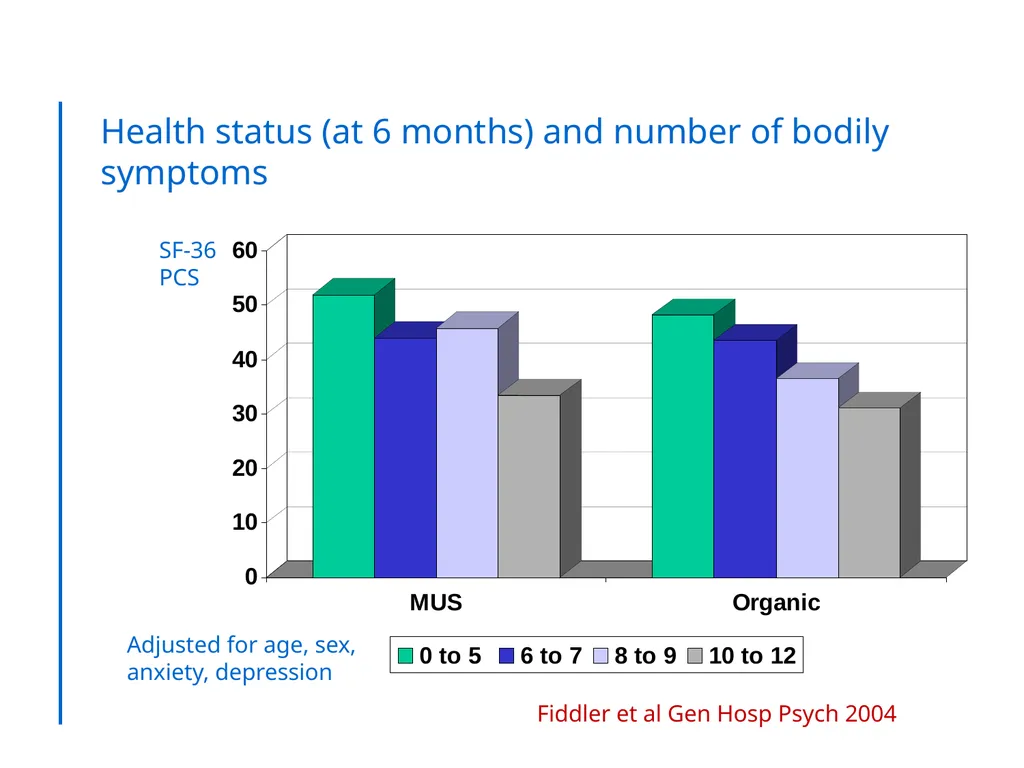
Health status (at 6 months) and number of bodily symptoms Fiddler et al Gen Hosp Psych 2004 SF-36
PCS Adjusted for age, sex, anxiety, depression<br>
18
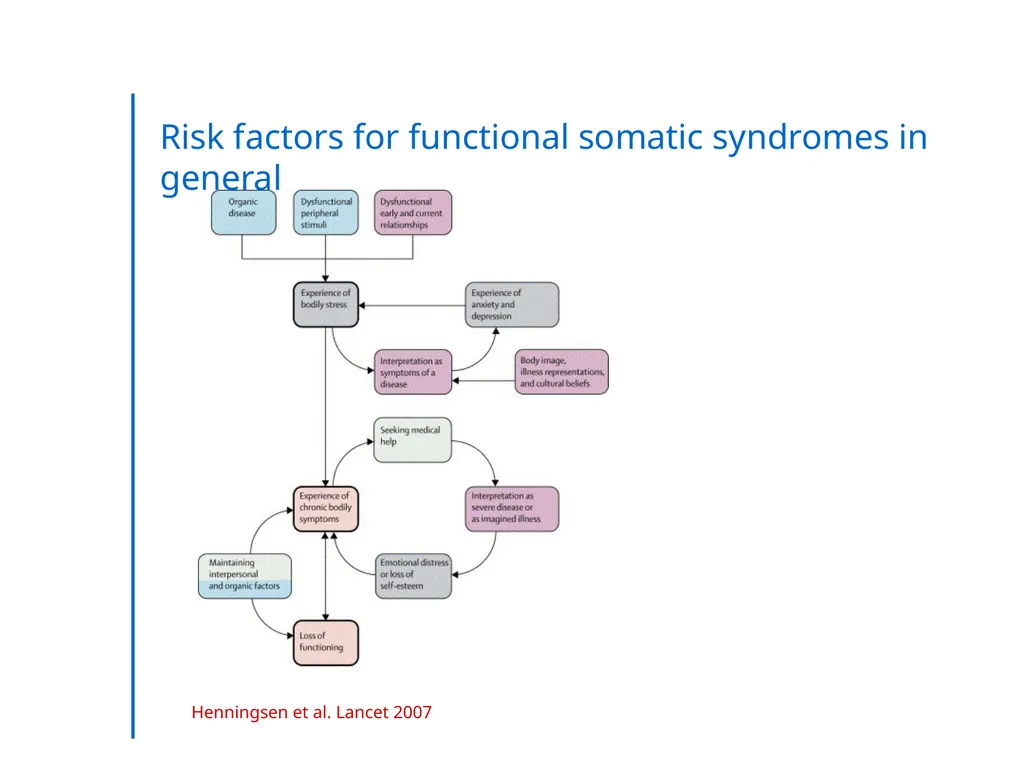
Risk factors for functional somatic syndromes in general Henningsen et al. Lancet 2007<br>
19
Risk factors for chronic pain Denk F et al. Nature Neuroscience 2014<br>
20
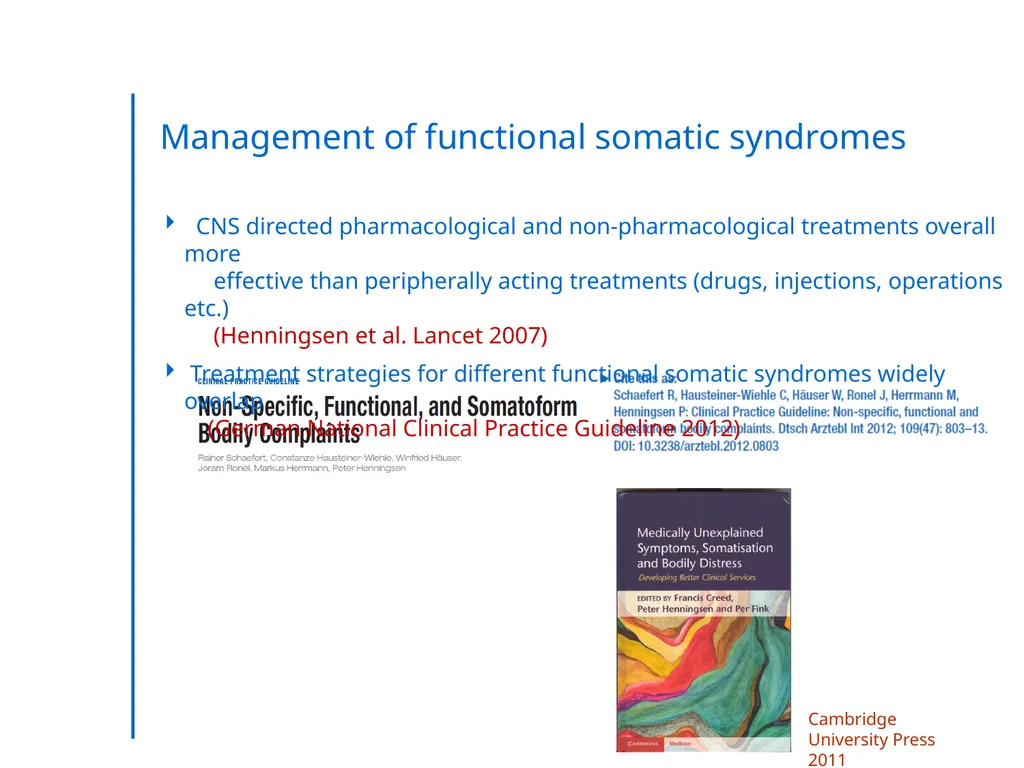
Management of functional somatic syndromes CNS directed pharmacological and non-pharmacological treatments overall more
effective than peripherally acting treatments (drugs, injections, operations etc.)
(Henningsen et al. Lancet 2007)
Treatment strategies for different functional somatic syndromes widely overlap (German National Clinical Practice Guideline 2012) Cambridge University Press 2011<br>
Treatment strategies for different functional somatic syndromes widely overlap (German National Clinical Practice Guideline 2012) Cambridge University Press 2011<br>
21
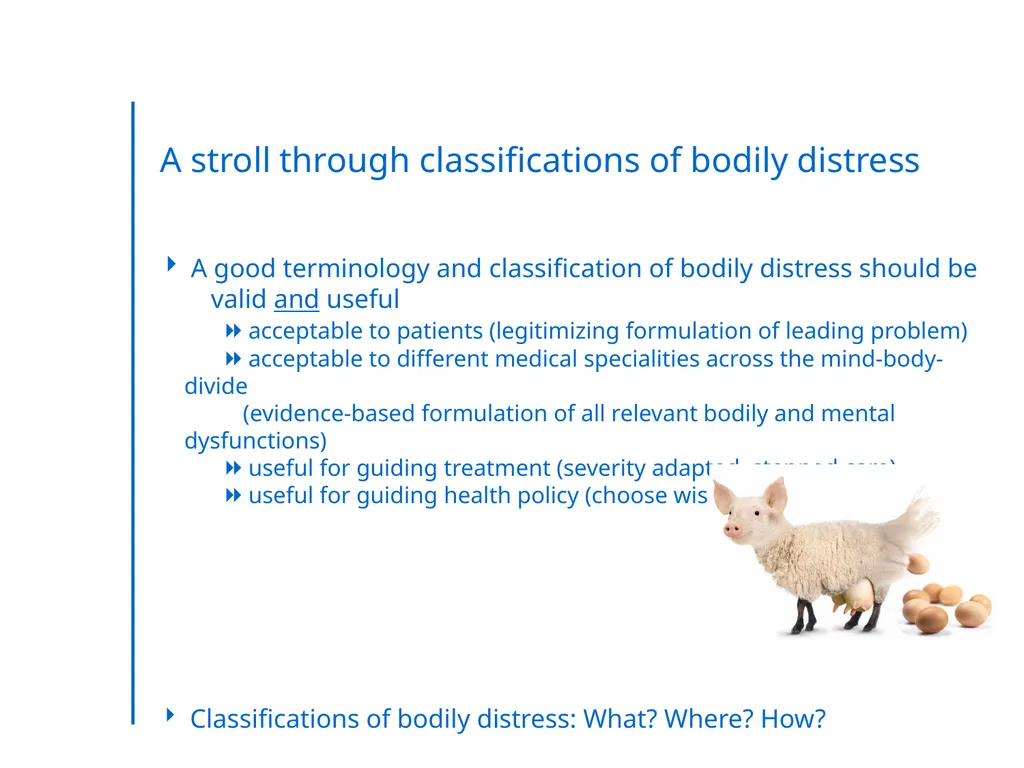
A stroll through classifications of bodily distress A good terminology and classification of bodily distress should be
valid and useful
acceptable to patients (legitimizing formulation of leading problem)
acceptable to different medical specialities across the mind-body-divide
(evidence-based formulation of all relevant bodily and mental dysfunctions)
useful for guiding treatment (severity adapted, stepped care)
useful for guiding health policy (choose wisely!)
Classifications of bodily distress: What? Where? How?<br>
Classifications of bodily distress: What? Where? How?<br>
22
A stroll through classifications of bodily distress What should be classified? Symptoms? Syndromes? Disorders?
Are single symptoms a good basis? Usually not (but: see later)
Single syndromes (e.g. CFS, IBS, FMS…)? pro – the splitting perspective (Patients! Somatic specialists! Specialized researchers!) con – the lumping perspective (Epidemiologists! Psychiatrists! Specialized researchers!)
Disorders? Which disorders?<br>
Are single symptoms a good basis? Usually not (but: see later)
Single syndromes (e.g. CFS, IBS, FMS…)? pro – the splitting perspective (Patients! Somatic specialists! Specialized researchers!) con – the lumping perspective (Epidemiologists! Psychiatrists! Specialized researchers!)
Disorders? Which disorders?<br>
23
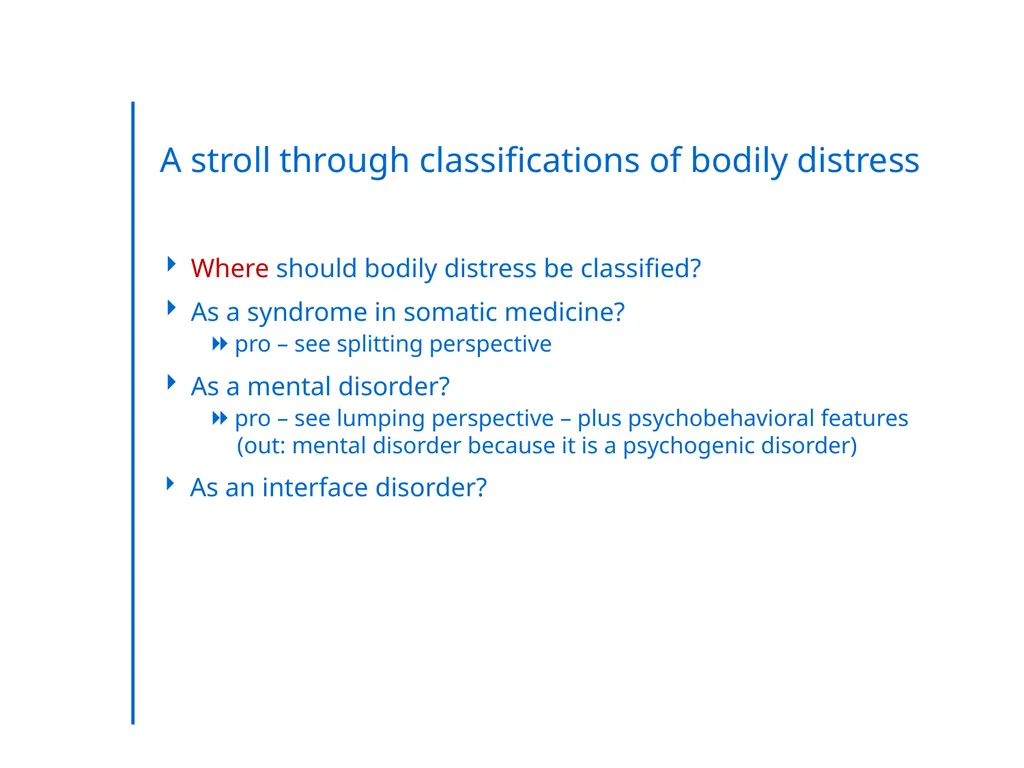
A stroll through classifications of bodily distress Where should bodily distress be classified?
As a syndrome in somatic medicine? pro – see splitting perspective
As a mental disorder? pro – see lumping perspective – plus psychobehavioral features (out: mental disorder because it is a psychogenic disorder)
As an interface disorder?<br>
As a syndrome in somatic medicine? pro – see splitting perspective
As a mental disorder? pro – see lumping perspective – plus psychobehavioral features (out: mental disorder because it is a psychogenic disorder)
As an interface disorder?<br>
24
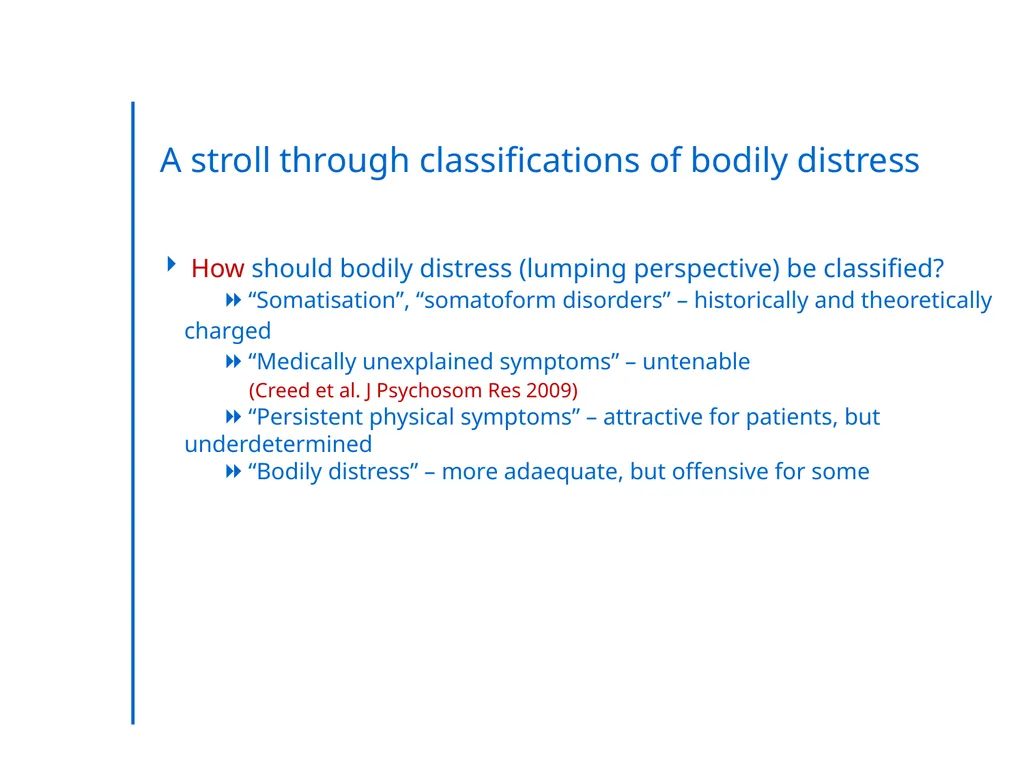
A stroll through classifications of bodily distress How should bodily distress (lumping perspective) be classified?
“Somatisation”, “somatoform disorders” – historically and theoretically charged
“Medically unexplained symptoms” – untenable
(Creed et al. J Psychosom Res 2009)
“Persistent physical symptoms” – attractive for patients, but underdetermined
“Bodily distress” – more adaequate, but offensive for some<br>
25
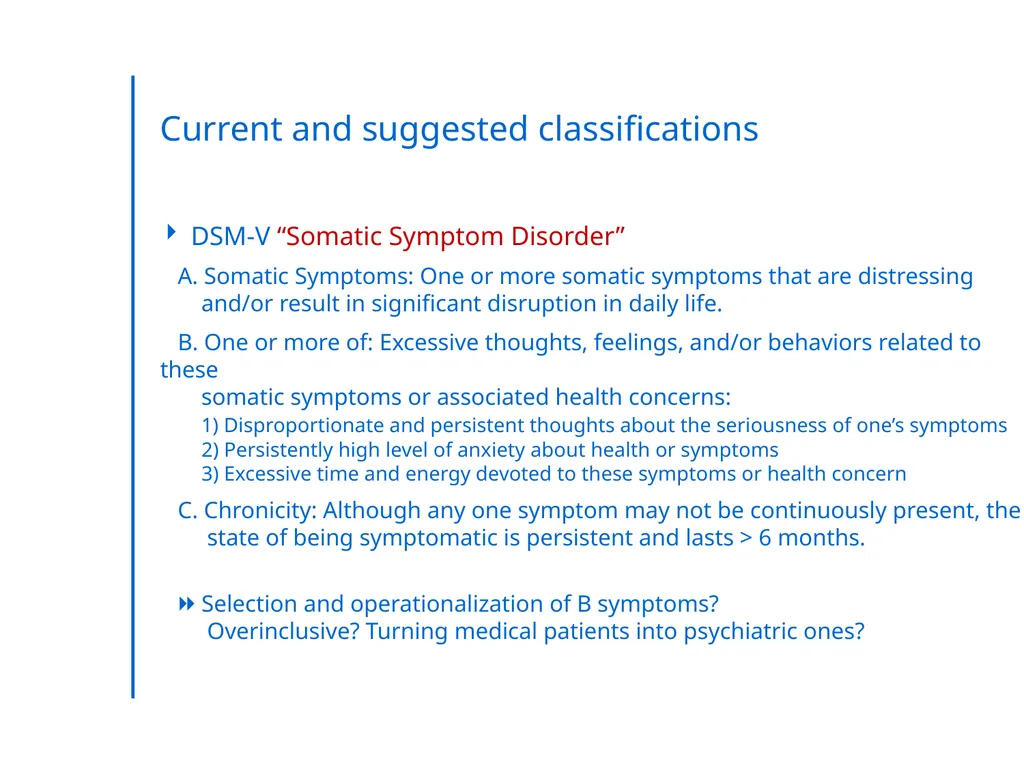
Current and suggested classifications DSM-V “Somatic Symptom Disorder”
A. Somatic Symptoms: One or more somatic symptoms that are distressing and/or result in significant disruption in daily life.
B. One or more of: Excessive thoughts, feelings, and/or behaviors related to these somatic symptoms or associated health concerns: 1) Disproportionate and persistent thoughts about the seriousness of one’s symptoms 2) Persistently high level of anxiety about health or symptoms 3) Excessive time and energy devoted to these symptoms or health concern
C. Chronicity: Although any one symptom may not be continuously present, the state of being symptomatic is persistent and lasts > 6 months.
Selection and operationalization of B symptoms? Overinclusive? Turning medical patients into psychiatric ones?<br>
A. Somatic Symptoms: One or more somatic symptoms that are distressing and/or result in significant disruption in daily life.
B. One or more of: Excessive thoughts, feelings, and/or behaviors related to these somatic symptoms or associated health concerns: 1) Disproportionate and persistent thoughts about the seriousness of one’s symptoms 2) Persistently high level of anxiety about health or symptoms 3) Excessive time and energy devoted to these symptoms or health concern
C. Chronicity: Although any one symptom may not be continuously present, the state of being symptomatic is persistent and lasts > 6 months.
Selection and operationalization of B symptoms? Overinclusive? Turning medical patients into psychiatric ones?<br>
26
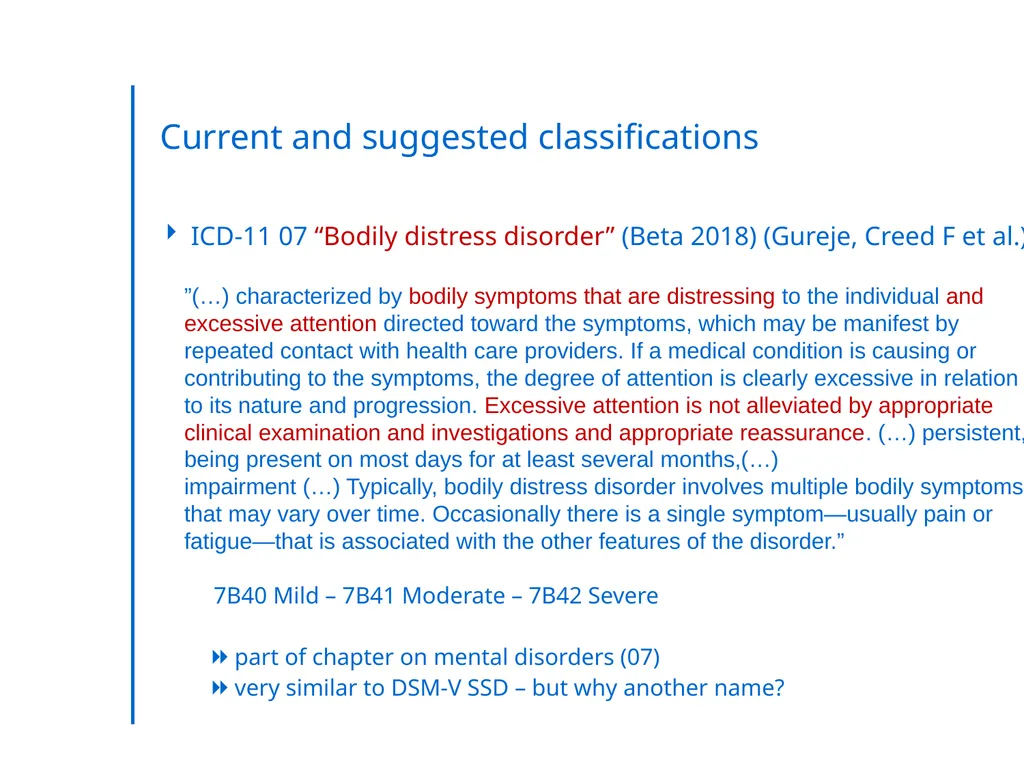
Current and suggested classifications ICD-11 07 “Bodily distress disorder” (Beta 2018) (Gureje, Creed F et al.)
”(…) characterized by bodily symptoms that are distressing to the individual and excessive attention directed toward the symptoms, which may be manifest by repeated contact with health care providers. If a medical condition is causing or contributing to the symptoms, the degree of attention is clearly excessive in relation to its nature and progression. Excessive attention is not alleviated by appropriate clinical examination and investigations and appropriate reassurance. (…) persistent, being present on most days for at least several months,(…)
impairment (…) Typically, bodily distress disorder involves multiple bodily symptoms that may vary over time. Occasionally there is a single symptom—usually pain or fatigue—that is associated with the other features of the disorder.”
7B40 Mild – 7B41 Moderate – 7B42 Severe
part of chapter on mental disorders (07)
very similar to DSM-V SSD – but why another name?<br>
27
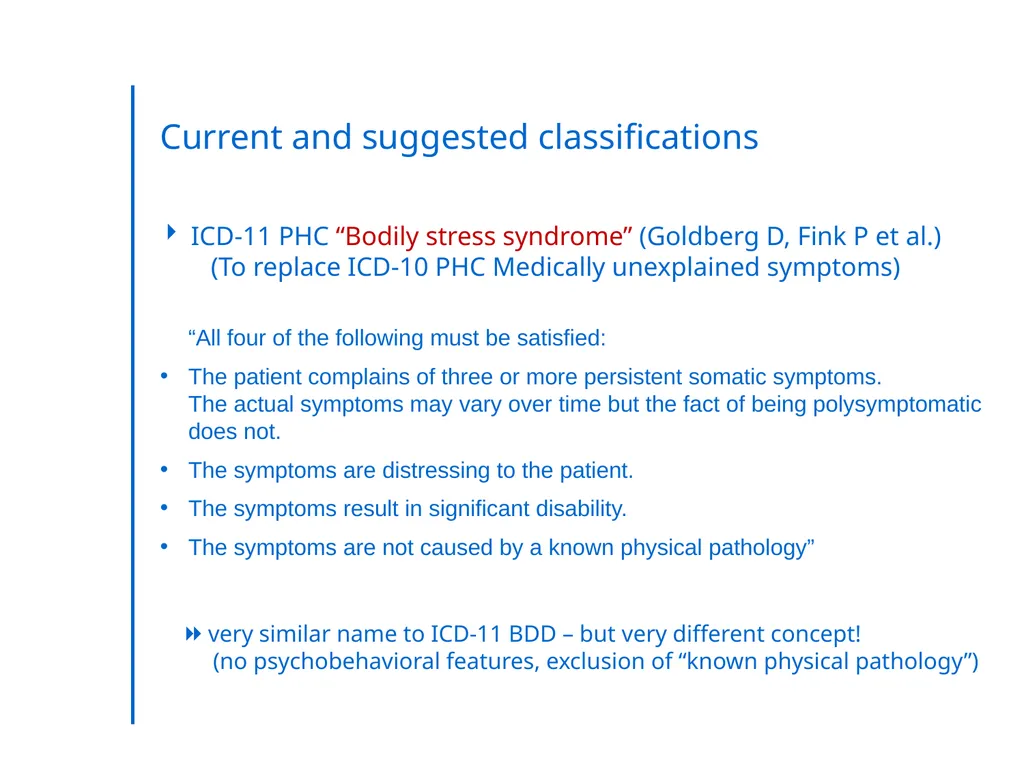
Current and suggested classifications ICD-11 PHC “Bodily stress syndrome” (Goldberg D, Fink P et al.)
(To replace ICD-10 PHC Medically unexplained symptoms)
“All four of the following must be satisfied:
The patient complains of three or more persistent somatic symptoms. The actual symptoms may vary over time but the fact of being polysymptomatic does not.
The symptoms are distressing to the patient.
The symptoms result in significant disability.
The symptoms are not caused by a known physical pathology”
very similar name to ICD-11 BDD – but very different concept! (no psychobehavioral features, exclusion of “known physical pathology”)<br>
“All four of the following must be satisfied:
The patient complains of three or more persistent somatic symptoms. The actual symptoms may vary over time but the fact of being polysymptomatic does not.
The symptoms are distressing to the patient.
The symptoms result in significant disability.
The symptoms are not caused by a known physical pathology”
very similar name to ICD-11 BDD – but very different concept! (no psychobehavioral features, exclusion of “known physical pathology”)<br>
28
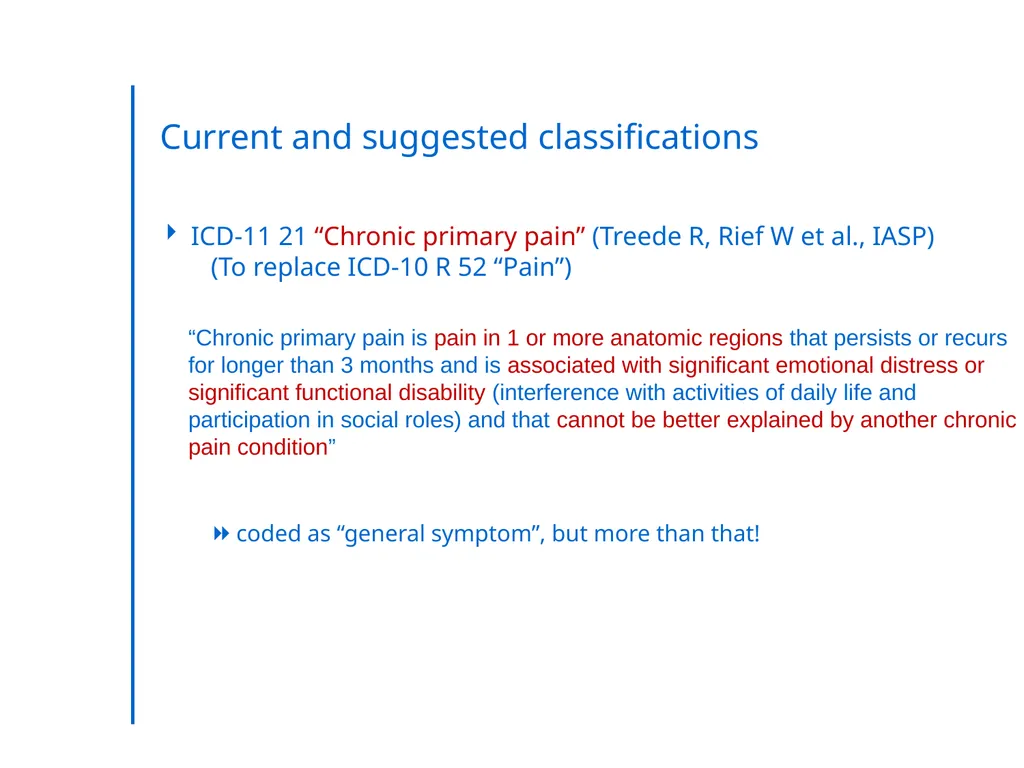
Current and suggested classifications ICD-11 21 “Chronic primary pain” (Treede R, Rief W et al., IASP)
(To replace ICD-10 R 52 “Pain”)
“Chronic primary pain is pain in 1 or more anatomic regions that persists or recurs for longer than 3 months and is associated with significant emotional distress or significant functional disability (interference with activities of daily life and participation in social roles) and that cannot be better explained by another chronic pain condition”
coded as “general symptom”, but more than that!<br>
“Chronic primary pain is pain in 1 or more anatomic regions that persists or recurs for longer than 3 months and is associated with significant emotional distress or significant functional disability (interference with activities of daily life and participation in social roles) and that cannot be better explained by another chronic pain condition”
coded as “general symptom”, but more than that!<br>
29
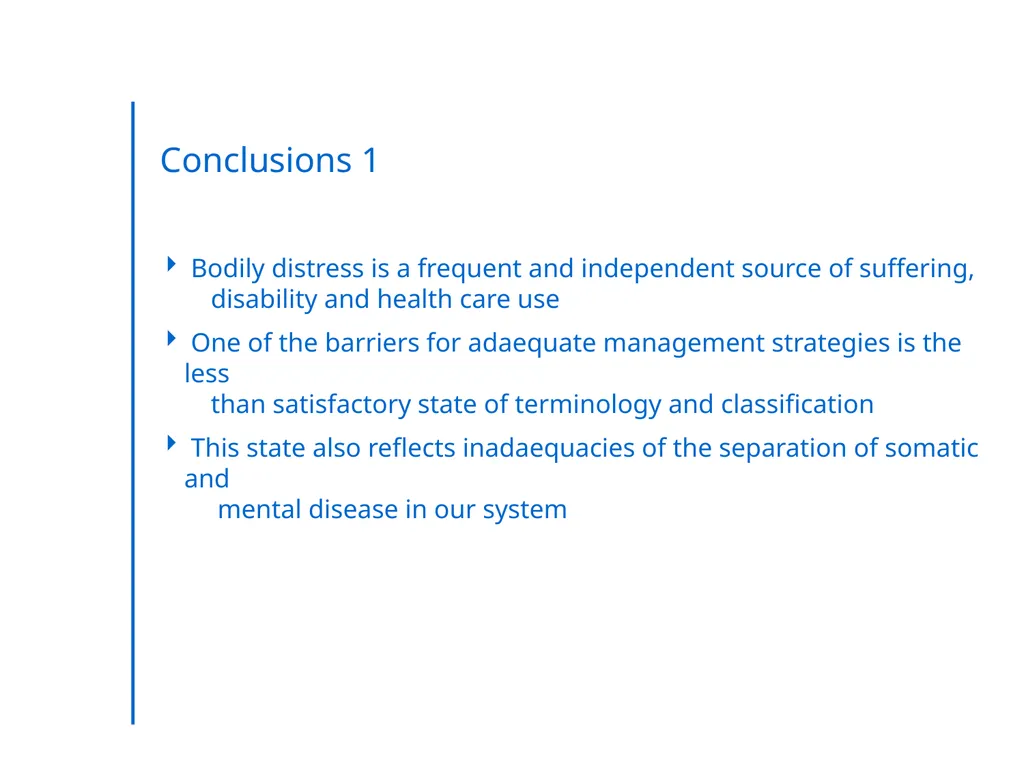
Conclusions 1 Bodily distress is a frequent and independent source of suffering,
disability and health care use
One of the barriers for adaequate management strategies is the less than satisfactory state of terminology and classification
This state also reflects inadaequacies of the separation of somatic and mental disease in our system<br>
One of the barriers for adaequate management strategies is the less than satisfactory state of terminology and classification
This state also reflects inadaequacies of the separation of somatic and mental disease in our system<br>
30
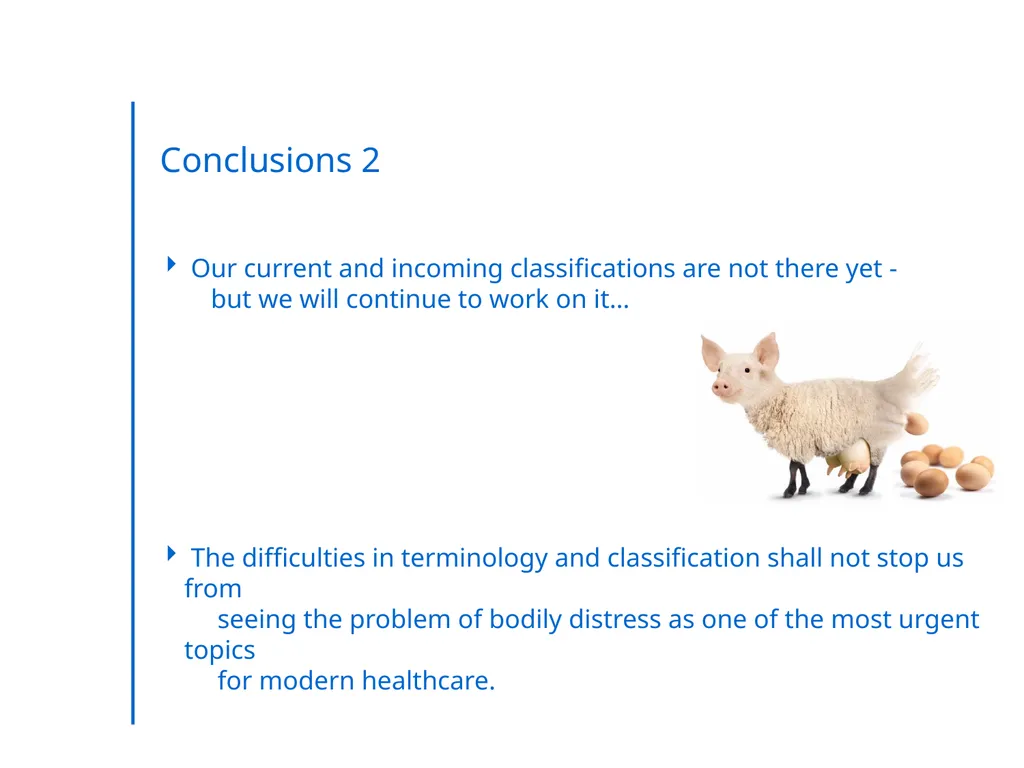
Conclusions 2 Our current and incoming classifications are not there yet -
but we will continue to work on it…
The difficulties in terminology and classification shall not stop us from seeing the problem of bodily distress as one of the most urgent topics for modern healthcare.<br>
The difficulties in terminology and classification shall not stop us from seeing the problem of bodily distress as one of the most urgent topics for modern healthcare.<br>
31
Thank you – and hope to see you Munich !
p.henningsen@tum.de<br>
p.henningsen@tum.de<br>