
Somatoform Disorders, Factitious Disorder and
PT
Published · 97 slides · 0 views

1 / 1


Description
Somatoform Disorders, Factitious Disorder and Malingering APM Resident Education Curriculum Thomas W. Heinrich, M.D. Associate Professor of Psychiatry Family Medicine Chief, Psychiatric Consult Service at Froedtert Hospital Department of
Related Topics
Share
Embed code
Download this presentation From Below
"Somatoform Disorders, Factitious Disorder and" is the property of its rightful owner. Permission is granted to download and print the materials on this website for personal, non-commercial use only, and to display it on your personal computer provided you do not modify the materials and that you retain all copyright notices contained in the materials. By downloading content from our website, you accept the terms of this agreement.
Presentation Transcript
01
Somatoform Disorders, Factitious Disorder and Malingering APM Resident Education Curriculum Thomas W. Heinrich, M.D.
Associate Professor of Psychiatry & Family Medicine
Chief, Psychiatric Consult Service at Froedtert Hospital
Department of Psychiatry & Behavioral Medicine
Medical College of Wisconsin<br>
Associate Professor of Psychiatry & Family Medicine
Chief, Psychiatric Consult Service at Froedtert Hospital
Department of Psychiatry & Behavioral Medicine
Medical College of Wisconsin<br>
02
Disclaimer DSM-5 published in May 2013.
The ABPN, however, will continue to test on DSM-IV criteria until 2015-16
Therefore, the talk will focus on the DSM-IV disorders and conclude with a brief summary of the changes inherent in this group of disorders in DSM-5
Rationale for changes
Disorders<br>
The ABPN, however, will continue to test on DSM-IV criteria until 2015-16
Therefore, the talk will focus on the DSM-IV disorders and conclude with a brief summary of the changes inherent in this group of disorders in DSM-5
Rationale for changes
Disorders<br>
03
Somatoform Disorders Medically unexplained physical symptoms (MUPS)
Physical symptoms that prompt the suffer to seek health care but remain unexplained after an appropriate evaluation (Richardson and Engel, 2004) 3<br>
Physical symptoms that prompt the suffer to seek health care but remain unexplained after an appropriate evaluation (Richardson and Engel, 2004) 3<br>
04
Somatoform Disorders MUPS – One syndrome or many?
Some authors have suggested that the precise diagnosis given depends more on the diagnosing physician’s specialty than on any actual differences between the syndromes
Categorization
Psychiatric
Hypothetical syndromes based on diagnostic criteria 4<br>
Some authors have suggested that the precise diagnosis given depends more on the diagnosing physician’s specialty than on any actual differences between the syndromes
Categorization
Psychiatric
Hypothetical syndromes based on diagnostic criteria 4<br>
05
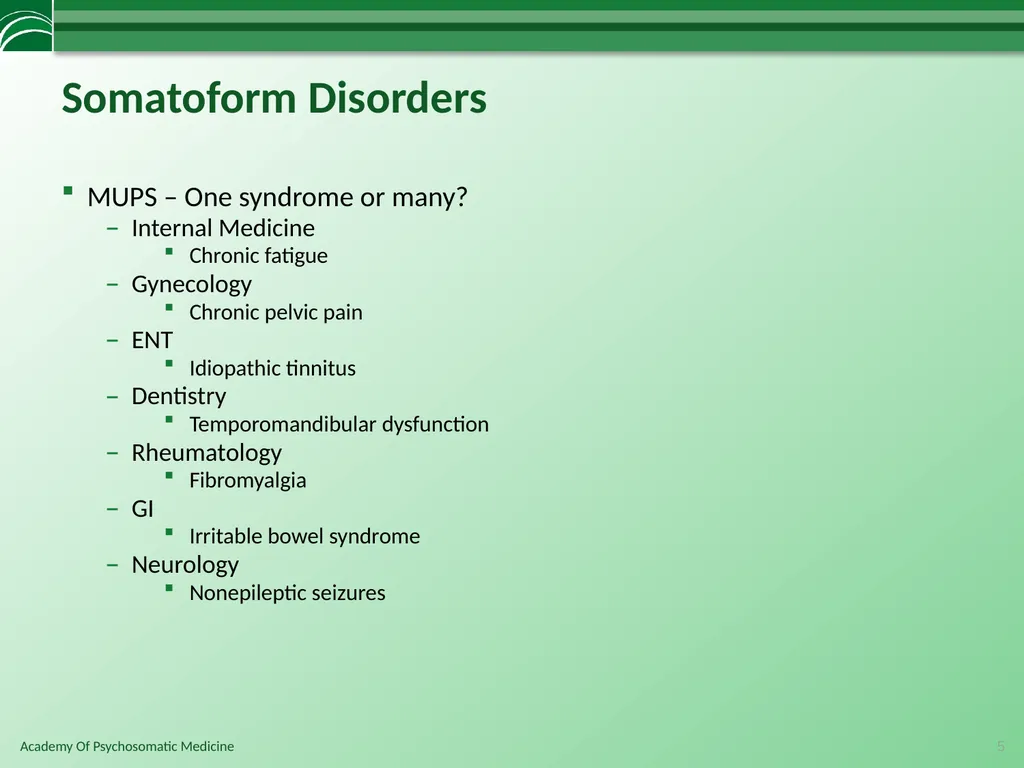
Somatoform Disorders MUPS – One syndrome or many?
Internal Medicine
Chronic fatigue
Gynecology
Chronic pelvic pain
ENT
Idiopathic tinnitus
Dentistry
Temporomandibular dysfunction
Rheumatology
Fibromyalgia
GI
Irritable bowel syndrome
Neurology
Nonepileptic seizures 5<br>
Internal Medicine
Chronic fatigue
Gynecology
Chronic pelvic pain
ENT
Idiopathic tinnitus
Dentistry
Temporomandibular dysfunction
Rheumatology
Fibromyalgia
GI
Irritable bowel syndrome
Neurology
Nonepileptic seizures 5<br>
06
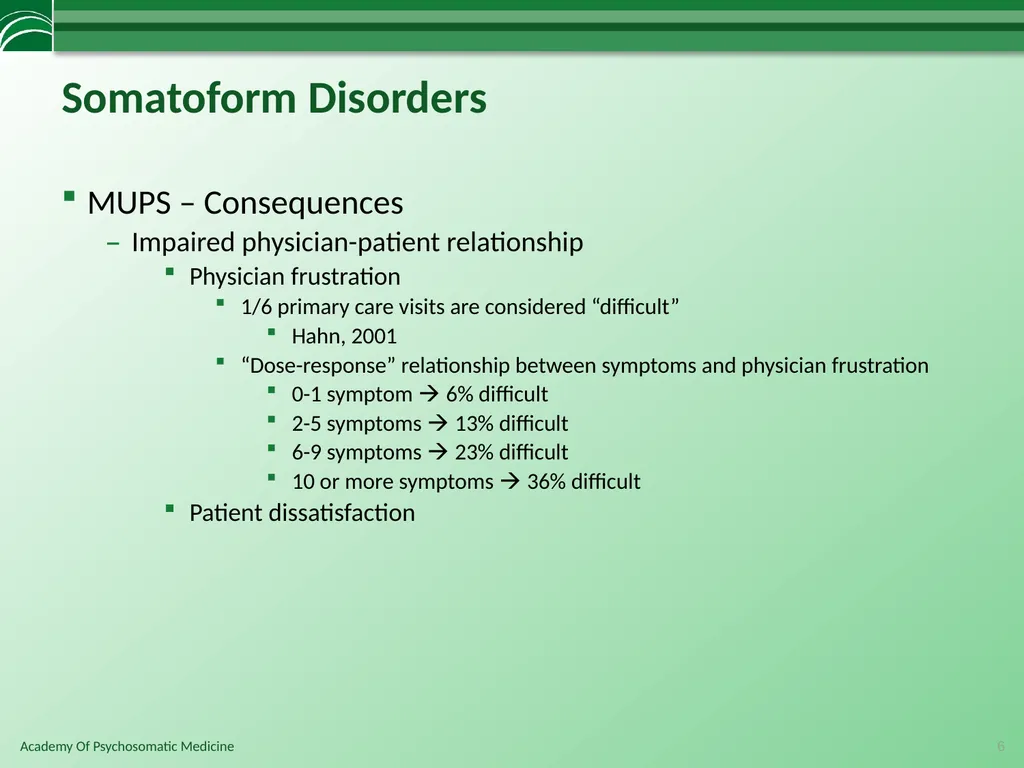
Somatoform Disorders MUPS – Consequences
Impaired physician-patient relationship
Physician frustration
1/6 primary care visits are considered “difficult”
Hahn, 2001
“Dose-response” relationship between symptoms and physician frustration
0-1 symptom 6% difficult
2-5 symptoms 13% difficult
6-9 symptoms 23% difficult
10 or more symptoms 36% difficult
Patient dissatisfaction 6<br>
Impaired physician-patient relationship
Physician frustration
1/6 primary care visits are considered “difficult”
Hahn, 2001
“Dose-response” relationship between symptoms and physician frustration
0-1 symptom 6% difficult
2-5 symptoms 13% difficult
6-9 symptoms 23% difficult
10 or more symptoms 36% difficult
Patient dissatisfaction 6<br>
07
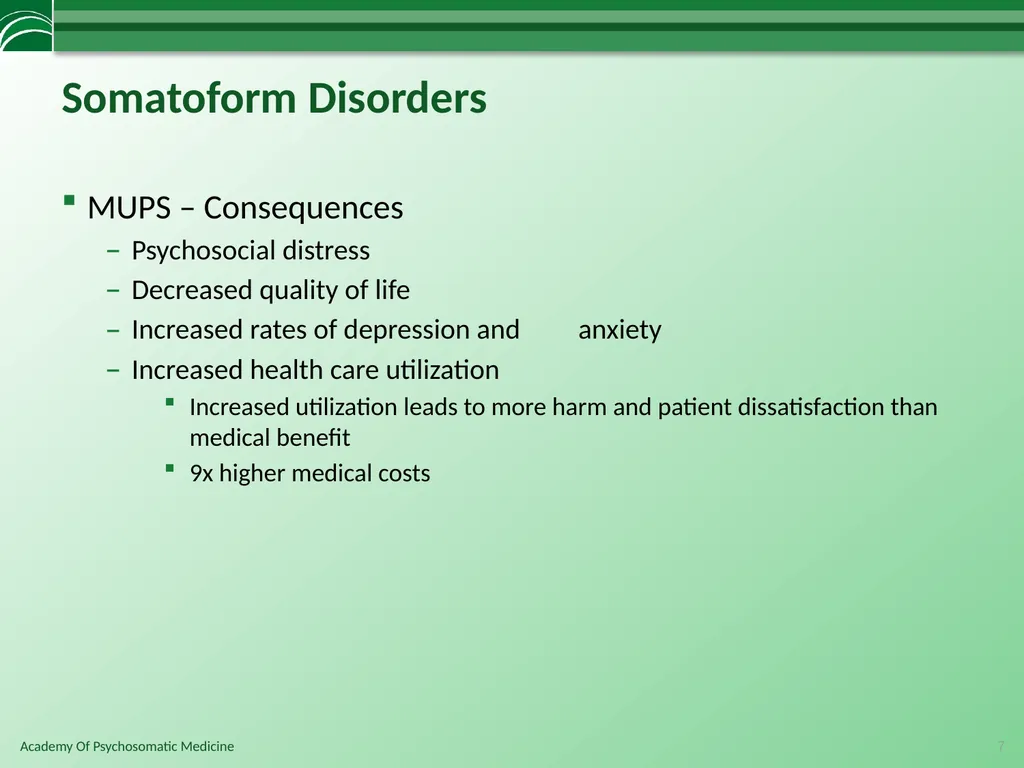
Somatoform Disorders MUPS – Consequences
Psychosocial distress
Decreased quality of life
Increased rates of depression and anxiety
Increased health care utilization
Increased utilization leads to more harm and patient dissatisfaction than medical benefit
9x higher medical costs 7<br>
Psychosocial distress
Decreased quality of life
Increased rates of depression and anxiety
Increased health care utilization
Increased utilization leads to more harm and patient dissatisfaction than medical benefit
9x higher medical costs 7<br>
08
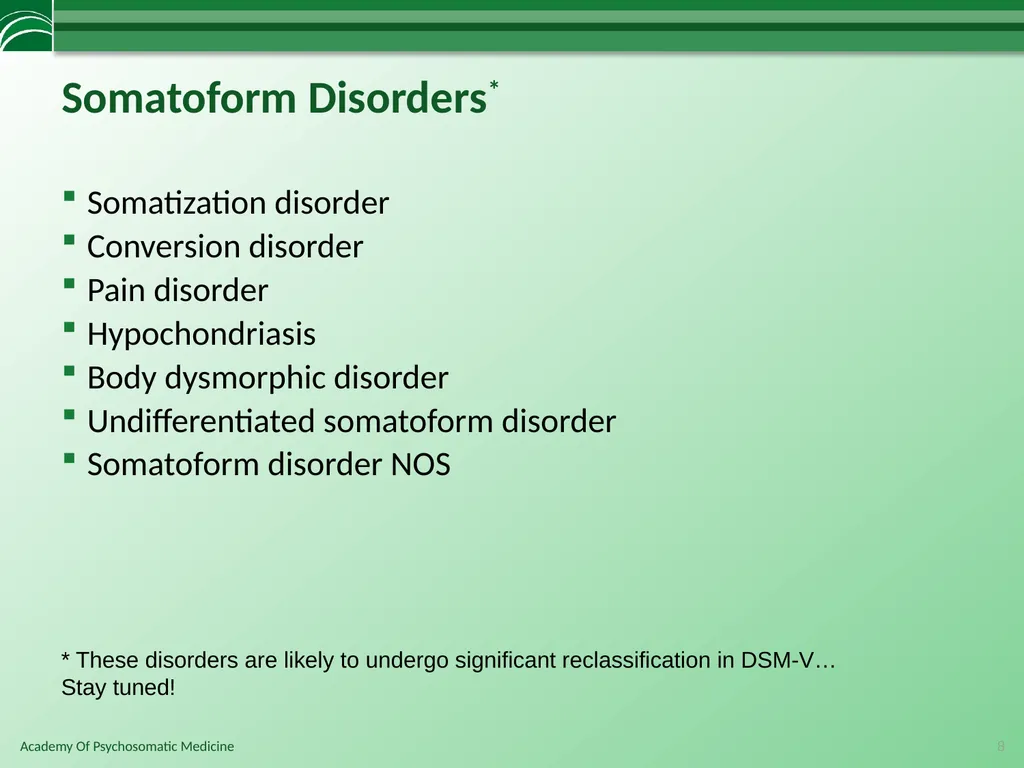
Somatoform Disorders* Somatization disorder
Conversion disorder
Pain disorder
Hypochondriasis
Body dysmorphic disorder
Undifferentiated somatoform disorder
Somatoform disorder NOS 8 * These disorders are likely to undergo significant reclassification in DSM-V… Stay tuned!<br>
Conversion disorder
Pain disorder
Hypochondriasis
Body dysmorphic disorder
Undifferentiated somatoform disorder
Somatoform disorder NOS 8 * These disorders are likely to undergo significant reclassification in DSM-V… Stay tuned!<br>
09
Somatoform Disorders Generalities
Presence of physical symptoms that suggest a general medical condition, but are not explained by a medical condition.
Psychosocial stress = somatic distress
Misinterpretation of normal physiological functions
Not consciously produced or feigned
Alexithymia 9<br>
Presence of physical symptoms that suggest a general medical condition, but are not explained by a medical condition.
Psychosocial stress = somatic distress
Misinterpretation of normal physiological functions
Not consciously produced or feigned
Alexithymia 9<br>
10
Somatoform Disorders Alexithymia
Term coined by Sifneos in 1973
Individuals who have difficulties expressing emotions verbally
Correlates positively with:
Depression
Somatization
Hypochondriasis 10<br>
Term coined by Sifneos in 1973
Individuals who have difficulties expressing emotions verbally
Correlates positively with:
Depression
Somatization
Hypochondriasis 10<br>
11
Somatization Disorder DSM-IV TR Criteria
Multiple recurring physical complaints that begin before age 30
All 4 of the following criteria at some point
4 pain symptoms
2 non-pain GI symptoms
1 sexual complaint
1 pseudoneurological complaint
Not caused by known medical condition
Not intentionally produced 11<br>
Multiple recurring physical complaints that begin before age 30
All 4 of the following criteria at some point
4 pain symptoms
2 non-pain GI symptoms
1 sexual complaint
1 pseudoneurological complaint
Not caused by known medical condition
Not intentionally produced 11<br>
12
Somatization Disorder Epidemiology
Somatization disorder
General population: 0.01%
Primary care setting: 3%
Subsyndromal somatization disorder
General population: 11%
Primary care setting: 20% 12<br>
Somatization disorder
General population: 0.01%
Primary care setting: 3%
Subsyndromal somatization disorder
General population: 11%
Primary care setting: 20% 12<br>
13
Somatization Disorder Clinical features
DSM-IV TR features
Large number of outpatient visits
Frequent hospitalizations
Repetitive subspecialty referrals
Large number of diagnoses
Multiple medications 13<br>
DSM-IV TR features
Large number of outpatient visits
Frequent hospitalizations
Repetitive subspecialty referrals
Large number of diagnoses
Multiple medications 13<br>
14
Somatization Disorder Etiologies
Defense mechanisms
Genetic & family studies
Behavioral
Early life experiences
Personality 14<br>
Defense mechanisms
Genetic & family studies
Behavioral
Early life experiences
Personality 14<br>
15
Somatization Disorder Differential diagnosis
Medical conditions
Disorders with transient nonspecific symptoms
Psychiatric conditions
Other somatoform disorders
Depression
Anxiety 15<br>
Medical conditions
Disorders with transient nonspecific symptoms
Psychiatric conditions
Other somatoform disorders
Depression
Anxiety 15<br>
16
Somatization Disorder Differential diagnosis (continued)
The three features that most suggest a diagnosis of somatization disorder instead of another medical disorder are
Involvement of multiple organ systems
Early onset and chronic course without development of physical signs or structural abnormalities
Absence of laboratory abnormalities that are characteristic of the suggested medical condition 16<br>
The three features that most suggest a diagnosis of somatization disorder instead of another medical disorder are
Involvement of multiple organ systems
Early onset and chronic course without development of physical signs or structural abnormalities
Absence of laboratory abnormalities that are characteristic of the suggested medical condition 16<br>
17
Somatization Disorder Differential diagnosis
“Psychologization” may not entirely explain somatization either
Many patients have no other psychiatric diagnosis
Directionality is unclear
Even when physical symptoms respond to psychological treatments the effect size may be less than for depression 17<br>
“Psychologization” may not entirely explain somatization either
Many patients have no other psychiatric diagnosis
Directionality is unclear
Even when physical symptoms respond to psychological treatments the effect size may be less than for depression 17<br>
18
Somatization Disorder General treatment issues:
Schedule regular follow-up visits
Perform a brief physical exam focused on the area of discomfort on each visit
Look closely for objective signs of disease rather than taking the patient’s symptoms at “face value”
Avoid unnecessary tests, invasive treatments, referrals and hospitalizations.
Avoid insulting explanations such as “the symptoms are all in your head”
Explain that stress can cause physical symptoms
Set limits on contacts outside of scheduled visits 18<br>
Schedule regular follow-up visits
Perform a brief physical exam focused on the area of discomfort on each visit
Look closely for objective signs of disease rather than taking the patient’s symptoms at “face value”
Avoid unnecessary tests, invasive treatments, referrals and hospitalizations.
Avoid insulting explanations such as “the symptoms are all in your head”
Explain that stress can cause physical symptoms
Set limits on contacts outside of scheduled visits 18<br>
19
Somatization Disorder General treatment issues:
Is diagnostic testing therapeutic?
Noncardiac chest pain (Sox 1981)
ECG vs. no test
More satisfied and less disabled at 3-weeks, but no difference at 4-month follow-up
Headache (Howard 2005)
Ct scan of brain
Less worried at 3 month, but not at 1 year
So… Limit work-ups to objective findings 19<br>
Is diagnostic testing therapeutic?
Noncardiac chest pain (Sox 1981)
ECG vs. no test
More satisfied and less disabled at 3-weeks, but no difference at 4-month follow-up
Headache (Howard 2005)
Ct scan of brain
Less worried at 3 month, but not at 1 year
So… Limit work-ups to objective findings 19<br>
20
Somatization Disorder Specific treatments
Psychotherapy
Not responsive to long-term insight oriented psychotherapy
Short-term dynamic therapy has shown some efficacy
Cognitive-behavioral therapy has been shown to be effective 20<br>
Psychotherapy
Not responsive to long-term insight oriented psychotherapy
Short-term dynamic therapy has shown some efficacy
Cognitive-behavioral therapy has been shown to be effective 20<br>
21
Somatization Disorder Specific treatments
Psychopharmacology
Antidepressants have shown inconsistent results
Antidepressants have limitations in treating somatization disorder
Partial response instead of remission
Higher discontinuation rates
Sensitive to side effects
Attribution to physical, whereas antidepressants suggest psychiatric
Unknown long-term efficacy 21<br>
Psychopharmacology
Antidepressants have shown inconsistent results
Antidepressants have limitations in treating somatization disorder
Partial response instead of remission
Higher discontinuation rates
Sensitive to side effects
Attribution to physical, whereas antidepressants suggest psychiatric
Unknown long-term efficacy 21<br>
22
Somatization Disorder Nonspecific treatments
Reassurance
Concluding the visit in a positive and reassuring manner has shown benefit (Kathol, 1997)
Reattribution
Broadening the agenda to include both physical and psychological factors may be beneficial (Fink 2002)
Normalization
Stating that one’s test are “normal” or “everything is fine” has not been effective
Need to address the patients concern(s) (Knipschild, 2005) 22<br>
Reassurance
Concluding the visit in a positive and reassuring manner has shown benefit (Kathol, 1997)
Reattribution
Broadening the agenda to include both physical and psychological factors may be beneficial (Fink 2002)
Normalization
Stating that one’s test are “normal” or “everything is fine” has not been effective
Need to address the patients concern(s) (Knipschild, 2005) 22<br>
23
Conversion Disorder Definition
One or more symptoms involving voluntary motor or sensory function that suggest a medical condition
Psychological factors are judged to be associated with the symptom
Not intentionally produced or feigned 23<br>
One or more symptoms involving voluntary motor or sensory function that suggest a medical condition
Psychological factors are judged to be associated with the symptom
Not intentionally produced or feigned 23<br>
24
Conversion Disorder The theoretical goal of a conversion symptom
Symbolic resolution of an unconscious conflict in an attempt to keep the conflicting memories out of consciousness 24<br>
Symbolic resolution of an unconscious conflict in an attempt to keep the conflicting memories out of consciousness 24<br>
25
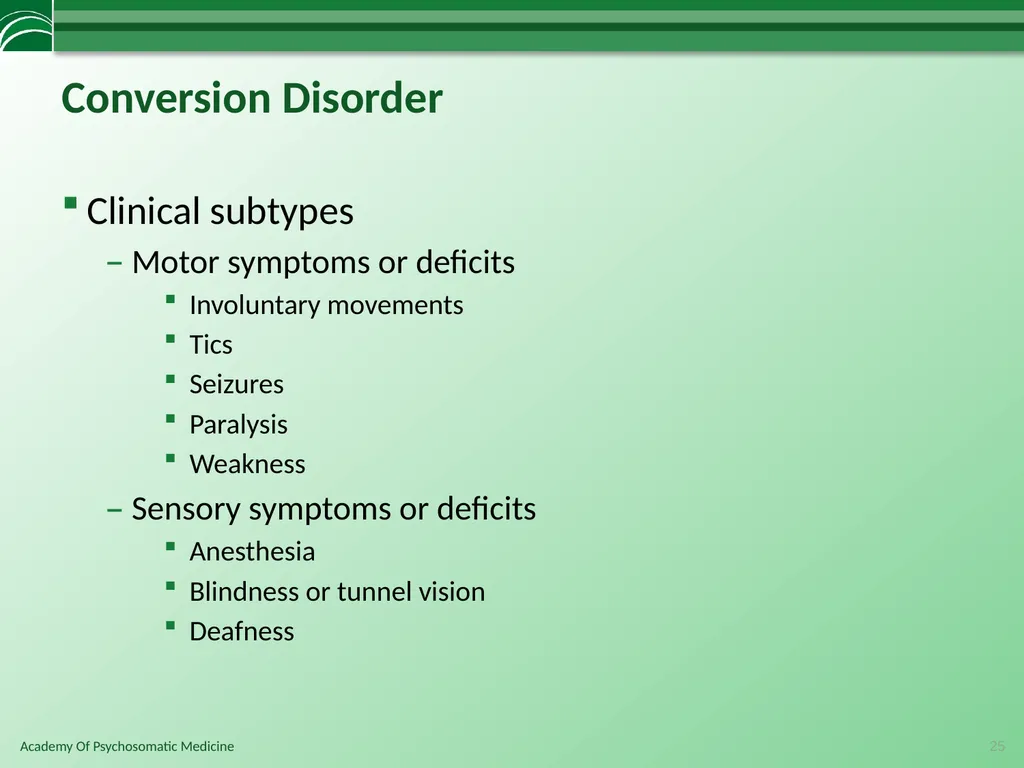
Conversion Disorder Clinical subtypes
Motor symptoms or deficits
Involuntary movements
Tics
Seizures
Paralysis
Weakness
Sensory symptoms or deficits
Anesthesia
Blindness or tunnel vision
Deafness 25<br>
Motor symptoms or deficits
Involuntary movements
Tics
Seizures
Paralysis
Weakness
Sensory symptoms or deficits
Anesthesia
Blindness or tunnel vision
Deafness 25<br>
26
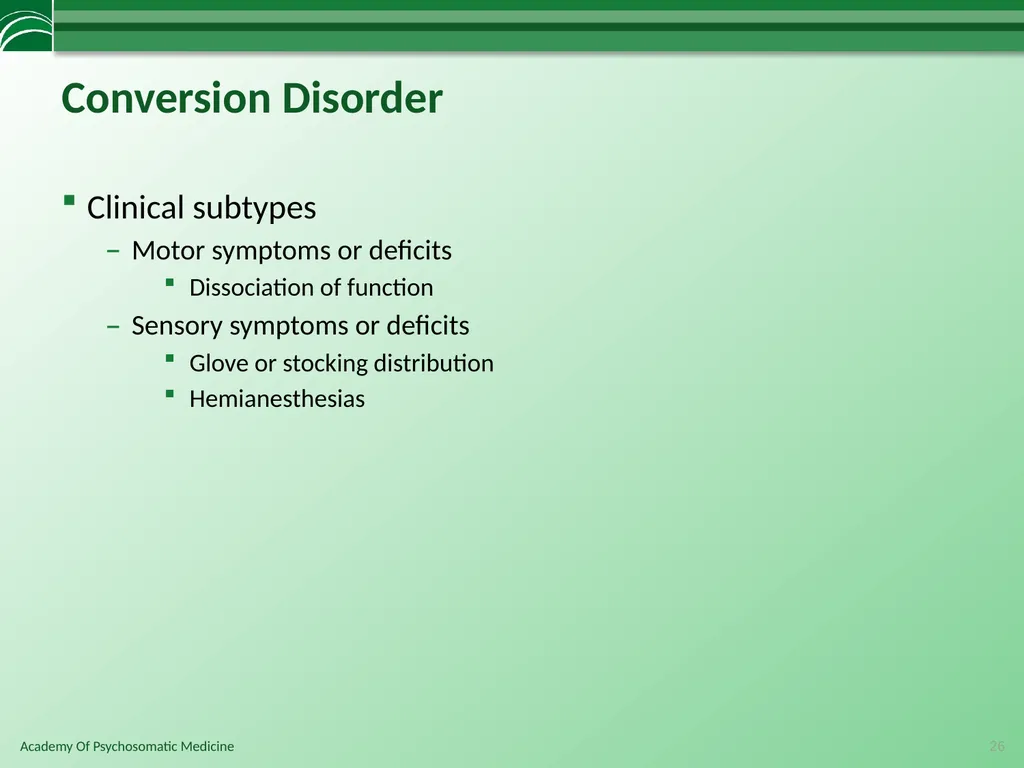
Conversion Disorder Clinical subtypes
Motor symptoms or deficits
Dissociation of function
Sensory symptoms or deficits
Glove or stocking distribution
Hemianesthesias 26<br>
Motor symptoms or deficits
Dissociation of function
Sensory symptoms or deficits
Glove or stocking distribution
Hemianesthesias 26<br>
27
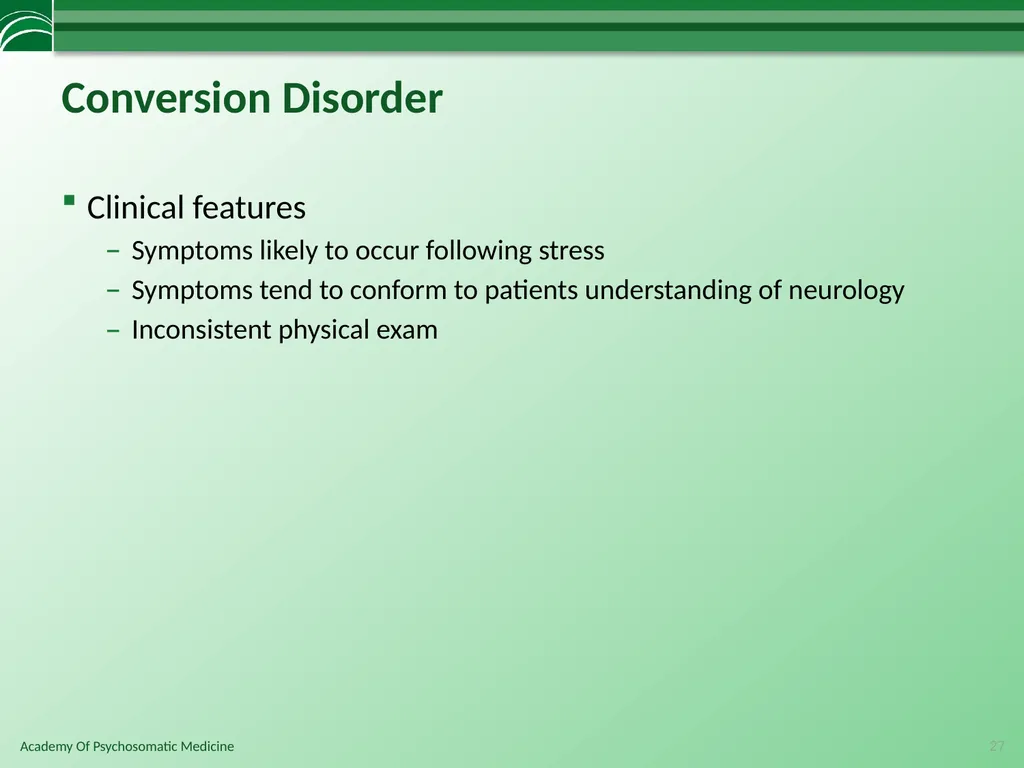
Conversion Disorder Clinical features
Symptoms likely to occur following stress
Symptoms tend to conform to patients understanding of neurology
Inconsistent physical exam 27<br>
Symptoms likely to occur following stress
Symptoms tend to conform to patients understanding of neurology
Inconsistent physical exam 27<br>
28
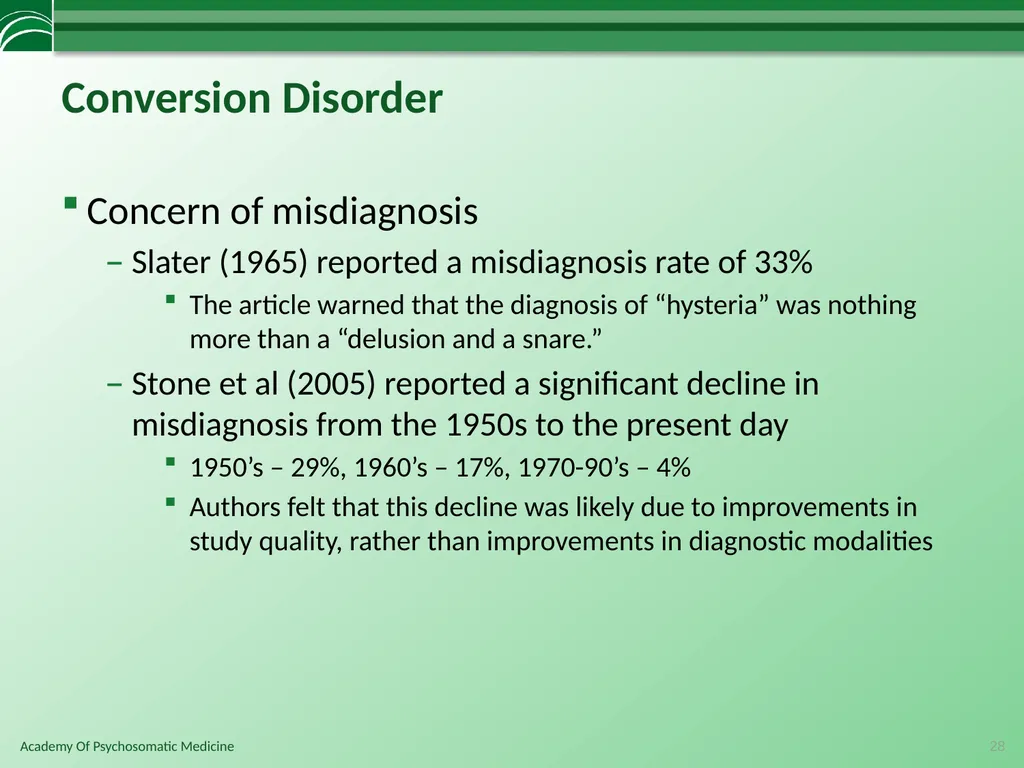
Conversion Disorder Concern of misdiagnosis
Slater (1965) reported a misdiagnosis rate of 33%
The article warned that the diagnosis of “hysteria” was nothing more than a “delusion and a snare.”
Stone et al (2005) reported a significant decline in misdiagnosis from the 1950s to the present day
1950’s – 29%, 1960’s – 17%, 1970-90’s – 4%
Authors felt that this decline was likely due to improvements in study quality, rather than improvements in diagnostic modalities 28<br>
Slater (1965) reported a misdiagnosis rate of 33%
The article warned that the diagnosis of “hysteria” was nothing more than a “delusion and a snare.”
Stone et al (2005) reported a significant decline in misdiagnosis from the 1950s to the present day
1950’s – 29%, 1960’s – 17%, 1970-90’s – 4%
Authors felt that this decline was likely due to improvements in study quality, rather than improvements in diagnostic modalities 28<br>
29
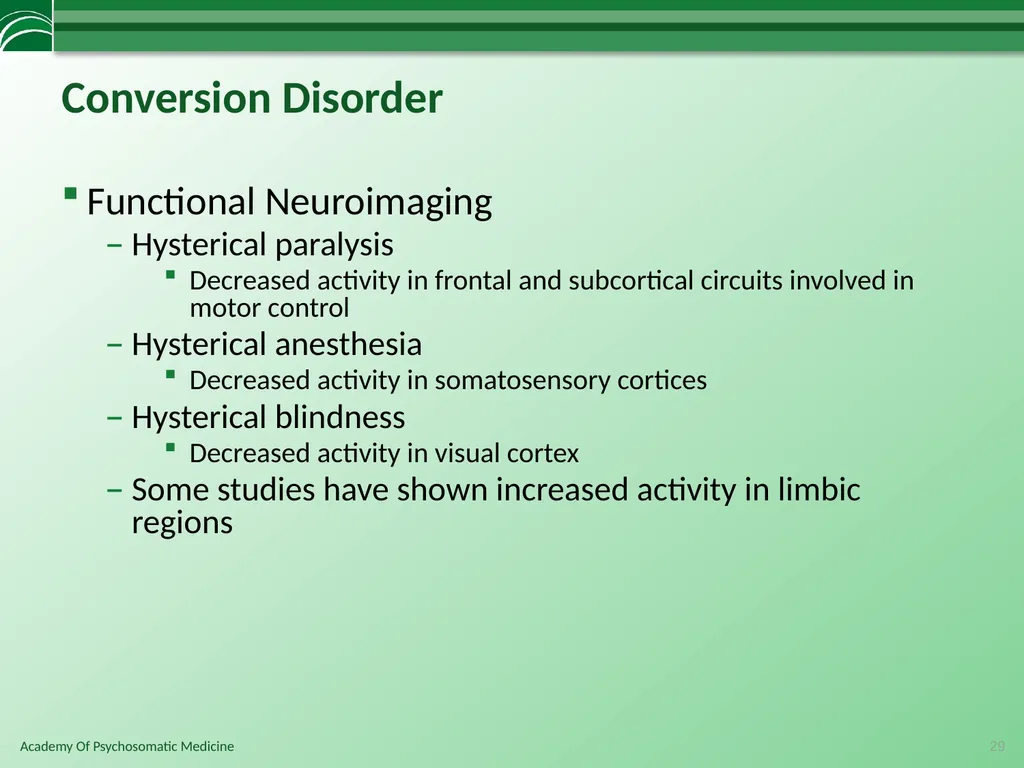
Conversion Disorder Functional Neuroimaging
Hysterical paralysis
Decreased activity in frontal and subcortical circuits involved in motor control
Hysterical anesthesia
Decreased activity in somatosensory cortices
Hysterical blindness
Decreased activity in visual cortex
Some studies have shown increased activity in limbic regions 29<br>
Hysterical paralysis
Decreased activity in frontal and subcortical circuits involved in motor control
Hysterical anesthesia
Decreased activity in somatosensory cortices
Hysterical blindness
Decreased activity in visual cortex
Some studies have shown increased activity in limbic regions 29<br>
30
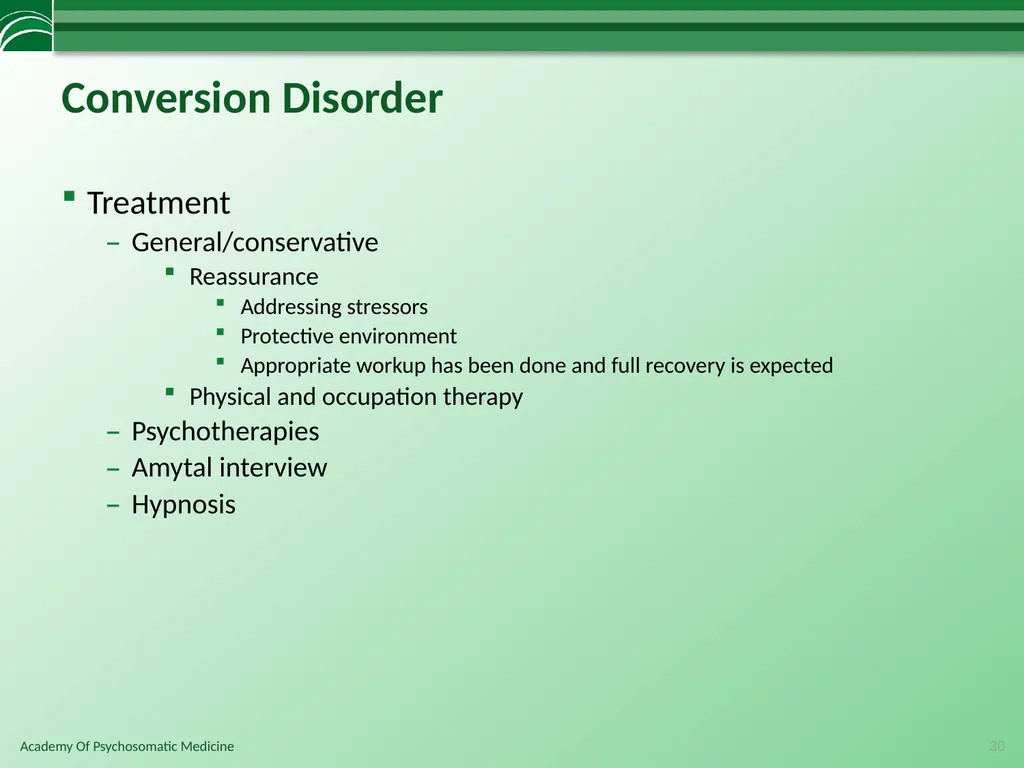
Conversion Disorder Treatment
General/conservative
Reassurance
Addressing stressors
Protective environment
Appropriate workup has been done and full recovery is expected
Physical and occupation therapy
Psychotherapies
Amytal interview
Hypnosis 30<br>
General/conservative
Reassurance
Addressing stressors
Protective environment
Appropriate workup has been done and full recovery is expected
Physical and occupation therapy
Psychotherapies
Amytal interview
Hypnosis 30<br>
31
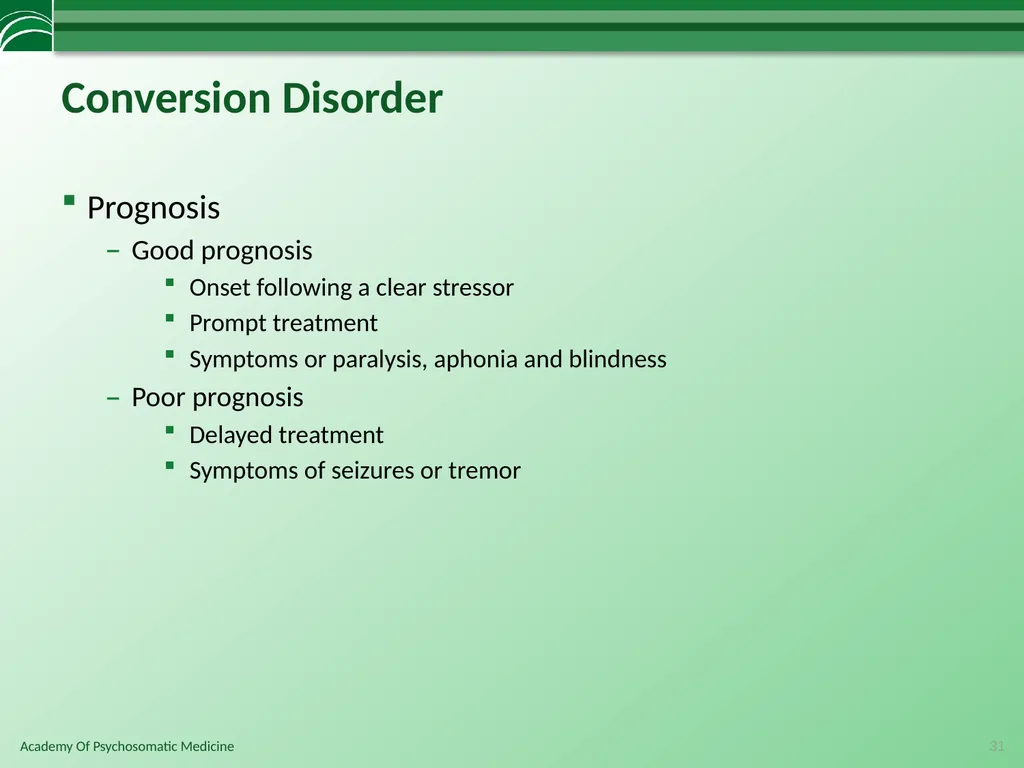
Conversion Disorder Prognosis
Good prognosis
Onset following a clear stressor
Prompt treatment
Symptoms or paralysis, aphonia and blindness
Poor prognosis
Delayed treatment
Symptoms of seizures or tremor 31<br>
Good prognosis
Onset following a clear stressor
Prompt treatment
Symptoms or paralysis, aphonia and blindness
Poor prognosis
Delayed treatment
Symptoms of seizures or tremor 31<br>
32
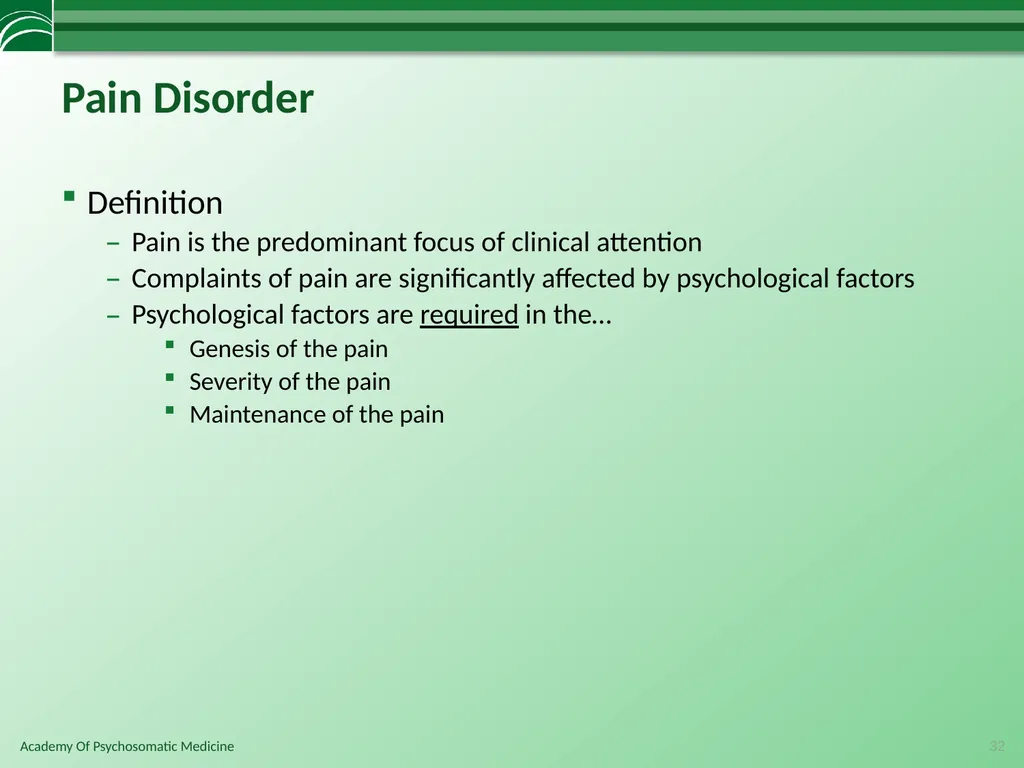
Pain Disorder Definition
Pain is the predominant focus of clinical attention
Complaints of pain are significantly affected by psychological factors
Psychological factors are required in the…
Genesis of the pain
Severity of the pain
Maintenance of the pain 32<br>
Pain is the predominant focus of clinical attention
Complaints of pain are significantly affected by psychological factors
Psychological factors are required in the…
Genesis of the pain
Severity of the pain
Maintenance of the pain 32<br>
33
Pain Disorder Clinical features
Pain may take various forms
Pain is severe and constant
Pain may be disproportionate to underlying condition
Psychological factors predominate
Pain is often the main focus of the patient’s life
There are concerns about the diagnostic validity of this somatoform disorder 33<br>
Pain may take various forms
Pain is severe and constant
Pain may be disproportionate to underlying condition
Psychological factors predominate
Pain is often the main focus of the patient’s life
There are concerns about the diagnostic validity of this somatoform disorder 33<br>
34
Pain Disorder Differential Diagnosis
Purely physical pain
Depression
Other somatoform disorders
Substance use disorders
Malingering
Factitious disorder 34<br>
Purely physical pain
Depression
Other somatoform disorders
Substance use disorders
Malingering
Factitious disorder 34<br>
35
Pain Disorder Treatment
General
Stress an understanding that the pain is real
Goal is likely an improvement in functioning rather than a complete relief of pain
Cognitive-behavioral therapy
Relaxation therapy
Biofeedback
Hypnosis
Pharmacotherapy 35<br>
General
Stress an understanding that the pain is real
Goal is likely an improvement in functioning rather than a complete relief of pain
Cognitive-behavioral therapy
Relaxation therapy
Biofeedback
Hypnosis
Pharmacotherapy 35<br>
36
Pain Disorder Prognosis
Poor prognosis
Pre-existing character pathology
Pending litigation
Use of addictive substances
Prolonged history of pain complaints
Good prognosis
Resolution of litigation
Prompt treatment 36<br>
Poor prognosis
Pre-existing character pathology
Pending litigation
Use of addictive substances
Prolonged history of pain complaints
Good prognosis
Resolution of litigation
Prompt treatment 36<br>
37
Hypochondriasis Definition
Preoccupation with fears of having a serious illness that does not respond to reassurance after appropriate medical work-up.
Epidemiology
General population: ??
Medical clinic population: 4-6%
Medical students: 3% 37<br>
Preoccupation with fears of having a serious illness that does not respond to reassurance after appropriate medical work-up.
Epidemiology
General population: ??
Medical clinic population: 4-6%
Medical students: 3% 37<br>
38
Hypochondriasis Clinical features
Bodily preoccupation
Disease phobia
Disease conviction
Onset in early adulthood
Chronic with waxing and waning of symptoms 38<br>
Bodily preoccupation
Disease phobia
Disease conviction
Onset in early adulthood
Chronic with waxing and waning of symptoms 38<br>
39
Hypochondriasis Etiologies
Psychodynamic model
Symptoms can be seen as a “defense against guilt”
Cognitive-behavioral model
Misinterpretation of harmless bodily symptoms
“Better safe than sorry”
Physiologic model
Low thresholds for, and low tolerance of, physical symptoms 39<br>
Psychodynamic model
Symptoms can be seen as a “defense against guilt”
Cognitive-behavioral model
Misinterpretation of harmless bodily symptoms
“Better safe than sorry”
Physiologic model
Low thresholds for, and low tolerance of, physical symptoms 39<br>
40
Hypochondriasis Treatment
General aspects
Establishment of trust
History taking
Identification of stressors
Education
Cognitive-behavioral therapy
Supportive therapy
Pharmacotherapy
Serotonergic meds appear to most beneficial 40<br>
General aspects
Establishment of trust
History taking
Identification of stressors
Education
Cognitive-behavioral therapy
Supportive therapy
Pharmacotherapy
Serotonergic meds appear to most beneficial 40<br>
41
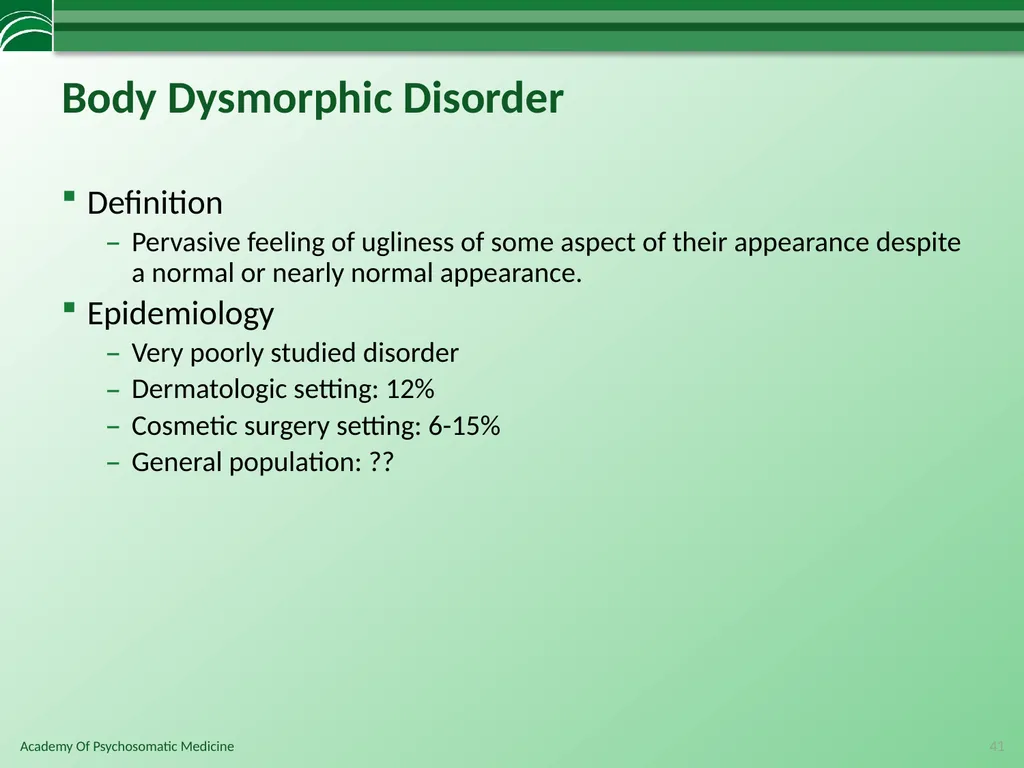
Body Dysmorphic Disorder Definition
Pervasive feeling of ugliness of some aspect of their appearance despite a normal or nearly normal appearance.
Epidemiology
Very poorly studied disorder
Dermatologic setting: 12%
Cosmetic surgery setting: 6-15%
General population: ?? 41<br>
Pervasive feeling of ugliness of some aspect of their appearance despite a normal or nearly normal appearance.
Epidemiology
Very poorly studied disorder
Dermatologic setting: 12%
Cosmetic surgery setting: 6-15%
General population: ?? 41<br>
42
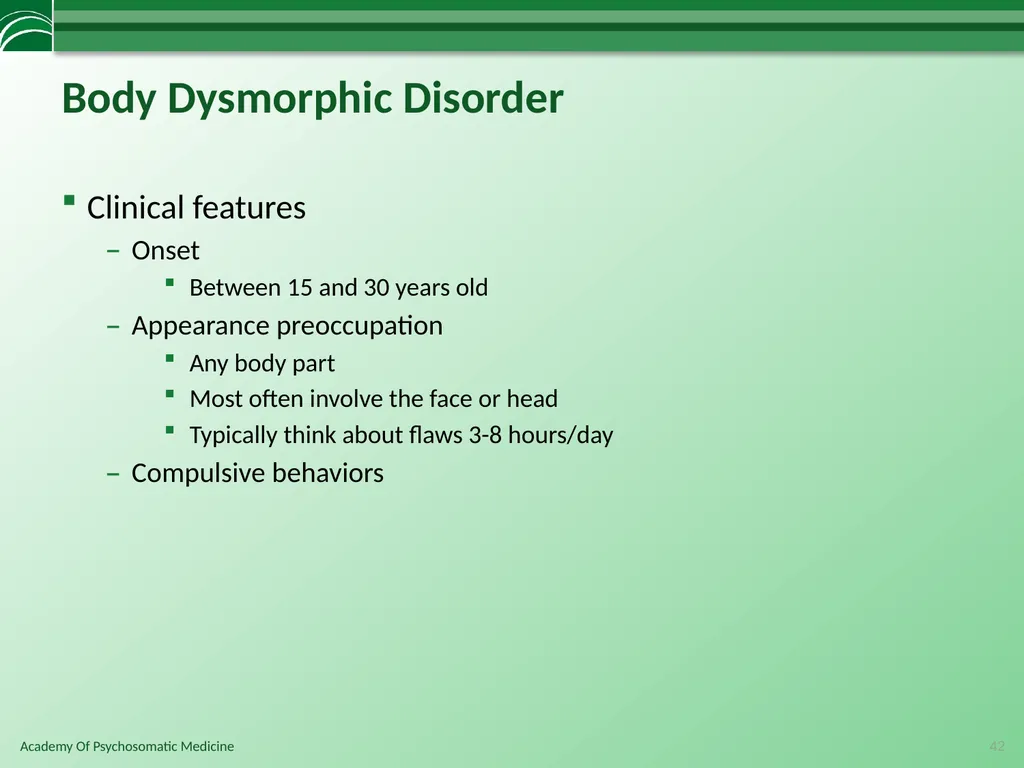
Body Dysmorphic Disorder Clinical features
Onset
Between 15 and 30 years old
Appearance preoccupation
Any body part
Most often involve the face or head
Typically think about flaws 3-8 hours/day
Compulsive behaviors 42<br>
Onset
Between 15 and 30 years old
Appearance preoccupation
Any body part
Most often involve the face or head
Typically think about flaws 3-8 hours/day
Compulsive behaviors 42<br>
43
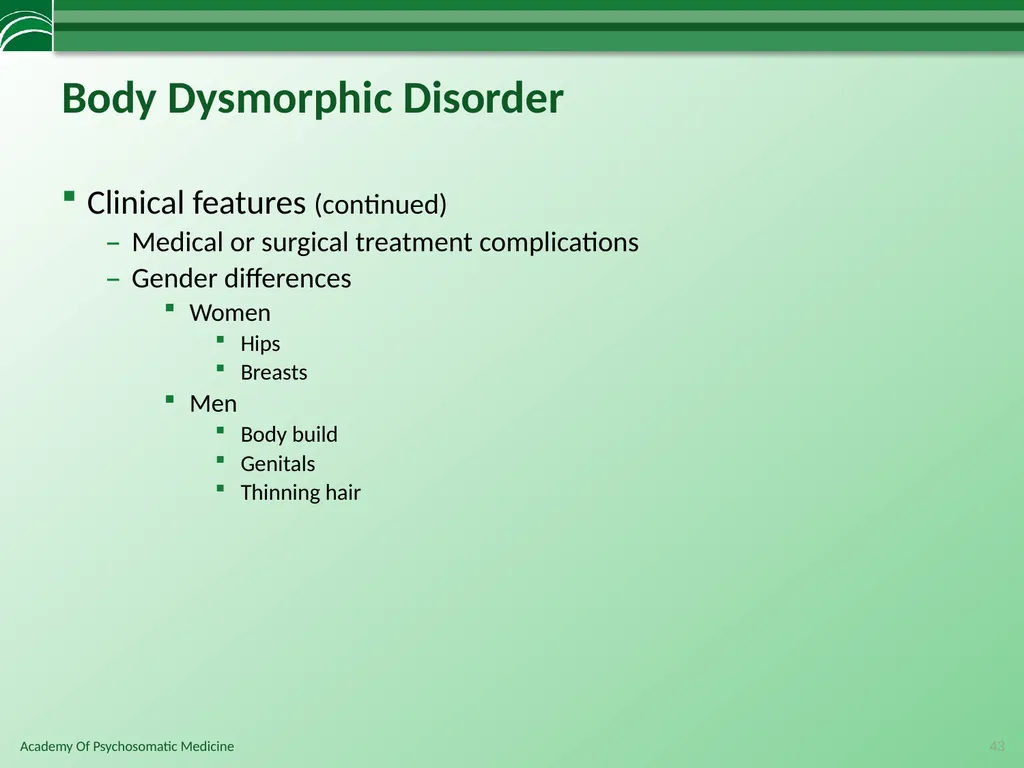
Body Dysmorphic Disorder Clinical features (continued)
Medical or surgical treatment complications
Gender differences
Women
Hips
Breasts
Men
Body build
Genitals
Thinning hair 43<br>
Medical or surgical treatment complications
Gender differences
Women
Hips
Breasts
Men
Body build
Genitals
Thinning hair 43<br>
44
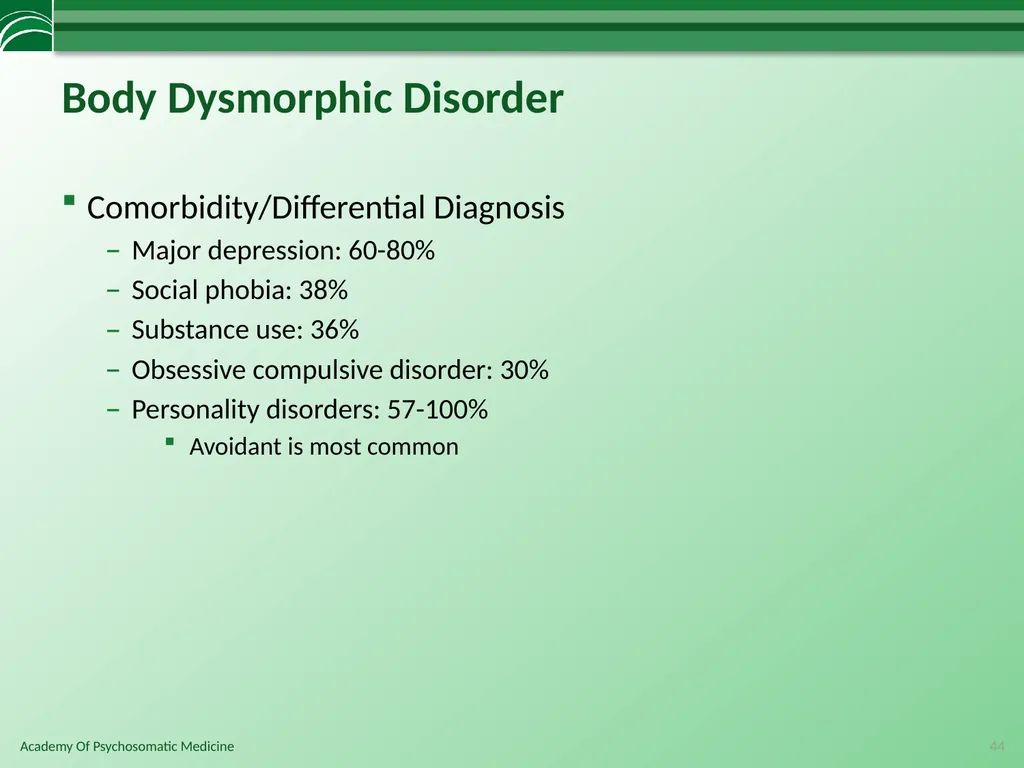
Body Dysmorphic Disorder Comorbidity/Differential Diagnosis
Major depression: 60-80%
Social phobia: 38%
Substance use: 36%
Obsessive compulsive disorder: 30%
Personality disorders: 57-100%
Avoidant is most common 44<br>
Major depression: 60-80%
Social phobia: 38%
Substance use: 36%
Obsessive compulsive disorder: 30%
Personality disorders: 57-100%
Avoidant is most common 44<br>
45
Body Dysmorphic Disorder Treatment
General
Avoid iatrogenic harm
Cognitive-behavioral therapy
Pharmacotherapy
Serotonin-specific medications
High-dose and delayed response
“Corrective” surgery does NOT work
Potential cause of litigation 45<br>
General
Avoid iatrogenic harm
Cognitive-behavioral therapy
Pharmacotherapy
Serotonin-specific medications
High-dose and delayed response
“Corrective” surgery does NOT work
Potential cause of litigation 45<br>
46
The Future… What will DSM-V hold in regards to the somatoform disorders?
Who knows…
But some items under consideration
Make somatization disorder more inclusive
Consideration has been given to renaming somatization disorder: complex symptom disorder, physical symptom disorder, or somatic symptom disorder
Remove undifferentiated somatoform disorder
Move pain disorder to axis III
Rename hypochondriasis “health anxiety disorder” 46 Kroenke K, et al., Psychosomatics 2007.<br>
Who knows…
But some items under consideration
Make somatization disorder more inclusive
Consideration has been given to renaming somatization disorder: complex symptom disorder, physical symptom disorder, or somatic symptom disorder
Remove undifferentiated somatoform disorder
Move pain disorder to axis III
Rename hypochondriasis “health anxiety disorder” 46 Kroenke K, et al., Psychosomatics 2007.<br>
47
Factitious Disorder Definition
Intentionally exaggerates or induces signs and symptoms of illness.
Motivation is to assume the sick role
Other incentives for the illness inducing behavior are absent 47<br>
Intentionally exaggerates or induces signs and symptoms of illness.
Motivation is to assume the sick role
Other incentives for the illness inducing behavior are absent 47<br>
48
Factitious Disorder Epidemiology
Prevalence in general population is unknown
Diagnosed in about 1% of patients seen in psychiatric consultation in general hospitals
Likely higher in referral centers 48<br>
Prevalence in general population is unknown
Diagnosed in about 1% of patients seen in psychiatric consultation in general hospitals
Likely higher in referral centers 48<br>
49
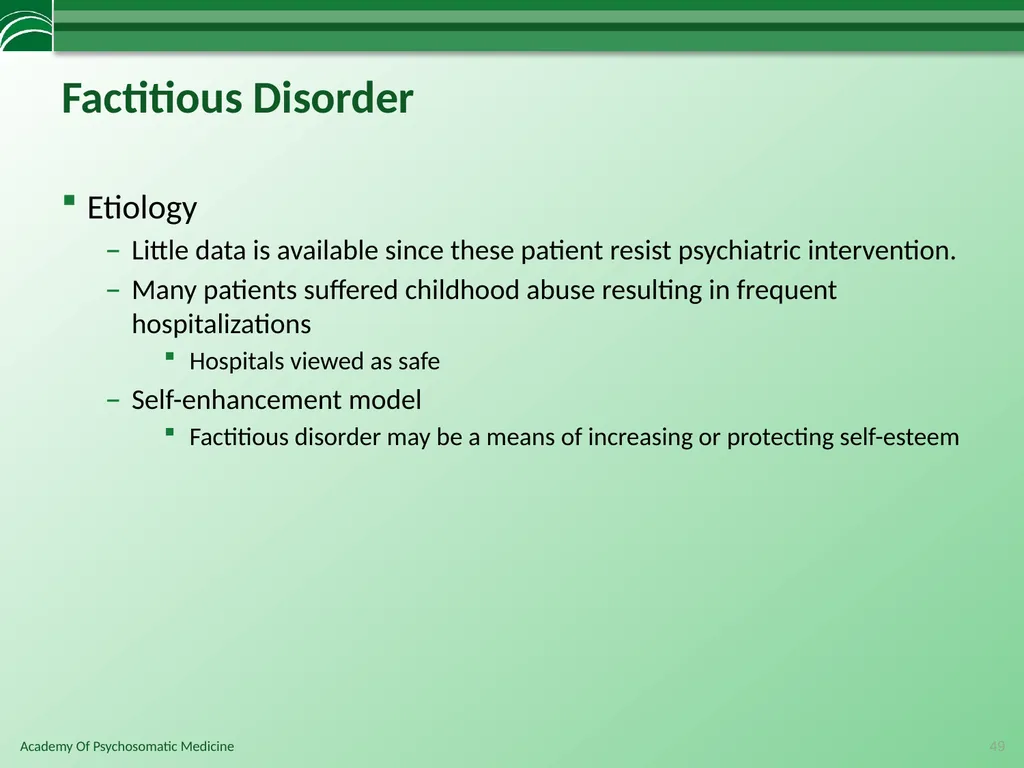
Factitious Disorder Etiology
Little data is available since these patient resist psychiatric intervention.
Many patients suffered childhood abuse resulting in frequent hospitalizations
Hospitals viewed as safe
Self-enhancement model
Factitious disorder may be a means of increasing or protecting self-esteem 49<br>
Little data is available since these patient resist psychiatric intervention.
Many patients suffered childhood abuse resulting in frequent hospitalizations
Hospitals viewed as safe
Self-enhancement model
Factitious disorder may be a means of increasing or protecting self-esteem 49<br>
50
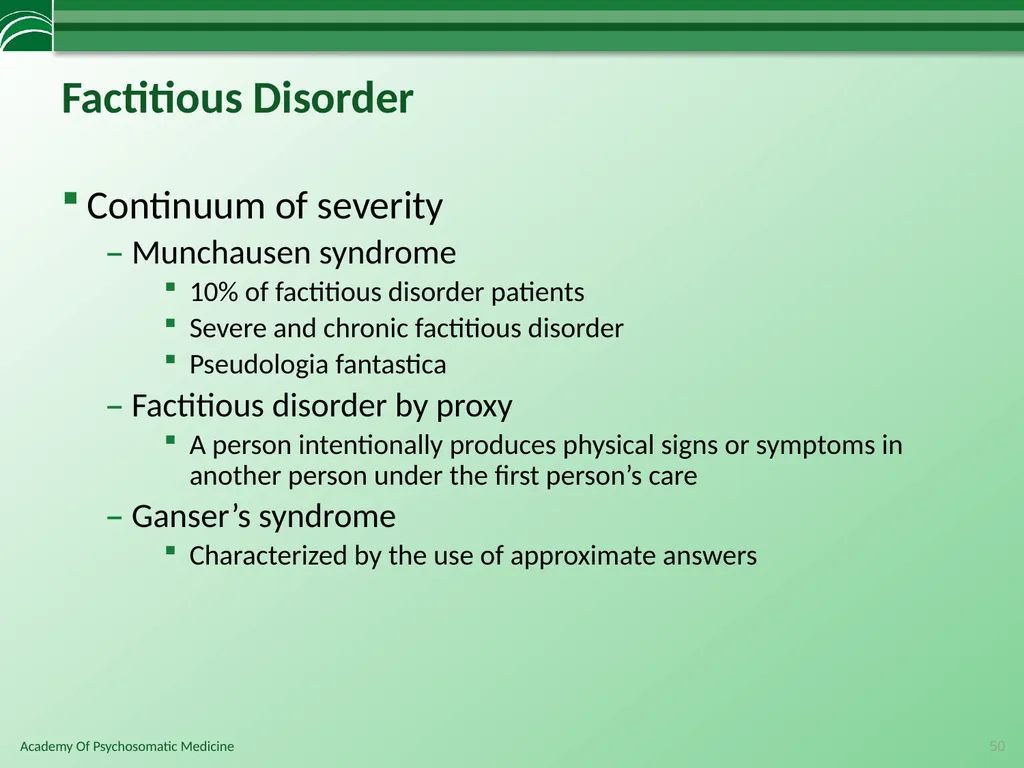
Factitious Disorder Continuum of severity
Munchausen syndrome
10% of factitious disorder patients
Severe and chronic factitious disorder
Pseudologia fantastica
Factitious disorder by proxy
A person intentionally produces physical signs or symptoms in another person under the first person’s care
Ganser’s syndrome
Characterized by the use of approximate answers 50<br>
Munchausen syndrome
10% of factitious disorder patients
Severe and chronic factitious disorder
Pseudologia fantastica
Factitious disorder by proxy
A person intentionally produces physical signs or symptoms in another person under the first person’s care
Ganser’s syndrome
Characterized by the use of approximate answers 50<br>
51
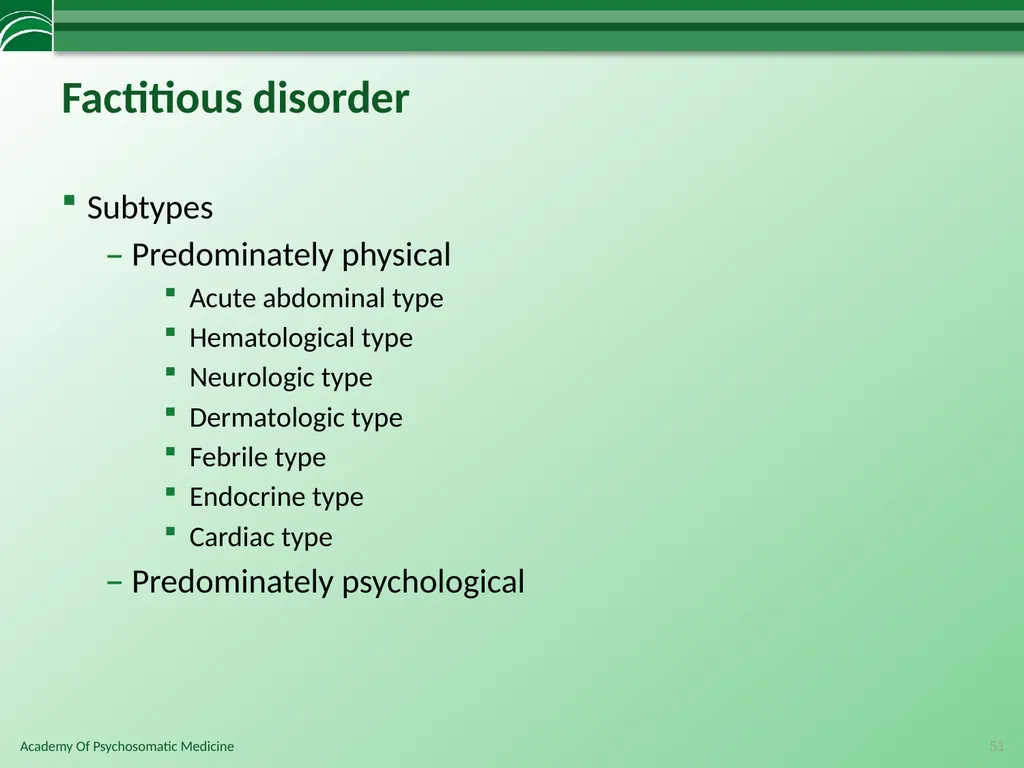
Factitious disorder Subtypes
Predominately physical
Acute abdominal type
Hematological type
Neurologic type
Dermatologic type
Febrile type
Endocrine type
Cardiac type
Predominately psychological 51<br>
Predominately physical
Acute abdominal type
Hematological type
Neurologic type
Dermatologic type
Febrile type
Endocrine type
Cardiac type
Predominately psychological 51<br>
52
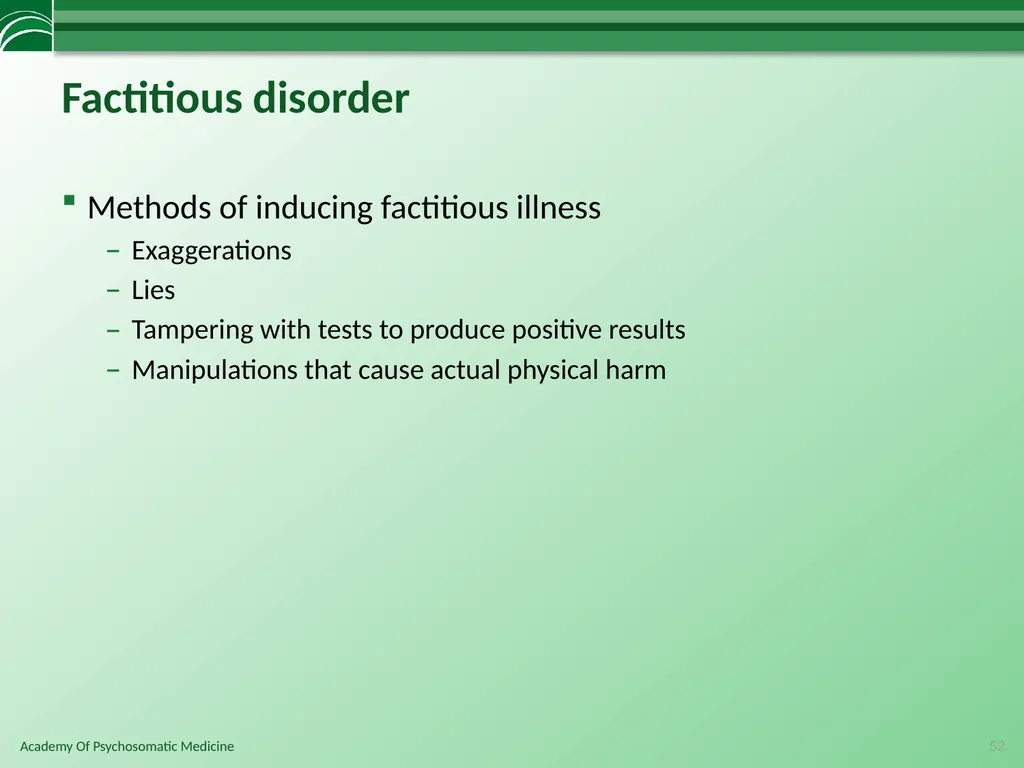
Factitious disorder Methods of inducing factitious illness
Exaggerations
Lies
Tampering with tests to produce positive results
Manipulations that cause actual physical harm 52<br>
Exaggerations
Lies
Tampering with tests to produce positive results
Manipulations that cause actual physical harm 52<br>
53
Factitious disorder Differential diagnosis
Must establish the intentional and conscious production of symptoms
Direct evidence
Excluding other causes
True physical illness
Other somatoform disorders
Malingering 53<br>
Must establish the intentional and conscious production of symptoms
Direct evidence
Excluding other causes
True physical illness
Other somatoform disorders
Malingering 53<br>
54
Factitious disorder Predisposing factors
True physical disorders in childhood leading to extensive medical treatment
Employment (present or past) as a medical paraprofessional
Severe personality disorder 54<br>
True physical disorders in childhood leading to extensive medical treatment
Employment (present or past) as a medical paraprofessional
Severe personality disorder 54<br>
55
Factitious disorder Comorbidity
Anxiety
Depression
Personality disorders
Borderline personality disorder is the most prevalent 55<br>
Anxiety
Depression
Personality disorders
Borderline personality disorder is the most prevalent 55<br>
56
Factitious disorder Typical hospital admission
Weekend or late night admission
Praise then punish and demand behavior while hospitalized
Anger from treatment team
Discharge
Readmission to another hospital 56<br>
Weekend or late night admission
Praise then punish and demand behavior while hospitalized
Anger from treatment team
Discharge
Readmission to another hospital 56<br>
57
Factitious disorder Management
No specific treatment shown effective
Early identification
Prevent iatrogenesis
Beware of negative countertransference
Be mindful of legal and ethical issues
Address any psychiatric diagnosis underlying the factitious disorder diagnosis
Rarely allowed by the patient 57<br>
No specific treatment shown effective
Early identification
Prevent iatrogenesis
Beware of negative countertransference
Be mindful of legal and ethical issues
Address any psychiatric diagnosis underlying the factitious disorder diagnosis
Rarely allowed by the patient 57<br>
58
Malingering Definition
The intentional production of feigning illness
Motivated by external incentives
Drugs
Litigation
Financial compensation
Avoid work/military service
Evade criminal prosecution 58<br>
The intentional production of feigning illness
Motivated by external incentives
Drugs
Litigation
Financial compensation
Avoid work/military service
Evade criminal prosecution 58<br>
59
Malingering Clinical features
Suspect malingering when:
Discrepancy between complaints and findings
Lack of cooperation with evaluation
Obvious gains
Concurrent antisocial personality 59<br>
Suspect malingering when:
Discrepancy between complaints and findings
Lack of cooperation with evaluation
Obvious gains
Concurrent antisocial personality 59<br>
60
Malingering Management
Identification without placation 60<br>
Identification without placation 60<br>
61
DSM-5
_________________________________________________________________
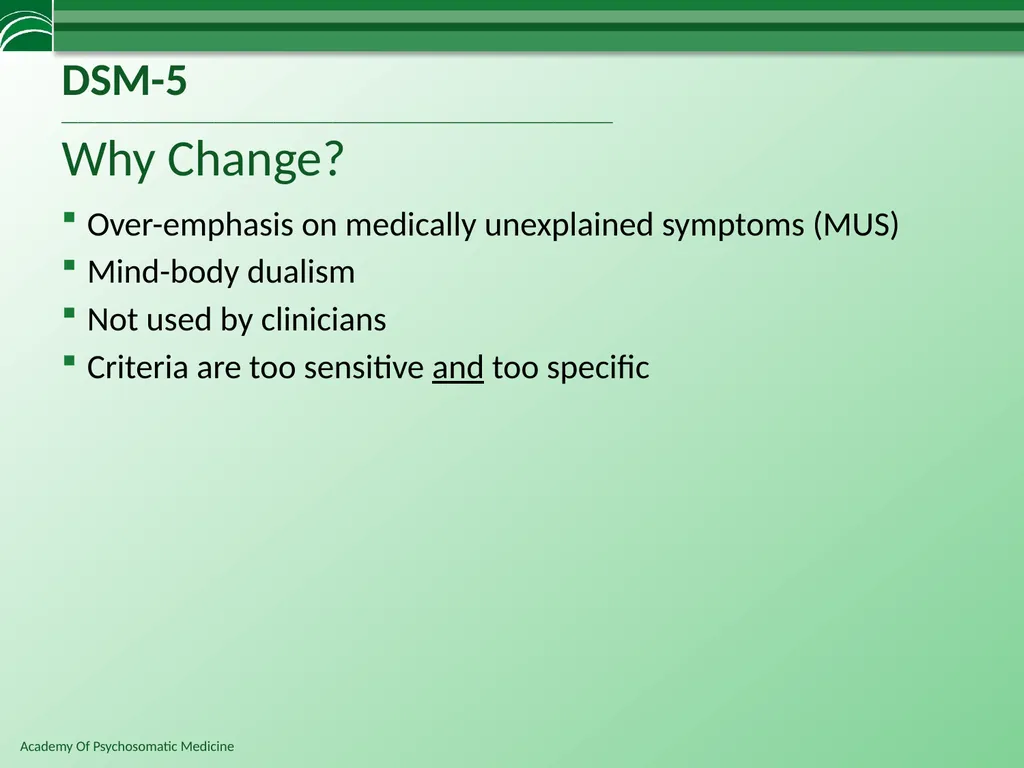
Why Change? Over-emphasis on medically unexplained symptoms (MUS)
Mind-body dualism
Not used by clinicians
Criteria are too sensitive and too specific<br>
Mind-body dualism
Not used by clinicians
Criteria are too sensitive and too specific<br>
62
Somatic Symptom Disorders Old
The central focus of medically unexplained symptoms has been de-emphasized
New
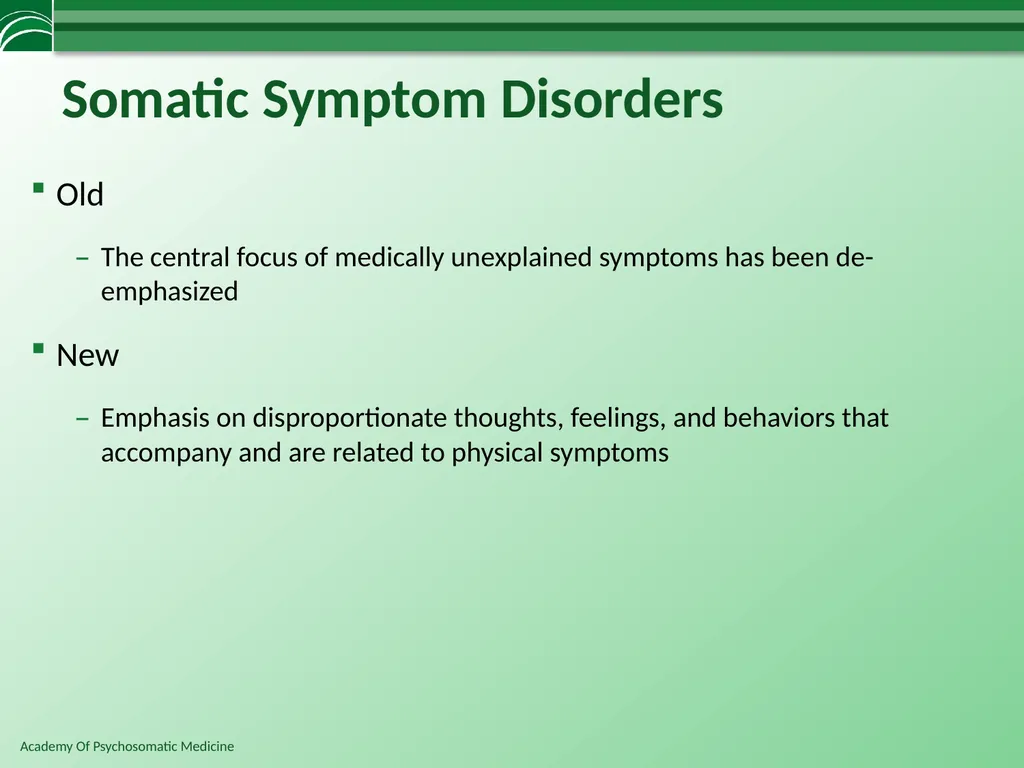
Emphasis on disproportionate thoughts, feelings, and behaviors that accompany and are related to physical symptoms<br>
The central focus of medically unexplained symptoms has been de-emphasized
New
Emphasis on disproportionate thoughts, feelings, and behaviors that accompany and are related to physical symptoms<br>
63
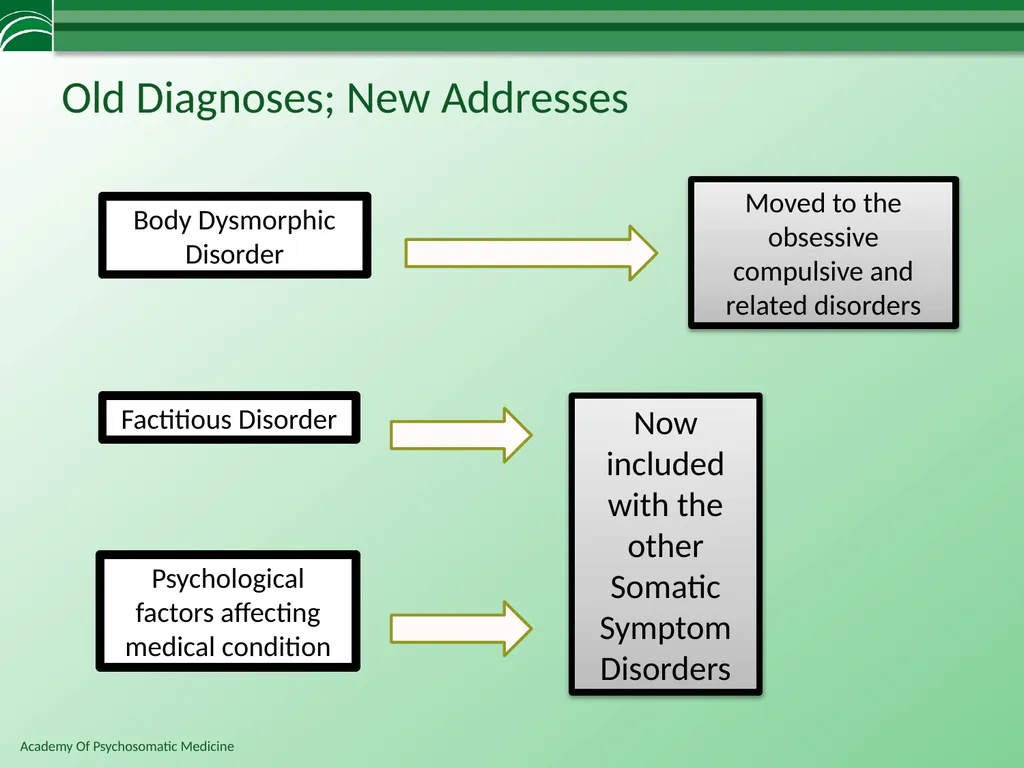
Old Diagnoses; New Addresses Body Dysmorphic Disorder Factitious Disorder Psychological factors affecting medical condition Now included with the other Somatic Symptom Disorders Moved to the obsessive compulsive and related disorders<br>
64
All That is Old is New Again
_______________________________________
The New Diagnoses Somatization Disorder
________________
Undifferentiated Somatoform Disorder
__________________
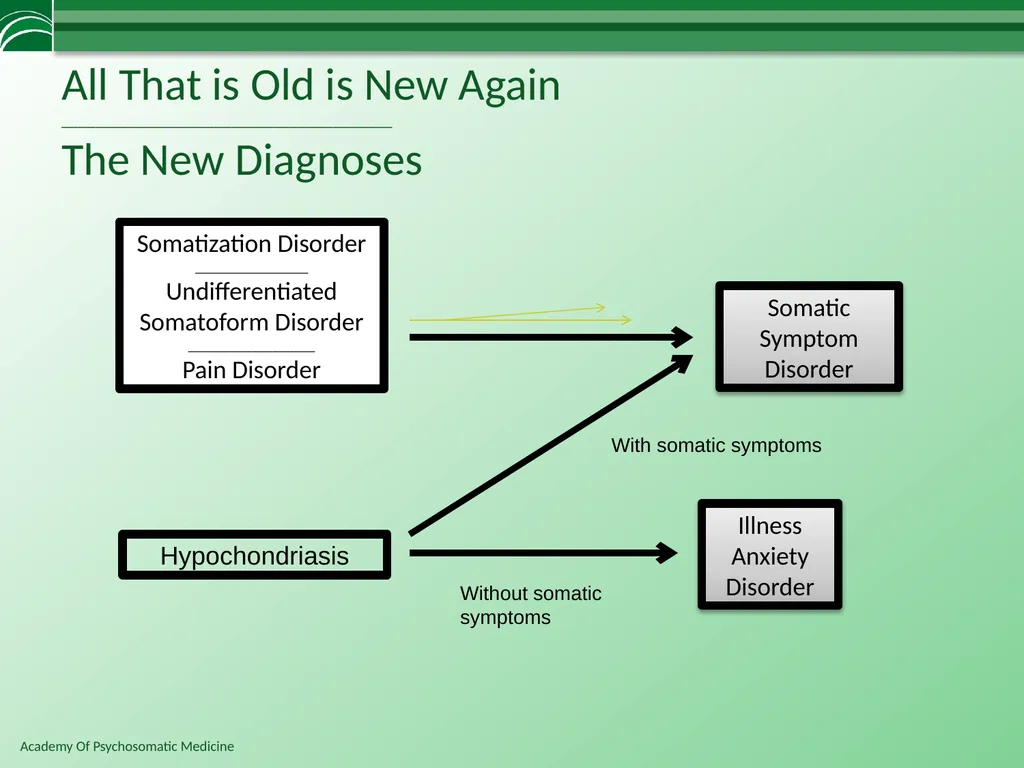
Pain Disorder Hypochondriasis Somatic Symptom Disorder Illness Anxiety Disorder With somatic symptoms Without somatic symptoms<br>
________________
Undifferentiated Somatoform Disorder
__________________
Pain Disorder Hypochondriasis Somatic Symptom Disorder Illness Anxiety Disorder With somatic symptoms Without somatic symptoms<br>
65
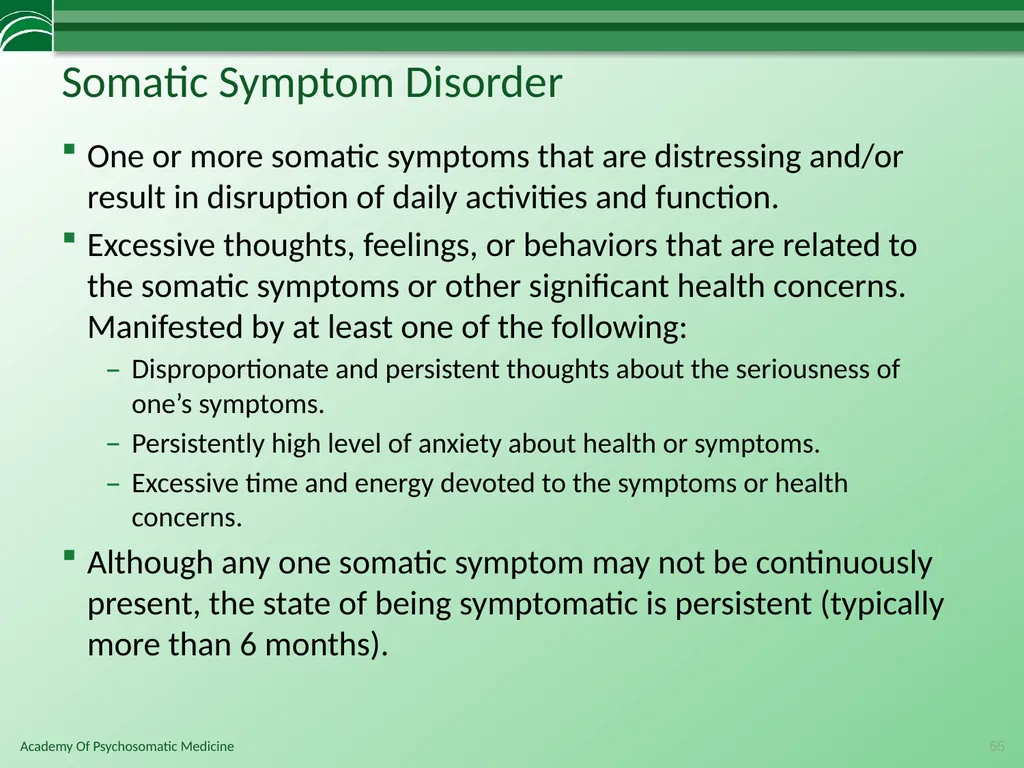
Somatic Symptom Disorder One or more somatic symptoms that are distressing and/or result in disruption of daily activities and function.
Excessive thoughts, feelings, or behaviors that are related to the somatic symptoms or other significant health concerns. Manifested by at least one of the following:
Disproportionate and persistent thoughts about the seriousness of one’s symptoms.
Persistently high level of anxiety about health or symptoms.
Excessive time and energy devoted to the symptoms or health concerns.
Although any one somatic symptom may not be continuously present, the state of being symptomatic is persistent (typically more than 6 months). 65<br>
Excessive thoughts, feelings, or behaviors that are related to the somatic symptoms or other significant health concerns. Manifested by at least one of the following:
Disproportionate and persistent thoughts about the seriousness of one’s symptoms.
Persistently high level of anxiety about health or symptoms.
Excessive time and energy devoted to the symptoms or health concerns.
Although any one somatic symptom may not be continuously present, the state of being symptomatic is persistent (typically more than 6 months). 65<br>
66
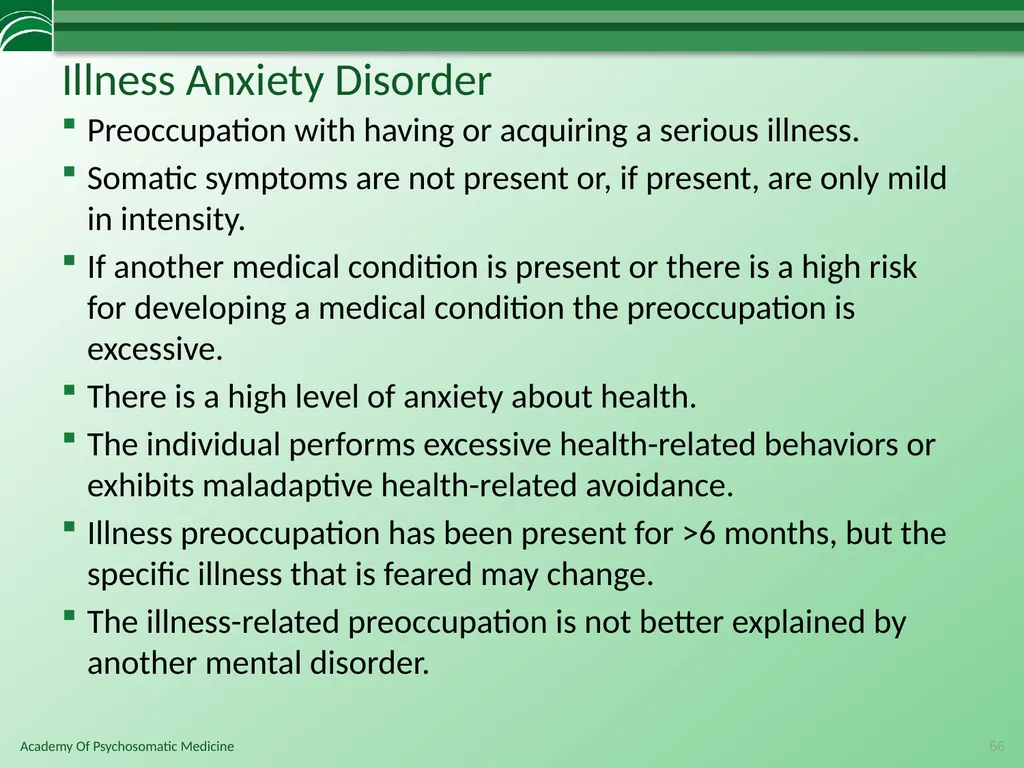
Illness Anxiety Disorder Preoccupation with having or acquiring a serious illness.
Somatic symptoms are not present or, if present, are only mild in intensity.
If another medical condition is present or there is a high risk for developing a medical condition the preoccupation is excessive.
There is a high level of anxiety about health.
The individual performs excessive health-related behaviors or exhibits maladaptive health-related avoidance.
Illness preoccupation has been present for >6 months, but the specific illness that is feared may change.
The illness-related preoccupation is not better explained by another mental disorder. 66<br>
Somatic symptoms are not present or, if present, are only mild in intensity.
If another medical condition is present or there is a high risk for developing a medical condition the preoccupation is excessive.
There is a high level of anxiety about health.
The individual performs excessive health-related behaviors or exhibits maladaptive health-related avoidance.
Illness preoccupation has been present for >6 months, but the specific illness that is feared may change.
The illness-related preoccupation is not better explained by another mental disorder. 66<br>
67
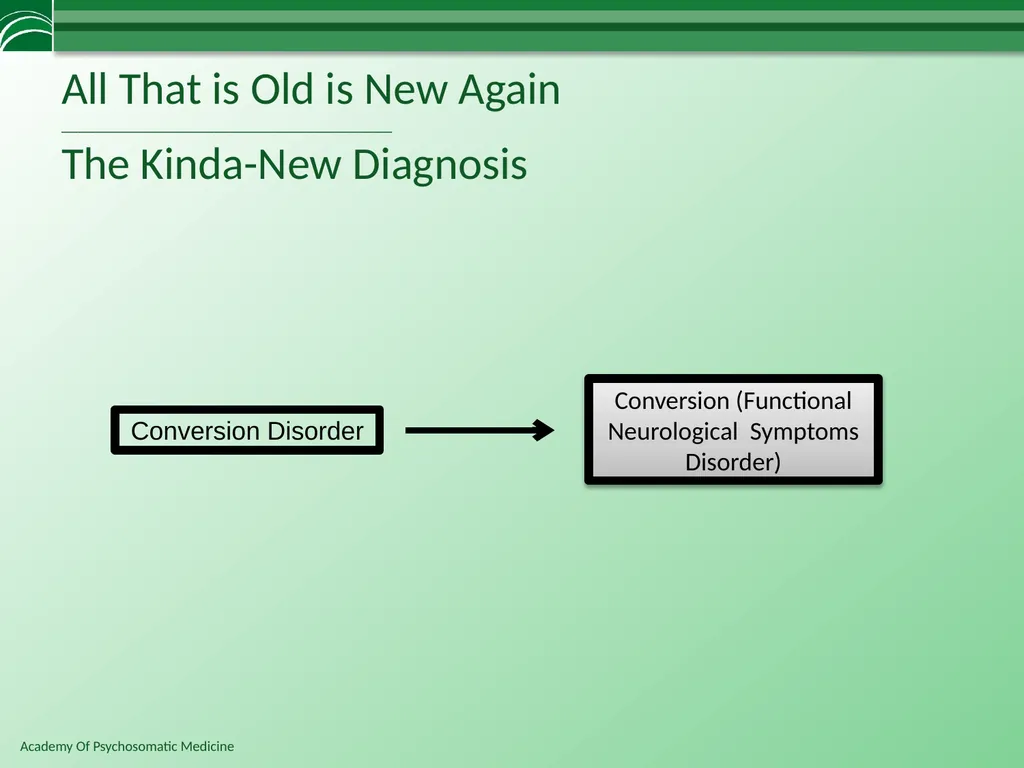
Conversion Disorder Conversion (Functional Neurological Symptoms Disorder) All That is Old is New Again
_______________________________________
The Kinda-New Diagnosis<br>
68
Conversion
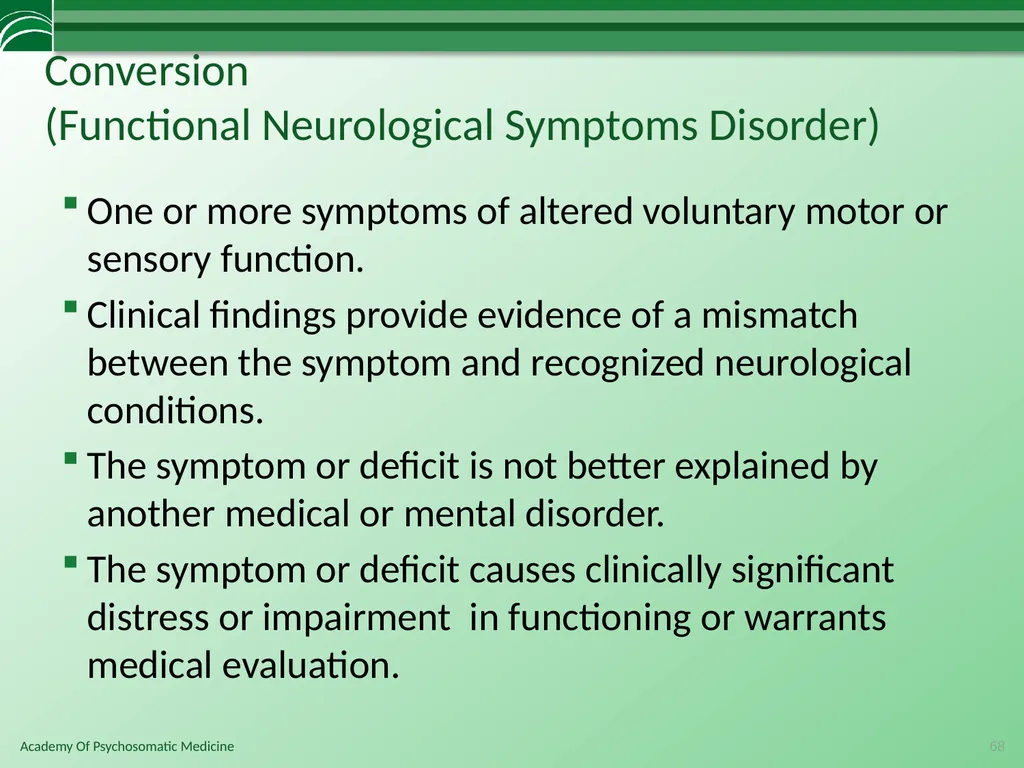
(Functional Neurological Symptoms Disorder) One or more symptoms of altered voluntary motor or sensory function.
Clinical findings provide evidence of a mismatch between the symptom and recognized neurological conditions.
The symptom or deficit is not better explained by another medical or mental disorder.
The symptom or deficit causes clinically significant distress or impairment in functioning or warrants medical evaluation. 68<br>
Clinical findings provide evidence of a mismatch between the symptom and recognized neurological conditions.
The symptom or deficit is not better explained by another medical or mental disorder.
The symptom or deficit causes clinically significant distress or impairment in functioning or warrants medical evaluation. 68<br>
69
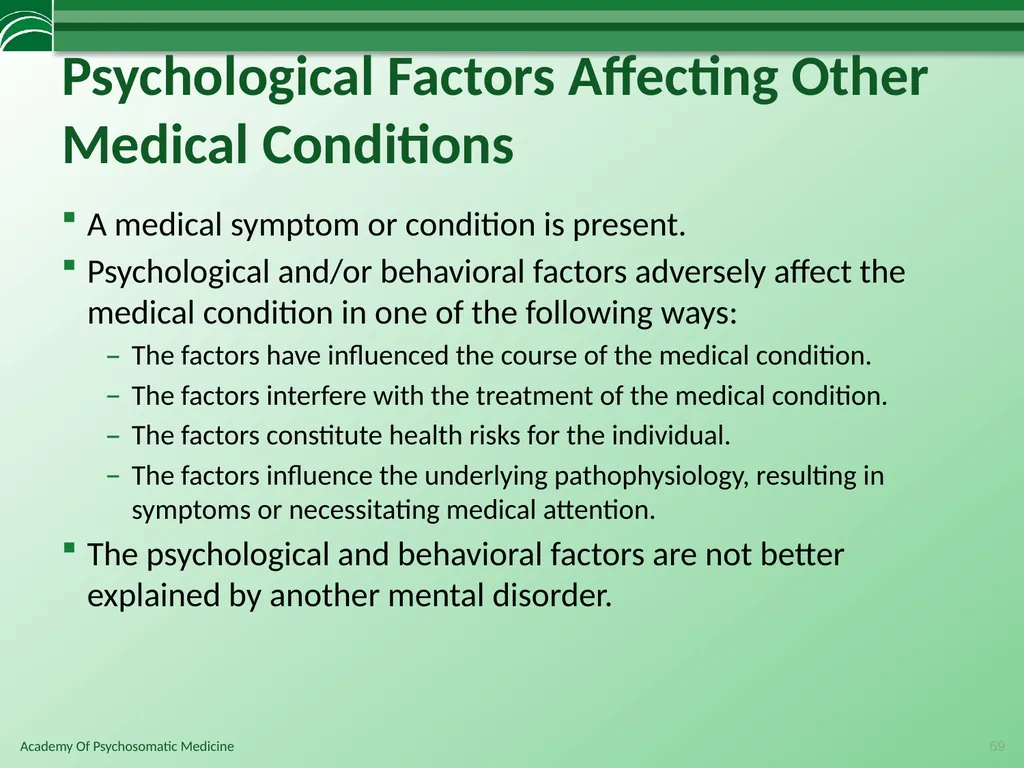
Psychological Factors Affecting Other Medical Conditions A medical symptom or condition is present.
Psychological and/or behavioral factors adversely affect the medical condition in one of the following ways:
The factors have influenced the course of the medical condition.
The factors interfere with the treatment of the medical condition.
The factors constitute health risks for the individual.
The factors influence the underlying pathophysiology, resulting in symptoms or necessitating medical attention.
The psychological and behavioral factors are not better explained by another mental disorder. 69<br>
Psychological and/or behavioral factors adversely affect the medical condition in one of the following ways:
The factors have influenced the course of the medical condition.
The factors interfere with the treatment of the medical condition.
The factors constitute health risks for the individual.
The factors influence the underlying pathophysiology, resulting in symptoms or necessitating medical attention.
The psychological and behavioral factors are not better explained by another mental disorder. 69<br>
70
Somatic Symptom Disorders
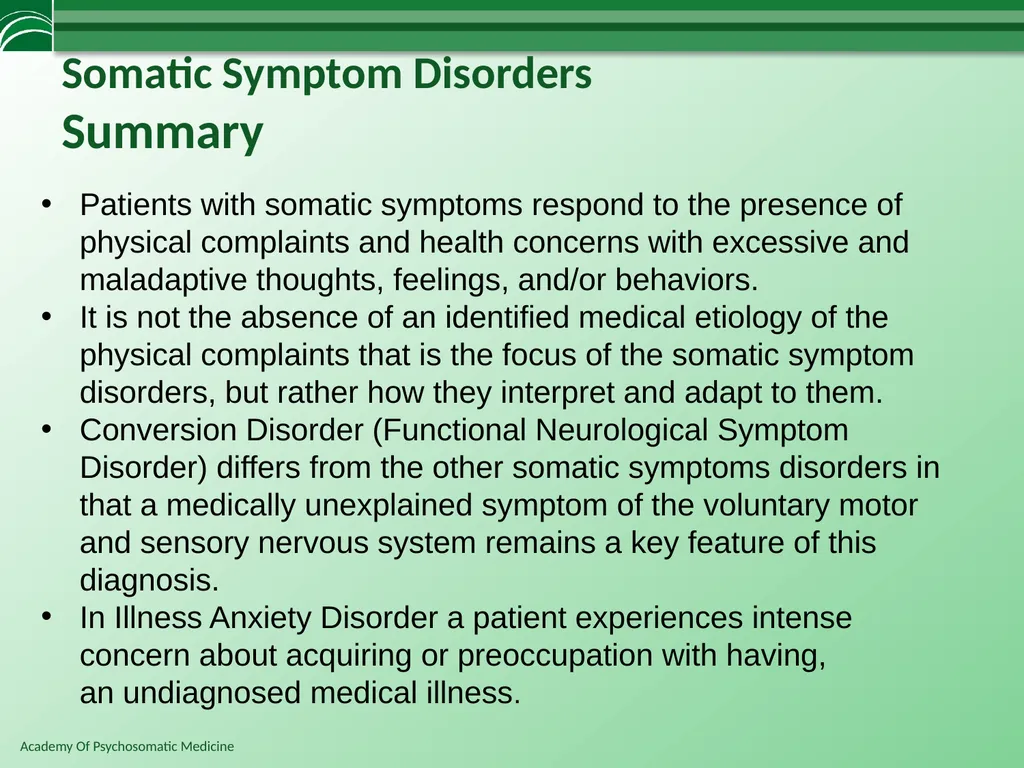
Summary Patients with somatic symptoms respond to the presence of physical complaints and health concerns with excessive and maladaptive thoughts, feelings, and/or behaviors.
It is not the absence of an identified medical etiology of the physical complaints that is the focus of the somatic symptom disorders, but rather how they interpret and adapt to them.
Conversion Disorder (Functional Neurological Symptom Disorder) differs from the other somatic symptoms disorders in that a medically unexplained symptom of the voluntary motor and sensory nervous system remains a key feature of this diagnosis.
In Illness Anxiety Disorder a patient experiences intense concern about acquiring or preoccupation with having, an undiagnosed medical illness.<br>
It is not the absence of an identified medical etiology of the physical complaints that is the focus of the somatic symptom disorders, but rather how they interpret and adapt to them.
Conversion Disorder (Functional Neurological Symptom Disorder) differs from the other somatic symptoms disorders in that a medically unexplained symptom of the voluntary motor and sensory nervous system remains a key feature of this diagnosis.
In Illness Anxiety Disorder a patient experiences intense concern about acquiring or preoccupation with having, an undiagnosed medical illness.<br>
71
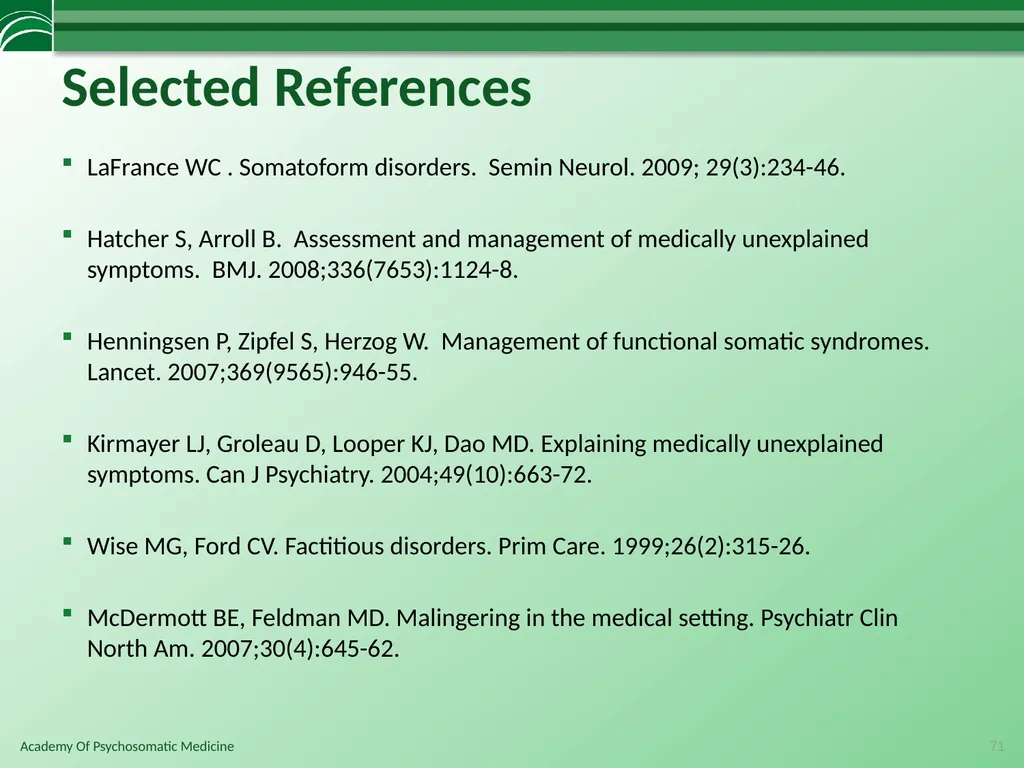
Selected References LaFrance WC . Somatoform disorders. Semin Neurol. 2009; 29(3):234-46.
Hatcher S, Arroll B. Assessment and management of medically unexplained symptoms. BMJ. 2008;336(7653):1124-8.
Henningsen P, Zipfel S, Herzog W. Management of functional somatic syndromes. Lancet. 2007;369(9565):946-55.
Kirmayer LJ, Groleau D, Looper KJ, Dao MD. Explaining medically unexplained symptoms. Can J Psychiatry. 2004;49(10):663-72.
Wise MG, Ford CV. Factitious disorders. Prim Care. 1999;26(2):315-26.
McDermott BE, Feldman MD. Malingering in the medical setting. Psychiatr Clin North Am. 2007;30(4):645-62. 71<br>
Hatcher S, Arroll B. Assessment and management of medically unexplained symptoms. BMJ. 2008;336(7653):1124-8.
Henningsen P, Zipfel S, Herzog W. Management of functional somatic syndromes. Lancet. 2007;369(9565):946-55.
Kirmayer LJ, Groleau D, Looper KJ, Dao MD. Explaining medically unexplained symptoms. Can J Psychiatry. 2004;49(10):663-72.
Wise MG, Ford CV. Factitious disorders. Prim Care. 1999;26(2):315-26.
McDermott BE, Feldman MD. Malingering in the medical setting. Psychiatr Clin North Am. 2007;30(4):645-62. 71<br>
72
Part II Case Presentations<br>
73
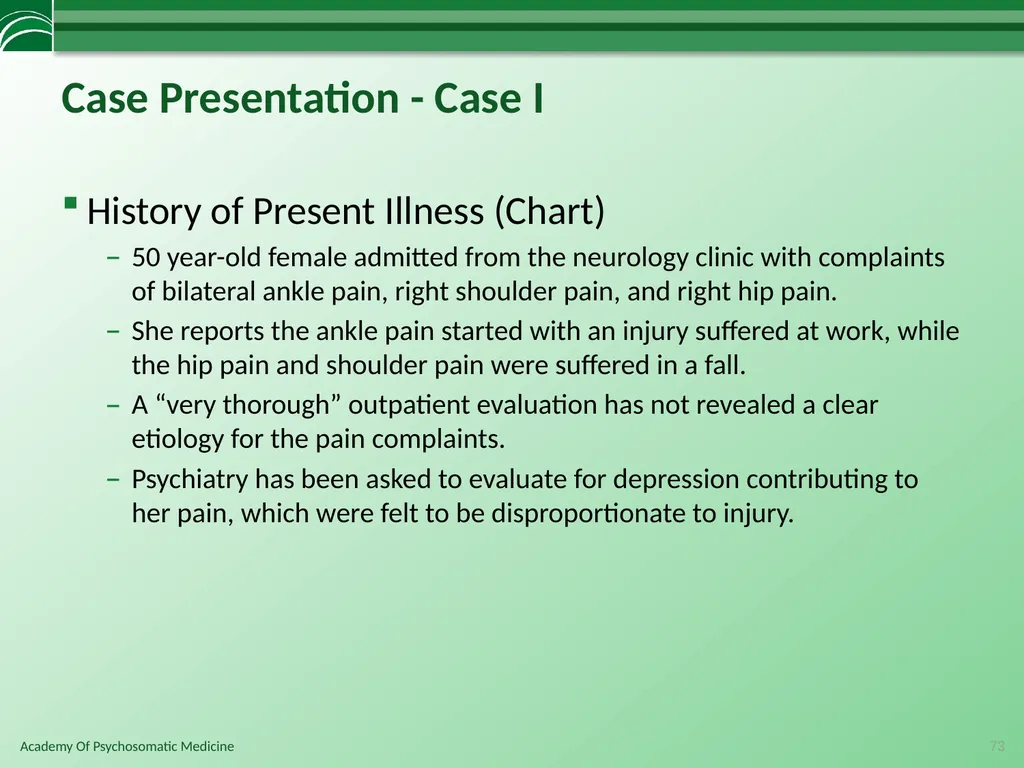
Case Presentation - Case I History of Present Illness (Chart)
50 year-old female admitted from the neurology clinic with complaints of bilateral ankle pain, right shoulder pain, and right hip pain.
She reports the ankle pain started with an injury suffered at work, while the hip pain and shoulder pain were suffered in a fall.
A “very thorough” outpatient evaluation has not revealed a clear etiology for the pain complaints.
Psychiatry has been asked to evaluate for depression contributing to her pain, which were felt to be disproportionate to injury. 73<br>
50 year-old female admitted from the neurology clinic with complaints of bilateral ankle pain, right shoulder pain, and right hip pain.
She reports the ankle pain started with an injury suffered at work, while the hip pain and shoulder pain were suffered in a fall.
A “very thorough” outpatient evaluation has not revealed a clear etiology for the pain complaints.
Psychiatry has been asked to evaluate for depression contributing to her pain, which were felt to be disproportionate to injury. 73<br>
74
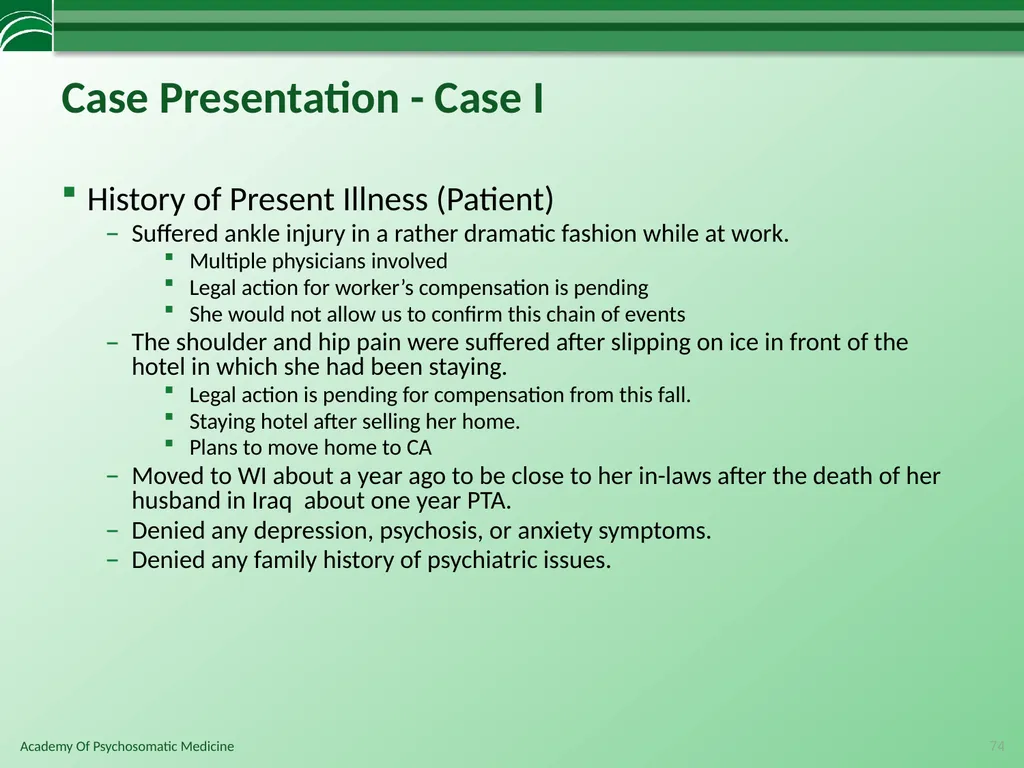
Case Presentation - Case I History of Present Illness (Patient)
Suffered ankle injury in a rather dramatic fashion while at work.
Multiple physicians involved
Legal action for worker’s compensation is pending
She would not allow us to confirm this chain of events
The shoulder and hip pain were suffered after slipping on ice in front of the hotel in which she had been staying.
Legal action is pending for compensation from this fall.
Staying hotel after selling her home.
Plans to move home to CA
Moved to WI about a year ago to be close to her in-laws after the death of her husband in Iraq about one year PTA.
Denied any depression, psychosis, or anxiety symptoms.
Denied any family history of psychiatric issues. 74<br>
Suffered ankle injury in a rather dramatic fashion while at work.
Multiple physicians involved
Legal action for worker’s compensation is pending
She would not allow us to confirm this chain of events
The shoulder and hip pain were suffered after slipping on ice in front of the hotel in which she had been staying.
Legal action is pending for compensation from this fall.
Staying hotel after selling her home.
Plans to move home to CA
Moved to WI about a year ago to be close to her in-laws after the death of her husband in Iraq about one year PTA.
Denied any depression, psychosis, or anxiety symptoms.
Denied any family history of psychiatric issues. 74<br>
75
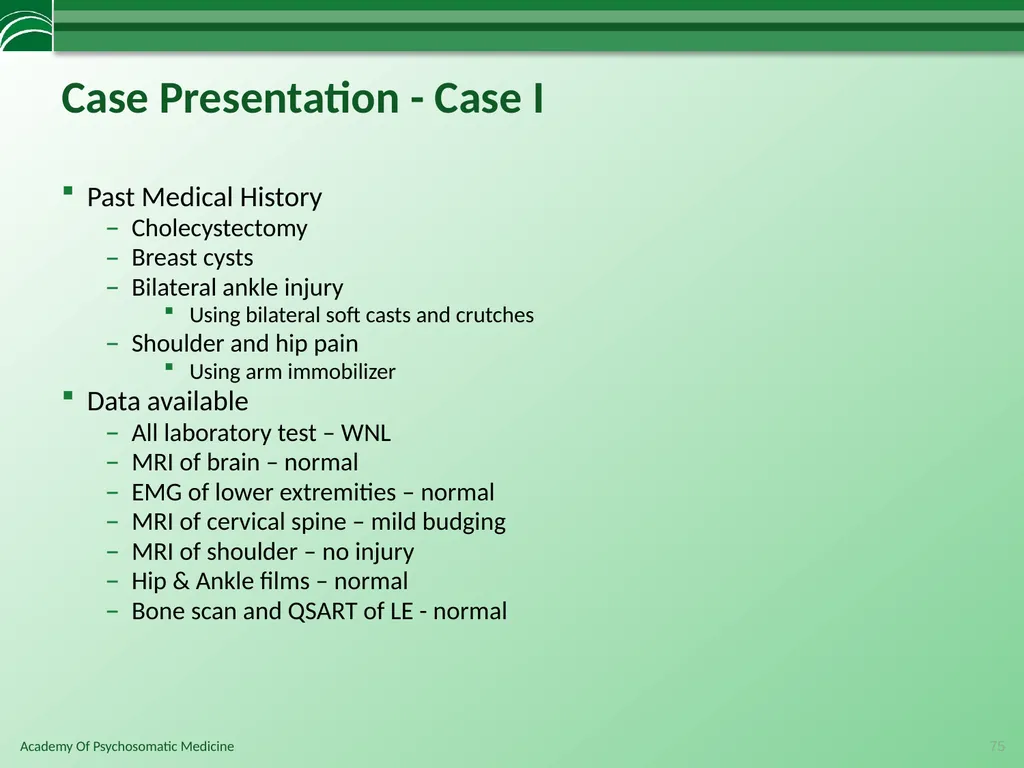
Case Presentation - Case I Past Medical History
Cholecystectomy
Breast cysts
Bilateral ankle injury
Using bilateral soft casts and crutches
Shoulder and hip pain
Using arm immobilizer
Data available
All laboratory test – WNL
MRI of brain – normal
EMG of lower extremities – normal
MRI of cervical spine – mild budging
MRI of shoulder – no injury
Hip & Ankle films – normal
Bone scan and QSART of LE - normal 75<br>
Cholecystectomy
Breast cysts
Bilateral ankle injury
Using bilateral soft casts and crutches
Shoulder and hip pain
Using arm immobilizer
Data available
All laboratory test – WNL
MRI of brain – normal
EMG of lower extremities – normal
MRI of cervical spine – mild budging
MRI of shoulder – no injury
Hip & Ankle films – normal
Bone scan and QSART of LE - normal 75<br>
76
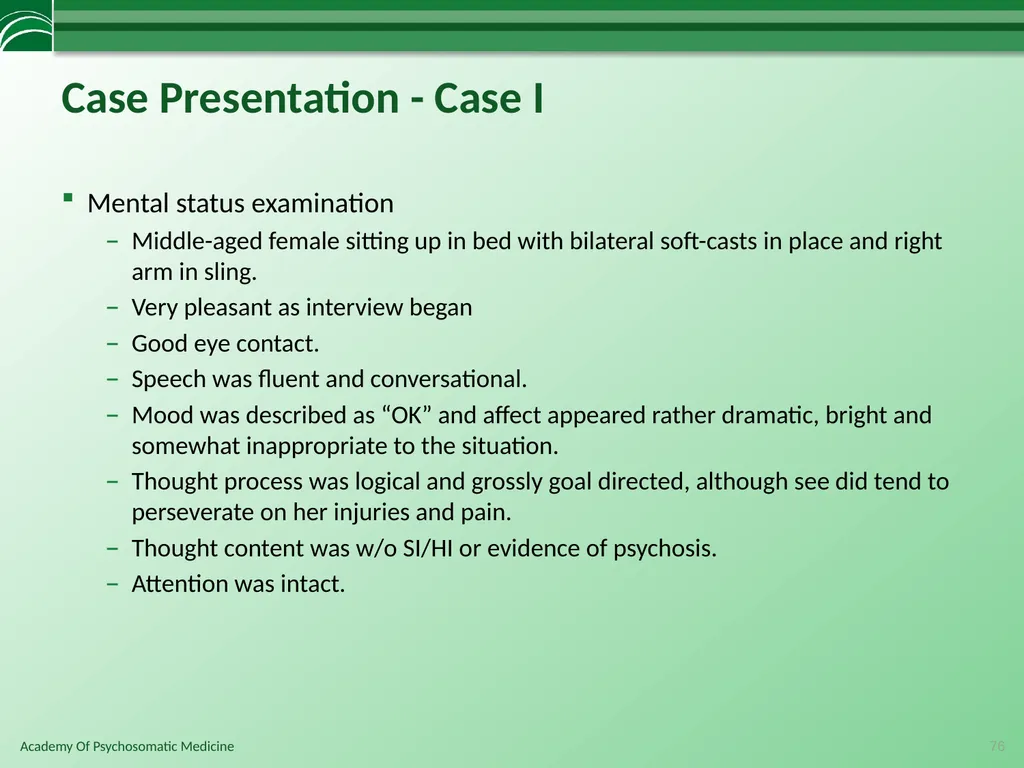
Case Presentation - Case I Mental status examination
Middle-aged female sitting up in bed with bilateral soft-casts in place and right arm in sling.
Very pleasant as interview began
Good eye contact.
Speech was fluent and conversational.
Mood was described as “OK” and affect appeared rather dramatic, bright and somewhat inappropriate to the situation.
Thought process was logical and grossly goal directed, although see did tend to perseverate on her injuries and pain.
Thought content was w/o SI/HI or evidence of psychosis.
Attention was intact. 76<br>
Middle-aged female sitting up in bed with bilateral soft-casts in place and right arm in sling.
Very pleasant as interview began
Good eye contact.
Speech was fluent and conversational.
Mood was described as “OK” and affect appeared rather dramatic, bright and somewhat inappropriate to the situation.
Thought process was logical and grossly goal directed, although see did tend to perseverate on her injuries and pain.
Thought content was w/o SI/HI or evidence of psychosis.
Attention was intact. 76<br>
77
Case Presentation - Case I Initial impression….
Initial recommendations…. 77<br>
Initial recommendations…. 77<br>
78
Case Presentation - Case I Hospital Course
The negative results of the work-up begin to return and she becomes increasing labile and irritable. Demanding a more aggressive work-up to find out what is wrong.
Patient continued to complain of 10/10 pain without appearing subjectively distressed.
Refuses contact with outside providers do to “pending legal action.”
The primary team does attempt to address her pain without the use of opiates.
Instead utilizing gabapentin and prn acetaminophen. 78<br>
The negative results of the work-up begin to return and she becomes increasing labile and irritable. Demanding a more aggressive work-up to find out what is wrong.
Patient continued to complain of 10/10 pain without appearing subjectively distressed.
Refuses contact with outside providers do to “pending legal action.”
The primary team does attempt to address her pain without the use of opiates.
Instead utilizing gabapentin and prn acetaminophen. 78<br>
79
Case Presentation - Case I Did your impression change?
How about your recommendations? 79<br>
How about your recommendations? 79<br>
80
Case Presentation - Case II History of Present Illness (Chart)
47 year-old male admitted through emergency department with complaints of generalized weakness, abdominal pain, and falls.
Had recently been discharged from hospital with similar complaints and no etiology found.
Psychiatry consulted to evaluate for “conversion disorder” as etiology of the patients complaints. 80<br>
47 year-old male admitted through emergency department with complaints of generalized weakness, abdominal pain, and falls.
Had recently been discharged from hospital with similar complaints and no etiology found.
Psychiatry consulted to evaluate for “conversion disorder” as etiology of the patients complaints. 80<br>
81
Case Presentation - Case II History of Present Illness (Patient)
Patient denies any significant stressors apart from financial concerns and current somatic complaints. He further denies any depressive symptoms except for fatigue and weight loss (25lbs over 4 months).
Patient also had complaints of polyuria.
Describes mood as afraid and frustrated, but not depressed or anxious.
He studied psychology in college. 81<br>
Patient denies any significant stressors apart from financial concerns and current somatic complaints. He further denies any depressive symptoms except for fatigue and weight loss (25lbs over 4 months).
Patient also had complaints of polyuria.
Describes mood as afraid and frustrated, but not depressed or anxious.
He studied psychology in college. 81<br>
82
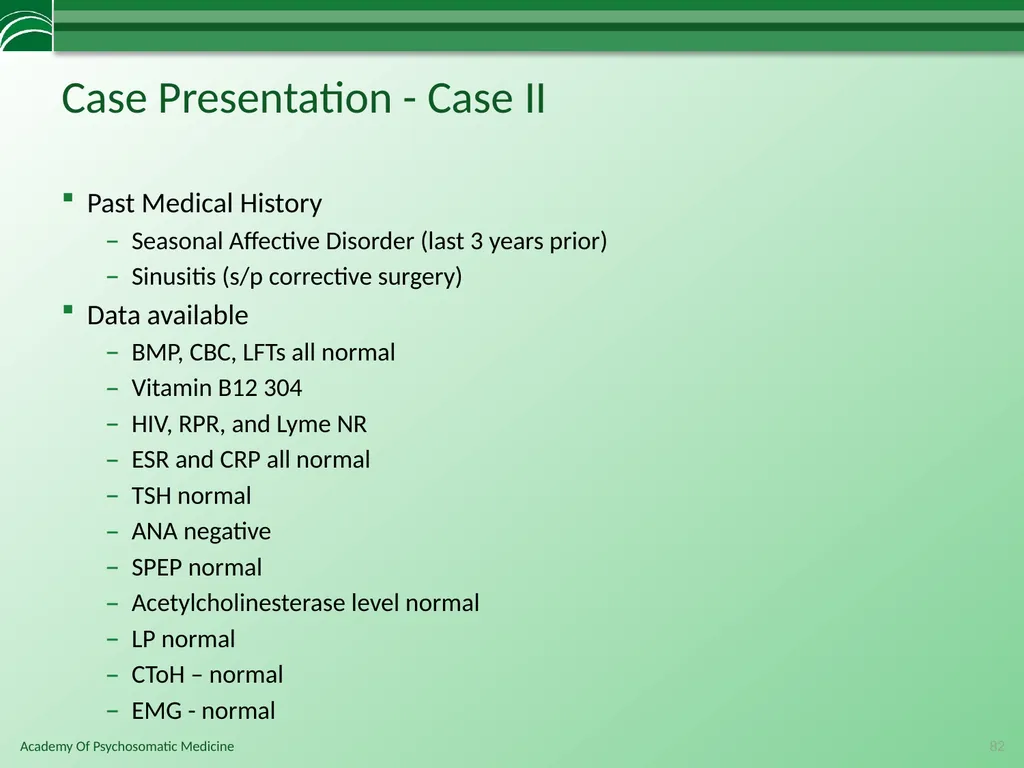
Case Presentation - Case II Past Medical History
Seasonal Affective Disorder (last 3 years prior)
Sinusitis (s/p corrective surgery)
Data available
BMP, CBC, LFTs all normal
Vitamin B12 304
HIV, RPR, and Lyme NR
ESR and CRP all normal
TSH normal
ANA negative
SPEP normal
Acetylcholinesterase level normal
LP normal
CToH – normal
EMG - normal 82<br>
Seasonal Affective Disorder (last 3 years prior)
Sinusitis (s/p corrective surgery)
Data available
BMP, CBC, LFTs all normal
Vitamin B12 304
HIV, RPR, and Lyme NR
ESR and CRP all normal
TSH normal
ANA negative
SPEP normal
Acetylcholinesterase level normal
LP normal
CToH – normal
EMG - normal 82<br>
83
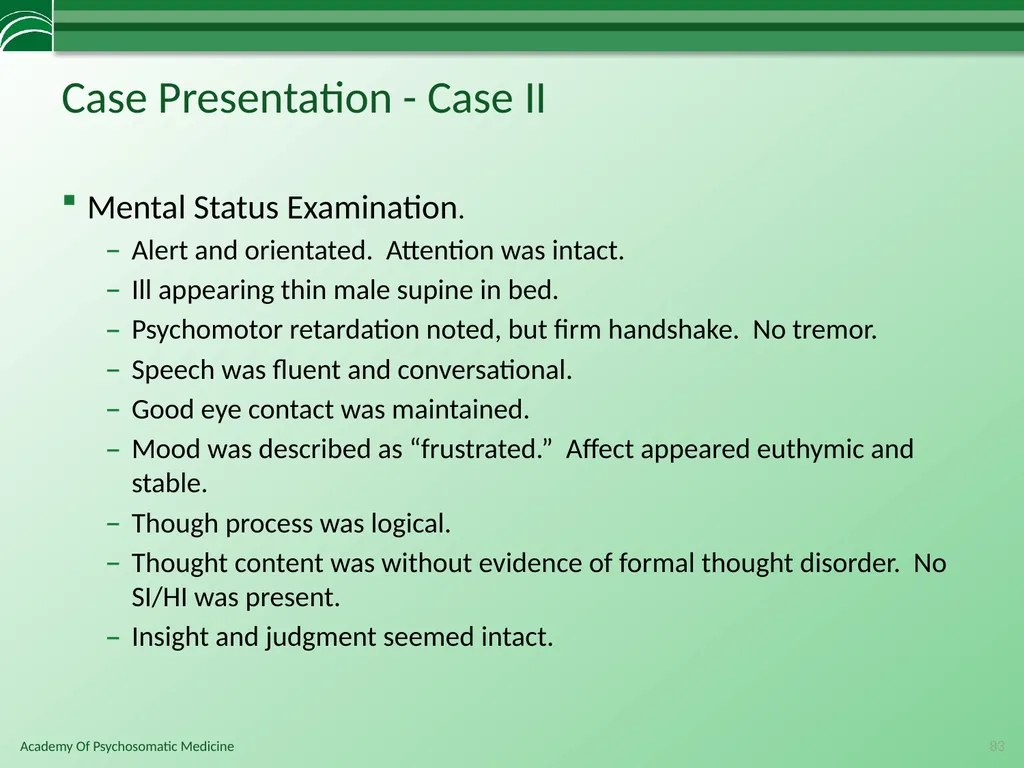
Case Presentation - Case II Mental Status Examination.
Alert and orientated. Attention was intact.
Ill appearing thin male supine in bed.
Psychomotor retardation noted, but firm handshake. No tremor.
Speech was fluent and conversational.
Good eye contact was maintained.
Mood was described as “frustrated.” Affect appeared euthymic and stable.
Though process was logical.
Thought content was without evidence of formal thought disorder. No SI/HI was present.
Insight and judgment seemed intact. 83<br>
Alert and orientated. Attention was intact.
Ill appearing thin male supine in bed.
Psychomotor retardation noted, but firm handshake. No tremor.
Speech was fluent and conversational.
Good eye contact was maintained.
Mood was described as “frustrated.” Affect appeared euthymic and stable.
Though process was logical.
Thought content was without evidence of formal thought disorder. No SI/HI was present.
Insight and judgment seemed intact. 83<br>
84
Case Presentation - Case II Initial impression….
Initial recommendations…. 84<br>
Initial recommendations…. 84<br>
85
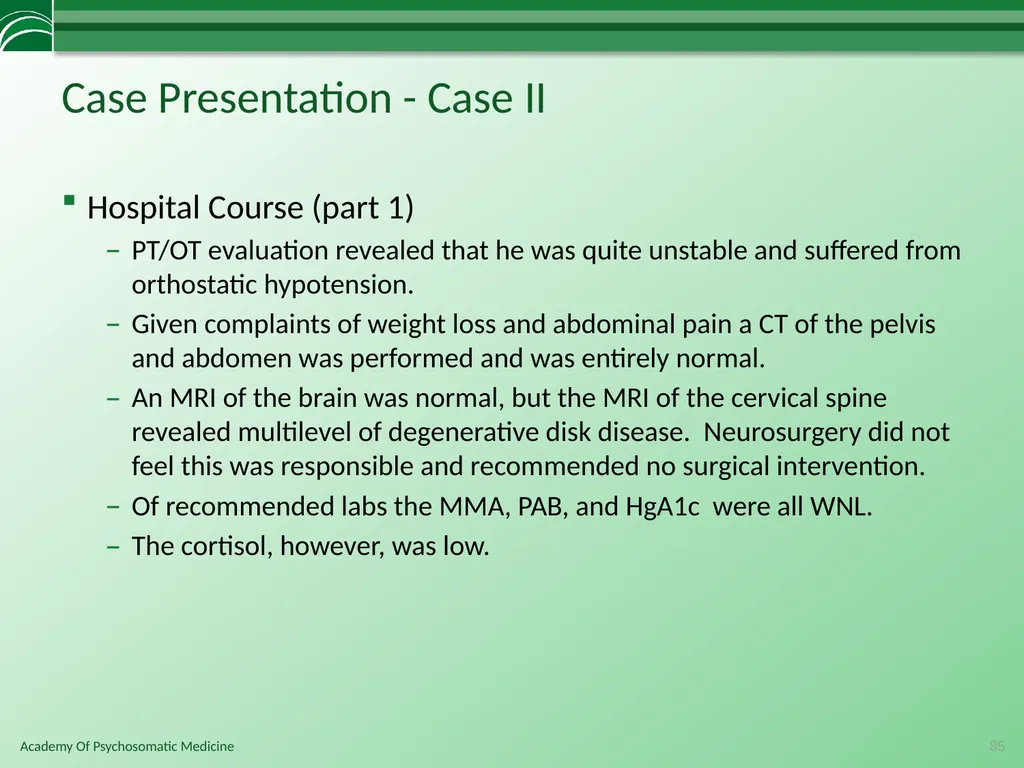
Case Presentation - Case II Hospital Course (part 1)
PT/OT evaluation revealed that he was quite unstable and suffered from orthostatic hypotension.
Given complaints of weight loss and abdominal pain a CT of the pelvis and abdomen was performed and was entirely normal.
An MRI of the brain was normal, but the MRI of the cervical spine revealed multilevel of degenerative disk disease. Neurosurgery did not feel this was responsible and recommended no surgical intervention.
Of recommended labs the MMA, PAB, and HgA1c were all WNL.
The cortisol, however, was low. 85<br>
PT/OT evaluation revealed that he was quite unstable and suffered from orthostatic hypotension.
Given complaints of weight loss and abdominal pain a CT of the pelvis and abdomen was performed and was entirely normal.
An MRI of the brain was normal, but the MRI of the cervical spine revealed multilevel of degenerative disk disease. Neurosurgery did not feel this was responsible and recommended no surgical intervention.
Of recommended labs the MMA, PAB, and HgA1c were all WNL.
The cortisol, however, was low. 85<br>
86
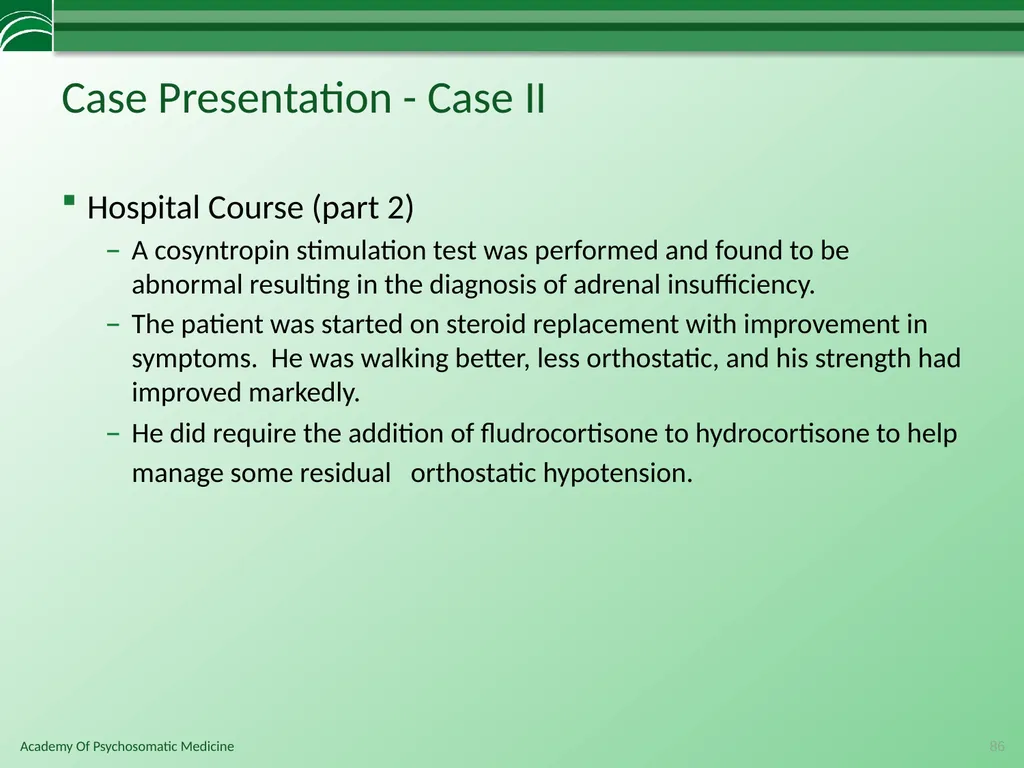
Case Presentation - Case II Hospital Course (part 2)
A cosyntropin stimulation test was performed and found to be abnormal resulting in the diagnosis of adrenal insufficiency.
The patient was started on steroid replacement with improvement in symptoms. He was walking better, less orthostatic, and his strength had improved markedly.
He did require the addition of fludrocortisone to hydrocortisone to help manage some residual orthostatic hypotension. 86<br>
A cosyntropin stimulation test was performed and found to be abnormal resulting in the diagnosis of adrenal insufficiency.
The patient was started on steroid replacement with improvement in symptoms. He was walking better, less orthostatic, and his strength had improved markedly.
He did require the addition of fludrocortisone to hydrocortisone to help manage some residual orthostatic hypotension. 86<br>
87
Case Presentation - Case II Did your impression change?
How about your recommendations? 87<br>
How about your recommendations? 87<br>
88
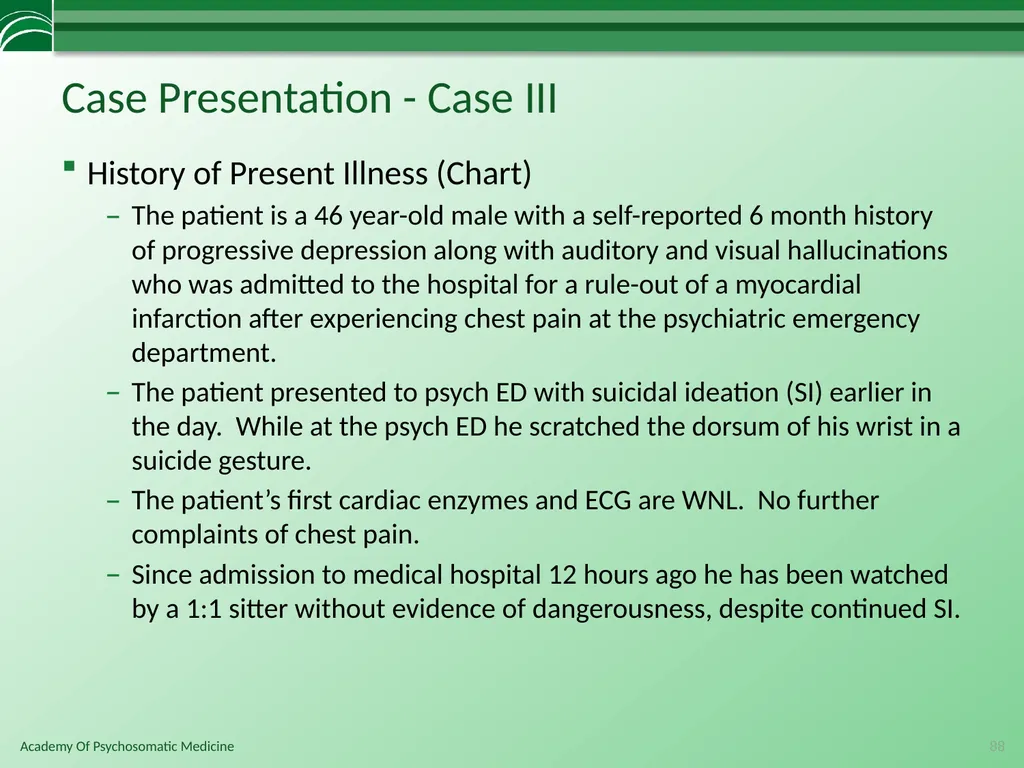
Case Presentation - Case III History of Present Illness (Chart)
The patient is a 46 year-old male with a self-reported 6 month history of progressive depression along with auditory and visual hallucinations who was admitted to the hospital for a rule-out of a myocardial infarction after experiencing chest pain at the psychiatric emergency department.
The patient presented to psych ED with suicidal ideation (SI) earlier in the day. While at the psych ED he scratched the dorsum of his wrist in a suicide gesture.
The patient’s first cardiac enzymes and ECG are WNL. No further complaints of chest pain.
Since admission to medical hospital 12 hours ago he has been watched by a 1:1 sitter without evidence of dangerousness, despite continued SI. 88<br>
The patient is a 46 year-old male with a self-reported 6 month history of progressive depression along with auditory and visual hallucinations who was admitted to the hospital for a rule-out of a myocardial infarction after experiencing chest pain at the psychiatric emergency department.
The patient presented to psych ED with suicidal ideation (SI) earlier in the day. While at the psych ED he scratched the dorsum of his wrist in a suicide gesture.
The patient’s first cardiac enzymes and ECG are WNL. No further complaints of chest pain.
Since admission to medical hospital 12 hours ago he has been watched by a 1:1 sitter without evidence of dangerousness, despite continued SI. 88<br>
89
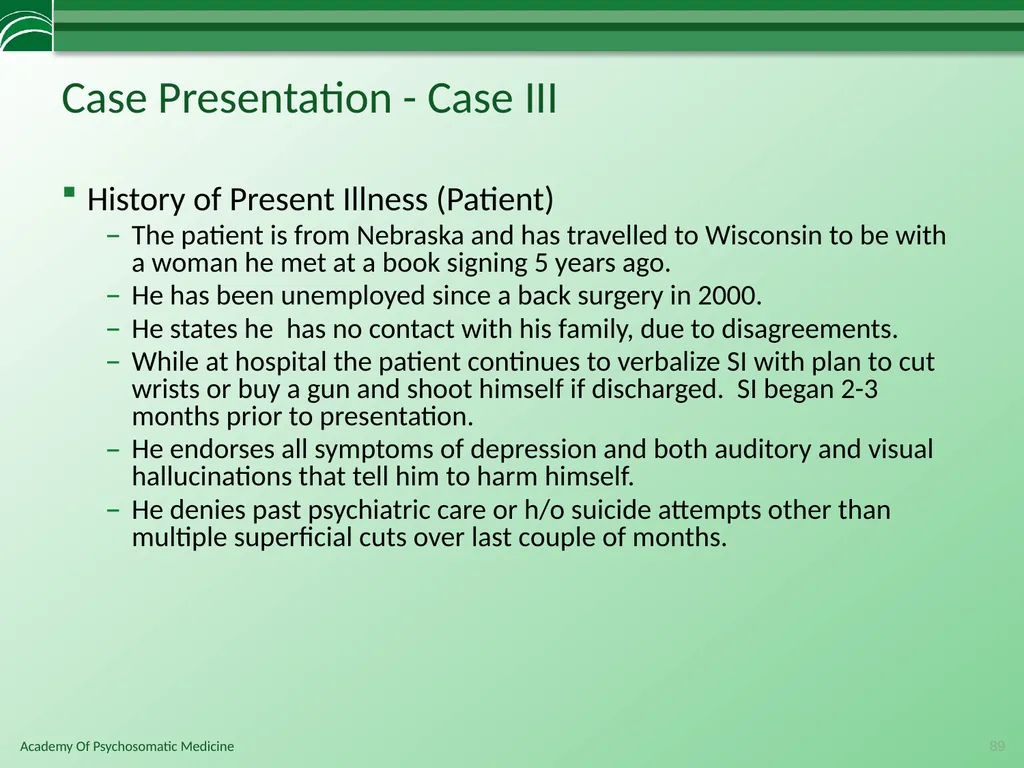
Case Presentation - Case III History of Present Illness (Patient)
The patient is from Nebraska and has travelled to Wisconsin to be with a woman he met at a book signing 5 years ago.
He has been unemployed since a back surgery in 2000.
He states he has no contact with his family, due to disagreements.
While at hospital the patient continues to verbalize SI with plan to cut wrists or buy a gun and shoot himself if discharged. SI began 2-3 months prior to presentation.
He endorses all symptoms of depression and both auditory and visual hallucinations that tell him to harm himself.
He denies past psychiatric care or h/o suicide attempts other than multiple superficial cuts over last couple of months. 89<br>
The patient is from Nebraska and has travelled to Wisconsin to be with a woman he met at a book signing 5 years ago.
He has been unemployed since a back surgery in 2000.
He states he has no contact with his family, due to disagreements.
While at hospital the patient continues to verbalize SI with plan to cut wrists or buy a gun and shoot himself if discharged. SI began 2-3 months prior to presentation.
He endorses all symptoms of depression and both auditory and visual hallucinations that tell him to harm himself.
He denies past psychiatric care or h/o suicide attempts other than multiple superficial cuts over last couple of months. 89<br>
90
Case Presentation - Case III Past Medical History
Back pain (chronic)
S/P laminectomy in 1999 and 2000
Migraine headaches 90<br>
Back pain (chronic)
S/P laminectomy in 1999 and 2000
Migraine headaches 90<br>
91
Case Presentation - Case III Mental Status Examination
Alert with intact attention span.
Well nourished slightly disheveled male in no acute distress.
Speech was hesitant when answering questions but quite fluent when he had a point to make.
Mood was described as “bad.” Affect appeared euthymic and stable. No tears or labilty observed.
Thought process was logical and goal-directed.
Thought content was with continued SI, but no HI. He reported active A/V hallucination, however there was no objective evidence of this.
I/J were judged to be poor. 91<br>
Alert with intact attention span.
Well nourished slightly disheveled male in no acute distress.
Speech was hesitant when answering questions but quite fluent when he had a point to make.
Mood was described as “bad.” Affect appeared euthymic and stable. No tears or labilty observed.
Thought process was logical and goal-directed.
Thought content was with continued SI, but no HI. He reported active A/V hallucination, however there was no objective evidence of this.
I/J were judged to be poor. 91<br>
92
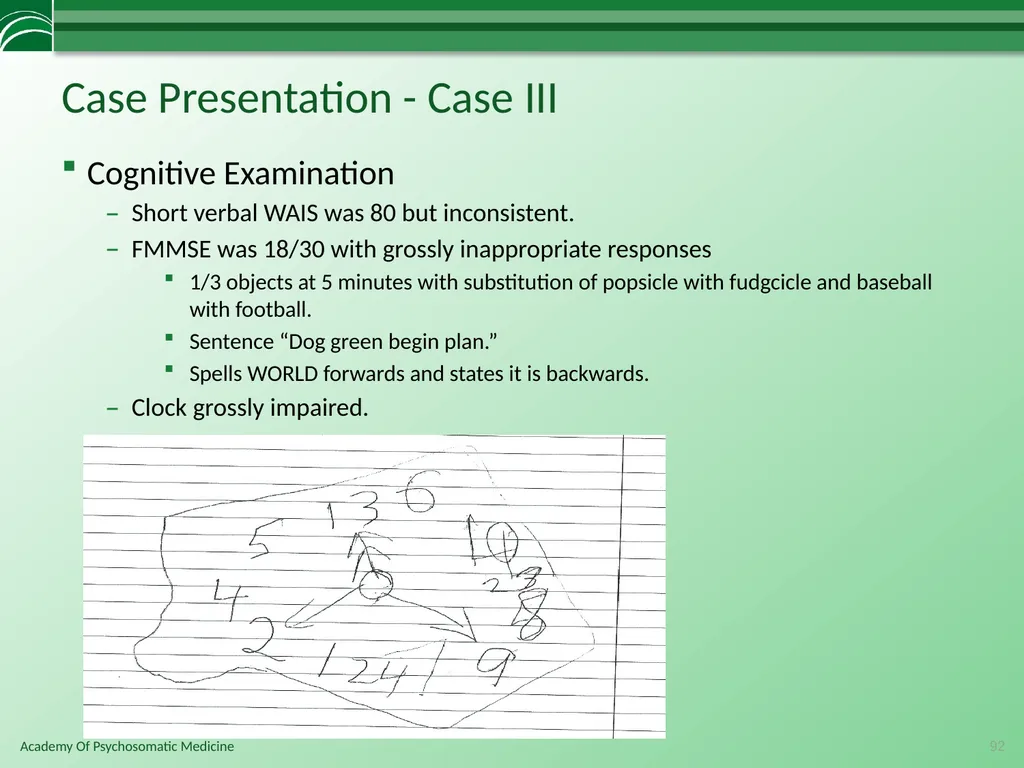
Case Presentation - Case III Cognitive Examination
Short verbal WAIS was 80 but inconsistent.
FMMSE was 18/30 with grossly inappropriate responses
1/3 objects at 5 minutes with substitution of popsicle with fudgcicle and baseball with football.
Sentence “Dog green begin plan.”
Spells WORLD forwards and states it is backwards.
Clock grossly impaired. 92<br>
Short verbal WAIS was 80 but inconsistent.
FMMSE was 18/30 with grossly inappropriate responses
1/3 objects at 5 minutes with substitution of popsicle with fudgcicle and baseball with football.
Sentence “Dog green begin plan.”
Spells WORLD forwards and states it is backwards.
Clock grossly impaired. 92<br>
93
Case Presentation - Case III Cognitive Examination
General questions
How many months in a year?
11
Can you name the 12 months?
Able to name 8
What is 2+2?
5
What is 2+3?
6
What is 10-5?
6
How many legs does a horse have?
5
How many doors does a 2 door car have?
3
Who is buried in Grant’s Tomb?
Me 93<br>
General questions
How many months in a year?
11
Can you name the 12 months?
Able to name 8
What is 2+2?
5
What is 2+3?
6
What is 10-5?
6
How many legs does a horse have?
5
How many doors does a 2 door car have?
3
Who is buried in Grant’s Tomb?
Me 93<br>
94
Case Presentation - Case III Initial impression….
Initial recommendations…. 94<br>
Initial recommendations…. 94<br>
95
Case Presentation - Case III Hospital Course (part 1)
Patient continued to display inconsistencies in memory and cognition.
Contacted woman whom he came to stay with.
She reports that he has been verbalizing concerns about his memory for the past couple of months.
His visit was a surprise, but not as big as when she was told that he was going to be staying with her.
She was unaware of any psychiatric or substance abuse history by the patient.
Spoke to the physicians at who saw the patient in the psychiatric ED who did not feel that the patient was truly suffering from any psychotic symptoms. 95<br>
Patient continued to display inconsistencies in memory and cognition.
Contacted woman whom he came to stay with.
She reports that he has been verbalizing concerns about his memory for the past couple of months.
His visit was a surprise, but not as big as when she was told that he was going to be staying with her.
She was unaware of any psychiatric or substance abuse history by the patient.
Spoke to the physicians at who saw the patient in the psychiatric ED who did not feel that the patient was truly suffering from any psychotic symptoms. 95<br>
96
Case Presentation - Case III Hospital Course (part 2)
Still with SI and reports of A/V hallucinations.
Requesting narcotics for back pain.
Uncooperative with attempts at neuropsychiatric testing.
CToH was normal.
Cardiac stress test was normal.
No dangerousness during his stay at the medical hospital.
Discharged back to the Mental Health Complex. 96<br>
Still with SI and reports of A/V hallucinations.
Requesting narcotics for back pain.
Uncooperative with attempts at neuropsychiatric testing.
CToH was normal.
Cardiac stress test was normal.
No dangerousness during his stay at the medical hospital.
Discharged back to the Mental Health Complex. 96<br>
97
Case Presentation - Case III Did your impression change?
How about your recommendations? 97<br>
How about your recommendations? 97<br>