
Speeches and Powerful Devices Communicating and
PM
Published · 28 slides · 0 views
1 / 1



Description
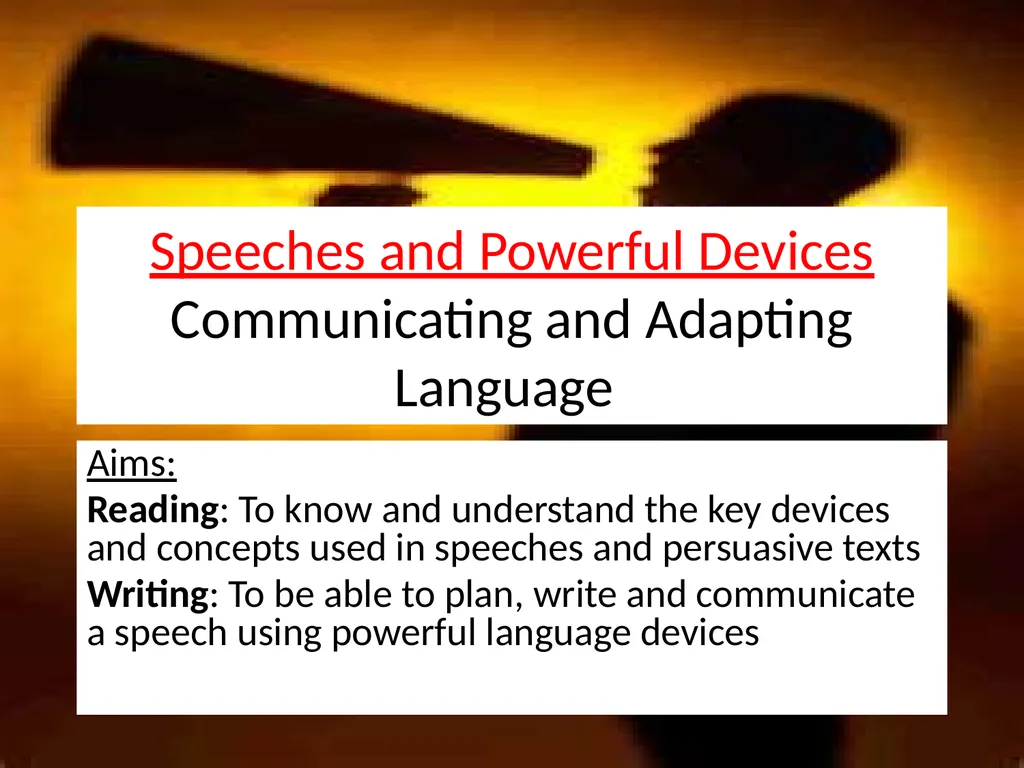
Speeches and Powerful Devices Communicating and Adapting Language Aims: Reading: To know and understand the key devices and concepts used in speeches and persuasive texts Writing: To be able to plan, write and communicate a speech using
Related Topics
Share
Embed code
Download this presentation From Below
"Speeches and Powerful Devices Communicating and" is the property of its rightful owner. Permission is granted to download and print the materials on this website for personal, non-commercial use only, and to display it on your personal computer provided you do not modify the materials and that you retain all copyright notices contained in the materials. By downloading content from our website, you accept the terms of this agreement.
Presentation Transcript
01
Speeches and Powerful Devices
Communicating and Adapting Language Aims:
Reading: To know and understand the key devices and concepts used in speeches and persuasive texts
Writing: To be able to plan, write and communicate a speech using powerful language devices<br>
Reading: To know and understand the key devices and concepts used in speeches and persuasive texts
Writing: To be able to plan, write and communicate a speech using powerful language devices<br>
02
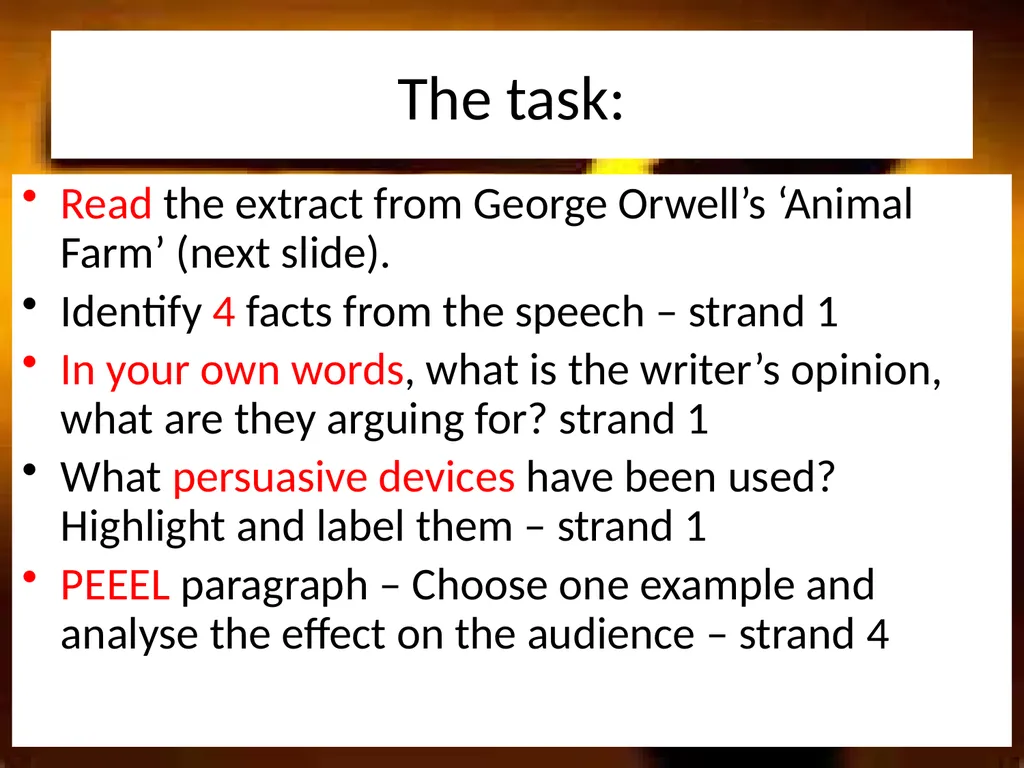
The task: Read the extract from George Orwell’s ‘Animal Farm’ (next slide).
Identify 4 facts from the speech – strand 1
In your own words, what is the writer’s opinion, what are they arguing for? strand 1
What persuasive devices have been used? Highlight and label them – strand 1
PEEEL paragraph – Choose one example and analyse the effect on the audience – strand 4<br>
Identify 4 facts from the speech – strand 1
In your own words, what is the writer’s opinion, what are they arguing for? strand 1
What persuasive devices have been used? Highlight and label them – strand 1
PEEEL paragraph – Choose one example and analyse the effect on the audience – strand 4<br>
03
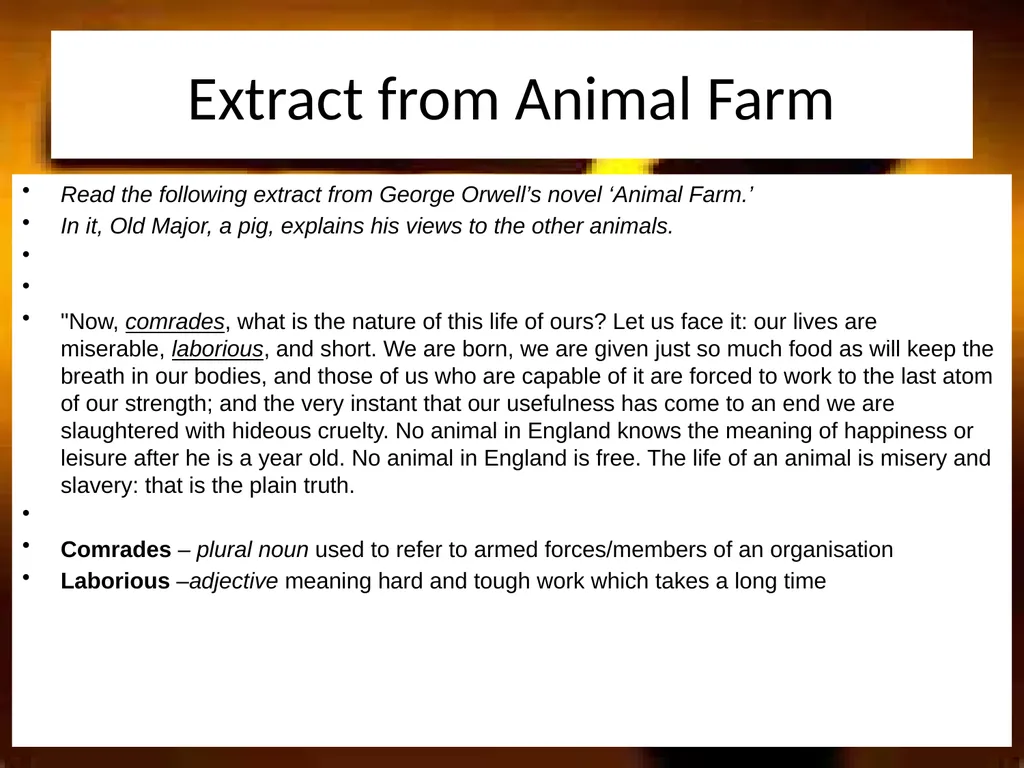
Extract from Animal Farm Read the following extract from George Orwell’s novel ‘Animal Farm.’
In it, Old Major, a pig, explains his views to the other animals.
"Now, comrades, what is the nature of this life of ours? Let us face it: our lives are miserable, laborious, and short. We are born, we are given just so much food as will keep the breath in our bodies, and those of us who are capable of it are forced to work to the last atom of our strength; and the very instant that our usefulness has come to an end we are slaughtered with hideous cruelty. No animal in England knows the meaning of happiness or leisure after he is a year old. No animal in England is free. The life of an animal is misery and slavery: that is the plain truth.
Comrades – plural noun used to refer to armed forces/members of an organisation
Laborious –adjective meaning hard and tough work which takes a long time<br>
In it, Old Major, a pig, explains his views to the other animals.
"Now, comrades, what is the nature of this life of ours? Let us face it: our lives are miserable, laborious, and short. We are born, we are given just so much food as will keep the breath in our bodies, and those of us who are capable of it are forced to work to the last atom of our strength; and the very instant that our usefulness has come to an end we are slaughtered with hideous cruelty. No animal in England knows the meaning of happiness or leisure after he is a year old. No animal in England is free. The life of an animal is misery and slavery: that is the plain truth.
Comrades – plural noun used to refer to armed forces/members of an organisation
Laborious –adjective meaning hard and tough work which takes a long time<br>
04
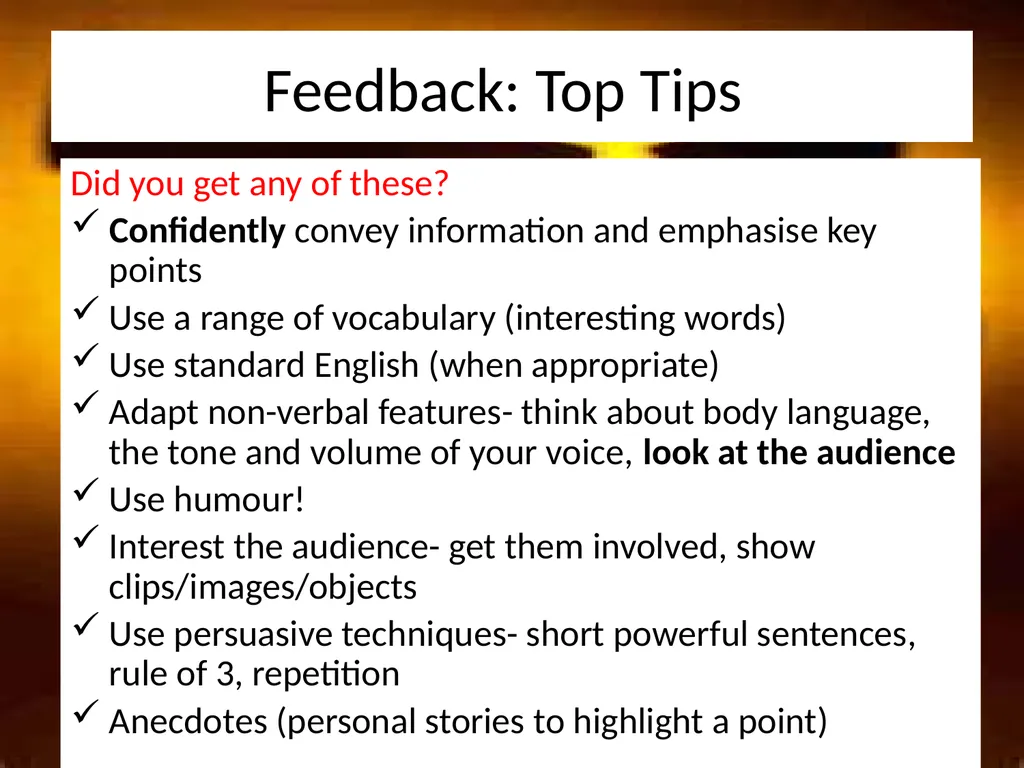
Feedback: Top Tips Did you get any of these?
Confidently convey information and emphasise key points
Use a range of vocabulary (interesting words)
Use standard English (when appropriate)
Adapt non-verbal features- think about body language, the tone and volume of your voice, look at the audience
Use humour!
Interest the audience- get them involved, show clips/images/objects
Use persuasive techniques- short powerful sentences, rule of 3, repetition
Anecdotes (personal stories to highlight a point)<br>
Confidently convey information and emphasise key points
Use a range of vocabulary (interesting words)
Use standard English (when appropriate)
Adapt non-verbal features- think about body language, the tone and volume of your voice, look at the audience
Use humour!
Interest the audience- get them involved, show clips/images/objects
Use persuasive techniques- short powerful sentences, rule of 3, repetition
Anecdotes (personal stories to highlight a point)<br>
05
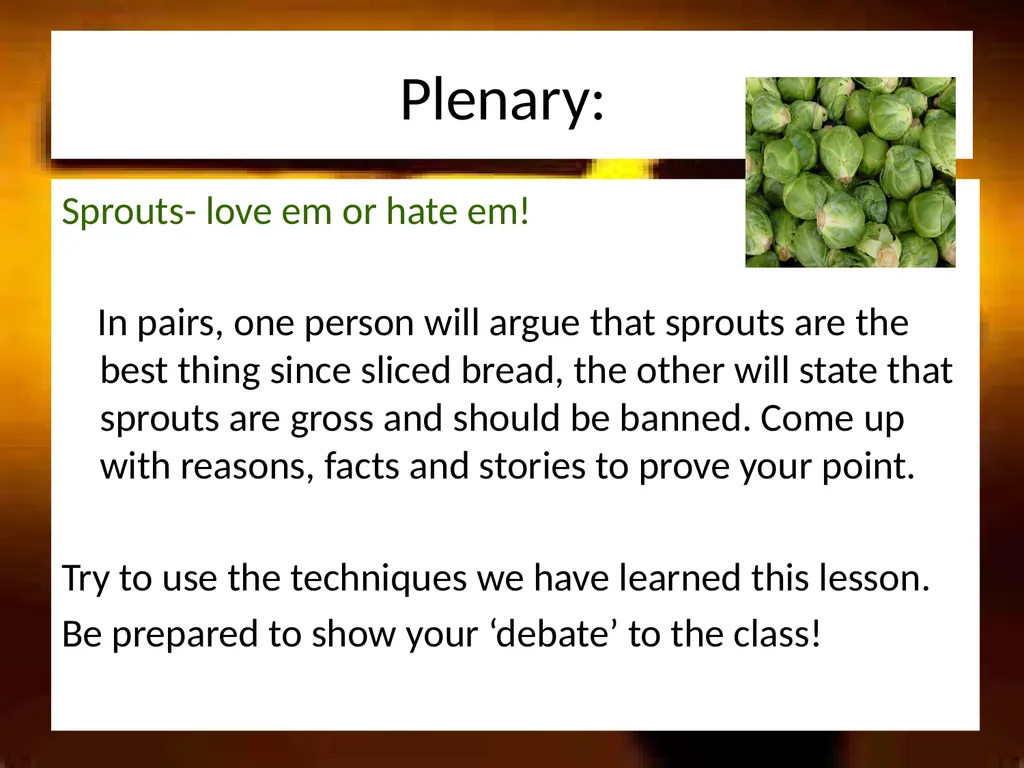
Plenary: Sprouts- love em or hate em!
In pairs, one person will argue that sprouts are the best thing since sliced bread, the other will state that sprouts are gross and should be banned. Come up with reasons, facts and stories to prove your point.
Try to use the techniques we have learned this lesson.
Be prepared to show your ‘debate’ to the class!<br>
In pairs, one person will argue that sprouts are the best thing since sliced bread, the other will state that sprouts are gross and should be banned. Come up with reasons, facts and stories to prove your point.
Try to use the techniques we have learned this lesson.
Be prepared to show your ‘debate’ to the class!<br>
06
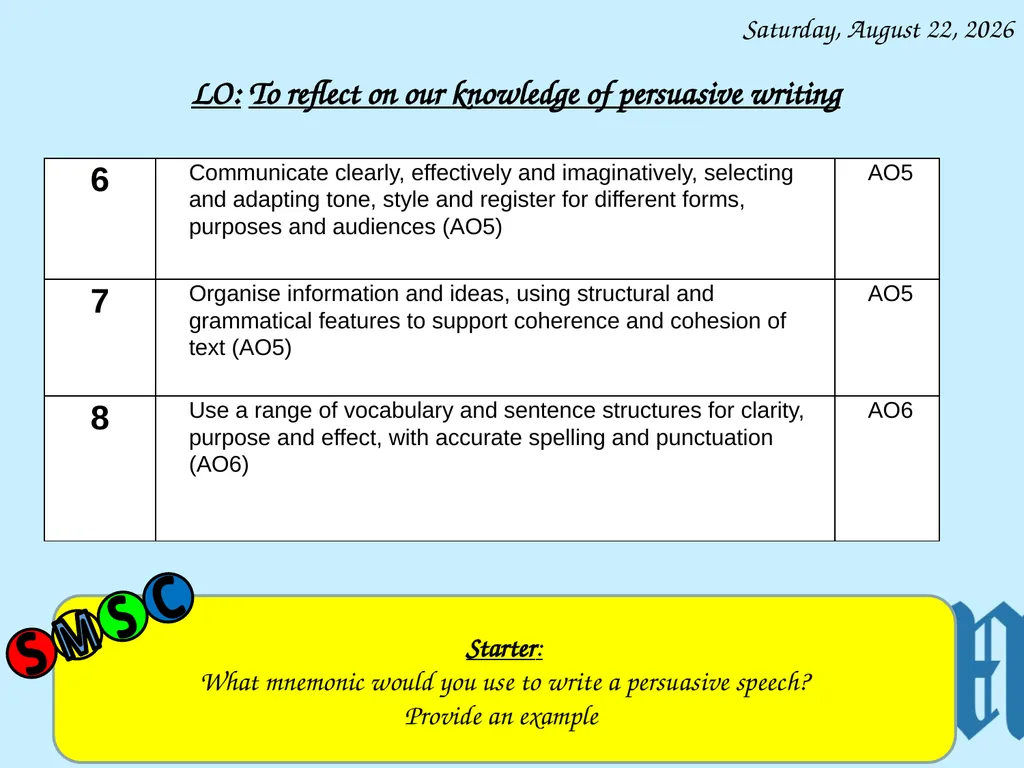
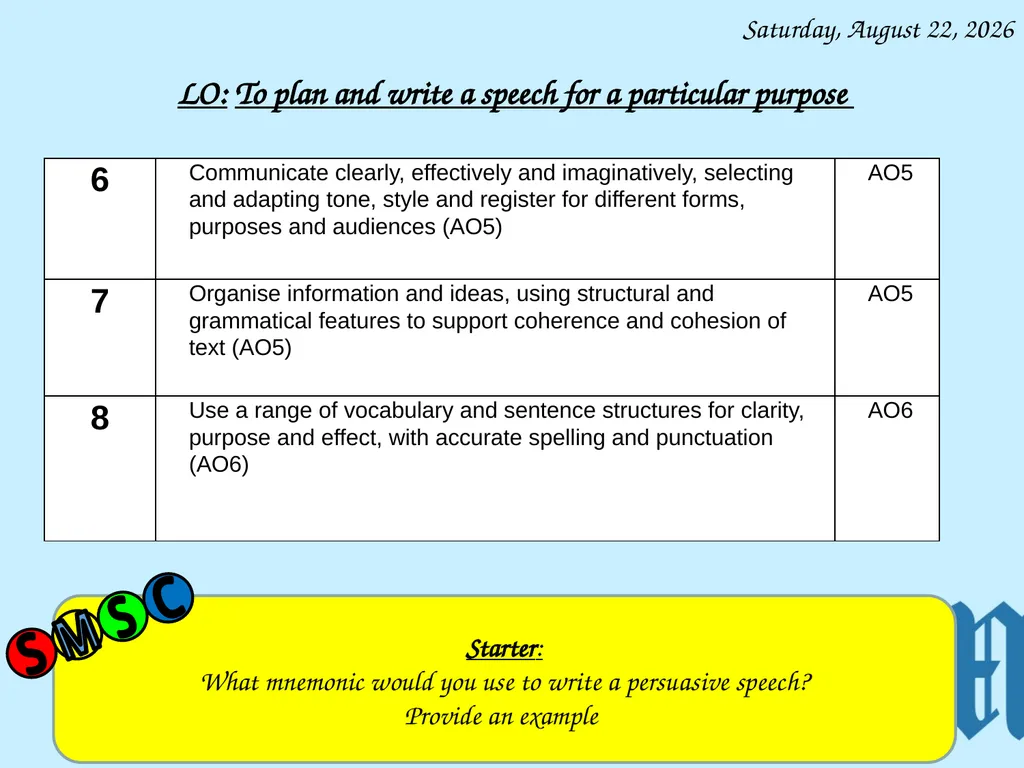
Starter:
What mnemonic would you use to write a persuasive speech?
Provide an example Tuesday, November 24, 2020 LO: To reflect on our knowledge of persuasive writing<br>
What mnemonic would you use to write a persuasive speech?
Provide an example Tuesday, November 24, 2020 LO: To reflect on our knowledge of persuasive writing<br>
07
TASK Plan and write a speech for a junior school Year 6 assembly persuading pupils to attend Mayfield School. To plan and write a speech for a particular purpose Must be at least 4 paragraphs
Use proper paragraphs
Correct SPAG HINT: who is my audience?
Where can I use AFOREST?<br>
Use proper paragraphs
Correct SPAG HINT: who is my audience?
Where can I use AFOREST?<br>
08
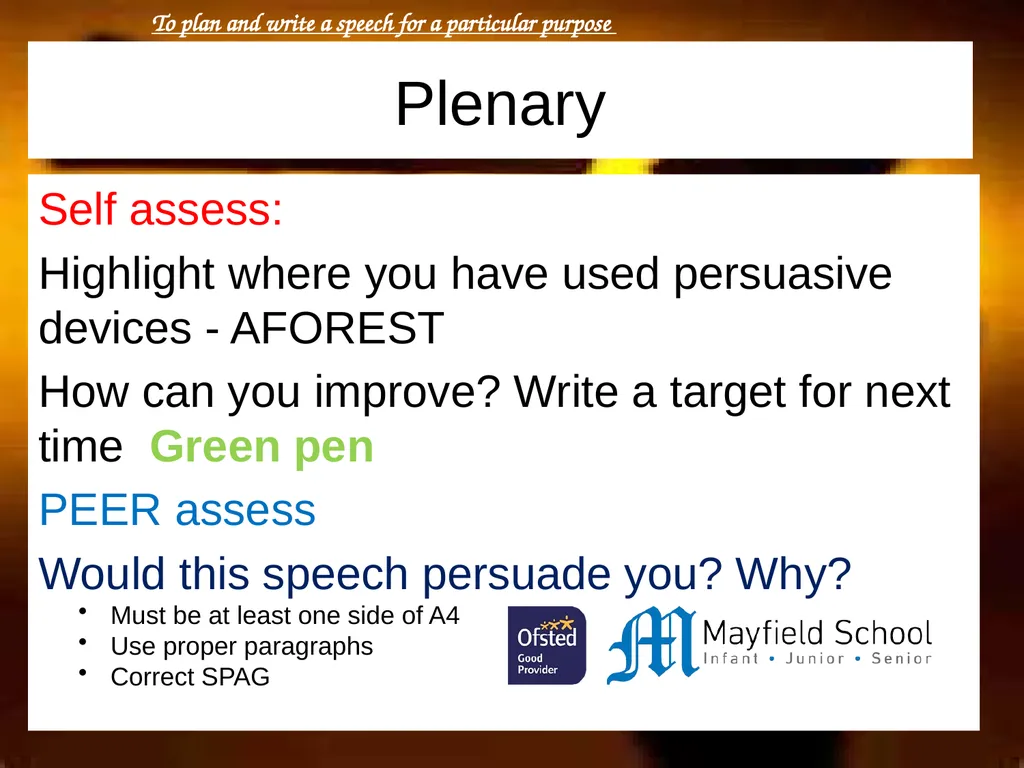
Plenary Self assess:
Highlight where you have used persuasive devices - AFOREST
How can you improve? Write a target for next time Green pen
PEER assess
Would this speech persuade you? Why? To plan and write a speech for a particular purpose Must be at least one side of A4
Use proper paragraphs
Correct SPAG<br>
Highlight where you have used persuasive devices - AFOREST
How can you improve? Write a target for next time Green pen
PEER assess
Would this speech persuade you? Why? To plan and write a speech for a particular purpose Must be at least one side of A4
Use proper paragraphs
Correct SPAG<br>
09
Starter:
What mnemonic would you use to write a persuasive speech?
Provide an example Tuesday, November 24, 2020 LO: To plan and write a speech for a particular purpose<br>
What mnemonic would you use to write a persuasive speech?
Provide an example Tuesday, November 24, 2020 LO: To plan and write a speech for a particular purpose<br>
10
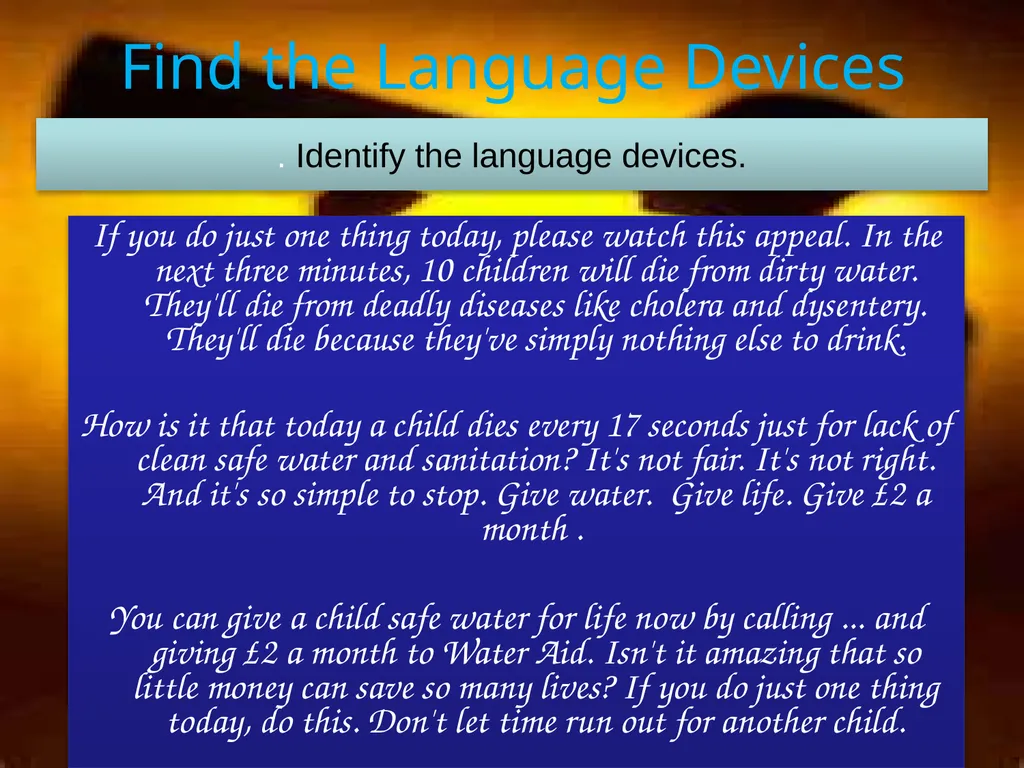
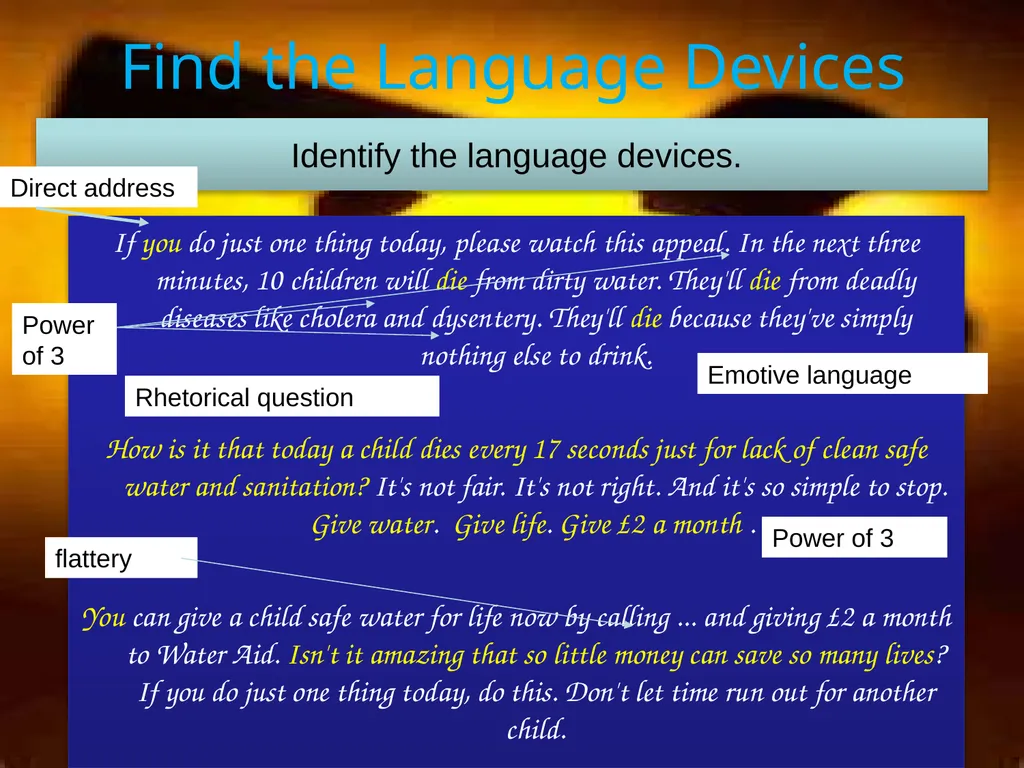
Find the Language Devices If you do just one thing today, please watch this appeal. In the next three minutes, 10 children will die from dirty water. They'll die from deadly diseases like cholera and dysentery. They'll die because they've simply nothing else to drink.
How is it that today a child dies every 17 seconds just for lack of clean safe water and sanitation? It's not fair. It's not right. And it's so simple to stop. Give water. Give life. Give £2 a month .
You can give a child safe water for life now by calling ... and giving £2 a month to Water Aid. Isn't it amazing that so little money can save so many lives? If you do just one thing today, do this. Don't let time run out for another child. . Identify the language devices.<br>
How is it that today a child dies every 17 seconds just for lack of clean safe water and sanitation? It's not fair. It's not right. And it's so simple to stop. Give water. Give life. Give £2 a month .
You can give a child safe water for life now by calling ... and giving £2 a month to Water Aid. Isn't it amazing that so little money can save so many lives? If you do just one thing today, do this. Don't let time run out for another child. . Identify the language devices.<br>
11
Find the Language Devices If you do just one thing today, please watch this appeal. In the next three minutes, 10 children will die from dirty water. They'll die from deadly diseases like cholera and dysentery. They'll die because they've simply nothing else to drink.
How is it that today a child dies every 17 seconds just for lack of clean safe water and sanitation? It's not fair. It's not right. And it's so simple to stop. Give water. Give life. Give £2 a month .
You can give a child safe water for life now by calling ... and giving £2 a month to Water Aid. Isn't it amazing that so little money can save so many lives? If you do just one thing today, do this. Don't let time run out for another child. Identify the language devices. Power of 3 Direct address Rhetorical question Emotive language Power of 3 flattery<br>
How is it that today a child dies every 17 seconds just for lack of clean safe water and sanitation? It's not fair. It's not right. And it's so simple to stop. Give water. Give life. Give £2 a month .
You can give a child safe water for life now by calling ... and giving £2 a month to Water Aid. Isn't it amazing that so little money can save so many lives? If you do just one thing today, do this. Don't let time run out for another child. Identify the language devices. Power of 3 Direct address Rhetorical question Emotive language Power of 3 flattery<br>
12
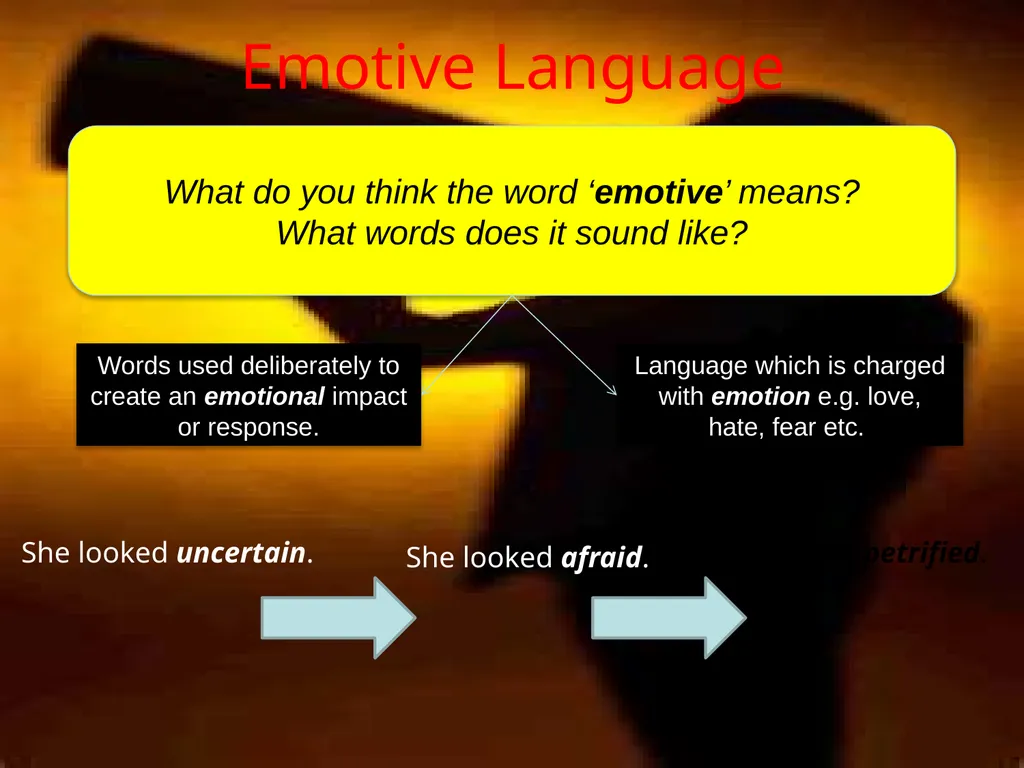
Emotive Language What do you think the word ‘emotive’ means?
What words does it sound like? Words used deliberately to create an emotional impact or response. Language which is charged with emotion e.g. love, hate, fear etc. She looked uncertain. She looked afraid. She looked petrified.<br>
What words does it sound like? Words used deliberately to create an emotional impact or response. Language which is charged with emotion e.g. love, hate, fear etc. She looked uncertain. She looked afraid. She looked petrified.<br>
13
Can you identify the emotive language in this short article?
underline emotive words.
I have done the first one; why is ‘mob’ an emotive word?
What does the word make you think of?
What other words could have been used instead?<br>
underline emotive words.
I have done the first one; why is ‘mob’ an emotive word?
What does the word make you think of?
What other words could have been used instead?<br>
14
Can you identify the emotive language in this short article?
Use the IWB pens to underline emotive words.
I have done the first one; why is ‘mob’ an emotive word?
What does the word make you think of?
What other words could have been used instead? Plenary
What’s the effect of the emotive language?
How does it make the reader feel?<br>
Use the IWB pens to underline emotive words.
I have done the first one; why is ‘mob’ an emotive word?
What does the word make you think of?
What other words could have been used instead? Plenary
What’s the effect of the emotive language?
How does it make the reader feel?<br>
15
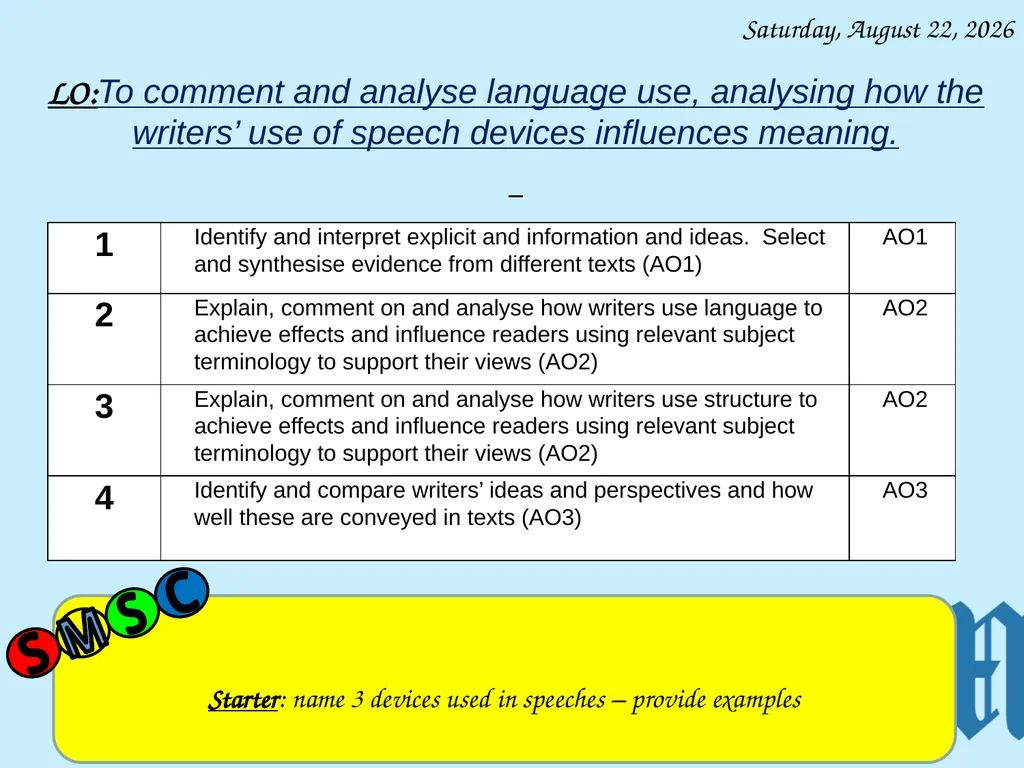
Starter: name 3 devices used in speeches – provide examples Tuesday, November 24, 2020 LO:To comment and analyse language use, analysing how the writers’ use of speech devices influences meaning.<br>
16
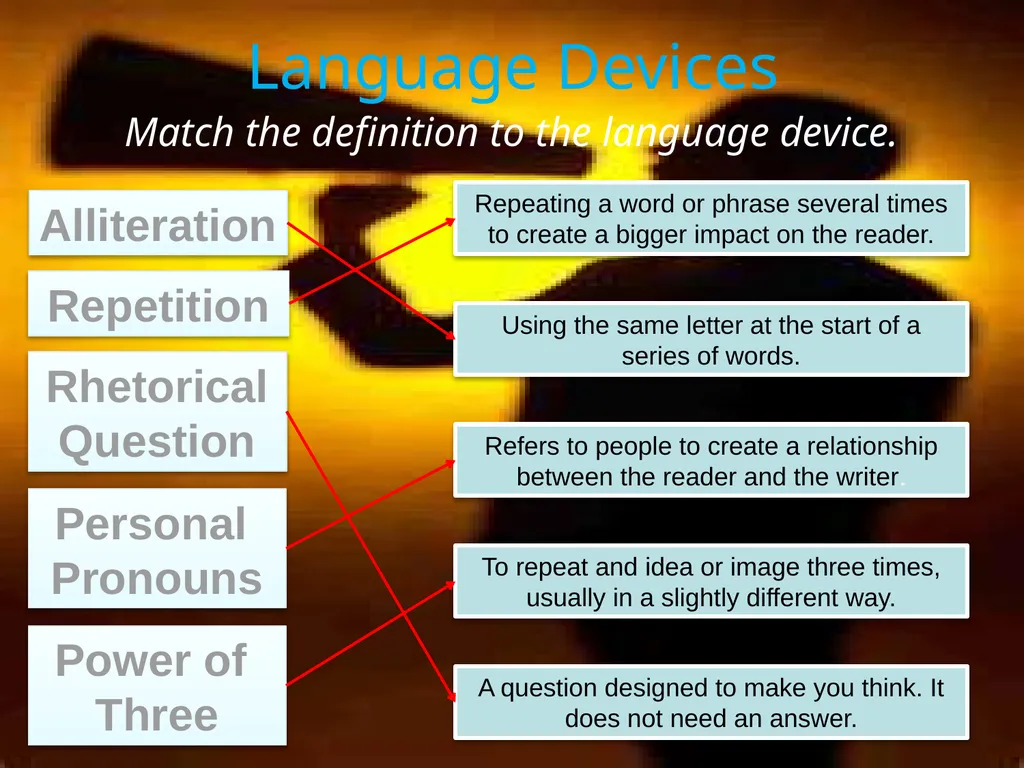
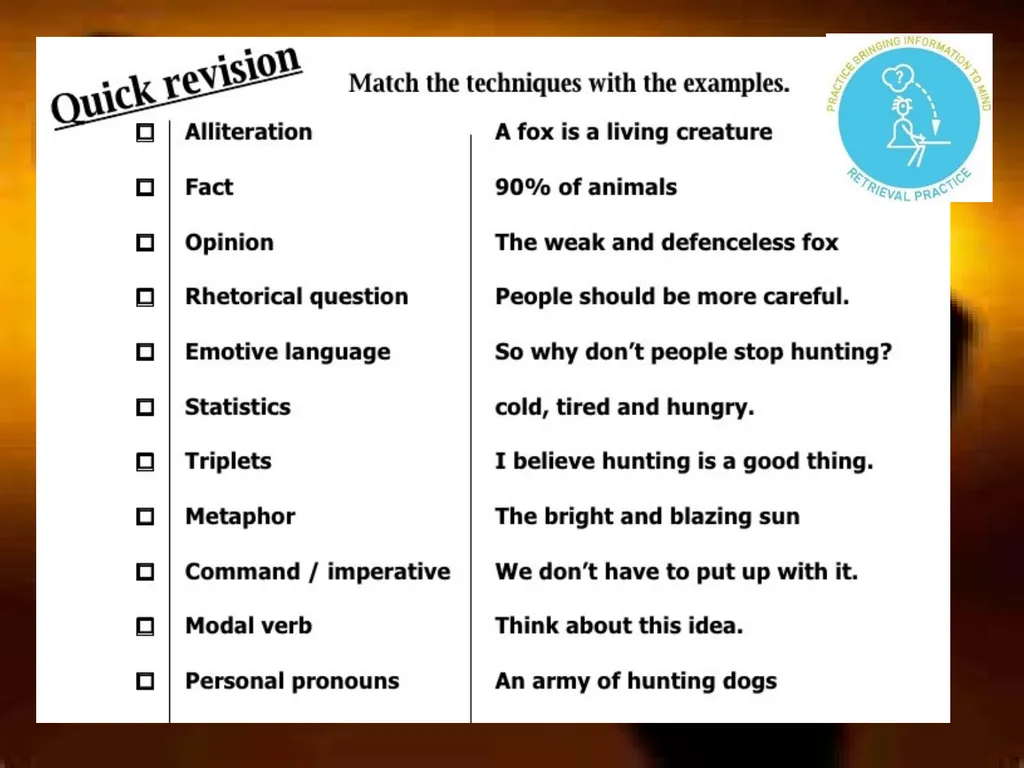
Language Devices Match the definition to the language device. Alliteration Repetition Rhetorical
Question Power of
Three Personal
Pronouns Repeating a word or phrase several times to create a bigger impact on the reader. A question designed to make you think. It does not need an answer. To repeat and idea or image three times, usually in a slightly different way. Using the same letter at the start of a series of words. Refers to people to create a relationship between the reader and the writer.<br>
Question Power of
Three Personal
Pronouns Repeating a word or phrase several times to create a bigger impact on the reader. A question designed to make you think. It does not need an answer. To repeat and idea or image three times, usually in a slightly different way. Using the same letter at the start of a series of words. Refers to people to create a relationship between the reader and the writer.<br>
17
Can you identify the emotive language in this short article?
In your books write down each emotive word you find and say why it is emotive – what does the word make you think of? And say which other words could have been used instead.
I have done the first one; why is ‘mob’ an emotive word?
What does the word make you think of?
What other words could have been used instead? What’s the effect of the emotive language?
PEEE
How does it make the reader feel? Add your response to the sheet<br>
In your books write down each emotive word you find and say why it is emotive – what does the word make you think of? And say which other words could have been used instead.
I have done the first one; why is ‘mob’ an emotive word?
What does the word make you think of?
What other words could have been used instead? What’s the effect of the emotive language?
PEEE
How does it make the reader feel? Add your response to the sheet<br>
18
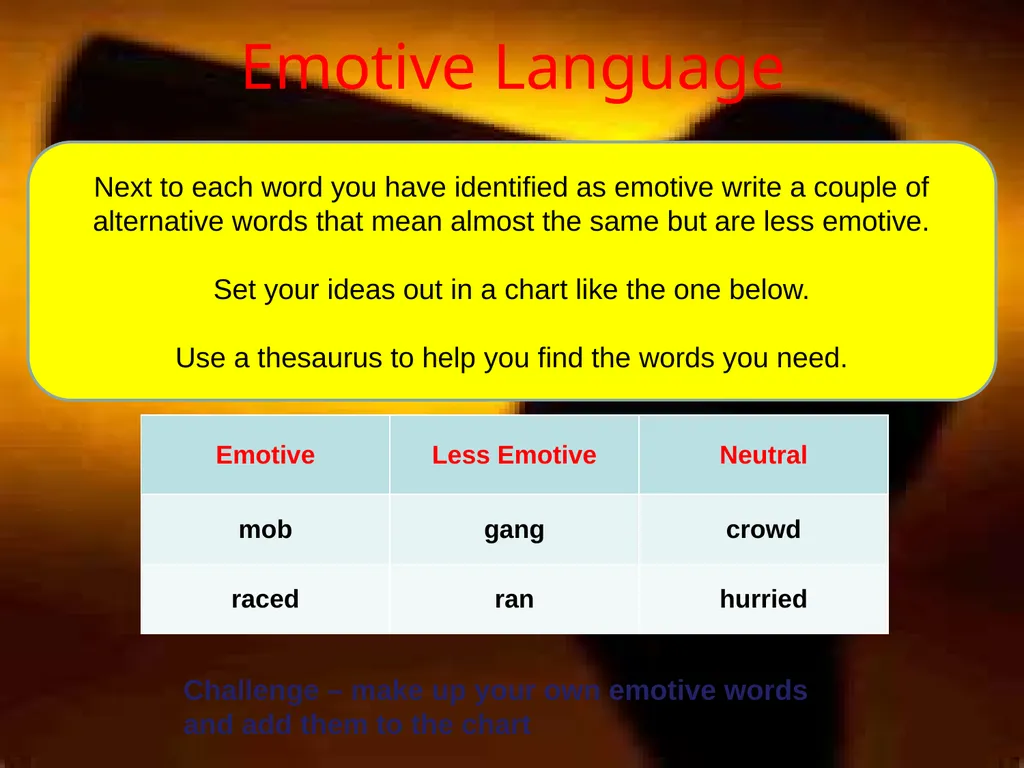
Next to each word you have identified as emotive write a couple of alternative words that mean almost the same but are less emotive.
Set your ideas out in a chart like the one below.
Use a thesaurus to help you find the words you need. Emotive Language Challenge – make up your own emotive words and add them to the chart<br>
Set your ideas out in a chart like the one below.
Use a thesaurus to help you find the words you need. Emotive Language Challenge – make up your own emotive words and add them to the chart<br>
19
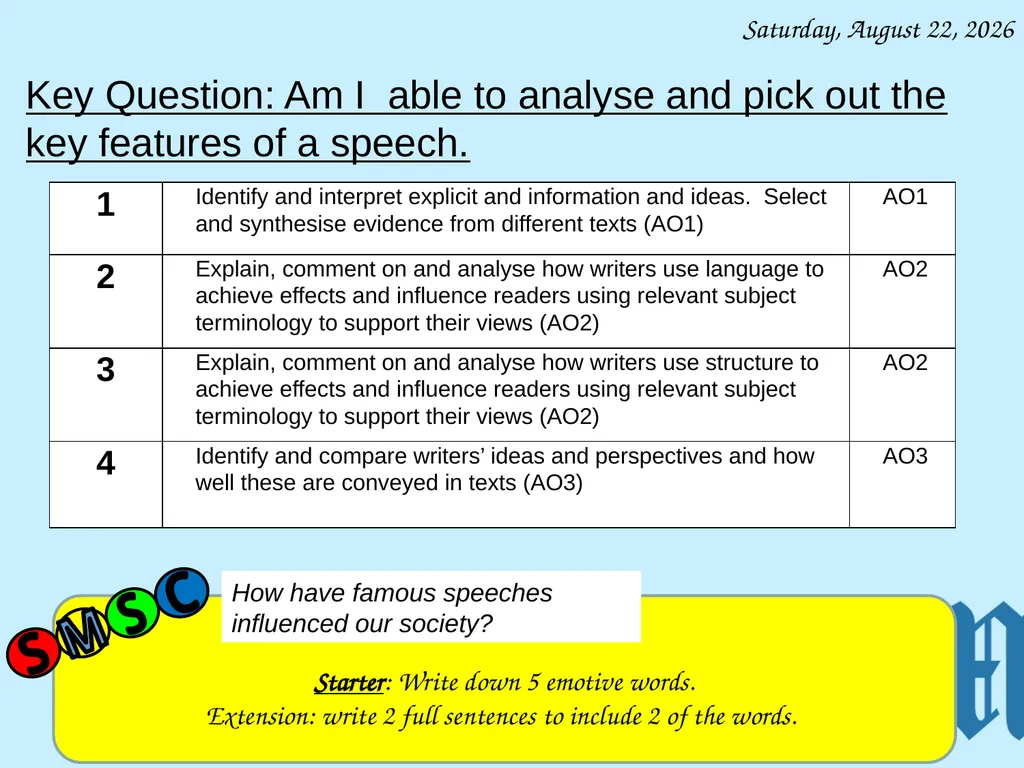
Starter: Write down 5 emotive words.
Extension: write 2 full sentences to include 2 of the words. Tuesday, November 24, 2020 Key Question: Am I able to analyse and pick out the key features of a speech. How have famous speeches influenced our society?<br>
Extension: write 2 full sentences to include 2 of the words. Tuesday, November 24, 2020 Key Question: Am I able to analyse and pick out the key features of a speech. How have famous speeches influenced our society?<br>
20
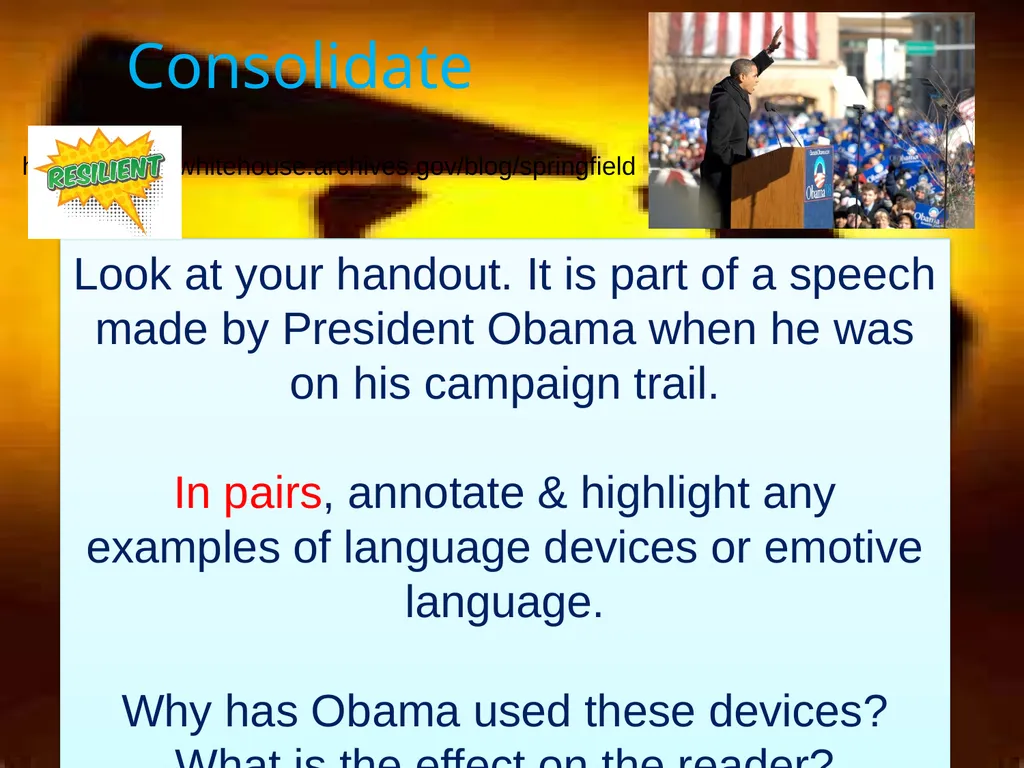
Consolidate Look at your handout. It is part of a speech made by President Obama when he was on his campaign trail.
In pairs, annotate & highlight any examples of language devices or emotive language.
Why has Obama used these devices? What is the effect on the reader? https://obamawhitehouse.archives.gov/blog/springfield<br>
In pairs, annotate & highlight any examples of language devices or emotive language.
Why has Obama used these devices? What is the effect on the reader? https://obamawhitehouse.archives.gov/blog/springfield<br>
21
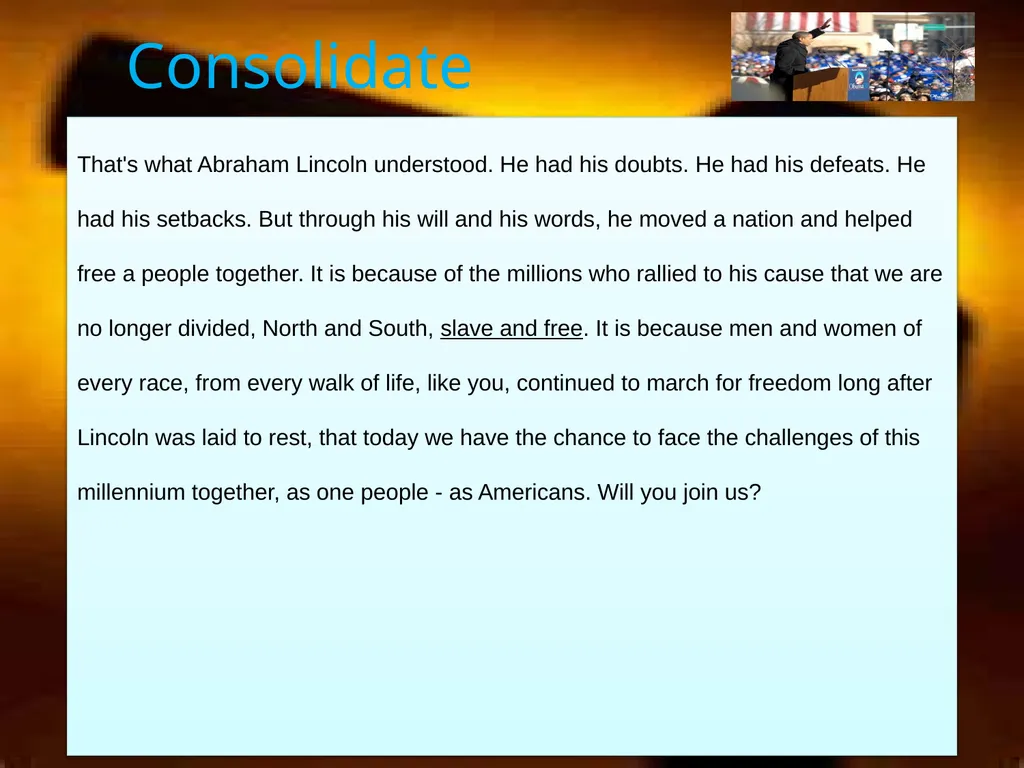
Consolidate That's what Abraham Lincoln understood. He had his doubts. He had his defeats. He had his setbacks. But through his will and his words, he moved a nation and helped free a people together. It is because of the millions who rallied to his cause that we are no longer divided, North and South, slave and free. It is because men and women of every race, from every walk of life, like you, continued to march for freedom long after Lincoln was laid to rest, that today we have the chance to face the challenges of this millennium together, as one people - as Americans. Will you join us?<br>
22
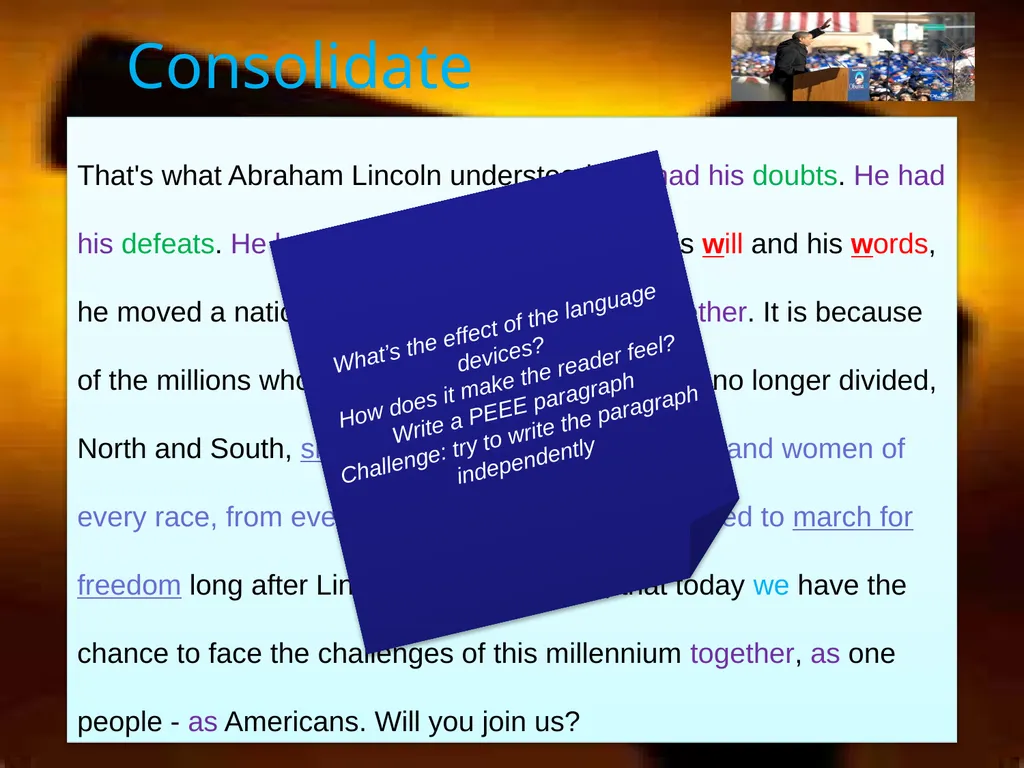
Consolidate That's what Abraham Lincoln understood. He had his doubts. He had his defeats. He had his setbacks. But through his will and his words, he moved a nation and helped free a people together. It is because of the millions who rallied to his cause that we are no longer divided, North and South, slave and free. It is because men and women of every race, from every walk of life, like you, continued to march for freedom long after Lincoln was laid to rest, that today we have the chance to face the challenges of this millennium together, as one people - as Americans. Will you join us? What’s the effect of the language devices?
How does it make the reader feel?
Write a PEEE paragraph
Challenge: try to write the paragraph independently<br>
How does it make the reader feel?
Write a PEEE paragraph
Challenge: try to write the paragraph independently<br>
23
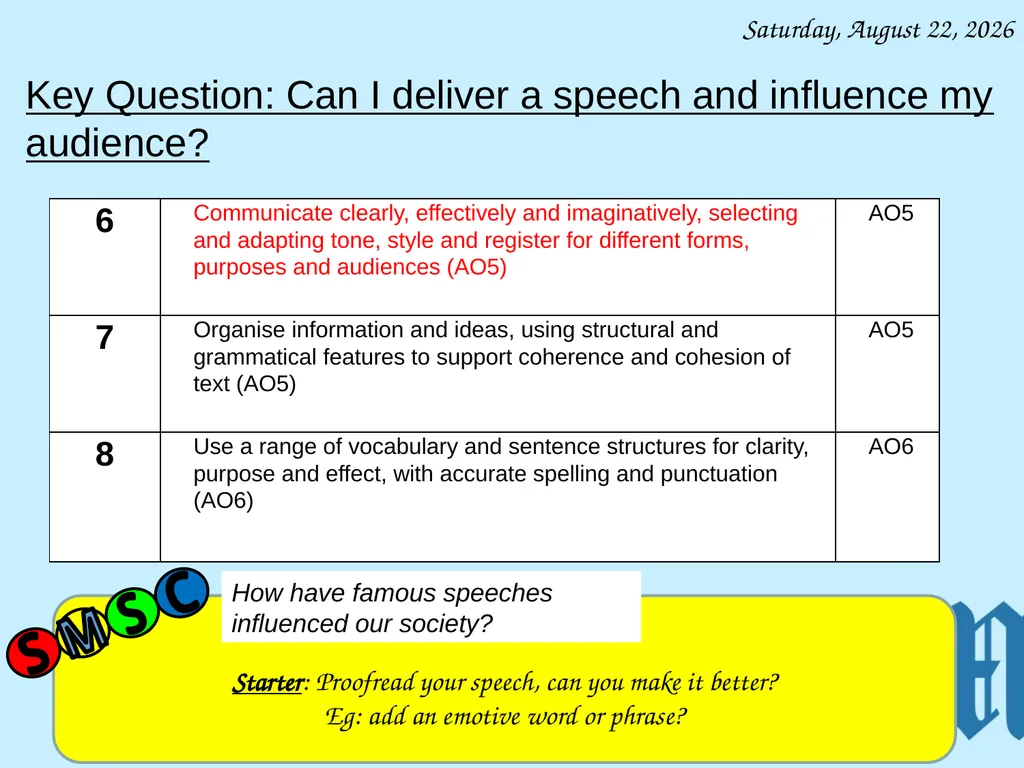
Starter: Proofread your speech, can you make it better?
Eg: add an emotive word or phrase? Tuesday, November 24, 2020 Key Question: Can I deliver a speech and influence my audience? How have famous speeches influenced our society?<br>
Eg: add an emotive word or phrase? Tuesday, November 24, 2020 Key Question: Can I deliver a speech and influence my audience? How have famous speeches influenced our society?<br>
24
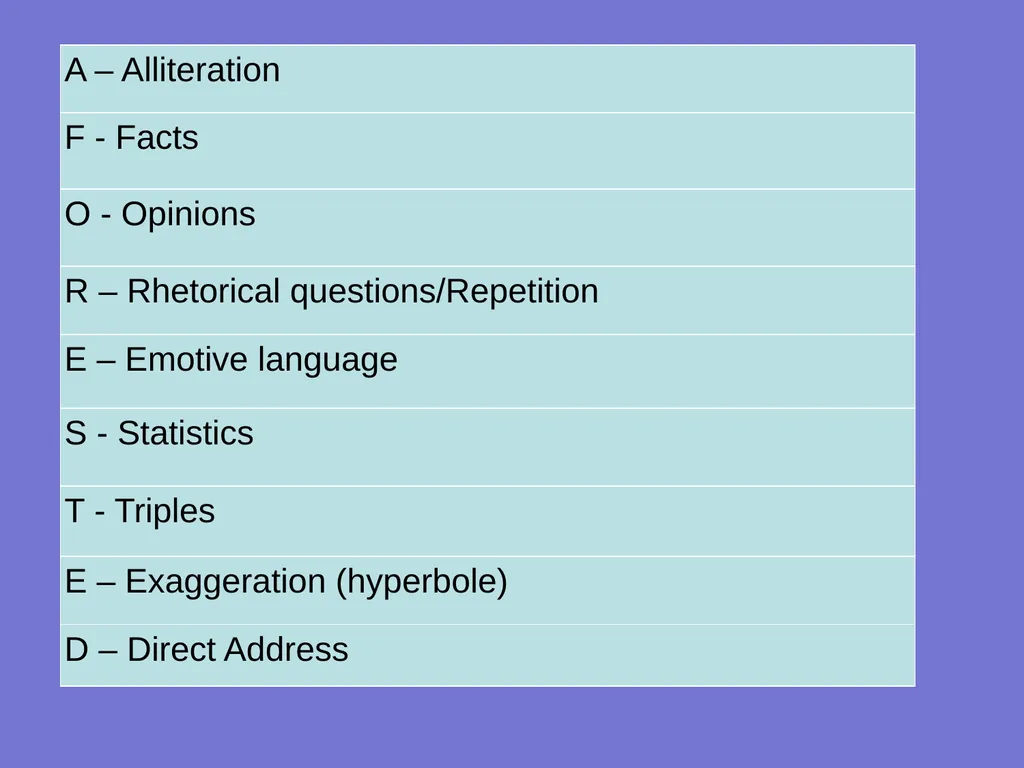
RETRIEVAL –– What does AFOREST stand for?
What is the definition?
What is an example?
What is the effect? Key Question: Am I able to understand purpose, audience and form?<br>
What is the definition?
What is an example?
What is the effect? Key Question: Am I able to understand purpose, audience and form?<br>
25
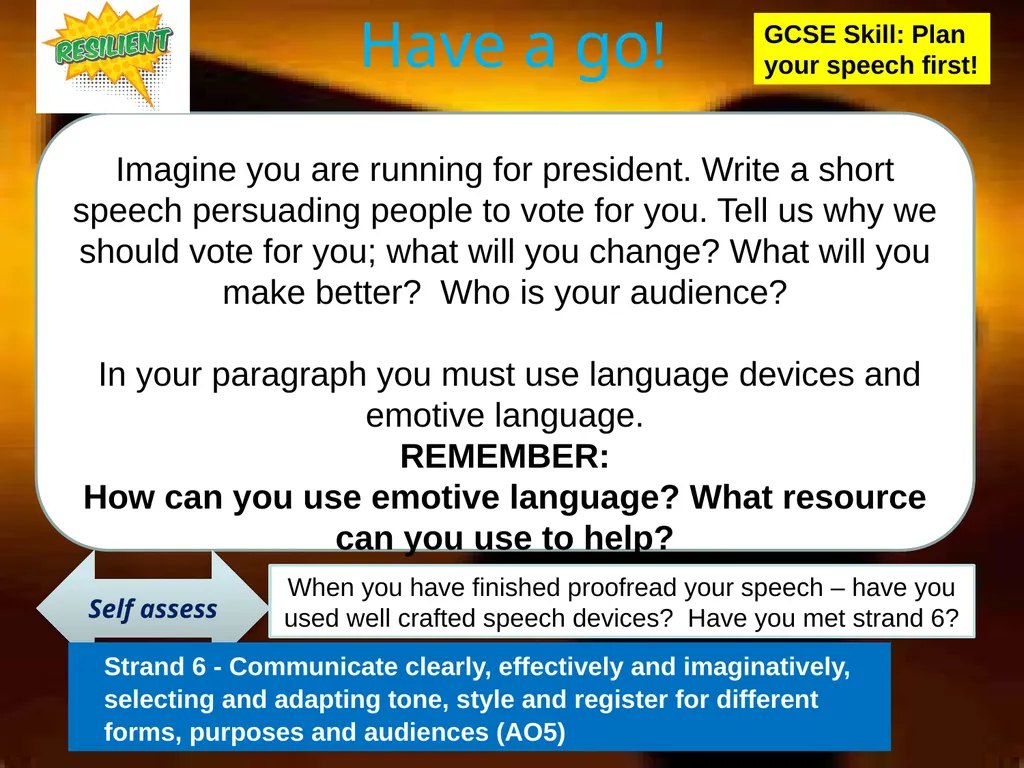
Imagine you are running for president. Write a short speech persuading people to vote for you. Tell us why we should vote for you; what will you change? What will you make better? Who is your audience?
In your paragraph you must use language devices and emotive language.
REMEMBER:
How can you use emotive language? What resource can you use to help? Have a go! Self assess When you have finished proofread your speech – have you used well crafted speech devices? Have you met strand 6? GCSE Skill: Plan your speech first! Strand 6 - Communicate clearly, effectively and imaginatively, selecting and adapting tone, style and register for different forms, purposes and audiences (AO5)<br>
In your paragraph you must use language devices and emotive language.
REMEMBER:
How can you use emotive language? What resource can you use to help? Have a go! Self assess When you have finished proofread your speech – have you used well crafted speech devices? Have you met strand 6? GCSE Skill: Plan your speech first! Strand 6 - Communicate clearly, effectively and imaginatively, selecting and adapting tone, style and register for different forms, purposes and audiences (AO5)<br>
26
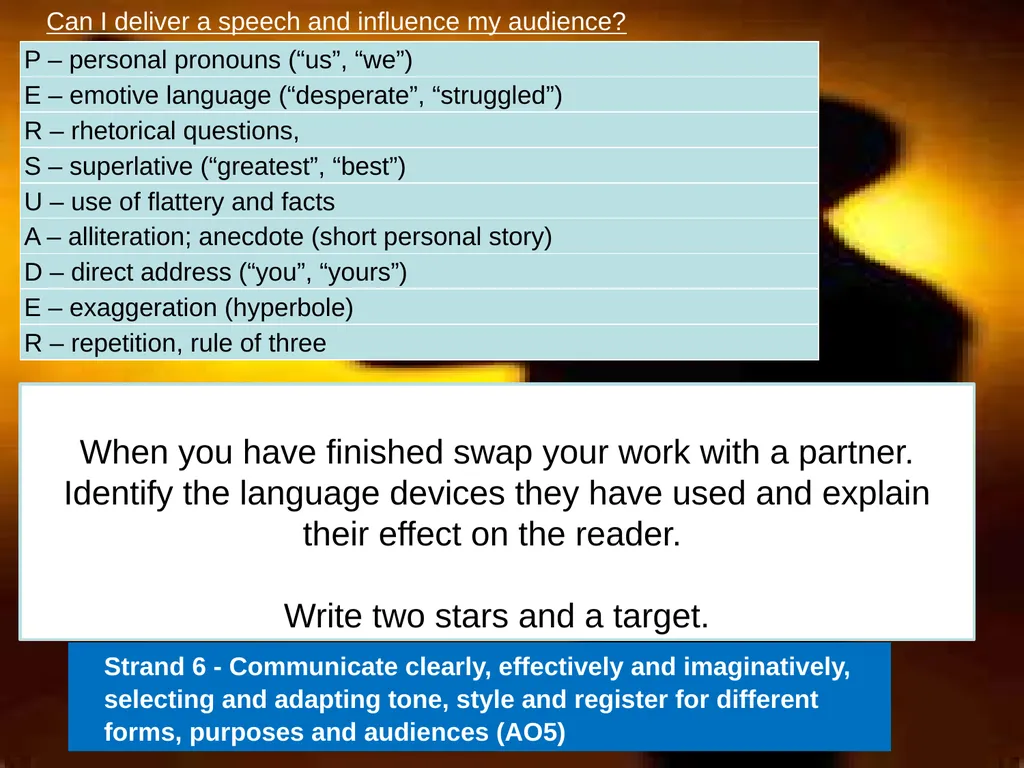
When you have finished swap your work with a partner. Identify the language devices they have used and explain their effect on the reader.
Write two stars and a target. Can I deliver a speech and influence my audience? Strand 6 - Communicate clearly, effectively and imaginatively, selecting and adapting tone, style and register for different forms, purposes and audiences (AO5)<br>
Write two stars and a target. Can I deliver a speech and influence my audience? Strand 6 - Communicate clearly, effectively and imaginatively, selecting and adapting tone, style and register for different forms, purposes and audiences (AO5)<br>