
Spinal cord reflexes Lecture1 and 2 Mustafa



Description: Spinal cord reflexes Lecture1 and 2 Mustafa Al-Badran CABM FIBMS Department of Medicine College of Medicine University of Basrah Objectives 1. Reflex Arc 2. Types of Reflex arch 3. Stretch reflex components and physiology 4. Golgi tendons
Related Topics
Download Presentation
"Spinal cord reflexes Lecture1 and 2 Mustafa" is the property of its rightful owner. Permission is granted to download and print the materials on this website for personal, non-commercial use only, and to display it on your personal computer provided you do not modify the materials and that you retain all copyright notices contained in the materials. By downloading content from our website, you accept the terms of this agreement.
Presentation Transcript
slide1. Spinal cord reflexes
Lecture1 and 2 Mustafa Al-Badran CABM FIBMS
Department of Medicine
College of Medicine\ University of Basrah<br>
slide2. Objectives 1. Reflex Arc
2. Types of Reflex arch
3. Stretch reflex components and physiology
4. Golgi tendons
5. Component and Mechanism of inverse stretch reflex
6. Withdrawal reflex University of Basrah-College of Medicine-Physiology Department 1<br>
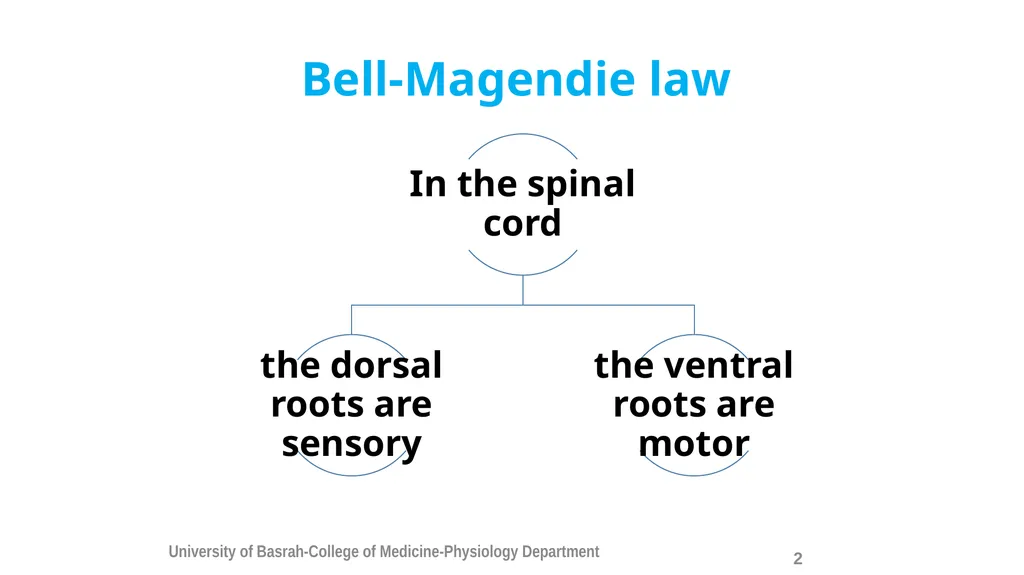
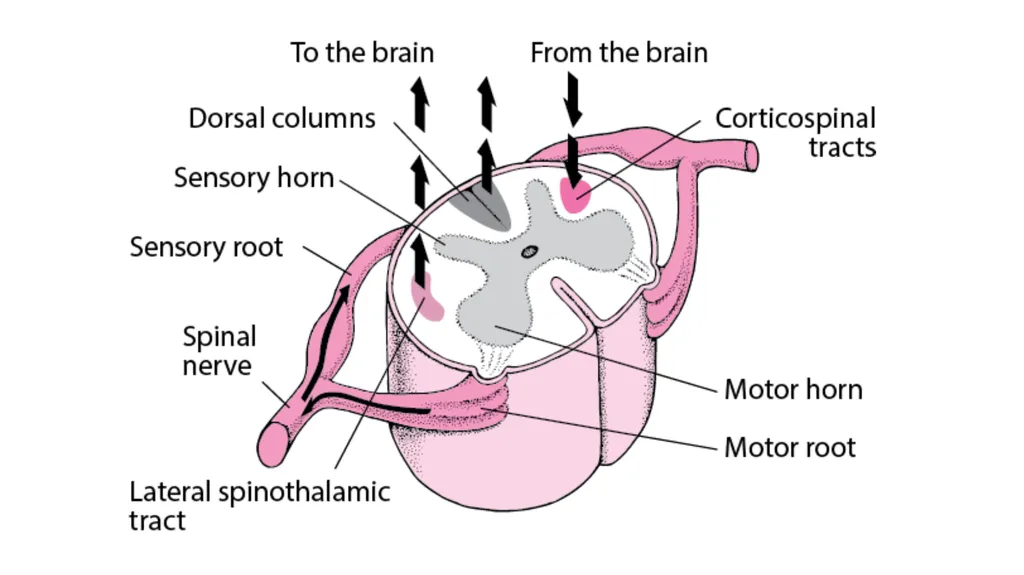
slide3. Bell-Magendie law 2 University of Basrah-College of Medicine-Physiology Department<br>
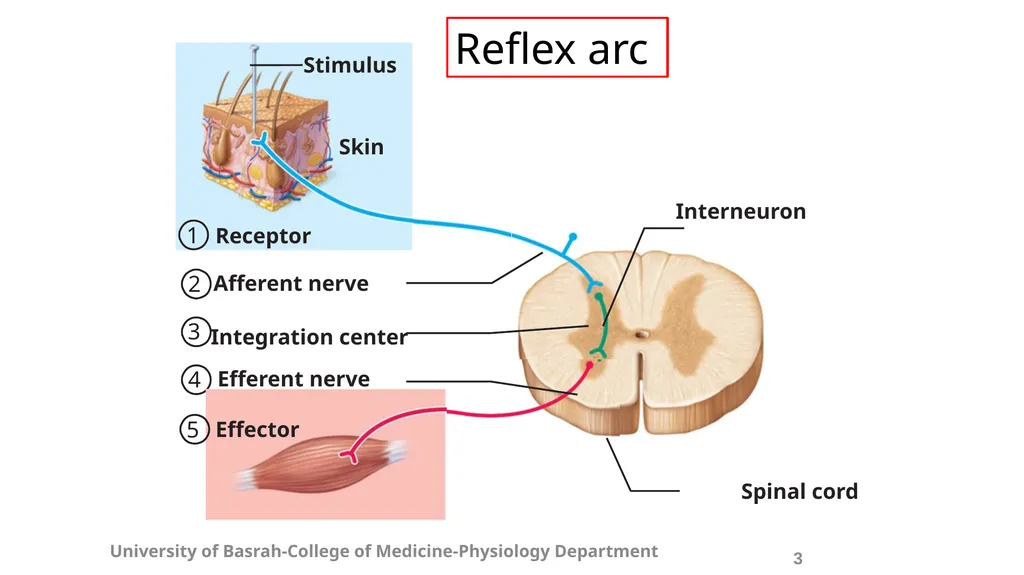
slide5. Integration center Spinal cord Interneuron 3 4 5 Receptor Stimulus Skin 1 2 Afferent nerve Effector Efferent nerve Reflex arc 3 University of Basrah-College of Medicine-Physiology Department<br>
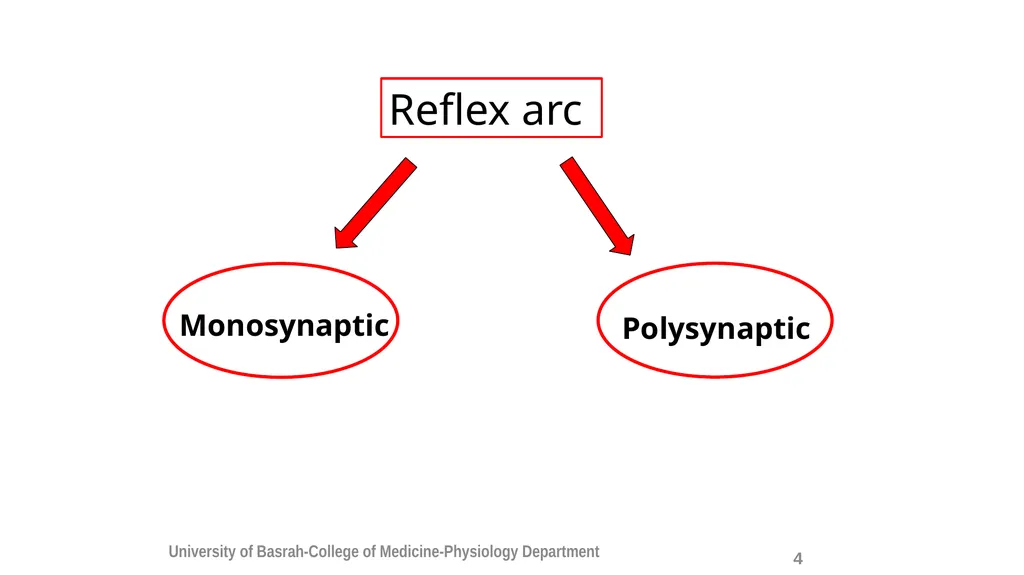
slide6. Reflex arc Monosynaptic Polysynaptic 4 University of Basrah-College of Medicine-Physiology Department<br>
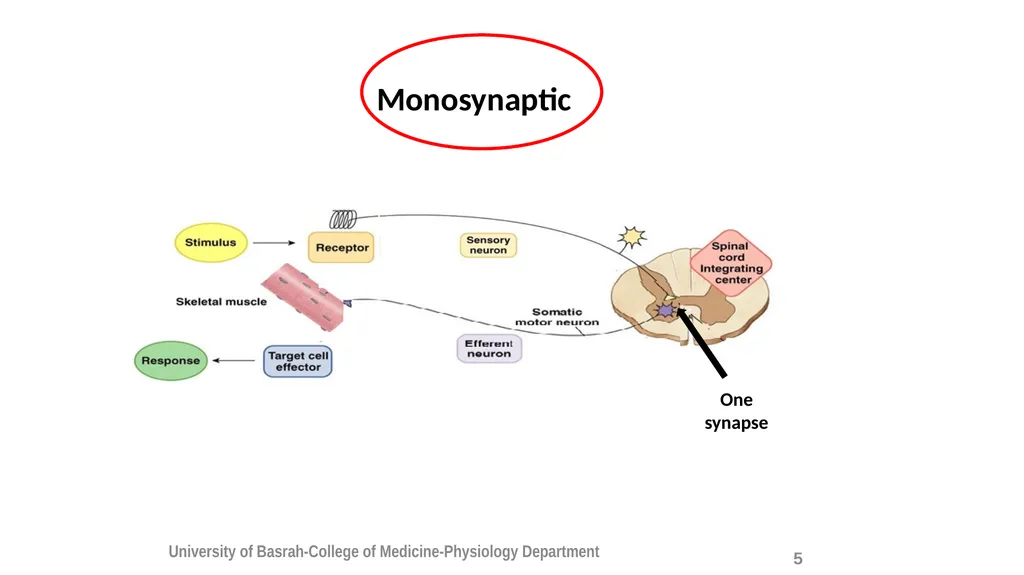
slide7. One synapse Monosynaptic 5 University of Basrah-College of Medicine-Physiology Department<br>
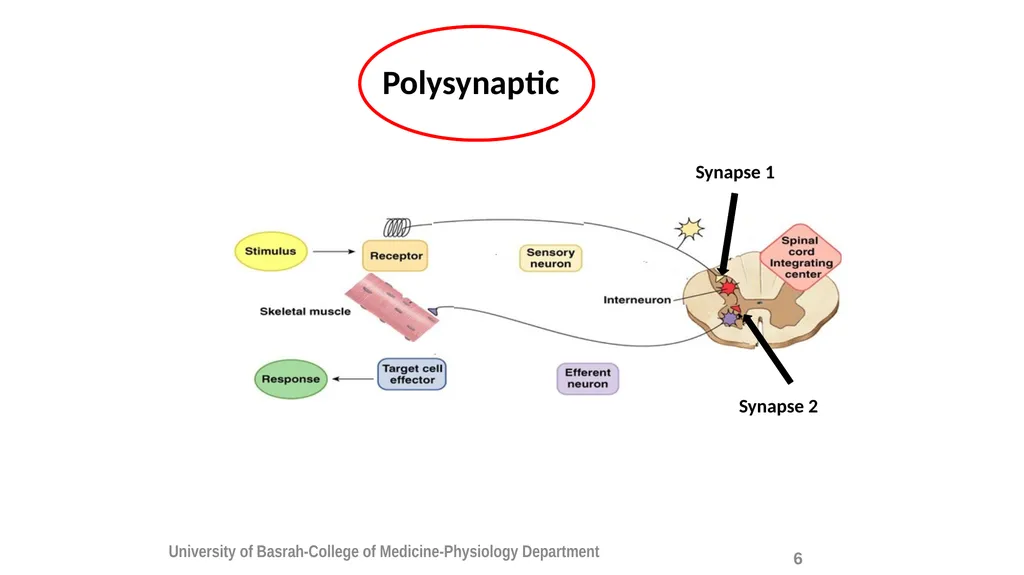
slide8. Synapse 2 Polysynaptic Synapse 1 6 University of Basrah-College of Medicine-Physiology Department<br>
slide9. Monosynaptic Stretch reflex 7 University of Basrah-College of Medicine-Physiology Department<br>
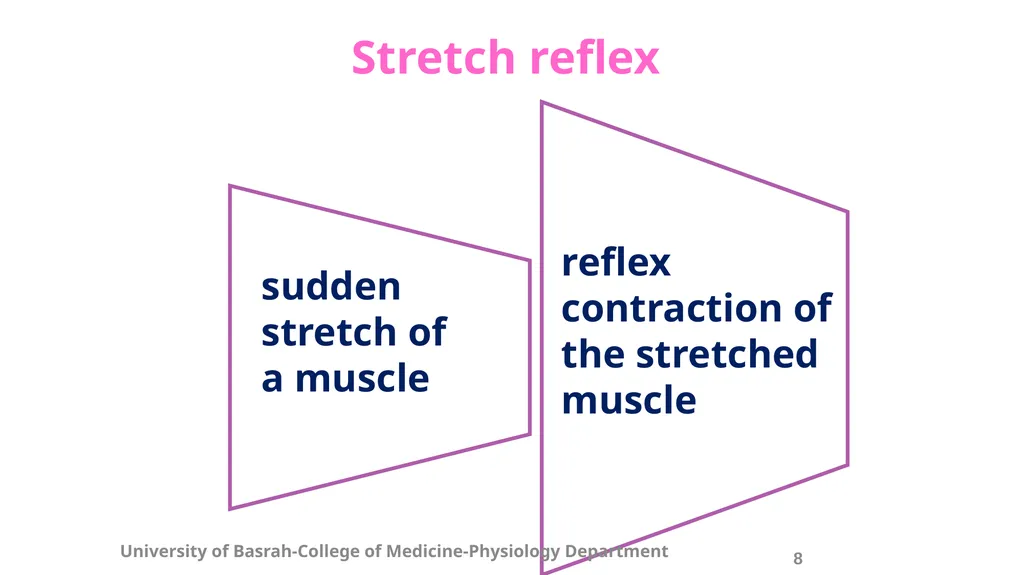
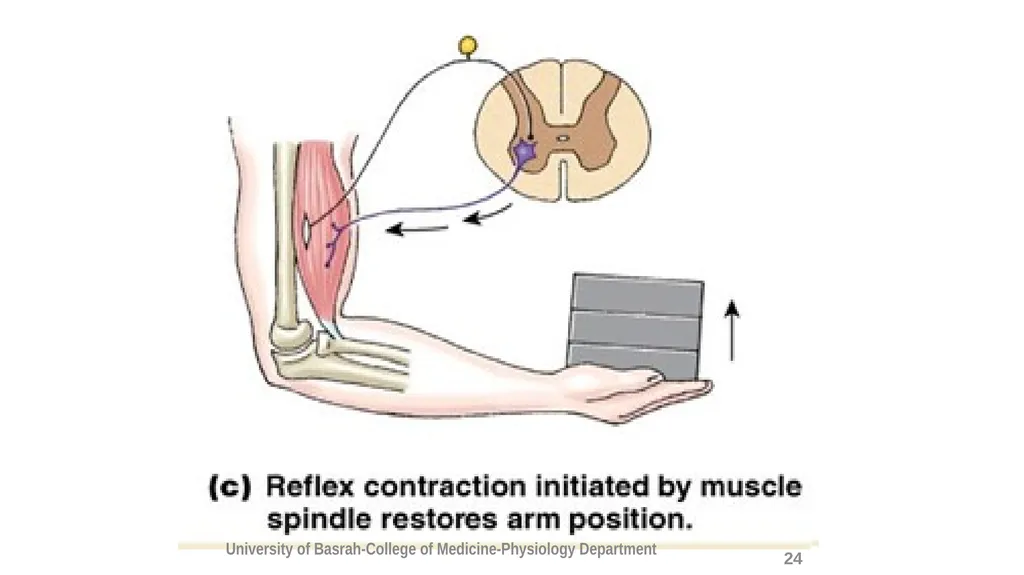
slide10. Stretch reflex sudden stretch of a muscle reflex contraction of the stretched muscle 8 University of Basrah-College of Medicine-Physiology Department<br>
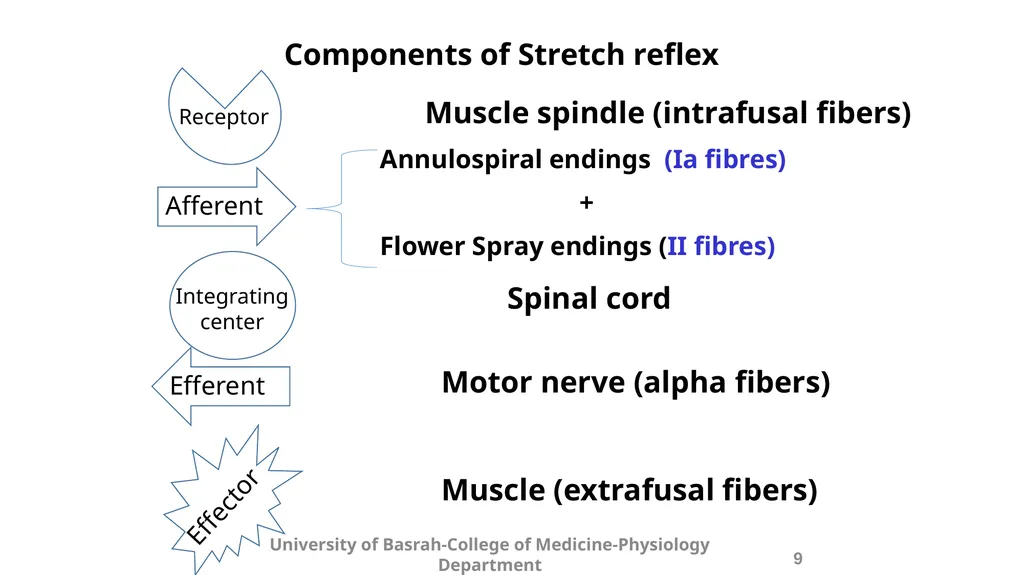
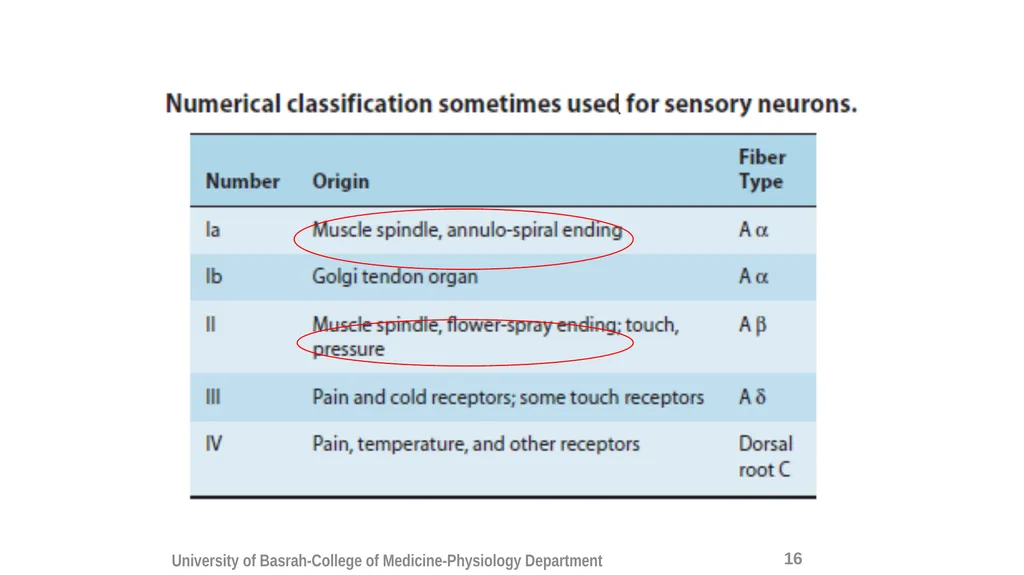
slide11. Components of Stretch reflex Receptor Afferent Integrating center Effector Efferent Muscle spindle (intrafusal fibers) Spinal cord Annulospiral endings (Ia fibres)
+
Flower Spray endings (II fibres) Motor nerve (alpha fibers) Muscle (extrafusal fibers) 9 University of Basrah-College of Medicine-Physiology Department<br>
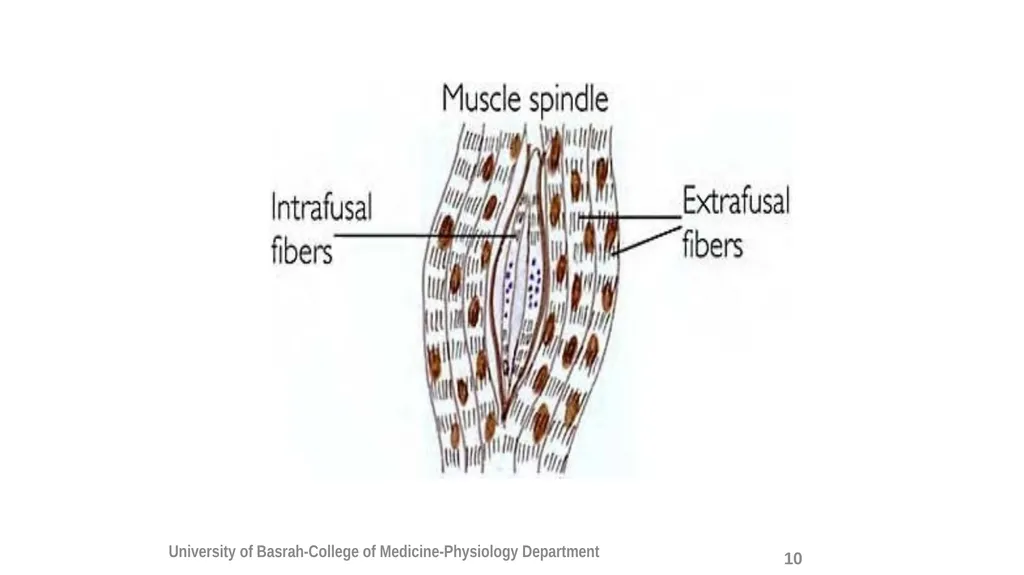
slide12. 10 University of Basrah-College of Medicine-Physiology Department<br>
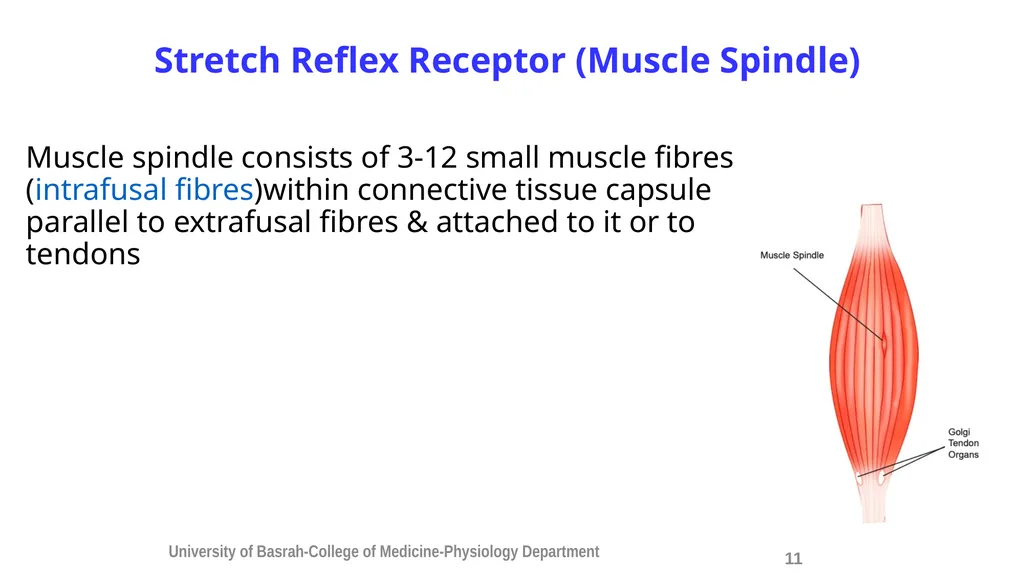
slide13. Stretch Reflex Receptor (Muscle Spindle) Muscle spindle consists of 3-12 small muscle fibres (intrafusal fibres)within connective tissue capsule parallel to extrafusal fibres & attached to it or to tendons 11 University of Basrah-College of Medicine-Physiology Department<br>
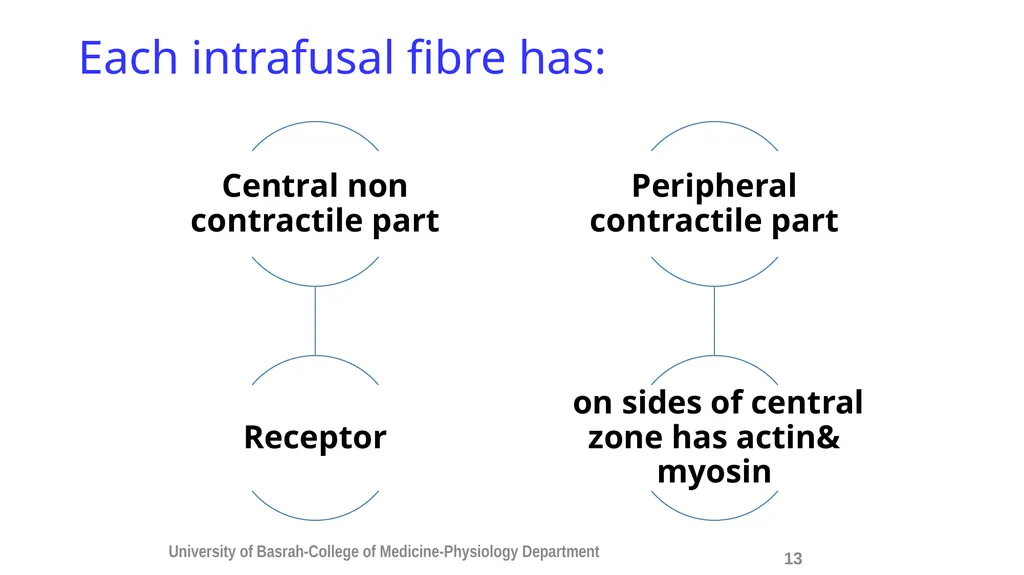
slide14. Each intrafusal fibre has: 13 University of Basrah-College of Medicine-Physiology Department<br>
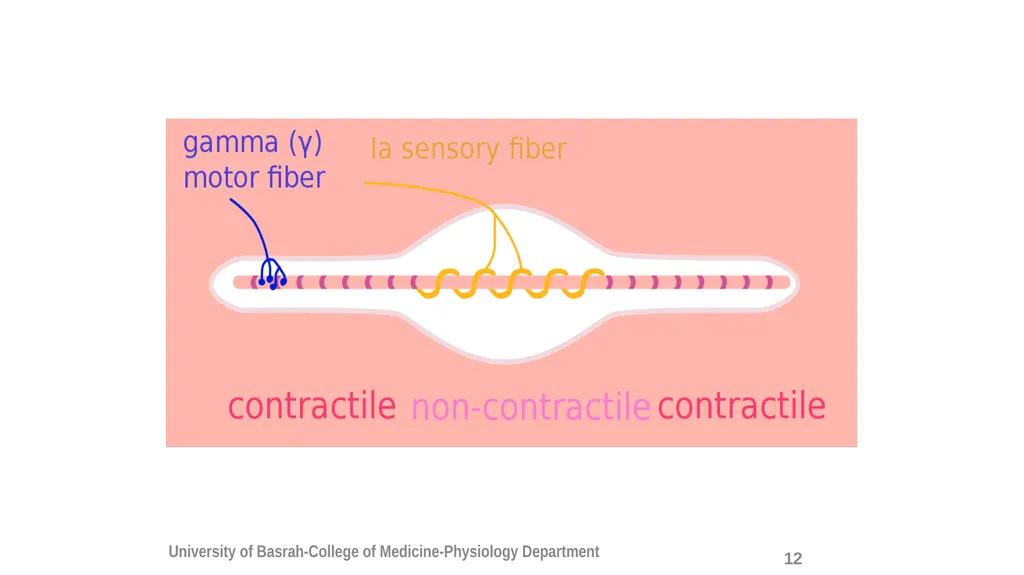
slide15. 12 University of Basrah-College of Medicine-Physiology Department<br>
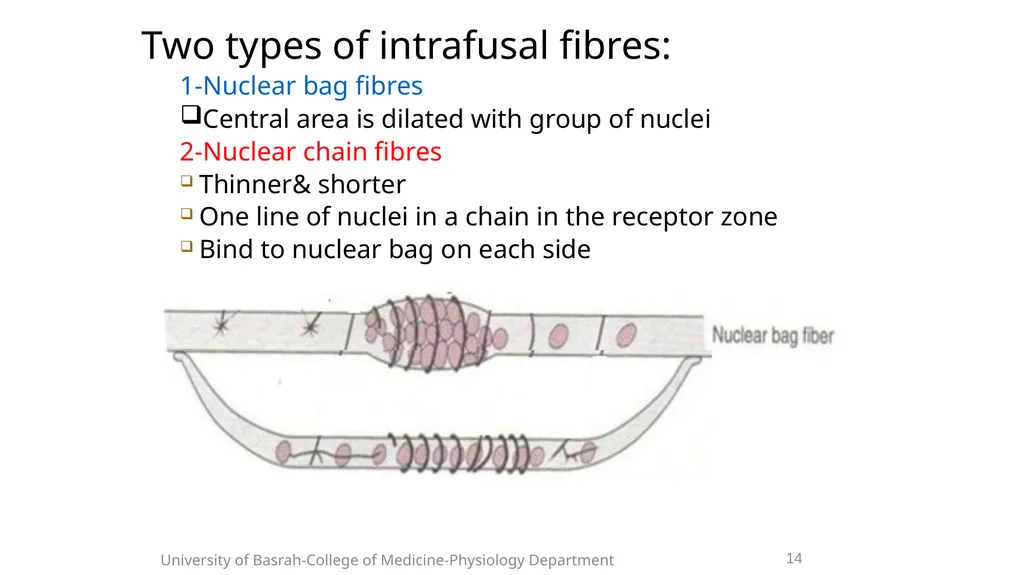
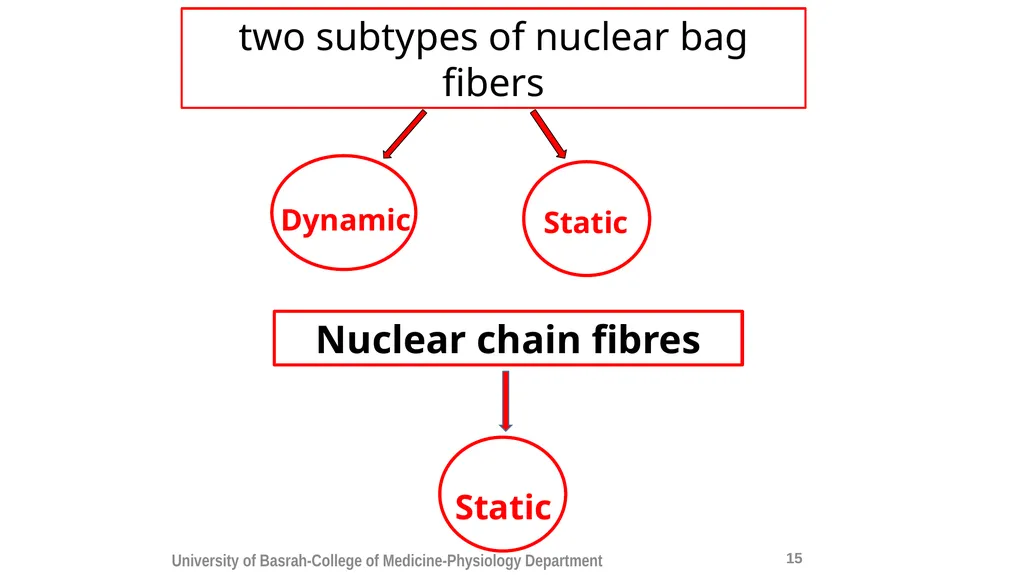
slide16. Two types of intrafusal fibres:
1-Nuclear bag fibres
Central area is dilated with group of nuclei
2-Nuclear chain fibres
Thinner& shorter
One line of nuclei in a chain in the receptor zone
Bind to nuclear bag on each side 14 University of Basrah-College of Medicine-Physiology Department<br>
slide17. two subtypes of nuclear bag fibers Dynamic Static Nuclear chain fibres Static 15 University of Basrah-College of Medicine-Physiology Department<br>
slide18. 16 University of Basrah-College of Medicine-Physiology Department<br>
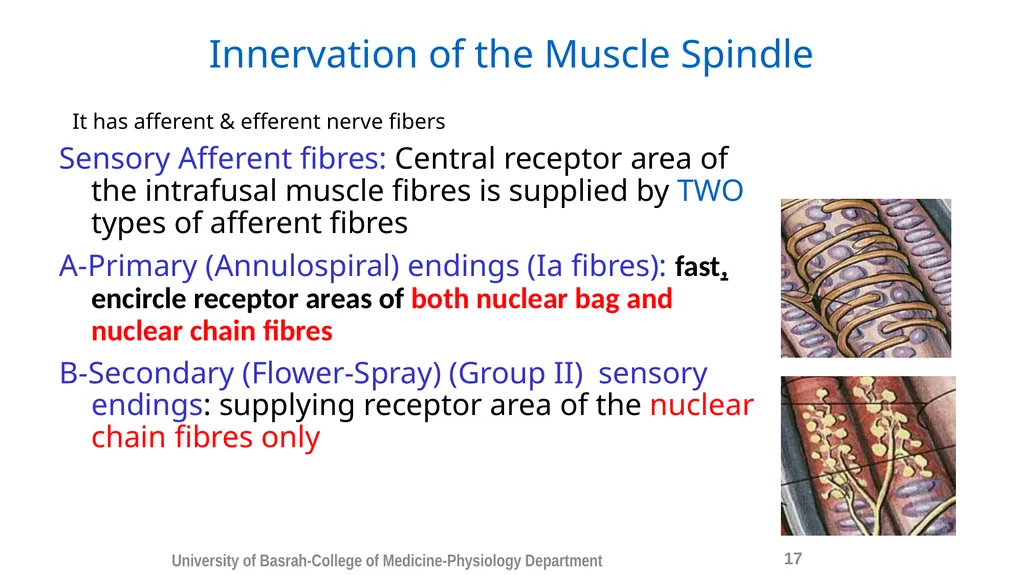
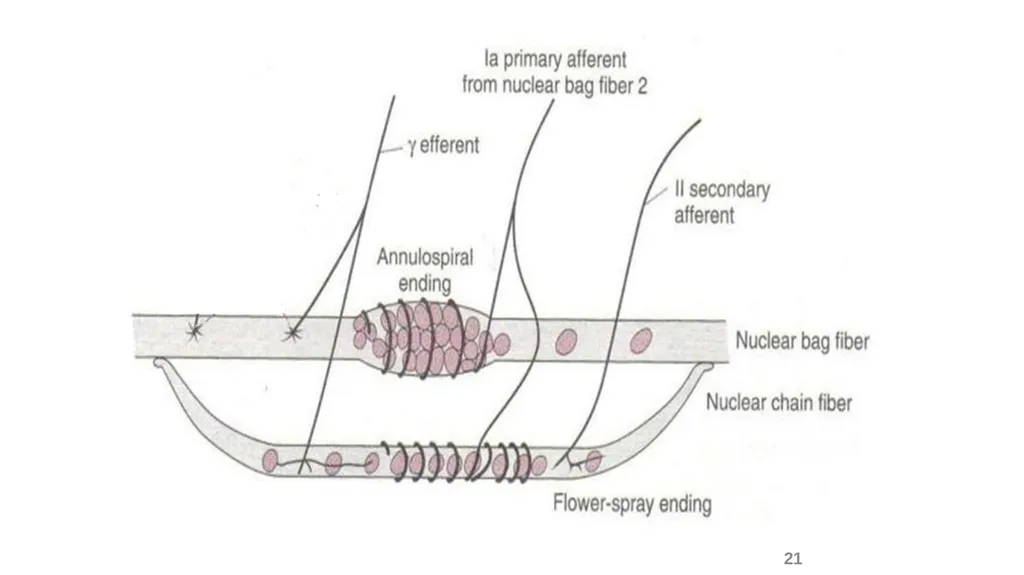
slide19. Innervation of the Muscle Spindle Sensory Afferent fibres: Central receptor area of the intrafusal muscle fibres is supplied by TWO types of afferent fibres
A-Primary (Annulospiral) endings (Ia fibres): fast, encircle receptor areas of both nuclear bag and nuclear chain fibres
B-Secondary (Flower-Spray) (Group II) sensory endings: supplying receptor area of the nuclear chain fibres only 17 University of Basrah-College of Medicine-Physiology Department It has afferent & efferent nerve fibers<br>
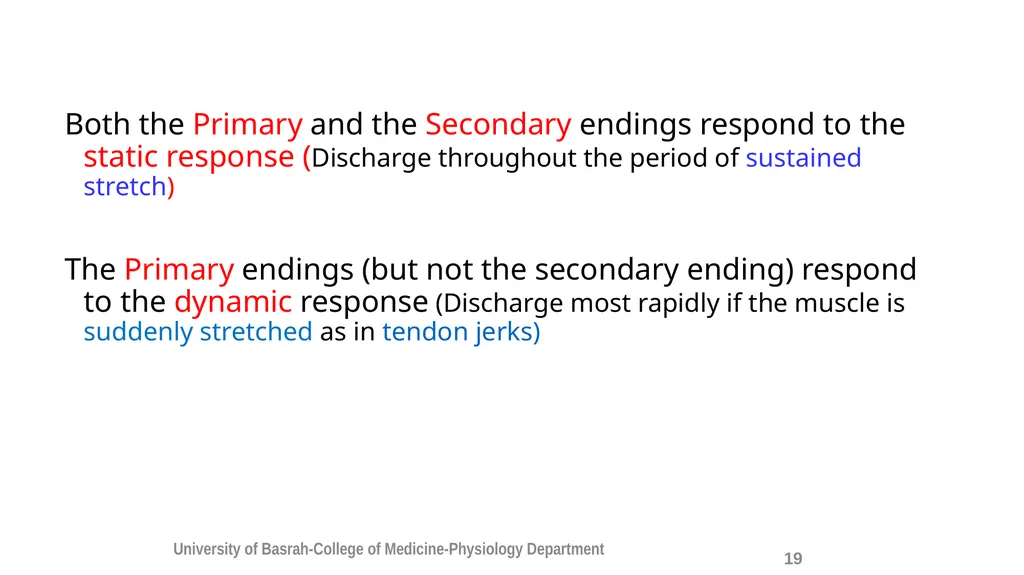
slide20. Both the Primary and the Secondary endings respond to the static response (Discharge throughout the period of sustained stretch)
The Primary endings (but not the secondary ending) respond to the dynamic response (Discharge most rapidly if the muscle is suddenly stretched as in tendon jerks) 19 University of Basrah-College of Medicine-Physiology Department<br>
slide21. Efferent fibres to spindle (Anterior Motor Neurons)
Gamma motor neurons >>>>gamma efferent 30% >>>>> to the peripheral contractile parts of the intrafusal muscle fibres
70% >>> Alpha efferent to extrafusal muscle fibres Effect of Gamma efferent discharge:- Gamma efferent increase sensitivity of muscle spindle to stretch 20<br>
slide22. 21<br>
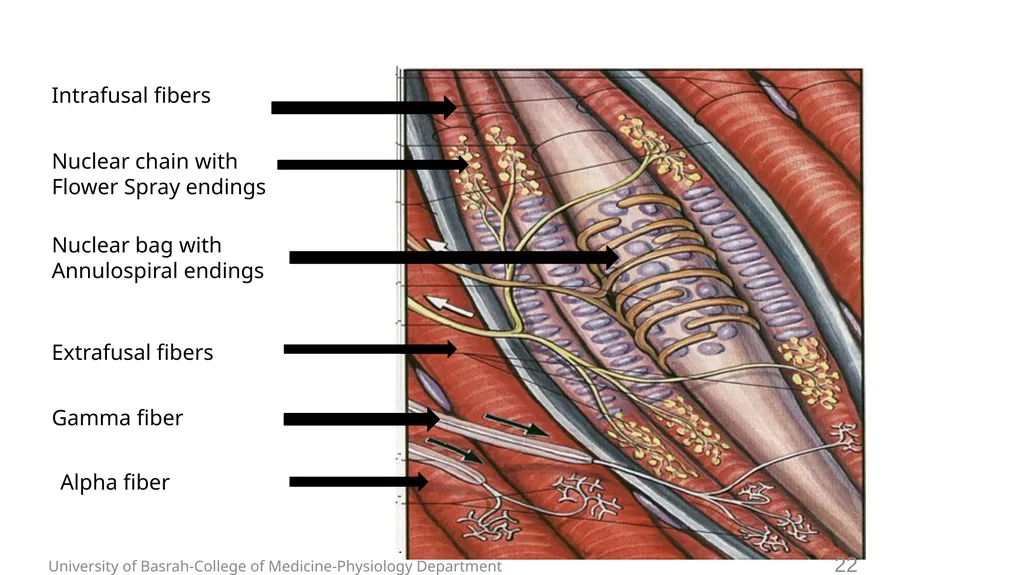
slide23. Extrafusal fibers Intrafusal fibers Gamma fiber Alpha fiber Nuclear chain with
Flower Spray endings Nuclear bag with Annulospiral endings 22 University of Basrah-College of Medicine-Physiology Department<br>
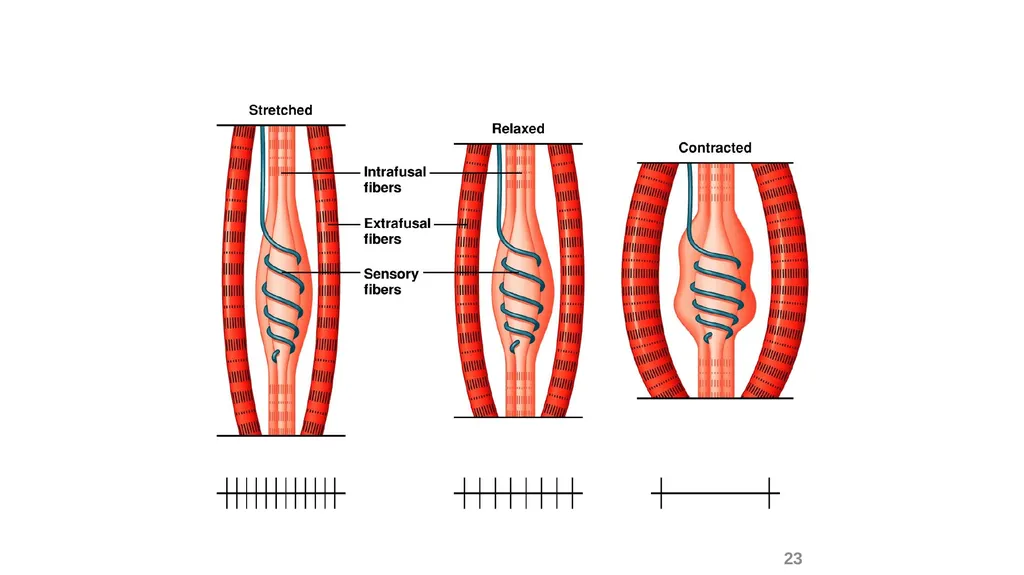
slide24. 23<br>
slide25. + + + + 24 University of Basrah-College of Medicine-Physiology Department<br>
slide26. Types of responses (Component of stretch reflex) 1-Dynamic stretch reflex (Dynamic Response) Sudden rapid stretch of a muscle >>>>> Jerk movement 25 University of Basrah-College of Medicine-Physiology Department<br>
slide27. This is the basis of Tendon Jerk
( contraction followed by relaxation) When muscle contract, it shortens, muscle spindle relax>>> no discharge of nerve endings, and muscle relax Why relaxation follow the contraction? 26 University of Basrah-College of Medicine-Physiology Department<br>
slide28. 2- Static stretch reflex(Static Response)
Mild sustained contraction of muscle extrafusal fibers as long as it is stretched (Basis of muscle tone) 27 University of Basrah-College of Medicine-Physiology Department<br>
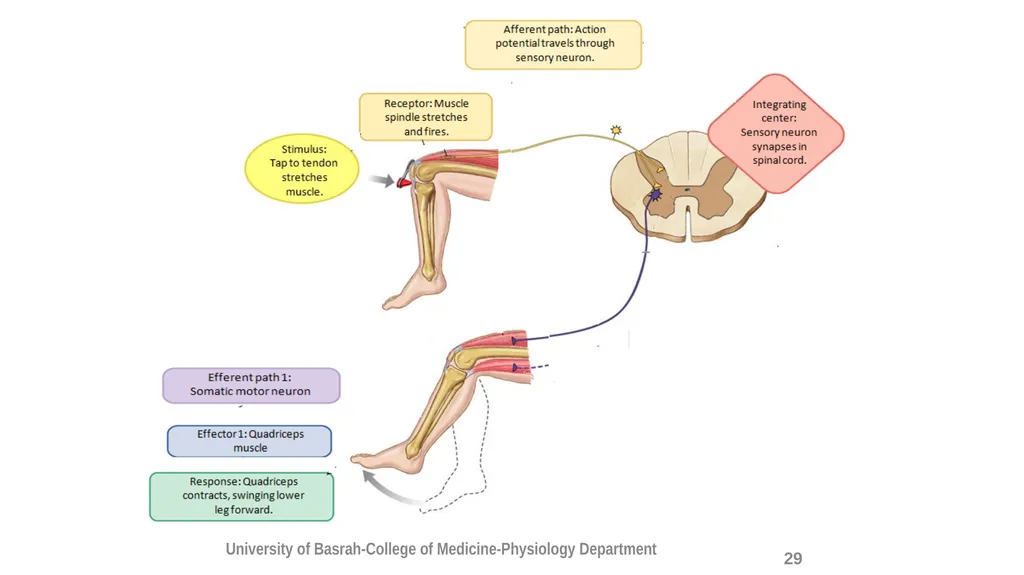
slide29. knee jerk Clinical example of stretch reflex 28 University of Basrah-College of Medicine-Physiology Department<br>
slide30. 29 University of Basrah-College of Medicine-Physiology Department<br>
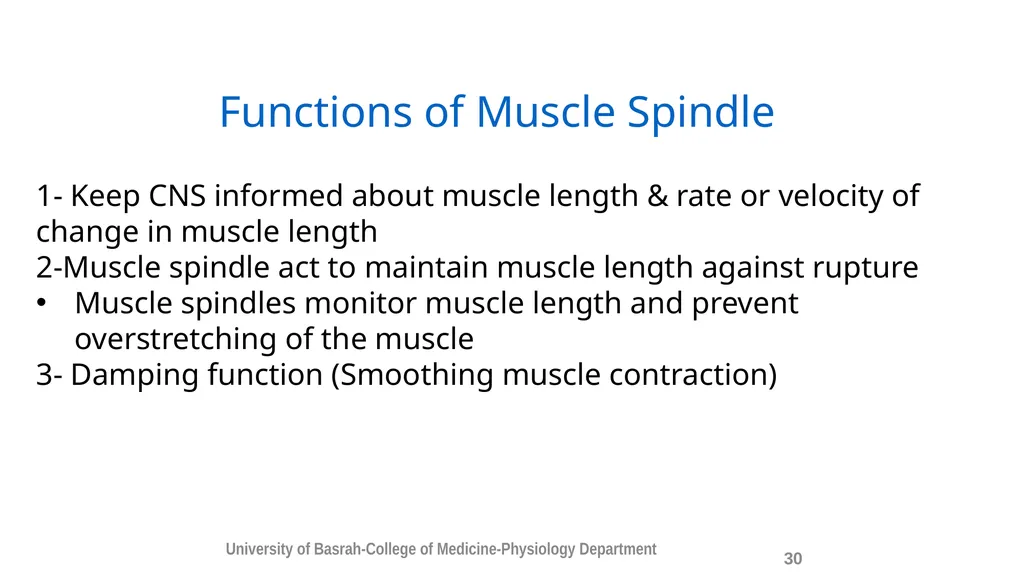
slide31. Functions of Muscle Spindle
1- Keep CNS informed about muscle length & rate or velocity of change in muscle length
2-Muscle spindle act to maintain muscle length against rupture
Muscle spindles monitor muscle length and prevent overstretching of the muscle
3- Damping function (Smoothing muscle contraction) 30 University of Basrah-College of Medicine-Physiology Department<br>
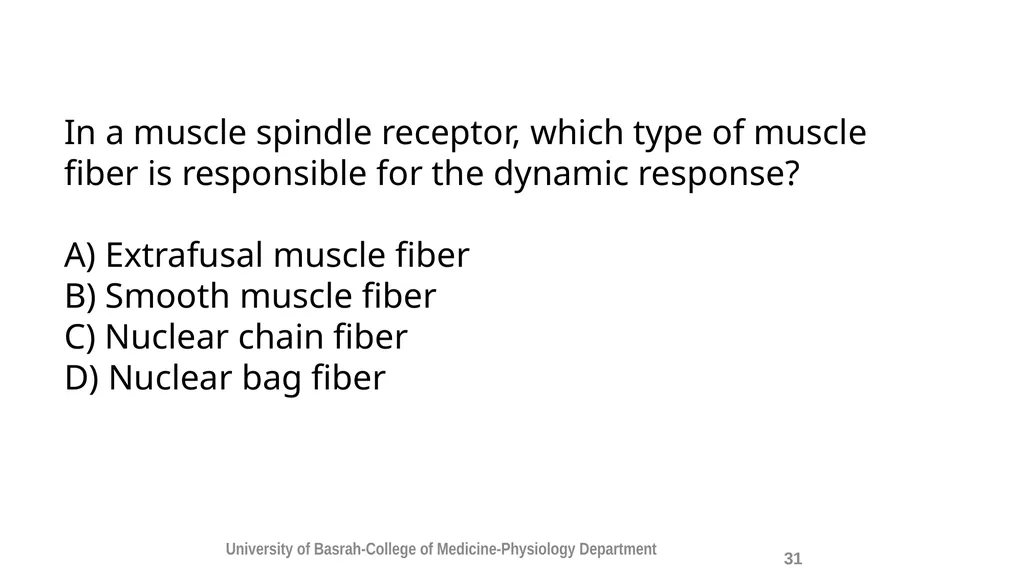
slide32. In a muscle spindle receptor, which type of muscle fiber is responsible for the dynamic response?
A) Extrafusal muscle fiber
B) Smooth muscle fiber
C) Nuclear chain fiber
D) Nuclear bag fiber 31 University of Basrah-College of Medicine-Physiology Department<br>
slide33. Reciprocal inhibition with Stretch Reflex Reflex contraction of an agonistic muscle is accompanied by inhibition of the antagonistic muscle ex: (contraction of biceps + inhibition of the triceps) 32 University of Basrah-College of Medicine-Physiology Department<br>
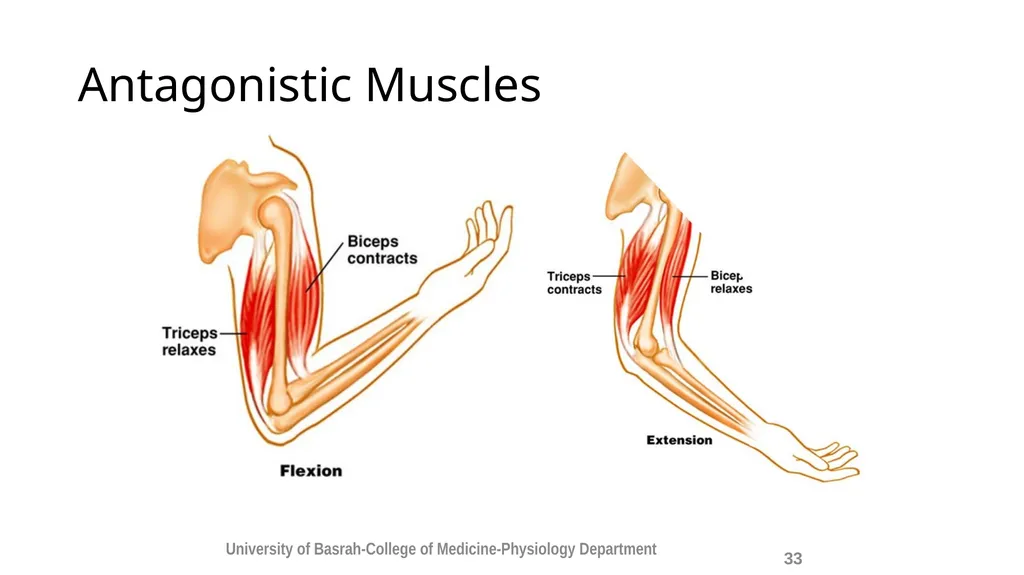
slide34. Antagonistic Muscles 33 University of Basrah-College of Medicine-Physiology Department<br>
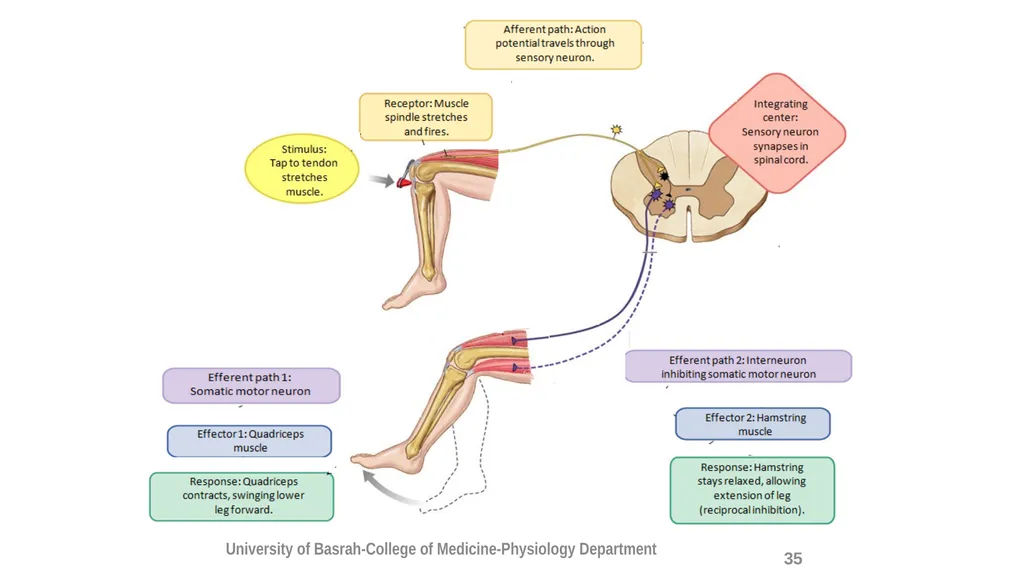
slide35. Impulses from stretched muscle>>>> Spinal cord to cause:-
1-Stimulate the motor neurons of the stimulated muscle
2- Send collaterals >>>> Inhibitory Interneurons synapse on the AHCs of the antagonistic muscle & inhibit them 34 University of Basrah-College of Medicine-Physiology Department<br>
slide36. 35 University of Basrah-College of Medicine-Physiology Department<br>
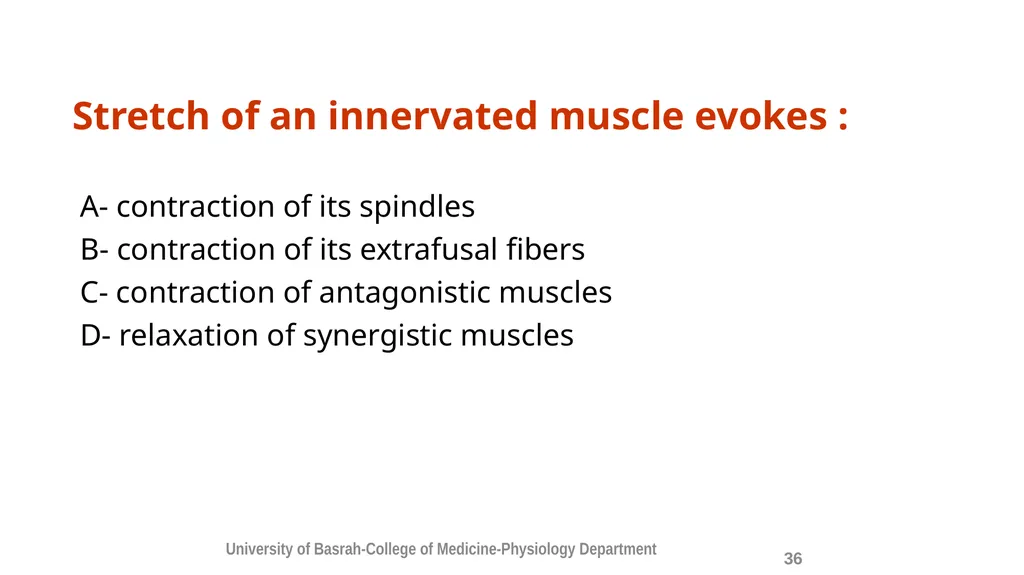
slide37. Stretch of an innervated muscle evokes :
A- contraction of its spindles
B- contraction of its extrafusal fibers
C- contraction of antagonistic muscles
D- relaxation of synergistic muscles 36 University of Basrah-College of Medicine-Physiology Department<br>
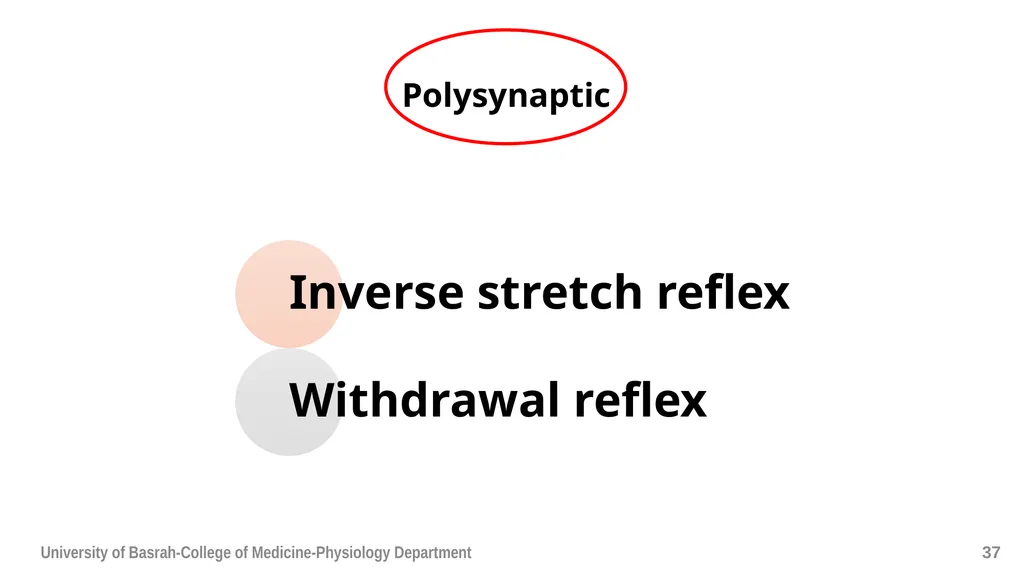
slide38. Polysynaptic University of Basrah-College of Medicine-Physiology Department 37<br>
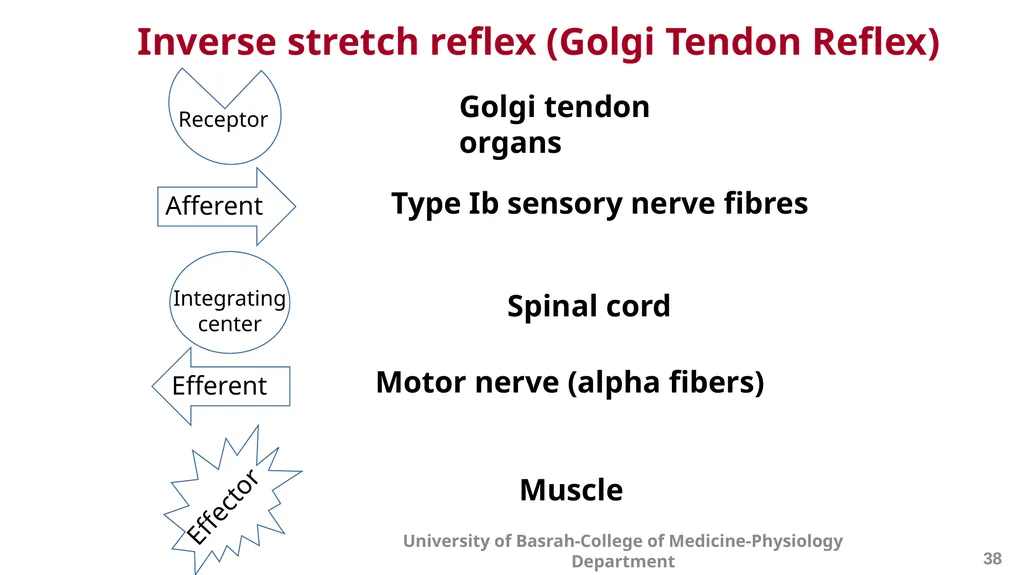
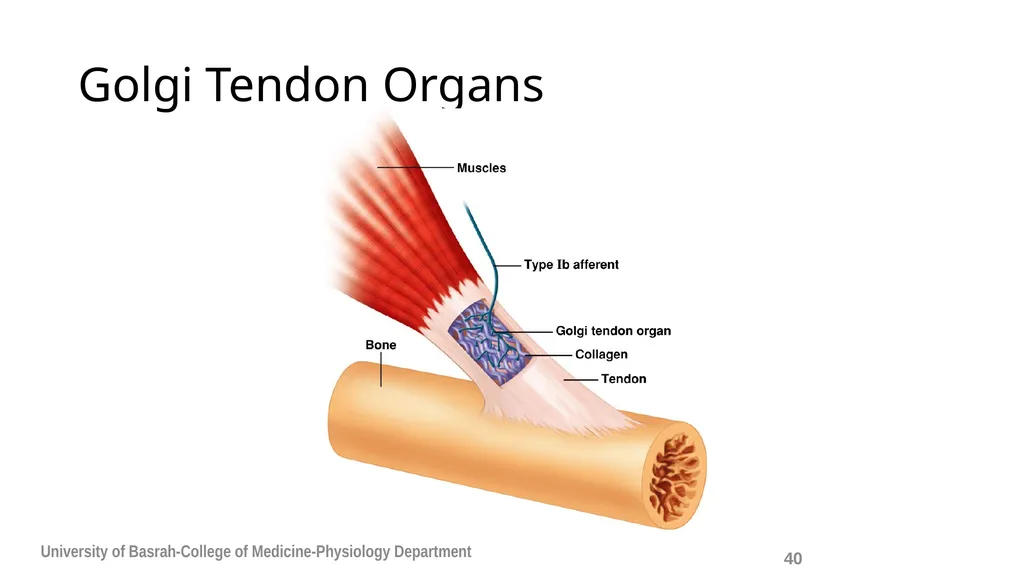
slide39. Inverse stretch reflex (Golgi Tendon Reflex) Receptor Afferent Integrating center Effector Efferent Spinal cord Type Ib sensory nerve fibres Motor nerve (alpha fibers) Muscle Golgi tendon organs University of Basrah-College of Medicine-Physiology Department 38<br>
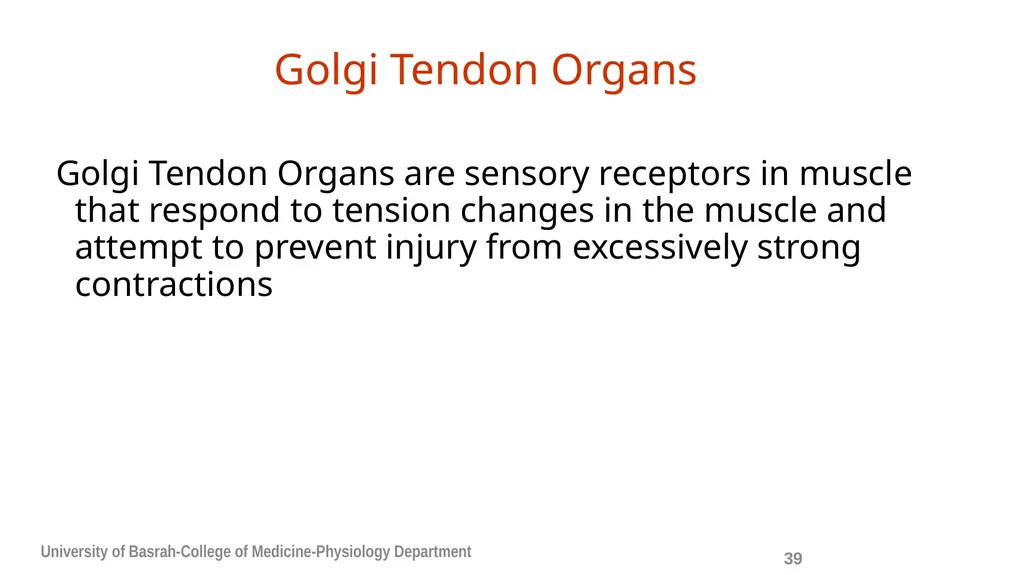
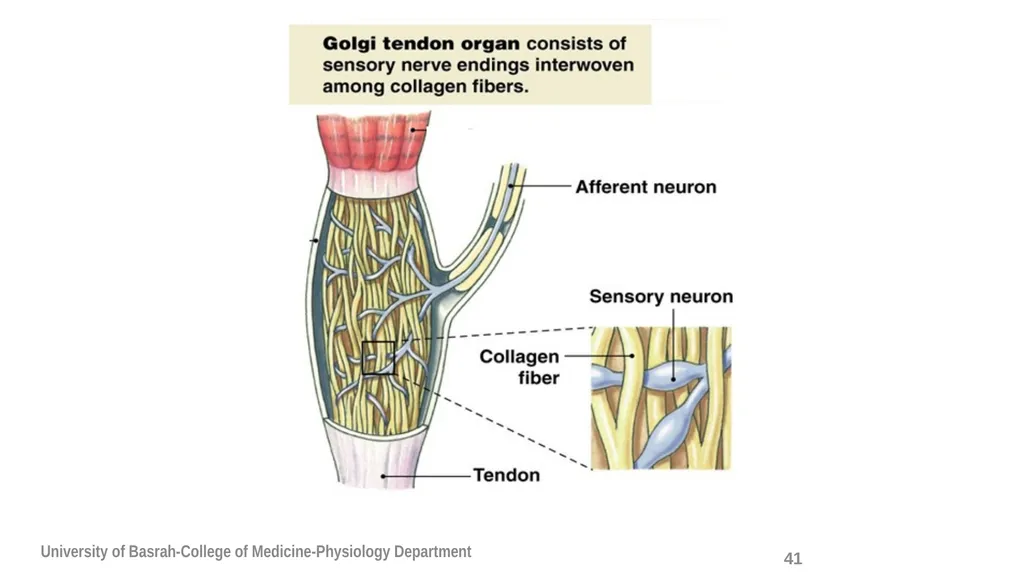
slide40. Golgi Tendon Organs Golgi Tendon Organs are sensory receptors in muscle that respond to tension changes in the muscle and attempt to prevent injury from excessively strong contractions University of Basrah-College of Medicine-Physiology Department 39<br>
slide41. Golgi Tendon Organs University of Basrah-College of Medicine-Physiology Department 40<br>
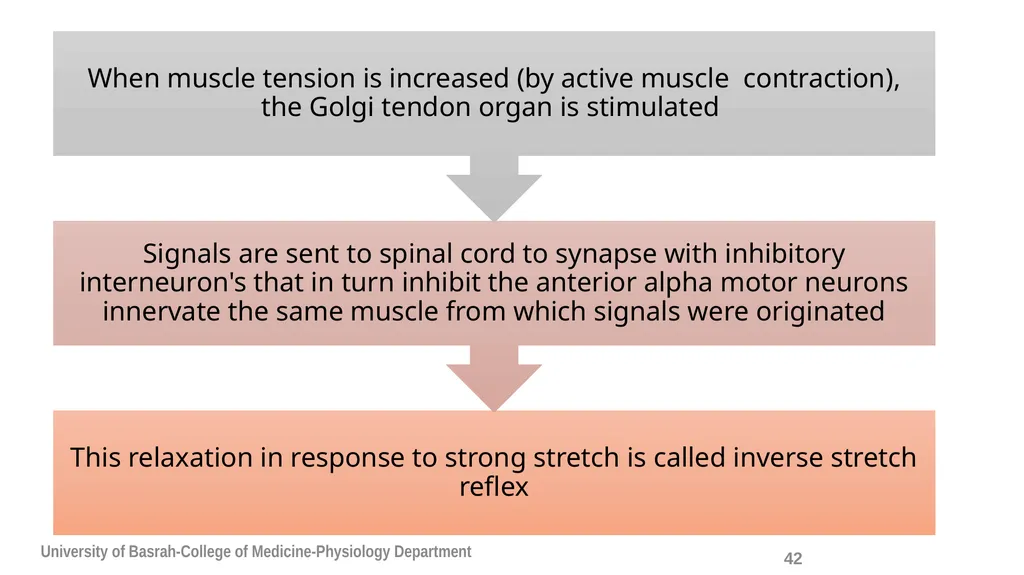
slide42. University of Basrah-College of Medicine-Physiology Department 41<br>
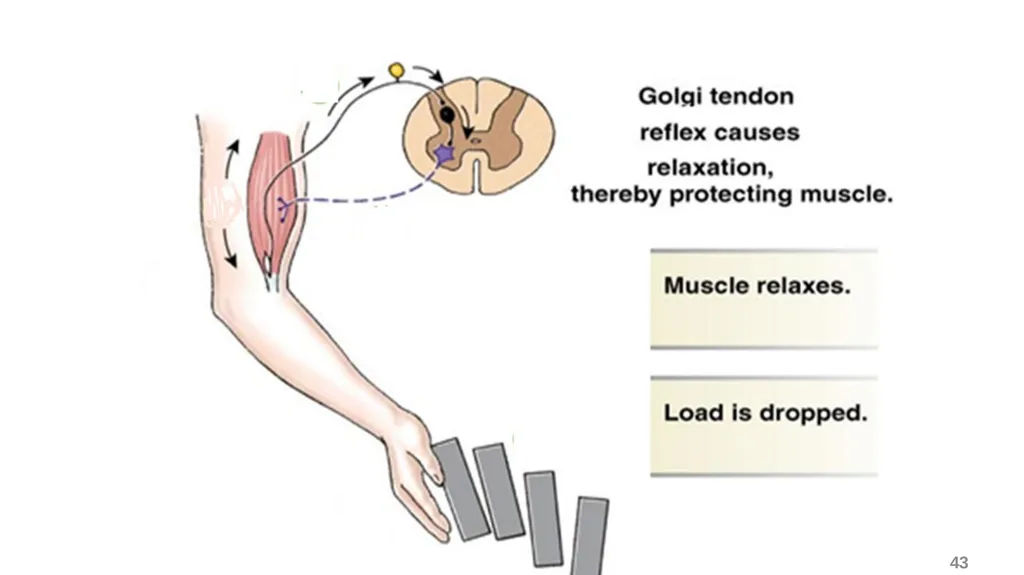
slide43. University of Basrah-College of Medicine-Physiology Department 42<br>
slide44. + + + + + + - - 43<br>
slide45. When the tension becomes too little, impulses from the tendon organ ceases and the loss of inhibition leads to activation of alpha motor neurons again University of Basrah-College of Medicine-Physiology Department 44<br>
slide46. Prevents tearing of the muscle or avulsions of tendon from its attachment to the bone
Equalize the contractile forces of the separate muscle fibres This reflex University of Basrah-College of Medicine-Physiology Department 45<br>
slide47. Which cells receive direct synaptic input from Golgi tendon organs?
A) Type Ia neurons
B) Gamma motor neurons
C) Alpha motor neurons
D) Type Ib neurons
E) Type II neurons University of Basrah-College of Medicine-Physiology Department 46<br>
slide48. A tendon jerk :-
A- Is a dynamic stretch reflex
B- Is a static stretch reflex
C- Is evoked by gradually stretching the muscle
D- Is evoked by stimulation of tendon receptors University of Basrah-College of Medicine-Physiology Department 47<br>
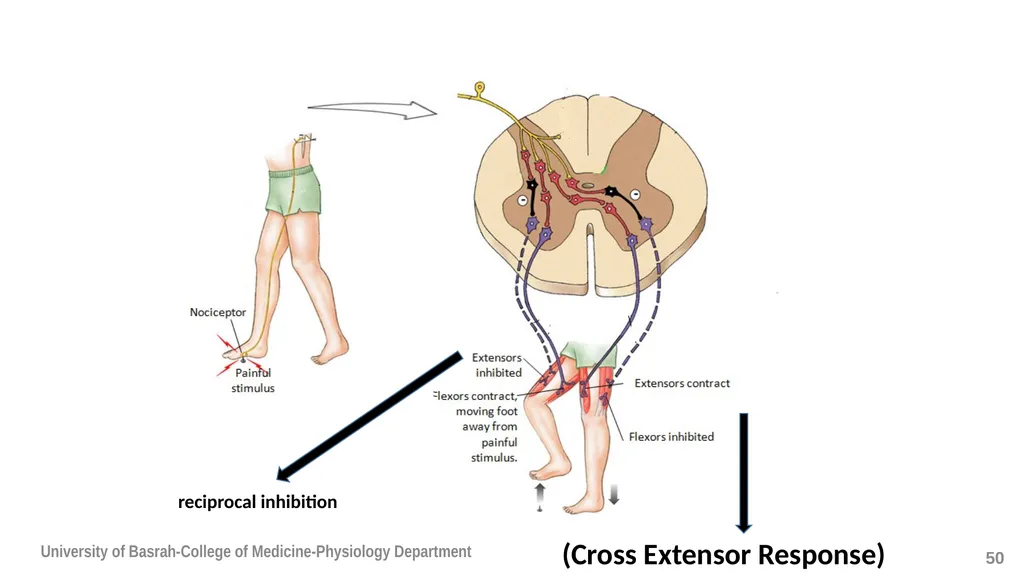
slide49. Withdrawal Reflex it’s a polysynaptic reflex that occur in response to a painful stimulation of the skin or subcutaneous tissue & the response is
A. Flexor muscle contraction & inhibition of extensor muscles (Reciprocal Inhibition Circuits) so that the body part stimulated is flexed & withdrawn from the stimulus B. extension of the opposite limb (Cross Extensor Response) University of Basrah-College of Medicine-Physiology Department 48<br>
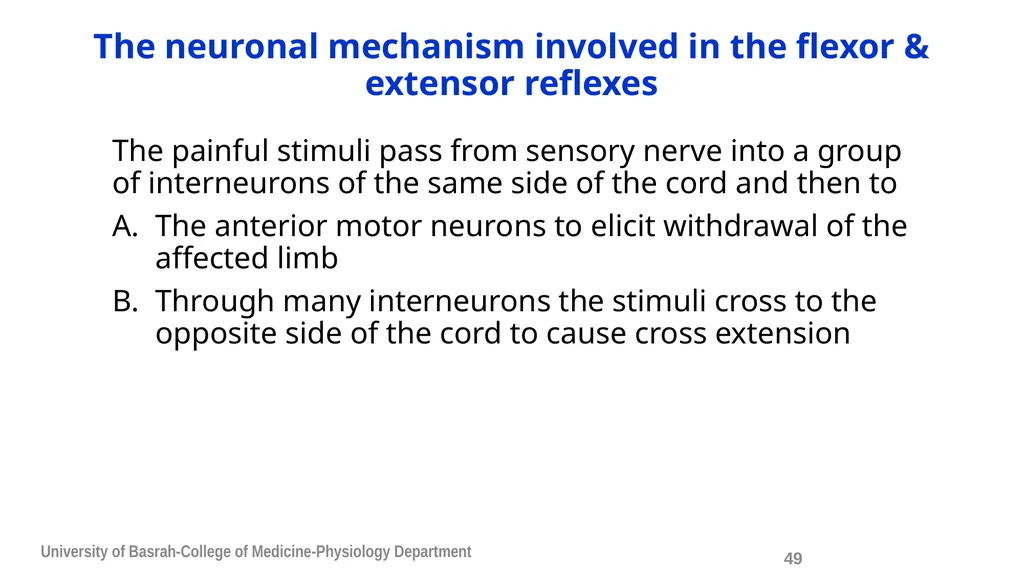
slide50. The neuronal mechanism involved in the flexor & extensor reflexes The painful stimuli pass from sensory nerve into a group of interneurons of the same side of the cord and then to
The anterior motor neurons to elicit withdrawal of the affected limb
Through many interneurons the stimuli cross to the opposite side of the cord to cause cross extension University of Basrah-College of Medicine-Physiology Department 49<br>
slide51. (Cross Extensor Response) reciprocal inhibition University of Basrah-College of Medicine-Physiology Department 50<br>
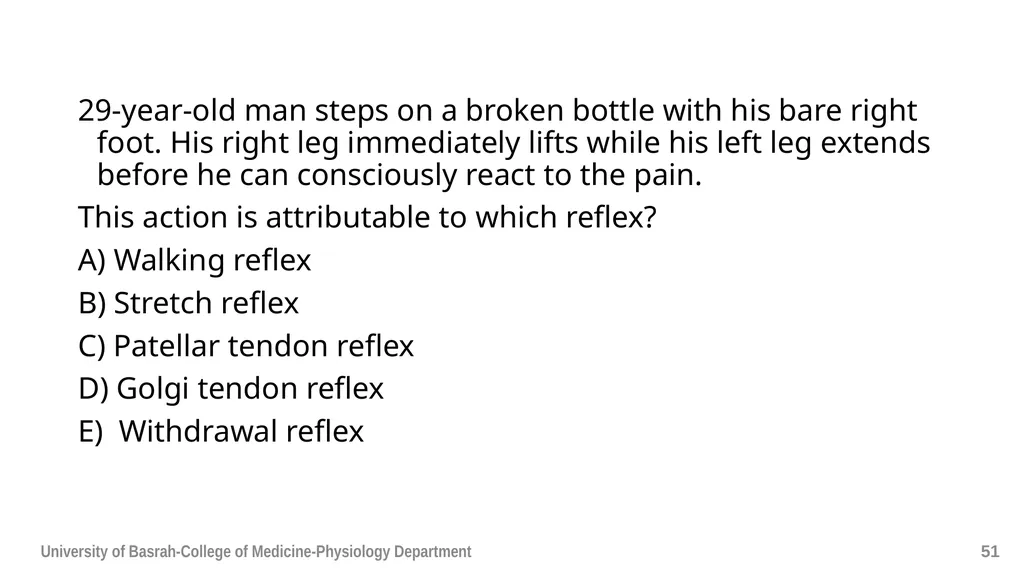
slide52. 29-year-old man steps on a broken bottle with his bare right foot. His right leg immediately lifts while his left leg extends before he can consciously react to the pain.
This action is attributable to which reflex?
A) Walking reflex
B) Stretch reflex
C) Patellar tendon reflex
D) Golgi tendon reflex
E) Withdrawal reflex University of Basrah-College of Medicine-Physiology Department 51<br>
Department of Medicine
College of Medicine\ University of Basrah<br>
slide2. Objectives 1. Reflex Arc
2. Types of Reflex arch
3. Stretch reflex components and physiology
4. Golgi tendons
5. Component and Mechanism of inverse stretch reflex
6. Withdrawal reflex University of Basrah-College of Medicine-Physiology Department 1<br>
slide3. Bell-Magendie law 2 University of Basrah-College of Medicine-Physiology Department<br>
slide5. Integration center Spinal cord Interneuron 3 4 5 Receptor Stimulus Skin 1 2 Afferent nerve Effector Efferent nerve Reflex arc 3 University of Basrah-College of Medicine-Physiology Department<br>
slide6. Reflex arc Monosynaptic Polysynaptic 4 University of Basrah-College of Medicine-Physiology Department<br>
slide7. One synapse Monosynaptic 5 University of Basrah-College of Medicine-Physiology Department<br>
slide8. Synapse 2 Polysynaptic Synapse 1 6 University of Basrah-College of Medicine-Physiology Department<br>
slide9. Monosynaptic Stretch reflex 7 University of Basrah-College of Medicine-Physiology Department<br>
slide10. Stretch reflex sudden stretch of a muscle reflex contraction of the stretched muscle 8 University of Basrah-College of Medicine-Physiology Department<br>
slide11. Components of Stretch reflex Receptor Afferent Integrating center Effector Efferent Muscle spindle (intrafusal fibers) Spinal cord Annulospiral endings (Ia fibres)
+
Flower Spray endings (II fibres) Motor nerve (alpha fibers) Muscle (extrafusal fibers) 9 University of Basrah-College of Medicine-Physiology Department<br>
slide12. 10 University of Basrah-College of Medicine-Physiology Department<br>
slide13. Stretch Reflex Receptor (Muscle Spindle) Muscle spindle consists of 3-12 small muscle fibres (intrafusal fibres)within connective tissue capsule parallel to extrafusal fibres & attached to it or to tendons 11 University of Basrah-College of Medicine-Physiology Department<br>
slide14. Each intrafusal fibre has: 13 University of Basrah-College of Medicine-Physiology Department<br>
slide15. 12 University of Basrah-College of Medicine-Physiology Department<br>
slide16. Two types of intrafusal fibres:
1-Nuclear bag fibres
Central area is dilated with group of nuclei
2-Nuclear chain fibres
Thinner& shorter
One line of nuclei in a chain in the receptor zone
Bind to nuclear bag on each side 14 University of Basrah-College of Medicine-Physiology Department<br>
slide17. two subtypes of nuclear bag fibers Dynamic Static Nuclear chain fibres Static 15 University of Basrah-College of Medicine-Physiology Department<br>
slide18. 16 University of Basrah-College of Medicine-Physiology Department<br>
slide19. Innervation of the Muscle Spindle Sensory Afferent fibres: Central receptor area of the intrafusal muscle fibres is supplied by TWO types of afferent fibres
A-Primary (Annulospiral) endings (Ia fibres): fast, encircle receptor areas of both nuclear bag and nuclear chain fibres
B-Secondary (Flower-Spray) (Group II) sensory endings: supplying receptor area of the nuclear chain fibres only 17 University of Basrah-College of Medicine-Physiology Department It has afferent & efferent nerve fibers<br>
slide20. Both the Primary and the Secondary endings respond to the static response (Discharge throughout the period of sustained stretch)
The Primary endings (but not the secondary ending) respond to the dynamic response (Discharge most rapidly if the muscle is suddenly stretched as in tendon jerks) 19 University of Basrah-College of Medicine-Physiology Department<br>
slide21. Efferent fibres to spindle (Anterior Motor Neurons)
Gamma motor neurons >>>>gamma efferent 30% >>>>> to the peripheral contractile parts of the intrafusal muscle fibres
70% >>> Alpha efferent to extrafusal muscle fibres Effect of Gamma efferent discharge:- Gamma efferent increase sensitivity of muscle spindle to stretch 20<br>
slide22. 21<br>
slide23. Extrafusal fibers Intrafusal fibers Gamma fiber Alpha fiber Nuclear chain with
Flower Spray endings Nuclear bag with Annulospiral endings 22 University of Basrah-College of Medicine-Physiology Department<br>
slide24. 23<br>
slide25. + + + + 24 University of Basrah-College of Medicine-Physiology Department<br>
slide26. Types of responses (Component of stretch reflex) 1-Dynamic stretch reflex (Dynamic Response) Sudden rapid stretch of a muscle >>>>> Jerk movement 25 University of Basrah-College of Medicine-Physiology Department<br>
slide27. This is the basis of Tendon Jerk
( contraction followed by relaxation) When muscle contract, it shortens, muscle spindle relax>>> no discharge of nerve endings, and muscle relax Why relaxation follow the contraction? 26 University of Basrah-College of Medicine-Physiology Department<br>
slide28. 2- Static stretch reflex(Static Response)
Mild sustained contraction of muscle extrafusal fibers as long as it is stretched (Basis of muscle tone) 27 University of Basrah-College of Medicine-Physiology Department<br>
slide29. knee jerk Clinical example of stretch reflex 28 University of Basrah-College of Medicine-Physiology Department<br>
slide30. 29 University of Basrah-College of Medicine-Physiology Department<br>
slide31. Functions of Muscle Spindle
1- Keep CNS informed about muscle length & rate or velocity of change in muscle length
2-Muscle spindle act to maintain muscle length against rupture
Muscle spindles monitor muscle length and prevent overstretching of the muscle
3- Damping function (Smoothing muscle contraction) 30 University of Basrah-College of Medicine-Physiology Department<br>
slide32. In a muscle spindle receptor, which type of muscle fiber is responsible for the dynamic response?
A) Extrafusal muscle fiber
B) Smooth muscle fiber
C) Nuclear chain fiber
D) Nuclear bag fiber 31 University of Basrah-College of Medicine-Physiology Department<br>
slide33. Reciprocal inhibition with Stretch Reflex Reflex contraction of an agonistic muscle is accompanied by inhibition of the antagonistic muscle ex: (contraction of biceps + inhibition of the triceps) 32 University of Basrah-College of Medicine-Physiology Department<br>
slide34. Antagonistic Muscles 33 University of Basrah-College of Medicine-Physiology Department<br>
slide35. Impulses from stretched muscle>>>> Spinal cord to cause:-
1-Stimulate the motor neurons of the stimulated muscle
2- Send collaterals >>>> Inhibitory Interneurons synapse on the AHCs of the antagonistic muscle & inhibit them 34 University of Basrah-College of Medicine-Physiology Department<br>
slide36. 35 University of Basrah-College of Medicine-Physiology Department<br>
slide37. Stretch of an innervated muscle evokes :
A- contraction of its spindles
B- contraction of its extrafusal fibers
C- contraction of antagonistic muscles
D- relaxation of synergistic muscles 36 University of Basrah-College of Medicine-Physiology Department<br>
slide38. Polysynaptic University of Basrah-College of Medicine-Physiology Department 37<br>
slide39. Inverse stretch reflex (Golgi Tendon Reflex) Receptor Afferent Integrating center Effector Efferent Spinal cord Type Ib sensory nerve fibres Motor nerve (alpha fibers) Muscle Golgi tendon organs University of Basrah-College of Medicine-Physiology Department 38<br>
slide40. Golgi Tendon Organs Golgi Tendon Organs are sensory receptors in muscle that respond to tension changes in the muscle and attempt to prevent injury from excessively strong contractions University of Basrah-College of Medicine-Physiology Department 39<br>
slide41. Golgi Tendon Organs University of Basrah-College of Medicine-Physiology Department 40<br>
slide42. University of Basrah-College of Medicine-Physiology Department 41<br>
slide43. University of Basrah-College of Medicine-Physiology Department 42<br>
slide44. + + + + + + - - 43<br>
slide45. When the tension becomes too little, impulses from the tendon organ ceases and the loss of inhibition leads to activation of alpha motor neurons again University of Basrah-College of Medicine-Physiology Department 44<br>
slide46. Prevents tearing of the muscle or avulsions of tendon from its attachment to the bone
Equalize the contractile forces of the separate muscle fibres This reflex University of Basrah-College of Medicine-Physiology Department 45<br>
slide47. Which cells receive direct synaptic input from Golgi tendon organs?
A) Type Ia neurons
B) Gamma motor neurons
C) Alpha motor neurons
D) Type Ib neurons
E) Type II neurons University of Basrah-College of Medicine-Physiology Department 46<br>
slide48. A tendon jerk :-
A- Is a dynamic stretch reflex
B- Is a static stretch reflex
C- Is evoked by gradually stretching the muscle
D- Is evoked by stimulation of tendon receptors University of Basrah-College of Medicine-Physiology Department 47<br>
slide49. Withdrawal Reflex it’s a polysynaptic reflex that occur in response to a painful stimulation of the skin or subcutaneous tissue & the response is
A. Flexor muscle contraction & inhibition of extensor muscles (Reciprocal Inhibition Circuits) so that the body part stimulated is flexed & withdrawn from the stimulus B. extension of the opposite limb (Cross Extensor Response) University of Basrah-College of Medicine-Physiology Department 48<br>
slide50. The neuronal mechanism involved in the flexor & extensor reflexes The painful stimuli pass from sensory nerve into a group of interneurons of the same side of the cord and then to
The anterior motor neurons to elicit withdrawal of the affected limb
Through many interneurons the stimuli cross to the opposite side of the cord to cause cross extension University of Basrah-College of Medicine-Physiology Department 49<br>
slide51. (Cross Extensor Response) reciprocal inhibition University of Basrah-College of Medicine-Physiology Department 50<br>
slide52. 29-year-old man steps on a broken bottle with his bare right foot. His right leg immediately lifts while his left leg extends before he can consciously react to the pain.
This action is attributable to which reflex?
A) Walking reflex
B) Stretch reflex
C) Patellar tendon reflex
D) Golgi tendon reflex
E) Withdrawal reflex University of Basrah-College of Medicine-Physiology Department 51<br>