
Standing Committee on Finance Stakeholder
SB
Published · 24 slides · 0 views

1 / 1



Description
Standing Committee on Finance Stakeholder responses to the Report of the VAT Panel in respect of the recommendation to Zero Rate White Bread with specific Objective of providing Relief to Poor and Low-Income Households in South Africa 12
Related Topics
Share
Embed code
Download this presentation From Below
"Standing Committee on Finance Stakeholder" is the property of its rightful owner. Permission is granted to download and print the materials on this website for personal, non-commercial use only, and to display it on your personal computer provided you do not modify the materials and that you retain all copyright notices contained in the materials. By downloading content from our website, you accept the terms of this agreement.
Presentation Transcript
01
Standing Committee on Finance
Stakeholder responses to the Report of the VAT Panel in respect of the recommendation to Zero Rate White Bread with specific Objective of providing Relief to Poor and Low-Income Households in South Africa 12 September 2018<br>
02
Key elements of the Submission by the South African Chamber of Baking in collaboration with PwC Standing Committee on Finance<br>
03
Food insecurity and hunger alleviation – the problem is greater than just zero rating of basic foodstuffs!
Food insecurity in South Africa is unacceptably high.
Although there is sufficient food produced in South Africa, an extremely large portion of the country’s population is food insecure, often quoted as high as 25%.
The Department of Health is in the process of implementing improved fortification to maize and wheat products, which includes bread, to address micro-nutrient deficiency and malnutrition in South Africa.
These health issues are most prevalent in the poorer sectors of the population.
Making bread even more affordable by zero-rating white bread, the poorest and most vulnerable sectors of the population will be afforded better nutrition.<br>
04
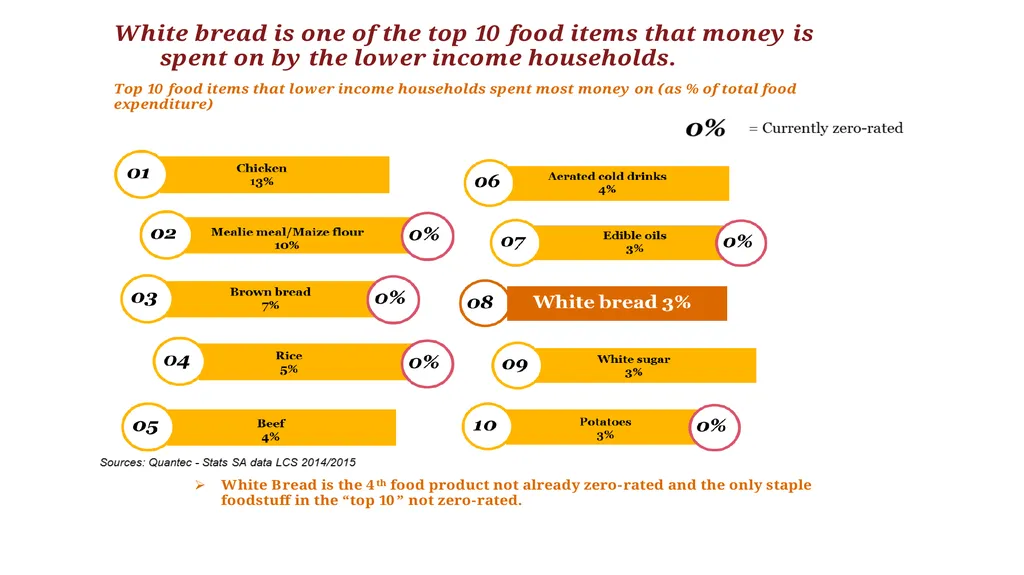
Bread is a staple foodstuff. The top ten food items that lower income households spend most money on include Brown bread at number 3 and White bread at number 8. The wheat value chain including the baking industry, will benefit marginally from white bread being zero rated. Those who will benefit most will be the lower income and poorer sectors of our population. The consensus view in the industry is that zero rating White bread is the “right thing to do”.<br>
05
Initiatives involving the bread industry to improve
the overall health of the nation
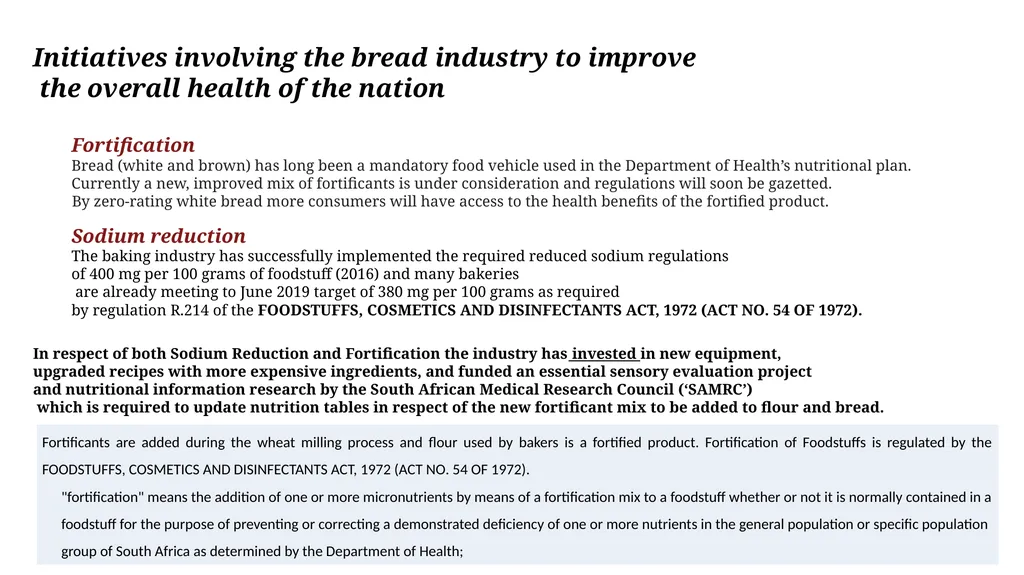
Fortification Bread (white and brown) has long been a mandatory food vehicle used in the Department of Health’s nutritional plan. Currently a new, improved mix of fortificants is under consideration and regulations will soon be gazetted.
By zero-rating white bread more consumers will have access to the health benefits of the fortified product.
Sodium reduction
The baking industry has successfully implemented the required reduced sodium regulations of 400 mg per 100 grams of foodstuff (2016) and many bakeries are already meeting to June 2019 target of 380 mg per 100 grams as required by regulation R.214 of the FOODSTUFFS, COSMETICS AND DISINFECTANTS ACT, 1972 (ACT NO. 54 OF 1972).
In respect of both Sodium Reduction and Fortification the industry has invested in new equipment, upgraded recipes with more expensive ingredients, and funded an essential sensory evaluation project and nutritional information research by the South African Medical Research Council (‘SAMRC’) which is required to update nutrition tables in respect of the new fortificant mix to be added to flour and bread.<br>
Fortification Bread (white and brown) has long been a mandatory food vehicle used in the Department of Health’s nutritional plan. Currently a new, improved mix of fortificants is under consideration and regulations will soon be gazetted.
By zero-rating white bread more consumers will have access to the health benefits of the fortified product.
Sodium reduction
The baking industry has successfully implemented the required reduced sodium regulations of 400 mg per 100 grams of foodstuff (2016) and many bakeries are already meeting to June 2019 target of 380 mg per 100 grams as required by regulation R.214 of the FOODSTUFFS, COSMETICS AND DISINFECTANTS ACT, 1972 (ACT NO. 54 OF 1972).
In respect of both Sodium Reduction and Fortification the industry has invested in new equipment, upgraded recipes with more expensive ingredients, and funded an essential sensory evaluation project and nutritional information research by the South African Medical Research Council (‘SAMRC’) which is required to update nutrition tables in respect of the new fortificant mix to be added to flour and bread.<br>
06
Brief description of the Bread Industry in South Africa, and theoretical VAT Contribution by the Baking Industry and prices of Bread in South Africa<br>
07
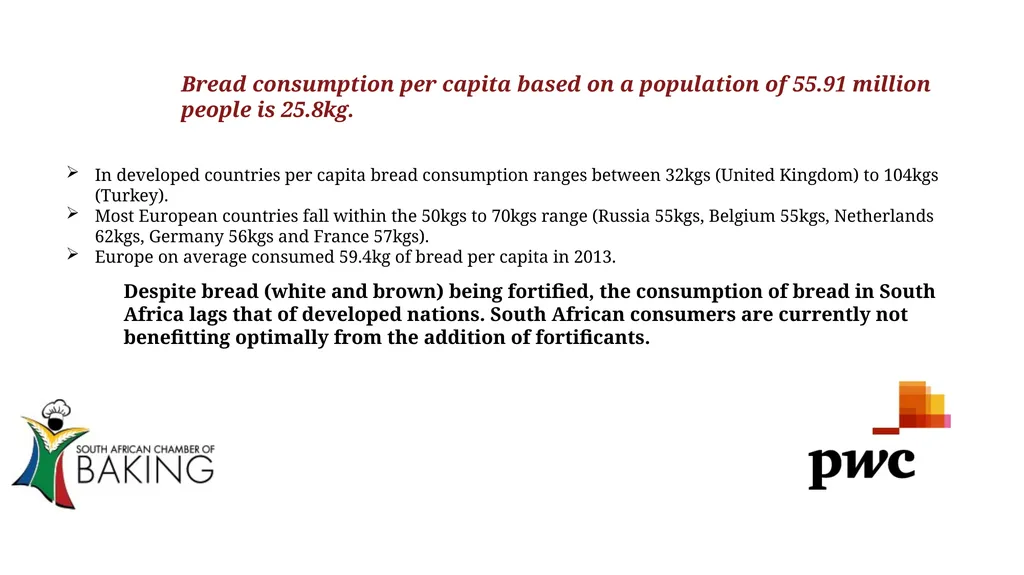
Bread consumption per capita based on a population of 55.91 million people is 25.8kg.
In developed countries per capita bread consumption ranges between 32kgs (United Kingdom) to 104kgs (Turkey).
Most European countries fall within the 50kgs to 70kgs range (Russia 55kgs, Belgium 55kgs, Netherlands 62kgs, Germany 56kgs and France 57kgs).
Europe on average consumed 59.4kg of bread per capita in 2013.
Despite bread (white and brown) being fortified, the consumption of bread in South Africa lags that of developed nations. South African consumers are currently not benefitting optimally from the addition of fortificants.<br>
In developed countries per capita bread consumption ranges between 32kgs (United Kingdom) to 104kgs (Turkey).
Most European countries fall within the 50kgs to 70kgs range (Russia 55kgs, Belgium 55kgs, Netherlands 62kgs, Germany 56kgs and France 57kgs).
Europe on average consumed 59.4kg of bread per capita in 2013.
Despite bread (white and brown) being fortified, the consumption of bread in South Africa lags that of developed nations. South African consumers are currently not benefitting optimally from the addition of fortificants.<br>
08
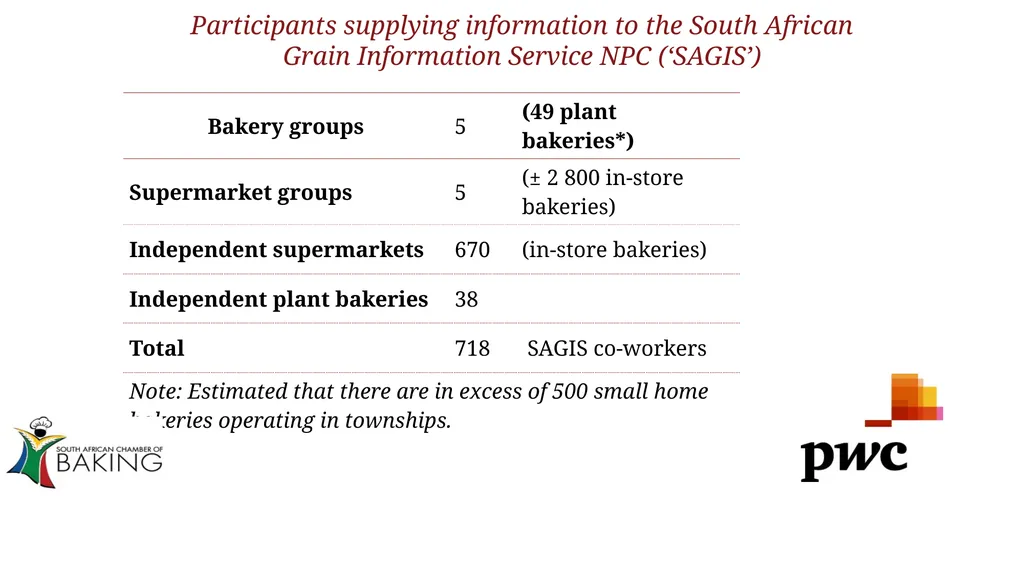
Participants supplying information to the South African Grain Information Service NPC (‘SAGIS’)<br>
09
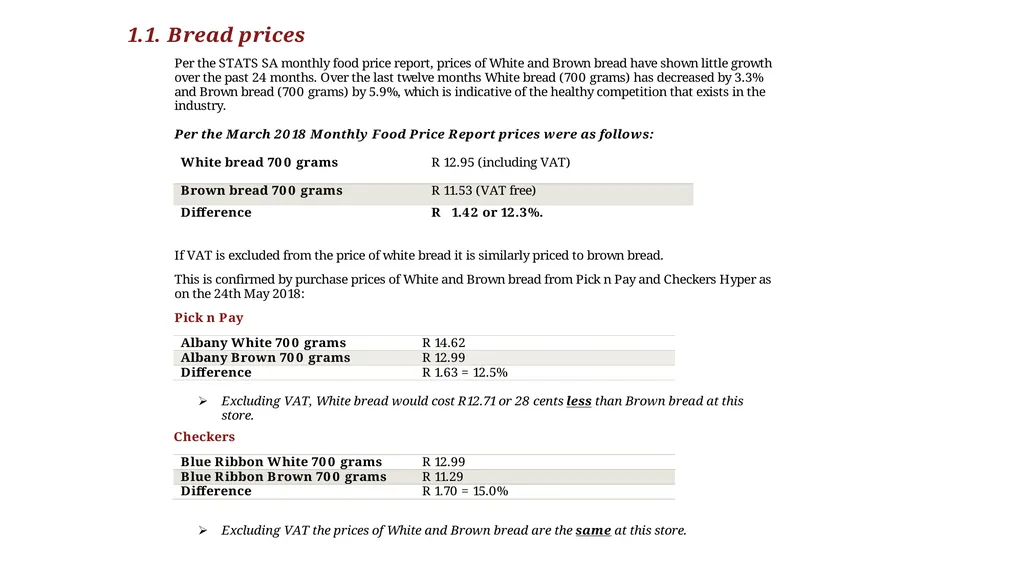
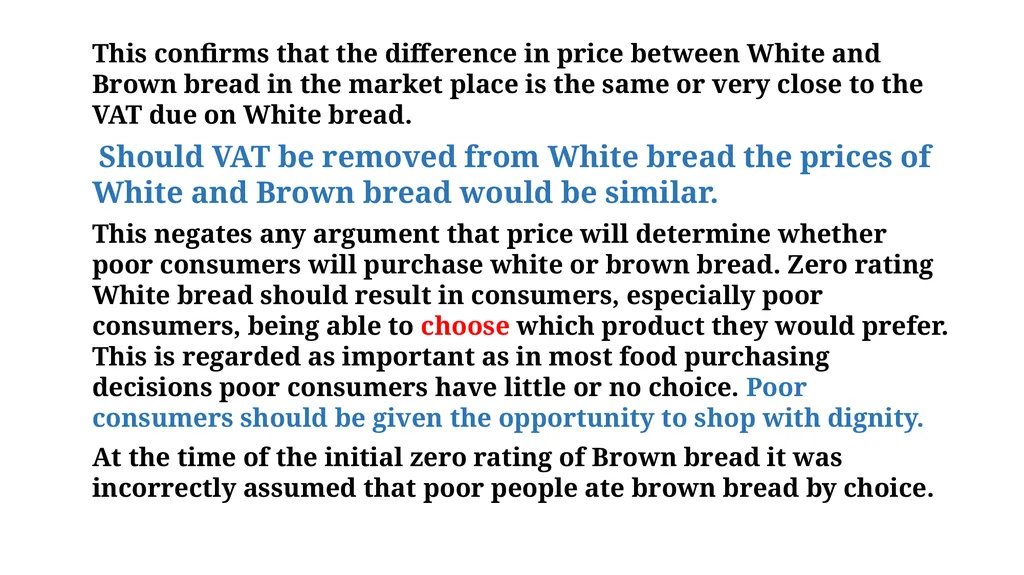
This confirms that the difference in price between White and Brown bread in the market place is the same or very close to the VAT due on White bread.
Should VAT be removed from White bread the prices of White and Brown bread would be similar.
This negates any argument that price will determine whether poor consumers will purchase white or brown bread. Zero rating White bread should result in consumers, especially poor consumers, being able to choose which product they would prefer. This is regarded as important as in most food purchasing decisions poor consumers have little or no choice. Poor consumers should be given the opportunity to shop with dignity.
At the time of the initial zero rating of Brown bread it was incorrectly assumed that poor people ate brown bread by choice.<br>
Should VAT be removed from White bread the prices of White and Brown bread would be similar.
This negates any argument that price will determine whether poor consumers will purchase white or brown bread. Zero rating White bread should result in consumers, especially poor consumers, being able to choose which product they would prefer. This is regarded as important as in most food purchasing decisions poor consumers have little or no choice. Poor consumers should be given the opportunity to shop with dignity.
At the time of the initial zero rating of Brown bread it was incorrectly assumed that poor people ate brown bread by choice.<br>
10
Motivation that adding white bread to the zero-rated list could counter the regressive impact of VAT on the poor
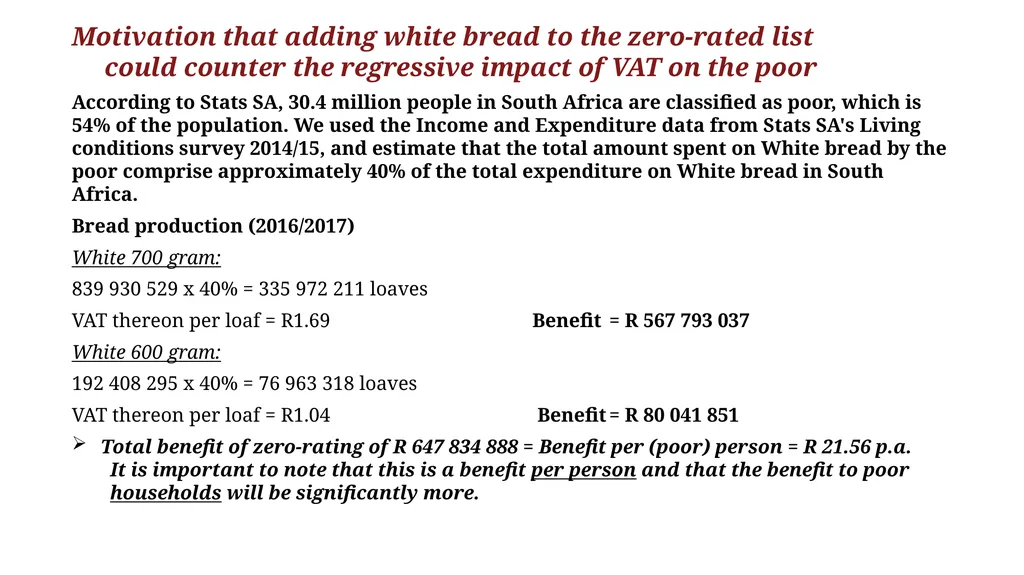
According to Stats SA, 30.4 million people in South Africa are classified as poor, which is 54% of the population. We used the Income and Expenditure data from Stats SA's Living conditions survey 2014/15, and estimate that the total amount spent on White bread by the poor comprise approximately 40% of the total expenditure on White bread in South Africa.
Bread production (2016/2017)
White 700 gram:
839 930 529 x 40% = 335 972 211 loaves
VAT thereon per loaf = R1.69 Benefit = R 567 793 037
White 600 gram:
192 408 295 x 40% = 76 963 318 loaves
VAT thereon per loaf = R1.04 Benefit = R 80 041 851
Total benefit of zero-rating of R 647 834 888 = Benefit per (poor) person = R 21.56 p.a.
It is important to note that this is a benefit per person and that the benefit to poor households will be significantly more.<br>
According to Stats SA, 30.4 million people in South Africa are classified as poor, which is 54% of the population. We used the Income and Expenditure data from Stats SA's Living conditions survey 2014/15, and estimate that the total amount spent on White bread by the poor comprise approximately 40% of the total expenditure on White bread in South Africa.
Bread production (2016/2017)
White 700 gram:
839 930 529 x 40% = 335 972 211 loaves
VAT thereon per loaf = R1.69 Benefit = R 567 793 037
White 600 gram:
192 408 295 x 40% = 76 963 318 loaves
VAT thereon per loaf = R1.04 Benefit = R 80 041 851
Total benefit of zero-rating of R 647 834 888 = Benefit per (poor) person = R 21.56 p.a.
It is important to note that this is a benefit per person and that the benefit to poor households will be significantly more.<br>
11
Further Consideration
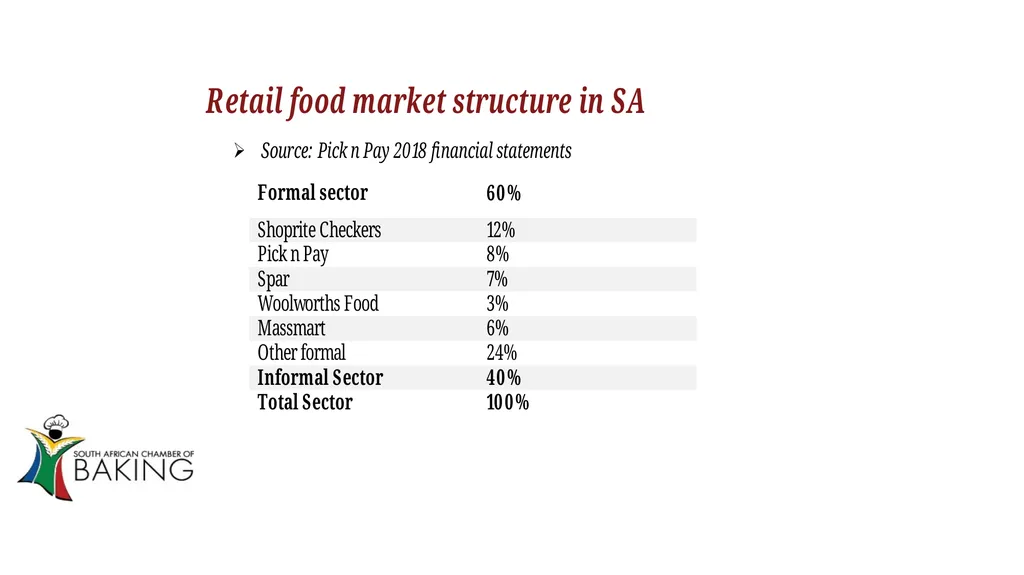
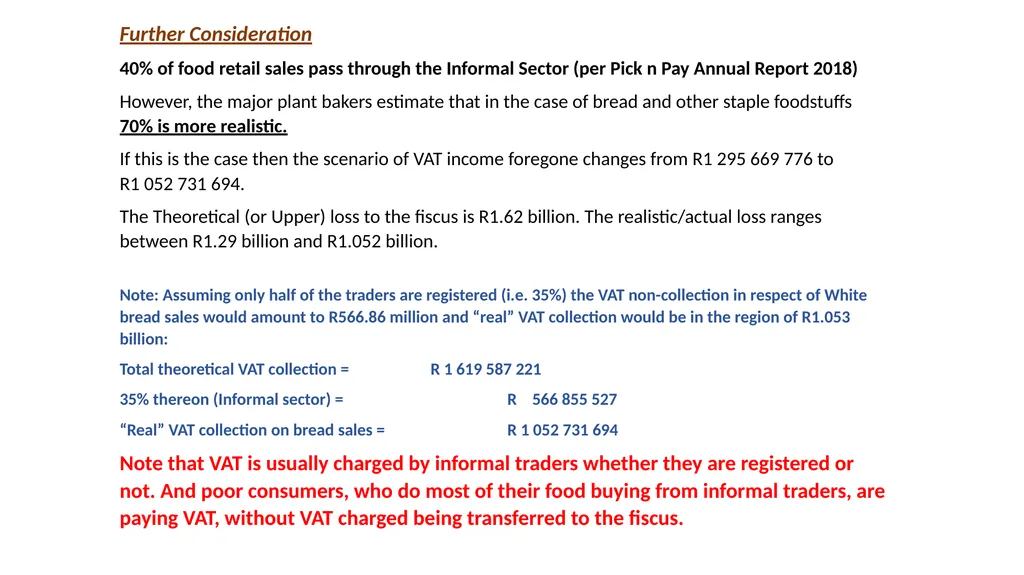
40% of food retail sales pass through the Informal Sector (per Pick n Pay Annual Report 2018)
However, the major plant bakers estimate that in the case of bread and other staple foodstuffs 70% is more realistic.
If this is the case then the scenario of VAT income foregone changes from R1 295 669 776 to R1 052 731 694.
The Theoretical (or Upper) loss to the fiscus is R1.62 billion. The realistic/actual loss ranges between R1.29 billion and R1.052 billion.
Note: Assuming only half of the traders are registered (i.e. 35%) the VAT non-collection in respect of White bread sales would amount to R566.86 million and “real” VAT collection would be in the region of R1.053 billion:
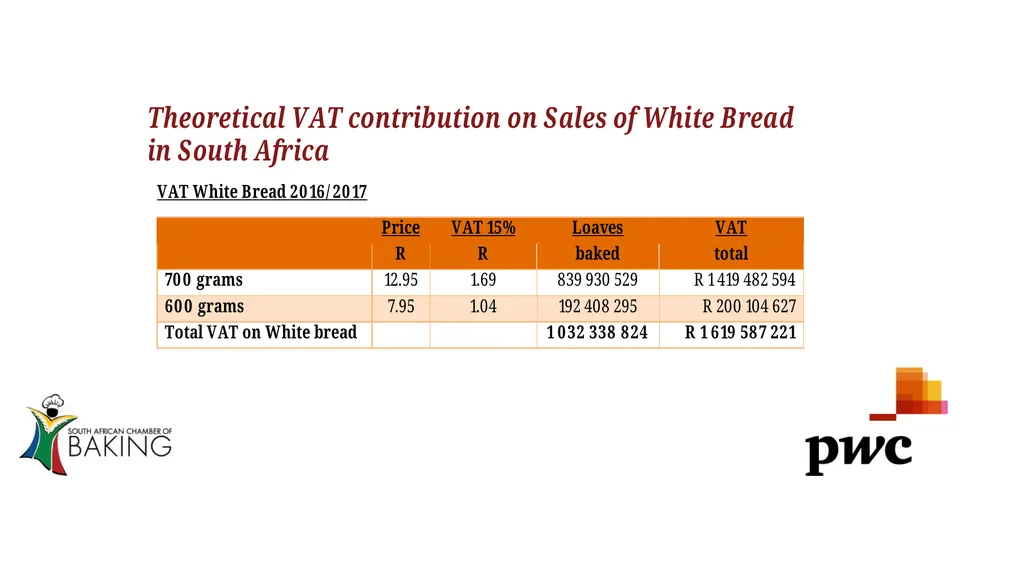
Total theoretical VAT collection = R 1 619 587 221
35% thereon (Informal sector) = R 566 855 527
“Real” VAT collection on bread sales = R 1 052 731 694
Note that VAT is usually charged by informal traders whether they are registered or not. And poor consumers, who do most of their food buying from informal traders, are paying VAT, without VAT charged being transferred to the fiscus.<br>
40% of food retail sales pass through the Informal Sector (per Pick n Pay Annual Report 2018)
However, the major plant bakers estimate that in the case of bread and other staple foodstuffs 70% is more realistic.
If this is the case then the scenario of VAT income foregone changes from R1 295 669 776 to R1 052 731 694.
The Theoretical (or Upper) loss to the fiscus is R1.62 billion. The realistic/actual loss ranges between R1.29 billion and R1.052 billion.
Note: Assuming only half of the traders are registered (i.e. 35%) the VAT non-collection in respect of White bread sales would amount to R566.86 million and “real” VAT collection would be in the region of R1.053 billion:
Total theoretical VAT collection = R 1 619 587 221
35% thereon (Informal sector) = R 566 855 527
“Real” VAT collection on bread sales = R 1 052 731 694
Note that VAT is usually charged by informal traders whether they are registered or not. And poor consumers, who do most of their food buying from informal traders, are paying VAT, without VAT charged being transferred to the fiscus.<br>
12
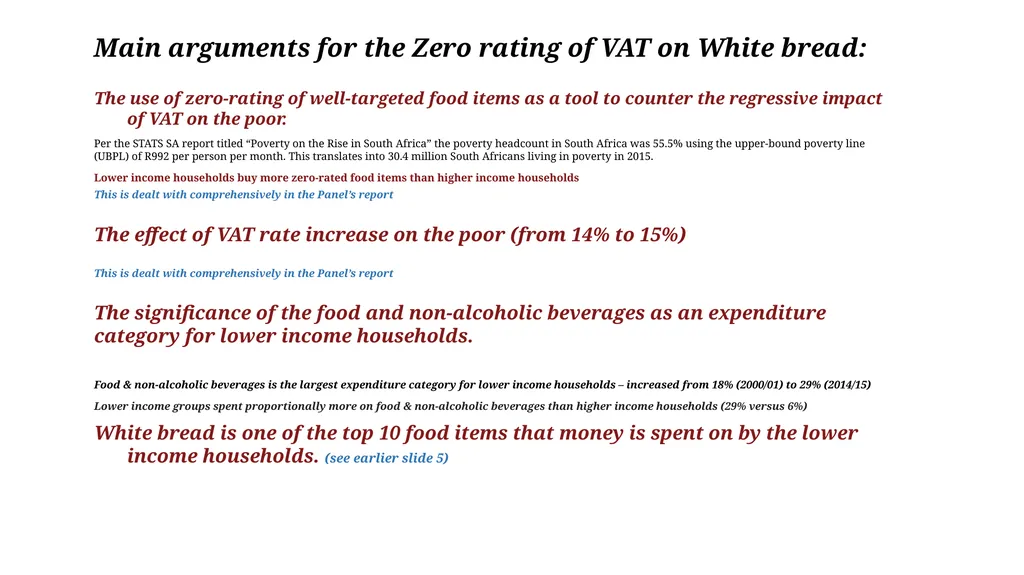
Main arguments for the Zero rating of VAT on White bread:
The use of zero-rating of well-targeted food items as a tool to counter the regressive impact of VAT on the poor.
Per the STATS SA report titled “Poverty on the Rise in South Africa” the poverty headcount in South Africa was 55.5% using the upper-bound poverty line (UBPL) of R992 per person per month. This translates into 30.4 million South Africans living in poverty in 2015.
Lower income households buy more zero-rated food items than higher income households
This is dealt with comprehensively in the Panel’s report
The effect of VAT rate increase on the poor (from 14% to 15%)
This is dealt with comprehensively in the Panel’s report
The significance of the food and non-alcoholic beverages as an expenditure category for lower income households.
Food & non-alcoholic beverages is the largest expenditure category for lower income households – increased from 18% (2000/01) to 29% (2014/15)
Lower income groups spent proportionally more on food & non-alcoholic beverages than higher income households (29% versus 6%)
White bread is one of the top 10 food items that money is spent on by the lower income households. (see earlier slide 5)<br>
The use of zero-rating of well-targeted food items as a tool to counter the regressive impact of VAT on the poor.
Per the STATS SA report titled “Poverty on the Rise in South Africa” the poverty headcount in South Africa was 55.5% using the upper-bound poverty line (UBPL) of R992 per person per month. This translates into 30.4 million South Africans living in poverty in 2015.
Lower income households buy more zero-rated food items than higher income households
This is dealt with comprehensively in the Panel’s report
The effect of VAT rate increase on the poor (from 14% to 15%)
This is dealt with comprehensively in the Panel’s report
The significance of the food and non-alcoholic beverages as an expenditure category for lower income households.
Food & non-alcoholic beverages is the largest expenditure category for lower income households – increased from 18% (2000/01) to 29% (2014/15)
Lower income groups spent proportionally more on food & non-alcoholic beverages than higher income households (29% versus 6%)
White bread is one of the top 10 food items that money is spent on by the lower income households. (see earlier slide 5)<br>
13
The economic impact if white bread is zero-rated.
The overall benefit for the Wheat-to-bread value chain is likely to be relatively small.
A movement from Brown bread to White bread purchasing and consumption is likely, but as can be seen in the pricing structures, the attraction to consumers will be that they are now able to have greater choice when buying bread. This is often referred to as “shopper’s dignity” where poorer people will have greater choice.
In that more White bread will be sold and millers will produce more White bread flour, which will result in a modest increase in wheat milled, with the knock-on benefit to agriculture.
Any growth in the industry will therefore be beneficial to the entire value chain from the farmer, grain storage operators, millers, bakers and retailers, ending with the consumer.<br>
The overall benefit for the Wheat-to-bread value chain is likely to be relatively small.
A movement from Brown bread to White bread purchasing and consumption is likely, but as can be seen in the pricing structures, the attraction to consumers will be that they are now able to have greater choice when buying bread. This is often referred to as “shopper’s dignity” where poorer people will have greater choice.
In that more White bread will be sold and millers will produce more White bread flour, which will result in a modest increase in wheat milled, with the knock-on benefit to agriculture.
Any growth in the industry will therefore be beneficial to the entire value chain from the farmer, grain storage operators, millers, bakers and retailers, ending with the consumer.<br>
14
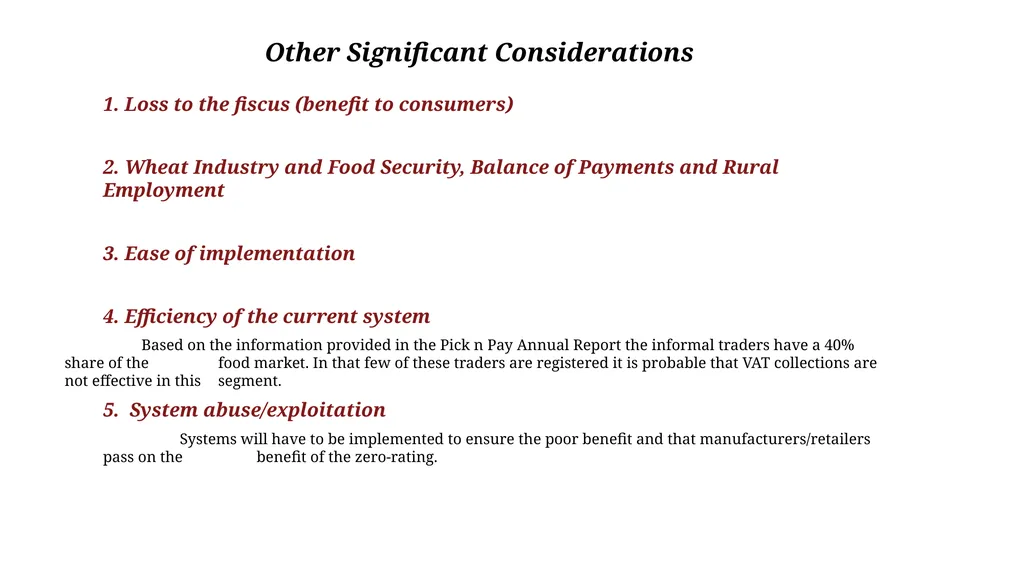
Other Significant Considerations
1. Loss to the fiscus (benefit to consumers)
2. Wheat Industry and Food Security, Balance of Payments and Rural Employment
3. Ease of implementation
4. Efficiency of the current system
Based on the information provided in the Pick n Pay Annual Report the informal traders have a 40% share of the food market. In that few of these traders are registered it is probable that VAT collections are not effective in this segment.
5. System abuse/exploitation
Systems will have to be implemented to ensure the poor benefit and that manufacturers/retailers pass on the benefit of the zero-rating.<br>
1. Loss to the fiscus (benefit to consumers)
2. Wheat Industry and Food Security, Balance of Payments and Rural Employment
3. Ease of implementation
4. Efficiency of the current system
Based on the information provided in the Pick n Pay Annual Report the informal traders have a 40% share of the food market. In that few of these traders are registered it is probable that VAT collections are not effective in this segment.
5. System abuse/exploitation
Systems will have to be implemented to ensure the poor benefit and that manufacturers/retailers pass on the benefit of the zero-rating.<br>
15
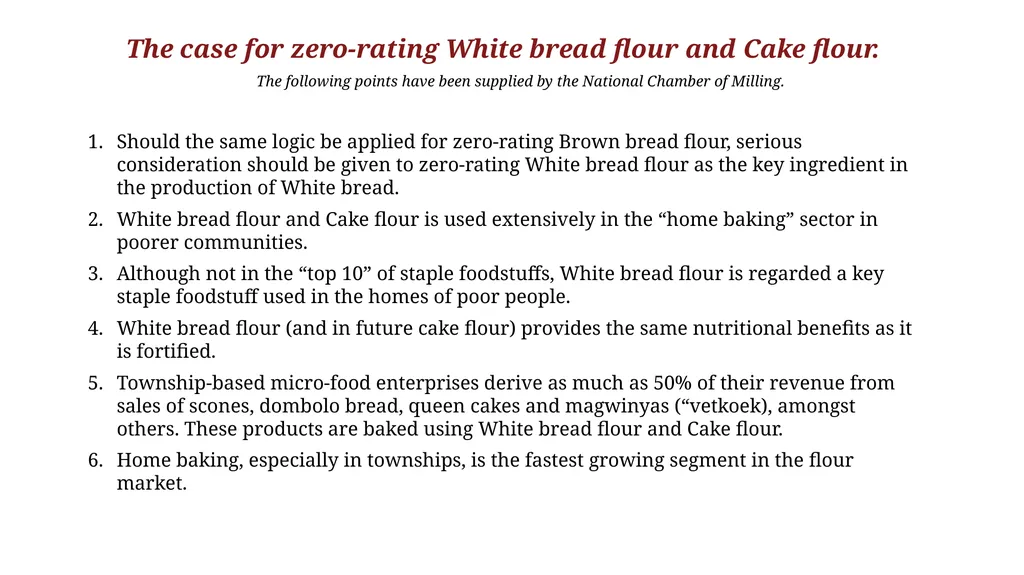
The case for zero-rating White bread flour and Cake flour.
The following points have been supplied by the National Chamber of Milling.
Should the same logic be applied for zero-rating Brown bread flour, serious consideration should be given to zero-rating White bread flour as the key ingredient in the production of White bread.
White bread flour and Cake flour is used extensively in the “home baking” sector in poorer communities.
Although not in the “top 10” of staple foodstuffs, White bread flour is regarded a key staple foodstuff used in the homes of poor people.
White bread flour (and in future cake flour) provides the same nutritional benefits as it is fortified.
Township-based micro-food enterprises derive as much as 50% of their revenue from sales of scones, dombolo bread, queen cakes and magwinyas (“vetkoek), amongst others. These products are baked using White bread flour and Cake flour.
Home baking, especially in townships, is the fastest growing segment in the flour market.<br>
The following points have been supplied by the National Chamber of Milling.
Should the same logic be applied for zero-rating Brown bread flour, serious consideration should be given to zero-rating White bread flour as the key ingredient in the production of White bread.
White bread flour and Cake flour is used extensively in the “home baking” sector in poorer communities.
Although not in the “top 10” of staple foodstuffs, White bread flour is regarded a key staple foodstuff used in the homes of poor people.
White bread flour (and in future cake flour) provides the same nutritional benefits as it is fortified.
Township-based micro-food enterprises derive as much as 50% of their revenue from sales of scones, dombolo bread, queen cakes and magwinyas (“vetkoek), amongst others. These products are baked using White bread flour and Cake flour.
Home baking, especially in townships, is the fastest growing segment in the flour market.<br>
16
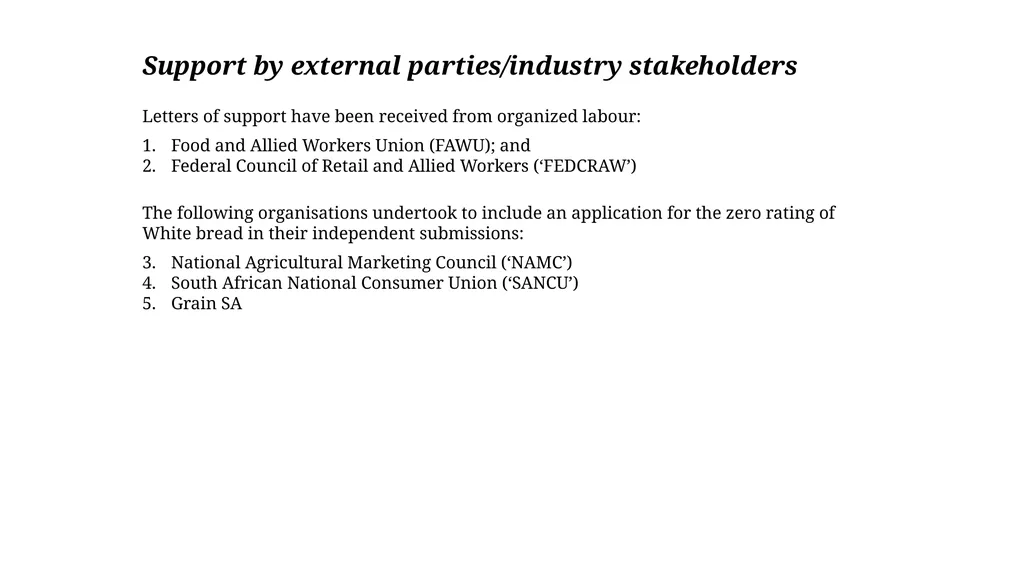
Support by external parties/industry stakeholders
Letters of support have been received from organized labour:
Food and Allied Workers Union (FAWU); and
Federal Council of Retail and Allied Workers (‘FEDCRAW’)
The following organisations undertook to include an application for the zero rating of White bread in their independent submissions:
National Agricultural Marketing Council (‘NAMC’)
South African National Consumer Union (‘SANCU’)
Grain SA<br>
Letters of support have been received from organized labour:
Food and Allied Workers Union (FAWU); and
Federal Council of Retail and Allied Workers (‘FEDCRAW’)
The following organisations undertook to include an application for the zero rating of White bread in their independent submissions:
National Agricultural Marketing Council (‘NAMC’)
South African National Consumer Union (‘SANCU’)
Grain SA<br>
17
Conclusion
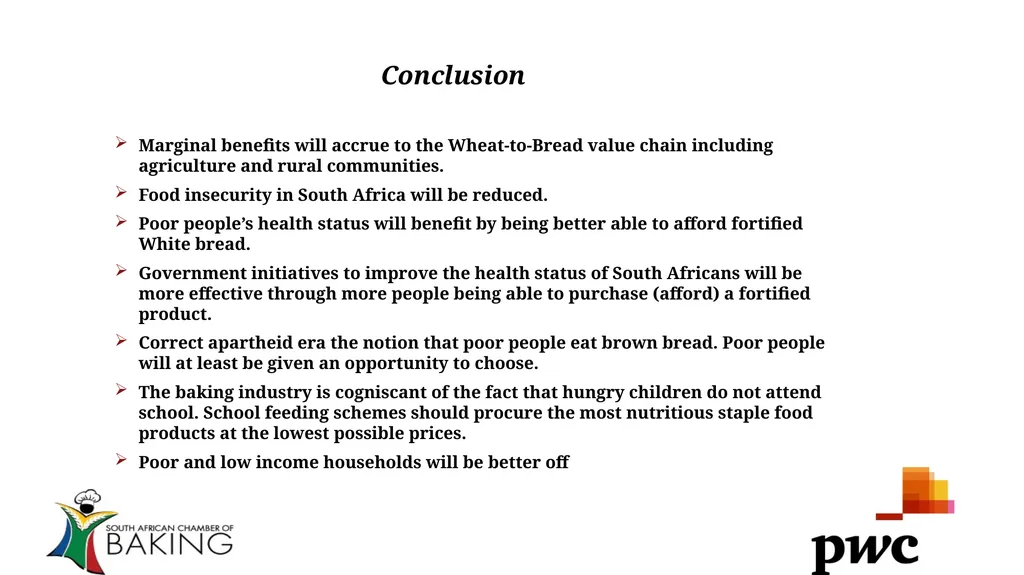
Marginal benefits will accrue to the Wheat-to-Bread value chain including agriculture and rural communities.
Food insecurity in South Africa will be reduced.
Poor people’s health status will benefit by being better able to afford fortified White bread.
Government initiatives to improve the health status of South Africans will be more effective through more people being able to purchase (afford) a fortified product.
Correct apartheid era the notion that poor people eat brown bread. Poor people will at least be given an opportunity to choose.
The baking industry is cogniscant of the fact that hungry children do not attend school. School feeding schemes should procure the most nutritious staple food products at the lowest possible prices.
Poor and low income households will be better off<br>
Marginal benefits will accrue to the Wheat-to-Bread value chain including agriculture and rural communities.
Food insecurity in South Africa will be reduced.
Poor people’s health status will benefit by being better able to afford fortified White bread.
Government initiatives to improve the health status of South Africans will be more effective through more people being able to purchase (afford) a fortified product.
Correct apartheid era the notion that poor people eat brown bread. Poor people will at least be given an opportunity to choose.
The baking industry is cogniscant of the fact that hungry children do not attend school. School feeding schemes should procure the most nutritious staple food products at the lowest possible prices.
Poor and low income households will be better off<br>
18
THANK YOU<br>