State Tax Policy Boot Camp Session Two SALES USE TAX OVERVIEW 45 states and D.C. have statewide sales taxes The NOMAD states: New Hampshire, Oregon, Massachusetts, Alaska, and Delaware 38 states have local option sales taxes Significant
"State Tax Policy Boot Camp Session Two SALES & USE" is the property of its rightful owner. Permission is granted to
download and print the materials on this website for personal, non-commercial use only, and to display it
on your personal computer provided you do not modify the materials and that you retain all copyright
notices contained in the materials. By downloading content from our website, you accept the terms of this
agreement.
Presentation Transcript
01
State Tax Policy Boot Camp Session Two<br>
02
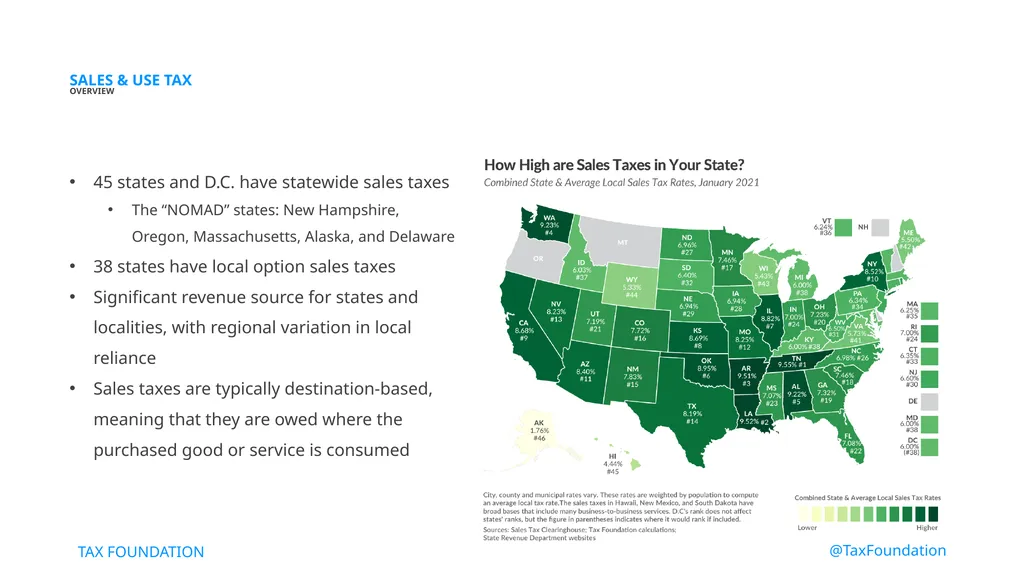
SALES & USE TAX OVERVIEW 45 states and D.C. have statewide sales taxes
The “NOMAD” states: New Hampshire, Oregon, Massachusetts, Alaska, and Delaware
38 states have local option sales taxes
Significant revenue source for states and localities, with regional variation in local reliance
Sales taxes are typically destination-based, meaning that they are owed where the purchased good or service is consumed<br>
03
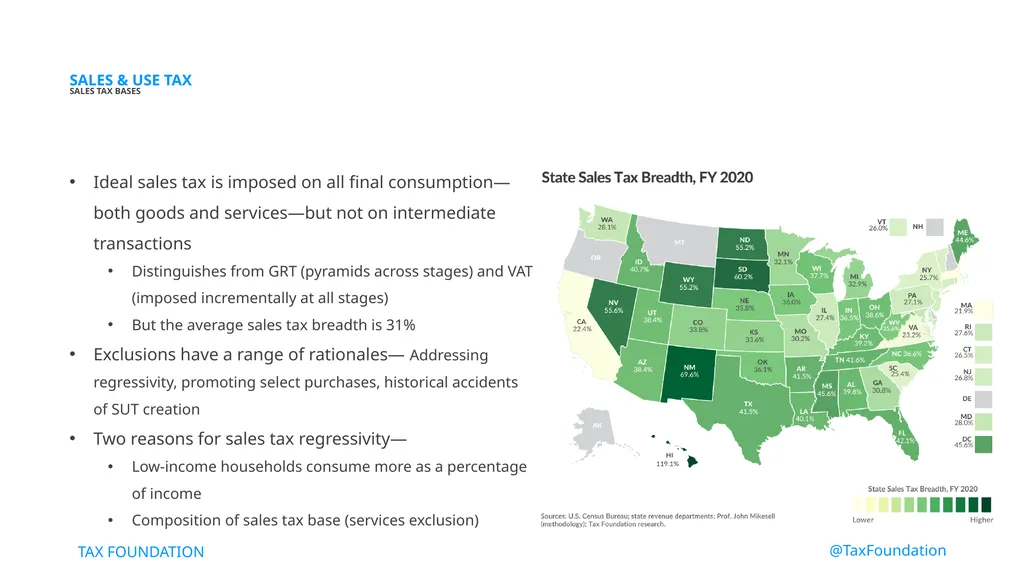
SALES & USE TAX SALES TAX BASES Ideal sales tax is imposed on all final consumption—both goods and services—but not on intermediate transactions
Distinguishes from GRT (pyramids across stages) and VAT (imposed incrementally at all stages)
But the average sales tax breadth is 31%
Exclusions have a range of rationales— Addressing regressivity, promoting select purchases, historical accidents of SUT creation
Two reasons for sales tax regressivity—
Low-income households consume more as a percentage of income
Composition of sales tax base (services exclusion)<br>
04
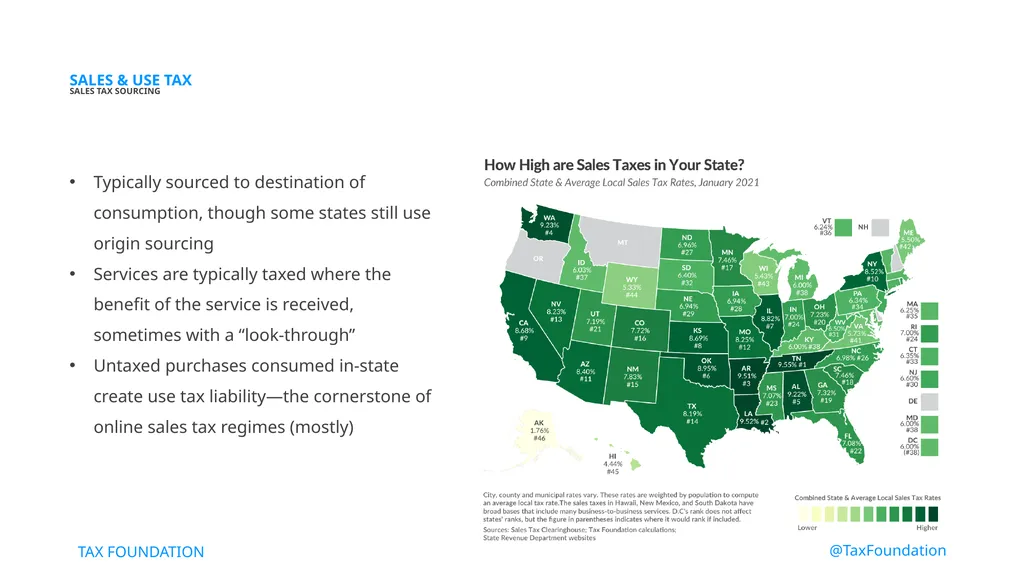
SALES & USE TAX SALES TAX SOURCING Typically sourced to destination of consumption, though some states still use origin sourcing
Services are typically taxed where the benefit of the service is received, sometimes with a “look-through”
Untaxed purchases consumed in-state create use tax liability—the cornerstone of online sales tax regimes (mostly)<br>
05
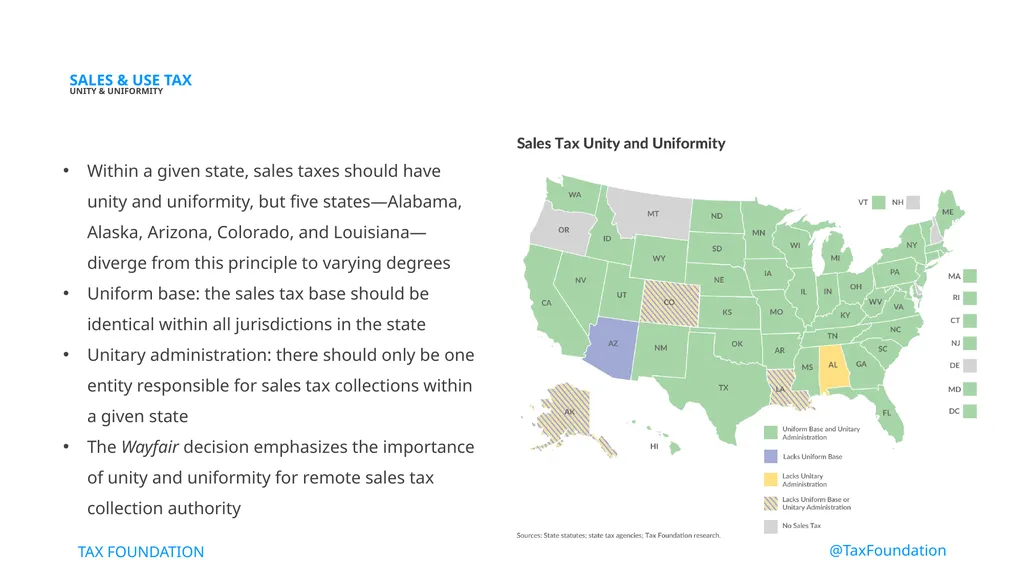
SALES & USE TAX UNITY & UNIFORMITY Within a given state, sales taxes should have unity and uniformity, but five states—Alabama, Alaska, Arizona, Colorado, and Louisiana—diverge from this principle to varying degrees
Uniform base: the sales tax base should be identical within all jurisdictions in the state
Unitary administration: there should only be one entity responsible for sales tax collections within a given state
The Wayfair decision emphasizes the importance of unity and uniformity for remote sales tax collection authority<br>
06
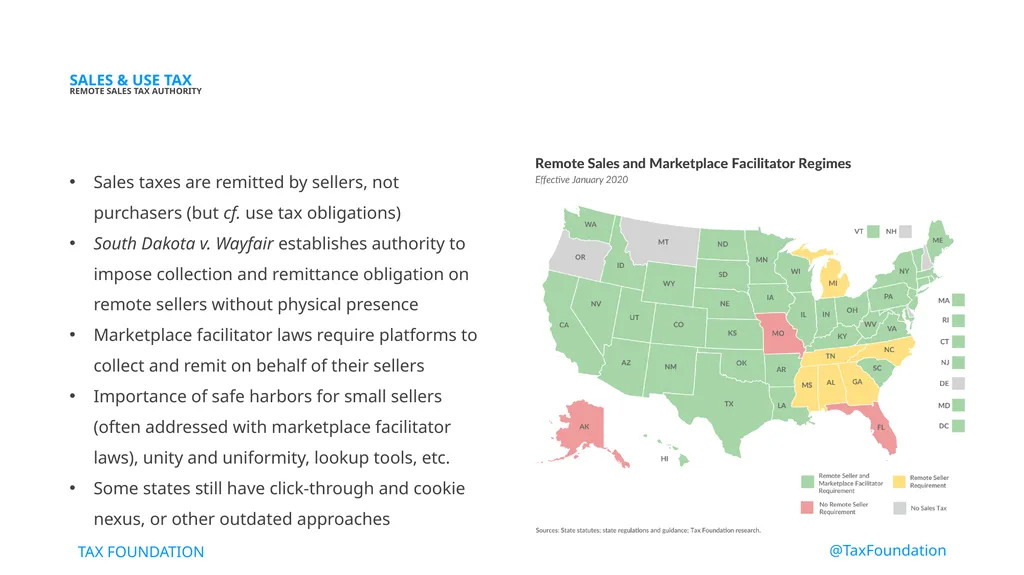
SALES & USE TAX REMOTE SALES TAX AUTHORITY Sales taxes are remitted by sellers, not purchasers (but cf. use tax obligations)
South Dakota v. Wayfair establishes authority to impose collection and remittance obligation on remote sellers without physical presence
Marketplace facilitator laws require platforms to collect and remit on behalf of their sellers
Importance of safe harbors for small sellers (often addressed with marketplace facilitator laws), unity and uniformity, lookup tools, etc.
Some states still have click-through and cookie nexus, or other outdated approaches<br>
07
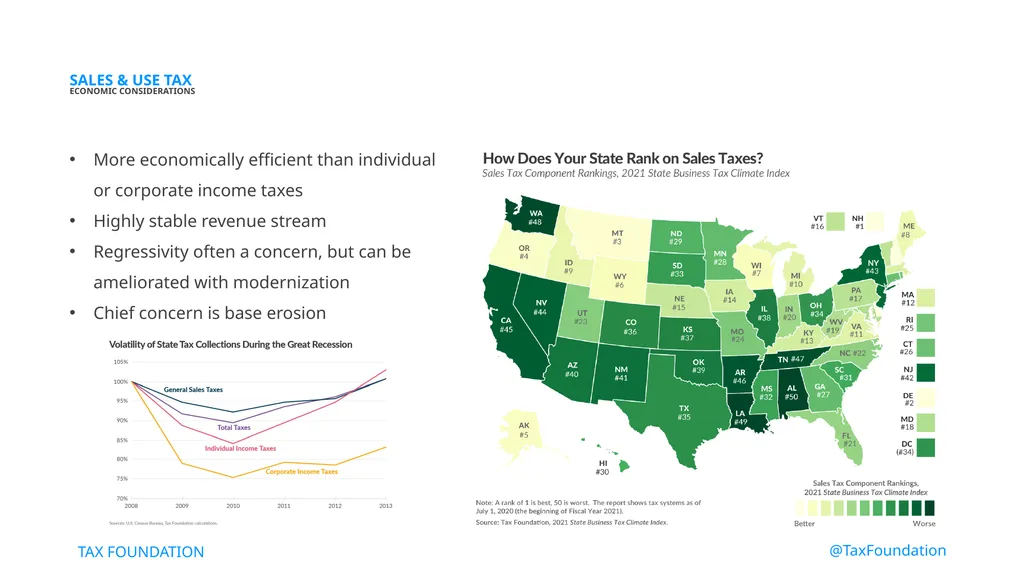
SALES & USE TAX ECONOMIC CONSIDERATIONS More economically efficient than individual or corporate income taxes
Highly stable revenue stream
Regressivity often a concern, but can be ameliorated with modernization
Chief concern is base erosion<br>
08
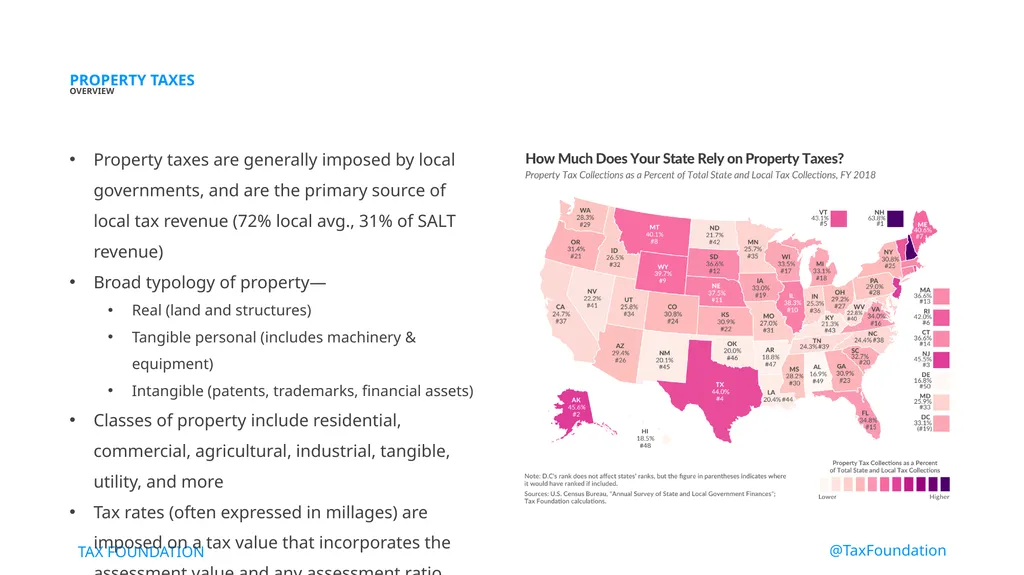
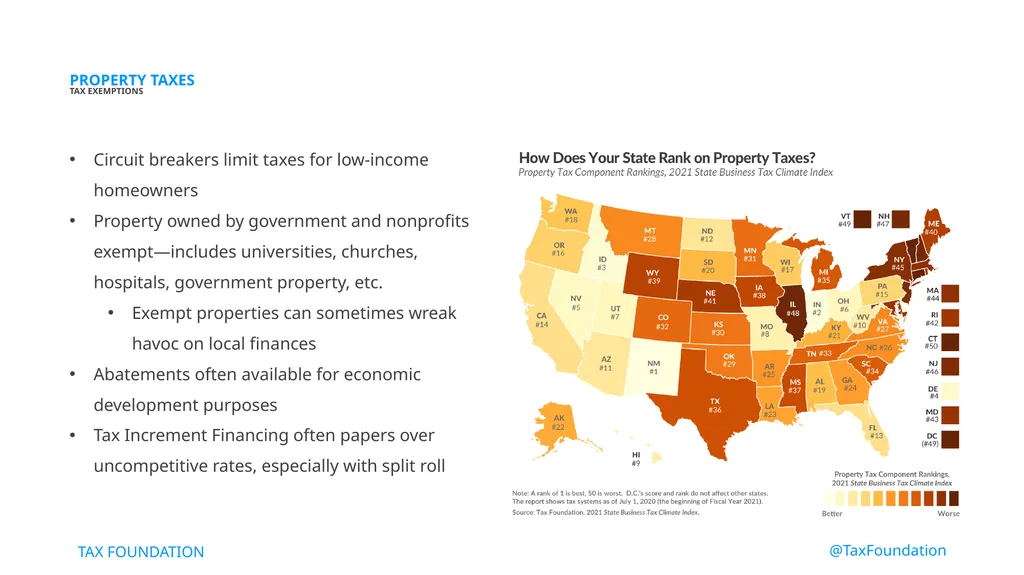
PROPERTY TAXES OVERVIEW Property taxes are generally imposed by local governments, and are the primary source of local tax revenue (72% local avg., 31% of SALT revenue)
Broad typology of property—
Real (land and structures)
Tangible personal (includes machinery & equipment)
Intangible (patents, trademarks, financial assets)
Classes of property include residential, commercial, agricultural, industrial, tangible, utility, and more
Tax rates (often expressed in millages) are imposed on a tax value that incorporates the assessment value and any assessment ratio<br>
09
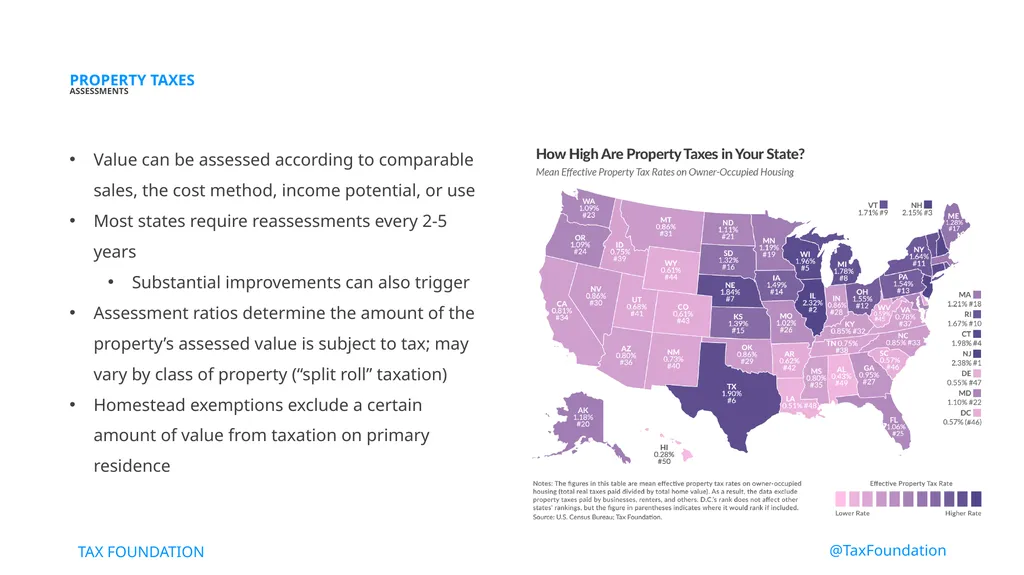
PROPERTY TAXES ASSESSMENTS Value can be assessed according to comparable sales, the cost method, income potential, or use
Most states require reassessments every 2-5 years
Substantial improvements can also trigger
Assessment ratios determine the amount of the property’s assessed value is subject to tax; may vary by class of property (“split roll” taxation)
Homestead exemptions exclude a certain amount of value from taxation on primary residence<br>
10
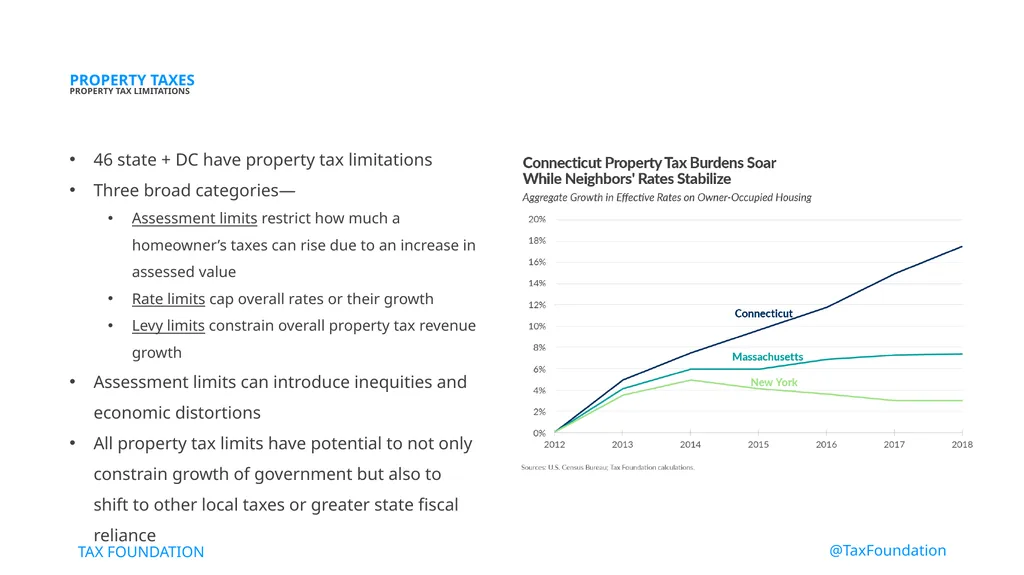
PROPERTY TAXES PROPERTY TAX LIMITATIONS 46 state + DC have property tax limitations
Three broad categories—
Assessment limits restrict how much a homeowner’s taxes can rise due to an increase in assessed value
Rate limits cap overall rates or their growth
Levy limits constrain overall property tax revenue growth
Assessment limits can introduce inequities and economic distortions
All property tax limits have potential to not only constrain growth of government but also to shift to other local taxes or greater state fiscal reliance<br>
11
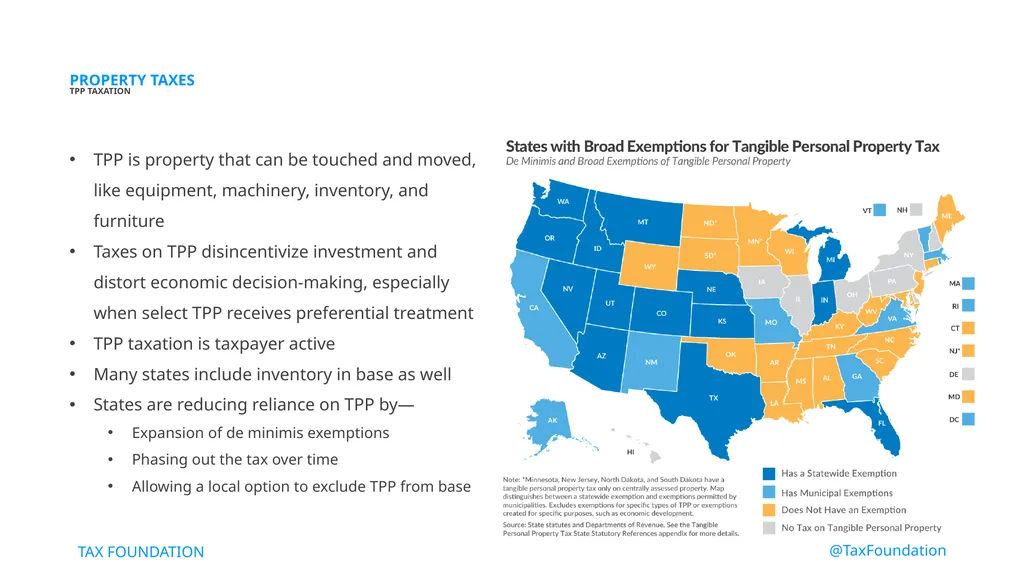
PROPERTY TAXES TPP TAXATION TPP is property that can be touched and moved, like equipment, machinery, inventory, and furniture
Taxes on TPP disincentivize investment and distort economic decision-making, especially when select TPP receives preferential treatment
TPP taxation is taxpayer active
Many states include inventory in base as well
States are reducing reliance on TPP by—
Expansion of de minimis exemptions
Phasing out the tax over time
Allowing a local option to exclude TPP from base<br>
12
PROPERTY TAXES TAX EXEMPTIONS Circuit breakers limit taxes for low-income homeowners
Property owned by government and nonprofits exempt—includes universities, churches, hospitals, government property, etc.
Exempt properties can sometimes wreak havoc on local finances
Abatements often available for economic development purposes
Tax Increment Financing often papers over uncompetitive rates, especially with split roll<br>
13
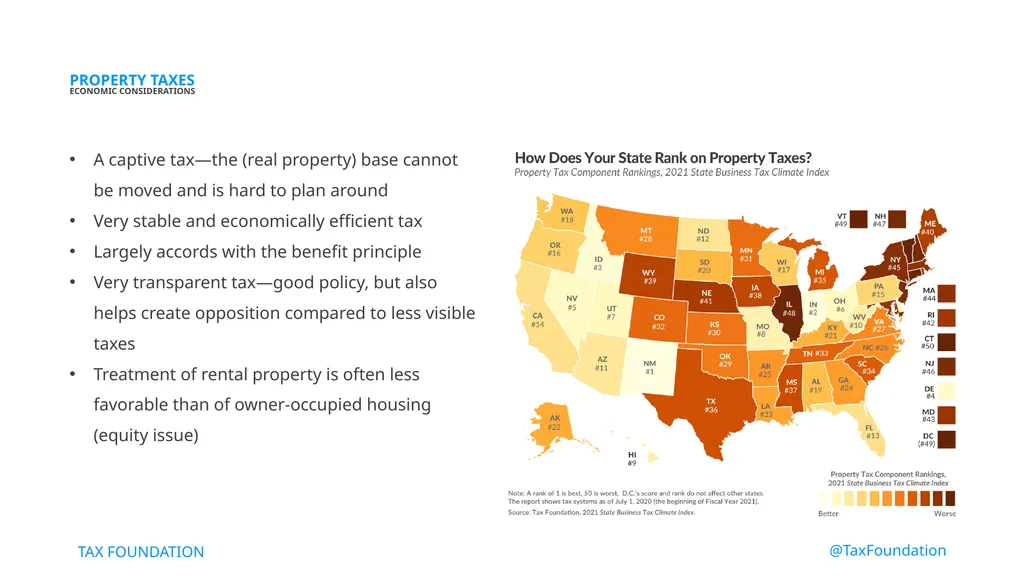
PROPERTY TAXES ECONOMIC CONSIDERATIONS A captive tax—the (real property) base cannot be moved and is hard to plan around
Very stable and economically efficient tax
Largely accords with the benefit principle
Very transparent tax—good policy, but also helps create opposition compared to less visible taxes
Treatment of rental property is often less favorable than of owner-occupied housing (equity issue)<br>
14
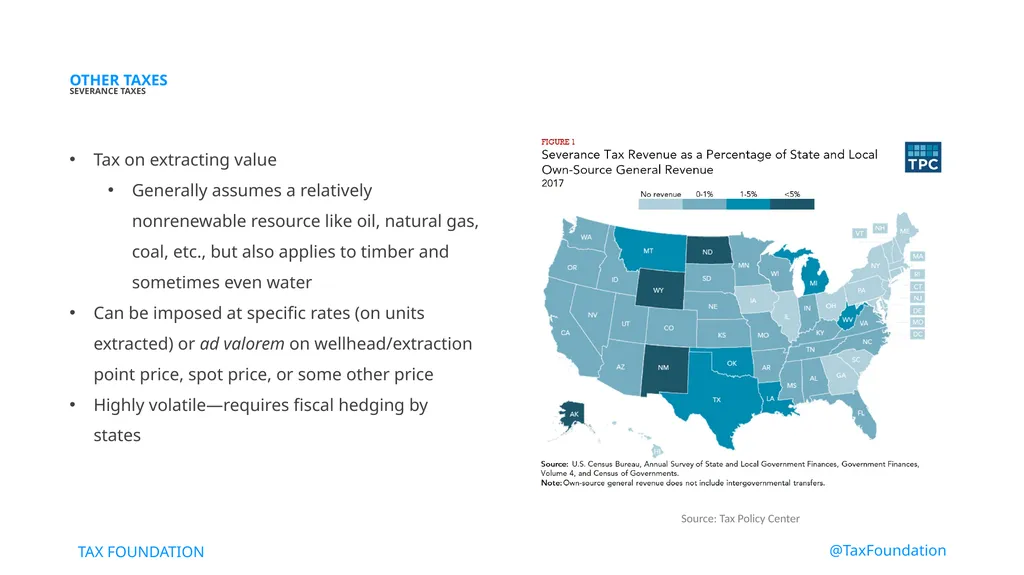
OTHER TAXES SEVERANCE TAXES Tax on extracting value
Generally assumes a relatively nonrenewable resource like oil, natural gas, coal, etc., but also applies to timber and sometimes even water
Can be imposed at specific rates (on units extracted) or ad valorem on wellhead/extraction point price, spot price, or some other price
Highly volatile—requires fiscal hedging by states Source: Tax Policy Center<br>
15
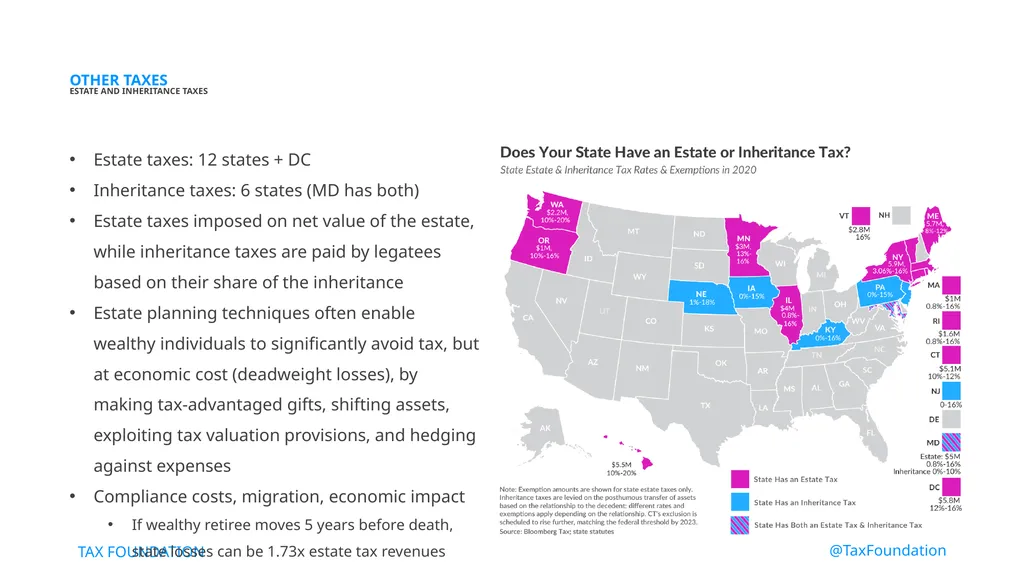
OTHER TAXES ESTATE AND INHERITANCE TAXES Estate taxes: 12 states + DC
Inheritance taxes: 6 states (MD has both)
Estate taxes imposed on net value of the estate, while inheritance taxes are paid by legatees based on their share of the inheritance
Estate planning techniques often enable wealthy individuals to significantly avoid tax, but at economic cost (deadweight losses), by making tax-advantaged gifts, shifting assets, exploiting tax valuation provisions, and hedging against expenses
Compliance costs, migration, economic impact
If wealthy retiree moves 5 years before death, state losses can be 1.73x estate tax revenues<br>