
statistical units in describing the production
A
Published · 17 slides · 0 views
1 / 1



Description
statistical units in describing the production process: main issues Peter van de Ven Head of National Accounts OECD Advisory Expert Group on National Accounts Paris, April 13 15, 2016 Introduction SNA 2008 distinguishes two different
Related Topics
Share
Embed code
Download this presentation From Below
"statistical units in describing the production" is the property of its rightful owner. Permission is granted to download and print the materials on this website for personal, non-commercial use only, and to display it on your personal computer provided you do not modify the materials and that you retain all copyright notices contained in the materials. By downloading content from our website, you accept the terms of this agreement.
Presentation Transcript
01
statistical units in describing the production process: main issues Peter van de Ven
Head of National Accounts
OECD Advisory Expert Group on National Accounts
Paris, April 13 – 15, 2016<br>
Head of National Accounts
OECD Advisory Expert Group on National Accounts
Paris, April 13 – 15, 2016<br>
02
Introduction SNA 2008 distinguishes two different types of statistical units:
Establishment for the description of the production process in supply and use framework
Institutional units for the description of income and finance in institutional sector accounts
Today: focus on the statistical unit for the description of the production process … although some of the considerations are interrelated
Main goal: to provide further guidance to the International Task Force on statistical units, to get a better idea of important considerations 2<br>
Establishment for the description of the production process in supply and use framework
Institutional units for the description of income and finance in institutional sector accounts
Today: focus on the statistical unit for the description of the production process … although some of the considerations are interrelated
Main goal: to provide further guidance to the International Task Force on statistical units, to get a better idea of important considerations 2<br>
03
International Task Force Terms of Reference for the establishment of an International Task Force on Statistical Units has been agreed, with the following main objectives:
To (re)consider the current 2008 SNA recommendations, and if need for change, to come up with concrete and implementable proposals
To come with concrete suggestions, e.g. regarding the criteria for distinguishing separate units, to arrive at internationally comparable implementation
To come with concrete proposals for classifications by industry and institutional sector
To asses the potential quantitative impact of proposals
Task Force still needs to be established 3<br>
To (re)consider the current 2008 SNA recommendations, and if need for change, to come up with concrete and implementable proposals
To come with concrete suggestions, e.g. regarding the criteria for distinguishing separate units, to arrive at internationally comparable implementation
To come with concrete proposals for classifications by industry and institutional sector
To asses the potential quantitative impact of proposals
Task Force still needs to be established 3<br>
04
Abstract description of the technological process
How enterprises (or parts thereof) use:
inputs of labour, capital (both tangible and intangible), and intermediate consumption
to produce outputs of goods and services
In terms of aggregating units, economists prefer to group units with similar production functions together
Much of this preference is linked to productivity analysis and analysis of technological change Production functions 4<br>
How enterprises (or parts thereof) use:
inputs of labour, capital (both tangible and intangible), and intermediate consumption
to produce outputs of goods and services
In terms of aggregating units, economists prefer to group units with similar production functions together
Much of this preference is linked to productivity analysis and analysis of technological change Production functions 4<br>
05
The premise in the SNA is that the establishment is the ideal unit
Establishment are the units with the greatest homogeneity in terms of output, which are also statistically observable
Thus also being the units designed to provide data that are more suitable for analyses of production
However, when this preference was developed:
More likely to be the only site for the entire enterprise
More likely to keep their records in such a way that data could be collected
Deemed the best way to maintain the link between inputs and outputs at a detailed industrial level as well as having a geographical link to produce regional statistics Why are establishments the preferred unit in the SNA 2008? 5<br>
Establishment are the units with the greatest homogeneity in terms of output, which are also statistically observable
Thus also being the units designed to provide data that are more suitable for analyses of production
However, when this preference was developed:
More likely to be the only site for the entire enterprise
More likely to keep their records in such a way that data could be collected
Deemed the best way to maintain the link between inputs and outputs at a detailed industrial level as well as having a geographical link to produce regional statistics Why are establishments the preferred unit in the SNA 2008? 5<br>
06
The items included in the production account and the generation of income account:
Must be feasible to calculate output, intermediate consumption and thus value added and also compensation of employees, taxes on production and imports, subsidies and the operating surplus or mixed income
Statistics of numbers of employees, types of employees and hours worked
Changes in inventories and gross fixed capital formation, including stocks of non-financial assets used in production Data needed for description of production process 6<br>
Must be feasible to calculate output, intermediate consumption and thus value added and also compensation of employees, taxes on production and imports, subsidies and the operating surplus or mixed income
Statistics of numbers of employees, types of employees and hours worked
Changes in inventories and gross fixed capital formation, including stocks of non-financial assets used in production Data needed for description of production process 6<br>
07
In the case of multi-establishment enterprises:
Establishments may not be the appropriate unit because not the decision unit
Essential inputs cannot be allocated uniquely to establishments
Capital services related to intellectual property products (e.g., R&D, software, and databases)
Business services (corporate and/or ancillary services provided or purchased at a centralised level of the enterprise)
Not possible to appropriately account for the operating surplus at the establishment level (absence of market prices and issues related to inter-establishment transactions) Feasibility of data at the establishment level: theoretical considerations 7<br>
Establishments may not be the appropriate unit because not the decision unit
Essential inputs cannot be allocated uniquely to establishments
Capital services related to intellectual property products (e.g., R&D, software, and databases)
Business services (corporate and/or ancillary services provided or purchased at a centralised level of the enterprise)
Not possible to appropriately account for the operating surplus at the establishment level (absence of market prices and issues related to inter-establishment transactions) Feasibility of data at the establishment level: theoretical considerations 7<br>
08
Changes in collection of source data:
Pressure to decrease respondent burden
More and more use of administrative data
Administrative records typically do not relate to establishments but to enterprises or legal units
More general shift from surveying at establishment level to surveying at enterprise level
Increasingly difficult for enterprises to provide data at establishment level
Quality concerns about data collected at establishment level, because not readily available Feasibility of data at the establishment level: practical considerations 8<br>
Pressure to decrease respondent burden
More and more use of administrative data
Administrative records typically do not relate to establishments but to enterprises or legal units
More general shift from surveying at establishment level to surveying at enterprise level
Increasingly difficult for enterprises to provide data at establishment level
Quality concerns about data collected at establishment level, because not readily available Feasibility of data at the establishment level: practical considerations 8<br>
09
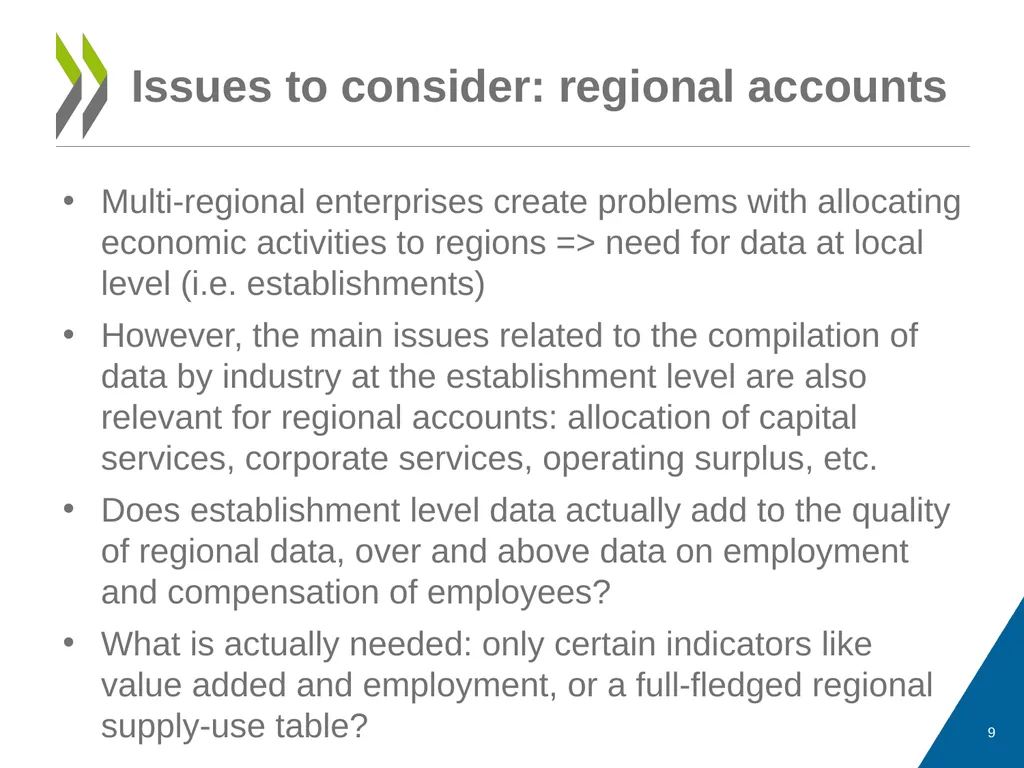
Multi-regional enterprises create problems with allocating economic activities to regions => need for data at local level (i.e. establishments)
However, the main issues related to the compilation of data by industry at the establishment level are also relevant for regional accounts: allocation of capital services, corporate services, operating surplus, etc.
Does establishment level data actually add to the quality of regional data, over and above data on employment and compensation of employees?
What is actually needed: only certain indicators like value added and employment, or a full-fledged regional supply-use table? Issues to consider: regional accounts 9<br>
However, the main issues related to the compilation of data by industry at the establishment level are also relevant for regional accounts: allocation of capital services, corporate services, operating surplus, etc.
Does establishment level data actually add to the quality of regional data, over and above data on employment and compensation of employees?
What is actually needed: only certain indicators like value added and employment, or a full-fledged regional supply-use table? Issues to consider: regional accounts 9<br>
10
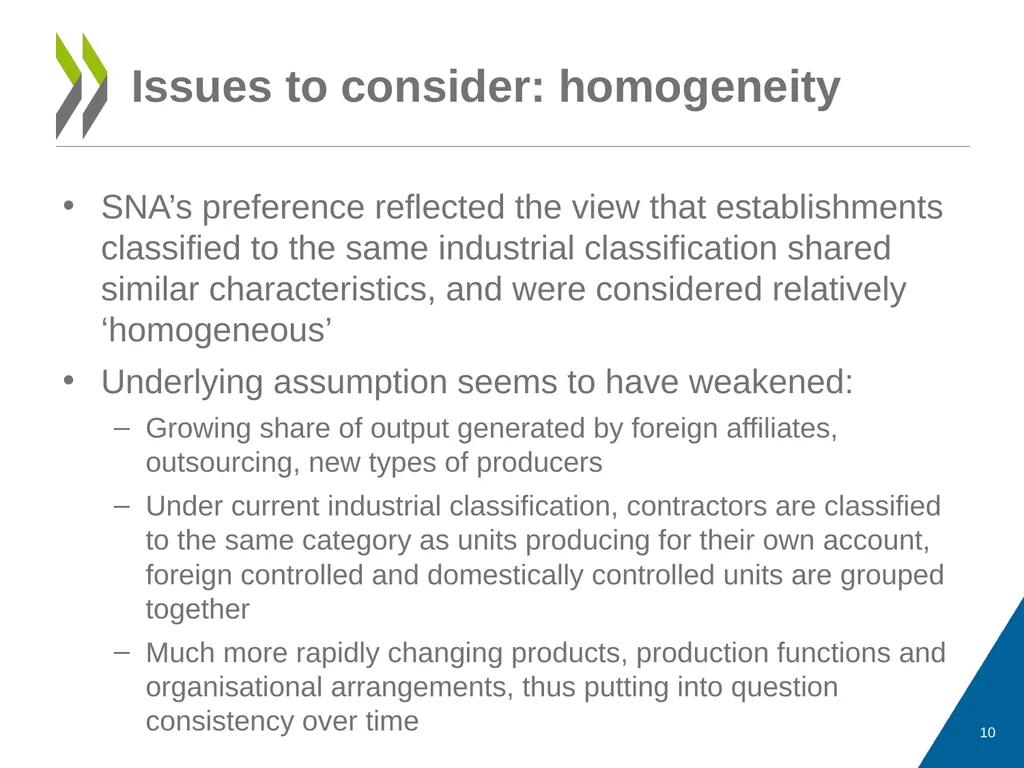
SNA’s preference reflected the view that establishments classified to the same industrial classification shared similar characteristics, and were considered relatively ‘homogeneous’
Underlying assumption seems to have weakened:
Growing share of output generated by foreign affiliates, outsourcing, new types of producers
Under current industrial classification, contractors are classified to the same category as units producing for their own account, foreign controlled and domestically controlled units are grouped together
Much more rapidly changing products, production functions and organisational arrangements, thus putting into question consistency over time Issues to consider: homogeneity 10<br>
Underlying assumption seems to have weakened:
Growing share of output generated by foreign affiliates, outsourcing, new types of producers
Under current industrial classification, contractors are classified to the same category as units producing for their own account, foreign controlled and domestically controlled units are grouped together
Much more rapidly changing products, production functions and organisational arrangements, thus putting into question consistency over time Issues to consider: homogeneity 10<br>
11
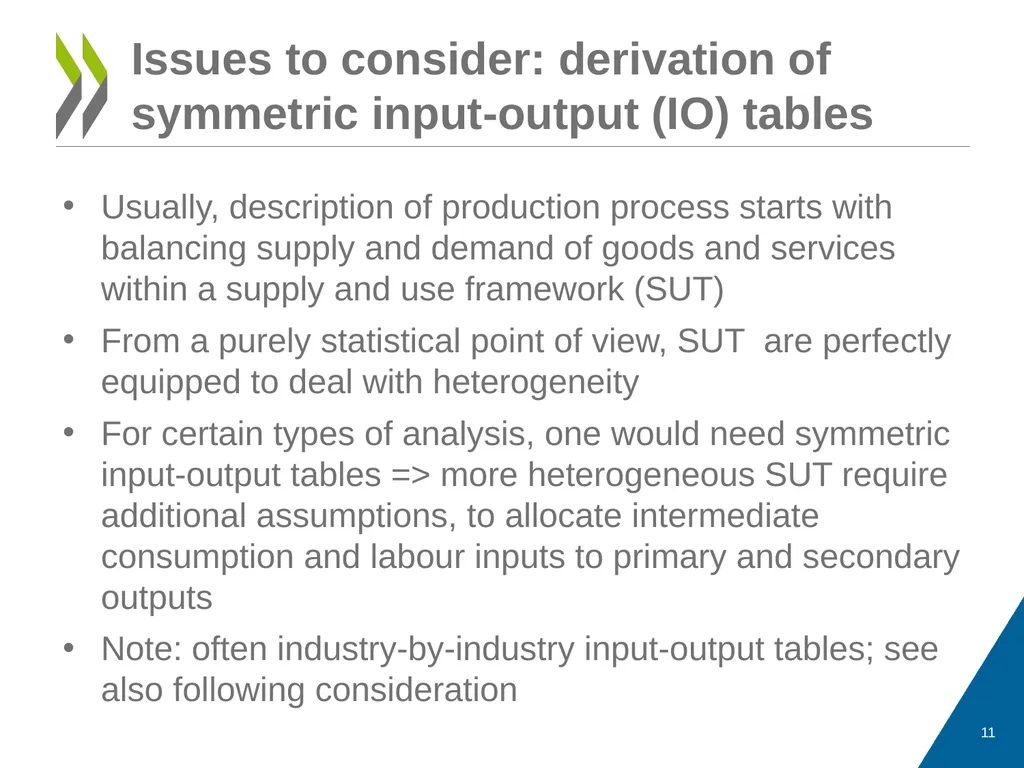
Usually, description of production process starts with balancing supply and demand of goods and services within a supply and use framework (SUT)
From a purely statistical point of view, SUT are perfectly equipped to deal with heterogeneity
For certain types of analysis, one would need symmetric input-output tables => more heterogeneous SUT require additional assumptions, to allocate intermediate consumption and labour inputs to primary and secondary outputs
Note: often industry-by-industry input-output tables; see also following consideration Issues to consider: derivation of symmetric input-output (IO) tables 11<br>
From a purely statistical point of view, SUT are perfectly equipped to deal with heterogeneity
For certain types of analysis, one would need symmetric input-output tables => more heterogeneous SUT require additional assumptions, to allocate intermediate consumption and labour inputs to primary and secondary outputs
Note: often industry-by-industry input-output tables; see also following consideration Issues to consider: derivation of symmetric input-output (IO) tables 11<br>
12
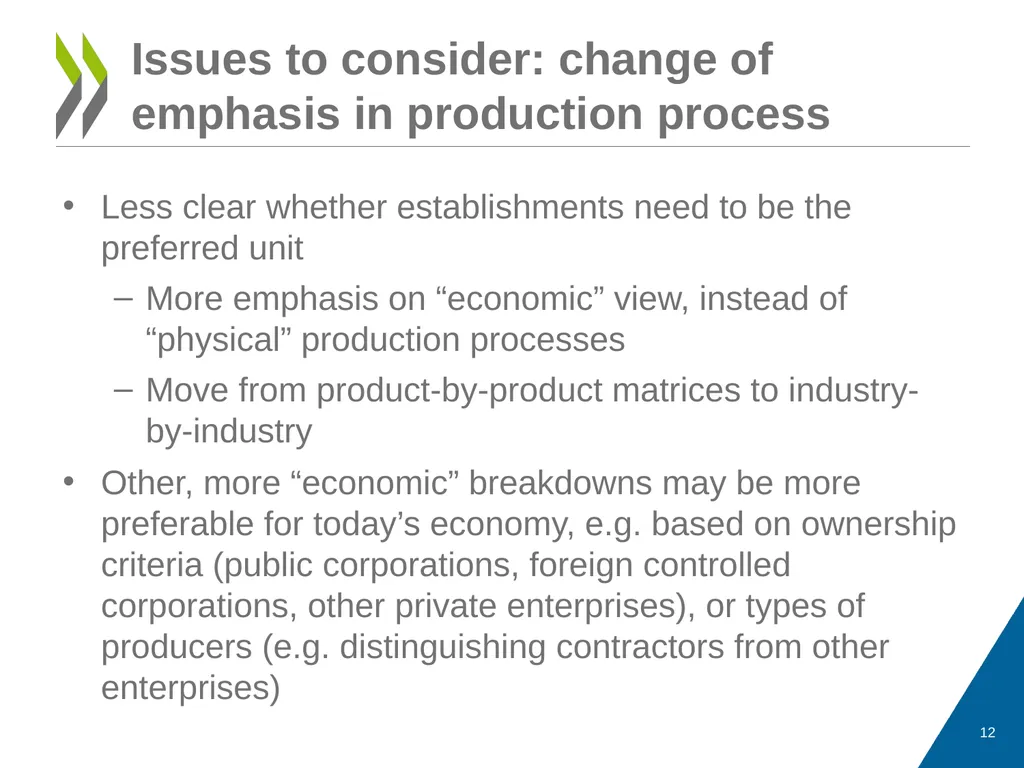
Less clear whether establishments need to be the preferred unit
More emphasis on “economic” view, instead of “physical” production processes
Move from product-by-product matrices to industry-by-industry
Other, more “economic” breakdowns may be more preferable for today’s economy, e.g. based on ownership criteria (public corporations, foreign controlled corporations, other private enterprises), or types of producers (e.g. distinguishing contractors from other enterprises) Issues to consider: change of emphasis in production process 12<br>
More emphasis on “economic” view, instead of “physical” production processes
Move from product-by-product matrices to industry-by-industry
Other, more “economic” breakdowns may be more preferable for today’s economy, e.g. based on ownership criteria (public corporations, foreign controlled corporations, other private enterprises), or types of producers (e.g. distinguishing contractors from other enterprises) Issues to consider: change of emphasis in production process 12<br>
13
Increasingly important to link the “real” economy and the “financial” economy (e.g. financial crisis, impact of holding gains, trade in value added)
Using the same statistical unit in the SUT and institutional sector accounts would allow for better integration, and combined monitoring and analysis of production, income, and finance
This would disqualify establishment, as most of the information needed to compile institutional sector accounts is not available at the establishment level Issues to consider: integrated analysis 13<br>
Using the same statistical unit in the SUT and institutional sector accounts would allow for better integration, and combined monitoring and analysis of production, income, and finance
This would disqualify establishment, as most of the information needed to compile institutional sector accounts is not available at the establishment level Issues to consider: integrated analysis 13<br>
14
Increasing demands for detailed analysis in which, for example, production statistics need to be linked to statistics on enterprise characteristics, foreign (affiliate) trade, employment, etc.
Use of establishment makes it difficult to properly link the data as these phenomena are typically only available at the enterprise level
More generally: potential for micro-macro linking Issues to consider: linking data 14<br>
Use of establishment makes it difficult to properly link the data as these phenomena are typically only available at the enterprise level
More generally: potential for micro-macro linking Issues to consider: linking data 14<br>
15
Removing the preference for establishments
Provides a better link to corporates’ own business accounting frameworks
Reduce reporting burden for respondents
Reduce statistical burden for national statistical offices
Creates more opportunities for linking data, thus increasing flexibility of statistical system Issues to consider: efficiency and flexibility 15<br>
Provides a better link to corporates’ own business accounting frameworks
Reduce reporting burden for respondents
Reduce statistical burden for national statistical offices
Creates more opportunities for linking data, thus increasing flexibility of statistical system Issues to consider: efficiency and flexibility 15<br>
16
Are these the most important issues for the discussion on the choice of statistical unit?
Are there additional considerations which may need to be taken into account?
In your opinion, how important are the various considerations? Questions for the AEG 16<br>
Are there additional considerations which may need to be taken into account?
In your opinion, how important are the various considerations? Questions for the AEG 16<br>
17
Thank you for your attention! 17<br>