04
4 Emphasizing the Development of Self-Help Skills Focus too little on self-help development – particularly with young children
Easier to simply do it for the child
An area where parents may feel successful – fostering dependency
Adaptive deficits > Cognitive deficits<br>
05
5 Why is it important Adaptive skills signal the beginning of independence from parents
Failure to address may prevent community integration, school functions, recreational activities, and eventually housing and job opportunities
Challenging behavior and the absence of S-H skills most often associated with out-of-home placement<br>
06
Problem with generalization
Problem learning complex skills requiring abstraction or attention to social norms
Ability to understand language
Restricted/stereotyped range of interests-attention
Sensory sensitivities
Other behavioral concerns Weaknesses for children with ASD<br>
07
Teaching self-help skills is complex
Significant investment of time
May be able to scaffold on top of things already doing
Are there limits on what parents can be expected to accomplish? Parents’ Role<br>
08
Individuals with Disabilities Education Improvement Act – Revised, 2006
Indicates a responsibility to address all areas of development, including self-help School’s Role<br>
09
General education – focus on meeting academic standards
Most kids come prepared already
Environment not very conducive to instruction (e.g., toileting skills)
Focus on transfer of skills
Measuring success at school (check lists)
Special education – greater responsibility School’s Role<br>
10
Choosing the right skills<br>
11
Age-Appropriate (don’t get too far ahead)?
Functional Skills (important for child now)?
Prerequisite behaviors (able to attend and follow simple instructions; imitation)?
Shown any interest?
Any physical limitations (accommodations)? Is the child ready?<br>
12
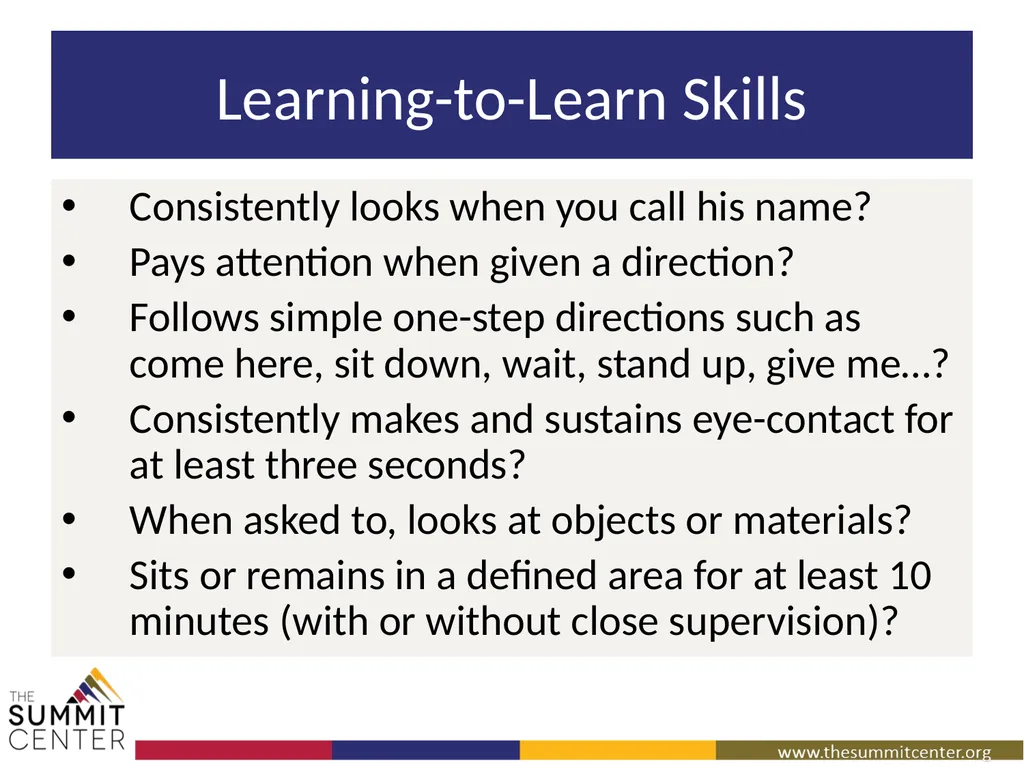
Consistently looks when you call his name?
Pays attention when given a direction?
Follows simple one-step directions such as come here, sit down, wait, stand up, give me…?
Consistently makes and sustains eye-contact for at least three seconds?
When asked to, looks at objects or materials?
Sits or remains in a defined area for at least 10 minutes (with or without close supervision)? Learning-to-Learn Skills<br>
13
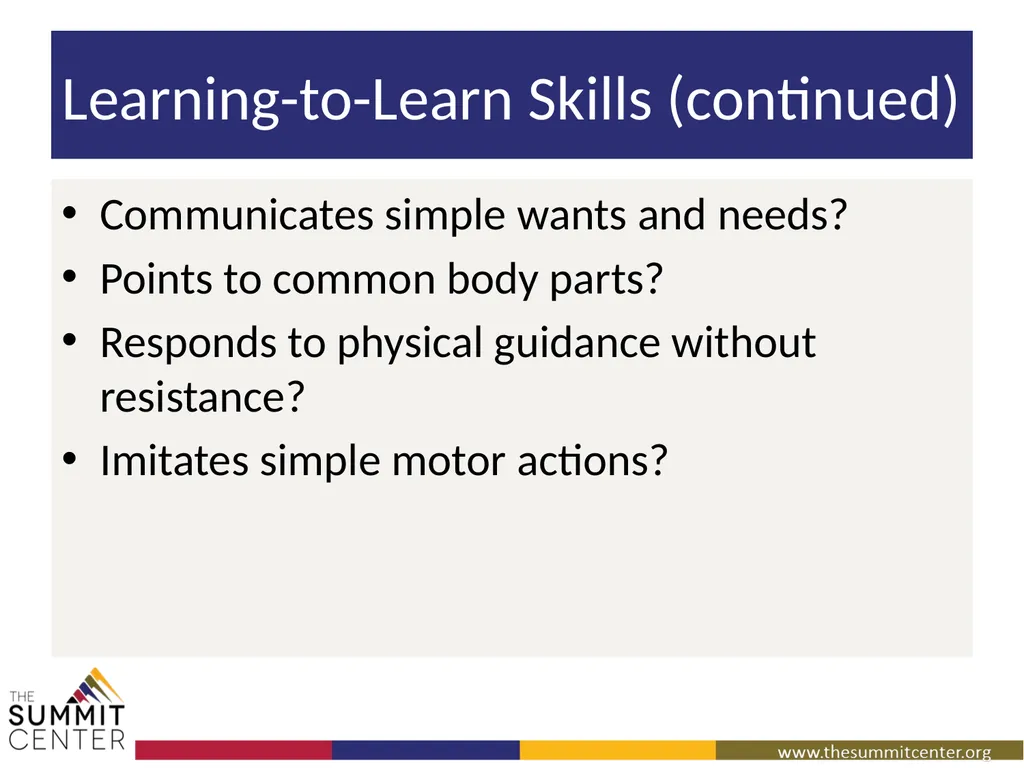
Communicates simple wants and needs?
Points to common body parts?
Responds to physical guidance without resistance?
Imitates simple motor actions? Learning-to-Learn Skills (continued)<br>
14
Skills Inventory Functional Area
Tasks
Skill Targets
Prioritize
Develop goals<br>
15
Motivating The child to Learn<br>
16
Items that many of us find reinforcing (e.g., recognition, task completion, etc.) may not be sufficient to motivate children with autism Need for Rewards<br>
17
Praise – most practical
Food – very powerful
Attention (verbal and physical)
Activities
Praise + Super rewards Potential Reinforcers<br>
18
Spending time with preferred people
Special activities
Recess, computer time
Special responsibilities
Line leader, picking story Examples of Activity Reinforcers<br>
19
Frequent use of rewards is a tool for teaching, not the end result
Gradually begin to expect more from the child before reinforcement is delivered
Fading too quickly may lead to failure, while waiting too long may lead to increased dependence
Fade to a level that is to be expected in the most natural setting Fading Reinforcers<br>
20
Using Effective Tools for CHange<br>
21
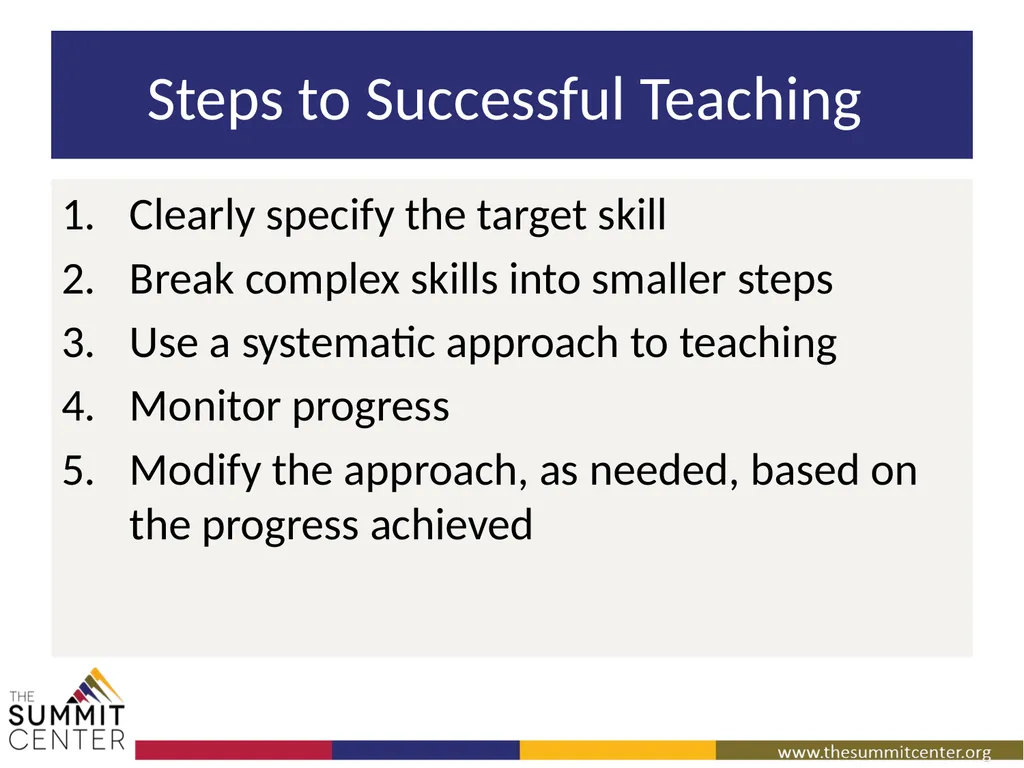
Clearly specify the target skill
Break complex skills into smaller steps
Use a systematic approach to teaching
Monitor progress
Modify the approach, as needed, based on the progress achieved Steps to Successful Teaching<br>
22
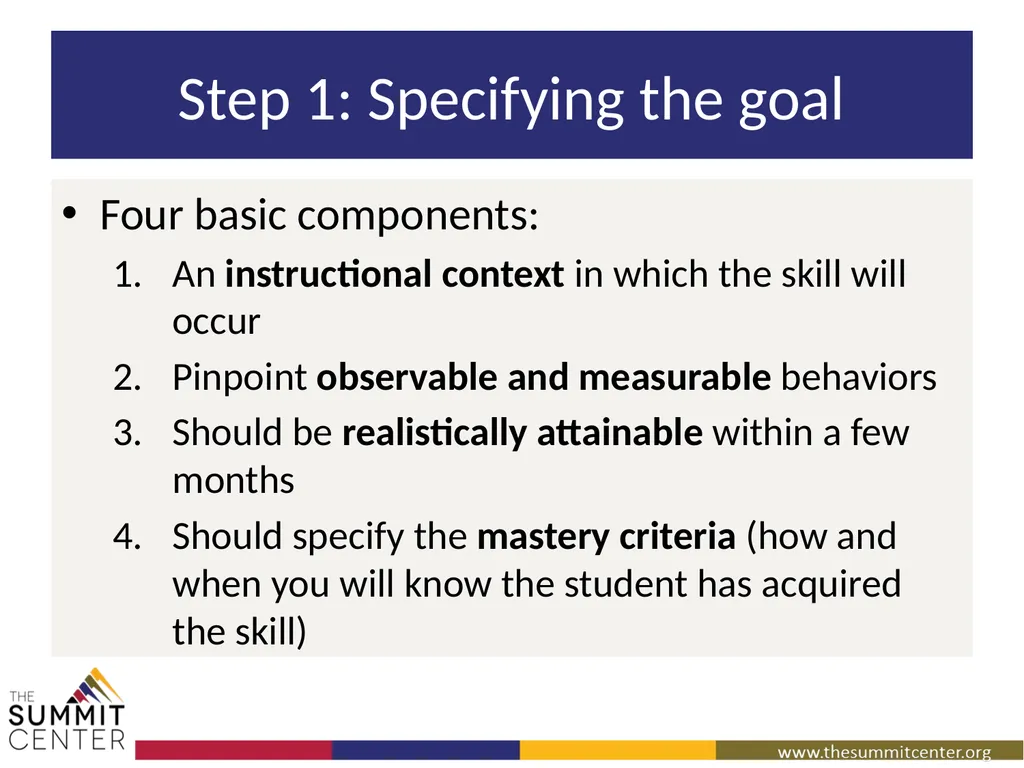
Four basic components:
An instructional context in which the skill will occur
Pinpoint observable and measurable behaviors
Should be realistically attainable within a few months
Should specify the mastery criteria (how and when you will know the student has acquired the skill) Step 1: Specifying the goal<br>
23
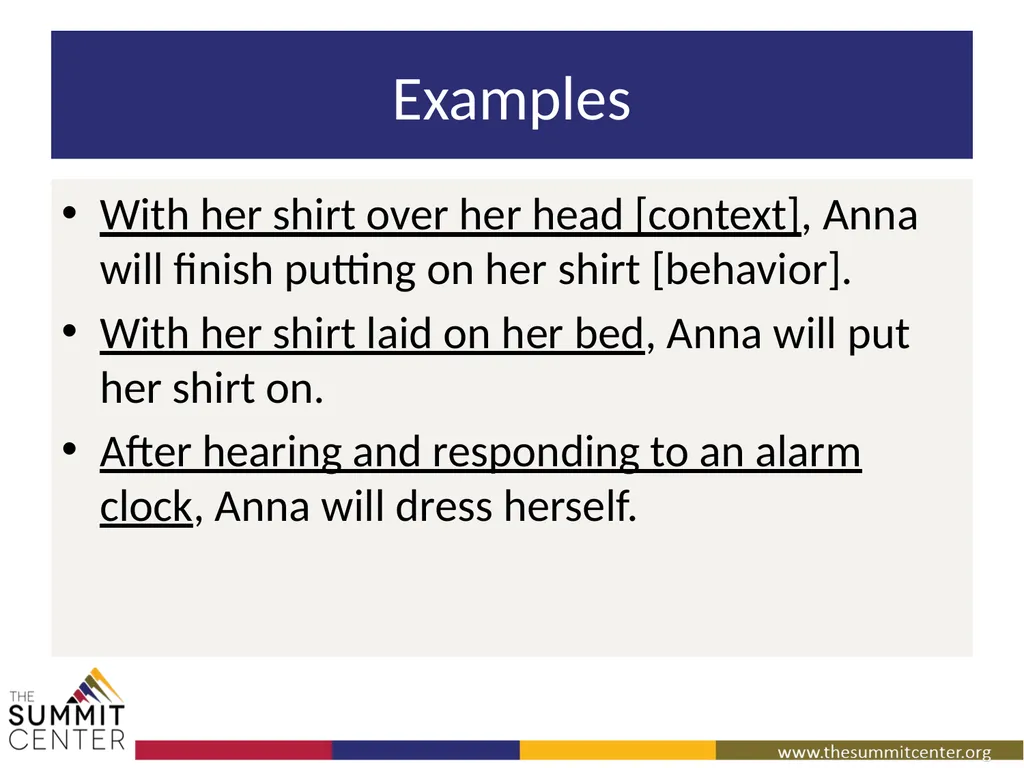
With her shirt over her head [context], Anna will finish putting on her shirt [behavior].
With her shirt laid on her bed, Anna will put her shirt on.
After hearing and responding to an alarm clock, Anna will dress herself. Examples<br>
24
A Task Analysis breaks a task into smaller, more easily attainable steps
The number of steps depends on the student’s prerequisite abilities and skills
Increases the number of opportunities for reinforcement and success Step 2: Breaking tasks into steps<br>
25
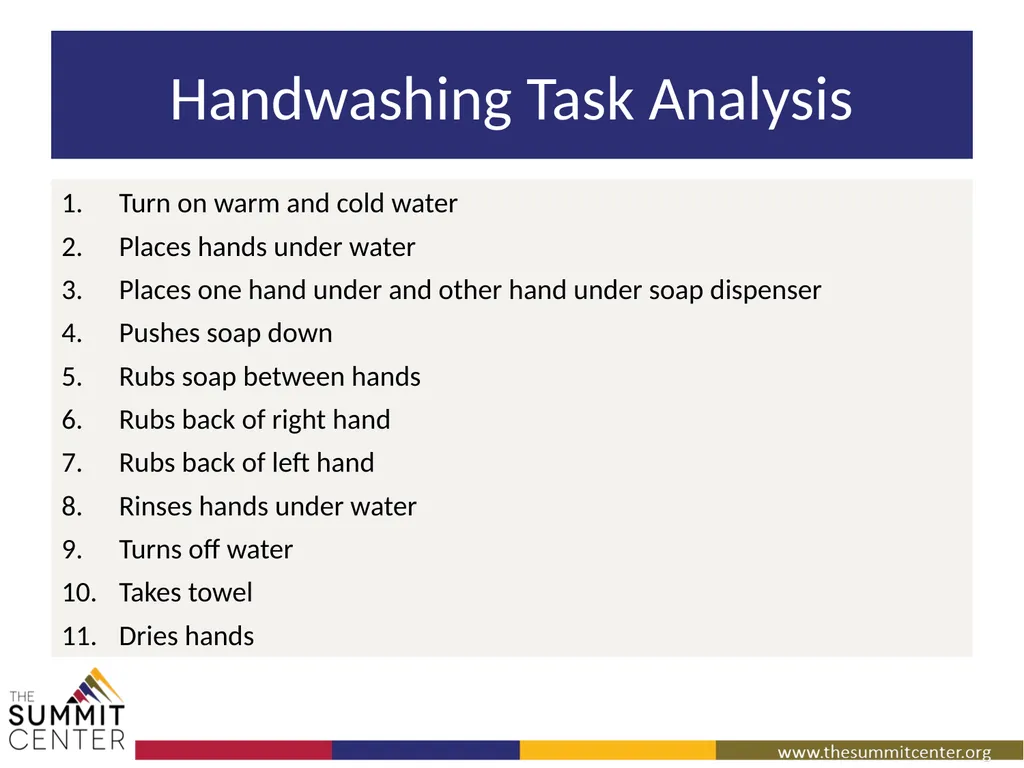
Handwashing Task Analysis Turn on warm and cold water
Places hands under water
Places one hand under and other hand under soap dispenser
Pushes soap down
Rubs soap between hands
Rubs back of right hand
Rubs back of left hand
Rinses hands under water
Turns off water
Takes towel
Dries hands<br>
26
Frequently practice emerging skills
Provide high levels of repetition
Commit to a teaching approach until its results can be clearly evaluated
Utilize proven tools for instruction, including:
Chaining
Prompting
Shaping Step 3: Systematic approaches to teaching<br>
27
A method of linking relatively simple steps (task analysis) to form a more complex task (a chain of behavior)
Each step in the chain signals the next step to be completed and reinforces the previous step
Three methods of chaining:
Backward, Whole chain, Forward Chaining<br>
28
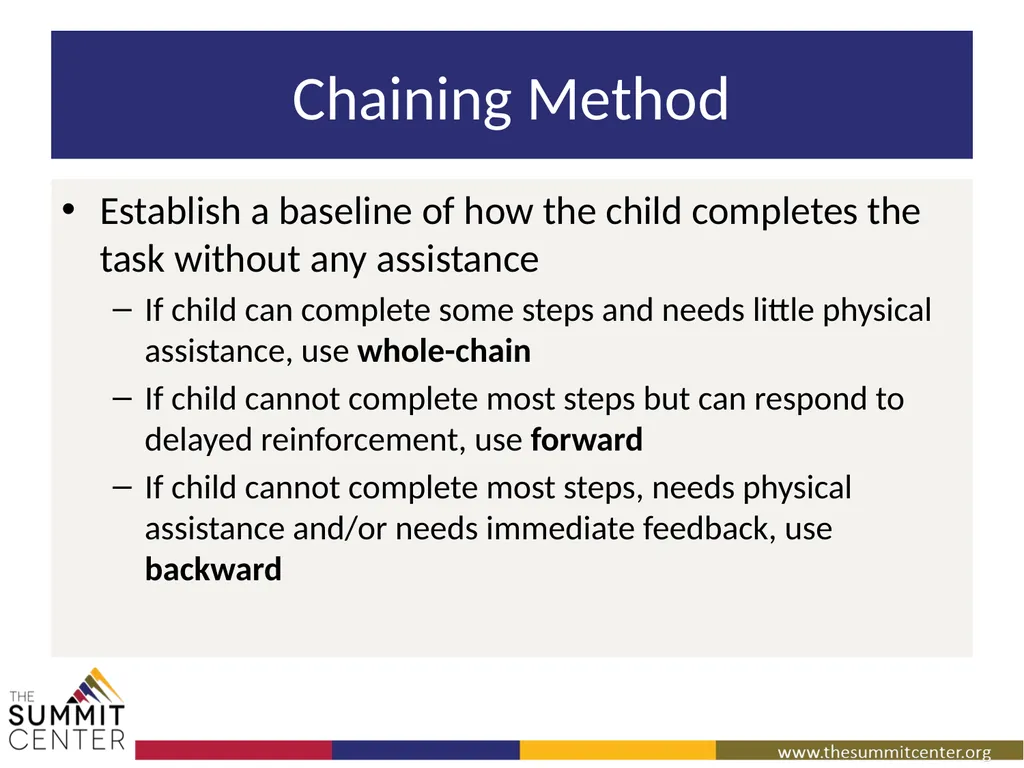
Establish a baseline of how the child completes the task without any assistance
If child can complete some steps and needs little physical assistance, use whole-chain
If child cannot complete most steps but can respond to delayed reinforcement, use forward
If child cannot complete most steps, needs physical assistance and/or needs immediate feedback, use backward Chaining Method<br>
29
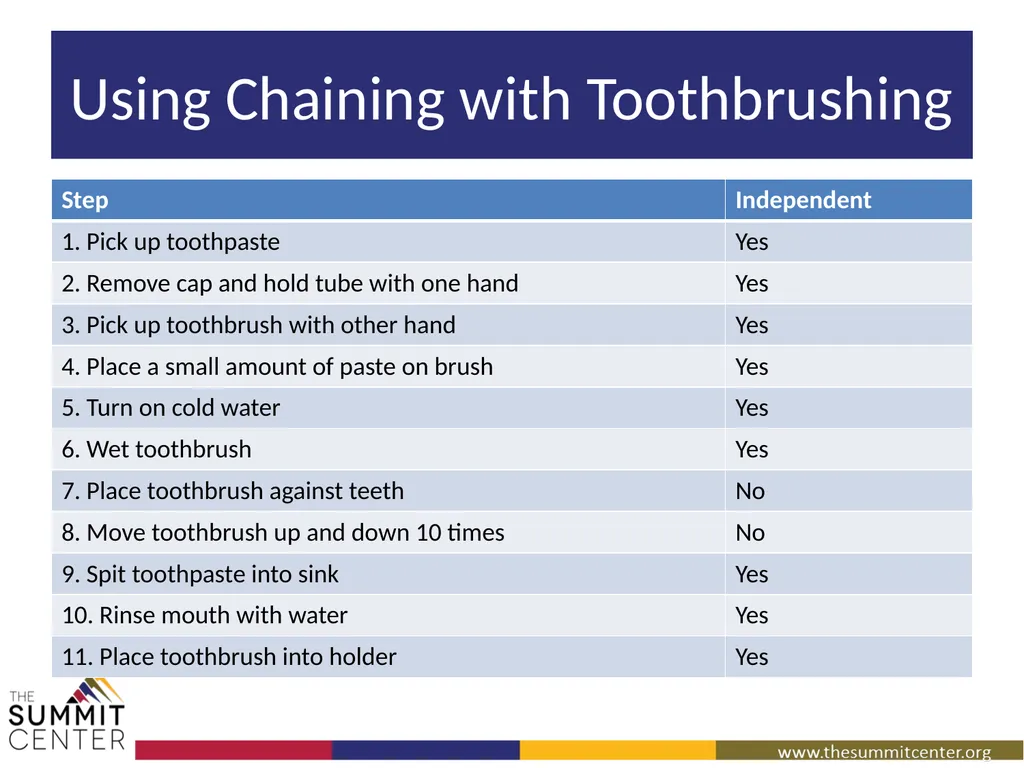
Using Chaining with Toothbrushing<br>
30
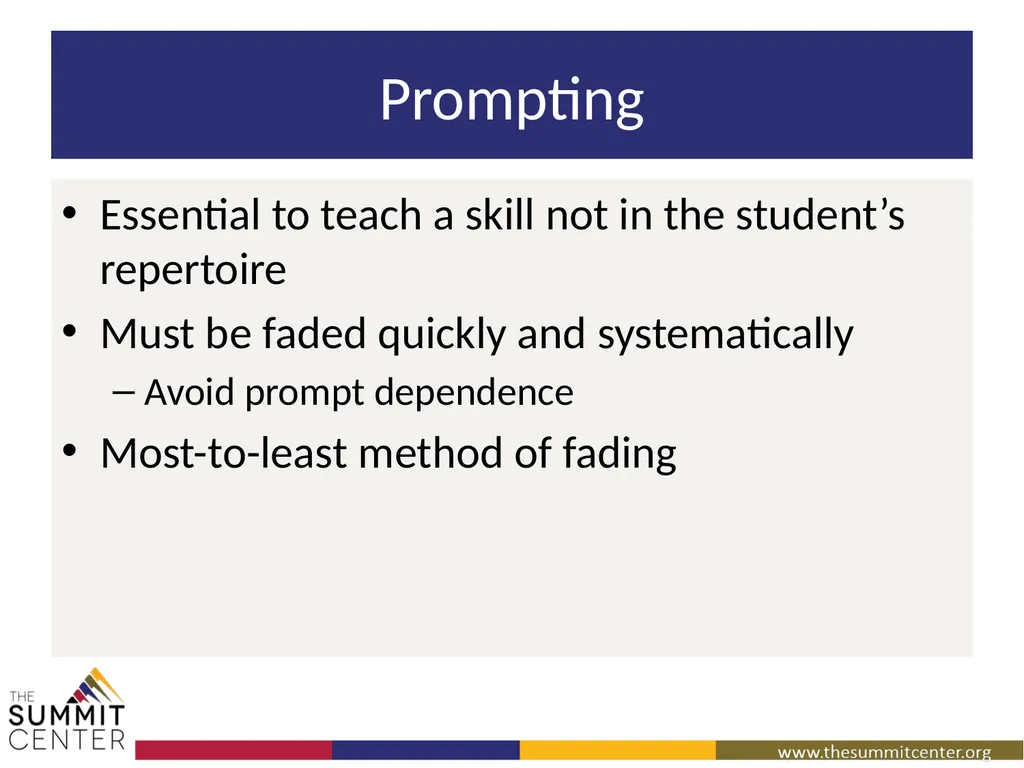
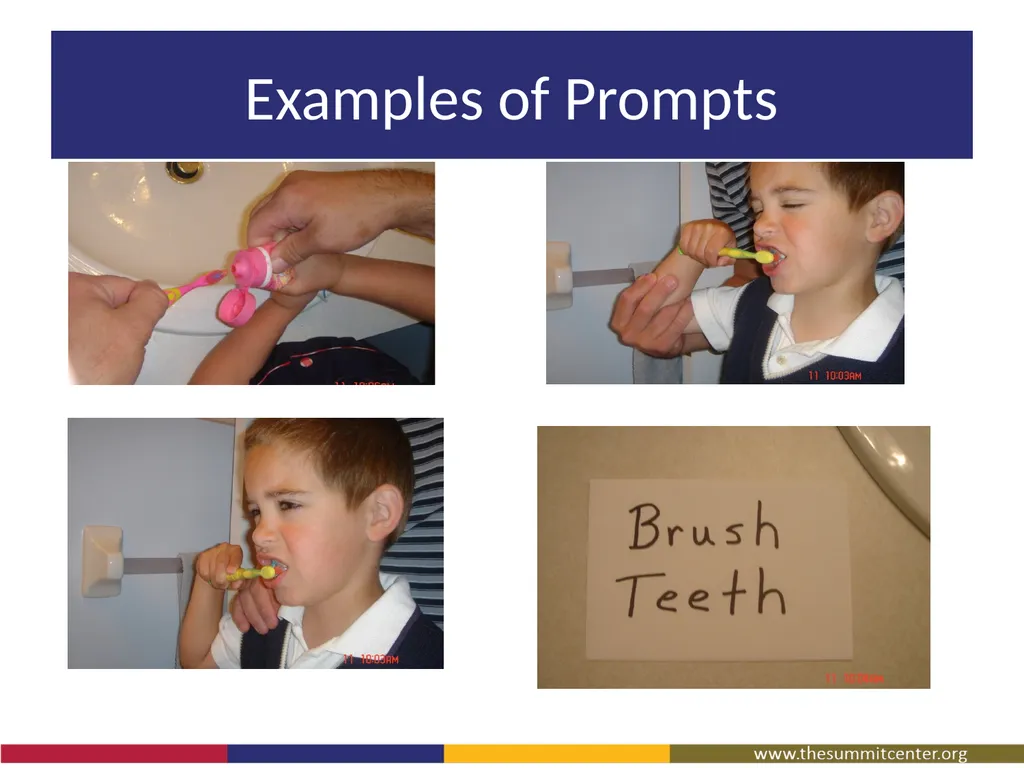
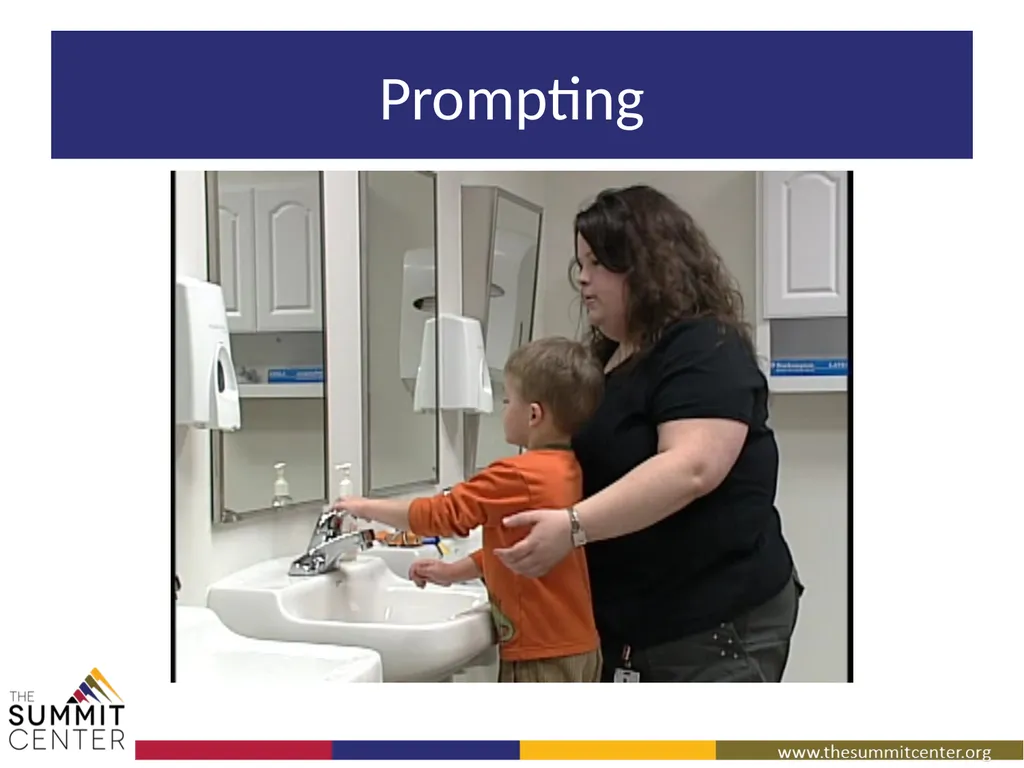
Essential to teach a skill not in the student’s repertoire
Must be faded quickly and systematically
Avoid prompt dependence
Most-to-least method of fading Prompting<br>
32
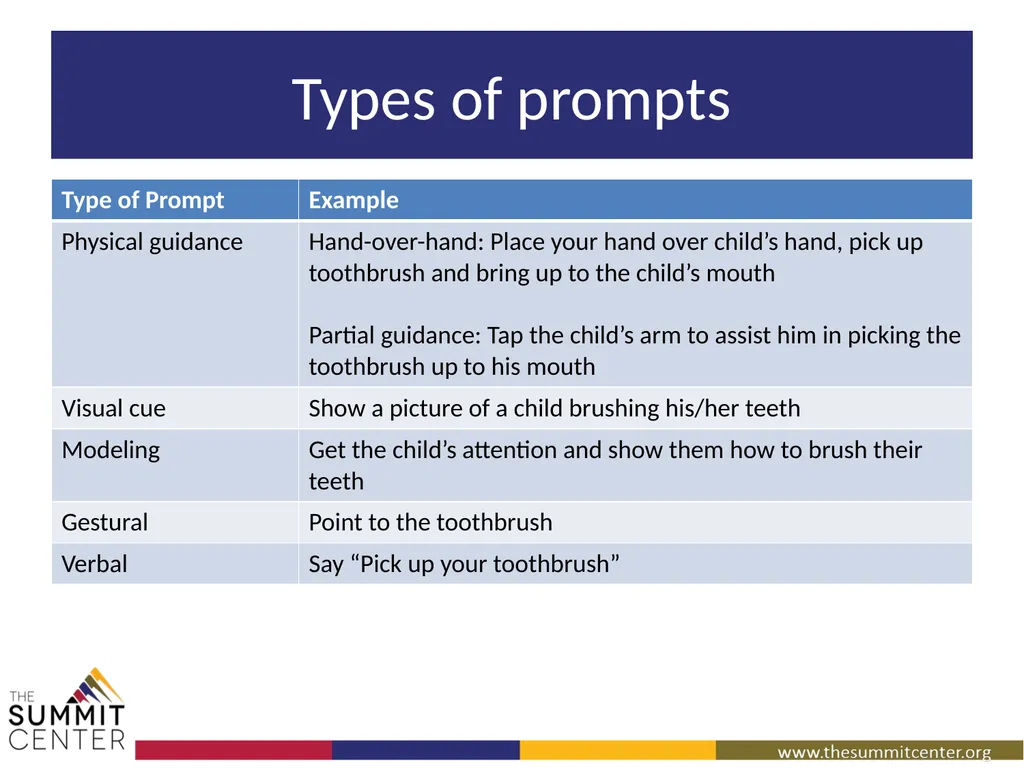
Examples of Prompts<br>
34
Using reinforcement with approximations of a newly developed or rarely occurring behavior Shaping<br>
35
Need to consistently monitor student’s progress and compare to the learning goals that have been established
Rate of progress will vary by child and will be influenced by the complexity of the skill being taught, the consistency of the teaching methods and other factors (e.g., location, number of opportunities, etc) Step 4: Monitoring progress<br>
36
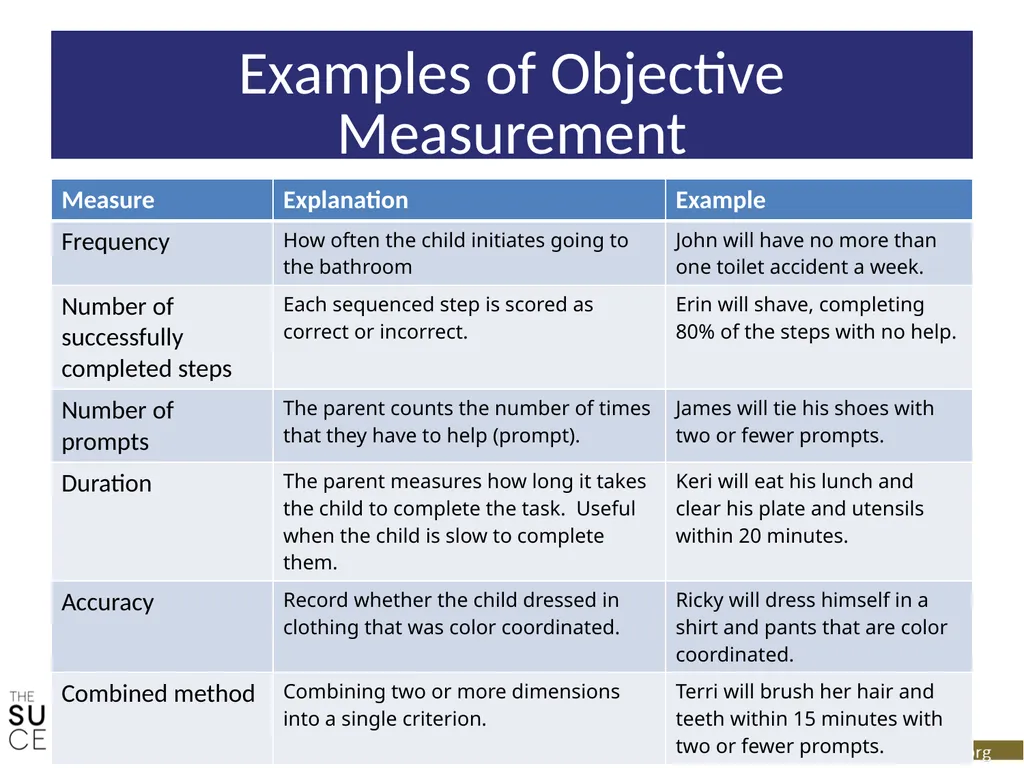
Examples of Objective Measurement<br>
37
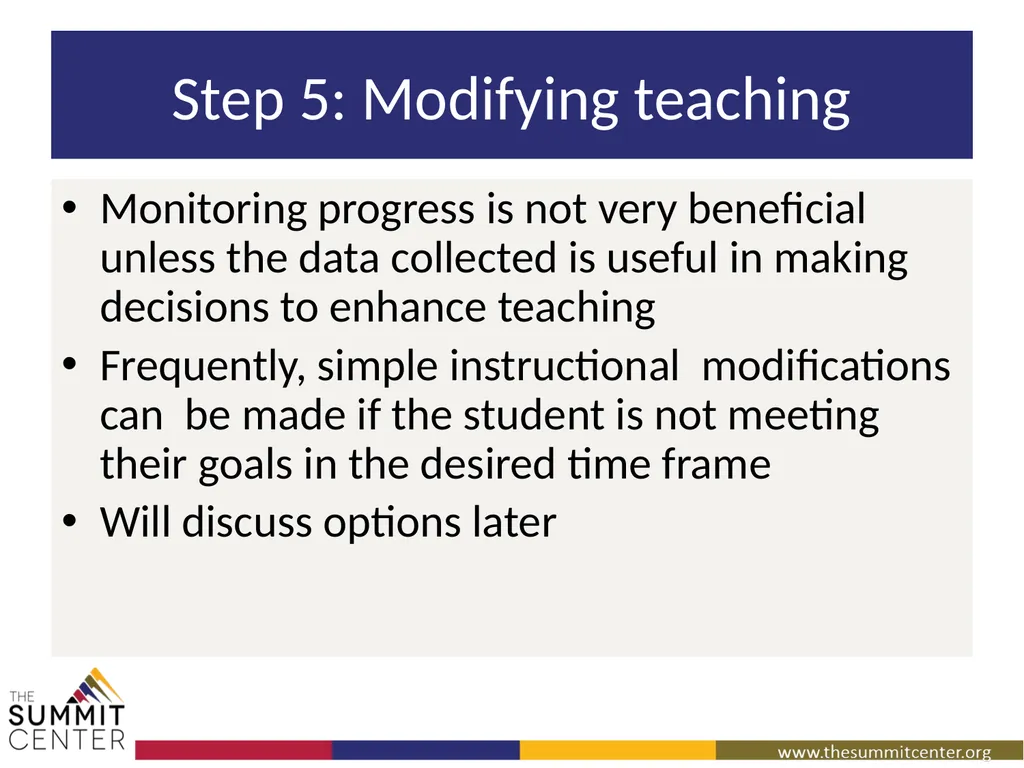
Monitoring progress is not very beneficial unless the data collected is useful in making decisions to enhance teaching
Frequently, simple instructional modifications can be made if the student is not meeting their goals in the desired time frame
Will discuss options later Step 5: Modifying teaching<br>
38
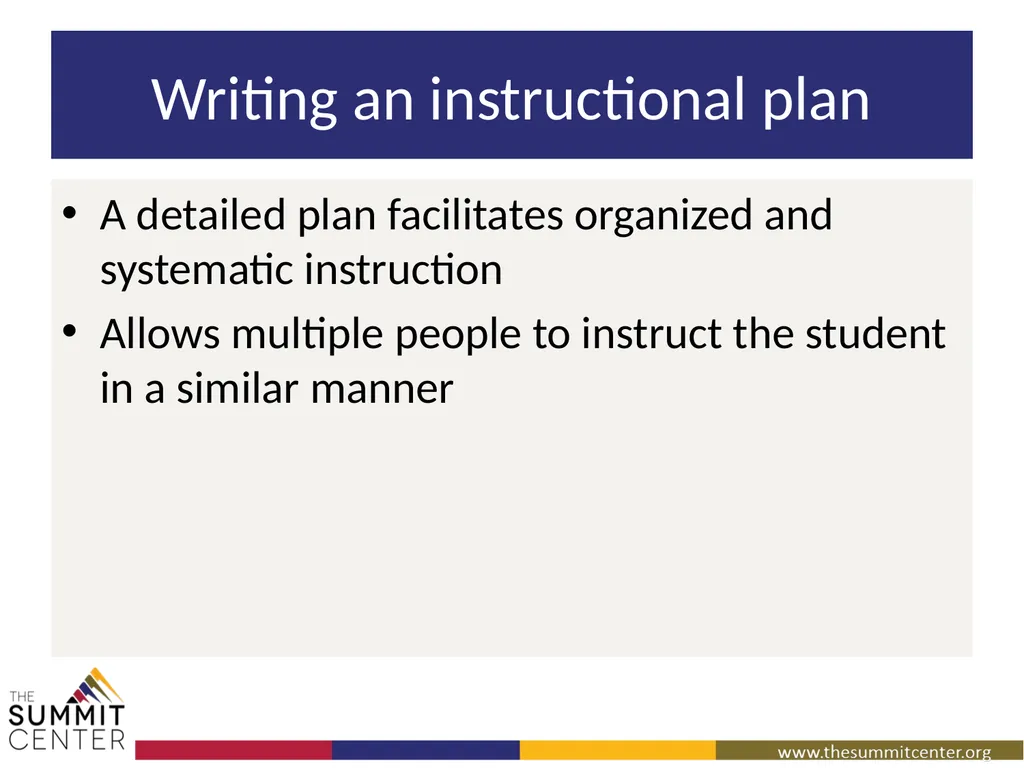
A detailed plan facilitates organized and systematic instruction
Allows multiple people to instruct the student in a similar manner Writing an instructional plan<br>
39
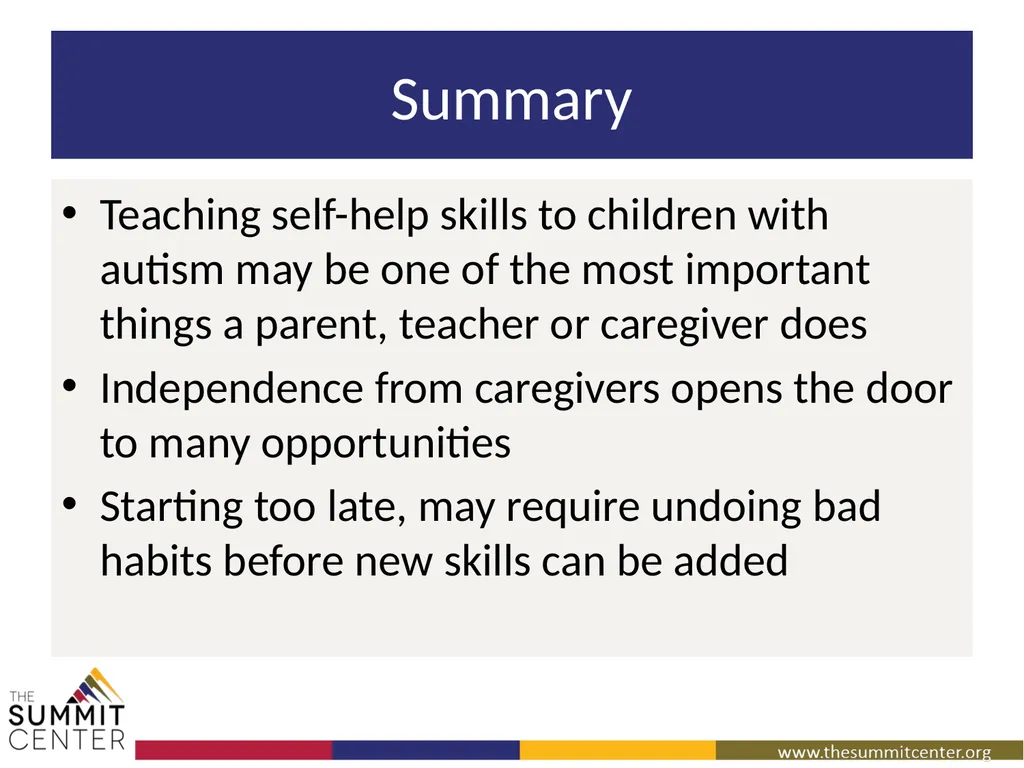
Teaching self-help skills to children with autism may be one of the most important things a parent, teacher or caregiver does
Independence from caregivers opens the door to many opportunities
Starting too late, may require undoing bad habits before new skills can be added Summary<br>
40
jtoomey@thesummitcenter.org
Thank you! Questions??<br>