Structuralism Presented by Dr. B.Kalidoss Assistant Professor of English Arul Anandar College Originated in France in the 1950s First seen in the work of the anthropoligist Claud Levi-Strauss (1908) Roland Barthes Imported to Britain in
"Structuralism Presented by Dr. B.Kalidoss" is the property of its rightful owner. Permission is granted to
download and print the materials on this website for personal, non-commercial use only, and to display it
on your personal computer provided you do not modify the materials and that you retain all copyright
notices contained in the materials. By downloading content from our website, you accept the terms of this
agreement.
Presentation Transcript
01
Structuralism
Presented by
Dr. B.Kalidoss
Assistant Professor of English
Arul Anandar College<br>
02
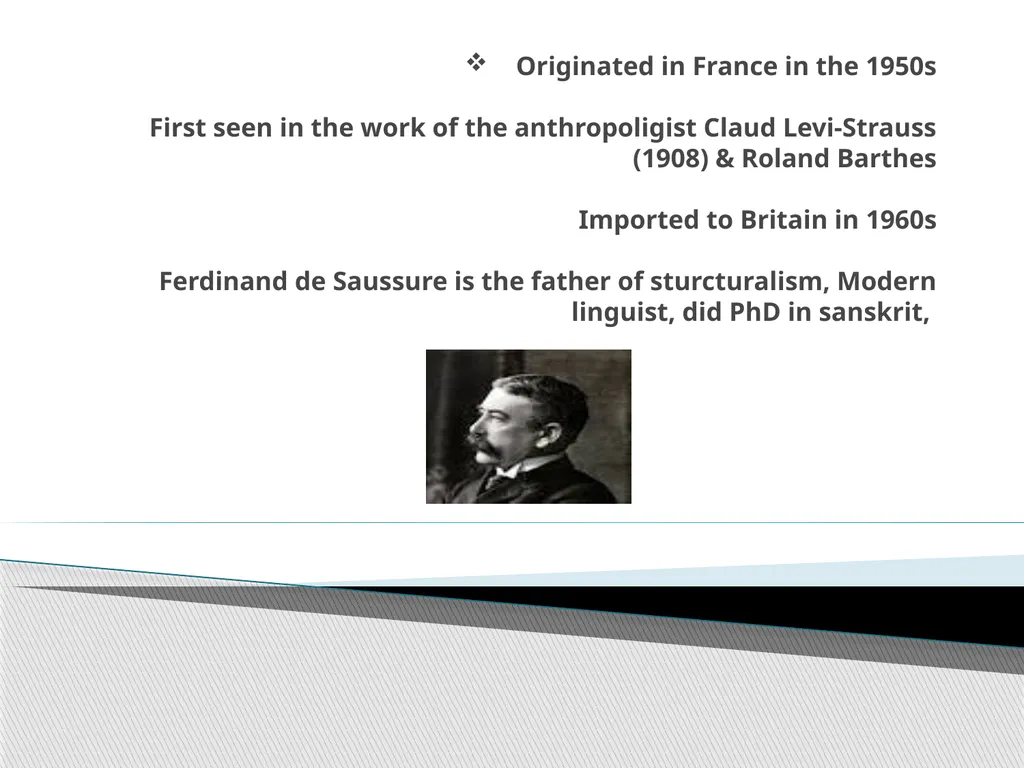
Originated in France in the 1950s First seen in the work of the anthropoligist Claud Levi-Strauss (1908) & Roland Barthes Imported to Britain in 1960s Ferdinand de Saussure is the father of sturcturalism, Modern linguist, did PhD in sanskrit,<br>
03
“Course in General Linguistics”, posthumously published Emerged as a trend in the 1950s challenged New Criticism Embraced all disciplines. Pioneers: Derrida, Jacques Lacan, Michel Foucault, Louis Althusser His theory emerged from “Theories of Language and Linguistics” by Calude –Levi-Strauss & Roland Barthes<br>
04
What is Structurlaism?
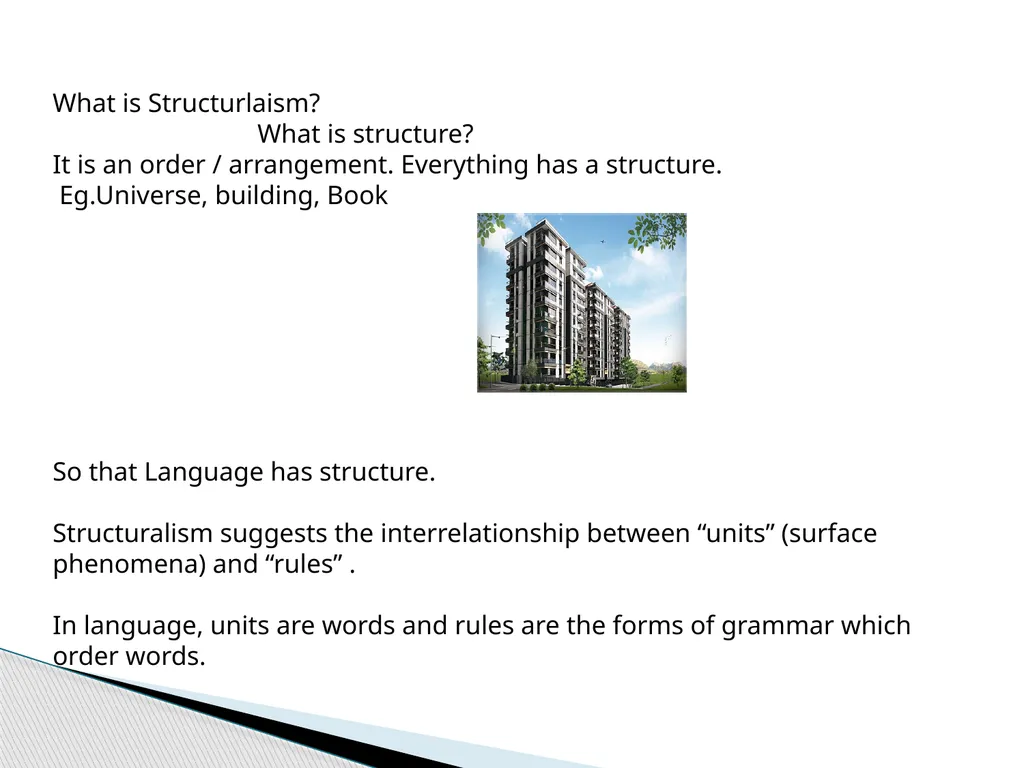
What is structure?
It is an order / arrangement. Everything has a structure.
Eg.Universe, building, Book
So that Language has structure.
Structuralism suggests the interrelationship between “units” (surface phenomena) and “rules” .
In language, units are words and rules are the forms of grammar which order words.<br>
05
What is structure is literature?
Not a new theory. Aristotle explained the structure of tragedy .
Started somewhere around 1920s
Became a movement in 1950s
1920s – used to look at literatrary piece as a work – has close ended meaning, can’t do anything else about it, nth can’t be changed. meaning derived out of social, cultural context.
Post1950s – same ltry piece looked differently, no longer a work but a text.<br>
06
Text–open ended – open interpretation – analysing linguistic construct – by understanding language we can know lot abt the text.
Might get lot of diff meaning of the same poem from what Donne intended to be. Understand even better , might use post colonial theory like structuralism, deconstruction.
Author died. Roland Barthes is one behind the concept of the “Death of Author”.<br>
07
After mastering over the language,esp Sanskrit, Saussure framed some principles.
Saussure gives four major theories:
1.Concept of Episteme.
Unit of knowledge is construct of language, means to gain knowledge need to know language
Linguistic determinism is the key., language determines the thought.
Eg. A Child learns
So unit of knowledge is construct of language.<br>
08
Structuralism suggests the interrelationship between “units” (surface phenomena) and “rules” (the ways in which units can be put together). In language, units are words and rules are the forms of grammar which order words.
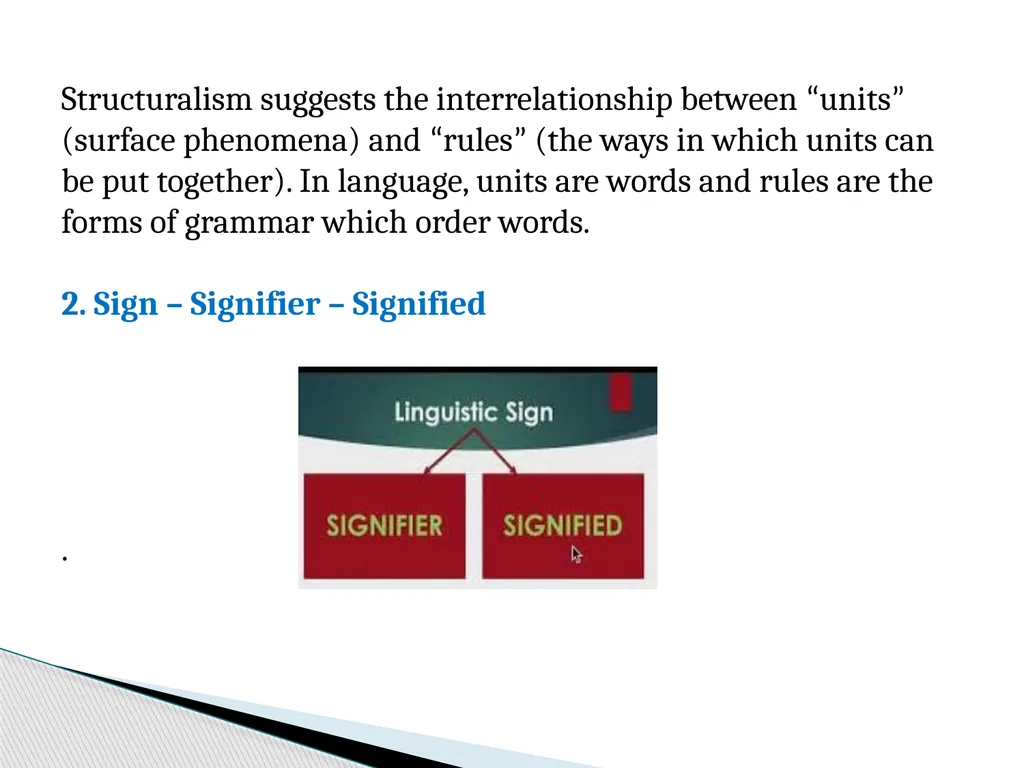
2. Sign – Signifier – Signified
.<br>
09
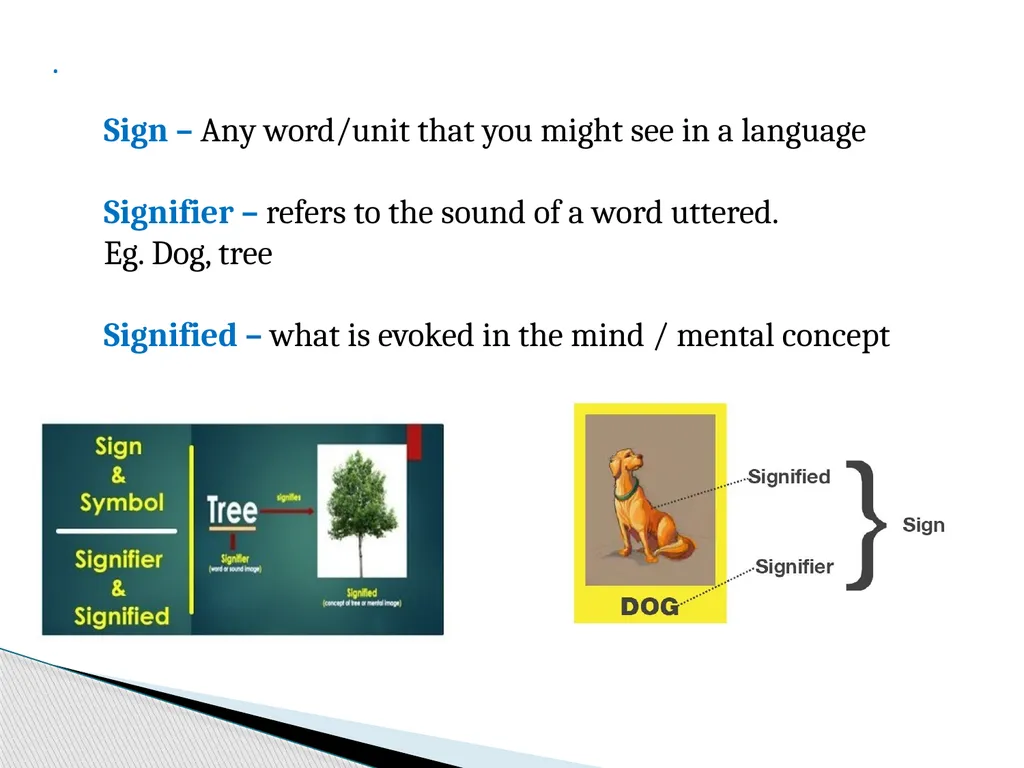
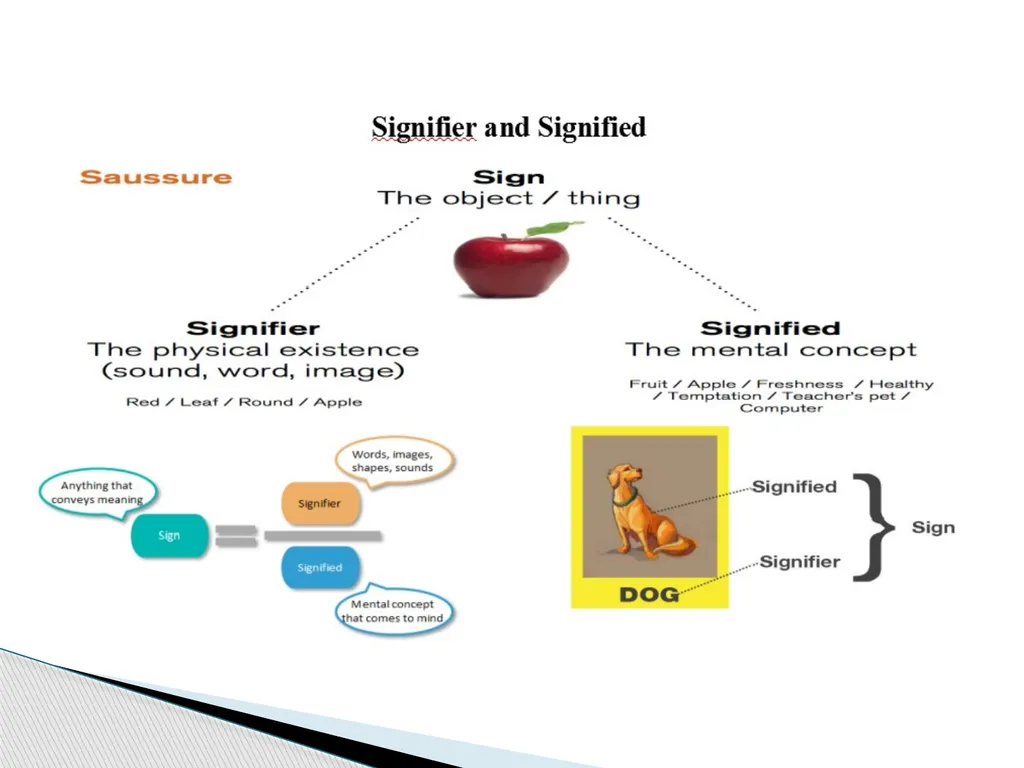
. Sign – Any word/unit that you might see in a language
Signifier – refers to the sound of a word uttered.
Eg. Dog, tree
Signified – what is evoked in the mind / mental concept<br>
10
According to Saussure
‘Signifier’ is more important to ‘signified’
Word is culturally constructed
Arbitrary – The relation between the signifier and the sign is arbitrary. no fixed connections between ‘signifier’ and ‘signified’ - different meaning to everybody.
Eg. - God
An ordered series of signs make sense because of the way the signs are ordered. This is called ‘syntagm’.
Eg. Bark the at the dog stranger
The dog barks at the stranger.<br>
11
The meaning of a word is always imposed on it by human mind and idea. It is never universal. For example, there is no impartial and real method for distinguishing two persons — one is a ‘terrorist’ and another is a ‘Freedom fighter’. They can be accepted by various persons with various ideas and valuations. So, language is arbitrary and relational and constitutive.<br>
12
Binary Opposition
Saussure – Meaning is not sth absolute but relative & depends upon binary oppositions. we can understand the word by looking at opposite.
Eg, darkness
God
Good, male-female, hot- cold, native -foreign
So, things cannot be understood in isolation. They have to be seen in the context of the larger structure. They are the part of elements of the whole.
Eg, leaf - tree<br>
13
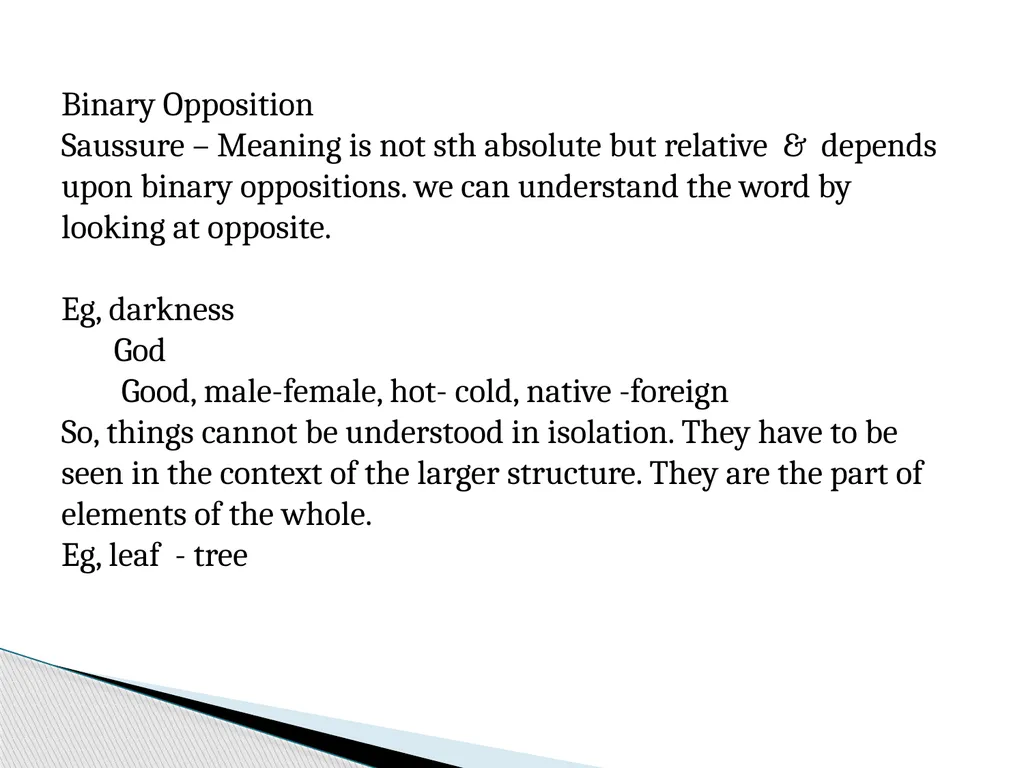
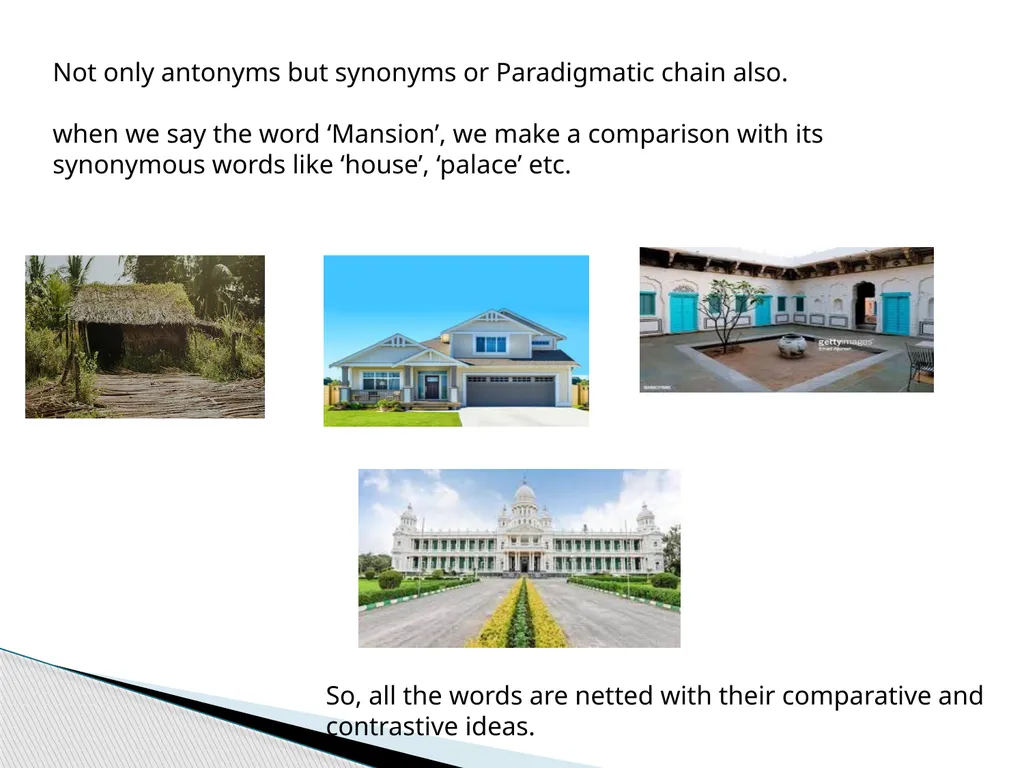
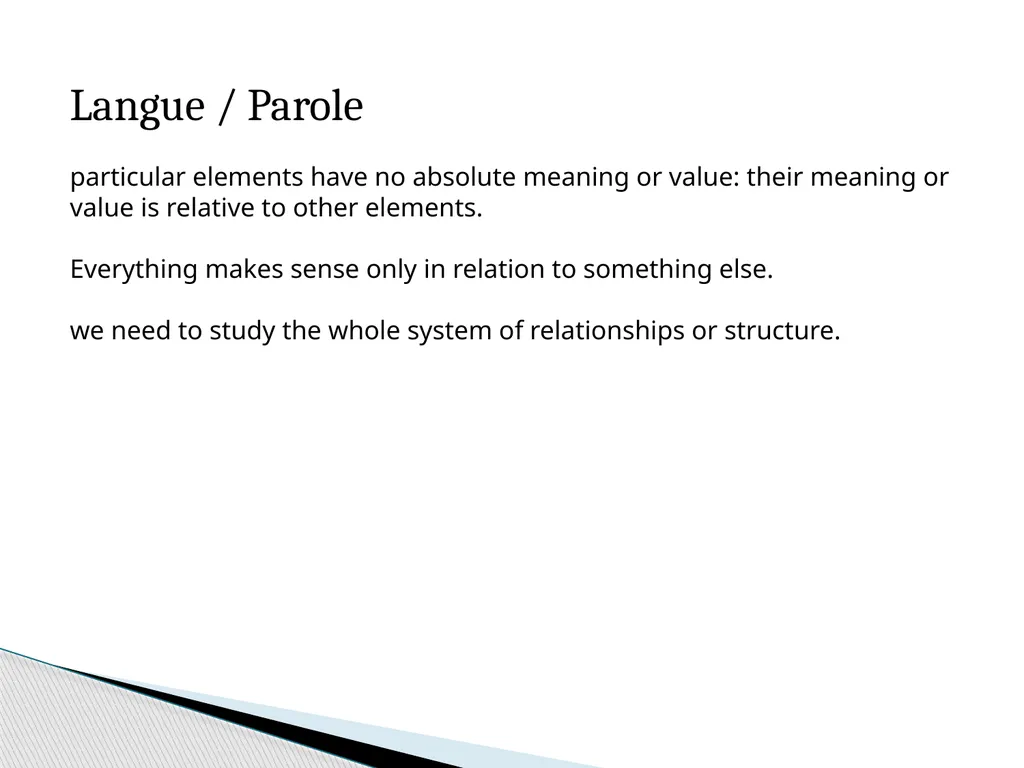
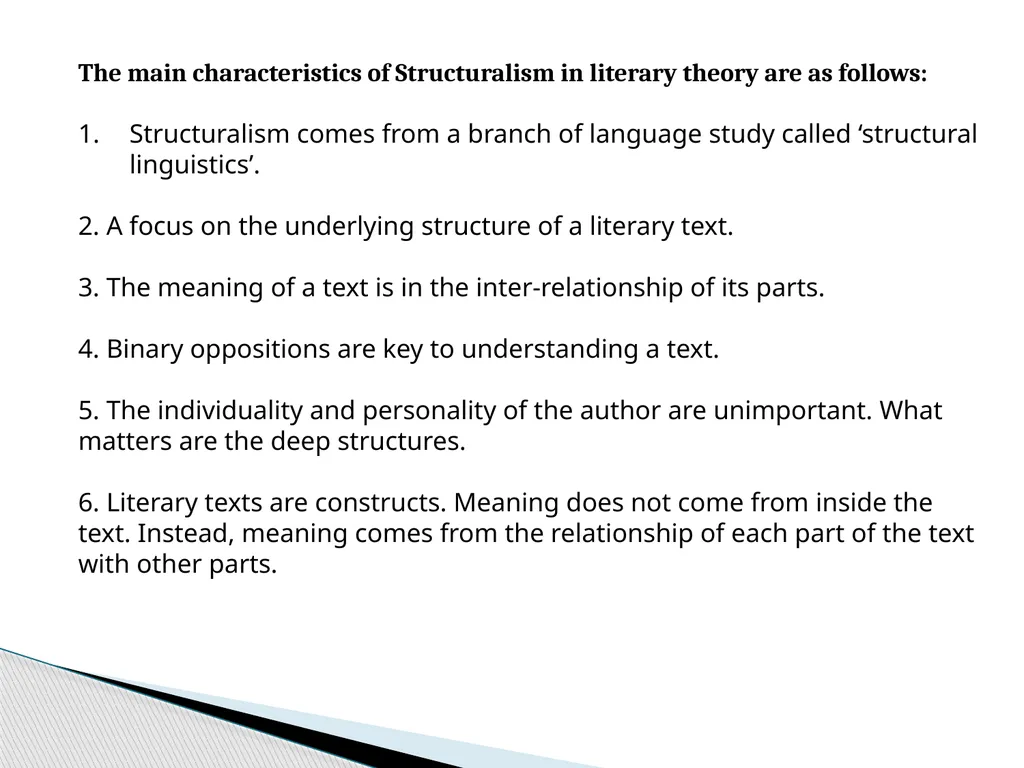
Not only antonyms but synonyms or Paradigmatic chain also.
when we say the word ‘Mansion’, we make a comparison with its synonymous words like ‘house’, ‘palace’ etc. So, all the words are netted with their comparative and contrastive ideas.<br>
14
Langue / Parole
particular elements have no absolute meaning or value: their meaning or value is relative to other elements.
Everything makes sense only in relation to something else.
we need to study the whole system of relationships or structure.<br>
15
The main characteristics of Structuralism in literary theory are as follows:
Structuralism comes from a branch of language study called ‘structural linguistics’.
2. A focus on the underlying structure of a literary text.
3. The meaning of a text is in the inter-relationship of its parts.
4. Binary oppositions are key to understanding a text.
5. The individuality and personality of the author are unimportant. What matters are the deep structures.
6. Literary texts are constructs. Meaning does not come from inside the text. Instead, meaning comes from the relationship of each part of the text with other parts.<br>