Student Affairs Academic Affairs Group 2 Group 2 Jiawen Zhang Darlene Leifson Yolima Cueto Research Objectives Questions Data Collection: U.S. Bureau of Labor Statistics Higher Ed Jobs The Chronicle of Higher Education Inside Higher Ed
"Student Affairs & Academic Affairs Group 2 Group 2" is the property of its rightful owner. Permission is granted to
download and print the materials on this website for personal, non-commercial use only, and to display it
on your personal computer provided you do not modify the materials and that you retain all copyright
notices contained in the materials. By downloading content from our website, you accept the terms of this
agreement.
Presentation Transcript
01
Student Affairs
&
Academic Affairs Group 2 Group 2
Jiawen Zhang
Darlene Leifson
Yolima Cueto<br>
02
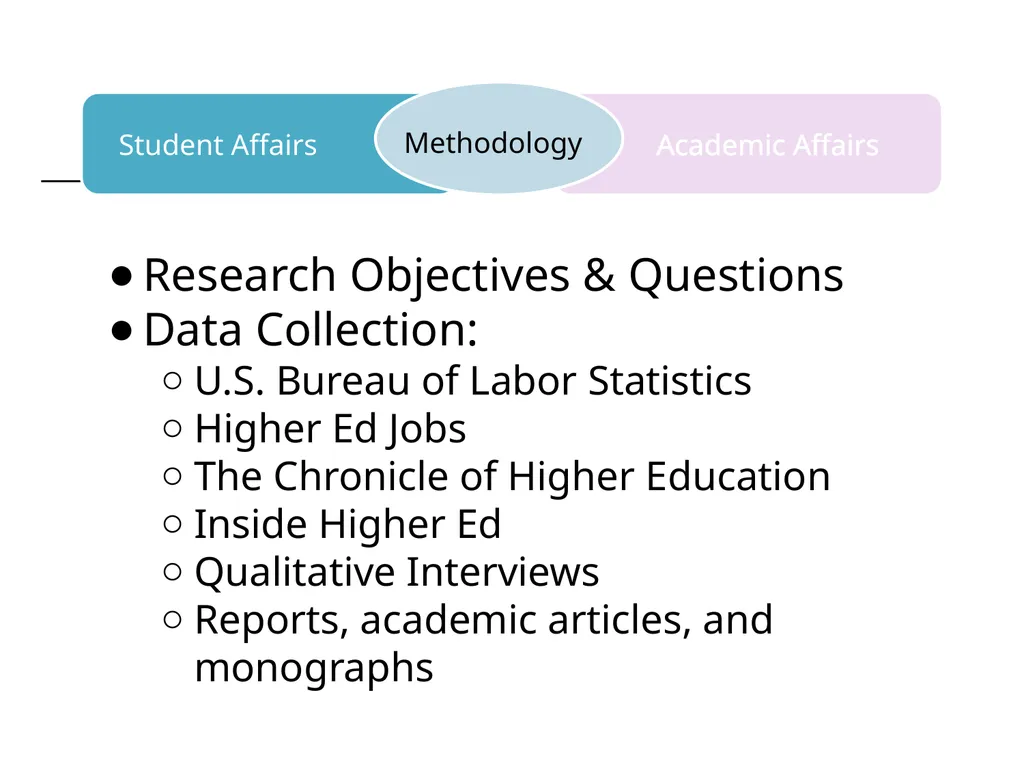
Research Objectives & Questions
Data Collection:
U.S. Bureau of Labor Statistics
Higher Ed Jobs
The Chronicle of Higher Education
Inside Higher Ed
Qualitative Interviews
Reports, academic articles, and monographs Student Affairs Academic Affairs Methodology<br>
03
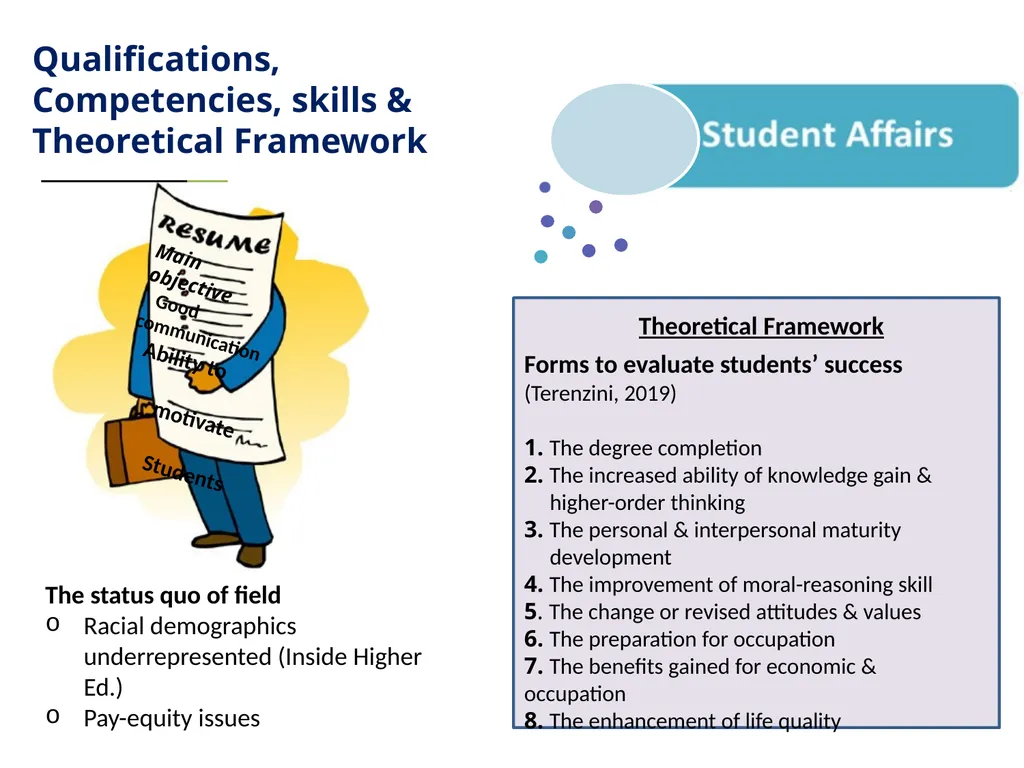
The status quo of field
Racial demographics underrepresented (Inside Higher Ed.)
Pay-equity issues Qualifications, Competencies, skills & Theoretical Framework Theoretical Framework Forms to evaluate students’ success (Terenzini, 2019)
1. The degree completion
2. The increased ability of knowledge gain &
higher-order thinking
3. The personal & interpersonal maturity
development
4. The improvement of moral-reasoning skill
5. The change or revised attitudes & values
6. The preparation for occupation
7. The benefits gained for economic & occupation
8. The enhancement of life quality Main objective
Good communication
Ability to
motivate
Students<br>
04
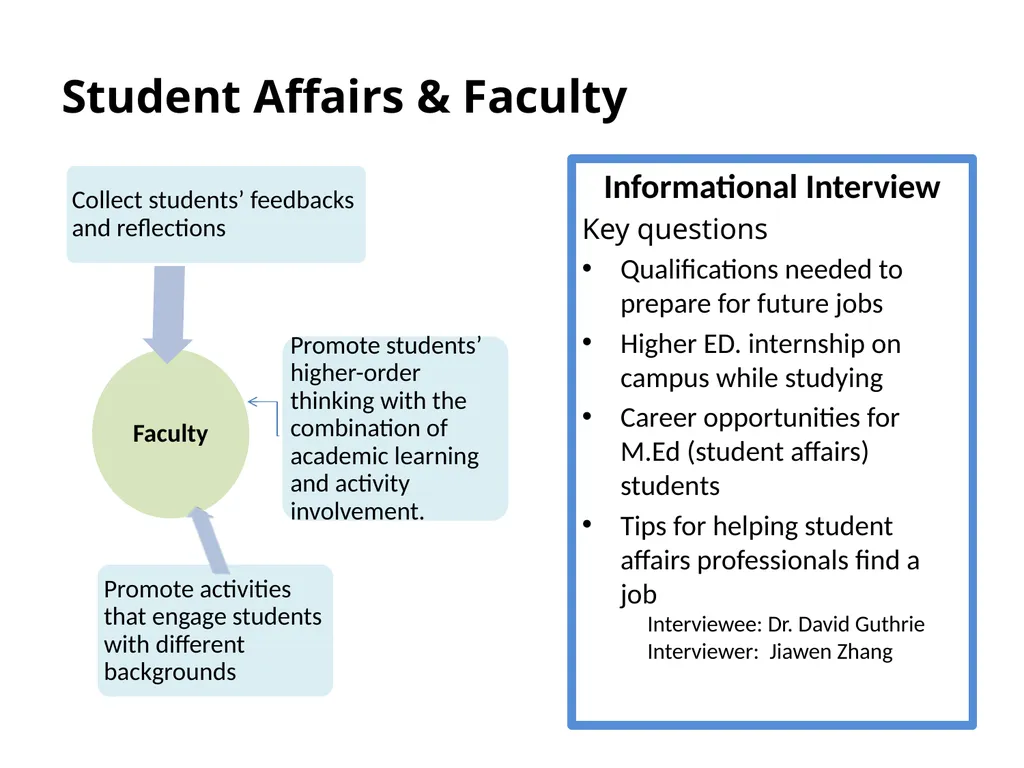
Student Affairs & Faculty Informational Interview
Key questions
Qualifications needed to prepare for future jobs
Higher ED. internship on campus while studying
Career opportunities for M.Ed (student affairs) students
Tips for helping student affairs professionals find a job
Interviewee: Dr. David Guthrie
Interviewer: Jiawen Zhang<br>
05
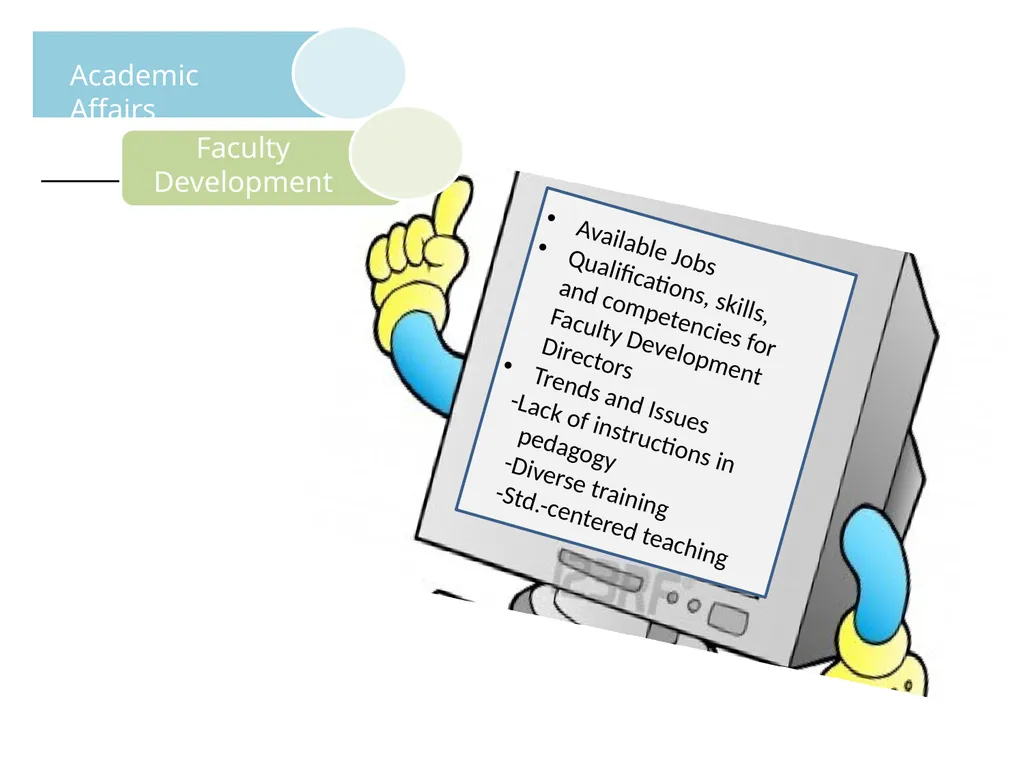
Academic Affairs Faculty Development Available Jobs
Qualifications, skills, and competencies for Faculty Development Directors
Trends and Issues
-Lack of instructions in
pedagogy
-Diverse training
-Std.-centered teaching<br>
06
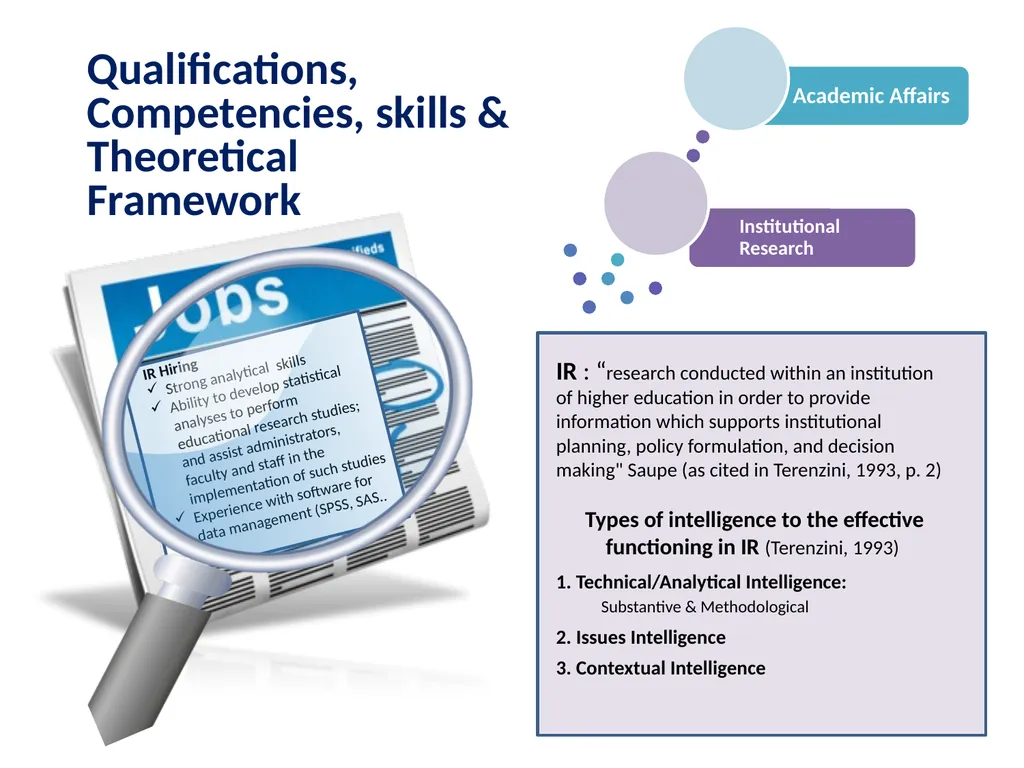
Qualifications, Competencies, skills & Theoretical Framework Strong analytical skills IR Hiring
Strong analytical skills
Ability to develop statistical analyses to perform educational research studies; and assist administrators, faculty and staff in the implementation of such studies
Experience with software for data management (SPSS, SAS.. IR : “research conducted within an institution of higher education in order to provide information which supports institutional planning, policy formulation, and decision making" Saupe (as cited in Terenzini, 1993, p. 2)
Types of intelligence to the effective functioning in IR (Terenzini, 1993)
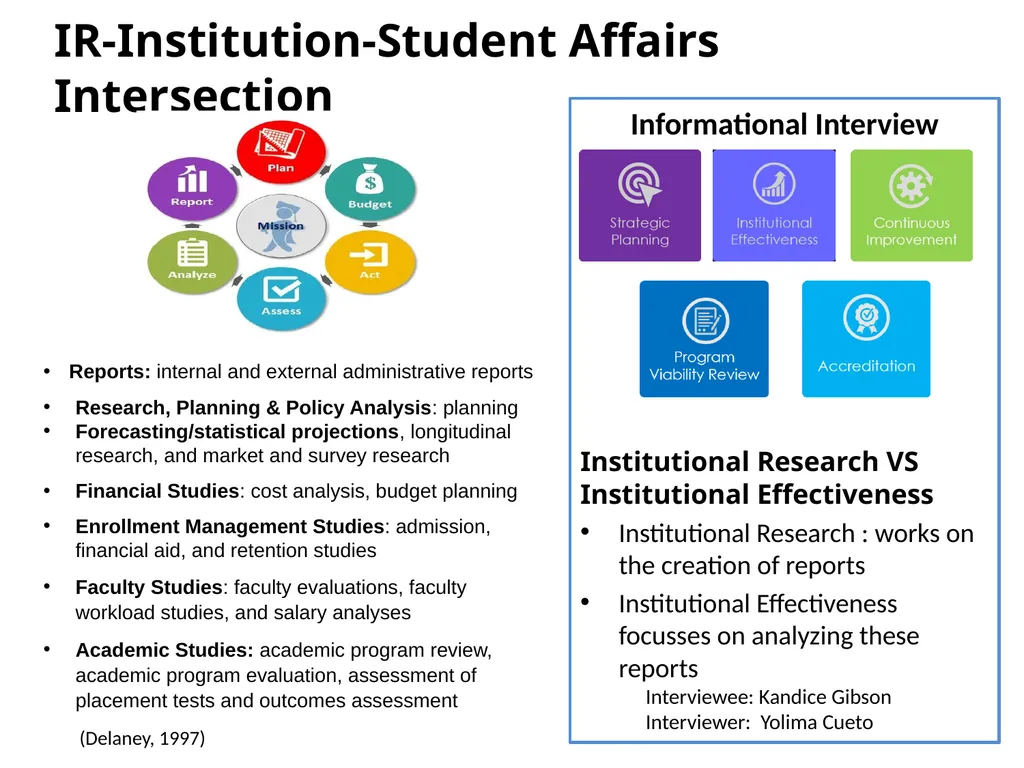
Institutional Research VS Institutional Effectiveness
Institutional Research : works on the creation of reports
Institutional Effectiveness focusses on analyzing these reports
Interviewee: Kandice Gibson
Interviewer: Yolima Cueto Reports: internal and external administrative reports
Research, Planning & Policy Analysis: planning
Forecasting/statistical projections, longitudinal research, and market and survey research
Financial Studies: cost analysis, budget planning
Enrollment Management Studies: admission, financial aid, and retention studies
Faculty Studies: faculty evaluations, faculty workload studies, and salary analyses
Academic Studies: academic program review, academic program evaluation, assessment of placement tests and outcomes assessment
(Delaney, 1997)<br>
08
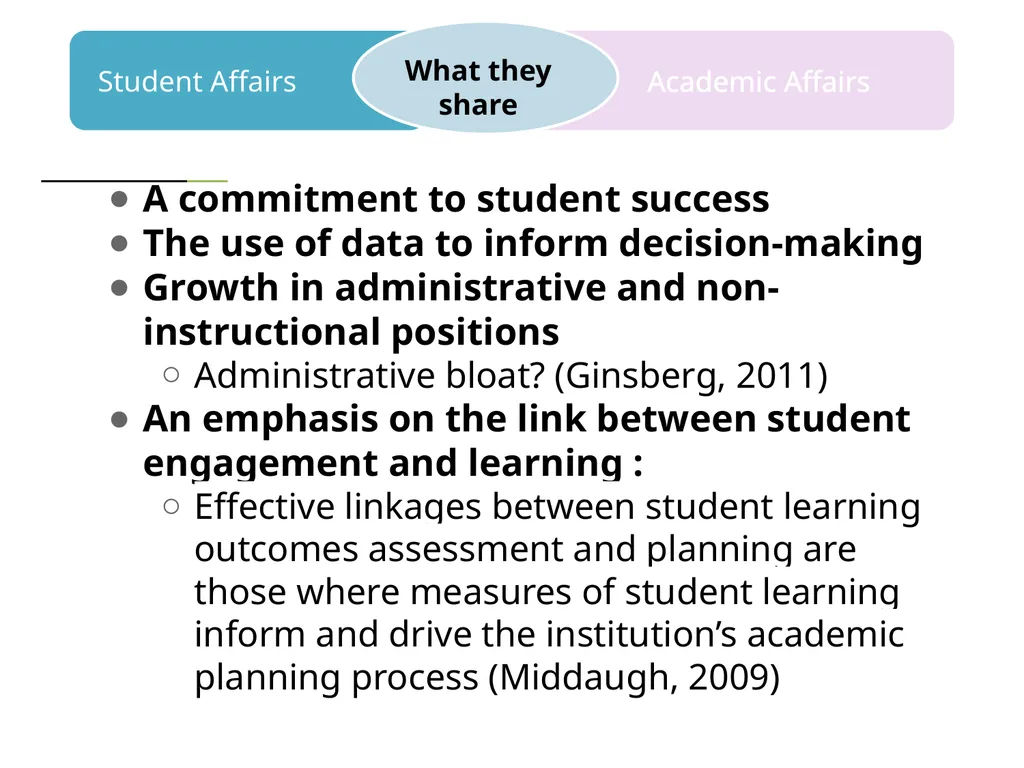
Academic Affairs Student Affairs What they share A commitment to student success
The use of data to inform decision-making
Growth in administrative and non-instructional positions
Administrative bloat? (Ginsberg, 2011)
An emphasis on the link between student engagement and learning :
Effective linkages between student learning outcomes assessment and planning are those where measures of student learning inform and drive the institution’s academic planning process (Middaugh, 2009)<br>
09
Academic Affairs Student Affairs References Delaney, A.M. Research in Higher Education (1997). The Role of Institutional Research in Higher Education: Enabling Researchers to Meet New Challenges, 38(1). Retrieve from https://link-springer-com.ezaccess.libraries.psu.edu/article/10.1023/A%3A10 24907527884.
Ginsberg, B. (2011). The fall of the faculty: The rise of the all-administrative university and why it matters. New York: Oxford University Press.
Middaugh, M. (2009). Closing the loop: Linking planning and assessment. Planning for Higher Education, 37(3), 5-14. Report: Student affairs professionals more diverse than rest of college professions. (n.d.). Retrieved from https://www.insidehighered.com/news/2018/11/02/report-student-affairs- professionals-more-diverse-rest-college-professions.
Terenzini, P.T. Res High Educ (1993). On the nature of institutional research and
the knowledge and skills it requires, 34(1). Retrieve from
https://link-springer-com.ezaccess.libraries.psu.edu/article/ 10.1007/BF00991859.
Terenzini, P. T. (2019). MISSING THE FOREST FOR THE TREES: RETHINKING WHAT INFLUENCES STUDENT SUCCESS. Presentation, University Park Campus, Penn State University.<br>