
STUDENT SUPPORT SERVICES FINANCIAL WELLNESS SERIES
CP
Published · 79 slides · 0 views
1 / 1





Description
STUDENT SUPPORT SERVICES FINANCIAL WELLNESS SERIES 2023 Session 5 Tax Planning Issues Strategies April 5, 2023 Brian Bolton Professor of Finance brian.boltonlouisiana.edu http:business.louisiana.edufinanceispersonal Opening Quiz
Related Topics
Share
Embed code
Download this presentation From Below
"STUDENT SUPPORT SERVICES FINANCIAL WELLNESS SERIES" is the property of its rightful owner. Permission is granted to download and print the materials on this website for personal, non-commercial use only, and to display it on your personal computer provided you do not modify the materials and that you retain all copyright notices contained in the materials. By downloading content from our website, you accept the terms of this agreement.
Presentation Transcript
01
STUDENT SUPPORT SERVICES
FINANCIAL WELLNESS SERIES 2023
Session #5
Tax Planning Issues & Strategies
April 5, 2023<br>
FINANCIAL WELLNESS SERIES 2023
Session #5
Tax Planning Issues & Strategies
April 5, 2023<br>
02
Brian Bolton
Professor of Finance
brian.bolton@louisiana.edu
http://business.louisiana.edu/financeispersonal<br>
03
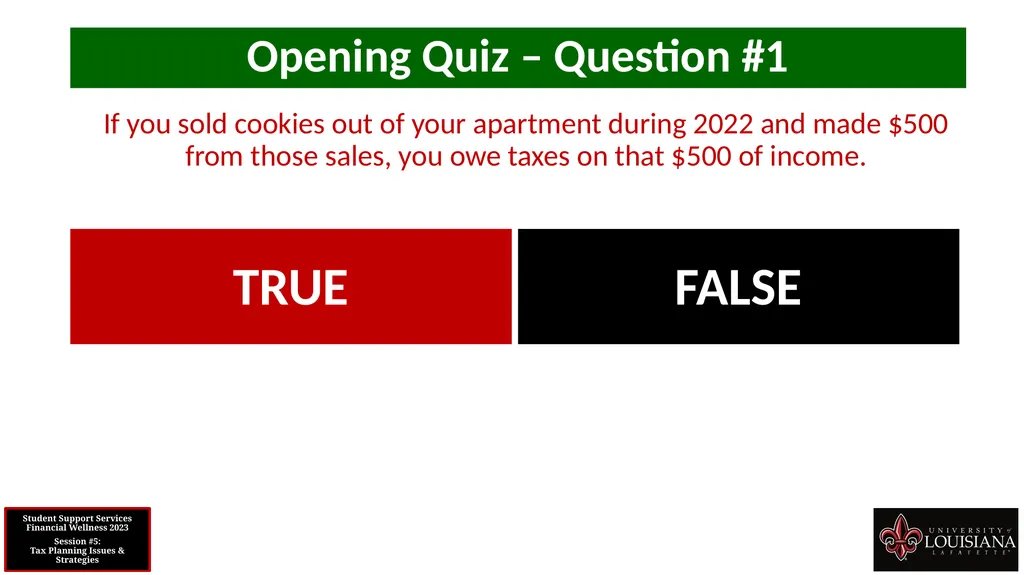
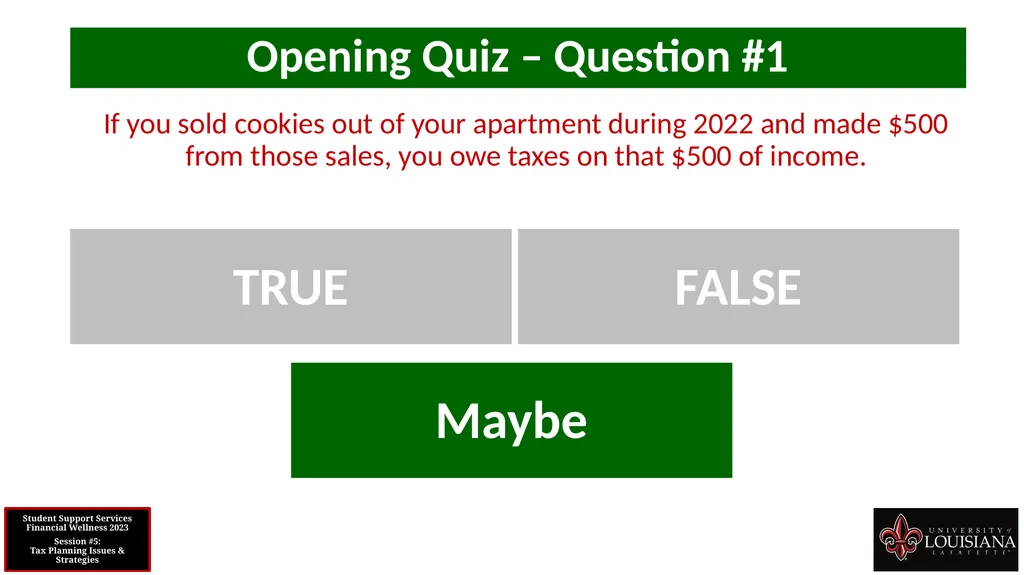
Opening Quiz – Question #1 If you sold cookies out of your apartment during 2022 and made $500 from those sales, you owe taxes on that $500 of income. TRUE FALSE<br>
04
Opening Quiz – Question #1 If you sold cookies out of your apartment during 2022 and made $500 from those sales, you owe taxes on that $500 of income. TRUE FALSE Maybe<br>
05
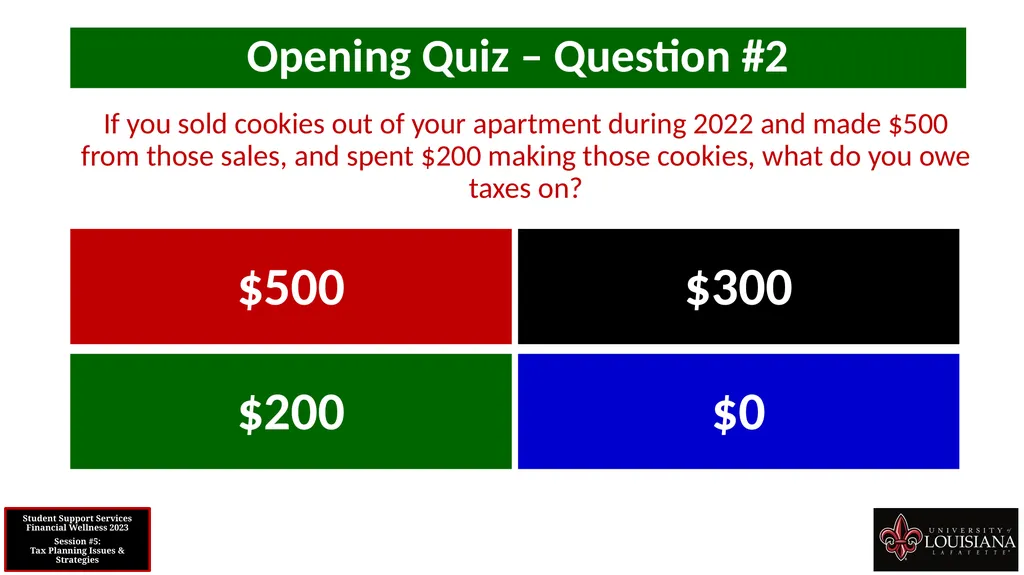
Opening Quiz – Question #2 If you sold cookies out of your apartment during 2022 and made $500 from those sales, and spent $200 making those cookies, what do you owe taxes on? $500 $300 $200 $0<br>
06
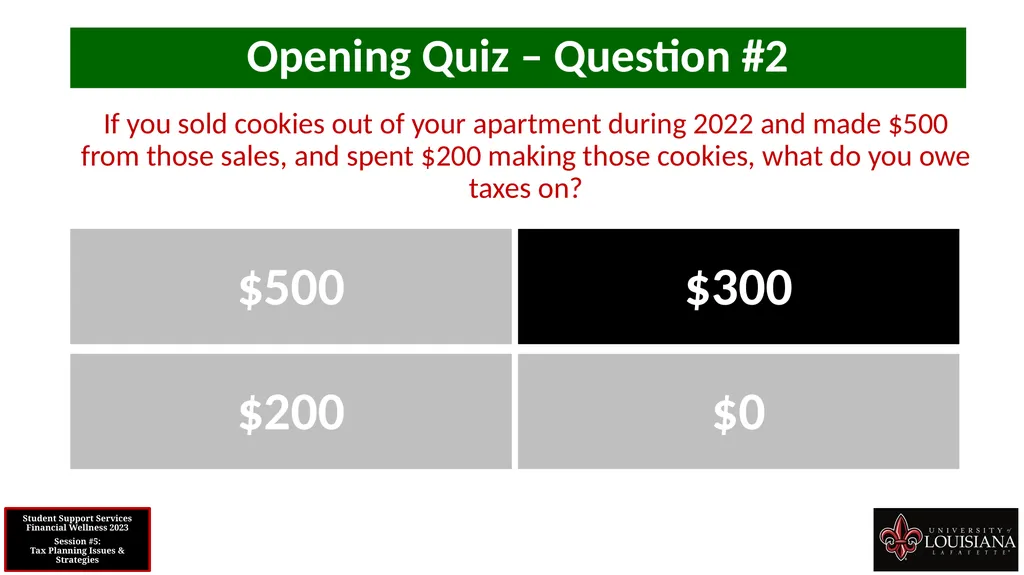
Opening Quiz – Question #2 If you sold cookies out of your apartment during 2022 and made $500 from those sales, and spent $200 making those cookies, what do you owe taxes on? $500 $300 $200 $0<br>
07
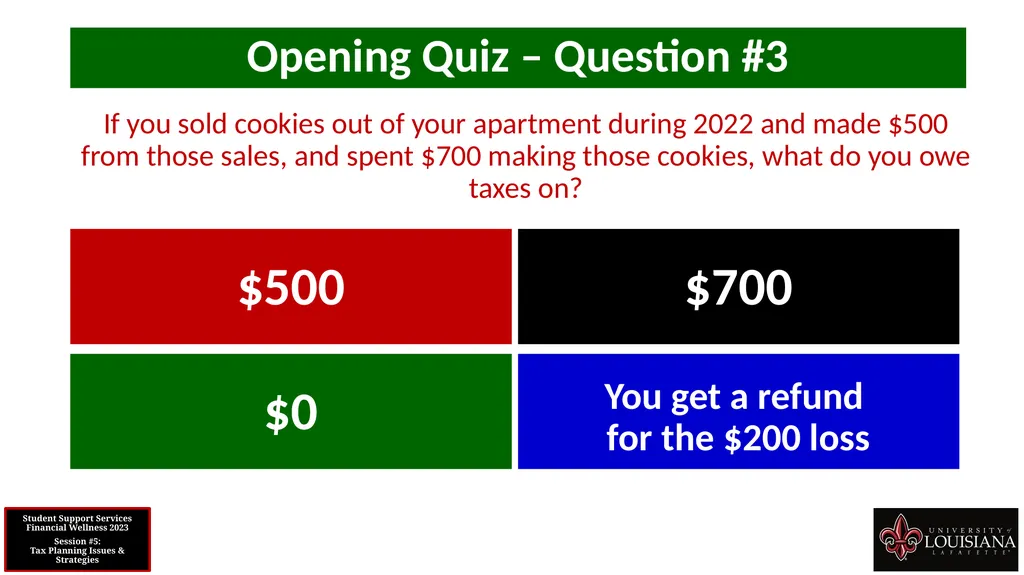
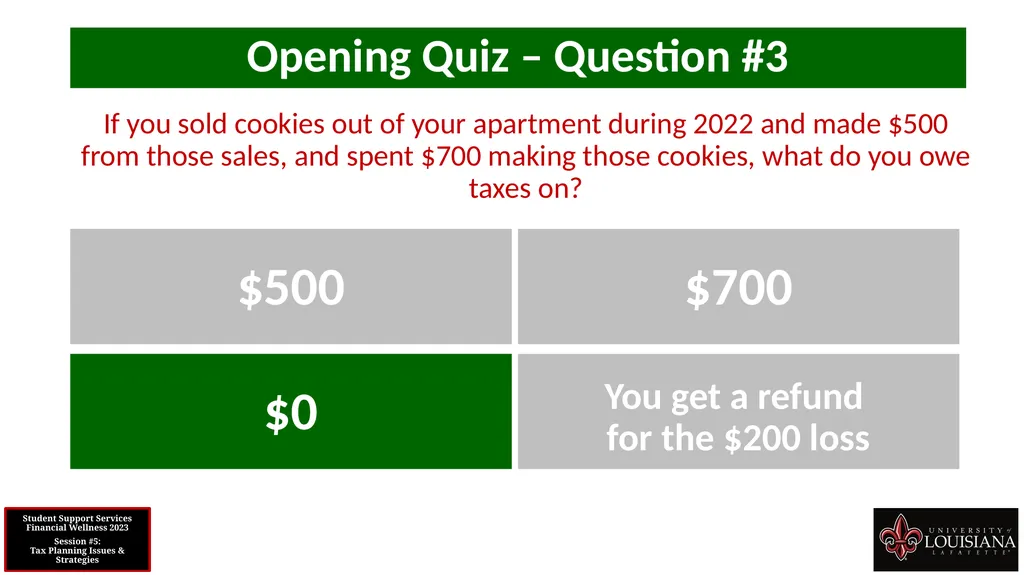
Opening Quiz – Question #3 If you sold cookies out of your apartment during 2022 and made $500 from those sales, and spent $700 making those cookies, what do you owe taxes on? $500 $700 $0 You get a refund
for the $200 loss<br>
08
Opening Quiz – Question #3 If you sold cookies out of your apartment during 2022 and made $500 from those sales, and spent $700 making those cookies, what do you owe taxes on? $500 $700 $0 You get a refund
for the $200 loss<br>
09
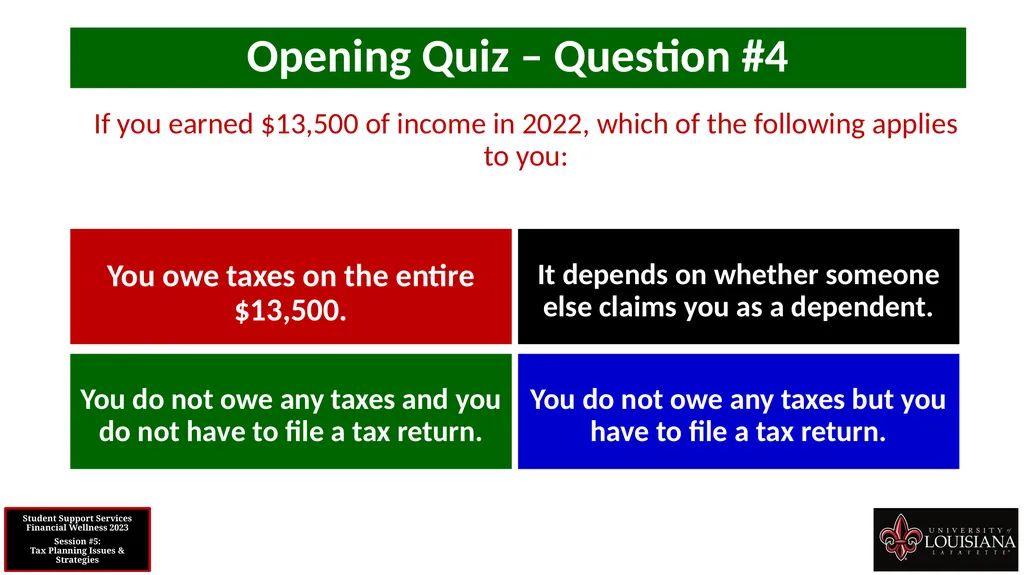
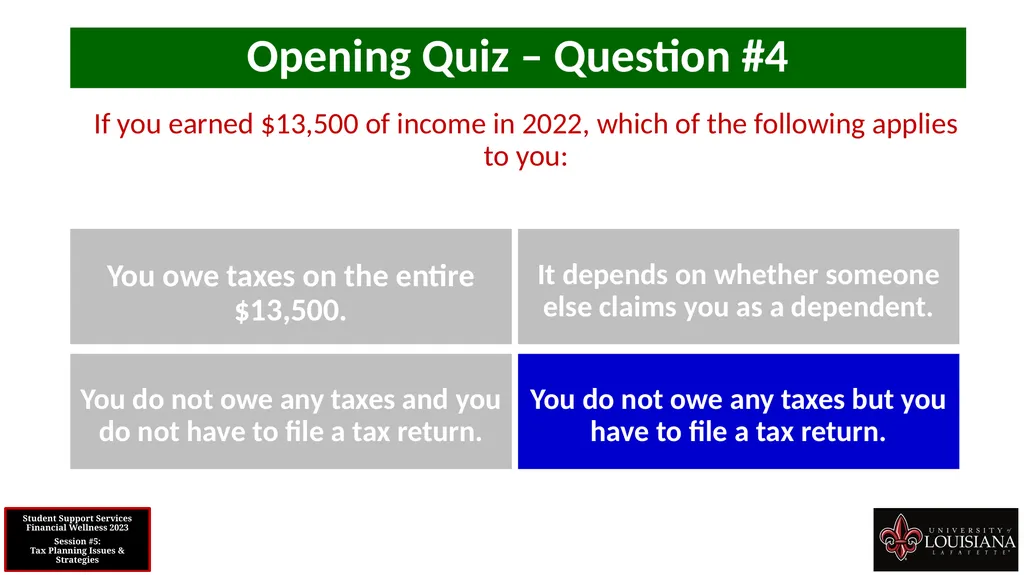
Opening Quiz – Question #4 If you earned $13,500 of income in 2022, which of the following applies to you: You owe taxes on the entire $13,500. It depends on whether someone else claims you as a dependent. You do not owe any taxes and you do not have to file a tax return. You do not owe any taxes but you have to file a tax return.<br>
10
Opening Quiz – Question #4 If you earned $13,500 of income in 2022, which of the following applies to you: You owe taxes on the entire $13,500. It depends on whether someone else claims you as a dependent. You do not owe any taxes and you do not have to file a tax return. You do not owe any taxes but you have to file a tax return.<br>
11
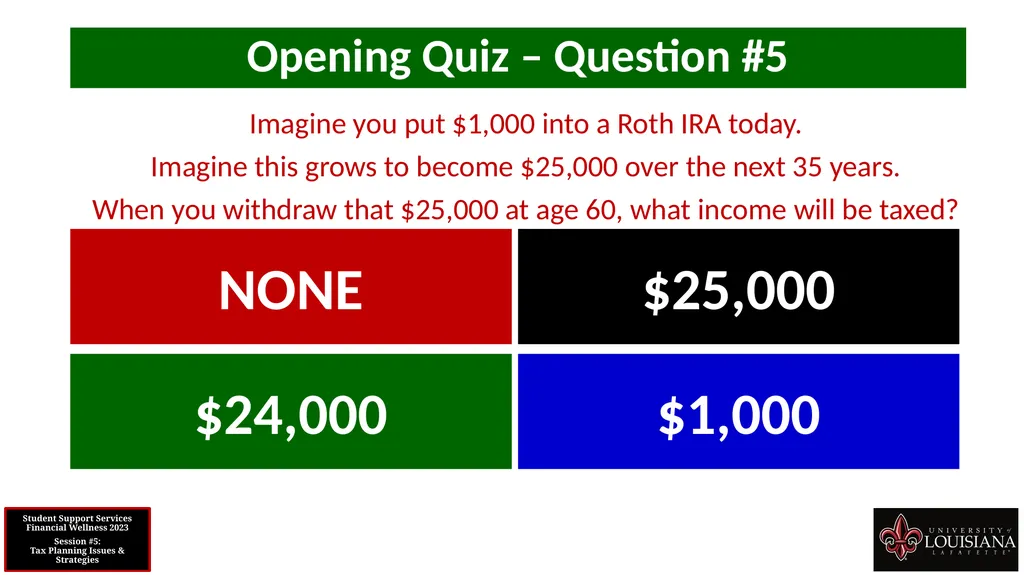
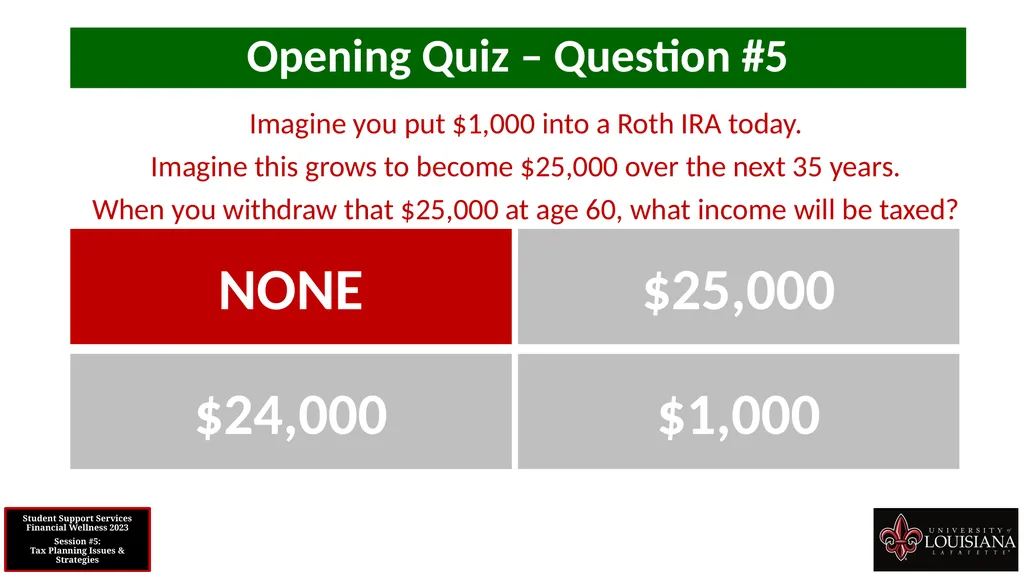
Opening Quiz – Question #5 Imagine you put $1,000 into a Roth IRA today.
Imagine this grows to become $25,000 over the next 35 years.
When you withdraw that $25,000 at age 60, what income will be taxed? NONE $25,000 $24,000 $1,000<br>
Imagine this grows to become $25,000 over the next 35 years.
When you withdraw that $25,000 at age 60, what income will be taxed? NONE $25,000 $24,000 $1,000<br>
12
Opening Quiz – Question #5 Imagine you put $1,000 into a Roth IRA today.
Imagine this grows to become $25,000 over the next 35 years.
When you withdraw that $25,000 at age 60, what income will be taxed? NONE $25,000 $24,000 $1,000<br>
Imagine this grows to become $25,000 over the next 35 years.
When you withdraw that $25,000 at age 60, what income will be taxed? NONE $25,000 $24,000 $1,000<br>
13
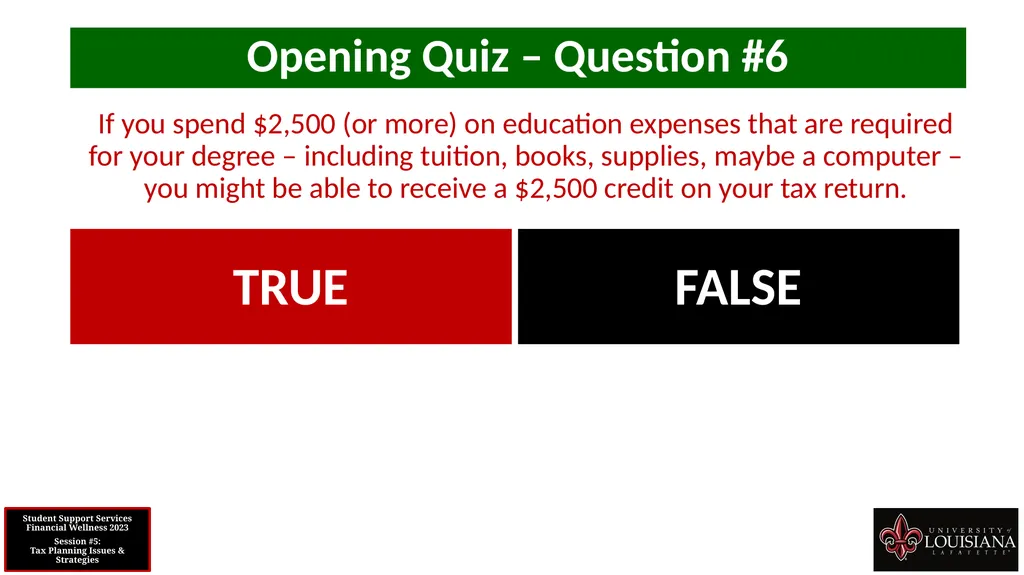
Opening Quiz – Question #6 If you spend $2,500 (or more) on education expenses that are required for your degree – including tuition, books, supplies, maybe a computer – you might be able to receive a $2,500 credit on your tax return. TRUE FALSE<br>
14
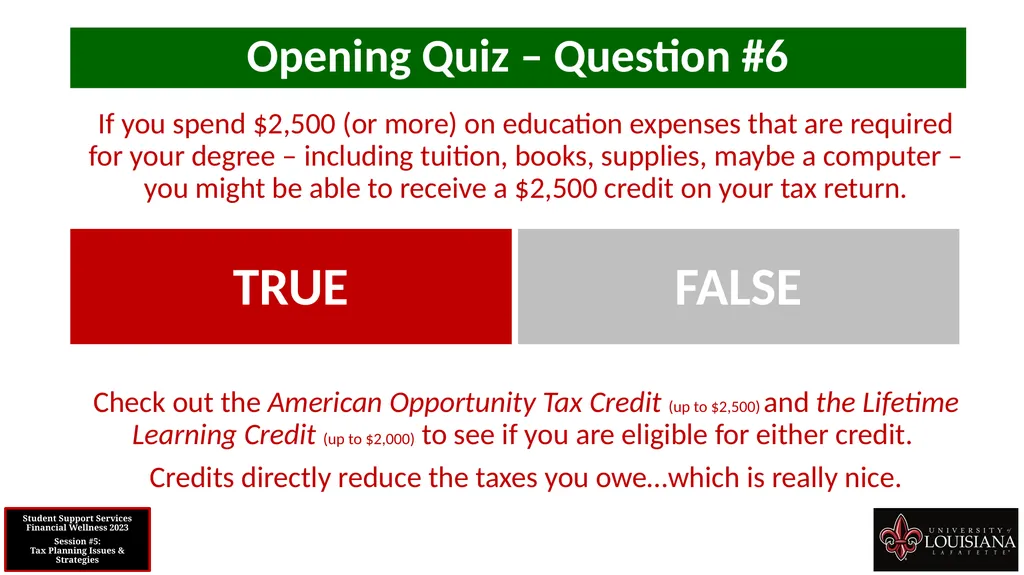
Opening Quiz – Question #6 If you spend $2,500 (or more) on education expenses that are required for your degree – including tuition, books, supplies, maybe a computer – you might be able to receive a $2,500 credit on your tax return.
Check out the American Opportunity Tax Credit (up to $2,500) and the Lifetime Learning Credit (up to $2,000) to see if you are eligible for either credit.
Credits directly reduce the taxes you owe…which is really nice. TRUE FALSE<br>
Check out the American Opportunity Tax Credit (up to $2,500) and the Lifetime Learning Credit (up to $2,000) to see if you are eligible for either credit.
Credits directly reduce the taxes you owe…which is really nice. TRUE FALSE<br>
15
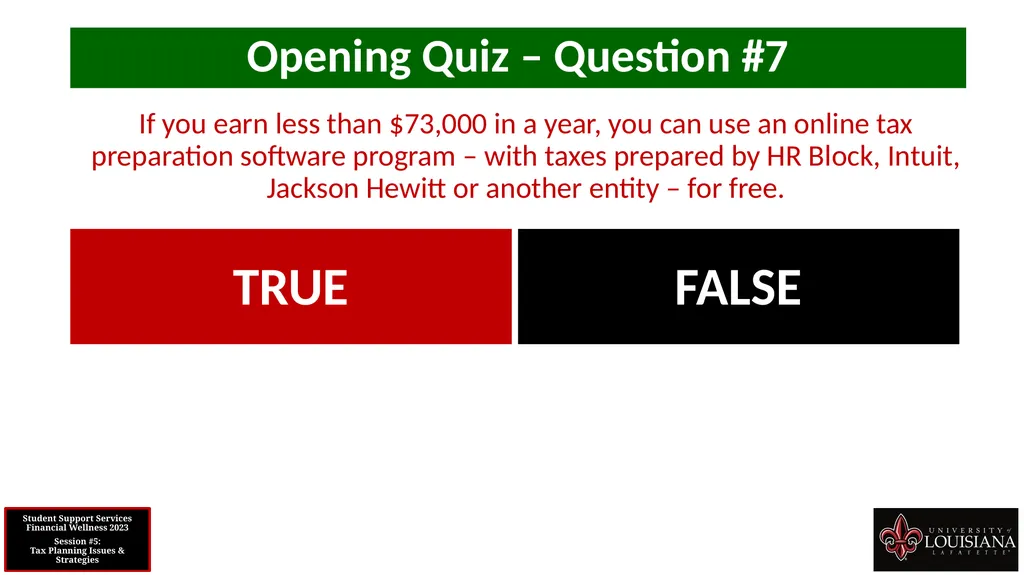
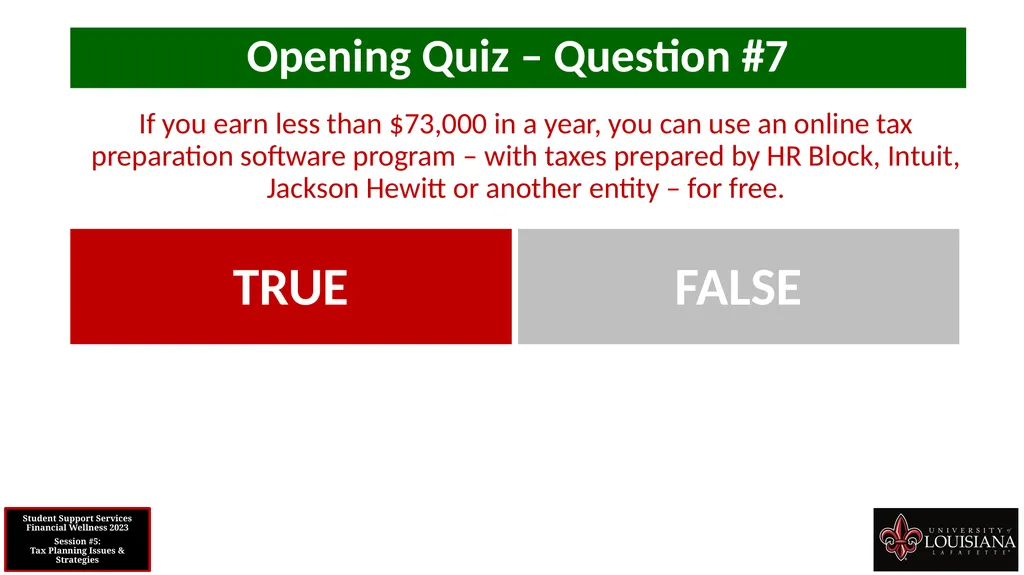
Opening Quiz – Question #7 If you earn less than $73,000 in a year, you can use an online tax preparation software program – with taxes prepared by HR Block, Intuit, Jackson Hewitt or another entity – for free. TRUE FALSE<br>
16
Opening Quiz – Question #7 If you earn less than $73,000 in a year, you can use an online tax preparation software program – with taxes prepared by HR Block, Intuit, Jackson Hewitt or another entity – for free. TRUE FALSE<br>
17
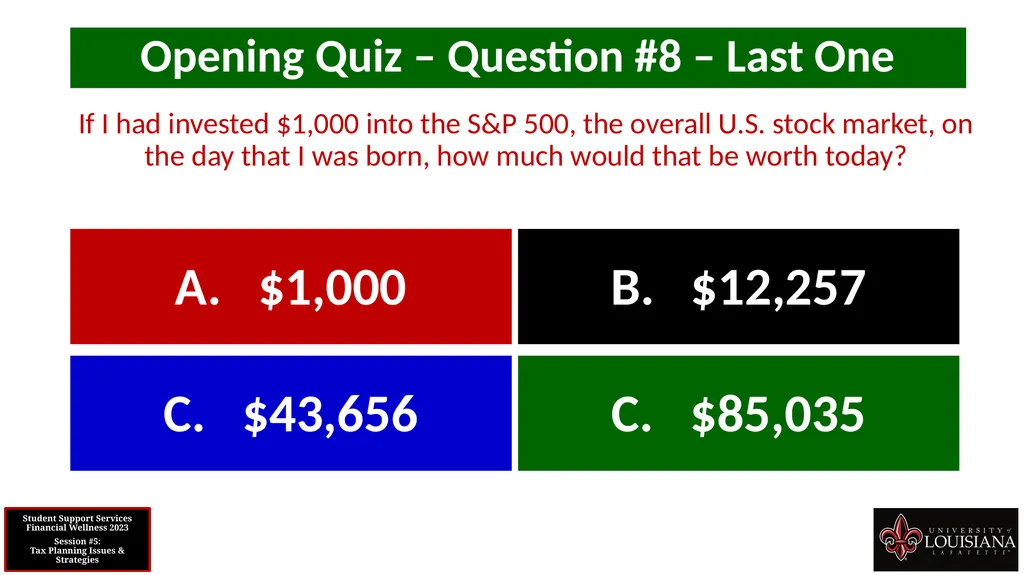
Opening Quiz – Question #8 – Last One If I had invested $1,000 into the S&P 500, the overall U.S. stock market, on the day that I was born, how much would that be worth today? A. $1,000 C. $43,656 B. $12,257 C. $85,035<br>
18
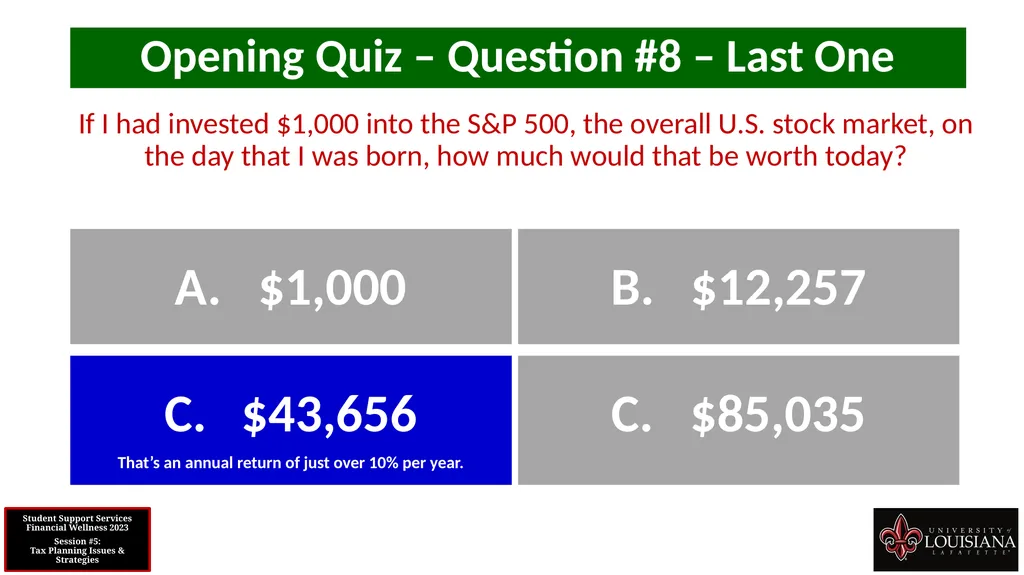
Opening Quiz – Question #8 – Last One If I had invested $1,000 into the S&P 500, the overall U.S. stock market, on the day that I was born, how much would that be worth today? A. $1,000 $43,656
That’s an annual return of just over 10% per year. B. $12,257 C. $85,035<br>
That’s an annual return of just over 10% per year. B. $12,257 C. $85,035<br>
19
Owning Your Financial Future INVESTING GOALS, HABITS & STRATEGIES
Today, January 23 CREATING AN INVESTMENT STRATEGY
Wednesday, March 15 CREDIT SCORES & DEBT MANAGEMENT
Wednesday, March 8<br>
Today, January 23 CREATING AN INVESTMENT STRATEGY
Wednesday, March 15 CREDIT SCORES & DEBT MANAGEMENT
Wednesday, March 8<br>
20
Owning Your Financial Future OPENING AN INDIVIDUAL RETIREMENT ACCOUNT
Wednesday, March 22 TAX PLANNING ISSUES & STRATEGIES
Wednesday, April 5 CAREER PLANNING: YOUR MONEY & YOUR FUTURE
Wednesday, April 26<br>
Wednesday, March 22 TAX PLANNING ISSUES & STRATEGIES
Wednesday, April 5 CAREER PLANNING: YOUR MONEY & YOUR FUTURE
Wednesday, April 26<br>
21
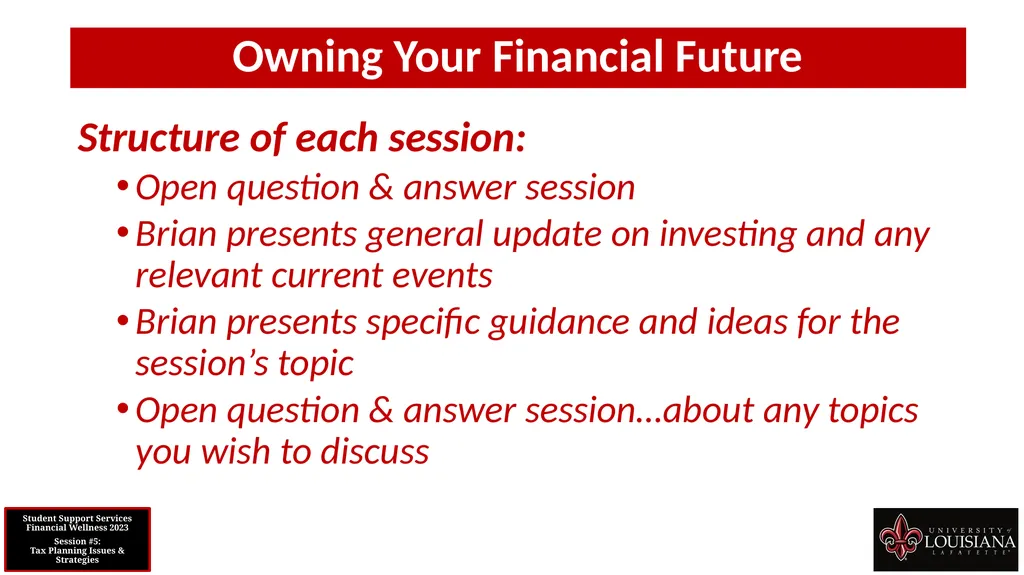
Owning Your Financial Future Structure of each session:
Open question & answer session
Brian presents general update on investing and any relevant current events
Brian presents specific guidance and ideas for the session’s topic
Open question & answer session…about any topics you wish to discuss<br>
Open question & answer session
Brian presents general update on investing and any relevant current events
Brian presents specific guidance and ideas for the session’s topic
Open question & answer session…about any topics you wish to discuss<br>
22
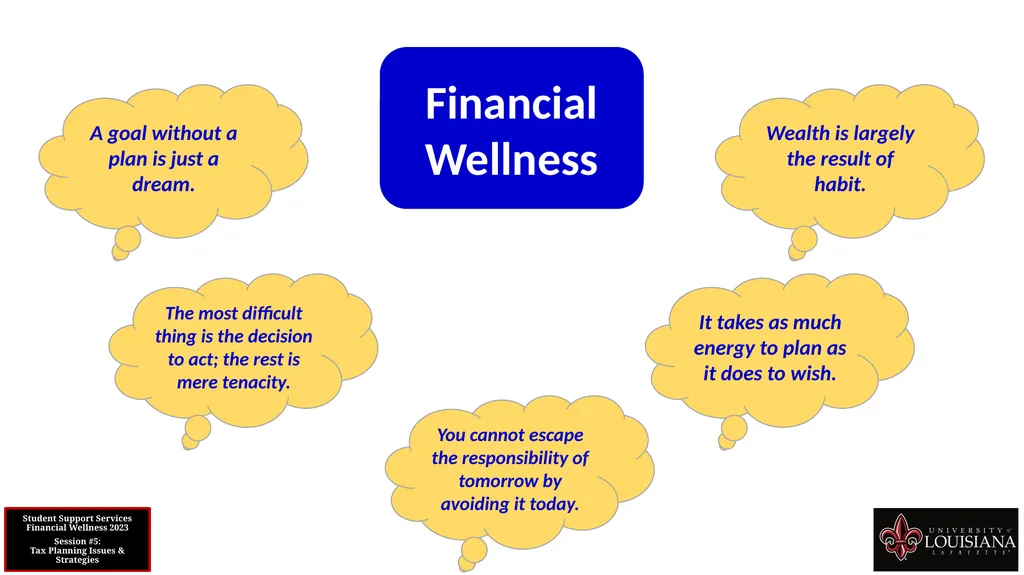
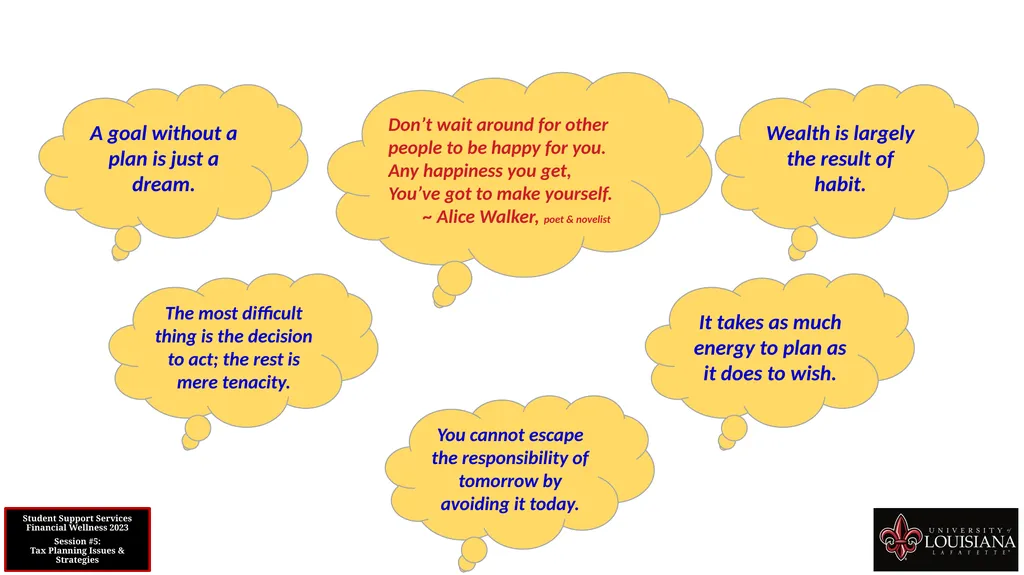
Financial Wellness A goal without a plan is just a dream. The most difficult thing is the decision to act; the rest is mere tenacity. Wealth is largely the result of habit. It takes as much energy to plan as it does to wish. You cannot escape the responsibility of tomorrow by avoiding it today.<br>
23
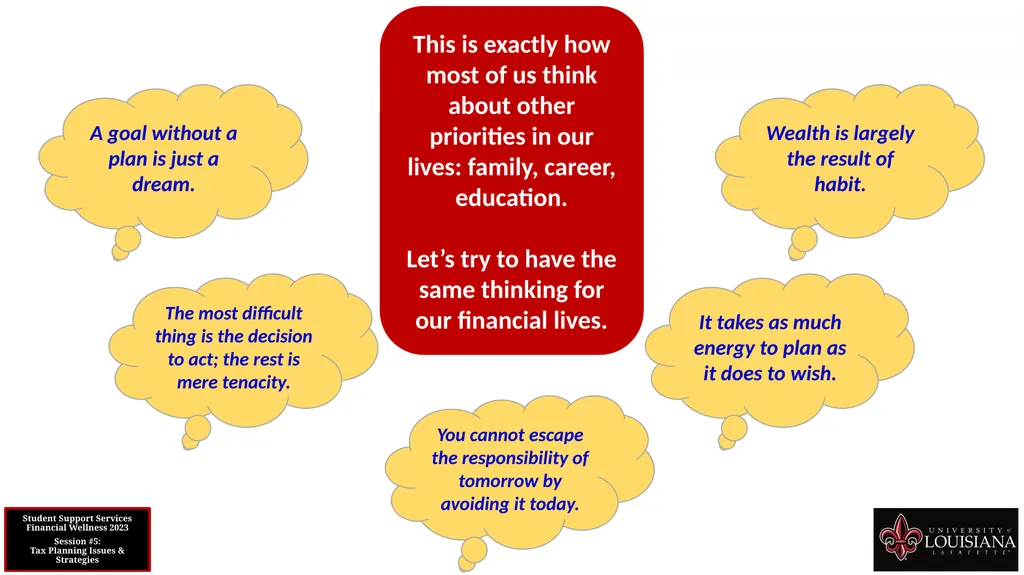
This is exactly how most of us think about other priorities in our lives: family, career, education.
Let’s try to have the same thinking for our financial lives. A goal without a plan is just a dream. The most difficult thing is the decision to act; the rest is mere tenacity. Wealth is largely the result of habit. It takes as much energy to plan as it does to wish. You cannot escape the responsibility of tomorrow by avoiding it today.<br>
Let’s try to have the same thinking for our financial lives. A goal without a plan is just a dream. The most difficult thing is the decision to act; the rest is mere tenacity. Wealth is largely the result of habit. It takes as much energy to plan as it does to wish. You cannot escape the responsibility of tomorrow by avoiding it today.<br>
24
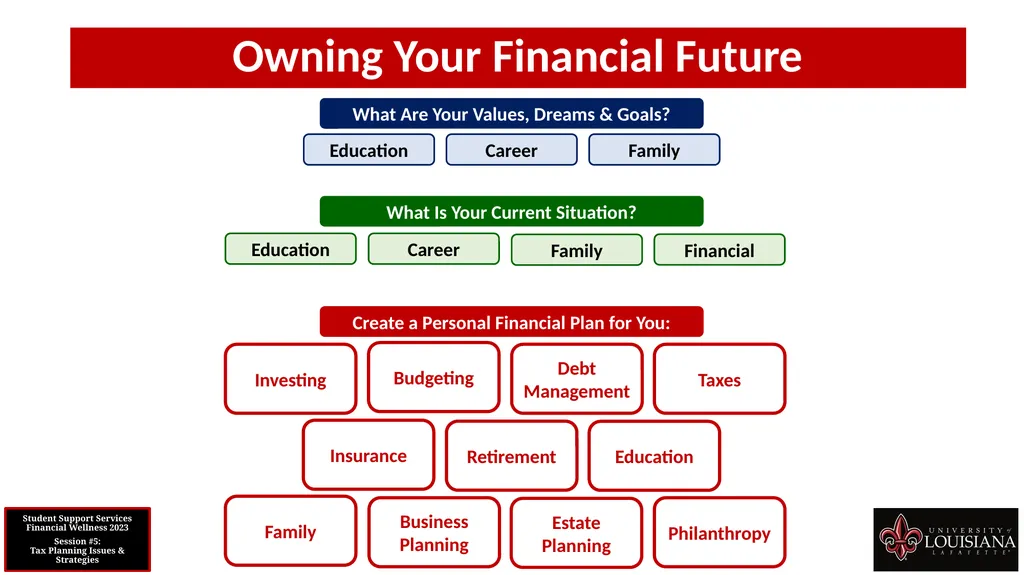
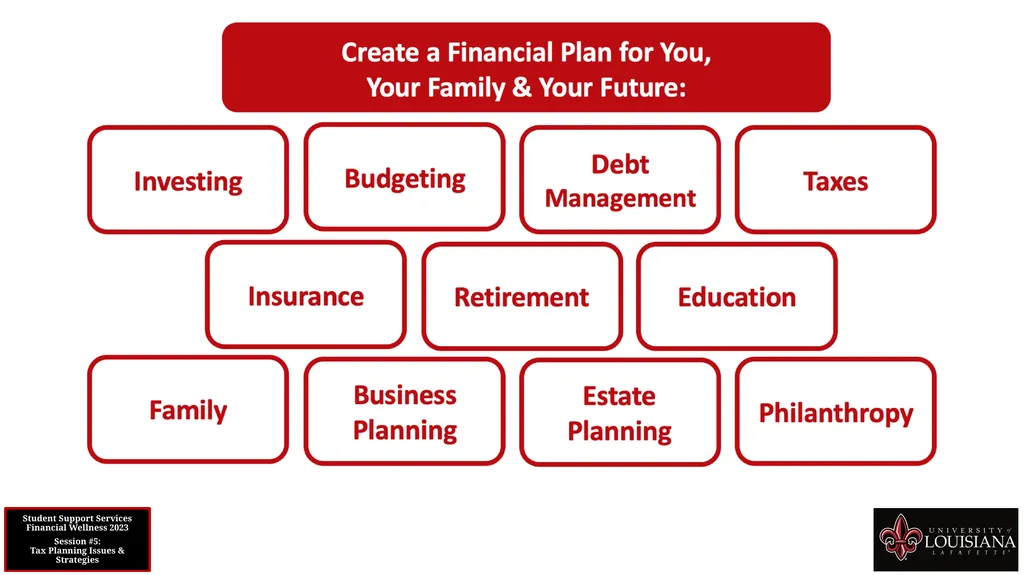
Owning Your Financial Future What Are Your Values, Dreams & Goals? What Is Your Current Situation? Career Family Education Career Family Education Financial Create a Personal Financial Plan for You: Investing Budgeting Debt Management Taxes Insurance Retirement Education Family Business Planning Estate Planning Philanthropy<br>
25
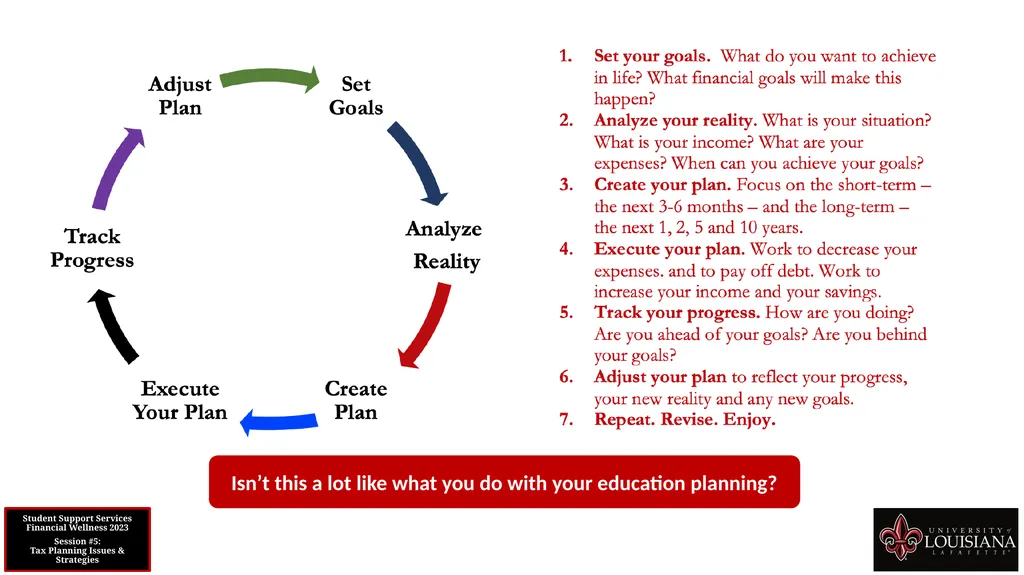
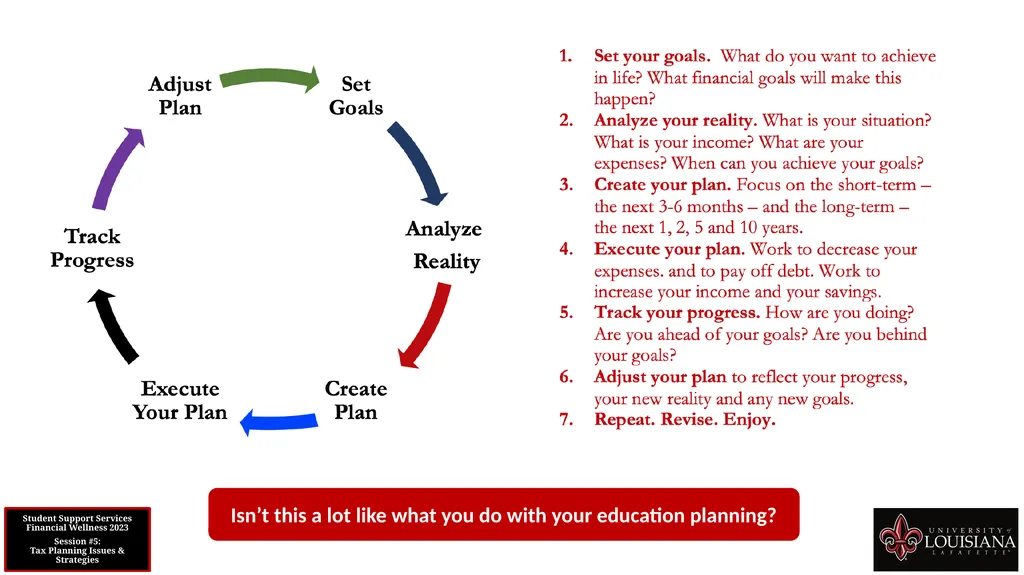
Isn’t this a lot like what you do with your education planning?<br>
26
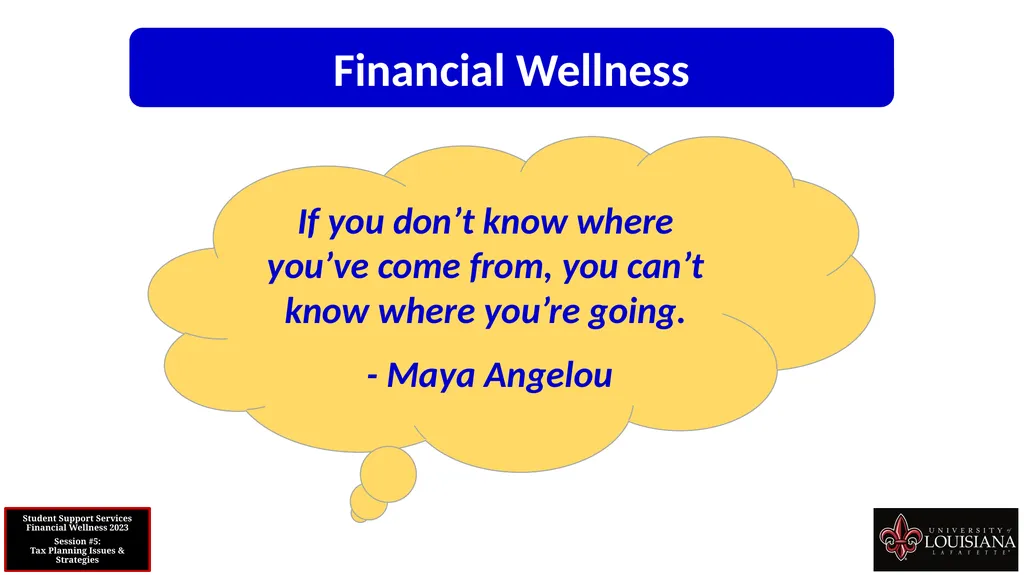
If you don’t know where you’ve come from, you can’t know where you’re going.
- Maya Angelou Financial Wellness<br>
- Maya Angelou Financial Wellness<br>
27
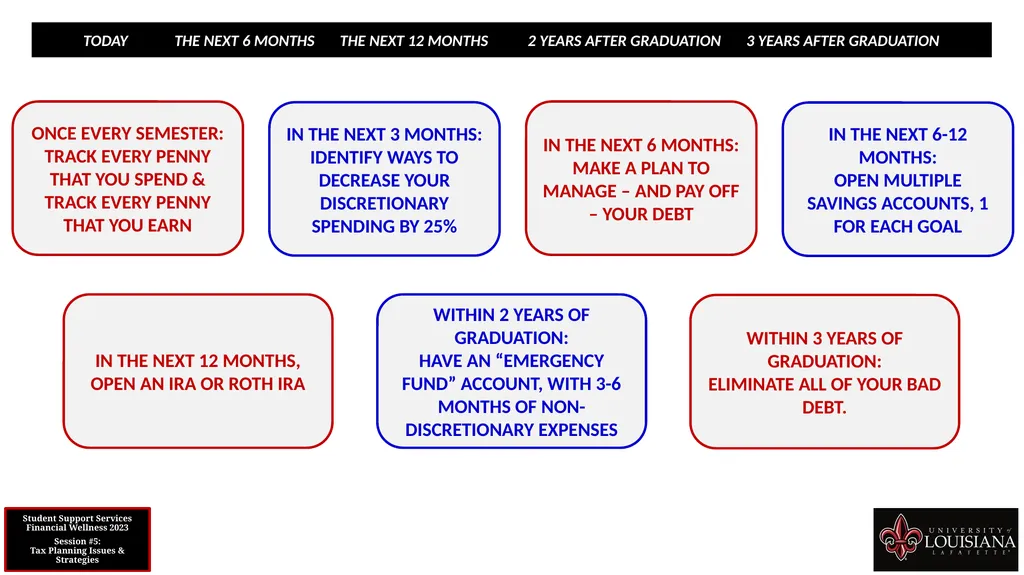
TODAY THE NEXT 6 MONTHS THE NEXT 12 MONTHS 2 YEARS AFTER GRADUATION 3 YEARS AFTER GRADUATION ONCE EVERY SEMESTER:
TRACK EVERY PENNY THAT YOU SPEND & TRACK EVERY PENNY THAT YOU EARN IN THE NEXT 12 MONTHS, OPEN AN IRA OR ROTH IRA IN THE NEXT 3 MONTHS:
IDENTIFY WAYS TO DECREASE YOUR DISCRETIONARY SPENDING BY 25% IN THE NEXT 6 MONTHS:
MAKE A PLAN TO MANAGE – AND PAY OFF – YOUR DEBT IN THE NEXT 6-12 MONTHS:
OPEN MULTIPLE SAVINGS ACCOUNTS, 1 FOR EACH GOAL WITHIN 2 YEARS OF GRADUATION:
HAVE AN “EMERGENCY FUND” ACCOUNT, WITH 3-6 MONTHS OF NON-DISCRETIONARY EXPENSES WITHIN 3 YEARS OF GRADUATION:
ELIMINATE ALL OF YOUR BAD DEBT.<br>
TRACK EVERY PENNY THAT YOU SPEND & TRACK EVERY PENNY THAT YOU EARN IN THE NEXT 12 MONTHS, OPEN AN IRA OR ROTH IRA IN THE NEXT 3 MONTHS:
IDENTIFY WAYS TO DECREASE YOUR DISCRETIONARY SPENDING BY 25% IN THE NEXT 6 MONTHS:
MAKE A PLAN TO MANAGE – AND PAY OFF – YOUR DEBT IN THE NEXT 6-12 MONTHS:
OPEN MULTIPLE SAVINGS ACCOUNTS, 1 FOR EACH GOAL WITHIN 2 YEARS OF GRADUATION:
HAVE AN “EMERGENCY FUND” ACCOUNT, WITH 3-6 MONTHS OF NON-DISCRETIONARY EXPENSES WITHIN 3 YEARS OF GRADUATION:
ELIMINATE ALL OF YOUR BAD DEBT.<br>
28
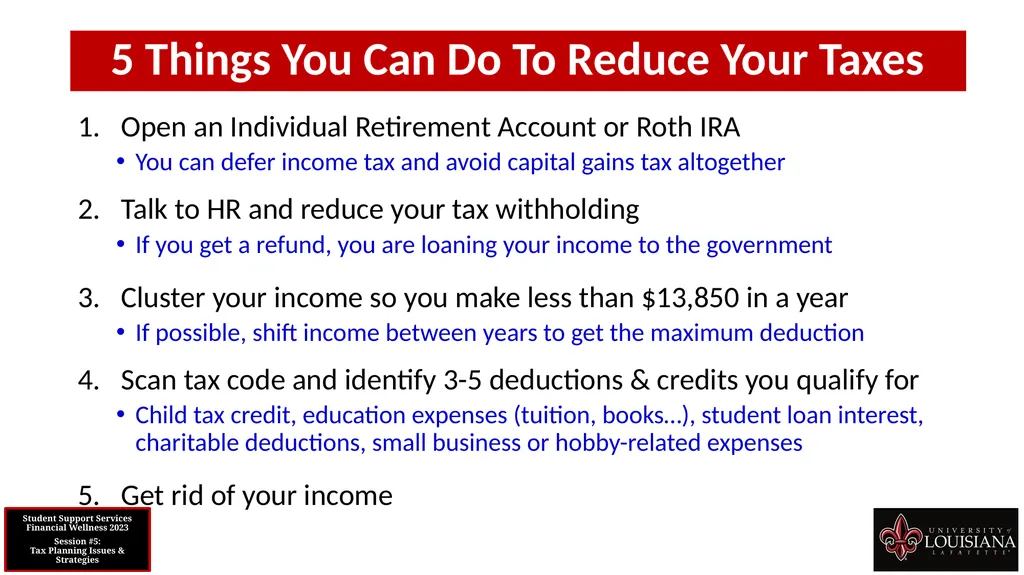
5 Things You Can Do To Reduce Your Taxes Open an Individual Retirement Account or Roth IRA
You can defer income tax and avoid capital gains tax altogether
Talk to HR and reduce your tax withholding
If you get a refund, you are loaning your income to the government
Cluster your income so you make less than $13,850 in a year
If possible, shift income between years to get the maximum deduction
Scan tax code and identify 3-5 deductions & credits you qualify for
Child tax credit, education expenses (tuition, books…), student loan interest, charitable deductions, small business or hobby-related expenses
Get rid of your income<br>
You can defer income tax and avoid capital gains tax altogether
Talk to HR and reduce your tax withholding
If you get a refund, you are loaning your income to the government
Cluster your income so you make less than $13,850 in a year
If possible, shift income between years to get the maximum deduction
Scan tax code and identify 3-5 deductions & credits you qualify for
Child tax credit, education expenses (tuition, books…), student loan interest, charitable deductions, small business or hobby-related expenses
Get rid of your income<br>
29
Income Taxes in the U.S. A few rules and definitions:
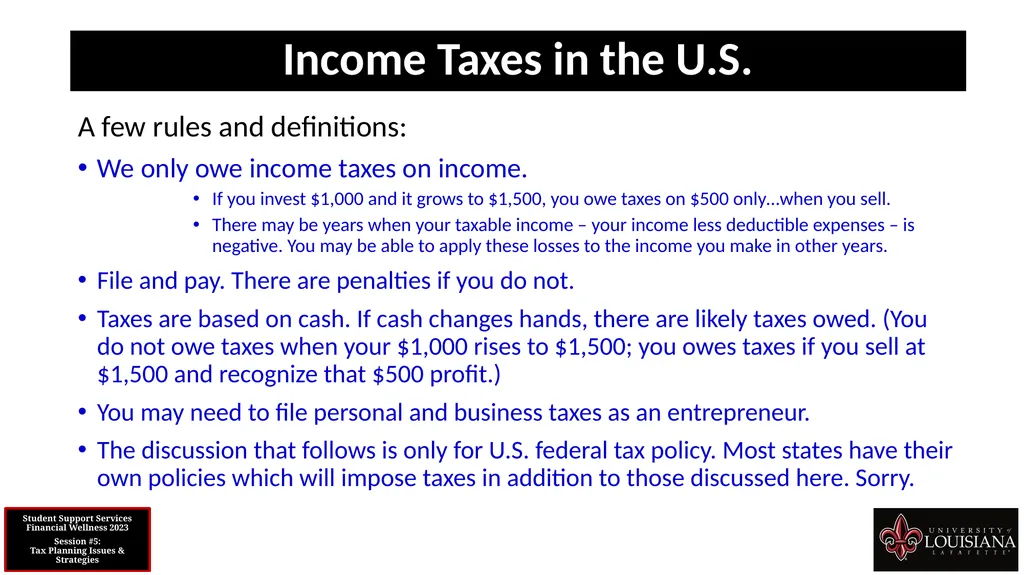
We only owe income taxes on income.
If you invest $1,000 and it grows to $1,500, you owe taxes on $500 only…when you sell.
There may be years when your taxable income – your income less deductible expenses – is negative. You may be able to apply these losses to the income you make in other years.
File and pay. There are penalties if you do not.
Taxes are based on cash. If cash changes hands, there are likely taxes owed. (You do not owe taxes when your $1,000 rises to $1,500; you owes taxes if you sell at $1,500 and recognize that $500 profit.)
You may need to file personal and business taxes as an entrepreneur.
The discussion that follows is only for U.S. federal tax policy. Most states have their own policies which will impose taxes in addition to those discussed here. Sorry.<br>
We only owe income taxes on income.
If you invest $1,000 and it grows to $1,500, you owe taxes on $500 only…when you sell.
There may be years when your taxable income – your income less deductible expenses – is negative. You may be able to apply these losses to the income you make in other years.
File and pay. There are penalties if you do not.
Taxes are based on cash. If cash changes hands, there are likely taxes owed. (You do not owe taxes when your $1,000 rises to $1,500; you owes taxes if you sell at $1,500 and recognize that $500 profit.)
You may need to file personal and business taxes as an entrepreneur.
The discussion that follows is only for U.S. federal tax policy. Most states have their own policies which will impose taxes in addition to those discussed here. Sorry.<br>
30
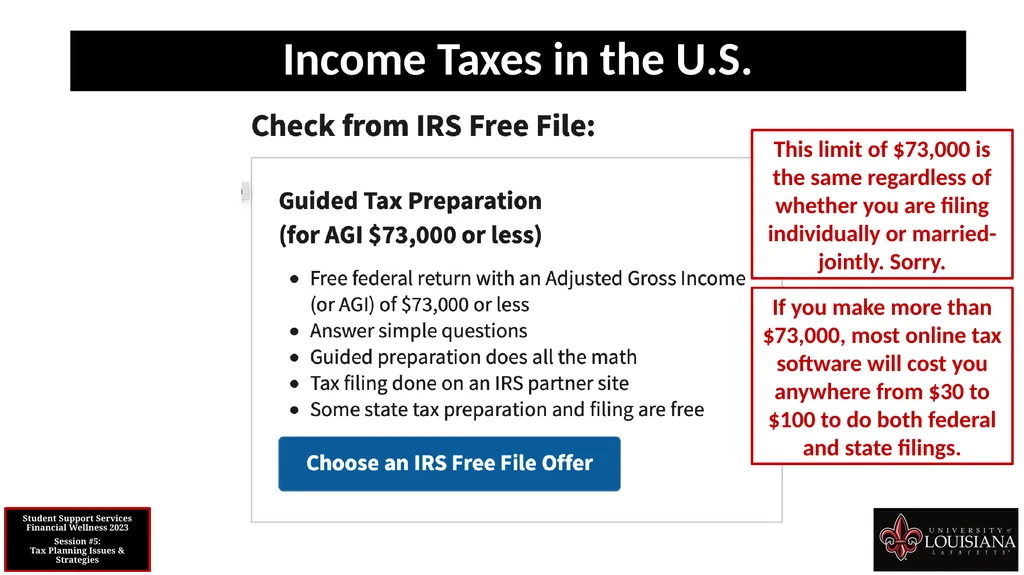
Income Taxes in the U.S. This limit of $73,000 is the same regardless of whether you are filing individually or married-jointly. Sorry. If you make more than $73,000, most online tax software will cost you anywhere from $30 to $100 to do both federal and state filings.<br>
31
Income Taxes in the U.S. A few rules and definitions:
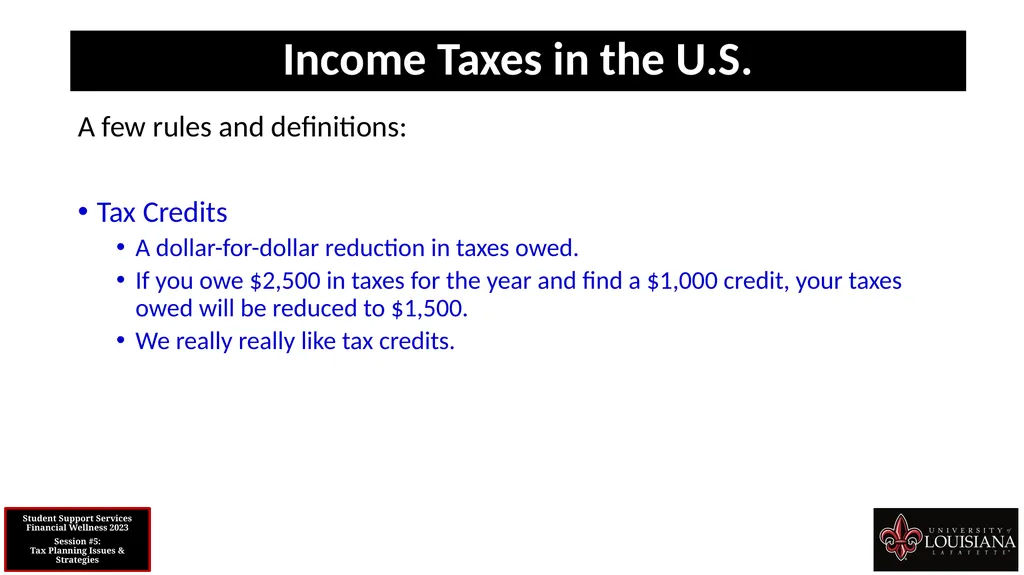
Tax Credits
A dollar-for-dollar reduction in taxes owed.
If you owe $2,500 in taxes for the year and find a $1,000 credit, your taxes owed will be reduced to $1,500.
We really really like tax credits.<br>
Tax Credits
A dollar-for-dollar reduction in taxes owed.
If you owe $2,500 in taxes for the year and find a $1,000 credit, your taxes owed will be reduced to $1,500.
We really really like tax credits.<br>
32
Income Taxes in the U.S. A few rules and definitions:
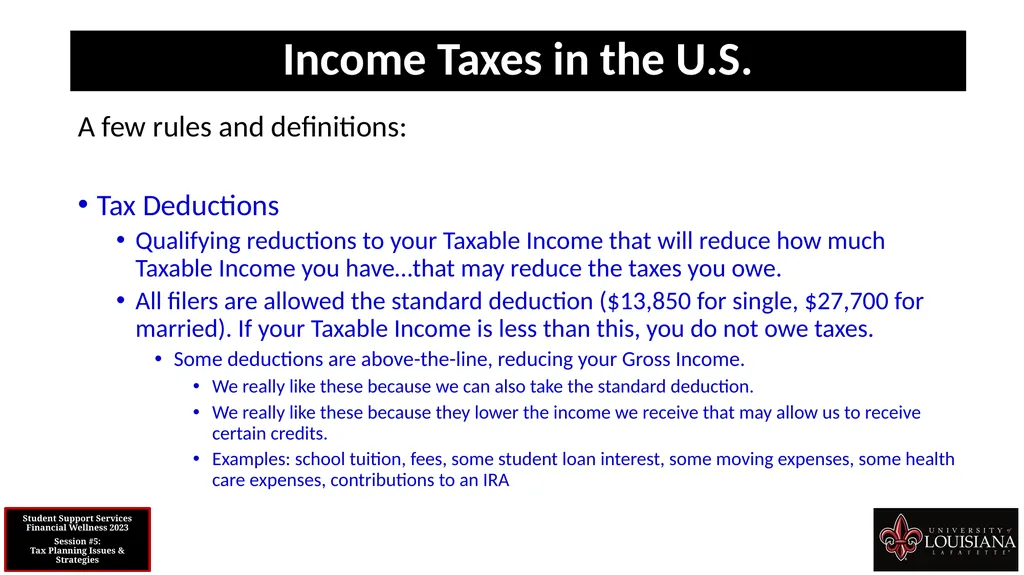
Tax Deductions
Qualifying reductions to your Taxable Income that will reduce how much Taxable Income you have…that may reduce the taxes you owe.
All filers are allowed the standard deduction ($13,850 for single, $27,700 for married). If your Taxable Income is less than this, you do not owe taxes.
Some deductions are above-the-line, reducing your Gross Income.
We really like these because we can also take the standard deduction.
We really like these because they lower the income we receive that may allow us to receive certain credits.
Examples: school tuition, fees, some student loan interest, some moving expenses, some health care expenses, contributions to an IRA<br>
Tax Deductions
Qualifying reductions to your Taxable Income that will reduce how much Taxable Income you have…that may reduce the taxes you owe.
All filers are allowed the standard deduction ($13,850 for single, $27,700 for married). If your Taxable Income is less than this, you do not owe taxes.
Some deductions are above-the-line, reducing your Gross Income.
We really like these because we can also take the standard deduction.
We really like these because they lower the income we receive that may allow us to receive certain credits.
Examples: school tuition, fees, some student loan interest, some moving expenses, some health care expenses, contributions to an IRA<br>
33
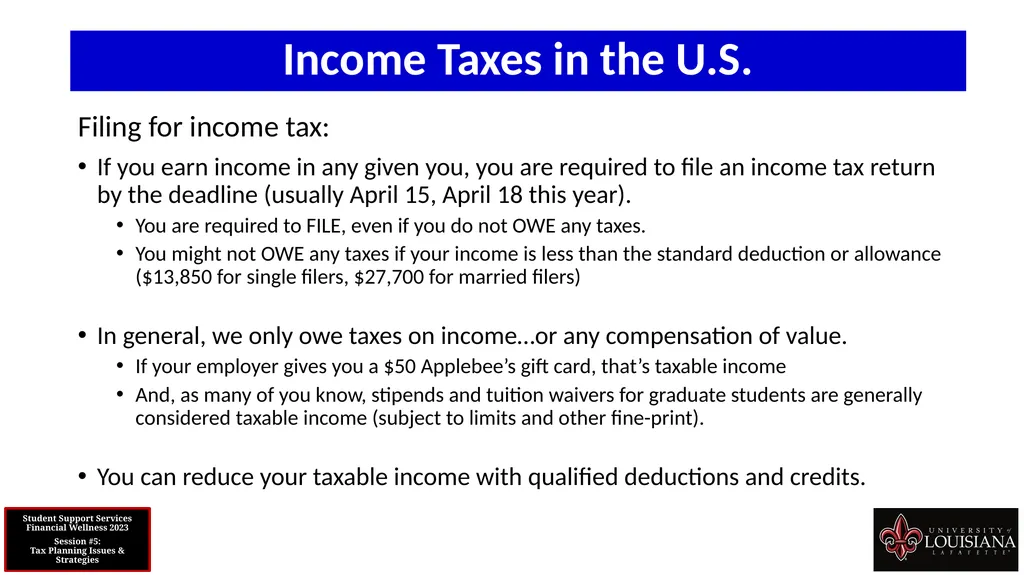
Income Taxes in the U.S. Filing for income tax:
If you earn income in any given you, you are required to file an income tax return by the deadline (usually April 15, April 18 this year).
You are required to FILE, even if you do not OWE any taxes.
You might not OWE any taxes if your income is less than the standard deduction or allowance ($13,850 for single filers, $27,700 for married filers)
In general, we only owe taxes on income…or any compensation of value.
If your employer gives you a $50 Applebee’s gift card, that’s taxable income
And, as many of you know, stipends and tuition waivers for graduate students are generally considered taxable income (subject to limits and other fine-print).
You can reduce your taxable income with qualified deductions and credits.<br>
If you earn income in any given you, you are required to file an income tax return by the deadline (usually April 15, April 18 this year).
You are required to FILE, even if you do not OWE any taxes.
You might not OWE any taxes if your income is less than the standard deduction or allowance ($13,850 for single filers, $27,700 for married filers)
In general, we only owe taxes on income…or any compensation of value.
If your employer gives you a $50 Applebee’s gift card, that’s taxable income
And, as many of you know, stipends and tuition waivers for graduate students are generally considered taxable income (subject to limits and other fine-print).
You can reduce your taxable income with qualified deductions and credits.<br>
34
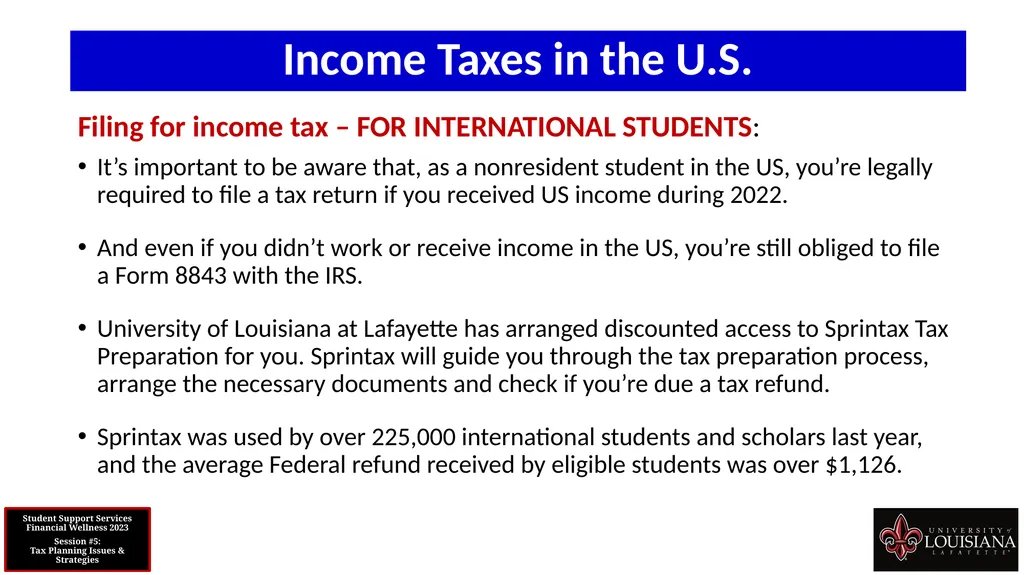
Income Taxes in the U.S. Filing for income tax – FOR INTERNATIONAL STUDENTS:
It’s important to be aware that, as a nonresident student in the US, you’re legally required to file a tax return if you received US income during 2022.
And even if you didn’t work or receive income in the US, you’re still obliged to file a Form 8843 with the IRS.
University of Louisiana at Lafayette has arranged discounted access to Sprintax Tax Preparation for you. Sprintax will guide you through the tax preparation process, arrange the necessary documents and check if you’re due a tax refund.
Sprintax was used by over 225,000 international students and scholars last year, and the average Federal refund received by eligible students was over $1,126.<br>
It’s important to be aware that, as a nonresident student in the US, you’re legally required to file a tax return if you received US income during 2022.
And even if you didn’t work or receive income in the US, you’re still obliged to file a Form 8843 with the IRS.
University of Louisiana at Lafayette has arranged discounted access to Sprintax Tax Preparation for you. Sprintax will guide you through the tax preparation process, arrange the necessary documents and check if you’re due a tax refund.
Sprintax was used by over 225,000 international students and scholars last year, and the average Federal refund received by eligible students was over $1,126.<br>
35
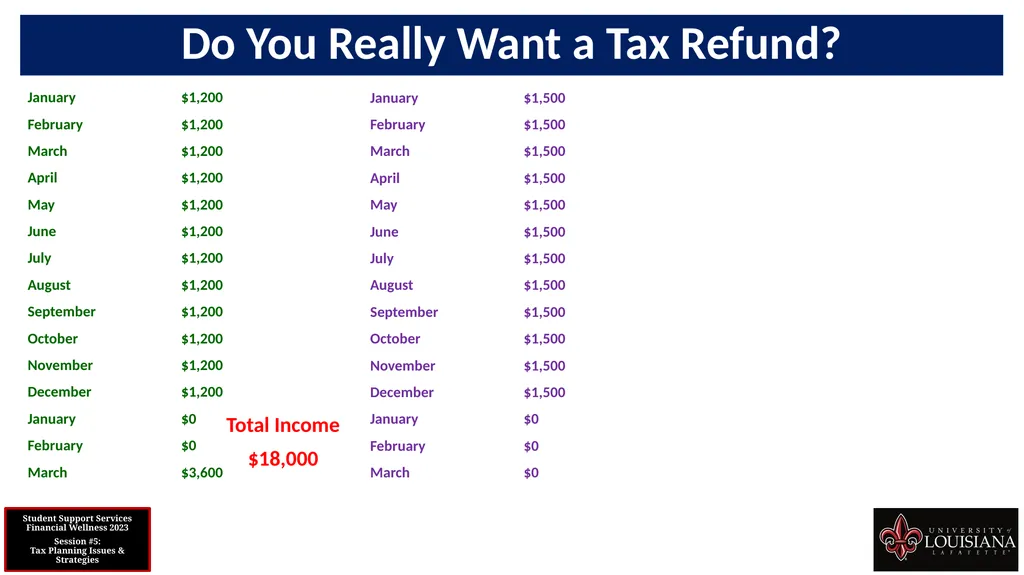
Do You Really Want a Tax Refund? January $1,200
February $1,200
March $1,200
April $1,200
May $1,200
June $1,200
July $1,200
August $1,200
September $1,200
October $1,200
November $1,200
December $1,200
January $0
February $0
March $3,600 January $1,500
February $1,500
March $1,500
April $1,500
May $1,500
June $1,500
July $1,500
August $1,500
September $1,500
October $1,500
November $1,500
December $1,500
January $0
February $0
March $0 Total Income
$18,000<br>
February $1,200
March $1,200
April $1,200
May $1,200
June $1,200
July $1,200
August $1,200
September $1,200
October $1,200
November $1,200
December $1,200
January $0
February $0
March $3,600 January $1,500
February $1,500
March $1,500
April $1,500
May $1,500
June $1,500
July $1,500
August $1,500
September $1,500
October $1,500
November $1,500
December $1,500
January $0
February $0
March $0 Total Income
$18,000<br>
36
Do You Really Want a Tax Refund? January $1,200
February $1,200
March $1,200
April $1,200
May $1,200
June $1,200
July $1,200
August $1,200
September $1,200
October $1,200
November $1,200
December $1,200
January $0
February $0
March $3,600 January $1,500
February $1,500
March $1,500
April $1,500
May $1,500
June $1,500
July $1,500
August $1,500
September $1,500
October $1,500
November $1,500
December $1,500
January $0
February $0
March $0 Total Income
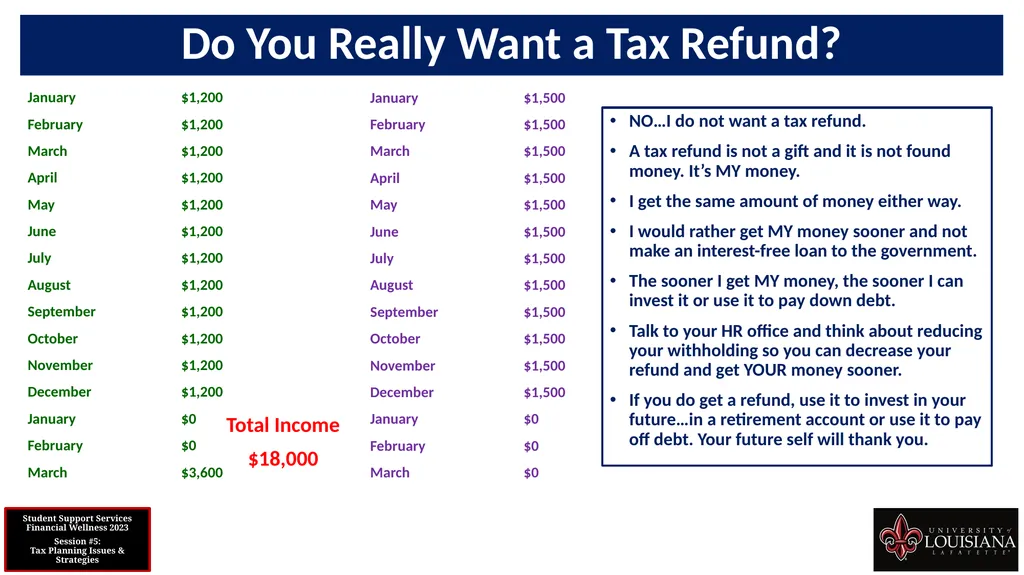
$18,000 NO…I do not want a tax refund.
A tax refund is not a gift and it is not found money. It’s MY money.
I get the same amount of money either way.
I would rather get MY money sooner and not make an interest-free loan to the government.
The sooner I get MY money, the sooner I can invest it or use it to pay down debt.
Talk to your HR office and think about reducing your withholding so you can decrease your refund and get YOUR money sooner.
If you do get a refund, use it to invest in your future…in a retirement account or use it to pay off debt. Your future self will thank you.<br>
February $1,200
March $1,200
April $1,200
May $1,200
June $1,200
July $1,200
August $1,200
September $1,200
October $1,200
November $1,200
December $1,200
January $0
February $0
March $3,600 January $1,500
February $1,500
March $1,500
April $1,500
May $1,500
June $1,500
July $1,500
August $1,500
September $1,500
October $1,500
November $1,500
December $1,500
January $0
February $0
March $0 Total Income
$18,000 NO…I do not want a tax refund.
A tax refund is not a gift and it is not found money. It’s MY money.
I get the same amount of money either way.
I would rather get MY money sooner and not make an interest-free loan to the government.
The sooner I get MY money, the sooner I can invest it or use it to pay down debt.
Talk to your HR office and think about reducing your withholding so you can decrease your refund and get YOUR money sooner.
If you do get a refund, use it to invest in your future…in a retirement account or use it to pay off debt. Your future self will thank you.<br>
37
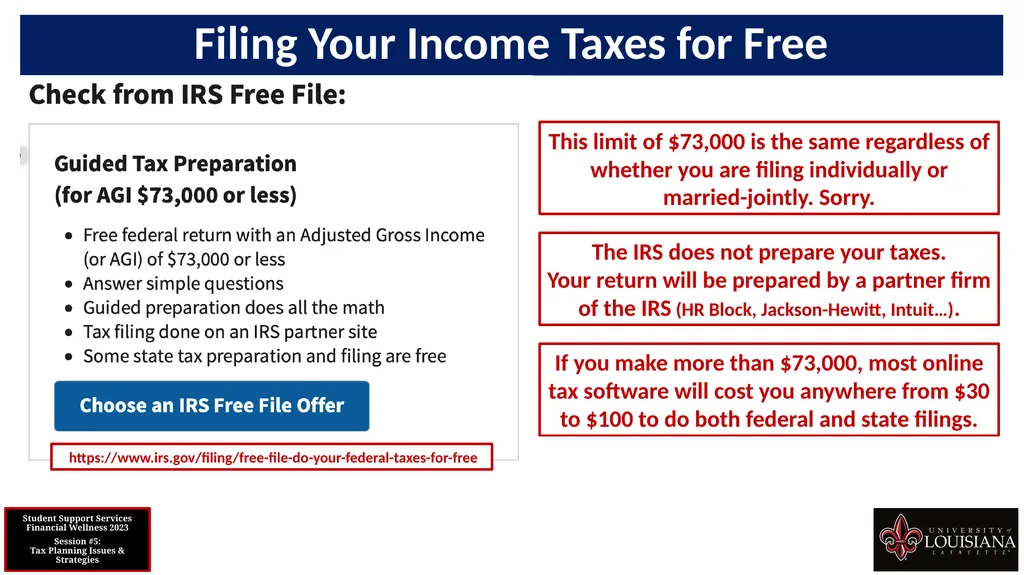
Filing Your Income Taxes for Free This limit of $73,000 is the same regardless of whether you are filing individually or married-jointly. Sorry. The IRS does not prepare your taxes.
Your return will be prepared by a partner firm of the IRS (HR Block, Jackson-Hewitt, Intuit…). https://www.irs.gov/filing/free-file-do-your-federal-taxes-for-free If you make more than $73,000, most online tax software will cost you anywhere from $30 to $100 to do both federal and state filings.<br>
Your return will be prepared by a partner firm of the IRS (HR Block, Jackson-Hewitt, Intuit…). https://www.irs.gov/filing/free-file-do-your-federal-taxes-for-free If you make more than $73,000, most online tax software will cost you anywhere from $30 to $100 to do both federal and state filings.<br>
38
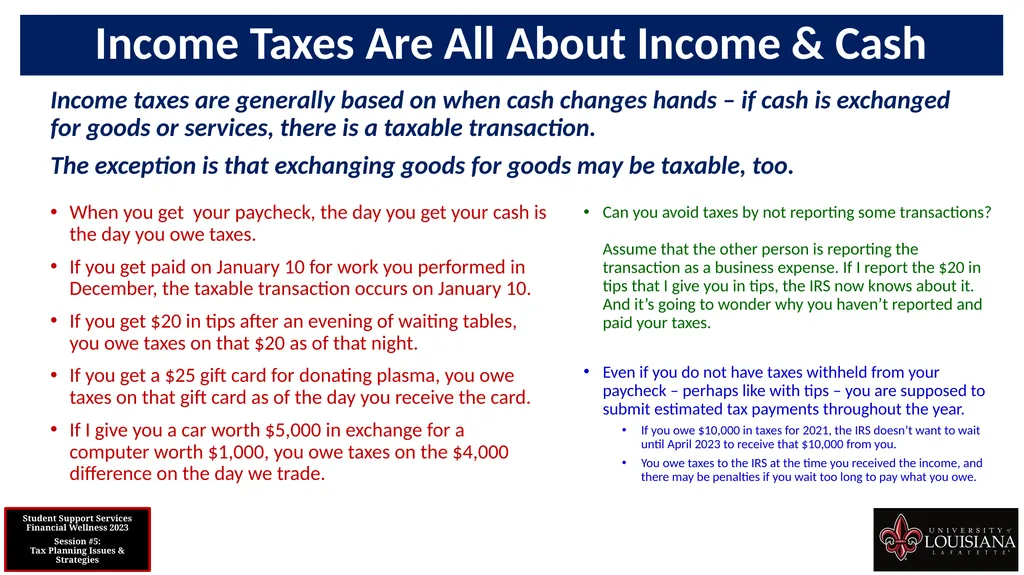
Income Taxes Are All About Income & Cash Income taxes are generally based on when cash changes hands – if cash is exchanged for goods or services, there is a taxable transaction.
The exception is that exchanging goods for goods may be taxable, too. When you get your paycheck, the day you get your cash is the day you owe taxes.
If you get paid on January 10 for work you performed in December, the taxable transaction occurs on January 10.
If you get $20 in tips after an evening of waiting tables, you owe taxes on that $20 as of that night.
If you get a $25 gift card for donating plasma, you owe taxes on that gift card as of the day you receive the card.
If I give you a car worth $5,000 in exchange for a computer worth $1,000, you owe taxes on the $4,000 difference on the day we trade. Can you avoid taxes by not reporting some transactions? Assume that the other person is reporting the transaction as a business expense. If I report the $20 in tips that I give you in tips, the IRS now knows about it. And it’s going to wonder why you haven’t reported and paid your taxes.
Even if you do not have taxes withheld from your paycheck – perhaps like with tips – you are supposed to submit estimated tax payments throughout the year.
If you owe $10,000 in taxes for 2021, the IRS doesn’t want to wait until April 2023 to receive that $10,000 from you.
You owe taxes to the IRS at the time you received the income, and there may be penalties if you wait too long to pay what you owe.<br>
The exception is that exchanging goods for goods may be taxable, too. When you get your paycheck, the day you get your cash is the day you owe taxes.
If you get paid on January 10 for work you performed in December, the taxable transaction occurs on January 10.
If you get $20 in tips after an evening of waiting tables, you owe taxes on that $20 as of that night.
If you get a $25 gift card for donating plasma, you owe taxes on that gift card as of the day you receive the card.
If I give you a car worth $5,000 in exchange for a computer worth $1,000, you owe taxes on the $4,000 difference on the day we trade. Can you avoid taxes by not reporting some transactions? Assume that the other person is reporting the transaction as a business expense. If I report the $20 in tips that I give you in tips, the IRS now knows about it. And it’s going to wonder why you haven’t reported and paid your taxes.
Even if you do not have taxes withheld from your paycheck – perhaps like with tips – you are supposed to submit estimated tax payments throughout the year.
If you owe $10,000 in taxes for 2021, the IRS doesn’t want to wait until April 2023 to receive that $10,000 from you.
You owe taxes to the IRS at the time you received the income, and there may be penalties if you wait too long to pay what you owe.<br>
39
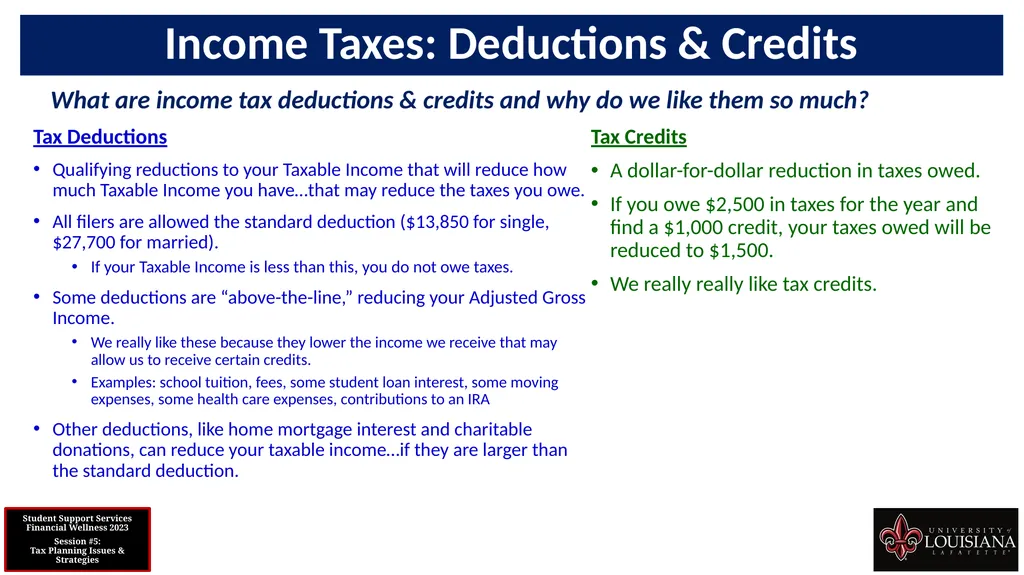
Income Taxes: Deductions & Credits What are income tax deductions & credits and why do we like them so much? Tax Deductions
Qualifying reductions to your Taxable Income that will reduce how much Taxable Income you have…that may reduce the taxes you owe.
All filers are allowed the standard deduction ($13,850 for single, $27,700 for married).
If your Taxable Income is less than this, you do not owe taxes.
Some deductions are “above-the-line,” reducing your Adjusted Gross Income.
We really like these because they lower the income we receive that may allow us to receive certain credits.
Examples: school tuition, fees, some student loan interest, some moving expenses, some health care expenses, contributions to an IRA
Other deductions, like home mortgage interest and charitable donations, can reduce your taxable income…if they are larger than the standard deduction. Tax Credits
A dollar-for-dollar reduction in taxes owed.
If you owe $2,500 in taxes for the year and find a $1,000 credit, your taxes owed will be reduced to $1,500.
We really really like tax credits.<br>
Qualifying reductions to your Taxable Income that will reduce how much Taxable Income you have…that may reduce the taxes you owe.
All filers are allowed the standard deduction ($13,850 for single, $27,700 for married).
If your Taxable Income is less than this, you do not owe taxes.
Some deductions are “above-the-line,” reducing your Adjusted Gross Income.
We really like these because they lower the income we receive that may allow us to receive certain credits.
Examples: school tuition, fees, some student loan interest, some moving expenses, some health care expenses, contributions to an IRA
Other deductions, like home mortgage interest and charitable donations, can reduce your taxable income…if they are larger than the standard deduction. Tax Credits
A dollar-for-dollar reduction in taxes owed.
If you owe $2,500 in taxes for the year and find a $1,000 credit, your taxes owed will be reduced to $1,500.
We really really like tax credits.<br>
40
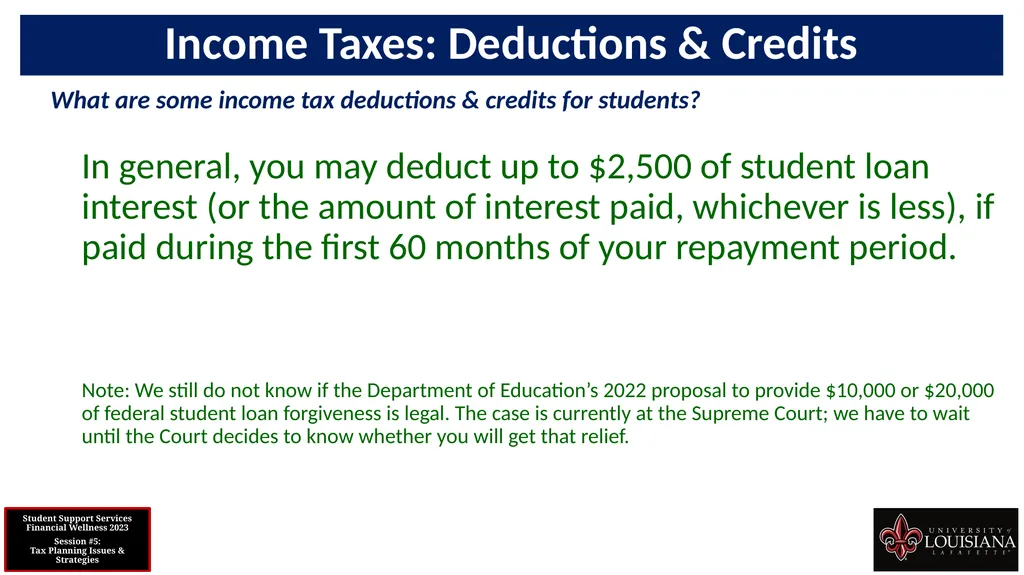
Income Taxes: Deductions & Credits What are some income tax deductions & credits for students? In general, you may deduct up to $2,500 of student loan interest (or the amount of interest paid, whichever is less), if paid during the first 60 months of your repayment period.
Note: We still do not know if the Department of Education’s 2022 proposal to provide $10,000 or $20,000 of federal student loan forgiveness is legal. The case is currently at the Supreme Court; we have to wait until the Court decides to know whether you will get that relief.<br>
Note: We still do not know if the Department of Education’s 2022 proposal to provide $10,000 or $20,000 of federal student loan forgiveness is legal. The case is currently at the Supreme Court; we have to wait until the Court decides to know whether you will get that relief.<br>
41
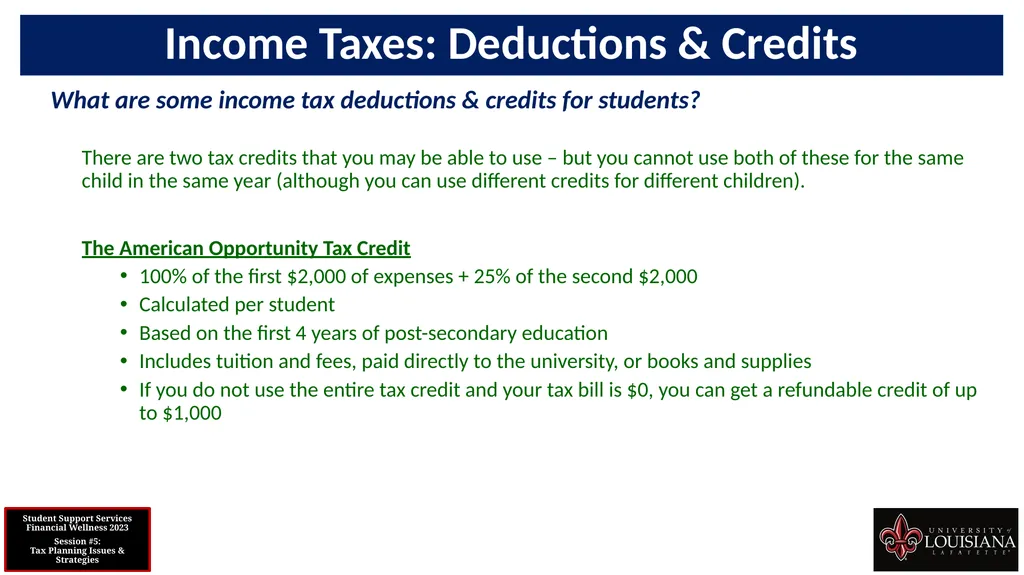
Income Taxes: Deductions & Credits What are some income tax deductions & credits for students? There are two tax credits that you may be able to use – but you cannot use both of these for the same child in the same year (although you can use different credits for different children).
The American Opportunity Tax Credit
100% of the first $2,000 of expenses + 25% of the second $2,000
Calculated per student
Based on the first 4 years of post-secondary education
Includes tuition and fees, paid directly to the university, or books and supplies
If you do not use the entire tax credit and your tax bill is $0, you can get a refundable credit of up to $1,000<br>
The American Opportunity Tax Credit
100% of the first $2,000 of expenses + 25% of the second $2,000
Calculated per student
Based on the first 4 years of post-secondary education
Includes tuition and fees, paid directly to the university, or books and supplies
If you do not use the entire tax credit and your tax bill is $0, you can get a refundable credit of up to $1,000<br>
42
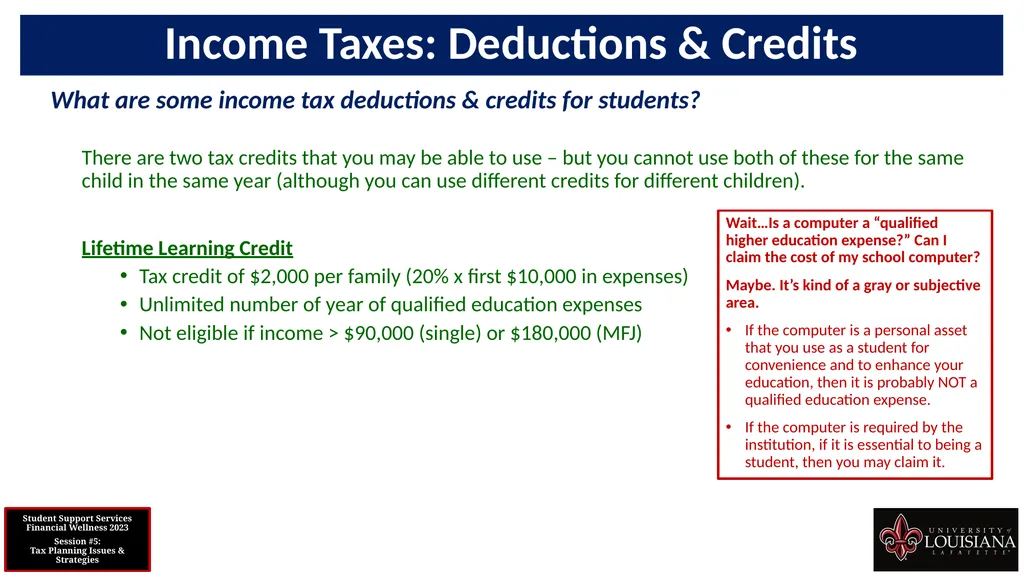
Income Taxes: Deductions & Credits What are some income tax deductions & credits for students? There are two tax credits that you may be able to use – but you cannot use both of these for the same child in the same year (although you can use different credits for different children).
Lifetime Learning Credit
Tax credit of $2,000 per family (20% x first $10,000 in expenses)
Unlimited number of year of qualified education expenses
Not eligible if income > $90,000 (single) or $180,000 (MFJ) Wait…Is a computer a “qualified higher education expense?” Can I claim the cost of my school computer?
Maybe. It’s kind of a gray or subjective area.
If the computer is a personal asset that you use as a student for convenience and to enhance your education, then it is probably NOT a qualified education expense.
If the computer is required by the institution, if it is essential to being a student, then you may claim it.<br>
Lifetime Learning Credit
Tax credit of $2,000 per family (20% x first $10,000 in expenses)
Unlimited number of year of qualified education expenses
Not eligible if income > $90,000 (single) or $180,000 (MFJ) Wait…Is a computer a “qualified higher education expense?” Can I claim the cost of my school computer?
Maybe. It’s kind of a gray or subjective area.
If the computer is a personal asset that you use as a student for convenience and to enhance your education, then it is probably NOT a qualified education expense.
If the computer is required by the institution, if it is essential to being a student, then you may claim it.<br>
43
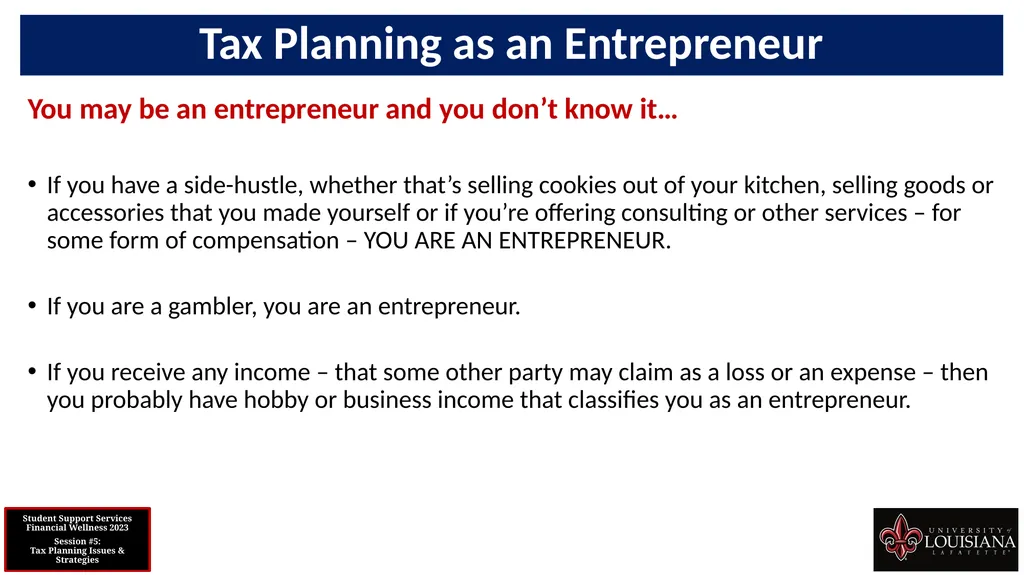
Tax Planning as an Entrepreneur You may be an entrepreneur and you don’t know it…
If you have a side-hustle, whether that’s selling cookies out of your kitchen, selling goods or accessories that you made yourself or if you’re offering consulting or other services – for some form of compensation – YOU ARE AN ENTREPRENEUR.
If you are a gambler, you are an entrepreneur.
If you receive any income – that some other party may claim as a loss or an expense – then you probably have hobby or business income that classifies you as an entrepreneur.<br>
If you have a side-hustle, whether that’s selling cookies out of your kitchen, selling goods or accessories that you made yourself or if you’re offering consulting or other services – for some form of compensation – YOU ARE AN ENTREPRENEUR.
If you are a gambler, you are an entrepreneur.
If you receive any income – that some other party may claim as a loss or an expense – then you probably have hobby or business income that classifies you as an entrepreneur.<br>
44
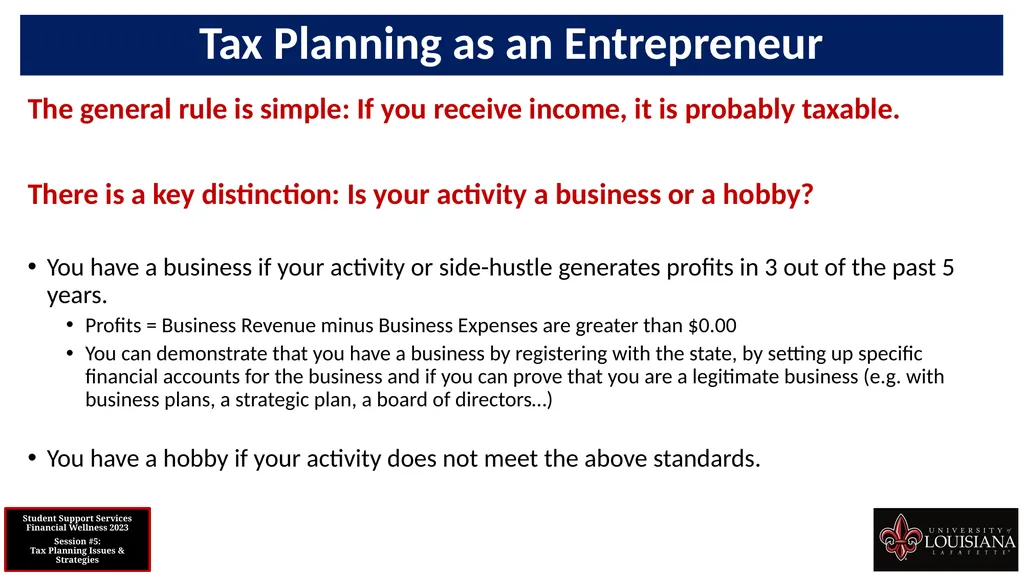
Tax Planning as an Entrepreneur The general rule is simple: If you receive income, it is probably taxable.
There is a key distinction: Is your activity a business or a hobby?
You have a business if your activity or side-hustle generates profits in 3 out of the past 5 years.
Profits = Business Revenue minus Business Expenses are greater than $0.00
You can demonstrate that you have a business by registering with the state, by setting up specific financial accounts for the business and if you can prove that you are a legitimate business (e.g. with business plans, a strategic plan, a board of directors…)
You have a hobby if your activity does not meet the above standards.<br>
There is a key distinction: Is your activity a business or a hobby?
You have a business if your activity or side-hustle generates profits in 3 out of the past 5 years.
Profits = Business Revenue minus Business Expenses are greater than $0.00
You can demonstrate that you have a business by registering with the state, by setting up specific financial accounts for the business and if you can prove that you are a legitimate business (e.g. with business plans, a strategic plan, a board of directors…)
You have a hobby if your activity does not meet the above standards.<br>
45
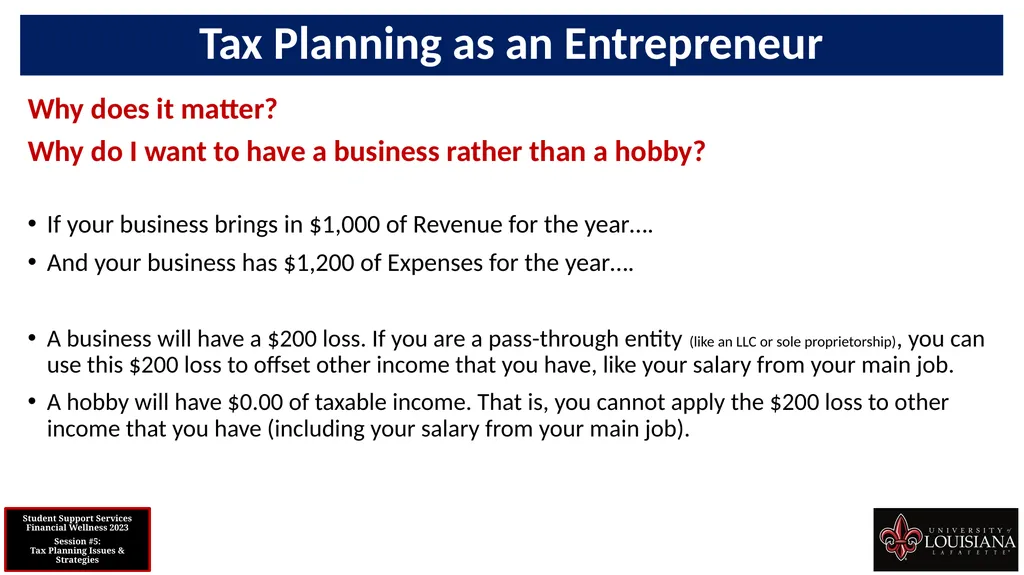
Tax Planning as an Entrepreneur Why does it matter?
Why do I want to have a business rather than a hobby?
If your business brings in $1,000 of Revenue for the year….
And your business has $1,200 of Expenses for the year….
A business will have a $200 loss. If you are a pass-through entity (like an LLC or sole proprietorship), you can use this $200 loss to offset other income that you have, like your salary from your main job.
A hobby will have $0.00 of taxable income. That is, you cannot apply the $200 loss to other income that you have (including your salary from your main job).<br>
Why do I want to have a business rather than a hobby?
If your business brings in $1,000 of Revenue for the year….
And your business has $1,200 of Expenses for the year….
A business will have a $200 loss. If you are a pass-through entity (like an LLC or sole proprietorship), you can use this $200 loss to offset other income that you have, like your salary from your main job.
A hobby will have $0.00 of taxable income. That is, you cannot apply the $200 loss to other income that you have (including your salary from your main job).<br>
46
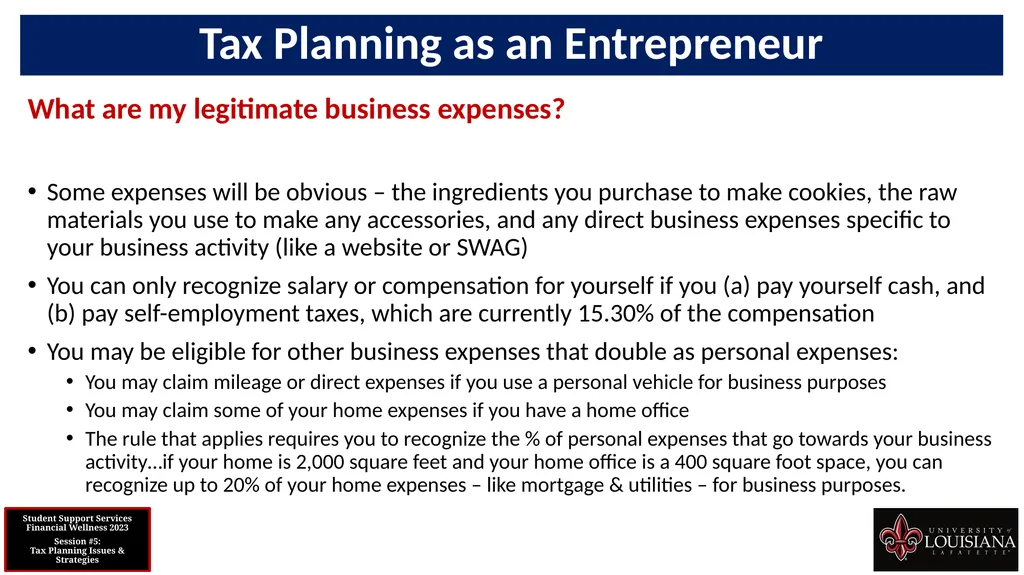
Tax Planning as an Entrepreneur What are my legitimate business expenses?
Some expenses will be obvious – the ingredients you purchase to make cookies, the raw materials you use to make any accessories, and any direct business expenses specific to your business activity (like a website or SWAG)
You can only recognize salary or compensation for yourself if you (a) pay yourself cash, and (b) pay self-employment taxes, which are currently 15.30% of the compensation
You may be eligible for other business expenses that double as personal expenses:
You may claim mileage or direct expenses if you use a personal vehicle for business purposes
You may claim some of your home expenses if you have a home office
The rule that applies requires you to recognize the % of personal expenses that go towards your business activity…if your home is 2,000 square feet and your home office is a 400 square foot space, you can recognize up to 20% of your home expenses – like mortgage & utilities – for business purposes.<br>
Some expenses will be obvious – the ingredients you purchase to make cookies, the raw materials you use to make any accessories, and any direct business expenses specific to your business activity (like a website or SWAG)
You can only recognize salary or compensation for yourself if you (a) pay yourself cash, and (b) pay self-employment taxes, which are currently 15.30% of the compensation
You may be eligible for other business expenses that double as personal expenses:
You may claim mileage or direct expenses if you use a personal vehicle for business purposes
You may claim some of your home expenses if you have a home office
The rule that applies requires you to recognize the % of personal expenses that go towards your business activity…if your home is 2,000 square feet and your home office is a 400 square foot space, you can recognize up to 20% of your home expenses – like mortgage & utilities – for business purposes.<br>
47
Tax Planning as an Entrepreneur What are my legitimate business expenses?
Some expenses will be obvious – the ingredients you purchase to make cookies, the raw materials you use to make any accessories, and any direct business expenses specific to your business activity (like a website or SWAG)
You can only recognize salary or compensation for yourself if you (a) pay yourself cash, and (b) pay self-employment taxes, which are currently 15.30% of the compensation
You may be eligible for other business expenses that double as personal expenses:
You may claim mileage or direct expenses if you use a personal vehicle for business purposes
You may claim some of your home expenses if you have a home office
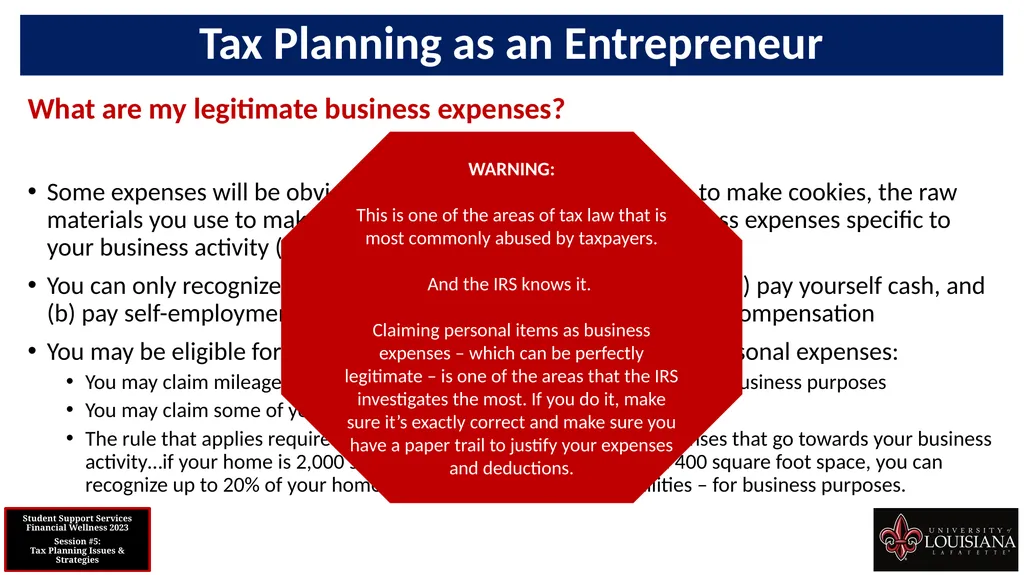
The rule that applies requires you to recognize the % of personal expenses that go towards your business activity…if your home is 2,000 square feet and your home office is a 400 square foot space, you can recognize up to 20% of your home expenses – like mortgage & utilities – for business purposes. WARNING:
This is one of the areas of tax law that is most commonly abused by taxpayers.
And the IRS knows it.
Claiming personal items as business expenses – which can be perfectly legitimate – is one of the areas that the IRS investigates the most. If you do it, make sure it’s exactly correct and make sure you have a paper trail to justify your expenses and deductions.<br>
Some expenses will be obvious – the ingredients you purchase to make cookies, the raw materials you use to make any accessories, and any direct business expenses specific to your business activity (like a website or SWAG)
You can only recognize salary or compensation for yourself if you (a) pay yourself cash, and (b) pay self-employment taxes, which are currently 15.30% of the compensation
You may be eligible for other business expenses that double as personal expenses:
You may claim mileage or direct expenses if you use a personal vehicle for business purposes
You may claim some of your home expenses if you have a home office
The rule that applies requires you to recognize the % of personal expenses that go towards your business activity…if your home is 2,000 square feet and your home office is a 400 square foot space, you can recognize up to 20% of your home expenses – like mortgage & utilities – for business purposes. WARNING:
This is one of the areas of tax law that is most commonly abused by taxpayers.
And the IRS knows it.
Claiming personal items as business expenses – which can be perfectly legitimate – is one of the areas that the IRS investigates the most. If you do it, make sure it’s exactly correct and make sure you have a paper trail to justify your expenses and deductions.<br>
48
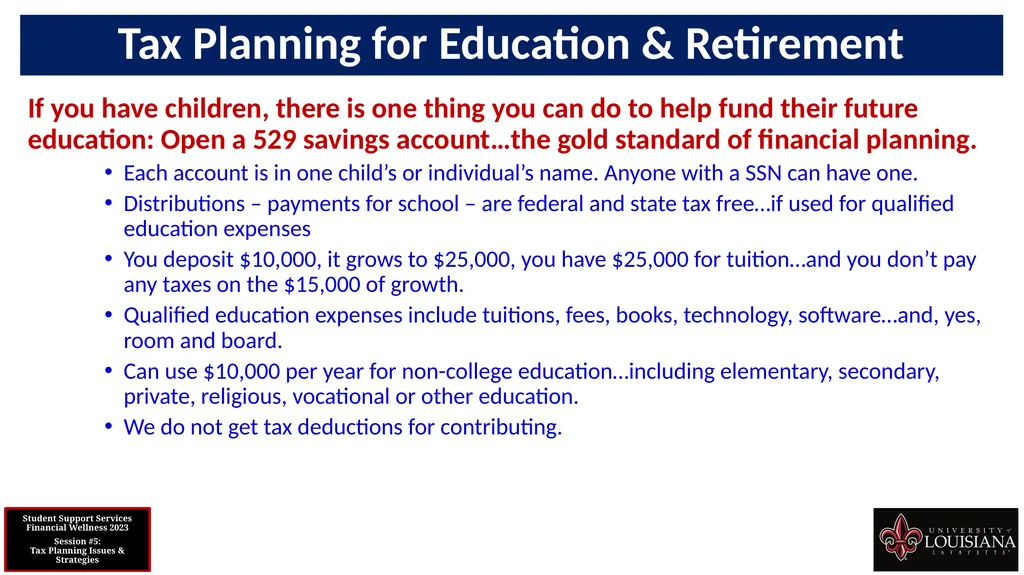
Tax Planning for Education & Retirement If you have children, there is one thing you can do to help fund their future education: Open a 529 savings account…the gold standard of financial planning.
Each account is in one child’s or individual’s name. Anyone with a SSN can have one.
Distributions – payments for school – are federal and state tax free…if used for qualified education expenses
You deposit $10,000, it grows to $25,000, you have $25,000 for tuition…and you don’t pay any taxes on the $15,000 of growth.
Qualified education expenses include tuitions, fees, books, technology, software…and, yes, room and board.
Can use $10,000 per year for non-college education…including elementary, secondary, private, religious, vocational or other education.
We do not get tax deductions for contributing.<br>
Each account is in one child’s or individual’s name. Anyone with a SSN can have one.
Distributions – payments for school – are federal and state tax free…if used for qualified education expenses
You deposit $10,000, it grows to $25,000, you have $25,000 for tuition…and you don’t pay any taxes on the $15,000 of growth.
Qualified education expenses include tuitions, fees, books, technology, software…and, yes, room and board.
Can use $10,000 per year for non-college education…including elementary, secondary, private, religious, vocational or other education.
We do not get tax deductions for contributing.<br>
49
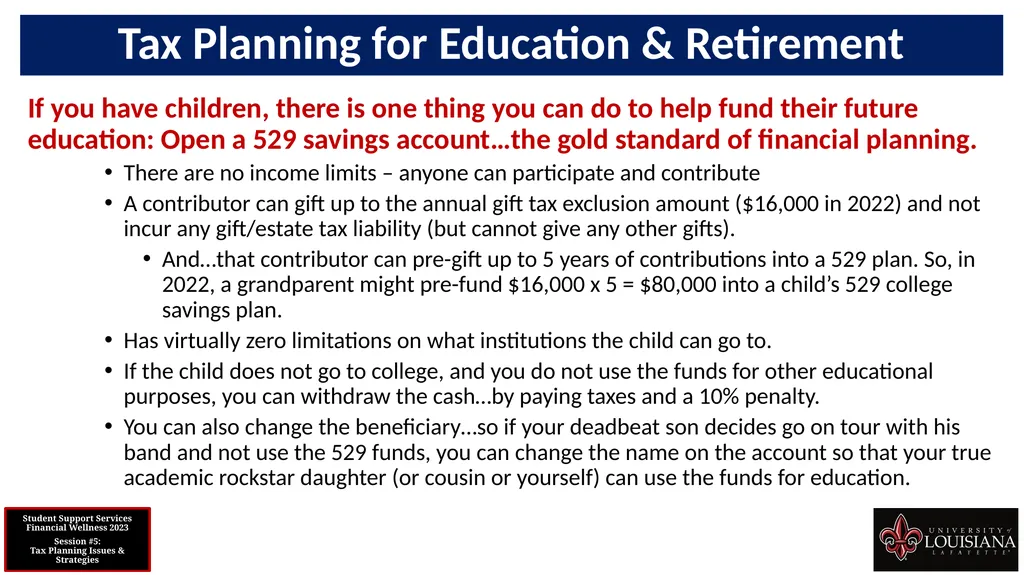
Tax Planning for Education & Retirement If you have children, there is one thing you can do to help fund their future education: Open a 529 savings account…the gold standard of financial planning.
There are no income limits – anyone can participate and contribute
A contributor can gift up to the annual gift tax exclusion amount ($16,000 in 2022) and not incur any gift/estate tax liability (but cannot give any other gifts).
And…that contributor can pre-gift up to 5 years of contributions into a 529 plan. So, in 2022, a grandparent might pre-fund $16,000 x 5 = $80,000 into a child’s 529 college savings plan.
Has virtually zero limitations on what institutions the child can go to.
If the child does not go to college, and you do not use the funds for other educational purposes, you can withdraw the cash…by paying taxes and a 10% penalty.
You can also change the beneficiary…so if your deadbeat son decides go on tour with his band and not use the 529 funds, you can change the name on the account so that your true academic rockstar daughter (or cousin or yourself) can use the funds for education.<br>
There are no income limits – anyone can participate and contribute
A contributor can gift up to the annual gift tax exclusion amount ($16,000 in 2022) and not incur any gift/estate tax liability (but cannot give any other gifts).
And…that contributor can pre-gift up to 5 years of contributions into a 529 plan. So, in 2022, a grandparent might pre-fund $16,000 x 5 = $80,000 into a child’s 529 college savings plan.
Has virtually zero limitations on what institutions the child can go to.
If the child does not go to college, and you do not use the funds for other educational purposes, you can withdraw the cash…by paying taxes and a 10% penalty.
You can also change the beneficiary…so if your deadbeat son decides go on tour with his band and not use the 529 funds, you can change the name on the account so that your true academic rockstar daughter (or cousin or yourself) can use the funds for education.<br>
50
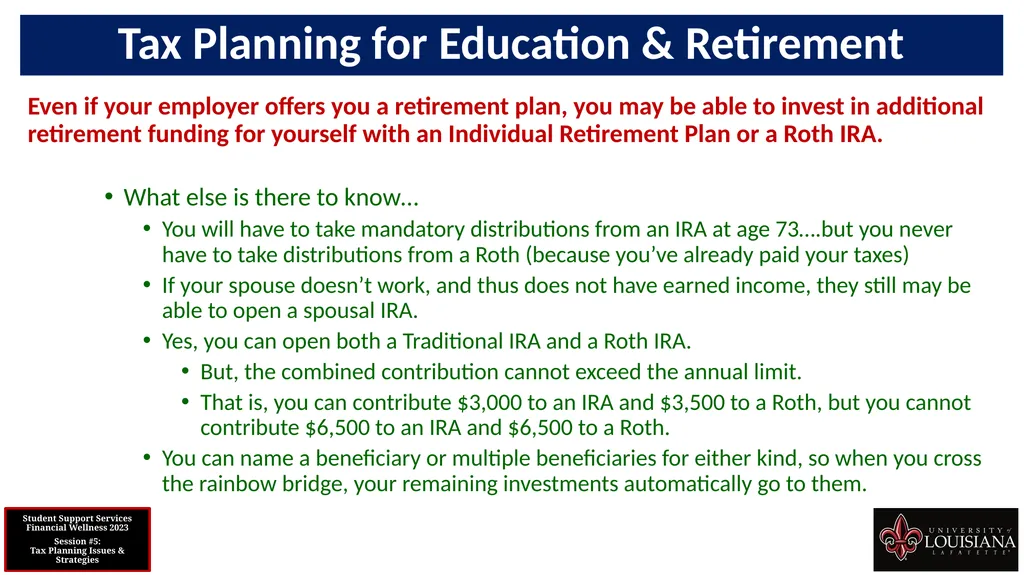
Tax Planning for Education & Retirement Even if your employer offers you a retirement plan, you may be able to invest in additional retirement funding for yourself with an Individual Retirement Plan or a Roth IRA.
You can open a Traditional IRA or a Roth IRA with any traditional brokerage firm – like Fidelity or Robinhood.
You can contribute $6,500 per year ($7,500 if you’re over 50).
You can invest in just about anything you can with a normal (taxable) brokerage account….whereas your company retirement plan may only offer you 10-15 mutual fund options.
You receive big tax benefits, either today or in retirement.
However, if you take out the money before you turn 59 ½, you will (a) pay appropriate taxes on the distributions, and (b) pay a 10% penalty. And you cannot borrow from an IRA.<br>
You can open a Traditional IRA or a Roth IRA with any traditional brokerage firm – like Fidelity or Robinhood.
You can contribute $6,500 per year ($7,500 if you’re over 50).
You can invest in just about anything you can with a normal (taxable) brokerage account….whereas your company retirement plan may only offer you 10-15 mutual fund options.
You receive big tax benefits, either today or in retirement.
However, if you take out the money before you turn 59 ½, you will (a) pay appropriate taxes on the distributions, and (b) pay a 10% penalty. And you cannot borrow from an IRA.<br>
51
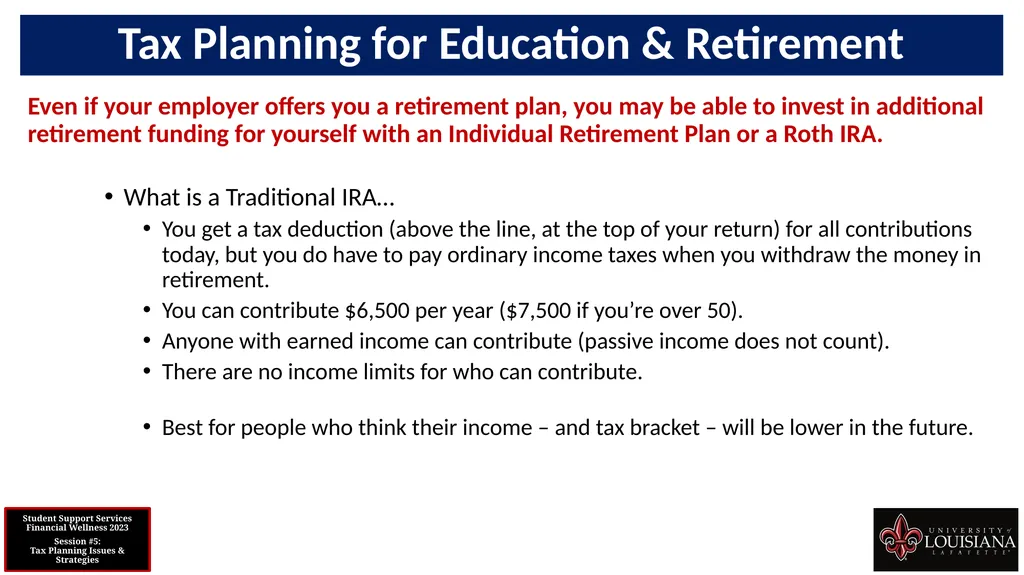
Tax Planning for Education & Retirement Even if your employer offers you a retirement plan, you may be able to invest in additional retirement funding for yourself with an Individual Retirement Plan or a Roth IRA.
What is a Traditional IRA…
You get a tax deduction (above the line, at the top of your return) for all contributions today, but you do have to pay ordinary income taxes when you withdraw the money in retirement.
You can contribute $6,500 per year ($7,500 if you’re over 50).
Anyone with earned income can contribute (passive income does not count).
There are no income limits for who can contribute.
Best for people who think their income – and tax bracket – will be lower in the future.<br>
What is a Traditional IRA…
You get a tax deduction (above the line, at the top of your return) for all contributions today, but you do have to pay ordinary income taxes when you withdraw the money in retirement.
You can contribute $6,500 per year ($7,500 if you’re over 50).
Anyone with earned income can contribute (passive income does not count).
There are no income limits for who can contribute.
Best for people who think their income – and tax bracket – will be lower in the future.<br>
52
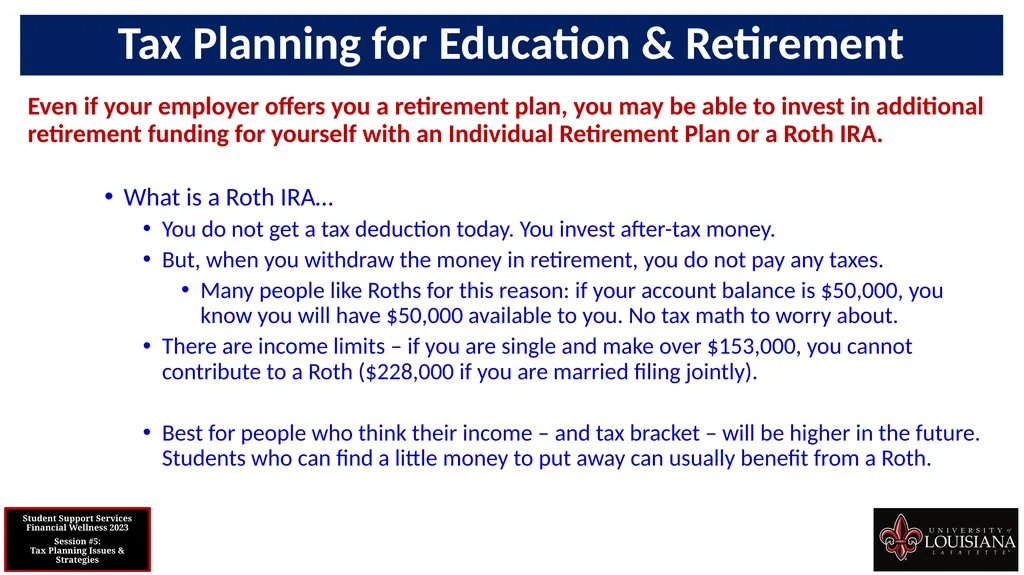
Tax Planning for Education & Retirement Even if your employer offers you a retirement plan, you may be able to invest in additional retirement funding for yourself with an Individual Retirement Plan or a Roth IRA.
What is a Roth IRA…
You do not get a tax deduction today. You invest after-tax money.
But, when you withdraw the money in retirement, you do not pay any taxes.
Many people like Roths for this reason: if your account balance is $50,000, you know you will have $50,000 available to you. No tax math to worry about.
There are income limits – if you are single and make over $153,000, you cannot contribute to a Roth ($228,000 if you are married filing jointly).
Best for people who think their income – and tax bracket – will be higher in the future. Students who can find a little money to put away can usually benefit from a Roth.<br>
What is a Roth IRA…
You do not get a tax deduction today. You invest after-tax money.
But, when you withdraw the money in retirement, you do not pay any taxes.
Many people like Roths for this reason: if your account balance is $50,000, you know you will have $50,000 available to you. No tax math to worry about.
There are income limits – if you are single and make over $153,000, you cannot contribute to a Roth ($228,000 if you are married filing jointly).
Best for people who think their income – and tax bracket – will be higher in the future. Students who can find a little money to put away can usually benefit from a Roth.<br>
53
Tax Planning for Education & Retirement Even if your employer offers you a retirement plan, you may be able to invest in additional retirement funding for yourself with an Individual Retirement Plan or a Roth IRA.
What else is there to know…
You will have to take mandatory distributions from an IRA at age 73….but you never have to take distributions from a Roth (because you’ve already paid your taxes)
If your spouse doesn’t work, and thus does not have earned income, they still may be able to open a spousal IRA.
Yes, you can open both a Traditional IRA and a Roth IRA.
But, the combined contribution cannot exceed the annual limit.
That is, you can contribute $3,000 to an IRA and $3,500 to a Roth, but you cannot contribute $6,500 to an IRA and $6,500 to a Roth.
You can name a beneficiary or multiple beneficiaries for either kind, so when you cross the rainbow bridge, your remaining investments automatically go to them.<br>
What else is there to know…
You will have to take mandatory distributions from an IRA at age 73….but you never have to take distributions from a Roth (because you’ve already paid your taxes)
If your spouse doesn’t work, and thus does not have earned income, they still may be able to open a spousal IRA.
Yes, you can open both a Traditional IRA and a Roth IRA.
But, the combined contribution cannot exceed the annual limit.
That is, you can contribute $3,000 to an IRA and $3,500 to a Roth, but you cannot contribute $6,500 to an IRA and $6,500 to a Roth.
You can name a beneficiary or multiple beneficiaries for either kind, so when you cross the rainbow bridge, your remaining investments automatically go to them.<br>
54
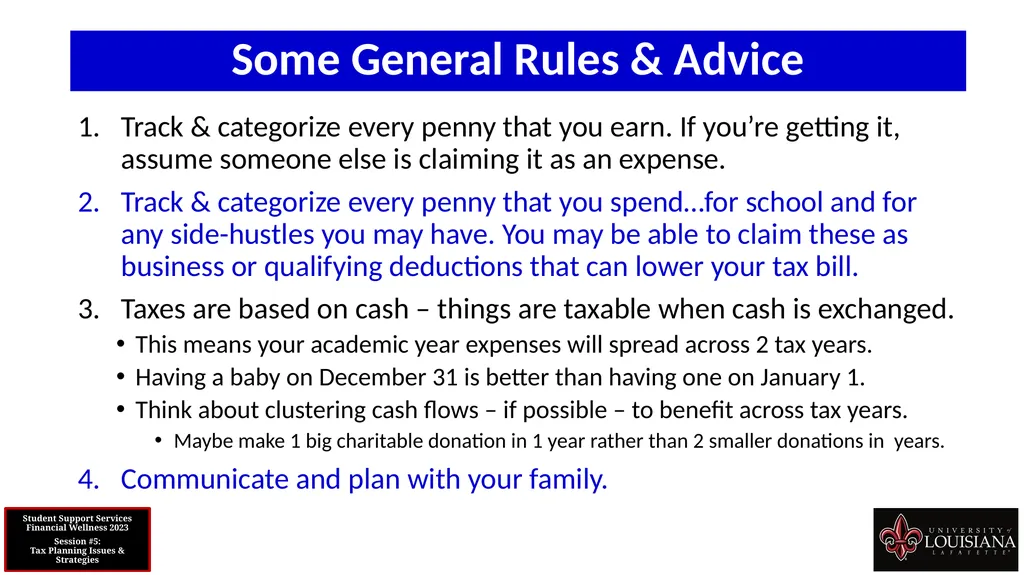
Some General Rules & Advice Track & categorize every penny that you earn. If you’re getting it, assume someone else is claiming it as an expense.
Track & categorize every penny that you spend…for school and for any side-hustles you may have. You may be able to claim these as business or qualifying deductions that can lower your tax bill.
Taxes are based on cash – things are taxable when cash is exchanged.
This means your academic year expenses will spread across 2 tax years.
Having a baby on December 31 is better than having one on January 1.
Think about clustering cash flows – if possible – to benefit across tax years.
Maybe make 1 big charitable donation in 1 year rather than 2 smaller donations in years.
Communicate and plan with your family.<br>
Track & categorize every penny that you spend…for school and for any side-hustles you may have. You may be able to claim these as business or qualifying deductions that can lower your tax bill.
Taxes are based on cash – things are taxable when cash is exchanged.
This means your academic year expenses will spread across 2 tax years.
Having a baby on December 31 is better than having one on January 1.
Think about clustering cash flows – if possible – to benefit across tax years.
Maybe make 1 big charitable donation in 1 year rather than 2 smaller donations in years.
Communicate and plan with your family.<br>
55
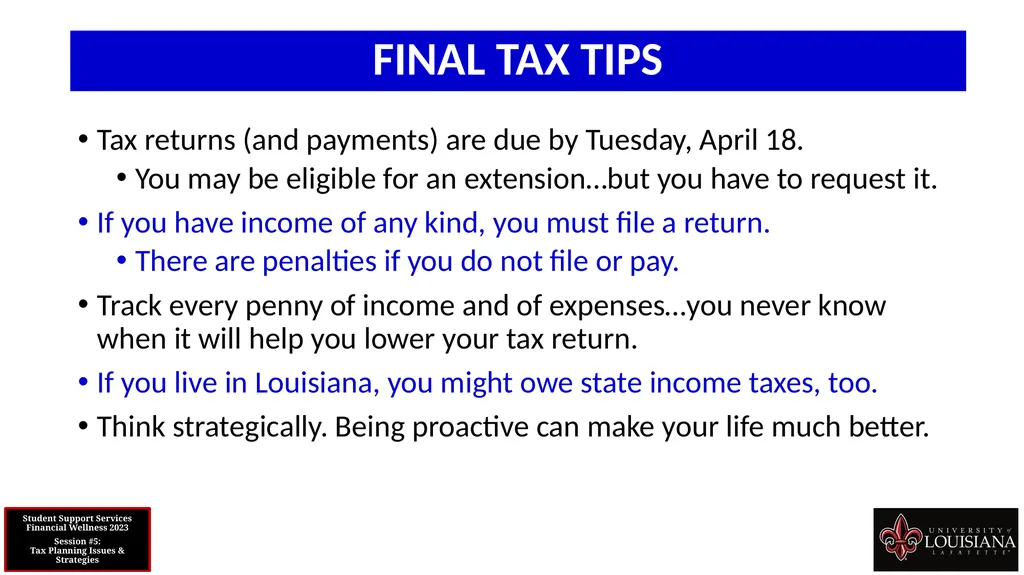
Tax returns (and payments) are due by Tuesday, April 18.
You may be eligible for an extension…but you have to request it.
If you have income of any kind, you must file a return.
There are penalties if you do not file or pay.
Track every penny of income and of expenses…you never know when it will help you lower your tax return.
If you live in Louisiana, you might owe state income taxes, too.
Think strategically. Being proactive can make your life much better. FINAL TAX TIPS<br>
You may be eligible for an extension…but you have to request it.
If you have income of any kind, you must file a return.
There are penalties if you do not file or pay.
Track every penny of income and of expenses…you never know when it will help you lower your tax return.
If you live in Louisiana, you might owe state income taxes, too.
Think strategically. Being proactive can make your life much better. FINAL TAX TIPS<br>
56
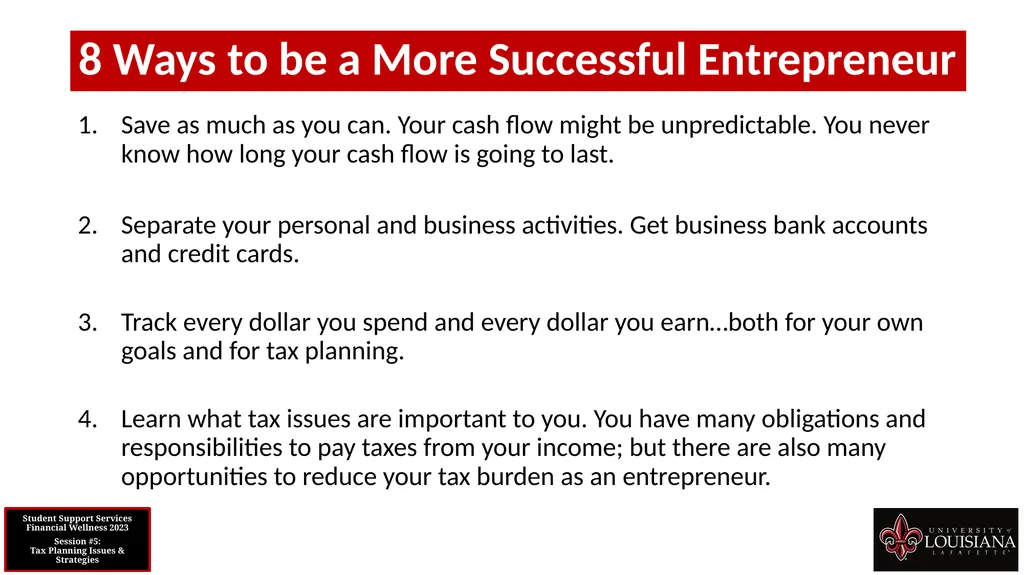
8 Ways to be a More Successful Entrepreneur Save as much as you can. Your cash flow might be unpredictable. You never know how long your cash flow is going to last.
Separate your personal and business activities. Get business bank accounts and credit cards.
Track every dollar you spend and every dollar you earn…both for your own goals and for tax planning.
Learn what tax issues are important to you. You have many obligations and responsibilities to pay taxes from your income; but there are also many opportunities to reduce your tax burden as an entrepreneur.<br>
Separate your personal and business activities. Get business bank accounts and credit cards.
Track every dollar you spend and every dollar you earn…both for your own goals and for tax planning.
Learn what tax issues are important to you. You have many obligations and responsibilities to pay taxes from your income; but there are also many opportunities to reduce your tax burden as an entrepreneur.<br>
57
Think about the type of legal entity you run. Sole proprietorships and partnerships are the default – but creating an LLC or corporation might protect you from liability.
Set up an Individual Retirement Account as soon as possible. Invest a little when you can – and watch it grow.
Develop your team. Who can help you achieve your mission? What advisors can make your life easier?
Create your personal biography. People want to know who you are and how you can make their life better. 8 Ways to be a More Successful Entrepreneur<br>
Set up an Individual Retirement Account as soon as possible. Invest a little when you can – and watch it grow.
Develop your team. Who can help you achieve your mission? What advisors can make your life easier?
Create your personal biography. People want to know who you are and how you can make their life better. 8 Ways to be a More Successful Entrepreneur<br>
58
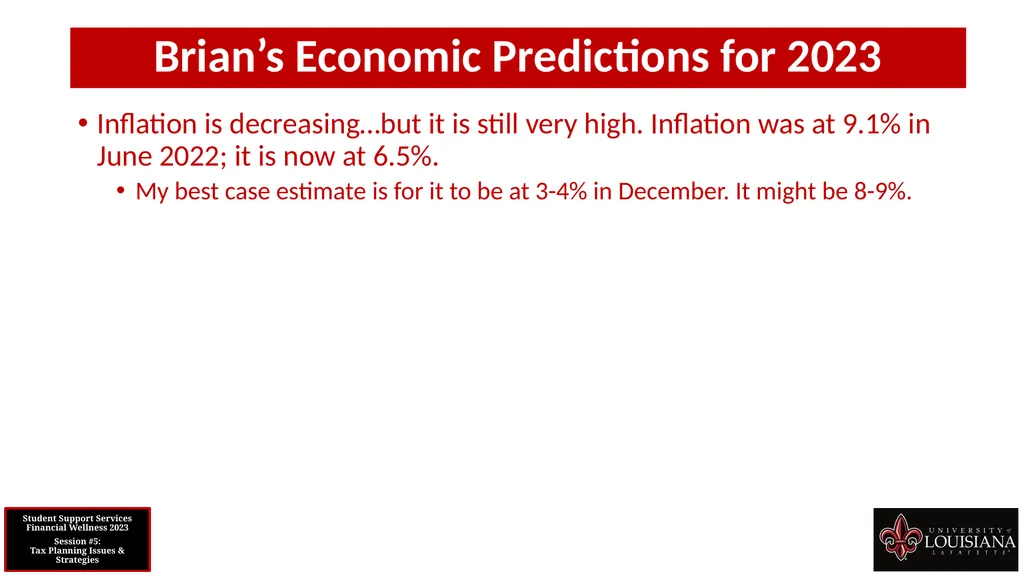
Brian’s Economic Predictions for 2023 Inflation is decreasing…but it is still very high. Inflation was at 9.1% in June 2022; it is now at 6.5%.
My best case estimate is for it to be at 3-4% in December. It might be 8-9%.<br>
My best case estimate is for it to be at 3-4% in December. It might be 8-9%.<br>
59
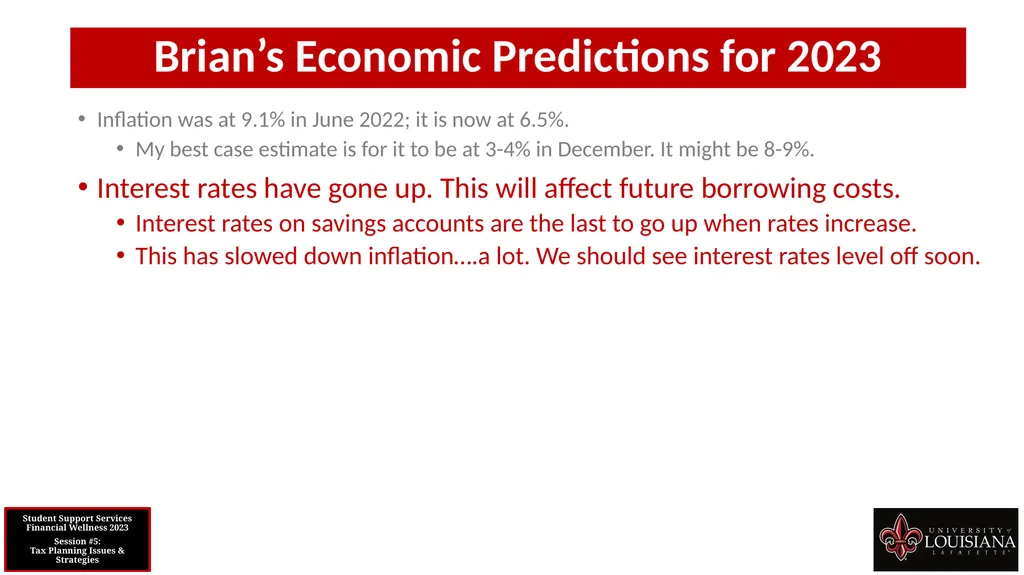
Brian’s Economic Predictions for 2023 Inflation was at 9.1% in June 2022; it is now at 6.5%.
My best case estimate is for it to be at 3-4% in December. It might be 8-9%.
Interest rates have gone up. This will affect future borrowing costs.
Interest rates on savings accounts are the last to go up when rates increase.
This has slowed down inflation….a lot. We should see interest rates level off soon.<br>
My best case estimate is for it to be at 3-4% in December. It might be 8-9%.
Interest rates have gone up. This will affect future borrowing costs.
Interest rates on savings accounts are the last to go up when rates increase.
This has slowed down inflation….a lot. We should see interest rates level off soon.<br>
60
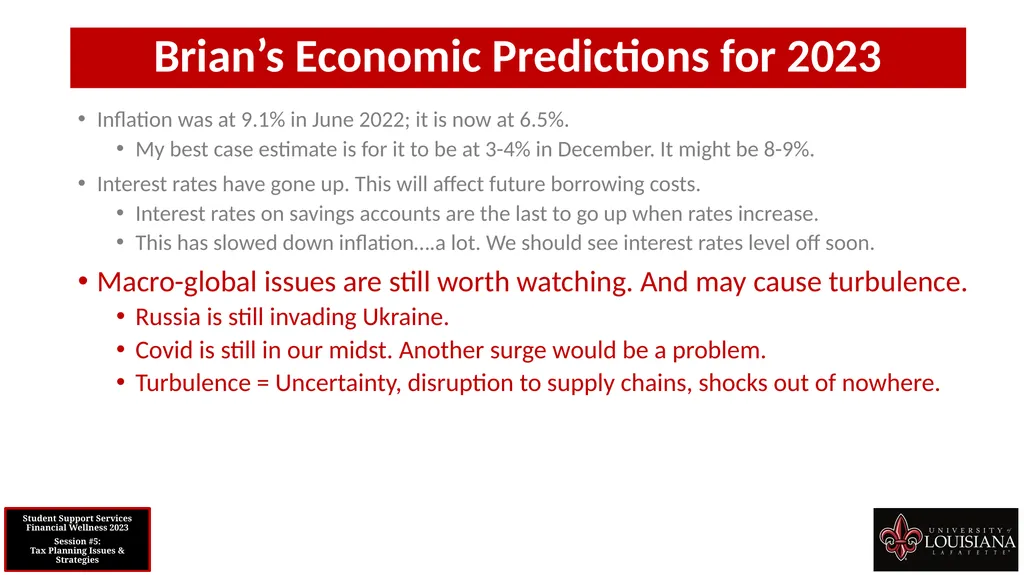
Brian’s Economic Predictions for 2023 Inflation was at 9.1% in June 2022; it is now at 6.5%.
My best case estimate is for it to be at 3-4% in December. It might be 8-9%.
Interest rates have gone up. This will affect future borrowing costs.
Interest rates on savings accounts are the last to go up when rates increase.
This has slowed down inflation….a lot. We should see interest rates level off soon.
Macro-global issues are still worth watching. And may cause turbulence.
Russia is still invading Ukraine.
Covid is still in our midst. Another surge would be a problem.
Turbulence = Uncertainty, disruption to supply chains, shocks out of nowhere.<br>
My best case estimate is for it to be at 3-4% in December. It might be 8-9%.
Interest rates have gone up. This will affect future borrowing costs.
Interest rates on savings accounts are the last to go up when rates increase.
This has slowed down inflation….a lot. We should see interest rates level off soon.
Macro-global issues are still worth watching. And may cause turbulence.
Russia is still invading Ukraine.
Covid is still in our midst. Another surge would be a problem.
Turbulence = Uncertainty, disruption to supply chains, shocks out of nowhere.<br>
61
Brian’s Economic Predictions for 2023 Inflation was at 9.1% in June 2022; it is now at 6.5%.
My best case estimate is for it to be at 3-4% in December. It might be 8-9%.
Interest rates have gone up. This will affect future borrowing costs.
Interest rates on savings accounts are the last to go up when rates increase.
This has slowed down inflation….a lot. We should see interest rates level off soon.
Macro-global issues are still worth watching. And may cause turbulence.
Russia is still invading Ukraine.
Covid is still in our midst. Another surge would be a problem.
Turbulence = Uncertainty, disruption to supply chains, shocks out of nowhere.
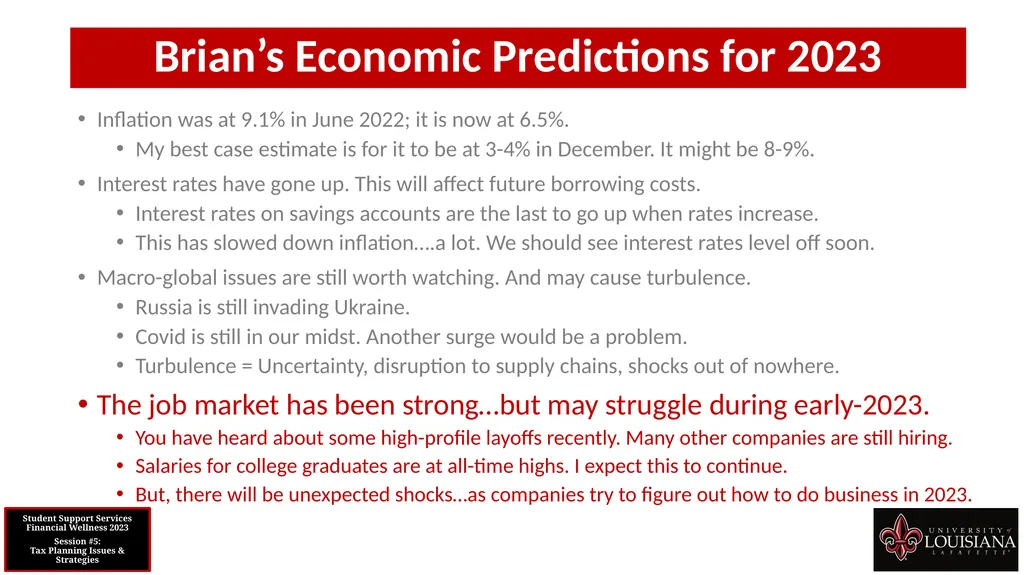
The job market has been strong…but may struggle during early-2023.
You have heard about some high-profile layoffs recently. Many other companies are still hiring.
Salaries for college graduates are at all-time highs. I expect this to continue.
But, there will be unexpected shocks…as companies try to figure out how to do business in 2023.<br>
My best case estimate is for it to be at 3-4% in December. It might be 8-9%.
Interest rates have gone up. This will affect future borrowing costs.
Interest rates on savings accounts are the last to go up when rates increase.
This has slowed down inflation….a lot. We should see interest rates level off soon.
Macro-global issues are still worth watching. And may cause turbulence.
Russia is still invading Ukraine.
Covid is still in our midst. Another surge would be a problem.
Turbulence = Uncertainty, disruption to supply chains, shocks out of nowhere.
The job market has been strong…but may struggle during early-2023.
You have heard about some high-profile layoffs recently. Many other companies are still hiring.
Salaries for college graduates are at all-time highs. I expect this to continue.
But, there will be unexpected shocks…as companies try to figure out how to do business in 2023.<br>
62
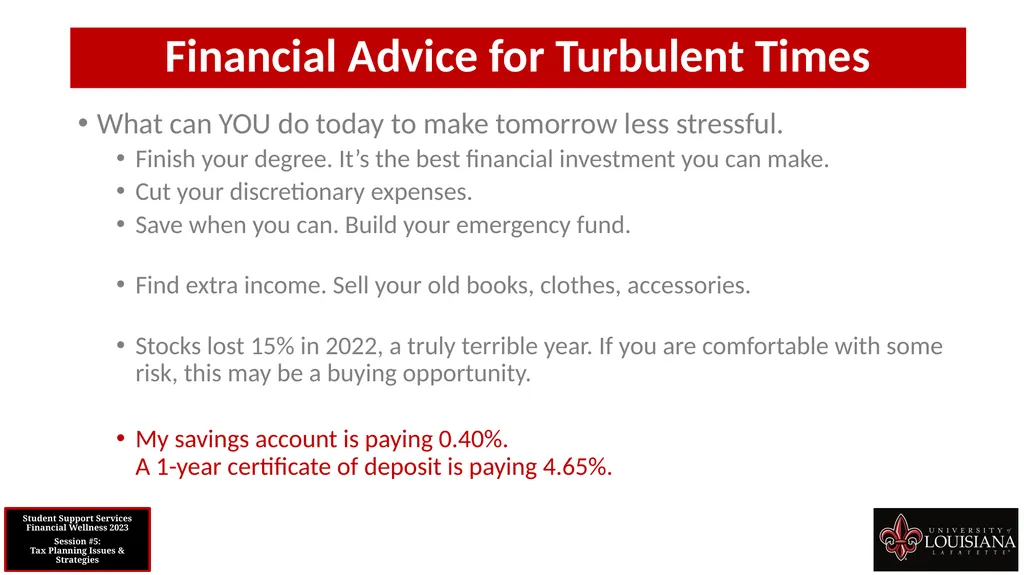
Financial Advice for Turbulent Times What can YOU do today to make tomorrow less stressful.
Finish your degree. It’s the best financial investment you can make.
Cut your discretionary expenses.
Save when you can. Build your emergency fund.<br>
Finish your degree. It’s the best financial investment you can make.
Cut your discretionary expenses.
Save when you can. Build your emergency fund.<br>
63
Financial Advice for Turbulent Times What can YOU do today to make tomorrow less stressful.
Finish your degree. It’s the best financial investment you can make.
Cut your discretionary expenses.
Save when you can. Build your emergency fund.
Find extra income. Sell your old books, clothes, accessories.<br>
Finish your degree. It’s the best financial investment you can make.
Cut your discretionary expenses.
Save when you can. Build your emergency fund.
Find extra income. Sell your old books, clothes, accessories.<br>
64
Financial Advice for Turbulent Times What can YOU do today to make tomorrow less stressful.
Finish your degree. It’s the best financial investment you can make.
Cut your discretionary expenses.
Save when you can. Build your emergency fund.
Find extra income. Sell your old books, clothes, accessories.
Stocks lost 15% in 2022, a truly terrible year. If you are comfortable with some risk, this may be a buying opportunity.<br>
Finish your degree. It’s the best financial investment you can make.
Cut your discretionary expenses.
Save when you can. Build your emergency fund.
Find extra income. Sell your old books, clothes, accessories.
Stocks lost 15% in 2022, a truly terrible year. If you are comfortable with some risk, this may be a buying opportunity.<br>
65
Financial Advice for Turbulent Times What can YOU do today to make tomorrow less stressful.
Finish your degree. It’s the best financial investment you can make.
Cut your discretionary expenses.
Save when you can. Build your emergency fund.
Find extra income. Sell your old books, clothes, accessories.
Stocks lost 15% in 2022, a truly terrible year. If you are comfortable with some risk, this may be a buying opportunity.
My savings account is paying 0.40%. A 1-year certificate of deposit is paying 4.65%.<br>
Finish your degree. It’s the best financial investment you can make.
Cut your discretionary expenses.
Save when you can. Build your emergency fund.
Find extra income. Sell your old books, clothes, accessories.
Stocks lost 15% in 2022, a truly terrible year. If you are comfortable with some risk, this may be a buying opportunity.
My savings account is paying 0.40%. A 1-year certificate of deposit is paying 4.65%.<br>
66
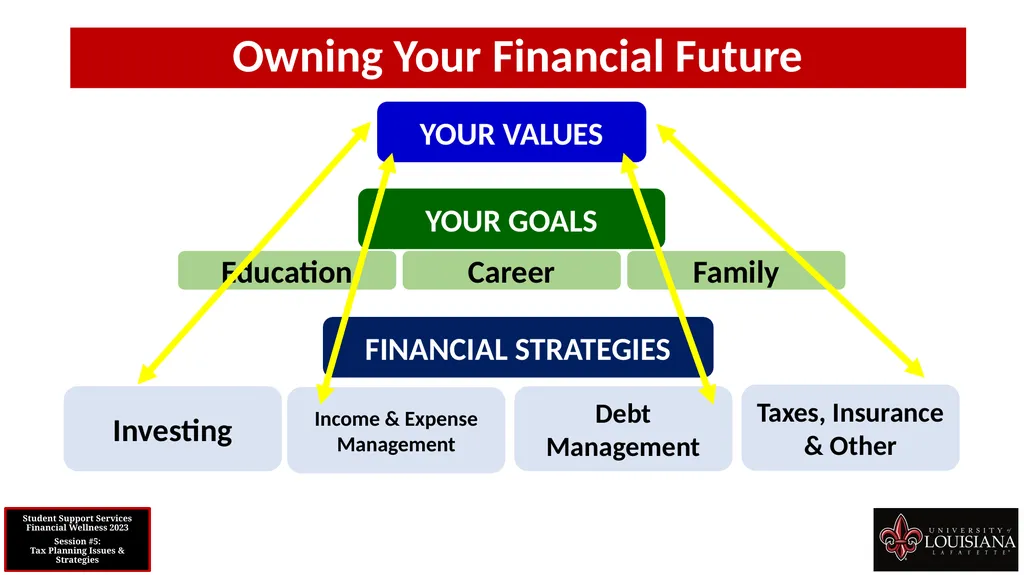
Owning Your Financial Future YOUR VALUES YOUR GOALS Career Family Education FINANCIAL STRATEGIES Investing Debt Management Income & Expense Management Taxes, Insurance & Other<br>
67
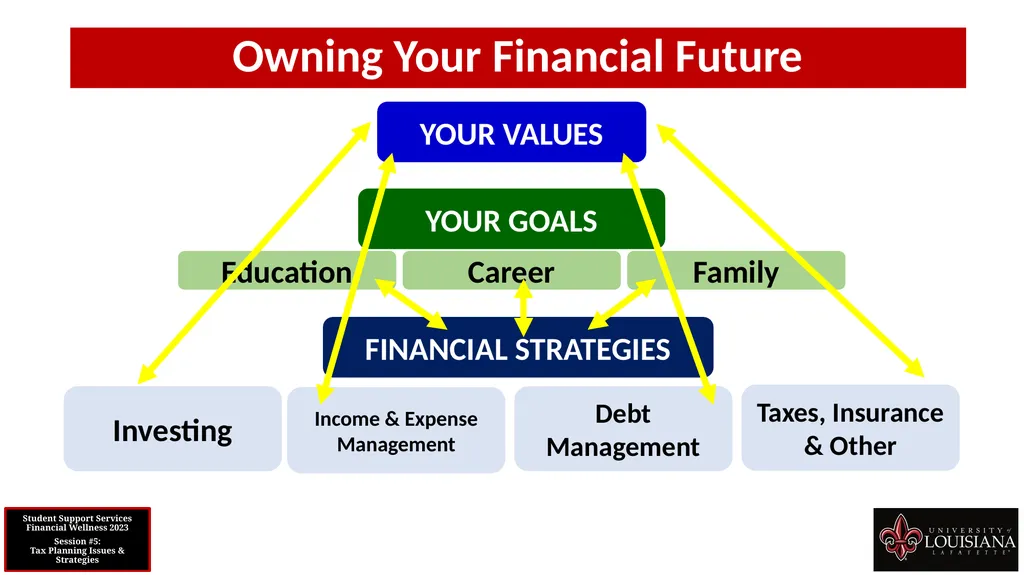
Owning Your Financial Future YOUR VALUES YOUR GOALS Career Family Education FINANCIAL STRATEGIES Investing Debt Management Income & Expense Management Taxes, Insurance & Other<br>
68
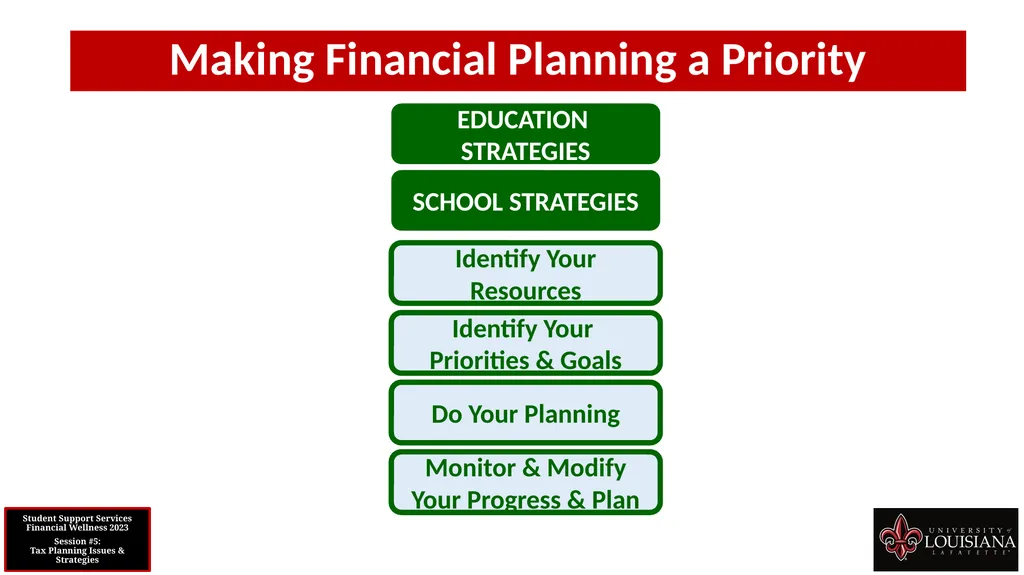
Making Financial Planning a Priority EDUCATION STRATEGIES SCHOOL STRATEGIES Identify Your Resources Identify Your
Priorities & Goals Do Your Planning Monitor & Modify Your Progress & Plan<br>
69
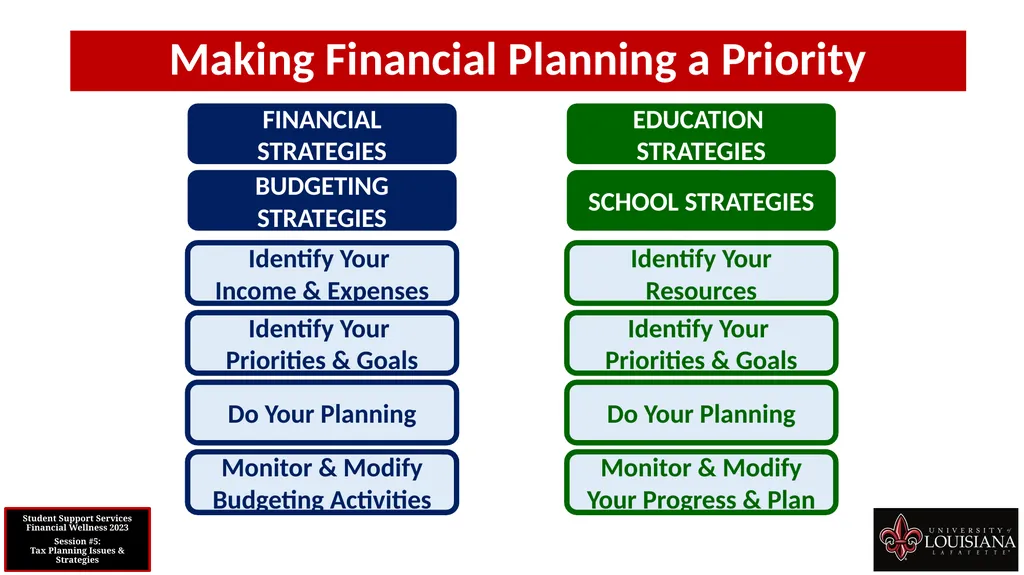
Making Financial Planning a Priority FINANCIAL STRATEGIES BUDGETING
STRATEGIES Identify Your Income & Expenses Identify Your Priorities & Goals Do Your Planning Monitor & Modify Budgeting Activities EDUCATION STRATEGIES SCHOOL STRATEGIES Identify Your Resources Identify Your Priorities & Goals Do Your Planning Monitor & Modify Your Progress & Plan<br>
STRATEGIES Identify Your Income & Expenses Identify Your Priorities & Goals Do Your Planning Monitor & Modify Budgeting Activities EDUCATION STRATEGIES SCHOOL STRATEGIES Identify Your Resources Identify Your Priorities & Goals Do Your Planning Monitor & Modify Your Progress & Plan<br>
70
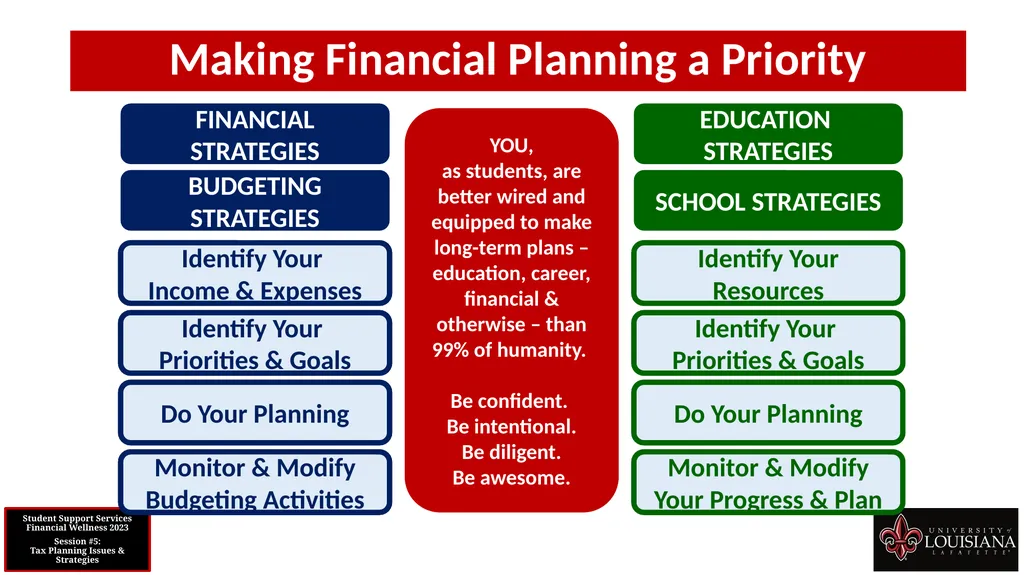
FINANCIAL STRATEGIES BUDGETING
STRATEGIES Identify Your Income & Expenses Identify Your Priorities & Goals Do Your Planning Monitor & Modify Budgeting Activities EDUCATION STRATEGIES SCHOOL STRATEGIES Identify Your Resources Identify Your Priorities & Goals Do Your Planning Monitor & Modify Your Progress & Plan YOU,
as students, are better wired and equipped to make long-term plans – education, career, financial & otherwise – than 99% of humanity.
Be confident. Be intentional.
Be diligent.
Be awesome. Making Financial Planning a Priority<br>
STRATEGIES Identify Your Income & Expenses Identify Your Priorities & Goals Do Your Planning Monitor & Modify Budgeting Activities EDUCATION STRATEGIES SCHOOL STRATEGIES Identify Your Resources Identify Your Priorities & Goals Do Your Planning Monitor & Modify Your Progress & Plan YOU,
as students, are better wired and equipped to make long-term plans – education, career, financial & otherwise – than 99% of humanity.
Be confident. Be intentional.
Be diligent.
Be awesome. Making Financial Planning a Priority<br>
71
Isn’t this a lot like what you do with your education planning?<br>
72
Owning Your Financial Future INVESTING GOALS, HABITS & STRATEGIES
Today, January 23 CREATING AN INVESTMENT STRATEGY
Wednesday, March 15 CREDIT SCORES & DEBT MANAGEMENT
Wednesday, March 8<br>
Today, January 23 CREATING AN INVESTMENT STRATEGY
Wednesday, March 15 CREDIT SCORES & DEBT MANAGEMENT
Wednesday, March 8<br>
73
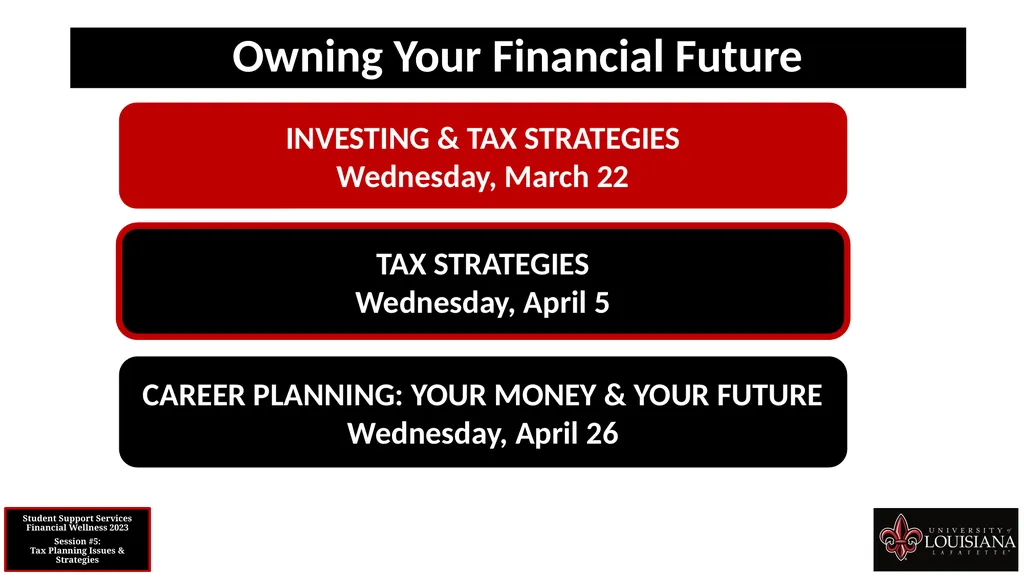
Owning Your Financial Future INVESTING & TAX STRATEGIES
Wednesday, March 22 TAX STRATEGIES
Wednesday, April 5 CAREER PLANNING: YOUR MONEY & YOUR FUTURE
Wednesday, April 26<br>
Wednesday, March 22 TAX STRATEGIES
Wednesday, April 5 CAREER PLANNING: YOUR MONEY & YOUR FUTURE
Wednesday, April 26<br>
74
A goal without a plan is just a dream. The most difficult thing is the decision to act; the rest is mere tenacity. Wealth is largely the result of habit. It takes as much energy to plan as it does to wish. You cannot escape the responsibility of tomorrow by avoiding it today. Don’t wait around for other people to be happy for you.
Any happiness you get,
You’ve got to make yourself.
~ Alice Walker, poet & novelist<br>
Any happiness you get,
You’ve got to make yourself.
~ Alice Walker, poet & novelist<br>
75
Brian Bolton
Professor of Finance
brian.bolton@louisiana.edu
http://business.louisiana.edu/financeispersonal<br>