
STUDENT SUPPORT SERVICES FINANCIAL WELLNESS SERIES
JO
Published · 64 slides · 0 views
1 / 1



Description
STUDENT SUPPORT SERVICES FINANCIAL WELLNESS SERIES 2023 Session 1 Investing Goals, Habits Strategies January 25, 2023 Brian Bolton Professor of Finance brian.boltonlouisiana.edu http:business.louisiana.edufinanceispersonal Owning
Related Topics
Share
Embed code
Download this presentation From Below
"STUDENT SUPPORT SERVICES FINANCIAL WELLNESS SERIES" is the property of its rightful owner. Permission is granted to download and print the materials on this website for personal, non-commercial use only, and to display it on your personal computer provided you do not modify the materials and that you retain all copyright notices contained in the materials. By downloading content from our website, you accept the terms of this agreement.
Presentation Transcript
01
STUDENT SUPPORT SERVICES
FINANCIAL WELLNESS SERIES 2023
Session #1
Investing Goals, Habits & Strategies
January 25, 2023<br>
FINANCIAL WELLNESS SERIES 2023
Session #1
Investing Goals, Habits & Strategies
January 25, 2023<br>
02
Brian Bolton
Professor of Finance
brian.bolton@louisiana.edu
http://business.louisiana.edu/financeispersonal<br>
03
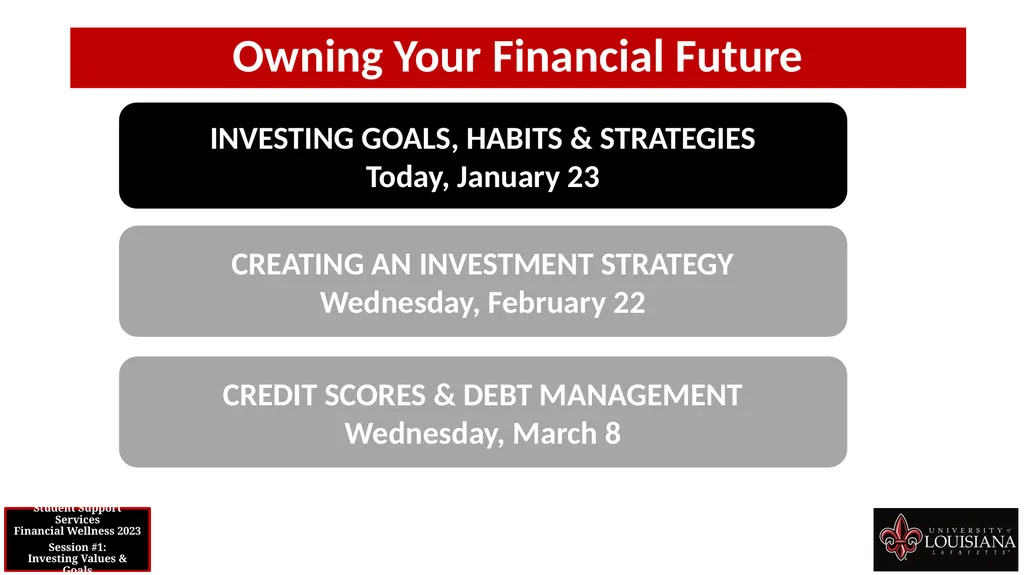
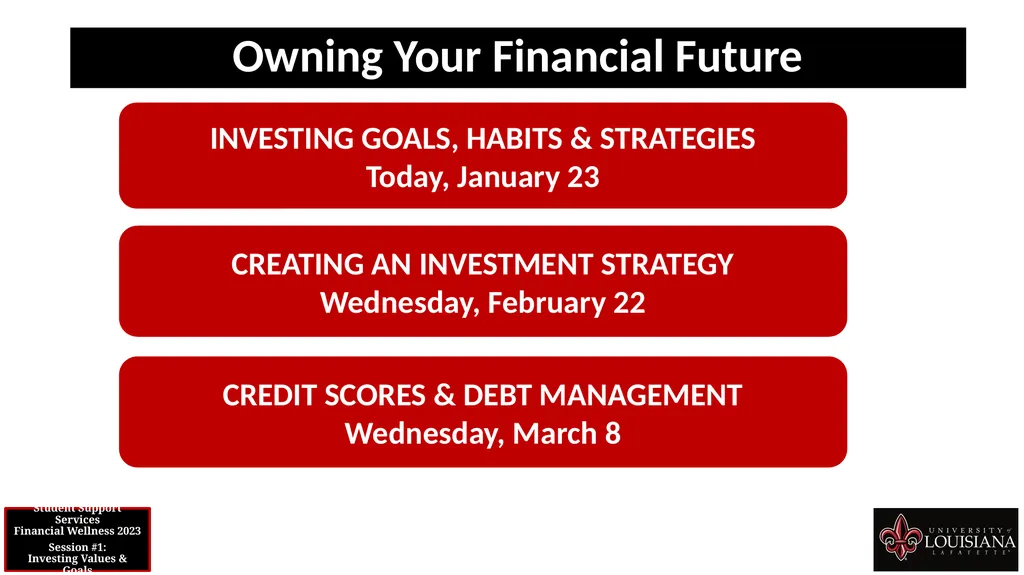
Owning Your Financial Future INVESTING GOALS, HABITS & STRATEGIES
Today, January 23 CREATING AN INVESTMENT STRATEGY
Wednesday, February 22 CREDIT SCORES & DEBT MANAGEMENT
Wednesday, March 8<br>
Today, January 23 CREATING AN INVESTMENT STRATEGY
Wednesday, February 22 CREDIT SCORES & DEBT MANAGEMENT
Wednesday, March 8<br>
04
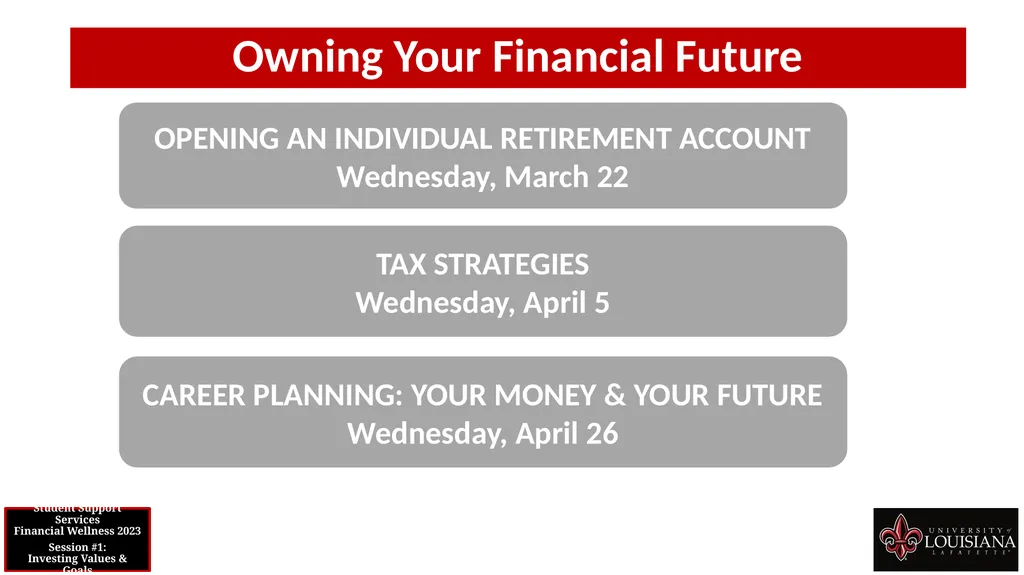
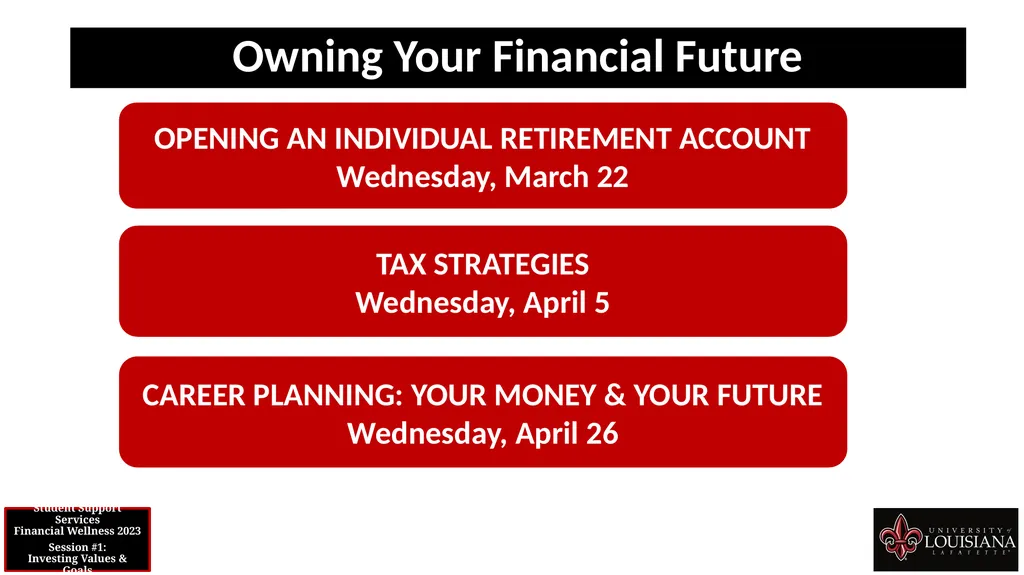
Owning Your Financial Future OPENING AN INDIVIDUAL RETIREMENT ACCOUNT
Wednesday, March 22 TAX STRATEGIES
Wednesday, April 5 CAREER PLANNING: YOUR MONEY & YOUR FUTURE
Wednesday, April 26<br>
Wednesday, March 22 TAX STRATEGIES
Wednesday, April 5 CAREER PLANNING: YOUR MONEY & YOUR FUTURE
Wednesday, April 26<br>
05
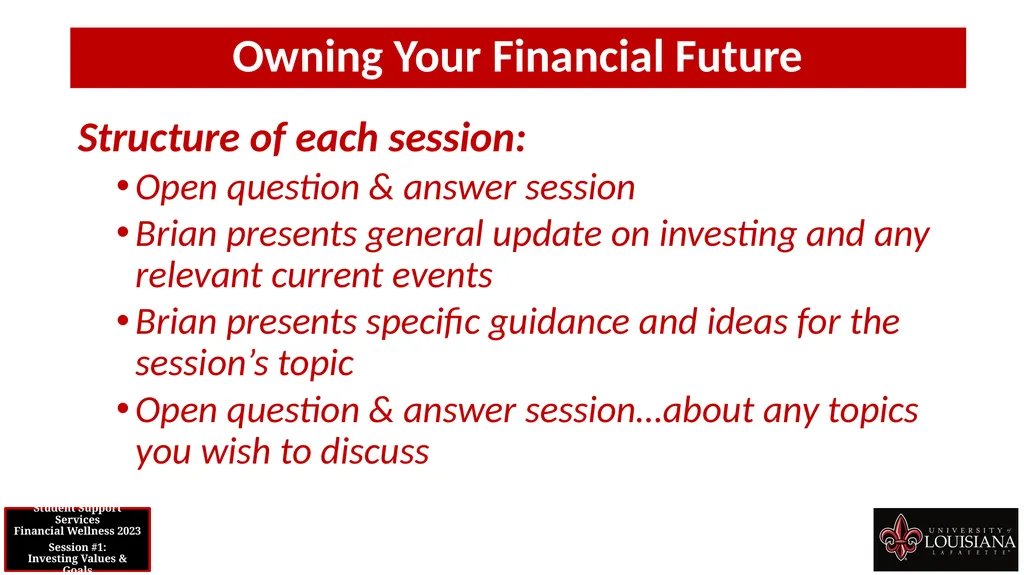
Owning Your Financial Future Structure of each session:
Open question & answer session
Brian presents general update on investing and any relevant current events
Brian presents specific guidance and ideas for the session’s topic
Open question & answer session…about any topics you wish to discuss<br>
Open question & answer session
Brian presents general update on investing and any relevant current events
Brian presents specific guidance and ideas for the session’s topic
Open question & answer session…about any topics you wish to discuss<br>
06
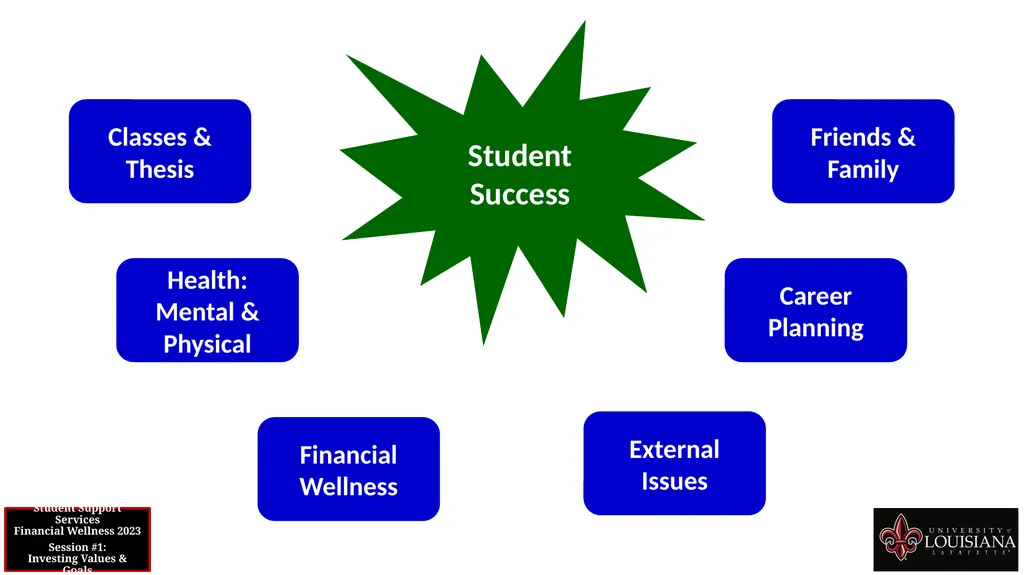
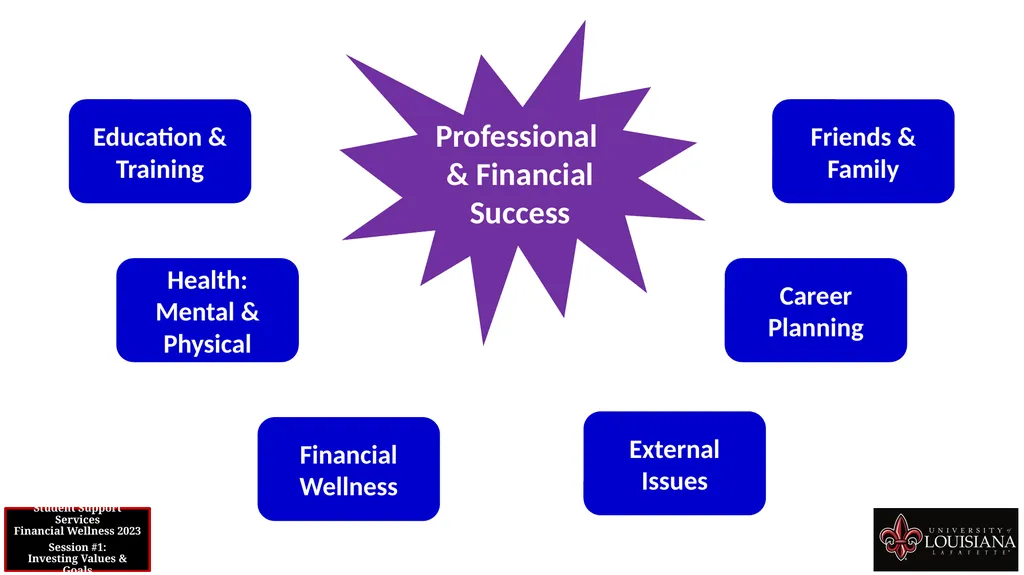
Student Success Friends & Family Career Planning External Issues Classes & Thesis Health: Mental & Physical Financial Wellness<br>
07
Professional
& Financial Success Friends & Family Career Planning External Issues Education & Training Health: Mental & Physical Financial Wellness<br>
& Financial Success Friends & Family Career Planning External Issues Education & Training Health: Mental & Physical Financial Wellness<br>
08
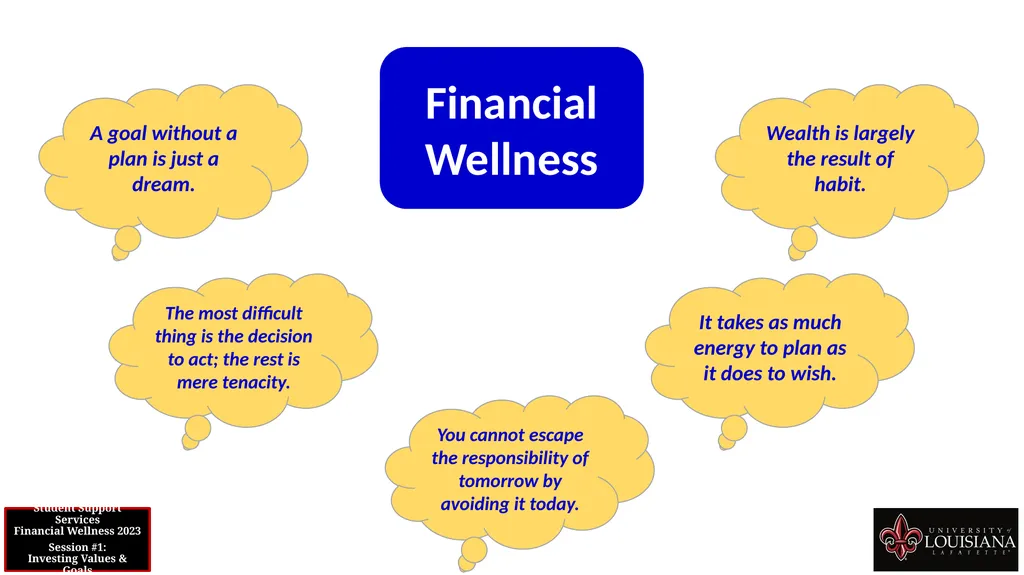
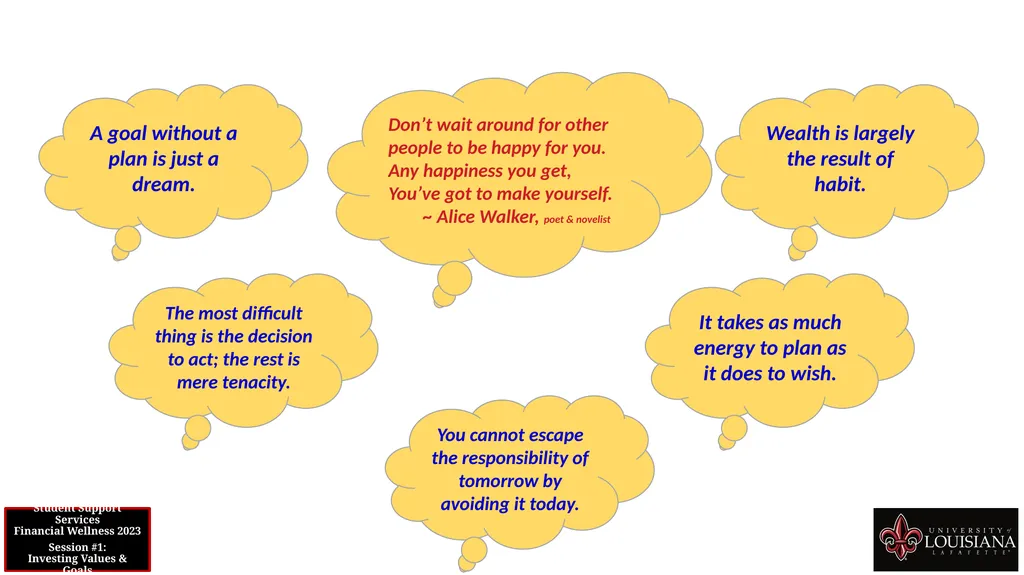
Financial Wellness A goal without a plan is just a dream. The most difficult thing is the decision to act; the rest is mere tenacity. Wealth is largely the result of habit. It takes as much energy to plan as it does to wish. You cannot escape the responsibility of tomorrow by avoiding it today.<br>
09
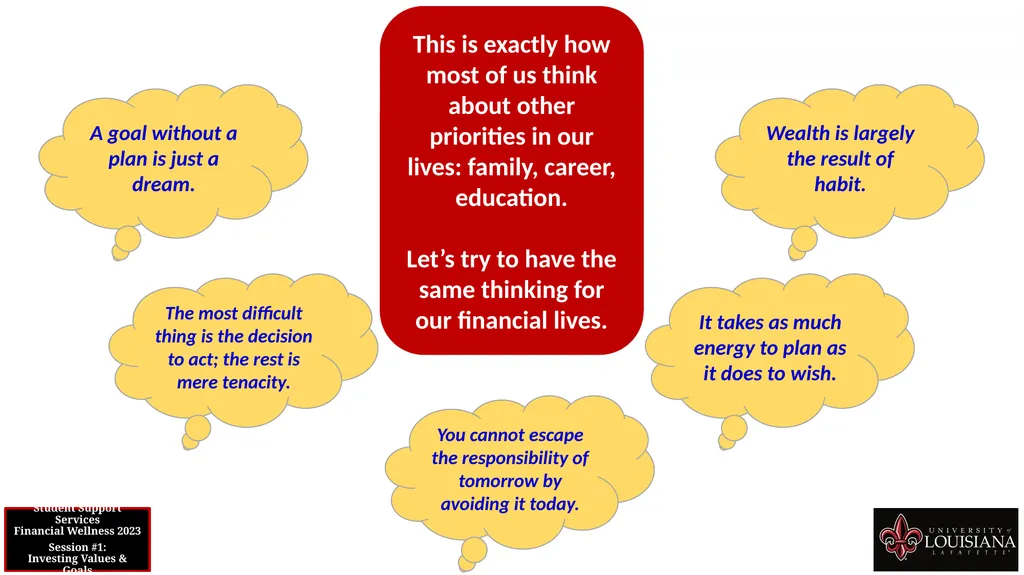
This is exactly how most of us think about other priorities in our lives: family, career, education.
Let’s try to have the same thinking for our financial lives. A goal without a plan is just a dream. The most difficult thing is the decision to act; the rest is mere tenacity. Wealth is largely the result of habit. It takes as much energy to plan as it does to wish. You cannot escape the responsibility of tomorrow by avoiding it today.<br>
Let’s try to have the same thinking for our financial lives. A goal without a plan is just a dream. The most difficult thing is the decision to act; the rest is mere tenacity. Wealth is largely the result of habit. It takes as much energy to plan as it does to wish. You cannot escape the responsibility of tomorrow by avoiding it today.<br>
10
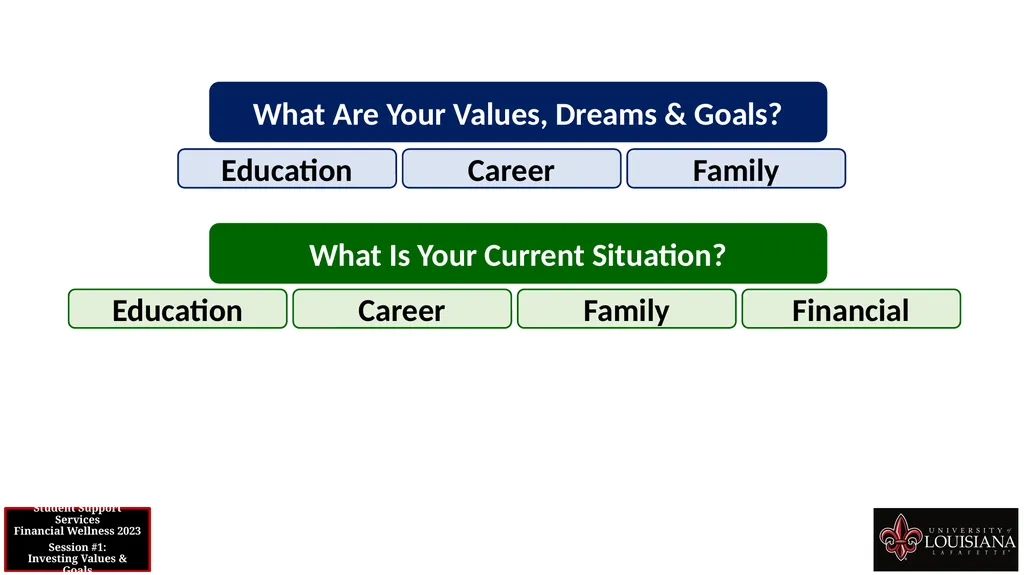
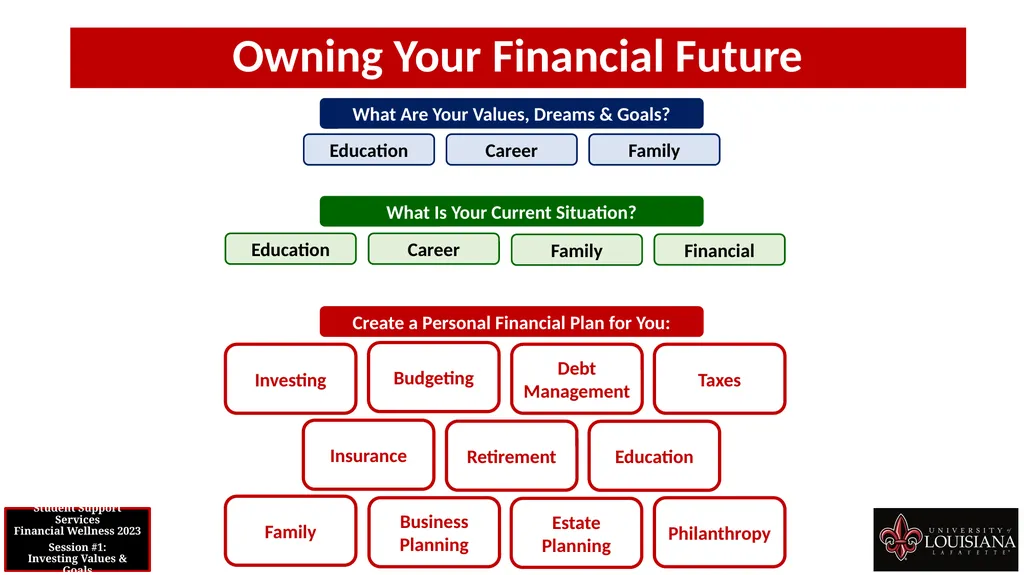
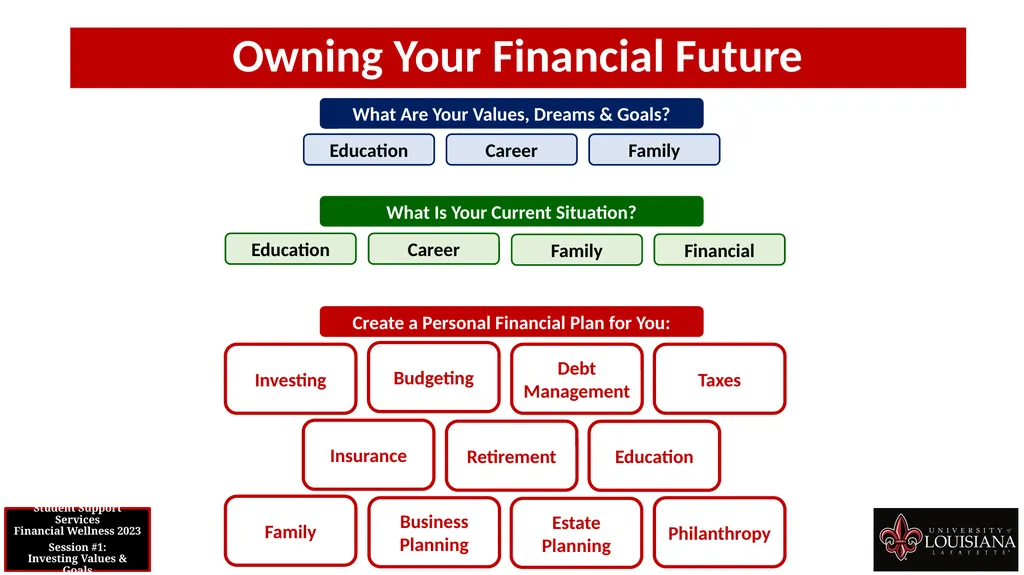
What Are Your Values, Dreams & Goals? What Is Your Current Situation? Career Family Education Career Family Education Financial<br>
11
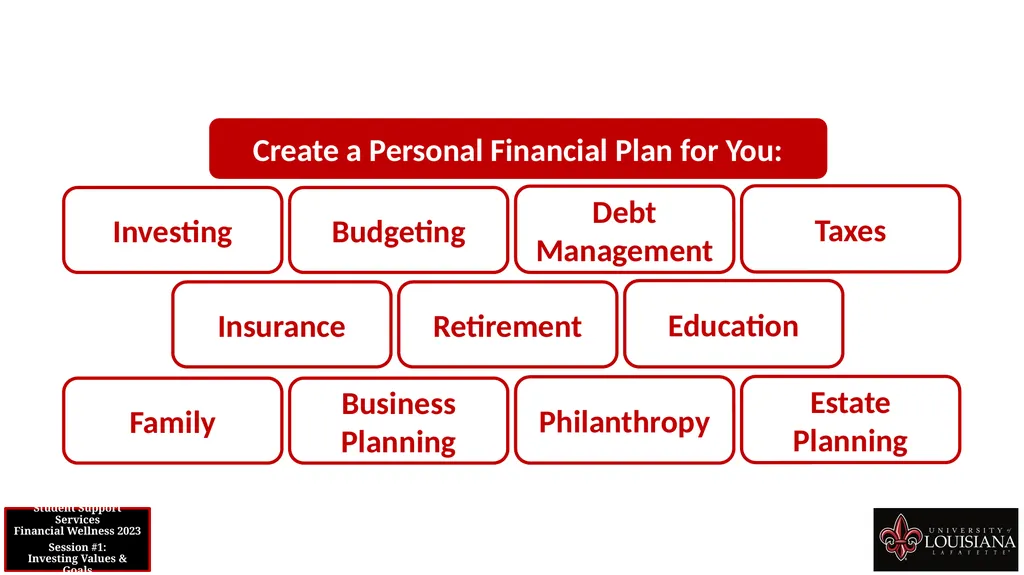
Create a Personal Financial Plan for You: Investing Budgeting Debt Management Taxes Insurance Retirement Education Family Business Planning Philanthropy Estate Planning<br>
12
A Few Opening Morals Personal Finance is…personal.
It’s about you and not about anyone else.
You have to make it about you and your goals.<br>
It’s about you and not about anyone else.
You have to make it about you and your goals.<br>
13
A Few Opening Morals There is no judgment in personal finance.
There is no ego in personal finance.
There is no shame in personal finance.
It’s about you and not about anyone else.<br>
There is no ego in personal finance.
There is no shame in personal finance.
It’s about you and not about anyone else.<br>
14
A Few Opening Morals Because personal finance is personal, it is virtually impossible for me to give you any specific advice.
However, there is one word of advice that applies to 99% of people working on their finances:
SAVE<br>
However, there is one word of advice that applies to 99% of people working on their finances:
SAVE<br>
15
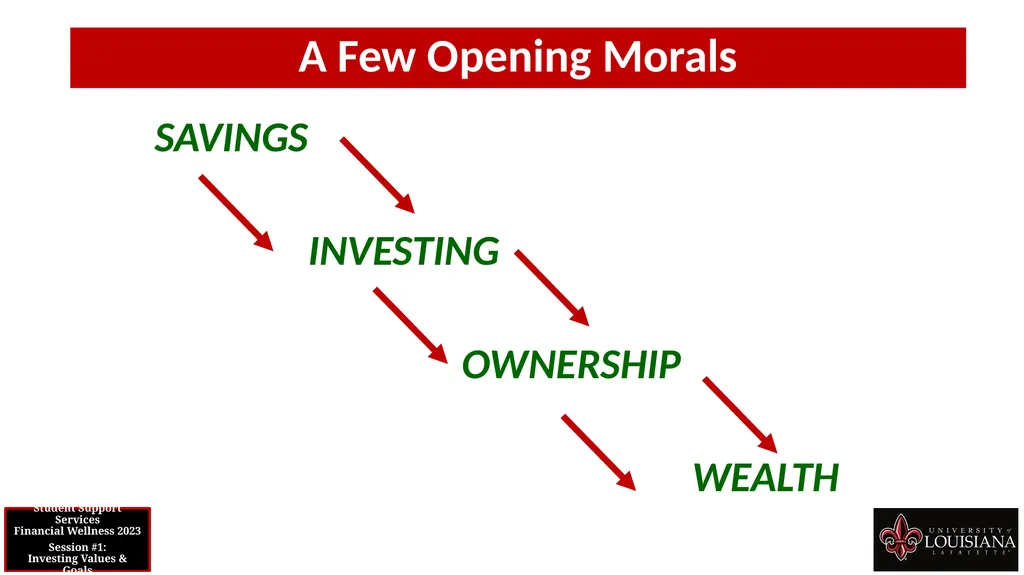
A Few Opening Morals SAVINGS
INVESTING
OWNERSHIP
WEALTH<br>
INVESTING
OWNERSHIP
WEALTH<br>
16
Owning Your Financial Future What Are Your Values, Dreams & Goals? What Is Your Current Situation? Career Family Education Career Family Education Financial Create a Personal Financial Plan for You: Investing Budgeting Debt Management Taxes Insurance Retirement Education Family Business Planning Estate Planning Philanthropy<br>
17
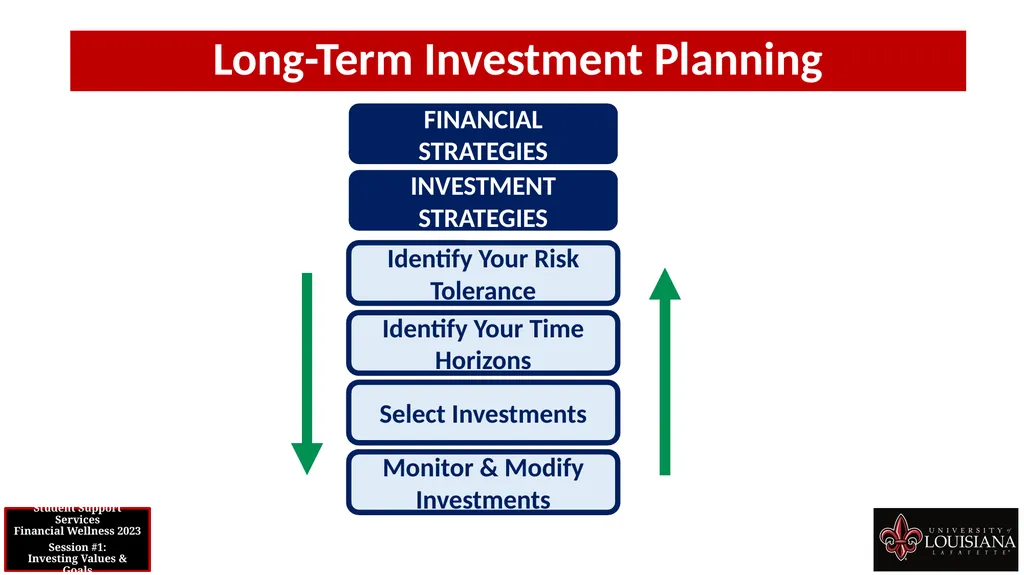
Long-Term Investment Planning FINANCIAL STRATEGIES INVESTMENT STRATEGIES Identify Your Risk Tolerance Identify Your Time Horizons Select Investments Monitor & Modify Investments<br>
18
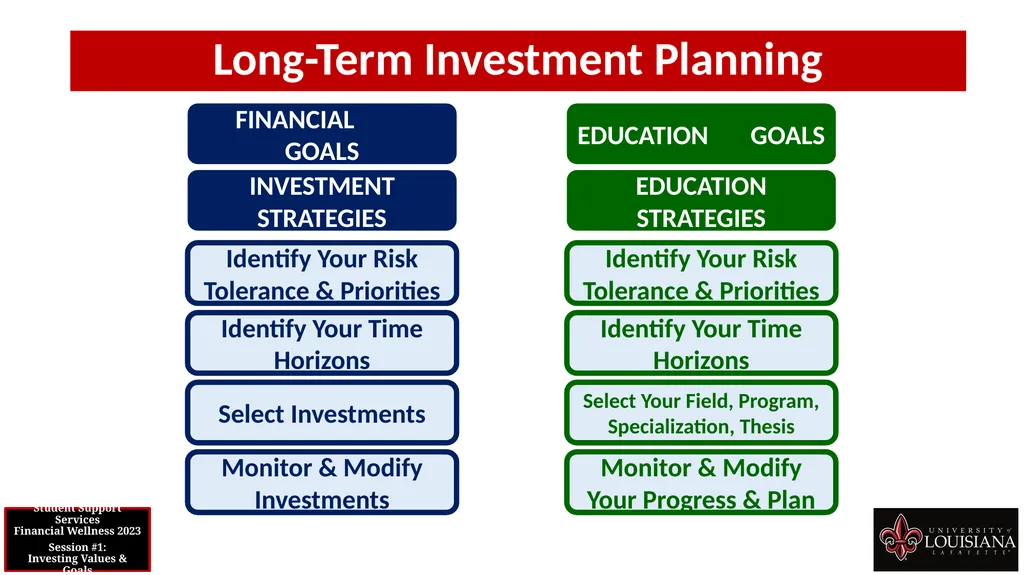
Long-Term Investment Planning FINANCIAL GOALS INVESTMENT STRATEGIES Identify Your Risk Tolerance & Priorities Identify Your Time Horizons Select Investments Monitor & Modify Investments EDUCATION GOALS EDUCATION STRATEGIES Identify Your Risk Tolerance & Priorities Identify Your Time Horizons Select Your Field, Program, Specialization, Thesis Monitor & Modify Your Progress & Plan<br>
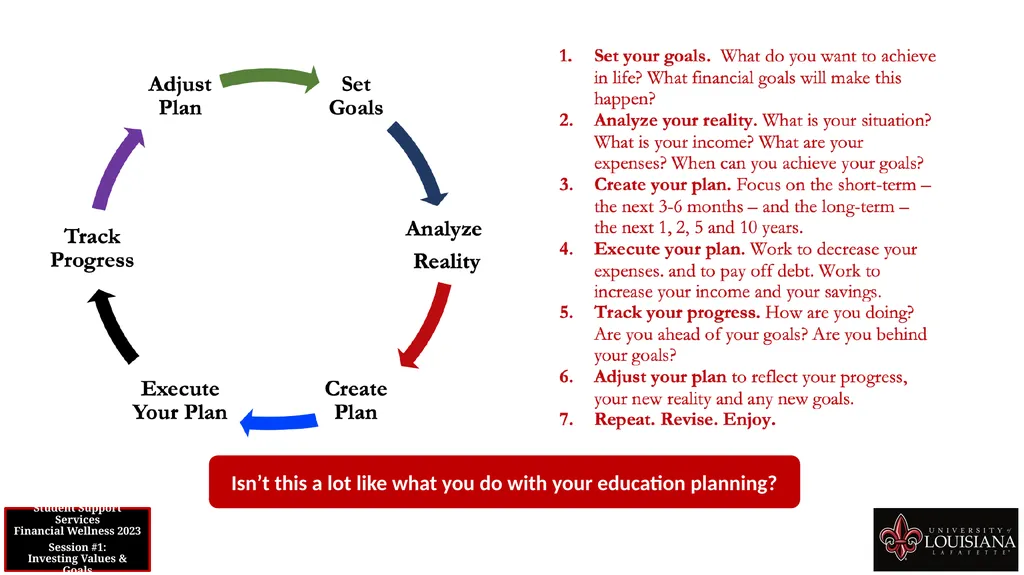
19
Isn’t this a lot like what you do with your education planning?<br>
20
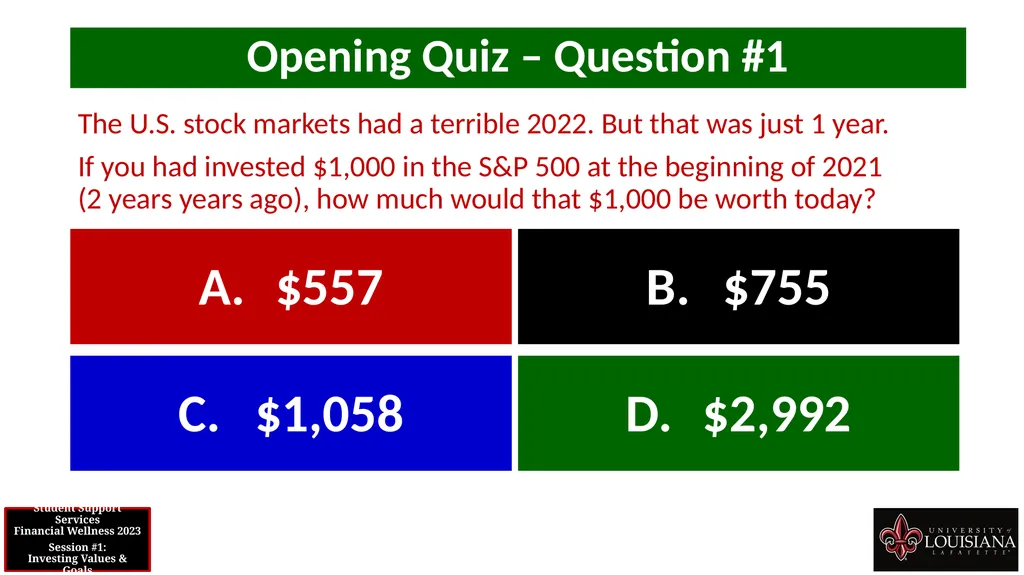
Opening Quiz – Question #1 The U.S. stock markets had a terrible 2022. But that was just 1 year.
If you had invested $1,000 in the S&P 500 at the beginning of 2021 (2 years years ago), how much would that $1,000 be worth today? A. $557 C. $1,058 B. $755 D. $2,992<br>
If you had invested $1,000 in the S&P 500 at the beginning of 2021 (2 years years ago), how much would that $1,000 be worth today? A. $557 C. $1,058 B. $755 D. $2,992<br>
21
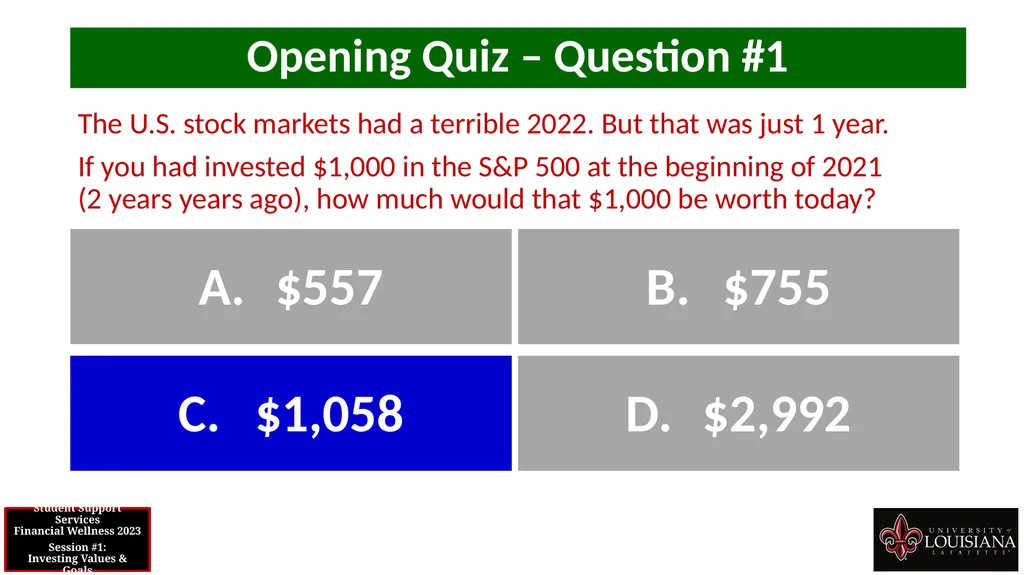
Opening Quiz – Question #1 The U.S. stock markets had a terrible 2022. But that was just 1 year.
If you had invested $1,000 in the S&P 500 at the beginning of 2021 (2 years years ago), how much would that $1,000 be worth today? A. $557 C. $1,058 B. $755 D. $2,992<br>
If you had invested $1,000 in the S&P 500 at the beginning of 2021 (2 years years ago), how much would that $1,000 be worth today? A. $557 C. $1,058 B. $755 D. $2,992<br>
22
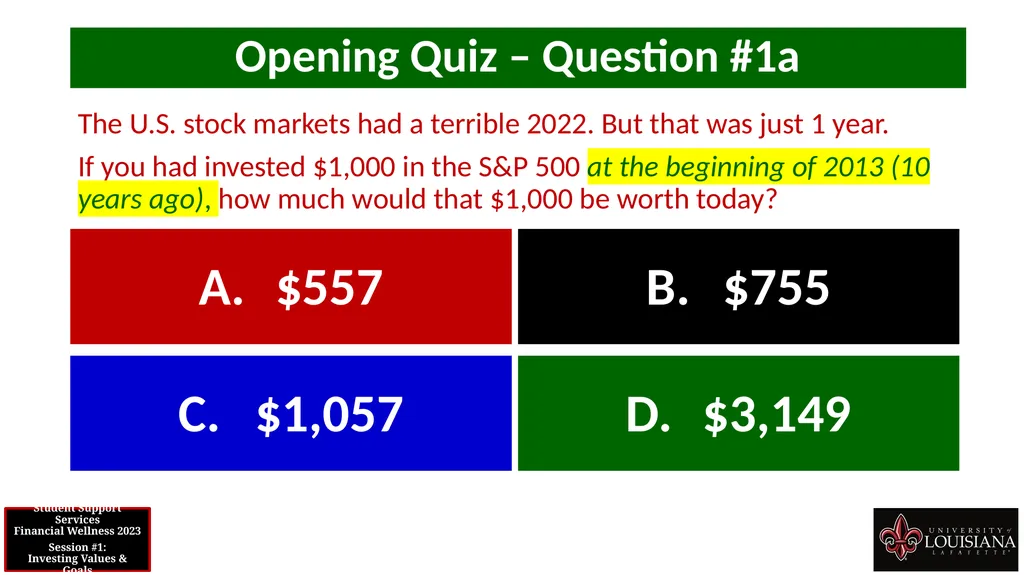
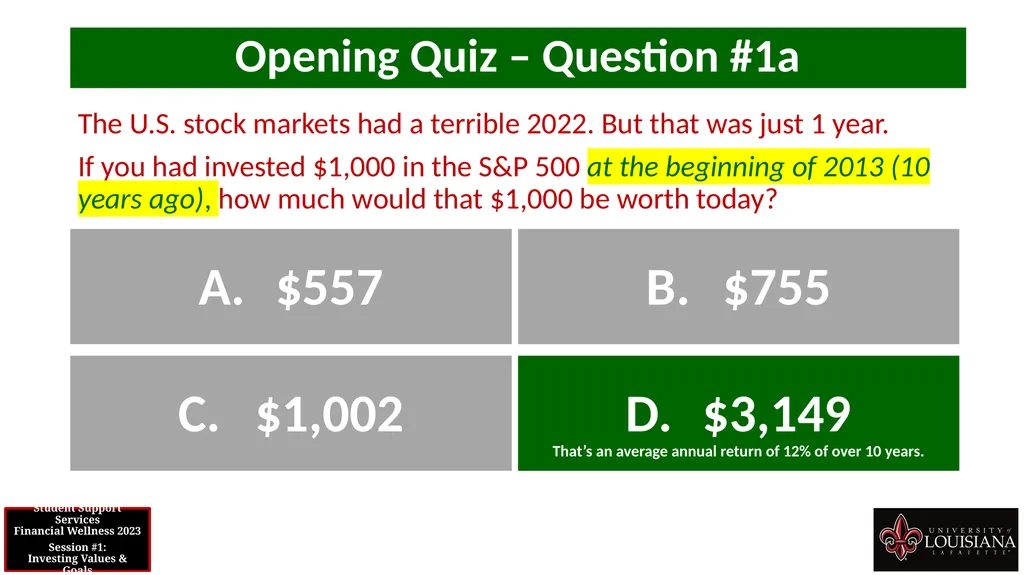
Opening Quiz – Question #1a The U.S. stock markets had a terrible 2022. But that was just 1 year.
If you had invested $1,000 in the S&P 500 at the beginning of 2013 (10 years ago), how much would that $1,000 be worth today? A. $557 C. $1,057 B. $755 D. $3,149<br>
If you had invested $1,000 in the S&P 500 at the beginning of 2013 (10 years ago), how much would that $1,000 be worth today? A. $557 C. $1,057 B. $755 D. $3,149<br>
23
Opening Quiz – Question #1a The U.S. stock markets had a terrible 2022. But that was just 1 year.
If you had invested $1,000 in the S&P 500 at the beginning of 2013 (10 years ago), how much would that $1,000 be worth today? A. $557 C. $1,002 B. $755 D. $3,149 That’s an average annual return of 12% of over 10 years.<br>
If you had invested $1,000 in the S&P 500 at the beginning of 2013 (10 years ago), how much would that $1,000 be worth today? A. $557 C. $1,002 B. $755 D. $3,149 That’s an average annual return of 12% of over 10 years.<br>
24
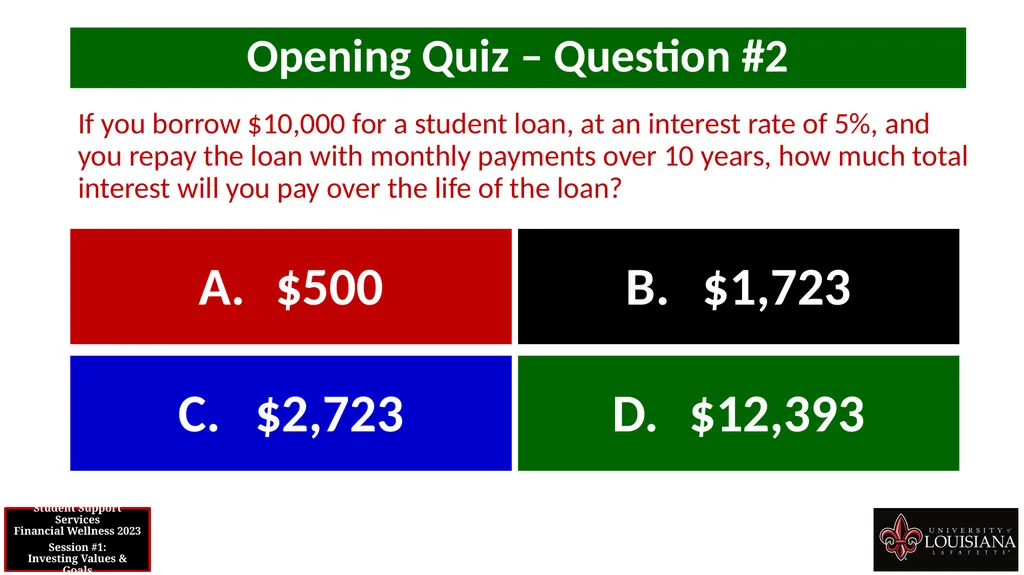
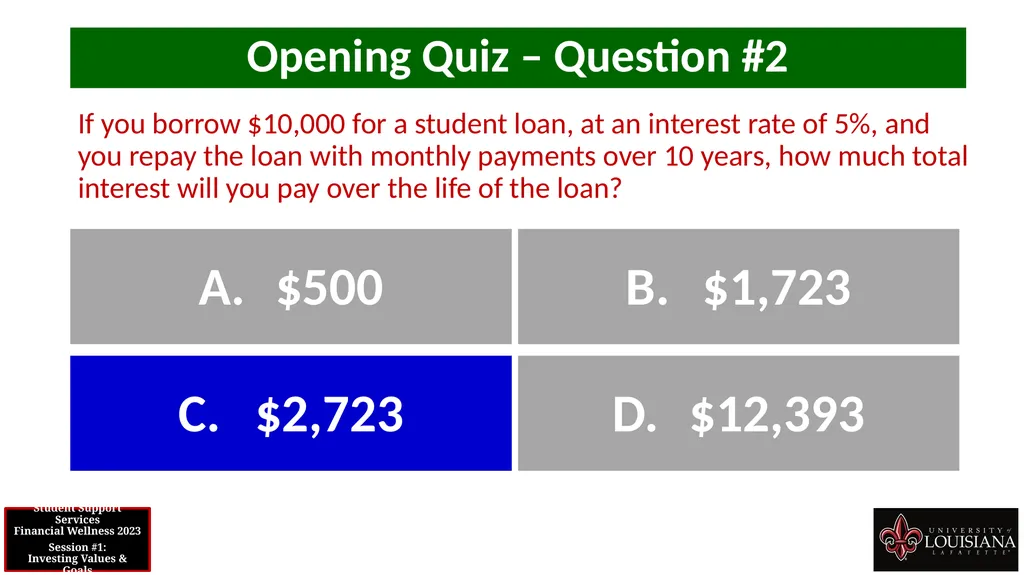
Opening Quiz – Question #2 If you borrow $10,000 for a student loan, at an interest rate of 5%, and you repay the loan with monthly payments over 10 years, how much total interest will you pay over the life of the loan? A. $500 C. $2,723 B. $1,723 D. $12,393<br>
25
Opening Quiz – Question #2 If you borrow $10,000 for a student loan, at an interest rate of 5%, and you repay the loan with monthly payments over 10 years, how much total interest will you pay over the life of the loan? A. $500 C. $2,723 B. $1,723 D. $12,393<br>
26
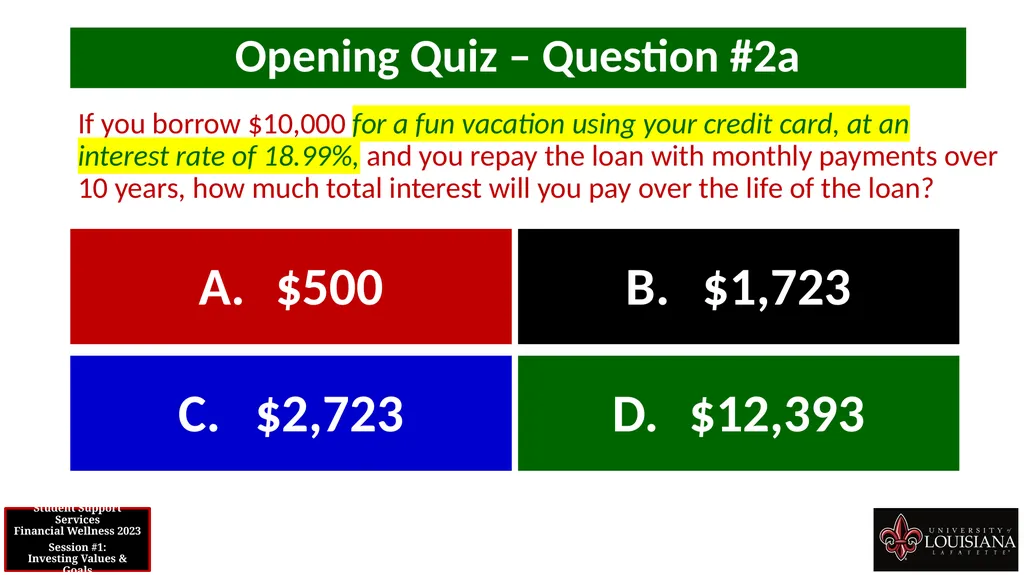
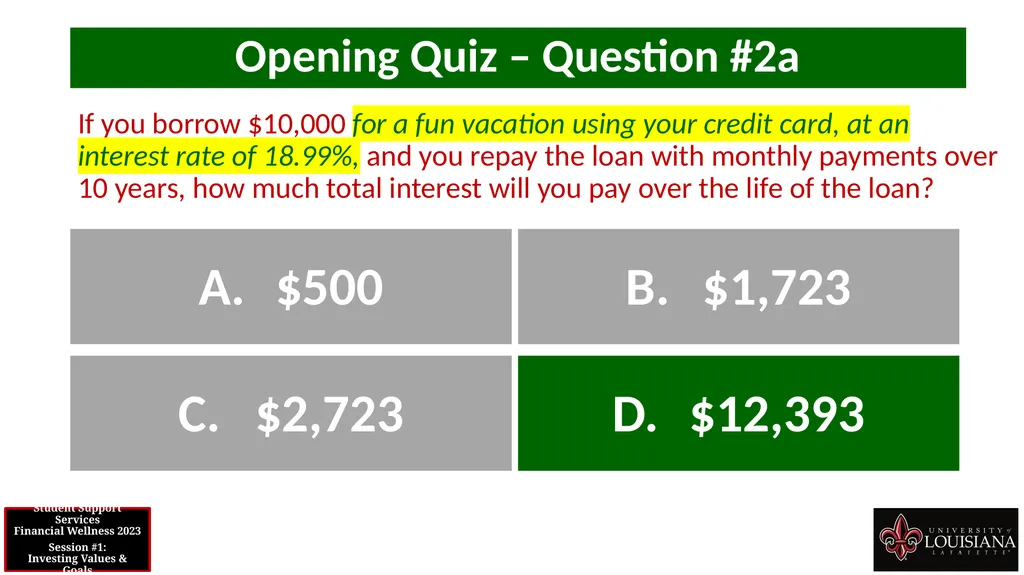
Opening Quiz – Question #2a If you borrow $10,000 for a fun vacation using your credit card, at an interest rate of 18.99%, and you repay the loan with monthly payments over 10 years, how much total interest will you pay over the life of the loan? A. $500 C. $2,723 B. $1,723 D. $12,393<br>
27
Opening Quiz – Question #2a If you borrow $10,000 for a fun vacation using your credit card, at an interest rate of 18.99%, and you repay the loan with monthly payments over 10 years, how much total interest will you pay over the life of the loan? A. $500 C. $2,723 B. $1,723 D. $12,393<br>
28
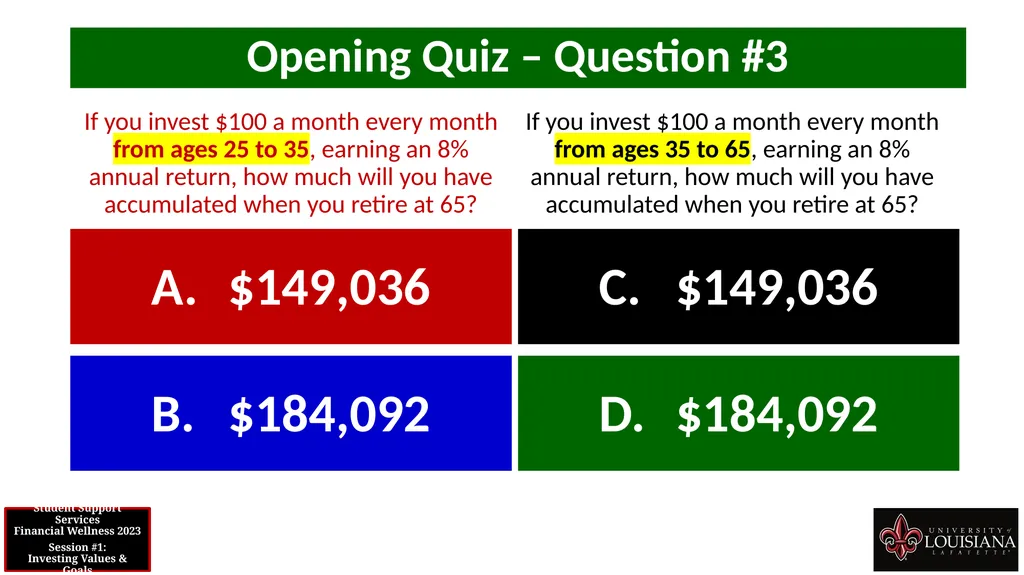
Opening Quiz – Question #3 If you invest $100 a month every month from ages 25 to 35, earning an 8% annual return, how much will you have accumulated when you retire at 65? A. $149,036 B. $184,092 C. $149,036 D. $184,092 If you invest $100 a month every month from ages 35 to 65, earning an 8% annual return, how much will you have accumulated when you retire at 65?<br>
29
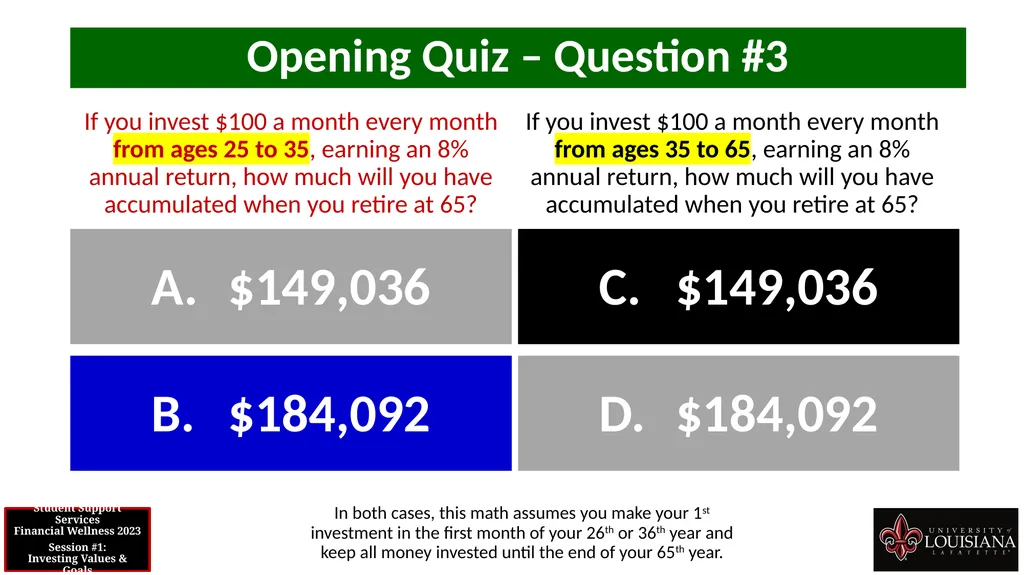
Opening Quiz – Question #3 If you invest $100 a month every month from ages 25 to 35, earning an 8% annual return, how much will you have accumulated when you retire at 65? A. $149,036 B. $184,092 C. $149,036 D. $184,092 If you invest $100 a month every month from ages 35 to 65, earning an 8% annual return, how much will you have accumulated when you retire at 65? In both cases, this math assumes you make your 1st investment in the first month of your 26th or 36th year and keep all money invested until the end of your 65th year.<br>
30
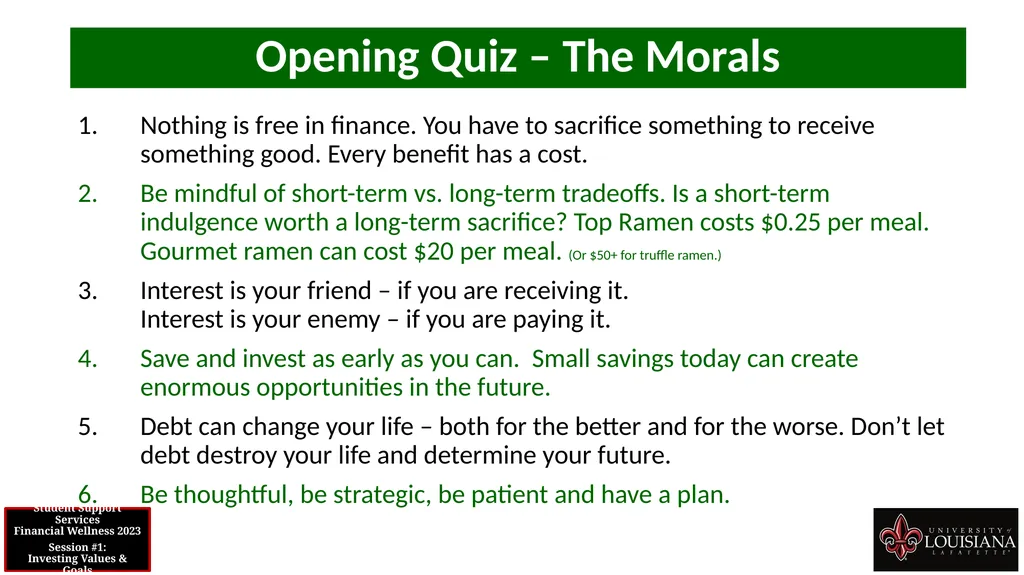
Opening Quiz – The Morals Nothing is free in finance. You have to sacrifice something to receive something good. Every benefit has a cost.
Be mindful of short-term vs. long-term tradeoffs. Is a short-term indulgence worth a long-term sacrifice? Top Ramen costs $0.25 per meal. Gourmet ramen can cost $20 per meal. (Or $50+ for truffle ramen.)
Interest is your friend – if you are receiving it. Interest is your enemy – if you are paying it.
Save and invest as early as you can. Small savings today can create enormous opportunities in the future.
Debt can change your life – both for the better and for the worse. Don’t let debt destroy your life and determine your future.
Be thoughtful, be strategic, be patient and have a plan.<br>
31
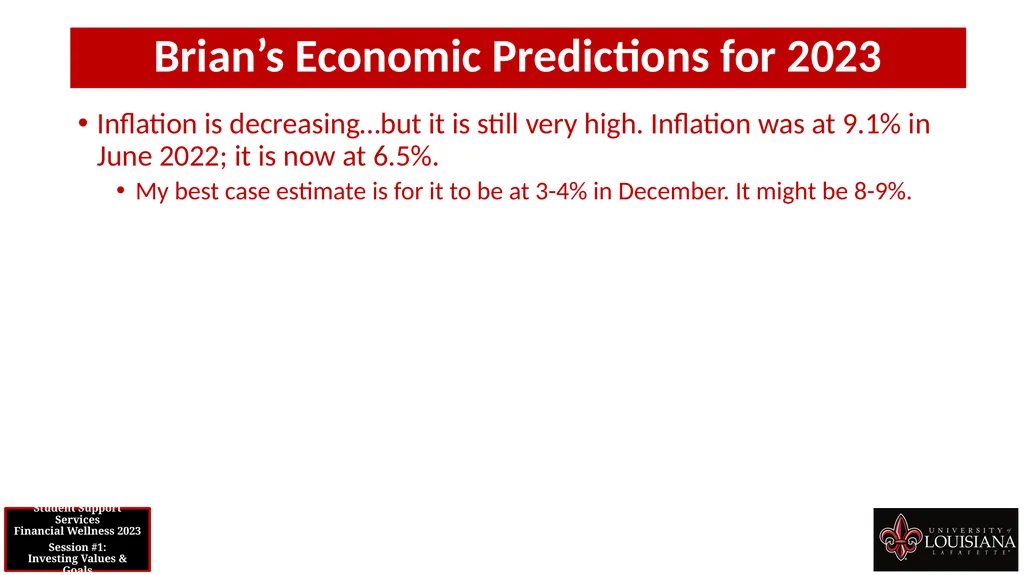
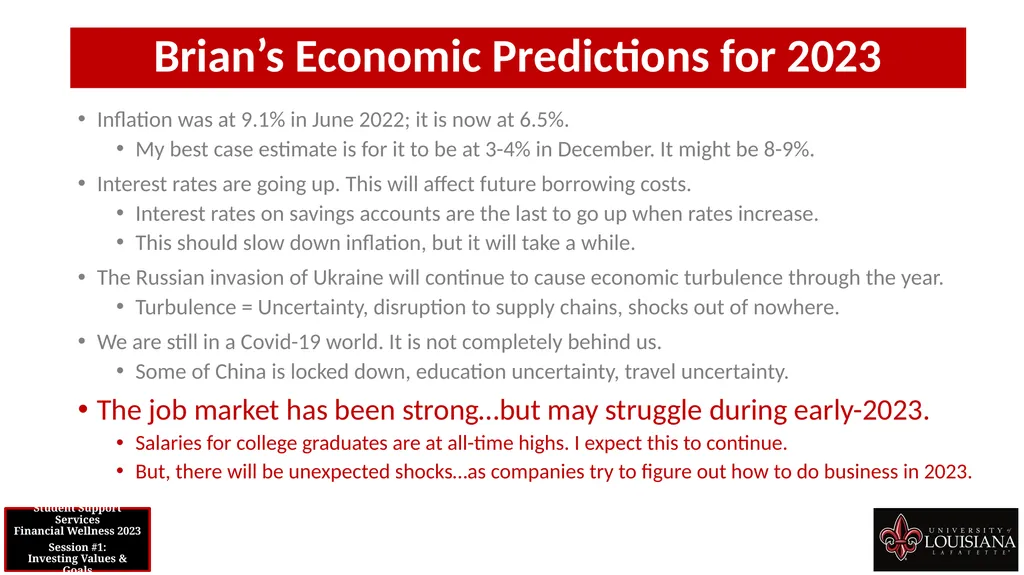
Brian’s Economic Predictions for 2023 Inflation is decreasing…but it is still very high. Inflation was at 9.1% in June 2022; it is now at 6.5%.
My best case estimate is for it to be at 3-4% in December. It might be 8-9%.<br>
My best case estimate is for it to be at 3-4% in December. It might be 8-9%.<br>
32
Brian’s Economic Predictions for 2023 Inflation was at 9.1% in June 2022; it is now at 6.5%.
My best case estimate is for it to be at 3-4% in December. It might be 8-9%.
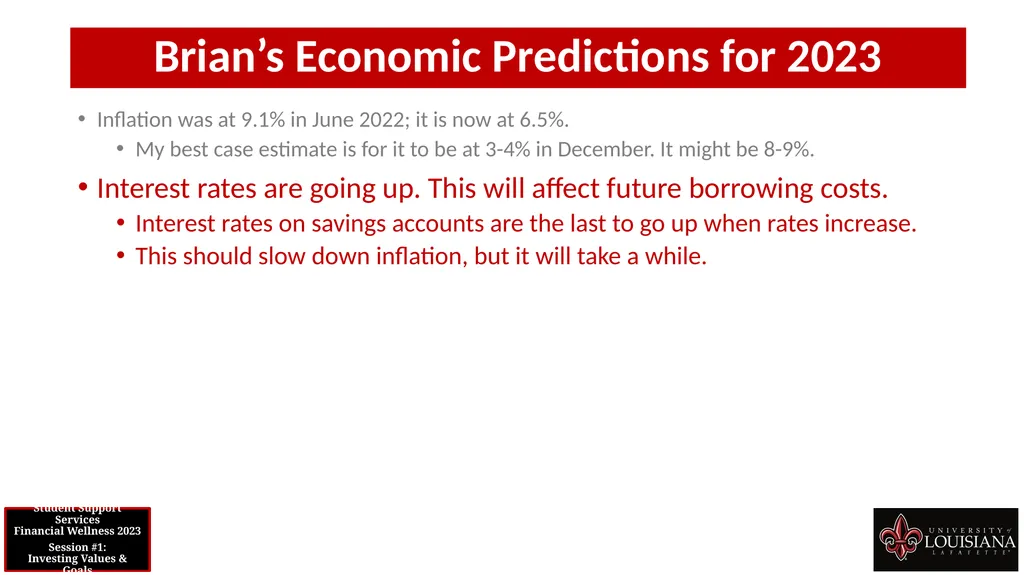
Interest rates are going up. This will affect future borrowing costs.
Interest rates on savings accounts are the last to go up when rates increase.
This should slow down inflation, but it will take a while.<br>
My best case estimate is for it to be at 3-4% in December. It might be 8-9%.
Interest rates are going up. This will affect future borrowing costs.
Interest rates on savings accounts are the last to go up when rates increase.
This should slow down inflation, but it will take a while.<br>
33
Brian’s Economic Predictions for 2023 Inflation was at 9.1% in June 2022; it is now at 6.5%.
My best case estimate is for it to be at 3-4% in December. It might be 8-9%.
Interest rates are going up. This will affect future borrowing costs.
Interest rates on savings accounts are the last to go up when rates increase.
This should slow down inflation, but it will take a while.
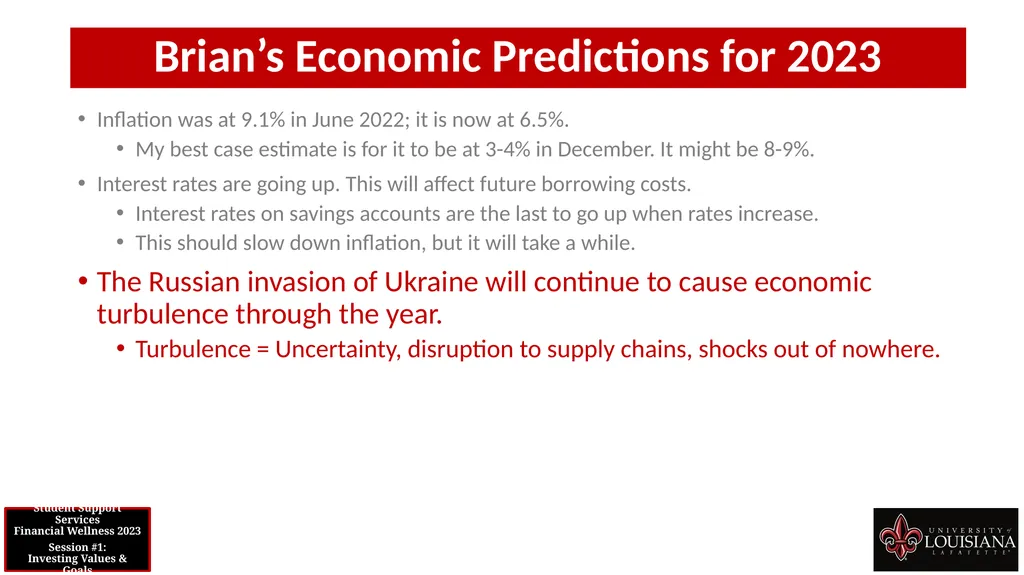
The Russian invasion of Ukraine will continue to cause economic turbulence through the year.
Turbulence = Uncertainty, disruption to supply chains, shocks out of nowhere.<br>
34
Brian’s Economic Predictions for 2023 Inflation was at 9.1% in June 2022; it is now at 6.5%.
My best case estimate is for it to be at 3-4% in December. It might be 8-9%.
Interest rates are going up. This will affect future borrowing costs.
Interest rates on savings accounts are the last to go up when rates increase.
This should slow down inflation, but it will take a while.
The Russian invasion of Ukraine will continue to cause economic turbulence through the year.
Turbulence = Uncertainty, disruption to supply chains, shocks out of nowhere.
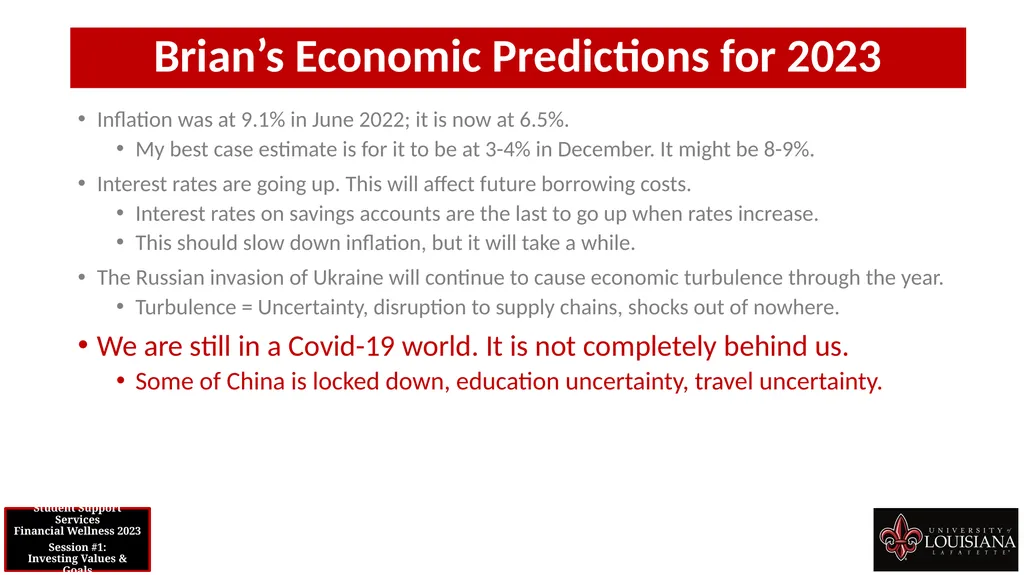
We are still in a Covid-19 world. It is not completely behind us.
Some of China is locked down, education uncertainty, travel uncertainty.<br>
35
Brian’s Economic Predictions for 2023 Inflation was at 9.1% in June 2022; it is now at 6.5%.
My best case estimate is for it to be at 3-4% in December. It might be 8-9%.
Interest rates are going up. This will affect future borrowing costs.
Interest rates on savings accounts are the last to go up when rates increase.
This should slow down inflation, but it will take a while.
The Russian invasion of Ukraine will continue to cause economic turbulence through the year.
Turbulence = Uncertainty, disruption to supply chains, shocks out of nowhere.
We are still in a Covid-19 world. It is not completely behind us.
Some of China is locked down, education uncertainty, travel uncertainty.
The job market has been strong…but may struggle during early-2023.
Salaries for college graduates are at all-time highs. I expect this to continue.
But, there will be unexpected shocks…as companies try to figure out how to do business in 2023.<br>
36
Inflation was at 9.1% in June 2022; it is now at 6.5%.
My best case estimate is for it to be at 3-4% in December. It might be 8-9%.
Interest rates have gone up. This will affect future borrowing costs.
Interest rates on savings accounts are the last to go up when rates increase.
This should slow down inflation, but it will take a while.
The Russian invasion of Ukraine will continue to cause economic turbulence through the year.
Turbulence = Uncertainty, disruption to supply chains, shocks out of nowhere.
We are still in a Covid-19 world. It is not completely behind us.
Much of China is locked down, education uncertainty, travel uncertainty.
The job market has been strong…but may struggle during early-2023.
Salaries for college graduates are at all-time highs. I expect this to continue.
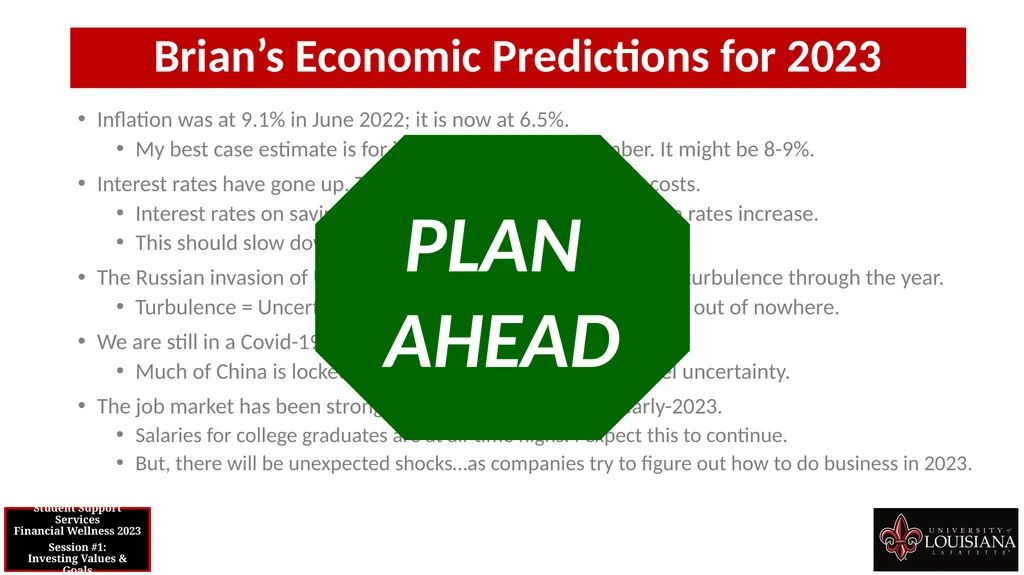
But, there will be unexpected shocks…as companies try to figure out how to do business in 2023. PLAN
AHEAD Brian’s Economic Predictions for 2023<br>
37
Inflation was at 9.1% in June 2022; it is now at 6.5%.
My best case estimate is for it to be at 3-4% in December. It might be 8-9%.
Interest rates have gone up. This will affect future borrowing costs.
Interest rates on savings accounts are the last to go up when rates increase.
This should slow down inflation, but it will take a while.
The Russian invasion of Ukraine will continue to cause economic turbulence through the year.
Turbulence = Uncertainty, disruption to supply chains, shocks out of nowhere.
We are still in a Covid-19 world. It is not completely behind us.
Much of China is locked down, education uncertainty, travel uncertainty.
The job market has been strong…but may struggle during early-2023.
Salaries for college graduates are at all-time highs. I expect this to continue.
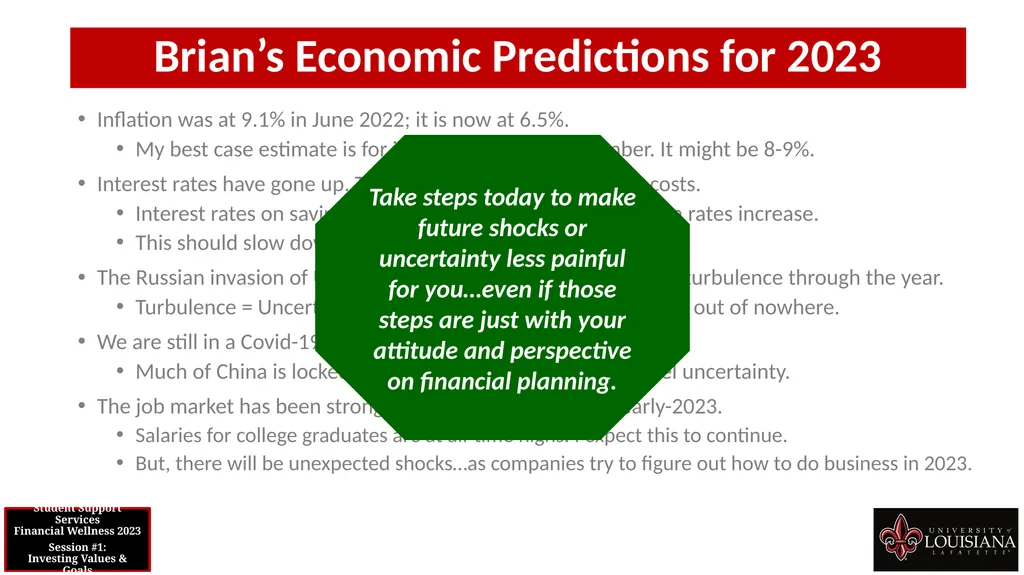
But, there will be unexpected shocks…as companies try to figure out how to do business in 2023. Brian’s Economic Predictions for 2023 Take steps today to make future shocks or uncertainty less painful for you…even if those steps are just with your attitude and perspective on financial planning.<br>
38
15 Simple Challenges You Can Take to Help You Control Your Financial Future
(and maybe be better prepared for future financial turbulence)<br>
(and maybe be better prepared for future financial turbulence)<br>
39
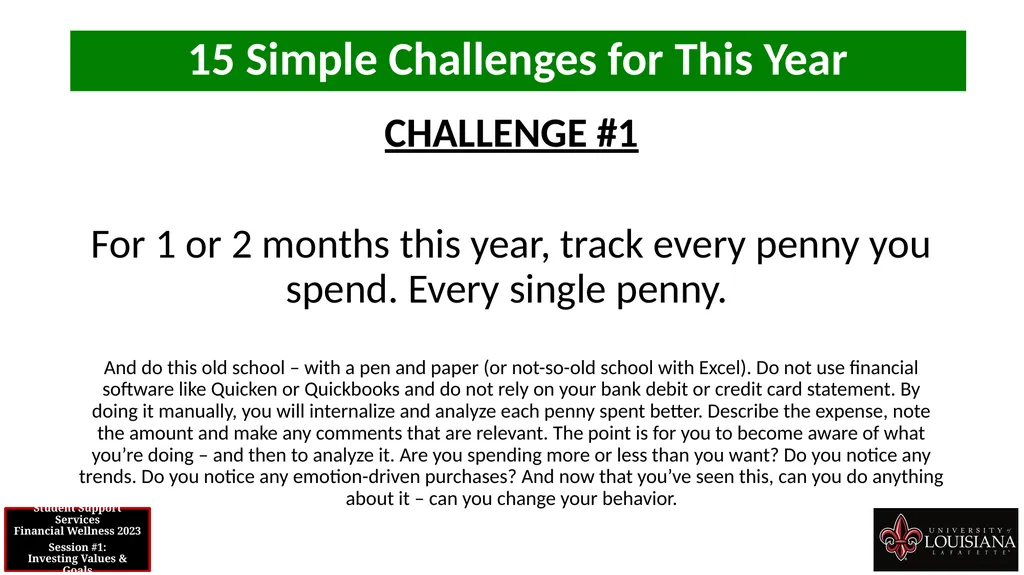
CHALLENGE #1
For 1 or 2 months this year, track every penny you spend. Every single penny. And do this old school – with a pen and paper (or not-so-old school with Excel). Do not use financial software like Quicken or Quickbooks and do not rely on your bank debit or credit card statement. By doing it manually, you will internalize and analyze each penny spent better. Describe the expense, note the amount and make any comments that are relevant. The point is for you to become aware of what you’re doing – and then to analyze it. Are you spending more or less than you want? Do you notice any trends. Do you notice any emotion-driven purchases? And now that you’ve seen this, can you do anything about it – can you change your behavior. 15 Simple Challenges for This Year<br>
For 1 or 2 months this year, track every penny you spend. Every single penny. And do this old school – with a pen and paper (or not-so-old school with Excel). Do not use financial software like Quicken or Quickbooks and do not rely on your bank debit or credit card statement. By doing it manually, you will internalize and analyze each penny spent better. Describe the expense, note the amount and make any comments that are relevant. The point is for you to become aware of what you’re doing – and then to analyze it. Are you spending more or less than you want? Do you notice any trends. Do you notice any emotion-driven purchases? And now that you’ve seen this, can you do anything about it – can you change your behavior. 15 Simple Challenges for This Year<br>
40
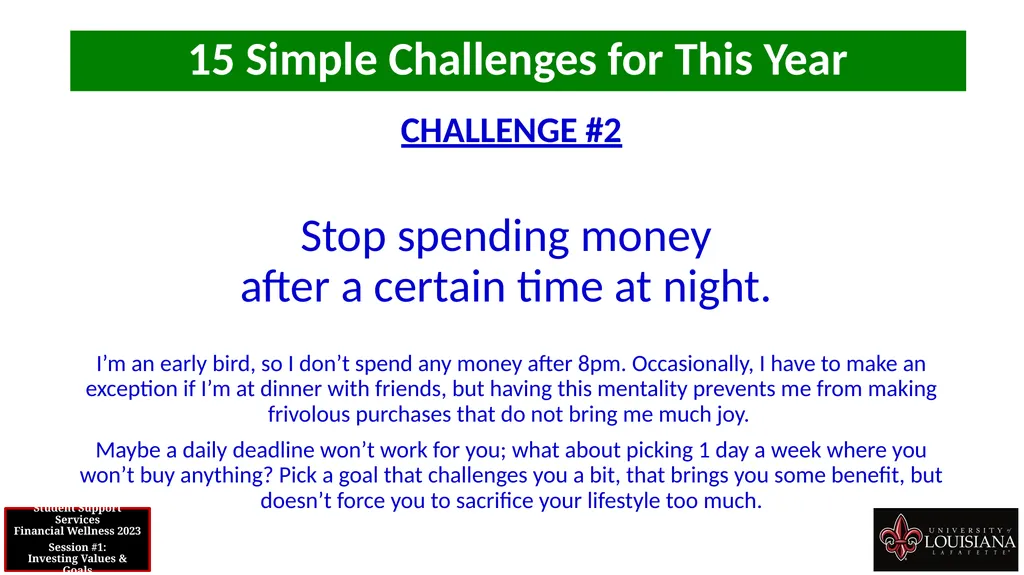
CHALLENGE #2
Stop spending money after a certain time at night. I’m an early bird, so I don’t spend any money after 8pm. Occasionally, I have to make an exception if I’m at dinner with friends, but having this mentality prevents me from making frivolous purchases that do not bring me much joy.
Maybe a daily deadline won’t work for you; what about picking 1 day a week where you won’t buy anything? Pick a goal that challenges you a bit, that brings you some benefit, but doesn’t force you to sacrifice your lifestyle too much. 15 Simple Challenges for This Year<br>
41
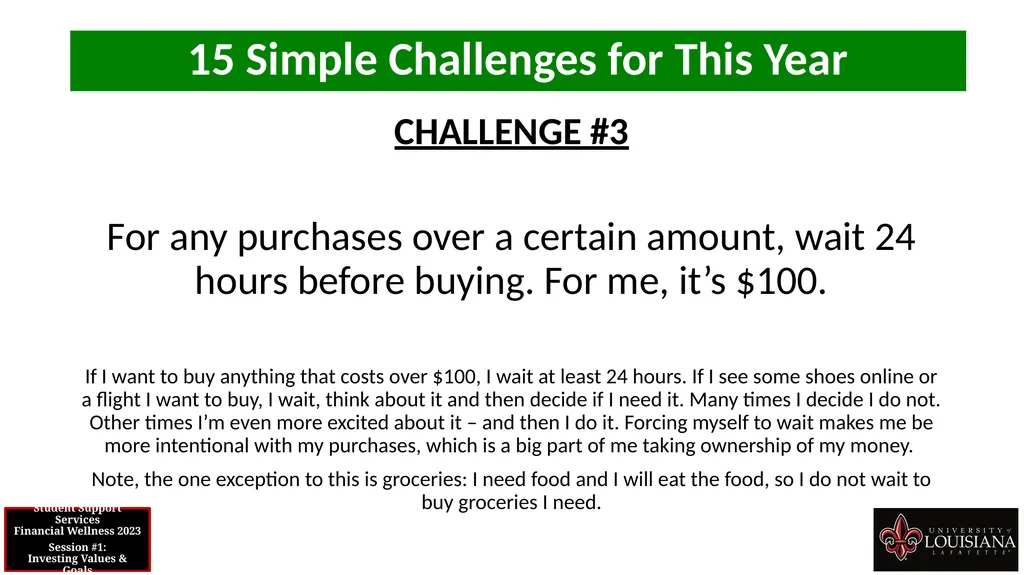
CHALLENGE #3
For any purchases over a certain amount, wait 24 hours before buying. For me, it’s $100.
If I want to buy anything that costs over $100, I wait at least 24 hours. If I see some shoes online or a flight I want to buy, I wait, think about it and then decide if I need it. Many times I decide I do not. Other times I’m even more excited about it – and then I do it. Forcing myself to wait makes me be more intentional with my purchases, which is a big part of me taking ownership of my money.
Note, the one exception to this is groceries: I need food and I will eat the food, so I do not wait to buy groceries I need. 15 Simple Challenges for This Year<br>
42
CHALLENGE #4
As soon as you get each paycheck, or on the 1st day of each month, explicitly save $25.
Maybe that means moving $25 from your checking or debit account to a savings account. And then do not touch that money. The goal is to get in the habit of paying yourself first (or paying your future self first). And a side benefit is that you will have separate financial accounts, each with separate financial goals. 15 Simple Challenges for This Year<br>
43
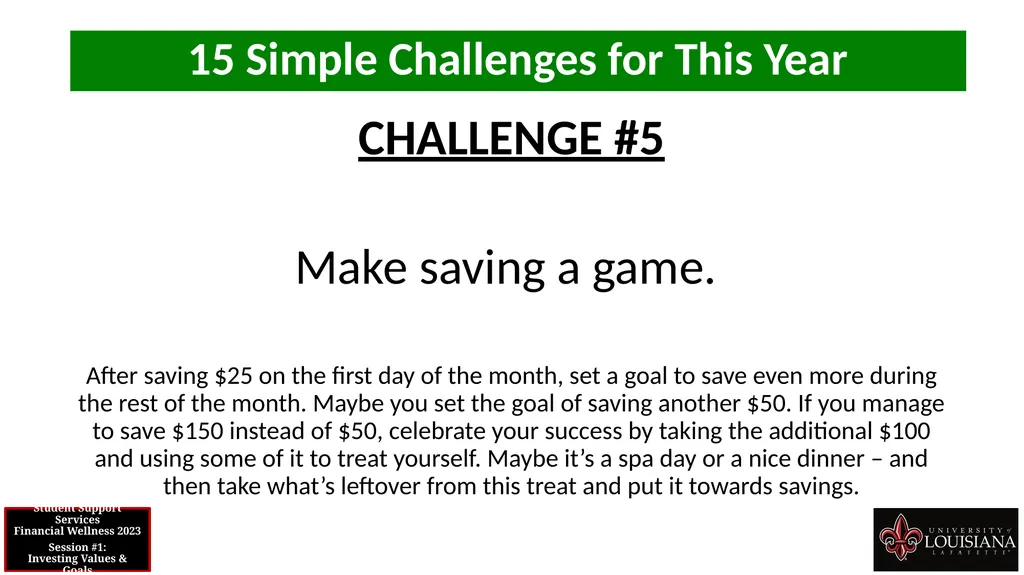
CHALLENGE #5
Make saving a game.
After saving $25 on the first day of the month, set a goal to save even more during the rest of the month. Maybe you set the goal of saving another $50. If you manage to save $150 instead of $50, celebrate your success by taking the additional $100 and using some of it to treat yourself. Maybe it’s a spa day or a nice dinner – and then take what’s leftover from this treat and put it towards savings. 15 Simple Challenges for This Year<br>
44
CHALLENGE #5 - Alternative
Make saving a game.
Anytime you treat yourself to a purchase over a certain amount, set aside ½ of the amount amount of the purchase to give to charity. For me, it’s $200.
If I buy anything over $200 – except food or rent – I immediately set aside ½ of the amount to give to charity. I do not donate the money immediately, but I may pool it over several months to be able to give a bigger donation. 15 Simple Challenges for This Year<br>
45
CHALLENGE #6
Check your credit score. And study your credit report.
You can get a credit report for free from TransUnion, Equifax or Experian. Make sure what’s on the credit report belongs to you. Challenge anything that is wrong. And make a plan to improve your credit score – by cleaning up your credit report or establishing a payment history that will work to your advantage over time. 15 Simple Challenges for This Year<br>
46
CHALLENGE #6 - Bonus
Check your credit score. And study your credit report.
For the most part, the only way to improve your credit score is slowly over time. However, there is one hack that might provide a one-time bump to your credit score: request a higher credit limit for all your credit cards. But, of course, do not use this higher limit. 15 Simple Challenges for This Year<br>
47
CHALLENGE #7
Analyze your insurance expenses at least once a year. Contact 3 different insurance companies and compare pricing.
It’s easy to stick with the same company for years. But you may be missing out on the best pricing. It’s easy to switch companies, so don’t be afraid of it. Or maybe you can use the price comparisons to get a better deal at your current company. As the commercials say, just a few minutes of work can save you hundreds. 15 Simple Challenges for This Year<br>
48
CHALLENGE #8
Are you expecting a tax refund this year?
If so, get rid of it.
While that may feel good, any financial advisor will tell you that that’s bad financial planning. If you’re getting a refund, it means you’ve been giving an interest free loan to the U.S. government for 12-15 months. Why do that? Would you rather have $1000 a month for 12 months or $800 a month for those same 13 months plus $2400 three months later? I would rather have the money sooner – because then I can save it or invest it. So if you are expecting a tax refund this year, go talk to your human resources folks and change your withholding so you pay less in taxes each pay period and get more of your own money with each paycheck. 15 Simple Challenges for This Year<br>
49
CHALLENGE #8 - Alternative
Are you expecting a tax refund this year?
If so, get rid of it.
Note, the one exception I may make depends on your behavior: if you get that $2400 refund, are you going to use this to invest or pay off debt? If so, then getting a refund may make sense. But if you view a refund as found money that you can do anything with, get rid of it. 15 Simple Challenges for This Year<br>
50
CHALLENGE #9
Cancel (at least) one subscription this year.
Look through your recurring subscriptions that automatically charge your credit card or deduct money from your bank account and think about (a) whether you really need that subscription, and (b) whether you would be better off just paying a-la-carte instead of with the subscription.
For me, I had a $32 monthly car wash subscription; I could wash my car all I wanted every month for $32. Well, in reality, I only need my car washed once or twice a month – especially as I’m driving less these days. So I got rid of the subscription. I still wash my car at the same place, but now I spend $10-$20 a month instead of the fixed $32 a month. It may not be a huge savings, but it’s more about the habit and the ownership of my spending. 15 Simple Challenges for This Year<br>
51
CHALLENGE #10
For 1 month during the rest of the year, do not eat out.
At all.
If you want to go out for social reasons, eat and drink before going out. And just enjoy your company.
Remember – there is no ego in financial planning, there is no shame in financial planning. 15 Simple Challenges for This Year<br>
For 1 month during the rest of the year, do not eat out.
At all.
If you want to go out for social reasons, eat and drink before going out. And just enjoy your company.
Remember – there is no ego in financial planning, there is no shame in financial planning. 15 Simple Challenges for This Year<br>
52
CHALLENGE #11
For 1 month each year, empty your pantry and empty your freezer.
Only buy perishable groceries during that month (and be sure to eat every single penny/ounce of your perishable food). 15 Simple Challenges for This Year<br>
For 1 month each year, empty your pantry and empty your freezer.
Only buy perishable groceries during that month (and be sure to eat every single penny/ounce of your perishable food). 15 Simple Challenges for This Year<br>
53
CHALLENGE #12
Open an IRA or Roth IRA account to take a little more control of your retirement.
The difference is that with a Roth IRA, your income is taxed today, while with a Traditional IRA your income is taxed when you withdraw in retirement.
If you are a full-time student, a Roth IRA is probably better for you because you’re probably in a low tax bracket today. Even if you’re not a student, the Roth may be be very attractive to you because your future withdrawals are not subject to either income tax or capital gains tax. 15 Simple Challenges for This Year<br>
54
CHALLENGE #13
If you have children, set up a 529 College Savings Plan.
The IRS has created lots of tax-preferred investment plans for us which encourage us to pursue certain behaviors – like the retirement plans in the previous challenge. The 529 College Savings Plan is arguably the best-of-the-best of these tax-preferred investment plans. 15 Simple Challenges for This Year<br>
55
CHALLENGE #14
For every debt payment you have – mortgage, car loan, student loan, credit card – pay more than is required. Pay an extra $20 for each payment. Or round up to the next even $100 increment. Or make a one-time, non-recurring extra payment ever other month. 15 Simple Challenges for This Year<br>
For every debt payment you have – mortgage, car loan, student loan, credit card – pay more than is required. Pay an extra $20 for each payment. Or round up to the next even $100 increment. Or make a one-time, non-recurring extra payment ever other month. 15 Simple Challenges for This Year<br>
56
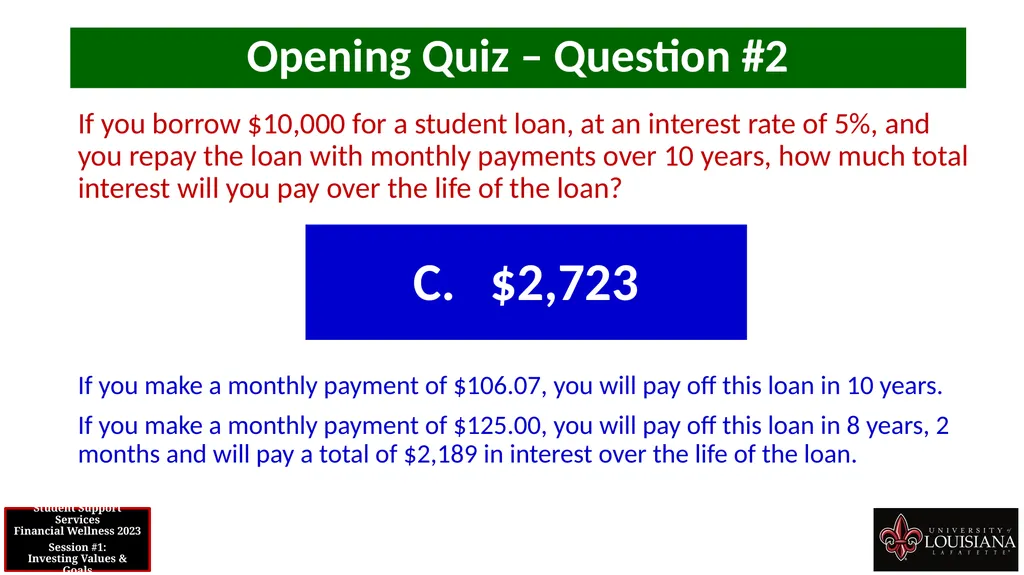
Opening Quiz – Question #2 If you borrow $10,000 for a student loan, at an interest rate of 5%, and you repay the loan with monthly payments over 10 years, how much total interest will you pay over the life of the loan?
If you make a monthly payment of $106.07, you will pay off this loan in 10 years.
If you make a monthly payment of $125.00, you will pay off this loan in 8 years, 2 months and will pay a total of $2,189 in interest over the life of the loan. C. $2,723<br>
If you make a monthly payment of $106.07, you will pay off this loan in 10 years.
If you make a monthly payment of $125.00, you will pay off this loan in 8 years, 2 months and will pay a total of $2,189 in interest over the life of the loan. C. $2,723<br>
57
CHALLENGE #15
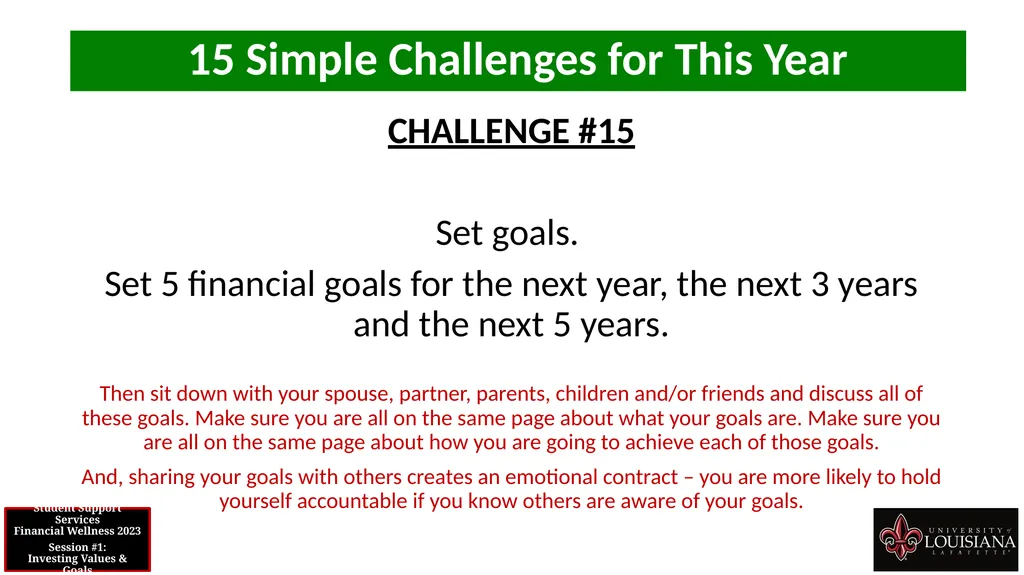
Set goals.
Set 5 financial goals for the next year, the next 3 years and the next 5 years.
Goals can be very specific – “I want to save $1,000 for a vacation” – or rather generic – “I want to begin saving for retirement.” And then begin taking tangible steps towards each goal. Write your goals down, put them on a white board, set up a vision board for them. Be a nerd about it. And get excited about it. But don’t stop there; share your goals with others, especially your family. As with resolutions and exercise classes, telling others what you want to do establishes some accountability and possibly gives you a partner work on the goal with. And if you’re married, in a long-term partnership or have children, share your goals with them…because your goals innately become their goals, too. By working on the goals together and making progress together, you will all take full ownership of these goals and all of the pride that achieving them gives you. 15 Simple Challenges for This Year<br>
58
CHALLENGE #15
Set goals.
Set 5 financial goals for the next year, the next 3 years and the next 5 years.
Then sit down with your spouse, partner, parents, children and/or friends and discuss all of these goals. Make sure you are all on the same page about what your goals are. Make sure you are all on the same page about how you are going to achieve each of those goals.
And, sharing your goals with others creates an emotional contract – you are more likely to hold yourself accountable if you know others are aware of your goals. 15 Simple Challenges for This Year<br>
59
Owning Your Financial Future INVESTING GOALS, HABITS & STRATEGIES
Today, January 23 CREATING AN INVESTMENT STRATEGY
Wednesday, February 22 CREDIT SCORES & DEBT MANAGEMENT
Wednesday, March 8<br>
Today, January 23 CREATING AN INVESTMENT STRATEGY
Wednesday, February 22 CREDIT SCORES & DEBT MANAGEMENT
Wednesday, March 8<br>
60
Owning Your Financial Future OPENING AN INDIVIDUAL RETIREMENT ACCOUNT
Wednesday, March 22 TAX STRATEGIES
Wednesday, April 5 CAREER PLANNING: YOUR MONEY & YOUR FUTURE
Wednesday, April 26<br>
Wednesday, March 22 TAX STRATEGIES
Wednesday, April 5 CAREER PLANNING: YOUR MONEY & YOUR FUTURE
Wednesday, April 26<br>
61
Owning Your Financial Future What Are Your Values, Dreams & Goals? What Is Your Current Situation? Career Family Education Career Family Education Financial Create a Personal Financial Plan for You: Investing Budgeting Debt Management Taxes Insurance Retirement Education Family Business Planning Estate Planning Philanthropy<br>
62
A goal without a plan is just a dream. The most difficult thing is the decision to act; the rest is mere tenacity. Wealth is largely the result of habit. It takes as much energy to plan as it does to wish. You cannot escape the responsibility of tomorrow by avoiding it today. Don’t wait around for other people to be happy for you.
Any happiness you get,
You’ve got to make yourself.
~ Alice Walker, poet & novelist<br>
Any happiness you get,
You’ve got to make yourself.
~ Alice Walker, poet & novelist<br>
63
Brian Bolton
Professor of Finance
brian.bolton@louisiana.edu
http://business.louisiana.edu/financeispersonal<br>