Studying nursing: Study Skills and Test-taking Tips PowerPoint by: Sabina Monosova Information Credited To: Margot R. De Sevo, PhD, RNC Associate Professor Nursing Courses v. Other Academic Courses Most academic courses content-based only
"Studying nursing: Study Skills and Test-taking" is the property of its rightful owner. Permission is granted to
download and print the materials on this website for personal, non-commercial use only, and to display it
on your personal computer provided you do not modify the materials and that you retain all copyright
notices contained in the materials. By downloading content from our website, you accept the terms of this
agreement.
Presentation Transcript
01
Studying nursing: Study Skills and Test-taking Tips PowerPoint by: Sabina Monosova Information Credited To:
Margot R. De Sevo, PhD, RNC
Associate Professor<br>
02
Nursing Courses v. Other Academic Courses Most academic courses
content-based only
E.g. A & P of cardiac system – learn structures of the system and their functions
Nursing
Profession – applied science
Must learn content AND use the information
E.g. Care of the child with a cardiac defect – learn about the defect, learn about children AND be able to determine the nursing care based on the child’s age as well as his/her clinical status<br>
03
Techniques for Studying Nursing CRITICALLY read the material – BEFORE CLASS!!!
identify key facts
Pay attention to the headers cited by the authors. They often highlight key concepts
ALWAYS focus on items in tables, boxes, figures, etc.
Key facts or concepts may be included in tables, boxes, figures, etc.
OR clarification of concepts may be included in the tables, boxes, figures, etc.<br>
04
Techniques for Studying Nursing, cont. WHY READ BEFORE CLASS
When faculty lecture, students are passive.
Content is not learned – easily forgotten.
If the content is read before class, faculty are able to clarify information.
Questions can be asked by students.
Case studies can be analyzed.
Discussions can take place.
Classes are more interesting and stimulating.<br>
05
Where do Class Notes come in? After class, compare notes with the text
Are they consistent? – If NOT:
Ask a fellow student – maybe notes were taken incorrectly
Ask the faculty member
– maybe he/she misspoke in class
-- maybe new evidence has emerged – books are 2-3 years out of date by the time they are published
-- maybe there are differences in opinion – there are often honest discrepancies between and among books<br>
06
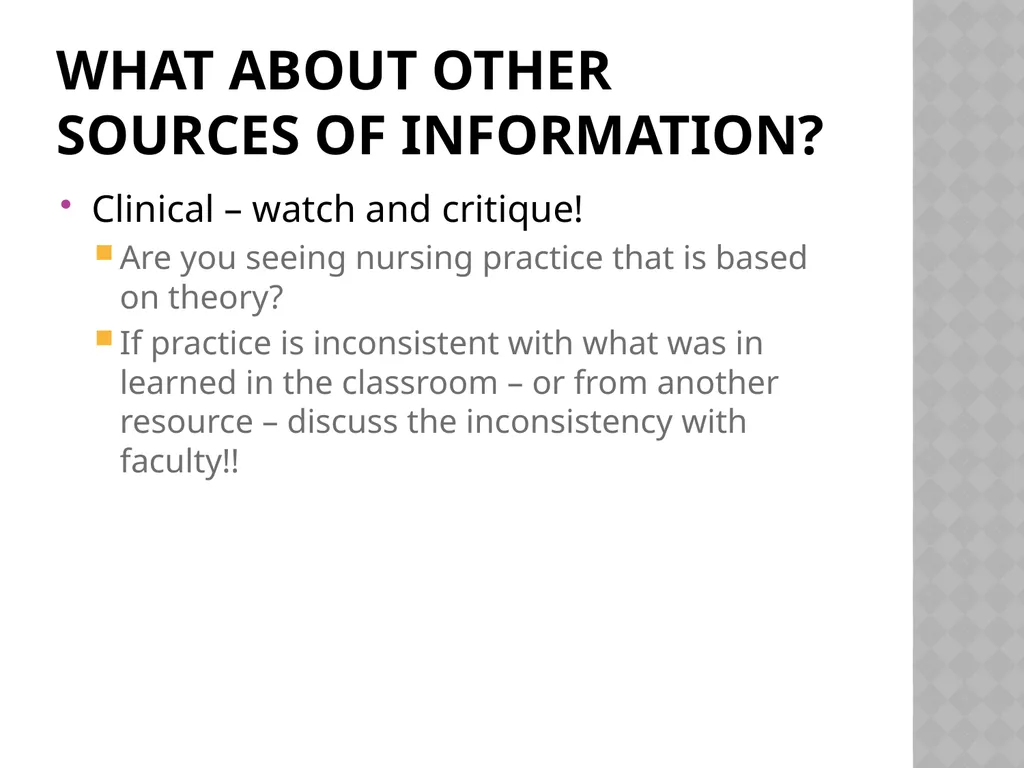
What about other sources of information? Clinical – watch and critique!
Are you seeing nursing practice that is based on theory?
If practice is inconsistent with what was in learned in the classroom – or from another resource – discuss the inconsistency with faculty!!<br>
07
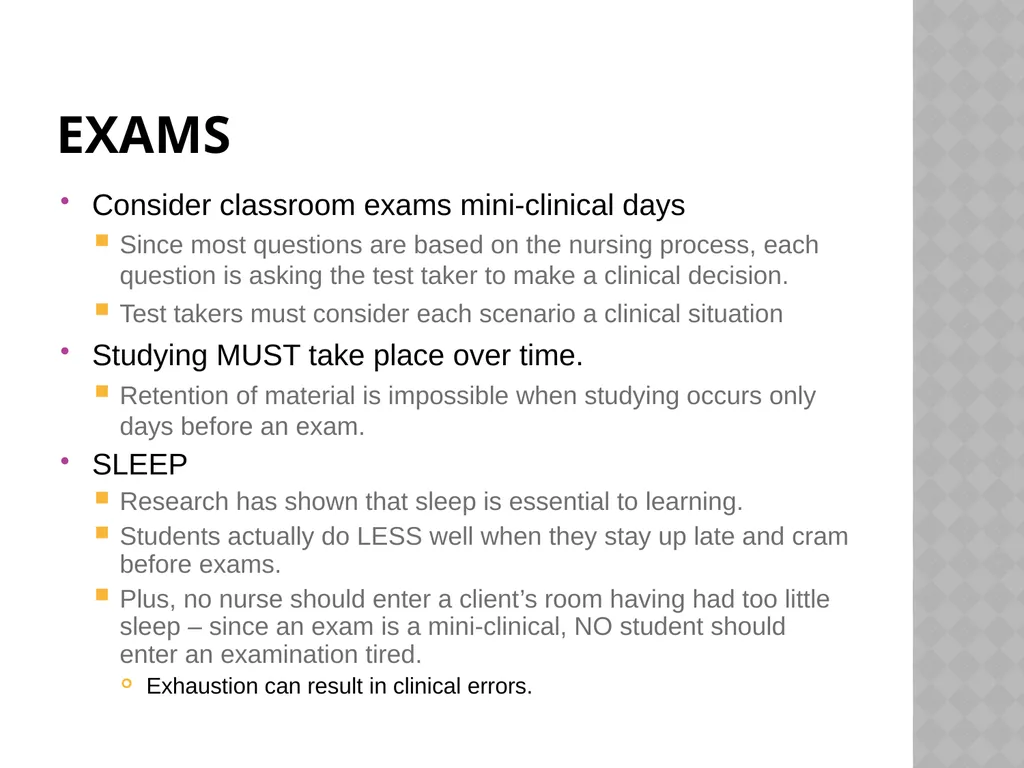
EXAMS Consider classroom exams mini-clinical days
Since most questions are based on the nursing process, each question is asking the test taker to make a clinical decision.
Test takers must consider each scenario a clinical situation
Studying MUST take place over time.
Retention of material is impossible when studying occurs only days before an exam.
SLEEP
Research has shown that sleep is essential to learning.
Students actually do LESS well when they stay up late and cram before exams.
Plus, no nurse should enter a client’s room having had too little sleep – since an exam is a mini-clinical, NO student should enter an examination tired.
Exhaustion can result in clinical errors.<br>
08
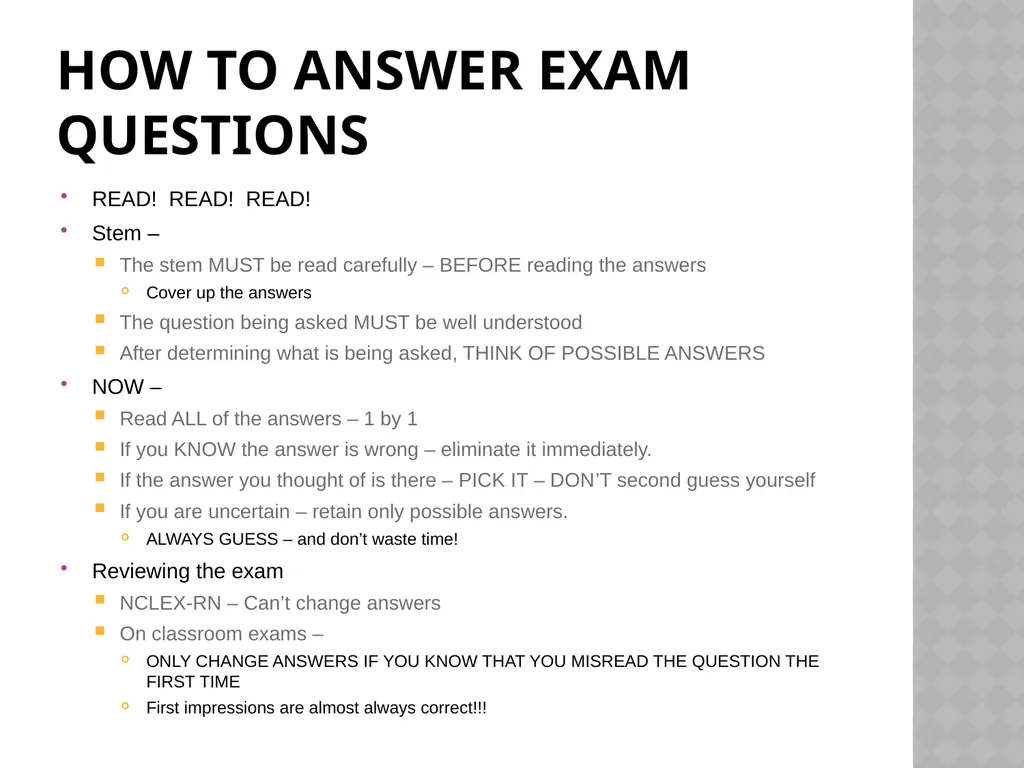
How to answer exam questions READ! READ! READ!
Stem –
The stem MUST be read carefully – BEFORE reading the answers
Cover up the answers
The question being asked MUST be well understood
After determining what is being asked, THINK OF POSSIBLE ANSWERS
NOW –
Read ALL of the answers – 1 by 1
If you KNOW the answer is wrong – eliminate it immediately.
If the answer you thought of is there – PICK IT – DON’T second guess yourself
If you are uncertain – retain only possible answers.
ALWAYS GUESS – and don’t waste time!
Reviewing the exam
NCLEX-RN – Can’t change answers
On classroom exams –
ONLY CHANGE ANSWERS IF YOU KNOW THAT YOU MISREAD THE QUESTION THE FIRST TIME
First impressions are almost always correct!!!<br>
09
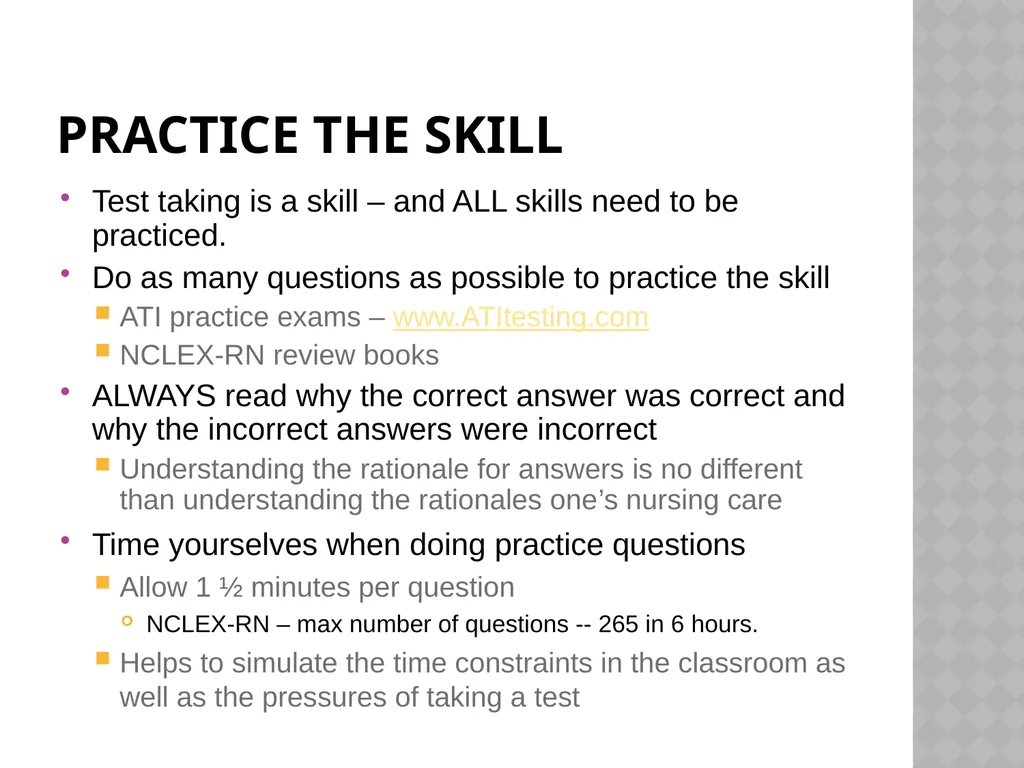
Practice the Skill Test taking is a skill – and ALL skills need to be practiced.
Do as many questions as possible to practice the skill
ATI practice exams – www.ATItesting.com
NCLEX-RN review books
ALWAYS read why the correct answer was correct and why the incorrect answers were incorrect
Understanding the rationale for answers is no different than understanding the rationales one’s nursing care
Time yourselves when doing practice questions
Allow 1 ½ minutes per question
NCLEX-RN – max number of questions -- 265 in 6 hours.
Helps to simulate the time constraints in the classroom as well as the pressures of taking a test<br>