
StudyMafia.Org Submitted To: Submitted By:

Description: StudyMafia.Org Submitted To: Submitted By: Studymafia.org Studymafia.org Web-Development Table Contents Definition Introduction Classification Frontend Roadmap Backend Roadmap Full-Stack Developer What does Developer do? Tools Used
Related Topics
Download Presentation
"StudyMafia.Org Submitted To: Submitted By:" is the property of its rightful owner. Permission is granted to download and print the materials on this website for personal, non-commercial use only, and to display it on your personal computer provided you do not modify the materials and that you retain all copyright notices contained in the materials. By downloading content from our website, you accept the terms of this agreement.
Presentation Transcript
slide1. StudyMafia.Org Submitted To: Submitted By:
Studymafia.org Studymafia.org Web-Development<br>
slide2. Table Contents Definition
Introduction
Classification
Frontend Roadmap
Backend Roadmap
Full-Stack Developer
What does Developer do?
Tools Used
Conclusion 2<br>
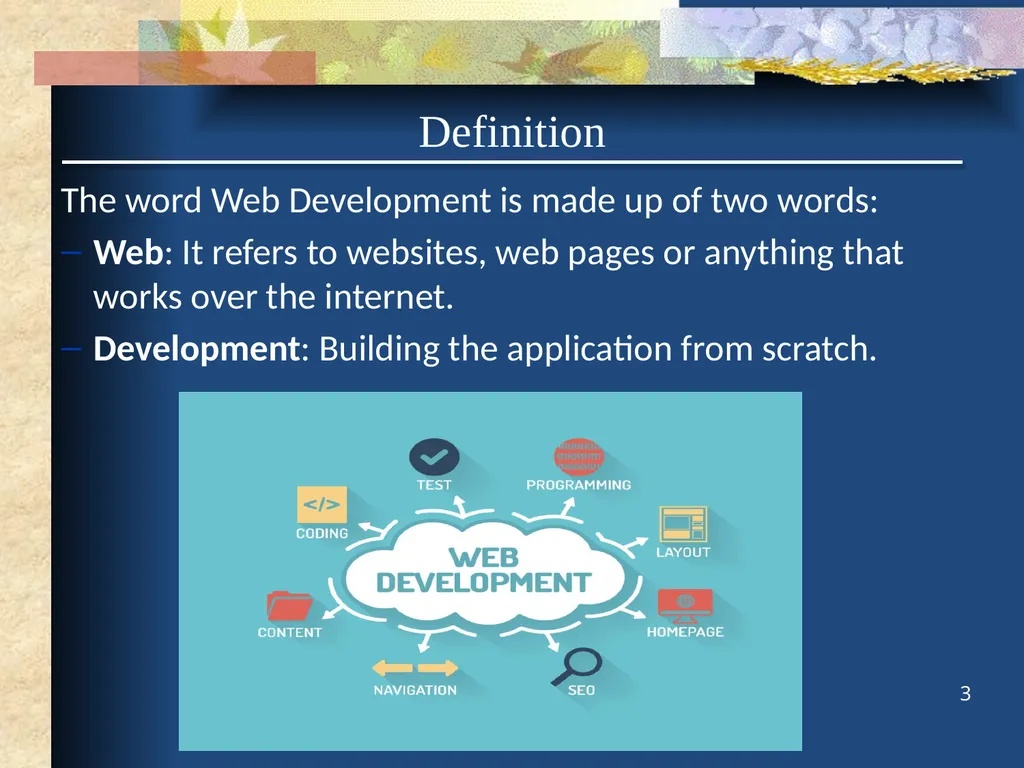
slide3. Definition The word Web Development is made up of two words:
Web: It refers to websites, web pages or anything that works over the internet.
Development: Building the application from scratch. 3<br>
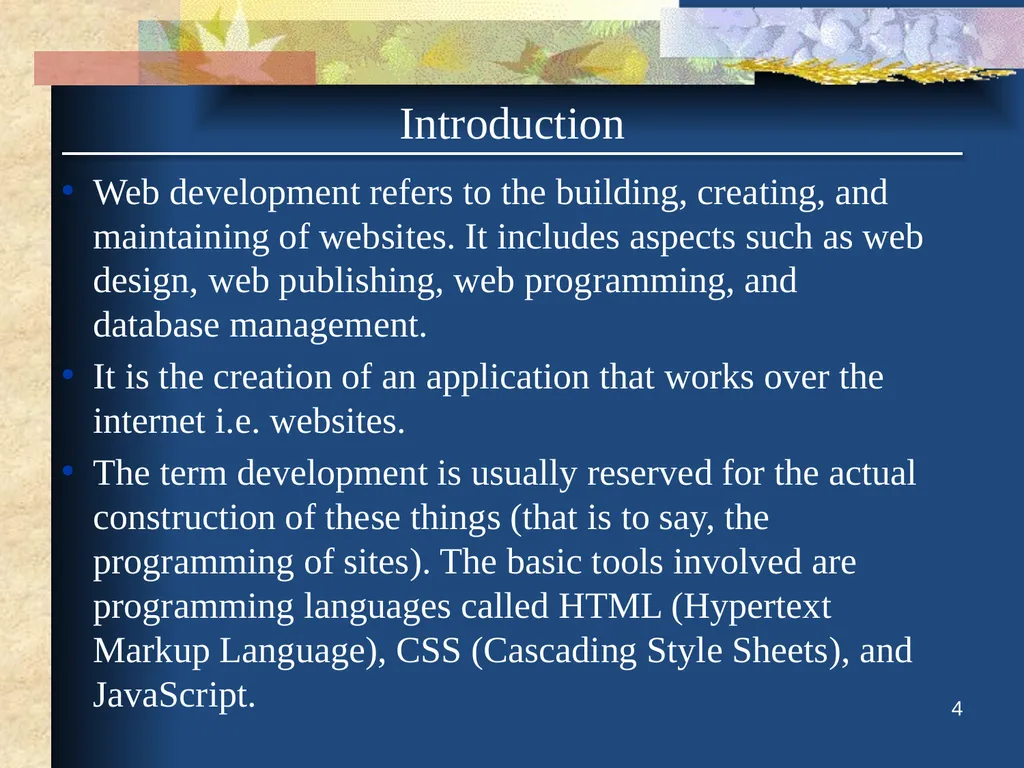
slide4. Introduction Web development refers to the building, creating, and maintaining of websites. It includes aspects such as web design, web publishing, web programming, and database management.
It is the creation of an application that works over the internet i.e. websites.
The term development is usually reserved for the actual construction of these things (that is to say, the programming of sites). The basic tools involved are programming languages called HTML (Hypertext Markup Language), CSS (Cascading Style Sheets), and JavaScript. 4<br>
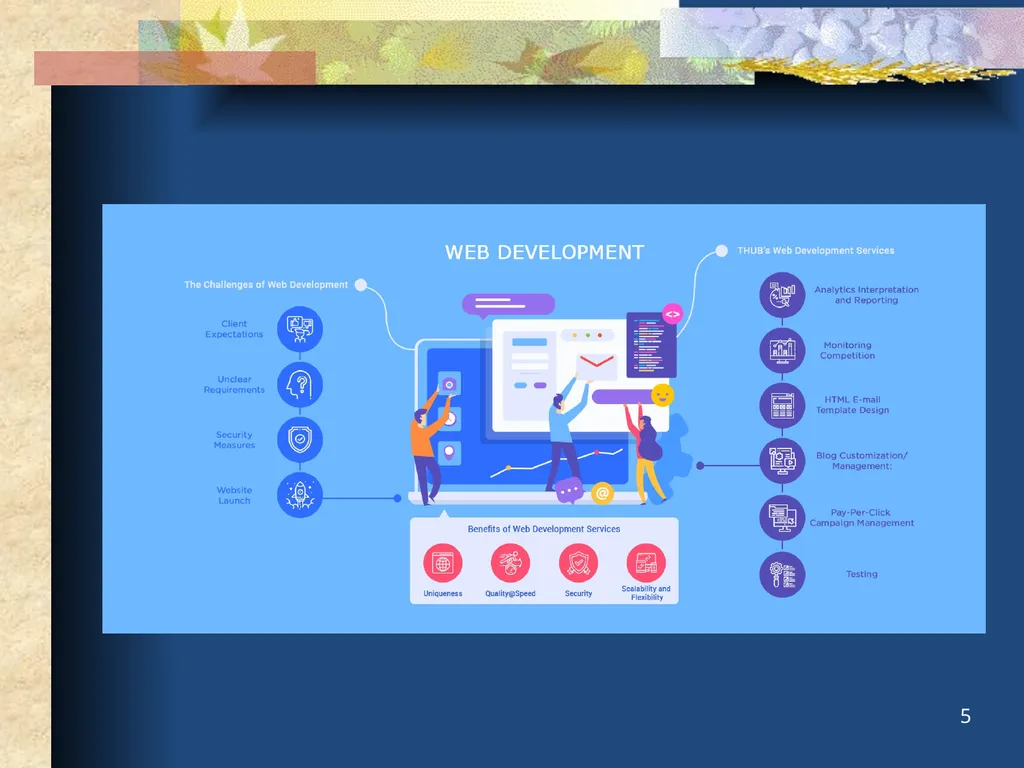
slide5. 5<br>
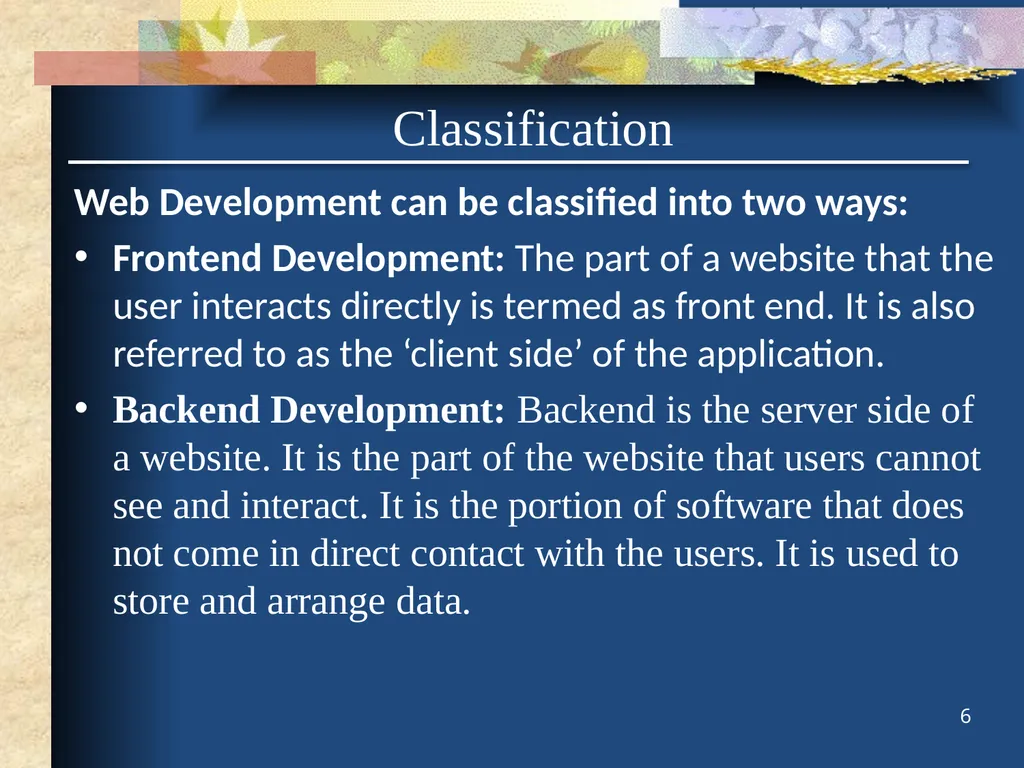
slide6. Web Development can be classified into two ways:
Frontend Development: The part of a website that the user interacts directly is termed as front end. It is also referred to as the ‘client side’ of the application.
Backend Development: Backend is the server side of a website. It is the part of the website that users cannot see and interact. It is the portion of software that does not come in direct contact with the users. It is used to store and arrange data. 6 Classification<br>
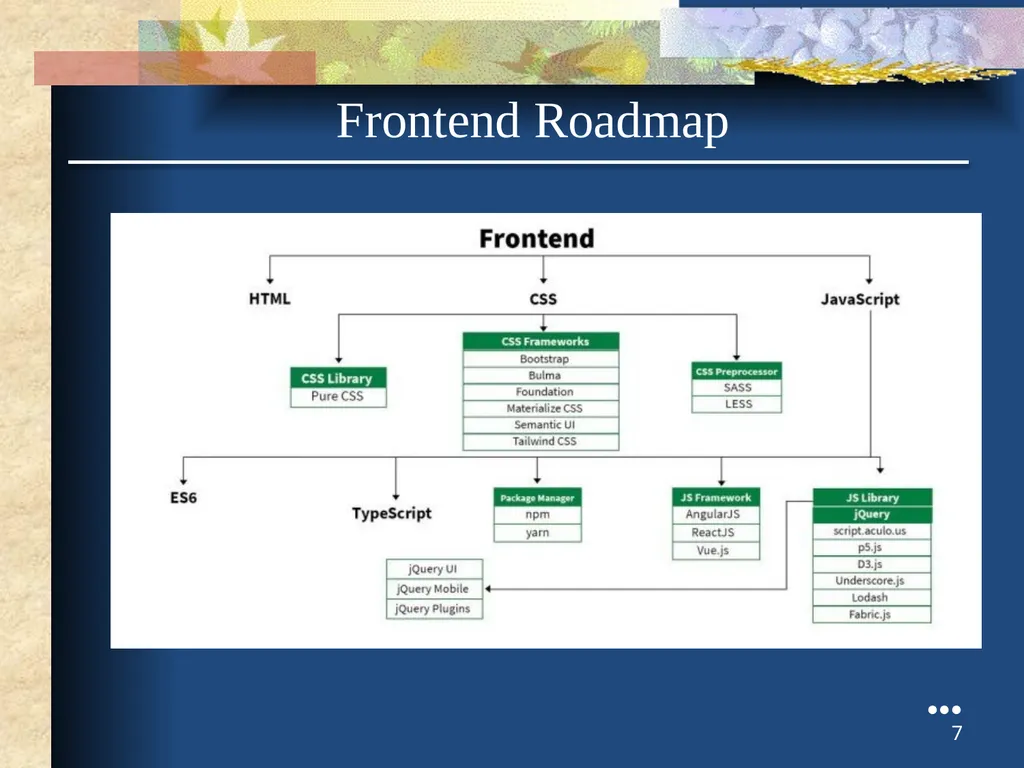
slide7. ●●●
7 Frontend Roadmap<br>
slide8. HTML: HTML stands for HyperText Markup Language. It is used to design the front end portion of web pages using markup language. It acts as a skeleton for a website since it is used to make the structure of a website.
CSS: Cascading Style Sheets fondly referred to as CSS is a simply designed language intended to simplify the process of making web pages presentable. It is used to style our website.
JavaScript: JavaScript is a scripting language used to provide a dynamic behavior to our website. ●●●
8 Frontend Roadmap<br>
slide9. Bootstrap: Bootstrap is a free and open-source tool collection for creating responsive websites and web applications.
It is the most popular CSS framework for developing responsive, mobile-first websites. Nowadays, the websites are perfect for all the browsers (IE, Firefox, and Chrome) and for all sizes of screens (Desktop, Tablets, Phablets, and Phones).
Bootstrap 4
Bootstrap 5 ●●●
9 Frontend Roadmap<br>
slide10. Frontend Frameworks and Libraries:
AngularJS
React.js
VueJS
jQuery
Bootstrap
Material UI
Tailwind CSS
jQuery UI 10 Frontend Roadmap<br>
slide11. Backend Roadmap ●●●
11<br>
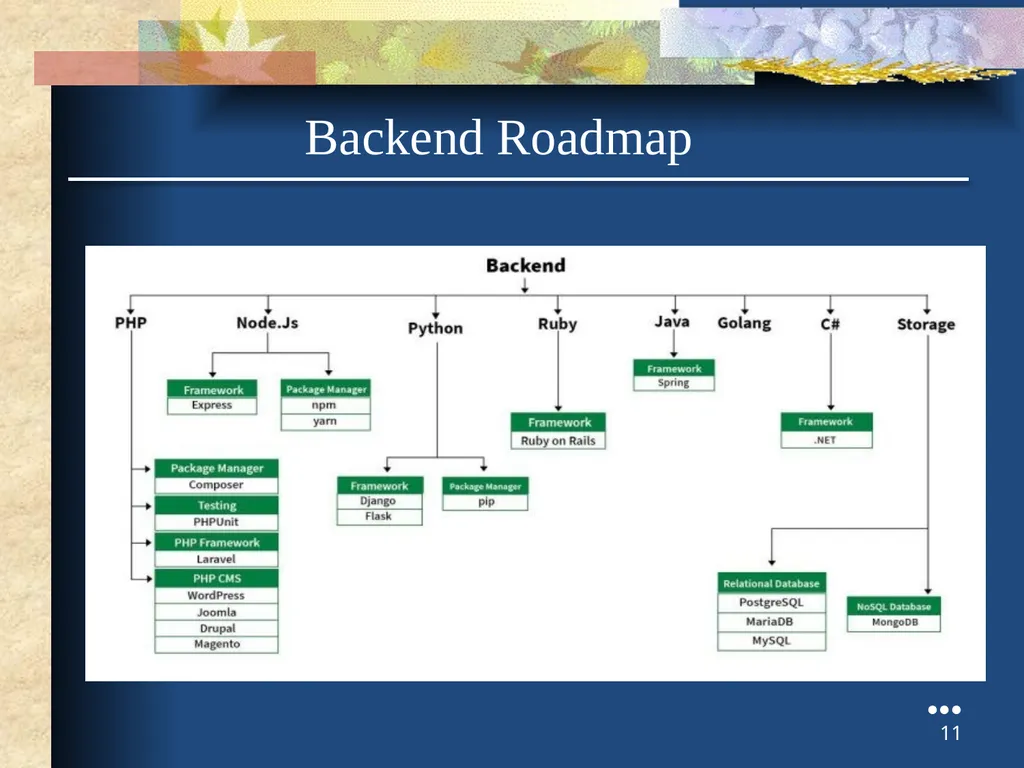
slide12. Backend Roadmap PHP: PHP is a server-side scripting language designed specifically for web development.
Java: Java is one of the most popular and widely used programming language. It is highly scalable.
Python: Python is a programming language that lets you work quickly and integrate systems more efficiently.
Node.js: Node.js is an open source and cross-platform runtime environment for executing JavaScript code outside a browser. ●●●
12<br>
slide13. Backend Roadmap Back End Frameworks
The list of back end frameworks are:
Express,
Django,
Rails,
Laravel,
Spring, etc. 13<br>
slide14. Full-Stack Developer A Full-Stack Developer is someone familiar with both front- and back-end development. They are generalists, adept at wearing both hats, and familiar with every layer of development. Obviously, employers want to hire Full-Stack Developers – according to an Indeed study, they are the fourth-most in-demand job in tech.
If the title is contentious, it’s in the generalist nature of the position. Developers who specialize in the front-end or back-end often bristle at the notion that someone could be equally adept at both – the expression “jack-of-all-trades, master of none” comes to mind. 14<br>
slide15. What Does Web-Developer Do? Translating wireframe designs into working code
Creating the architecture and content of a site
Building in functionality and responsivity
Making a site go live
Updating and renovating sites
Troubleshooting, fixing bugs, and glitches 15<br>
slide16. Tools Used WordPress
Joomla!
Drupal
TYPO3
Adobe Experience Manager
Sketch – A toolkit for digital designs
InVision Cloud – A leading digital product design platform
Sublime Text – A code editor for advanced website design
Foundation – A family of front-end frameworks
Chrome DevTools – Tools from the popular browser that facilitate web development 16<br>
slide17. Conclusion In today's Web development, a good page design is essential. A bad design will lead to the loss of visitors and that can lead to a loss of business. In general, a good page layout has to satisfy the basic elements of a good page design.
This includes color contrast, text organization, font selection, style of a page, page size, graphics used, and consistency. In order to create a well-designed page for a specific audience. 17<br>
slide18. References Google.com
Wikipedia.org
Studymafia.org
Slidespanda.com<br>
slide19. Thanks To StudyMafia.org<br>
Studymafia.org Studymafia.org Web-Development<br>
slide2. Table Contents Definition
Introduction
Classification
Frontend Roadmap
Backend Roadmap
Full-Stack Developer
What does Developer do?
Tools Used
Conclusion 2<br>
slide3. Definition The word Web Development is made up of two words:
Web: It refers to websites, web pages or anything that works over the internet.
Development: Building the application from scratch. 3<br>
slide4. Introduction Web development refers to the building, creating, and maintaining of websites. It includes aspects such as web design, web publishing, web programming, and database management.
It is the creation of an application that works over the internet i.e. websites.
The term development is usually reserved for the actual construction of these things (that is to say, the programming of sites). The basic tools involved are programming languages called HTML (Hypertext Markup Language), CSS (Cascading Style Sheets), and JavaScript. 4<br>
slide5. 5<br>
slide6. Web Development can be classified into two ways:
Frontend Development: The part of a website that the user interacts directly is termed as front end. It is also referred to as the ‘client side’ of the application.
Backend Development: Backend is the server side of a website. It is the part of the website that users cannot see and interact. It is the portion of software that does not come in direct contact with the users. It is used to store and arrange data. 6 Classification<br>
slide7. ●●●
7 Frontend Roadmap<br>
slide8. HTML: HTML stands for HyperText Markup Language. It is used to design the front end portion of web pages using markup language. It acts as a skeleton for a website since it is used to make the structure of a website.
CSS: Cascading Style Sheets fondly referred to as CSS is a simply designed language intended to simplify the process of making web pages presentable. It is used to style our website.
JavaScript: JavaScript is a scripting language used to provide a dynamic behavior to our website. ●●●
8 Frontend Roadmap<br>
slide9. Bootstrap: Bootstrap is a free and open-source tool collection for creating responsive websites and web applications.
It is the most popular CSS framework for developing responsive, mobile-first websites. Nowadays, the websites are perfect for all the browsers (IE, Firefox, and Chrome) and for all sizes of screens (Desktop, Tablets, Phablets, and Phones).
Bootstrap 4
Bootstrap 5 ●●●
9 Frontend Roadmap<br>
slide10. Frontend Frameworks and Libraries:
AngularJS
React.js
VueJS
jQuery
Bootstrap
Material UI
Tailwind CSS
jQuery UI 10 Frontend Roadmap<br>
slide11. Backend Roadmap ●●●
11<br>
slide12. Backend Roadmap PHP: PHP is a server-side scripting language designed specifically for web development.
Java: Java is one of the most popular and widely used programming language. It is highly scalable.
Python: Python is a programming language that lets you work quickly and integrate systems more efficiently.
Node.js: Node.js is an open source and cross-platform runtime environment for executing JavaScript code outside a browser. ●●●
12<br>
slide13. Backend Roadmap Back End Frameworks
The list of back end frameworks are:
Express,
Django,
Rails,
Laravel,
Spring, etc. 13<br>
slide14. Full-Stack Developer A Full-Stack Developer is someone familiar with both front- and back-end development. They are generalists, adept at wearing both hats, and familiar with every layer of development. Obviously, employers want to hire Full-Stack Developers – according to an Indeed study, they are the fourth-most in-demand job in tech.
If the title is contentious, it’s in the generalist nature of the position. Developers who specialize in the front-end or back-end often bristle at the notion that someone could be equally adept at both – the expression “jack-of-all-trades, master of none” comes to mind. 14<br>
slide15. What Does Web-Developer Do? Translating wireframe designs into working code
Creating the architecture and content of a site
Building in functionality and responsivity
Making a site go live
Updating and renovating sites
Troubleshooting, fixing bugs, and glitches 15<br>
slide16. Tools Used WordPress
Joomla!
Drupal
TYPO3
Adobe Experience Manager
Sketch – A toolkit for digital designs
InVision Cloud – A leading digital product design platform
Sublime Text – A code editor for advanced website design
Foundation – A family of front-end frameworks
Chrome DevTools – Tools from the popular browser that facilitate web development 16<br>
slide17. Conclusion In today's Web development, a good page design is essential. A bad design will lead to the loss of visitors and that can lead to a loss of business. In general, a good page layout has to satisfy the basic elements of a good page design.
This includes color contrast, text organization, font selection, style of a page, page size, graphics used, and consistency. In order to create a well-designed page for a specific audience. 17<br>
slide18. References Google.com
Wikipedia.org
Studymafia.org
Slidespanda.com<br>
slide19. Thanks To StudyMafia.org<br>