
Subject: Performing Arts: Dance Topic: Dancing
Description: Subject: Performing Arts: Dance Topic: Dancing Through The Decades Year: 7 1920s Swing: Swing dance is an umbrella term that covers lots of individual styles and techniques. Swing dance combines ballroom and jazz with focus on fast
Related Topics
Download Presentation
"Subject: Performing Arts: Dance Topic: Dancing" is the property of its rightful owner. Permission is granted to download and print the materials on this website for personal, non-commercial use only, and to display it on your personal computer provided you do not modify the materials and that you retain all copyright notices contained in the materials. By downloading content from our website, you accept the terms of this agreement.
Presentation Transcript
slide1. Subject: Performing Arts: Dance
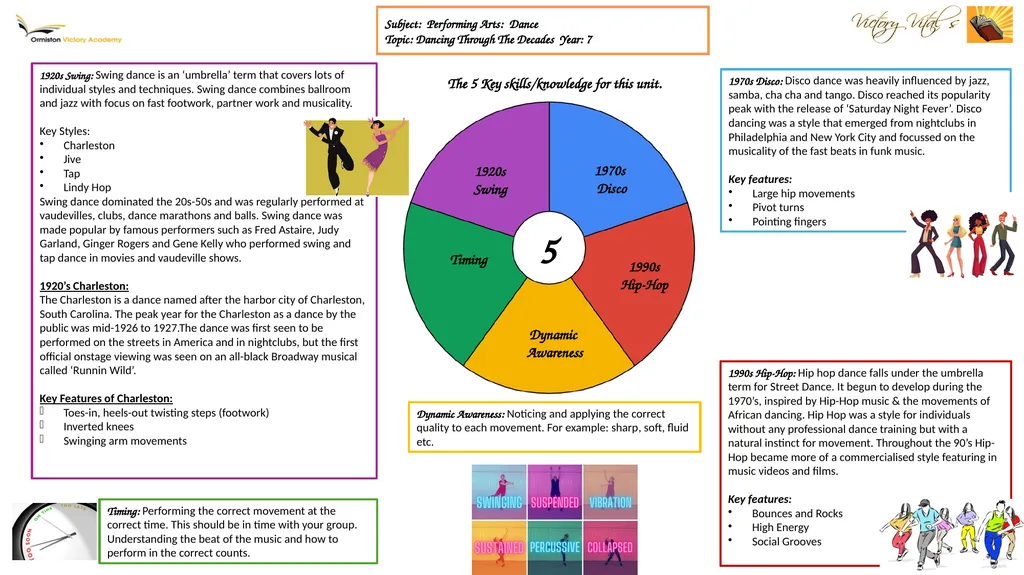
Topic: Dancing Through The Decades Year: 7 1920s Swing: Swing dance is an ‘umbrella’ term that covers lots of individual styles and techniques. Swing dance combines ballroom and jazz with focus on fast footwork, partner work and musicality. Key Styles:
Charleston
Jive
Tap
Lindy Hop
Swing dance dominated the 20s-50s and was regularly performed at vaudevilles, clubs, dance marathons and balls. Swing dance was made popular by famous performers such as Fred Astaire, Judy Garland, Ginger Rogers and Gene Kelly who performed swing and tap dance in movies and vaudeville shows.
1920’s Charleston: The Charleston is a dance named after the harbor city of Charleston, South Carolina. The peak year for the Charleston as a dance by the public was mid-1926 to 1927.The dance was first seen to be performed on the streets in America and in nightclubs, but the first official onstage viewing was seen on an all-black Broadway musical called ‘Runnin Wild’. Key Features of Charleston:
Toes-in, heels-out twisting steps (footwork)
Inverted knees
Swinging arm movements 1970s Disco: Disco dance was heavily influenced by jazz, samba, cha cha and tango. Disco reached its popularity peak with the release of ‘Saturday Night Fever’. Disco dancing was a style that emerged from nightclubs in Philadelphia and New York City and focussed on the musicality of the fast beats in funk music.
Key features:
Large hip movements
Pivot turns
Pointing fingers 1990s Hip-Hop: Hip hop dance falls under the umbrella term for Street Dance. It begun to develop during the 1970’s, inspired by Hip-Hop music & the movements of African dancing. Hip Hop was a style for individuals without any professional dance training but with a natural instinct for movement. Throughout the 90’s Hip-Hop became more of a commercialised style featuring in music videos and films.
Key features:
Bounces and Rocks
High Energy
Social Grooves Dynamic Awareness: Noticing and applying the correct quality to each movement. For example: sharp, soft, fluid etc. Timing: Performing the correct movement at the correct time. This should be in time with your group.
Understanding the beat of the music and how to perform in the correct counts. The 5 Key skills/knowledge for this unit.<br>
slide2. Subject: Performing Arts: Dance
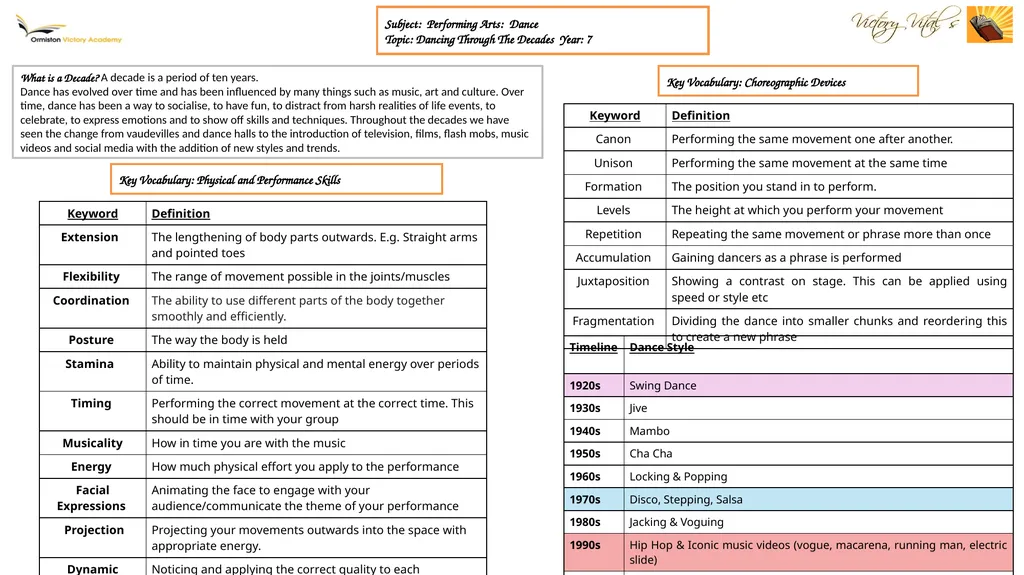
Topic: Dancing Through The Decades Year: 7 Key Vocabulary: Physical and Performance Skills Key Vocabulary: Choreographic Devices What is a Decade? A decade is a period of ten years. Dance has evolved over time and has been influenced by many things such as music, art and culture. Over time, dance has been a way to socialise, to have fun, to distract from harsh realities of life events, to celebrate, to express emotions and to show off skills and techniques. Throughout the decades we have seen the change from vaudevilles and dance halls to the introduction of television, films, flash mobs, music videos and social media with the addition of new styles and trends.<br>
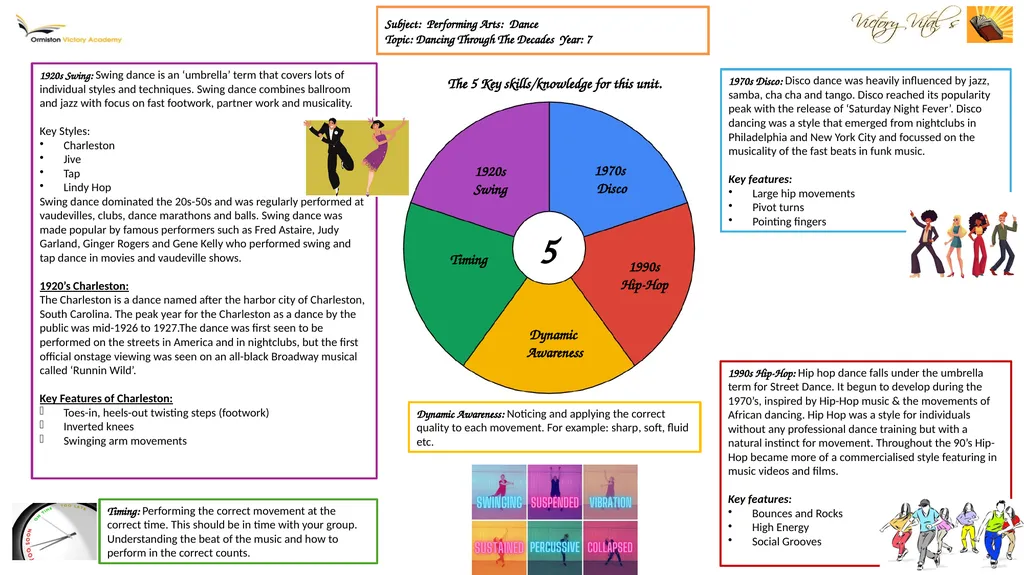
Topic: Dancing Through The Decades Year: 7 1920s Swing: Swing dance is an ‘umbrella’ term that covers lots of individual styles and techniques. Swing dance combines ballroom and jazz with focus on fast footwork, partner work and musicality. Key Styles:
Charleston
Jive
Tap
Lindy Hop
Swing dance dominated the 20s-50s and was regularly performed at vaudevilles, clubs, dance marathons and balls. Swing dance was made popular by famous performers such as Fred Astaire, Judy Garland, Ginger Rogers and Gene Kelly who performed swing and tap dance in movies and vaudeville shows.
1920’s Charleston: The Charleston is a dance named after the harbor city of Charleston, South Carolina. The peak year for the Charleston as a dance by the public was mid-1926 to 1927.The dance was first seen to be performed on the streets in America and in nightclubs, but the first official onstage viewing was seen on an all-black Broadway musical called ‘Runnin Wild’. Key Features of Charleston:
Toes-in, heels-out twisting steps (footwork)
Inverted knees
Swinging arm movements 1970s Disco: Disco dance was heavily influenced by jazz, samba, cha cha and tango. Disco reached its popularity peak with the release of ‘Saturday Night Fever’. Disco dancing was a style that emerged from nightclubs in Philadelphia and New York City and focussed on the musicality of the fast beats in funk music.
Key features:
Large hip movements
Pivot turns
Pointing fingers 1990s Hip-Hop: Hip hop dance falls under the umbrella term for Street Dance. It begun to develop during the 1970’s, inspired by Hip-Hop music & the movements of African dancing. Hip Hop was a style for individuals without any professional dance training but with a natural instinct for movement. Throughout the 90’s Hip-Hop became more of a commercialised style featuring in music videos and films.
Key features:
Bounces and Rocks
High Energy
Social Grooves Dynamic Awareness: Noticing and applying the correct quality to each movement. For example: sharp, soft, fluid etc. Timing: Performing the correct movement at the correct time. This should be in time with your group.
Understanding the beat of the music and how to perform in the correct counts. The 5 Key skills/knowledge for this unit.<br>
slide2. Subject: Performing Arts: Dance
Topic: Dancing Through The Decades Year: 7 Key Vocabulary: Physical and Performance Skills Key Vocabulary: Choreographic Devices What is a Decade? A decade is a period of ten years. Dance has evolved over time and has been influenced by many things such as music, art and culture. Over time, dance has been a way to socialise, to have fun, to distract from harsh realities of life events, to celebrate, to express emotions and to show off skills and techniques. Throughout the decades we have seen the change from vaudevilles and dance halls to the introduction of television, films, flash mobs, music videos and social media with the addition of new styles and trends.<br>