SUSTAINABLE DEVELOPMENT UNIT: 4 CONTENTS Concept Of Sustainable Development Notion Of Sustainability: Strong And Weak Indicators Of Sustainable Development Environmental Impact Assessment Concept Of Sustainable Development Sustainable
"SUSTAINABLE DEVELOPMENT UNIT: 4 CONTENTS Concept" is the property of its rightful owner. Permission is granted to
download and print the materials on this website for personal, non-commercial use only, and to display it
on your personal computer provided you do not modify the materials and that you retain all copyright
notices contained in the materials. By downloading content from our website, you accept the terms of this
agreement.
Presentation Transcript
01
SUSTAINABLE DEVELOPMENT UNIT: 4<br>
02
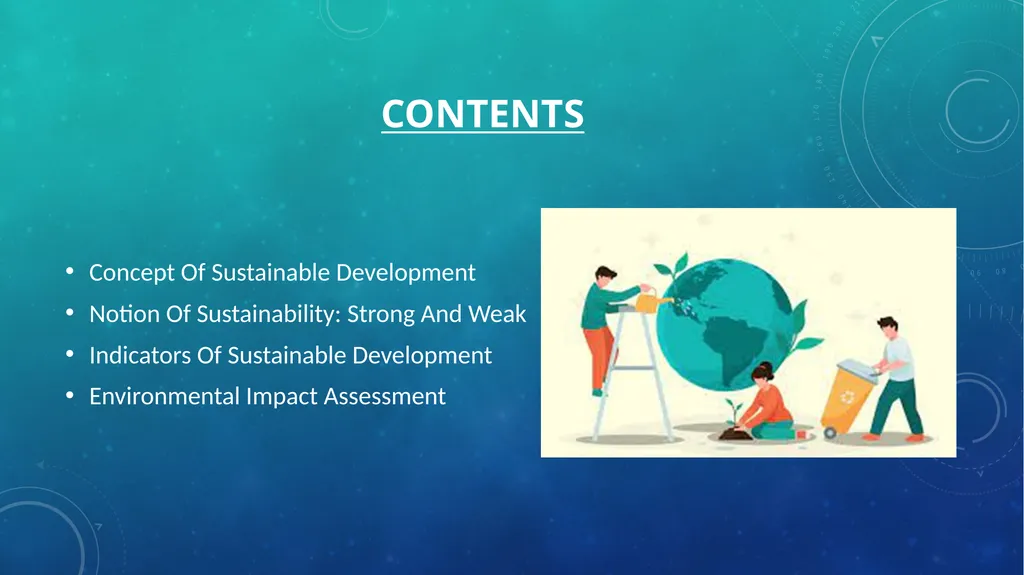
CONTENTS Concept Of Sustainable Development
Notion Of Sustainability: Strong And Weak
Indicators Of Sustainable Development
Environmental Impact Assessment<br>
03
Concept Of Sustainable Development Sustainable development is the idea that human societies must live and meet their needs without compromising the ability of future generations to meet their own needs.
The concept of sustainable development was described by the 1987 Bruntland Commission Report as “development that meets the needs of the present without compromising the ability of future generations to meet their own needs.”
Specifically, sustainable development is a way of organizing society so that it can exist in the long term.
Using recycled materials or renewable resources when building is an example of sustainable development.
Sustainability is a paradigm for thinking about the future in which environmental, societal and economic considerations are balanced in the pursuit of an improved quality of life. For example, a prosperous society relies on a healthy environment to provide food and resources, safe drinking water and clean air for its citizens.<br>
04
What are the Sustainable Development Goals? The Sustainable Development Goals (SDGs), also known as the Global Goals, were adopted by all United Nations Member States in 2015 as a universal call to action to end poverty, protect the planet and ensure that all people enjoy peace and prosperity by 2030.<br>
05
Notion of sustainability weak sustainability strong sustainability Weak sustainability is an idea within environmental economics which states that 'human capital' can substitute 'natural capital'. It is based upon the work of Nobel Laureate Robert Solow and John Hartwick. Contrary to weak sustainability, strong sustainability assumes that "human capital" and "natural capital" are complementary, but not interchangeable.
Weak sustainability assumes that everything is substitutable and assumes that total capital stock should be non-decreasing, so the contributions of the natural world to economic production (‘natural capital’) and to manufactured capital are substitutable. Strong sustainability focuses on keeping the resource stock constant over time and focuses on the optimal scale of economic activity.<br>
06
Weak sustainability has been defined using concepts like human capital and natural capital.] Human (or produced) capital incorporates resources such as infrastructure, labour and knowledge. Natural capital covers the stock of environmental assets such as fossil fuels, biodiversity and other ecosystem structures and functions relevant for ecosystem services. In very weak sustainability, the overall stock of man-made capital and natural capital remains constant over time. It is important to note that, unconditional substitution between the various kinds of capital is allowed within weak sustainability. This means that natural resources may decline as long as human capital is increased. Examples include the degradation of the ozone layer, tropical forests and coral reefs if accompanied by benefits to human capital. An example of the benefit to human capital could include increased financial profits. If capital is left constant over time intergenerational equity, and thus Sustainable Development, is achieved. An example of weak sustainability could be mining coal and using it for production of electricity. The natural resource coal, is replaced by a manufactured good which is electricity. The electricity is then in turn used to improve domestic life quality (e.g. cooking, lighting, heating, refrigeration and operating boreholes to supply water in some villages) and for industrial purposes (growing the economy by producing other resources using machines that are electricity operated.)<br>
07
Strong sustainability assumes that the economic and environmental capital is complementary, but not interchangeable. Strong sustainability accepts there are certain functions that the environment performs that cannot be duplicated by humans or human made capital. The ozone layer is one example of an ecosystem service that is crucial for human existence, forms part of natural capital, but is difficult for humans to duplicate.
Unlike weak sustainability, strong sustainability puts the emphasis on ecological scale over economic gains. This implies that nature has a right to exist and that it has been borrowed and should be passed on from one generation to the next still intact in its original form.
An example of strong sustainability could be the manufacturing of office carpet tiles from used car tyres. In this scenario, office carpets and other products are manufactured from used motorcar tires that would have been sent to a landfill.<br>
08
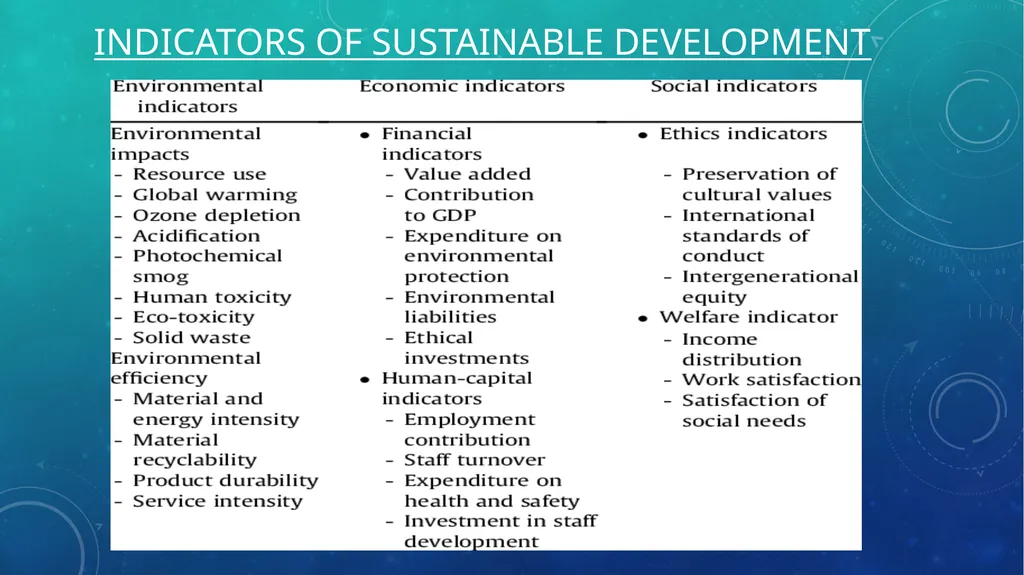
Indicators Of Sustainable Development<br>
09
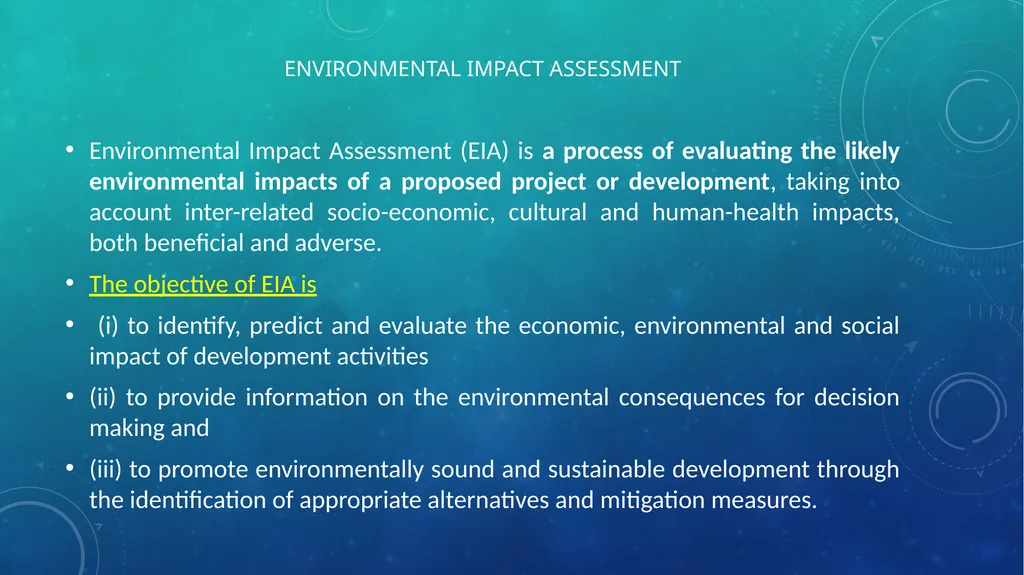
Environmental Impact Assessment Environmental Impact Assessment (EIA) is a process of evaluating the likely environmental impacts of a proposed project or development, taking into account inter-related socio-economic, cultural and human-health impacts, both beneficial and adverse.
The objective of EIA is
(i) to identify, predict and evaluate the economic, environmental and social impact of development activities
(ii) to provide information on the environmental consequences for decision making and
(iii) to promote environmentally sound and sustainable development through the identification of appropriate alternatives and mitigation measures.<br>
10
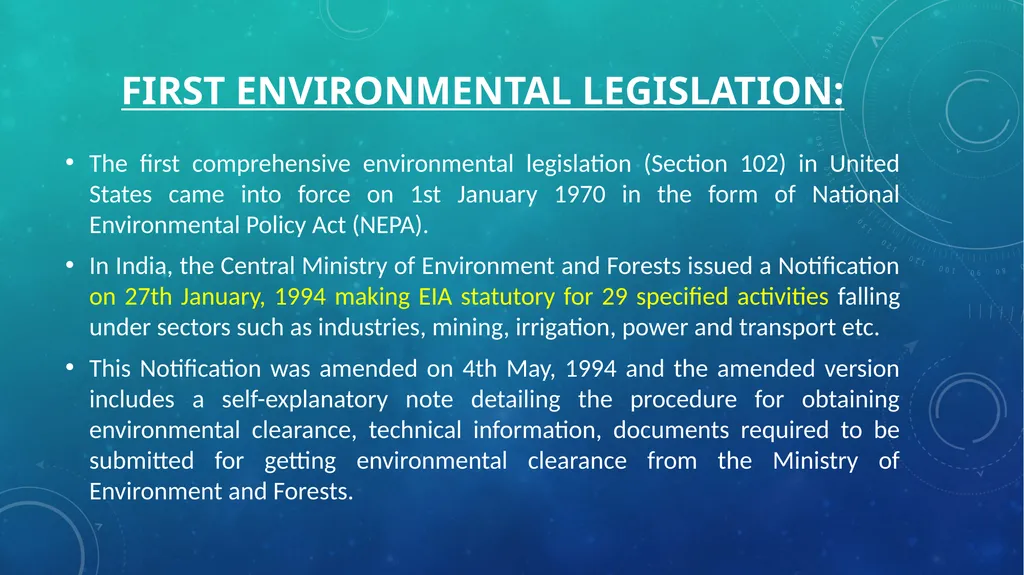
First Environmental Legislation: The first comprehensive environmental legislation (Section 102) in United States came into force on 1st January 1970 in the form of National Environmental Policy Act (NEPA).
In India, the Central Ministry of Environment and Forests issued a Notification on 27th January, 1994 making EIA statutory for 29 specified activities falling under sectors such as industries, mining, irrigation, power and transport etc.
This Notification was amended on 4th May, 1994 and the amended version includes a self-explanatory note detailing the procedure for obtaining environmental clearance, technical information, documents required to be submitted for getting environmental clearance from the Ministry of Environment and Forests.<br>
11
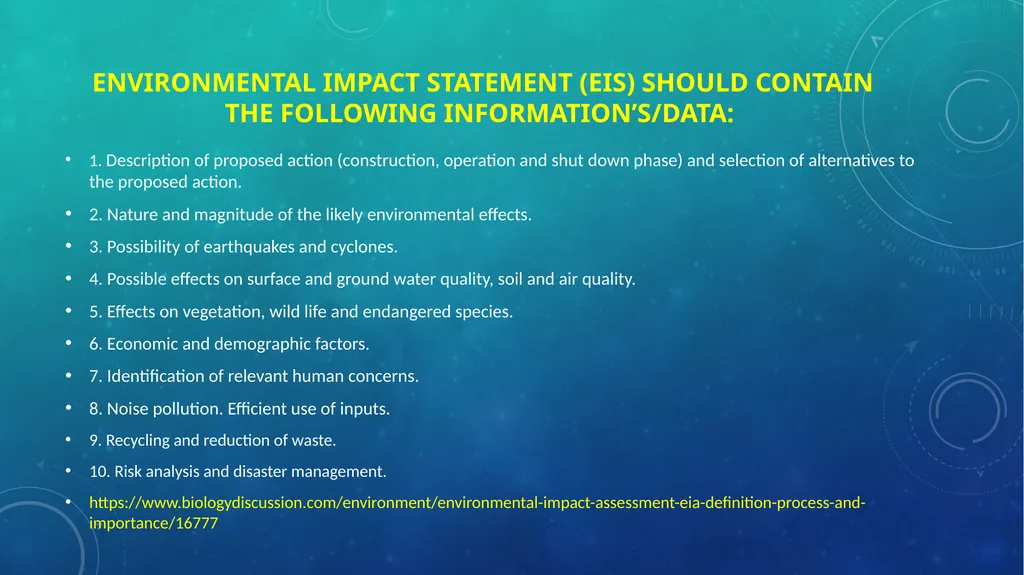
Environmental Impact Statement (EIS) should contain the following information’s/data: 1. Description of proposed action (construction, operation and shut down phase) and selection of alternatives to the proposed action.
2. Nature and magnitude of the likely environmental effects.
3. Possibility of earthquakes and cyclones.
4. Possible effects on surface and ground water quality, soil and air quality.
5. Effects on vegetation, wild life and endangered species.
6. Economic and demographic factors.
7. Identification of relevant human concerns.
8. Noise pollution. Efficient use of inputs.
9. Recycling and reduction of waste.
10. Risk analysis and disaster management.
https://www.biologydiscussion.com/environment/environmental-impact-assessment-eia-definition-process-and-importance/16777<br>