
T ABLE OF CONTENTS 1 Programme
MJ
Published · 16 slides · 0 views

1 / 1
Description
T ABLE OF CONTENTS 1 Programme Rationale03 2 Programme Background.04 3 Programme Objectives.05 4 Programme
Related Topics
Share
Embed code
Download this presentation From Below
"T ABLE OF CONTENTS 1 Programme" is the property of its rightful owner. Permission is granted to download and print the materials on this website for personal, non-commercial use only, and to display it on your personal computer provided you do not modify the materials and that you retain all copyright notices contained in the materials. By downloading content from our website, you accept the terms of this agreement.
Presentation Transcript
01
T ABLE OF CONTENTS 1 Programme Rationale………………………………………………………………………………………03
2 Programme Background………………………………………………………………………………….04
3 Programme Objectives…………………………………………………………………………………….05
4 Programme Framework……………………………………………………………………………………06
5 Programme Courses………………………………………………………………………………………..08
Knowing Module (01): Political Parties in Democratic Societies………….…….09
Acting Module (02): Political Parties in Election Campaigning……….………….09
Serving Module (03): Political Parties in Local Governance
and Development…………………………………………………………………………………….10
Connecting Module (04): Political Parties in Europe and Germany…………..10
6 Programme Evaluation and Completion…………………………………………………….……11
7 Eligibility Criteria………………………………………………………………………………………….…..12
8 Participants’ Responsibilities……………………………………………………………………….…..12
9 Foundation’s Role………………………………………………………………………….....................13
10 Application Process……………………………………………………………………………………....13
11 Application Documents………………………………………………………………………………...14
12 Submission Details………………………………………………………………………………………..14
13 References…………………………………………………………………………………………………….15 2<br>
2 Programme Background………………………………………………………………………………….04
3 Programme Objectives…………………………………………………………………………………….05
4 Programme Framework……………………………………………………………………………………06
5 Programme Courses………………………………………………………………………………………..08
Knowing Module (01): Political Parties in Democratic Societies………….…….09
Acting Module (02): Political Parties in Election Campaigning……….………….09
Serving Module (03): Political Parties in Local Governance
and Development…………………………………………………………………………………….10
Connecting Module (04): Political Parties in Europe and Germany…………..10
6 Programme Evaluation and Completion…………………………………………………….……11
7 Eligibility Criteria………………………………………………………………………………………….…..12
8 Participants’ Responsibilities……………………………………………………………………….…..12
9 Foundation’s Role………………………………………………………………………….....................13
10 Application Process……………………………………………………………………………………....13
11 Application Documents………………………………………………………………………………...14
12 Submission Details………………………………………………………………………………………..14
13 References…………………………………………………………………………………………………….15 2<br>
02
1 PROGRAMME RATIONALE A key task for consolidating democracy is strengthening the political party system. Political parties perform four elementary and interrelated functions for modern, representative democracy: they aggregate the population’s interests and channel their demands and proposals from the grassroots to governments and parliament, they train, select and propose leaders for elections and government roles, through parliaments and elections they supervise the government, and they develop and evaluate policy alternatives (Catón, 2007). However, in young democracies, parties’ performance of these functions is often weak. Parties fail to link citizens with the state (Wild, Foresti, & Domingo, 2011), because they lack internal party democracy (Svåsand, 2014), have an electoral instead of programmatic party orientation (Wild, Foresti, & Domingo, 2011), and their institutionalization is marred by patronage and personalistic structures around strong leaders (Catón, 2007).
While the causes for these shortcomings are complex and contingent of each country’s specific context, some factors are common to many party systems in young democracies: a compressed transition from autocracy to democracy, weak Rule of Law, poverty and inequality, anti-political legacies among citizens, and presidential systems of government with weak parliaments (Carothers, 2014).
Asian political parties are no strangers to these challenges. The record electoral year of 2019, with five massive and vibrant national elections in the region, masks a worrying trend: the consolidation process of Asian democracies is struggling. A bouquet of formal requirements such as Constitutions that prescribe separation of powers, institutional checks and balances, multi-party systems and legal recognition of civil liberties are largely in place throughout the region. But underneath the formalities, structures of power co-optation, clientelism, corruption, exclusion and sectarianism persist; illiberal and authoritarian forces remain strong (Pepinsky, 2017). In Southeast Asia, political participation – measured by voter turnout and mobilization – increased, for example in Malaysia since 2018, but the overall situation in Cambodia, India, Indonesia, the Philippines, Thailand and Vietnam is deteriorating since 2016 or earlier (Sharp, 2019).
Against this background, international party assistance (IPA) has become a cornerstone of international development’s efforts for democracy and capacity-development programmes are the most common tools for IPA. 3<br>
While the causes for these shortcomings are complex and contingent of each country’s specific context, some factors are common to many party systems in young democracies: a compressed transition from autocracy to democracy, weak Rule of Law, poverty and inequality, anti-political legacies among citizens, and presidential systems of government with weak parliaments (Carothers, 2014).
Asian political parties are no strangers to these challenges. The record electoral year of 2019, with five massive and vibrant national elections in the region, masks a worrying trend: the consolidation process of Asian democracies is struggling. A bouquet of formal requirements such as Constitutions that prescribe separation of powers, institutional checks and balances, multi-party systems and legal recognition of civil liberties are largely in place throughout the region. But underneath the formalities, structures of power co-optation, clientelism, corruption, exclusion and sectarianism persist; illiberal and authoritarian forces remain strong (Pepinsky, 2017). In Southeast Asia, political participation – measured by voter turnout and mobilization – increased, for example in Malaysia since 2018, but the overall situation in Cambodia, India, Indonesia, the Philippines, Thailand and Vietnam is deteriorating since 2016 or earlier (Sharp, 2019).
Against this background, international party assistance (IPA) has become a cornerstone of international development’s efforts for democracy and capacity-development programmes are the most common tools for IPA. 3<br>
03
2 PROGRAMME BACKGROUND The Konrad Adenauer School for Young Politicians (KASYP) is a capacity-development programme implemented by the Regional Programme Political Dialogue Asia of the Konrad Adenauer Stiftung (KASPDA) since March 2010. Throughout its eleven years of existence, KASYP’s overarching objective has been to contribute to KASPDA’s goal of fostering representative and accountable democratic parties in the region through strengthening young members’ capacities.
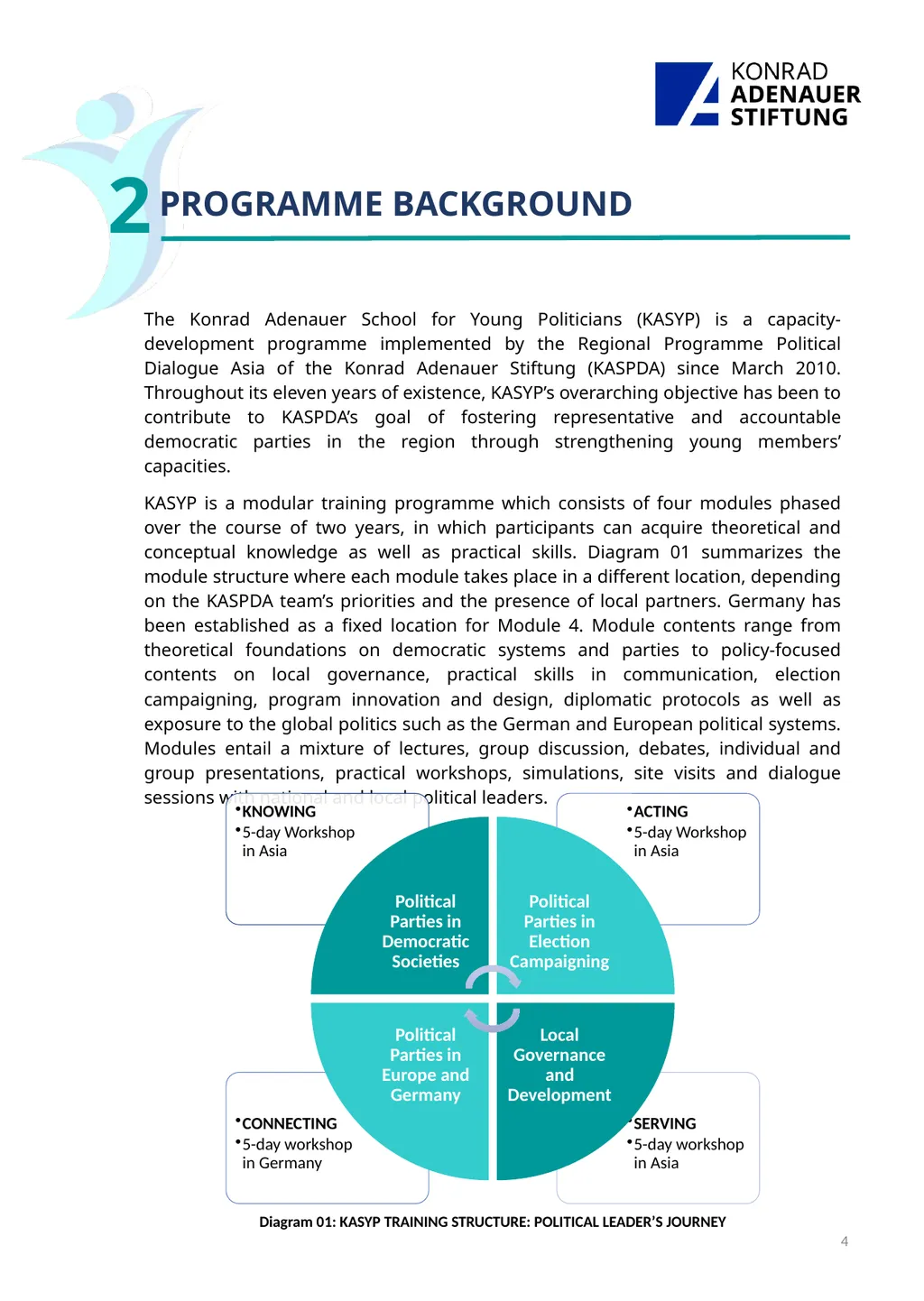
KASYP is a modular training programme which consists of four modules phased over the course of two years, in which participants can acquire theoretical and conceptual knowledge as well as practical skills. Diagram 01 summarizes the module structure where each module takes place in a different location, depending on the KASPDA team’s priorities and the presence of local partners. Germany has been established as a fixed location for Module 4. Module contents range from theoretical foundations on democratic systems and parties to policy-focused contents on local governance, practical skills in communication, election campaigning, program innovation and design, diplomatic protocols as well as exposure to the global politics such as the German and European political systems. Modules entail a mixture of lectures, group discussion, debates, individual and group presentations, practical workshops, simulations, site visits and dialogue sessions with national and local political leaders. 4 Diagram 01: KASYP TRAINING STRUCTURE: POLITICAL LEADER’S JOURNEY<br>
KASYP is a modular training programme which consists of four modules phased over the course of two years, in which participants can acquire theoretical and conceptual knowledge as well as practical skills. Diagram 01 summarizes the module structure where each module takes place in a different location, depending on the KASPDA team’s priorities and the presence of local partners. Germany has been established as a fixed location for Module 4. Module contents range from theoretical foundations on democratic systems and parties to policy-focused contents on local governance, practical skills in communication, election campaigning, program innovation and design, diplomatic protocols as well as exposure to the global politics such as the German and European political systems. Modules entail a mixture of lectures, group discussion, debates, individual and group presentations, practical workshops, simulations, site visits and dialogue sessions with national and local political leaders. 4 Diagram 01: KASYP TRAINING STRUCTURE: POLITICAL LEADER’S JOURNEY<br>
04
3 PROGRAMME OBJECTIVES Additionally, KASYP features compulsory leadership training and modular assignments throughout the programme, the Bridging Democratic Leadership (BDL). Successful applicants will undergo the BDL throughout the first three modules under different themes of Ownership, Co-ownership, and Co-creation. Apart from the BDL, participants are required to deliver outputs pertaining to their communication skills, leadership journey, election campaign plan, project design, and a final class project documenting their learning journey.
Per its design, KASYP provides its participants with the possibility of exchange with peers from other Asian countries, from competing parties of their home countries, and from European countries. This exchange is fostered beyond KASYP through annual alumni events and social networking platforms. 5 This project has its fundamentals in the realisation that parties require as much nurturing and attention as any other political institution in a democratic process. Well-run political parties anchored on sound development-platforms contribute to mature democratic ideals and principles.
Therefore, the main goal of this two-year programme is to develop a cadre of young political leaders who will take lead in the advancement of responsiveness and accountability of political parties in Asia.
The two-year programme aims to achieve the following objectives:
Strengthen participants’ democratic knowledge through a better understanding and appreciation of the role and functioning of political parties in democratic societies, the importance of intra-party democracy, principles of good governance, advantages and disadvantages of different political systems, free and fair elections, press freedom, disinformation, the market economy, sustainable development goals, multilateralism, and other aspects of democratic governance.<br>
Per its design, KASYP provides its participants with the possibility of exchange with peers from other Asian countries, from competing parties of their home countries, and from European countries. This exchange is fostered beyond KASYP through annual alumni events and social networking platforms. 5 This project has its fundamentals in the realisation that parties require as much nurturing and attention as any other political institution in a democratic process. Well-run political parties anchored on sound development-platforms contribute to mature democratic ideals and principles.
Therefore, the main goal of this two-year programme is to develop a cadre of young political leaders who will take lead in the advancement of responsiveness and accountability of political parties in Asia.
The two-year programme aims to achieve the following objectives:
Strengthen participants’ democratic knowledge through a better understanding and appreciation of the role and functioning of political parties in democratic societies, the importance of intra-party democracy, principles of good governance, advantages and disadvantages of different political systems, free and fair elections, press freedom, disinformation, the market economy, sustainable development goals, multilateralism, and other aspects of democratic governance.<br>
05
4 PROGRAMME FRAMEWORK Enhance participants’ political skills through training and mastery in communication and presentation (pitching, framing, storytelling, debate, public speaking), election campaign strategy (campaign planning), governance and development (negotiation, systems and design thinking), and engagement and networking (diplomacy protocols).
Nurture participants’ democratic values and principles through the practice and embodiment of accountability, transparency, human rights, freedom of speech, justice, equality, diversity, rule of law, truth, tolerance, popular sovereignty, and other liberal democratic values and principles.
Expand participants’ network through offline and online peer-to-peer exchange and dialogue with local and national leaders from Asia and Europe.
Contribute to the improvement of their respective political parties’ internal capacity in terms of organization, administration, outreach, membership strategy, party platform, election strategy, training and resource material development, and many more. 6 As a capacity-development programme, KASYP adopts the adult learning principles (Knowles, 1984) and the learning domains (Bloom, 1956) to comprise the KASYP programme framework. Bloom’s taxonomy will guide the programme framework to ensure that the modules’ content will address the cognitive domain (democratic knowledge), psychomotor or skills domain (political skills), and affective domain (democratic values and principles). Another aspect of the framework is the programme design and delivery which will employ andragogy considering that participants are from 24 – 35 years old. This means that participants will be involved in the planning and evaluation of the programme, participants’ experiences will provide the basis for their learning activities, topics will be chosen based on the relevance and impact on the participants’ professional and personal lives, and the programme will be problem-centred rather than content-oriented.<br>
Nurture participants’ democratic values and principles through the practice and embodiment of accountability, transparency, human rights, freedom of speech, justice, equality, diversity, rule of law, truth, tolerance, popular sovereignty, and other liberal democratic values and principles.
Expand participants’ network through offline and online peer-to-peer exchange and dialogue with local and national leaders from Asia and Europe.
Contribute to the improvement of their respective political parties’ internal capacity in terms of organization, administration, outreach, membership strategy, party platform, election strategy, training and resource material development, and many more. 6 As a capacity-development programme, KASYP adopts the adult learning principles (Knowles, 1984) and the learning domains (Bloom, 1956) to comprise the KASYP programme framework. Bloom’s taxonomy will guide the programme framework to ensure that the modules’ content will address the cognitive domain (democratic knowledge), psychomotor or skills domain (political skills), and affective domain (democratic values and principles). Another aspect of the framework is the programme design and delivery which will employ andragogy considering that participants are from 24 – 35 years old. This means that participants will be involved in the planning and evaluation of the programme, participants’ experiences will provide the basis for their learning activities, topics will be chosen based on the relevance and impact on the participants’ professional and personal lives, and the programme will be problem-centred rather than content-oriented.<br>
06
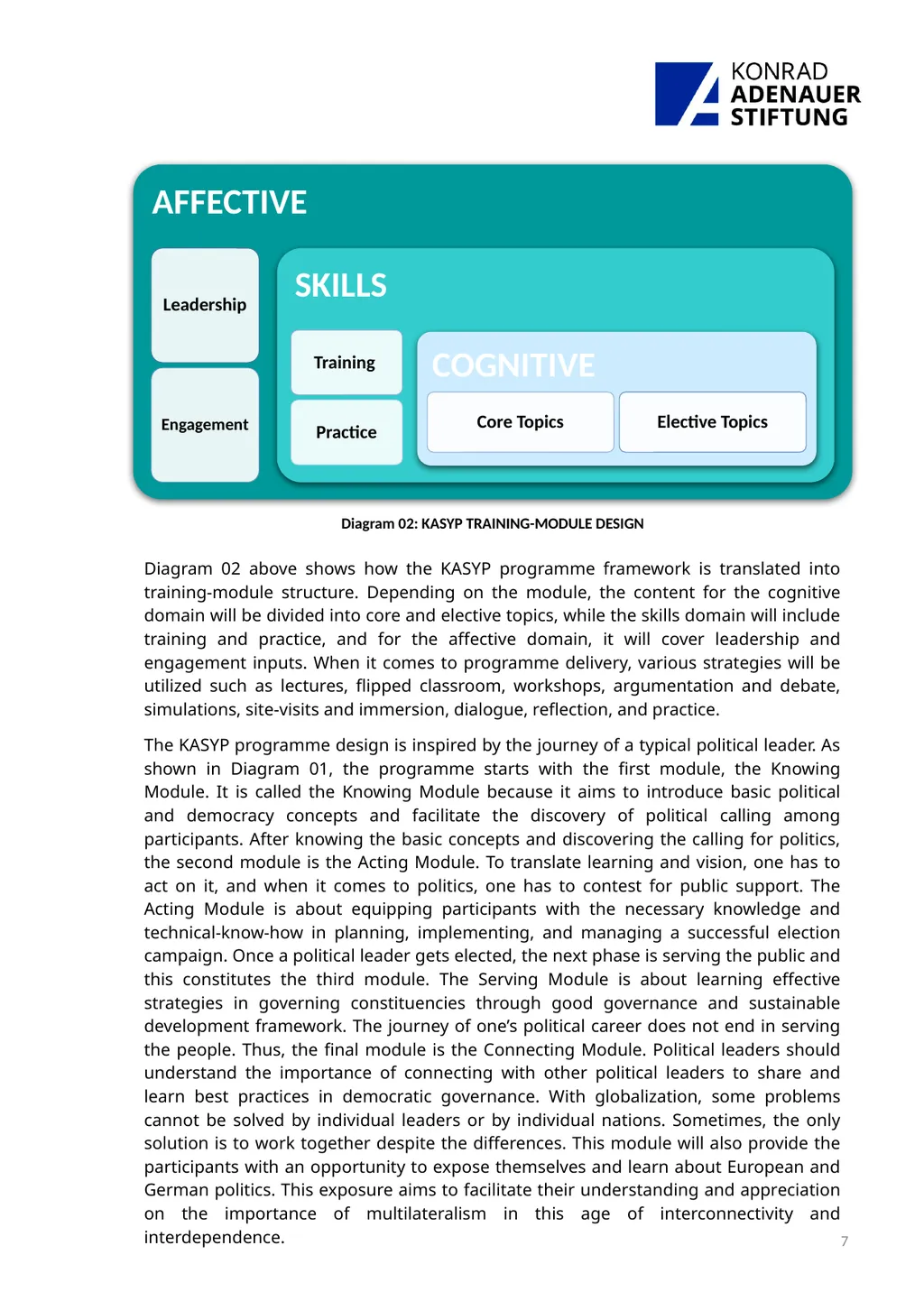
7 Diagram 02 above shows how the KASYP programme framework is translated into training-module structure. Depending on the module, the content for the cognitive domain will be divided into core and elective topics, while the skills domain will include training and practice, and for the affective domain, it will cover leadership and engagement inputs. When it comes to programme delivery, various strategies will be utilized such as lectures, flipped classroom, workshops, argumentation and debate, simulations, site-visits and immersion, dialogue, reflection, and practice.
The KASYP programme design is inspired by the journey of a typical political leader. As shown in Diagram 01, the programme starts with the first module, the Knowing Module. It is called the Knowing Module because it aims to introduce basic political and democracy concepts and facilitate the discovery of political calling among participants. After knowing the basic concepts and discovering the calling for politics, the second module is the Acting Module. To translate learning and vision, one has to act on it, and when it comes to politics, one has to contest for public support. The Acting Module is about equipping participants with the necessary knowledge and technical-know-how in planning, implementing, and managing a successful election campaign. Once a political leader gets elected, the next phase is serving the public and this constitutes the third module. The Serving Module is about learning effective strategies in governing constituencies through good governance and sustainable development framework. The journey of one’s political career does not end in serving the people. Thus, the final module is the Connecting Module. Political leaders should understand the importance of connecting with other political leaders to share and learn best practices in democratic governance. With globalization, some problems cannot be solved by individual leaders or by individual nations. Sometimes, the only solution is to work together despite the differences. This module will also provide the participants with an opportunity to expose themselves and learn about European and German politics. This exposure aims to facilitate their understanding and appreciation on the importance of multilateralism in this age of interconnectivity and interdependence. Diagram 02: KASYP TRAINING-MODULE DESIGN<br>
The KASYP programme design is inspired by the journey of a typical political leader. As shown in Diagram 01, the programme starts with the first module, the Knowing Module. It is called the Knowing Module because it aims to introduce basic political and democracy concepts and facilitate the discovery of political calling among participants. After knowing the basic concepts and discovering the calling for politics, the second module is the Acting Module. To translate learning and vision, one has to act on it, and when it comes to politics, one has to contest for public support. The Acting Module is about equipping participants with the necessary knowledge and technical-know-how in planning, implementing, and managing a successful election campaign. Once a political leader gets elected, the next phase is serving the public and this constitutes the third module. The Serving Module is about learning effective strategies in governing constituencies through good governance and sustainable development framework. The journey of one’s political career does not end in serving the people. Thus, the final module is the Connecting Module. Political leaders should understand the importance of connecting with other political leaders to share and learn best practices in democratic governance. With globalization, some problems cannot be solved by individual leaders or by individual nations. Sometimes, the only solution is to work together despite the differences. This module will also provide the participants with an opportunity to expose themselves and learn about European and German politics. This exposure aims to facilitate their understanding and appreciation on the importance of multilateralism in this age of interconnectivity and interdependence. Diagram 02: KASYP TRAINING-MODULE DESIGN<br>
07
8 5 PROGRAMME COURSES<br>
08
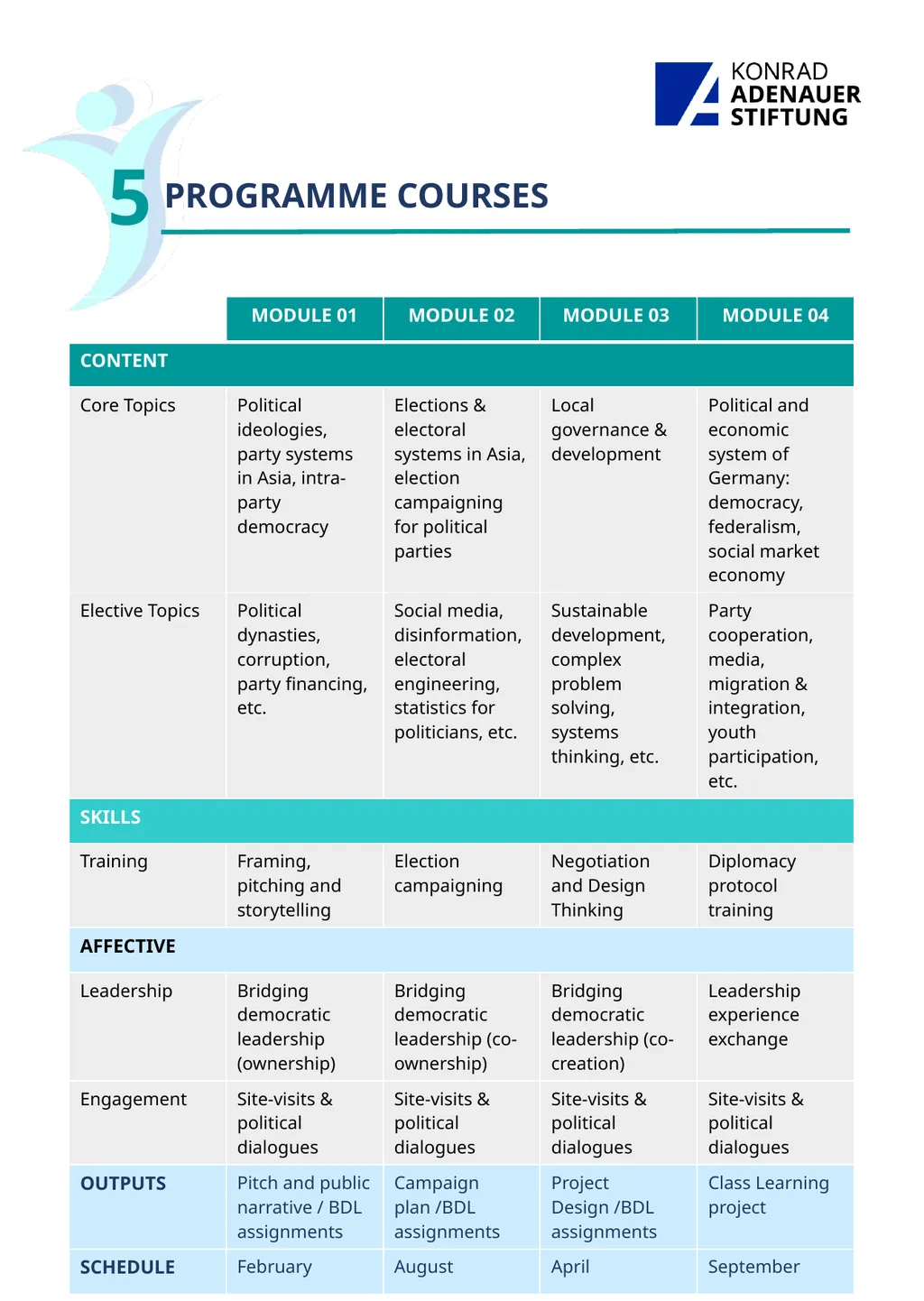
9 Main Objective: To provide participants with background knowledge on diverse political and party systems in Asia, skills in communication and party platform development, and training on democratic leadership (first session on ownership).
Core topics would include political ideologies, intra-party democracy, and political and party systems in Asia. To complement these core topics, there will be elective topics based on the learning needs of the participants. Options for the elective topics may include political dynasties, corruption, transparency and accountability, party financing, etc. Meanwhile, for skills training, participants will undergo a workshop on pitching, framing, storytelling, public speaking, and party platform development. The final input of module one will be a workshop on democratic leadership values through the Bridging Democratic Leadership framework. Session 01 of the BDL will focus on the topic of ownership.
Each module will have corresponding deliverables. For this module, the required output are the following: pitching, storytelling, and BDL outputs (leadership journey, leadership capital and development plan, giving voice to values, and public narrative).
The inaugural workshop is usually held around February and the class meets in one of the Asian countries. KNOWING MODULE (01): Political Parties in Democratic Societies Main Objective: To provide participants with the understanding and skills of electoral campaigning and its many tools as well as the importance of providing organized electoral choices to citizens through political parties, and training on democratic leadership (second session on co-ownership).
Core topics for this module will cover electoral campaigning for political parties and electoral systems in Asia, and campaigning strategies for political parties. Meanwhile, elective topics may include social media, freedom of speech, disinformation, statistics for politicians, big data, electoral engineering, etc. For the skills domain, there will be an election campaigning simulation and campaign planning training. The affective domain will continue with the second session of the BDL. For this session, the participants will tackle the topic on co-ownership.
The outputs for this module are the election campaign plan and the BDL assignments. Participants are expected to meet around August for the second module in another Asian country. ACTING MODULE (02): Political Parties in Election Campaigning<br>
Core topics would include political ideologies, intra-party democracy, and political and party systems in Asia. To complement these core topics, there will be elective topics based on the learning needs of the participants. Options for the elective topics may include political dynasties, corruption, transparency and accountability, party financing, etc. Meanwhile, for skills training, participants will undergo a workshop on pitching, framing, storytelling, public speaking, and party platform development. The final input of module one will be a workshop on democratic leadership values through the Bridging Democratic Leadership framework. Session 01 of the BDL will focus on the topic of ownership.
Each module will have corresponding deliverables. For this module, the required output are the following: pitching, storytelling, and BDL outputs (leadership journey, leadership capital and development plan, giving voice to values, and public narrative).
The inaugural workshop is usually held around February and the class meets in one of the Asian countries. KNOWING MODULE (01): Political Parties in Democratic Societies Main Objective: To provide participants with the understanding and skills of electoral campaigning and its many tools as well as the importance of providing organized electoral choices to citizens through political parties, and training on democratic leadership (second session on co-ownership).
Core topics for this module will cover electoral campaigning for political parties and electoral systems in Asia, and campaigning strategies for political parties. Meanwhile, elective topics may include social media, freedom of speech, disinformation, statistics for politicians, big data, electoral engineering, etc. For the skills domain, there will be an election campaigning simulation and campaign planning training. The affective domain will continue with the second session of the BDL. For this session, the participants will tackle the topic on co-ownership.
The outputs for this module are the election campaign plan and the BDL assignments. Participants are expected to meet around August for the second module in another Asian country. ACTING MODULE (02): Political Parties in Election Campaigning<br>
09
10 Main Objective: To provide participants with tools and knowledge to deliver effective democratic governance in societies facilitated by political parties at the local level, skills in project ideation and design, and the final training on democratic leadership (third session on co-creation).
The core topics for the third module include regional trends in local governance and development in Asia, economic governance, and social market economy. This will be supplemented with elective topics on sustainable development goals, disaster risk reduction management, youth employment, decentralization, green economy, etc. Skills training will focus on program innovation and design which will lead to the development of a project design. In this third module, participants will undergo their final workshop on democratic leadership. The topic for the third BDL session will focus on co-creation. The inputs from the skills training and BDL sessions are designed to support the core topics on democratic governance. Furthermore, participants will have an opportunity to dialogue with local leaders to learn best practices in local governance and development.
The deliverable for this module will be a project design and BDL assignments. The class is expected to meet for the third module around April of the second year in another Asian country. SERVING MODULE (03): Political Parties in Local Governance and Development Main Objective: To provide participants with an international perspective on global politics, multilateralism, and exposure to the role of political parties in different governance levels within a European political system.
For the final module, core topics will cover about the political and economic system of Germany such as democracy, federalism, and the social market economy. The elective topics will range from international party cooperation, public media, migration and social integration, youth participation, federal, regional, and local governance, etc. For the skills aspect, the participants will receive a diplomacy protocol training. Meanwhile for the affective domains, participants will have an opportunity to dialogue with leaders from the federal, regional, and local governments.
The final output for the 4th module will be a class project that will highlight their learning journey. The class will meet in Germany for the programme culmination around September of the second year. CONNECTING MODULE (04): Political Parties in Germany and Europe<br>
The core topics for the third module include regional trends in local governance and development in Asia, economic governance, and social market economy. This will be supplemented with elective topics on sustainable development goals, disaster risk reduction management, youth employment, decentralization, green economy, etc. Skills training will focus on program innovation and design which will lead to the development of a project design. In this third module, participants will undergo their final workshop on democratic leadership. The topic for the third BDL session will focus on co-creation. The inputs from the skills training and BDL sessions are designed to support the core topics on democratic governance. Furthermore, participants will have an opportunity to dialogue with local leaders to learn best practices in local governance and development.
The deliverable for this module will be a project design and BDL assignments. The class is expected to meet for the third module around April of the second year in another Asian country. SERVING MODULE (03): Political Parties in Local Governance and Development Main Objective: To provide participants with an international perspective on global politics, multilateralism, and exposure to the role of political parties in different governance levels within a European political system.
For the final module, core topics will cover about the political and economic system of Germany such as democracy, federalism, and the social market economy. The elective topics will range from international party cooperation, public media, migration and social integration, youth participation, federal, regional, and local governance, etc. For the skills aspect, the participants will receive a diplomacy protocol training. Meanwhile for the affective domains, participants will have an opportunity to dialogue with leaders from the federal, regional, and local governments.
The final output for the 4th module will be a class project that will highlight their learning journey. The class will meet in Germany for the programme culmination around September of the second year. CONNECTING MODULE (04): Political Parties in Germany and Europe<br>
10
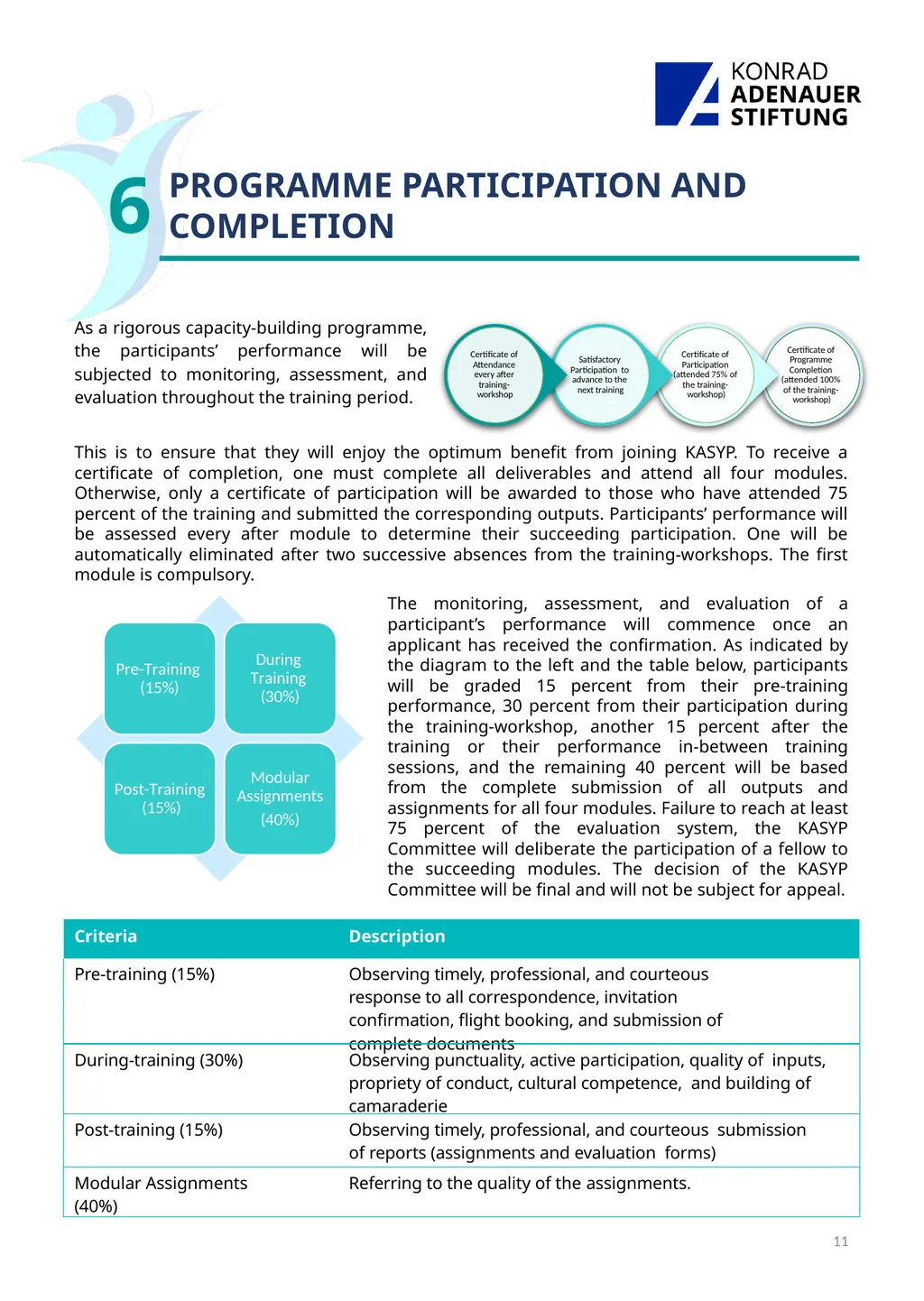
6 PROGRAMME PARTICIPATION AND COMPLETION 11 As a rigorous capacity-building programme, the participants’ performance will be subjected to monitoring, assessment, and evaluation throughout the training period. This is to ensure that they will enjoy the optimum benefit from joining KASYP. To receive a certificate of completion, one must complete all deliverables and attend all four modules. Otherwise, only a certificate of participation will be awarded to those who have attended 75 percent of the training and submitted the corresponding outputs. Participants’ performance will be assessed every after module to determine their succeeding participation. One will be automatically eliminated after two successive absences from the training-workshops. The first module is compulsory. The monitoring, assessment, and evaluation of a participant’s performance will commence once an applicant has received the confirmation. As indicated by the diagram to the left and the table below, participants will be graded 15 percent from their pre-training performance, 30 percent from their participation during the training-workshop, another 15 percent after the training or their performance in-between training sessions, and the remaining 40 percent will be based from the complete submission of all outputs and assignments for all four modules. Failure to reach at least 75 percent of the evaluation system, the KASYP Committee will deliberate the participation of a fellow to the succeeding modules. The decision of the KASYP Committee will be final and will not be subject for appeal.<br>
11
12 1. Must be a citizen of an Asian country
2. Living and working in your home country at the time of the application
3. Between the ages of 25 - 35 at the time of application
4. Fluent in oral and written English
5. At least two years of substantial experience particularly in work relevant to a political and/or party organizations.
6. Demonstrated commitment to public service
7. Leadership potential in politics, government, and/or civil society
8. Committed to becoming an active member in the KASYP community 7 ELIGIBILITY CRITERIA 8 PARTICIPANT’S RESPONSIBILITIES 1. To fill out all the necessary forms correctly and completely, and to follow the conditions deemed as a participant of the programme.
2. To submit all the requirements and comply with all the expected outputs before, during and after the programme.
3. To fully participate in all the activities and events deemed necessary for the success of the programme.
4. To contribute to the development of their communities with the acquired knowledge, skills and experiences upon return to their respective country.<br>
2. Living and working in your home country at the time of the application
3. Between the ages of 25 - 35 at the time of application
4. Fluent in oral and written English
5. At least two years of substantial experience particularly in work relevant to a political and/or party organizations.
6. Demonstrated commitment to public service
7. Leadership potential in politics, government, and/or civil society
8. Committed to becoming an active member in the KASYP community 7 ELIGIBILITY CRITERIA 8 PARTICIPANT’S RESPONSIBILITIES 1. To fill out all the necessary forms correctly and completely, and to follow the conditions deemed as a participant of the programme.
2. To submit all the requirements and comply with all the expected outputs before, during and after the programme.
3. To fully participate in all the activities and events deemed necessary for the success of the programme.
4. To contribute to the development of their communities with the acquired knowledge, skills and experiences upon return to their respective country.<br>
12
13 The Foundation will provide the following:
1. Economy class air ticket (point-to-point basis) from home country to training venue
2. Accommodation on a twin sharing basis
3. Cost of visa fee and local transfers related to the training programme
4. Meals during the training programme.
Other cost related to the attendance not mentioned here will be shouldered by the participant. 9 FOUNDATION’S ROLE 10 APPLICATION PROCESS All applicants must complete the application form and pass the selection procedure. Only short listed candidates will be contacted to undergo further screening and interview.
Maximum of 20 participants will be selected to take part in the programme.
15 August 2025: Application opens
15 September 2025: Application closes
September 2025: Review of applications
October 2025: Interview of short-listed candidates & confirmation process
November 2025: Finalists are notified of acceptance
February 2026 – September 2027: Programme dates<br>
1. Economy class air ticket (point-to-point basis) from home country to training venue
2. Accommodation on a twin sharing basis
3. Cost of visa fee and local transfers related to the training programme
4. Meals during the training programme.
Other cost related to the attendance not mentioned here will be shouldered by the participant. 9 FOUNDATION’S ROLE 10 APPLICATION PROCESS All applicants must complete the application form and pass the selection procedure. Only short listed candidates will be contacted to undergo further screening and interview.
Maximum of 20 participants will be selected to take part in the programme.
15 August 2025: Application opens
15 September 2025: Application closes
September 2025: Review of applications
October 2025: Interview of short-listed candidates & confirmation process
November 2025: Finalists are notified of acceptance
February 2026 – September 2027: Programme dates<br>
13
14 1. Application Form – should be honestly and completely filled out and signed
2. Picture (passport size with white background) – should be taken from June 2025 – August 2025, submit raw file or e-copy not scanned copy
3. Official Nomination Letter – Issued and written by a higher official in the applicant’s political party/organization using official letter head and signed
4. Evidence of Party Membership – This should be an official letter stating the type of membership and years of membership issued by the party administration using official letter head and signed
Please note: All documents must be written in English or accompanied by an English translation. 11 APPLICATION DOCUMENTS 12 SUBMISSION DETAILS Application form and other required documents should be emailed to:
Ms. Dessy Hristova
Programme Manager for Political Co-operation
Konrad Adenauer Stiftung
Singapore 209000
Email: dessy.hristova@kas.de
Telephone #: +65 6603 6161
WhatsApp: +65 97330544
Fax #: +65 6227 8343
Submission of application should not be later than 30 August 2025. Late submissions and incomplete application documents will not be accepted and reviewed. Application documents will not be returned for any reason. Due to the large number of applications, we cannot provide detailed explanations for those who will not be accepted to the programme.<br>
2. Picture (passport size with white background) – should be taken from June 2025 – August 2025, submit raw file or e-copy not scanned copy
3. Official Nomination Letter – Issued and written by a higher official in the applicant’s political party/organization using official letter head and signed
4. Evidence of Party Membership – This should be an official letter stating the type of membership and years of membership issued by the party administration using official letter head and signed
Please note: All documents must be written in English or accompanied by an English translation. 11 APPLICATION DOCUMENTS 12 SUBMISSION DETAILS Application form and other required documents should be emailed to:
Ms. Dessy Hristova
Programme Manager for Political Co-operation
Konrad Adenauer Stiftung
Singapore 209000
Email: dessy.hristova@kas.de
Telephone #: +65 6603 6161
WhatsApp: +65 97330544
Fax #: +65 6227 8343
Submission of application should not be later than 30 August 2025. Late submissions and incomplete application documents will not be accepted and reviewed. Application documents will not be returned for any reason. Due to the large number of applications, we cannot provide detailed explanations for those who will not be accepted to the programme.<br>
14
13 REFERENCES Bloom, B. (1965). Taxonomy of educational objectives: the classification of educational goals. New York: Longmans, Green
Carothers, T. (2014). Principles for political party assistance. In OECD, Accountability and democratic governance: Orientations and principles for Development (pp. 85-96). Paris: OECD. doi:https://doi.org/10.1787/9789264183636-en
Catón, M. (2007). Effective Party Assistance: Stronger Parties for Better Democracies. Policy Paper. Stockholm: IDEA International. Retrieved from http://iknowpolitics.org/sites/default/files/effective_party_pol_paper_final_lowres.pdf
Knowles, M. (1984). The adult learner: a neglected species (3rd ed.). Houston, TX: Gulf Publishing
Sharp, A. (2019, June 25). Asia's fragile democracies struggle to tame illiberal forces. Vibrant elections across region mask a lack of checks and balances. NIKKEI Asian Review. Retrieved from https://asia.nikkei.com/Spotlight/Asia-Insight/Asia-s-fragile-democracies-struggle-to-tame-illiberal-forces
Svåsand, L. (2014). International party assistance – What do we know about the effects? Stockholm: EBA Expert Group for Aid Studies. Retrieved July 25, 2019, from https://eba.se/en/rapporter/international-party-assistance-what-do-we-know-about-the-effects/1830/
Wild, L., Foresti, M., & Domingo, P. (2011). International assistance to political party and party system development. London: Overseas Development Institute. Retrieved from https://www.odi.org/sites/odi.org.uk/files/odi-assets/publications-opinion-files/6869.pdf 15<br>
Carothers, T. (2014). Principles for political party assistance. In OECD, Accountability and democratic governance: Orientations and principles for Development (pp. 85-96). Paris: OECD. doi:https://doi.org/10.1787/9789264183636-en
Catón, M. (2007). Effective Party Assistance: Stronger Parties for Better Democracies. Policy Paper. Stockholm: IDEA International. Retrieved from http://iknowpolitics.org/sites/default/files/effective_party_pol_paper_final_lowres.pdf
Knowles, M. (1984). The adult learner: a neglected species (3rd ed.). Houston, TX: Gulf Publishing
Sharp, A. (2019, June 25). Asia's fragile democracies struggle to tame illiberal forces. Vibrant elections across region mask a lack of checks and balances. NIKKEI Asian Review. Retrieved from https://asia.nikkei.com/Spotlight/Asia-Insight/Asia-s-fragile-democracies-struggle-to-tame-illiberal-forces
Svåsand, L. (2014). International party assistance – What do we know about the effects? Stockholm: EBA Expert Group for Aid Studies. Retrieved July 25, 2019, from https://eba.se/en/rapporter/international-party-assistance-what-do-we-know-about-the-effects/1830/
Wild, L., Foresti, M., & Domingo, P. (2011). International assistance to political party and party system development. London: Overseas Development Institute. Retrieved from https://www.odi.org/sites/odi.org.uk/files/odi-assets/publications-opinion-files/6869.pdf 15<br>
15
Looking forward to receiving your applications. We wish all the best!
Please connect with us through:
Facebook:
Regional Programme Political Dialogue Asia (KASPDA)
https://www.facebook.com/KAS.PDA/
KASYP – Konrad Adenauer School for Young Politician
https://www.facebook.com/KASYPASIA/
Instagram:
https://www.instagram.com/kasypasia/
Contact Us:
Regional Programme Political Dialogue Asia
Konrad Adenauer Stiftung
11-01, Arch 380, 380 Jalan Besar
Singapore 209000
Phone #: +65 6603 6161
Mobile #: +65 97380544
Email address: dessy.hristova@kas.de
Website: https://www.kas.de/en/web/politikdialog-asien<br>
Please connect with us through:
Facebook:
Regional Programme Political Dialogue Asia (KASPDA)
https://www.facebook.com/KAS.PDA/
KASYP – Konrad Adenauer School for Young Politician
https://www.facebook.com/KASYPASIA/
Instagram:
https://www.instagram.com/kasypasia/
Contact Us:
Regional Programme Political Dialogue Asia
Konrad Adenauer Stiftung
11-01, Arch 380, 380 Jalan Besar
Singapore 209000
Phone #: +65 6603 6161
Mobile #: +65 97380544
Email address: dessy.hristova@kas.de
Website: https://www.kas.de/en/web/politikdialog-asien<br>