
T LEVEL IN ANIMAL CARE AND MANAGEMENT Support
CP
Published · 139 slides · 0 views

1 / 1


Description
T LEVEL IN ANIMAL CARE AND MANAGEMENT Support holistic delivery of core content and occupational specialism content 1 Why do we study animal behaviour? Starter: Confidence rating Reflect on your skills and knowledge using the Animal
Related Topics
Share
Embed code
Download this presentation From Below
"T LEVEL IN ANIMAL CARE AND MANAGEMENT Support" is the property of its rightful owner. Permission is granted to download and print the materials on this website for personal, non-commercial use only, and to display it on your personal computer provided you do not modify the materials and that you retain all copyright notices contained in the materials. By downloading content from our website, you accept the terms of this agreement.
Presentation Transcript
01
T LEVEL IN ANIMAL CARE AND MANAGEMENT Support holistic delivery of core content and occupational specialism content<br>
02
1 Why do we study animal behaviour?<br>
03
Starter: Confidence rating Reflect on your skills and knowledge using the
Animal behaviour confidence rating worksheet. Education & Training Foundation 3<br>
04
Task Define animal behaviour. Education & Training Foundation 4<br>
05
Natural vs atypical behaviour Natural behaviour:
Behaviour that has developed during evolutionary processes.
Serves a function e.g. promoting health, survival and reproduction.
Atypical behaviour:
Any action that an animal performs which is not natural and does not serve a purpose. Education & Training Foundation 5<br>
Behaviour that has developed during evolutionary processes.
Serves a function e.g. promoting health, survival and reproduction.
Atypical behaviour:
Any action that an animal performs which is not natural and does not serve a purpose. Education & Training Foundation 5<br>
06
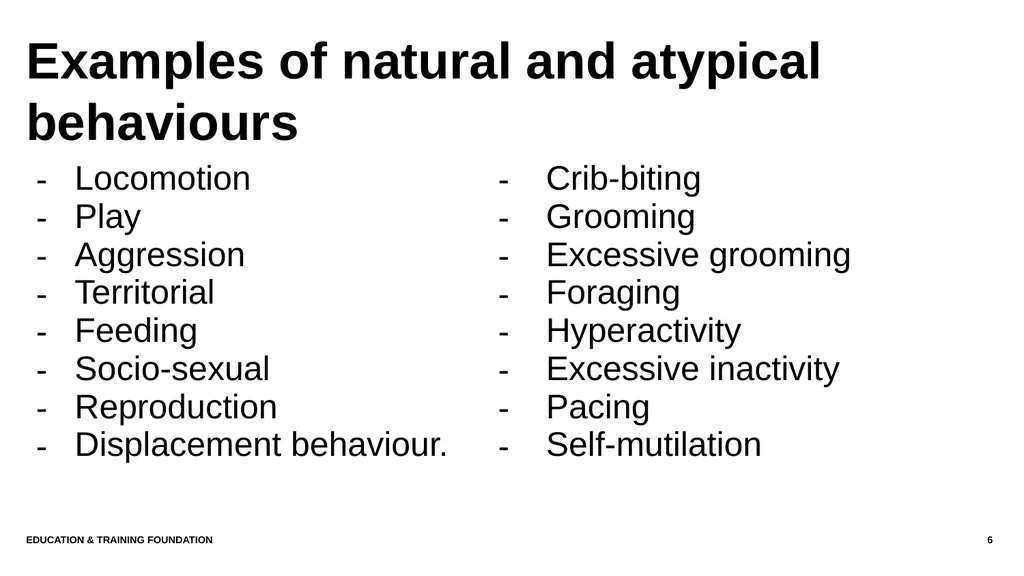
Examples of natural and atypical behaviours Education & Training Foundation 6<br>
07
Task: Species-specific behaviours Write natural and atypical behaviours specific for allocated animal on each piece of the flipchart paper.
Rotate to the next animal and add behaviours. Education & Training Foundation 7<br>
Rotate to the next animal and add behaviours. Education & Training Foundation 7<br>
08
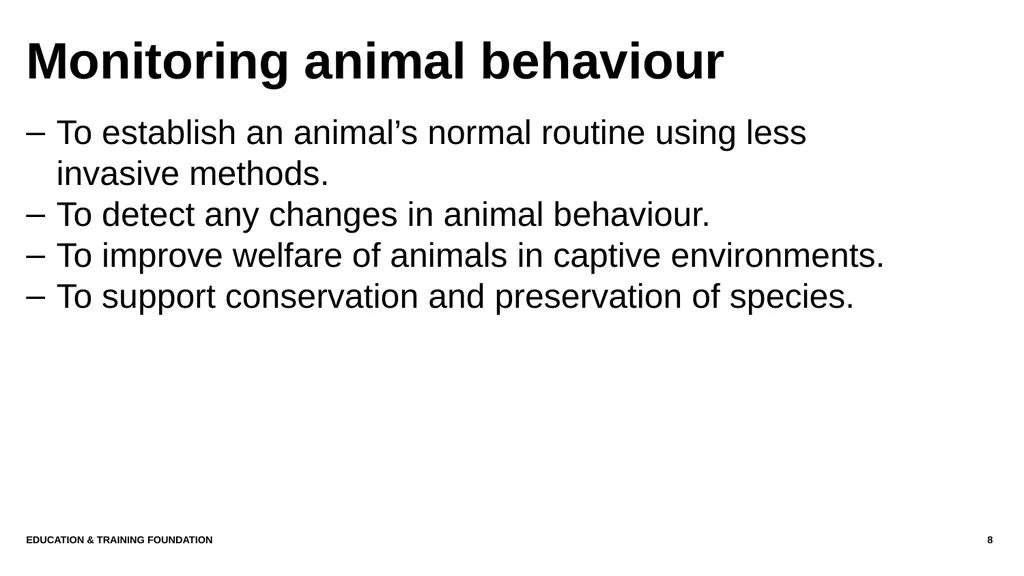
Monitoring animal behaviour To establish an animal’s normal routine using less invasive methods.
To detect any changes in animal behaviour.
To improve welfare of animals in captive environments.
To support conservation and preservation of species. Education & Training Foundation 8<br>
To detect any changes in animal behaviour.
To improve welfare of animals in captive environments.
To support conservation and preservation of species. Education & Training Foundation 8<br>
09
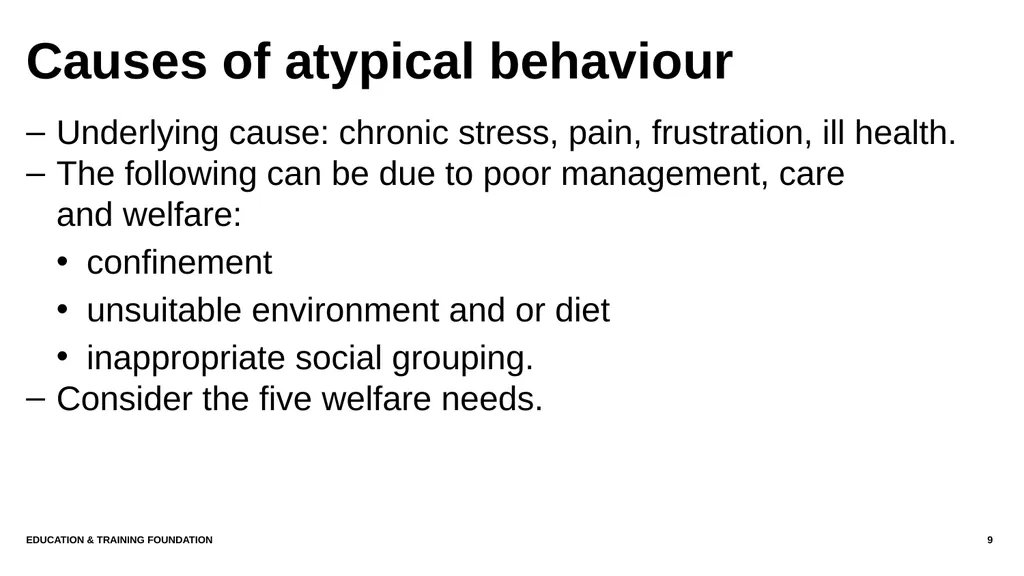
Causes of atypical behaviour Underlying cause: chronic stress, pain, frustration, ill health.
The following can be due to poor management, care and welfare:
confinement
unsuitable environment and or diet
inappropriate social grouping.
Consider the five welfare needs. Education & Training Foundation 9<br>
The following can be due to poor management, care and welfare:
confinement
unsuitable environment and or diet
inappropriate social grouping.
Consider the five welfare needs. Education & Training Foundation 9<br>
10
Confinement Lack of adequate space (challenges accommodating larger species), overcrowding e.g. battery/factory farms. Education & Training Foundation 10<br>
11
Examples of unsuitable environment Inappropriate housing: excessive noise, extremes of temperature, dirty and unhygienic, no enrichment provided, hazards, not suitable for species.
Inappropriate diet or insufficient food or water. Education & Training Foundation 11<br>
Inappropriate diet or insufficient food or water. Education & Training Foundation 11<br>
12
Examples of inappropriate social grouping Housing social animal on its own.
Solitary animals housed together.
Forcing social groups.
Incorrect social structures. Education & Training Foundation 12<br>
Solitary animals housed together.
Forcing social groups.
Incorrect social structures. Education & Training Foundation 12<br>
13
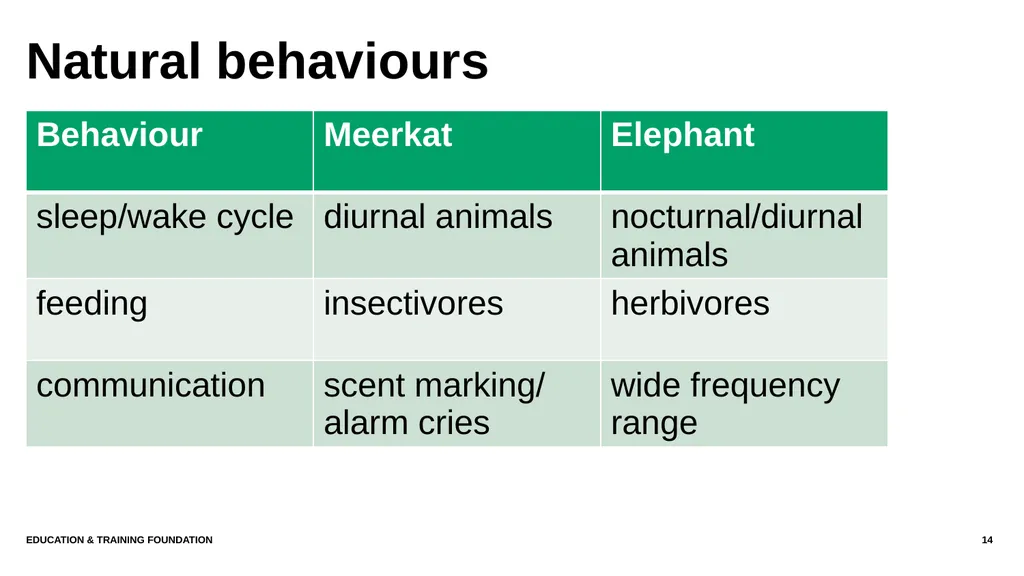
Natural behaviour examples Two specific animal species examples with regards to natural behaviour:
meerkat
elephant. Education & Training Foundation 13<br>
meerkat
elephant. Education & Training Foundation 13<br>
14
Education & Training Foundation 14 Natural behaviours<br>
15
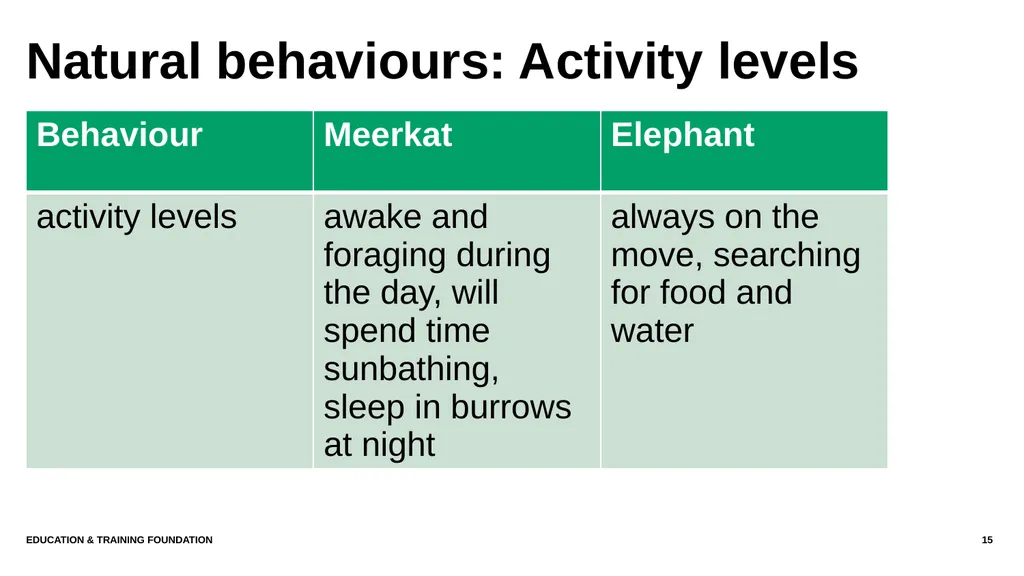
Education & Training Foundation 15 Natural behaviours: Activity levels<br>
16
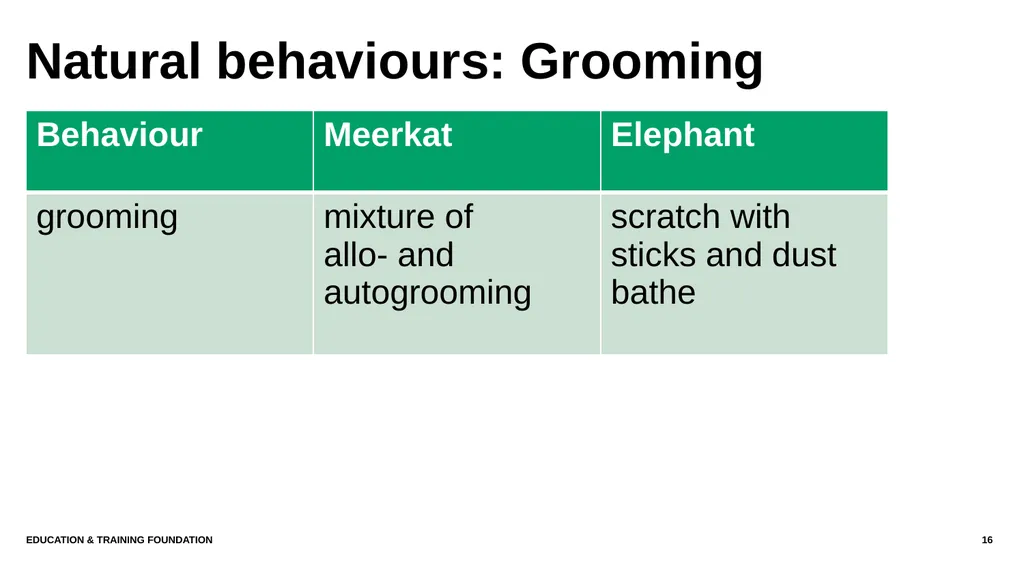
Education & Training Foundation 16 Natural behaviours: Grooming<br>
17
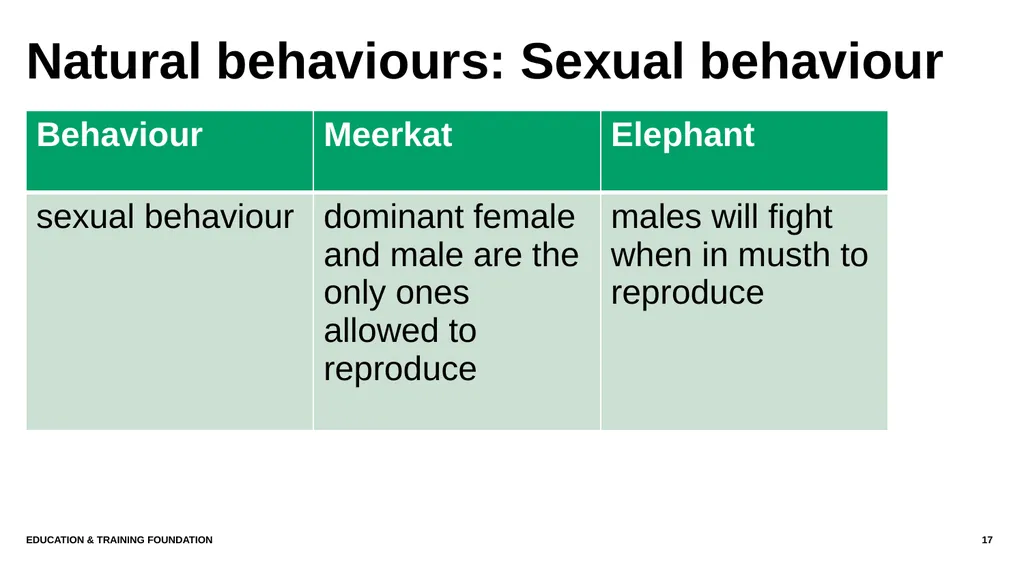
Education & Training Foundation 17 Natural behaviours: Sexual behaviour<br>
18
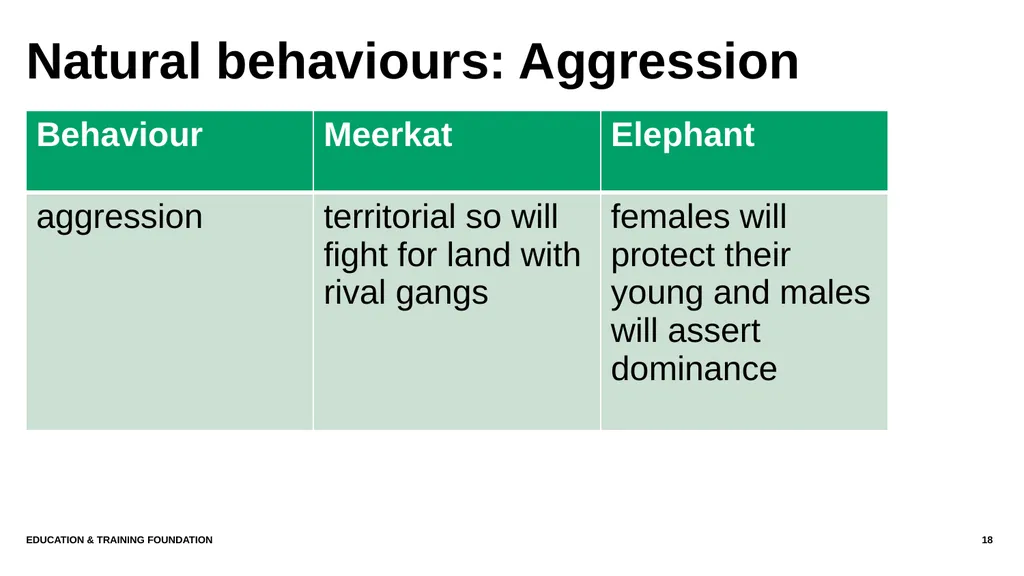
Education & Training Foundation 18 Natural behaviours: Aggression<br>
19
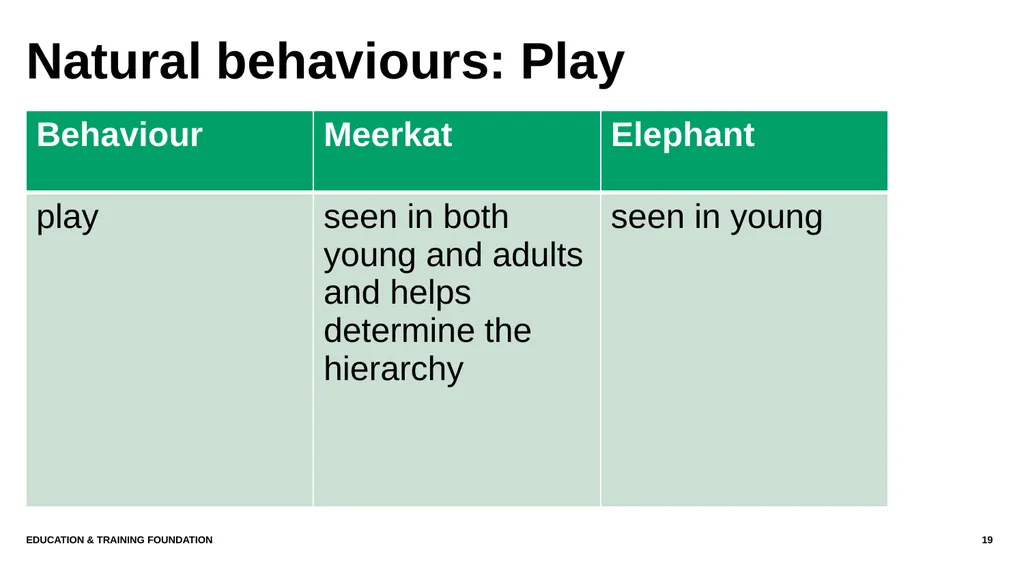
Education & Training Foundation 19 Natural behaviours: Play<br>
20
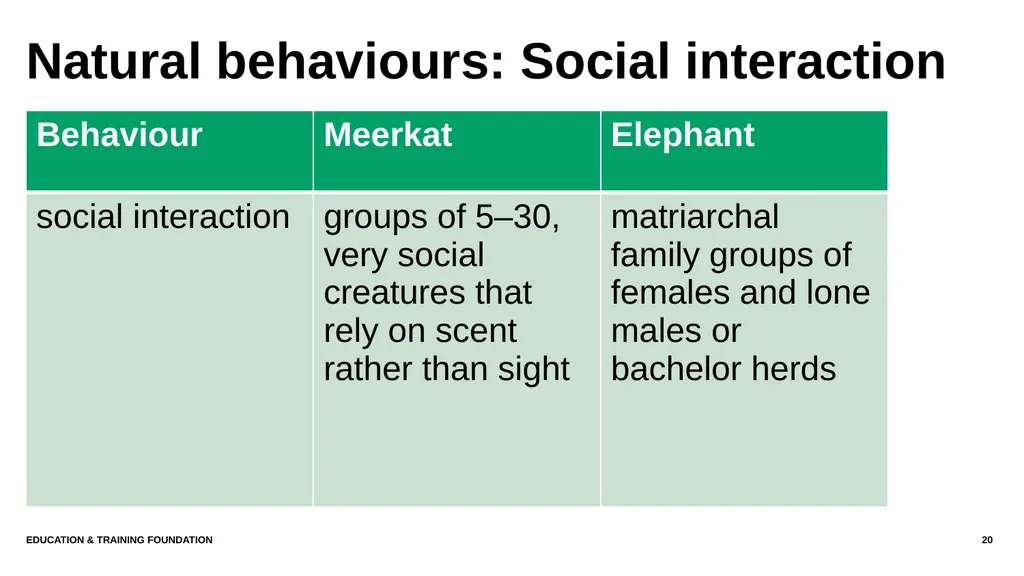
Education & Training Foundation 20 Natural behaviours: Social interaction<br>
21
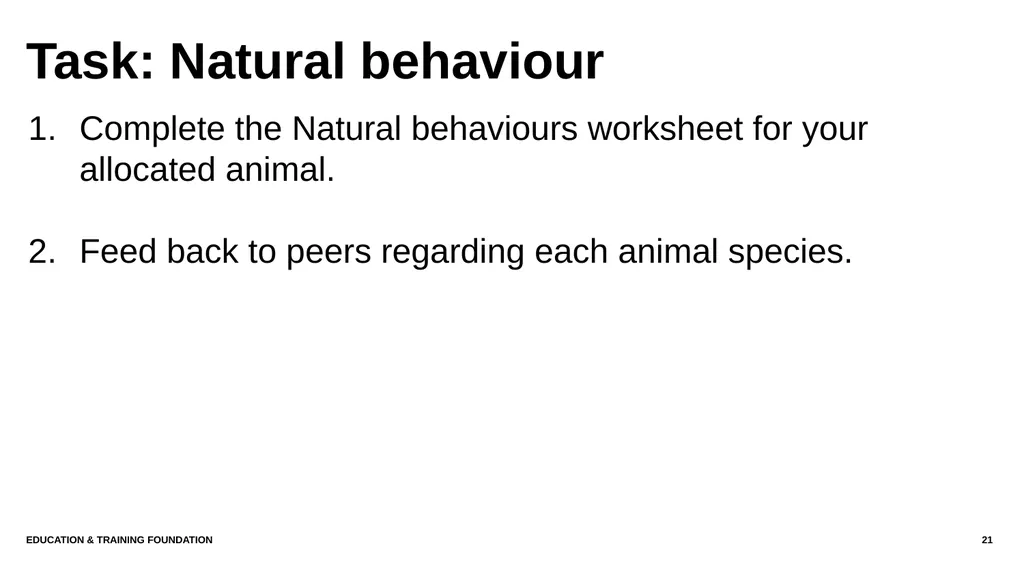
Task: Natural behaviour Complete the Natural behaviours worksheet for your allocated animal.
Feed back to peers regarding each animal species. Education & Training Foundation 21<br>
Feed back to peers regarding each animal species. Education & Training Foundation 21<br>
22
Plenary: Snap Play behaviour snap in pairs. Education & Training Foundation 22<br>
23
Question Education & Training Foundation 23 Why do we study animal behaviour?<br>
24
24 Answer To deepen our understanding of why animals behave the way they do, so that we can learn how to respond to the challenges that animals face when living in captive and wild environments. Education & Training Foundation<br>
25
Next steps: Ethologists Research one of the following ethologists:
Nikolaas Tinbergen
Konrad Lorenz
Jane Goodall
Charles Darwin. Education & Training Foundation 25<br>
Nikolaas Tinbergen
Konrad Lorenz
Jane Goodall
Charles Darwin. Education & Training Foundation 25<br>
26
2 Understanding ethologists and observation techniques in animal behaviour<br>
27
27 Starter: Who are ethologists? Nikolaas Tinbergen: The four questions of behaviour.
Konrad Lorenz: Imprinting in birds.
Jane Goodall: Primate behaviour studies.
Charles Darwin: Natural selection. Education & Training Foundation<br>
Konrad Lorenz: Imprinting in birds.
Jane Goodall: Primate behaviour studies.
Charles Darwin: Natural selection. Education & Training Foundation<br>
28
28 Nikolaas Tinbergen Research: Known for his work on the fixed action patterns and behaviour of animals, particularly birds and fish.
Conclusion: He identified and described various innate behaviours and how they contribute to an animal’s survival and reproduction.
Contribution: Tinbergen’s research laid the foundation for understanding the genetic and evolutionary basis of animal behaviour. Education & Training Foundation<br>
Conclusion: He identified and described various innate behaviours and how they contribute to an animal’s survival and reproduction.
Contribution: Tinbergen’s research laid the foundation for understanding the genetic and evolutionary basis of animal behaviour. Education & Training Foundation<br>
29
29 Konrad Lorenz Research: Known for his pioneering work on imprinting in birds and the concept of ethology as a discipline.
Conclusion: He discovered that certain animals, like ducks and geese, form strong bonds with the first moving object they see, often their parent, which is crucial for their survival.
Contribution: Lorenz’s work helped establish the field of ethology and contributed to our understanding of instinctual behaviour and the critical period for social attachment in animals. Education & Training Foundation<br>
30
30 Jane Goodall Research: Renowned for her long-term study of wild chimpanzees in Gombe Stream National Park, Tanzania.
Conclusion: Her work revealed complex social structures, tool use and the emotional lives of chimpanzees, challenging previous notions of human uniqueness.
Contribution: Goodall’s research significantly advanced our understanding of primates, leading to insights into the evolution and behaviour of our closest relatives. Education & Training Foundation<br>
31
31 Charles Darwin Research: Contributions to ethology were foundational as he developed the theory of evolution by natural selection.
Conclusion: His theory explained how species evolve and adapt to their environments over time.
Contribution: Darwin’s work laid the groundwork for understanding the diversity and adaptation of species, including their behaviour, in the context of evolution. Education & Training Foundation<br>
Conclusion: His theory explained how species evolve and adapt to their environments over time.
Contribution: Darwin’s work laid the groundwork for understanding the diversity and adaptation of species, including their behaviour, in the context of evolution. Education & Training Foundation<br>
32
32 Observation techniques Animal observation is the systematic study of animal behaviour in natural or controlled environments.
The purposes of animal observation include:
monitoring health and welfare
understanding natural behaviours
assessing environmental or husbandry changes
supporting conservation efforts
improving training and enrichment programmes. Education & Training Foundation<br>
The purposes of animal observation include:
monitoring health and welfare
understanding natural behaviours
assessing environmental or husbandry changes
supporting conservation efforts
improving training and enrichment programmes. Education & Training Foundation<br>
33
33 Types of animal observation: Ethograms A comprehensive list of all observed behaviours in a species or individual.
Can be general (covering all behaviours) or specific (focusing on certain behaviours, such as feeding or aggression).
Used to track behaviour patterns over time. Education & Training Foundation<br>
Can be general (covering all behaviours) or specific (focusing on certain behaviours, such as feeding or aggression).
Used to track behaviour patterns over time. Education & Training Foundation<br>
34
34 Types of animal observation:
Time sampling Observations are recorded at specific time intervals (e.g. every five minutes).
Provides a snapshot of behaviour trends over time.
Useful when continuous observation is not possible. Education & Training Foundation<br>
Provides a snapshot of behaviour trends over time.
Useful when continuous observation is not possible. Education & Training Foundation<br>
35
35 Types of animal observation:
Event sampling Records specific behaviours whenever they occur, rather than at set intervals.
Ideal for capturing rare or significant behaviours (e.g. mating displays, aggressive interactions).
Helps in understanding triggers and consequences of certain actions. Education & Training Foundation<br>
Ideal for capturing rare or significant behaviours (e.g. mating displays, aggressive interactions).
Helps in understanding triggers and consequences of certain actions. Education & Training Foundation<br>
36
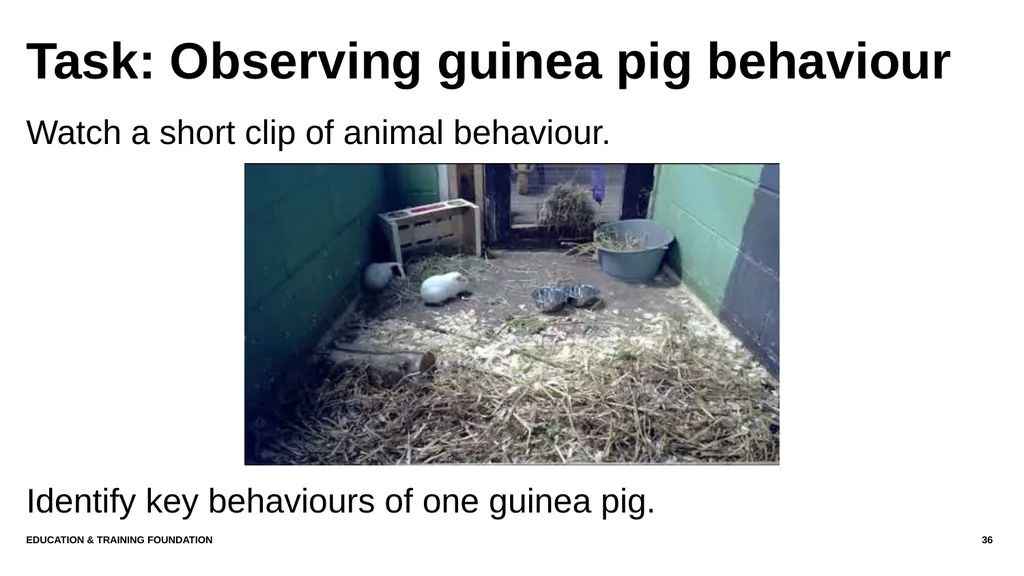
36 Task: Observing guinea pig behaviour Watch a short clip of animal behaviour.
Identify key behaviours of one guinea pig. Education & Training Foundation<br>
Identify key behaviours of one guinea pig. Education & Training Foundation<br>
37
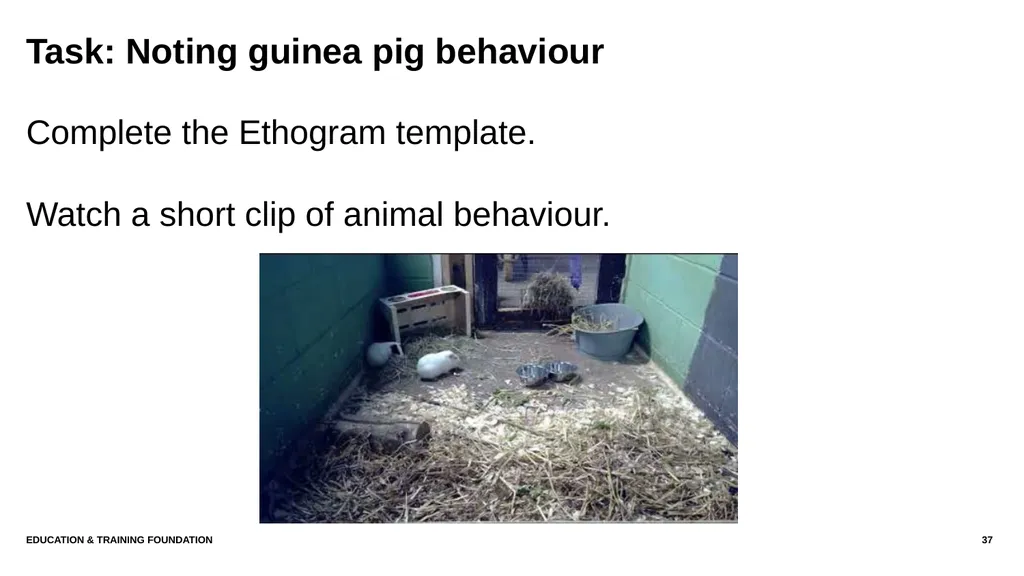
37 Task: Noting guinea pig behaviour Complete the Ethogram template.
Watch a short clip of animal behaviour. Education & Training Foundation<br>
Watch a short clip of animal behaviour. Education & Training Foundation<br>
38
38 Active listening In teamwork, active listening means fully concentrating on a speaker, understanding their message, responding thoughtfully and remembering the information, fostering a more cohesive and productive team dynamic. Education & Training Foundation<br>
39
39 Active listening continued Listening: paying attention to the speaker’s words, tone and body language.
Reflecting: paraphrasing or summarising what the speaker has said to ensure understanding.
Clarifying: asking clarifying questions to address any uncertainties.
Summarising: recapping the main points of the conversation to ensure everyone is on the same page. Education & Training Foundation<br>
Reflecting: paraphrasing or summarising what the speaker has said to ensure understanding.
Clarifying: asking clarifying questions to address any uncertainties.
Summarising: recapping the main points of the conversation to ensure everyone is on the same page. Education & Training Foundation<br>
40
40 Task: Animal behaviour observations Discuss observations with peers.
Compare any inconsistences in the observations. Education & Training Foundation<br>
Compare any inconsistences in the observations. Education & Training Foundation<br>
41
41 Plenary question: Guinea pig behaviour During a training programme for a guinea pig, learners are asked to observe the animal’s behaviour and responses.
Explain how continuous observation and recording of the guinea pig’s behaviour can contribute to ensuring the welfare needs of the animal are met. Education & Training Foundation<br>
Explain how continuous observation and recording of the guinea pig’s behaviour can contribute to ensuring the welfare needs of the animal are met. Education & Training Foundation<br>
42
42 Next steps: Safe working practices Read the distributed Safe working practices document(s) for working with animals.
Note the steps required to observe animals in an enclosure at your institution. Education & Training Foundation<br>
Note the steps required to observe animals in an enclosure at your institution. Education & Training Foundation<br>
43
3 Health and safety in animal behaviour observations<br>
44
44 Starter: Plan In groups, produce a plan that follows the Safe working practices document(s) for an allocated animal.
Include considerations before, during and after the observation. Education & Training Foundation<br>
Include considerations before, during and after the observation. Education & Training Foundation<br>
45
45 Key health and safety considerations Risk assessments and control measures.
Proper use of PPE and equipment.
Safe handling and restraint techniques.
Clear documentation and reporting procedures. Education & Training Foundation<br>
Proper use of PPE and equipment.
Safe handling and restraint techniques.
Clear documentation and reporting procedures. Education & Training Foundation<br>
46
46 Monitoring foxes case study Key risks: staff without personal protective equipment, electric fencing, injured animals.
Identify hazards and control measures to ensure safety and mitigate risk to the person working with the animals.
Note key points on the flipchart paper. Education & Training Foundation<br>
Identify hazards and control measures to ensure safety and mitigate risk to the person working with the animals.
Note key points on the flipchart paper. Education & Training Foundation<br>
47
47 Animal risk assessment definition A risk assessment is a process of identifying hazards, evaluating the risk of harm and implementing measures to reduce or eliminate the risk. Education & Training Foundation<br>
48
48 Animal risk assessment: Severity Determine severity of harm:
Minor: bruises, small cuts, temporary discomfort.
Moderate: fractures, burns, prolonged illness.
Severe: permanent disability, life-threatening injury, fatality. Education & Training Foundation<br>
Minor: bruises, small cuts, temporary discomfort.
Moderate: fractures, burns, prolonged illness.
Severe: permanent disability, life-threatening injury, fatality. Education & Training Foundation<br>
49
49 Animal risk assessment considerations Consideration when evaluating the likelihood of harm occurring:
Rare: highly unlikely to happen.
Unlikely: could happen but not often.
Likely: expected to happen occasionally.
Very likely: almost certain to occur. Education & Training Foundation<br>
Rare: highly unlikely to happen.
Unlikely: could happen but not often.
Likely: expected to happen occasionally.
Very likely: almost certain to occur. Education & Training Foundation<br>
50
50 Incident reporting Definition: recordable incidents are specific events or behaviours that are documented owing to their significance in monitoring animal welfare and safety.
Purpose: to ensure accurate tracking of animal behaviour and health, enabling timely interventions and the maintenance of a safe environment for both animals and visitors. Education & Training Foundation<br>
Purpose: to ensure accurate tracking of animal behaviour and health, enabling timely interventions and the maintenance of a safe environment for both animals and visitors. Education & Training Foundation<br>
51
51 Why report incidents? Link to welfare: recording incidents helps in identifying stressors and health issues early, ensuring animals receive appropriate care and interventions.
Safety: protects both animals and visitors by monitoring and addressing potentially dangerous behaviours.
Compliance: adheres to zoo policies and legal requirements for animal welfare and safety. Education & Training Foundation<br>
Safety: protects both animals and visitors by monitoring and addressing potentially dangerous behaviours.
Compliance: adheres to zoo policies and legal requirements for animal welfare and safety. Education & Training Foundation<br>
52
52 What should be recorded? Details of the incident: date, time and location of incident.
Behavioural observations: specific behaviours observed.
Affected animals: identification of animals involved.
Impact on others: effects on other animals and visitors.
Immediate actions taken: any interventions or changes made in response to the incident.
Follow-up: recommendations for further monitoring or actions needed. Education & Training Foundation<br>
53
53 Observing male goat case study Individually, read the case study.
In pairs, discuss the behaviours in the case study and complete the Incident report form template. Education & Training Foundation<br>
In pairs, discuss the behaviours in the case study and complete the Incident report form template. Education & Training Foundation<br>
54
54 Animal sanctuary case study Individually, read the case study and complete the Incident report form template. Education & Training Foundation<br>
55
55 Effective communication in animal observations Who needs the information? (staff, vets, inspectors)
Formal vs informal reporting methods.
Adapting communication for different stakeholders.
The importance of accurate, unbiased reporting. Education & Training Foundation<br>
Formal vs informal reporting methods.
Adapting communication for different stakeholders.
The importance of accurate, unbiased reporting. Education & Training Foundation<br>
56
56 Plenary: Zoo incident Write a formal email to the zoo manager based on one of the Incident report form templates.
Include detail about the incident, your concerns and recommendations. Education & Training Foundation<br>
Include detail about the incident, your concerns and recommendations. Education & Training Foundation<br>
57
57 Next steps: Animal incident Research an incident where an animal’s behaviour has caused significant harm to an individual
Complete Incident report form template. Education & Training Foundation<br>
Complete Incident report form template. Education & Training Foundation<br>
58
4 Developing and using ethograms<br>
59
59 Starter: Glossary worksheet Review the terms in the Glossary worksheet.
Write a definition for those behaviours most associated with degus. Education & Training Foundation<br>
Write a definition for those behaviours most associated with degus. Education & Training Foundation<br>
60
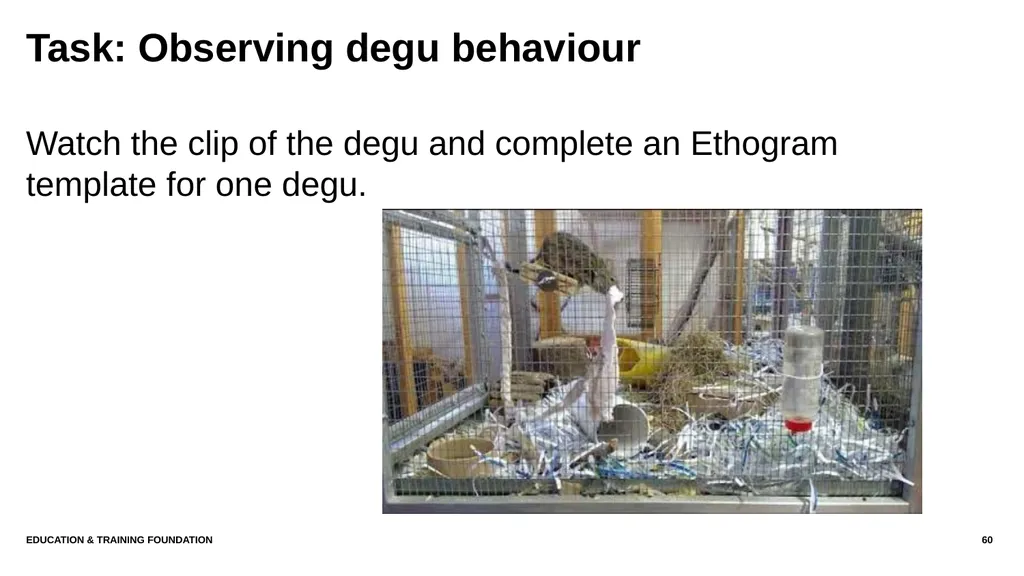
60 Task: Observing degu behaviour Watch the clip of the degu and complete an Ethogram template for one degu. Education & Training Foundation<br>
61
61 Task: Noting degu behaviour Discuss observations with peers.
Compare any inconsistencies in the observations. Education & Training Foundation<br>
Compare any inconsistencies in the observations. Education & Training Foundation<br>
62
62 Task: Observing animal behaviour Watch the video clip of your allocated animal and complete an Ethogram template. Education & Training Foundation<br>
63
63 Comparison of ethograms Compare ethograms in small groups.
Identify differences in recorded behaviour.
Discuss how accuracy can be improved. Education & Training Foundation<br>
Identify differences in recorded behaviour.
Discuss how accuracy can be improved. Education & Training Foundation<br>
64
64 Plenary question: Rehomed rabbit You are working in an animal care setting. One of your responsibilities is to observe animal behaviour and report on any unusual signs. You are asked to observe a rabbit that has recently been rehomed.
a) Identify three types of behaviour you would expect to observe in a healthy, settled rabbit.
b) Describe each identified behaviour. Education & Training Foundation<br>
a) Identify three types of behaviour you would expect to observe in a healthy, settled rabbit.
b) Describe each identified behaviour. Education & Training Foundation<br>
65
65 Next steps: Research jobs Research job posts for working in an animal collection.
Bring notes and advertisements to the next lesson. Education & Training Foundation<br>
Bring notes and advertisements to the next lesson. Education & Training Foundation<br>
66
5 Working with animals over their life stages: Roles and responsibilities<br>
67
67 Starter: Working at a zoo Refer to your notes from the next steps activity from the previous lesson.
Open and review the provider Safe working practice document.
In pairs, create a list of all the tasks and responsibilities required of staff working at a zoo.
Add your list to the collaborative space. Education & Training Foundation<br>
Open and review the provider Safe working practice document.
In pairs, create a list of all the tasks and responsibilities required of staff working at a zoo.
Add your list to the collaborative space. Education & Training Foundation<br>
68
68 Task: Zookeeper In your group, review either the person specification or the job description.
Write a short summary of your group’s section.
Add your group’s summary to the collaborative space. Education & Training Foundation<br>
Write a short summary of your group’s section.
Add your group’s summary to the collaborative space. Education & Training Foundation<br>
69
69 Features of a job advert Job title which clearly states the role (e.g. zookeeper).
Summary of the role providing a short overview of the job and what it involves.
Key responsibilities: main duties the person will carry out.
Required qualifications or experience: skills, experience or training needed to apply. Education & Training Foundation<br>
Summary of the role providing a short overview of the job and what it involves.
Key responsibilities: main duties the person will carry out.
Required qualifications or experience: skills, experience or training needed to apply. Education & Training Foundation<br>
70
70 Task Individually, use the summaries on the collaborative space to write a job advertisement for the role of the zookeeper.
In pairs, compare advertisements and make any improvements based on discussion with peer. Education & Training Foundation<br>
In pairs, compare advertisements and make any improvements based on discussion with peer. Education & Training Foundation<br>
71
71 Key life stages in animals Juvenile (growth and learning).
Adult (maturity and reproduction).
Senior (ageing and health decline). Education & Training Foundation<br>
Adult (maturity and reproduction).
Senior (ageing and health decline). Education & Training Foundation<br>
72
72 Interview preparation The zoo needs to move a mob of five juvenile meerkats into a shared enclosure with a senior porcupine.
Individually, research what animal behaviours you would monitor to determine whether the move is successful.
Make appropriate notes to take to the interview.
Note: notes will be presented to peers. Education & Training Foundation<br>
Individually, research what animal behaviours you would monitor to determine whether the move is successful.
Make appropriate notes to take to the interview.
Note: notes will be presented to peers. Education & Training Foundation<br>
73
73 Interview task In groups, discuss the animal behaviours findings.
Work together to compile a list of behaviours on the flipchart. Education & Training Foundation<br>
Work together to compile a list of behaviours on the flipchart. Education & Training Foundation<br>
74
74 Task: Mammal life stages Choose a named mammal species.
Describe the main physical and behavioural changes that occur during each of the key life stages.
For each stage, explain how these changes affect the care needs of the animal. Education & Training Foundation<br>
Describe the main physical and behavioural changes that occur during each of the key life stages.
For each stage, explain how these changes affect the care needs of the animal. Education & Training Foundation<br>
75
75 Next steps: Nutritional needs Research how the nutritional needs of the animal change over the key life stages. Education & Training Foundation<br>
76
6 Preparation for behavioural observation<br>
77
77 Starter: Word cloud Think about the key terms related to nutrition and life stages that you researched for homework.
Write three terms which are relevant to the infant life stage. Add these to the word cloud software.
Repeat for juvenile, adult and senior life stages. Education & Training Foundation<br>
Write three terms which are relevant to the infant life stage. Add these to the word cloud software.
Repeat for juvenile, adult and senior life stages. Education & Training Foundation<br>
78
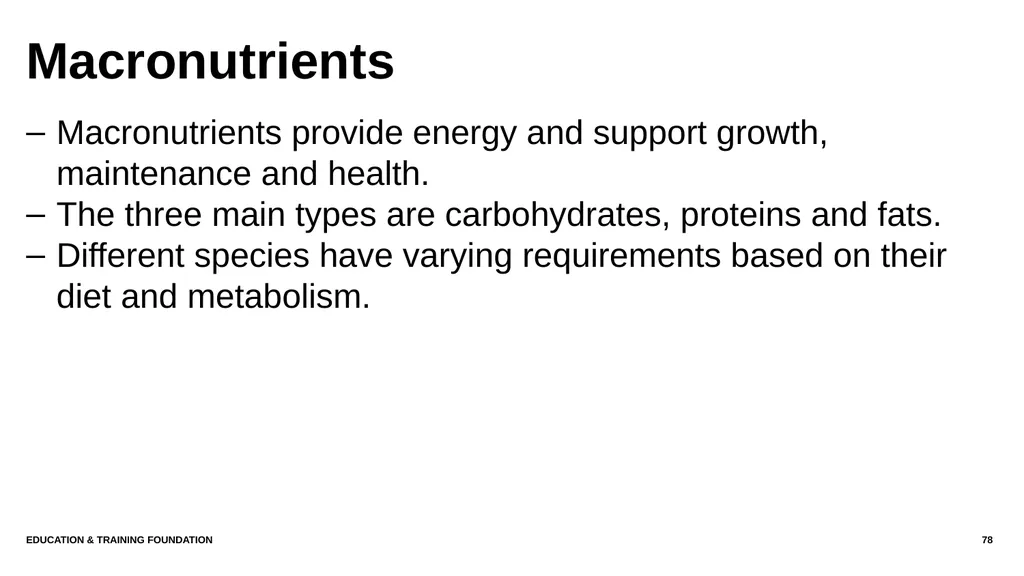
78 Macronutrients Macronutrients provide energy and support growth, maintenance and health.
The three main types are carbohydrates, proteins and fats.
Different species have varying requirements based on their diet and metabolism. Education & Training Foundation<br>
The three main types are carbohydrates, proteins and fats.
Different species have varying requirements based on their diet and metabolism. Education & Training Foundation<br>
79
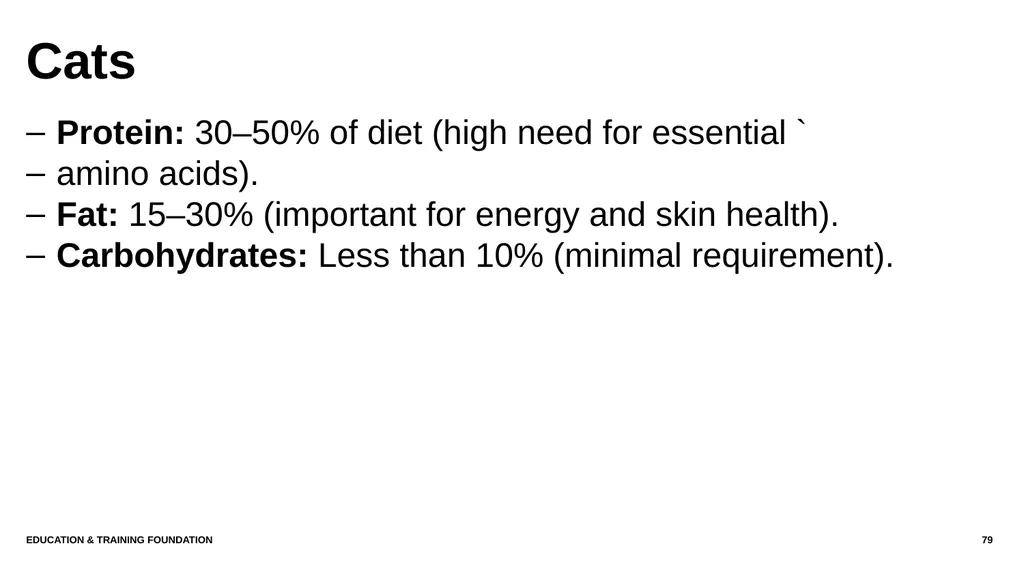
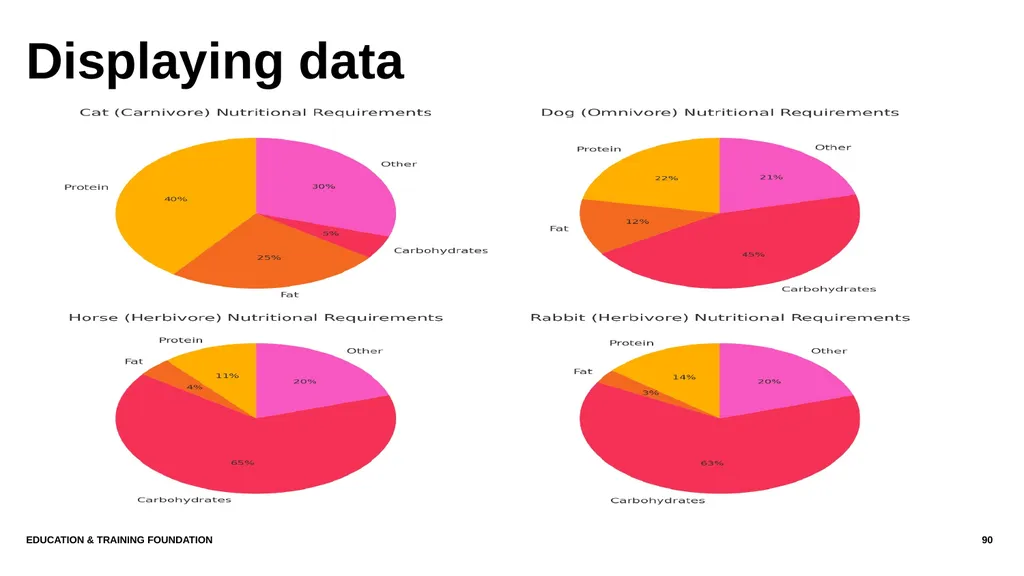
79 Cats Protein: 30–50% of diet (high need for essential `
amino acids).
Fat: 15–30% (important for energy and skin health).
Carbohydrates: Less than 10% (minimal requirement). Education & Training Foundation<br>
amino acids).
Fat: 15–30% (important for energy and skin health).
Carbohydrates: Less than 10% (minimal requirement). Education & Training Foundation<br>
80
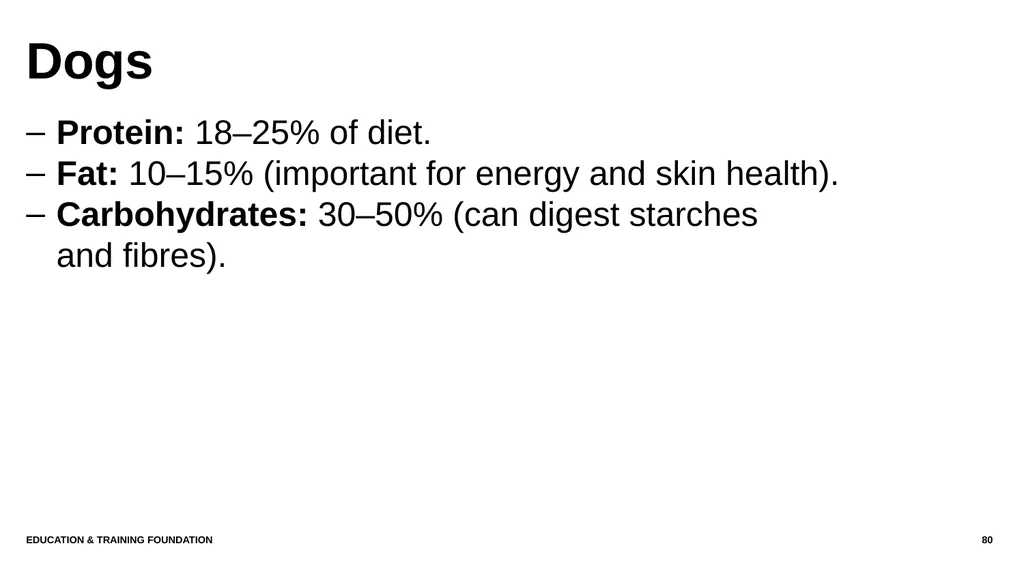
80 Dogs Protein: 18–25% of diet.
Fat: 10–15% (important for energy and skin health).
Carbohydrates: 30–50% (can digest starches and fibres). Education & Training Foundation<br>
Fat: 10–15% (important for energy and skin health).
Carbohydrates: 30–50% (can digest starches and fibres). Education & Training Foundation<br>
81
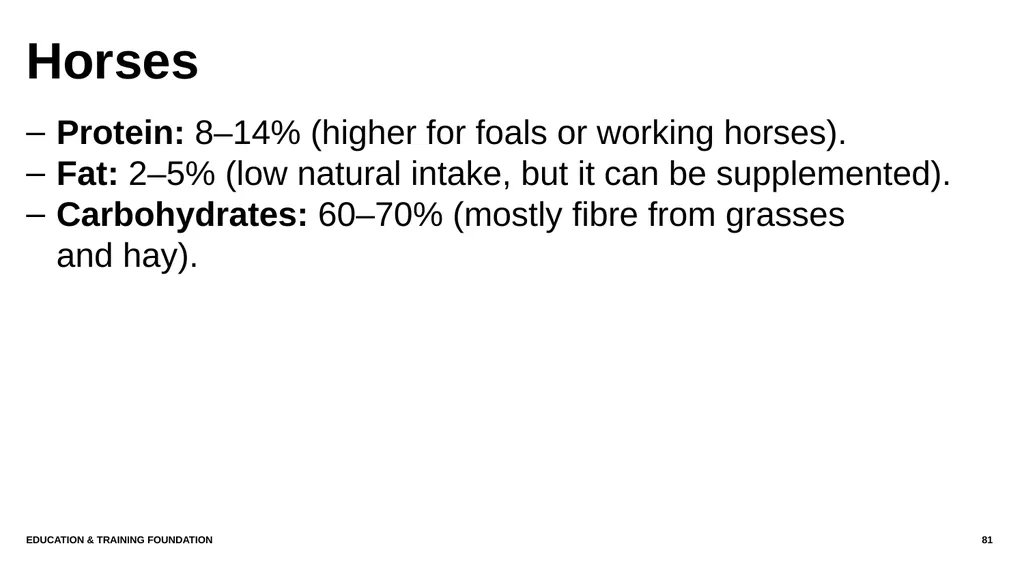
81 Horses Protein: 8–14% (higher for foals or working horses).
Fat: 2–5% (low natural intake, but it can be supplemented).
Carbohydrates: 60–70% (mostly fibre from grasses and hay). Education & Training Foundation<br>
Fat: 2–5% (low natural intake, but it can be supplemented).
Carbohydrates: 60–70% (mostly fibre from grasses and hay). Education & Training Foundation<br>
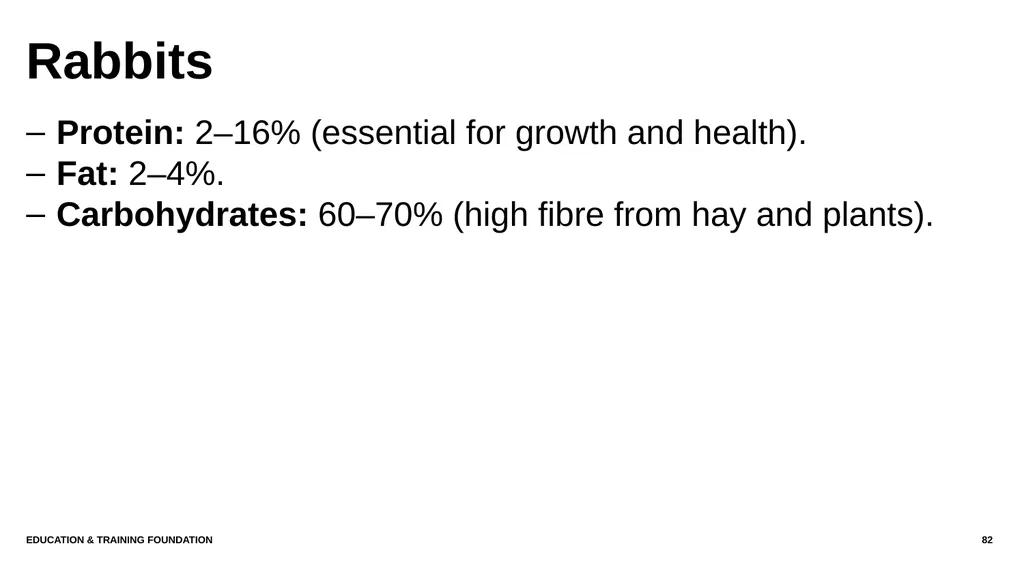
82
82 Rabbits Protein: 2–16% (essential for growth and health).
Fat: 2–4%.
Carbohydrates: 60–70% (high fibre from hay and plants). Education & Training Foundation<br>
Fat: 2–4%.
Carbohydrates: 60–70% (high fibre from hay and plants). Education & Training Foundation<br>
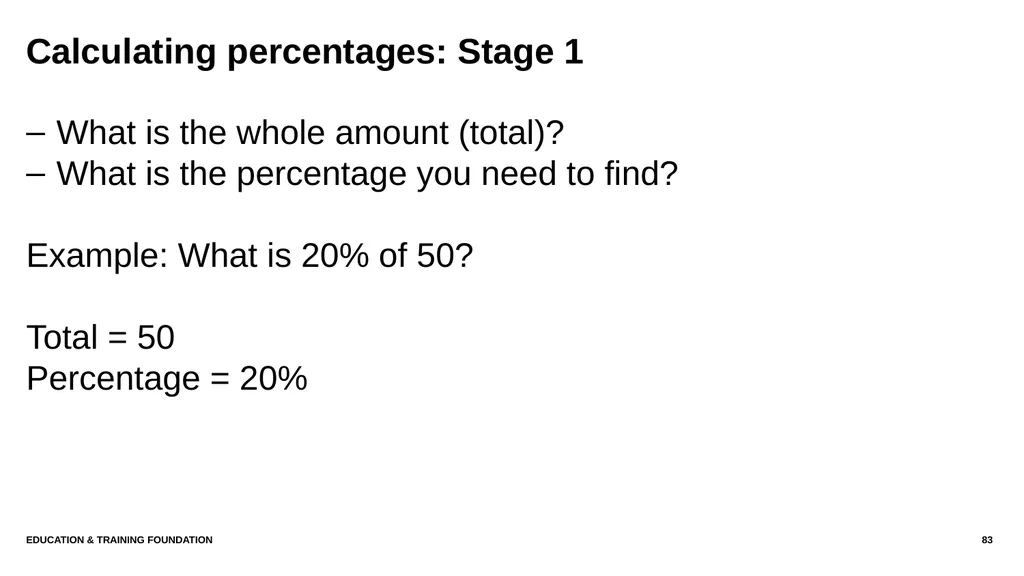
83
83 Calculating percentages: Stage 1 What is the whole amount (total)?
What is the percentage you need to find?
Example: What is 20% of 50?
Total = 50
Percentage = 20% Education & Training Foundation<br>
What is the percentage you need to find?
Example: What is 20% of 50?
Total = 50
Percentage = 20% Education & Training Foundation<br>
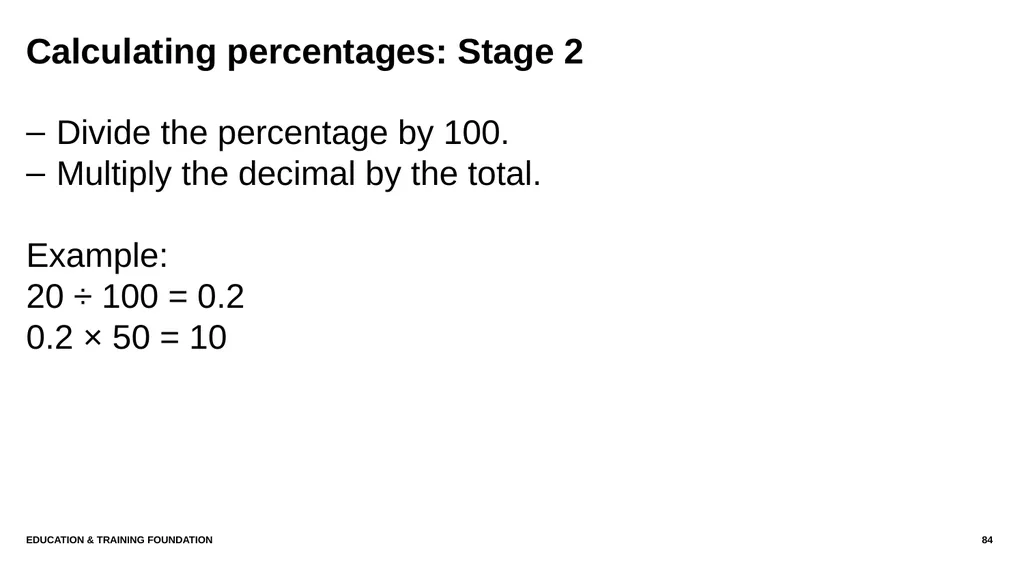
84
84 Calculating percentages: Stage 2 Divide the percentage by 100.
Multiply the decimal by the total.
Example: 20 ÷ 100 = 0.2 0.2 × 50 = 10 Education & Training Foundation<br>
Multiply the decimal by the total.
Example: 20 ÷ 100 = 0.2 0.2 × 50 = 10 Education & Training Foundation<br>
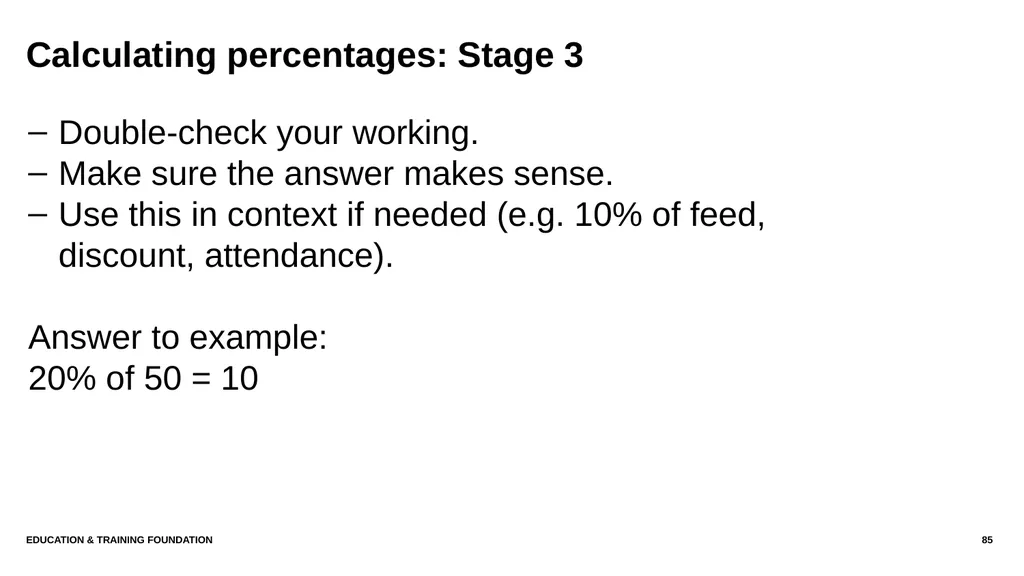
85
85 Calculating percentages: Stage 3 Double-check your working.
Make sure the answer makes sense.
Use this in context if needed (e.g. 10% of feed, discount, attendance).
Answer to example:
20% of 50 = 10 Education & Training Foundation<br>
Make sure the answer makes sense.
Use this in context if needed (e.g. 10% of feed, discount, attendance).
Answer to example:
20% of 50 = 10 Education & Training Foundation<br>
86
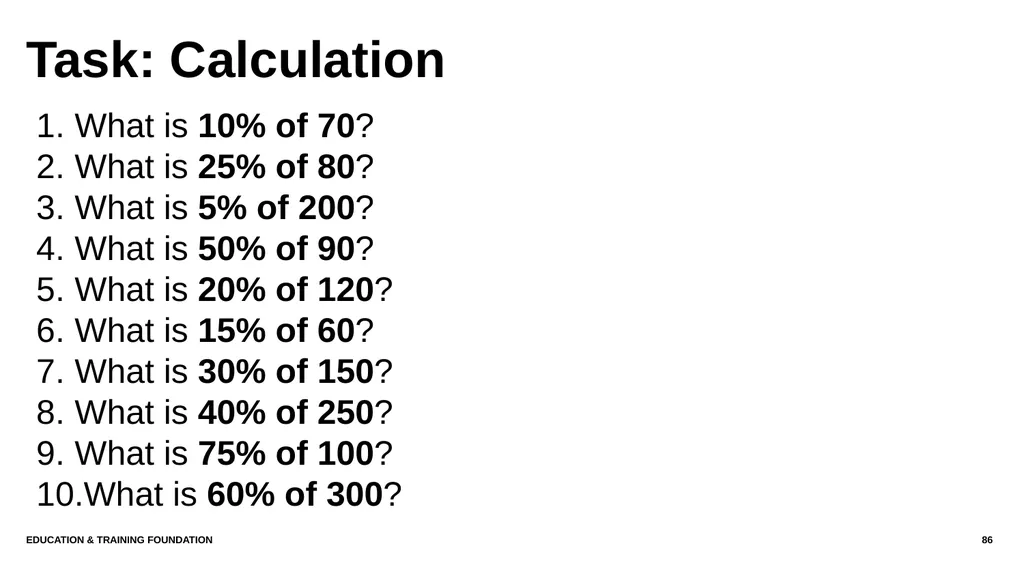
86 Task: Calculation Education & Training Foundation What is 10% of 70?
What is 25% of 80?
What is 5% of 200?
What is 50% of 90?
What is 20% of 120?
What is 15% of 60?
What is 30% of 150?
What is 40% of 250?
What is 75% of 100?
What is 60% of 300?<br>
What is 25% of 80?
What is 5% of 200?
What is 50% of 90?
What is 20% of 120?
What is 15% of 60?
What is 30% of 150?
What is 40% of 250?
What is 75% of 100?
What is 60% of 300?<br>
87
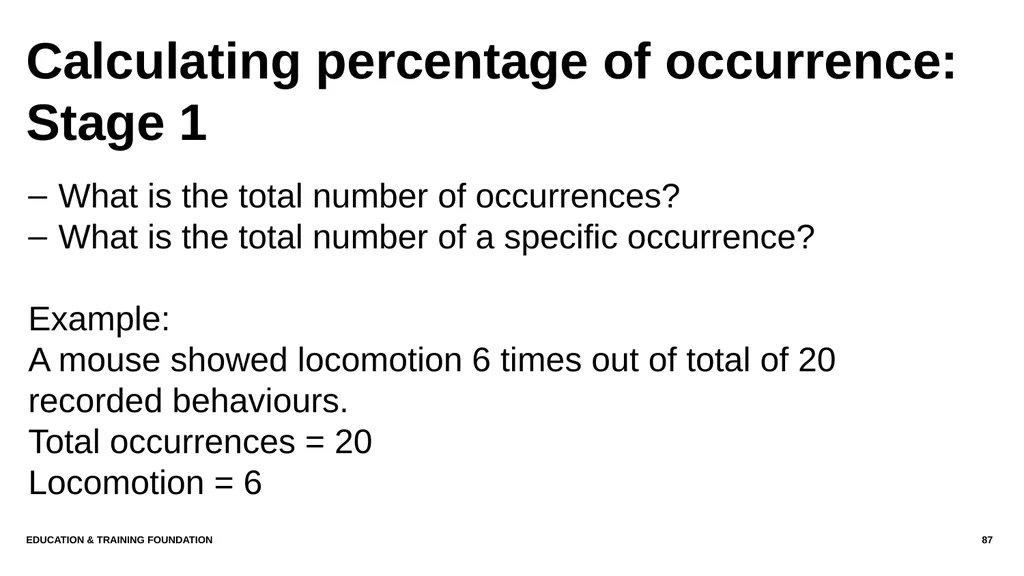
87 Calculating percentage of occurrence: Stage 1 What is the total number of occurrences?
What is the total number of a specific occurrence?
Example:
A mouse showed locomotion 6 times out of total of 20 recorded behaviours.
Total occurrences = 20
Locomotion = 6 Education & Training Foundation<br>
What is the total number of a specific occurrence?
Example:
A mouse showed locomotion 6 times out of total of 20 recorded behaviours.
Total occurrences = 20
Locomotion = 6 Education & Training Foundation<br>
88
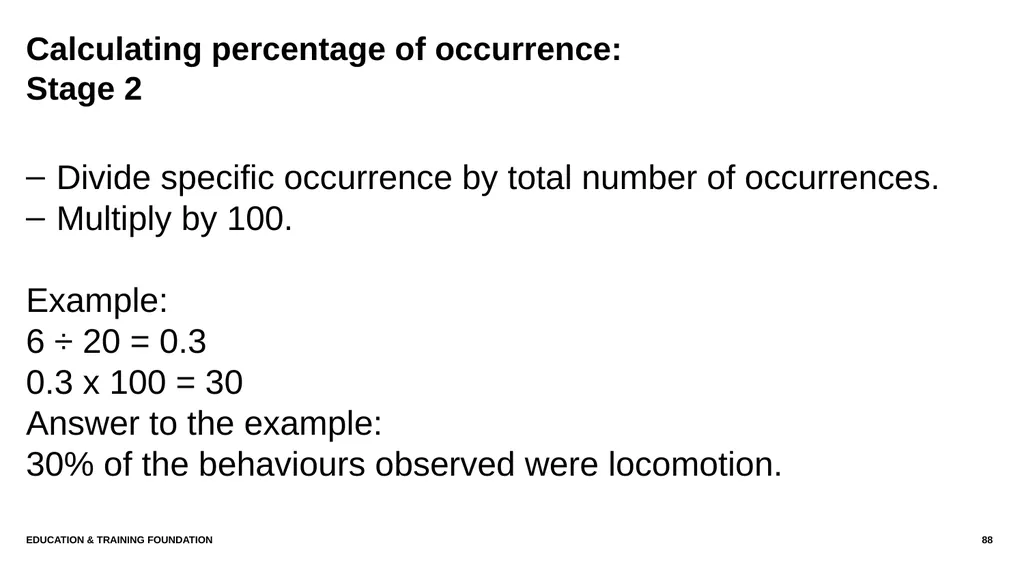
88 Calculating percentage of occurrence:
Stage 2 Divide specific occurrence by total number of occurrences.
Multiply by 100.
Example:
6 ÷ 20 = 0.3
0.3 x 100 = 30
Answer to the example: 30% of the behaviours observed were locomotion. Education & Training Foundation<br>
Multiply by 100.
Example:
6 ÷ 20 = 0.3
0.3 x 100 = 30
Answer to the example: 30% of the behaviours observed were locomotion. Education & Training Foundation<br>
89
89 Task: Behaviour percentages Using one of the Ethogram templates you completed in lesson 4, calculate the percentages of the behaviours. Education & Training Foundation<br>
90
90 Displaying data Education & Training Foundation<br>
91
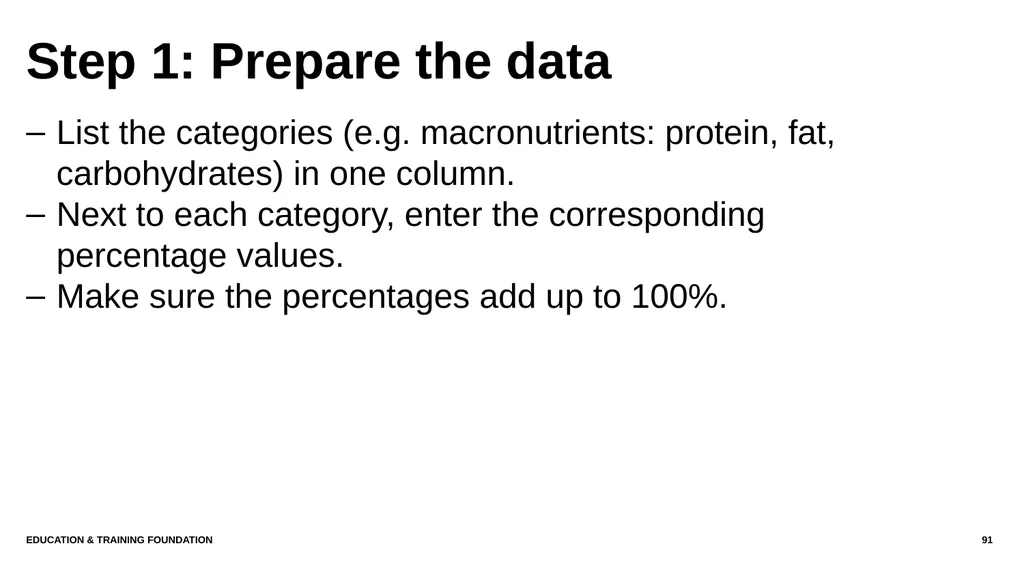
91 Step 1: Prepare the data List the categories (e.g. macronutrients: protein, fat, carbohydrates) in one column.
Next to each category, enter the corresponding percentage values.
Make sure the percentages add up to 100%. Education & Training Foundation<br>
Next to each category, enter the corresponding percentage values.
Make sure the percentages add up to 100%. Education & Training Foundation<br>
92
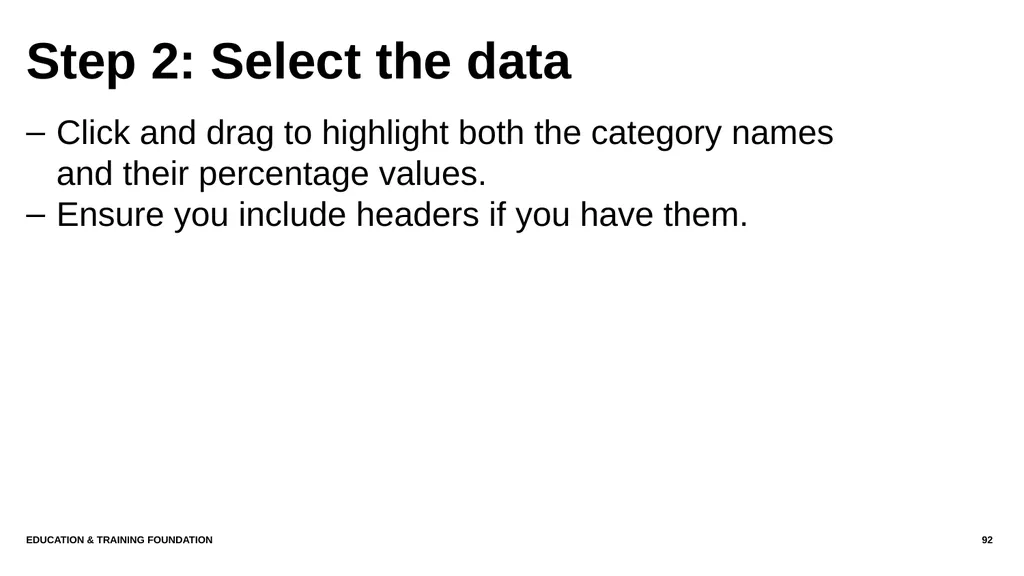
92 Step 2: Select the data Click and drag to highlight both the category names and their percentage values.
Ensure you include headers if you have them. Education & Training Foundation<br>
Ensure you include headers if you have them. Education & Training Foundation<br>
93
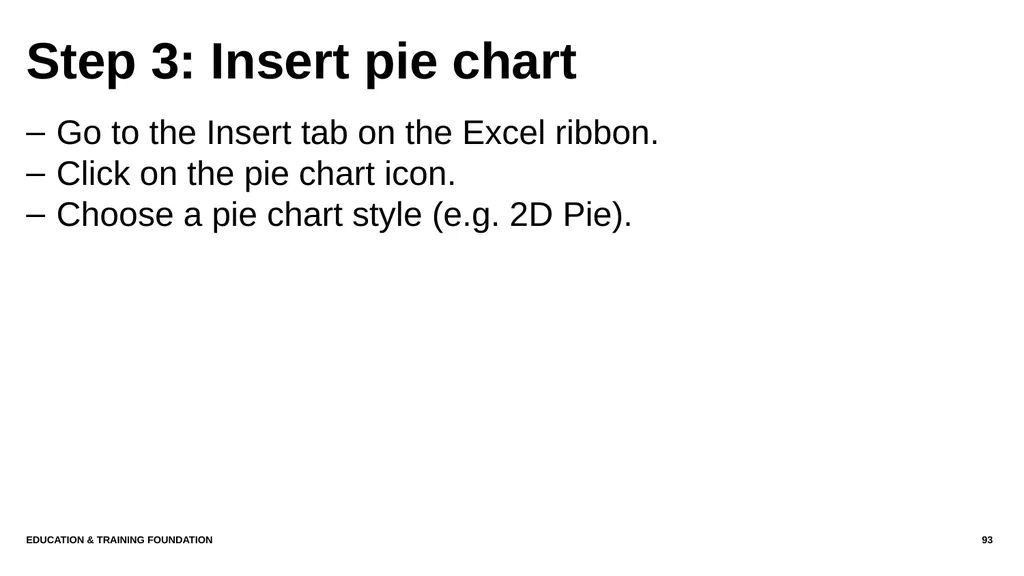
93 Step 3: Insert pie chart Go to the Insert tab on the Excel ribbon.
Click on the pie chart icon.
Choose a pie chart style (e.g. 2D Pie). Education & Training Foundation<br>
Click on the pie chart icon.
Choose a pie chart style (e.g. 2D Pie). Education & Training Foundation<br>
94
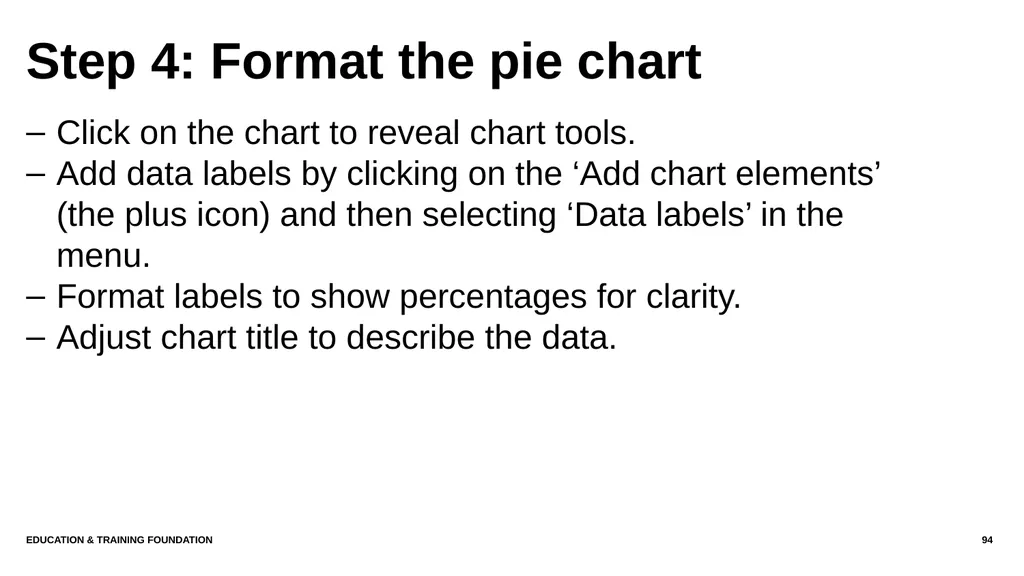
94 Step 4: Format the pie chart Click on the chart to reveal chart tools.
Add data labels by clicking on the ‘Add chart elements’ (the plus icon) and then selecting ‘Data labels’ in the menu.
Format labels to show percentages for clarity.
Adjust chart title to describe the data. Education & Training Foundation<br>
Add data labels by clicking on the ‘Add chart elements’ (the plus icon) and then selecting ‘Data labels’ in the menu.
Format labels to show percentages for clarity.
Adjust chart title to describe the data. Education & Training Foundation<br>
95
95 Step 5: Review and save Check that the pie slices correspond correctly to the percentages.
Save your workbook. Education & Training Foundation<br>
Save your workbook. Education & Training Foundation<br>
96
96 Task: Pie charts Using calculated percentages of each behaviour recorded in the previous task, create pie charts to display the data. Education & Training Foundation<br>
97
97 Task: Paired analysis Working in pairs, review each other’s set of data.
For each set of data, write an observation summary about the data.
Write three sentences starting with: The most observed behaviour was ___. The least observed was ___. This might suggest that ___. Education & Training Foundation<br>
For each set of data, write an observation summary about the data.
Write three sentences starting with: The most observed behaviour was ___. The least observed was ___. This might suggest that ___. Education & Training Foundation<br>
98
98 Overview of the rabbit stage Conduct structured behavioural observations over five weeks.
Spend four hours each week observing the same animal (rabbit, guinea pig or hamster).
Total of 20 observation hours required.
Goal: Understand animal behaviour, environment effects and welfare concerns. Education & Training Foundation<br>
Spend four hours each week observing the same animal (rabbit, guinea pig or hamster).
Total of 20 observation hours required.
Goal: Understand animal behaviour, environment effects and welfare concerns. Education & Training Foundation<br>
99
99 Choosing and scheduling Select one animal and stick with it for all five weeks.
Schedule observations at the same time each week for consistency.
Plan for four-hour sessions weekly and keep to the schedule strictly. Education & Training Foundation<br>
Schedule observations at the same time each week for consistency.
Plan for four-hour sessions weekly and keep to the schedule strictly. Education & Training Foundation<br>
100
100 Recording behaviour Use an ethogram to document behaviours precisely.
Focus on feeding, grooming, socialising, resting and activity patterns.
Note unusual behaviours or signs of stress (e.g. stereotypical movements).
Be detailed and objective in your notes. Education & Training Foundation<br>
Focus on feeding, grooming, socialising, resting and activity patterns.
Note unusual behaviours or signs of stress (e.g. stereotypical movements).
Be detailed and objective in your notes. Education & Training Foundation<br>
101
101 Environmental influences Observe how lighting, temperature, noise and handling affect behaviour.
Record any changes or responses to different enrichment or housing set-ups.
Consider how environment supports or limits natural behaviour. Education & Training Foundation<br>
Record any changes or responses to different enrichment or housing set-ups.
Consider how environment supports or limits natural behaviour. Education & Training Foundation<br>
102
102 Report and analysis Compile weekly observation logs and ethograms.
Create suitable pie charts to display your collected data.
Analyse behavioural trends. Education & Training Foundation<br>
Create suitable pie charts to display your collected data.
Analyse behavioural trends. Education & Training Foundation<br>
103
103 Task: Planning rabbit stage Create a plan template which will record day, time and environmental factors. Education & Training Foundation<br>
104
104 Plenary questions: Behaviour monitoring Explain why monitoring behaviour in animals is important for their welfare.
In your answer, include how relevant legislation supports this practice. Education & Training Foundation<br>
In your answer, include how relevant legislation supports this practice. Education & Training Foundation<br>
105
105 Next steps: Rabbit stage Undertake requirements as set out in the
Lesson 6 rabbit stage worksheet. Education & Training Foundation<br>
106
7 Applying learning theories to influence positive animal behaviour<br>
107
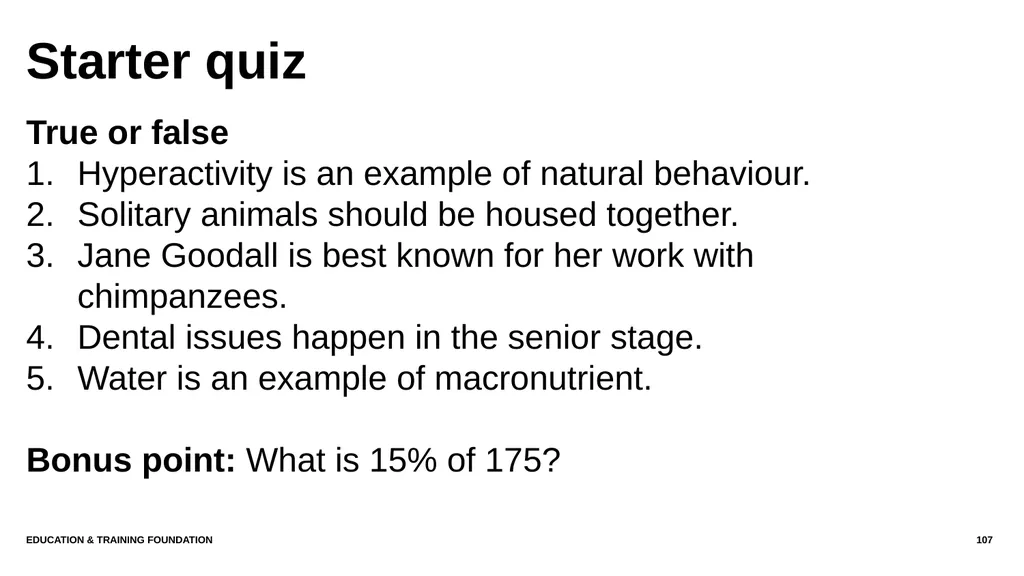
107 Starter quiz True or false
Hyperactivity is an example of natural behaviour.
Solitary animals should be housed together.
Jane Goodall is best known for her work with chimpanzees.
Dental issues happen in the senior stage.
Water is an example of macronutrient.
Bonus point: What is 15% of 175? Education & Training Foundation<br>
108
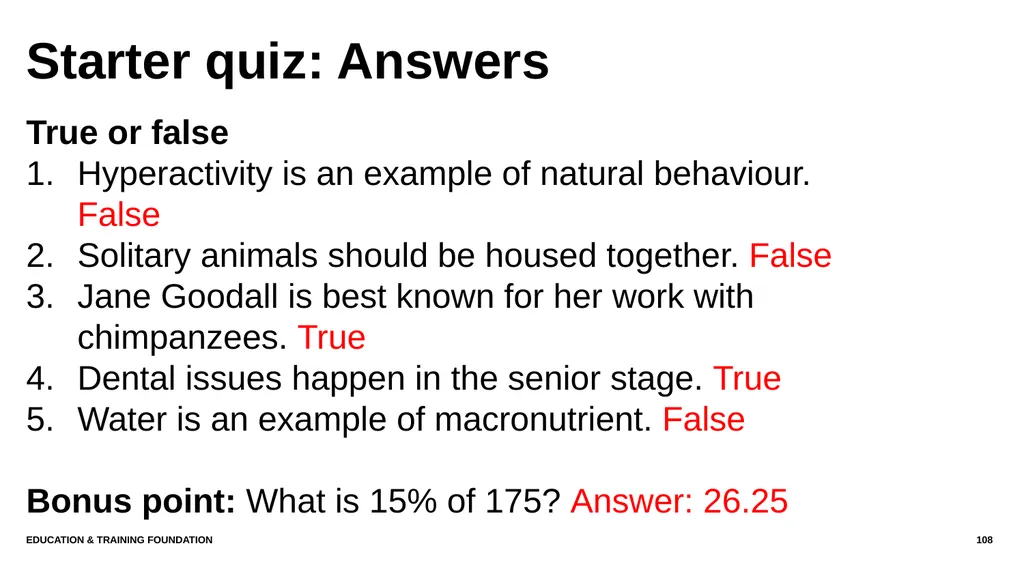
108 Starter quiz: Answers True or false
Hyperactivity is an example of natural behaviour. False
Solitary animals should be housed together. False
Jane Goodall is best known for her work with chimpanzees. True
Dental issues happen in the senior stage. True
Water is an example of macronutrient. False
Bonus point: What is 15% of 175? Answer: 26.25 Education & Training Foundation<br>
109
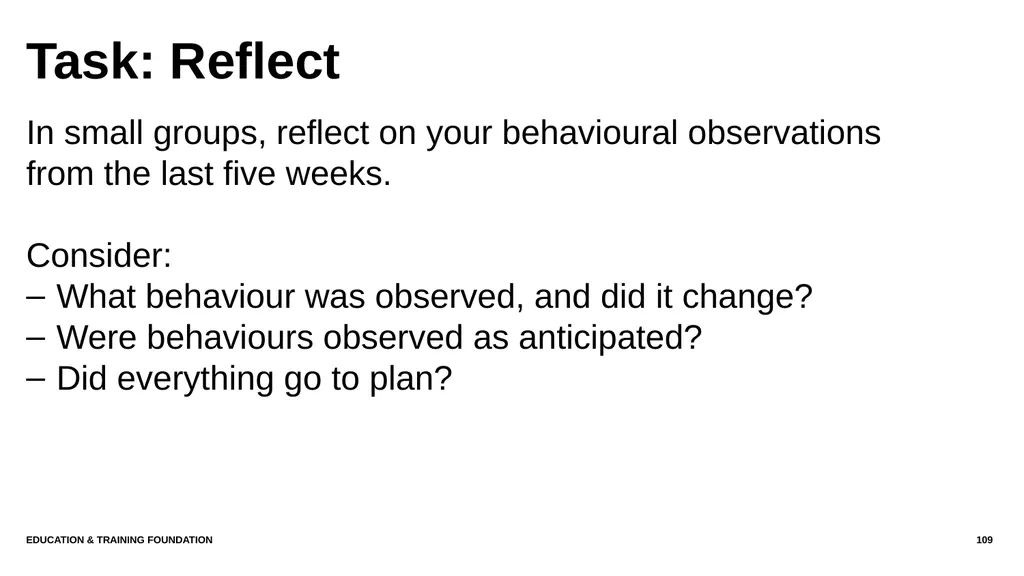
109 Task: Reflect In small groups, reflect on your behavioural observations from the last five weeks.
Consider:
What behaviour was observed, and did it change?
Were behaviours observed as anticipated?
Did everything go to plan? Education & Training Foundation<br>
Consider:
What behaviour was observed, and did it change?
Were behaviours observed as anticipated?
Did everything go to plan? Education & Training Foundation<br>
110
110 Classical conditioning Form of learning through association.
First described by Ivan Pavlov, a Russian physiologist.
Known as Pavlovian conditioning. Education & Training Foundation<br>
First described by Ivan Pavlov, a Russian physiologist.
Known as Pavlovian conditioning. Education & Training Foundation<br>
111
111 Operant conditioning Education & Training Foundation Learning that happens through consequences.
The response is strengthened or weakened.
Based on what happens after the behaviour.<br>
The response is strengthened or weakened.
Based on what happens after the behaviour.<br>
112
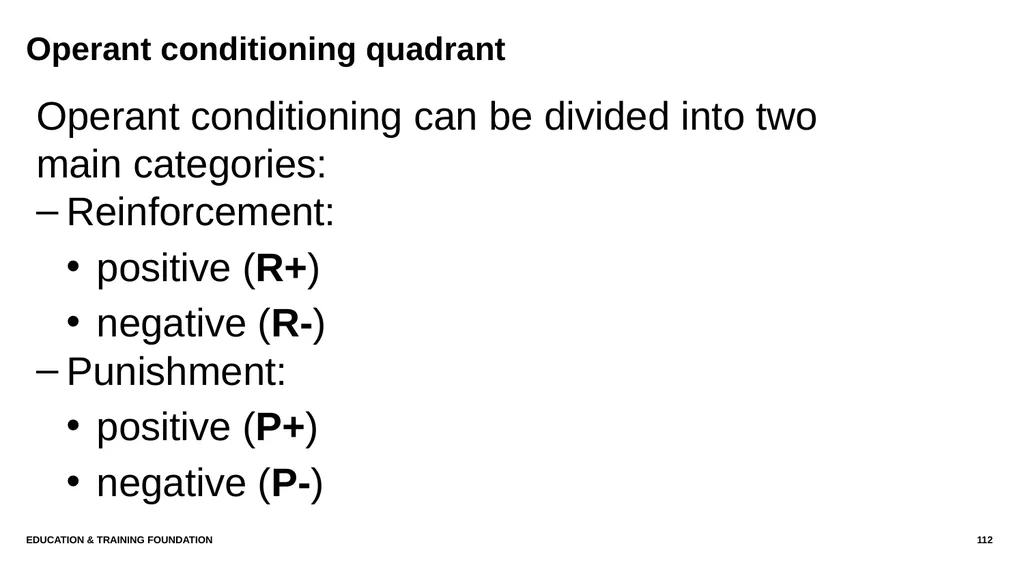
112 Operant conditioning quadrant Education & Training Foundation Operant conditioning can be divided into two main categories:
Reinforcement:
positive (R+)
negative (R-)
Punishment:
positive (P+)
negative (P-)<br>
Reinforcement:
positive (R+)
negative (R-)
Punishment:
positive (P+)
negative (P-)<br>
113
Behavioural challenge case studies Read the case study allocated.
Identify training techniques that could be used to overcome the behavioural challenges displayed by the animal in the allocated case study. Education & Training Foundation 113<br>
Identify training techniques that could be used to overcome the behavioural challenges displayed by the animal in the allocated case study. Education & Training Foundation 113<br>
114
114 Hot and cold game One person will be the ‘animal’, one will be the ‘trainer’, one will be the observer.
Total amount of time given: 10 minutes. One minute to hide ‘reward’, five minutes to locate ‘reward’, four minutes for observer feedback (including feedback from ‘trainer’ and ‘animal’).
Aim: to hide a reward and only using ‘hot’ or ‘cold’ as a signal to tell the ‘animal’ where their desired treat is located. Education & Training Foundation<br>
115
115 Plenary question: Conditioning Explain the key differences between classical and operant conditioning in animal training.
Describe the consequences of positive and negative reinforcement in the context of training animals. Education & Training Foundation<br>
Describe the consequences of positive and negative reinforcement in the context of training animals. Education & Training Foundation<br>
116
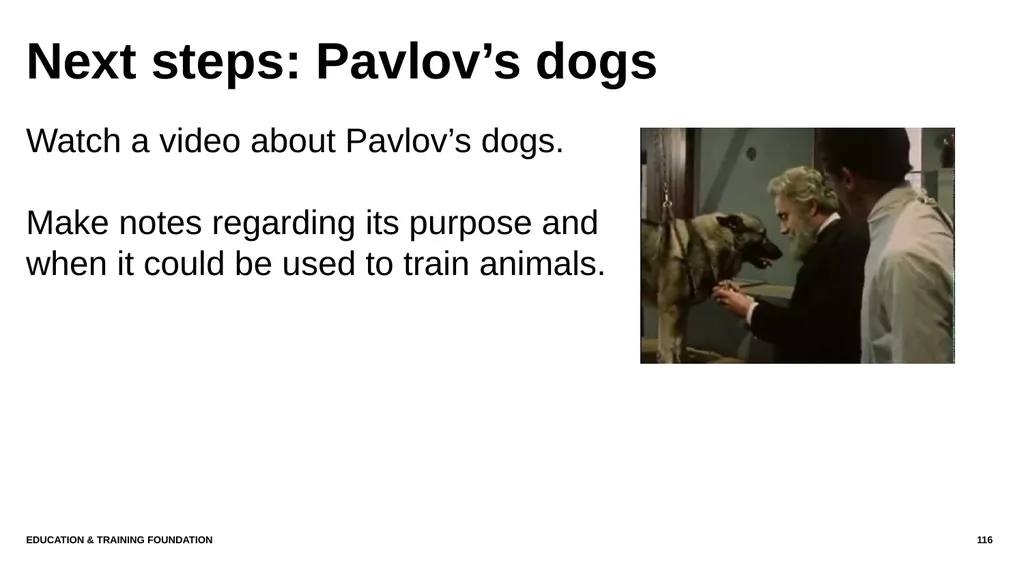
116 Next steps: Pavlov’s dogs Watch a video about Pavlov’s dogs.
Make notes regarding its purpose and when it could be used to train animals. Education & Training Foundation<br>
Make notes regarding its purpose and when it could be used to train animals. Education & Training Foundation<br>
117
8 Training plans using the S.P.I.D.E.R. framework<br>
118
118 Starter: Learning theories Read the introduction to the article.
As a pair, write a summary of the article.
Add your summary to the collaborative wall. Education & Training Foundation<br>
As a pair, write a summary of the article.
Add your summary to the collaborative wall. Education & Training Foundation<br>
119
119 Task: Planning training case studies Complete each case study in the allocated time. Education & Training Foundation<br>
120
120 Task: Framework Create a diagram of a framework that could be used to create and monitor animal training. Education & Training Foundation<br>
121
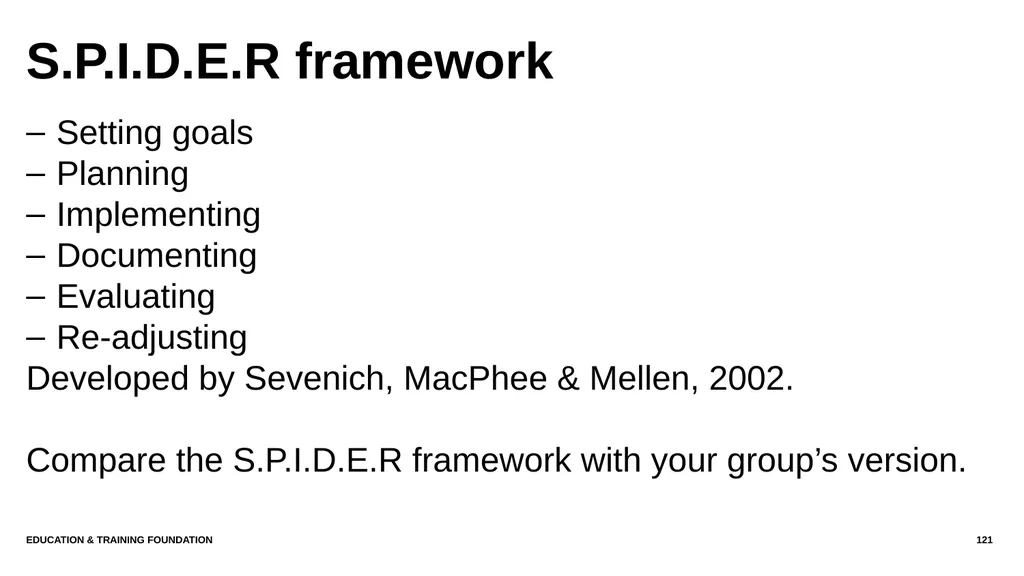
S.P.I.D.E.R framework Setting goals
Planning
Implementing
Documenting
Evaluating
Re-adjusting
Developed by Sevenich, MacPhee & Mellen, 2002.
Compare the S.P.I.D.E.R framework with your group’s version. Education & Training Foundation 121<br>
Planning
Implementing
Documenting
Evaluating
Re-adjusting
Developed by Sevenich, MacPhee & Mellen, 2002.
Compare the S.P.I.D.E.R framework with your group’s version. Education & Training Foundation 121<br>
122
122 Plenary question: Training conditions Discuss how to assess an animal’s progress when training.
Explain how to adjust the training plan to ensure success. Education & Training Foundation<br>
Explain how to adjust the training plan to ensure success. Education & Training Foundation<br>
123
123 Next steps: Training methods Read the the blog post.
Write a summary on adjusting training methods for different life stages. Education & Training Foundation<br>
Write a summary on adjusting training methods for different life stages. Education & Training Foundation<br>
124
9 Developing and proposing an animal training plan<br>
125
125 Starter: Hot and cold game One person will be the ‘animal’, one will be the ‘trainer’.
Total amount of time given: six minutes. One minute to hide ‘reward’, five minutes to locate ‘reward’.
Aim: to hide a reward and adapt ‘hot’ or ‘cold’ as per the life stage card as a signal to tell the ‘animal’ where their desired treat is located. Education & Training Foundation<br>
Total amount of time given: six minutes. One minute to hide ‘reward’, five minutes to locate ‘reward’.
Aim: to hide a reward and adapt ‘hot’ or ‘cold’ as per the life stage card as a signal to tell the ‘animal’ where their desired treat is located. Education & Training Foundation<br>
126
126 Task: Creating training plan Use your rabbit stage behaviour observations and data analysis to complete the task.
Set one or more training goals and create a training plan which improves the welfare of the animal you observed. Education & Training Foundation<br>
Set one or more training goals and create a training plan which improves the welfare of the animal you observed. Education & Training Foundation<br>
127
Task: Peer review Peer review the set goals and training plan.
Provide constructive feedback. Education & Training Foundation 127<br>
Provide constructive feedback. Education & Training Foundation 127<br>
128
128 Task: Adjusting training plan Using the feedback, make suitable adjustments to your goals and training plan. Education & Training Foundation<br>
129
129 Plenary task: Email collections manager Write an email to the collections manager who oversees the animals explaining your training plan.
Include:
a summary of the plan
how it improves welfare
reference to your behaviour observations and data. Education & Training Foundation<br>
Include:
a summary of the plan
how it improves welfare
reference to your behaviour observations and data. Education & Training Foundation<br>
130
130 Next steps Review materials from lessons 1–9 and collate notes in preparation for lesson 10 (bring to next lesson).
Review feedback from the email to the collection manager. Education & Training Foundation<br>
Review feedback from the email to the collection manager. Education & Training Foundation<br>
131
10 Proposing solutions to influence positive animal behaviour<br>
132
Starter: Task Watch the video clip and identify as many behaviours as you can. Education & Training Foundation 132<br>
133
133 List of behaviours Education & Training Foundation<br>
134
134 Task: Dutch rabbit or Syrian hamster Read the case study allocated.
Complete the Animal training plan template, proposing solutions to influence positive animal behaviour. Education & Training Foundation<br>
Complete the Animal training plan template, proposing solutions to influence positive animal behaviour. Education & Training Foundation<br>
135
Preparing for peer review analysis Read the peer review pro forma.
Prepare five-minute oral presentation.
Include:
a brief animal profile
atypical behaviours and factors
suggested training techniques. Education & Training Foundation 135<br>
Prepare five-minute oral presentation.
Include:
a brief animal profile
atypical behaviours and factors
suggested training techniques. Education & Training Foundation 135<br>
136
Peer review analysis In allocated pairs, each present your Animal training plan.
Provide feedback using the peer review pro forma. Education & Training Foundation 136<br>
Provide feedback using the peer review pro forma. Education & Training Foundation 136<br>
137
Plenary Complete the Animal behaviour confidence rating worksheet.
Create SMART targets identifying how you will further develop your skills and knowledge around the
techniques to influence positive animal behaviour;
needs of different animals;
working in different environments. Education & Training Foundation 137<br>
Create SMART targets identifying how you will further develop your skills and knowledge around the
techniques to influence positive animal behaviour;
needs of different animals;
working in different environments. Education & Training Foundation 137<br>
138
138 Next steps: Applying learning Apply learning of solutions to influence positive animal behaviour to other animals.
Observe other animals and use techniques to influence positive animal behaviour.
Review and use the formative feedback to improve training plans. Education & Training Foundation<br>
Observe other animals and use techniques to influence positive animal behaviour.
Review and use the formative feedback to improve training plans. Education & Training Foundation<br>
139
Education & Training Foundation 139 PRODUCED BY FUNDED BY This programme is funded by the Department for Education South Staffordshire College has produced this resource on behalf of the Education and Training Foundation ET-FOUNDATION.CO.UK<br>