
Tackling Child Exploitation: taking a principled
TF
Published · 32 slides · 0 views
1 / 1





Description
Tackling Child Exploitation: taking a principled approach 1 Dez Holmes Director, Research in Practice dezholmes Background TCE Programme: a DfE-funded consortium programme led by Research in Practice with The Childrens Society and the
Related Topics
Share
Embed code
Download this presentation From Below
"Tackling Child Exploitation: taking a principled" is the property of its rightful owner. Permission is granted to download and print the materials on this website for personal, non-commercial use only, and to display it on your personal computer provided you do not modify the materials and that you retain all copyright notices contained in the materials. By downloading content from our website, you accept the terms of this agreement.
Presentation Transcript
01
Tackling Child Exploitation: taking a principled approach 1 Dez Holmes
Director, Research in Practice
@dez_holmes<br>
Director, Research in Practice
@dez_holmes<br>
02
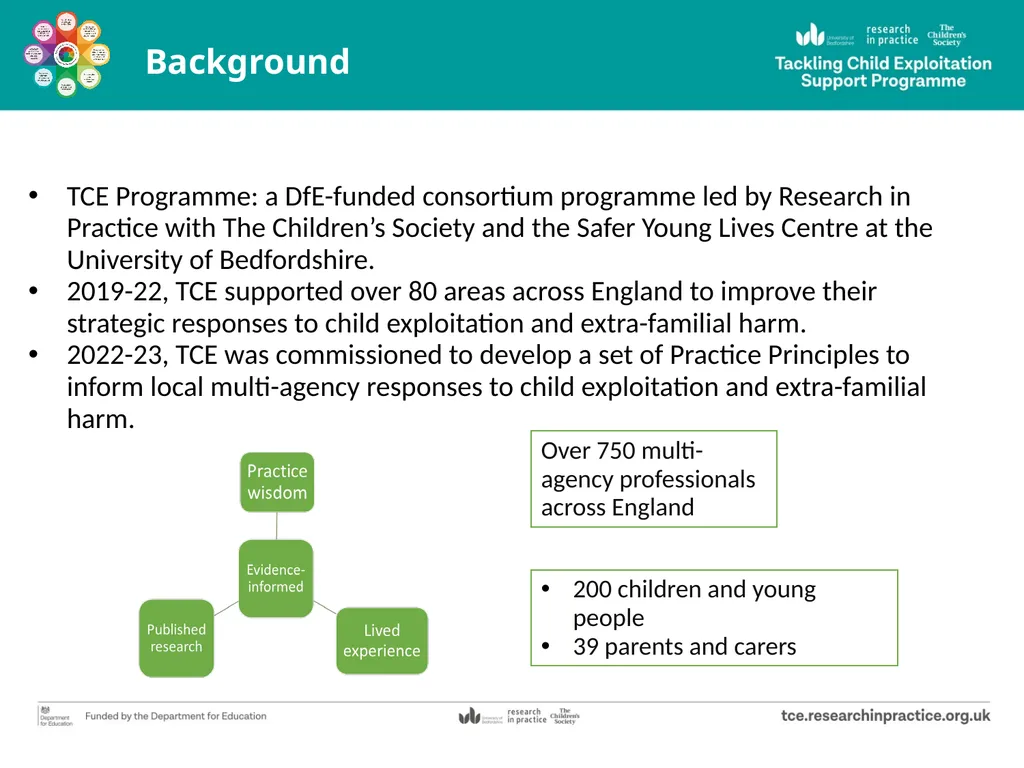
Background TCE Programme: a DfE-funded consortium programme led by Research in Practice with The Children’s Society and the Safer Young Lives Centre at the University of Bedfordshire.
2019-22, TCE supported over 80 areas across England to improve their strategic responses to child exploitation and extra-familial harm.
2022-23, TCE was commissioned to develop a set of Practice Principles to inform local multi-agency responses to child exploitation and extra-familial harm.
Over 750 multi-agency professionals across England 200 children and young people
39 parents and carers<br>
2019-22, TCE supported over 80 areas across England to improve their strategic responses to child exploitation and extra-familial harm.
2022-23, TCE was commissioned to develop a set of Practice Principles to inform local multi-agency responses to child exploitation and extra-familial harm.
Over 750 multi-agency professionals across England 200 children and young people
39 parents and carers<br>
03
The Practice Principles Interrelated and interdependent, focusing on the 'how' not the 'what’.
Offer a compass to help navigate a complex landscape, rather than a detailed map for every individual situation.
Are high-level to support a coherent approach across local partnerships and to support multi agency working.
Focus on behaviours and culture to help direct work with children, young people, and families, operational management and strategic leadership to align.
Aim to complement existing and forthcoming guidance endure over time and fit with diverse local contexts<br>
Offer a compass to help navigate a complex landscape, rather than a detailed map for every individual situation.
Are high-level to support a coherent approach across local partnerships and to support multi agency working.
Focus on behaviours and culture to help direct work with children, young people, and families, operational management and strategic leadership to align.
Aim to complement existing and forthcoming guidance endure over time and fit with diverse local contexts<br>
04
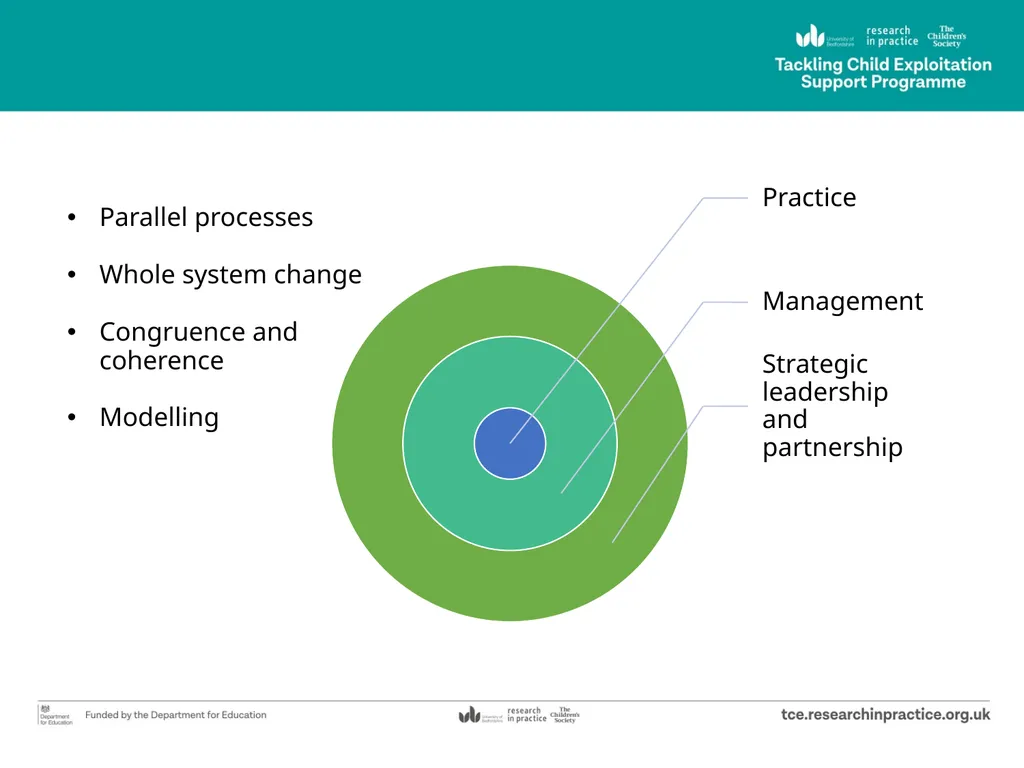
Parallel processes
Whole system change
Congruence and coherence
Modelling<br>
Whole system change
Congruence and coherence
Modelling<br>
05
The Practice Principles The eight Practice Principles Initial reactions…?<br>
06
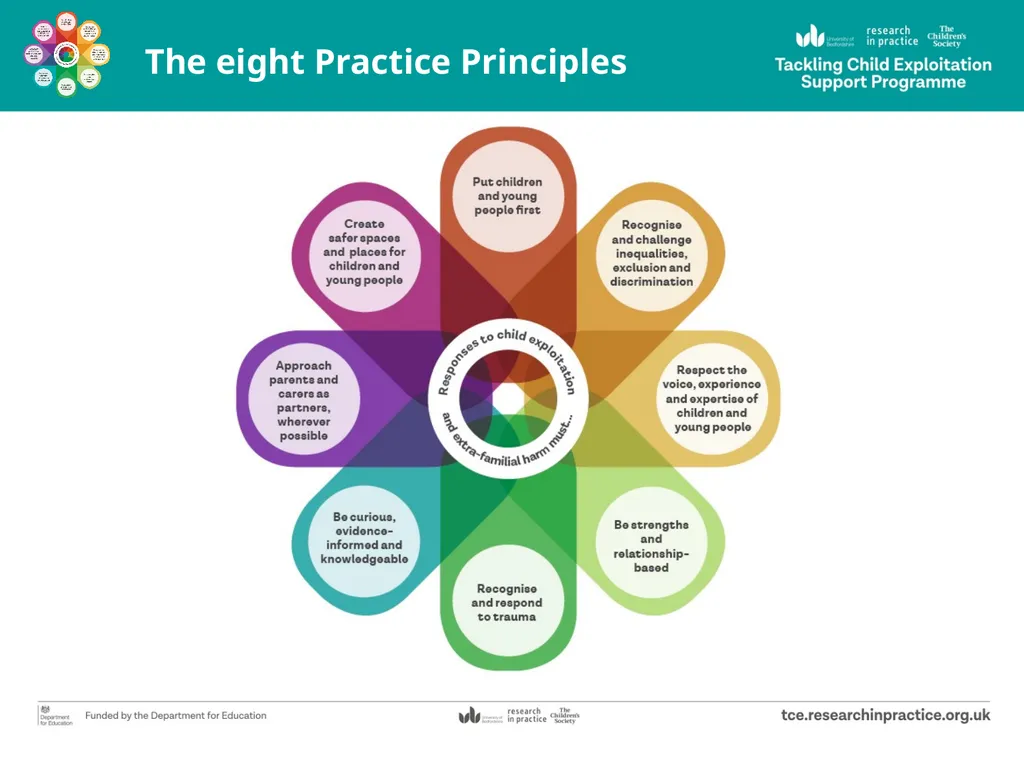
The Practice Principles The eight Practice Principles<br>
07
Responses to child exploitation and
extra-familial harm must…
Put children and young
people first Practice Principle 1<br>
extra-familial harm must…
Put children and young
people first Practice Principle 1<br>
08
Put children and young
people first Children cannot be held responsible for harm caused by others
Where children are causing harm – they are still children & responses should reflect that
All children and young people deserve to be supported in a way that respects their rights and offers protection
The complexities and presentation of child exploitation and extra-familial harm means that responses sometimes undermine the realisation of these rights<br>
people first Children cannot be held responsible for harm caused by others
Where children are causing harm – they are still children & responses should reflect that
All children and young people deserve to be supported in a way that respects their rights and offers protection
The complexities and presentation of child exploitation and extra-familial harm means that responses sometimes undermine the realisation of these rights<br>
09
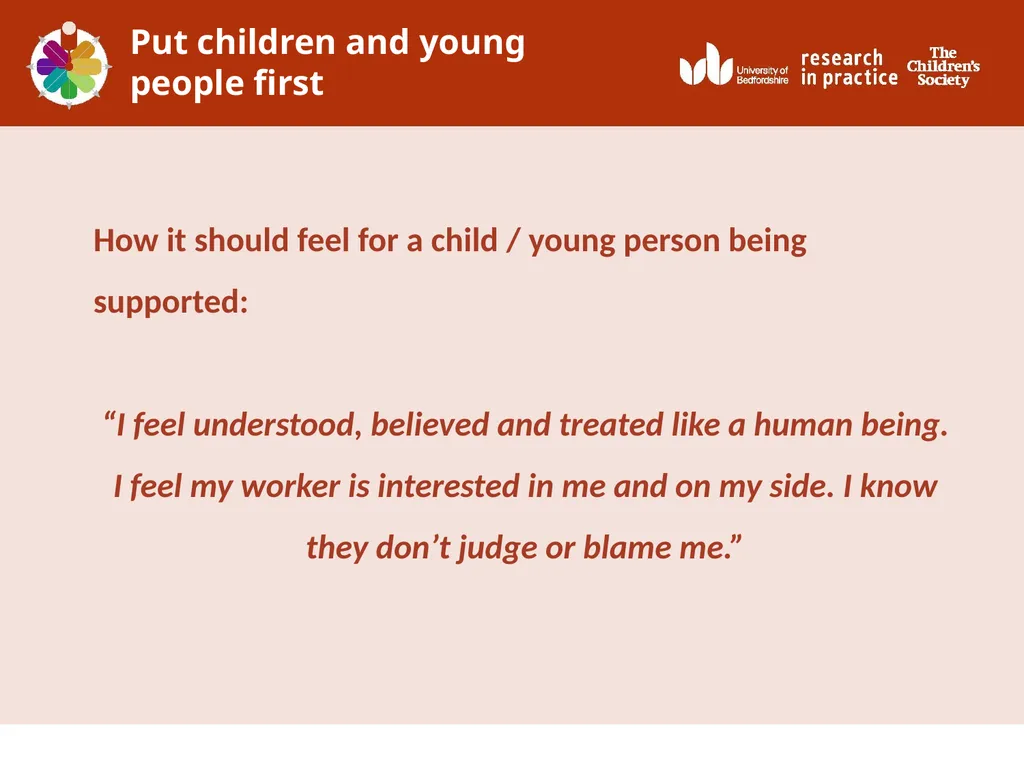
How it should feel for a child / young person being supported:
“I feel understood, believed and treated like a human being. I feel my worker is interested in me and on my side. I know they don’t judge or blame me.” Put children and young
people first<br>
“I feel understood, believed and treated like a human being. I feel my worker is interested in me and on my side. I know they don’t judge or blame me.” Put children and young
people first<br>
10
Practice Principle 2 Responses to child exploitation and extra-familial harm must…
Recognise and challenge inequalities, exclusion and discrimination<br>
Recognise and challenge inequalities, exclusion and discrimination<br>
11
Inequalities, exclusion and discrimination faced by children, young people and their parents / carers can be experienced in multiple ways and must be recognised and challenged
Systems issues can affect outcomes for children and young people, e.g. what data are or are not collected
Importance of developing an inclusive culture Recognise and challenge inequalities,
exclusion and discrimination<br>
Systems issues can affect outcomes for children and young people, e.g. what data are or are not collected
Importance of developing an inclusive culture Recognise and challenge inequalities,
exclusion and discrimination<br>
12
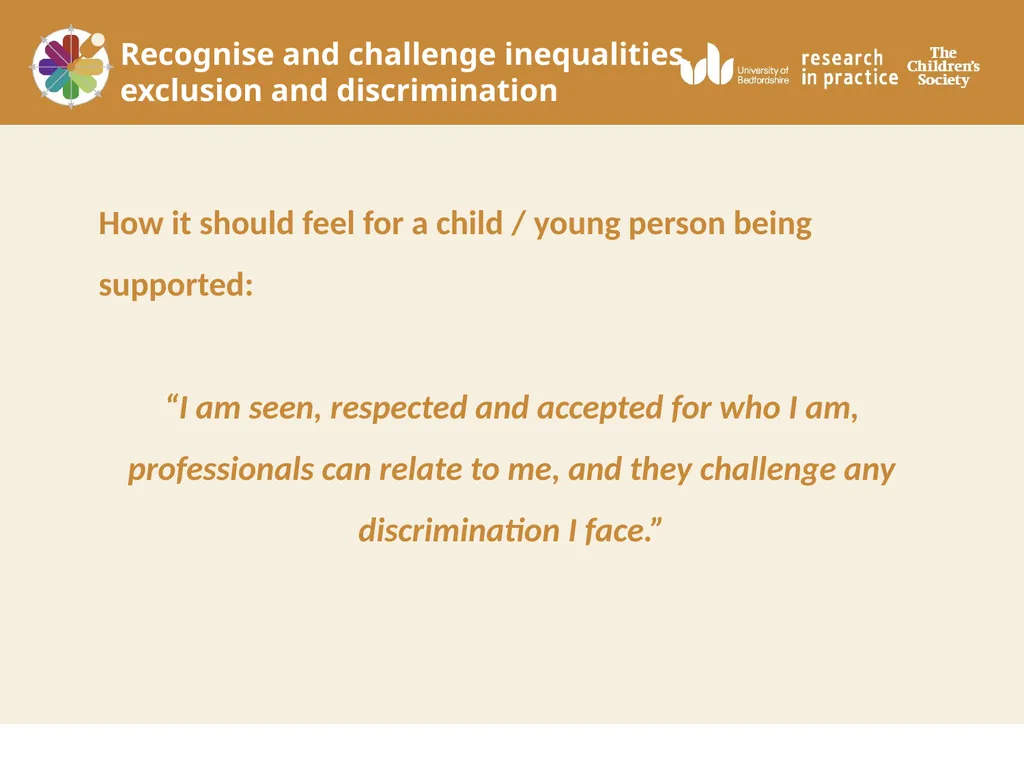
How it should feel for a child / young person being supported:
“I am seen, respected and accepted for who I am, professionals can relate to me, and they challenge any discrimination I face.” Recognise and challenge inequalities,
exclusion and discrimination<br>
“I am seen, respected and accepted for who I am, professionals can relate to me, and they challenge any discrimination I face.” Recognise and challenge inequalities,
exclusion and discrimination<br>
13
Children and young people:
have the right to have a say about matters that affect them and be heard in decisions made about them
should be respected and listened to as experts in their own lives: to develop trusting relationships and increase safety
Participation is a powerful way to invert the coercion and manipulation of exploitation and extra-familial harm
How it should feel for a child / young person being supported
I feel heard, acknowledged, and validated because my views and opinions are sought and included. This matters to me and makes me want to talk to them. Responses to child exploitation and
extra-familial harm must…
Respect the voices, experiences and expertise of children and young people Practice Principle 3<br>
have the right to have a say about matters that affect them and be heard in decisions made about them
should be respected and listened to as experts in their own lives: to develop trusting relationships and increase safety
Participation is a powerful way to invert the coercion and manipulation of exploitation and extra-familial harm
How it should feel for a child / young person being supported
I feel heard, acknowledged, and validated because my views and opinions are sought and included. This matters to me and makes me want to talk to them. Responses to child exploitation and
extra-familial harm must…
Respect the voices, experiences and expertise of children and young people Practice Principle 3<br>
14
Children and young people:
have the right to have a say about matters that affect them and be heard in decisions made about them
should be respected and listened to as experts in their own lives: to develop trusting relationships and increase safety
Participation is a powerful way to invert the coercion and manipulation of exploitation and extra-familial harm
How it should feel for a child / young person being supported
I feel heard, acknowledged, and validated because my views and opinions are sought and included. This matters to me and makes me want to talk to them. Respect the voices, experience and
expertise of children and young people Children and young people:
have the right to have a say about matters that affect them and be heard in decisions made about them
should be respected and listened to as experts in their own lives: to develop trusting relationships and increase safety
Participation is a powerful way to invert the coercion and manipulation of exploitation and extra-familial harm<br>
have the right to have a say about matters that affect them and be heard in decisions made about them
should be respected and listened to as experts in their own lives: to develop trusting relationships and increase safety
Participation is a powerful way to invert the coercion and manipulation of exploitation and extra-familial harm
How it should feel for a child / young person being supported
I feel heard, acknowledged, and validated because my views and opinions are sought and included. This matters to me and makes me want to talk to them. Respect the voices, experience and
expertise of children and young people Children and young people:
have the right to have a say about matters that affect them and be heard in decisions made about them
should be respected and listened to as experts in their own lives: to develop trusting relationships and increase safety
Participation is a powerful way to invert the coercion and manipulation of exploitation and extra-familial harm<br>
15
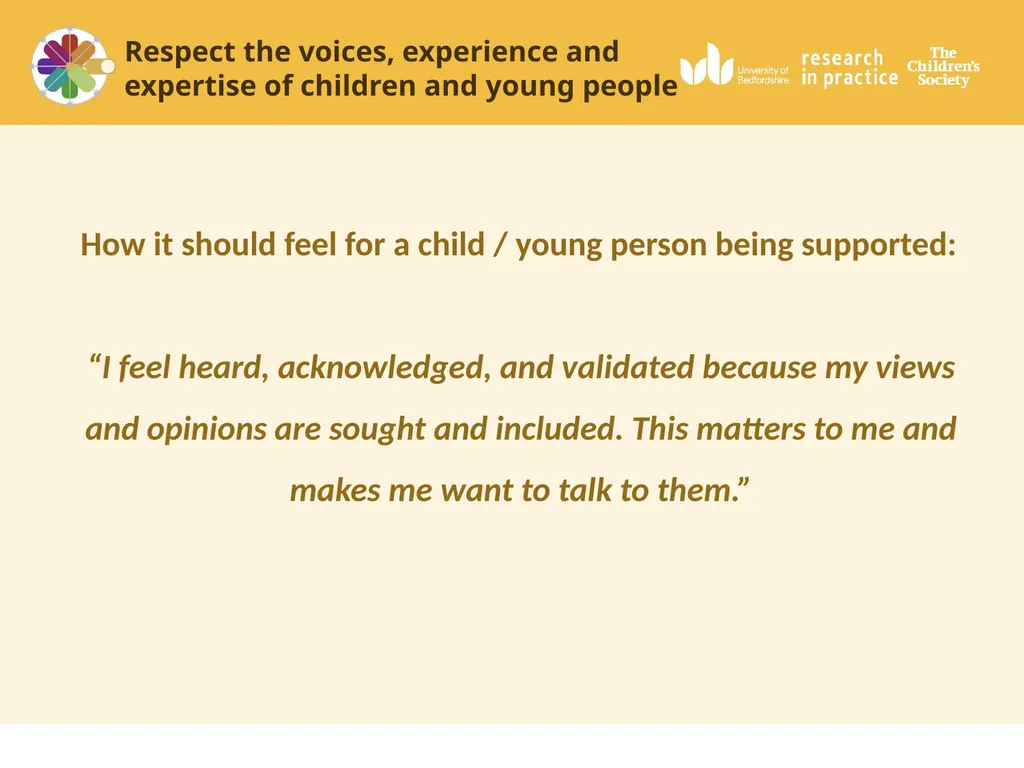
How it should feel for a child / young person being supported:
“I feel heard, acknowledged, and validated because my views and opinions are sought and included. This matters to me and makes me want to talk to them.” Respect the voices, experience and
expertise of children and young people<br>
“I feel heard, acknowledged, and validated because my views and opinions are sought and included. This matters to me and makes me want to talk to them.” Respect the voices, experience and
expertise of children and young people<br>
16
. Practice Principle 4 Responses to child exploitation and
extra-familial harm must…
Be strengths-based and relationship-based<br>
extra-familial harm must…
Be strengths-based and relationship-based<br>
17
. Be strengths-based
and relationships based Applies to working with children, young people, parents, carers and colleagues
Take a holistic approach: identify strengths, positive factors
Build on strengths, assets; work relationally to support growth and change<br>
and relationships based Applies to working with children, young people, parents, carers and colleagues
Take a holistic approach: identify strengths, positive factors
Build on strengths, assets; work relationally to support growth and change<br>
18
How it should feel for a child / young person being supported:
“I have someone to go to who genuinely cares about me and my future. They do things to actually help me. I feel safe with them and can trust them.” Be strengths-based
and relationships based<br>
“I have someone to go to who genuinely cares about me and my future. They do things to actually help me. I feel safe with them and can trust them.” Be strengths-based
and relationships based<br>
19
Practice Principle 5 Responses to child exploitation and
extra-familial harm must…
Recognise and respond to trauma<br>
extra-familial harm must…
Recognise and respond to trauma<br>
20
Recognise and respond to trauma Understand how individuals perceive and respond to threats and support.
Recognise that these responses might underpin perceived ‘non-engagement’ or ‘negative’ coping strategies.
Trauma can be experienced at different levels:
Direct trauma for children and young people - and potentially their parents / carers
Trauma that can impact wider communities, stemming from shared experiences
Trauma that can impact those working to support and protect traumatised individuals<br>
Recognise that these responses might underpin perceived ‘non-engagement’ or ‘negative’ coping strategies.
Trauma can be experienced at different levels:
Direct trauma for children and young people - and potentially their parents / carers
Trauma that can impact wider communities, stemming from shared experiences
Trauma that can impact those working to support and protect traumatised individuals<br>
21
How it should feel for a child / young person being supported:
“People understand how I have been affected by what has happened to me and they show that in the way they help me. I feel like I matter.” Recognise and respond to trauma<br>
“People understand how I have been affected by what has happened to me and they show that in the way they help me. I feel like I matter.” Recognise and respond to trauma<br>
22
PP6: Responses to child exploitation and extra-familial harm must be curious, evidence-informed and knowledgeable . Practice Principle 6 Responses to child exploitation and
extra-familial harm must…
Be curious, evidence-informed and knowledgeable<br>
extra-familial harm must…
Be curious, evidence-informed and knowledgeable<br>
23
PP6: Responses to child exploitation and extra-familial harm must be curious, evidence-informed and knowledgeable . Responding to the complexity of child exploitation and extra-familial harm requires:
curiosity, critical thinking, analysis skills
thoughtful use of evidence
a commitment to reflection and learning
Balance pace with purpose Be curious, evidence-informed
and knowledgeable<br>
curiosity, critical thinking, analysis skills
thoughtful use of evidence
a commitment to reflection and learning
Balance pace with purpose Be curious, evidence-informed
and knowledgeable<br>
24
How it should feel for a child / young person being supported:
“I feel properly seen, because the people who are there to help me put in the effort to understand me and my life. They are knowledgeable, and are always learning about how to help me feel safer.” Be curious, evidence-informed
and knowledgeable<br>
“I feel properly seen, because the people who are there to help me put in the effort to understand me and my life. They are knowledgeable, and are always learning about how to help me feel safer.” Be curious, evidence-informed
and knowledgeable<br>
25
PP7: Responses to child exploitation and extra-familial harm must approach parents and carers as partners wherever possible . Practice Principle 7 Responses to child exploitation and
extra-familial harm must…
Approach parents and carers as partners wherever possible<br>
extra-familial harm must…
Approach parents and carers as partners wherever possible<br>
26
PP7: Responses to child exploitation and extra-familial harm must approach parents and carers as partners wherever possible . Approach parents and carers as partners wherever possible Starting point: include parents and carers as partners
Parents and carers can hold invaluable information about their child and the contexts of their lives
Acknowledge and attend to their own potential distress
Recognition that circumstances will differ between families so there is no ‘one size fits all’ solution.<br>
Parents and carers can hold invaluable information about their child and the contexts of their lives
Acknowledge and attend to their own potential distress
Recognition that circumstances will differ between families so there is no ‘one size fits all’ solution.<br>
27
How it should feel for a child / young person being supported:
“I am included in decisions about involving my parents and carers. Supporting my parents and / or carers to understand what has happened to me can help improve family relationships and the support I receive.” Approach parents and carers as partners wherever possible<br>
“I am included in decisions about involving my parents and carers. Supporting my parents and / or carers to understand what has happened to me can help improve family relationships and the support I receive.” Approach parents and carers as partners wherever possible<br>
28
. . Practice Principle 8 Responses to child exploitation and
extra-familial harm must…
Create safe spaces and places for children and young people<br>
extra-familial harm must…
Create safe spaces and places for children and young people<br>
29
. . Understanding of harms and protective factors in spaces and places where children and young people spend their time (on- and off-line)
Identify harm and intervene accordingly (e.g. disruption) to make the space/place safer
This focus can prevent children and young people feeling blamed Create safe spaces and places for children and young people<br>
Identify harm and intervene accordingly (e.g. disruption) to make the space/place safer
This focus can prevent children and young people feeling blamed Create safe spaces and places for children and young people<br>
30
How it should feel for a child / young person being supported:
“In my community, I have opportunities to do activities and make new friends. The spaces and places where I spend my time feel safe, and give me a sense of belonging.” Create safe spaces and places for children and young people<br>
“In my community, I have opportunities to do activities and make new friends. The spaces and places where I spend my time feel safe, and give me a sense of belonging.” Create safe spaces and places for children and young people<br>
31
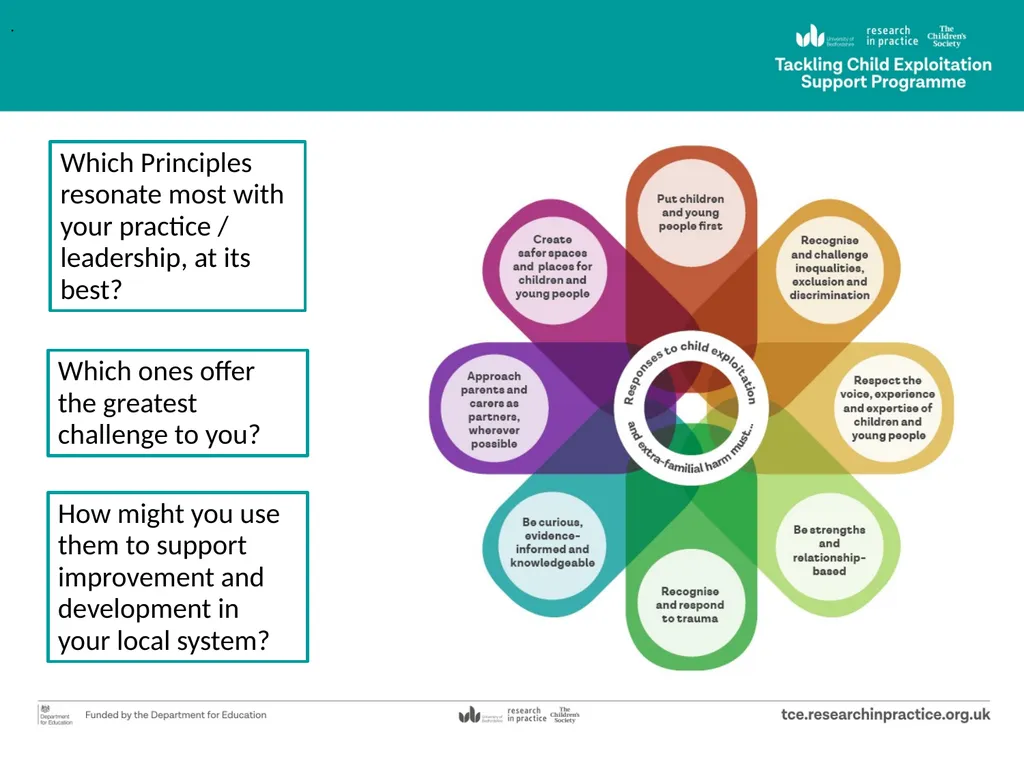
. How might you use them to support improvement and development in your local system? Which Principles resonate most with your practice / leadership, at its best? Which ones offer the greatest challenge to you?<br>
32
Supporting Resources Six supporting resources to support the application of the Practice Principles:
An evidence summary, a succinct summary of the research drawn upon in developing the Principles
An individual practice and reflection tool, a professional development tool to support practitioners to reflect on the Principles, and their application to their own practice
A multi-agency partnership reflective tool, an interactive, reflective tool for local partnerships to work together to assess their responses to child exploitation and extra-familial harm
An animation to explain the evidence, ideas and interdependencies that underpin the Principles
Parent and Carers Shifting Mindset, a resource to support local agencies and partnerships to engage parents and carers as partners at an operational and strategic level
Youth Voice in strategic change, a resource to help local agency leaders and partnerships incorporate children and young people’s views at a strategic level.<br>
An evidence summary, a succinct summary of the research drawn upon in developing the Principles
An individual practice and reflection tool, a professional development tool to support practitioners to reflect on the Principles, and their application to their own practice
A multi-agency partnership reflective tool, an interactive, reflective tool for local partnerships to work together to assess their responses to child exploitation and extra-familial harm
An animation to explain the evidence, ideas and interdependencies that underpin the Principles
Parent and Carers Shifting Mindset, a resource to support local agencies and partnerships to engage parents and carers as partners at an operational and strategic level
Youth Voice in strategic change, a resource to help local agency leaders and partnerships incorporate children and young people’s views at a strategic level.<br>