
Tactical Field Care 1a Introduction to Tactical


Description: Tactical Field Care 1a Introduction to Tactical Field Care Tactical Combat Casualty Care for Medical Personnel August 2018 (Based on TCCC-MP Guidelines 180801) The opinions or assertions contained herein are the private views of the author
Related Topics
Download Presentation
"Tactical Field Care 1a Introduction to Tactical" is the property of its rightful owner. Permission is granted to download and print the materials on this website for personal, non-commercial use only, and to display it on your personal computer provided you do not modify the materials and that you retain all copyright notices contained in the materials. By downloading content from our website, you accept the terms of this agreement.
Presentation Transcript
slide1. Tactical Field Care 1a
Introduction to Tactical Field Care Tactical Combat Casualty Care for Medical Personnel August 2018 (Based on TCCC-MP Guidelines 180801)<br>
slide2. “The opinions or assertions contained herein are the private views of the author and are not to be construed as official or as reflecting the views of the Departments of the Army, Air Force, Navy or the Department of Defense.”
No disclosures Disclaimer<br>
slide3. LEARNING OBJECTIVES Terminal Learning Objective
Perform Tactical Field Care
Enabling Learning Objectives
Identify the importance of perimeter security in tactical field care.
Identify the common causes of altered mental status on the battlefield.
Identify the importance of disarming and securing communications gear of a casualty with altered mental status.<br>
slide4. Enabling Learning Objectives
Describe the prioritization of treating life-threatening conditions using a tactical trauma assessment sequence such as the MARCH algorithm.
Identify triage considerations in tactical field care.
Determine appropriate treatment techniques for preventable causes of combat death.
Demonstrate a Tactical Trauma Casualty Assessment. LEARNING OBJECTIVES<br>
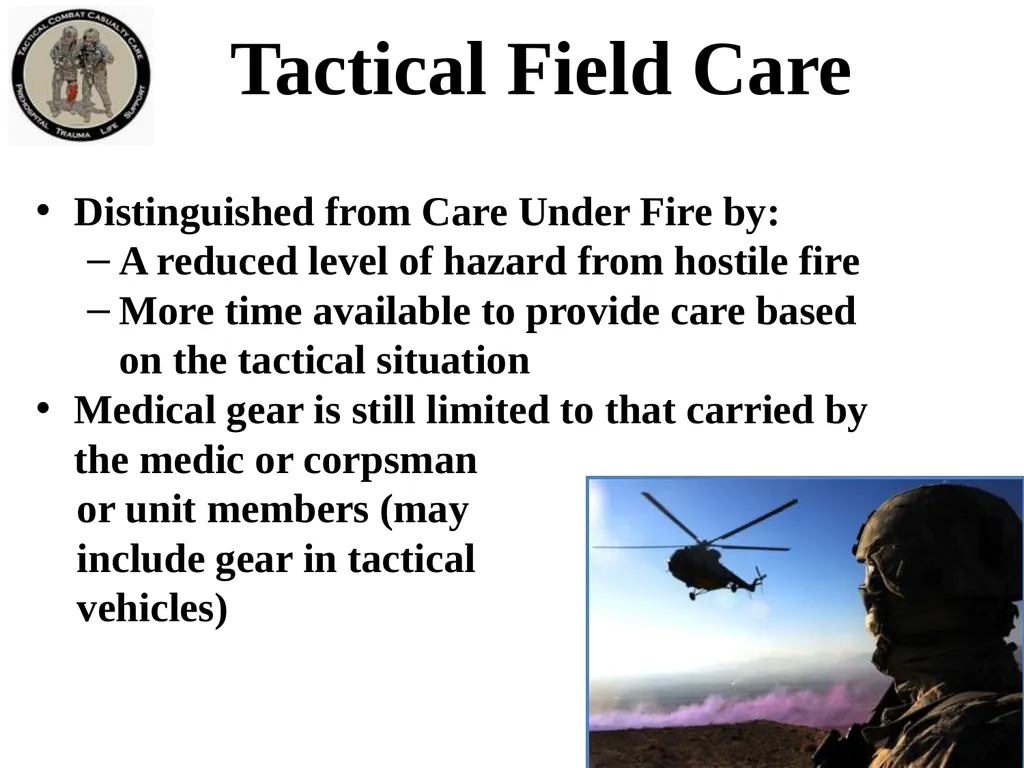
slide5. Tactical Field Care Distinguished from Care Under Fire by:
A reduced level of hazard from hostile fire
More time available to provide care based on the tactical situation
Medical gear is still limited to that carried by the medic or corpsman
or unit members (may
include gear in tactical
vehicles)<br>
slide6. May consist of rapid treatment of the most serious wounds with the expectation of a re-engagement with hostile forces at any moment, or
There may be ample time to render whatever care is possible in the field.
Time to evacuation may vary from minutes to several hours or longer. Tactical Field Care<br>
slide7. Battlefield Priorities in the Tactical Field Care Phase The TFC presentations cover the care to be recommended in TFC.
You must deal with your tactical situation and your casualties.
The sequence of care in TFC is compatible with the MARCH algorithm found in the USSOCOM Tactical Trauma Protocols.<br>
slide8. MARCH Massive hemorrhage – control life-threatening bleeding.
Airway – establish and maintain a patent airway.
Respiration – decompress suspected tension pneumothorax, seal open chest wounds, and support ventilation/oxygenation as required.<br>
slide9. Circulation – establish IV/IO access and administer fluids as required to treat shock.
Head injury/Hypothermia – prevent/treat hypotension and hypoxia to prevent worsening of traumatic brain injury and prevent/treat hypothermia. MARCH<br>
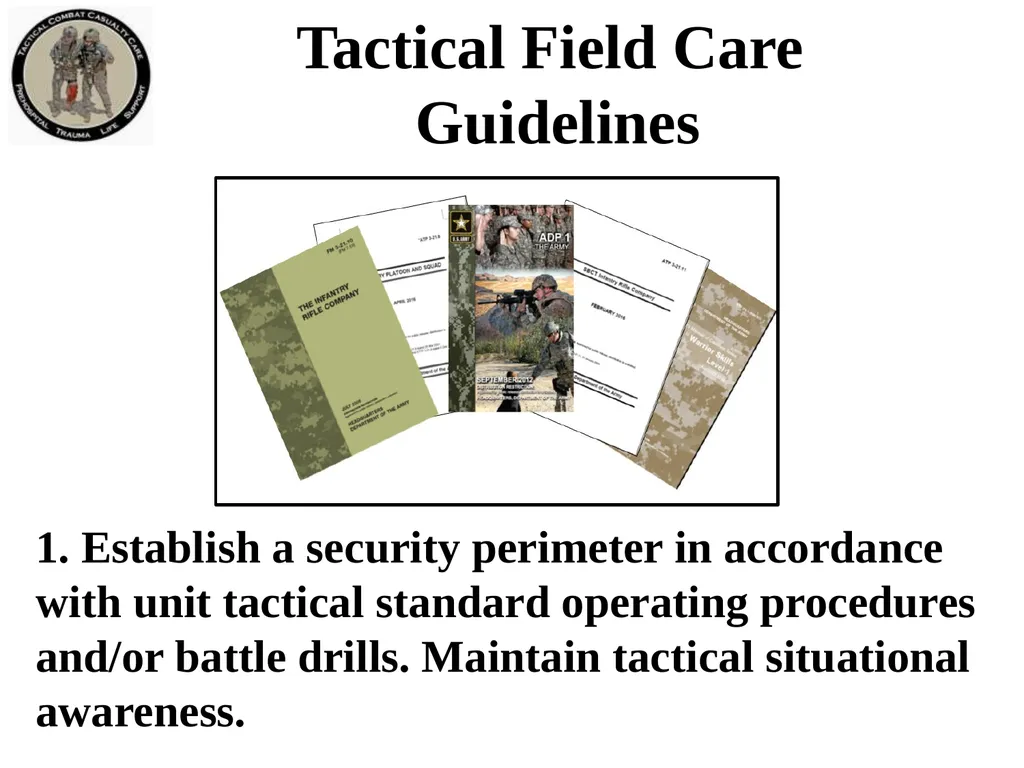
slide10. Tactical Field Care Guidelines 1. Establish a security perimeter in accordance with unit tactical standard operating procedures and/or battle drills. Maintain tactical situational awareness.<br>
slide11. Tactical Field Care Guidelines 2. Triage casualties as required. Casualties with an altered mental status should have weapons and communications equipment taken away immediately.<br>
slide12. Manage Casualties with Altered Mental Status A combatant with an altered mental status may use his weapons or radios inappropriately.
Secure long gun, pistols, knives, grenades, explosives, and all communications gear.
Possible causes of altered mental status are Traumatic Brain Injury (TBI), shock, hypoxia, and pain medications.
Say to the casualty: “Let Smith hold your weapon for you while I check you out.”<br>
slide13. Questions?<br>
Introduction to Tactical Field Care Tactical Combat Casualty Care for Medical Personnel August 2018 (Based on TCCC-MP Guidelines 180801)<br>
slide2. “The opinions or assertions contained herein are the private views of the author and are not to be construed as official or as reflecting the views of the Departments of the Army, Air Force, Navy or the Department of Defense.”
No disclosures Disclaimer<br>
slide3. LEARNING OBJECTIVES Terminal Learning Objective
Perform Tactical Field Care
Enabling Learning Objectives
Identify the importance of perimeter security in tactical field care.
Identify the common causes of altered mental status on the battlefield.
Identify the importance of disarming and securing communications gear of a casualty with altered mental status.<br>
slide4. Enabling Learning Objectives
Describe the prioritization of treating life-threatening conditions using a tactical trauma assessment sequence such as the MARCH algorithm.
Identify triage considerations in tactical field care.
Determine appropriate treatment techniques for preventable causes of combat death.
Demonstrate a Tactical Trauma Casualty Assessment. LEARNING OBJECTIVES<br>
slide5. Tactical Field Care Distinguished from Care Under Fire by:
A reduced level of hazard from hostile fire
More time available to provide care based on the tactical situation
Medical gear is still limited to that carried by the medic or corpsman
or unit members (may
include gear in tactical
vehicles)<br>
slide6. May consist of rapid treatment of the most serious wounds with the expectation of a re-engagement with hostile forces at any moment, or
There may be ample time to render whatever care is possible in the field.
Time to evacuation may vary from minutes to several hours or longer. Tactical Field Care<br>
slide7. Battlefield Priorities in the Tactical Field Care Phase The TFC presentations cover the care to be recommended in TFC.
You must deal with your tactical situation and your casualties.
The sequence of care in TFC is compatible with the MARCH algorithm found in the USSOCOM Tactical Trauma Protocols.<br>
slide8. MARCH Massive hemorrhage – control life-threatening bleeding.
Airway – establish and maintain a patent airway.
Respiration – decompress suspected tension pneumothorax, seal open chest wounds, and support ventilation/oxygenation as required.<br>
slide9. Circulation – establish IV/IO access and administer fluids as required to treat shock.
Head injury/Hypothermia – prevent/treat hypotension and hypoxia to prevent worsening of traumatic brain injury and prevent/treat hypothermia. MARCH<br>
slide10. Tactical Field Care Guidelines 1. Establish a security perimeter in accordance with unit tactical standard operating procedures and/or battle drills. Maintain tactical situational awareness.<br>
slide11. Tactical Field Care Guidelines 2. Triage casualties as required. Casualties with an altered mental status should have weapons and communications equipment taken away immediately.<br>
slide12. Manage Casualties with Altered Mental Status A combatant with an altered mental status may use his weapons or radios inappropriately.
Secure long gun, pistols, knives, grenades, explosives, and all communications gear.
Possible causes of altered mental status are Traumatic Brain Injury (TBI), shock, hypoxia, and pain medications.
Say to the casualty: “Let Smith hold your weapon for you while I check you out.”<br>
slide13. Questions?<br>