04
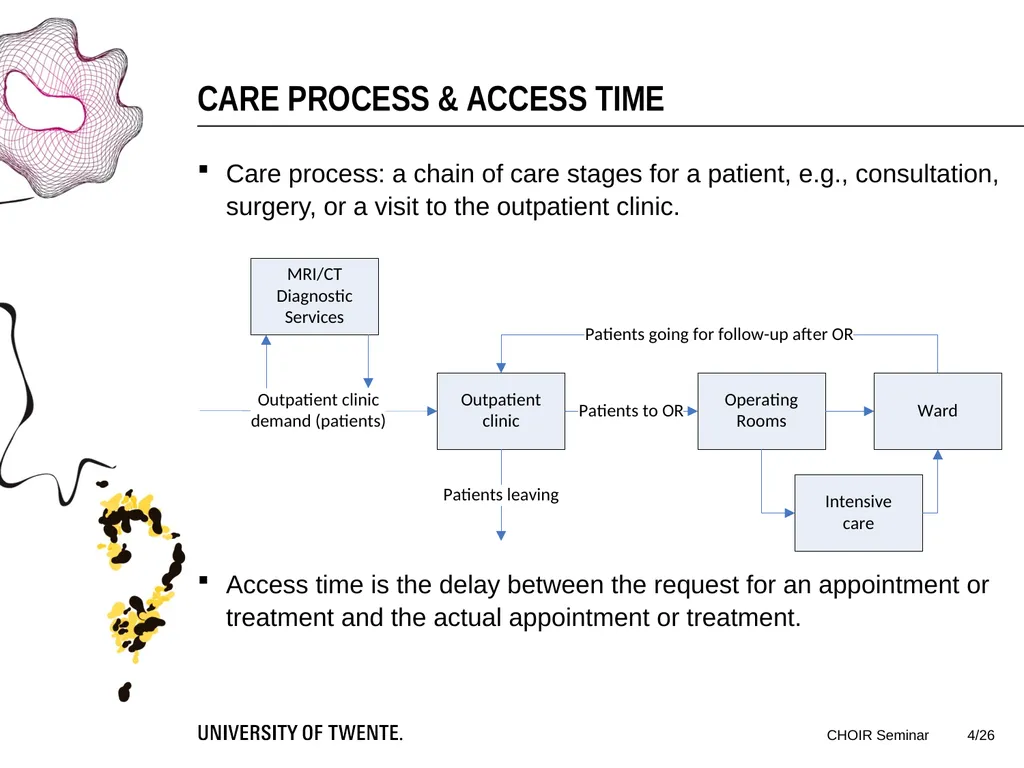
CARE PROCESS & ACCESS TIME CHOIR Seminar 4/26 Care process: a chain of care stages for a patient, e.g., consultation, surgery, or a visit to the outpatient clinic.
Access time is the delay between the request for an appointment or treatment and the actual appointment or treatment.<br>
05
OBJECTIVES OF TACTICAL PLANNING To control access times and care pathway durations
To ensure quality of care for the patient and to prevent patients from seeking treatment elsewhere
Decreasing care pathway duration decreases the delay between costs invested and revenues incurred
To serve the strategically agreed number of patients
To achieve high resource utilization and to balance workload
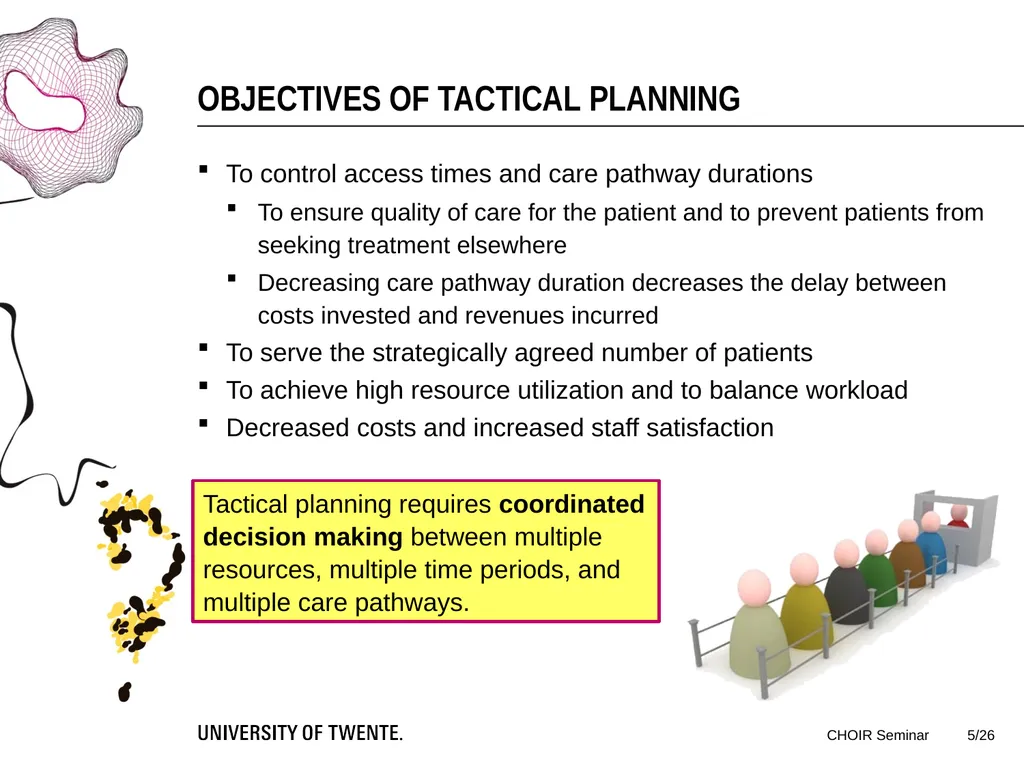
Decreased costs and increased staff satisfaction CHOIR Seminar 5/26 Tactical planning requires coordinated decision making between multiple resources, multiple time periods, and multiple care pathways.<br>
06
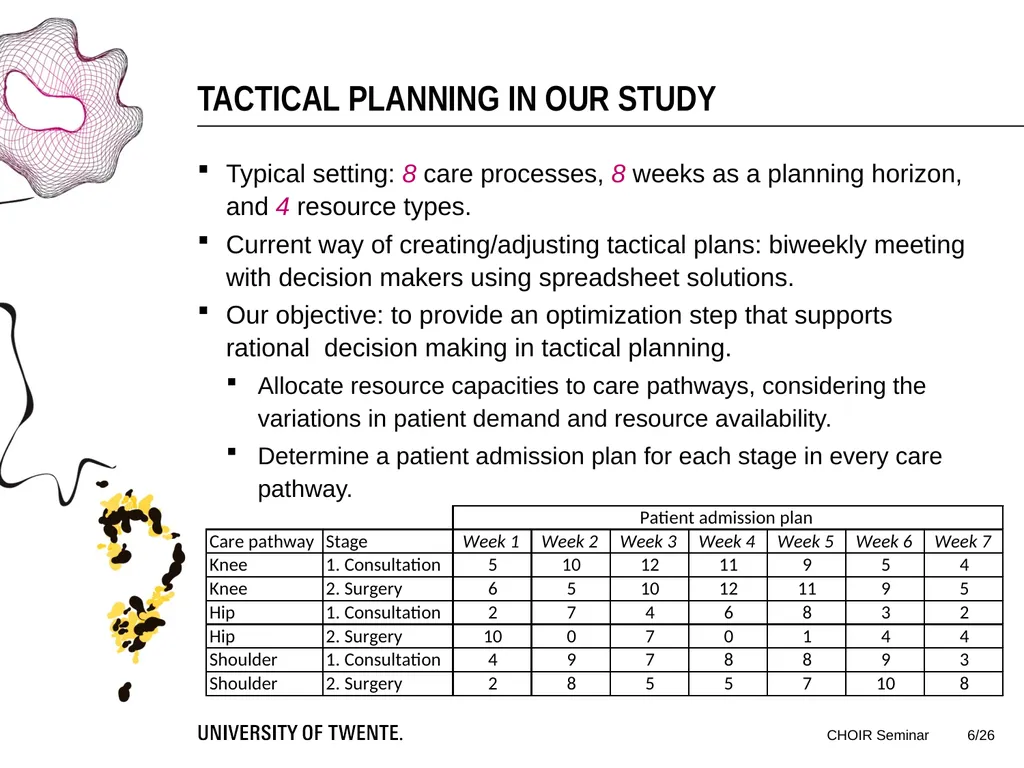
TACTICAL PLANNING IN OUR STUDY Typical setting: 8 care processes, 8 weeks as a planning horizon, and 4 resource types.
Current way of creating/adjusting tactical plans: biweekly meeting with decision makers using spreadsheet solutions.
Our objective: to provide an optimization step that supports rational decision making in tactical planning.
Allocate resource capacities to care pathways, considering the variations in patient demand and resource availability.
Determine a patient admission plan for each stage in every care pathway. CHOIR Seminar 6/26<br>
07
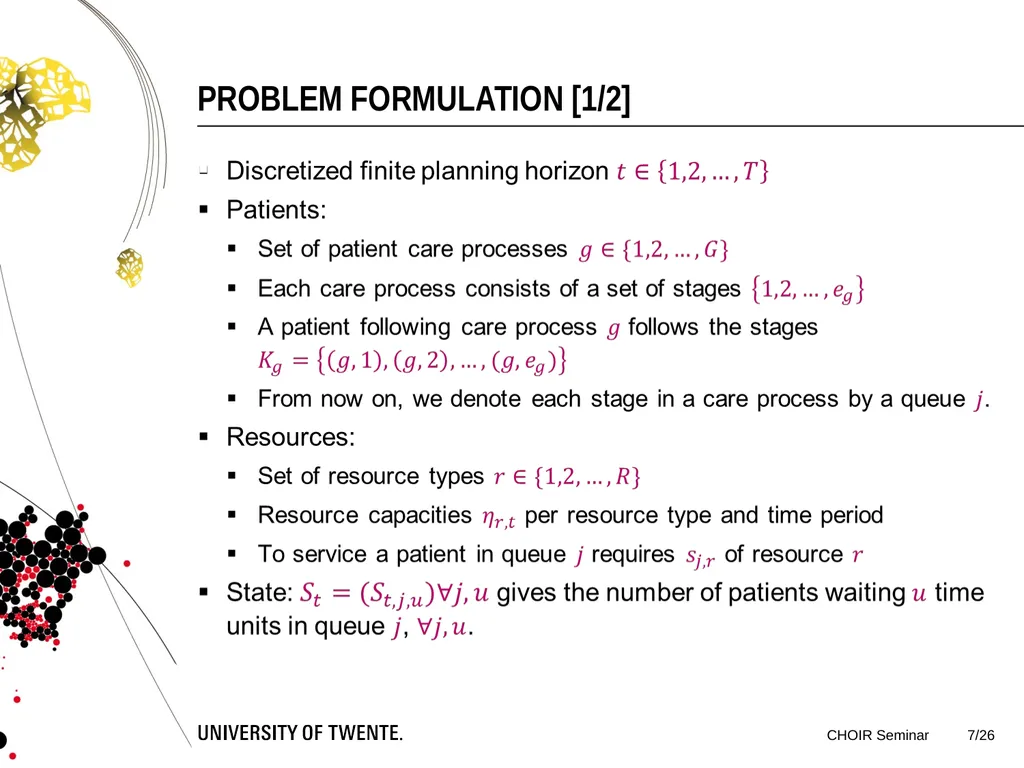
PROBLEM FORMULATION [1/2] CHOIR Seminar 7/26<br>
08
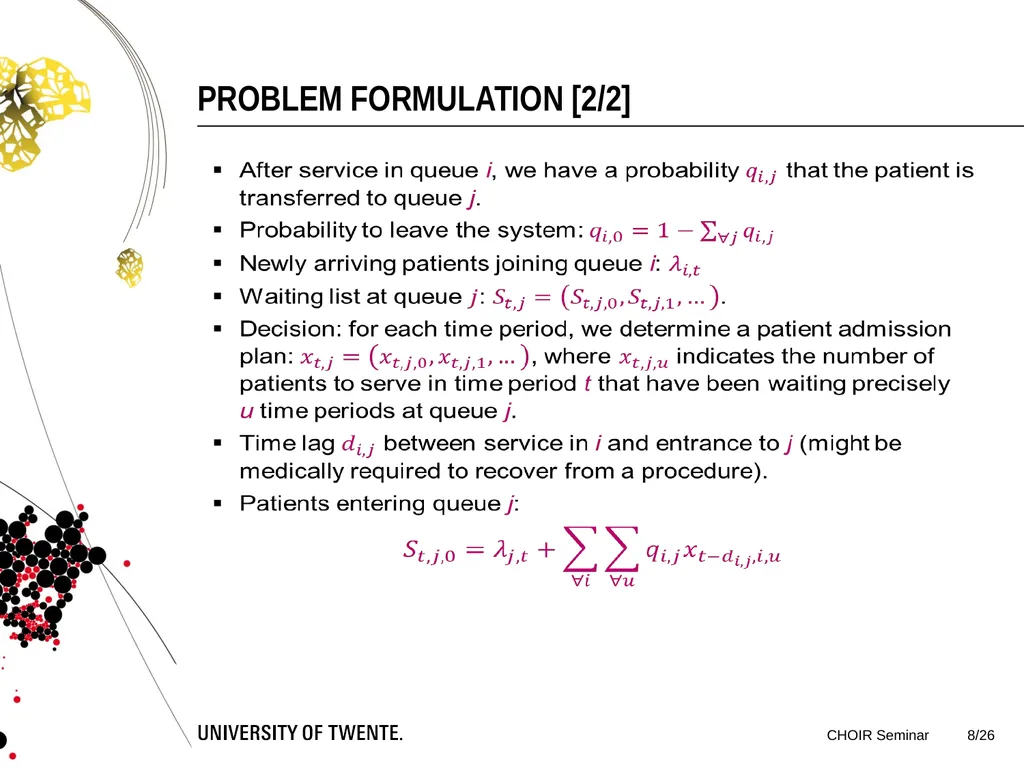
PROBLEM FORMULATION [2/2] CHOIR Seminar 8/26<br>
09
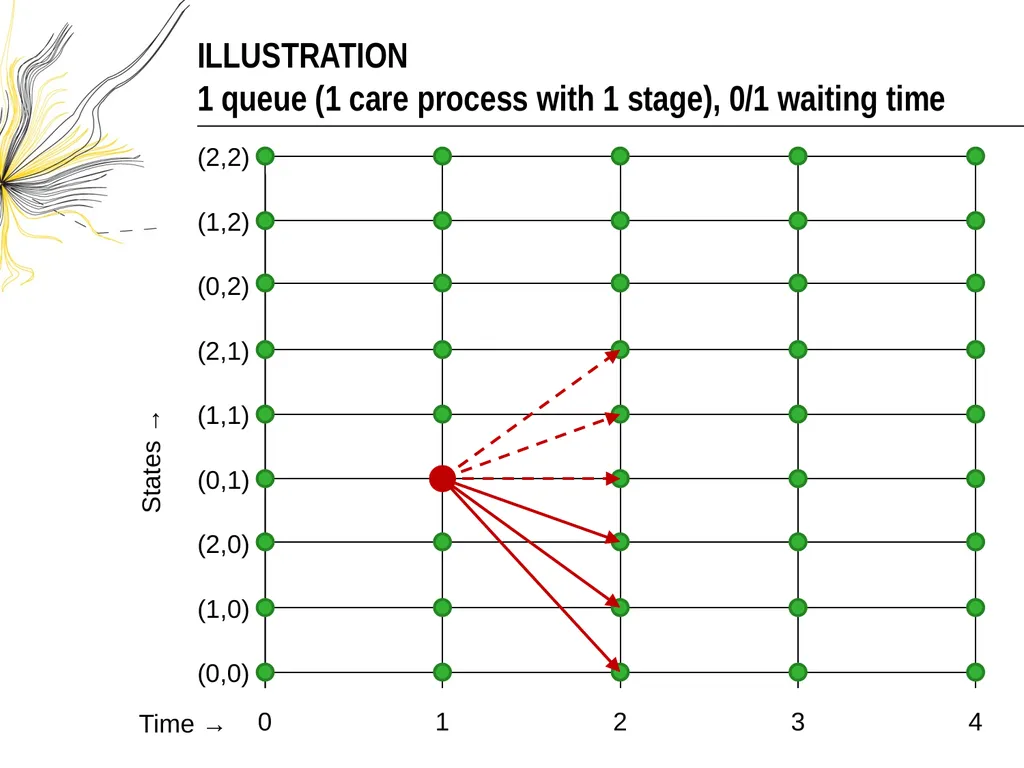
(2,2) (1,2) (0,2) (2,1) (1,1) (0,1) (2,0) (1,0) (0,0) 0 1 2 3 4 Time → States → ILLUSTRATION
1 queue (1 care process with 1 stage), 0/1 waiting time<br>
10
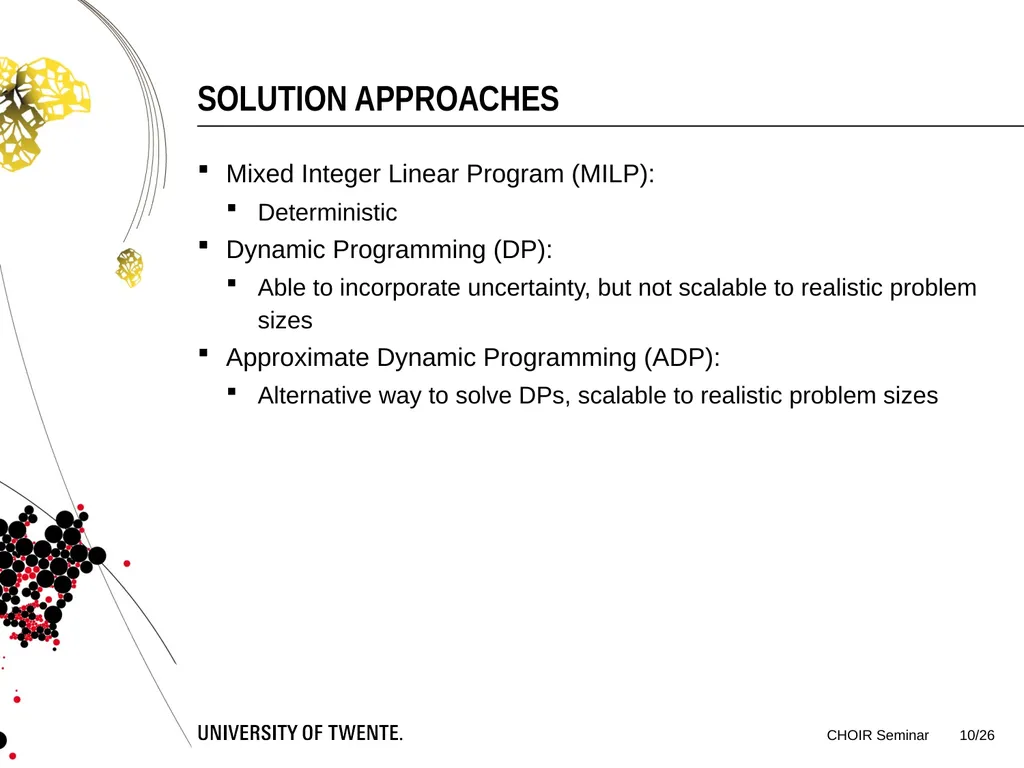
SOLUTION APPROACHES Mixed Integer Linear Program (MILP):
Deterministic
Dynamic Programming (DP):
Able to incorporate uncertainty, but not scalable to realistic problem sizes
Approximate Dynamic Programming (ADP):
Alternative way to solve DPs, scalable to realistic problem sizes CHOIR Seminar 10/26<br>
11
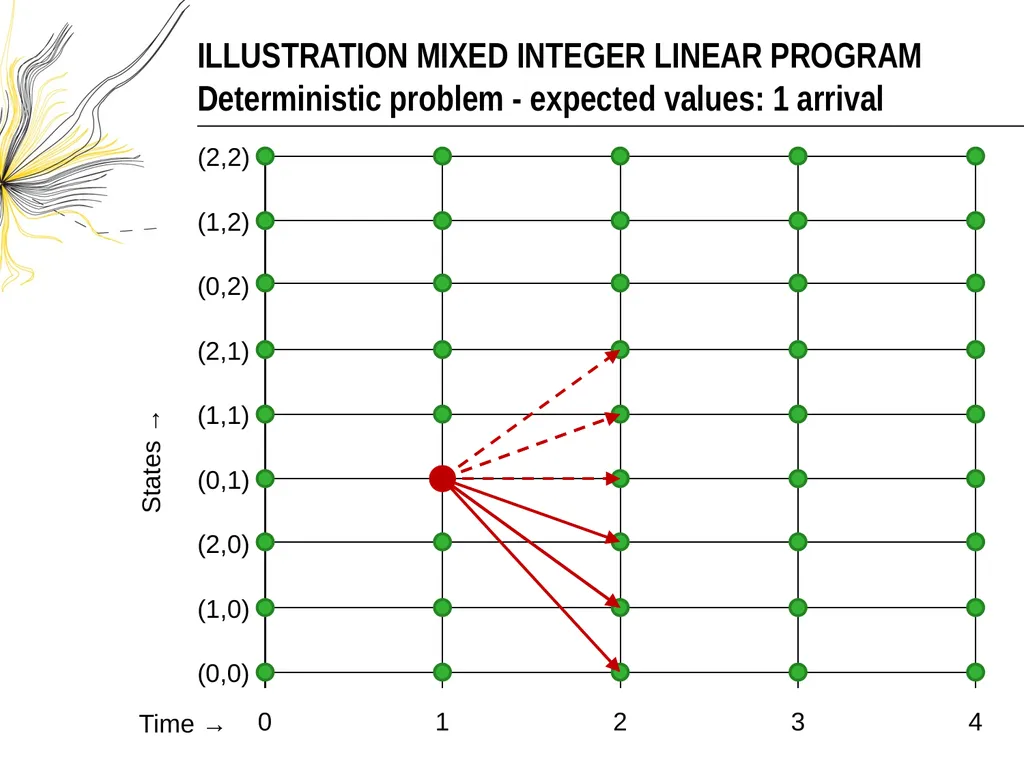
0 1 2 3 4 Time → States → (2,2) (1,2) (0,2) (2,1) (1,1) (0,1) (2,0) (1,0) (0,0) ILLUSTRATION MIXED INTEGER LINEAR PROGRAM Deterministic problem - expected values: 1 arrival<br>
12
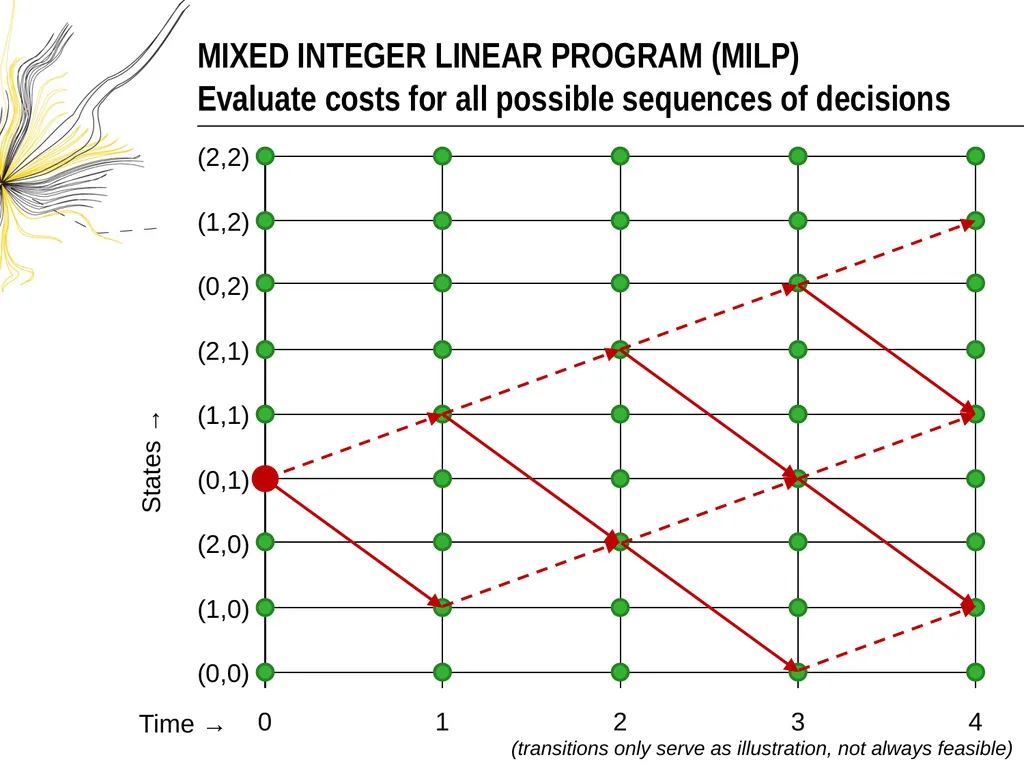
0 1 2 3 4 Time → States → (2,2) (1,2) (0,2) (2,1) (1,1) (0,1) (2,0) (1,0) (0,0) MIXED INTEGER LINEAR PROGRAM (MILP)
Evaluate costs for all possible sequences of decisions (transitions only serve as illustration, not always feasible)<br>
13
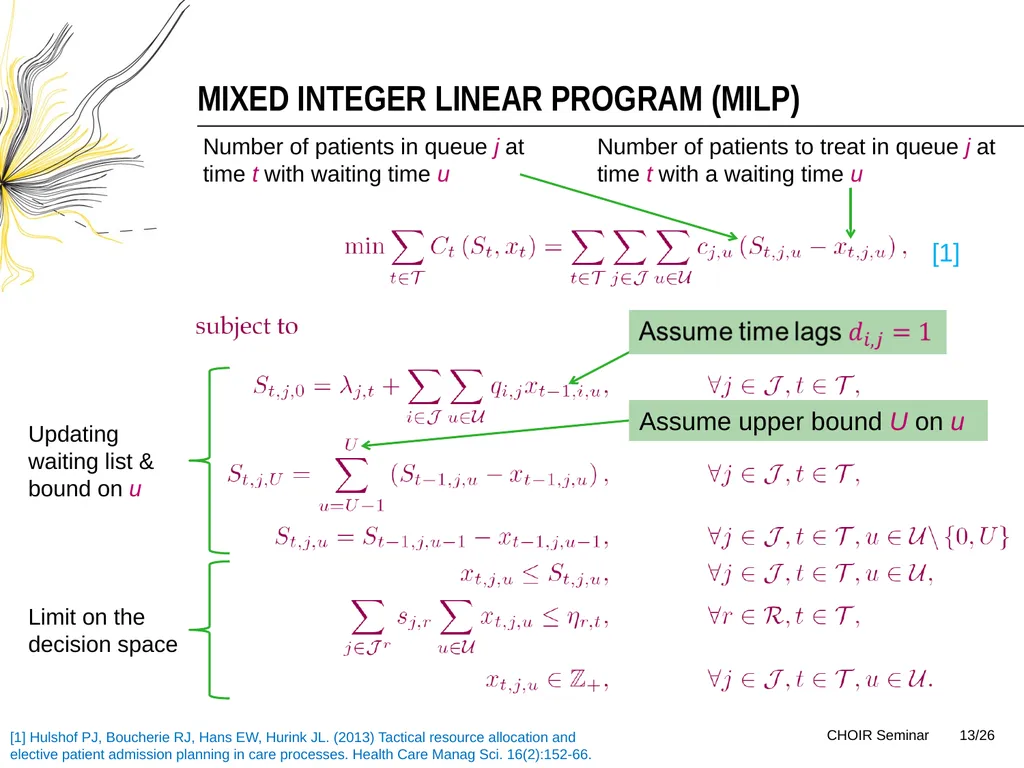
MIXED INTEGER LINEAR PROGRAM (MILP) 13/26 Number of patients in queue j at time t with waiting time u Number of patients to treat in queue j at time t with a waiting time u [1] [1] Hulshof PJ, Boucherie RJ, Hans EW, Hurink JL. (2013) Tactical resource allocation and �elective patient admission planning in care processes. Health Care Manag Sci. 16(2):152-66. Updating
waiting list &
bound on u Limit on the decision space CHOIR Seminar Assume upper bound U on u<br>
14
PROS & CONS OF THE MILP Pros:
Suitable to support integrated decision making for multiple resources, multiple time periods, and multiple patient groups.
Flexible formulation (other objective functions can easily be incorporated).
Cons:
Quite limited in the state space.
Rounding problems with fraction of patients moving from one queue to another after service.
Model does not include any form of randomness. CHOIR Seminar 14/26<br>
15
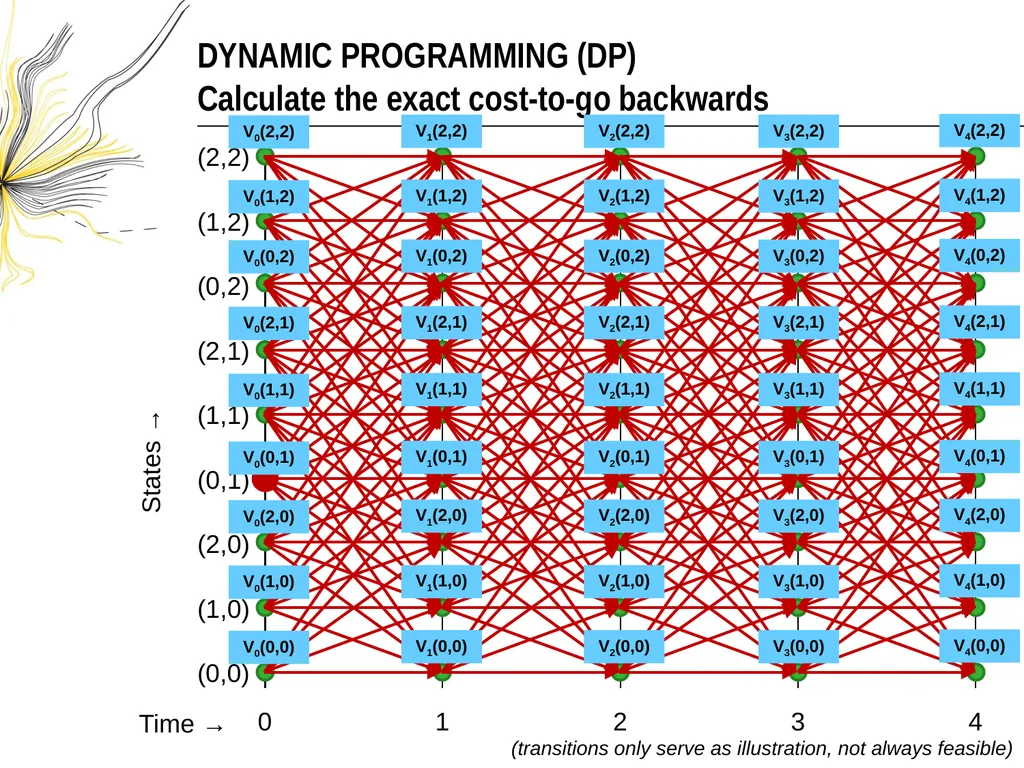
0 1 2 3 4 Time → States → (2,2) (1,2) (0,2) (2,1) (1,1) (0,1) (2,0) (1,0) (0,0) DYNAMIC PROGRAMMING (DP)
Calculate the exact cost-to-go backwards (transitions only serve as illustration, not always feasible)<br>
16
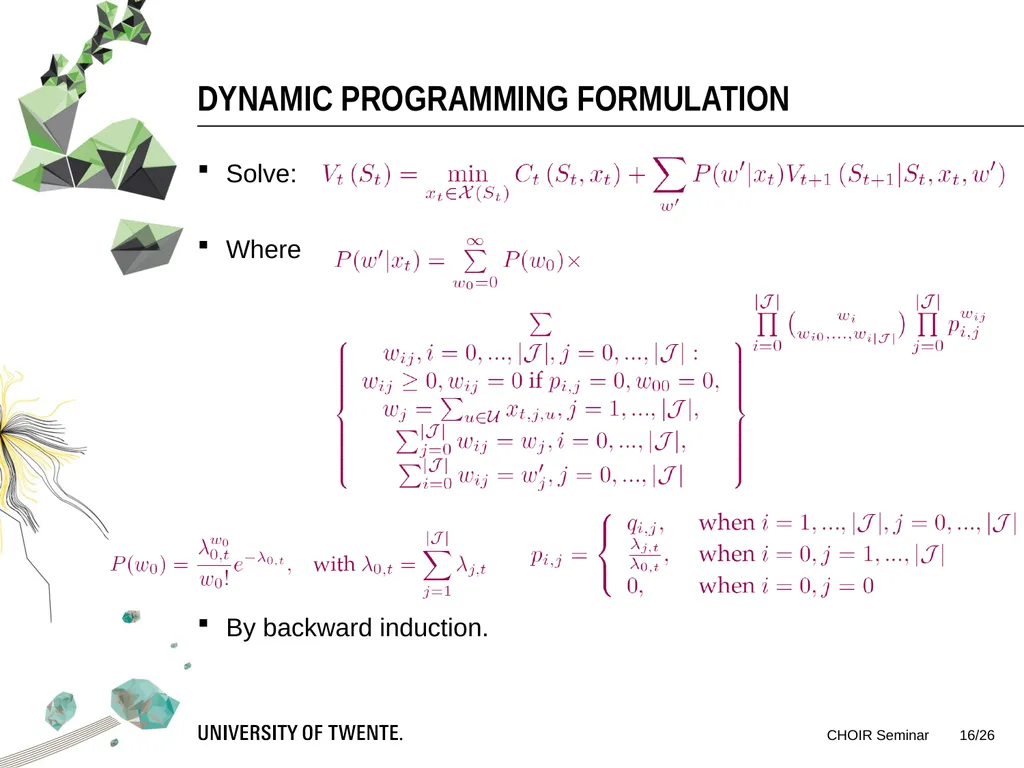
CHOIR Seminar DYNAMIC PROGRAMMING FORMULATION Solve:
Where
By backward induction. 16/26<br>
17
CHOIR Seminar THREE CURSUS OF DIMENSIONALITY 17/26<br>
18
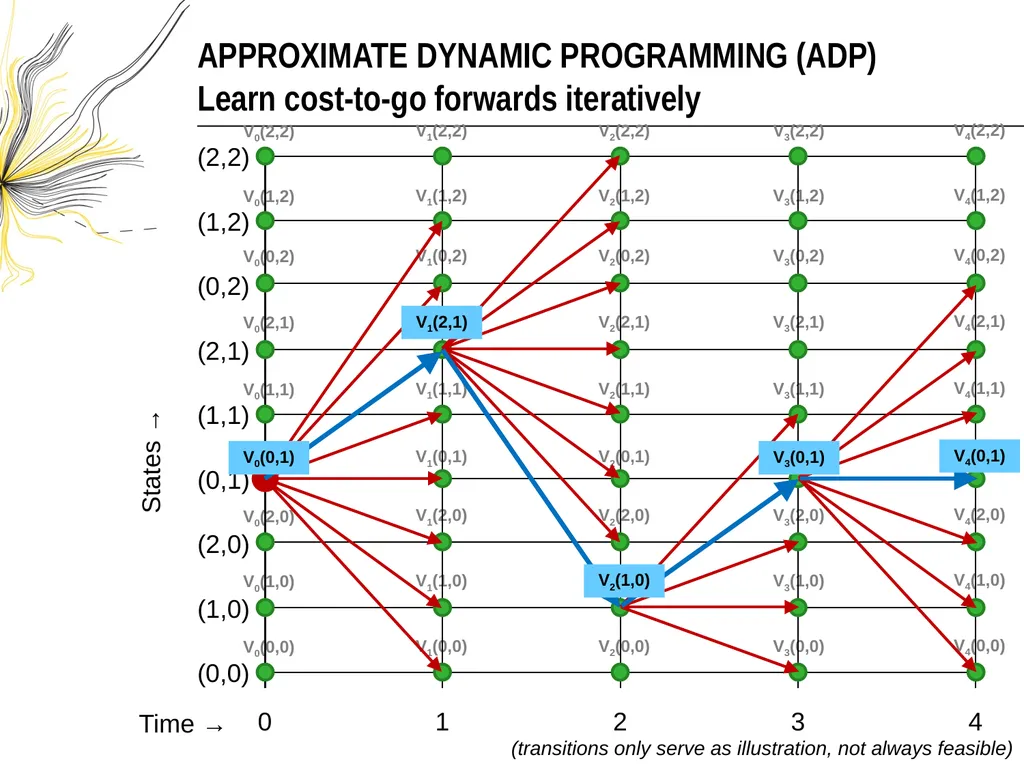
V4(0,1) V4(1,1) V4(2,1) V4(0,2) V4(1,2) V4(2,0) V4(1,0) V4(0,0) V4(2,2) V3(0,1) V3(1,1) V3(2,1) V3(0,2) V3(1,2) V3(2,0) V3(1,0) V3(0,0) V3(2,2) V2(0,1) V2(1,1) V2(2,1) V2(0,2) V2(1,2) V2(2,0) V2(1,0) V2(0,0) V2(2,2) V1(0,1) V1(1,1) V1(2,1) V1(0,2) V1(1,2) V1(2,0) V1(1,0) V1(0,0) V1(2,2) V0(0,1) V0(1,1) V0(2,1) V0(0,2) V0(1,2) V0(2,0) V0(1,0) V0(0,0) V0(2,2) 0 1 2 3 4 Time → States → (2,2) (1,2) (0,2) (2,1) (1,1) (0,1) (2,0) (1,0) (0,0) APPROXIMATE DYNAMIC PROGRAMMING (ADP)
Learn cost-to-go forwards iteratively V4(0,1) V3(0,1) V2(1,0) V1(2,1) V0(0,1) (transitions only serve as illustration, not always feasible)<br>
19
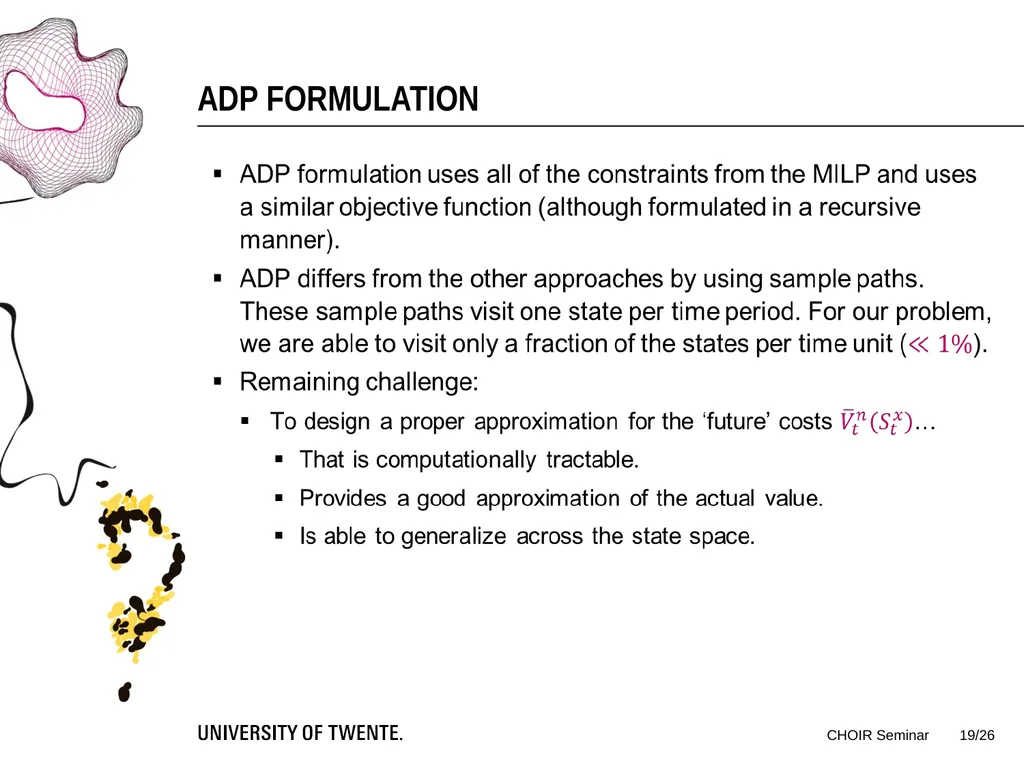
CHOIR Seminar ADP FORMULATION 19/26<br>
20
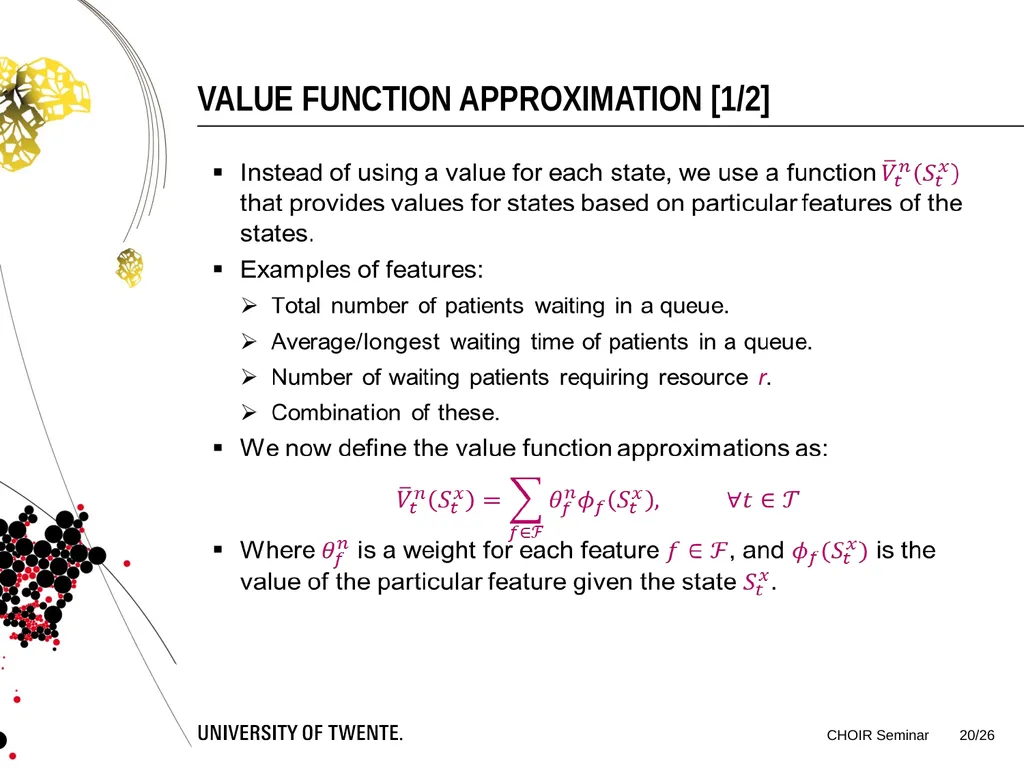
CHOIR Seminar VALUE FUNCTION APPROXIMATION [1/2] 20/26<br>
21
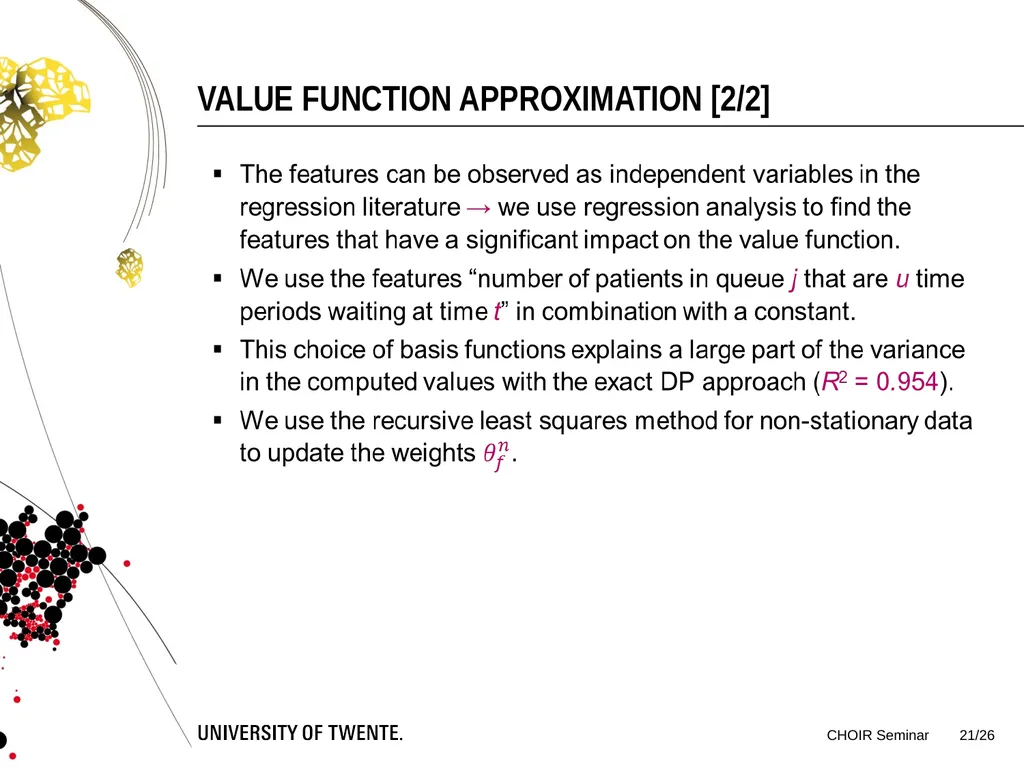
CHOIR Seminar VALUE FUNCTION APPROXIMATION [2/2] 21/26<br>
22
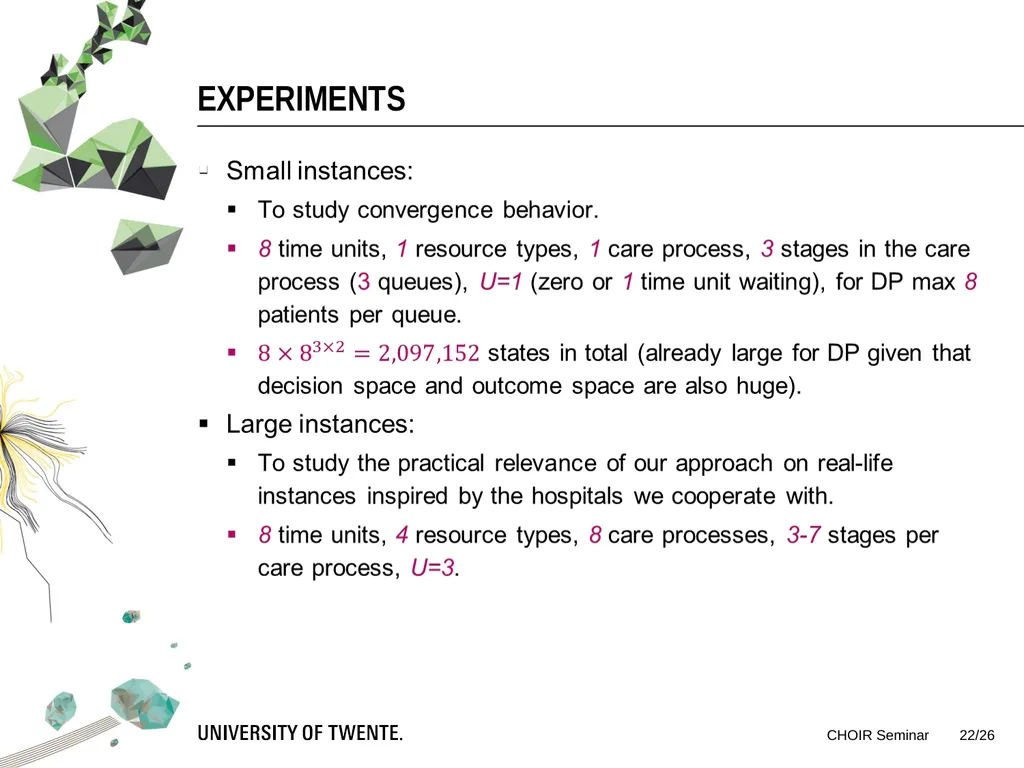
CHOIR Seminar EXPERIMENTS 22/26<br>
23
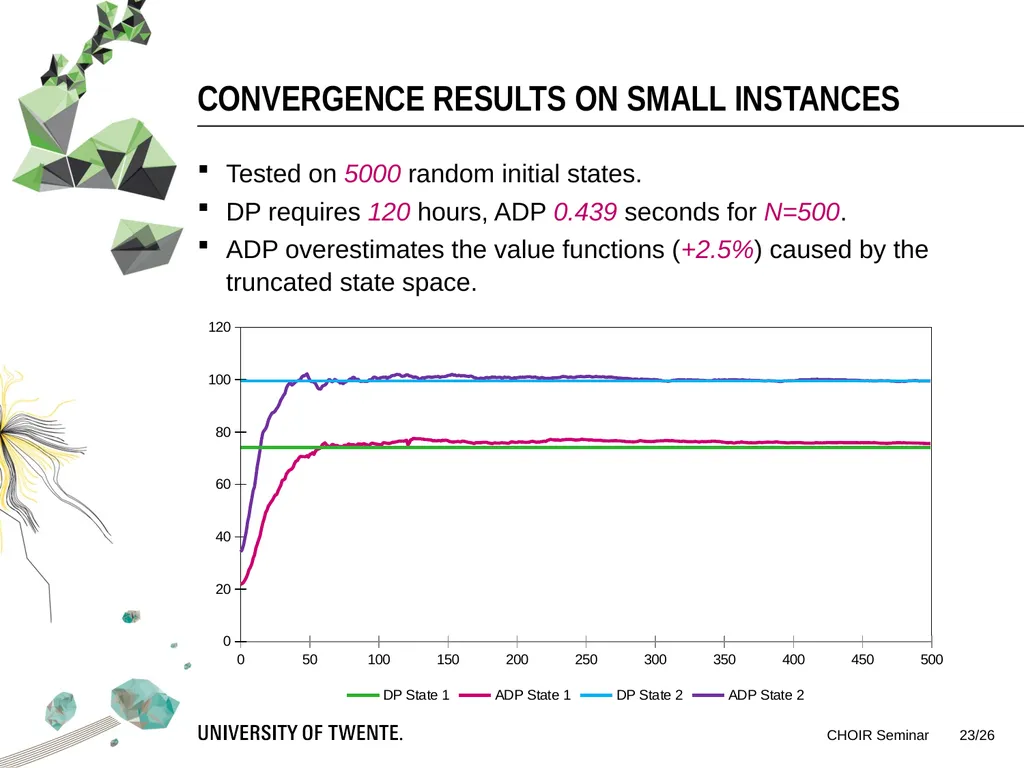
CHOIR Seminar CONVERGENCE RESULTS ON SMALL INSTANCES Tested on 5000 random initial states.
DP requires 120 hours, ADP 0.439 seconds for N=500.
ADP overestimates the value functions (+2.5%) caused by the truncated state space. 23/26<br>
24
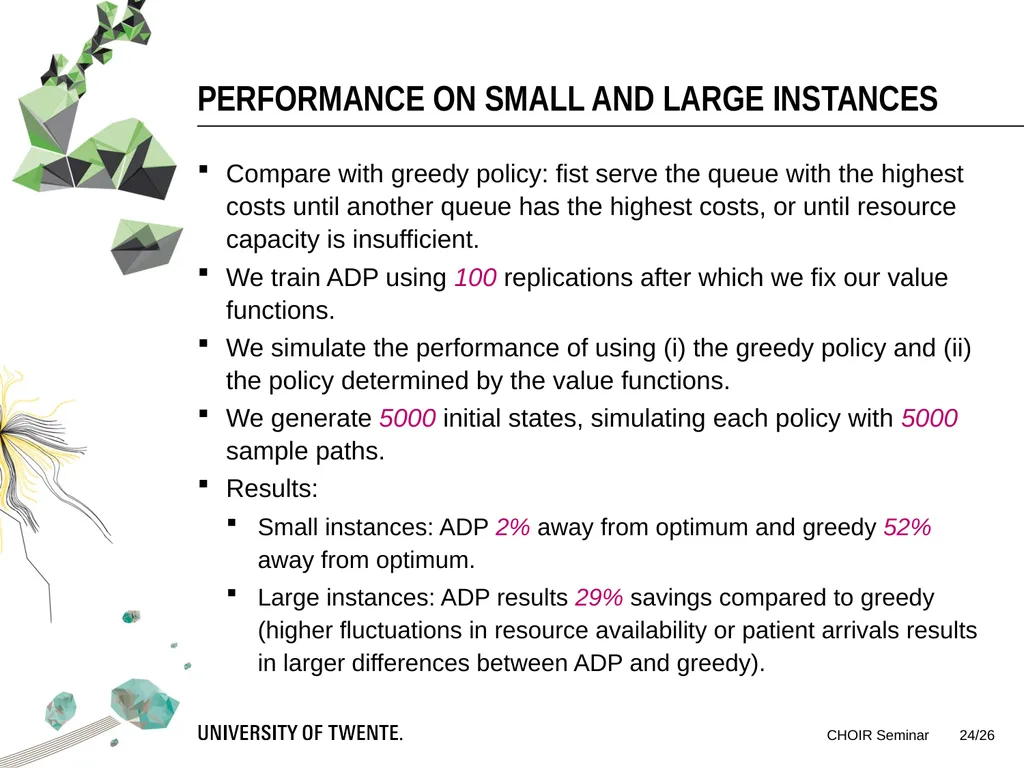
CHOIR Seminar PERFORMANCE ON SMALL AND LARGE INSTANCES Compare with greedy policy: fist serve the queue with the highest costs until another queue has the highest costs, or until resource capacity is insufficient.
We train ADP using 100 replications after which we fix our value functions.
We simulate the performance of using (i) the greedy policy and (ii) the policy determined by the value functions.
We generate 5000 initial states, simulating each policy with 5000 sample paths.
Results:
Small instances: ADP 2% away from optimum and greedy 52% away from optimum.
Large instances: ADP results 29% savings compared to greedy (higher fluctuations in resource availability or patient arrivals results in larger differences between ADP and greedy). 24/26<br>
25
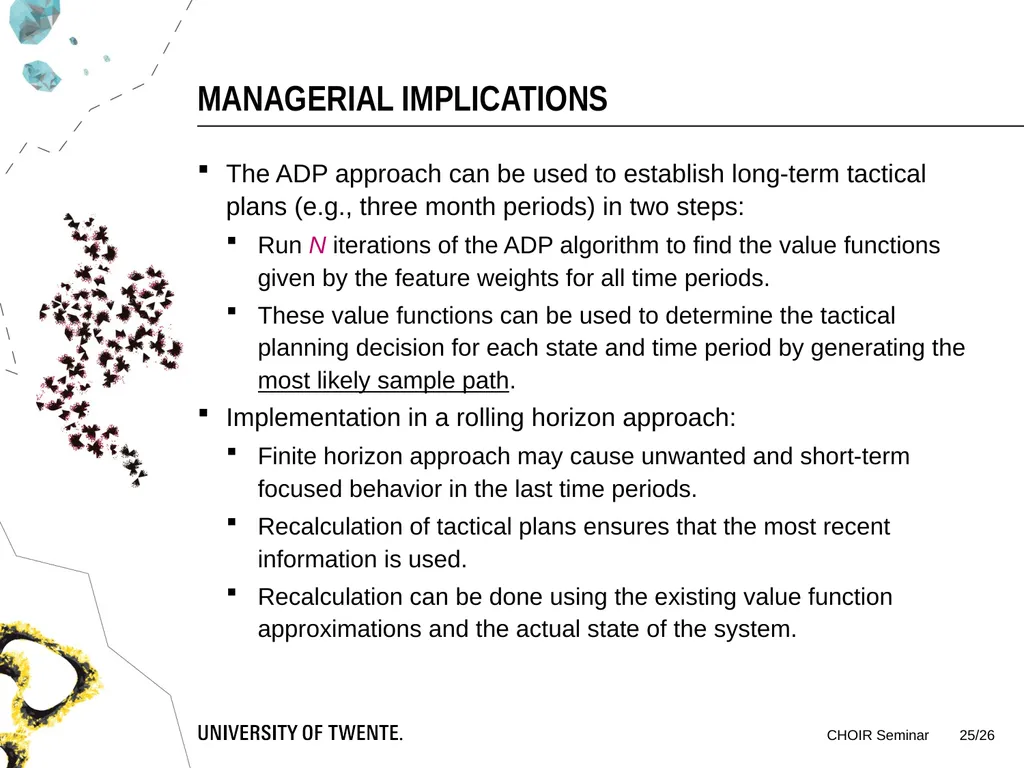
CHOIR Seminar MANAGERIAL IMPLICATIONS The ADP approach can be used to establish long-term tactical plans (e.g., three month periods) in two steps:
Run N iterations of the ADP algorithm to find the value functions given by the feature weights for all time periods.
These value functions can be used to determine the tactical planning decision for each state and time period by generating the most likely sample path.
Implementation in a rolling horizon approach:
Finite horizon approach may cause unwanted and short-term focused behavior in the last time periods.
Recalculation of tactical plans ensures that the most recent information is used.
Recalculation can be done using the existing value function approximations and the actual state of the system. 25/26<br>
26
QUESTIONS? Martijn Mes
Assistant professor
University of Twente
School of Management and Governance
Dept. Industrial Engineering and Business Information Systems
Contact
Phone: +31-534894062
Email: m.r.k.mes@utwente.nl
Web: http://www.utwente.nl/mb/iebis/staff/Mes/<br>