
Teacher Notes Narrative/Creative Writing using a
LS
Published · 39 slides · 0 views
1 / 1
Description
Teacher Notes NarrativeCreative Writing using a slow process This is a four week scheme of work It is designed to build from poor examples using the I WE YOU modelling process to build the writing into developed and detailed prose with
Related Topics
Share
Embed code
Download this presentation From Below
"Teacher Notes Narrative/Creative Writing using a" is the property of its rightful owner. Permission is granted to download and print the materials on this website for personal, non-commercial use only, and to display it on your personal computer provided you do not modify the materials and that you retain all copyright notices contained in the materials. By downloading content from our website, you accept the terms of this agreement.
Presentation Transcript
01
Teacher Notes Narrative/Creative Writing using a slow process
This is a four week scheme of work
It is designed to build from poor examples using the I – WE – YOU modelling process to build the writing into developed and detailed prose with a range of sentences types/openers and techniques embedded in them.
I use the classroom and a very short time frame as the inspiration
The first slide is a previously completed success criteria for ideas to build
I’d probably put more emphasis on character description development this time
This blog was about the first time I tried this: https://susansenglish.wordpress.com/2018/07/06/why-i-love-creative-writing-as-a-slow-process<br>
This is a four week scheme of work
It is designed to build from poor examples using the I – WE – YOU modelling process to build the writing into developed and detailed prose with a range of sentences types/openers and techniques embedded in them.
I use the classroom and a very short time frame as the inspiration
The first slide is a previously completed success criteria for ideas to build
I’d probably put more emphasis on character description development this time
This blog was about the first time I tried this: https://susansenglish.wordpress.com/2018/07/06/why-i-love-creative-writing-as-a-slow-process<br>
02
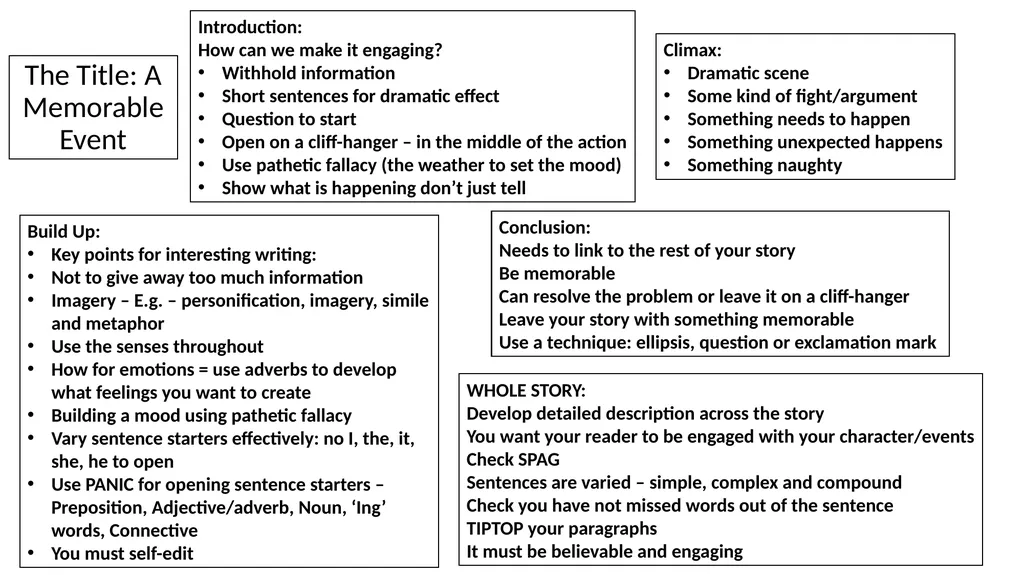
The Title: A Memorable Event Introduction:
How can we make it engaging?
Withhold information
Short sentences for dramatic effect
Question to start
Open on a cliff-hanger – in the middle of the action
Use pathetic fallacy (the weather to set the mood)
Show what is happening don’t just tell Build Up:
Key points for interesting writing:
Not to give away too much information
Imagery – E.g. – personification, imagery, simile and metaphor
Use the senses throughout
How for emotions = use adverbs to develop what feelings you want to create
Building a mood using pathetic fallacy
Vary sentence starters effectively: no I, the, it, she, he to open
Use PANIC for opening sentence starters – Preposition, Adjective/adverb, Noun, ‘Ing’ words, Connective
You must self-edit Climax:
Dramatic scene
Some kind of fight/argument
Something needs to happen
Something unexpected happens
Something naughty Conclusion:
Needs to link to the rest of your story
Be memorable
Can resolve the problem or leave it on a cliff-hanger
Leave your story with something memorable
Use a technique: ellipsis, question or exclamation mark WHOLE STORY:
Develop detailed description across the story
You want your reader to be engaged with your character/events
Check SPAG
Sentences are varied – simple, complex and compound
Check you have not missed words out of the sentence
TIPTOP your paragraphs
It must be believable and engaging<br>
How can we make it engaging?
Withhold information
Short sentences for dramatic effect
Question to start
Open on a cliff-hanger – in the middle of the action
Use pathetic fallacy (the weather to set the mood)
Show what is happening don’t just tell Build Up:
Key points for interesting writing:
Not to give away too much information
Imagery – E.g. – personification, imagery, simile and metaphor
Use the senses throughout
How for emotions = use adverbs to develop what feelings you want to create
Building a mood using pathetic fallacy
Vary sentence starters effectively: no I, the, it, she, he to open
Use PANIC for opening sentence starters – Preposition, Adjective/adverb, Noun, ‘Ing’ words, Connective
You must self-edit Climax:
Dramatic scene
Some kind of fight/argument
Something needs to happen
Something unexpected happens
Something naughty Conclusion:
Needs to link to the rest of your story
Be memorable
Can resolve the problem or leave it on a cliff-hanger
Leave your story with something memorable
Use a technique: ellipsis, question or exclamation mark WHOLE STORY:
Develop detailed description across the story
You want your reader to be engaged with your character/events
Check SPAG
Sentences are varied – simple, complex and compound
Check you have not missed words out of the sentence
TIPTOP your paragraphs
It must be believable and engaging<br>
03
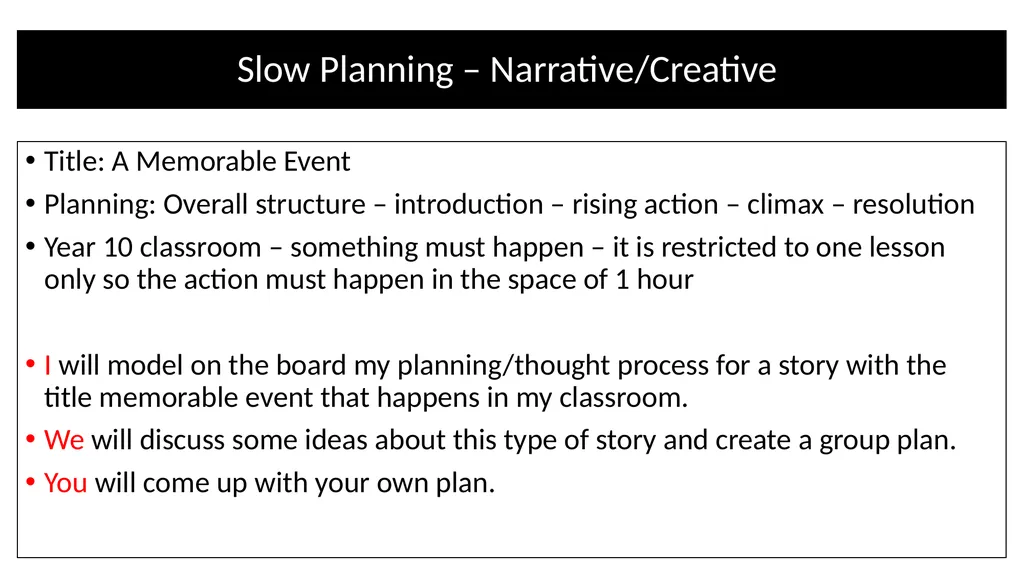
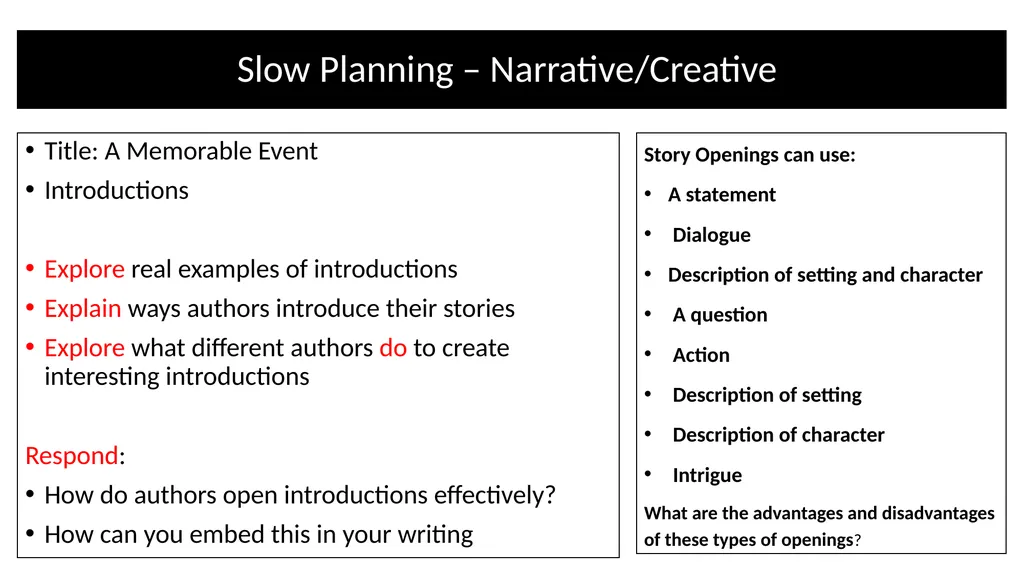
Slow Planning – Narrative/Creative Title: A Memorable Event
Planning: Overall structure – introduction – rising action – climax – resolution
Year 10 classroom – something must happen – it is restricted to one lesson only so the action must happen in the space of 1 hour
I will model on the board my planning/thought process for a story with the title memorable event that happens in my classroom.
We will discuss some ideas about this type of story and create a group plan.
You will come up with your own plan.<br>
Planning: Overall structure – introduction – rising action – climax – resolution
Year 10 classroom – something must happen – it is restricted to one lesson only so the action must happen in the space of 1 hour
I will model on the board my planning/thought process for a story with the title memorable event that happens in my classroom.
We will discuss some ideas about this type of story and create a group plan.
You will come up with your own plan.<br>
04
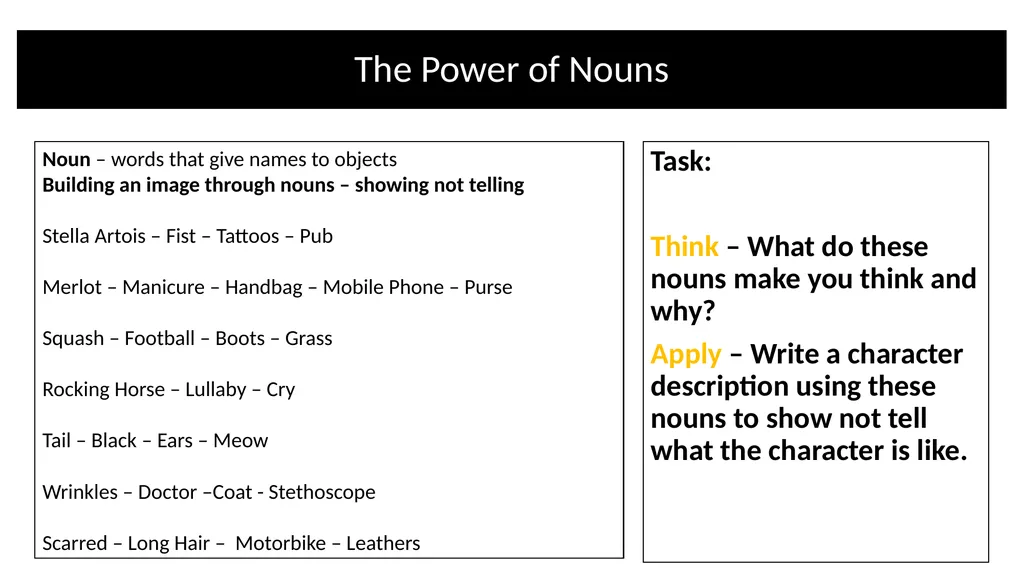
The Power of Nouns Task:
Think – What do these nouns make you think and why?
Apply – Write a character description using these nouns to show not tell what the character is like. Noun – words that give names to objects
Building an image through nouns – showing not telling
Stella Artois – Fist – Tattoos – Pub
Merlot – Manicure – Handbag – Mobile Phone – Purse
Squash – Football – Boots – Grass
Rocking Horse – Lullaby – Cry
Tail – Black – Ears – Meow
Wrinkles – Doctor –Coat - Stethoscope
Scarred – Long Hair – Motorbike – Leathers<br>
Think – What do these nouns make you think and why?
Apply – Write a character description using these nouns to show not tell what the character is like. Noun – words that give names to objects
Building an image through nouns – showing not telling
Stella Artois – Fist – Tattoos – Pub
Merlot – Manicure – Handbag – Mobile Phone – Purse
Squash – Football – Boots – Grass
Rocking Horse – Lullaby – Cry
Tail – Black – Ears – Meow
Wrinkles – Doctor –Coat - Stethoscope
Scarred – Long Hair – Motorbike – Leathers<br>
05
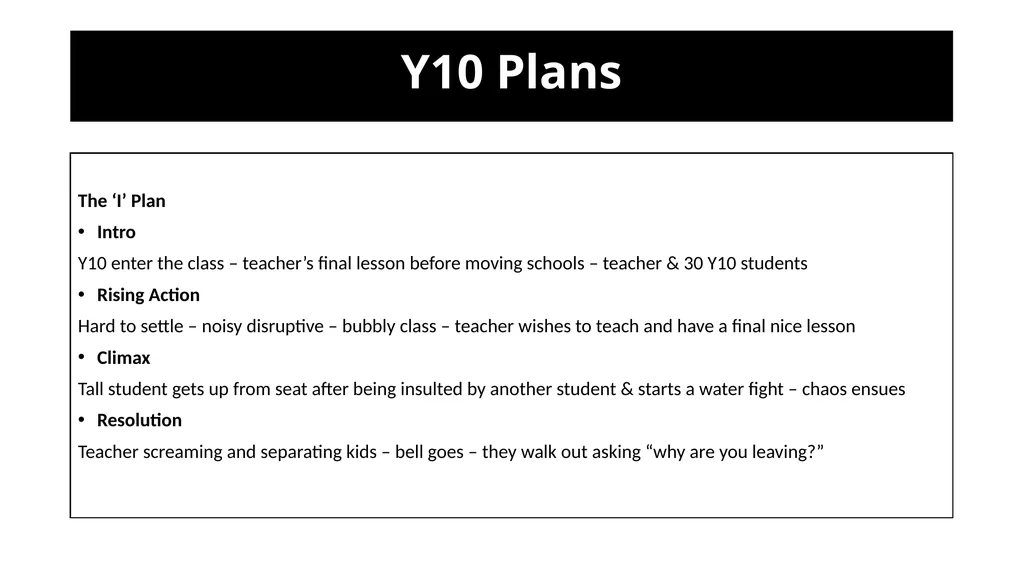
Y10 Plans The ‘I’ Plan
Intro
Y10 enter the class – teacher’s final lesson before moving schools – teacher & 30 Y10 students
Rising Action
Hard to settle – noisy disruptive – bubbly class – teacher wishes to teach and have a final nice lesson
Climax
Tall student gets up from seat after being insulted by another student & starts a water fight – chaos ensues
Resolution
Teacher screaming and separating kids – bell goes – they walk out asking “why are you leaving?”<br>
Intro
Y10 enter the class – teacher’s final lesson before moving schools – teacher & 30 Y10 students
Rising Action
Hard to settle – noisy disruptive – bubbly class – teacher wishes to teach and have a final nice lesson
Climax
Tall student gets up from seat after being insulted by another student & starts a water fight – chaos ensues
Resolution
Teacher screaming and separating kids – bell goes – they walk out asking “why are you leaving?”<br>
06
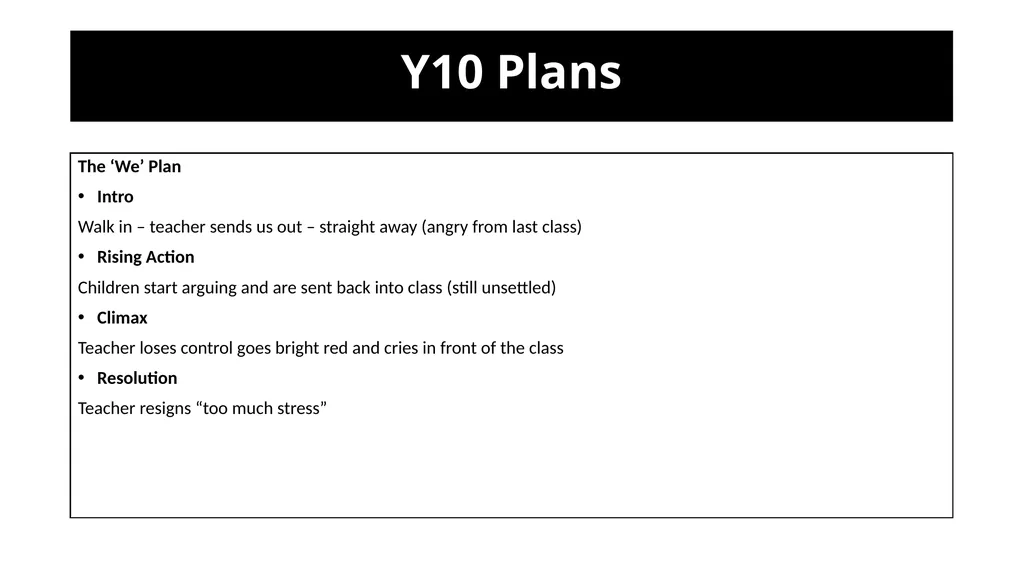
Y10 Plans The ‘We’ Plan
Intro
Walk in – teacher sends us out – straight away (angry from last class)
Rising Action
Children start arguing and are sent back into class (still unsettled)
Climax
Teacher loses control goes bright red and cries in front of the class
Resolution
Teacher resigns “too much stress”<br>
Intro
Walk in – teacher sends us out – straight away (angry from last class)
Rising Action
Children start arguing and are sent back into class (still unsettled)
Climax
Teacher loses control goes bright red and cries in front of the class
Resolution
Teacher resigns “too much stress”<br>
07
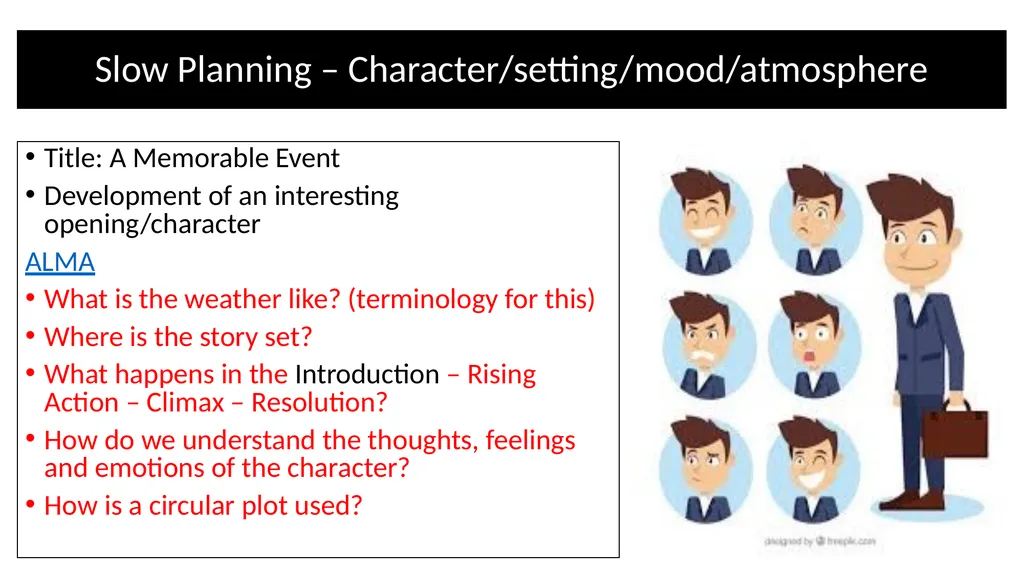
Slow Planning – Character/setting/mood/atmosphere Title: A Memorable Event
Development of an interesting opening/character
ALMA
What is the weather like? (terminology for this)
Where is the story set?
What happens in the Introduction – Rising Action – Climax – Resolution?
How do we understand the thoughts, feelings and emotions of the character?
How is a circular plot used?<br>
Development of an interesting opening/character
ALMA
What is the weather like? (terminology for this)
Where is the story set?
What happens in the Introduction – Rising Action – Climax – Resolution?
How do we understand the thoughts, feelings and emotions of the character?
How is a circular plot used?<br>
08
Slow Planning – Character/setting/mood/atmosphere Success Criteria discussed from Alma
Pathetic fallacy
Setting
Contrast between light and dark
Characterisation (what they are like and what they are doing)
Action
The viewer feels an emotion
Close up expression and features
The senses<br>
Pathetic fallacy
Setting
Contrast between light and dark
Characterisation (what they are like and what they are doing)
Action
The viewer feels an emotion
Close up expression and features
The senses<br>
09
Slow Planning – Narrative/Creative Title: A Memorable Event
Character Development
I will show a poor example of how to do this
We will improve the description of character
You will create your own character and decide when/how to add this to your introduction or where they will come into your story Success Criteria<br>
Character Development
I will show a poor example of how to do this
We will improve the description of character
You will create your own character and decide when/how to add this to your introduction or where they will come into your story Success Criteria<br>
10
I – Poor Example We - Improved She was stood at the front of the class. She looked out to Year 10. Her face was upset. Her tone was upset. Her body language was cross.
Poor:
1 - short sentences – no development
2 – she/her – too repetitive
3 – too short
4 – no clue about who the character is
5 – basic vocabulary Miss Strachan (the loud, Scottish, sometimes stressed teacher) was stood impatiently at the front of the musty, humid class. Glaring furiously at year 10, her tomato coloured face looked like it was about to explode, with frustration. Strachan’s volume was at an all time high like an animal in pain. Crossing her arms, tapping her feet, exuding anger as she faced her class and stood her ground firmly.
Better:
1 – Varied sentences (compound, complex & simple)
2- ideas are more developed
3 – PANIC sentence openers showing a variety of ways to start sentences
4 – use of imagery (simile/metaphor etc. or devices in your writing to bring the writing to life)
5 – punctuation used for effect
6 – vocabulary is complex, developed or advanced
7 – use of facial expressions, body language and the senses
8 – show the character not tell me about them<br>
Poor:
1 - short sentences – no development
2 – she/her – too repetitive
3 – too short
4 – no clue about who the character is
5 – basic vocabulary Miss Strachan (the loud, Scottish, sometimes stressed teacher) was stood impatiently at the front of the musty, humid class. Glaring furiously at year 10, her tomato coloured face looked like it was about to explode, with frustration. Strachan’s volume was at an all time high like an animal in pain. Crossing her arms, tapping her feet, exuding anger as she faced her class and stood her ground firmly.
Better:
1 – Varied sentences (compound, complex & simple)
2- ideas are more developed
3 – PANIC sentence openers showing a variety of ways to start sentences
4 – use of imagery (simile/metaphor etc. or devices in your writing to bring the writing to life)
5 – punctuation used for effect
6 – vocabulary is complex, developed or advanced
7 – use of facial expressions, body language and the senses
8 – show the character not tell me about them<br>
11
Slow Planning – Narrative/Creative Title: A Memorable Event
Character Development
Explore real examples of character description
Annotate how they show not tell
Explore what different authors do to create believable and interesting characters
Respond:
How do authors create interesting characters?
How can you embed this in your writing<br>
Character Development
Explore real examples of character description
Annotate how they show not tell
Explore what different authors do to create believable and interesting characters
Respond:
How do authors create interesting characters?
How can you embed this in your writing<br>
12
Slow Planning – Narrative/Creative Title: A Memorable Event
Introductions
Explore real examples of introductions
Explain ways authors introduce their stories
Explore what different authors do to create interesting introductions
Respond:
How do authors open introductions effectively?
How can you embed this in your writing Story Openings can use:
A statement
Dialogue
Description of setting and character
A question
Action
Description of setting
Description of character
Intrigue
What are the advantages and disadvantages of these types of openings?<br>
Introductions
Explore real examples of introductions
Explain ways authors introduce their stories
Explore what different authors do to create interesting introductions
Respond:
How do authors open introductions effectively?
How can you embed this in your writing Story Openings can use:
A statement
Dialogue
Description of setting and character
A question
Action
Description of setting
Description of character
Intrigue
What are the advantages and disadvantages of these types of openings?<br>
13
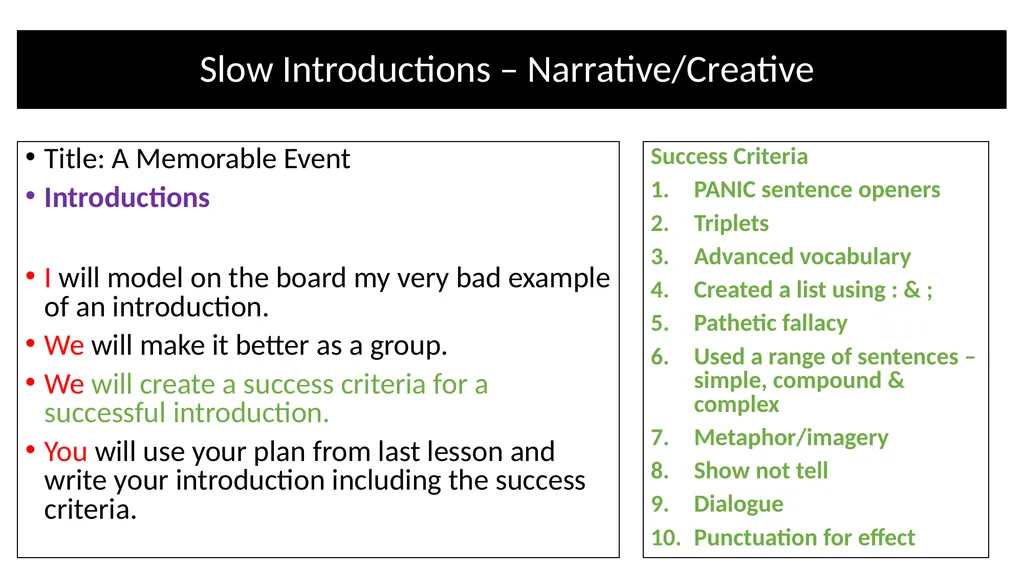
Slow Introductions – Narrative/Creative Title: A Memorable Event
Introductions
I will model on the board my very bad example of an introduction.
We will make it better as a group.
We will create a success criteria for a successful introduction.
You will use your plan from last lesson and write your introduction including the success criteria. Success Criteria
PANIC sentence openers
Triplets
Advanced vocabulary
Created a list using : & ;
Pathetic fallacy
Used a range of sentences – simple, compound & complex
Metaphor/imagery
Show not tell
Dialogue
Punctuation for effect<br>
Introductions
I will model on the board my very bad example of an introduction.
We will make it better as a group.
We will create a success criteria for a successful introduction.
You will use your plan from last lesson and write your introduction including the success criteria. Success Criteria
PANIC sentence openers
Triplets
Advanced vocabulary
Created a list using : & ;
Pathetic fallacy
Used a range of sentences – simple, compound & complex
Metaphor/imagery
Show not tell
Dialogue
Punctuation for effect<br>
14
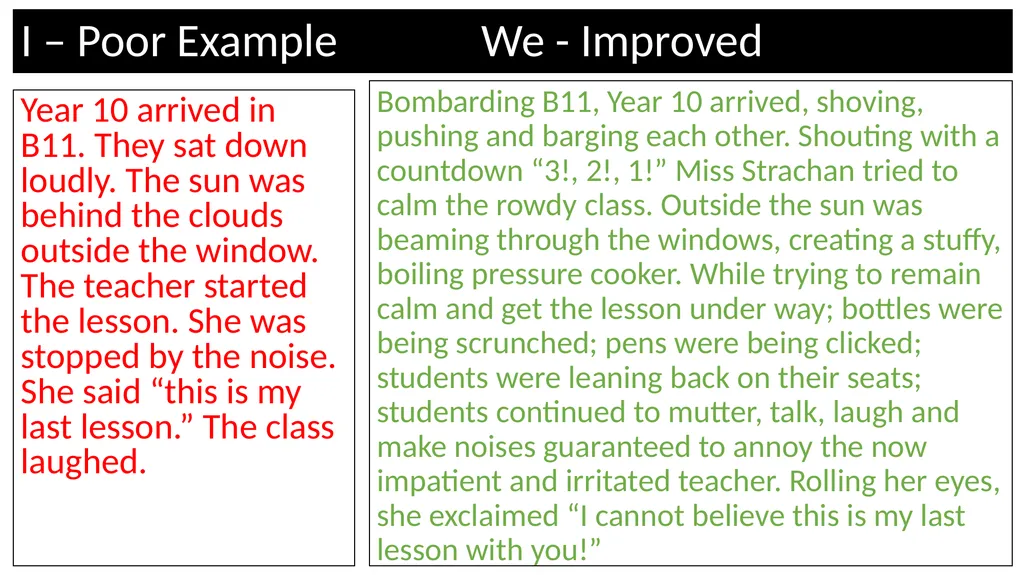
I – Poor Example We - Improved Year 10 arrived in B11. They sat down loudly. The sun was behind the clouds outside the window. The teacher started the lesson. She was stopped by the noise. She said “this is my last lesson.” The class laughed. Bombarding B11, Year 10 arrived, shoving, pushing and barging each other. Shouting with a countdown “3!, 2!, 1!” Miss Strachan tried to calm the rowdy class. Outside the sun was beaming through the windows, creating a stuffy, boiling pressure cooker. While trying to remain calm and get the lesson under way; bottles were being scrunched; pens were being clicked; students were leaning back on their seats; students continued to mutter, talk, laugh and make noises guaranteed to annoy the now impatient and irritated teacher. Rolling her eyes, she exclaimed “I cannot believe this is my last lesson with you!”<br>
15
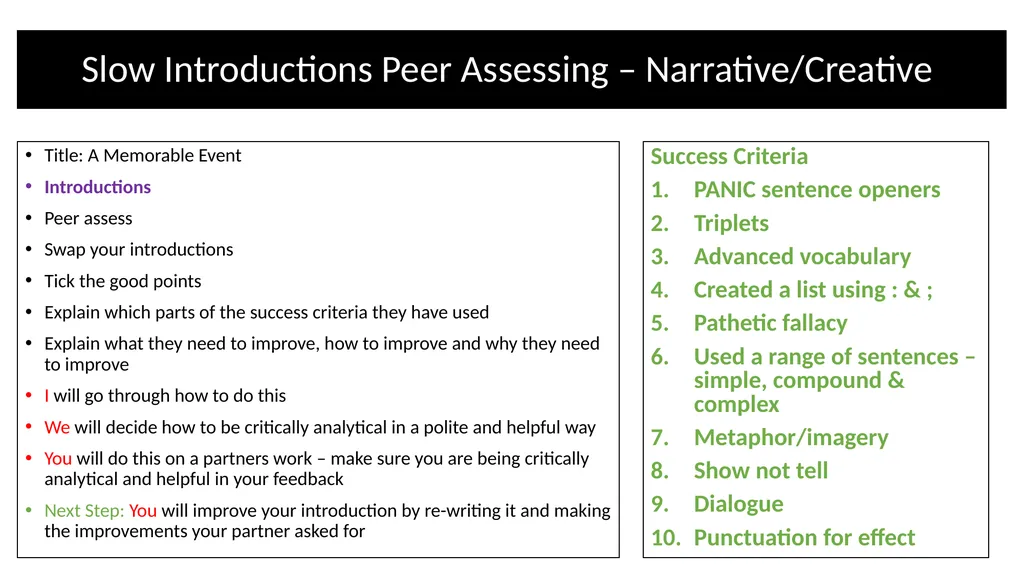
Slow Introductions Peer Assessing – Narrative/Creative Title: A Memorable Event
Introductions
Peer assess
Swap your introductions
Tick the good points
Explain which parts of the success criteria they have used
Explain what they need to improve, how to improve and why they need to improve
I will go through how to do this
We will decide how to be critically analytical in a polite and helpful way
You will do this on a partners work – make sure you are being critically analytical and helpful in your feedback
Next Step: You will improve your introduction by re-writing it and making the improvements your partner asked for Success Criteria
PANIC sentence openers
Triplets
Advanced vocabulary
Created a list using : & ;
Pathetic fallacy
Used a range of sentences – simple, compound & complex
Metaphor/imagery
Show not tell
Dialogue
Punctuation for effect<br>
Introductions
Peer assess
Swap your introductions
Tick the good points
Explain which parts of the success criteria they have used
Explain what they need to improve, how to improve and why they need to improve
I will go through how to do this
We will decide how to be critically analytical in a polite and helpful way
You will do this on a partners work – make sure you are being critically analytical and helpful in your feedback
Next Step: You will improve your introduction by re-writing it and making the improvements your partner asked for Success Criteria
PANIC sentence openers
Triplets
Advanced vocabulary
Created a list using : & ;
Pathetic fallacy
Used a range of sentences – simple, compound & complex
Metaphor/imagery
Show not tell
Dialogue
Punctuation for effect<br>
16
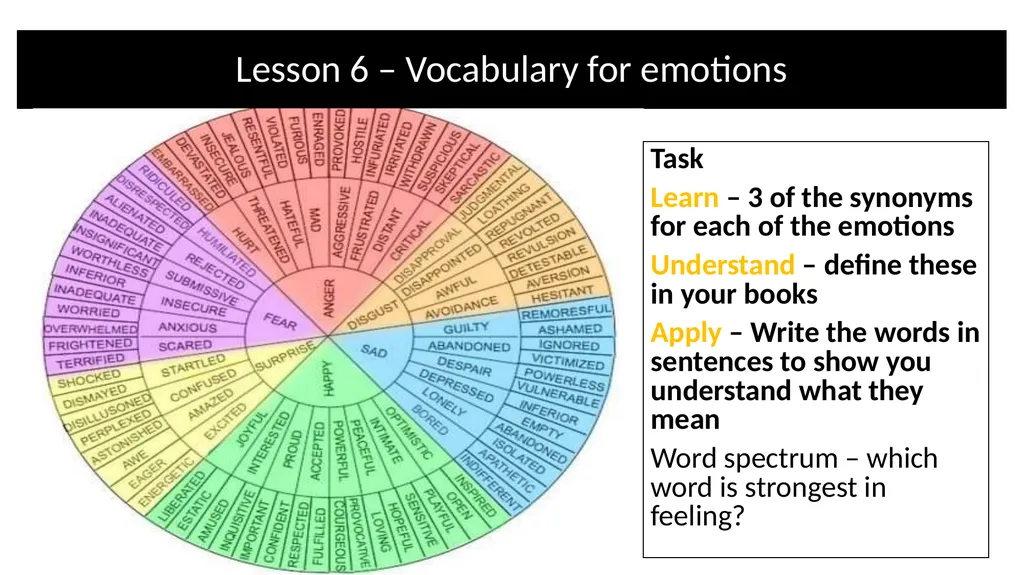
Lesson 6 – Vocabulary for emotions Task
Learn – 3 of the synonyms for each of the emotions
Understand – define these in your books
Apply – Write the words in sentences to show you understand what they mean
Word spectrum – which word is strongest in feeling?<br>
Learn – 3 of the synonyms for each of the emotions
Understand – define these in your books
Apply – Write the words in sentences to show you understand what they mean
Word spectrum – which word is strongest in feeling?<br>
17
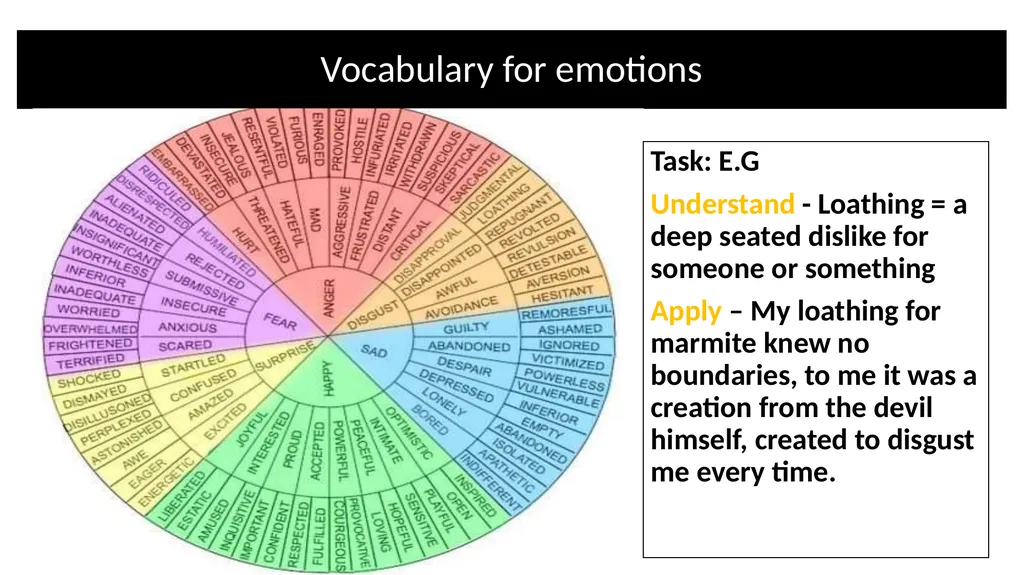
Vocabulary for emotions Task: E.G
Understand - Loathing = a deep seated dislike for someone or something
Apply – My loathing for marmite knew no boundaries, to me it was a creation from the devil himself, created to disgust me every time.<br>
Understand - Loathing = a deep seated dislike for someone or something
Apply – My loathing for marmite knew no boundaries, to me it was a creation from the devil himself, created to disgust me every time.<br>
18
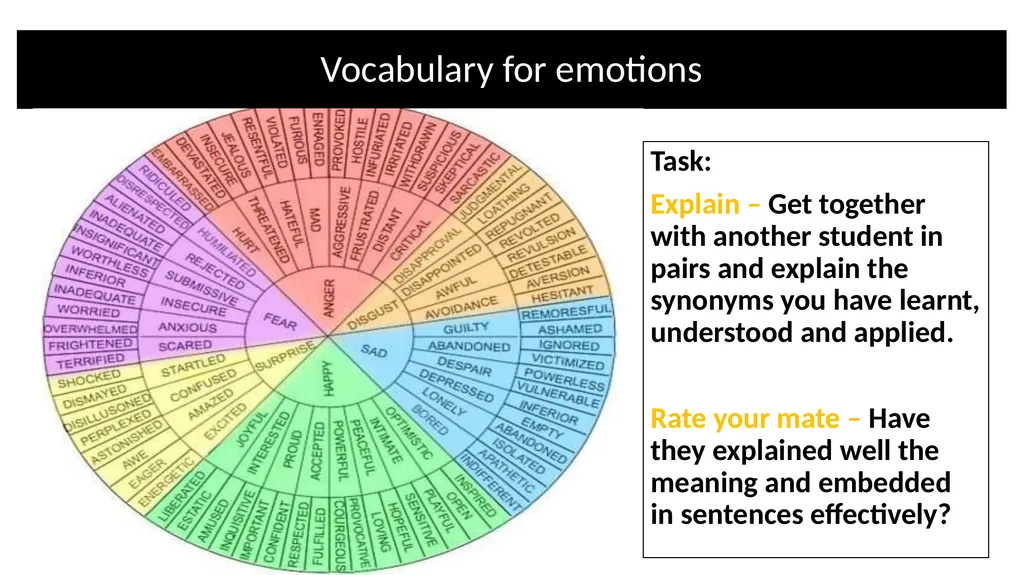
Vocabulary for emotions Task:
Explain – Get together with another student in pairs and explain the synonyms you have learnt, understood and applied.
Rate your mate – Have they explained well the meaning and embedded in sentences effectively?<br>
Explain – Get together with another student in pairs and explain the synonyms you have learnt, understood and applied.
Rate your mate – Have they explained well the meaning and embedded in sentences effectively?<br>
19
Slow Planning – Narrative/Creative Title: A Memorable Event
Rising Action
Explore real examples of rising action
Explain how authors develop the action or allow their story to unfold
Explore what different authors do to create
Respond:
How do authors build the action effectively?
How can you embed this in your writing<br>
Rising Action
Explore real examples of rising action
Explain how authors develop the action or allow their story to unfold
Explore what different authors do to create
Respond:
How do authors build the action effectively?
How can you embed this in your writing<br>
20
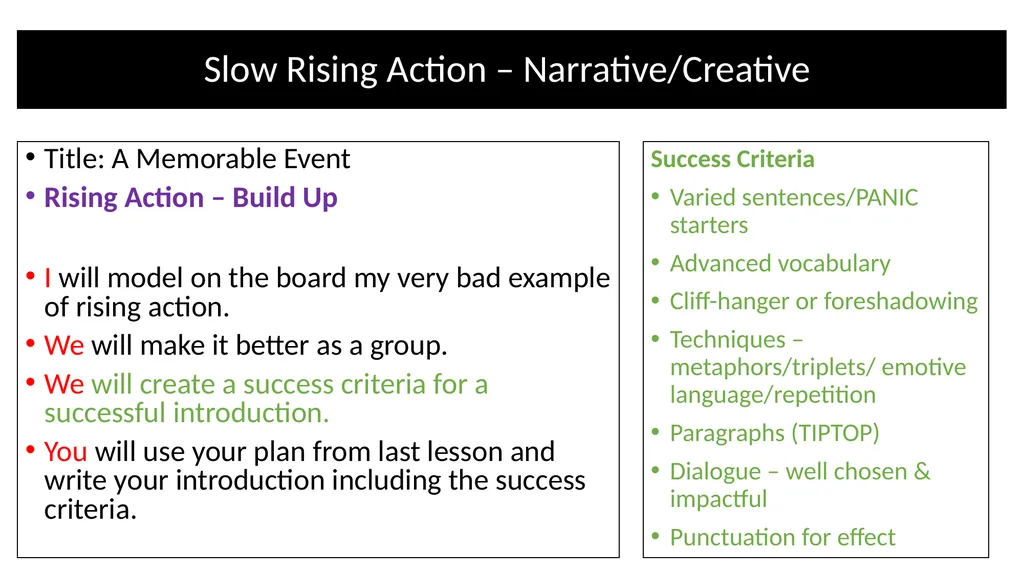
Slow Rising Action – Narrative/Creative Title: A Memorable Event
Rising Action – Build Up
I will model on the board my very bad example of rising action.
We will make it better as a group.
We will create a success criteria for a successful introduction.
You will use your plan from last lesson and write your introduction including the success criteria. Success Criteria
Varied sentences/PANIC starters
Advanced vocabulary
Cliff-hanger or foreshadowing
Techniques – metaphors/triplets/ emotive language/repetition
Paragraphs (TIPTOP)
Dialogue – well chosen & impactful
Punctuation for effect<br>
Rising Action – Build Up
I will model on the board my very bad example of rising action.
We will make it better as a group.
We will create a success criteria for a successful introduction.
You will use your plan from last lesson and write your introduction including the success criteria. Success Criteria
Varied sentences/PANIC starters
Advanced vocabulary
Cliff-hanger or foreshadowing
Techniques – metaphors/triplets/ emotive language/repetition
Paragraphs (TIPTOP)
Dialogue – well chosen & impactful
Punctuation for effect<br>
21
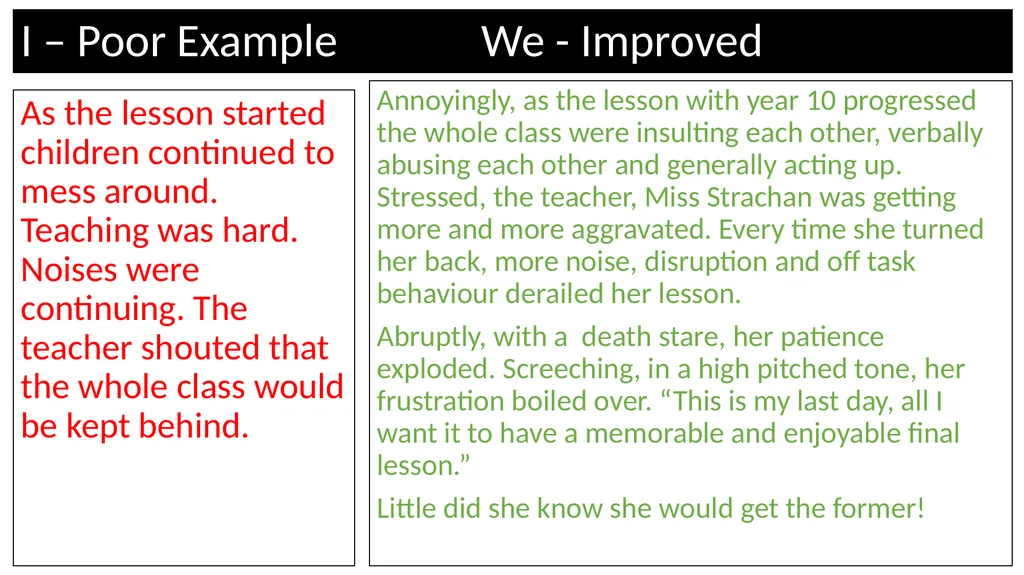
I – Poor Example We - Improved As the lesson started children continued to mess around. Teaching was hard. Noises were continuing. The teacher shouted that the whole class would be kept behind. Annoyingly, as the lesson with year 10 progressed the whole class were insulting each other, verbally abusing each other and generally acting up. Stressed, the teacher, Miss Strachan was getting more and more aggravated. Every time she turned her back, more noise, disruption and off task behaviour derailed her lesson.
Abruptly, with a death stare, her patience exploded. Screeching, in a high pitched tone, her frustration boiled over. “This is my last day, all I want it to have a memorable and enjoyable final lesson.”
Little did she know she would get the former!<br>
Abruptly, with a death stare, her patience exploded. Screeching, in a high pitched tone, her frustration boiled over. “This is my last day, all I want it to have a memorable and enjoyable final lesson.”
Little did she know she would get the former!<br>
22
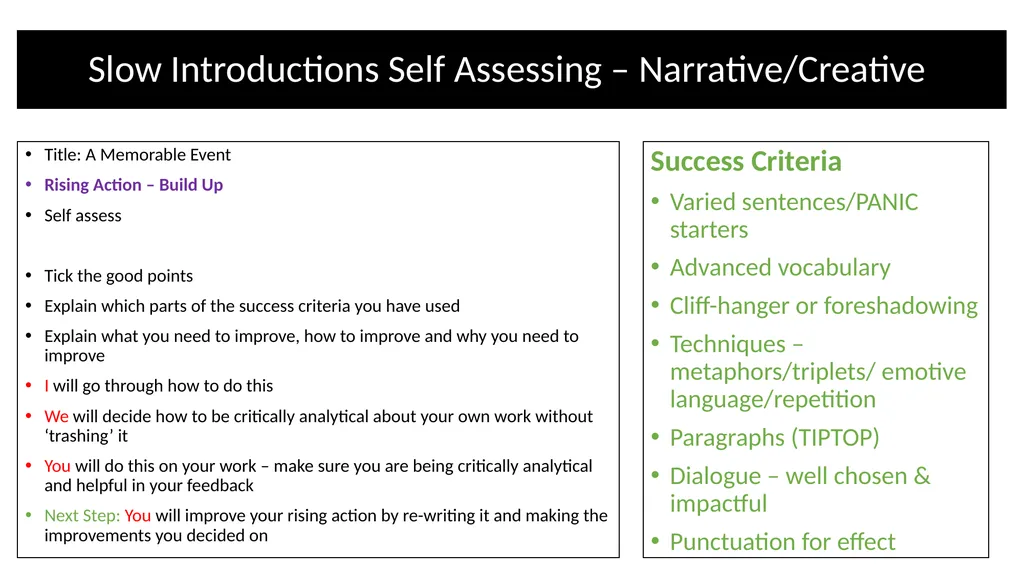
Slow Introductions Self Assessing – Narrative/Creative Title: A Memorable Event
Rising Action – Build Up
Self assess
Tick the good points
Explain which parts of the success criteria you have used
Explain what you need to improve, how to improve and why you need to improve
I will go through how to do this
We will decide how to be critically analytical about your own work without ‘trashing’ it
You will do this on your work – make sure you are being critically analytical and helpful in your feedback
Next Step: You will improve your rising action by re-writing it and making the improvements you decided on Success Criteria
Varied sentences/PANIC starters
Advanced vocabulary
Cliff-hanger or foreshadowing
Techniques – metaphors/triplets/ emotive language/repetition
Paragraphs (TIPTOP)
Dialogue – well chosen & impactful
Punctuation for effect<br>
Rising Action – Build Up
Self assess
Tick the good points
Explain which parts of the success criteria you have used
Explain what you need to improve, how to improve and why you need to improve
I will go through how to do this
We will decide how to be critically analytical about your own work without ‘trashing’ it
You will do this on your work – make sure you are being critically analytical and helpful in your feedback
Next Step: You will improve your rising action by re-writing it and making the improvements you decided on Success Criteria
Varied sentences/PANIC starters
Advanced vocabulary
Cliff-hanger or foreshadowing
Techniques – metaphors/triplets/ emotive language/repetition
Paragraphs (TIPTOP)
Dialogue – well chosen & impactful
Punctuation for effect<br>
23
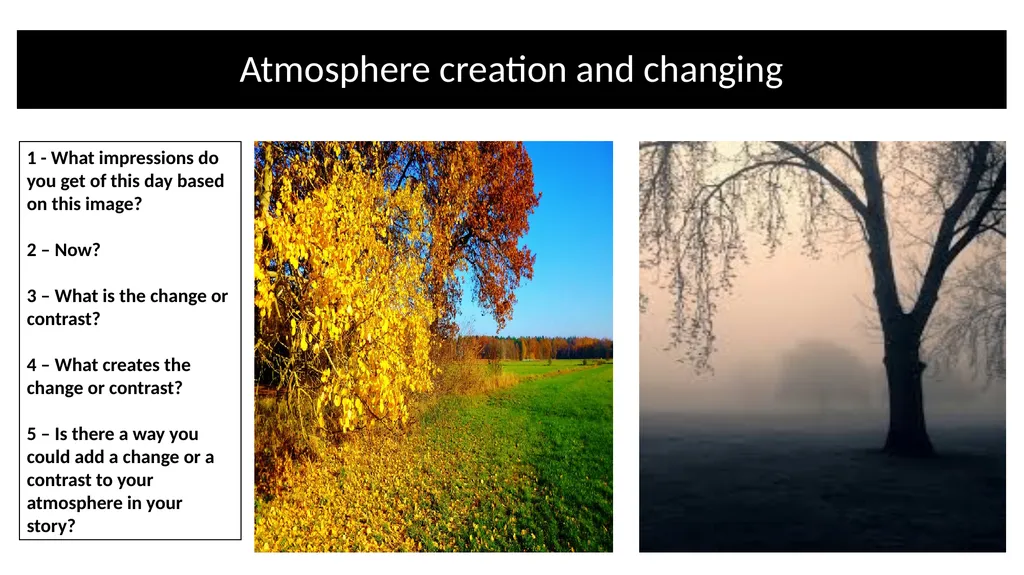
Atmosphere creation and changing 1 - What impressions do you get of this day based on this image?
2 – Now?
3 – What is the change or contrast?
4 – What creates the change or contrast?
5 – Is there a way you could add a change or a contrast to your atmosphere in your story?<br>
2 – Now?
3 – What is the change or contrast?
4 – What creates the change or contrast?
5 – Is there a way you could add a change or a contrast to your atmosphere in your story?<br>
24
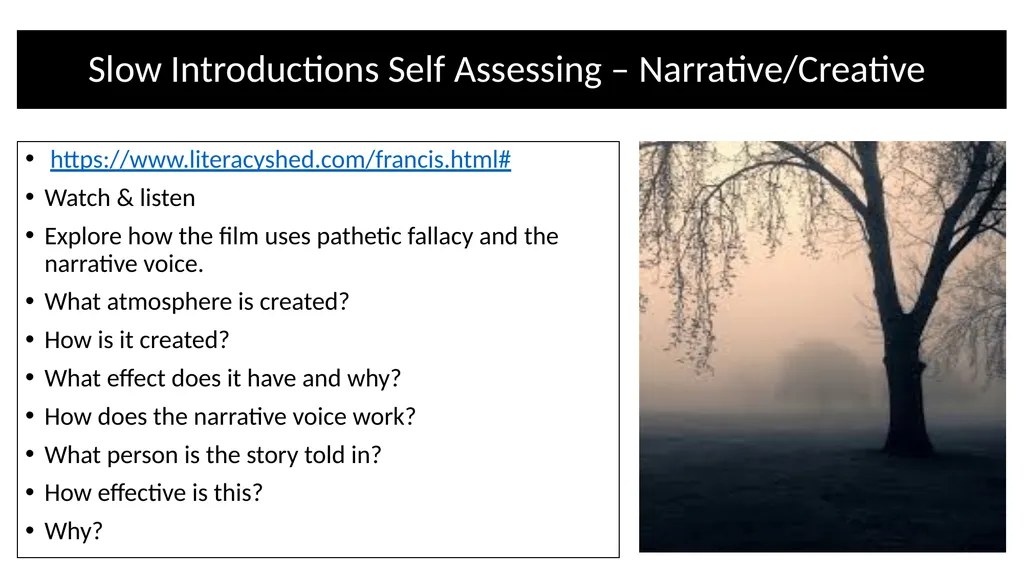
Slow Introductions Self Assessing – Narrative/Creative https://www.literacyshed.com/francis.html#
Watch & listen
Explore how the film uses pathetic fallacy and the narrative voice.
What atmosphere is created?
How is it created?
What effect does it have and why?
How does the narrative voice work?
What person is the story told in?
How effective is this?
Why?<br>
Watch & listen
Explore how the film uses pathetic fallacy and the narrative voice.
What atmosphere is created?
How is it created?
What effect does it have and why?
How does the narrative voice work?
What person is the story told in?
How effective is this?
Why?<br>
25
Atmosphere Contrast Example Glancing outside, the teacher realised that overhead storm clouds were gathering, in the distance she could hear the faint rumblings of thunder. An oppressive warmth spread over the classroom. Quietly, raindrops began to patter on the window panes.<br>
26
Slow Planning – Narrative/Creative Title: A Memorable Event
Climax
Explore real examples of the climax
Explain how authors create this high point in the action
Explore what different authors do to create this high point
Respond:
How do authors create the climax effectively?
How can you embed this in your writing<br>
Climax
Explore real examples of the climax
Explain how authors create this high point in the action
Explore what different authors do to create this high point
Respond:
How do authors create the climax effectively?
How can you embed this in your writing<br>
27
Climax – Narrative/Creative Title: A Memorable Event
Climax
I will model on the board my very bad example of an climax.
We will make it better as a group.
We will create a success criteria for a successful introduction.
You will use your plan from last lesson and write your introduction including the success criteria. Success Criteria
Varied sentences/PANIC starters
Advanced vocabulary
Cliff-hanger or foreshadowing
Techniques – metaphors/triplets/ emotive language/repetition
Paragraphs (TIPTOP)
Dialogue – well chosen & impactful
Punctuation for effect
Something happens – a high point in the action
Show not tell
Characters emotions and the senses used<br>
Climax
I will model on the board my very bad example of an climax.
We will make it better as a group.
We will create a success criteria for a successful introduction.
You will use your plan from last lesson and write your introduction including the success criteria. Success Criteria
Varied sentences/PANIC starters
Advanced vocabulary
Cliff-hanger or foreshadowing
Techniques – metaphors/triplets/ emotive language/repetition
Paragraphs (TIPTOP)
Dialogue – well chosen & impactful
Punctuation for effect
Something happens – a high point in the action
Show not tell
Characters emotions and the senses used<br>
28
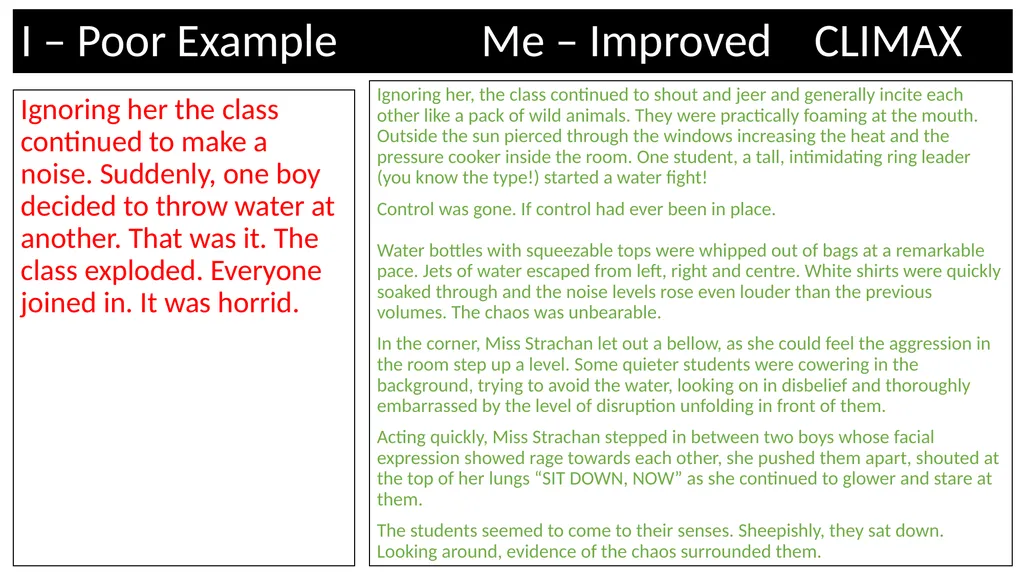
I – Poor Example Me – Improved CLIMAX Ignoring her the class continued to make a noise. Suddenly, one boy decided to throw water at another. That was it. The class exploded. Everyone joined in. It was horrid. Ignoring her, the class continued to shout and jeer and generally incite each other like a pack of wild animals. They were practically foaming at the mouth. Outside the sun pierced through the windows increasing the heat and the pressure cooker inside the room. One student, a tall, intimidating ring leader (you know the type!) started a water fight!
Control was gone. If control had ever been in place. Water bottles with squeezable tops were whipped out of bags at a remarkable pace. Jets of water escaped from left, right and centre. White shirts were quickly soaked through and the noise levels rose even louder than the previous volumes. The chaos was unbearable.
In the corner, Miss Strachan let out a bellow, as she could feel the aggression in the room step up a level. Some quieter students were cowering in the background, trying to avoid the water, looking on in disbelief and thoroughly embarrassed by the level of disruption unfolding in front of them.
Acting quickly, Miss Strachan stepped in between two boys whose facial expression showed rage towards each other, she pushed them apart, shouted at the top of her lungs “SIT DOWN, NOW” as she continued to glower and stare at them.
The students seemed to come to their senses. Sheepishly, they sat down. Looking around, evidence of the chaos surrounded them.<br>
Control was gone. If control had ever been in place. Water bottles with squeezable tops were whipped out of bags at a remarkable pace. Jets of water escaped from left, right and centre. White shirts were quickly soaked through and the noise levels rose even louder than the previous volumes. The chaos was unbearable.
In the corner, Miss Strachan let out a bellow, as she could feel the aggression in the room step up a level. Some quieter students were cowering in the background, trying to avoid the water, looking on in disbelief and thoroughly embarrassed by the level of disruption unfolding in front of them.
Acting quickly, Miss Strachan stepped in between two boys whose facial expression showed rage towards each other, she pushed them apart, shouted at the top of her lungs “SIT DOWN, NOW” as she continued to glower and stare at them.
The students seemed to come to their senses. Sheepishly, they sat down. Looking around, evidence of the chaos surrounded them.<br>
29
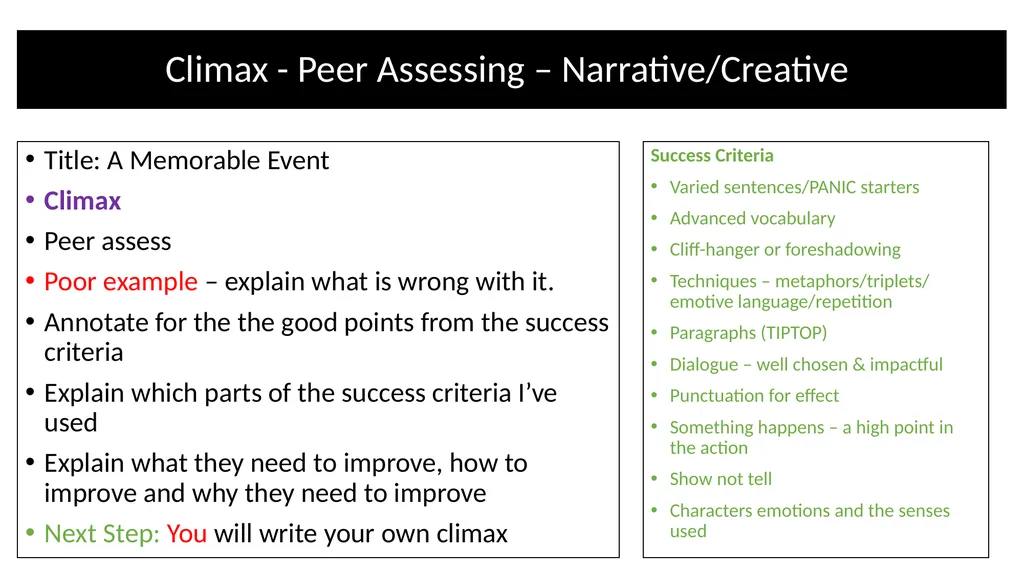
Climax - Peer Assessing – Narrative/Creative Title: A Memorable Event
Climax
Peer assess
Poor example – explain what is wrong with it.
Annotate for the the good points from the success criteria
Explain which parts of the success criteria I’ve used
Explain what they need to improve, how to improve and why they need to improve
Next Step: You will write your own climax Success Criteria
Varied sentences/PANIC starters
Advanced vocabulary
Cliff-hanger or foreshadowing
Techniques – metaphors/triplets/ emotive language/repetition
Paragraphs (TIPTOP)
Dialogue – well chosen & impactful
Punctuation for effect
Something happens – a high point in the action
Show not tell
Characters emotions and the senses used<br>
Climax
Peer assess
Poor example – explain what is wrong with it.
Annotate for the the good points from the success criteria
Explain which parts of the success criteria I’ve used
Explain what they need to improve, how to improve and why they need to improve
Next Step: You will write your own climax Success Criteria
Varied sentences/PANIC starters
Advanced vocabulary
Cliff-hanger or foreshadowing
Techniques – metaphors/triplets/ emotive language/repetition
Paragraphs (TIPTOP)
Dialogue – well chosen & impactful
Punctuation for effect
Something happens – a high point in the action
Show not tell
Characters emotions and the senses used<br>
30
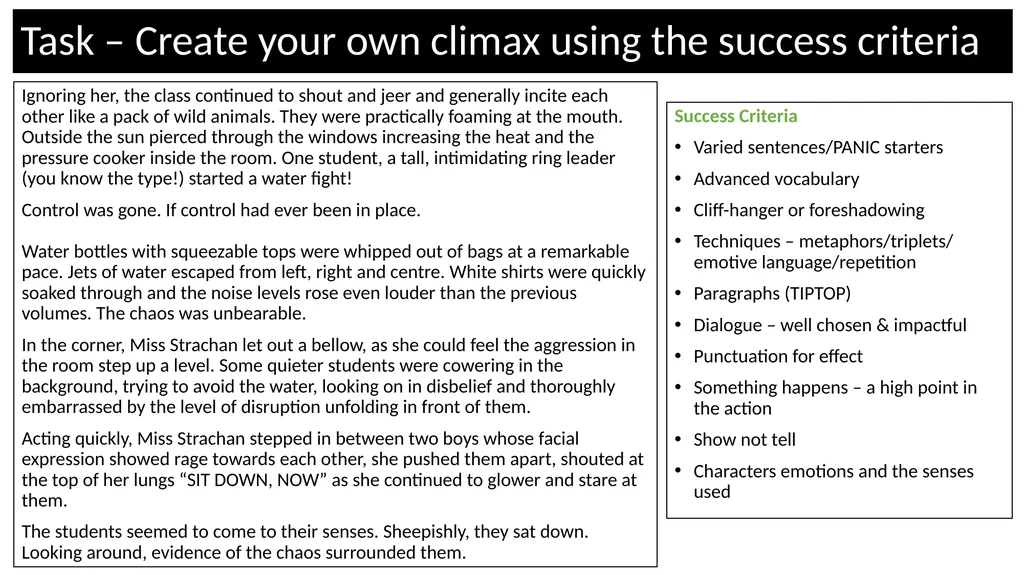
Task – Create your own climax using the success criteria Ignoring her, the class continued to shout and jeer and generally incite each other like a pack of wild animals. They were practically foaming at the mouth. Outside the sun pierced through the windows increasing the heat and the pressure cooker inside the room. One student, a tall, intimidating ring leader (you know the type!) started a water fight!
Control was gone. If control had ever been in place. Water bottles with squeezable tops were whipped out of bags at a remarkable pace. Jets of water escaped from left, right and centre. White shirts were quickly soaked through and the noise levels rose even louder than the previous volumes. The chaos was unbearable.
In the corner, Miss Strachan let out a bellow, as she could feel the aggression in the room step up a level. Some quieter students were cowering in the background, trying to avoid the water, looking on in disbelief and thoroughly embarrassed by the level of disruption unfolding in front of them.
Acting quickly, Miss Strachan stepped in between two boys whose facial expression showed rage towards each other, she pushed them apart, shouted at the top of her lungs “SIT DOWN, NOW” as she continued to glower and stare at them.
The students seemed to come to their senses. Sheepishly, they sat down. Looking around, evidence of the chaos surrounded them. Success Criteria
Varied sentences/PANIC starters
Advanced vocabulary
Cliff-hanger or foreshadowing
Techniques – metaphors/triplets/ emotive language/repetition
Paragraphs (TIPTOP)
Dialogue – well chosen & impactful
Punctuation for effect
Something happens – a high point in the action
Show not tell
Characters emotions and the senses used<br>
Control was gone. If control had ever been in place. Water bottles with squeezable tops were whipped out of bags at a remarkable pace. Jets of water escaped from left, right and centre. White shirts were quickly soaked through and the noise levels rose even louder than the previous volumes. The chaos was unbearable.
In the corner, Miss Strachan let out a bellow, as she could feel the aggression in the room step up a level. Some quieter students were cowering in the background, trying to avoid the water, looking on in disbelief and thoroughly embarrassed by the level of disruption unfolding in front of them.
Acting quickly, Miss Strachan stepped in between two boys whose facial expression showed rage towards each other, she pushed them apart, shouted at the top of her lungs “SIT DOWN, NOW” as she continued to glower and stare at them.
The students seemed to come to their senses. Sheepishly, they sat down. Looking around, evidence of the chaos surrounded them. Success Criteria
Varied sentences/PANIC starters
Advanced vocabulary
Cliff-hanger or foreshadowing
Techniques – metaphors/triplets/ emotive language/repetition
Paragraphs (TIPTOP)
Dialogue – well chosen & impactful
Punctuation for effect
Something happens – a high point in the action
Show not tell
Characters emotions and the senses used<br>
31
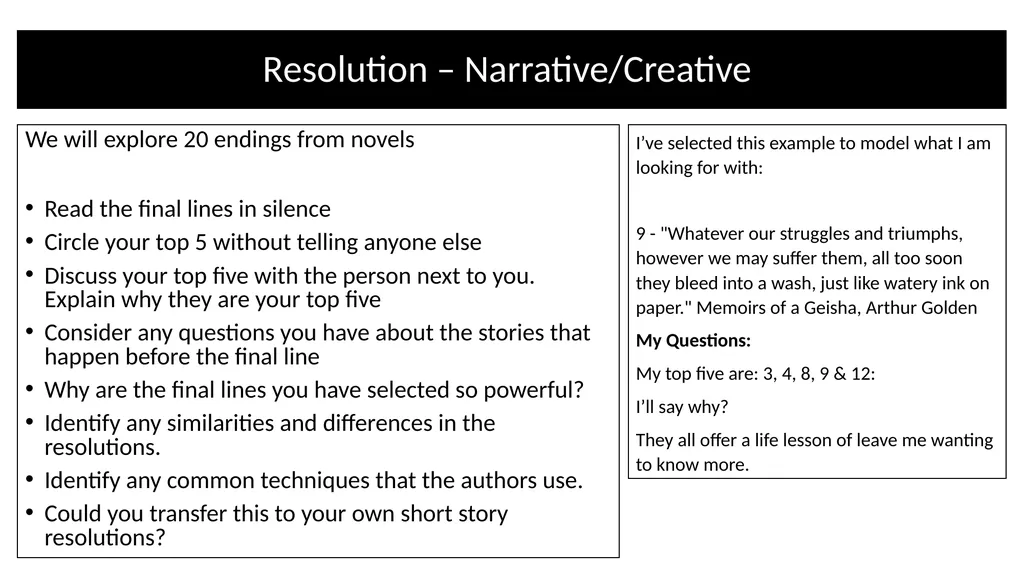
Resolution – Narrative/Creative We will explore 20 endings from novels
Read the final lines in silence
Circle your top 5 without telling anyone else
Discuss your top five with the person next to you. Explain why they are your top five
Consider any questions you have about the stories that happen before the final line
Why are the final lines you have selected so powerful?
Identify any similarities and differences in the resolutions.
Identify any common techniques that the authors use.
Could you transfer this to your own short story resolutions? I’ve selected this example to model what I am looking for with:
9 - "Whatever our struggles and triumphs, however we may suffer them, all too soon they bleed into a wash, just like watery ink on paper." Memoirs of a Geisha, Arthur Golden
My Questions:
My top five are: 3, 4, 8, 9 & 12:
I’ll say why?
They all offer a life lesson of leave me wanting to know more.<br>
Read the final lines in silence
Circle your top 5 without telling anyone else
Discuss your top five with the person next to you. Explain why they are your top five
Consider any questions you have about the stories that happen before the final line
Why are the final lines you have selected so powerful?
Identify any similarities and differences in the resolutions.
Identify any common techniques that the authors use.
Could you transfer this to your own short story resolutions? I’ve selected this example to model what I am looking for with:
9 - "Whatever our struggles and triumphs, however we may suffer them, all too soon they bleed into a wash, just like watery ink on paper." Memoirs of a Geisha, Arthur Golden
My Questions:
My top five are: 3, 4, 8, 9 & 12:
I’ll say why?
They all offer a life lesson of leave me wanting to know more.<br>
32
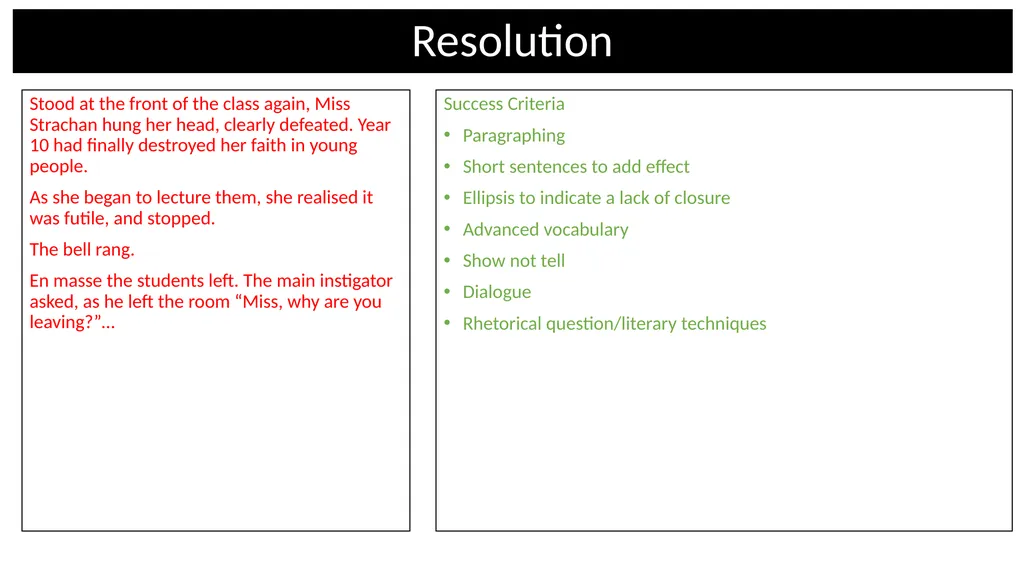
Resolution Stood at the front of the class again, Miss Strachan hung her head, clearly defeated. Year 10 had finally destroyed her faith in young people.
As she began to lecture them, she realised it was futile, and stopped.
The bell rang.
En masse the students left. The main instigator asked, as he left the room “Miss, why are you leaving?”… Success Criteria
Paragraphing
Short sentences to add effect
Ellipsis to indicate a lack of closure
Advanced vocabulary
Show not tell
Dialogue
Rhetorical question/literary techniques<br>
As she began to lecture them, she realised it was futile, and stopped.
The bell rang.
En masse the students left. The main instigator asked, as he left the room “Miss, why are you leaving?”… Success Criteria
Paragraphing
Short sentences to add effect
Ellipsis to indicate a lack of closure
Advanced vocabulary
Show not tell
Dialogue
Rhetorical question/literary techniques<br>
33
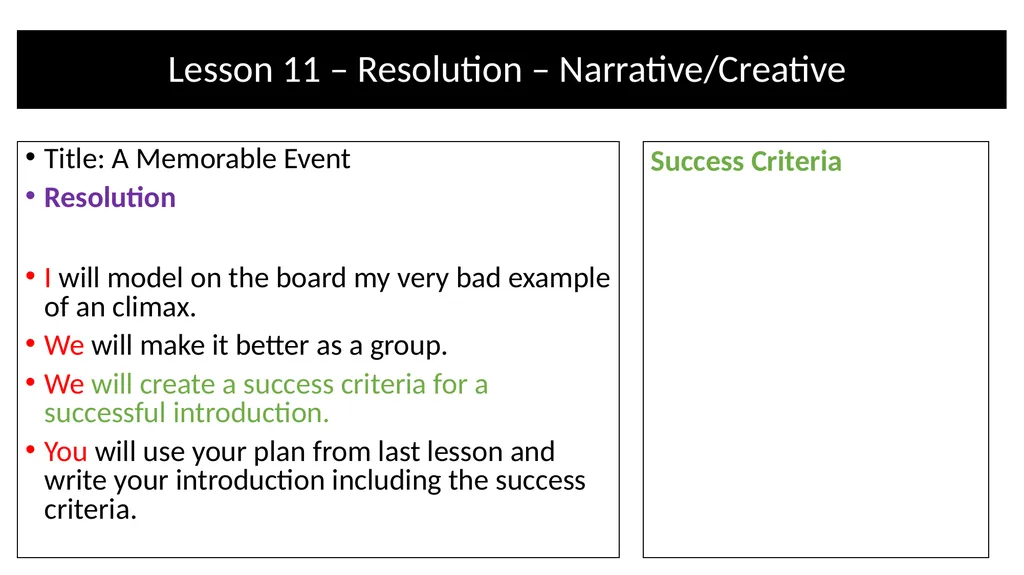
Lesson 11 – Resolution – Narrative/Creative Title: A Memorable Event
Resolution
I will model on the board my very bad example of an climax.
We will make it better as a group.
We will create a success criteria for a successful introduction.
You will use your plan from last lesson and write your introduction including the success criteria. Success Criteria<br>
Resolution
I will model on the board my very bad example of an climax.
We will make it better as a group.
We will create a success criteria for a successful introduction.
You will use your plan from last lesson and write your introduction including the success criteria. Success Criteria<br>
34
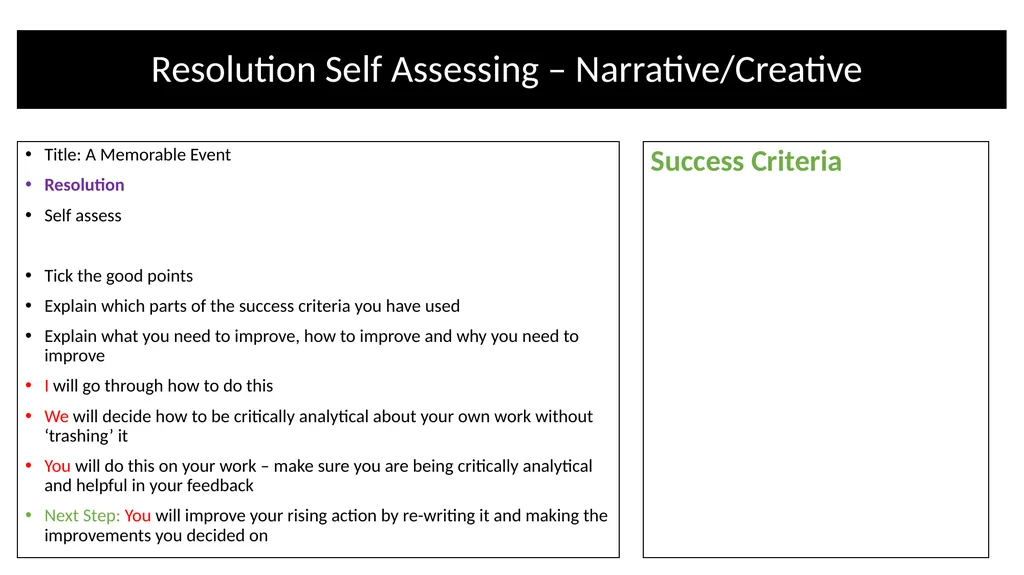
Resolution Self Assessing – Narrative/Creative Title: A Memorable Event
Resolution
Self assess
Tick the good points
Explain which parts of the success criteria you have used
Explain what you need to improve, how to improve and why you need to improve
I will go through how to do this
We will decide how to be critically analytical about your own work without ‘trashing’ it
You will do this on your work – make sure you are being critically analytical and helpful in your feedback
Next Step: You will improve your rising action by re-writing it and making the improvements you decided on Success Criteria<br>
Resolution
Self assess
Tick the good points
Explain which parts of the success criteria you have used
Explain what you need to improve, how to improve and why you need to improve
I will go through how to do this
We will decide how to be critically analytical about your own work without ‘trashing’ it
You will do this on your work – make sure you are being critically analytical and helpful in your feedback
Next Step: You will improve your rising action by re-writing it and making the improvements you decided on Success Criteria<br>
35
Resolution Self Assessing – Narrative/Creative Title: A Memorable Event
Resolution
Self assess
Tick the good points
Explain which parts of the success criteria you have used
Explain what you need to improve, how to improve and why you need to improve
I will go through how to do this
We will decide how to be critically analytical about your own work without ‘trashing’ it
You will do this on your work – make sure you are being critically analytical and helpful in your feedback
Next Step: You will improve your rising action by re-writing it and making the improvements you decided on Success Criteria<br>
Resolution
Self assess
Tick the good points
Explain which parts of the success criteria you have used
Explain what you need to improve, how to improve and why you need to improve
I will go through how to do this
We will decide how to be critically analytical about your own work without ‘trashing’ it
You will do this on your work – make sure you are being critically analytical and helpful in your feedback
Next Step: You will improve your rising action by re-writing it and making the improvements you decided on Success Criteria<br>
36
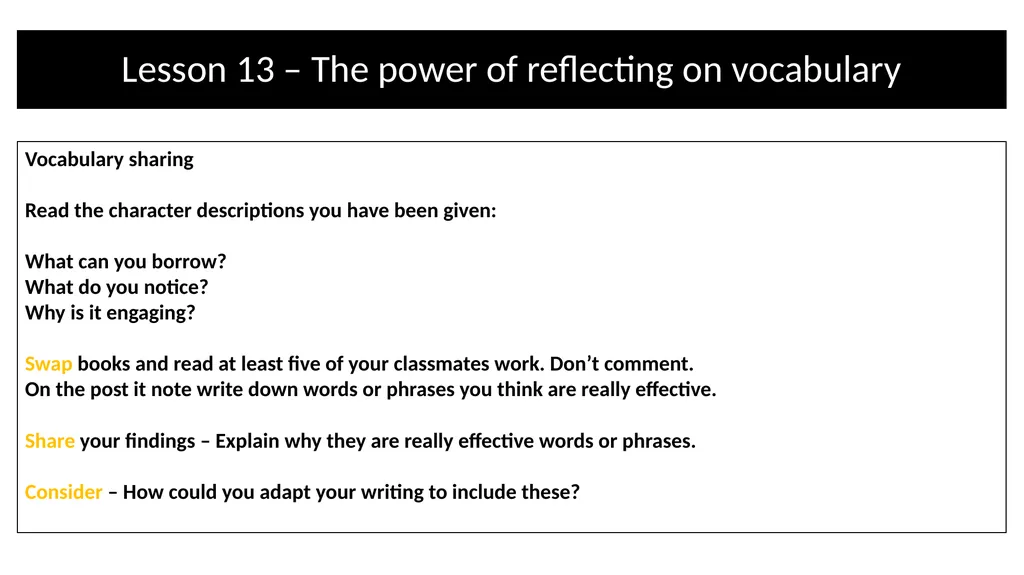
Lesson 13 – The power of reflecting on vocabulary Vocabulary sharing
Read the character descriptions you have been given:
What can you borrow? What do you notice?
Why is it engaging?
Swap books and read at least five of your classmates work. Don’t comment.
On the post it note write down words or phrases you think are really effective.
Share your findings – Explain why they are really effective words or phrases.
Consider – How could you adapt your writing to include these?<br>
Read the character descriptions you have been given:
What can you borrow? What do you notice?
Why is it engaging?
Swap books and read at least five of your classmates work. Don’t comment.
On the post it note write down words or phrases you think are really effective.
Share your findings – Explain why they are really effective words or phrases.
Consider – How could you adapt your writing to include these?<br>
37
Lesson 14 – Re-draft Re-write your story in full adapting it to improve it as you do<br>
38
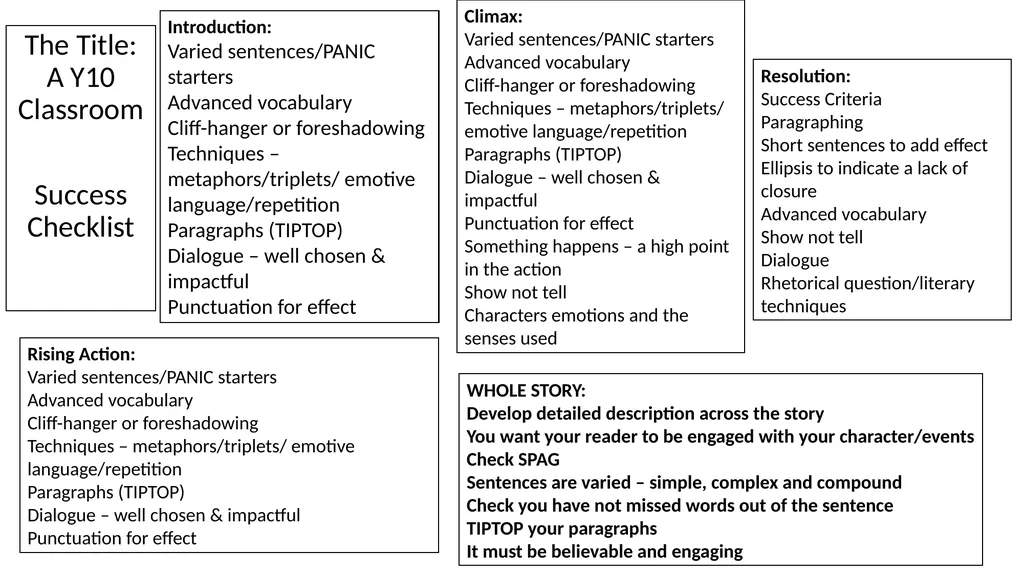
The Title: A Y10 Classroom
Success Checklist Introduction:
Varied sentences/PANIC starters
Advanced vocabulary
Cliff-hanger or foreshadowing
Techniques – metaphors/triplets/ emotive language/repetition
Paragraphs (TIPTOP)
Dialogue – well chosen & impactful
Punctuation for effect Rising Action:
Varied sentences/PANIC starters
Advanced vocabulary
Cliff-hanger or foreshadowing
Techniques – metaphors/triplets/ emotive language/repetition
Paragraphs (TIPTOP)
Dialogue – well chosen & impactful
Punctuation for effect Climax:
Varied sentences/PANIC starters
Advanced vocabulary
Cliff-hanger or foreshadowing
Techniques – metaphors/triplets/ emotive language/repetition
Paragraphs (TIPTOP)
Dialogue – well chosen & impactful
Punctuation for effect
Something happens – a high point in the action
Show not tell
Characters emotions and the senses used Resolution:
Success Criteria
Paragraphing
Short sentences to add effect
Ellipsis to indicate a lack of closure
Advanced vocabulary
Show not tell
Dialogue
Rhetorical question/literary techniques WHOLE STORY:
Develop detailed description across the story
You want your reader to be engaged with your character/events
Check SPAG
Sentences are varied – simple, complex and compound
Check you have not missed words out of the sentence
TIPTOP your paragraphs
It must be believable and engaging<br>
Success Checklist Introduction:
Varied sentences/PANIC starters
Advanced vocabulary
Cliff-hanger or foreshadowing
Techniques – metaphors/triplets/ emotive language/repetition
Paragraphs (TIPTOP)
Dialogue – well chosen & impactful
Punctuation for effect Rising Action:
Varied sentences/PANIC starters
Advanced vocabulary
Cliff-hanger or foreshadowing
Techniques – metaphors/triplets/ emotive language/repetition
Paragraphs (TIPTOP)
Dialogue – well chosen & impactful
Punctuation for effect Climax:
Varied sentences/PANIC starters
Advanced vocabulary
Cliff-hanger or foreshadowing
Techniques – metaphors/triplets/ emotive language/repetition
Paragraphs (TIPTOP)
Dialogue – well chosen & impactful
Punctuation for effect
Something happens – a high point in the action
Show not tell
Characters emotions and the senses used Resolution:
Success Criteria
Paragraphing
Short sentences to add effect
Ellipsis to indicate a lack of closure
Advanced vocabulary
Show not tell
Dialogue
Rhetorical question/literary techniques WHOLE STORY:
Develop detailed description across the story
You want your reader to be engaged with your character/events
Check SPAG
Sentences are varied – simple, complex and compound
Check you have not missed words out of the sentence
TIPTOP your paragraphs
It must be believable and engaging<br>
39
Lesson 15 – Go Blind Apply the combined success criteria to this new title:
Write a story about a childhood memory<br>
Write a story about a childhood memory<br>