
Teaching basic first aid ADAPT THIS FOR YOUR OWN
DP
Published · 104 slides · 0 views

1 / 1



Description
Teaching basic first aid ADAPT THIS FOR YOUR OWN PRESENTATION Training module Part of: Physical health and mental wellbeing YOUR NAME, YOUR SCHOOL Primary Secondary September 2020 Contents 2 3 About this training module 5 Teaching the new
Related Topics
Share
Embed code
Download this presentation From Below
"Teaching basic first aid ADAPT THIS FOR YOUR OWN" is the property of its rightful owner. Permission is granted to download and print the materials on this website for personal, non-commercial use only, and to display it on your personal computer provided you do not modify the materials and that you retain all copyright notices contained in the materials. By downloading content from our website, you accept the terms of this agreement.
Presentation Transcript
01
Teaching basic first aid ADAPT THIS FOR YOUR OWN PRESENTATION Training module Part of: Physical health and mental wellbeing [YOUR NAME, YOUR SCHOOL] Primary Secondary September 2020<br>
02
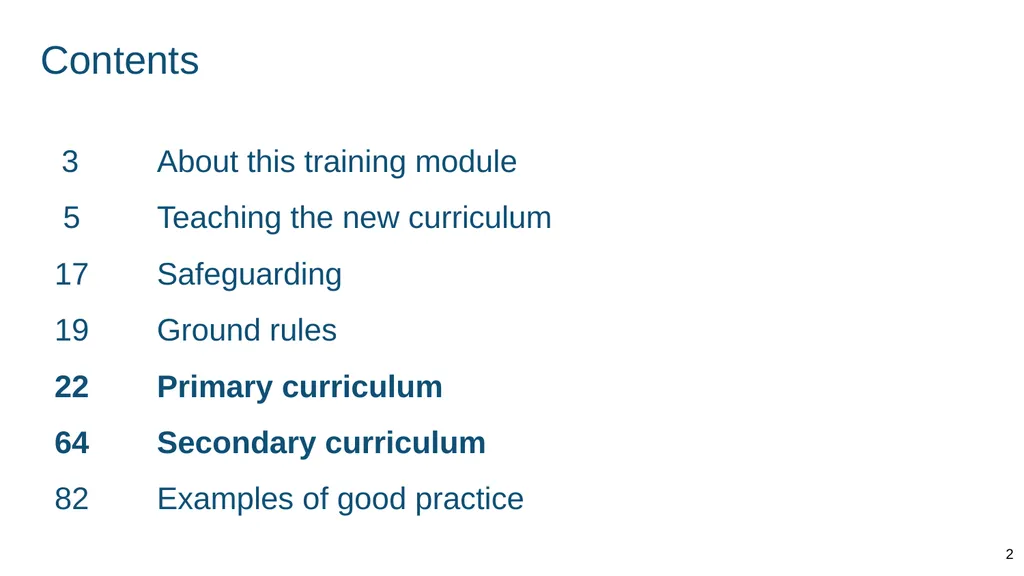
Contents 2 3 About this training module
5 Teaching the new curriculum
17 Safeguarding
19 Ground rules
22 Primary curriculum
64 Secondary curriculum
82 Examples of good practice<br>
5 Teaching the new curriculum
17 Safeguarding
19 Ground rules
22 Primary curriculum
64 Secondary curriculum
82 Examples of good practice<br>
03
About this training module Subject leads can use the adaptable slides and ‘activities and templates for trainers’ section at the end of this module to help shape training sessions for teachers.
This non-statutory training module supplements the statutory guidance on teaching basic first aid, which schools should read in full.
Schools can choose whether and how to follow or adapt this training module and should refer to the Early Career Framework for pedagogical guidance. 3<br>
This non-statutory training module supplements the statutory guidance on teaching basic first aid, which schools should read in full.
Schools can choose whether and how to follow or adapt this training module and should refer to the Early Career Framework for pedagogical guidance. 3<br>
04
What you get out of today By the end of this training you should:
know what is included in the statutory guidance
know some key knowledge and skills to cover as part of this topic
have strategies to deal with questions that come up in class
feel more confident teaching about basic first aid 4<br>
know what is included in the statutory guidance
know some key knowledge and skills to cover as part of this topic
have strategies to deal with questions that come up in class
feel more confident teaching about basic first aid 4<br>
05
Teaching the new curriculum 5<br>
06
Related topics Basic first aid is related to the science curriculum as well as topics such as:
health and prevention
physical health and fitness
healthy eating
drugs, alcohol and tobacco
Therefore you should:
consider thematic links across key topics and the whole school when planning and delivering lessons
find ways to link knowledge and vocabulary across topics 6<br>
health and prevention
physical health and fitness
healthy eating
drugs, alcohol and tobacco
Therefore you should:
consider thematic links across key topics and the whole school when planning and delivering lessons
find ways to link knowledge and vocabulary across topics 6<br>
07
First aid support at [school name] Our leads
[Names, contact details of first aid leads, school nurse]
Our policies
[Add details - e.g. school policy on PSHE, first aid, medicines policy, procedures for sanitisation of equipment, training opportunities]
Specialist support [Add details - e.g. providers school already works with]
Other information
[Add resources] 7<br>
[Names, contact details of first aid leads, school nurse]
Our policies
[Add details - e.g. school policy on PSHE, first aid, medicines policy, procedures for sanitisation of equipment, training opportunities]
Specialist support [Add details - e.g. providers school already works with]
Other information
[Add resources] 7<br>
08
First aid at [school name] Ways in which we already teach about basic first aid at our school:
[Add details]
[Add details]
[Add details]
Our first aid equipment
[Add details of equipment and location]
[Add details of equipment and location]
[Add details of equipment and location] 8<br>
[Add details]
[Add details]
[Add details]
Our first aid equipment
[Add details of equipment and location]
[Add details of equipment and location]
[Add details of equipment and location] 8<br>
09
External training and resources (1) This training module provides information about what schools can teach pupils about basic first aid. However, it should be noted that this module is not a substitute for basic first aid training.
It is likely that when teaching the knowledge and skills many schools will choose to use external trainers and quality audio-visual resources from recognised expert organisations and websites, such as:
British Red Cross
Resuscitation Council UK
St John Ambulance
NHS.UK, which has informed much of the content about basic first aid in this module 9<br>
It is likely that when teaching the knowledge and skills many schools will choose to use external trainers and quality audio-visual resources from recognised expert organisations and websites, such as:
British Red Cross
Resuscitation Council UK
St John Ambulance
NHS.UK, which has informed much of the content about basic first aid in this module 9<br>
10
External training and resources (2) Due to the practical nature of this topic, schools may want to incorporate the following in lessons:
quality audio-visual content such as video
practical demonstrations of first aid skills
opportunities for pupils to practise first aid skills
When using this training module teachers may therefore benefit from familiarising themselves with some core first aid skills, for example:
discussing a CPR video (St John Ambulance) as a prompt
considering how resources like Lifesaver and Lifesaver VR (Resuscitation Council UK) could be used in lessons 10<br>
quality audio-visual content such as video
practical demonstrations of first aid skills
opportunities for pupils to practise first aid skills
When using this training module teachers may therefore benefit from familiarising themselves with some core first aid skills, for example:
discussing a CPR video (St John Ambulance) as a prompt
considering how resources like Lifesaver and Lifesaver VR (Resuscitation Council UK) could be used in lessons 10<br>
11
Whole-school approach to first aid Teaching about basic first aid should take place as part of a wider school context that promotes health and wellbeing.
Teachers and pupils should be aware of provision such as:
school nurse
first aiders
location of first aid box
location of automated external defibrillator (AED) if the school has one, or if there is one nearby
Teachers should also be aware of the school’s medicines policy and who to approach if advice is needed. 11<br>
Teachers and pupils should be aware of provision such as:
school nurse
first aiders
location of first aid box
location of automated external defibrillator (AED) if the school has one, or if there is one nearby
Teachers should also be aware of the school’s medicines policy and who to approach if advice is needed. 11<br>
12
Use of language and terminology While the core slides in this module contain some language and terminology that schools may wish to include in lessons, this content is primarily for teacher use in understanding what can be taught to pupils.
Teachers will need to use language and terminology that is appropriate and accessible to their pupil groups. 12<br>
Teachers will need to use language and terminology that is appropriate and accessible to their pupil groups. 12<br>
13
Protecting our health and that of others From September 2020, schools must have regard to the new statutory guidance for teaching basic first aid. The statutory guidance explains how this teaching fits into the wider topic of health education. STATUTORY GUIDANCE
Teachers should go on to talk about the steps pupils can take to protect and support their own and others’ health and wellbeing, including simple self-care techniques, personal hygiene, prevention of health and wellbeing problems and basic first aid. (p32) 13<br>
14
Primary and secondary teaching Some slides in this training have a Primary or Secondary label to indicate that the material is usually first introduced in that phase. STATUTORY GUIDANCE
Schools have flexibility to design and plan age-appropriate subject content. (p31) Using your knowledge of your pupils and school community you can:
introduce secondary content in primary with pupils who need it and are ready
teach the primary content in early secondary lessons to pupils who need to build knowledge before secondary content is taught 14<br>
introduce secondary content in primary with pupils who need it and are ready
teach the primary content in early secondary lessons to pupils who need to build knowledge before secondary content is taught 14<br>
15
Pupils with SEND You will need to plan lessons to allow all pupils to access and practise the core knowledge, using your expertise as you normally would.
You might want to link lesson outcomes with statutory ‘preparing for adulthood’ outcomes for those with an education, health and care (EHC) plan. (See SEND code of practice, section 8.) STATUTORY GUIDANCE
In special schools and for some SEND pupils in mainstream schools there may be a need to tailor content and teaching to meet the specific needs of pupils at different developmental stages. As with all teaching for these subjects, schools should ensure that their teaching is sensitive, age-appropriate, developmentally appropriate and delivered with reference to the law. (p15) 15<br>
You might want to link lesson outcomes with statutory ‘preparing for adulthood’ outcomes for those with an education, health and care (EHC) plan. (See SEND code of practice, section 8.) STATUTORY GUIDANCE
In special schools and for some SEND pupils in mainstream schools there may be a need to tailor content and teaching to meet the specific needs of pupils at different developmental stages. As with all teaching for these subjects, schools should ensure that their teaching is sensitive, age-appropriate, developmentally appropriate and delivered with reference to the law. (p15) 15<br>
16
Teacher wellbeing The new curriculum covers a wide range of topics, some of which individual teachers might find personally challenging in different ways.
It is important to feel you can ask for support or raise questions if:
you have personal experience of a topic which makes teaching that content particularly challenging for you
you have personal views on a topic that mean you need to discuss how you can ensure the teaching is delivered objectively
Talk to your line manager, in the first instance, if you do need support. 16<br>
It is important to feel you can ask for support or raise questions if:
you have personal experience of a topic which makes teaching that content particularly challenging for you
you have personal views on a topic that mean you need to discuss how you can ensure the teaching is delivered objectively
Talk to your line manager, in the first instance, if you do need support. 16<br>
17
Safeguarding 17<br>
18
Safeguarding (1) Pupils may be affected by issues discussed in lessons.
Let your designated safeguarding lead or deputy and any other relevant staff, such as pastoral leads, know what you are teaching. This will enable them to identify and speak to relevant pupils, especially those who they know may have been directly impacted by issues covered in the lessons and those with adverse childhood experiences.
Teachers may need to deal with disclosures or concerns (e.g. of abuse or offending behaviour) in a way that safeguards pupils in line with school policies, especially the child protection policy. 18<br>
Let your designated safeguarding lead or deputy and any other relevant staff, such as pastoral leads, know what you are teaching. This will enable them to identify and speak to relevant pupils, especially those who they know may have been directly impacted by issues covered in the lessons and those with adverse childhood experiences.
Teachers may need to deal with disclosures or concerns (e.g. of abuse or offending behaviour) in a way that safeguards pupils in line with school policies, especially the child protection policy. 18<br>
19
Ground rules 19<br>
20
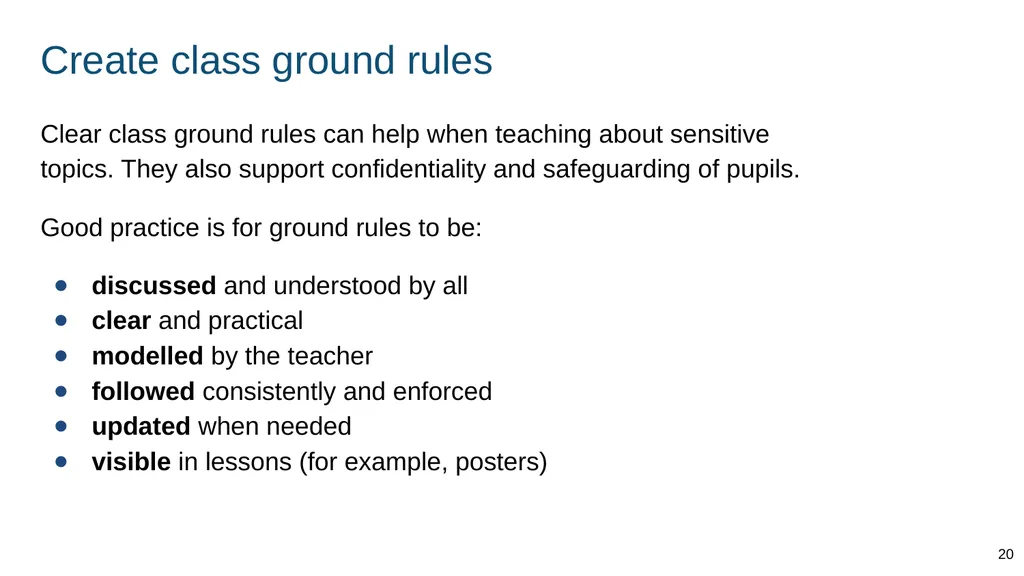
Create class ground rules Clear class ground rules can help when teaching about sensitive topics. They also support confidentiality and safeguarding of pupils.
Good practice is for ground rules to be:
discussed and understood by all
clear and practical
modelled by the teacher
followed consistently and enforced
updated when needed
visible in lessons (for example, posters) 20<br>
Good practice is for ground rules to be:
discussed and understood by all
clear and practical
modelled by the teacher
followed consistently and enforced
updated when needed
visible in lessons (for example, posters) 20<br>
21
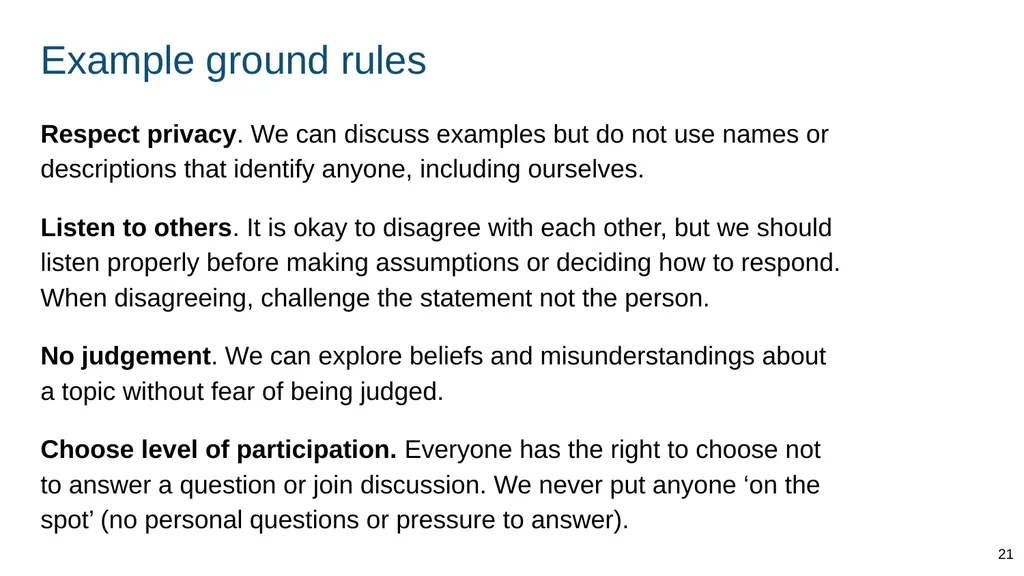
Example ground rules Respect privacy. We can discuss examples but do not use names or descriptions that identify anyone, including ourselves.
Listen to others. It is okay to disagree with each other, but we should listen properly before making assumptions or deciding how to respond. When disagreeing, challenge the statement not the person.
No judgement. We can explore beliefs and misunderstandings about a topic without fear of being judged.
Choose level of participation. Everyone has the right to choose not to answer a question or join discussion. We never put anyone ‘on the spot’ (no personal questions or pressure to answer). 21<br>
Listen to others. It is okay to disagree with each other, but we should listen properly before making assumptions or deciding how to respond. When disagreeing, challenge the statement not the person.
No judgement. We can explore beliefs and misunderstandings about a topic without fear of being judged.
Choose level of participation. Everyone has the right to choose not to answer a question or join discussion. We never put anyone ‘on the spot’ (no personal questions or pressure to answer). 21<br>
22
Primary curriculum 22<br>
23
Concepts of basic first aid 23<br>
24
Explain that basic first aid teaches us when and how to help someone who is suddenly injured or ill.
This can mean:
carrying out first aid on ourselves or another person
explaining to someone else how to carry out first aid
calling for help from adults or emergency services
Explore situations where basic first aid might be needed (e.g. the scenarios in this module). Explain that pupils will learn when and how they might help, but they should still speak to an adult if they or someone they know is in pain or has hurt themselves. Introducing basic first aid Primary STATUTORY GUIDANCE Know concepts of basic first-aid, for example dealing with common injuries, including head injuries. 24<br>
This can mean:
carrying out first aid on ourselves or another person
explaining to someone else how to carry out first aid
calling for help from adults or emergency services
Explore situations where basic first aid might be needed (e.g. the scenarios in this module). Explain that pupils will learn when and how they might help, but they should still speak to an adult if they or someone they know is in pain or has hurt themselves. Introducing basic first aid Primary STATUTORY GUIDANCE Know concepts of basic first-aid, for example dealing with common injuries, including head injuries. 24<br>
25
Explain that pupils should always check whether it is safe for them and other people if they do basic first aid. For example, they should check for a risk of:
being cut by broken glass
falling from a height
something falling onto them
busy traffic
coming into contact with fire or chemicals
If there has been an accident, or there is a serious danger to them or another person, pupils should always find a safe space and call 999. Putting safety first Primary STATUTORY GUIDANCE Know concepts of basic first-aid, for example dealing with common injuries, including head injuries. 25<br>
being cut by broken glass
falling from a height
something falling onto them
busy traffic
coming into contact with fire or chemicals
If there has been an accident, or there is a serious danger to them or another person, pupils should always find a safe space and call 999. Putting safety first Primary STATUTORY GUIDANCE Know concepts of basic first-aid, for example dealing with common injuries, including head injuries. 25<br>
26
Minor and major injuries Primary Explain that basic first aid allows us to:
help when someone has a minor injury or illness
keep someone with a more serious injury safe while they are waiting for emergency help (if it is safe to do so)
Teach that it is not always obvious whether an injury is minor or major. Explain that when they learn about common injuries, pupils will also learn to look out for signs that they should get emergency help.
Remind pupils that they should always tell an adult if they or somebody else is hurt or ill. STATUTORY GUIDANCE Know concepts of basic first-aid, for example dealing with common injuries, including head injuries. 26<br>
help when someone has a minor injury or illness
keep someone with a more serious injury safe while they are waiting for emergency help (if it is safe to do so)
Teach that it is not always obvious whether an injury is minor or major. Explain that when they learn about common injuries, pupils will also learn to look out for signs that they should get emergency help.
Remind pupils that they should always tell an adult if they or somebody else is hurt or ill. STATUTORY GUIDANCE Know concepts of basic first-aid, for example dealing with common injuries, including head injuries. 26<br>
27
Medication Primary Explain that:
the painkillers paracetamol and ibuprofen are often used for pain caused by minor injuries
antihistamines are used to treat allergies
Stress that pupils should:
only take painkillers with the knowledge, consent and guidance of a parent/guardian/doctor
follow packaging instructions for recommended dose (which varies according to age)
never take aspirin, if they are under 16 (as it can damage their liver and brain) STATUTORY GUIDANCE Know concepts of basic first-aid, for example dealing with common injuries, including head injuries. 27<br>
the painkillers paracetamol and ibuprofen are often used for pain caused by minor injuries
antihistamines are used to treat allergies
Stress that pupils should:
only take painkillers with the knowledge, consent and guidance of a parent/guardian/doctor
follow packaging instructions for recommended dose (which varies according to age)
never take aspirin, if they are under 16 (as it can damage their liver and brain) STATUTORY GUIDANCE Know concepts of basic first-aid, for example dealing with common injuries, including head injuries. 27<br>
28
Antiseptic cream Primary Teach that antiseptic creams are used to treat minor injuries such as cuts, grazes, burns and scalds, and insect bites. They help clean wounds and protect against infection by killing bacteria around the wound.
Explain that antiseptic cream should not be used on wounds that are going to be covered by a dressing. This is because they can keep the skin wet, damage it and slow down healing. (Reference: NHS website.) STATUTORY GUIDANCE Know concepts of basic first-aid, for example dealing with common injuries, including head injuries. 28<br>
Explain that antiseptic cream should not be used on wounds that are going to be covered by a dressing. This is because they can keep the skin wet, damage it and slow down healing. (Reference: NHS website.) STATUTORY GUIDANCE Know concepts of basic first-aid, for example dealing with common injuries, including head injuries. 28<br>
29
Dressings and bandages Primary Introduce pupils to a range of dressings (e.g. plasters) and bandages (e.g. roller bandage). Explore situations in which pupils might need to use dressings and bandages.
Teach that dressings are sterile pads that we put onto wounds to promote healing, keep wounds clean and prevent further harm. Bandages are used to hold dressings in place, support injured joints and control bleeding.
Provide pupils with opportunities to practise applying dressings and bandages. STATUTORY GUIDANCE Know concepts of basic first-aid, for example dealing with common injuries, including head injuries. 29<br>
Teach that dressings are sterile pads that we put onto wounds to promote healing, keep wounds clean and prevent further harm. Bandages are used to hold dressings in place, support injured joints and control bleeding.
Provide pupils with opportunities to practise applying dressings and bandages. STATUTORY GUIDANCE Know concepts of basic first-aid, for example dealing with common injuries, including head injuries. 29<br>
30
Applying dressings Primary Explain that when applying a dressing, pupils should:
stop bleeding by putting pressure on the wound and lifting it above the heart
clean the wound under running water (for 5 to 10 minutes)
pat dry using a clean cloth (but nothing fluffy)
choose a dressing that is slightly bigger than the wound they are to cover
hold the dressing at the edges and not touch the part that will cover the wound
replace dressings when they are dirty or wet, or when blood soaks through STATUTORY GUIDANCE Know concepts of basic first-aid, for example dealing with common injuries, including head injuries. 30<br>
stop bleeding by putting pressure on the wound and lifting it above the heart
clean the wound under running water (for 5 to 10 minutes)
pat dry using a clean cloth (but nothing fluffy)
choose a dressing that is slightly bigger than the wound they are to cover
hold the dressing at the edges and not touch the part that will cover the wound
replace dressings when they are dirty or wet, or when blood soaks through STATUTORY GUIDANCE Know concepts of basic first-aid, for example dealing with common injuries, including head injuries. 30<br>
31
Using bandages Primary Give pupils a chance to practise using a bandage to secure a dressing on each other. Explain they should:
support the person’s limb
start from the front and injured side of the person
spiral the bandage around the limb tightly, but without restricting circulation
leave toes or fingers uncovered
fasten the bandage with pins or tape, or tuck the bandage into itself if no pins or tape are available
Explain that many dressings are self-adhesive and do not require a bandage to hold them in place. STATUTORY GUIDANCE Know concepts of basic first-aid, for example dealing with common injuries, including head injuries. 31<br>
support the person’s limb
start from the front and injured side of the person
spiral the bandage around the limb tightly, but without restricting circulation
leave toes or fingers uncovered
fasten the bandage with pins or tape, or tuck the bandage into itself if no pins or tape are available
Explain that many dressings are self-adhesive and do not require a bandage to hold them in place. STATUTORY GUIDANCE Know concepts of basic first-aid, for example dealing with common injuries, including head injuries. 31<br>
32
Common injuries 32<br>
33
Teaching common injuries The following slides introduce the concept of basic first aid for common injuries.
As well as setting out steps pupils can take if an injury is minor and it is safe for them to carry out first aid, the slides also give more advanced advice on when to get emergency help.
At primary level, teachers will need to use their understanding of their class’s developmental level to determine whether it is appropriate to teach the more advanced information for each injury. STATUTORY GUIDANCE Know concepts of basic first-aid, for example dealing with common injuries, including head injuries. Primary 33<br>
As well as setting out steps pupils can take if an injury is minor and it is safe for them to carry out first aid, the slides also give more advanced advice on when to get emergency help.
At primary level, teachers will need to use their understanding of their class’s developmental level to determine whether it is appropriate to teach the more advanced information for each injury. STATUTORY GUIDANCE Know concepts of basic first-aid, for example dealing with common injuries, including head injuries. Primary 33<br>
34
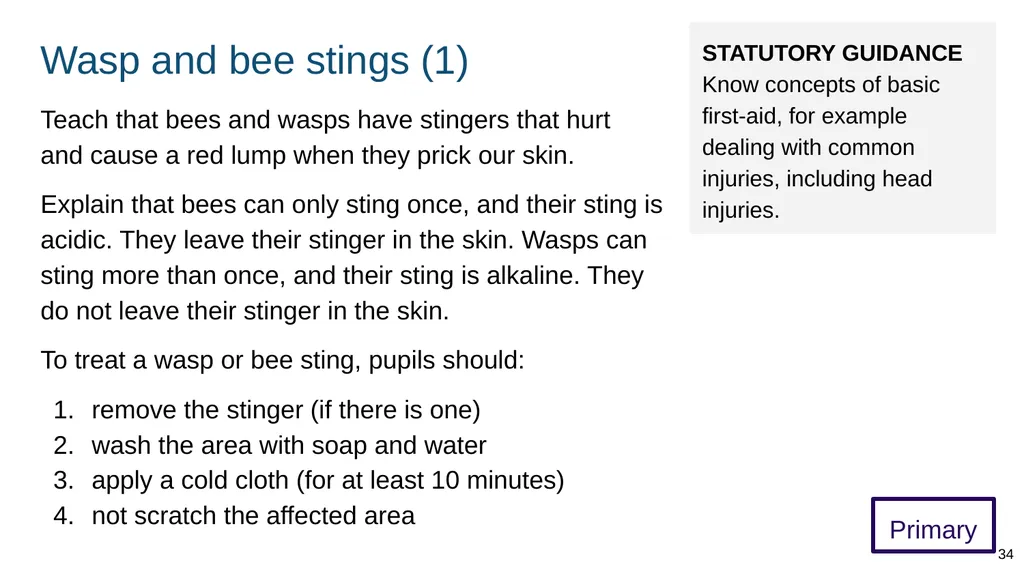
Wasp and bee stings (1) Primary Teach that bees and wasps have stingers that hurt
and cause a red lump when they prick our skin.
Explain that bees can only sting once, and their sting is acidic. They leave their stinger in the skin. Wasps can sting more than once, and their sting is alkaline. They do not leave their stinger in the skin.
To treat a wasp or bee sting, pupils should:
remove the stinger (if there is one)
wash the area with soap and water
apply a cold cloth (for at least 10 minutes)
not scratch the affected area STATUTORY GUIDANCE Know concepts of basic first-aid, for example dealing with common injuries, including head injuries. 34<br>
Explain that bees can only sting once, and their sting is acidic. They leave their stinger in the skin. Wasps can sting more than once, and their sting is alkaline. They do not leave their stinger in the skin.
To treat a wasp or bee sting, pupils should:
remove the stinger (if there is one)
wash the area with soap and water
apply a cold cloth (for at least 10 minutes)
not scratch the affected area STATUTORY GUIDANCE Know concepts of basic first-aid, for example dealing with common injuries, including head injuries. 34<br>
35
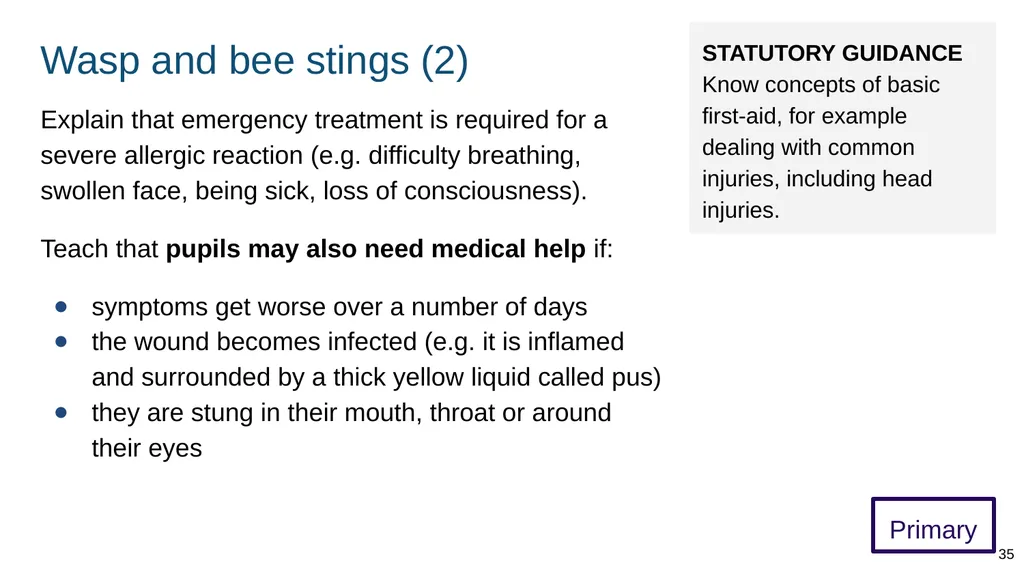
Wasp and bee stings (2) Primary Explain that emergency treatment is required for a severe allergic reaction (e.g. difficulty breathing, swollen face, being sick, loss of consciousness).
Teach that pupils may also need medical help if:
symptoms get worse over a number of days
the wound becomes infected (e.g. it is inflamed and surrounded by a thick yellow liquid called pus)
they are stung in their mouth, throat or around their eyes STATUTORY GUIDANCE Know concepts of basic first-aid, for example dealing with common injuries, including head injuries. 35<br>
Teach that pupils may also need medical help if:
symptoms get worse over a number of days
the wound becomes infected (e.g. it is inflamed and surrounded by a thick yellow liquid called pus)
they are stung in their mouth, throat or around their eyes STATUTORY GUIDANCE Know concepts of basic first-aid, for example dealing with common injuries, including head injuries. 35<br>
36
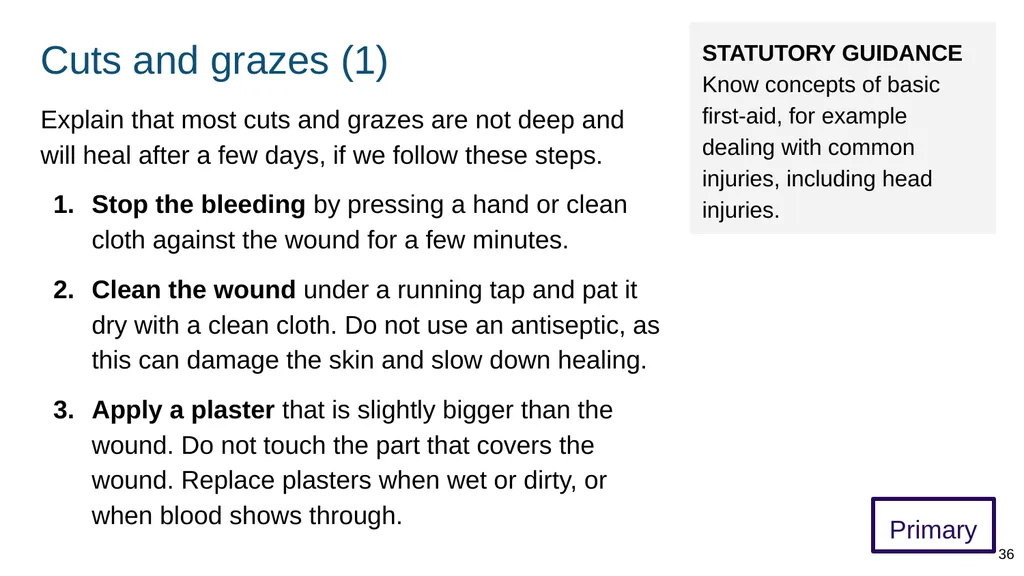
Cuts and grazes (1) Primary Explain that most cuts and grazes are not deep and will heal after a few days, if we follow these steps.
Stop the bleeding by pressing a hand or clean cloth against the wound for a few minutes.
Clean the wound under a running tap and pat it dry with a clean cloth. Do not use an antiseptic, as this can damage the skin and slow down healing.
Apply a plaster that is slightly bigger than the wound. Do not touch the part that covers the wound. Replace plasters when wet or dirty, or when blood shows through. STATUTORY GUIDANCE Know concepts of basic first-aid, for example dealing with common injuries, including head injuries. 36<br>
Stop the bleeding by pressing a hand or clean cloth against the wound for a few minutes.
Clean the wound under a running tap and pat it dry with a clean cloth. Do not use an antiseptic, as this can damage the skin and slow down healing.
Apply a plaster that is slightly bigger than the wound. Do not touch the part that covers the wound. Replace plasters when wet or dirty, or when blood shows through. STATUTORY GUIDANCE Know concepts of basic first-aid, for example dealing with common injuries, including head injuries. 36<br>
37
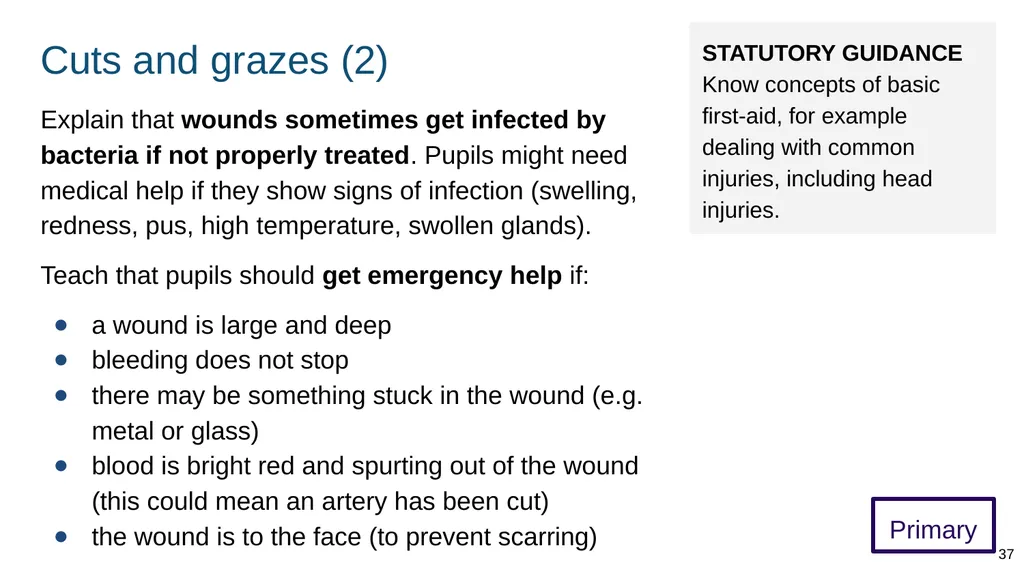
Cuts and grazes (2) Primary Explain that wounds sometimes get infected by bacteria if not properly treated. Pupils might need medical help if they show signs of infection (swelling, redness, pus, high temperature, swollen glands).
Teach that pupils should get emergency help if:
a wound is large and deep
bleeding does not stop
there may be something stuck in the wound (e.g. metal or glass)
blood is bright red and spurting out of the wound (this could mean an artery has been cut)
the wound is to the face (to prevent scarring) STATUTORY GUIDANCE Know concepts of basic first-aid, for example dealing with common injuries, including head injuries. 37<br>
Teach that pupils should get emergency help if:
a wound is large and deep
bleeding does not stop
there may be something stuck in the wound (e.g. metal or glass)
blood is bright red and spurting out of the wound (this could mean an artery has been cut)
the wound is to the face (to prevent scarring) STATUTORY GUIDANCE Know concepts of basic first-aid, for example dealing with common injuries, including head injuries. 37<br>
38
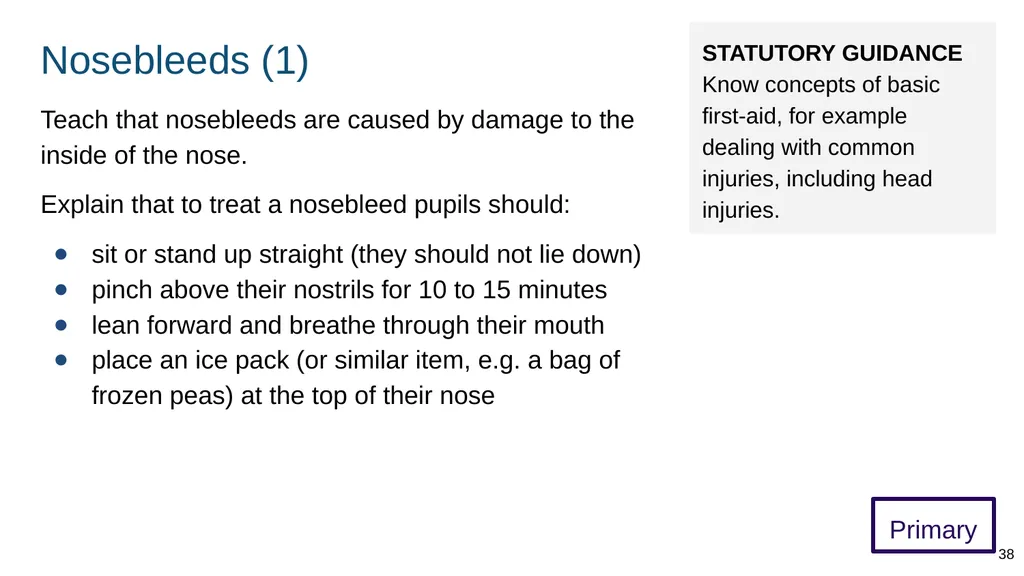
Nosebleeds (1) Primary Teach that nosebleeds are caused by damage to the inside of the nose.
Explain that to treat a nosebleed pupils should:
sit or stand up straight (they should not lie down)
pinch above their nostrils for 10 to 15 minutes
lean forward and breathe through their mouth
place an ice pack (or similar item, e.g. a bag of frozen peas) at the top of their nose STATUTORY GUIDANCE Know concepts of basic first-aid, for example dealing with common injuries, including head injuries. 38<br>
Explain that to treat a nosebleed pupils should:
sit or stand up straight (they should not lie down)
pinch above their nostrils for 10 to 15 minutes
lean forward and breathe through their mouth
place an ice pack (or similar item, e.g. a bag of frozen peas) at the top of their nose STATUTORY GUIDANCE Know concepts of basic first-aid, for example dealing with common injuries, including head injuries. 38<br>
39
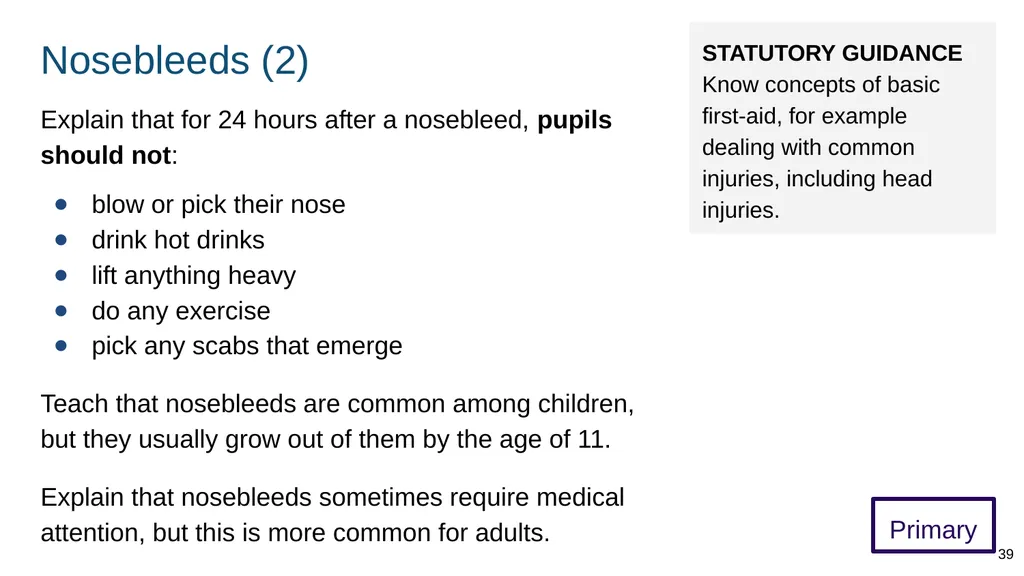
Nosebleeds (2) Primary Explain that for 24 hours after a nosebleed, pupils should not:
blow or pick their nose
drink hot drinks
lift anything heavy
do any exercise
pick any scabs that emerge
Teach that nosebleeds are common among children, but they usually grow out of them by the age of 11.
Explain that nosebleeds sometimes require medical attention, but this is more common for adults. STATUTORY GUIDANCE Know concepts of basic first-aid, for example dealing with common injuries, including head injuries. 39<br>
blow or pick their nose
drink hot drinks
lift anything heavy
do any exercise
pick any scabs that emerge
Teach that nosebleeds are common among children, but they usually grow out of them by the age of 11.
Explain that nosebleeds sometimes require medical attention, but this is more common for adults. STATUTORY GUIDANCE Know concepts of basic first-aid, for example dealing with common injuries, including head injuries. 39<br>
40
Headaches (1) 40 Primary Explain that headaches can be caused by factors such as dehydration, stress, a cold or staring at a screen for too long. They are usually short term, go away by themselves and are not a sign of anything serious.
Explore ways pupils might deal with a headache, e.g.:
drinking plenty of water to stay hydrated
avoiding anything stressful
doing some light exercise in the fresh air
resting, if they have a cold or the flu
Teach that parents/guardians may take them to see a GP if they keep getting headaches or have other symptoms (e.g. they are vomiting). STATUTORY GUIDANCE Know concepts of basic first-aid, for example dealing with common injuries, including head injuries.<br>
Explore ways pupils might deal with a headache, e.g.:
drinking plenty of water to stay hydrated
avoiding anything stressful
doing some light exercise in the fresh air
resting, if they have a cold or the flu
Teach that parents/guardians may take them to see a GP if they keep getting headaches or have other symptoms (e.g. they are vomiting). STATUTORY GUIDANCE Know concepts of basic first-aid, for example dealing with common injuries, including head injuries.<br>
41
Headaches (2) Primary Teach that pupils should never take painkillers for a headache without the knowledge and instruction of a parent/guardian/doctor.
Explain that they should call 999 if someone has a headache that is extremely painful and is accompanied by:
difficulty talking or remembering things
loss of vision
drowsiness or confusion
high temperature, shivers, a stiff neck or rash
the white of the eye turning red STATUTORY GUIDANCE Know concepts of basic first-aid, for example dealing with common injuries, including head injuries. 41<br>
Explain that they should call 999 if someone has a headache that is extremely painful and is accompanied by:
difficulty talking or remembering things
loss of vision
drowsiness or confusion
high temperature, shivers, a stiff neck or rash
the white of the eye turning red STATUTORY GUIDANCE Know concepts of basic first-aid, for example dealing with common injuries, including head injuries. 41<br>
42
Head injuries (1) Primary Teach that banging our head (e.g. by falling over or something hitting our head) can cause a head injury.
Reassure pupils that most head injuries are minor, but they should always tell an adult if they bang their head. After banging their head, they can also:
hold an ice pack to the head to reduce swelling
rest and avoid stress
stay close to an adult for 24 hours - so they can continue to check for signs of serious injury
Pupils should not take painkillers without the knowledge and instruction of a parent/guardian. STATUTORY GUIDANCE Know concepts of basic first-aid, for example dealing with common injuries, including head injuries. 42<br>
Reassure pupils that most head injuries are minor, but they should always tell an adult if they bang their head. After banging their head, they can also:
hold an ice pack to the head to reduce swelling
rest and avoid stress
stay close to an adult for 24 hours - so they can continue to check for signs of serious injury
Pupils should not take painkillers without the knowledge and instruction of a parent/guardian. STATUTORY GUIDANCE Know concepts of basic first-aid, for example dealing with common injuries, including head injuries. 42<br>
43
Head injuries (2) Primary Explain that pupils should always call 999 if
someone has:
been in a serious accident (e.g. a car crash)
been knocked out (even if they wake up)
fluid or blood coming from their ears or nose
numbness or problems walking, balancing, understanding or speaking
changes to their usual behaviour
memory loss
continuous vomiting after the injury
trouble staying awake
seizures
. STATUTORY GUIDANCE Know concepts of basic first-aid, for example dealing with common injuries, including head injuries. 43<br>
been in a serious accident (e.g. a car crash)
been knocked out (even if they wake up)
fluid or blood coming from their ears or nose
numbness or problems walking, balancing, understanding or speaking
changes to their usual behaviour
memory loss
continuous vomiting after the injury
trouble staying awake
seizures
. STATUTORY GUIDANCE Know concepts of basic first-aid, for example dealing with common injuries, including head injuries. 43<br>
44
Sprains Primary Teach that in day-to-day activity (e.g. playing sports), we can tear or twist ligaments, which hold together joints such as knees, ankles and wrists.
Explain that sprains cause pain around an affected ligament, and the area becomes swollen or bruised. Usually, we can treat a strain at home if we:
rest, so that we do not put weight on the injury
put an ice pack on the area every 2 to 3 hours
put a bandage around the injury to support it
keep it raised on a pillow as much as possible
keep moving the joint, once pain dies down (to prevent stiffness) STATUTORY GUIDANCE Know concepts of basic first-aid, for example dealing with common injuries, including head injuries. 44<br>
Explain that sprains cause pain around an affected ligament, and the area becomes swollen or bruised. Usually, we can treat a strain at home if we:
rest, so that we do not put weight on the injury
put an ice pack on the area every 2 to 3 hours
put a bandage around the injury to support it
keep it raised on a pillow as much as possible
keep moving the joint, once pain dies down (to prevent stiffness) STATUTORY GUIDANCE Know concepts of basic first-aid, for example dealing with common injuries, including head injuries. 44<br>
45
Broken bones Primary Teach that signs of a broken bone include:
extreme pain in an injury after an incident
a large amount of swelling or bruising
a bone looking like it is at a strange angle
inability to use the injured part of the body
Explain that it is important to treat broken bones as soon as possible, so pupils should call 999 even if they only suspect a bone may be broken. They should:
tell the person to keep the injury still
support the injury with soft items (e.g. cushions)
try to stop any bleeding while waiting for help STATUTORY GUIDANCE Know concepts of basic first-aid, for example dealing with common injuries, including head injuries. 45<br>
extreme pain in an injury after an incident
a large amount of swelling or bruising
a bone looking like it is at a strange angle
inability to use the injured part of the body
Explain that it is important to treat broken bones as soon as possible, so pupils should call 999 even if they only suspect a bone may be broken. They should:
tell the person to keep the injury still
support the injury with soft items (e.g. cushions)
try to stop any bleeding while waiting for help STATUTORY GUIDANCE Know concepts of basic first-aid, for example dealing with common injuries, including head injuries. 45<br>
46
Vomiting Primary Teach that vomiting is very common in children and is usually caused by a stomach infection. It usually stops within a few days. Pupils should tell an adult if they or someone they know has vomited. They should also:
get plenty of rest
drink lots of fluids
stay at home and wash their hands regularly (to prevent spreading infection)
not share items like towels or cutlery
A parent/guardian may take a child to see a GP if a child does not stop vomiting or has other symptoms. STATUTORY GUIDANCE Know concepts of basic first-aid, for example dealing with common injuries, including head injuries. 46<br>
get plenty of rest
drink lots of fluids
stay at home and wash their hands regularly (to prevent spreading infection)
not share items like towels or cutlery
A parent/guardian may take a child to see a GP if a child does not stop vomiting or has other symptoms. STATUTORY GUIDANCE Know concepts of basic first-aid, for example dealing with common injuries, including head injuries. 46<br>
47
Eye injuries (1) Primary Explain that if we get something in our eye it is usually minor and the injury heals within a day.
Teach that we can treat a minor eye injury at home by:
washing the eye with clean water (not hot)
if possible, running the eye under a tap for 20 minutes (only using a mild flow), holding the eye open
trying not to rub the eye until it is better STATUTORY GUIDANCE Know concepts of basic first-aid, for example dealing with common injuries, including head injuries. 47<br>
Teach that we can treat a minor eye injury at home by:
washing the eye with clean water (not hot)
if possible, running the eye under a tap for 20 minutes (only using a mild flow), holding the eye open
trying not to rub the eye until it is better STATUTORY GUIDANCE Know concepts of basic first-aid, for example dealing with common injuries, including head injuries. 47<br>
48
Eye injuries (2) Primary Explain that it is important to get emergency help if:
a strong chemical has got in the eye (keep rinsing the eye with water while waiting for help)
something has pierced the eye
something has hit the eye at high speed
We should also get emergency help if, after an injury:
our eyesight changes
we feel sick, have a headache, high temperature or sensitivity to light
we cannot move the eye
blood or pus is coming from the eye STATUTORY GUIDANCE Know concepts of basic first-aid, for example dealing with common injuries, including head injuries. 48<br>
a strong chemical has got in the eye (keep rinsing the eye with water while waiting for help)
something has pierced the eye
something has hit the eye at high speed
We should also get emergency help if, after an injury:
our eyesight changes
we feel sick, have a headache, high temperature or sensitivity to light
we cannot move the eye
blood or pus is coming from the eye STATUTORY GUIDANCE Know concepts of basic first-aid, for example dealing with common injuries, including head injuries. 48<br>
49
Burns and scalds (1) Primary Explain that burns and scalds are skin damage caused by heat. Burns are caused by dry heat (e.g. fire). Scalds are caused by wet heat (e.g. boiling water).
Teach pupils that if someone is burned, they should:
get them away from the source of heat
run the burn under cool/lukewarm water for 20 minutes (and not use ice or greasy substances)
remove clothing or jewellery near the burn (but not remove anything that is stuck to the skin)
keep the person warm with a blanket
cover the burn with cling film or a clean plastic bag STATUTORY GUIDANCE Know concepts of basic first-aid, for example dealing with common injuries, including head injuries. 49<br>
Teach pupils that if someone is burned, they should:
get them away from the source of heat
run the burn under cool/lukewarm water for 20 minutes (and not use ice or greasy substances)
remove clothing or jewellery near the burn (but not remove anything that is stuck to the skin)
keep the person warm with a blanket
cover the burn with cling film or a clean plastic bag STATUTORY GUIDANCE Know concepts of basic first-aid, for example dealing with common injuries, including head injuries. 49<br>
50
Burns and scalds (2) Primary Teach that some minor burns can be treated at home, if the burn is kept clean. People should not apply creams or burst any blisters that appear.
Explain that pupils should always get emergency medical help for:
any burns that are bigger than the person’s hand
chemical and electrical burns
burns that cause white or charred skin
burns that cause blisters on the face, hands, arms, feet, legs or genitals
people who have breathed in fumes or smoke STATUTORY GUIDANCE Know concepts of basic first-aid, for example dealing with common injuries, including head injuries. 50<br>
Explain that pupils should always get emergency medical help for:
any burns that are bigger than the person’s hand
chemical and electrical burns
burns that cause white or charred skin
burns that cause blisters on the face, hands, arms, feet, legs or genitals
people who have breathed in fumes or smoke STATUTORY GUIDANCE Know concepts of basic first-aid, for example dealing with common injuries, including head injuries. 50<br>
51
Allergies (1) Primary Teachers may also like to refer to content on allergies in the health and prevention module.
Explain that allergies are a reaction to particular substances (e.g. dust mites, food, chemicals). They are very common among children, who sometimes grow out of their allergies. Hay fever is an example of an allergy that is very common.
Teach that most allergic reactions are mild (e.g. runny nose, watery eyes, sneezing), and in most cases antihistamines are sufficient for preventing and treating allergic responses. STATUTORY GUIDANCE Know concepts of basic first-aid, for example dealing with common injuries, including head injuries. 51<br>
Explain that allergies are a reaction to particular substances (e.g. dust mites, food, chemicals). They are very common among children, who sometimes grow out of their allergies. Hay fever is an example of an allergy that is very common.
Teach that most allergic reactions are mild (e.g. runny nose, watery eyes, sneezing), and in most cases antihistamines are sufficient for preventing and treating allergic responses. STATUTORY GUIDANCE Know concepts of basic first-aid, for example dealing with common injuries, including head injuries. 51<br>
52
Allergies (2) Primary Explain that occasionally an allergy can cause ‘anaphylactic shock’. Symptoms are life-threatening, come on suddenly and get worse quickly. They include breathing difficulties, confusion, anxiety and unconsciousness.
It is vital to call 999 immediately and say that you think the person is having a serious allergic reaction.
Explain that some people carry ‘adrenaline auto-injectors’ (e.g. EpiPen). Explain their purpose and teach the importance of always carrying the auto-injector and knowing how to use it if one has been prescribed. STATUTORY GUIDANCE Know concepts of basic first-aid, for example dealing with common injuries, including head injuries. 52<br>
It is vital to call 999 immediately and say that you think the person is having a serious allergic reaction.
Explain that some people carry ‘adrenaline auto-injectors’ (e.g. EpiPen). Explain their purpose and teach the importance of always carrying the auto-injector and knowing how to use it if one has been prescribed. STATUTORY GUIDANCE Know concepts of basic first-aid, for example dealing with common injuries, including head injuries. 52<br>
53
Choking (1) Primary Explain that a person chokes if something (e.g. a piece of food) blocks their airway and stops air getting into the lungs.
Teach that it is important to remove the obstruction from their airway as soon as possible. Pupils can help to do this by shouting for an adult immediately and:
encouraging the person to try coughing hard
hitting the person hard on their upper back 5 times
calling 999, if this has not worked and nobody else is around to call emergency services
continuing to hit the person between the shoulders while waiting for help STATUTORY GUIDANCE Know concepts of basic first-aid, for example dealing with common injuries, including head injuries. 53<br>
Teach that it is important to remove the obstruction from their airway as soon as possible. Pupils can help to do this by shouting for an adult immediately and:
encouraging the person to try coughing hard
hitting the person hard on their upper back 5 times
calling 999, if this has not worked and nobody else is around to call emergency services
continuing to hit the person between the shoulders while waiting for help STATUTORY GUIDANCE Know concepts of basic first-aid, for example dealing with common injuries, including head injuries. 53<br>
54
Choking (2) Primary Teach that teenagers and adults can also try to remove an obstruction using the Heimlich manoeuvre. Explain that they do this by:
bending the person forward and putting their hands around the person’s waist
clenching 1 fist and placing it above their belly button
putting their other hand on top of the fist and pulling sharply inwards and upwards
Explain that there are also different methods for helping a choking baby. If pupils see a baby choking, they should call an adult immediately or call 999. STATUTORY GUIDANCE Know concepts of basic first-aid, for example dealing with common injuries, including head injuries. 54<br>
bending the person forward and putting their hands around the person’s waist
clenching 1 fist and placing it above their belly button
putting their other hand on top of the fist and pulling sharply inwards and upwards
Explain that there are also different methods for helping a choking baby. If pupils see a baby choking, they should call an adult immediately or call 999. STATUTORY GUIDANCE Know concepts of basic first-aid, for example dealing with common injuries, including head injuries. 54<br>
55
If someone falls unconscious 55<br>
56
If someone falls unconscious (1) Primary Explain that ‘unconscious’ means that someone looks asleep and is unable to respond. If a pupil thinks someone is unconscious, they should call for an adult’s help, if possible.
If no adult is around, the pupil should try to get a response by shaking the person, talking to them or pinching their ears. If they do not respond, they should check their breath by:
tipping their head back to open their airway
checking if their chest is moving up and down
listening for breath at their mouth STATUTORY GUIDANCE Know concepts of basic first-aid, for example dealing with common injuries, including head injuries. 56<br>
If no adult is around, the pupil should try to get a response by shaking the person, talking to them or pinching their ears. If they do not respond, they should check their breath by:
tipping their head back to open their airway
checking if their chest is moving up and down
listening for breath at their mouth STATUTORY GUIDANCE Know concepts of basic first-aid, for example dealing with common injuries, including head injuries. 56<br>
57
If someone falls unconscious (2) Primary If they are breathing, pull them onto their side and tip their head back so they can still breathe. Then call 999.
Explain that pupils should not leave an unconscious person who is breathing on their back, as this can block their airways.
If an unconscious person is not breathing, it is important to shout for an adult and call 999 immediately. Do not put the person on their side.
The life-saving section in the secondary part of this module contains detailed guidance on the recovery position, when to use it and when to avoid it. STATUTORY GUIDANCE Know concepts of basic first-aid, for example dealing with common injuries, including head injuries. 57<br>
Explain that pupils should not leave an unconscious person who is breathing on their back, as this can block their airways.
If an unconscious person is not breathing, it is important to shout for an adult and call 999 immediately. Do not put the person on their side.
The life-saving section in the secondary part of this module contains detailed guidance on the recovery position, when to use it and when to avoid it. STATUTORY GUIDANCE Know concepts of basic first-aid, for example dealing with common injuries, including head injuries. 57<br>
58
Making an emergency call 58<br>
59
Calling 999 for an ambulance Primary Explain to pupils that they will be learning about how to call 999 for an ambulance in a health emergency.
Tell pupils to make sure they are in no danger themselves before they call for an ambulance. For example, if they are in traffic or at risk from a fire they should first move to a safe place.
Explain to pupils that even if someone else is unwell or injured, their own safety must come first. STATUTORY GUIDANCE Know how to make a clear and efficient call to emergency services if necessary. 59<br>
Tell pupils to make sure they are in no danger themselves before they call for an ambulance. For example, if they are in traffic or at risk from a fire they should first move to a safe place.
Explain to pupils that even if someone else is unwell or injured, their own safety must come first. STATUTORY GUIDANCE Know how to make a clear and efficient call to emergency services if necessary. 59<br>
60
When to call 999 (emergency) Primary Teach pupils that they need to call 999 if any of the following apply to the casualty:
unconscious / unresponsive (does not respond when you shout and shake them by the shoulders)
not breathing, or not breathing normally
choking (cannot breathe)
seriously injured or unwell (discuss scenarios)
Emphasise that you must call straight away. Never call someone else first to check. Time is very important. It is right to call 999 even if they are unsure.
Tell pupils to stay with the person while they make the call if they can. STATUTORY GUIDANCE Know how to make a clear and efficient call to emergency services if necessary. 60<br>
unconscious / unresponsive (does not respond when you shout and shake them by the shoulders)
not breathing, or not breathing normally
choking (cannot breathe)
seriously injured or unwell (discuss scenarios)
Emphasise that you must call straight away. Never call someone else first to check. Time is very important. It is right to call 999 even if they are unsure.
Tell pupils to stay with the person while they make the call if they can. STATUTORY GUIDANCE Know how to make a clear and efficient call to emergency services if necessary. 60<br>
61
How to make a 999 call Primary Give pupils clear instructions for calling 999, including the following.
Dial 999 on a landline or a mobile phone. Put the phone on speakerphone if you can. This means your hands are free if you are asked to do anything else.
You will be put through to an operator who will ask:
Emergency. Which service? Police, Ambulance, Fire?
Ask for an ambulance.
The operator will ask questions to find out what is wrong with the unwell person, for example, if they have stopped breathing, to assess the level of emergency. STATUTORY GUIDANCE Know how to make a clear and efficient call to emergency services if necessary. 61<br>
Dial 999 on a landline or a mobile phone. Put the phone on speakerphone if you can. This means your hands are free if you are asked to do anything else.
You will be put through to an operator who will ask:
Emergency. Which service? Police, Ambulance, Fire?
Ask for an ambulance.
The operator will ask questions to find out what is wrong with the unwell person, for example, if they have stopped breathing, to assess the level of emergency. STATUTORY GUIDANCE Know how to make a clear and efficient call to emergency services if necessary. 61<br>
62
What you might be asked to do Primary Teach that the operator will:
ask you the address where you are and send an ambulance to you as soon as possible
ask you the reason for your call and ask for more details about the casualty - for example, medical problems and symptoms
give you advice on what you can do to help the casualty until the ambulance arrives
ask you to do things like put the casualty in the ‘recovery position’ (what they ask you to do will depend on your age and ability) STATUTORY GUIDANCE Know how to make a clear and efficient call to emergency services if necessary. 62<br>
ask you the address where you are and send an ambulance to you as soon as possible
ask you the reason for your call and ask for more details about the casualty - for example, medical problems and symptoms
give you advice on what you can do to help the casualty until the ambulance arrives
ask you to do things like put the casualty in the ‘recovery position’ (what they ask you to do will depend on your age and ability) STATUTORY GUIDANCE Know how to make a clear and efficient call to emergency services if necessary. 62<br>
63
Practise making an emergency call Primary Give pupils opportunities to practise making a pretend 999 call.
Show pupils how to make a call from both a landline and a mobile phone (including from locked screen). Based on a teacher-led scenario, check that pupils remember to:
ensure their own safety first
turn on speakerphone if they can (not essential)
give a correct address or directions
answer questions clearly
follow any instructions from the operator STATUTORY GUIDANCE Know how to make a clear and efficient call to emergency services if necessary. 63<br>
Show pupils how to make a call from both a landline and a mobile phone (including from locked screen). Based on a teacher-led scenario, check that pupils remember to:
ensure their own safety first
turn on speakerphone if they can (not essential)
give a correct address or directions
answer questions clearly
follow any instructions from the operator STATUTORY GUIDANCE Know how to make a clear and efficient call to emergency services if necessary. 63<br>
64
Secondary curriculum STATUTORY GUIDANCE
Schools should continue to develop knowledge on topics specified for primary as required and in addition cover the following content by the end of secondary. (p36) 64<br>
65
Basic treatment for common injuries 65<br>
66
Build on basic first aid skills For each of the common injuries set out in the primary section of this module, ensure that pupils understand:
basic first aid approaches
what to do if the injury requires an alternative or emergency response. STATUTORY GUIDANCE
Know basic treatment for common injuries. Secondary 66<br>
basic first aid approaches
what to do if the injury requires an alternative or emergency response. STATUTORY GUIDANCE
Know basic treatment for common injuries. Secondary 66<br>
67
Life-saving skills 67<br>
68
Assessing a casualty Build on advice on what to do if someone is unconscious in the primary section of this module by teaching how to assess an injured casualty after an incident.
Teach the 3 ABC priorities for assessment:
airway
breathing
circulation
Explain that before assessing a casualty, a pupil should ensure they, the casualty and the environment they are in are safe. STATUTORY GUIDANCE Know life-saving skills, including how to administer CPR. Secondary 68<br>
Teach the 3 ABC priorities for assessment:
airway
breathing
circulation
Explain that before assessing a casualty, a pupil should ensure they, the casualty and the environment they are in are safe. STATUTORY GUIDANCE Know life-saving skills, including how to administer CPR. Secondary 68<br>
69
Assessing a casualty: airway STATUTORY GUIDANCE
Know life-saving skills, including how to administer CPR. A casualty who is responsive after an incident can be left in the position they are in until help arrives. However, they should be constantly checked for consciousness.
If they fall unconscious, open their airway by placing a hand on their forehead and lifting the tip of their chin with 2 fingers (moving the tongue away from the back of the throat).
If a spinal injury is possible, place hands either side of their head and use fingertips to lift the angle of the jaw upwards and forward, without moving the head.
Take care not to move the casualty’s head. Secondary 69<br>
If they fall unconscious, open their airway by placing a hand on their forehead and lifting the tip of their chin with 2 fingers (moving the tongue away from the back of the throat).
If a spinal injury is possible, place hands either side of their head and use fingertips to lift the angle of the jaw upwards and forward, without moving the head.
Take care not to move the casualty’s head. Secondary 69<br>
70
Assessing a casualty: breathing To check that a person is still breathing:
look for a rise and fall in their chest
listen over their mouth and nose for a breathing sound
feel their breath against your cheek for 10 seconds
If they are breathing normally (not gasping or irregularly), put them in the ‘recovery position’ so that their airway stays open. Continue to monitor them.
If they stop breathing, call 999 for an ambulance and begin cardiopulmonary resuscitation (CPR). STATUTORY GUIDANCE Know life-saving skills, including how to administer CPR. Secondary 70<br>
look for a rise and fall in their chest
listen over their mouth and nose for a breathing sound
feel their breath against your cheek for 10 seconds
If they are breathing normally (not gasping or irregularly), put them in the ‘recovery position’ so that their airway stays open. Continue to monitor them.
If they stop breathing, call 999 for an ambulance and begin cardiopulmonary resuscitation (CPR). STATUTORY GUIDANCE Know life-saving skills, including how to administer CPR. Secondary 70<br>
71
Assessing a casualty: circulation If a casualty isn’t breathing normally, you should begin chest compressions immediately.
When a person has a cardiac arrest, they will commonly start gasping irregularly for a few minutes. This is called ‘agonal breathing’. It is not normal breathing, and it should not be taken as a sign that chest compressions are not necessary. STATUTORY GUIDANCE Know life-saving skills, including how to administer CPR. Secondary 71<br>
When a person has a cardiac arrest, they will commonly start gasping irregularly for a few minutes. This is called ‘agonal breathing’. It is not normal breathing, and it should not be taken as a sign that chest compressions are not necessary. STATUTORY GUIDANCE Know life-saving skills, including how to administer CPR. Secondary 71<br>
72
Recovery position (1) Explain the procedure for getting a casualty into the recovery position.
Lie the person on their back and kneel by their side.
Put the arm nearest to you at a right angle to their body with the palm facing up.
Fold the other arm so that its hand touches the cheek nearest to you, and hold it in place.
Use your free hand to bend the knee furthest from you up into a right angle.
Pull on the bent knee to roll the person over onto their side. STATUTORY GUIDANCE Know life-saving skills, including how to administer CPR. Secondary 72<br>
Lie the person on their back and kneel by their side.
Put the arm nearest to you at a right angle to their body with the palm facing up.
Fold the other arm so that its hand touches the cheek nearest to you, and hold it in place.
Use your free hand to bend the knee furthest from you up into a right angle.
Pull on the bent knee to roll the person over onto their side. STATUTORY GUIDANCE Know life-saving skills, including how to administer CPR. Secondary 72<br>
73
Recovery position (2) Their bent arm should support their head, and their extended arm should stop you rolling them too far.
Make sure their bent leg is at a right angle.
Open the airway by gently tilting the head back and lifting the chin, checking nothing is blocking the airway.
Stay with the person and monitor them until help arrives.
You can see a video of how to put someone into the recovery position on the NHS website. STATUTORY GUIDANCE Know life-saving skills, including how to administer CPR. Secondary 73<br>
Make sure their bent leg is at a right angle.
Open the airway by gently tilting the head back and lifting the chin, checking nothing is blocking the airway.
Stay with the person and monitor them until help arrives.
You can see a video of how to put someone into the recovery position on the NHS website. STATUTORY GUIDANCE Know life-saving skills, including how to administer CPR. Secondary 73<br>
74
Understanding CPR (1) STATUTORY GUIDANCE
Know life-saving skills, including how to administer CPR. Teach pupils the following principles in relation to CPR (cardiopulmonary resuscitation):
CPR is a way to keep someone’s blood circulating if they have stopped breathing (respiratory arrest) and/or their heart has stopped (cardiac arrest)
if circulation/breathing stops for too long people die
Introduce pupils to concepts of CPR such as chest compressions and rescue breaths.
CPR skills are usually best taught after 12 years of age, because of the strength required to carry out the procedure. Secondary 74<br>
CPR is a way to keep someone’s blood circulating if they have stopped breathing (respiratory arrest) and/or their heart has stopped (cardiac arrest)
if circulation/breathing stops for too long people die
Introduce pupils to concepts of CPR such as chest compressions and rescue breaths.
CPR skills are usually best taught after 12 years of age, because of the strength required to carry out the procedure. Secondary 74<br>
75
Understanding CPR (2) Also teach pupils the following important facts about CPR:
never do CPR on someone if they are awake and breathing normally
anyone can do CPR until medical help arrives, you do not need to be a doctor
CPR can sometimes save a life
sometimes a person will die, even if CPR is performed STATUTORY GUIDANCE Know life-saving skills, including how to administer CPR. Secondary 75<br>
never do CPR on someone if they are awake and breathing normally
anyone can do CPR until medical help arrives, you do not need to be a doctor
CPR can sometimes save a life
sometimes a person will die, even if CPR is performed STATUTORY GUIDANCE Know life-saving skills, including how to administer CPR. Secondary 75<br>
76
CPR skills When pupils are ready, introduce practical CPR skills as well as extending pupils’ knowledge.
Teach pupils:
when a casualty needs CPR
other actions you need to take (for example, calling 999, finding a defibrillator)
how to perform CPR
that chest compressions alone can often be highly effective, even if you cannot perform full CPR with ‘rescue breaths’ STATUTORY GUIDANCE Know life-saving skills, including how to administer CPR. Secondary 76<br>
Teach pupils:
when a casualty needs CPR
other actions you need to take (for example, calling 999, finding a defibrillator)
how to perform CPR
that chest compressions alone can often be highly effective, even if you cannot perform full CPR with ‘rescue breaths’ STATUTORY GUIDANCE Know life-saving skills, including how to administer CPR. Secondary 76<br>
77
If you cannot do CPR yourself Explain that people can still help even if they cannot do CPR themselves (for example, they are not strong or confident enough).
You can:
recognise an emergency, call 999 and look out for the ambulance
call out for someone else to help give CPR
help someone else to perform CPR:
talk them through the steps
count chest compressions/breaths for them
provide encouragement and reassurance that they are doing the right things STATUTORY GUIDANCE Know life-saving skills, including how to administer CPR. Secondary 77<br>
You can:
recognise an emergency, call 999 and look out for the ambulance
call out for someone else to help give CPR
help someone else to perform CPR:
talk them through the steps
count chest compressions/breaths for them
provide encouragement and reassurance that they are doing the right things STATUTORY GUIDANCE Know life-saving skills, including how to administer CPR. Secondary 77<br>
78
Defibrillators 78<br>
79
Understanding defibrillators (AEDs) Teach that an AED (automated external defibrillator) is a portable electronic machine that can detect the abnormal heart rhythms that are present when someone has a cardiac arrest.
When an abnormal rhythm is detected, the machine delivers an electric charge/shock that might be able to restart the heart or establish a regular rhythm. The sooner the heart is restarted, the better the casualty’s chance of survival.
Explain that it can take time for an ambulance to come. Using an AED could save a life. STATUTORY GUIDANCE Know the purpose of defibrillators and when one might be needed. Secondary 79<br>
When an abnormal rhythm is detected, the machine delivers an electric charge/shock that might be able to restart the heart or establish a regular rhythm. The sooner the heart is restarted, the better the casualty’s chance of survival.
Explain that it can take time for an ambulance to come. Using an AED could save a life. STATUTORY GUIDANCE Know the purpose of defibrillators and when one might be needed. Secondary 79<br>
80
Finding an AED Teach that you can find AEDs in public places such as offices, schools, gyms, shopping centres, supermarkets, stations and airports. Look out for ‘AED’ signage and when you ring 999 they’ll be able to tell you where to find one. Show pupils examples of signage.
In some places AEDs are kept in an unlocked cabinet. If a cabinet is locked, the emergency services operator will give you a code over the phone that you can use to unlock it.
If possible, one person should perform CPR while another person finds an AED. STATUTORY GUIDANCE Know the purpose of defibrillators and when one might be needed. Secondary 80<br>
In some places AEDs are kept in an unlocked cabinet. If a cabinet is locked, the emergency services operator will give you a code over the phone that you can use to unlock it.
If possible, one person should perform CPR while another person finds an AED. STATUTORY GUIDANCE Know the purpose of defibrillators and when one might be needed. Secondary 80<br>
81
Using an AED Explain that an AED is easy to use and safe. It cannot harm the casualty because it detects when shock is needed (irregular heart rhythm) and only works in that situation.
Anyone can use an AED - you do not need to be a medical professional or first aider. The machine will ‘speak’ instructions that tell you what to do.
Teach that it is always better to try to use an AED if someone’s heart has stopped than to do nothing. STATUTORY GUIDANCE Know the purpose of defibrillators and when one might be needed. Secondary 81<br>
Anyone can use an AED - you do not need to be a medical professional or first aider. The machine will ‘speak’ instructions that tell you what to do.
Teach that it is always better to try to use an AED if someone’s heart has stopped than to do nothing. STATUTORY GUIDANCE Know the purpose of defibrillators and when one might be needed. Secondary 81<br>
82
Examples of good practice 82<br>
83
Good practice The following are just some of the approaches you might consider when preparing to teach basic first aid.
You will need to adapt these approaches to ensure they are age appropriate and developmentally appropriate for your pupils.
You can also consider using qualified first aid trainers from recognised expert organisations, such as:
British Red Cross
Resuscitation Council UK
St John Ambulance Good practice 83<br>
You will need to adapt these approaches to ensure they are age appropriate and developmentally appropriate for your pupils.
You can also consider using qualified first aid trainers from recognised expert organisations, such as:
British Red Cross
Resuscitation Council UK
St John Ambulance Good practice 83<br>
84
Good practice approaches (1) Ensure first aid skills are taught at the right time so that pupils are not lacking the knowledge they need to make informed decisions in an emergency.
Check content of sessions will not adversely affect any pupils - for example, where they or a family member have experienced a traumatic first aid emergency.
As many emergency calls are made from people’s homes, schools may want to encourage pupils to learn or carry a note of their home address so they are able to give the correct details to emergency services if needed. Good practice 84<br>
Check content of sessions will not adversely affect any pupils - for example, where they or a family member have experienced a traumatic first aid emergency.
As many emergency calls are made from people’s homes, schools may want to encourage pupils to learn or carry a note of their home address so they are able to give the correct details to emergency services if needed. Good practice 84<br>
85
Good practice approaches (2) Give pupils opportunities to handle relevant objects (for example, first aid box including bandages, and life-saving equipment) and to ask questions about them.
Consider giving older pupils opportunities to practise skills by demonstrating what they have learnt to younger pupils, with teachers checking for accuracy and understanding.
Use purpose-made CPR manikins to demonstrate skills and give pupils opportunities to practise.
Involve pupils in cleaning/disinfecting CPR manikins before and after use to reassure them and to embed good hygiene practice. Good practice 85<br>
Consider giving older pupils opportunities to practise skills by demonstrating what they have learnt to younger pupils, with teachers checking for accuracy and understanding.
Use purpose-made CPR manikins to demonstrate skills and give pupils opportunities to practise.
Involve pupils in cleaning/disinfecting CPR manikins before and after use to reassure them and to embed good hygiene practice. Good practice 85<br>
86
Good practice approaches (3) Be ready to answer questions about people who do not want to be resuscitated. Further information on this can be found on the NHS website.
Encourage pupils to recognise how health and environmental factors can be related to an emergency situation, for example, eating and choking, or pollution and asthma.
Use medically/scientifically correct language to accurately describe human anatomy and processes of the body. Good practice 86<br>
Encourage pupils to recognise how health and environmental factors can be related to an emergency situation, for example, eating and choking, or pollution and asthma.
Use medically/scientifically correct language to accurately describe human anatomy and processes of the body. Good practice 86<br>
87
Good practice approaches (4) Ensure ample time is allowed for observing and practising first aid skills so that pupils are able to develop their abilities and confidence.
Ensure staff and pupils are aware of school first aiders, and the location of first aid equipment, including an AED if the school has one. Good practice 87<br>
Ensure staff and pupils are aware of school first aiders, and the location of first aid equipment, including an AED if the school has one. Good practice 87<br>
88
Further information Schools may want to refer to organisations such as the following for further information and teaching resources:
British Red Cross
NHS website
Resuscitation Council UK (includes resources)
St John Ambulance (includes resources) Good practice 88<br>
British Red Cross
NHS website
Resuscitation Council UK (includes resources)
St John Ambulance (includes resources) Good practice 88<br>
89
Activities and templates for trainers 89<br>
90
About these activities and templates Subject leads can use the following templates and training activities to plan training on teaching the new curriculum topics.
You can:
move slides - e.g. ‘rate your confidence (before training)’ - to the point in the presentation where you want to carry out that activity
delete slides if you are not covering those curriculum elements at this time 90<br>
You can:
move slides - e.g. ‘rate your confidence (before training)’ - to the point in the presentation where you want to carry out that activity
delete slides if you are not covering those curriculum elements at this time 90<br>
91
Training activity:
Rate your confidence 91<br>
Rate your confidence 91<br>
92
Rate your confidence (trainer notes) Ask your colleagues to rate confidence before and after topic training using the slides in this deck.
Before training Ask teachers to think about where they currently fit on the scale.
After training Ask teachers to rate their confidence again and talk about changes. You might want to repeat this activity at later check ins.
If teachers still rate confidence as low, discuss ways you can develop their subject knowledge, offer peer support etc. 92<br>
Before training Ask teachers to think about where they currently fit on the scale.
After training Ask teachers to rate their confidence again and talk about changes. You might want to repeat this activity at later check ins.
If teachers still rate confidence as low, discuss ways you can develop their subject knowledge, offer peer support etc. 92<br>
93
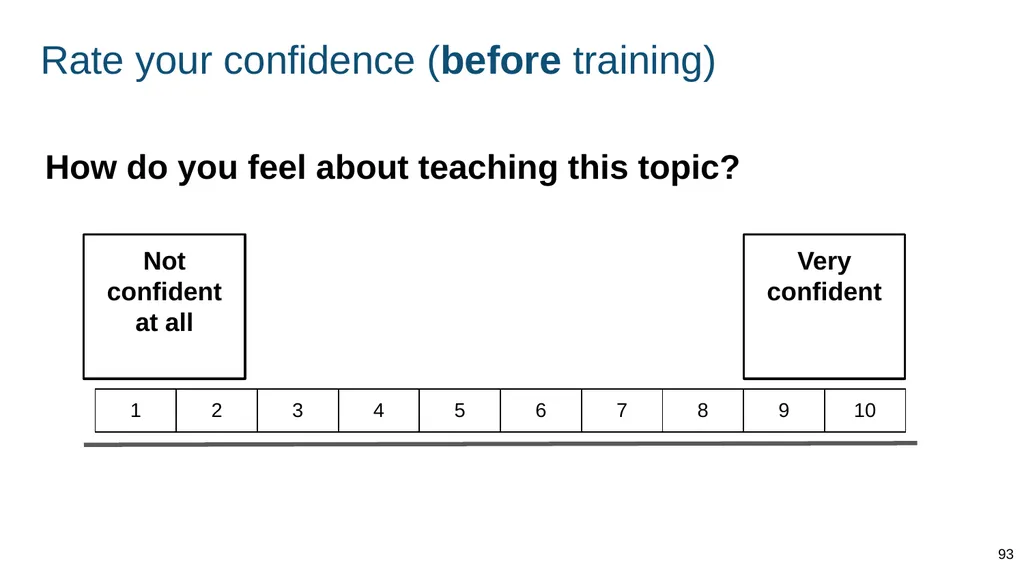
Rate your confidence (before training) How do you feel about teaching this topic? Not confident at all Very confident 93<br>
94
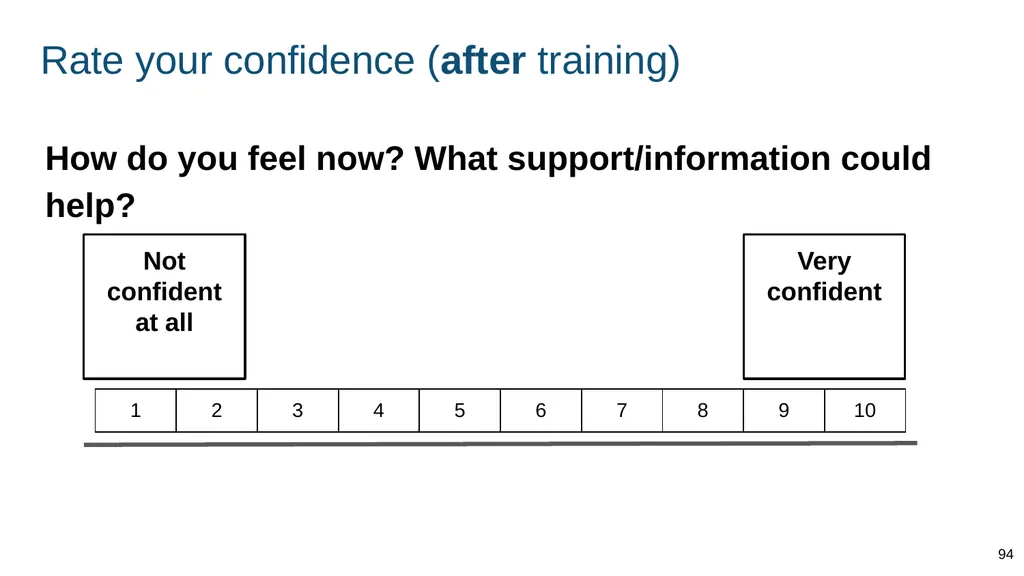
Rate your confidence (after training) How do you feel now? What support/information could help? Not confident at all Very confident 94<br>
95
Training activity:
Dealing with difficult questions 95<br>
Dealing with difficult questions 95<br>
96
Dealing with difficult questions (trainer notes) Use the following slides in your training to help teachers:
share concerns about questions they could be asked by pupils
strategise ways to respond to such questions 96<br>
share concerns about questions they could be asked by pupils
strategise ways to respond to such questions 96<br>
97
Dealing with difficult questions (1) [Prepare ‘difficult’ questions to discuss in training or give teachers a blank version to fill with their own questions] What would you say? What wouldn’t you say? Follow up 97<br>
98
Dealing with difficult questions (2) Pupils may well ask questions because they:
want information
are seeking permission - “Is it OK if I …?”
are trying to shock or get attention
have related personal beliefs
Remember:
don’t feel pressured or that you have to answer straight away
don’t disclose personal information - use third-person examples, say ‘some people...’
seek advice if you need it 98<br>
want information
are seeking permission - “Is it OK if I …?”
are trying to shock or get attention
have related personal beliefs
Remember:
don’t feel pressured or that you have to answer straight away
don’t disclose personal information - use third-person examples, say ‘some people...’
seek advice if you need it 98<br>
99
Training activity:
How will I teach this? 99<br>
How will I teach this? 99<br>
100
How will I teach this? (trainer notes) Use the following slides in your training to help teachers:
begin to plan and resource their lessons
discuss and address any issues they anticipate in the delivery of lessons 100<br>
begin to plan and resource their lessons
discuss and address any issues they anticipate in the delivery of lessons 100<br>
101
How will I teach this? 101<br>
102
Additional slides for structuring training 102<br>
103
Any concerns? ADAPT THIS FOR YOUR OWN PRESENTATION Any questions? What support do you need? 103<br>
104
XX% ADAPT THIS FOR YOUR OWN PRESENTATION [Use this format to present your own key facts and statistics - e.g. from your local authority or own monitoring. Include the source.] 104<br>