
Teaching Nuanced Economics Dave Colander Keynote
PC
Published · 22 slides · 0 views

1 / 1





Description
Teaching Nuanced Economics Dave Colander Keynote address 10th international Developments in Economics Education (DEE) Conference University of Warwick Teaching Nuanced Economics September 12th 2019. 1 Good economics is nuanced economics. It
Related Topics
Share
Embed code
Download this presentation From Below
"Teaching Nuanced Economics Dave Colander Keynote" is the property of its rightful owner. Permission is granted to download and print the materials on this website for personal, non-commercial use only, and to display it on your personal computer provided you do not modify the materials and that you retain all copyright notices contained in the materials. By downloading content from our website, you accept the terms of this agreement.
Presentation Transcript
01
Teaching Nuanced Economics Dave Colander
Keynote address
10th international Developments in Economics Education (DEE) Conference University of Warwick
Teaching Nuanced Economics
September 12th 2019. 1<br>
Keynote address
10th international Developments in Economics Education (DEE) Conference University of Warwick
Teaching Nuanced Economics
September 12th 2019. 1<br>
02
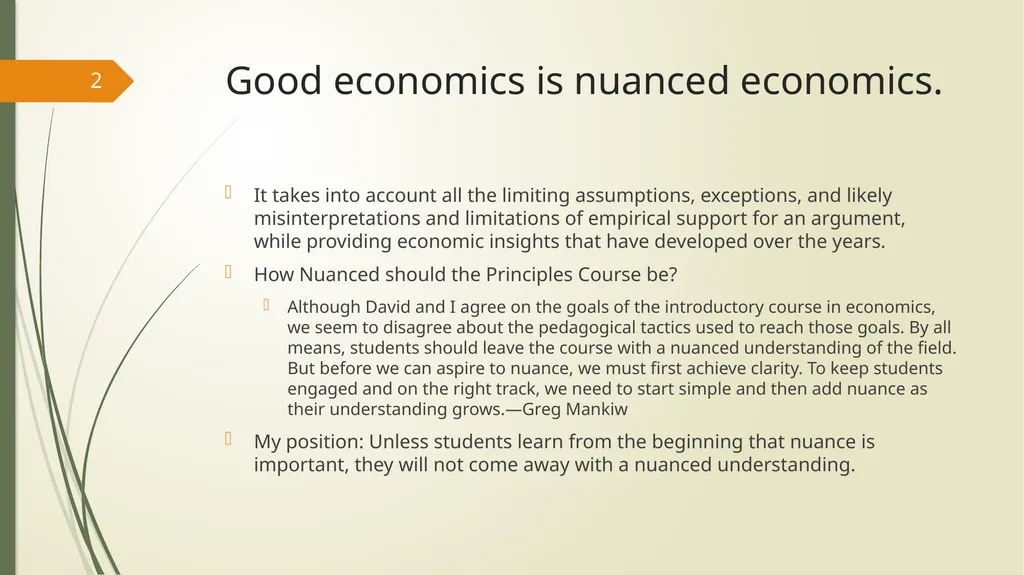
Good economics is nuanced economics. It takes into account all the limiting assumptions, exceptions, and likely misinterpretations and limitations of empirical support for an argument, while providing economic insights that have developed over the years.
How Nuanced should the Principles Course be?
Although David and I agree on the goals of the introductory course in economics, we seem to disagree about the pedagogical tactics used to reach those goals. By all means, students should leave the course with a nuanced understanding of the field. But before we can aspire to nuance, we must first achieve clarity. To keep students engaged and on the right track, we need to start simple and then add nuance as their understanding grows.—Greg Mankiw
My position: Unless students learn from the beginning that nuance is important, they will not come away with a nuanced understanding. 2<br>
How Nuanced should the Principles Course be?
Although David and I agree on the goals of the introductory course in economics, we seem to disagree about the pedagogical tactics used to reach those goals. By all means, students should leave the course with a nuanced understanding of the field. But before we can aspire to nuance, we must first achieve clarity. To keep students engaged and on the right track, we need to start simple and then add nuance as their understanding grows.—Greg Mankiw
My position: Unless students learn from the beginning that nuance is important, they will not come away with a nuanced understanding. 2<br>
03
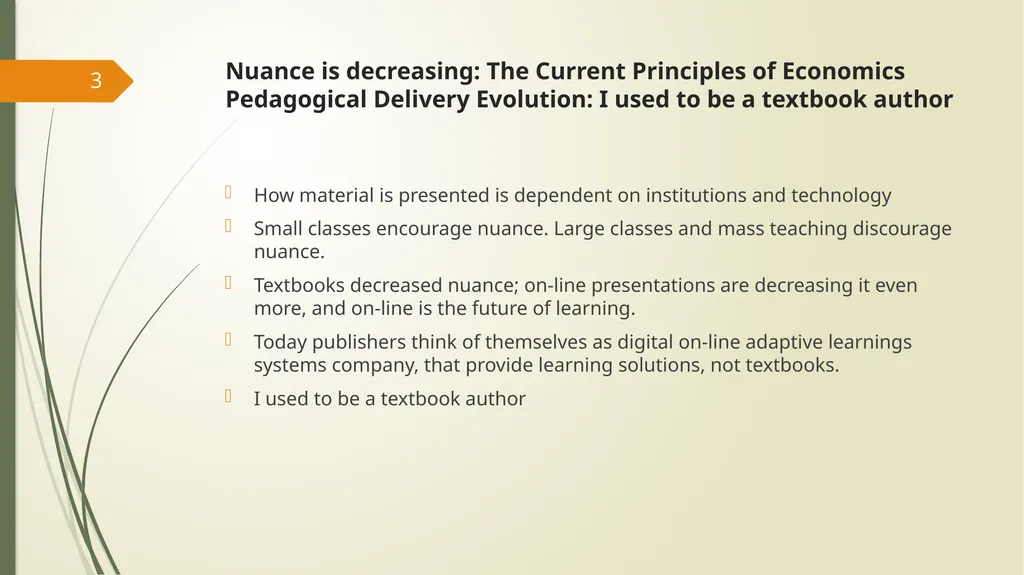
Nuance is decreasing: The Current Principles of Economics Pedagogical Delivery Evolution: I used to be a textbook author How material is presented is dependent on institutions and technology
Small classes encourage nuance. Large classes and mass teaching discourage nuance.
Textbooks decreased nuance; on-line presentations are decreasing it even more, and on-line is the future of learning.
Today publishers think of themselves as digital on-line adaptive learnings systems company, that provide learning solutions, not textbooks.
I used to be a textbook author 3<br>
Small classes encourage nuance. Large classes and mass teaching discourage nuance.
Textbooks decreased nuance; on-line presentations are decreasing it even more, and on-line is the future of learning.
Today publishers think of themselves as digital on-line adaptive learnings systems company, that provide learning solutions, not textbooks.
I used to be a textbook author 3<br>
04
McGraw Hill announcement of its Connect Master Program
NEW YORK (August 22, 2019) – McGraw-Hill, the leader in learning science and digital learning tools, has announced the expansion of its Connect Master® suite of course materials, with more than 60,000 college students expected to use these innovative, digital-first products this fall. Built with McGraw-Hill’s adaptive technology, Connect Master courses provide affordable active learning experiences to improve students’ engagement, critical thinking skills and ability to apply knowledge to real-world challenges.
Built to align with instructional goals using adaptive, modular technology, Connect Master gives instructors the flexibility to configure and tailor material by topic or key learning objective. Course content is dynamic, highly interactive and continually updated to ensure it is current. Key concepts are enhanced by adaptive questions, individualized study tools, practical assessments and other learning resources for students.
“We recognize the importance of maintaining instructors’ academic freedom. We work hard to preserve ‘choice’ – whether that means choice across various print or digital options, purchase or rental options, or delivery options such as Inclusive Access,” said Virkler. “Having a digital learning solution where print or eBook is an optional supplement is what instructors and students have been asking for, and McGraw-Hill is the only learning company able to do this at scale today. It is imperative that we give instructors the 21st century digital tools they need to take their students beyond basic learning to mastery with real-world application.”
Through this active, application-based learning approach, students are empowered to practice and demonstrate what they know, progressing through the course as they master each topic. 4<br>
NEW YORK (August 22, 2019) – McGraw-Hill, the leader in learning science and digital learning tools, has announced the expansion of its Connect Master® suite of course materials, with more than 60,000 college students expected to use these innovative, digital-first products this fall. Built with McGraw-Hill’s adaptive technology, Connect Master courses provide affordable active learning experiences to improve students’ engagement, critical thinking skills and ability to apply knowledge to real-world challenges.
Built to align with instructional goals using adaptive, modular technology, Connect Master gives instructors the flexibility to configure and tailor material by topic or key learning objective. Course content is dynamic, highly interactive and continually updated to ensure it is current. Key concepts are enhanced by adaptive questions, individualized study tools, practical assessments and other learning resources for students.
“We recognize the importance of maintaining instructors’ academic freedom. We work hard to preserve ‘choice’ – whether that means choice across various print or digital options, purchase or rental options, or delivery options such as Inclusive Access,” said Virkler. “Having a digital learning solution where print or eBook is an optional supplement is what instructors and students have been asking for, and McGraw-Hill is the only learning company able to do this at scale today. It is imperative that we give instructors the 21st century digital tools they need to take their students beyond basic learning to mastery with real-world application.”
Through this active, application-based learning approach, students are empowered to practice and demonstrate what they know, progressing through the course as they master each topic. 4<br>
05
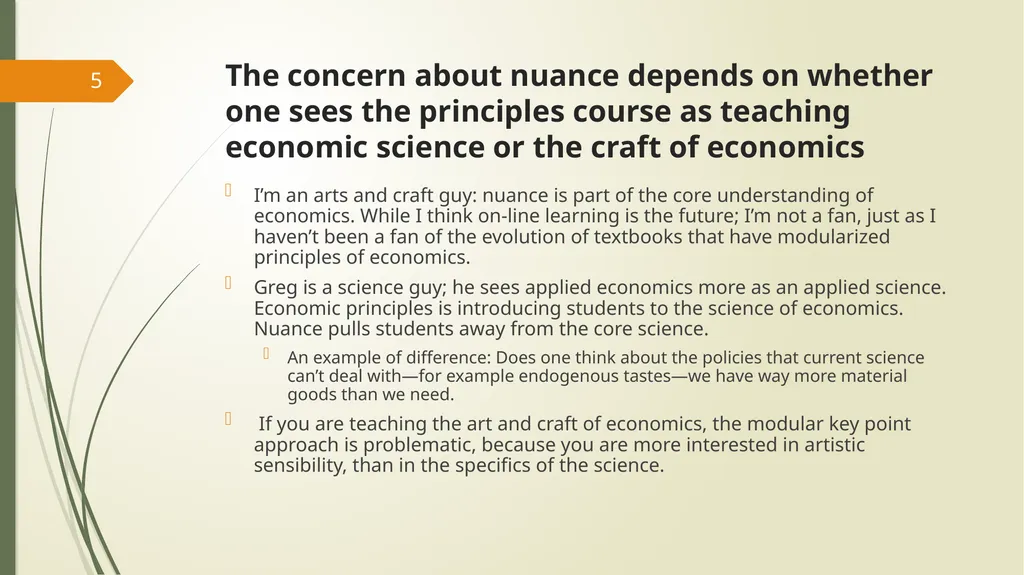
The concern about nuance depends on whether one sees the principles course as teaching economic science or the craft of economics I’m an arts and craft guy: nuance is part of the core understanding of economics. While I think on-line learning is the future; I’m not a fan, just as I haven’t been a fan of the evolution of textbooks that have modularized principles of economics.
Greg is a science guy; he sees applied economics more as an applied science. Economic principles is introducing students to the science of economics. Nuance pulls students away from the core science.
An example of difference: Does one think about the policies that current science can’t deal with—for example endogenous tastes—we have way more material goods than we need.
If you are teaching the art and craft of economics, the modular key point approach is problematic, because you are more interested in artistic sensibility, than in the specifics of the science. 5<br>
Greg is a science guy; he sees applied economics more as an applied science. Economic principles is introducing students to the science of economics. Nuance pulls students away from the core science.
An example of difference: Does one think about the policies that current science can’t deal with—for example endogenous tastes—we have way more material goods than we need.
If you are teaching the art and craft of economics, the modular key point approach is problematic, because you are more interested in artistic sensibility, than in the specifics of the science. 5<br>
06
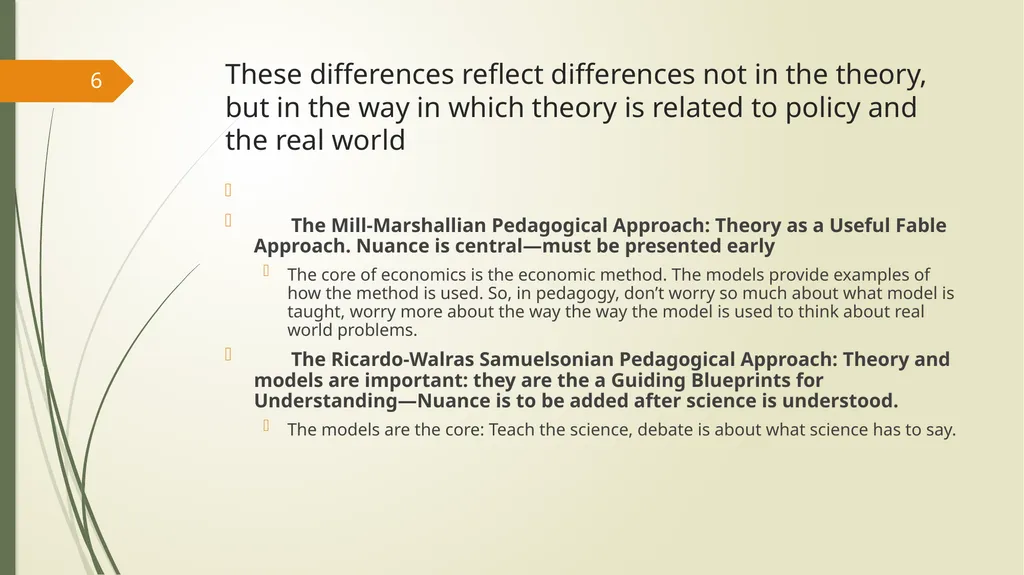
These differences reflect differences not in the theory, but in the way in which theory is related to policy and the real world The Mill-Marshallian Pedagogical Approach: Theory as a Useful Fable Approach. Nuance is central—must be presented early
The core of economics is the economic method. The models provide examples of how the method is used. So, in pedagogy, don’t worry so much about what model is taught, worry more about the way the way the model is used to think about real world problems.
The Ricardo-Walras Samuelsonian Pedagogical Approach: Theory and models are important: they are the a Guiding Blueprints for Understanding—Nuance is to be added after science is understood.
The models are the core: Teach the science, debate is about what science has to say. 6<br>
The core of economics is the economic method. The models provide examples of how the method is used. So, in pedagogy, don’t worry so much about what model is taught, worry more about the way the way the model is used to think about real world problems.
The Ricardo-Walras Samuelsonian Pedagogical Approach: Theory and models are important: they are the a Guiding Blueprints for Understanding—Nuance is to be added after science is understood.
The models are the core: Teach the science, debate is about what science has to say. 6<br>
07
The Mill-Marshallian Art and Craft Approach to Economics: Economics is a method not a doctrine The Theory of Economics does not furnish a body of settled conclusions immediately applicable to policy. It is a method rather than a doctrine, an apparatus of the mind, a technique of thinking, which helps its possessor to draw correct conclusions. --J.M Keynes
Nuance is inherent because the models don’t match reality.
Rational choice—you know people aren’t close to rational, but it is helpful to think about a model in which they are rational
Understand models, don’t believe them. The models we teach in principles are calisthenics of the mind, not directly applicable to reality
Nassau Senior’s admonition: A theoretical economists’ “conclusions, whatever be their generality and their truth, do not authorize him in adding a single syllable of advice. That privilege belongs to the writer or the statesman who has considered all the causes which may promote or impede the general welfare of those whom he addresses, not to the theorist who has considered only one.” (Senior, 1836) 7<br>
Nuance is inherent because the models don’t match reality.
Rational choice—you know people aren’t close to rational, but it is helpful to think about a model in which they are rational
Understand models, don’t believe them. The models we teach in principles are calisthenics of the mind, not directly applicable to reality
Nassau Senior’s admonition: A theoretical economists’ “conclusions, whatever be their generality and their truth, do not authorize him in adding a single syllable of advice. That privilege belongs to the writer or the statesman who has considered all the causes which may promote or impede the general welfare of those whom he addresses, not to the theorist who has considered only one.” (Senior, 1836) 7<br>
08
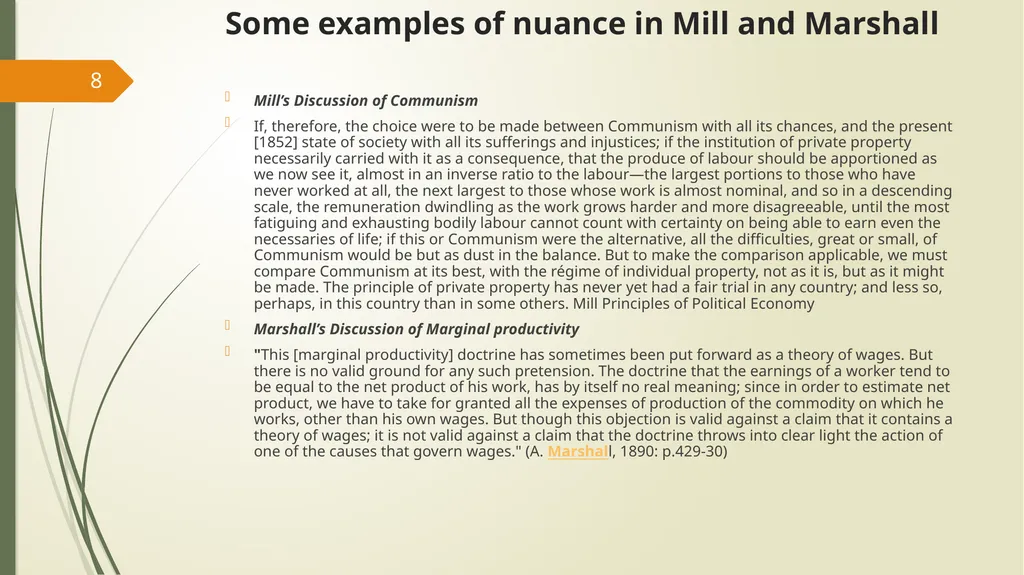
Some examples of nuance in Mill and Marshall Mill’s Discussion of Communism
If, therefore, the choice were to be made between Communism with all its chances, and the present [1852] state of society with all its sufferings and injustices; if the institution of private property necessarily carried with it as a consequence, that the produce of labour should be apportioned as we now see it, almost in an inverse ratio to the labour—the largest portions to those who have never worked at all, the next largest to those whose work is almost nominal, and so in a descending scale, the remuneration dwindling as the work grows harder and more disagreeable, until the most fatiguing and exhausting bodily labour cannot count with certainty on being able to earn even the necessaries of life; if this or Communism were the alternative, all the difficulties, great or small, of Communism would be but as dust in the balance. But to make the comparison applicable, we must compare Communism at its best, with the régime of individual property, not as it is, but as it might be made. The principle of private property has never yet had a fair trial in any country; and less so, perhaps, in this country than in some others. Mill Principles of Political Economy
Marshall’s Discussion of Marginal productivity
"This [marginal productivity] doctrine has sometimes been put forward as a theory of wages. But there is no valid ground for any such pretension. The doctrine that the earnings of a worker tend to be equal to the net product of his work, has by itself no real meaning; since in order to estimate net product, we have to take for granted all the expenses of production of the commodity on which he works, other than his own wages. But though this objection is valid against a claim that it contains a theory of wages; it is not valid against a claim that the doctrine throws into clear light the action of one of the causes that govern wages." (A. Marshall, 1890: p.429-30) 8<br>
If, therefore, the choice were to be made between Communism with all its chances, and the present [1852] state of society with all its sufferings and injustices; if the institution of private property necessarily carried with it as a consequence, that the produce of labour should be apportioned as we now see it, almost in an inverse ratio to the labour—the largest portions to those who have never worked at all, the next largest to those whose work is almost nominal, and so in a descending scale, the remuneration dwindling as the work grows harder and more disagreeable, until the most fatiguing and exhausting bodily labour cannot count with certainty on being able to earn even the necessaries of life; if this or Communism were the alternative, all the difficulties, great or small, of Communism would be but as dust in the balance. But to make the comparison applicable, we must compare Communism at its best, with the régime of individual property, not as it is, but as it might be made. The principle of private property has never yet had a fair trial in any country; and less so, perhaps, in this country than in some others. Mill Principles of Political Economy
Marshall’s Discussion of Marginal productivity
"This [marginal productivity] doctrine has sometimes been put forward as a theory of wages. But there is no valid ground for any such pretension. The doctrine that the earnings of a worker tend to be equal to the net product of his work, has by itself no real meaning; since in order to estimate net product, we have to take for granted all the expenses of production of the commodity on which he works, other than his own wages. But though this objection is valid against a claim that it contains a theory of wages; it is not valid against a claim that the doctrine throws into clear light the action of one of the causes that govern wages." (A. Marshall, 1890: p.429-30) 8<br>
09
A Super brief history of principles of economic textbooks “Classical” Principles of Political Economy books (Ricardo, Mill, others) were not textbooks in modern sense, but summaries of economic knowledge for all, not just be beginning students.
Mill separated economic science (logical deductive models based on rational choice) and “art” of economics—applied policy economics, which integrated normative and science. Nuance was very much a part
Marshall followed this tradition, but was not a textbook but, like Mill, high theory and basic insights combined. Full of nuance
Principles of Economics Textbooks (books used in introductory economics textbooks often lacked the sophistication of Mill and Marshall, and became associated with pro-market or anti-market views. E.g.: Seligman’s Principles of Economics was interventionist, and Francis Walker’s Principles of economics was laissez faire.
Neutrality of economic theory to policy debates was lost in these texts.
Keynesian revolution brought this bias to a head. In the US. Lorrie Tarshis’ book was attacked as communist. McCarthy era 9<br>
Mill separated economic science (logical deductive models based on rational choice) and “art” of economics—applied policy economics, which integrated normative and science. Nuance was very much a part
Marshall followed this tradition, but was not a textbook but, like Mill, high theory and basic insights combined. Full of nuance
Principles of Economics Textbooks (books used in introductory economics textbooks often lacked the sophistication of Mill and Marshall, and became associated with pro-market or anti-market views. E.g.: Seligman’s Principles of Economics was interventionist, and Francis Walker’s Principles of economics was laissez faire.
Neutrality of economic theory to policy debates was lost in these texts.
Keynesian revolution brought this bias to a head. In the US. Lorrie Tarshis’ book was attacked as communist. McCarthy era 9<br>
10
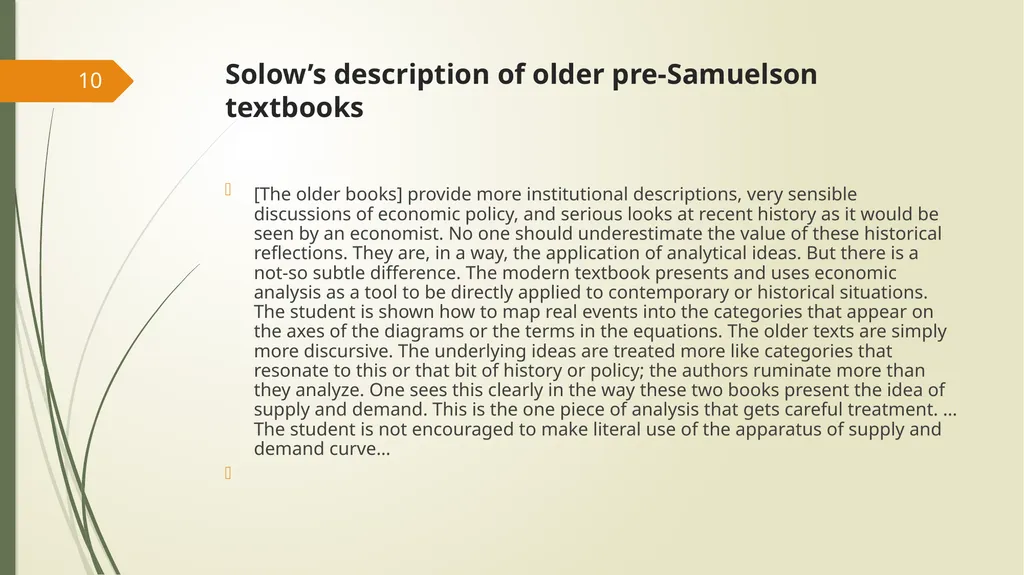
Solow’s description of older pre-Samuelson textbooks [The older books] provide more institutional descriptions, very sensible discussions of economic policy, and serious looks at recent history as it would be seen by an economist. No one should underestimate the value of these historical reflections. They are, in a way, the application of analytical ideas. But there is a not-so subtle difference. The modern textbook presents and uses economic analysis as a tool to be directly applied to contemporary or historical situations. The student is shown how to map real events into the categories that appear on the axes of the diagrams or the terms in the equations. The older texts are simply more discursive. The underlying ideas are treated more like categories that resonate to this or that bit of history or policy; the authors ruminate more than they analyze. One sees this clearly in the way these two books present the idea of supply and demand. This is the one piece of analysis that gets careful treatment. …The student is not encouraged to make literal use of the apparatus of supply and demand curve… 10<br>
11
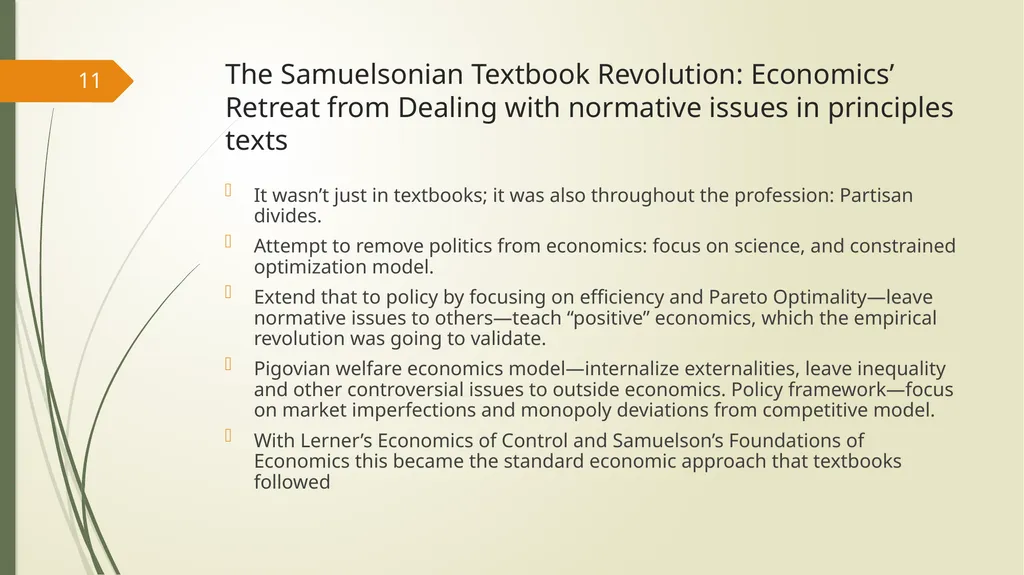
The Samuelsonian Textbook Revolution: Economics’ Retreat from Dealing with normative issues in principles texts It wasn’t just in textbooks; it was also throughout the profession: Partisan divides.
Attempt to remove politics from economics: focus on science, and constrained optimization model.
Extend that to policy by focusing on efficiency and Pareto Optimality—leave normative issues to others—teach “positive” economics, which the empirical revolution was going to validate.
Pigovian welfare economics model—internalize externalities, leave inequality and other controversial issues to outside economics. Policy framework—focus on market imperfections and monopoly deviations from competitive model.
With Lerner’s Economics of Control and Samuelson’s Foundations of Economics this became the standard economic approach that textbooks followed 11<br>
Attempt to remove politics from economics: focus on science, and constrained optimization model.
Extend that to policy by focusing on efficiency and Pareto Optimality—leave normative issues to others—teach “positive” economics, which the empirical revolution was going to validate.
Pigovian welfare economics model—internalize externalities, leave inequality and other controversial issues to outside economics. Policy framework—focus on market imperfections and monopoly deviations from competitive model.
With Lerner’s Economics of Control and Samuelson’s Foundations of Economics this became the standard economic approach that textbooks followed 11<br>
12
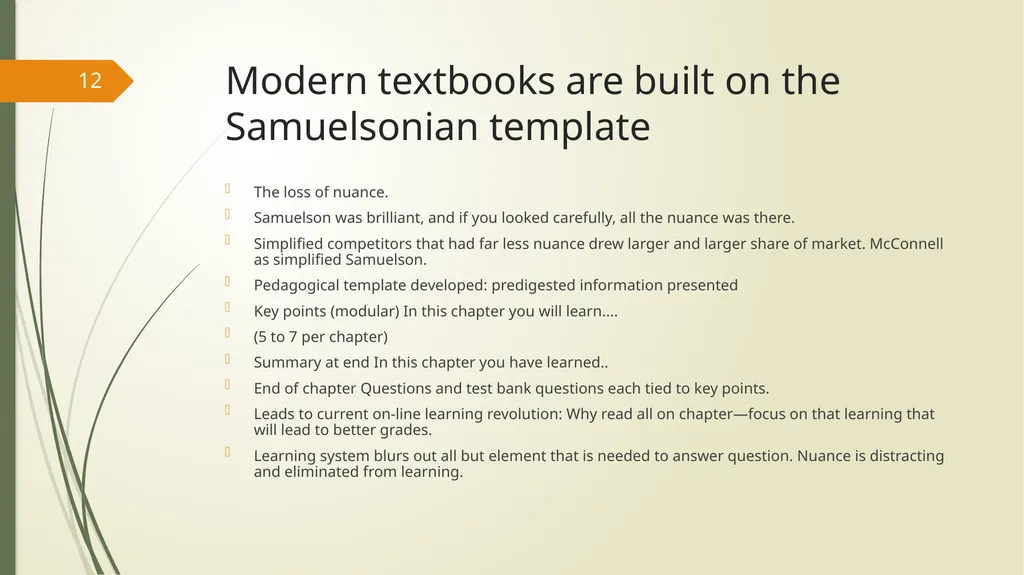
Modern textbooks are built on the Samuelsonian template The loss of nuance.
Samuelson was brilliant, and if you looked carefully, all the nuance was there.
Simplified competitors that had far less nuance drew larger and larger share of market. McConnell as simplified Samuelson.
Pedagogical template developed: predigested information presented
Key points (modular) In this chapter you will learn....
(5 to 7 per chapter)
Summary at end In this chapter you have learned..
End of chapter Questions and test bank questions each tied to key points.
Leads to current on-line learning revolution: Why read all on chapter—focus on that learning that will lead to better grades.
Learning system blurs out all but element that is needed to answer question. Nuance is distracting and eliminated from learning. 12<br>
Samuelson was brilliant, and if you looked carefully, all the nuance was there.
Simplified competitors that had far less nuance drew larger and larger share of market. McConnell as simplified Samuelson.
Pedagogical template developed: predigested information presented
Key points (modular) In this chapter you will learn....
(5 to 7 per chapter)
Summary at end In this chapter you have learned..
End of chapter Questions and test bank questions each tied to key points.
Leads to current on-line learning revolution: Why read all on chapter—focus on that learning that will lead to better grades.
Learning system blurs out all but element that is needed to answer question. Nuance is distracting and eliminated from learning. 12<br>
13
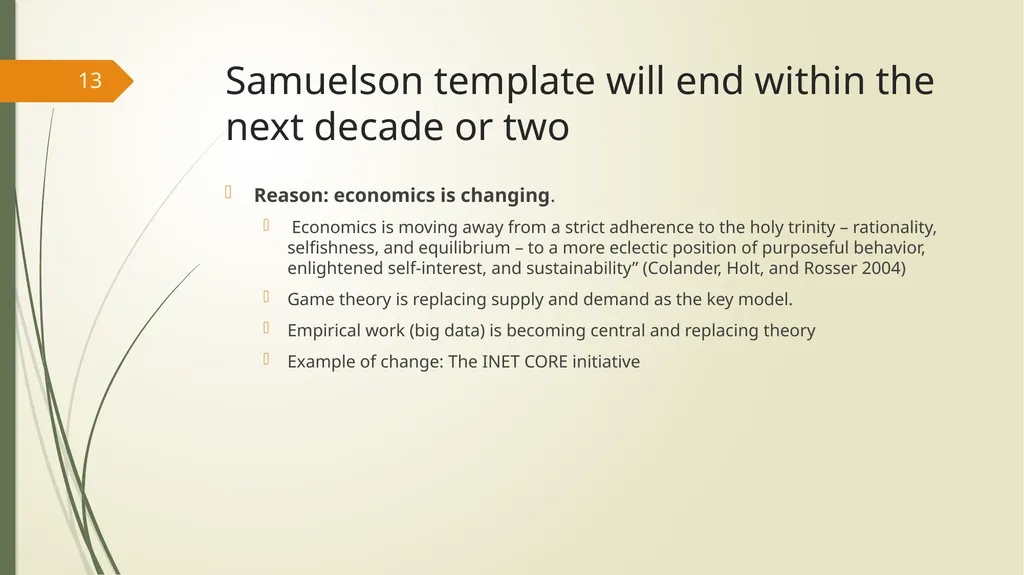
Samuelson template will end within the next decade or two Reason: economics is changing.
Economics is moving away from a strict adherence to the holy trinity – rationality, selfishness, and equilibrium – to a more eclectic position of purposeful behavior, enlightened self-interest, and sustainability” (Colander, Holt, and Rosser 2004)
Game theory is replacing supply and demand as the key model.
Empirical work (big data) is becoming central and replacing theory
Example of change: The INET CORE initiative 13<br>
Economics is moving away from a strict adherence to the holy trinity – rationality, selfishness, and equilibrium – to a more eclectic position of purposeful behavior, enlightened self-interest, and sustainability” (Colander, Holt, and Rosser 2004)
Game theory is replacing supply and demand as the key model.
Empirical work (big data) is becoming central and replacing theory
Example of change: The INET CORE initiative 13<br>
14
Some Comments about the INET CORE
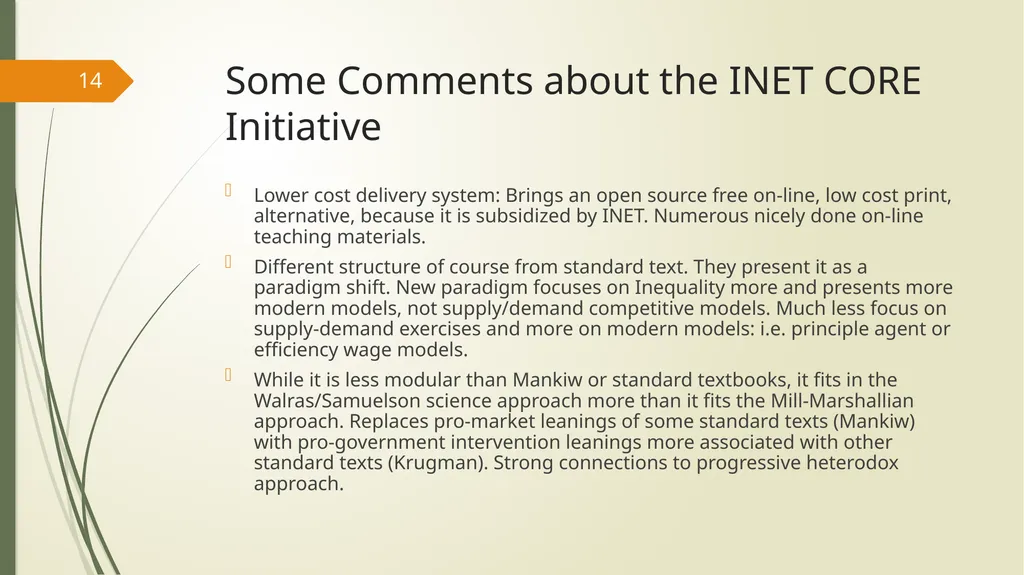
Initiative Lower cost delivery system: Brings an open source free on-line, low cost print, alternative, because it is subsidized by INET. Numerous nicely done on-line teaching materials.
Different structure of course from standard text. They present it as a paradigm shift. New paradigm focuses on Inequality more and presents more modern models, not supply/demand competitive models. Much less focus on supply-demand exercises and more on modern models: i.e. principle agent or efficiency wage models.
While it is less modular than Mankiw or standard textbooks, it fits in the Walras/Samuelson science approach more than it fits the Mill-Marshallian approach. Replaces pro-market leanings of some standard texts (Mankiw) with pro-government intervention leanings more associated with other standard texts (Krugman). Strong connections to progressive heterodox approach. 14<br>
Different structure of course from standard text. They present it as a paradigm shift. New paradigm focuses on Inequality more and presents more modern models, not supply/demand competitive models. Much less focus on supply-demand exercises and more on modern models: i.e. principle agent or efficiency wage models.
While it is less modular than Mankiw or standard textbooks, it fits in the Walras/Samuelson science approach more than it fits the Mill-Marshallian approach. Replaces pro-market leanings of some standard texts (Mankiw) with pro-government intervention leanings more associated with other standard texts (Krugman). Strong connections to progressive heterodox approach. 14<br>
15
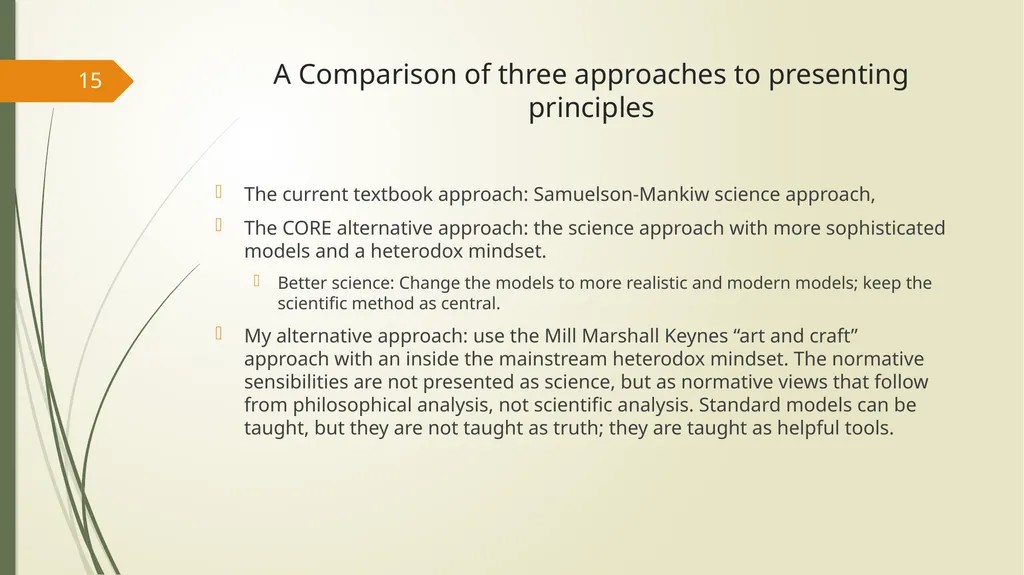
A Comparison of three approaches to presenting principles The current textbook approach: Samuelson-Mankiw science approach,
The CORE alternative approach: the science approach with more sophisticated models and a heterodox mindset.
Better science: Change the models to more realistic and modern models; keep the scientific method as central.
My alternative approach: use the Mill Marshall Keynes “art and craft” approach with an inside the mainstream heterodox mindset. The normative sensibilities are not presented as science, but as normative views that follow from philosophical analysis, not scientific analysis. Standard models can be taught, but they are not taught as truth; they are taught as helpful tools. 15<br>
The CORE alternative approach: the science approach with more sophisticated models and a heterodox mindset.
Better science: Change the models to more realistic and modern models; keep the scientific method as central.
My alternative approach: use the Mill Marshall Keynes “art and craft” approach with an inside the mainstream heterodox mindset. The normative sensibilities are not presented as science, but as normative views that follow from philosophical analysis, not scientific analysis. Standard models can be taught, but they are not taught as truth; they are taught as helpful tools. 15<br>
16
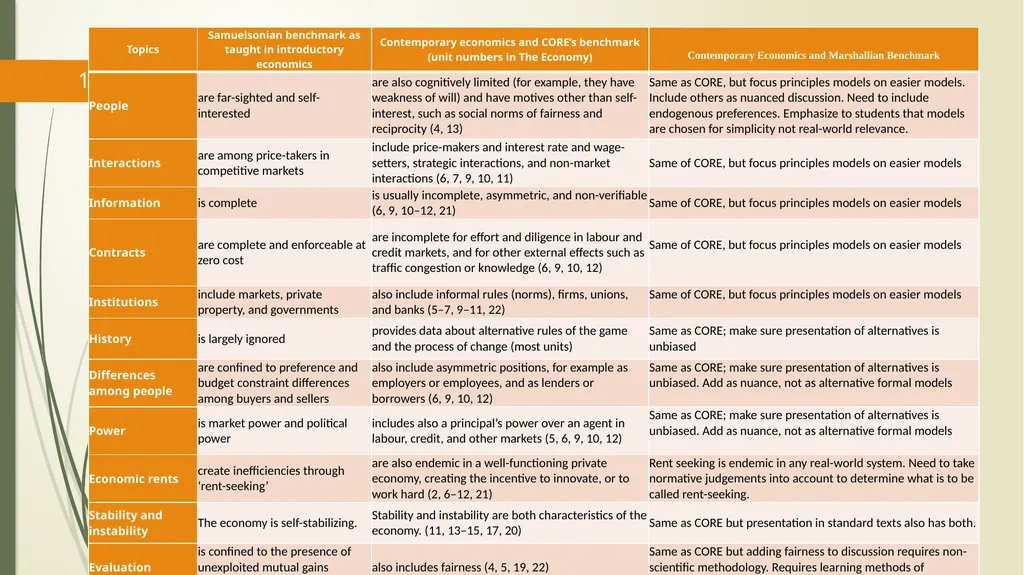
16<br>
17
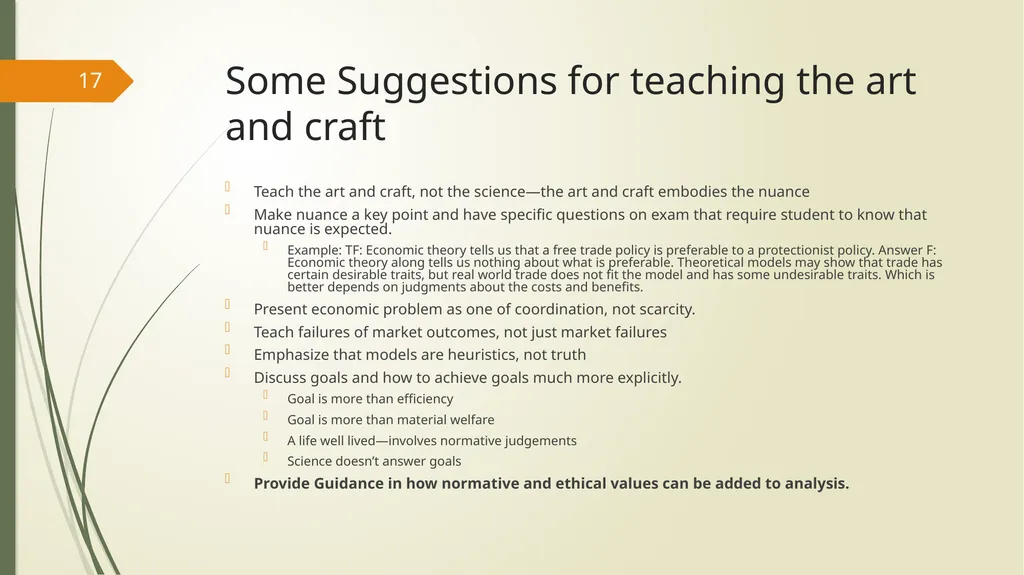
Some Suggestions for teaching the art and craft Teach the art and craft, not the science—the art and craft embodies the nuance
Make nuance a key point and have specific questions on exam that require student to know that nuance is expected.
Example: TF: Economic theory tells us that a free trade policy is preferable to a protectionist policy. Answer F: Economic theory along tells us nothing about what is preferable. Theoretical models may show that trade has certain desirable traits, but real world trade does not fit the model and has some undesirable traits. Which is better depends on judgments about the costs and benefits.
Present economic problem as one of coordination, not scarcity.
Teach failures of market outcomes, not just market failures
Emphasize that models are heuristics, not truth
Discuss goals and how to achieve goals much more explicitly.
Goal is more than efficiency
Goal is more than material welfare
A life well lived—involves normative judgements
Science doesn’t answer goals
Provide Guidance in how normative and ethical values can be added to analysis. 17<br>
Make nuance a key point and have specific questions on exam that require student to know that nuance is expected.
Example: TF: Economic theory tells us that a free trade policy is preferable to a protectionist policy. Answer F: Economic theory along tells us nothing about what is preferable. Theoretical models may show that trade has certain desirable traits, but real world trade does not fit the model and has some undesirable traits. Which is better depends on judgments about the costs and benefits.
Present economic problem as one of coordination, not scarcity.
Teach failures of market outcomes, not just market failures
Emphasize that models are heuristics, not truth
Discuss goals and how to achieve goals much more explicitly.
Goal is more than efficiency
Goal is more than material welfare
A life well lived—involves normative judgements
Science doesn’t answer goals
Provide Guidance in how normative and ethical values can be added to analysis. 17<br>
18
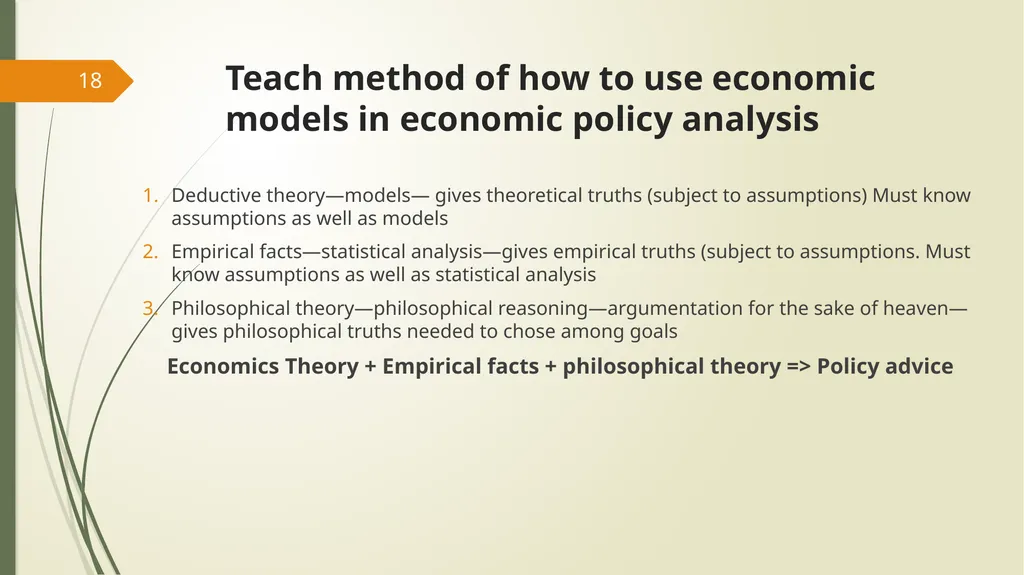
Teach method of how to use economic models in economic policy analysis Deductive theory—models— gives theoretical truths (subject to assumptions) Must know assumptions as well as models
Empirical facts—statistical analysis—gives empirical truths (subject to assumptions. Must know assumptions as well as statistical analysis
Philosophical theory—philosophical reasoning—argumentation for the sake of heaven—gives philosophical truths needed to chose among goals
Economics Theory + Empirical facts + philosophical theory => Policy advice 18<br>
Empirical facts—statistical analysis—gives empirical truths (subject to assumptions. Must know assumptions as well as statistical analysis
Philosophical theory—philosophical reasoning—argumentation for the sake of heaven—gives philosophical truths needed to chose among goals
Economics Theory + Empirical facts + philosophical theory => Policy advice 18<br>
19
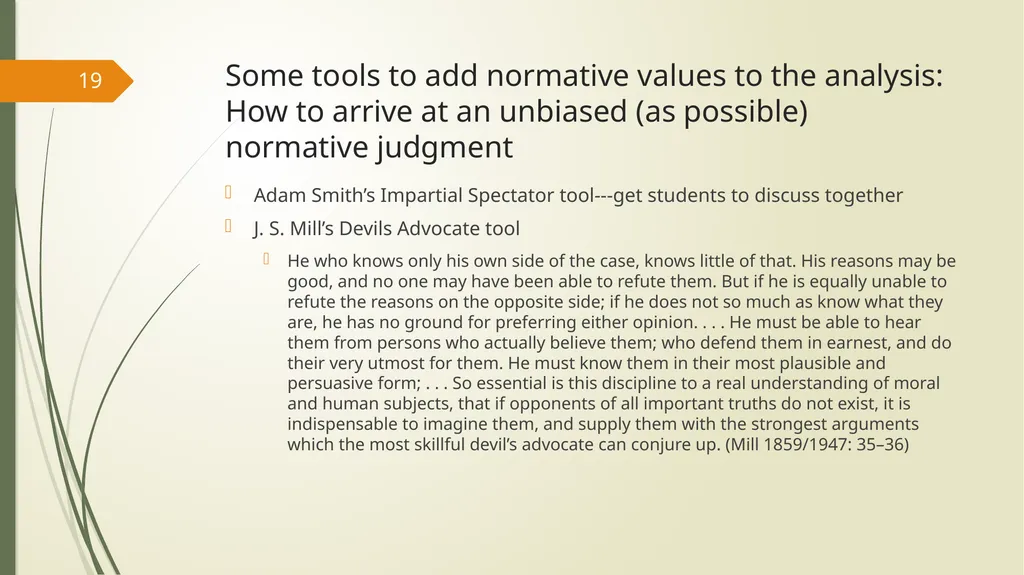
Some tools to add normative values to the analysis: How to arrive at an unbiased (as possible) normative judgment Adam Smith’s Impartial Spectator tool---get students to discuss together
J. S. Mill’s Devils Advocate tool
He who knows only his own side of the case, knows little of that. His reasons may be good, and no one may have been able to refute them. But if he is equally unable to refute the reasons on the opposite side; if he does not so much as know what they are, he has no ground for preferring either opinion. . . . He must be able to hear them from persons who actually believe them; who defend them in earnest, and do their very utmost for them. He must know them in their most plausible and persuasive form; . . . So essential is this discipline to a real understanding of moral and human subjects, that if opponents of all important truths do not exist, it is indispensable to imagine them, and supply them with the strongest arguments which the most skillful devil’s advocate can conjure up. (Mill 1859/1947: 35–36) 19<br>
J. S. Mill’s Devils Advocate tool
He who knows only his own side of the case, knows little of that. His reasons may be good, and no one may have been able to refute them. But if he is equally unable to refute the reasons on the opposite side; if he does not so much as know what they are, he has no ground for preferring either opinion. . . . He must be able to hear them from persons who actually believe them; who defend them in earnest, and do their very utmost for them. He must know them in their most plausible and persuasive form; . . . So essential is this discipline to a real understanding of moral and human subjects, that if opponents of all important truths do not exist, it is indispensable to imagine them, and supply them with the strongest arguments which the most skillful devil’s advocate can conjure up. (Mill 1859/1947: 35–36) 19<br>
20
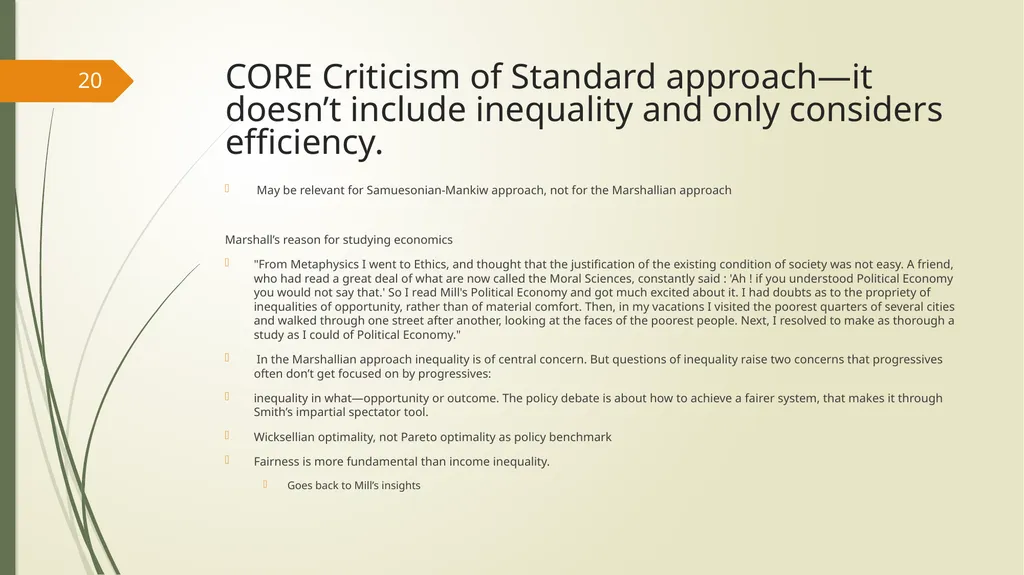
CORE Criticism of Standard approach—it doesn’t include inequality and only considers efficiency. May be relevant for Samuesonian-Mankiw approach, not for the Marshallian approach
Marshall’s reason for studying economics
"From Metaphysics I went to Ethics, and thought that the justification of the existing condition of society was not easy. A friend, who had read a great deal of what are now called the Moral Sciences, constantly said : 'Ah ! if you understood Political Economy you would not say that.' So I read Mill's Political Economy and got much excited about it. I had doubts as to the propriety of inequalities of opportunity, rather than of material comfort. Then, in my vacations I visited the poorest quarters of several cities and walked through one street after another, looking at the faces of the poorest people. Next, I resolved to make as thorough a study as I could of Political Economy."
In the Marshallian approach inequality is of central concern. But questions of inequality raise two concerns that progressives often don’t get focused on by progressives:
inequality in what—opportunity or outcome. The policy debate is about how to achieve a fairer system, that makes it through Smith’s impartial spectator tool.
Wicksellian optimality, not Pareto optimality as policy benchmark
Fairness is more fundamental than income inequality.
Goes back to Mill’s insights 20<br>
Marshall’s reason for studying economics
"From Metaphysics I went to Ethics, and thought that the justification of the existing condition of society was not easy. A friend, who had read a great deal of what are now called the Moral Sciences, constantly said : 'Ah ! if you understood Political Economy you would not say that.' So I read Mill's Political Economy and got much excited about it. I had doubts as to the propriety of inequalities of opportunity, rather than of material comfort. Then, in my vacations I visited the poorest quarters of several cities and walked through one street after another, looking at the faces of the poorest people. Next, I resolved to make as thorough a study as I could of Political Economy."
In the Marshallian approach inequality is of central concern. But questions of inequality raise two concerns that progressives often don’t get focused on by progressives:
inequality in what—opportunity or outcome. The policy debate is about how to achieve a fairer system, that makes it through Smith’s impartial spectator tool.
Wicksellian optimality, not Pareto optimality as policy benchmark
Fairness is more fundamental than income inequality.
Goes back to Mill’s insights 20<br>
21
Mill on income inequality, and how to deal with it The principle of private property has never yet had a fair trial in any country; and less so, perhaps, in this country [England] than in some others. The social arrangements of modern Europe commenced from a distribution of property which was the result, not of just partition, or acquisition by industry, but of conquest and violence; and notwithstanding what industry has been doing for many centuries to modify the work of force, the system still retains many and large traces of its origin. The laws of property have never yet conformed to the principles on which the justification of private property rests. They have made property of things which never ought to be property, and absolute property where only a qualified property ought to exist. They have not held the balance fairly between human beings, but have heaped impediments upon some, to give advantage to others; they have purposely fostered inequalities, and prevented all from starting fair in the race. That all should indeed start on perfectly equal terms, is inconsistent with any law of private property; but if as much pains as has been taken to aggravate the inequality of chances arising from the natural working of the principle had been taken to temper that inequality by every means not subversive of the principle itself; if the tendency of legislation had been to favor the diffusion, instead of the concentration of wealth—to encourage the subdivision of the large masses, instead of striving to keep them together—the principle of individual property would have been found to have no necessary connection with the physical and social evils which almost all Socialist writers assume to be inseparable from it.
Property rights policy. Patents, copyrights, competition and government capture are central policy problems that need to be dealt with, Policies to redistribute income lead to too much temptation for groups to change rules to benefit them. 21<br>
Property rights policy. Patents, copyrights, competition and government capture are central policy problems that need to be dealt with, Policies to redistribute income lead to too much temptation for groups to change rules to benefit them. 21<br>
22
Conclusion There is far too little argumentation for the sake a heaven in economics, where the goal of the debate in understanding, not winning. Progressives dump on conservatives, and conservatives dump on progressives, and there is little movement toward finding common ground.
A big reason for that is that differences are presented as scientific differences, when in fact, I think there is much more agreement about the deductive models than economists recognize. The differences are primarily in sensibility, not in theory or science.
The strongest differences are generally about how relevant the models are for reality. That’s a much more difficult question, but if we are to teach a nuanced principles of economics, we need to focus a lot more on that aspect than we currently do, and we need to do it in the principles course.
We don’t have to change the models; we have to change the nuanced way in which the models are presented to students. 22<br>
A big reason for that is that differences are presented as scientific differences, when in fact, I think there is much more agreement about the deductive models than economists recognize. The differences are primarily in sensibility, not in theory or science.
The strongest differences are generally about how relevant the models are for reality. That’s a much more difficult question, but if we are to teach a nuanced principles of economics, we need to focus a lot more on that aspect than we currently do, and we need to do it in the principles course.
We don’t have to change the models; we have to change the nuanced way in which the models are presented to students. 22<br>