Teaching Performance Assessment ConsortiuM (TPAC) Andrea Whittaker. Ph.D. Stanford University September 2011 Stanford Center for Assessment, Learning and Equity Academic Language Defining TPAC constructs Examples in Practice Rubric
"Teaching Performance Assessment ConsortiuM (TPAC)" is the property of its rightful owner. Permission is granted to
download and print the materials on this website for personal, non-commercial use only, and to display it
on your personal computer provided you do not modify the materials and that you retain all copyright
notices contained in the materials. By downloading content from our website, you accept the terms of this
agreement.
Presentation Transcript
01
Teaching Performance Assessment ConsortiuM (TPAC) Andrea Whittaker. Ph.D.
Stanford University
September 2011 Stanford Center for Assessment, Learning and Equity<br>
02
Academic Language Defining TPAC constructs
Examples in Practice
Rubric Descriptors
Other resources Stanford Center for Assessment, Learning and Equity 2011<br>
03
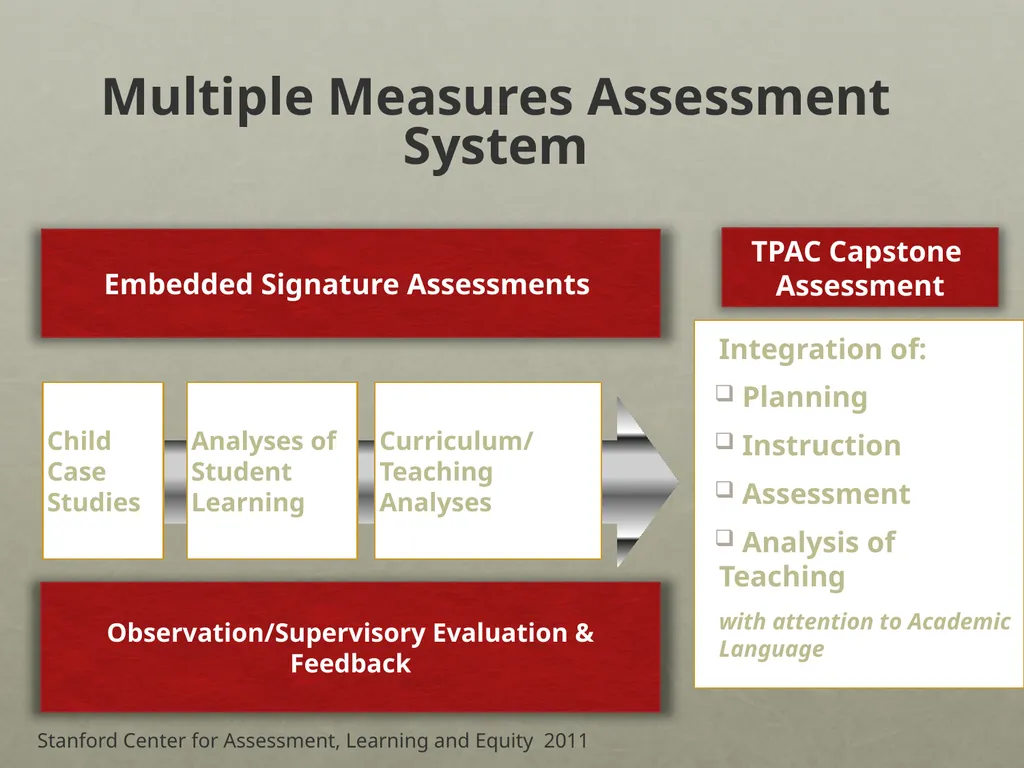
Multiple Measures Assessment System Embedded Signature Assessments Observation/Supervisory Evaluation & Feedback Child Case Studies Analyses of Student Learning Curriculum/Teaching Analyses TPAC Capstone
Assessment Integration of:
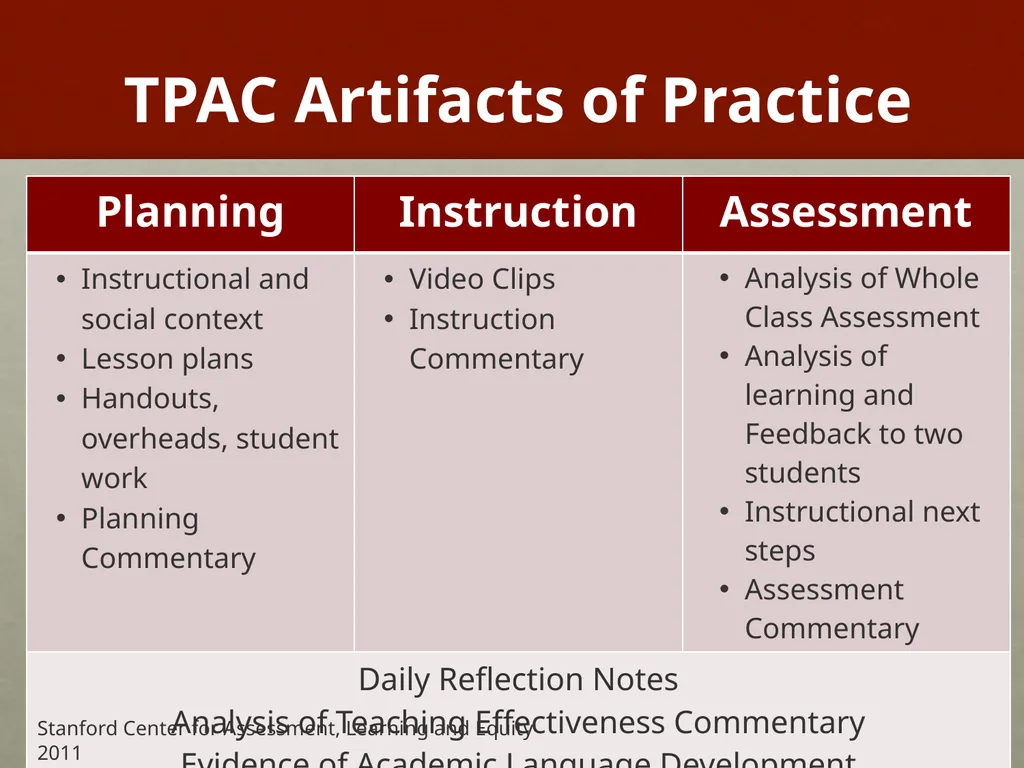
Planning
Instruction
Assessment
Analysis of Teaching
with attention to Academic Language Stanford Center for Assessment, Learning and Equity 2011<br>
04
TPAC Artifacts of Practice Stanford Center for Assessment, Learning and Equity 2011<br>
05
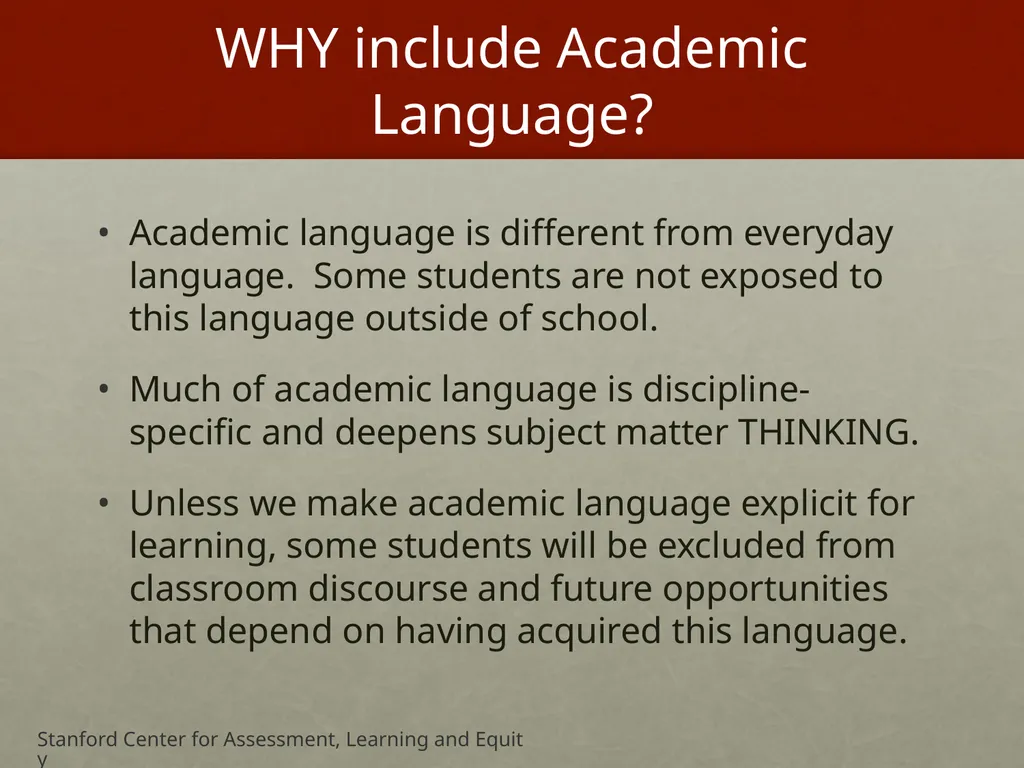
WHY include Academic Language? Academic language is different from everyday language. Some students are not exposed to this language outside of school.
Much of academic language is discipline-specific and deepens subject matter THINKING.
Unless we make academic language explicit for learning, some students will be excluded from classroom discourse and future opportunities that depend on having acquired this language. Stanford Center for Assessment, Learning and Equity<br>
06
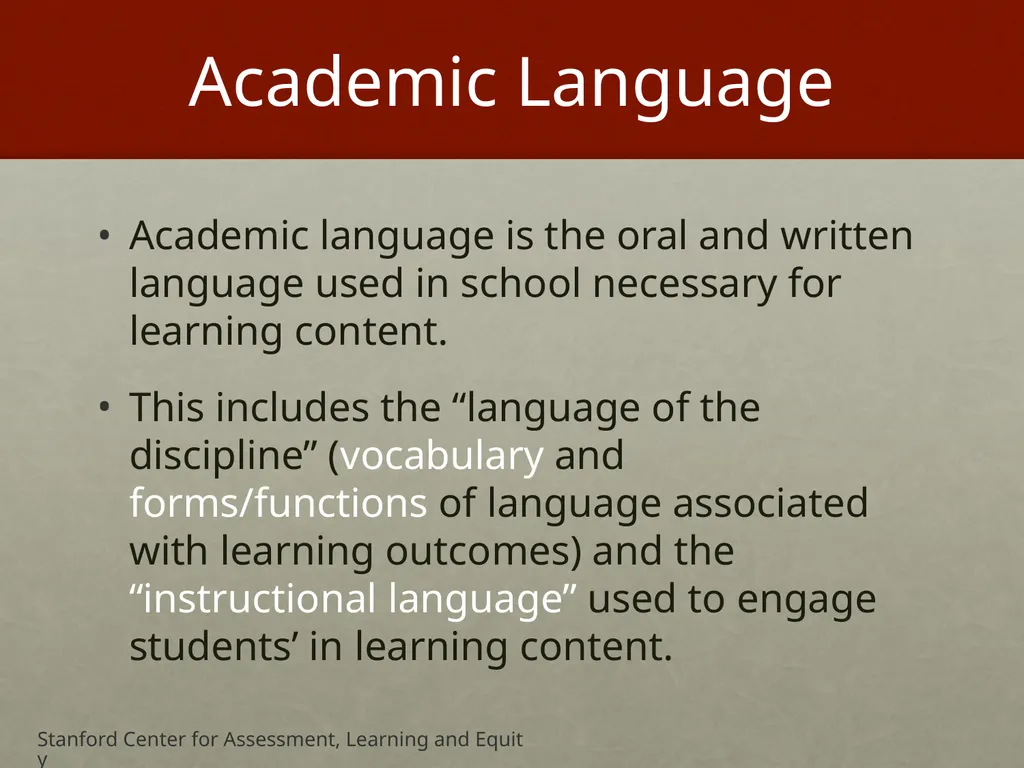
Academic language is the oral and written language used in school necessary for learning content.
This includes the “language of the discipline” (vocabulary and forms/functions of language associated with learning outcomes) and the “instructional language” used to engage students’ in learning content. Academic Language Stanford Center for Assessment, Learning and Equity<br>
07
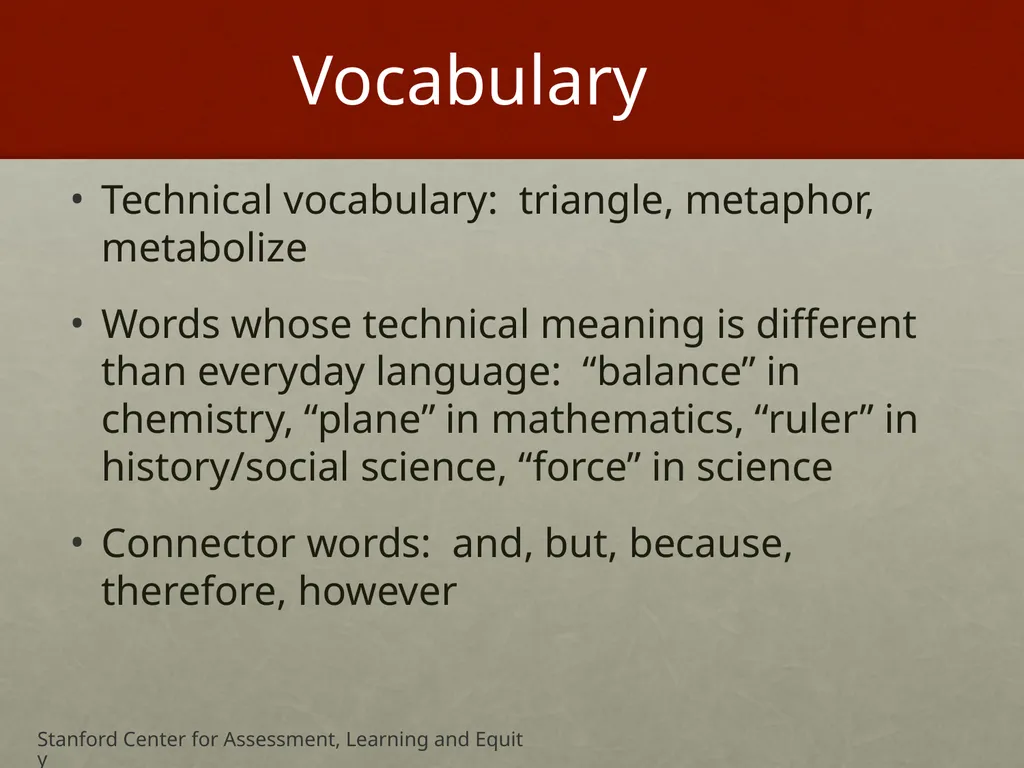
Vocabulary Technical vocabulary: triangle, metaphor, metabolize
Words whose technical meaning is different than everyday language: “balance” in chemistry, “plane” in mathematics, “ruler” in history/social science, “force” in science
Connector words: and, but, because, therefore, however Stanford Center for Assessment, Learning and Equity<br>
08
Vocabulary Brainstorm discipline specific vocabulary
Technical
Multiple meaning
Connector… Stanford Center for Assessment, Learning and Equity<br>
09
Three F Words The FUNCTIONS of Academic Language are to clearly and explicitly define, classify, analyze, explain, argue, interpret and evaluate ideas for distant audiences.
Every language function has FORMS or structures that are common and often discipline specific (text, sentence or graphic/symbolic)
Developing students’ FLUENCY in academic language forms and functions provides access to the “language of school” and academic success Stanford Center for Assessment, Learning and Equity<br>
10
“F” Words Brainstorm discipline specific FUNCTIONS – THINK VERBS!
Brainstorm discipline specific FORMS or structures -- oral, written/text, graphic or symbolic Stanford Center for Assessment, Learning and Equity<br>
11
Academic Language Brainstorm Instructional Language
Language teachers use to direct student engagement in learning (task directions, routines, questions,…) and language that students need to participate with each other in a learning activity (questions, …) Stanford Center for Assessment, Learning and Equity<br>
12
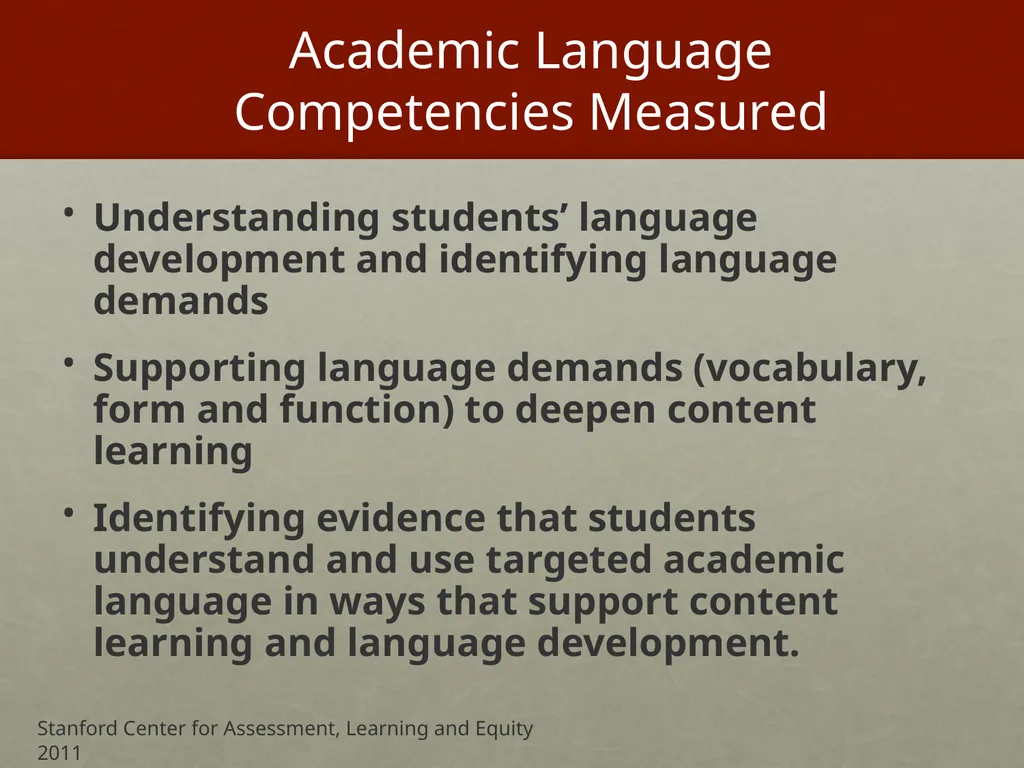
Academic Language Competencies Measured Understanding students’ language development and identifying language demands
Supporting language demands (vocabulary, form and function) to deepen content learning
Identifying evidence that students understand and use targeted academic language in ways that support content learning and language development. Stanford Center for Assessment, Learning and Equity 2011<br>
13
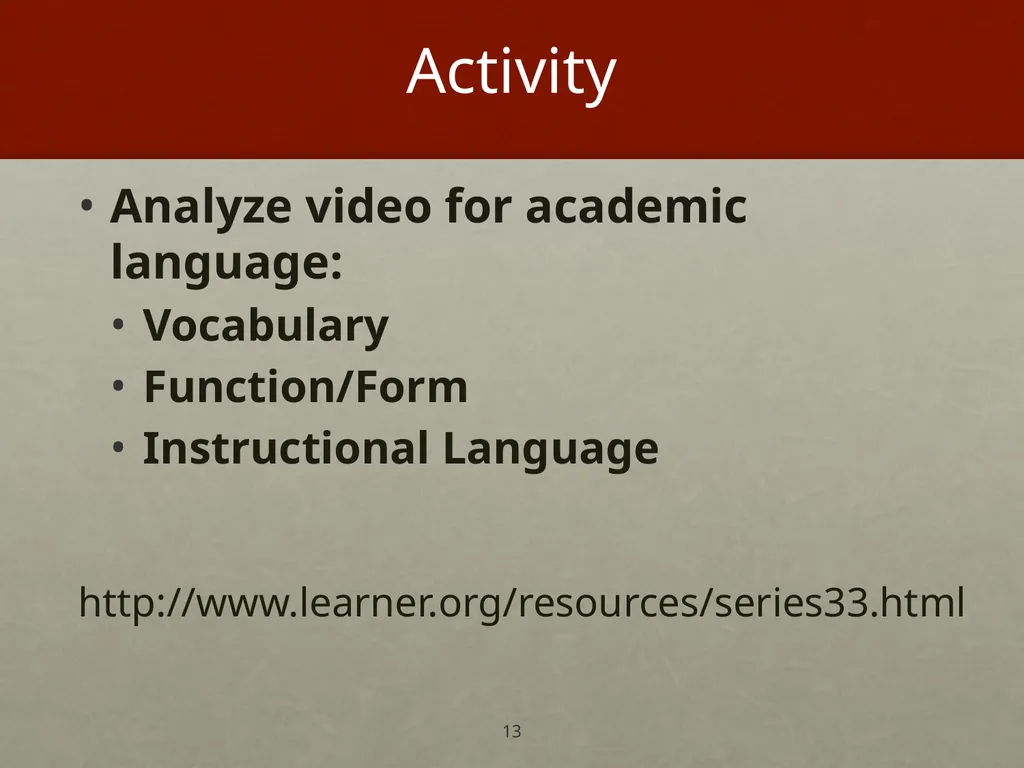
Analyze video for academic language:
Vocabulary
Function/Form
Instructional Language
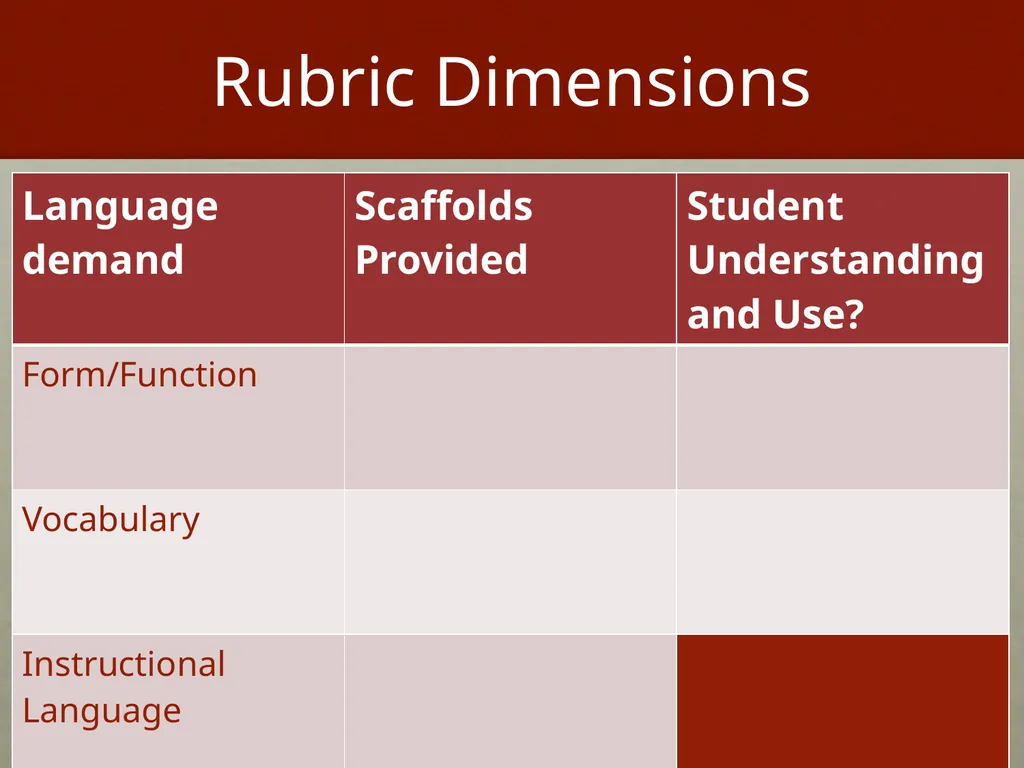
Rubric Dimensions Stanford Center for Assessment, Learning and Equity<br>
15
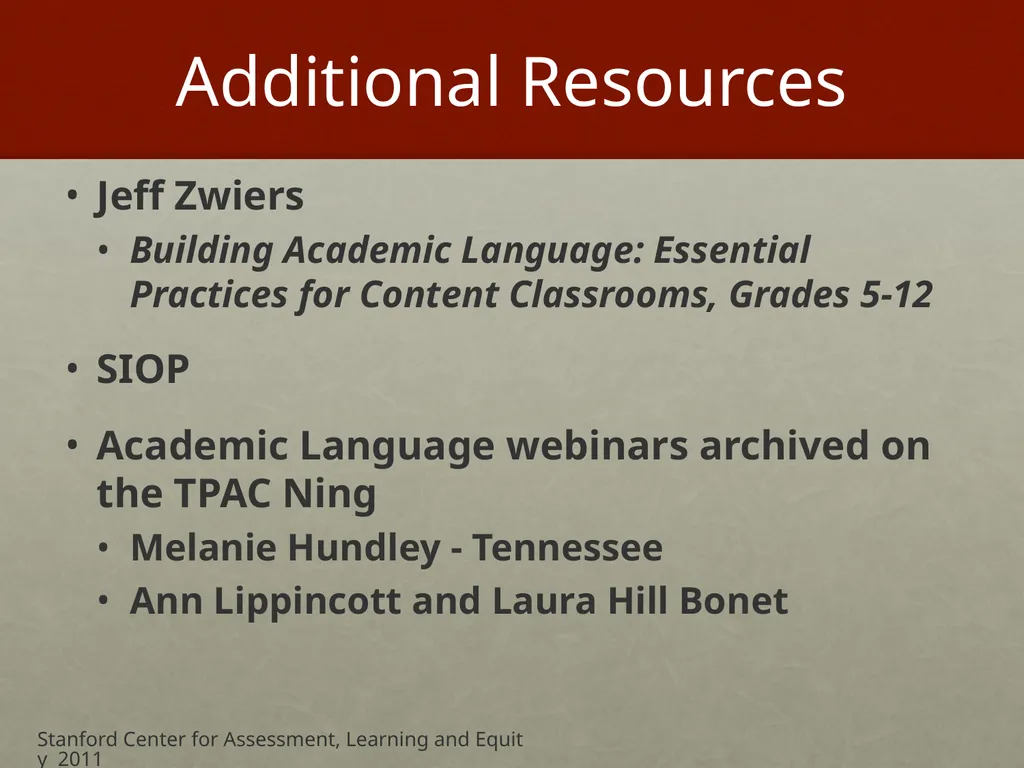
Additional Resources Jeff Zwiers
Building Academic Language: Essential Practices for Content Classrooms, Grades 5-12
SIOP
Academic Language webinars archived on the TPAC Ning
Melanie Hundley - Tennessee
Ann Lippincott and Laura Hill Bonet Stanford Center for Assessment, Learning and Equity 2011<br>
16
Academic Language Takeaways Unless we make academic language explicit for learning, some students will be excluded from classroom discourse and future opportunities that depend on having acquired this language.
Language of the Discipline
Three “F” Words
Vocabulary
Instructional Language Stanford Center for Assessment, Learning and Equity<br>