
TEACHING SKILLS AND ITS DEVELOPMENT TEACHING

Description: TEACHING SKILLS AND ITS DEVELOPMENT TEACHING SKILLS Teaching skill is a set of related overt behaviour of the teacher (verbal and nonverbal) which are observable, definable, measurable , demonstrable and refinable through practices. The
Related Topics
Download Presentation
"TEACHING SKILLS AND ITS DEVELOPMENT TEACHING" is the property of its rightful owner. Permission is granted to download and print the materials on this website for personal, non-commercial use only, and to display it on your personal computer provided you do not modify the materials and that you retain all copyright notices contained in the materials. By downloading content from our website, you accept the terms of this agreement.
Presentation Transcript
slide1. TEACHING SKILLS AND ITS DEVELOPMENT<br>
slide2. TEACHING SKILLS Teaching skill is a set of related overt behaviour of the teacher (verbal and nonverbal) which are observable, definable, measurable , demonstrable and refinable through practices.
The skill that are useful for teaching any subject at any level are called teaching skills.
The skills that are used extensively in routine teaching are called core teaching skills.<br>
slide3. 1.SKILL OF INTRODUCING A LESSON When a teacher introduces a lesson he gives a brief introduction about the lesson in-order to pre dispose the pupils mind to it.
Components of the skill
Use of previous knowledge
Use of previous knowledge is must , because it help to establish an integration between the pre existing knowledge of the learner and the new knowledge that the teacher wants to impart him.
Use of appropriate devices
Many devices such as lecturing ,narrating ,dramatisation ,audio, visual-aids , experimentation, story telling , role playing etc are useful for motivating the pupils and to gradually lead them to the new teaching material.
Maintenance of continuity
There should be continuity in teaching.
Appropriate
It should be appropriate and effective<br>
slide4. 2.SKILL OF STIMULUS VARIATION Stimulus Variation is described as a deliberate change in stimuli(behaviour) of the teacher in order to sustain the attention of his learners through out the lesson or class.
Components of the skill
Focussing : It implies the behaviour that help in focussing the pupils attention on a particular object , word ,idea or generalisation .
Teacher movements : Meaningful and purposeful movements of the teacher.
Teacher gestures :Gestures are the movements of the part of the body used for expressing emotions ,size ,shape, direction.
Change in speech pattern: Change in volume ,tone or speed of verbal communication for attracting students attention.
Change in interaction style
Teacher pupil interaction
Pupil-Pupil interaction
Pupil-teacher interaction
Pausing: Deliberate use of silence , during talk.
Oral-visual switching [change in sensory focuses]
Oral –Visual
Visual -Oral<br>
slide5. 3. SKILL OF USING BLACK BOARD Black Board is the most widely used visual aid. It is one of the fittest and easiest meaning of illustrating an important points.
Components of the skill
Legibility of Hand writing
Neatness in Black board work
Organisation of Black board work
Appropriateness of black board work<br>
slide6. 4.SKILL OF EXPLAINING Explaining is the skill by which teacher can clearly bring out the exact meaning of a concept.
Components of the skill
Use of beginning statement
All the explanation will contain a beginning statement In order to make the student mentally ready for learning.
Use of explaining links
Words or phrases which increase effectiveness of explanation .They bring continuity in statements . E.g: As a result, therefore , in order to, because, on the other hand ,due to, hence but.
Use of mediators
Presentation of various mediators to make the explanation more interesting and meaningful e.g ; diagrams ,models.
Use of concluding statements
Statements made at the end of the explanation in order to Summarize the important points.
Questions to test pupils understanding
In the case of explanation , frequent questions are asked in between or at the end of the explanation which will help the teacher to get feedback from the students.<br>
slide7. 5.SKILL OF ILLUSTRATING WITH EXAMPLES This is the skill of timely use of examples for the purpose of making an idea , concept or principles clear. A good illustrate example can catch up the attention of students.
Components of the skill
Formulating simple example
Examples that of familiar to the students and hence helpful for easy assimilation.
Formulating relevant examples
Examples relevant to the item being taught.
Formulating interesting examples
Examples that can arouse curiosity and interest.
Use of appropriate media for examples
Verbal and Non verbal media for examples.
Use of inductive and deductive approach
Inductive approach-particular to general
Deductive approach –general to particular.<br>
slide8. 6.SKILL OF PROBING QUESTIONS Probing questions refers to giving deep into the pupils response by asking series of subsequent questions.
Components of the skill
Prompting : When there is no response or incorrect response the teacher gives clues for leading the pupil to the correct responses.
Seeking further information : If the initial response of the pupil is partially correct or incomplete the help the pupil to clarify response by asking additional questions.
Re-focussing: When pupil gives the response the teacher relates the response with something that already taken.
Increasing critical awareness : Teacher asked how, why of a correct response for increasing critical awareness in pupil.
Redirection: Asking the same questions to another pupil for increasing pupil’s participation.<br>
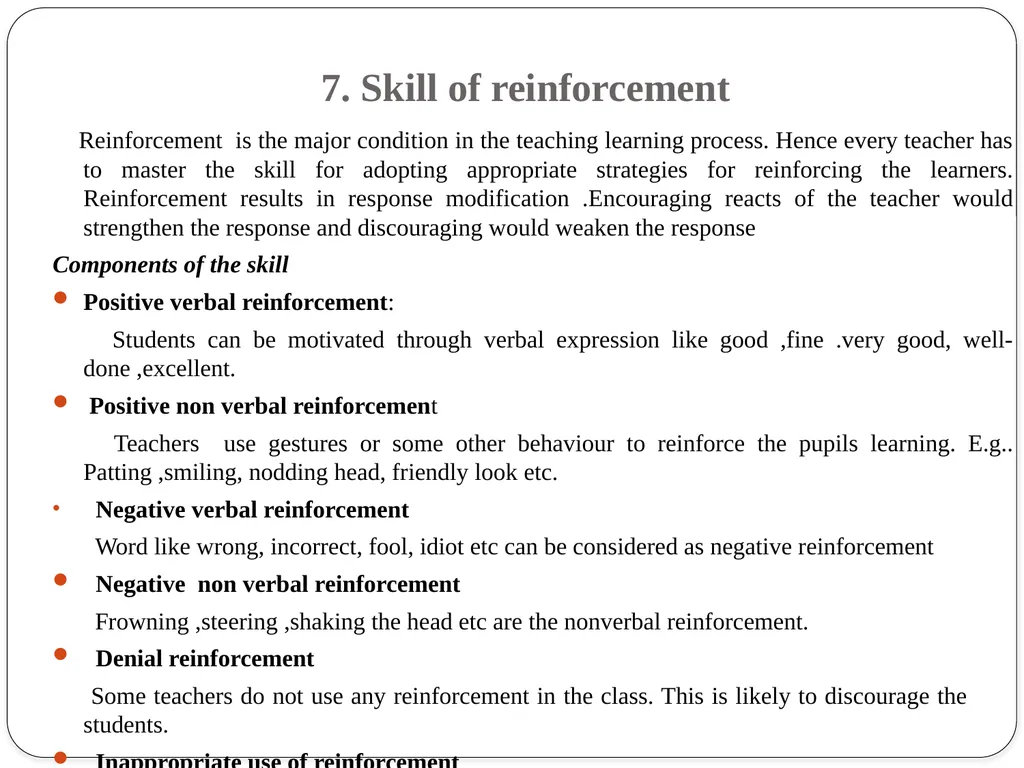
slide9. 7. Skill of reinforcement Reinforcement is the major condition in the teaching learning process. Hence every teacher has to master the skill for adopting appropriate strategies for reinforcing the learners. Reinforcement results in response modification .Encouraging reacts of the teacher would strengthen the response and discouraging would weaken the response
Components of the skill
Positive verbal reinforcement:
Students can be motivated through verbal expression like good ,fine .very good, well-done ,excellent.
Positive non verbal reinforcement
Teachers use gestures or some other behaviour to reinforce the pupils learning. E.g.. Patting ,smiling, nodding head, friendly look etc.
Negative verbal reinforcement
Word like wrong, incorrect, fool, idiot etc can be considered as negative reinforcement
Negative non verbal reinforcement
Frowning ,steering ,shaking the head etc are the nonverbal reinforcement.
Denial reinforcement
Some teachers do not use any reinforcement in the class. This is likely to discourage the students.
Inappropriate use of reinforcement
Reinforcement should be suit the nature of the response given by the students.
D<br>
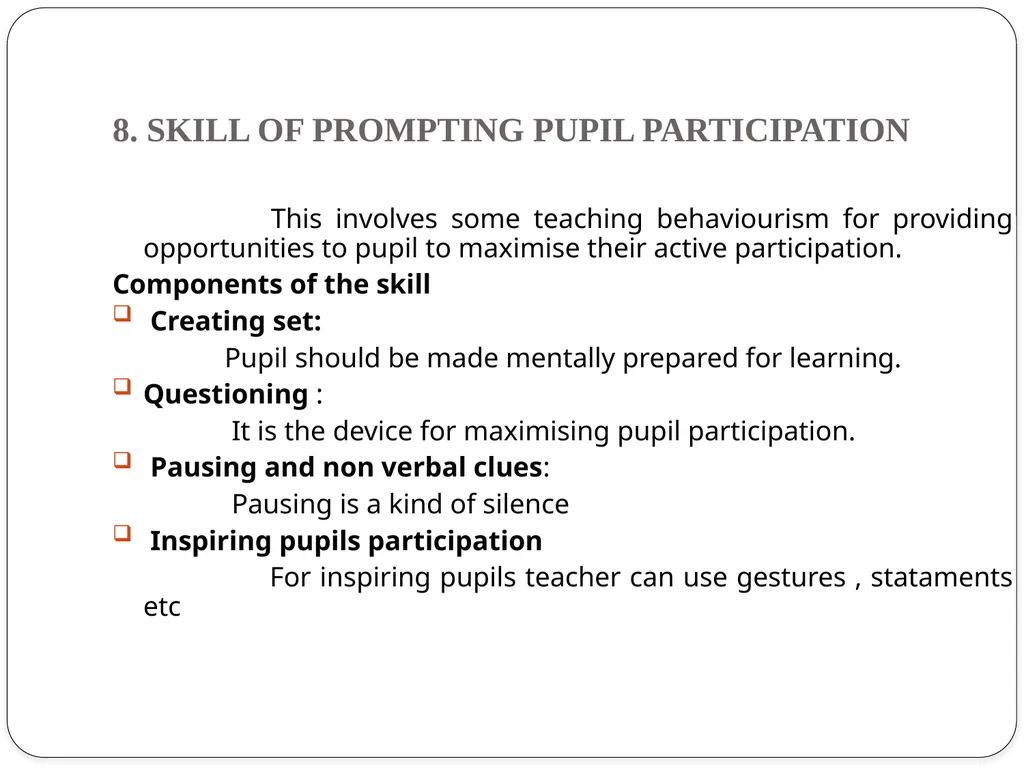
slide10. 8. SKILL OF PROMPTING PUPIL PARTICIPATION This involves some teaching behaviourism for providing opportunities to pupil to maximise their active participation.
Components of the skill
Creating set:
Pupil should be made mentally prepared for learning.
Questioning :
It is the device for maximising pupil participation.
Pausing and non verbal clues:
Pausing is a kind of silence
Inspiring pupils participation
For inspiring pupils teacher can use gestures , stataments etc<br>
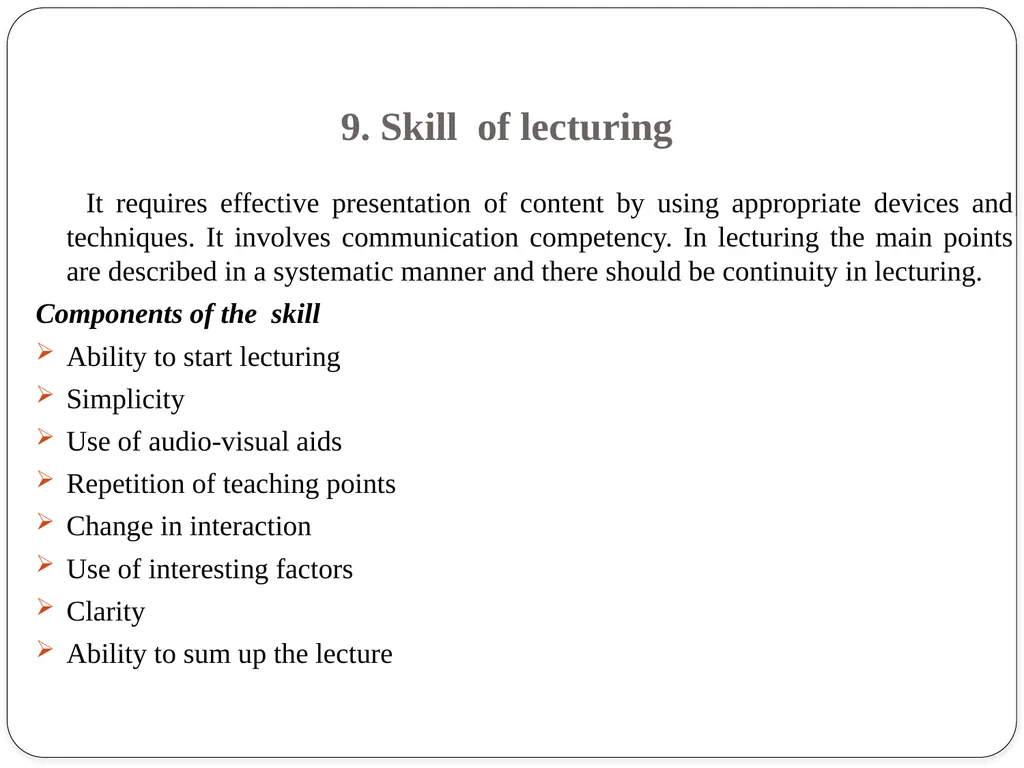
slide11. 9. Skill of lecturing It requires effective presentation of content by using appropriate devices and techniques. It involves communication competency. In lecturing the main points are described in a systematic manner and there should be continuity in lecturing.
Components of the skill
Ability to start lecturing
Simplicity
Use of audio-visual aids
Repetition of teaching points
Change in interaction
Use of interesting factors
Clarity
Ability to sum up the lecture<br>
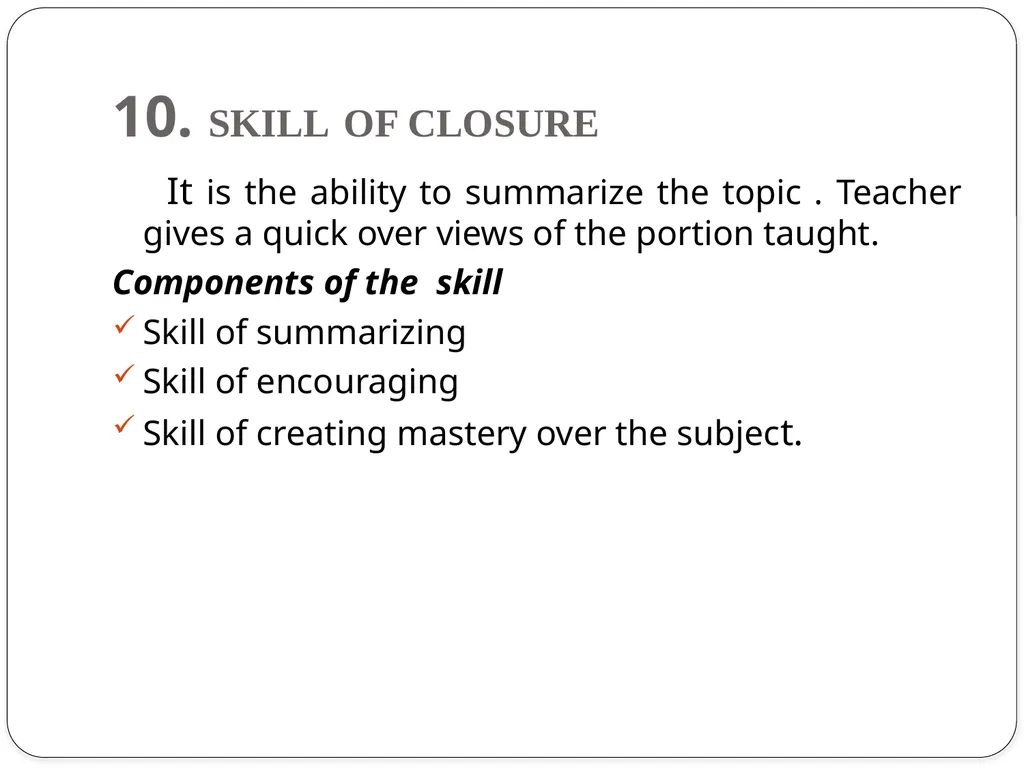
slide12. 10. SKILL OF CLOSURE It is the ability to summarize the topic . Teacher gives a quick over views of the portion taught.
Components of the skill
Skill of summarizing
Skill of encouraging
Skill of creating mastery over the subject.<br>
slide2. TEACHING SKILLS Teaching skill is a set of related overt behaviour of the teacher (verbal and nonverbal) which are observable, definable, measurable , demonstrable and refinable through practices.
The skill that are useful for teaching any subject at any level are called teaching skills.
The skills that are used extensively in routine teaching are called core teaching skills.<br>
slide3. 1.SKILL OF INTRODUCING A LESSON When a teacher introduces a lesson he gives a brief introduction about the lesson in-order to pre dispose the pupils mind to it.
Components of the skill
Use of previous knowledge
Use of previous knowledge is must , because it help to establish an integration between the pre existing knowledge of the learner and the new knowledge that the teacher wants to impart him.
Use of appropriate devices
Many devices such as lecturing ,narrating ,dramatisation ,audio, visual-aids , experimentation, story telling , role playing etc are useful for motivating the pupils and to gradually lead them to the new teaching material.
Maintenance of continuity
There should be continuity in teaching.
Appropriate
It should be appropriate and effective<br>
slide4. 2.SKILL OF STIMULUS VARIATION Stimulus Variation is described as a deliberate change in stimuli(behaviour) of the teacher in order to sustain the attention of his learners through out the lesson or class.
Components of the skill
Focussing : It implies the behaviour that help in focussing the pupils attention on a particular object , word ,idea or generalisation .
Teacher movements : Meaningful and purposeful movements of the teacher.
Teacher gestures :Gestures are the movements of the part of the body used for expressing emotions ,size ,shape, direction.
Change in speech pattern: Change in volume ,tone or speed of verbal communication for attracting students attention.
Change in interaction style
Teacher pupil interaction
Pupil-Pupil interaction
Pupil-teacher interaction
Pausing: Deliberate use of silence , during talk.
Oral-visual switching [change in sensory focuses]
Oral –Visual
Visual -Oral<br>
slide5. 3. SKILL OF USING BLACK BOARD Black Board is the most widely used visual aid. It is one of the fittest and easiest meaning of illustrating an important points.
Components of the skill
Legibility of Hand writing
Neatness in Black board work
Organisation of Black board work
Appropriateness of black board work<br>
slide6. 4.SKILL OF EXPLAINING Explaining is the skill by which teacher can clearly bring out the exact meaning of a concept.
Components of the skill
Use of beginning statement
All the explanation will contain a beginning statement In order to make the student mentally ready for learning.
Use of explaining links
Words or phrases which increase effectiveness of explanation .They bring continuity in statements . E.g: As a result, therefore , in order to, because, on the other hand ,due to, hence but.
Use of mediators
Presentation of various mediators to make the explanation more interesting and meaningful e.g ; diagrams ,models.
Use of concluding statements
Statements made at the end of the explanation in order to Summarize the important points.
Questions to test pupils understanding
In the case of explanation , frequent questions are asked in between or at the end of the explanation which will help the teacher to get feedback from the students.<br>
slide7. 5.SKILL OF ILLUSTRATING WITH EXAMPLES This is the skill of timely use of examples for the purpose of making an idea , concept or principles clear. A good illustrate example can catch up the attention of students.
Components of the skill
Formulating simple example
Examples that of familiar to the students and hence helpful for easy assimilation.
Formulating relevant examples
Examples relevant to the item being taught.
Formulating interesting examples
Examples that can arouse curiosity and interest.
Use of appropriate media for examples
Verbal and Non verbal media for examples.
Use of inductive and deductive approach
Inductive approach-particular to general
Deductive approach –general to particular.<br>
slide8. 6.SKILL OF PROBING QUESTIONS Probing questions refers to giving deep into the pupils response by asking series of subsequent questions.
Components of the skill
Prompting : When there is no response or incorrect response the teacher gives clues for leading the pupil to the correct responses.
Seeking further information : If the initial response of the pupil is partially correct or incomplete the help the pupil to clarify response by asking additional questions.
Re-focussing: When pupil gives the response the teacher relates the response with something that already taken.
Increasing critical awareness : Teacher asked how, why of a correct response for increasing critical awareness in pupil.
Redirection: Asking the same questions to another pupil for increasing pupil’s participation.<br>
slide9. 7. Skill of reinforcement Reinforcement is the major condition in the teaching learning process. Hence every teacher has to master the skill for adopting appropriate strategies for reinforcing the learners. Reinforcement results in response modification .Encouraging reacts of the teacher would strengthen the response and discouraging would weaken the response
Components of the skill
Positive verbal reinforcement:
Students can be motivated through verbal expression like good ,fine .very good, well-done ,excellent.
Positive non verbal reinforcement
Teachers use gestures or some other behaviour to reinforce the pupils learning. E.g.. Patting ,smiling, nodding head, friendly look etc.
Negative verbal reinforcement
Word like wrong, incorrect, fool, idiot etc can be considered as negative reinforcement
Negative non verbal reinforcement
Frowning ,steering ,shaking the head etc are the nonverbal reinforcement.
Denial reinforcement
Some teachers do not use any reinforcement in the class. This is likely to discourage the students.
Inappropriate use of reinforcement
Reinforcement should be suit the nature of the response given by the students.
D<br>
slide10. 8. SKILL OF PROMPTING PUPIL PARTICIPATION This involves some teaching behaviourism for providing opportunities to pupil to maximise their active participation.
Components of the skill
Creating set:
Pupil should be made mentally prepared for learning.
Questioning :
It is the device for maximising pupil participation.
Pausing and non verbal clues:
Pausing is a kind of silence
Inspiring pupils participation
For inspiring pupils teacher can use gestures , stataments etc<br>
slide11. 9. Skill of lecturing It requires effective presentation of content by using appropriate devices and techniques. It involves communication competency. In lecturing the main points are described in a systematic manner and there should be continuity in lecturing.
Components of the skill
Ability to start lecturing
Simplicity
Use of audio-visual aids
Repetition of teaching points
Change in interaction
Use of interesting factors
Clarity
Ability to sum up the lecture<br>
slide12. 10. SKILL OF CLOSURE It is the ability to summarize the topic . Teacher gives a quick over views of the portion taught.
Components of the skill
Skill of summarizing
Skill of encouraging
Skill of creating mastery over the subject.<br>