
Telecommuting Student Name Instructor Name Course
Description: Telecommuting Student Name Instructor Name Course Date Introduction Telecommuting is a work strategy in which an employee is working from home or from a location other than the companys workplace (Chang, et al., 2020). Working from home or
Related Topics
Download Presentation
"Telecommuting Student Name Instructor Name Course" is the property of its rightful owner. Permission is granted to download and print the materials on this website for personal, non-commercial use only, and to display it on your personal computer provided you do not modify the materials and that you retain all copyright notices contained in the materials. By downloading content from our website, you accept the terms of this agreement.
Presentation Transcript
slide1. Telecommuting
Student Name
Instructor Name
Course
Date<br>
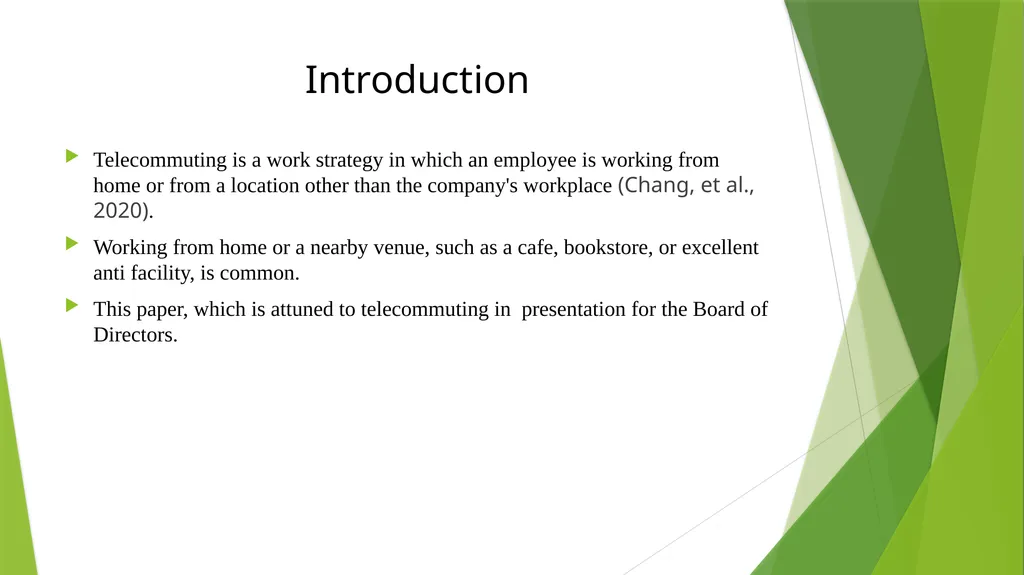
slide2. Introduction Telecommuting is a work strategy in which an employee is working from home or from a location other than the company's workplace (Chang, et al., 2020).
Working from home or a nearby venue, such as a cafe, bookstore, or excellent anti facility, is common.
This paper, which is attuned to telecommuting in presentation for the Board of Directors.<br>
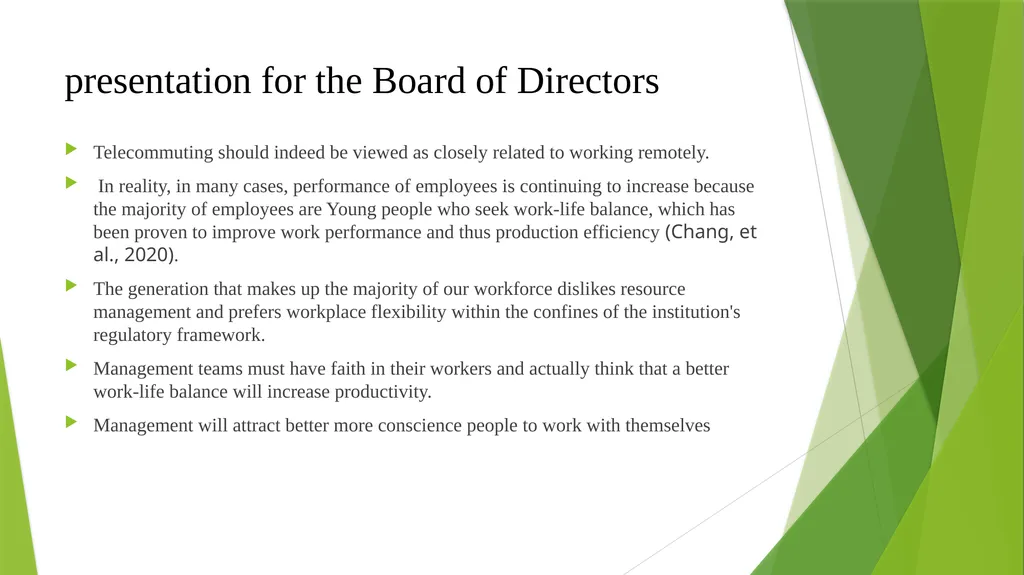
slide3. presentation for the Board of Directors Telecommuting should indeed be viewed as closely related to working remotely.
In reality, in many cases, performance of employees is continuing to increase because the majority of employees are Young people who seek work-life balance, which has been proven to improve work performance and thus production efficiency (Chang, et al., 2020).
The generation that makes up the majority of our workforce dislikes resource management and prefers workplace flexibility within the confines of the institution's regulatory framework.
Management teams must have faith in their workers and actually think that a better work-life balance will increase productivity.
Management will attract better more conscience people to work with themselves<br>
slide4. Continuation The strategic plan must be objectively developed, with a weighting system based on task completion.
Proficiency evaluations should be conducted on a regular basis, and they should be constructed in a completely objective manner to eliminate any potential for bias among those that visit the office.
Everybody has equal access to training and advancement chances, and thus more professional development packages should be offered.<br>
slide5. Continuation In benefits such as reduced workplace and operating costs, there would be substantial cost reductions.
Trying to squeeze a few percent interest out of slow, strained, and misdirected operations wouldn't be enough to keep a strategic advantage in this chaotic market (Nayak, & Pandit 2020).
Forward-thinking insurance companies have engaged on a far more radical shift in management and strategic capacities.<br>
slide6. Continuation The five actions outlined here focus on optimizing rather than eliminating costs to guarantee that your company continues to thrive and achieves its full potential.
First, begin with the strategy. Secondly, align expenses to strategy.
Third, aim for the stars.
Set the tone and lead by example
Create a cost-cutting culture: Make sure you instill a sense of accountability and reward continual improvement.<br>
slide7. Continuation
If you get this right, you'll reap huge benefits on both the top and bottom lines.
Your company will be more distinctive and capable of achieving its goals.
Because resources are focused on high-earning, high-growth businesses, you'll become less dependent on marketing to keep up with the competition.
You risk becoming left adrift if you don't have a clear understanding of which costs to preserve and others to cut.<br>
slide8. Worker satisfaction is higher You might be amazed to realize that 83 percent of those polled believe that working from home makes them happy.
This is because telecommute has been shown to improve employee work satisfaction for a myriad of purposes.
First, because no one is interrupting employees from completing their tasks, they are more likely to be fully involved and excitable.
Telecommuters have more flexibility in their work schedules, which encourages them to stay longer.<br>
slide9. A more favorable work-life equilibrium Teleworking employees are able to do more in less time because they can concentrate on the subject at hand rather than small disruptions found in an office environment (Chang, et al., 2020).
They might devote their workweek in concentrated chunks of time instead of just being tugged in various places, which may help them finish more quickly.
This gives them more time in their day to devote to personal things that they might not have had capacity to pursue normally.
All of this free time allows employees to achieve an improved employee balancing, resulting in satisfied and efficient employees.<br>
slide10. References Bagley, P. L., Dalton, D. W., Eller, C. K., & Harp, N. L. (2020). Preparing students for the future of work: Lessons learned from telecommuting in public accounting. Journal of Accounting Education, 56, 100728.
Chang, Y., Chien, C., & Shen, L. F. (2020). Telecommuting during the coronavirus pandemic: Future time orientation as a mediator between proactive coping and perceived work productivity in two cultural samples. Personality and individual differences, 171, 110508.
Frakes, M. D., & Wasserman, M. F. (2020). Knowledge spillovers, peer effects, and telecommuting: Evidence from the US Patent Office. Journal of Public Economics, 198, 104425.
Nayak, S., & Pandit, D. (2020). Potential of telecommuting for different employees in the Indian context beyond COVID-19 lockdown. Transport Policy.<br>
Student Name
Instructor Name
Course
Date<br>
slide2. Introduction Telecommuting is a work strategy in which an employee is working from home or from a location other than the company's workplace (Chang, et al., 2020).
Working from home or a nearby venue, such as a cafe, bookstore, or excellent anti facility, is common.
This paper, which is attuned to telecommuting in presentation for the Board of Directors.<br>
slide3. presentation for the Board of Directors Telecommuting should indeed be viewed as closely related to working remotely.
In reality, in many cases, performance of employees is continuing to increase because the majority of employees are Young people who seek work-life balance, which has been proven to improve work performance and thus production efficiency (Chang, et al., 2020).
The generation that makes up the majority of our workforce dislikes resource management and prefers workplace flexibility within the confines of the institution's regulatory framework.
Management teams must have faith in their workers and actually think that a better work-life balance will increase productivity.
Management will attract better more conscience people to work with themselves<br>
slide4. Continuation The strategic plan must be objectively developed, with a weighting system based on task completion.
Proficiency evaluations should be conducted on a regular basis, and they should be constructed in a completely objective manner to eliminate any potential for bias among those that visit the office.
Everybody has equal access to training and advancement chances, and thus more professional development packages should be offered.<br>
slide5. Continuation In benefits such as reduced workplace and operating costs, there would be substantial cost reductions.
Trying to squeeze a few percent interest out of slow, strained, and misdirected operations wouldn't be enough to keep a strategic advantage in this chaotic market (Nayak, & Pandit 2020).
Forward-thinking insurance companies have engaged on a far more radical shift in management and strategic capacities.<br>
slide6. Continuation The five actions outlined here focus on optimizing rather than eliminating costs to guarantee that your company continues to thrive and achieves its full potential.
First, begin with the strategy. Secondly, align expenses to strategy.
Third, aim for the stars.
Set the tone and lead by example
Create a cost-cutting culture: Make sure you instill a sense of accountability and reward continual improvement.<br>
slide7. Continuation
If you get this right, you'll reap huge benefits on both the top and bottom lines.
Your company will be more distinctive and capable of achieving its goals.
Because resources are focused on high-earning, high-growth businesses, you'll become less dependent on marketing to keep up with the competition.
You risk becoming left adrift if you don't have a clear understanding of which costs to preserve and others to cut.<br>
slide8. Worker satisfaction is higher You might be amazed to realize that 83 percent of those polled believe that working from home makes them happy.
This is because telecommute has been shown to improve employee work satisfaction for a myriad of purposes.
First, because no one is interrupting employees from completing their tasks, they are more likely to be fully involved and excitable.
Telecommuters have more flexibility in their work schedules, which encourages them to stay longer.<br>
slide9. A more favorable work-life equilibrium Teleworking employees are able to do more in less time because they can concentrate on the subject at hand rather than small disruptions found in an office environment (Chang, et al., 2020).
They might devote their workweek in concentrated chunks of time instead of just being tugged in various places, which may help them finish more quickly.
This gives them more time in their day to devote to personal things that they might not have had capacity to pursue normally.
All of this free time allows employees to achieve an improved employee balancing, resulting in satisfied and efficient employees.<br>
slide10. References Bagley, P. L., Dalton, D. W., Eller, C. K., & Harp, N. L. (2020). Preparing students for the future of work: Lessons learned from telecommuting in public accounting. Journal of Accounting Education, 56, 100728.
Chang, Y., Chien, C., & Shen, L. F. (2020). Telecommuting during the coronavirus pandemic: Future time orientation as a mediator between proactive coping and perceived work productivity in two cultural samples. Personality and individual differences, 171, 110508.
Frakes, M. D., & Wasserman, M. F. (2020). Knowledge spillovers, peer effects, and telecommuting: Evidence from the US Patent Office. Journal of Public Economics, 198, 104425.
Nayak, S., & Pandit, D. (2020). Potential of telecommuting for different employees in the Indian context beyond COVID-19 lockdown. Transport Policy.<br>