
Thank you for using this resource. We hope it
TF
Published · 31 slides · 0 views

1 / 1

Description
Thank you for using this resource. We hope it helps you, and your pupils! This advice may help. PowerPoints cover more than one lesson The PowerPoint presentation matches a section in the planning provided for this unit of work. This is
Related Topics
Share
Embed code
Download this presentation From Below
"Thank you for using this resource. We hope it" is the property of its rightful owner. Permission is granted to download and print the materials on this website for personal, non-commercial use only, and to display it on your personal computer provided you do not modify the materials and that you retain all copyright notices contained in the materials. By downloading content from our website, you accept the terms of this agreement.
Presentation Transcript
01
Thank you for using this resource. We hope it helps you, and your pupils! This advice may help.
PowerPoints cover more than one lesson
The PowerPoint presentation matches a section in the planning provided for this unit of work. This is likely to contain material for more than one lesson. It is important not to speed through the slides without completing suggested activities or discussion. Most sections in the planning, and the matching PowerPoints, will cover two lessons.
Please make sure you prepare and plan with staff
It is critical that delivery, style and speed reflect the needs and responses of pupils. The resource has been designed to support teachers, not to replace you! If this resource is provided as supporting material for HLTAs, cover teachers or non-specialists please ensure you prepare them carefully and plan with them.
We recommend you use the detailed planning as well as this PowerPoint
This PowerPoint is designed to be used with the detailed planning written to support the RE syllabus ‘Believing and Belonging’. We strongly recommend that you use the PowerPoint in conjunction with the planning. Please ask us how to access this if you do not have it.
To feed back and for further support and to access webinar training please email enquiries@penninelearning.com. Dear Teacher…<br>
02
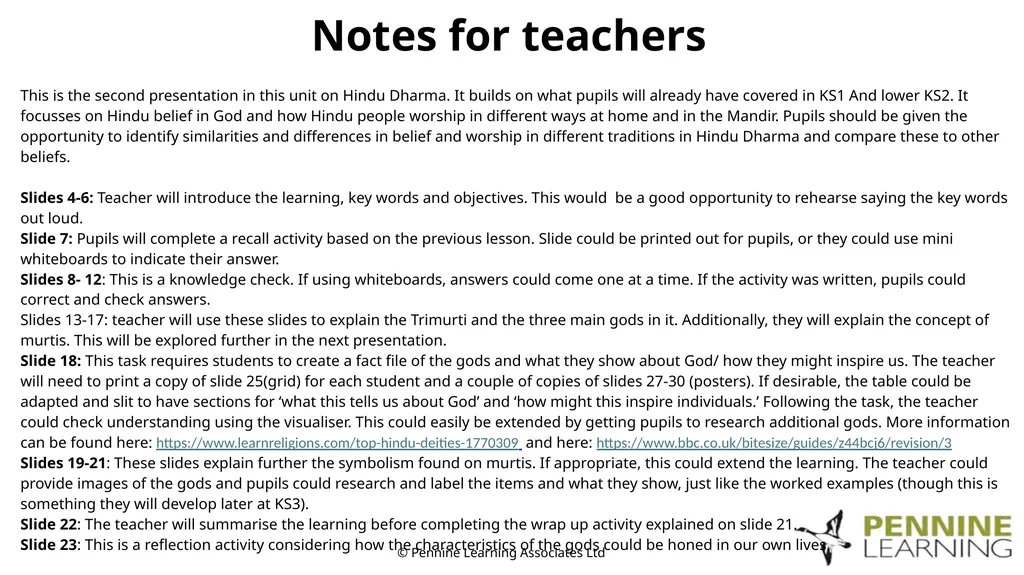
This is the second presentation in this unit on Hindu Dharma. It builds on what pupils will already have covered in KS1 And lower KS2. It focusses on Hindu belief in God and how Hindu people worship in different ways at home and in the Mandir. Pupils should be given the opportunity to identify similarities and differences in belief and worship in different traditions in Hindu Dharma and compare these to other beliefs.
Slides 4-6: Teacher will introduce the learning, key words and objectives. This would be a good opportunity to rehearse saying the key words out loud.
Slide 7: Pupils will complete a recall activity based on the previous lesson. Slide could be printed out for pupils, or they could use mini whiteboards to indicate their answer.
Slides 8- 12: This is a knowledge check. If using whiteboards, answers could come one at a time. If the activity was written, pupils could correct and check answers.
Slides 13-17: teacher will use these slides to explain the Trimurti and the three main gods in it. Additionally, they will explain the concept of murtis. This will be explored further in the next presentation.
Slide 18: This task requires students to create a fact file of the gods and what they show about God/ how they might inspire us. The teacher will need to print a copy of slide 25(grid) for each student and a couple of copies of slides 27-30 (posters). If desirable, the table could be adapted and slit to have sections for ‘what this tells us about God’ and ‘how might this inspire individuals.’ Following the task, the teacher could check understanding using the visualiser. This could easily be extended by getting pupils to research additional gods. More information can be found here: https://www.learnreligions.com/top-hindu-deities-1770309 and here: https://www.bbc.co.uk/bitesize/guides/z44bcj6/revision/3
Slides 19-21: These slides explain further the symbolism found on murtis. If appropriate, this could extend the learning. The teacher could provide images of the gods and pupils could research and label the items and what they show, just like the worked examples (though this is something they will develop later at KS3).
Slide 22: The teacher will summarise the learning before completing the wrap up activity explained on slide 21.
Slide 23: This is a reflection activity considering how the characteristics of the gods could be honed in our own lives. Notes for teachers<br>
03
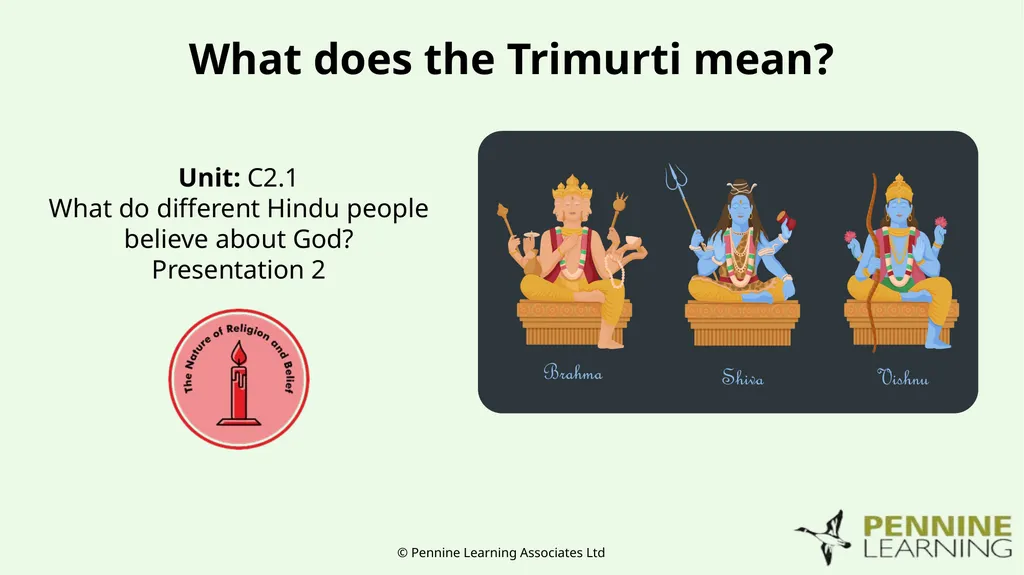
What does the Trimurti mean? Unit: C2.1
What do different Hindu people believe about God?
Presentation 2<br>
What do different Hindu people believe about God?
Presentation 2<br>
04
Key Stage 2
Through investigating the Nature of Religion and Belief, pupils should learn that:
The terms ‘religion' or 'worldview' represent an overall approach to life including beliefs, practices, values and identity.
Within each there is diversity in beliefs and practices.
There are reasons why some aspects have stayed the same and others have changed. How this presentation links to the pathway:
In this presentation you will be learning about the Trimurti in Hinduism and that it is like a superhero team. You will discover how Hindus use Murti to represent different forms of God, and that each Murti is personal to individuals. Pathway 1: The Nature of Religion and Belief<br>
05
Learning objectives To understand the concept of the Trimurti To describe how Hindu murtis show different aspects of God<br>
06
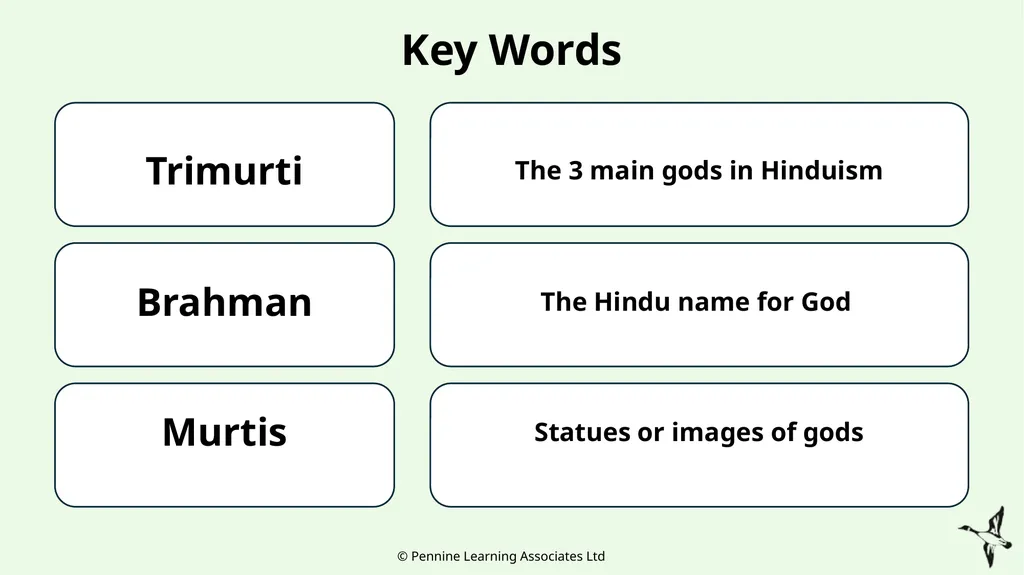
Key Words Brahman The Hindu name for God Murtis Statues or images of gods<br>
07
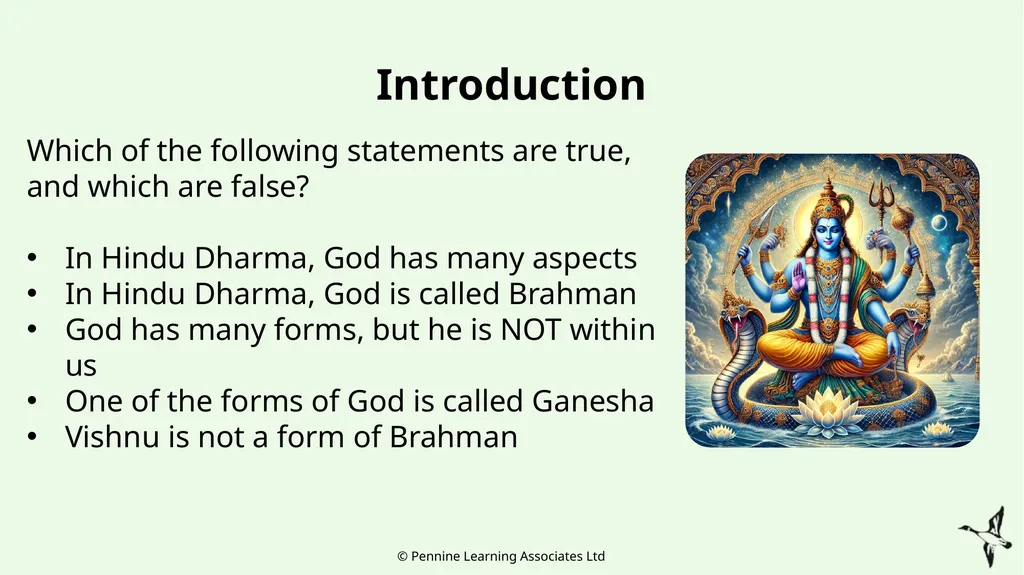
Introduction Which of the following statements are true, and which are false?
In Hindu Dharma, God has many aspects
In Hindu Dharma, God is called Brahman
God has many forms, but he is NOT within us
One of the forms of God is called Ganesha
Vishnu is not a form of Brahman<br>
In Hindu Dharma, God has many aspects
In Hindu Dharma, God is called Brahman
God has many forms, but he is NOT within us
One of the forms of God is called Ganesha
Vishnu is not a form of Brahman<br>
08
Knowledge Check In Hinduism, God has many aspects This is true. There are over 300,00 different forms of Brahman!<br>
09
Knowledge Check In Hindu Dharma, God is called Brahman This is true. The Hindu name for God (the ultimate reality) is Brahman!<br>
10
Knowledge Check God has many forms, but he is not within us This is false because of the Hindu idea about paramatma. God is in all living things.<br>
11
Knowledge Check One of the forms of God is called Ganesha This is true! Ganesha is a god who helps us removes barriers and obstacles.<br>
12
Knowledge Check Vishnu is not a form of Brahman This is false. Vishnu is a form of Brahman. He is part of the Trimurti which we will be learning about today.<br>
13
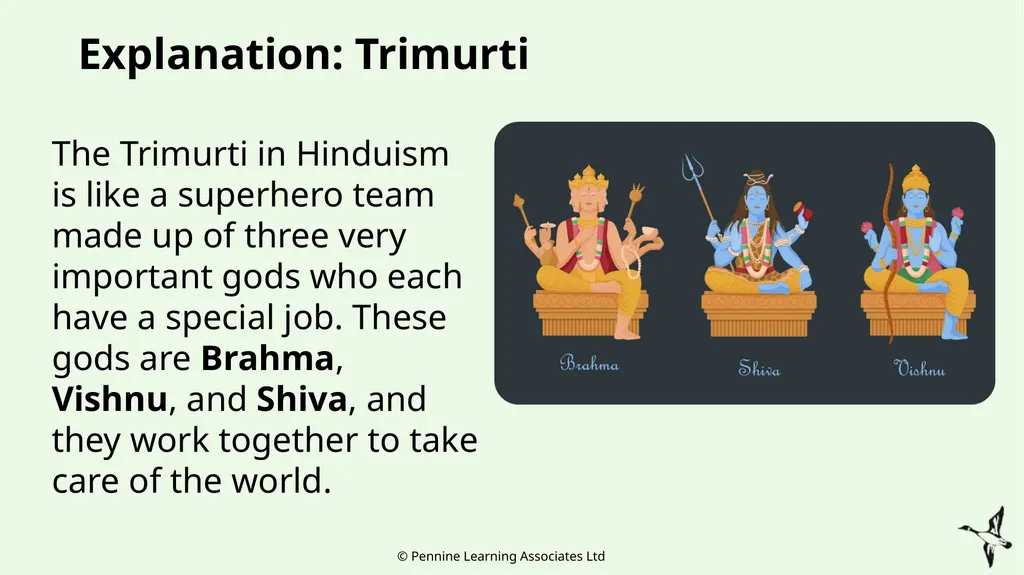
Explanation: Trimurti The Trimurti in Hinduism is like a superhero team made up of three very important gods who each have a special job. These gods are Brahma, Vishnu, and Shiva, and they work together to take care of the world.<br>
14
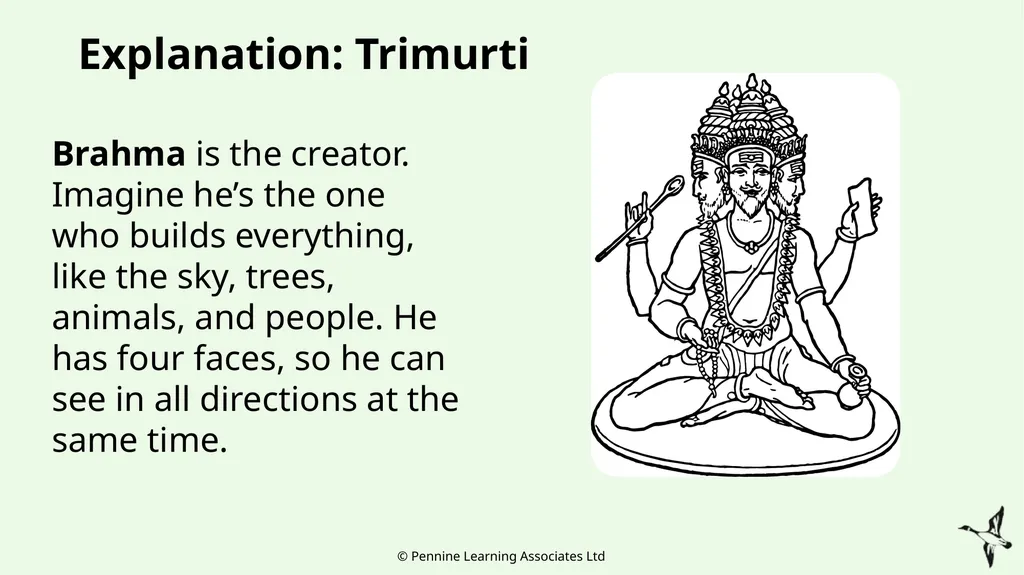
Explanation: Trimurti Brahma is the creator. Imagine he’s the one who builds everything, like the sky, trees, animals, and people. He has four faces, so he can see in all directions at the same time.<br>
15
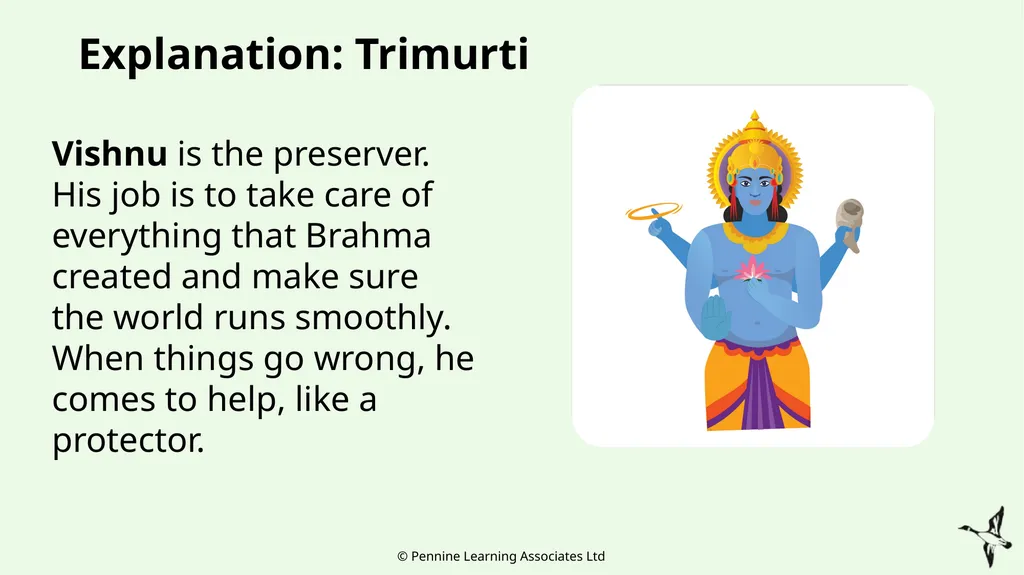
Explanation: Trimurti Vishnu is the preserver. His job is to take care of everything that Brahma created and make sure the world runs smoothly. When things go wrong, he comes to help, like a protector.<br>
16
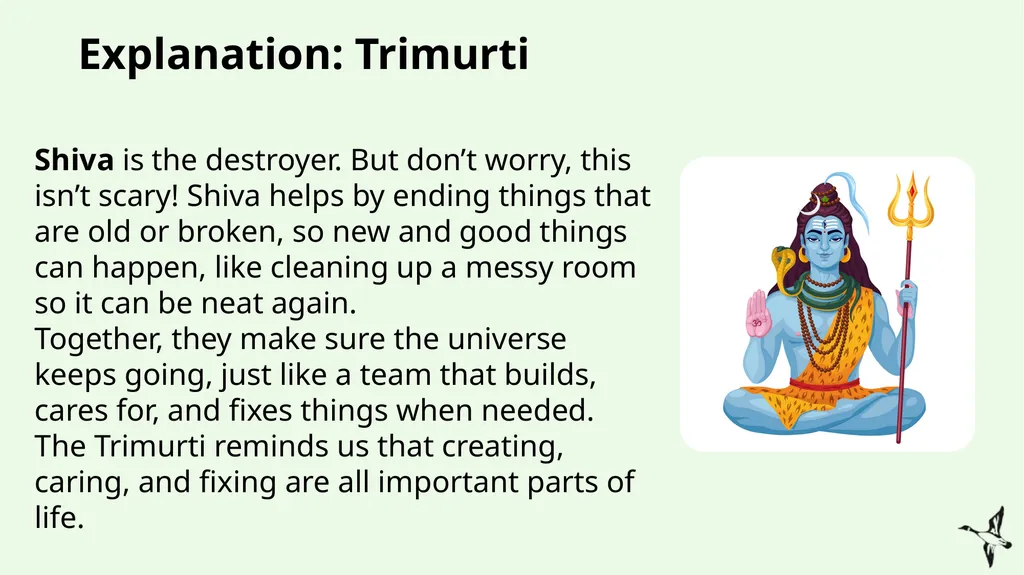
Explanation: Trimurti Shiva is the destroyer. But don’t worry, this isn’t scary! Shiva helps by ending things that are old or broken, so new and good things can happen, like cleaning up a messy room so it can be neat again.
Together, they make sure the universe keeps going, just like a team that builds, cares for, and fixes things when needed. The Trimurti reminds us that creating, caring, and fixing are all important parts of life.<br>
Together, they make sure the universe keeps going, just like a team that builds, cares for, and fixes things when needed. The Trimurti reminds us that creating, caring, and fixing are all important parts of life.<br>
17
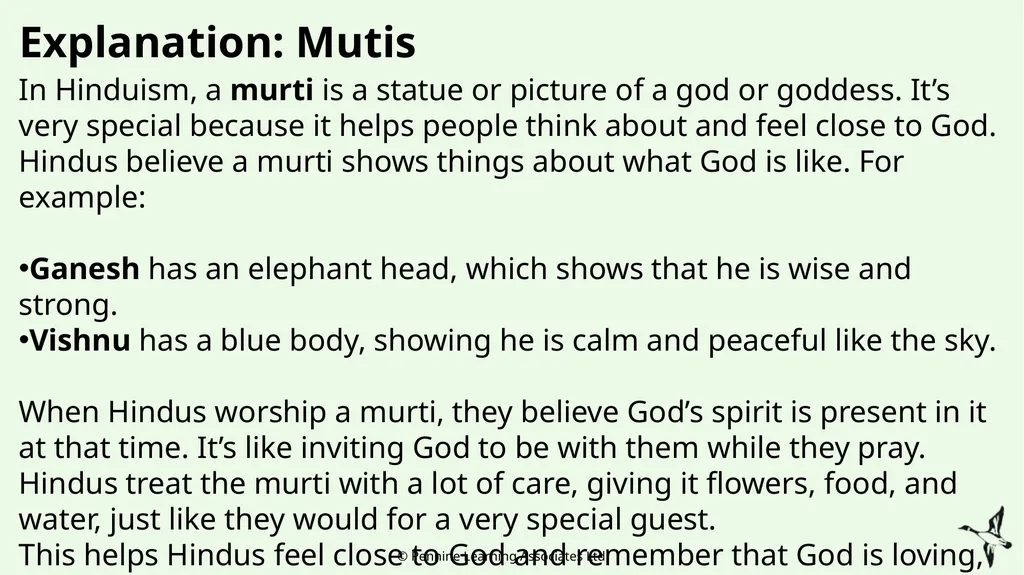
Explanation: Mutis In Hinduism, a murti is a statue or picture of a god or goddess. It’s very special because it helps people think about and feel close to God. Hindus believe a murti shows things about what God is like. For example:
Ganesh has an elephant head, which shows that he is wise and strong.
Vishnu has a blue body, showing he is calm and peaceful like the sky.
When Hindus worship a murti, they believe God’s spirit is present in it at that time. It’s like inviting God to be with them while they pray. Hindus treat the murti with a lot of care, giving it flowers, food, and water, just like they would for a very special guest.
This helps Hindus feel close to God and remember that God is loving, kind, and always near them.<br>
18
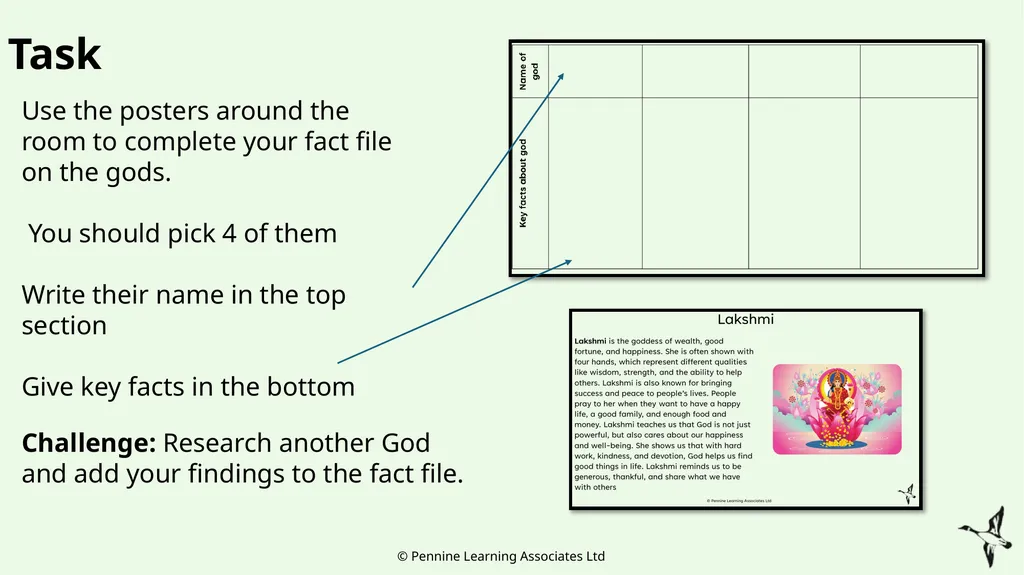
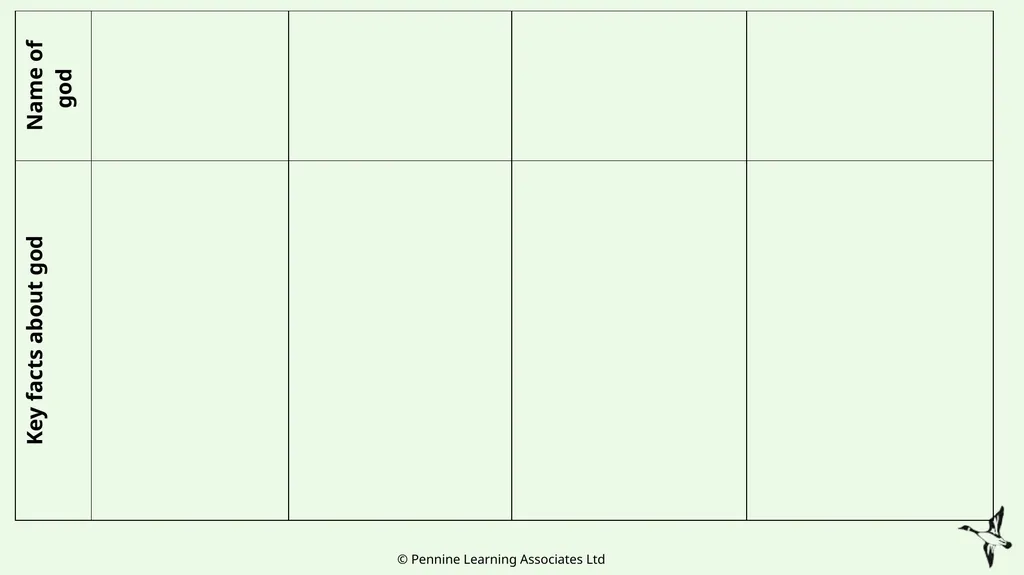
Task Use the posters around the room to complete your fact file on the gods.
You should pick 4 of them
Write their name in the top section
Give key facts in the bottom Challenge: Research another God and add your findings to the fact file.<br>
You should pick 4 of them
Write their name in the top section
Give key facts in the bottom Challenge: Research another God and add your findings to the fact file.<br>
19
Explanation: Trimurti While each of the gods tells us something about God, the items held by each murti tell us even more!
Here are some examples!<br>
Here are some examples!<br>
20
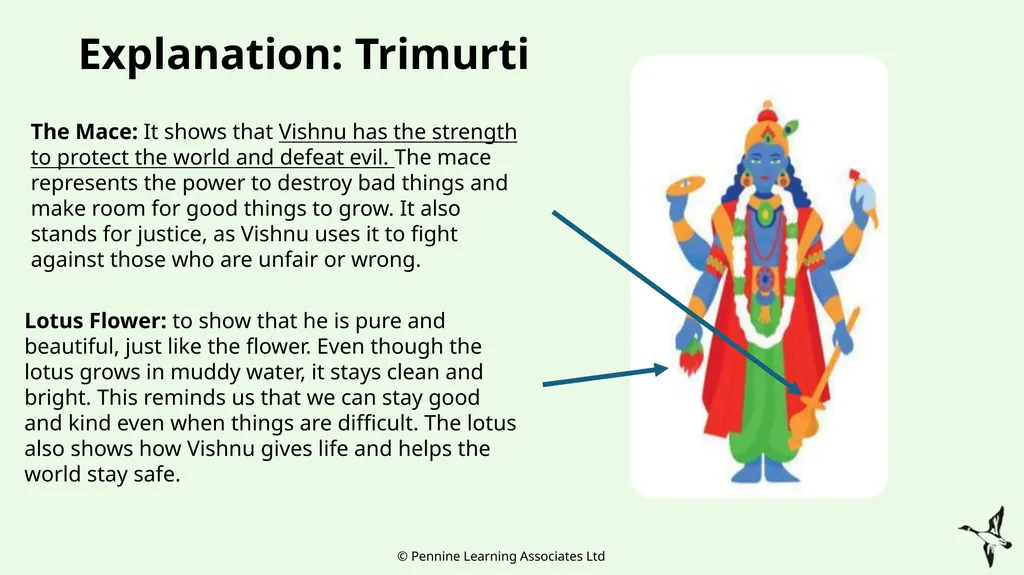
Explanation: Trimurti The Mace: It shows that Vishnu has the strength to protect the world and defeat evil. The mace represents the power to destroy bad things and make room for good things to grow. It also stands for justice, as Vishnu uses it to fight against those who are unfair or wrong. Lotus Flower: to show that he is pure and beautiful, just like the flower. Even though the lotus grows in muddy water, it stays clean and bright. This reminds us that we can stay good and kind even when things are difficult. The lotus also shows how Vishnu gives life and helps the world stay safe.<br>
21
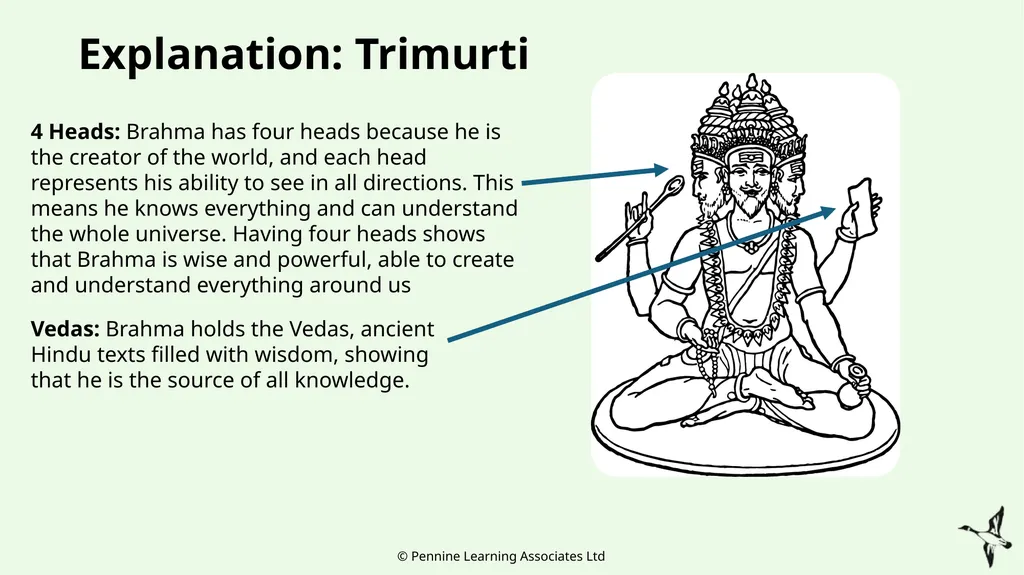
Explanation: Trimurti 4 Heads: Brahma has four heads because he is the creator of the world, and each head represents his ability to see in all directions. This means he knows everything and can understand the whole universe. Having four heads shows that Brahma is wise and powerful, able to create and understand everything around us Vedas: Brahma holds the Vedas, ancient Hindu texts filled with wisdom, showing that he is the source of all knowledge.<br>
22
Learning summary The main three forms of God are found in the Trimurti (Brahma, Vishnu and Shiva) Each of the gods reveals something about what God is like Murtis are images of God. They are used in worship and also show us what God is like<br>
23
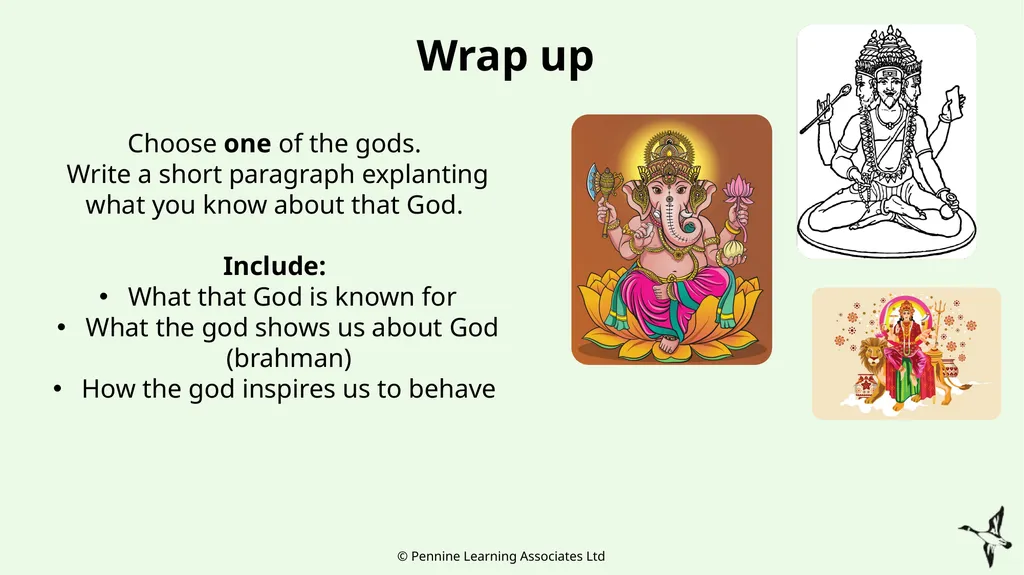
Wrap up Choose one of the gods.
Write a short paragraph explanting what you know about that God.
Include:
What that God is known for
What the god shows us about God (brahman)
How the god inspires us to behave<br>
Write a short paragraph explanting what you know about that God.
Include:
What that God is known for
What the god shows us about God (brahman)
How the god inspires us to behave<br>
24
What qualities/ characteristics did you most like about the gods we have studied?
Which ones might you like to grow in your life?<br>
Which ones might you like to grow in your life?<br>
25
Acknowledgments All images are from vecteezy or AI generated by Jake Womack<br>
26
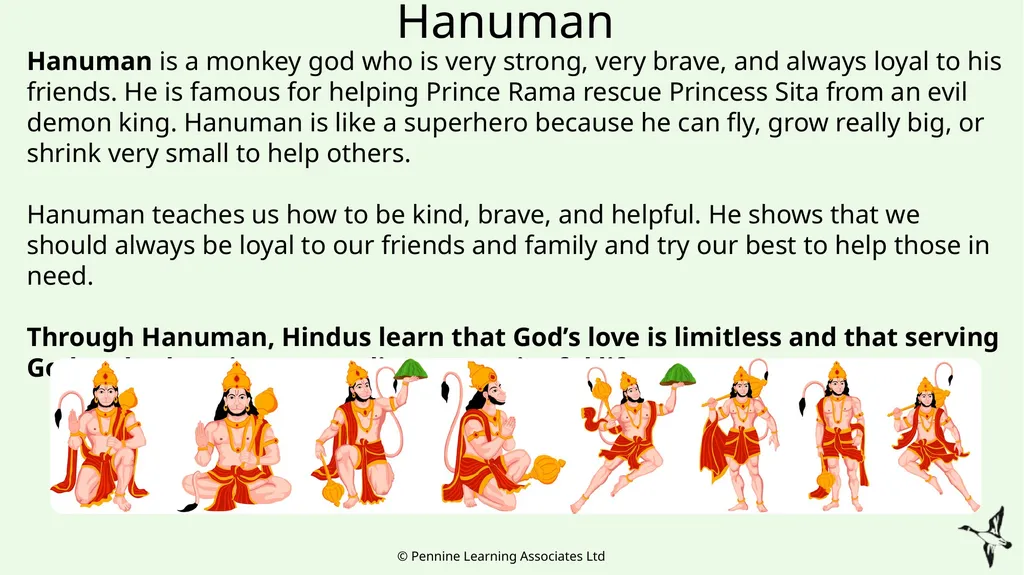
Hanuman Hanuman is a monkey god who is very strong, very brave, and always loyal to his friends. He is famous for helping Prince Rama rescue Princess Sita from an evil demon king. Hanuman is like a superhero because he can fly, grow really big, or shrink very small to help others.
Hanuman teaches us how to be kind, brave, and helpful. He shows that we should always be loyal to our friends and family and try our best to help those in need.
Through Hanuman, Hindus learn that God’s love is limitless and that serving God and others is a way to live a meaningful life<br>
Hanuman teaches us how to be kind, brave, and helpful. He shows that we should always be loyal to our friends and family and try our best to help those in need.
Through Hanuman, Hindus learn that God’s love is limitless and that serving God and others is a way to live a meaningful life<br>
27
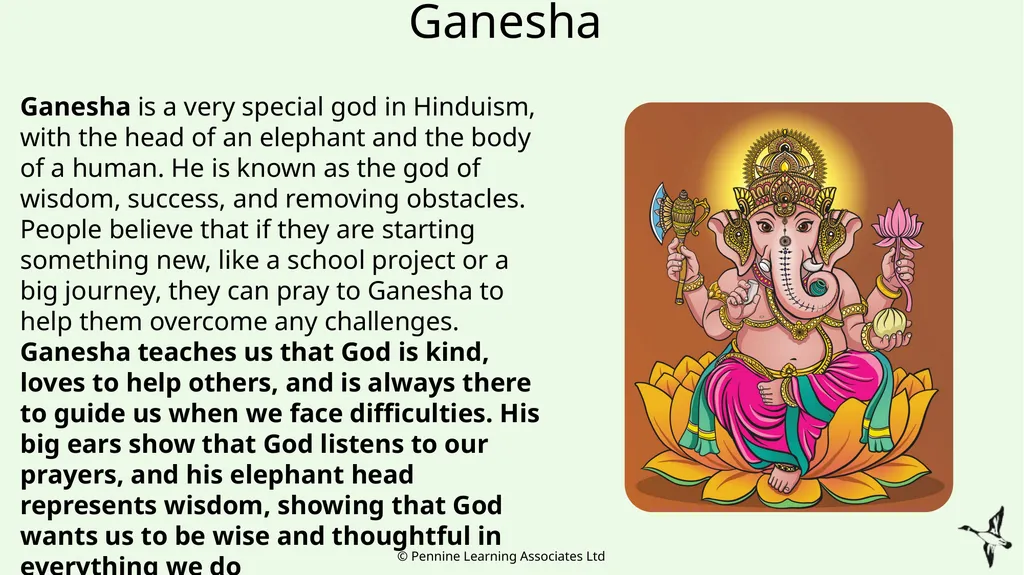
Ganesha Ganesha is a very special god in Hinduism, with the head of an elephant and the body of a human. He is known as the god of wisdom, success, and removing obstacles. People believe that if they are starting something new, like a school project or a big journey, they can pray to Ganesha to help them overcome any challenges. Ganesha teaches us that God is kind, loves to help others, and is always there to guide us when we face difficulties. His big ears show that God listens to our prayers, and his elephant head represents wisdom, showing that God wants us to be wise and thoughtful in everything we do<br>
28
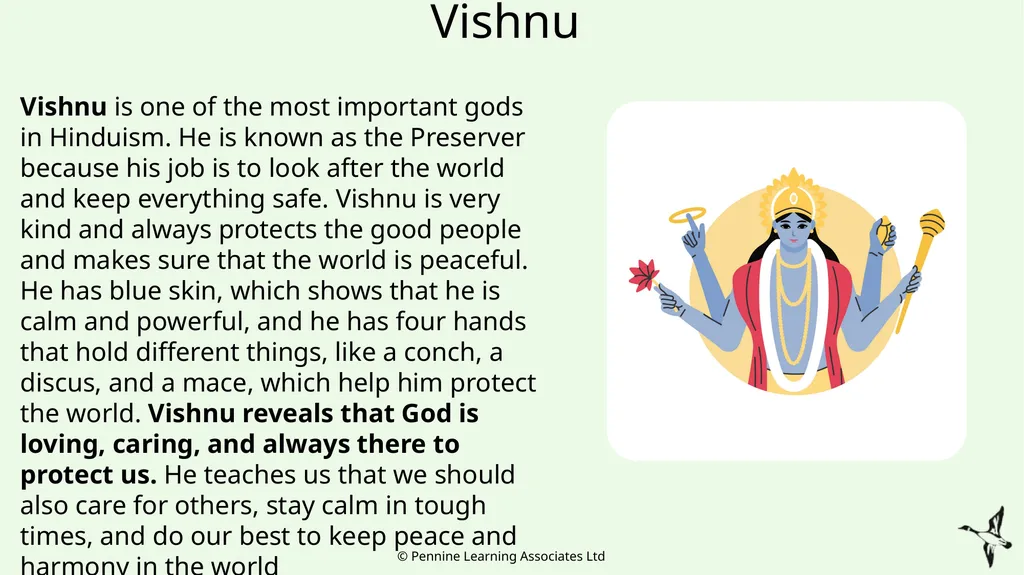
Vishnu Vishnu is one of the most important gods in Hinduism. He is known as the Preserver because his job is to look after the world and keep everything safe. Vishnu is very kind and always protects the good people and makes sure that the world is peaceful. He has blue skin, which shows that he is calm and powerful, and he has four hands that hold different things, like a conch, a discus, and a mace, which help him protect the world. Vishnu reveals that God is loving, caring, and always there to protect us. He teaches us that we should also care for others, stay calm in tough times, and do our best to keep peace and harmony in the world<br>
29
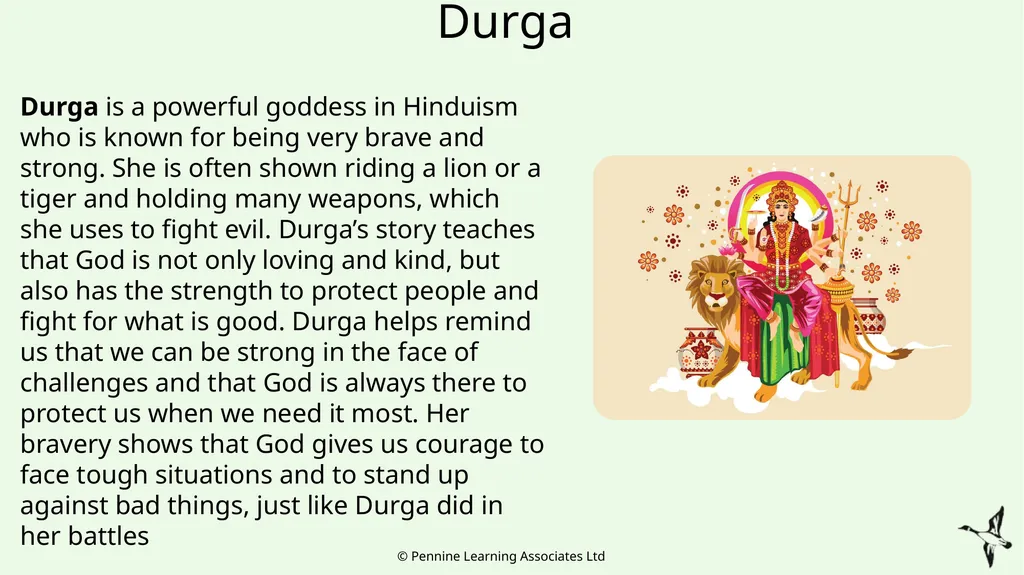
Durga Durga is a powerful goddess in Hinduism who is known for being very brave and strong. She is often shown riding a lion or a tiger and holding many weapons, which she uses to fight evil. Durga’s story teaches that God is not only loving and kind, but also has the strength to protect people and fight for what is good. Durga helps remind us that we can be strong in the face of challenges and that God is always there to protect us when we need it most. Her bravery shows that God gives us courage to face tough situations and to stand up against bad things, just like Durga did in her battles<br>
30
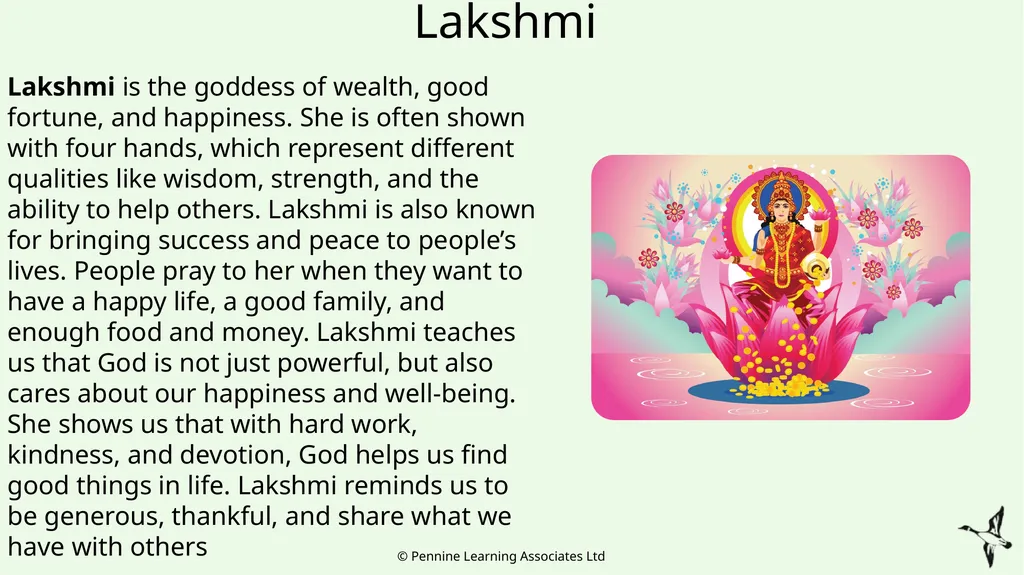
Lakshmi Lakshmi is the goddess of wealth, good fortune, and happiness. She is often shown with four hands, which represent different qualities like wisdom, strength, and the ability to help others. Lakshmi is also known for bringing success and peace to people’s lives. People pray to her when they want to have a happy life, a good family, and enough food and money. Lakshmi teaches us that God is not just powerful, but also cares about our happiness and well-being. She shows us that with hard work, kindness, and devotion, God helps us find good things in life. Lakshmi reminds us to be generous, thankful, and share what we have with others<br>