
Thank you for using this resource. We hope it








Description: Thank you for using this resource. We hope it helps you, and your pupils! This advice may help. PowerPoints cover more than one lesson The PowerPoint presentation matches a section in the planning provided for this unit of work. This is
Related Topics
Download Presentation
"Thank you for using this resource. We hope it" is the property of its rightful owner. Permission is granted to download and print the materials on this website for personal, non-commercial use only, and to display it on your personal computer provided you do not modify the materials and that you retain all copyright notices contained in the materials. By downloading content from our website, you accept the terms of this agreement.
Presentation Transcript
slide1. Thank you for using this resource. We hope it helps you, and your pupils! This advice may help.
PowerPoints cover more than one lesson
The PowerPoint presentation matches a section in the planning provided for this unit of work. This is likely to contain material for more than one lesson. It is important not to speed through the slides without completing suggested activities or discussion. Most sections in the planning, and the matching PowerPoints, will cover two lessons.
Please make sure you prepare and plan with staff
It is critical that delivery, style and speed reflect the needs and responses of pupils. The resource has been designed to support teachers, not to replace you! If this resource is provided as supporting material for HLTAs, cover teachers or non-specialists, please ensure you prepare them carefully and plan with them.
We recommend you use the detailed planning as well as this PowerPoint
This PowerPoint is designed to be used with the detailed planning written to support the RE syllabus ‘Believing and Belonging’. We strongly recommend that you use the PowerPoint in conjunction with the planning. Please ask us how to access this if you do not have it.
To feed back and for further support and to access webinar training please email enquiries@penninelearning.com. Dear Teacher…<br>
slide2. Where this lesson fits: Children will now have an understanding about the beauty of the natural world through an outdoor senses walk. They will also have a knowledge of the Christian, Jewish and Muslim viewpoints around the creation story and the similarities between these religions linked to beliefs about creation. This presentation looks at a Hindu creation story.
Further enrichment: The unit will be enriched by various visitors into school detailing their beliefs about creation, being thankful for the world and how they help to look after our world. In this lesson a Hindu visitor could be invited into school to share their beliefs and stories about creation and how they look after our world.
A Faith Visits Directory for West Yorkshire can be found at https://www.penninelearning.com/resources/
Possible misconceptions: Sensitivity is needed when teaching because different pupils and their families will have different beliefs and ideas about the creation of the world.
Points to note: Children will be learning about tolerance and understanding of different beliefs and ideas around creation.
Sensitivity: please be respectful when using religious artefacts in class to show the respect given to each item from its religion and religious followers.
Sensitivity: Take care sharing the creation story, ensure that more sensitive children are supported in their understanding of Shiva’s role in the Hindu story of creation at the end of the clip. Notes for teachers<br>
slide3. Resources needed: see slide 4 for books and resources ideas.
Further lesson notes and additional ideas may be found in the notes section of some slides (normal or presenter view). Please refer to the full unit plan for more activities and resources.
Religious Education in Early Years settings: Activities may be adapted to suit Reception and Nursery settings. See the full unit plan for links to Early Learning Goals and a full range of ideas for adult-led and independent activities. Further advice about planning for RE in EYFS can be found in the RE syllabus, Believing and Belonging (p 20 – 23). Notes for teachers<br>
slide4. Slide 10-11: Have some Hindu artefacts in class, Hindu images, Hindu deities, singing bowls, hand chime/chime bars. Practise the ‘Aum’ sound.
Hindu Aum, singing bowls and sound meditation practices to try
https://www.youtube.com/watch?v=Cmn1QVhgtlg
https://www.youtube.com/watch?v=sNOdOx2Ztyc – best children’s video
https://www.youtube.com/watch?v=8oNU3_mSF04
https://www.youtube.com/watch?v=atgRGOBa1Bw
Slide 12: Pictures of Hindu Gods and artefacts relating to these. In particular Brahma, Vishnu, Shiva.
Slide 13: Watch a Hindu Creation story – notice the ‘Aum’ at the beginning of the universe.
https://www.youtube.com/watch?v=pfy0jKaxBFs (see sensitivity notes on slide 2). Notes for teachers<br>
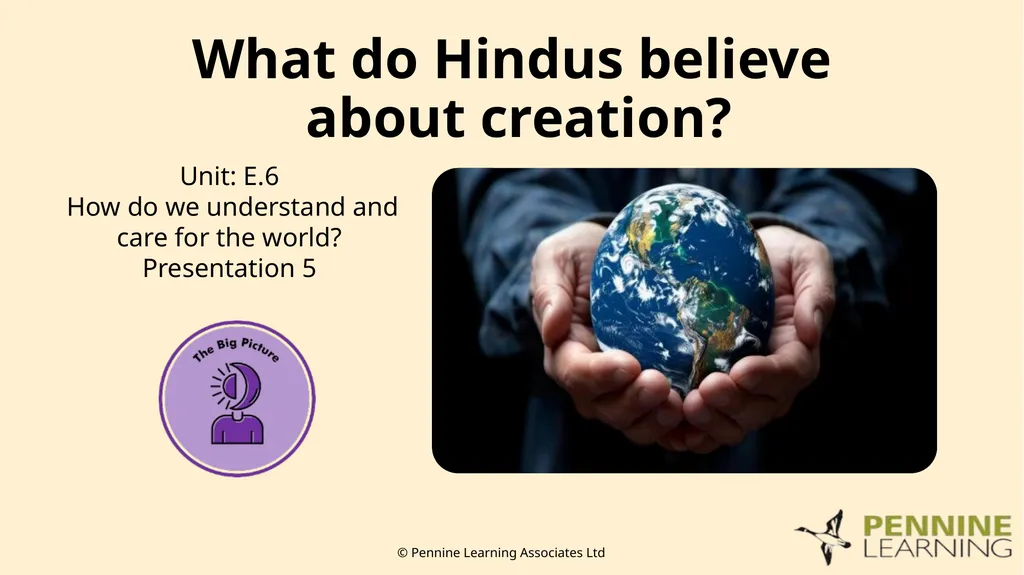
slide5. Unit: E.6
How do we understand and care for the world?
Presentation 5 What do Hindus believe about creation?<br>
slide6. How this presentation links to the pathway:
This presentation explores a Hindu story of creation and the Hindu deities who are a part of the story. It continues to develop a sense of awe and wonder at the natural world in pupils. Hinduism has several creation stories; one example is examined in this presentation. Early Years
Through considering the Big Picture, children should learn that:
Stories, including religious stories, can help them to talk about some of the big questions of life.
Many of these stories are well-known as they have been handed down over generations. Pathway 6: The Big Picture<br>
slide7. Notice some sounds and images
in relation to this Hindu creation story Listen to and explore a Hindu creation story Learning objectives<br>
slide8. Key words<br>
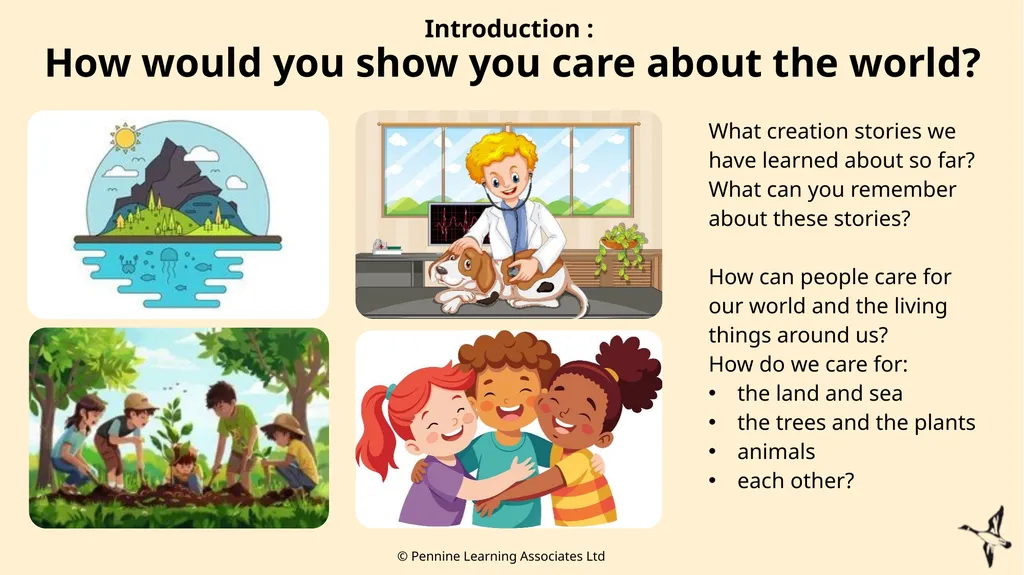
slide9. What creation stories we have learned about so far?
What can you remember about these stories?
How can people care for our world and the living things around us?
How do we care for:
the land and sea
the trees and the plants
animals
each other? Introduction : How would you show you care about the world?<br>
slide10. Look at the Hindu Aum symbol.
Try tracing the symbol in the air with your finger.
What do you think it means? Explanation: Hindu Aum symbol<br>
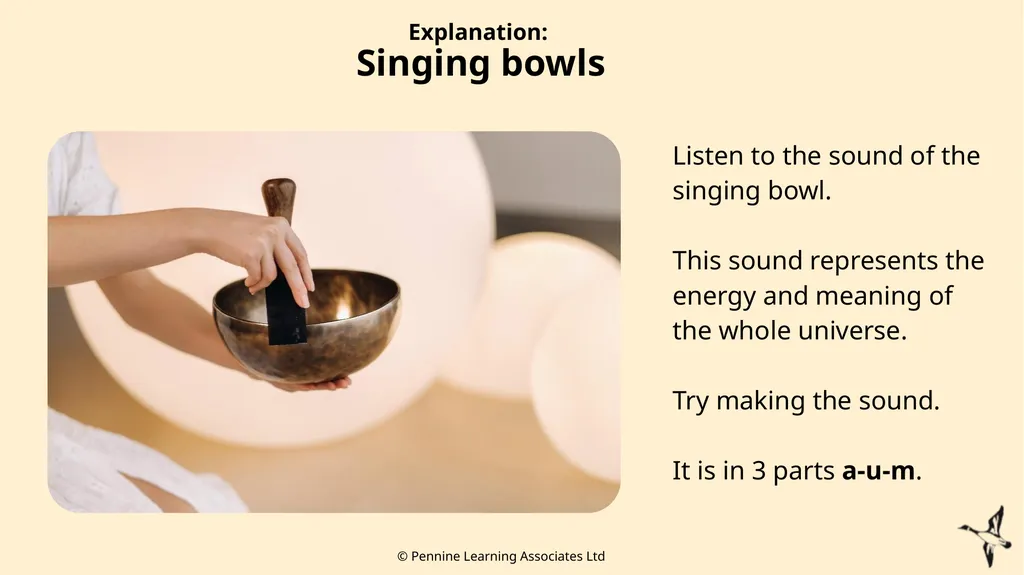
slide11. Listen to the sound of the singing bowl.
This sound represents the energy and meaning of the whole universe.
Try making the sound.
It is in 3 parts a-u-m. Explanation: Singing bowls<br>
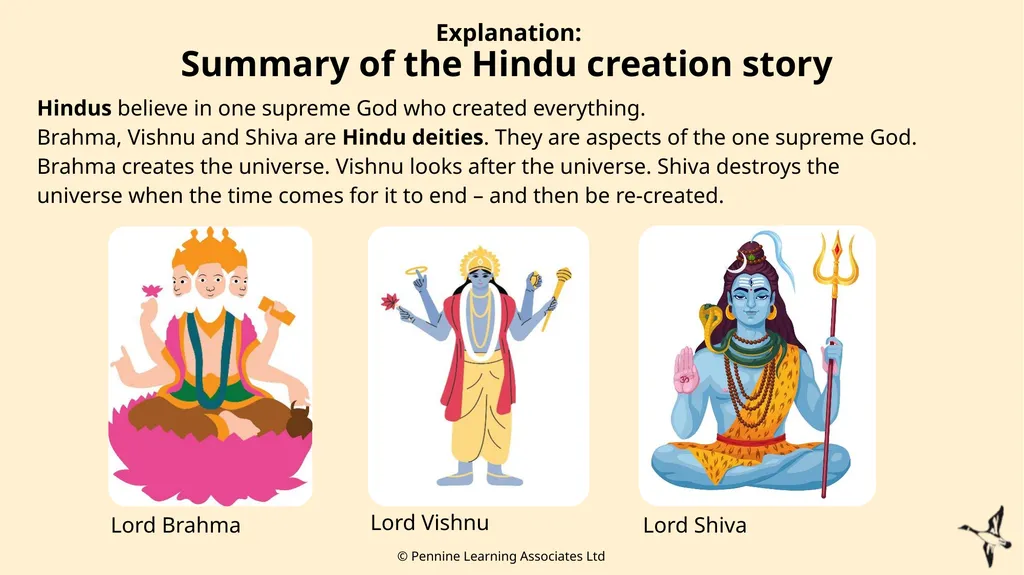
slide12. Look at pictures of the Hindu deities:
Brahma
Vishnu
Shiva.
What do you notice about them? Explanation: Listen to and explore the Hindu story of creation<br>
slide13. Now listen to and watch this Hindu story of creation.
Notice the ‘Aum’ sound at the beginning of the universe. Explanation: Listen to and explore the Hindu story of creation<br>
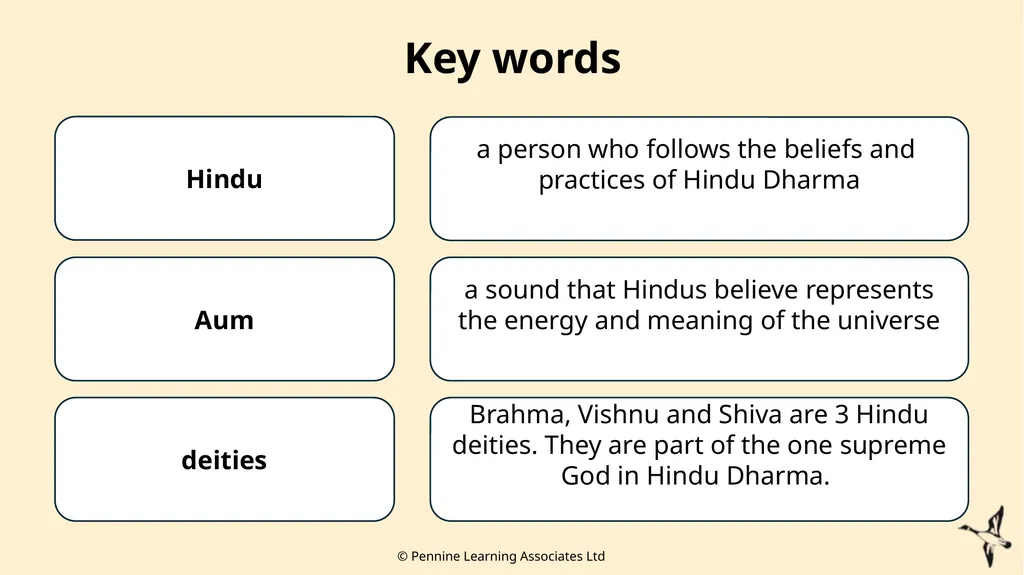
slide14. Lord Shiva Lord Vishnu Lord Brahma Hindus believe in one supreme God who created everything.
Brahma, Vishnu and Shiva are Hindu deities. They are aspects of the one supreme God.
Brahma creates the universe. Vishnu looks after the universe. Shiva destroys the universe when the time comes for it to end – and then be re-created. Explanation: Summary of the Hindu creation story<br>
slide15. Sequence pictures from the Hindu creation story and retell together
Create a storyboard/comic strip of the Hindu creation story
Read a child-friendly version of the story e.g. Tales from India. (Jamilla Gavin/Amanda Hall, published by Templar Publishing. ISBN-10: 1787410889). This book is aimed at older pupils. It may help to provide teacher knowledge of the story and be adaptable for younger pupils
Invite a Hindu visitor into school. Tasks: Adult-led<br>
slide16. Create paper lotus flowers.
Wonder at the natural world by drawing lotus flowers or other aspects of creation.
Create and add to a representation of the ‘Aum’ symbol using natural materials.
Take it deeper: throughout the unit pupils will ask or answer questions. Keep a record of these in a class book.
Suggested thinking point for this lesson: How does the Hindu understanding of creation use all the senses. Tasks: Independent in provision<br>
slide17. Learning summary<br>
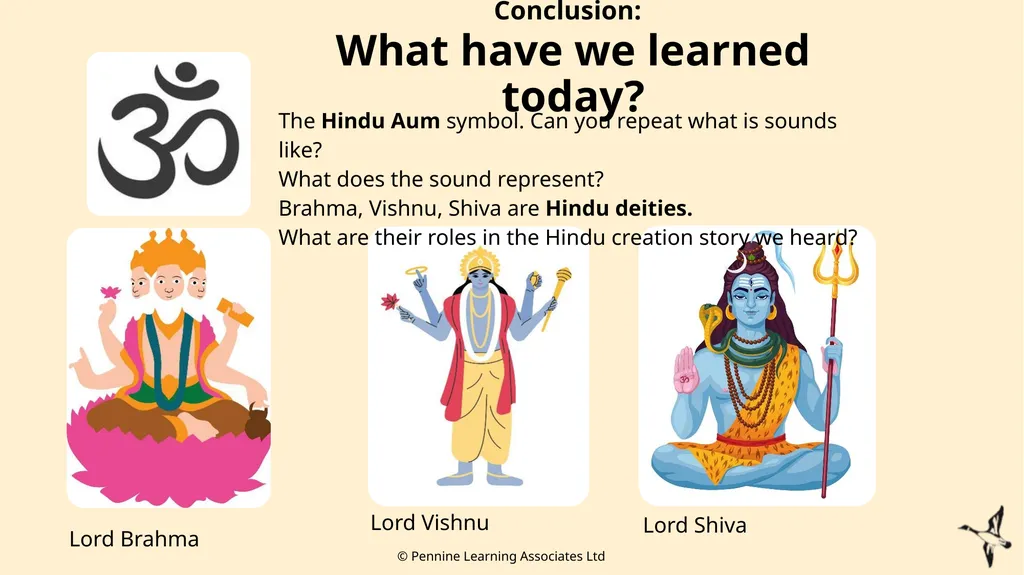
slide18. Lord Shiva Lord Vishnu Lord Brahma The Hindu Aum symbol. Can you repeat what is sounds like?
What does the sound represent?
Brahma, Vishnu, Shiva are Hindu deities.
What are their roles in the Hindu creation story we heard? Conclusion: What have we learned today?<br>
slide19. This Hindu creation story is about deities who made the world, and who are aspects of one supreme God.
The Aum sound is the beginning of the Hindu creation story. Before Aum there was nothing at all.
Can you remember the Aum sound?
What does it make you think about?
What does this sound mean to Hindus? Time to think<br>
slide20. All pictures reproduced under professional licence from Vecteezy. Acknowledgments<br>
PowerPoints cover more than one lesson
The PowerPoint presentation matches a section in the planning provided for this unit of work. This is likely to contain material for more than one lesson. It is important not to speed through the slides without completing suggested activities or discussion. Most sections in the planning, and the matching PowerPoints, will cover two lessons.
Please make sure you prepare and plan with staff
It is critical that delivery, style and speed reflect the needs and responses of pupils. The resource has been designed to support teachers, not to replace you! If this resource is provided as supporting material for HLTAs, cover teachers or non-specialists, please ensure you prepare them carefully and plan with them.
We recommend you use the detailed planning as well as this PowerPoint
This PowerPoint is designed to be used with the detailed planning written to support the RE syllabus ‘Believing and Belonging’. We strongly recommend that you use the PowerPoint in conjunction with the planning. Please ask us how to access this if you do not have it.
To feed back and for further support and to access webinar training please email enquiries@penninelearning.com. Dear Teacher…<br>
slide2. Where this lesson fits: Children will now have an understanding about the beauty of the natural world through an outdoor senses walk. They will also have a knowledge of the Christian, Jewish and Muslim viewpoints around the creation story and the similarities between these religions linked to beliefs about creation. This presentation looks at a Hindu creation story.
Further enrichment: The unit will be enriched by various visitors into school detailing their beliefs about creation, being thankful for the world and how they help to look after our world. In this lesson a Hindu visitor could be invited into school to share their beliefs and stories about creation and how they look after our world.
A Faith Visits Directory for West Yorkshire can be found at https://www.penninelearning.com/resources/
Possible misconceptions: Sensitivity is needed when teaching because different pupils and their families will have different beliefs and ideas about the creation of the world.
Points to note: Children will be learning about tolerance and understanding of different beliefs and ideas around creation.
Sensitivity: please be respectful when using religious artefacts in class to show the respect given to each item from its religion and religious followers.
Sensitivity: Take care sharing the creation story, ensure that more sensitive children are supported in their understanding of Shiva’s role in the Hindu story of creation at the end of the clip. Notes for teachers<br>
slide3. Resources needed: see slide 4 for books and resources ideas.
Further lesson notes and additional ideas may be found in the notes section of some slides (normal or presenter view). Please refer to the full unit plan for more activities and resources.
Religious Education in Early Years settings: Activities may be adapted to suit Reception and Nursery settings. See the full unit plan for links to Early Learning Goals and a full range of ideas for adult-led and independent activities. Further advice about planning for RE in EYFS can be found in the RE syllabus, Believing and Belonging (p 20 – 23). Notes for teachers<br>
slide4. Slide 10-11: Have some Hindu artefacts in class, Hindu images, Hindu deities, singing bowls, hand chime/chime bars. Practise the ‘Aum’ sound.
Hindu Aum, singing bowls and sound meditation practices to try
https://www.youtube.com/watch?v=Cmn1QVhgtlg
https://www.youtube.com/watch?v=sNOdOx2Ztyc – best children’s video
https://www.youtube.com/watch?v=8oNU3_mSF04
https://www.youtube.com/watch?v=atgRGOBa1Bw
Slide 12: Pictures of Hindu Gods and artefacts relating to these. In particular Brahma, Vishnu, Shiva.
Slide 13: Watch a Hindu Creation story – notice the ‘Aum’ at the beginning of the universe.
https://www.youtube.com/watch?v=pfy0jKaxBFs (see sensitivity notes on slide 2). Notes for teachers<br>
slide5. Unit: E.6
How do we understand and care for the world?
Presentation 5 What do Hindus believe about creation?<br>
slide6. How this presentation links to the pathway:
This presentation explores a Hindu story of creation and the Hindu deities who are a part of the story. It continues to develop a sense of awe and wonder at the natural world in pupils. Hinduism has several creation stories; one example is examined in this presentation. Early Years
Through considering the Big Picture, children should learn that:
Stories, including religious stories, can help them to talk about some of the big questions of life.
Many of these stories are well-known as they have been handed down over generations. Pathway 6: The Big Picture<br>
slide7. Notice some sounds and images
in relation to this Hindu creation story Listen to and explore a Hindu creation story Learning objectives<br>
slide8. Key words<br>
slide9. What creation stories we have learned about so far?
What can you remember about these stories?
How can people care for our world and the living things around us?
How do we care for:
the land and sea
the trees and the plants
animals
each other? Introduction : How would you show you care about the world?<br>
slide10. Look at the Hindu Aum symbol.
Try tracing the symbol in the air with your finger.
What do you think it means? Explanation: Hindu Aum symbol<br>
slide11. Listen to the sound of the singing bowl.
This sound represents the energy and meaning of the whole universe.
Try making the sound.
It is in 3 parts a-u-m. Explanation: Singing bowls<br>
slide12. Look at pictures of the Hindu deities:
Brahma
Vishnu
Shiva.
What do you notice about them? Explanation: Listen to and explore the Hindu story of creation<br>
slide13. Now listen to and watch this Hindu story of creation.
Notice the ‘Aum’ sound at the beginning of the universe. Explanation: Listen to and explore the Hindu story of creation<br>
slide14. Lord Shiva Lord Vishnu Lord Brahma Hindus believe in one supreme God who created everything.
Brahma, Vishnu and Shiva are Hindu deities. They are aspects of the one supreme God.
Brahma creates the universe. Vishnu looks after the universe. Shiva destroys the universe when the time comes for it to end – and then be re-created. Explanation: Summary of the Hindu creation story<br>
slide15. Sequence pictures from the Hindu creation story and retell together
Create a storyboard/comic strip of the Hindu creation story
Read a child-friendly version of the story e.g. Tales from India. (Jamilla Gavin/Amanda Hall, published by Templar Publishing. ISBN-10: 1787410889). This book is aimed at older pupils. It may help to provide teacher knowledge of the story and be adaptable for younger pupils
Invite a Hindu visitor into school. Tasks: Adult-led<br>
slide16. Create paper lotus flowers.
Wonder at the natural world by drawing lotus flowers or other aspects of creation.
Create and add to a representation of the ‘Aum’ symbol using natural materials.
Take it deeper: throughout the unit pupils will ask or answer questions. Keep a record of these in a class book.
Suggested thinking point for this lesson: How does the Hindu understanding of creation use all the senses. Tasks: Independent in provision<br>
slide17. Learning summary<br>
slide18. Lord Shiva Lord Vishnu Lord Brahma The Hindu Aum symbol. Can you repeat what is sounds like?
What does the sound represent?
Brahma, Vishnu, Shiva are Hindu deities.
What are their roles in the Hindu creation story we heard? Conclusion: What have we learned today?<br>
slide19. This Hindu creation story is about deities who made the world, and who are aspects of one supreme God.
The Aum sound is the beginning of the Hindu creation story. Before Aum there was nothing at all.
Can you remember the Aum sound?
What does it make you think about?
What does this sound mean to Hindus? Time to think<br>
slide20. All pictures reproduced under professional licence from Vecteezy. Acknowledgments<br>