
Thank you for using this resource. We hope it
CS
Published · 30 slides · 0 views
1 / 1


Description
Thank you for using this resource. We hope it helps you, and your pupils! This advice may help. PowerPoints cover more than one lesson The PowerPoint presentation matches a section in the planning provided for this unit of work. This is
Related Topics
Share
Embed code
Download this presentation From Below
"Thank you for using this resource. We hope it" is the property of its rightful owner. Permission is granted to download and print the materials on this website for personal, non-commercial use only, and to display it on your personal computer provided you do not modify the materials and that you retain all copyright notices contained in the materials. By downloading content from our website, you accept the terms of this agreement.
Presentation Transcript
01
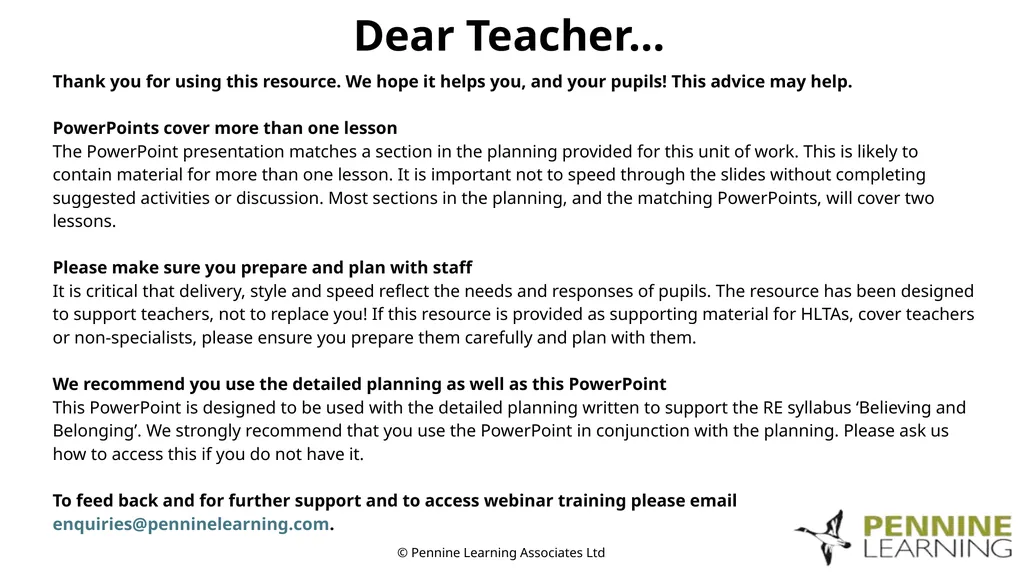
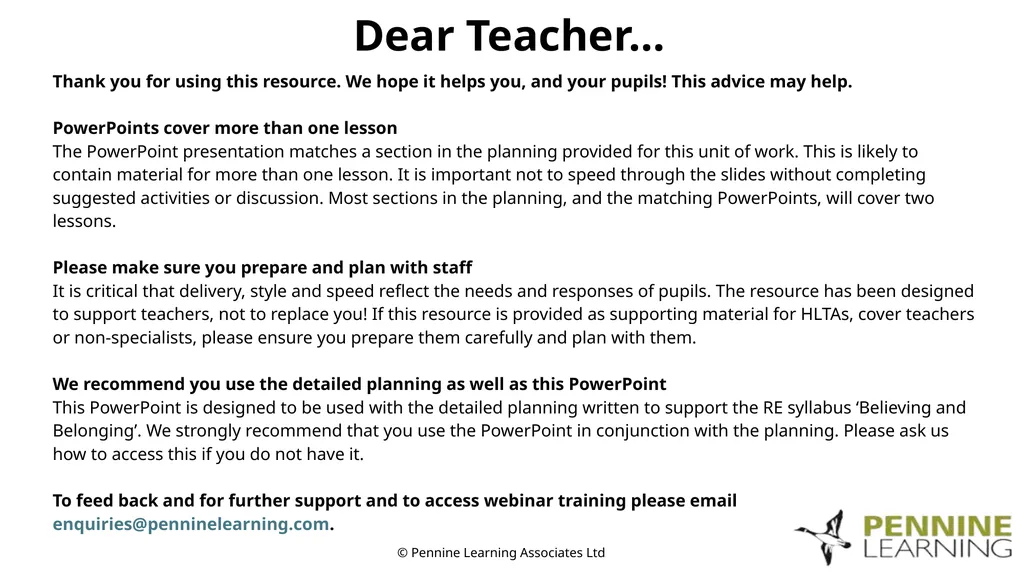
Thank you for using this resource. We hope it helps you, and your pupils! This advice may help.
PowerPoints cover more than one lesson
The PowerPoint presentation matches a section in the planning provided for this unit of work. This is likely to contain material for more than one lesson. It is important not to speed through the slides without completing suggested activities or discussion. Most sections in the planning, and the matching PowerPoints, will cover two lessons.
Please make sure you prepare and plan with staff
It is critical that delivery, style and speed reflect the needs and responses of pupils. The resource has been designed to support teachers, not to replace you! If this resource is provided as supporting material for HLTAs, cover teachers or non-specialists, please ensure you prepare them carefully and plan with them.
We recommend you use the detailed planning as well as this PowerPoint
This PowerPoint is designed to be used with the detailed planning written to support the RE syllabus ‘Believing and Belonging’. We strongly recommend that you use the PowerPoint in conjunction with the planning. Please ask us how to access this if you do not have it.
To feed back and for further support and to access webinar training please email enquiries@penninelearning.com. Dear Teacher…<br>
PowerPoints cover more than one lesson
The PowerPoint presentation matches a section in the planning provided for this unit of work. This is likely to contain material for more than one lesson. It is important not to speed through the slides without completing suggested activities or discussion. Most sections in the planning, and the matching PowerPoints, will cover two lessons.
Please make sure you prepare and plan with staff
It is critical that delivery, style and speed reflect the needs and responses of pupils. The resource has been designed to support teachers, not to replace you! If this resource is provided as supporting material for HLTAs, cover teachers or non-specialists, please ensure you prepare them carefully and plan with them.
We recommend you use the detailed planning as well as this PowerPoint
This PowerPoint is designed to be used with the detailed planning written to support the RE syllabus ‘Believing and Belonging’. We strongly recommend that you use the PowerPoint in conjunction with the planning. Please ask us how to access this if you do not have it.
To feed back and for further support and to access webinar training please email enquiries@penninelearning.com. Dear Teacher…<br>
02
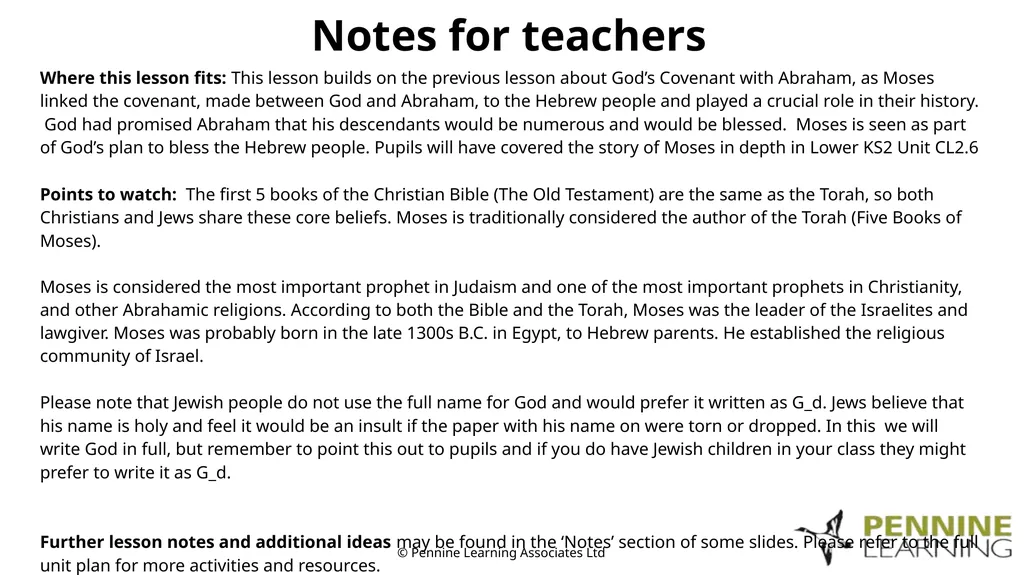
Where this lesson fits: This lesson builds on the previous lesson about God’s Covenant with Abraham, as Moses linked the covenant, made between God and Abraham, to the Hebrew people and played a crucial role in their history. God had promised Abraham that his descendants would be numerous and would be blessed. Moses is seen as part of God’s plan to bless the Hebrew people. Pupils will have covered the story of Moses in depth in Lower KS2 Unit CL2.6
Points to watch: The first 5 books of the Christian Bible (The Old Testament) are the same as the Torah, so both Christians and Jews share these core beliefs. Moses is traditionally considered the author of the Torah (Five Books of Moses).
Moses is considered the most important prophet in Judaism and one of the most important prophets in Christianity, and other Abrahamic religions. According to both the Bible and the Torah, Moses was the leader of the Israelites and lawgiver. Moses was probably born in the late 1300s B.C. in Egypt, to Hebrew parents. He established the religious community of Israel.
Please note that Jewish people do not use the full name for God and would prefer it written as G_d. Jews believe that his name is holy and feel it would be an insult if the paper with his name on were torn or dropped. In this we will write God in full, but remember to point this out to pupils and if you do have Jewish children in your class they might prefer to write it as G_d.
Further lesson notes and additional ideas may be found in the ‘Notes’ section of some slides. Please refer to the full unit plan for more activities and resources. Notes for teachers<br>
Points to watch: The first 5 books of the Christian Bible (The Old Testament) are the same as the Torah, so both Christians and Jews share these core beliefs. Moses is traditionally considered the author of the Torah (Five Books of Moses).
Moses is considered the most important prophet in Judaism and one of the most important prophets in Christianity, and other Abrahamic religions. According to both the Bible and the Torah, Moses was the leader of the Israelites and lawgiver. Moses was probably born in the late 1300s B.C. in Egypt, to Hebrew parents. He established the religious community of Israel.
Please note that Jewish people do not use the full name for God and would prefer it written as G_d. Jews believe that his name is holy and feel it would be an insult if the paper with his name on were torn or dropped. In this we will write God in full, but remember to point this out to pupils and if you do have Jewish children in your class they might prefer to write it as G_d.
Further lesson notes and additional ideas may be found in the ‘Notes’ section of some slides. Please refer to the full unit plan for more activities and resources. Notes for teachers<br>
03
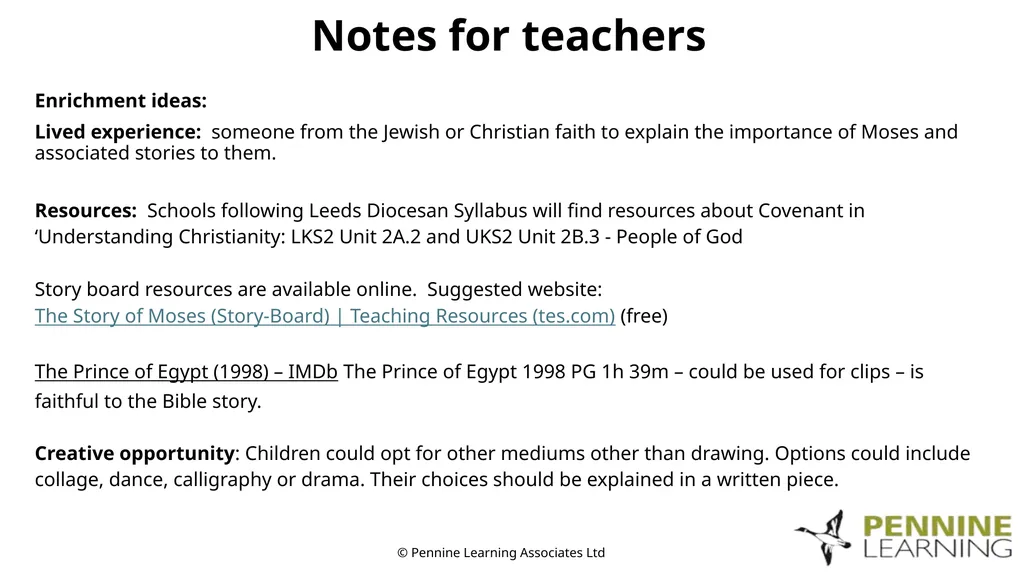
Enrichment ideas:
Lived experience: someone from the Jewish or Christian faith to explain the importance of Moses and associated stories to them.
Resources: Schools following Leeds Diocesan Syllabus will find resources about Covenant in ‘Understanding Christianity: LKS2 Unit 2A.2 and UKS2 Unit 2B.3 - People of God
Story board resources are available online. Suggested website: The Story of Moses (Story-Board) | Teaching Resources (tes.com) (free)
The Prince of Egypt (1998) – IMDb The Prince of Egypt 1998 PG 1h 39m – could be used for clips – is faithful to the Bible story.
Creative opportunity: Children could opt for other mediums other than drawing. Options could include collage, dance, calligraphy or drama. Their choices should be explained in a written piece. Notes for teachers<br>
Lived experience: someone from the Jewish or Christian faith to explain the importance of Moses and associated stories to them.
Resources: Schools following Leeds Diocesan Syllabus will find resources about Covenant in ‘Understanding Christianity: LKS2 Unit 2A.2 and UKS2 Unit 2B.3 - People of God
Story board resources are available online. Suggested website: The Story of Moses (Story-Board) | Teaching Resources (tes.com) (free)
The Prince of Egypt (1998) – IMDb The Prince of Egypt 1998 PG 1h 39m – could be used for clips – is faithful to the Bible story.
Creative opportunity: Children could opt for other mediums other than drawing. Options could include collage, dance, calligraphy or drama. Their choices should be explained in a written piece. Notes for teachers<br>
04
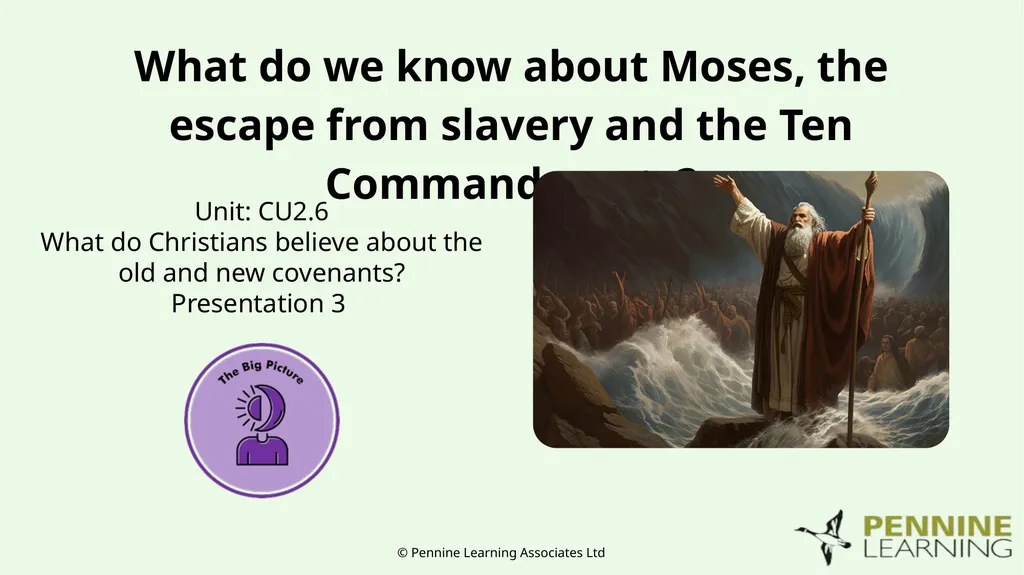
Unit: CU2.6
What do Christians believe about the old and new covenants?
Presentation 3 What do we know about Moses, the escape from slavery and the Ten Commandments?<br>
What do Christians believe about the old and new covenants?
Presentation 3 What do we know about Moses, the escape from slavery and the Ten Commandments?<br>
05
Key Stage 2
Through considering the Big Picture, pupils should learn that:
People tell different stories to communicate important teachings and these stories often form part of longer narratives.
Groups of religious and non-religious people tell different stories, which reflect the different ways in which they view the world. How this presentation links to the pathway:
In this presentation you will learn about Moses and the Ten Commandments as part of the narrative of covenant throughout the Bible. Pathway 6: The Big Picture<br>
Through considering the Big Picture, pupils should learn that:
People tell different stories to communicate important teachings and these stories often form part of longer narratives.
Groups of religious and non-religious people tell different stories, which reflect the different ways in which they view the world. How this presentation links to the pathway:
In this presentation you will learn about Moses and the Ten Commandments as part of the narrative of covenant throughout the Bible. Pathway 6: The Big Picture<br>
06
Learning objectives Explain Moses’ covenant with God Discuss who Moses was and reflect on why he is important to Jews and Christians Suggest reasons why the Ten Commandments are important for Jews and Christians Make connections between Moses and Abraham<br>
07
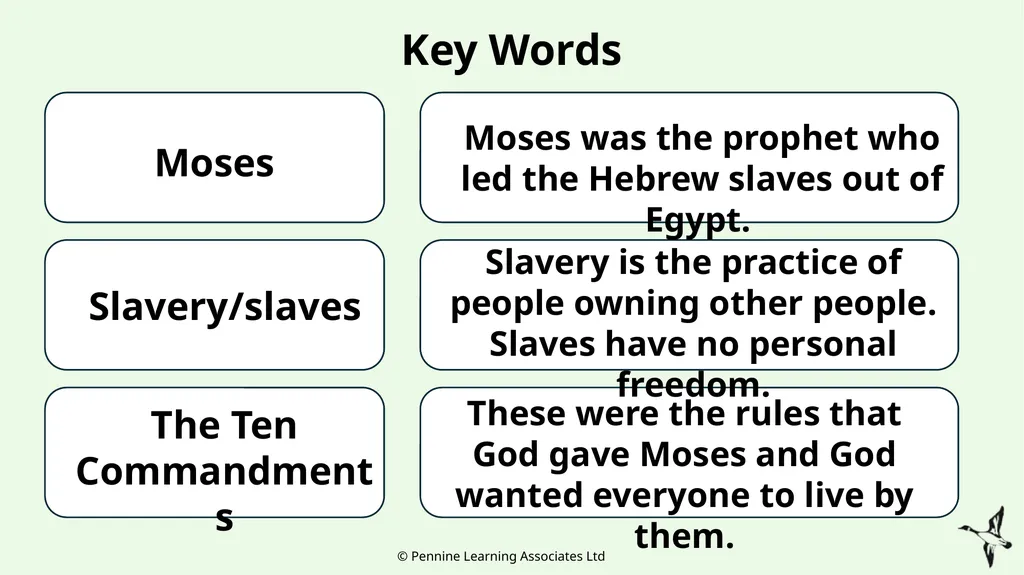
Key Words Slavery/slaves The Ten Commandments Moses was the prophet who led the Hebrew slaves out of Egypt. Slavery is the practice of people owning other people. Slaves have no personal freedom. These were the rules that God gave Moses and God wanted everyone to live by them.<br>
08
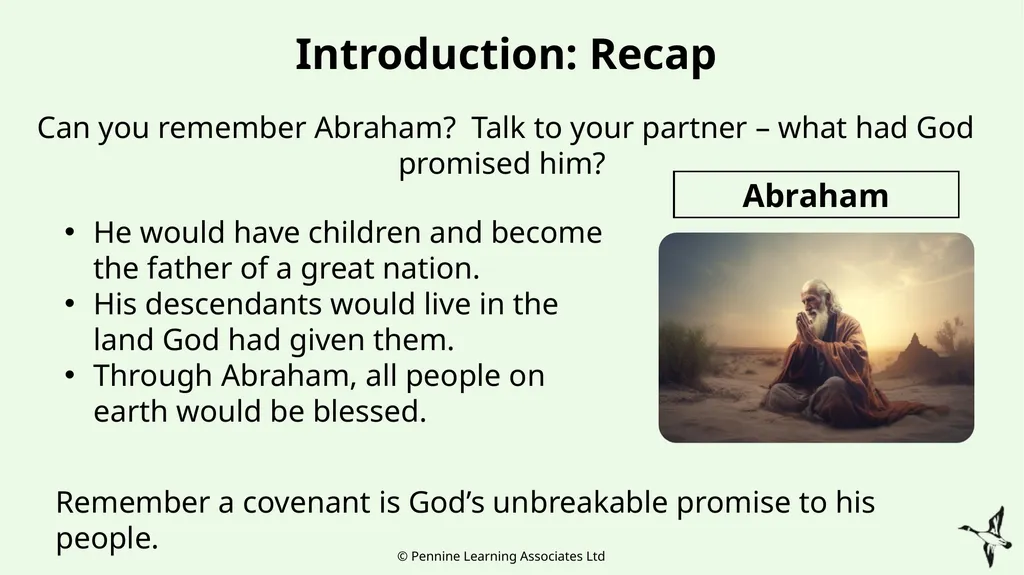
Introduction: Recap Abraham Can you remember Abraham? Talk to your partner – what had God promised him? He would have children and become the father of a great nation.
His descendants would live in the land God had given them.
Through Abraham, all people on earth would be blessed. Remember a covenant is God’s unbreakable promise to his people.<br>
His descendants would live in the land God had given them.
Through Abraham, all people on earth would be blessed. Remember a covenant is God’s unbreakable promise to his people.<br>
09
Introduction: What can you remember about Moses? Moses Add to your mind map throughout the lesson.<br>
10
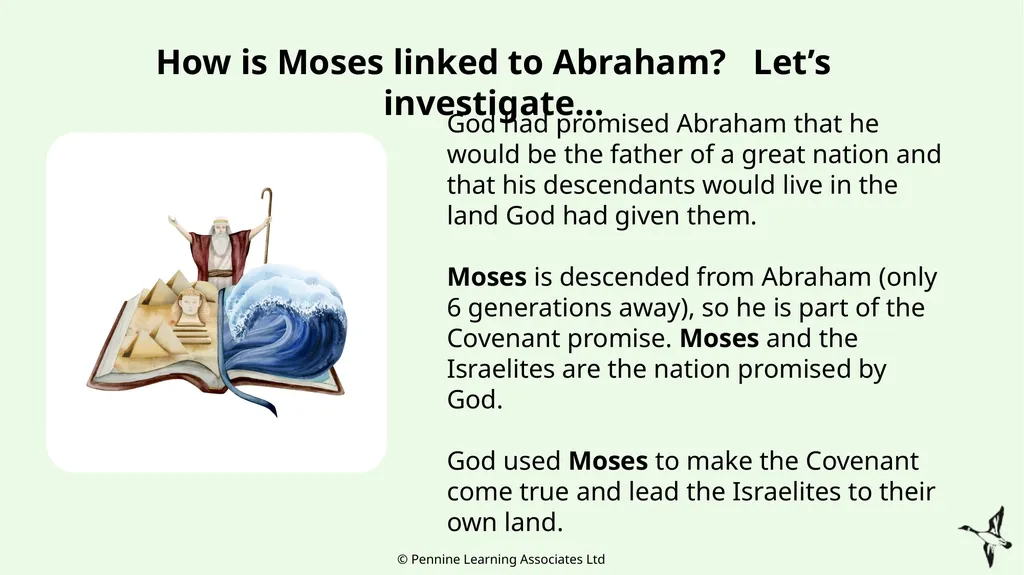
How is Moses linked to Abraham? Let’s investigate… God had promised Abraham that he would be the father of a great nation and that his descendants would live in the land God had given them.
Moses is descended from Abraham (only 6 generations away), so he is part of the Covenant promise. Moses and the Israelites are the nation promised by God.
God used Moses to make the Covenant come true and lead the Israelites to their own land.<br>
Moses is descended from Abraham (only 6 generations away), so he is part of the Covenant promise. Moses and the Israelites are the nation promised by God.
God used Moses to make the Covenant come true and lead the Israelites to their own land.<br>
11
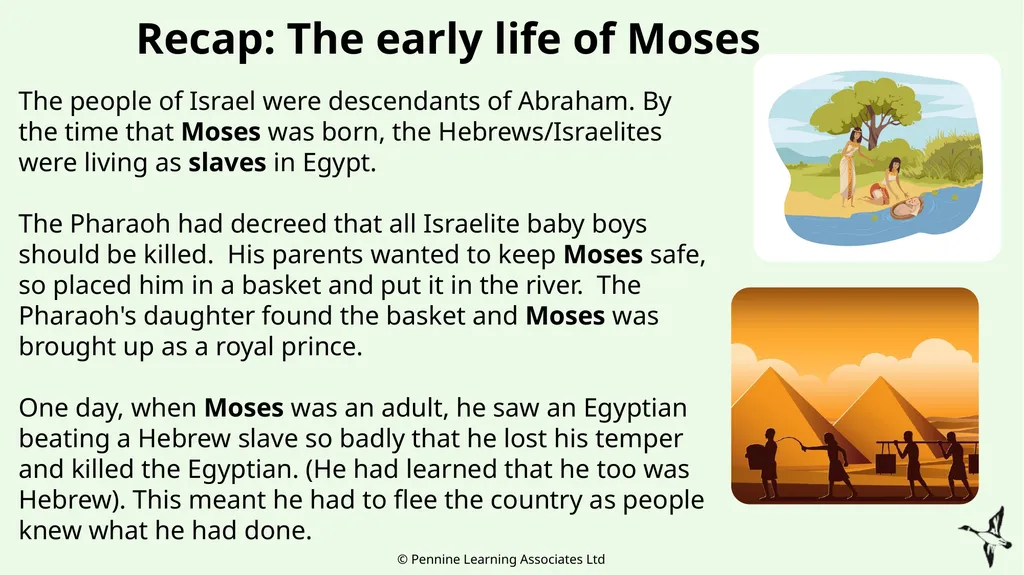
Recap: The early life of Moses The people of Israel were descendants of Abraham. By the time that Moses was born, the Hebrews/Israelites were living as slaves in Egypt.
The Pharaoh had decreed that all Israelite baby boys should be killed. His parents wanted to keep Moses safe, so placed him in a basket and put it in the river. The Pharaoh's daughter found the basket and Moses was brought up as a royal prince.
One day, when Moses was an adult, he saw an Egyptian beating a Hebrew slave so badly that he lost his temper and killed the Egyptian. (He had learned that he too was Hebrew). This meant he had to flee the country as people knew what he had done.<br>
The Pharaoh had decreed that all Israelite baby boys should be killed. His parents wanted to keep Moses safe, so placed him in a basket and put it in the river. The Pharaoh's daughter found the basket and Moses was brought up as a royal prince.
One day, when Moses was an adult, he saw an Egyptian beating a Hebrew slave so badly that he lost his temper and killed the Egyptian. (He had learned that he too was Hebrew). This meant he had to flee the country as people knew what he had done.<br>
12
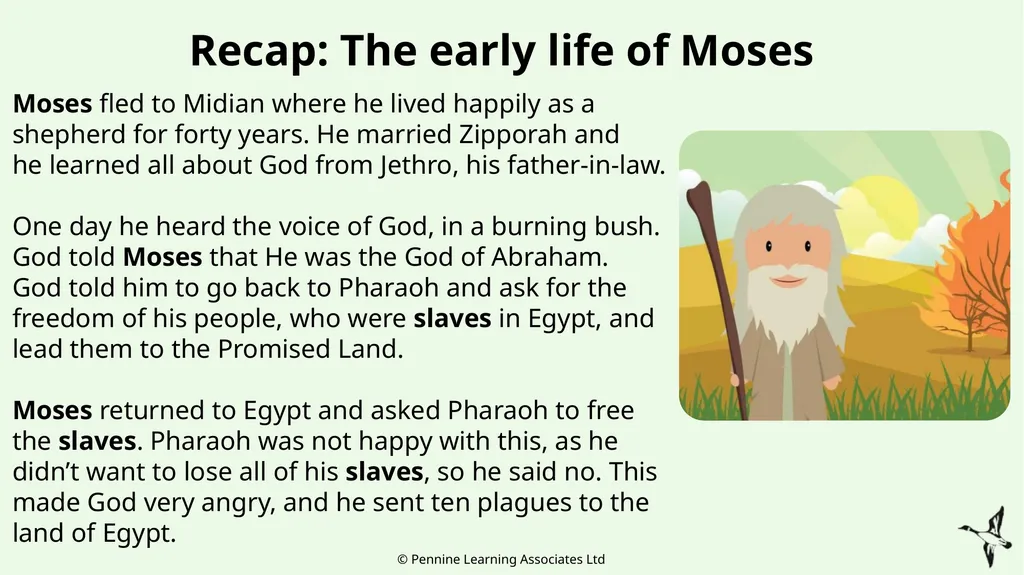
Moses fled to Midian where he lived happily as a shepherd for forty years. He married Zipporah and he learned all about God from Jethro, his father-in-law.
One day he heard the voice of God, in a burning bush. God told Moses that He was the God of Abraham. God told him to go back to Pharaoh and ask for the freedom of his people, who were slaves in Egypt, and lead them to the Promised Land.
Moses returned to Egypt and asked Pharaoh to free the slaves. Pharaoh was not happy with this, as he didn’t want to lose all of his slaves, so he said no. This made God very angry, and he sent ten plagues to the land of Egypt. Recap: The early life of Moses<br>
One day he heard the voice of God, in a burning bush. God told Moses that He was the God of Abraham. God told him to go back to Pharaoh and ask for the freedom of his people, who were slaves in Egypt, and lead them to the Promised Land.
Moses returned to Egypt and asked Pharaoh to free the slaves. Pharaoh was not happy with this, as he didn’t want to lose all of his slaves, so he said no. This made God very angry, and he sent ten plagues to the land of Egypt. Recap: The early life of Moses<br>
13
How much of the story did you remember?
Why was it important that God introduced himself to Moses as ‘the God of Abraham…’?
Can you remember any of the plagues? Discussion: The early life of Moses<br>
Why was it important that God introduced himself to Moses as ‘the God of Abraham…’?
Can you remember any of the plagues? Discussion: The early life of Moses<br>
14
The story of the Exodus has inspired Jews and Christians for centuries.
They believe that God did miraculous things to keep Moses safe and use him to free the Hebrew people from slavery in Egypt.
Both Jews and Christians believe that God will do amazing things for them if they trust and obey him. The Story of Moses: The Exodus When we read the story of Moses, remember how he is connected to Abraham and why he is so important.<br>
They believe that God did miraculous things to keep Moses safe and use him to free the Hebrew people from slavery in Egypt.
Both Jews and Christians believe that God will do amazing things for them if they trust and obey him. The Story of Moses: The Exodus When we read the story of Moses, remember how he is connected to Abraham and why he is so important.<br>
15
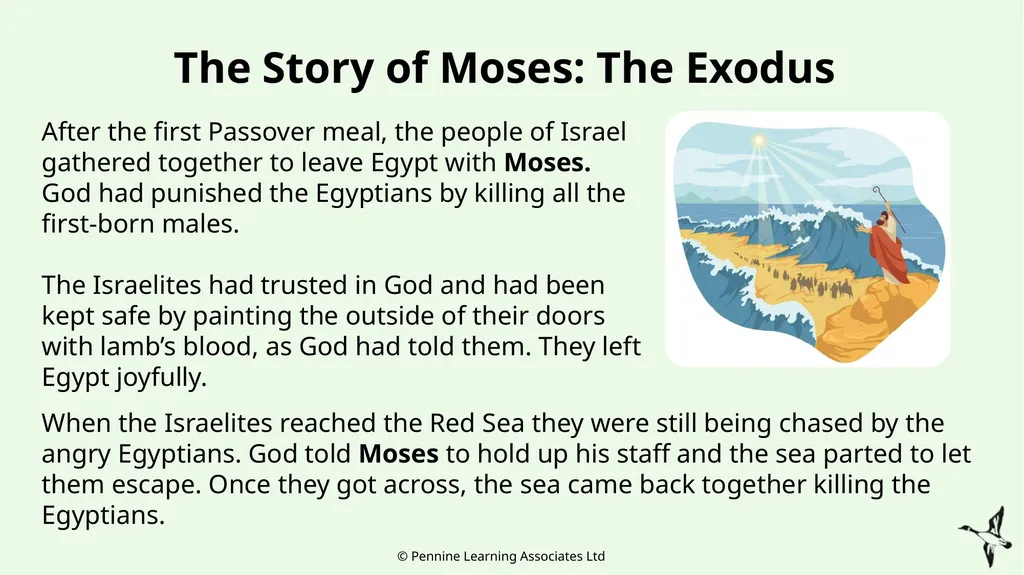
The Story of Moses: The Exodus After the first Passover meal, the people of Israel gathered together to leave Egypt with Moses. God had punished the Egyptians by killing all the first-born males.
The Israelites had trusted in God and had been kept safe by painting the outside of their doors with lamb’s blood, as God had told them. They left Egypt joyfully. When the Israelites reached the Red Sea they were still being chased by the angry Egyptians. God told Moses to hold up his staff and the sea parted to let them escape. Once they got across, the sea came back together killing the Egyptians.<br>
The Israelites had trusted in God and had been kept safe by painting the outside of their doors with lamb’s blood, as God had told them. They left Egypt joyfully. When the Israelites reached the Red Sea they were still being chased by the angry Egyptians. God told Moses to hold up his staff and the sea parted to let them escape. Once they got across, the sea came back together killing the Egyptians.<br>
16
The Israelites then spent the next forty years wandering the desert. This happened because they kept forgetting God and they even worshipped idols. Some even wanted to return to Egypt!
They were very hungry and thirsty. Moses asked for God’s help. Even though his people kept doing the wrong thing, God provided food and water. He was very patient with them. The Story of Moses: God’s Covenant<br>
They were very hungry and thirsty. Moses asked for God’s help. Even though his people kept doing the wrong thing, God provided food and water. He was very patient with them. The Story of Moses: God’s Covenant<br>
17
Discussion Why do you think it had to be Moses who led his people out of Egypt?
How might the Hebrew people feel now about being God’s people?<br>
How might the Hebrew people feel now about being God’s people?<br>
18
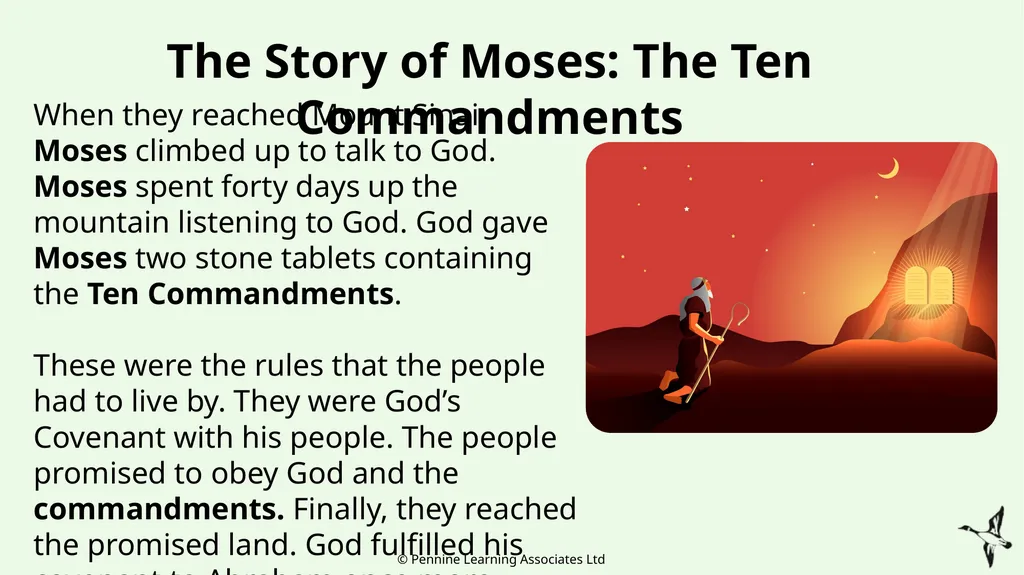
When they reached Mount Sinai, Moses climbed up to talk to God. Moses spent forty days up the mountain listening to God. God gave Moses two stone tablets containing the Ten Commandments.
These were the rules that the people had to live by. They were God’s Covenant with his people. The people promised to obey God and the commandments. Finally, they reached the promised land. God fulfilled his covenant to Abraham once more. The Story of Moses: The Ten Commandments<br>
These were the rules that the people had to live by. They were God’s Covenant with his people. The people promised to obey God and the commandments. Finally, they reached the promised land. God fulfilled his covenant to Abraham once more. The Story of Moses: The Ten Commandments<br>
19
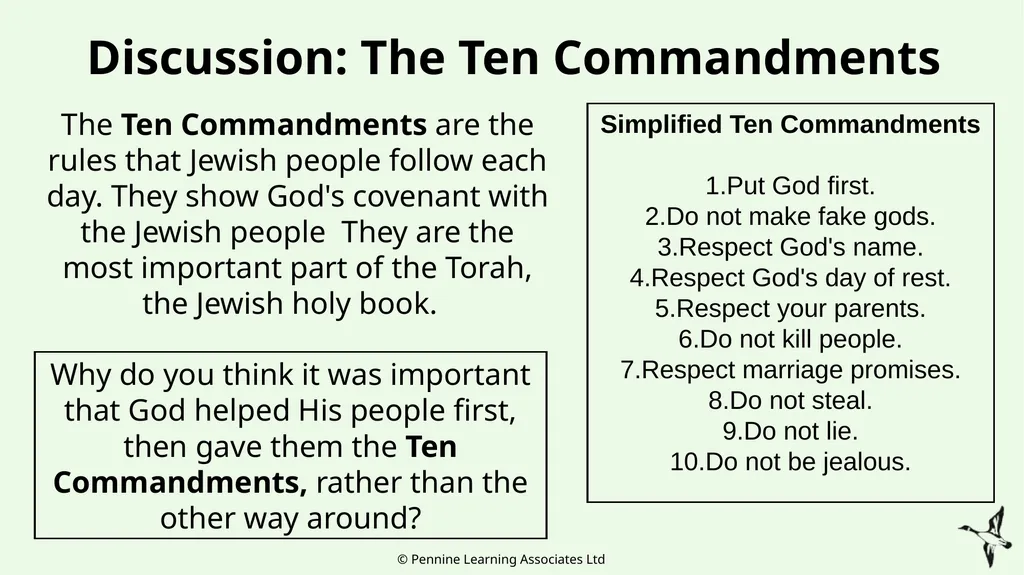
The Ten Commandments are the rules that Jewish people follow each day. They show God's covenant with the Jewish people They are the most important part of the Torah, the Jewish holy book. Discussion: The Ten Commandments Why do you think it was important that God helped His people first, then gave them the Ten Commandments, rather than the other way around? Simplified Ten Commandments
Put God first.
Do not make fake gods.
Respect God's name.
Respect God's day of rest.
Respect your parents.
Do not kill people.
Respect marriage promises.
Do not steal.
Do not lie.
Do not be jealous.<br>
Put God first.
Do not make fake gods.
Respect God's name.
Respect God's day of rest.
Respect your parents.
Do not kill people.
Respect marriage promises.
Do not steal.
Do not lie.
Do not be jealous.<br>
20
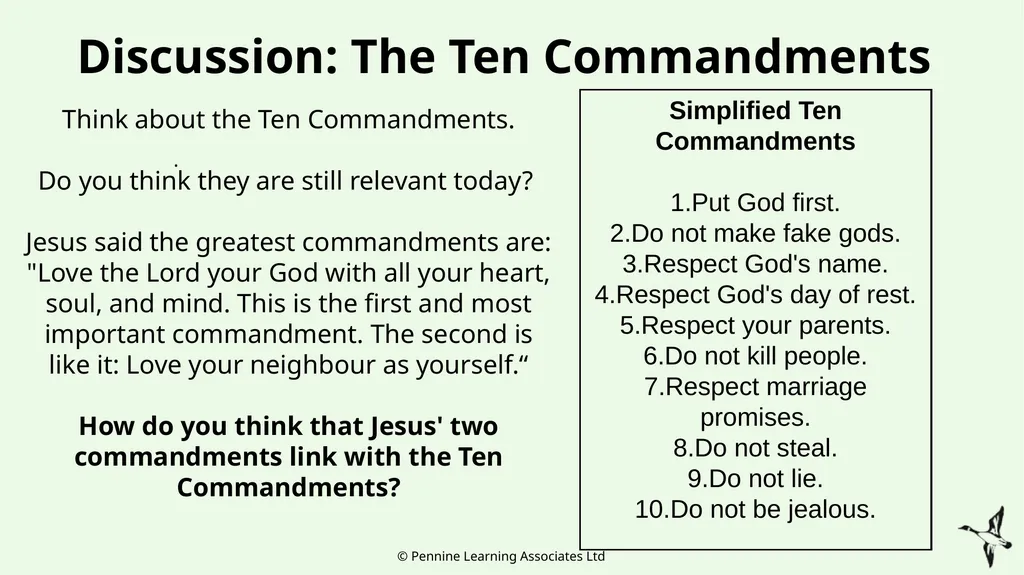
Discussion: The Ten Commandments . Think about the Ten Commandments.
Do you think they are still relevant today?
Jesus said the greatest commandments are: "Love the Lord your God with all your heart, soul, and mind. This is the first and most important commandment. The second is like it: Love your neighbour as yourself.“
How do you think that Jesus' two commandments link with the Ten Commandments? Simplified Ten Commandments
Put God first.
Do not make fake gods.
Respect God's name.
Respect God's day of rest.
Respect your parents.
Do not kill people.
Respect marriage promises.
Do not steal.
Do not lie.
Do not be jealous.<br>
Do you think they are still relevant today?
Jesus said the greatest commandments are: "Love the Lord your God with all your heart, soul, and mind. This is the first and most important commandment. The second is like it: Love your neighbour as yourself.“
How do you think that Jesus' two commandments link with the Ten Commandments? Simplified Ten Commandments
Put God first.
Do not make fake gods.
Respect God's name.
Respect God's day of rest.
Respect your parents.
Do not kill people.
Respect marriage promises.
Do not steal.
Do not lie.
Do not be jealous.<br>
21
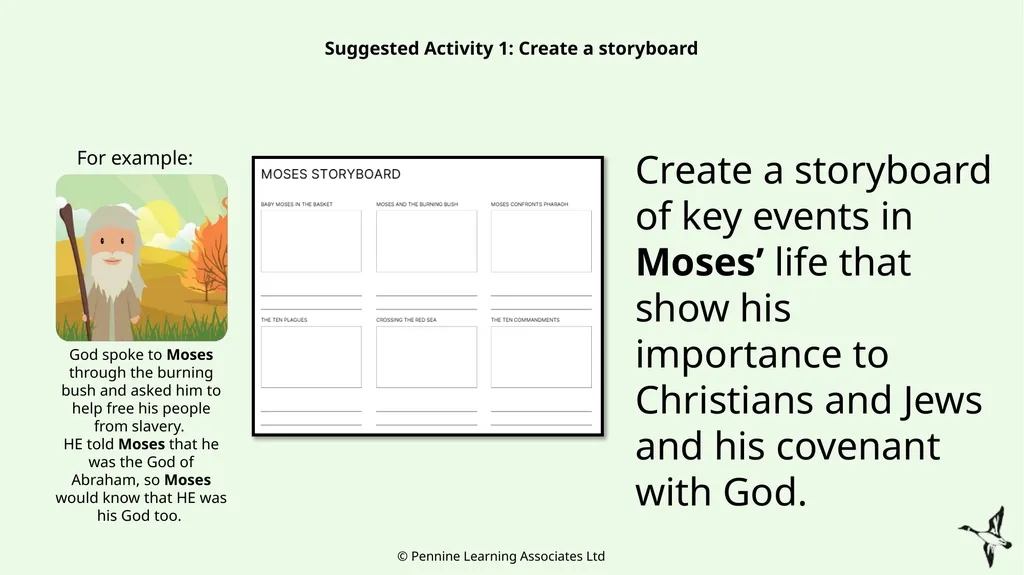
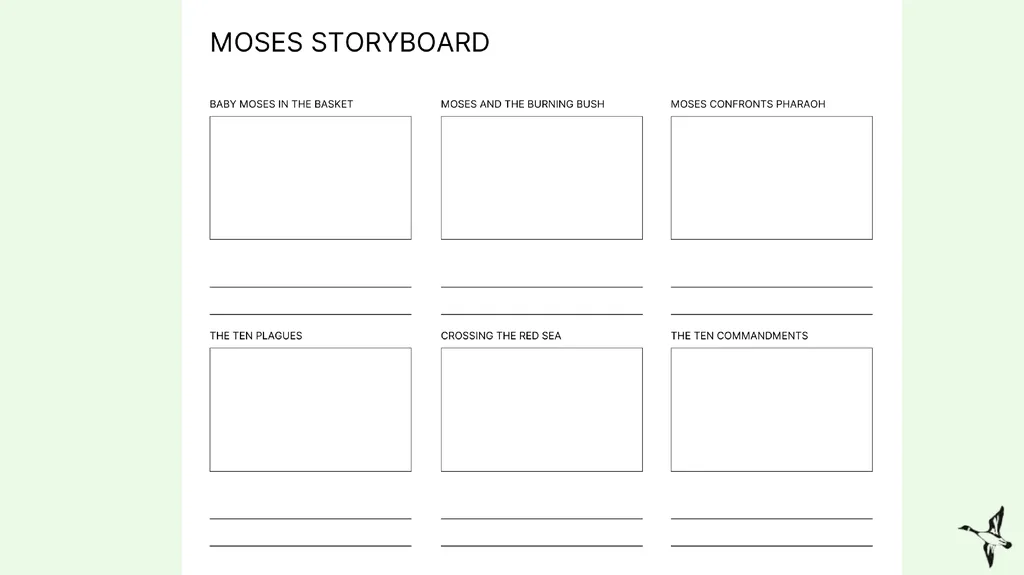
Suggested Activity 1: Create a storyboard Create a storyboard of key events in Moses’ life that show his importance to Christians and Jews and his covenant with God. For example: God spoke to Moses through the burning bush and asked him to help free his people from slavery.
HE told Moses that he was the God of Abraham, so Moses would know that HE was his God too.<br>
HE told Moses that he was the God of Abraham, so Moses would know that HE was his God too.<br>
22
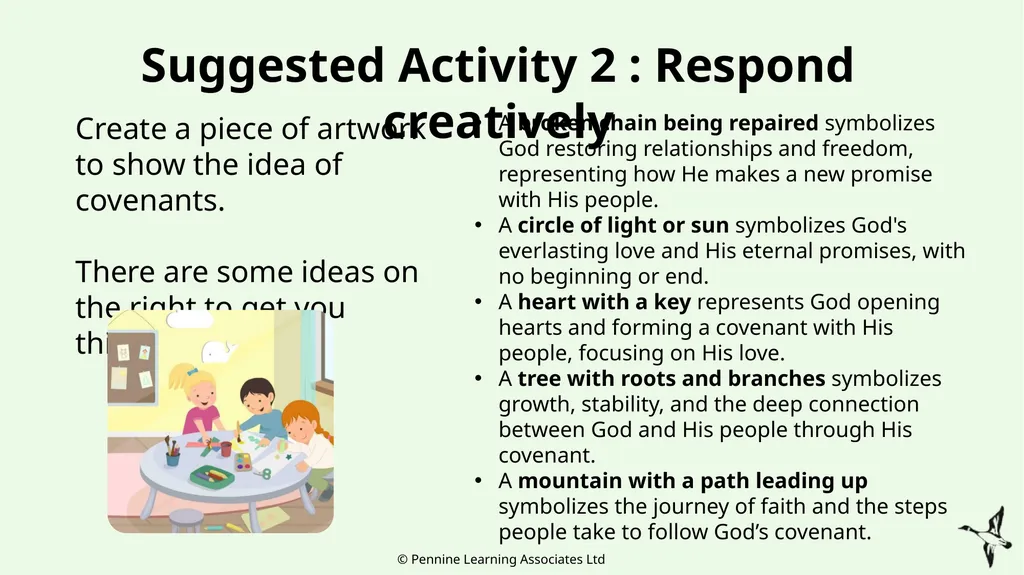
Suggested Activity 2 : Respond creatively Create a piece of artwork to show the idea of covenants.
There are some ideas on the right to get you thinking! A broken chain being repaired symbolizes God restoring relationships and freedom, representing how He makes a new promise with His people.
A circle of light or sun symbolizes God's everlasting love and His eternal promises, with no beginning or end.
A heart with a key represents God opening hearts and forming a covenant with His people, focusing on His love.
A tree with roots and branches symbolizes growth, stability, and the deep connection between God and His people through His covenant.
A mountain with a path leading up symbolizes the journey of faith and the steps people take to follow God’s covenant.<br>
There are some ideas on the right to get you thinking! A broken chain being repaired symbolizes God restoring relationships and freedom, representing how He makes a new promise with His people.
A circle of light or sun symbolizes God's everlasting love and His eternal promises, with no beginning or end.
A heart with a key represents God opening hearts and forming a covenant with His people, focusing on His love.
A tree with roots and branches symbolizes growth, stability, and the deep connection between God and His people through His covenant.
A mountain with a path leading up symbolizes the journey of faith and the steps people take to follow God’s covenant.<br>
23
Learning summary Moses was a descendant of Abraham and God made a covenant with him for the people of Israel. Moses led God’s people out of slavery and helped them form a special relationship with God. God made a new covenant with Moses and the people. The Ten Commandments taught God's people how to live and how to treat God.<br>
24
Learning summary Jews and Christians both believe that Moses is an important prophet and that the Ten Commandments are an important moral law from God, which should be kept.<br>
25
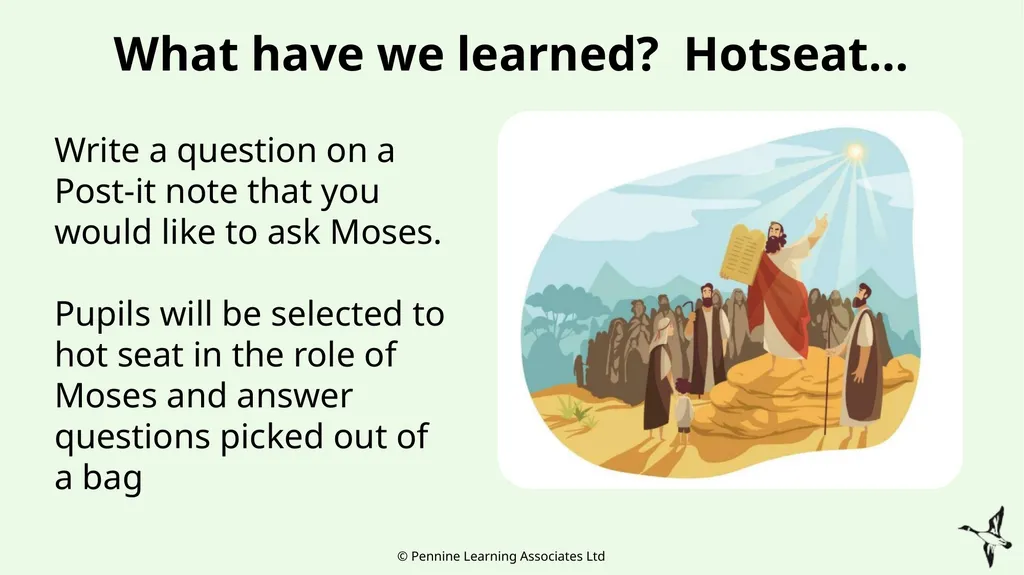
What have we learned? Hotseat… Write a question on a Post-it note that you would like to ask Moses.
Pupils will be selected to hot seat in the role of Moses and answer questions picked out of a bag<br>
Pupils will be selected to hot seat in the role of Moses and answer questions picked out of a bag<br>
26
Pause for thought Let’s think about the Ten Commandments.
Do you think the idea of ‘rules to live by’ is still something we have today?
.<br>
Do you think the idea of ‘rules to live by’ is still something we have today?
.<br>
27
Acknowledgments All images sourced from Vecteezy<br>
28
Suggested sections for storyboard (6 sections)
Baby Moses in the Basket
Moses’ mother hides him in the Nile River, and Pharaoh’s daughter rescues him.
Moses and the Burning Bush
God speaks to Moses through a burning bush and sends him to free the Israelites.
Moses Confronts Pharaoh
Moses tells Pharaoh, "Let my people go!"
The Ten Plagues
God sends plagues to Egypt until Pharaoh agrees to free the Israelites.
Crossing the Red Sea
Moses parts the Red Sea, and the Israelites escape from Egypt.
The Ten Commandments
Moses receives God’s laws on Mount Sinai to guide the Israelites.<br>
Baby Moses in the Basket
Moses’ mother hides him in the Nile River, and Pharaoh’s daughter rescues him.
Moses and the Burning Bush
God speaks to Moses through a burning bush and sends him to free the Israelites.
Moses Confronts Pharaoh
Moses tells Pharaoh, "Let my people go!"
The Ten Plagues
God sends plagues to Egypt until Pharaoh agrees to free the Israelites.
Crossing the Red Sea
Moses parts the Red Sea, and the Israelites escape from Egypt.
The Ten Commandments
Moses receives God’s laws on Mount Sinai to guide the Israelites.<br>
29
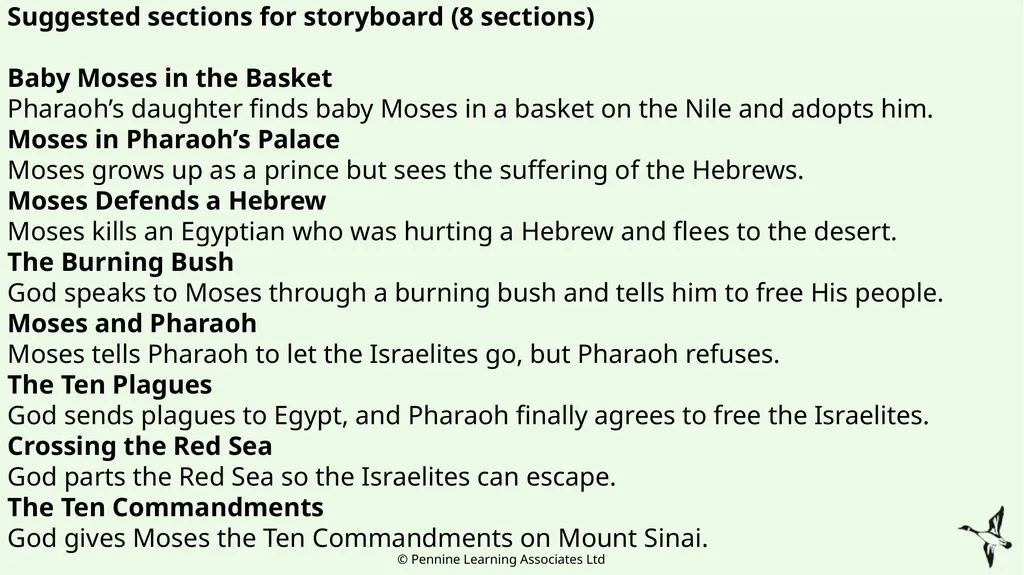
Suggested sections for storyboard (8 sections)
Baby Moses in the Basket
Pharaoh’s daughter finds baby Moses in a basket on the Nile and adopts him.
Moses in Pharaoh’s Palace
Moses grows up as a prince but sees the suffering of the Hebrews.
Moses Defends a Hebrew
Moses kills an Egyptian who was hurting a Hebrew and flees to the desert.
The Burning Bush
God speaks to Moses through a burning bush and tells him to free His people.
Moses and Pharaoh
Moses tells Pharaoh to let the Israelites go, but Pharaoh refuses.
The Ten Plagues
God sends plagues to Egypt, and Pharaoh finally agrees to free the Israelites.
Crossing the Red Sea
God parts the Red Sea so the Israelites can escape.
The Ten Commandments
God gives Moses the Ten Commandments on Mount Sinai.<br>
Baby Moses in the Basket
Pharaoh’s daughter finds baby Moses in a basket on the Nile and adopts him.
Moses in Pharaoh’s Palace
Moses grows up as a prince but sees the suffering of the Hebrews.
Moses Defends a Hebrew
Moses kills an Egyptian who was hurting a Hebrew and flees to the desert.
The Burning Bush
God speaks to Moses through a burning bush and tells him to free His people.
Moses and Pharaoh
Moses tells Pharaoh to let the Israelites go, but Pharaoh refuses.
The Ten Plagues
God sends plagues to Egypt, and Pharaoh finally agrees to free the Israelites.
Crossing the Red Sea
God parts the Red Sea so the Israelites can escape.
The Ten Commandments
God gives Moses the Ten Commandments on Mount Sinai.<br>