Thank you for using this resource. We hope it helps you, and your pupils! This advice may help. PowerPoints cover more than one lesson The PowerPoint presentation matches a section in the planning provided for this unit of work. This is
"Thank you for using this resource. We hope it" is the property of its rightful owner. Permission is granted to
download and print the materials on this website for personal, non-commercial use only, and to display it
on your personal computer provided you do not modify the materials and that you retain all copyright
notices contained in the materials. By downloading content from our website, you accept the terms of this
agreement.
Presentation Transcript
01
Thank you for using this resource. We hope it helps you, and your pupils! This advice may help.
PowerPoints cover more than one lesson
The PowerPoint presentation matches a section in the planning provided for this unit of work. This is likely to contain material for more than one lesson. It is important not to speed through the slides without completing suggested activities or discussion. Some sections in the planning, and the matching PowerPoints, may provide sufficient material for two or more lessons.
Please make sure you prepare and plan with staff
It is critical that delivery, style and speed reflect the needs and responses of pupils. The resource has been designed to support teachers, not to replace you! If this resource is provided as supporting material for HLTAs, cover teachers or non-specialists, please ensure you prepare them carefully and plan with them.
We recommend you use the detailed planning as well as this PowerPoint
This PowerPoint is designed to be used with the detailed planning written to support the RE syllabus ‘Believing and Belonging’. We strongly recommend that you use the PowerPoint in conjunction with the planning. Please ask us how to access this if you do not have it.
To feed back and for further support and to access webinar training please email enquiries@penninelearning.com. Dear Teacher<br>
02
Where this lesson fits: Lesson 6 – gives an introduction to the Buddhist way of life. Children will listen to a Buddhist story and learn about how to care for all living things.
Points to note: General sensitivity around differences of family beliefs, faiths and ideals.
Enrichment ideas: Lived experience - Ask a Buddhist to come into school and talk about how and why they care for others. A Faith Visits Directory for West Yorkshire can be found at https://www.penninelearning.com/resources/
Resources needed: See next slide
Further lesson notes and additional ideas may be found in the ‘Notes’ section of some slides. Refer to the full unit plan for more activities and resources. Notes for teachers<br>
03
Slide 12: Tell a Buddhist story, e.g. Siddhartha and the Swan or the Monkey King. This could be done using a story box with appropriate objects and props, an illustrated book or a film such as
https://www.bbc.co.uk/teach/class-clips-video/religious-studies-ks1-the-buddhist-story-of-siddhartha-and-the-swan-and-the-monkey-king/zfkcwty
Lived experience: Ask a Buddhist to come into school and talk about how and why they care for others. A Faith Visits Directory for West Yorkshire can be found at https://www.penninelearning.com/resources/ Resources to support this presentation<br>
04
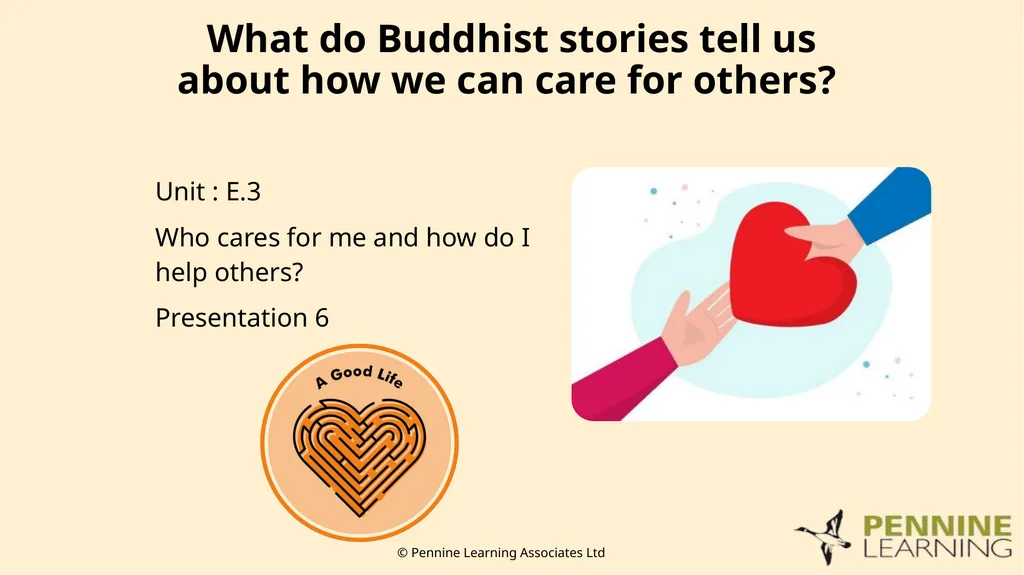
Unit : E.3
Who cares for me and how do I help others?
Presentation 6 What do Buddhist stories tell us about how we can care for others?<br>
05
How this presentation links to the pathway:
This presentation explores how Buddhists live a good life. Children will listen to a Buddhist story that teaches about caring for all living things. Early Years
Through investigating what is meant by a Good Life, children will learn that:
Most religions/worldviews tell stories about people from the past and present to demonstrate what is meant by a good life.
They also teach about the reasons for rules and explain actions that are right and wrong. Pathway 3 : A Good Life<br>
06
Listen carefully to a story and talk about what it teaches about caring Notice that Buddhists think it is important to care for all living things Learning objectives<br>
07
to look after something care Buddhists believe all living things are important Buddhists Key words<br>
08
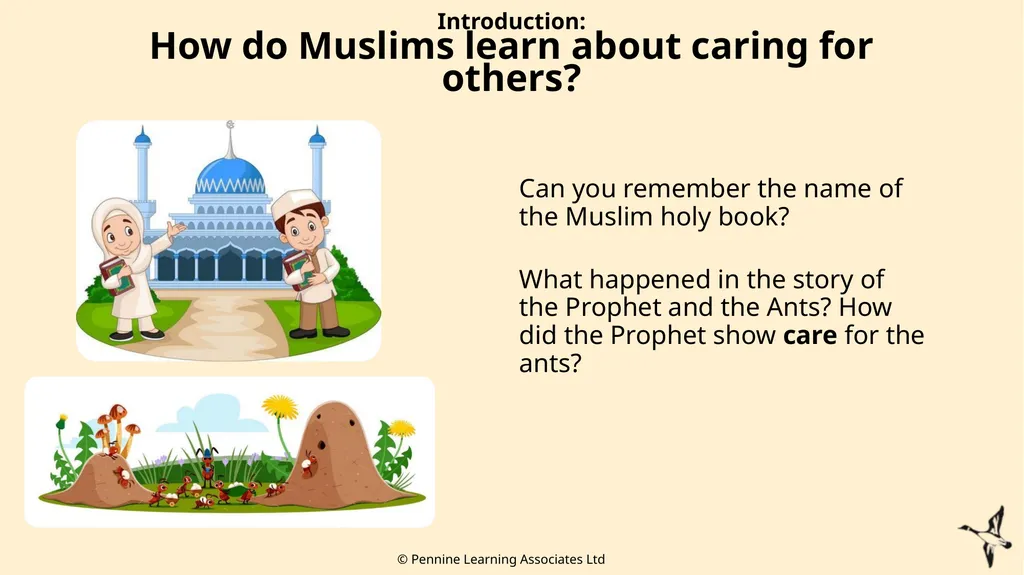
Can you remember the name of the Muslim holy book?
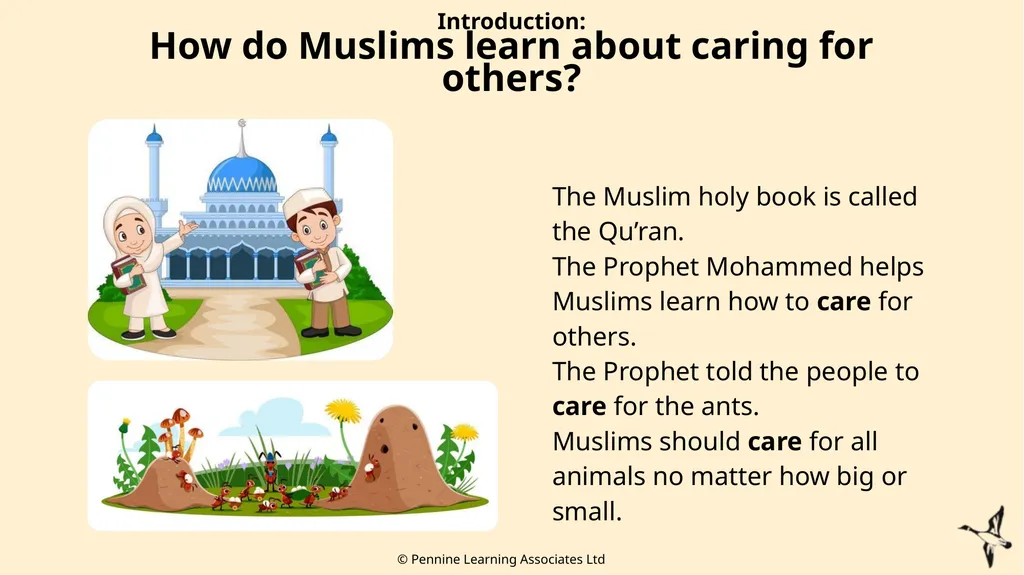
What happened in the story of the Prophet and the Ants? How did the Prophet show care for the ants? Introduction: How do Muslims learn about caring for others?<br>
09
The Muslim holy book is called the Qu’ran.
The Prophet Mohammed helps Muslims learn how to care for others.
The Prophet told the people to care for the ants.
Muslims should care for all animals no matter how big or small. Introduction: How do Muslims learn about caring for others?<br>
10
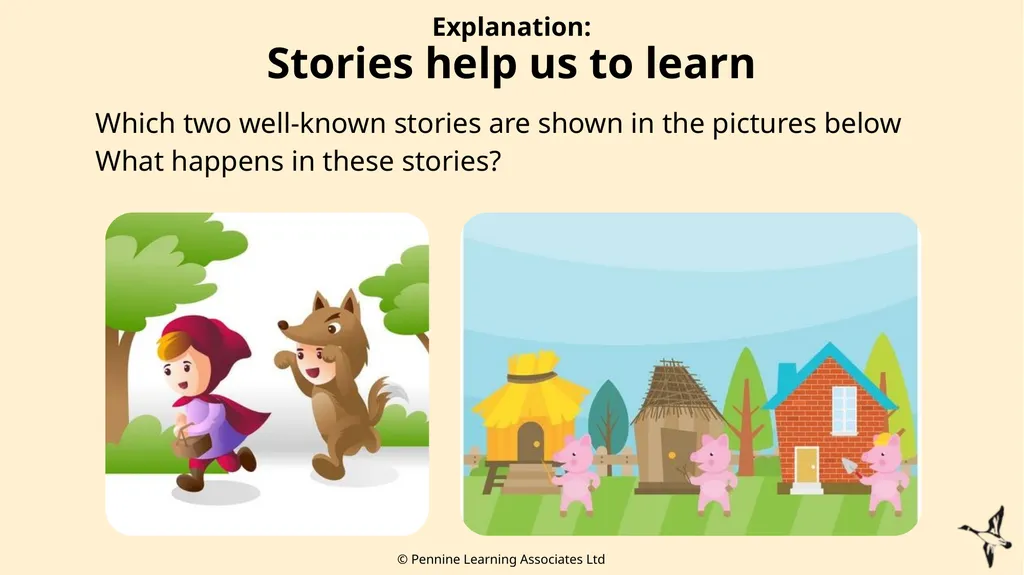
Which two well-known stories are shown in the pictures below
What happens in these stories? Explanation: Stories help us to learn<br>
11
Buddhists believe all living things are important.
Buddhist stories help Buddhists to understand ways in which they should live their life.
Listen to this Buddhist story. It is called Siddhartha and the Swan. Explanation: A Buddhist story<br>
12
Siddhartha was a Prince who lived in a huge palace. One day he was playing by the river in the palace grounds when a flock of swans flew by.
From out of no-where an arrow came flying through the air and hit one of the swans. The swan fell down to the floor.
Siddhartha was very shocked and upset. He ran straight away to try and help the swan. Explanation: Siddhartha and the Swan<br>
13
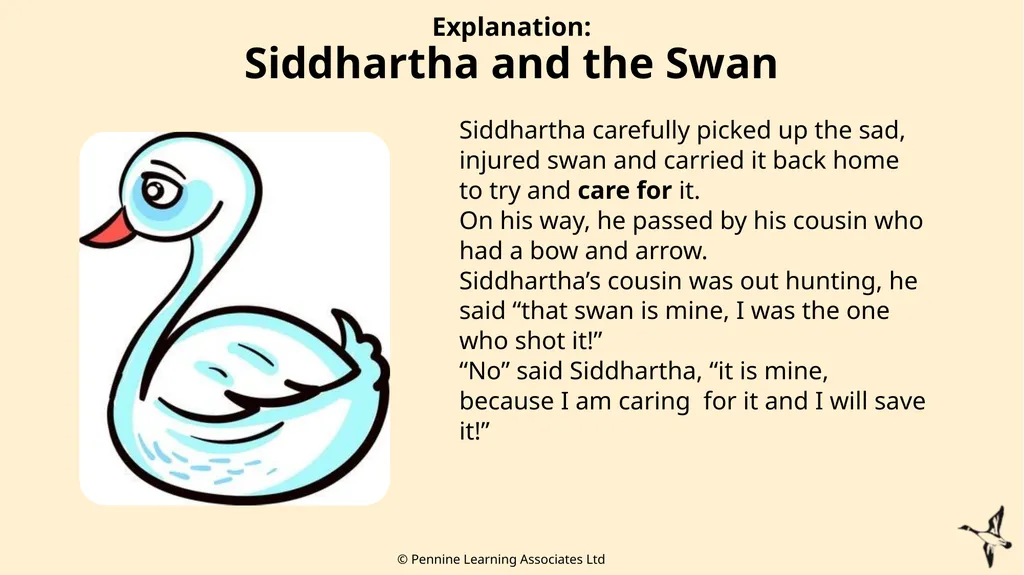
Siddhartha carefully picked up the sad, injured swan and carried it back home to try and care for it.
On his way, he passed by his cousin who had a bow and arrow.
Siddhartha’s cousin was out hunting, he said “that swan is mine, I was the one who shot it!”
“No” said Siddhartha, “it is mine, because I am caring for it and I will save it!” Explanation: Siddhartha and the Swan<br>
14
They took the swan to their wise teacher to solve the problem of who the swan belonged to.
The teacher listened to both children, and said,
“The swan is Siddhartha’s because he is the one who is caring for the swan and will help to save its life. He will love and cherish it.”
Siddhartha’s cousin was so angry about this and walked away.
Siddhartha was happy because he had saved the swan. Explanation: Siddhartha and the Swan<br>
15
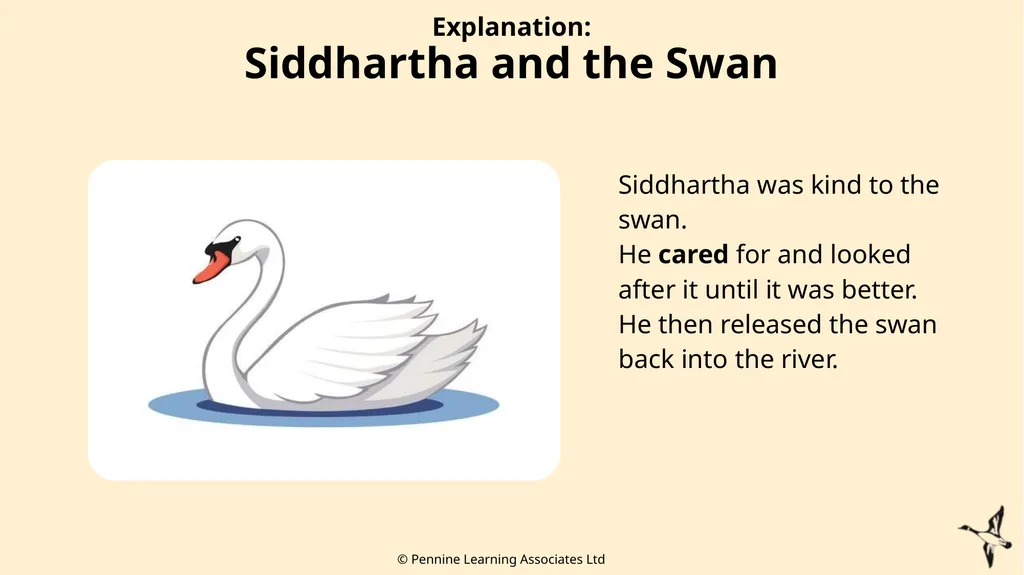
Siddhartha was kind to the swan.
He cared for and looked after it until it was better.
He then released the swan back into the river. Explanation: Siddhartha and the Swan<br>
16
How did Siddhartha show care in the story?
What do you think Buddhists can learn from listening to this story? Discussion: Siddhartha and the Swan<br>
17
Siddhartha was strong and knew that he should care for the swan, even though his cousin wanted to injure and kill the swan.
Buddhists believe that all living things are important.
There are lots of other Buddhist stories that show that people should be kind, care for and love all living things. Explanation: Siddhartha and the Swan<br>
18
Think of some questions they would like to ask a character in the story. Choose their favourite question and use this as the focus for a class discussion
Talk about times when caring and friendship is difficult
Make bird feeders to care for birds in the school grounds Suggested tasks: Adult-led<br>
19
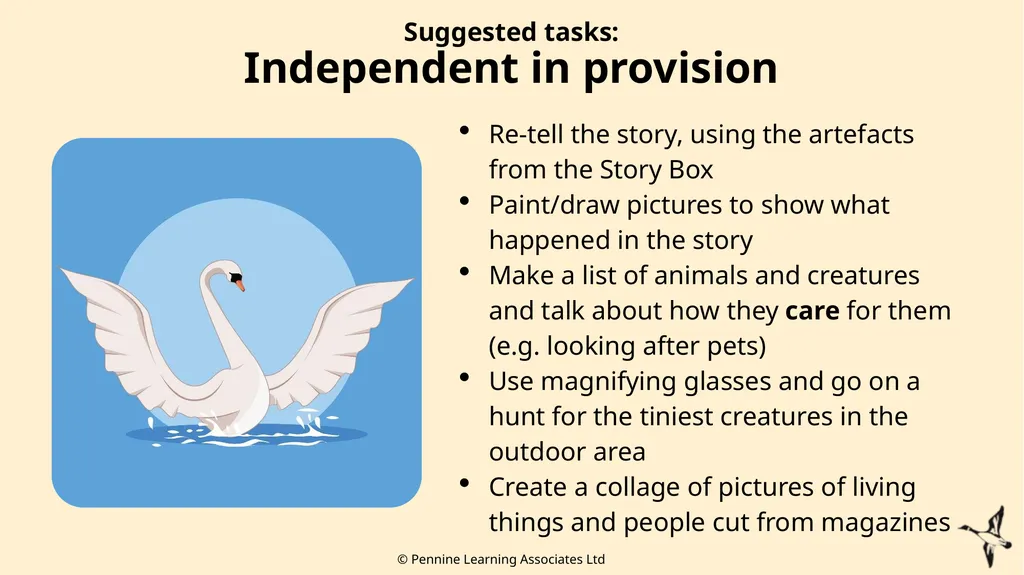
Re-tell the story, using the artefacts from the Story Box
Paint/draw pictures to show what happened in the story
Make a list of animals and creatures and talk about how they care for them (e.g. looking after pets)
Use magnifying glasses and go on a hunt for the tiniest creatures in the outdoor area
Create a collage of pictures of living things and people cut from magazines Suggested tasks: Independent in provision<br>
20
The story of Siddhartha and the swan teaches Buddhists to care for all animals. Buddhists should always care for and look after all living things in the world. Stories help Buddhists understand how they should live their lives. Learning summary<br>
21
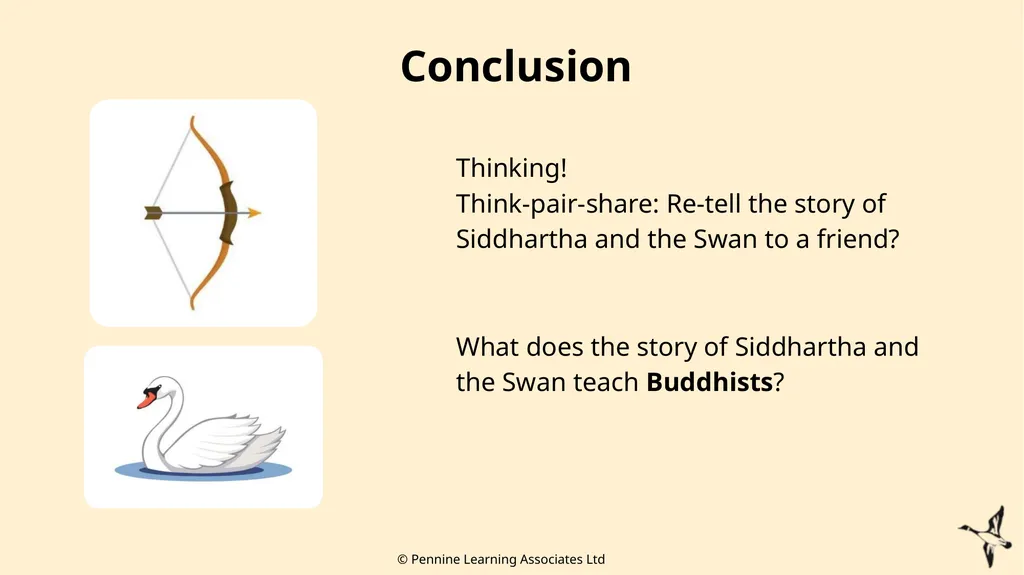
Thinking!
Think-pair-share: Re-tell the story of Siddhartha and the Swan to a friend?
What does the story of Siddhartha and the Swan teach Buddhists? Conclusion<br>
22
Buddhists are taught through stories to care for all living things.
In what ways have you helped to care for living things? e.g. gardens and plants, insects and bugs, pets at home, friends and family. Time to think<br>
23
Images reproduced under professional licence from Vecteezy. Acknowledgements<br>