Thank you for using this resource. We hope it helps you, and your pupils! This advice may help. PowerPoints cover more than one lesson The PowerPoint presentation matches a section in the planning provided for this unit of work. This is
"Thank you for using this resource. We hope it" is the property of its rightful owner. Permission is granted to
download and print the materials on this website for personal, non-commercial use only, and to display it
on your personal computer provided you do not modify the materials and that you retain all copyright
notices contained in the materials. By downloading content from our website, you accept the terms of this
agreement.
Presentation Transcript
01
Thank you for using this resource. We hope it helps you, and your pupils! This advice may help.
PowerPoints cover more than one lesson
The PowerPoint presentation matches a section in the planning provided for this unit of work. This is likely to contain material for more than one lesson. It is important not to speed through the slides without completing suggested activities or discussion. Most sections in the planning, and the matching PowerPoints, will cover two lessons.
Please make sure you prepare and plan with staff
It is critical that delivery, style and speed reflect the needs and responses of pupils. The resource has been designed to support teachers, not to replace you! If this resource is provided as supporting material for HLTAs, cover teachers or non-specialists please ensure you prepare them carefully and plan with them.
We recommend you use the detailed planning as well as this PowerPoint
This PowerPoint is designed to be used with the detailed planning written to support the RE syllabus ‘Believing and Belonging’. We strongly recommend that you use the PowerPoint in conjunction with the planning. Please ask us how to access this if you do not have it.
To feed back and for further support and to access webinar training please email enquiries@penninelearning.com. Dear Teacher…<br>
02
About this unit: This unit of work is based on Pathway 3 - a good life. The unit of study includes work on Muslim beliefs and practices, including the belief in Allah and the importance of the Prophet Muhammad (peace and blessings be upon him) as a role model and inspiration for Muslims. It expands and develops learning about the Five Pillars of Islam as a way of focusing on key Muslim beliefs about the right way to live. Pupils will learn and draw on specific religious language to explain Islamic values and how they are shared with other religions and worldviews.
Where this lesson fits: This lesson provides pupils with the opportunity to revisit their knowledge about Islam and recap key areas of Islam, thinking back to prior learning. Pupils will explore the significance of Islamic artefacts and share their knowledge with the class. They will learn some key facts about the religion of Islam and will have the opportunity to create a mind map to summarise their ongoing learning, as well as a class glossary for key vocabulary from this lesson and future lessons.
Points to note: Make sure pupils are aware that pictures of Allah and the Prophet Muhammad are Haraam (forbidden) and so at no point in this topic of Islam will pupils be asked to draw God or the prophets in Islam. Papers that bear the name of Allah, Qur'anic verses should be cross-shredded before disposal.
Enrichment ideas: This lesson will be enriched by an opportunity to interview a Muslim person from the school or wider community about their faith. A visit to a local mosque can also be arranged, where pupils can learn how the pillars are followed.
Further lesson notes and additional ideas may be found in the notes section of some slides (normal or presenter view). Please refer to the full unit plan for more activities and resources.
Slide 20 – Link to True Tube video: https://www.truetube.co.uk/resource/alien-abduction-islam/ Notes for teachers<br>
03
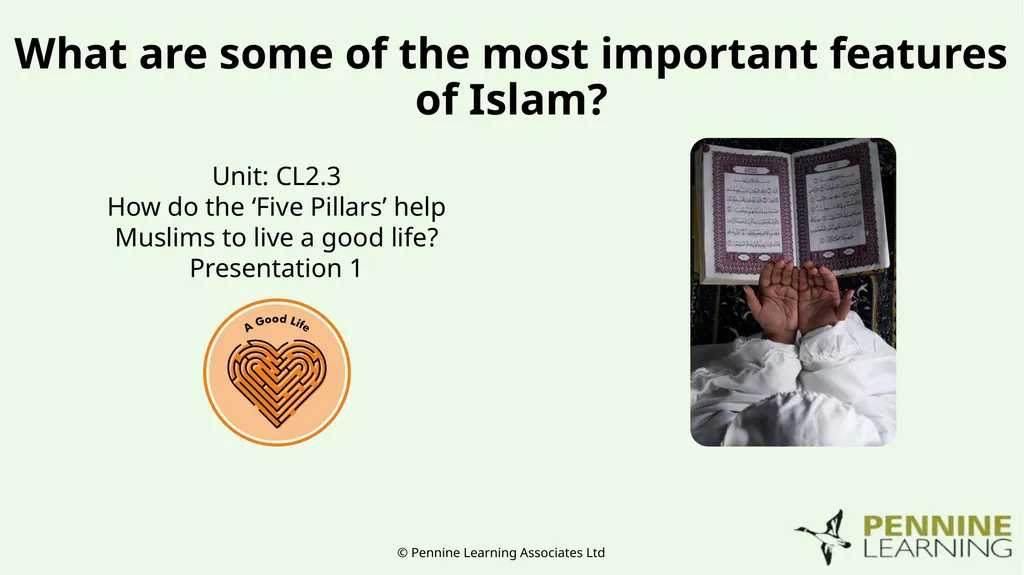
Unit: CL2.3
How do the ‘Five Pillars’ help Muslims to live a good life?
Presentation 1 What are some of the most important features of Islam?<br>
04
Key Stage 2
Through investigating what is meant by a Good Life, pupils will learn that:
Most religions share stories of moral exemplars from the past and more recently, guiding followers on leading virtuous lives.
Religions/worldviews provide guidance for their followers on how to live a good life.
There are both differing opinions and agreement on what is meant by a ‘good life’ and what is right and wrong. How this presentation links to the pathway:
This presentation gives you the opportunity to revisit your knowledge about Islam. You will explore the significance of Islamic artefacts and share their knowledge with the class of how Muslims use these in daily life Pathway 3: A Good Life<br>
05
Learning objectives<br>
06
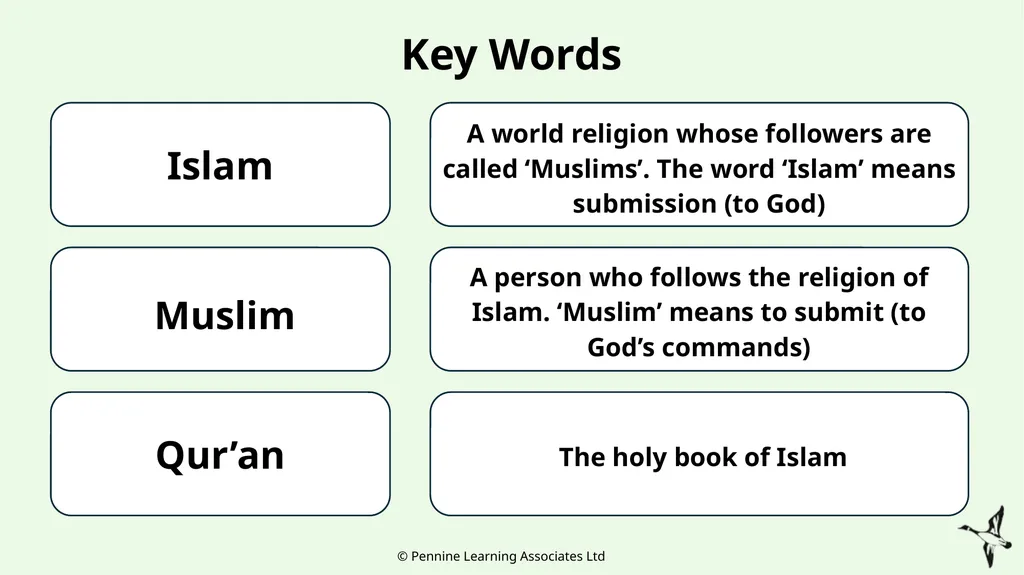
Key Words A person who follows the religion of Islam. ‘Muslim’ means to submit (to God’s commands)<br>
07
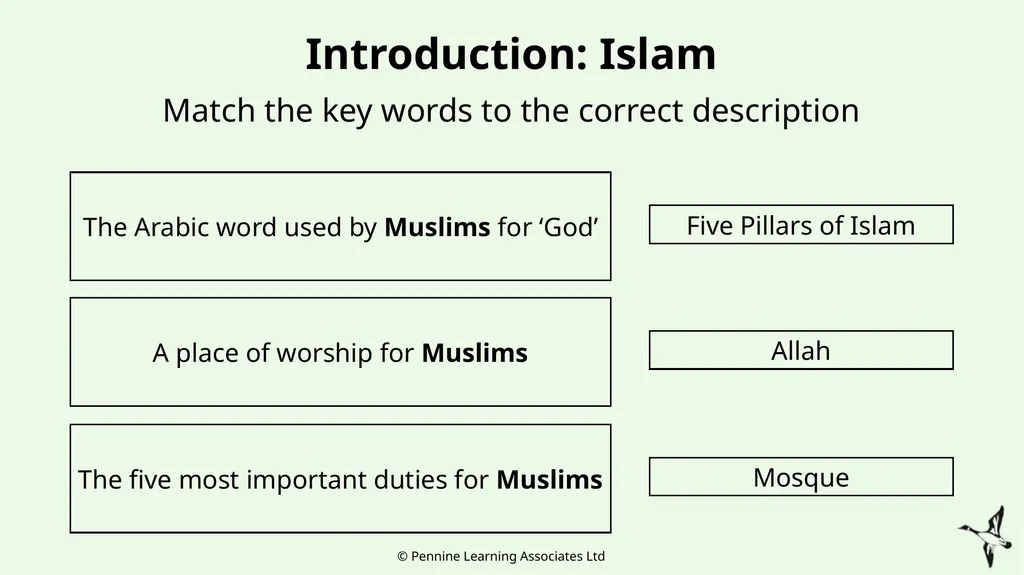
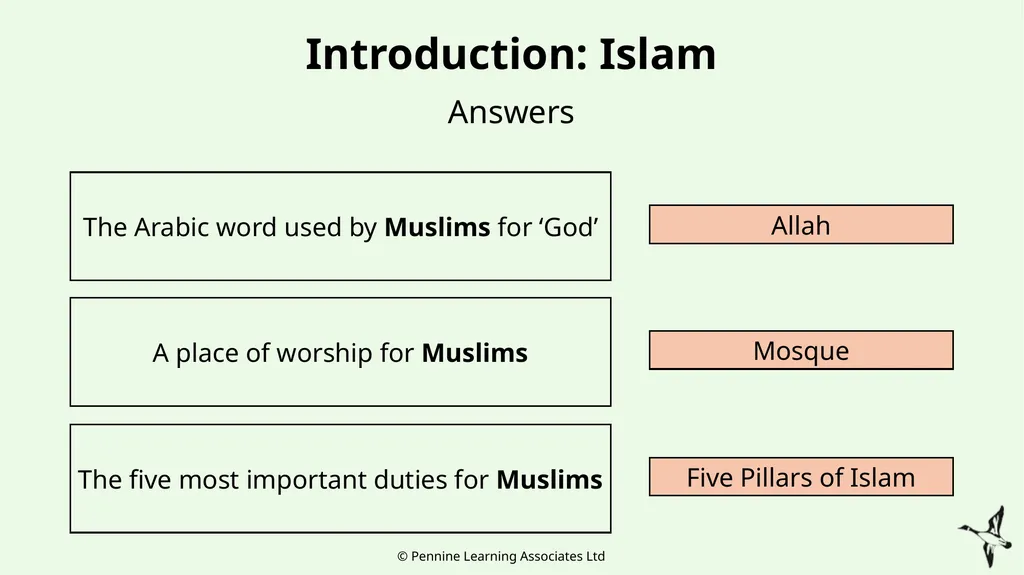
Introduction: Islam Allah Mosque Five Pillars of Islam The Arabic word used by Muslims for ‘God’ The five most important duties for Muslims A place of worship for Muslims Match the key words to the correct description<br>
08
Introduction: Islam Mosque Five Pillars of Islam Allah The Arabic word used by Muslims for ‘God’ The five most important duties for Muslims A place of worship for Muslims Answers<br>
09
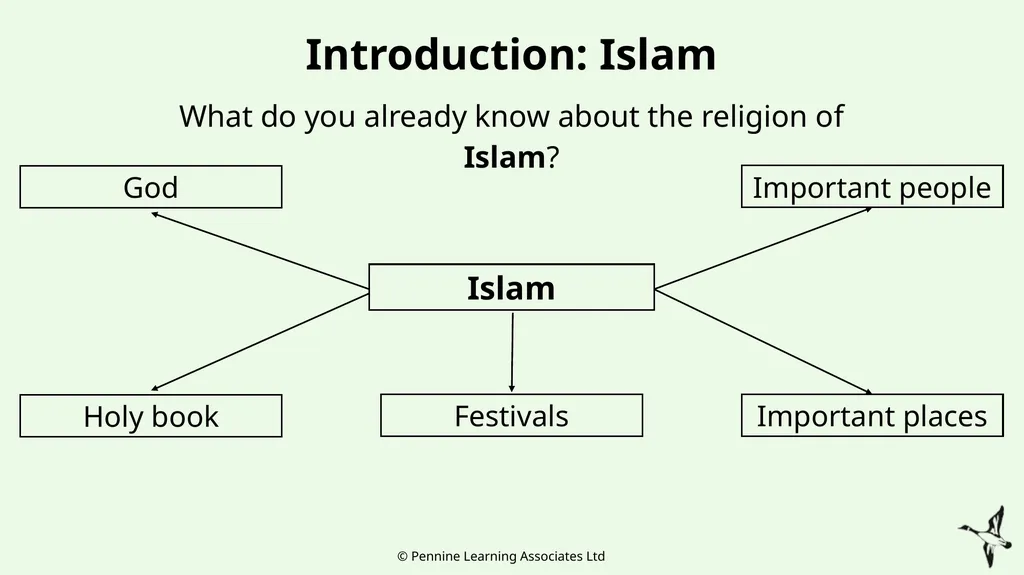
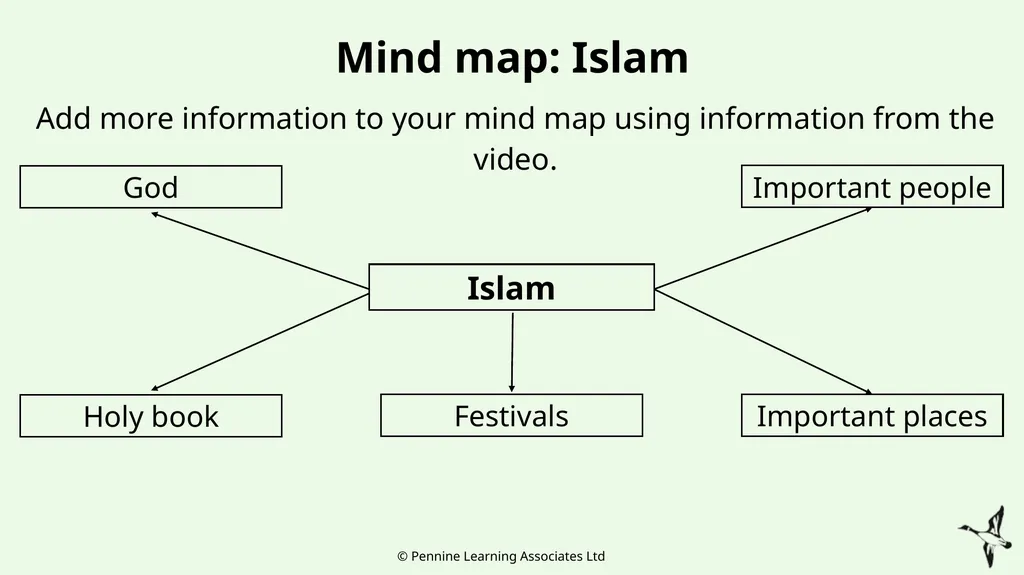
Introduction: Islam What do you already know about the religion of Islam? God Islam Holy book Important places Important people Festivals<br>
10
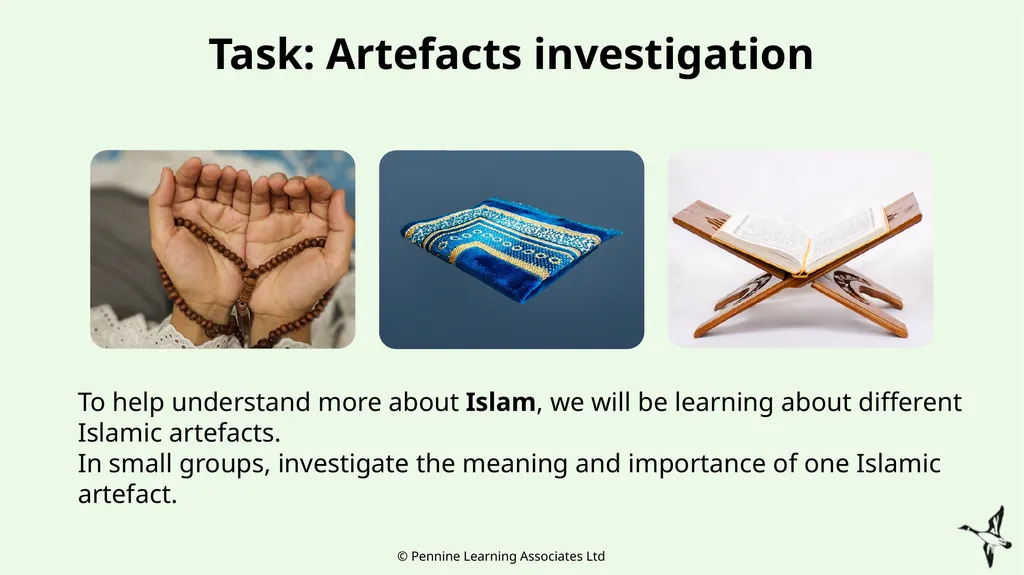
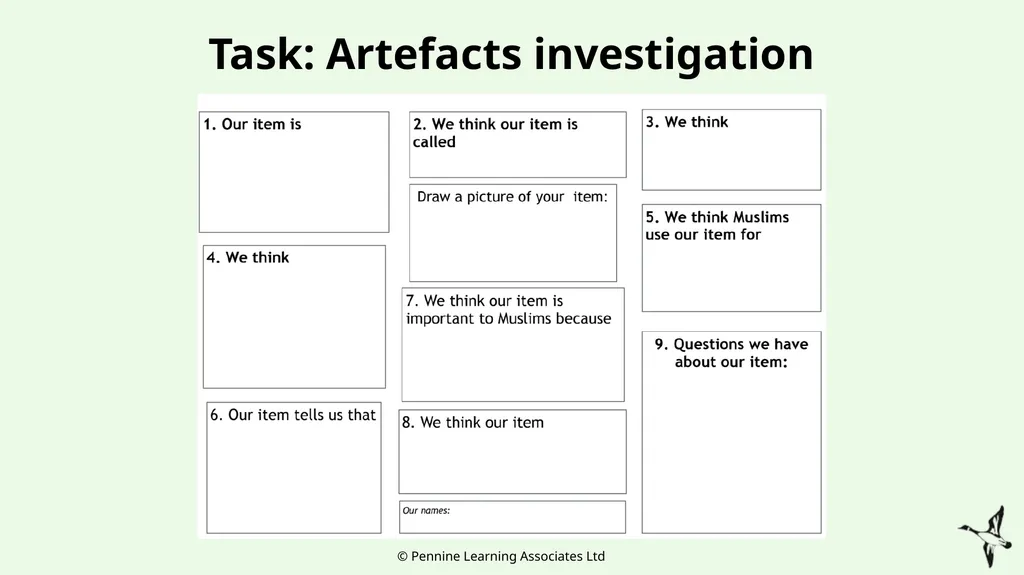
Task: Artefacts investigation To help understand more about Islam, we will be learning about different Islamic artefacts.
In small groups, investigate the meaning and importance of one Islamic artefact.<br>
11
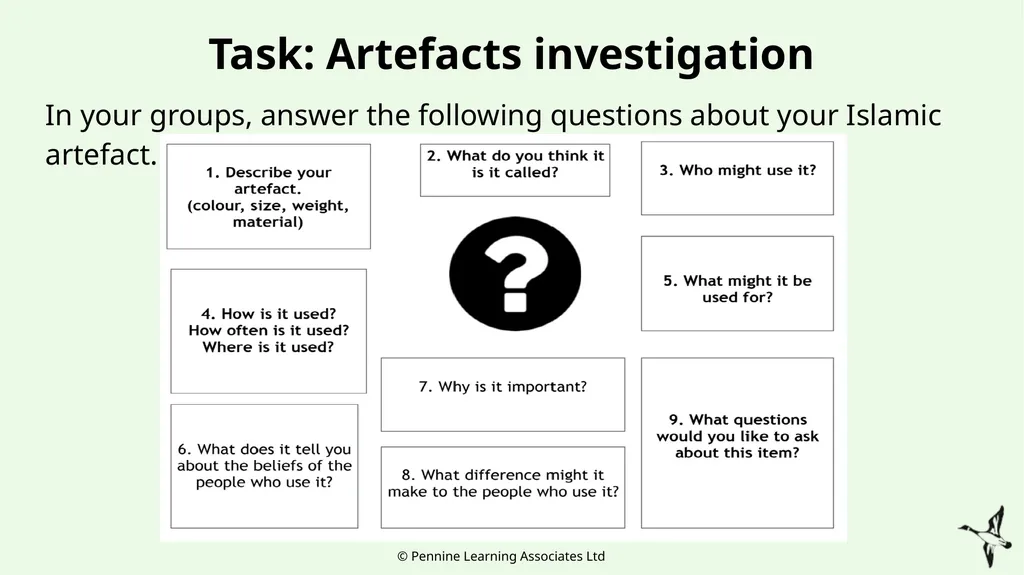
Task: Artefacts investigation In your groups, answer the following questions about your Islamic artefact.<br>
12
Task: Artefacts investigation<br>
13
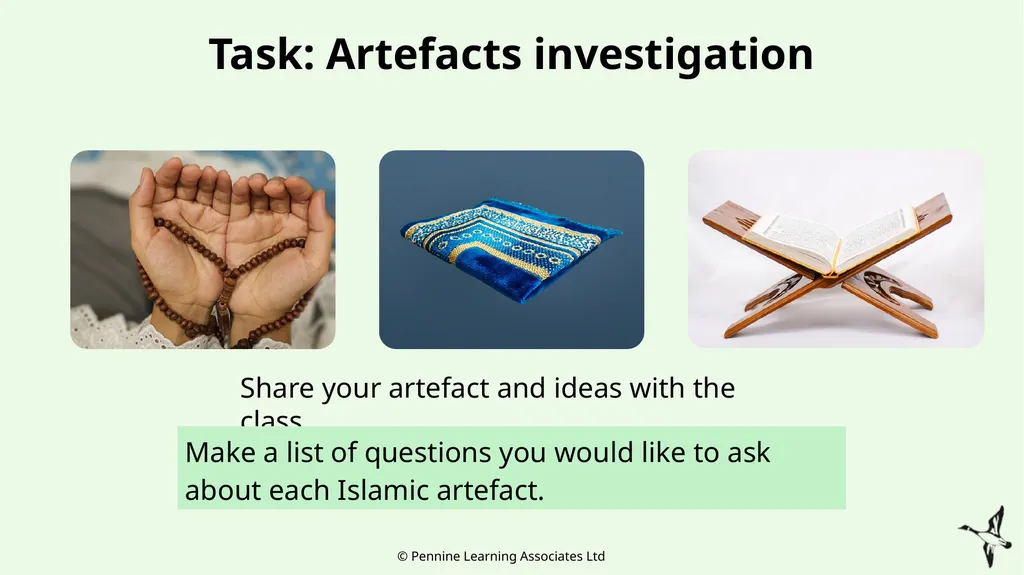
Task: Artefacts investigation Share your artefact and ideas with the class. Make a list of questions you would like to ask about each Islamic artefact.<br>
14
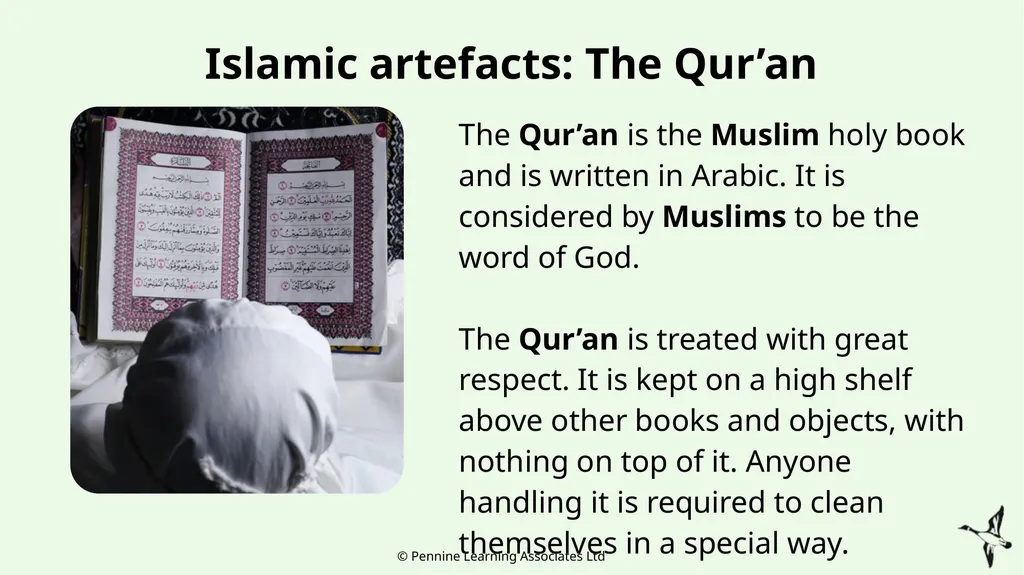
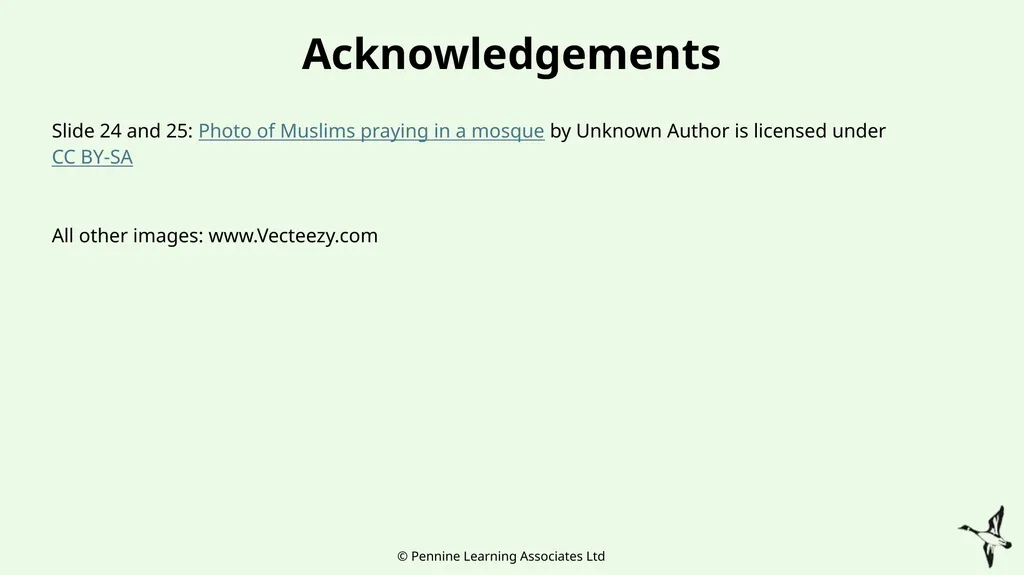
Islamic artefacts: The Qur’an The Qur’an is the Muslim holy book and is written in Arabic. It is considered by Muslims to be the word of God.
The Qur’an is treated with great respect. It is kept on a high shelf above other books and objects, with nothing on top of it. Anyone handling it is required to clean themselves in a special way.<br>
15
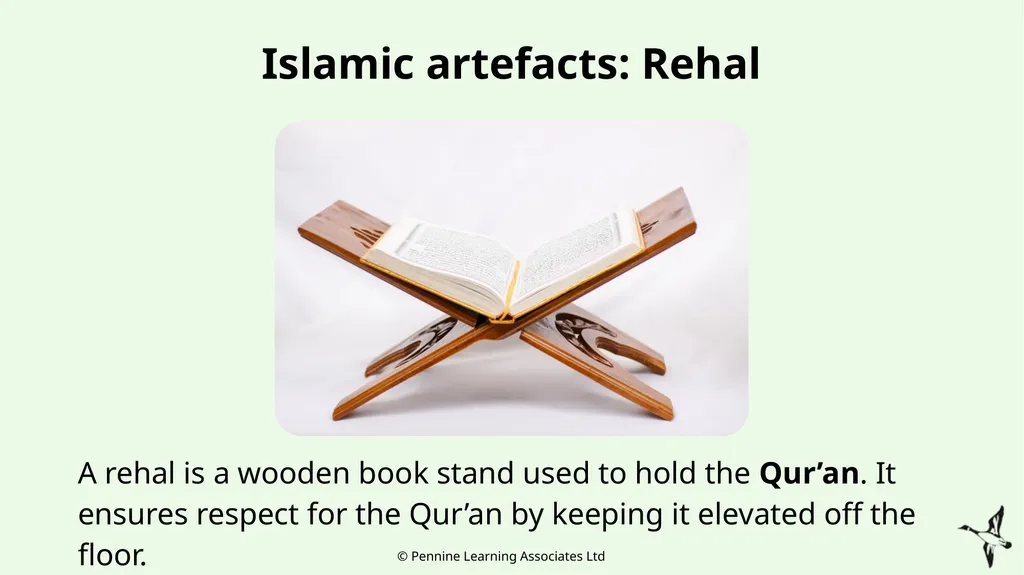
Islamic artefacts: Rehal A rehal is a wooden book stand used to hold the Qur’an. It ensures respect for the Qur’an by keeping it elevated off the floor.<br>
16
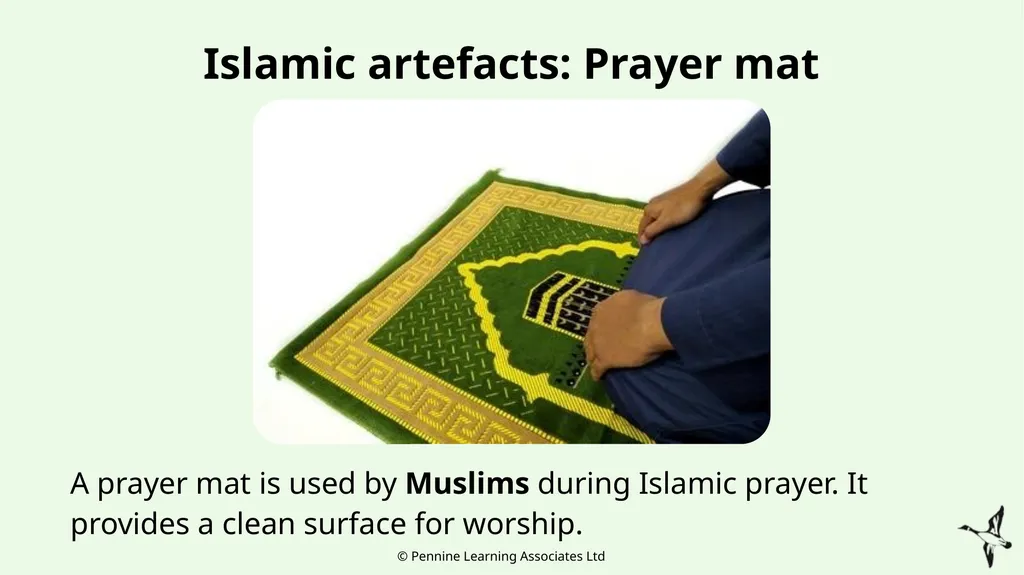
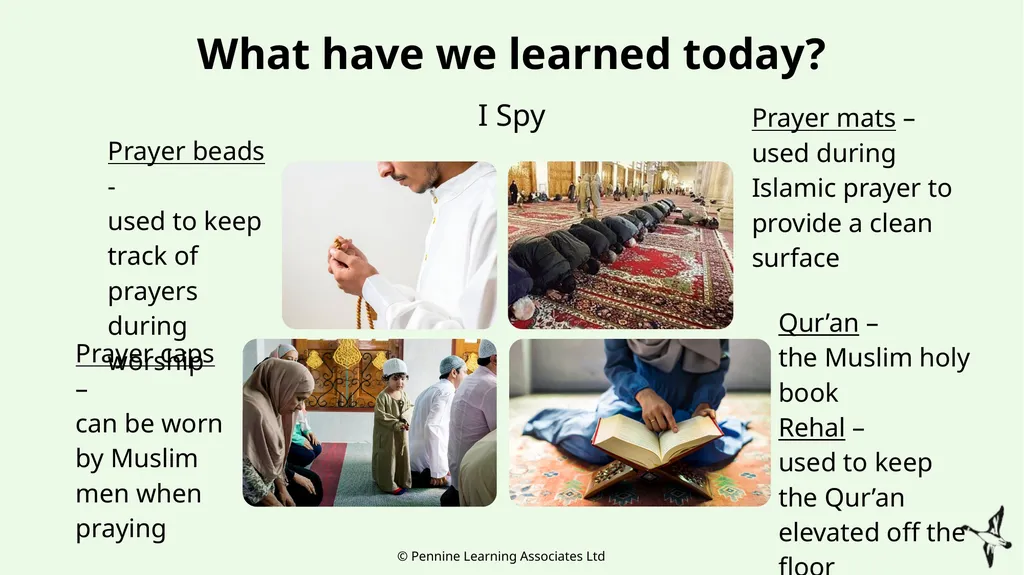
Islamic artefacts: Prayer mat A prayer mat is used by Muslims during Islamic prayer. It provides a clean surface for worship.<br>
17
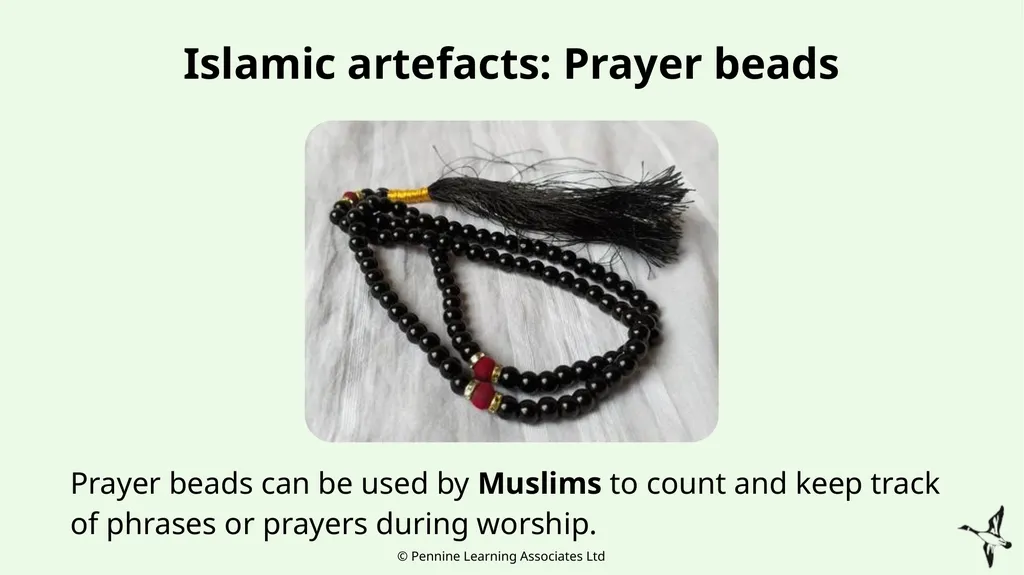
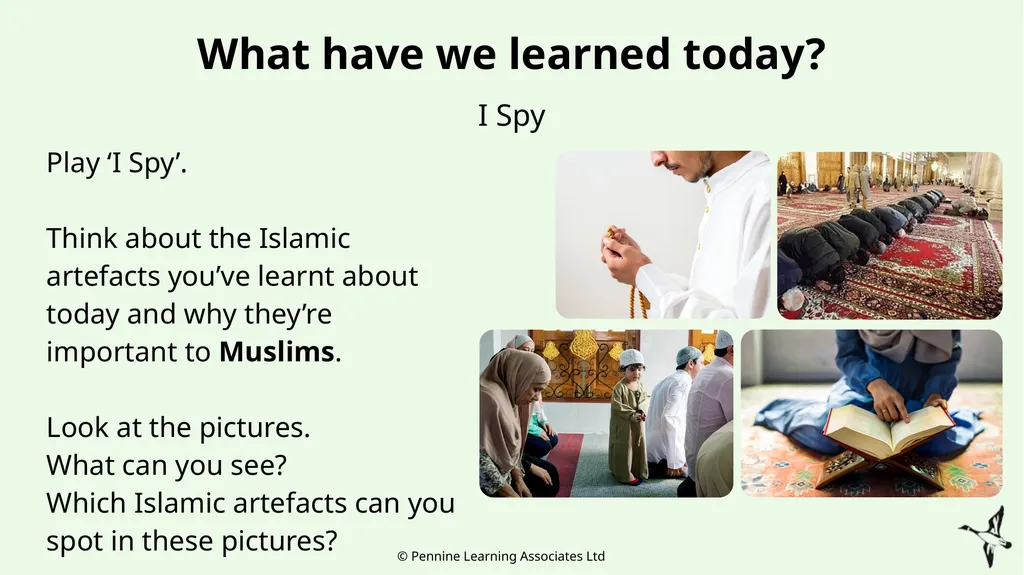
Islamic artefacts: Prayer beads Prayer beads can be used by Muslims to count and keep track of phrases or prayers during worship.<br>
18
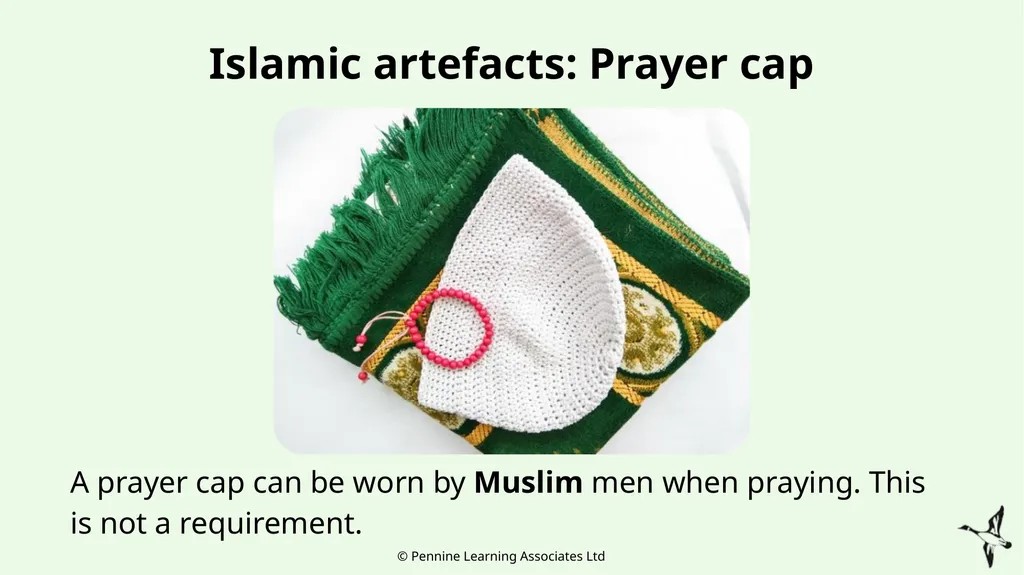
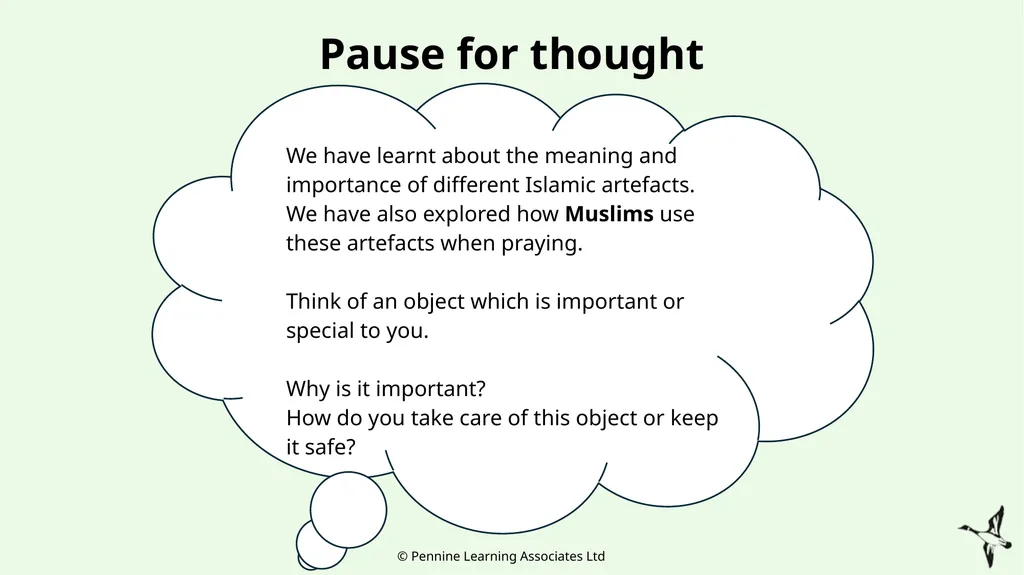
Islamic artefacts: Prayer cap A prayer cap can be worn by Muslim men when praying. This is not a requirement.<br>
19
Task: Make notes of key facts Watch the video about Islam.
Make notes about the information from the video, which you can add to your mind map.
Think about the following questions whilst watching the video: What do Muslims believe about God? How did Islam begin? What rules do Muslims try to follow for their everyday life?<br>
20
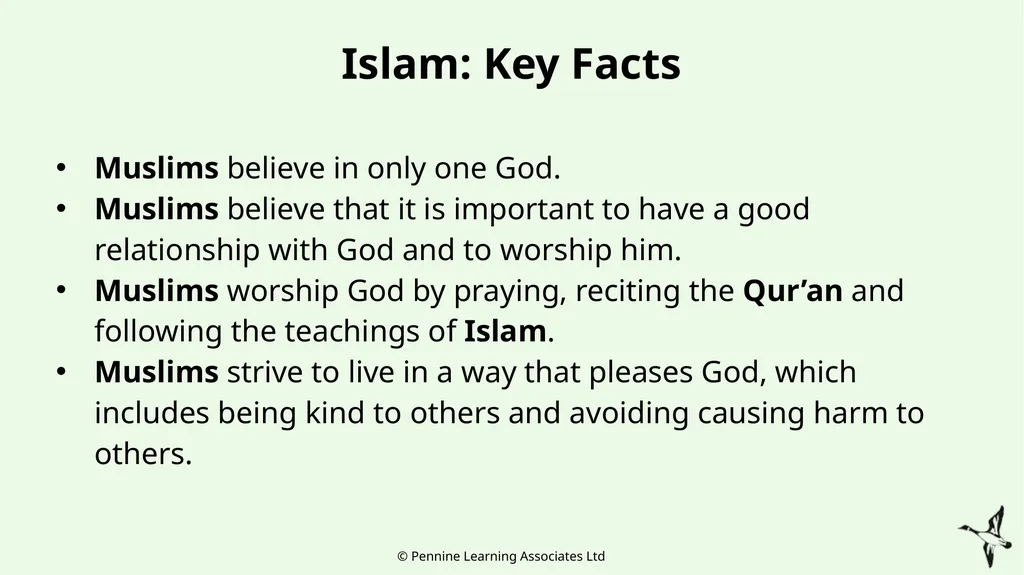
Islam: Key Facts Muslims believe in only one God.
Muslims believe that it is important to have a good relationship with God and to worship him.
Muslims worship God by praying, reciting the Qur’an and following the teachings of Islam.
Muslims strive to live in a way that pleases God, which includes being kind to others and avoiding causing harm to others.<br>
21
Add more information to your mind map using information from the video. God Islam Holy book Important places Important people Festivals Mind map: Islam<br>
22
Glossary Add key Islamic terms from today’s lesson can to the class glossary<br>
23
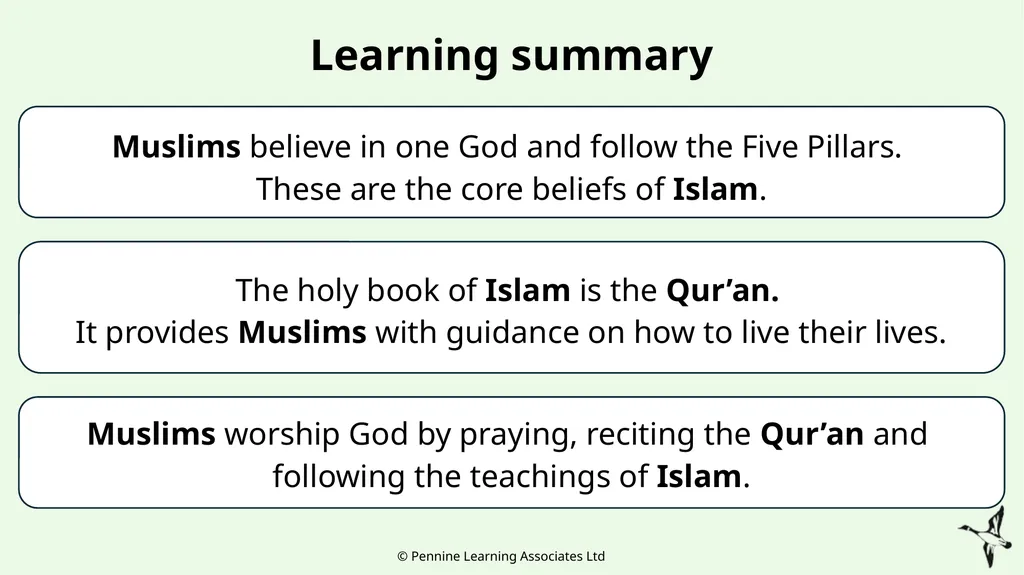
Learning summary The holy book of Islam is the Qur’an.
It provides Muslims with guidance on how to live their lives.<br>
24
What have we learned today? I Spy Play ‘I Spy’.
Think about the Islamic artefacts you’ve learnt about today and why they’re important to Muslims.
Look at the pictures.
What can you see?
Which Islamic artefacts can you spot in these pictures?<br>
25
What have we learned today? I Spy Prayer beads -
used to keep track of prayers during worship Prayer mats –
used during Islamic prayer to provide a clean surface Prayer caps –
can be worn by Muslim men when praying Qur’an –
the Muslim holy book
Rehal –
used to keep the Qur’an elevated off the floor<br>
26
We have learnt about the meaning and importance of different Islamic artefacts. We have also explored how Muslims use these artefacts when praying.
Think of an object which is important or special to you.
Why is it important?
How do you take care of this object or keep it safe? Pause for thought<br>
27
Acknowledgements Slide 24 and 25: Photo of Muslims praying in a mosque by Unknown Author is licensed under CC BY-SA