Thank you for using this resource. We hope it helps you, and your pupils! This advice may help. PowerPoints cover more than one lesson The PowerPoint presentation matches a section in the planning provided for this unit of work. This is
"Thank you for using this resource. We hope it" is the property of its rightful owner. Permission is granted to
download and print the materials on this website for personal, non-commercial use only, and to display it
on your personal computer provided you do not modify the materials and that you retain all copyright
notices contained in the materials. By downloading content from our website, you accept the terms of this
agreement.
Presentation Transcript
01
Thank you for using this resource. We hope it helps you, and your pupils! This advice may help.
PowerPoints cover more than one lesson
The PowerPoint presentation matches a section in the planning provided for this unit of work. This is likely to contain material for more than one lesson. It is important not to speed through the slides without completing suggested activities or discussion. Most sections in the planning, and the matching PowerPoints, will cover two lessons.
Please make sure you prepare and plan with staff
It is critical that delivery, style and speed reflect the needs and responses of pupils. The resource has been designed to support teachers, not to replace you! If this resource is provided as supporting material for HLTAs, cover teachers or non-specialists please ensure you prepare them carefully and plan with them.
We recommend you use the detailed planning as well as this PowerPoint
This PowerPoint is designed to be used with the detailed planning written to support the RE syllabus ‘Believing and Belonging’. We strongly recommend that you use the PowerPoint in conjunction with the planning. Please ask us how to access this if you do not have it.
To feed back and for further support and to access webinar training please email enquiries@penninelearning.com. Dear Teacher…<br>
02
Where this lesson fits: Having shared who is in their family and who lives in their home in the first session, children will be introduced to objects in homes that can be special. They will reflect on the concept of 'precious' and what it means to different people. As a class, they will reflect on how we can handle special objects with respect.
Points to note: Discussions will take place over several sessions and as part of continuous provision. Be sensitive to children’s family settings. This is a good opportunity to respect the differences between families but that all should be treated equally. Demonstrate respect for special objects by handling them carefully in front of the children.
Religious Education in Early Years settings: Activities may be adapted to suit Reception and Nursery settings. See the full unit plan for links to Early Learning Goals and a full range of ideas for adult-led and independent activities. Further advice about planning for RE in EYFS can be found in the RE syllabus, Believing and Belonging (p 20 – 23).
Further lesson notes and additional ideas may be found in the notes section of some slides (normal or presenter view).
Enrichment ideas: If staff or helpers are willing to bring in and share a special object, use this as an in-depth example, encouraging the children to handle it carefully and to ask questions about it. These questions could be recorded in the style of an interview. Encourage children to ask their own questions and listen to the replies.
Outdoor learning: create a cosy den with special objects to explore. Notes for teachers<br>
03
Resources needed:
Enhance the home corner with special objects (appropriate for the children to handle independently) such as framed photographs, postcards, souvenirs, a well-loved teddy / doll, a fake candle etc. Religious objects can be added provided they are suitable for children to handle independently.
Prepare a 'feely bag' containing a mixture of special and ordinary objects. Include an object that could be both, for example a shell or pebble.
Stories about lost toys: 'Dogger' by Shirley Hughes ISBN 10- 1862308055
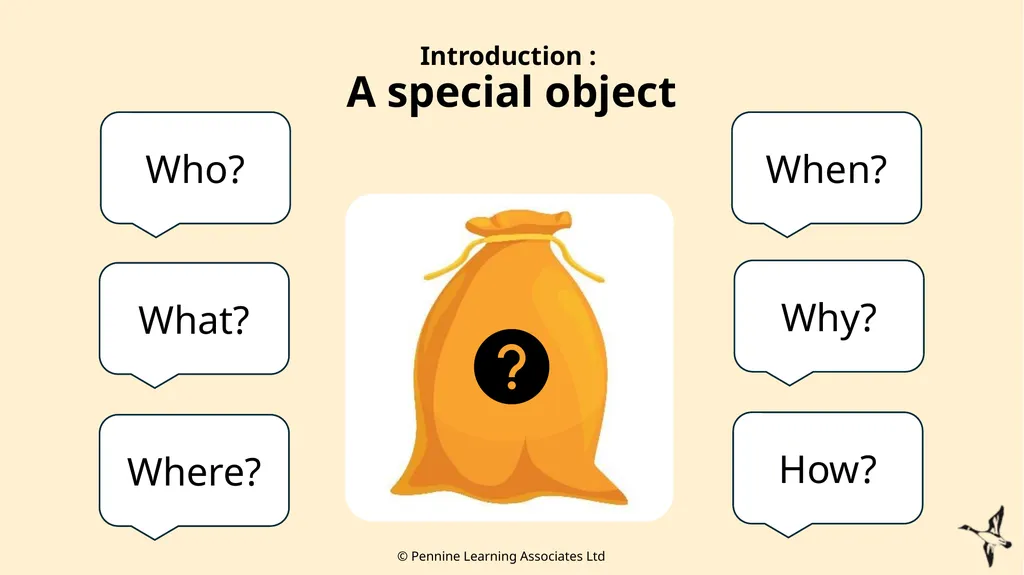
Slide: 9: Begin with a special object from your home, or from another adult's home in the feely bag. Encourage the children to ask you questions about the object to find out clues about it. Give examples using the question words. Ask other adults to model asking questions that the children may not ask such as 'how does it make you feel?'; 'how would you feel if you lost it?'
Slide: 11: Add a selection of special and ordinary objects to the bag. Pass the bag round and encourage children to take an object out and talk about it. Explain that we don't always know if an object is special or not without someone explaining why.
Slide 12: Use special objects or pictures that children have brought in from home / uploaded to discuss in a small group. If children have not brought anything in, use the drawings produced in the provision-based tasks.
Slide: 15: Make a list of rules together to show how we will treat special objects in our classroom. This can be printed and displayed in the classroom next to the special objects. Notes for teachers<br>
04
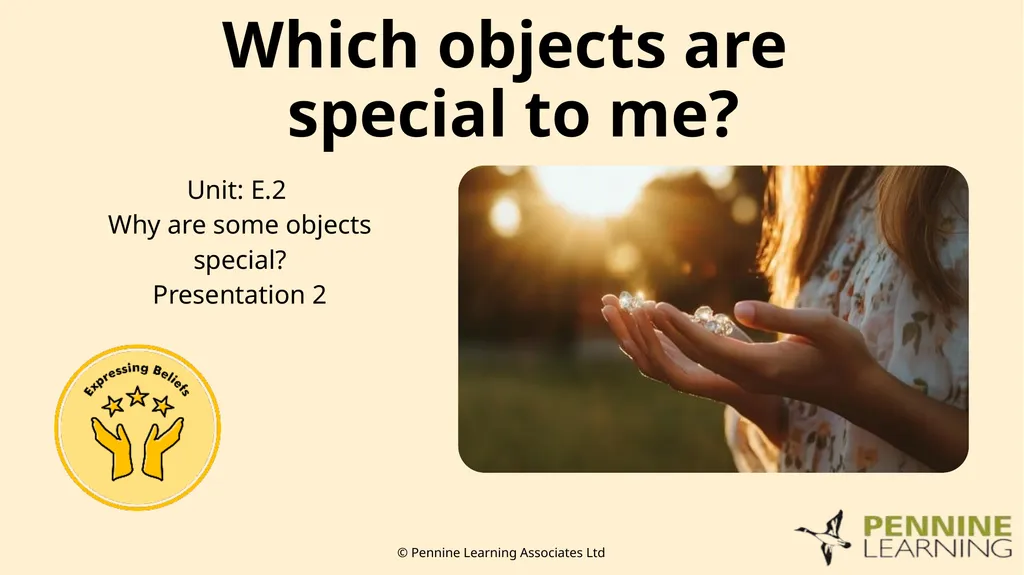
Unit: E.2
Why are some objects special?
Presentation 2 Which objects are special to me?<br>
05
How this presentation links to the pathway:
This presentation explores special objects and how they are precious to people. Early Years
Through investigating how beliefs are expressed, children should learn that:
people with different religions or worldviews express their beliefs through special actions, objects and pictures
some special objects and pictures that people use to express their beliefs can be called 'sacred' or 'holy' Pathway 2: Expressing Beliefs<br>
06
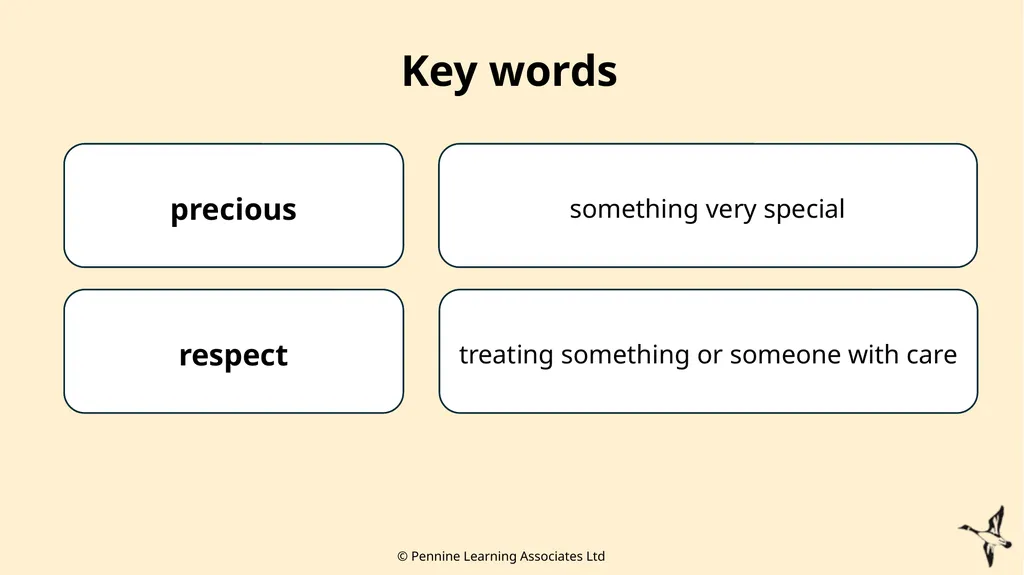
Key words<br>
07
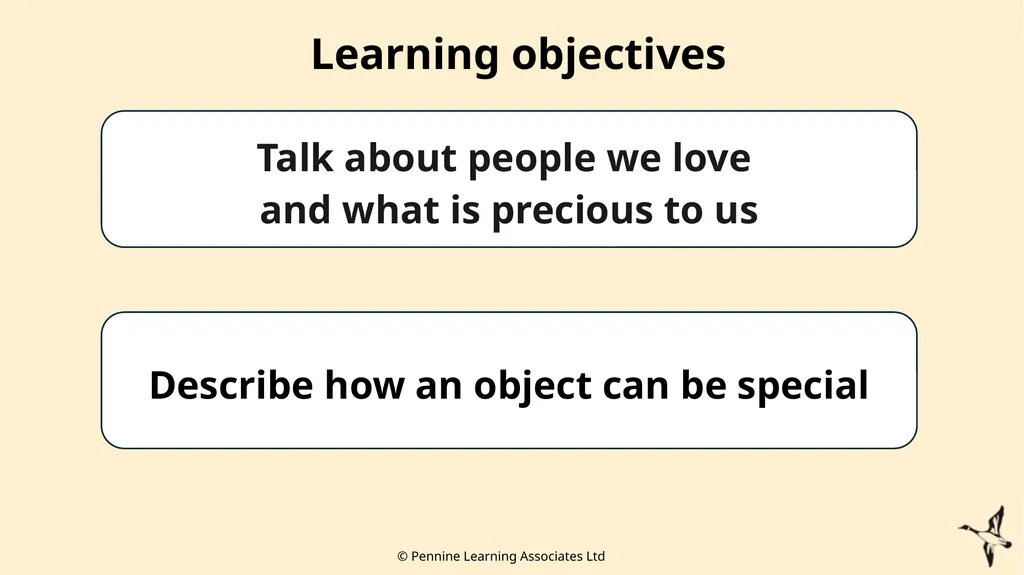
Describe how an object can be special Talk about people we love
and what is precious to us Learning objectives<br>
08
Pass the clap around the circle
Call out a person who is very special to you
Think about why they are special Recap: A special person<br>
09
How? Why? When? Where? What? Who? Introduction : A special object<br>
10
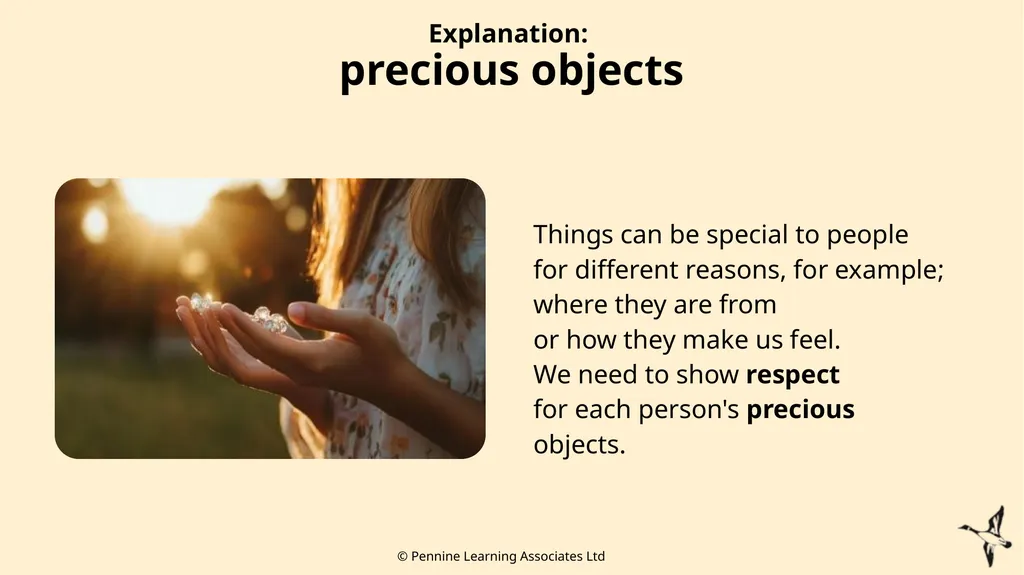
Things can be special to people for different reasons, for example;
where they are from
or how they make us feel.
We need to show respect
for each person's precious objects. Explanation: precious objects<br>
11
Pick an object from the bag.
Do you think it might be precious?
What is giving you a clue?
Can we always tell if an object is special?
How should we treat precious objects? Task : find the special objects<br>
12
Invite parents/ carers to send in photos of special objects or the special object itself. This maybe a special teddy, photograph or book etc.
In small groups talk about what the object is, where it has come from and why it is special.
Draw the special object and then annotate for children what it looks like, what it feels like, where it has come from and how it makes them feel.
Read a story about a lost toy, for example Dogger. Suggested tasks: Adult-led<br>
13
Create special objects in the model-making area using different materials.
Set up a basket of ‘special’ things for the children to explore and handle with care.
Give the children small pieces of paper to draw or write about people and objects special to them. They could be posted into a specially wrapped box.
Add special objects to the home corner and encourage the children to talk about their own homes.
Religious objects that are safe/suitable for handling could be included in the home corner. Suggested tasks: Independent learning in provision<br>
14
We need to treat objects that are special to people
with care and respect. We can't always tell if an object is precious.
Something that is special to one person might not be
special to someone else. Objects can be precious because of where they came from,
who gave them to us or how they make us feel. Learning summary<br>
15
Make a list of rules for handling special objects: What have we learned today?<br>
16
Tell your friend about a time when you gave someone you love something precious.
It could be something special you made for them, a hug, or anything else!
How did it make you feel?
How do you think it made them feel? Time to think<br>
17
Pictures licensed under Vecteezy. Acknowledgments<br>