
Thank you for using this resource. We hope it
GB
Published · 26 slides · 0 views

1 / 1


Description
Thank you for using this resource. We hope it helps you, and your pupils! This advice may help. PowerPoints cover more than one lesson The PowerPoint presentation matches a section in the planning provided for this unit of work. This is
Related Topics
Share
Embed code
Download this presentation From Below
"Thank you for using this resource. We hope it" is the property of its rightful owner. Permission is granted to download and print the materials on this website for personal, non-commercial use only, and to display it on your personal computer provided you do not modify the materials and that you retain all copyright notices contained in the materials. By downloading content from our website, you accept the terms of this agreement.
Presentation Transcript
01
Thank you for using this resource. We hope it helps you, and your pupils! This advice may help.
PowerPoints cover more than one lesson
The PowerPoint presentation matches a section in the planning provided for this unit of work. This is likely to contain material for more than one lesson. It is important not to speed through the slides without completing suggested activities or discussion. Most sections in the planning, and the matching PowerPoints, will cover two lessons. In particular, you may wish to spend one lesson looking carefully at a story/ video clip and its meaning, and another with discussion, acting it out and follow up.
Please make sure you prepare and plan with staff
It is critical that delivery, style and speed to reflect the needs and responses of pupils. The resource has been designed to support teachers, not to replace you! If this resource is provided as supporting material for HLTAs, cover teachers or non-specialists please ensure you prepare them carefully and plan with them.
We recommend you use the detailed planning as well as this PowerPoint
This PowerPoint is designed to be used with the detailed planning written to support the RE syllabus ‘Believing and Belonging’. We strongly recommend that you use the PowerPoint in conjunction with the planning. Please ask us how to access this if you do not have it.
To feed back and for further support and to access webinar training please email enquiries@penninelearning.com. Dear Teacher…<br>
PowerPoints cover more than one lesson
The PowerPoint presentation matches a section in the planning provided for this unit of work. This is likely to contain material for more than one lesson. It is important not to speed through the slides without completing suggested activities or discussion. Most sections in the planning, and the matching PowerPoints, will cover two lessons. In particular, you may wish to spend one lesson looking carefully at a story/ video clip and its meaning, and another with discussion, acting it out and follow up.
Please make sure you prepare and plan with staff
It is critical that delivery, style and speed to reflect the needs and responses of pupils. The resource has been designed to support teachers, not to replace you! If this resource is provided as supporting material for HLTAs, cover teachers or non-specialists please ensure you prepare them carefully and plan with them.
We recommend you use the detailed planning as well as this PowerPoint
This PowerPoint is designed to be used with the detailed planning written to support the RE syllabus ‘Believing and Belonging’. We strongly recommend that you use the PowerPoint in conjunction with the planning. Please ask us how to access this if you do not have it.
To feed back and for further support and to access webinar training please email enquiries@penninelearning.com. Dear Teacher…<br>
02
Where this lesson fits: This is lesson four in a sequence of festivals of light from Judaism, Sikhism, Hinduism, Christianity, Paganism and Ancient Civilisations. The unit is part of Pathway 5- Influence and Authority. Each lesson will focus on the ancient stories that underpin them and how these stories have influenced how people celebrate in modern times.
This lesson explores Christian advent traditions and focuses on the story of the first advent wreath. It emphasises how traditions are different around the world and how they evolve over time. Pupils will continue to build on their understanding of the symbolism of light across the festivals studied.
Enrichment ideas: If this unit is taught near advent time, the children could complete alternative advent calendars together such as the ‘random acts of Christmas kindness’ or ‘reverse advent calendar’ which involves collecting items for a local foodbank. Christmas activities that extend learning about the significance of light include the Christingle-https://www.childrenssociety.org.uk/how-you-can-help/fundraise-and-events/christingle/what-is-Christingle.
Resources needed: If the craft activity is selected, pupils will need a range of materials to choose from including pinecones, twine, ribbon, evergreen sprigs (real or fake), berries (fake), coloured card, paint, air drying clay and battery operated tealights.
If researching advent traditions in small groups they will require a shared device.
Further lesson notes and additional ideas may be found in the notes section of some slides (normal or presenter view). Please refer to the full unit plan for other suggested activities. Notes for teachers<br>
This lesson explores Christian advent traditions and focuses on the story of the first advent wreath. It emphasises how traditions are different around the world and how they evolve over time. Pupils will continue to build on their understanding of the symbolism of light across the festivals studied.
Enrichment ideas: If this unit is taught near advent time, the children could complete alternative advent calendars together such as the ‘random acts of Christmas kindness’ or ‘reverse advent calendar’ which involves collecting items for a local foodbank. Christmas activities that extend learning about the significance of light include the Christingle-https://www.childrenssociety.org.uk/how-you-can-help/fundraise-and-events/christingle/what-is-Christingle.
Resources needed: If the craft activity is selected, pupils will need a range of materials to choose from including pinecones, twine, ribbon, evergreen sprigs (real or fake), berries (fake), coloured card, paint, air drying clay and battery operated tealights.
If researching advent traditions in small groups they will require a shared device.
Further lesson notes and additional ideas may be found in the notes section of some slides (normal or presenter view). Please refer to the full unit plan for other suggested activities. Notes for teachers<br>
03
Useful internet links:
The history of the advent wreath-
Advent wreath Facts for Kids (kiddle.co)
Advent traditions differ across Protestant, Roman Catholic, Orthodox and other Christian traditions. Internet links to different traditions include:
Advent Season: What Is It, and How Is It Celebrated? (bibleproject.com)
The Advent Wreath - Young Catholics (young-catholics.com)
What is Advent? Here's everything you need to know - BBC Newsround Notes for teachers<br>
The history of the advent wreath-
Advent wreath Facts for Kids (kiddle.co)
Advent traditions differ across Protestant, Roman Catholic, Orthodox and other Christian traditions. Internet links to different traditions include:
Advent Season: What Is It, and How Is It Celebrated? (bibleproject.com)
The Advent Wreath - Young Catholics (young-catholics.com)
What is Advent? Here's everything you need to know - BBC Newsround Notes for teachers<br>
04
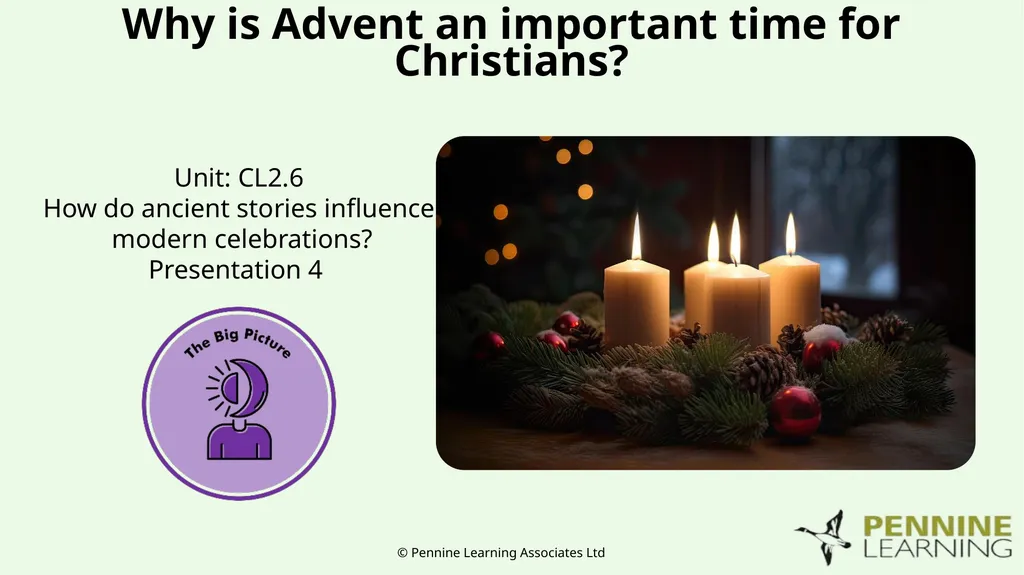
Why is Advent an important time for Christians? Unit: CL2.6
How do ancient stories influence
modern celebrations?
Presentation 4<br>
How do ancient stories influence
modern celebrations?
Presentation 4<br>
05
Key Stage 2
Through considering the Big Picture, pupils should learn that:
People tell different stories to communicate important teachings and these stories often form part of longer narratives.
Groups of religious and non-religious people tell different stories, which reflect the different ways in which they view the world. How this presentation links to the pathway:
This presentation explores Christian advent traditions and focuses on the story of the first advent wreath. It emphasises how traditions are different around the world and how they evolve over time. Pathway 6: The Big Picture<br>
Through considering the Big Picture, pupils should learn that:
People tell different stories to communicate important teachings and these stories often form part of longer narratives.
Groups of religious and non-religious people tell different stories, which reflect the different ways in which they view the world. How this presentation links to the pathway:
This presentation explores Christian advent traditions and focuses on the story of the first advent wreath. It emphasises how traditions are different around the world and how they evolve over time. Pathway 6: The Big Picture<br>
06
Learning objectives<br>
07
Key Words A practice that has happened for a
long time and been passed on.<br>
long time and been passed on.<br>
08
Introduction We have been learning about how stories from the past influence how people celebrate festivals today.
In this lesson, we will think about where Advent traditions have come from and how Christians around the world celebrate today.
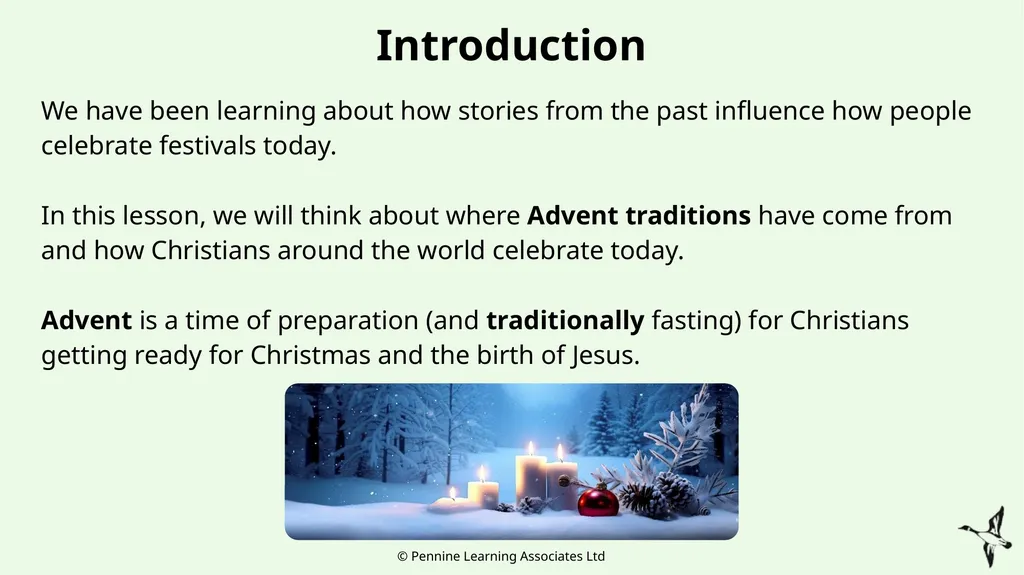
Advent is a time of preparation (and traditionally fasting) for Christians getting ready for Christmas and the birth of Jesus.<br>
In this lesson, we will think about where Advent traditions have come from and how Christians around the world celebrate today.
Advent is a time of preparation (and traditionally fasting) for Christians getting ready for Christmas and the birth of Jesus.<br>
09
What do we already know about Advent? Advent<br>
10
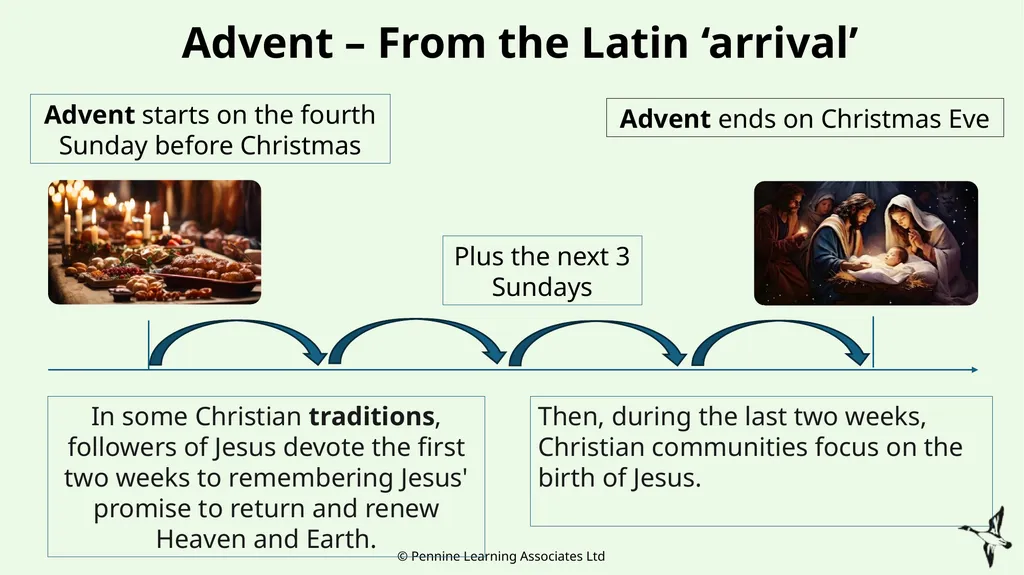
Advent – From the Latin ‘arrival’ Advent starts on the fourth Sunday before Christmas Plus the next 3 Sundays Advent ends on Christmas Eve In some Christian traditions, followers of Jesus devote the first two weeks to remembering Jesus' promise to return and renew Heaven and Earth. Then, during the last two weeks, Christian communities focus on the birth of Jesus.<br>
11
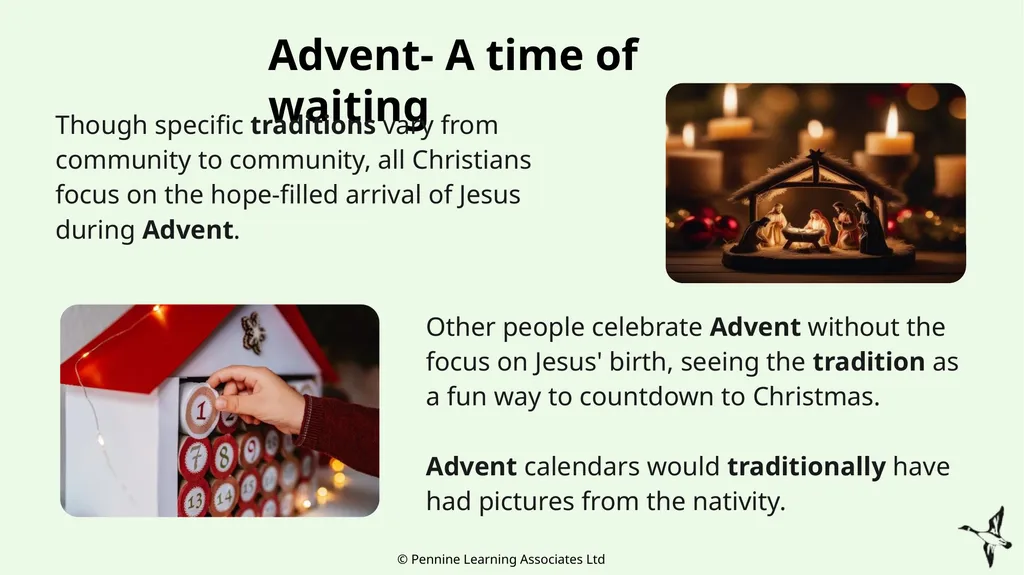
Advent- A time of waiting Other people celebrate Advent without the focus on Jesus' birth, seeing the tradition as a fun way to countdown to Christmas.
Advent calendars would traditionally have had pictures from the nativity. Though specific traditions vary from community to community, all Christians focus on the hope-filled arrival of Jesus during Advent.<br>
Advent calendars would traditionally have had pictures from the nativity. Though specific traditions vary from community to community, all Christians focus on the hope-filled arrival of Jesus during Advent.<br>
12
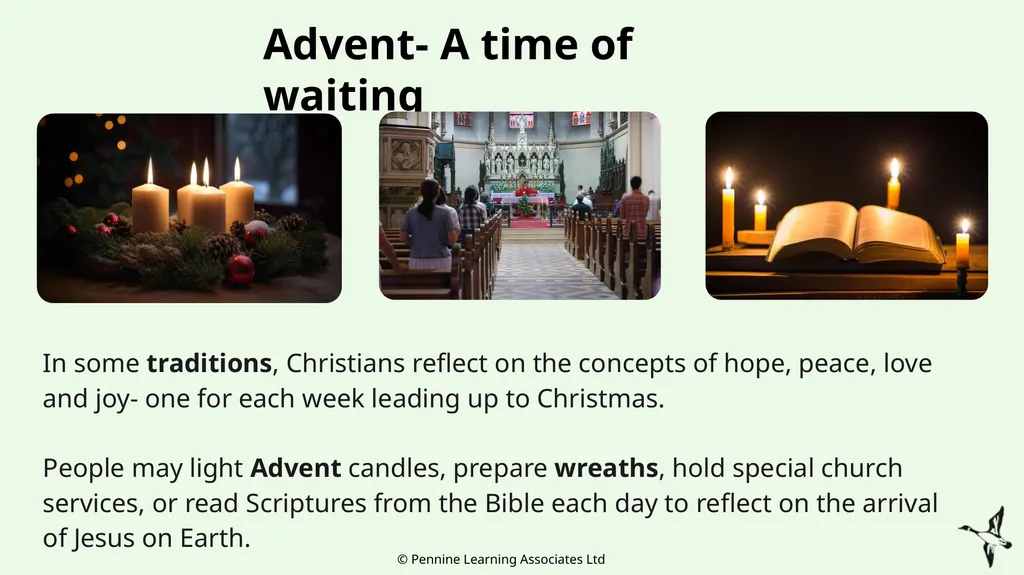
Advent- A time of waiting In some traditions, Christians reflect on the concepts of hope, peace, love and joy- one for each week leading up to Christmas.
People may light Advent candles, prepare wreaths, hold special church services, or read Scriptures from the Bible each day to reflect on the arrival of Jesus on Earth.<br>
People may light Advent candles, prepare wreaths, hold special church services, or read Scriptures from the Bible each day to reflect on the arrival of Jesus on Earth.<br>
13
The excitement of waiting Advent is a time of waiting and preparing for something very important to Christians – the arrival of Jesus Christ. What helps you to wait for something exciting?
Is 'waiting' worth it? think – pair – share<br>
Is 'waiting' worth it? think – pair – share<br>
14
The story of the first Advent wreath<br>
15
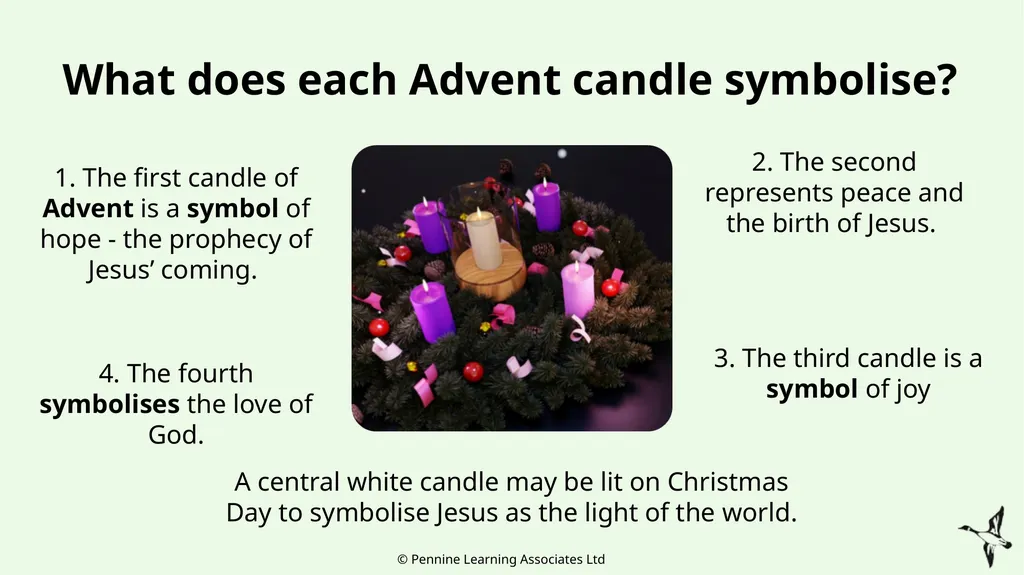
What does each Advent candle symbolise? 1. The first candle of Advent is a symbol of hope - the prophecy of Jesus’ coming. 2. The second represents peace and the birth of Jesus. 3. The third candle is a symbol of joy 4. The fourth symbolises the love of God. A central white candle may be lit on Christmas Day to symbolise Jesus as the light of the world.<br>
16
What does each Advent candle symbolise? 1. The first candle of Advent is a symbol of hope - the prophecy of Jesus’ coming. 2. The second represents peace and the birth of Jesus. 3. The third candle is a symbol of joy 4. The fourth symbolises the love of God. A central white candle may be lit on Christmas Day to symbolise Jesus as the light of the world.<br>
17
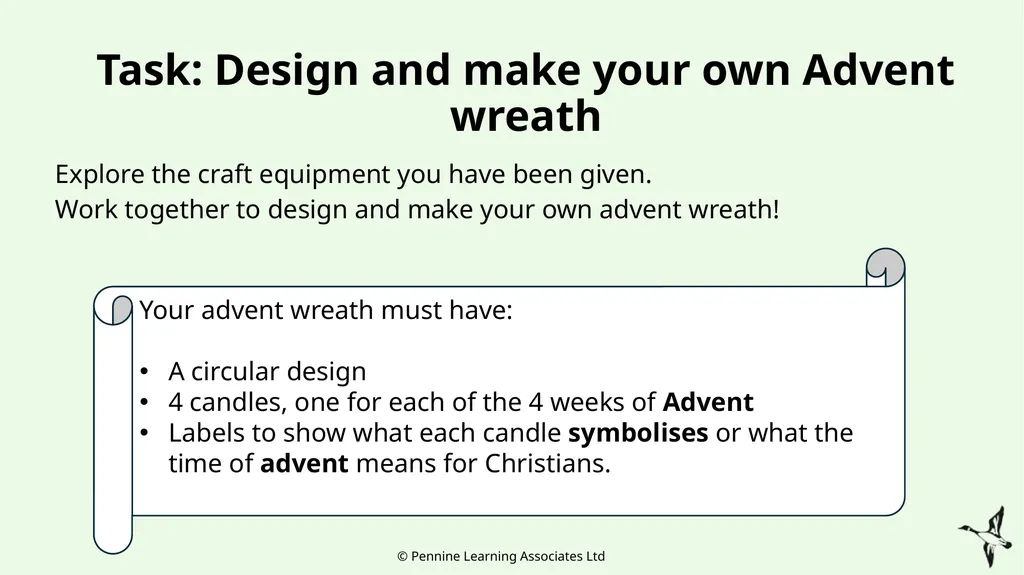
Task: Design and make your own Advent wreath Your advent wreath must have:
A circular design
4 candles, one for each of the 4 weeks of Advent
Labels to show what each candle symbolises or what the time of advent means for Christians. Explore the craft equipment you have been given.
Work together to design and make your own advent wreath!<br>
A circular design
4 candles, one for each of the 4 weeks of Advent
Labels to show what each candle symbolises or what the time of advent means for Christians. Explore the craft equipment you have been given.
Work together to design and make your own advent wreath!<br>
18
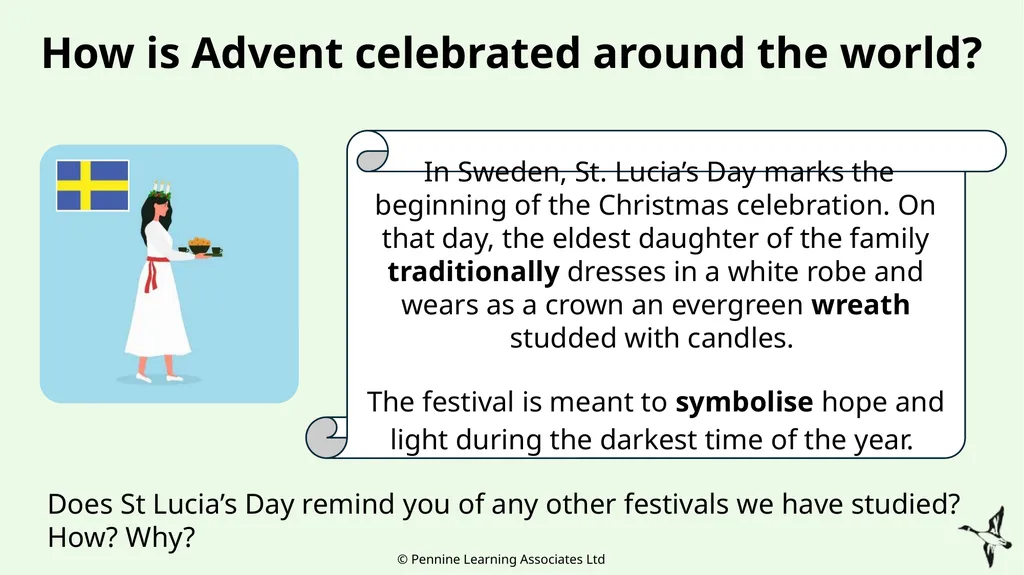
How is Advent celebrated around the world? In Sweden, St. Lucia’s Day marks the beginning of the Christmas celebration. On that day, the eldest daughter of the family traditionally dresses in a white robe and wears as a crown an evergreen wreath studded with candles.
The festival is meant to symbolise hope and light during the darkest time of the year. Does St Lucia’s Day remind you of any other festivals we have studied? How? Why?<br>
The festival is meant to symbolise hope and light during the darkest time of the year. Does St Lucia’s Day remind you of any other festivals we have studied? How? Why?<br>
19
Can you find another example of how Advent is celebrated today?
Work together to find out:
How it is celebrated
Why
Where
By whom
What it symbolises
Does anyone in your group have their own advent tradition? Task: Research Advent traditions<br>
Work together to find out:
How it is celebrated
Why
Where
By whom
What it symbolises
Does anyone in your group have their own advent tradition? Task: Research Advent traditions<br>
20
Learning summary Advent means ‘coming’ and is the 4 week period of preparation before celebrating the birth of Jesus for Christians. There are different advent traditions around the world, including St Lucia’s day in Sweden which symbolises hope and light during the darkest time of the year. The tradition of the advent wreath began nearly 200 years ago when Johann Hinrich Wichern built a cartwheel wreath to count the days until Christmas. The advent wreath candles symbolise peace, joy, the love of God and Jesus as the light of the world.<br>
21
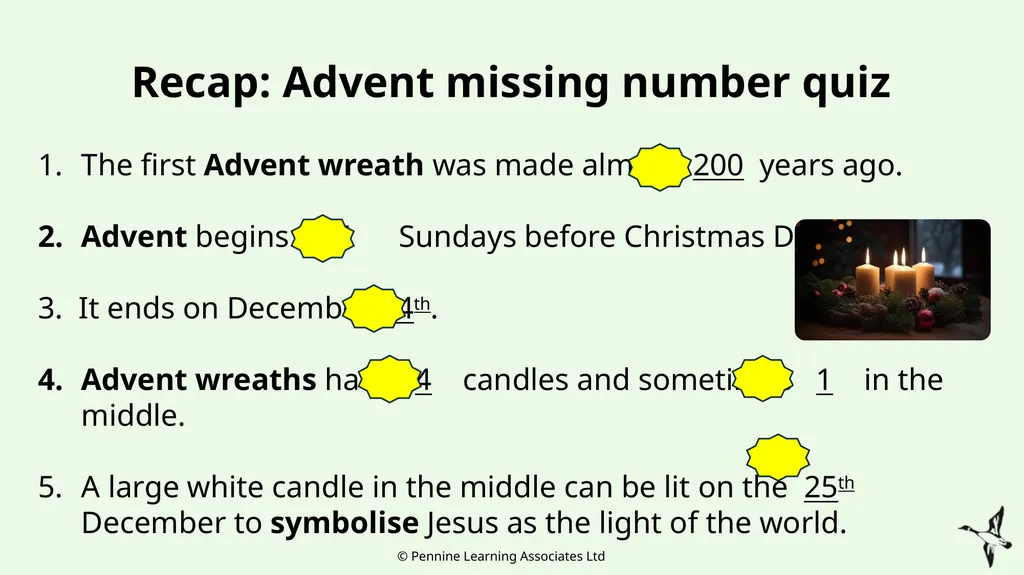
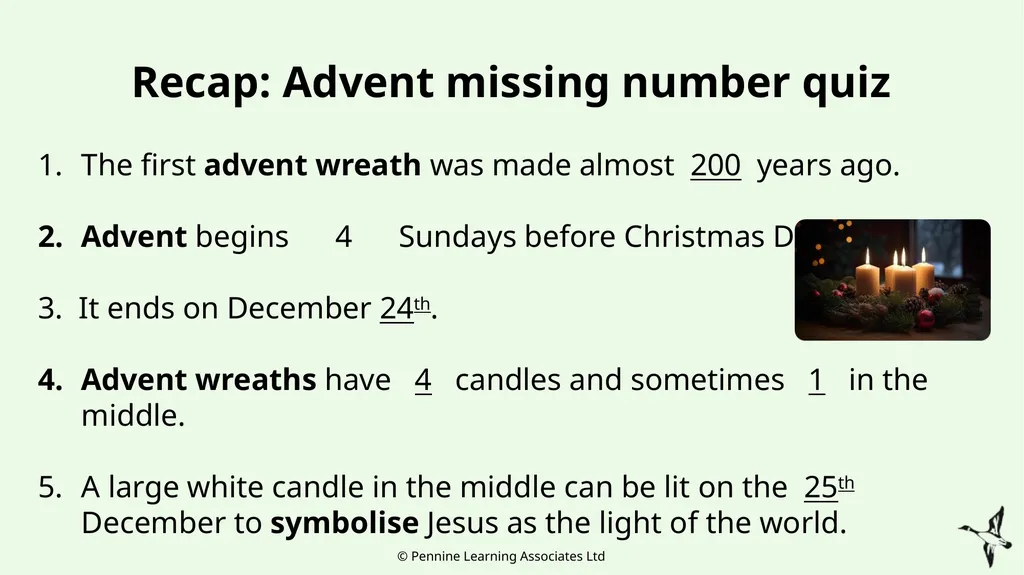
Recap: Advent missing number quiz The first Advent wreath was made almost 200 years ago.
Advent begins 4 Sundays before Christmas Day.
3. It ends on December 24th.
Advent wreaths have 4 candles and sometimes 1 in the middle.
A large white candle in the middle can be lit on the 25th December to symbolise Jesus as the light of the world.<br>
Advent begins 4 Sundays before Christmas Day.
3. It ends on December 24th.
Advent wreaths have 4 candles and sometimes 1 in the middle.
A large white candle in the middle can be lit on the 25th December to symbolise Jesus as the light of the world.<br>
22
Recap: Advent missing number quiz The first advent wreath was made almost 200 years ago.
Advent begins 4 Sundays before Christmas Day.
3. It ends on December 24th.
Advent wreaths have 4 candles and sometimes 1 in the middle.
A large white candle in the middle can be lit on the 25th December to symbolise Jesus as the light of the world.<br>
Advent begins 4 Sundays before Christmas Day.
3. It ends on December 24th.
Advent wreaths have 4 candles and sometimes 1 in the middle.
A large white candle in the middle can be lit on the 25th December to symbolise Jesus as the light of the world.<br>
23
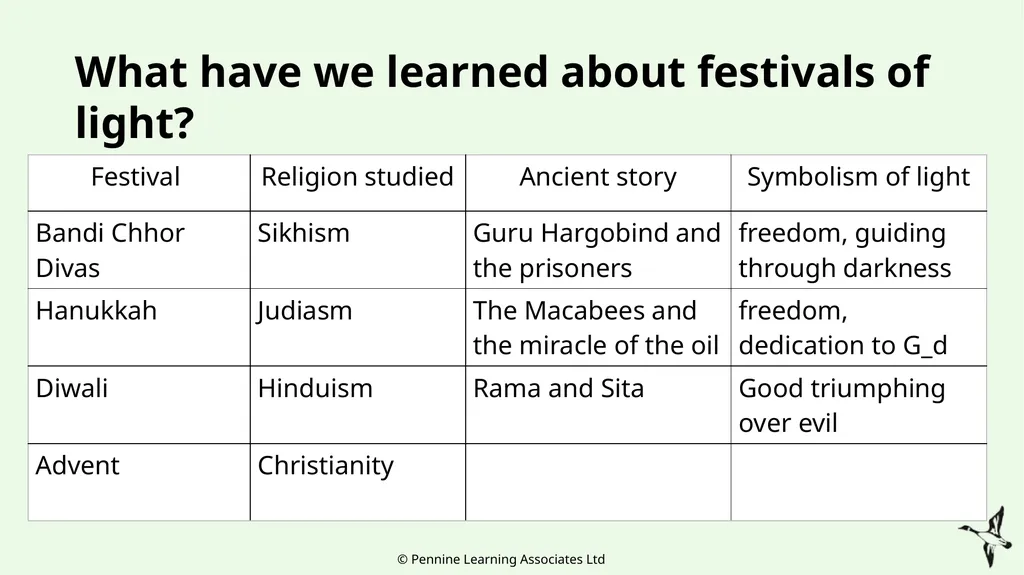
What have we learned about festivals of light?<br>
24
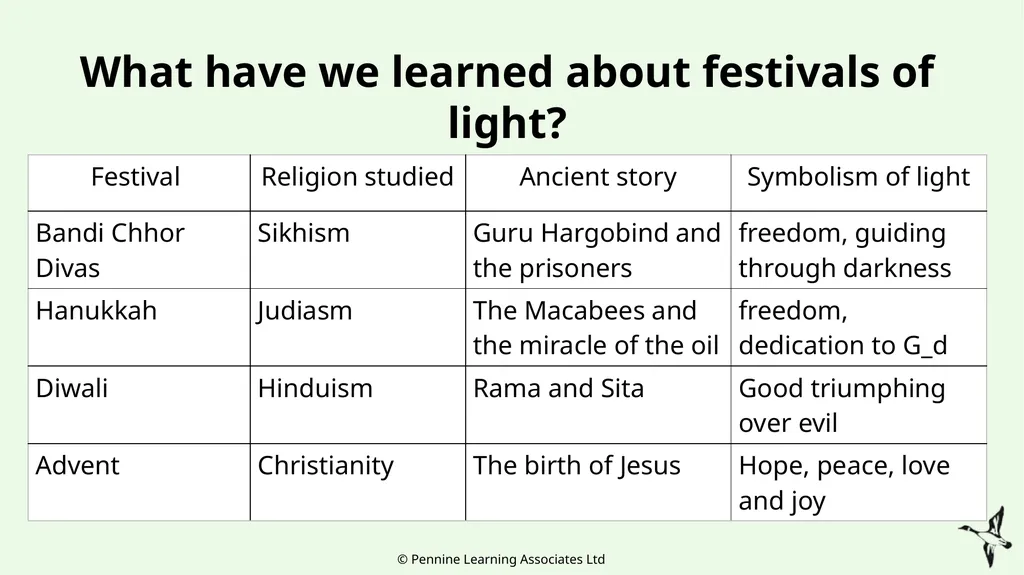
What have we learned about festivals of light?<br>
25
Imagine you were at Johann Hinrich Wichern’s school 200 years ago, counting down the days to Christmas. How did the Advent wreath help the children? What helps you to wait for something important?
How do the candles on the wreath help Christians to focus on important ideas during Advent? How does candlelight
help you to focus? Pause for thought<br>
How do the candles on the wreath help Christians to focus on important ideas during Advent? How does candlelight
help you to focus? Pause for thought<br>
26
Acknowledgments Images sourced from www.Vecteezy.com<br>