Thank you for using this resource. We hope it helps you, and your pupils! This advice may help. PowerPoints cover more than one lesson The PowerPoint presentation matches a section in the planning provided for this unit of work. This is
"Thank you for using this resource. We hope it" is the property of its rightful owner. Permission is granted to
download and print the materials on this website for personal, non-commercial use only, and to display it
on your personal computer provided you do not modify the materials and that you retain all copyright
notices contained in the materials. By downloading content from our website, you accept the terms of this
agreement.
Presentation Transcript
01
Thank you for using this resource. We hope it helps you, and your pupils! This advice may help.
PowerPoints cover more than one lesson
The PowerPoint presentation matches a section in the planning provided for this unit of work. This is likely to contain material for more than one lesson. It is important not to speed through the slides without completing suggested activities or discussion. Some sections in the planning, and the matching PowerPoints, may provide sufficient material for two or more lessons.
Please make sure you prepare and plan with staff
It is critical that delivery, style and speed reflect the needs and responses of pupils. The resource has been designed to support teachers, not to replace you! If this resource is provided as supporting material for HLTAs, cover teachers or non-specialists, please ensure you prepare them carefully and plan with them.
We recommend you use the detailed planning as well as this PowerPoint
This PowerPoint is designed to be used with the detailed planning written to support the RE syllabus ‘Believing and Belonging’. We strongly recommend that you use the PowerPoint in conjunction with the planning. Please ask us how to access this if you do not have it.
To feed back and for further support and to access webinar training please email enquiries@penninelearning.com. Dear Teacher<br>
02
Where this lesson fits: This Pathway 1 presentation continues with the focus on Old Testament stories. In this lesson pupils listen and respond to the story of Esau and Jacob and are asked to give examples of good and bad choices.
Points to note: This lesson links to unit C1.3 How can we make good choices.
Enrichment ideas: Make a small clay bowl for soup. Make and share lentil soup.
Outdoor learning: The pupils could share their soup together outdoors.
Resources needed: Printed pictures for the pupils to retell the story. Cut out cards for sorting good and bad choices.
Further lesson notes and additional ideas may be found in the ‘Notes’ section of some slides. Refer to the full unit plan for more activities and resources. Notes for teachers<br>
03
Slide 10 : Godly Play – Information about this creative and imaginative approach to Christian nurture can be found at http://www.godlyplay.org.uk Organisations offering Goldy Play sessions can be found on the list of faith visits and visitors available from www.penninelearning.com Resources to support this presentation<br>
04
Unit: F1.14
What stories from the Bible have been retold over many years?
Presentation 5 What is the story of Esau and Jacob?<br>
05
How this presentation links to the pathway:
In this presentation pupils listen and respond to the story of Esau and Jacob. They are then asked to consider their own lives and give examples of good and bad choices. Key Stage 1
Through considering the Big Picture, pupils should learn that:
Human beings, including groups of religious people, tell stories that help them grapple with some of the big questions of life.
Many of these stories are well-known as they have been handed down over generations. Pathway 6: The Big Picture<br>
06
Give examples of good and bad choices Listen and respond to the story of Esau and Jacob from the Old Testament Learning objectives<br>
07
a way to wish happiness for a person blessing receiving things when someone dies inheritance something that you choose choice Key words<br>
08
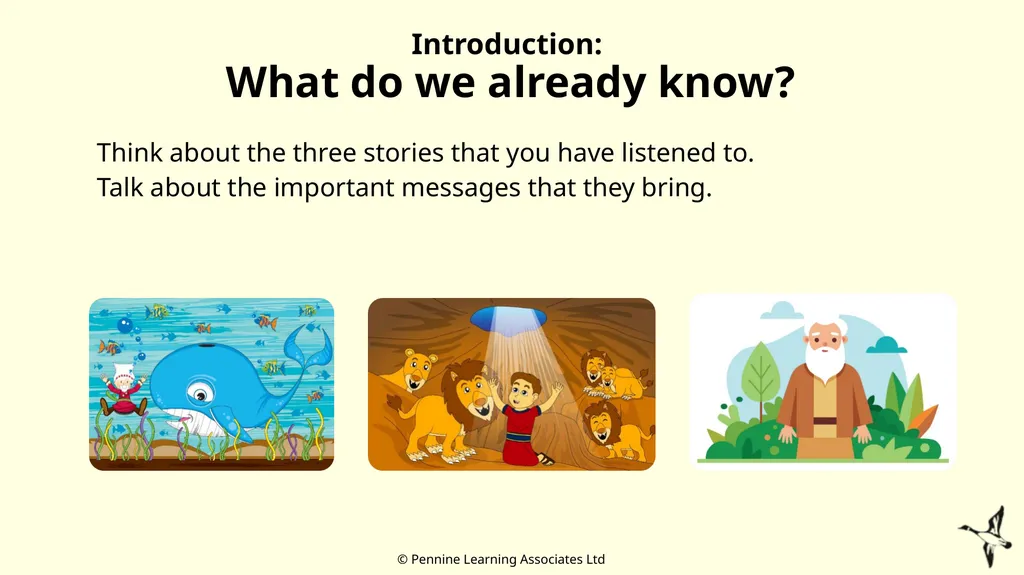
Think about the three stories that you have listened to.
Talk about the important messages that they bring. Introduction: What do we already know?<br>
09
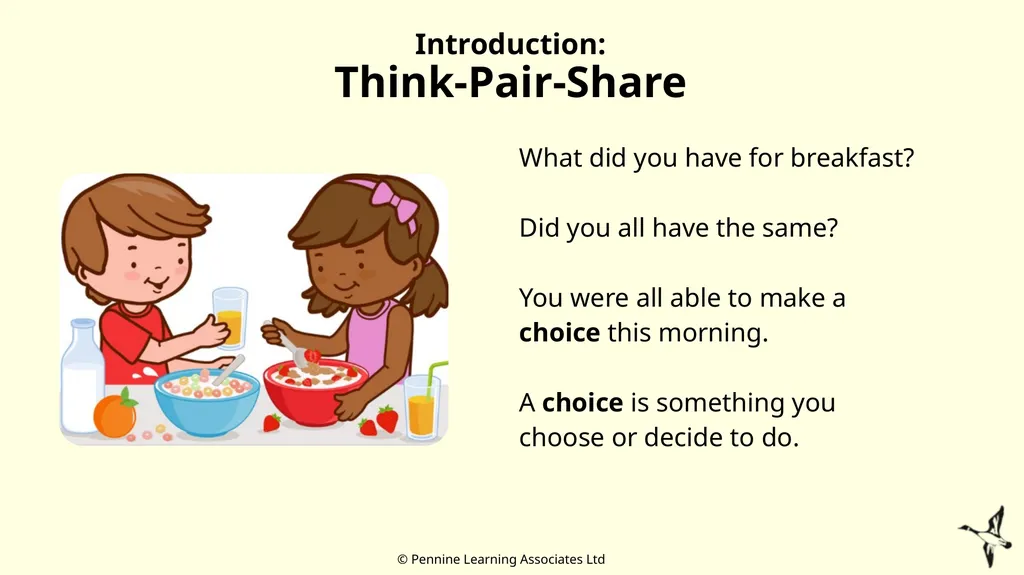
What did you have for breakfast?
Did you all have the same?
You were all able to make a choice this morning.
A choice is something you choose or decide to do. Introduction: Think-Pair-Share<br>
10
God made a promise to Abraham that he would have many children and that He would always be with him.
Abraham had a son named Isaac.
This story is about Isaac and his family.
In the story Isaac and his family all have some choices to make. Explanation: The story of Esau and Jacob<br>
11
Isaac and his wife Rebekah didn’t have children.
Isaac had learned from his father, Abraham, that if he prayed, God might answer his prayer.
God answered Isaac's prayer and Rebekah became pregnant with twins! Explanation: The story of Esau and Jacob<br>
12
The oldest twin was named Esau. His younger brother was called Jacob.
The boys were very different. They liked doing different things.
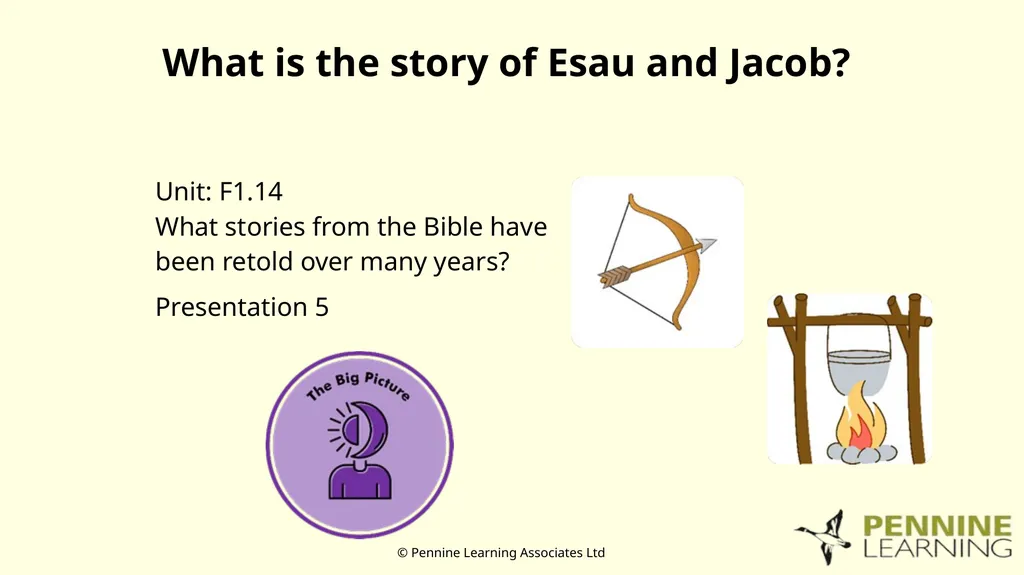
Esau was good at hunting and loved doing things outside.
Jacob liked to stay at home and enjoyed cooking. Explanation: The story of Esau and Jacob<br>
13
Esau was the older son. This meant that when his father died, he would inherit the things Isaac left behind, such as money and farm animals.
Jacob was very jealous about this. Explanation: The story of Esau and Jacob<br>
14
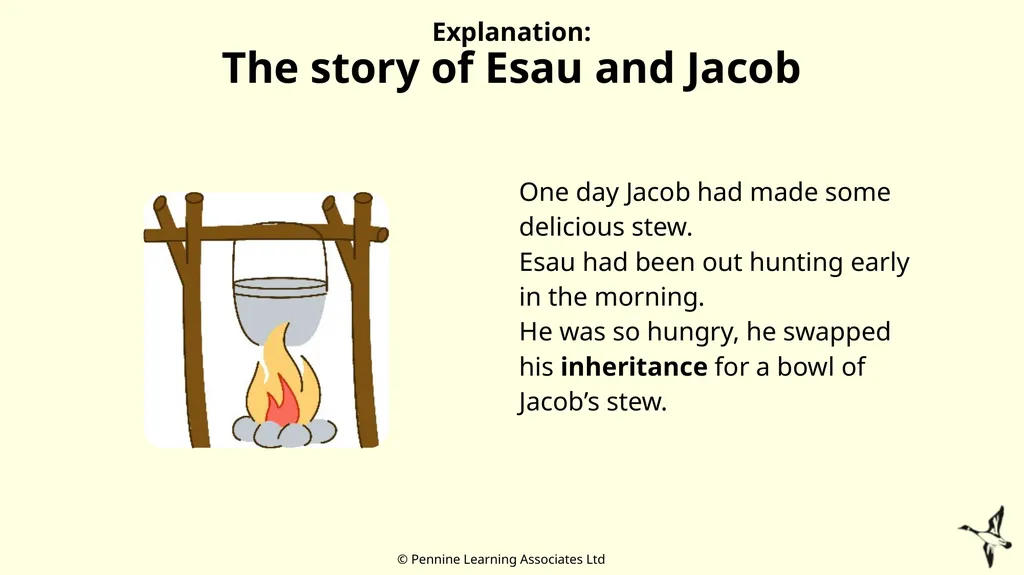
One day Jacob had made some delicious stew.
Esau had been out hunting early in the morning.
He was so hungry, he swapped his inheritance for a bowl of Jacob’s stew. Explanation: The story of Esau and Jacob<br>
15
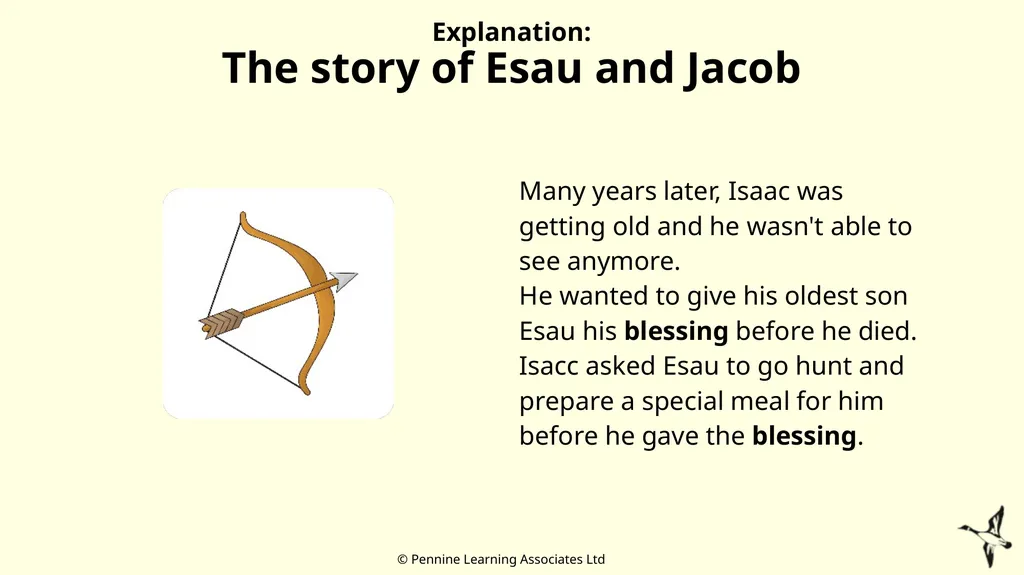
Many years later, Isaac was getting old and he wasn't able to see anymore.
He wanted to give his oldest son Esau his blessing before he died.
Isacc asked Esau to go hunt and prepare a special meal for him before he gave the blessing. Explanation: The story of Esau and Jacob<br>
16
Rebekah wanted her younger twin Jacob to have the blessing instead.
She told Jacob to get two goats and prepare a special meal.
Jacob took the meal to his father.
Isaac thought it was Esau bringing the meal, so he gave Jacob the blessing by mistake. Explanation: The story of Esau and Jacob<br>
17
As Jacob was walking away, Esau arrived and realised what had happened.
Esau was angry with his brother Jacob and wanted to kill him.
Jacob had to run away so he would be safe.
Both brothers did things that they shouldn't have done. They made bad choices that they couldn't change. Explanation: The story of Esau and Jacob<br>
18
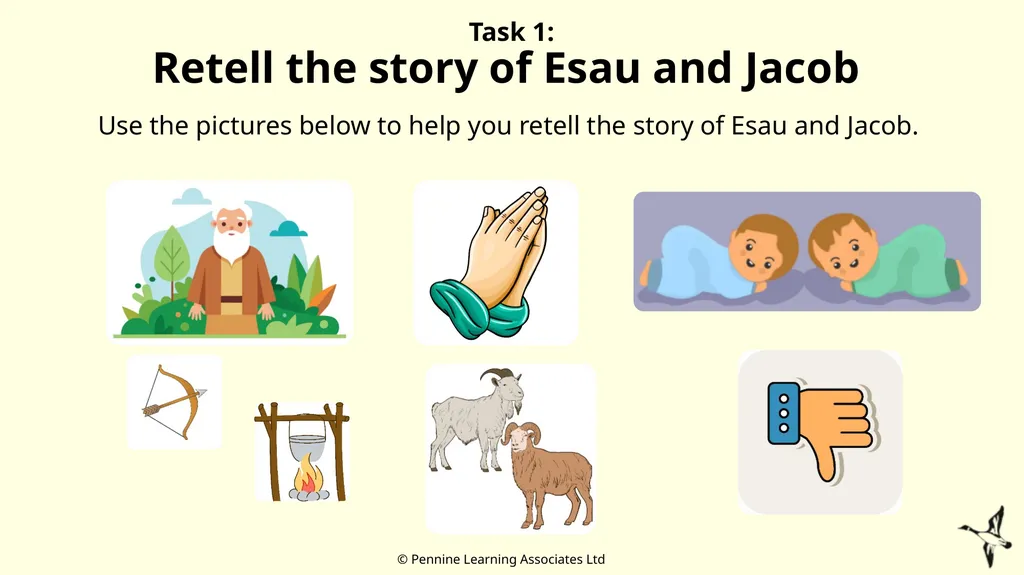
Use the pictures below to help you retell the story of Esau and Jacob. Task 1: Retell the story of Esau and Jacob<br>
19
Choose pupils to take on the roles of Esau and Jacob.
Plan some questions to ask them to find out what happened in the story and how they felt. Task 2: Hot Seat<br>
20
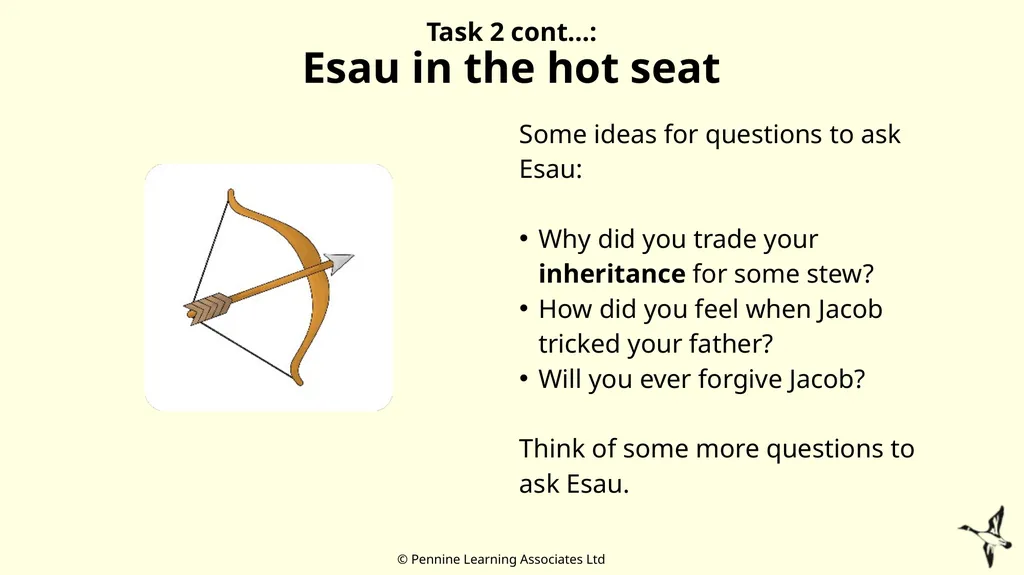
Some ideas for questions to ask Esau:
Why did you trade your inheritance for some stew?
How did you feel when Jacob tricked your father?
Will you ever forgive Jacob?
Think of some more questions to ask Esau. Task 2 cont…: Esau in the hot seat<br>
21
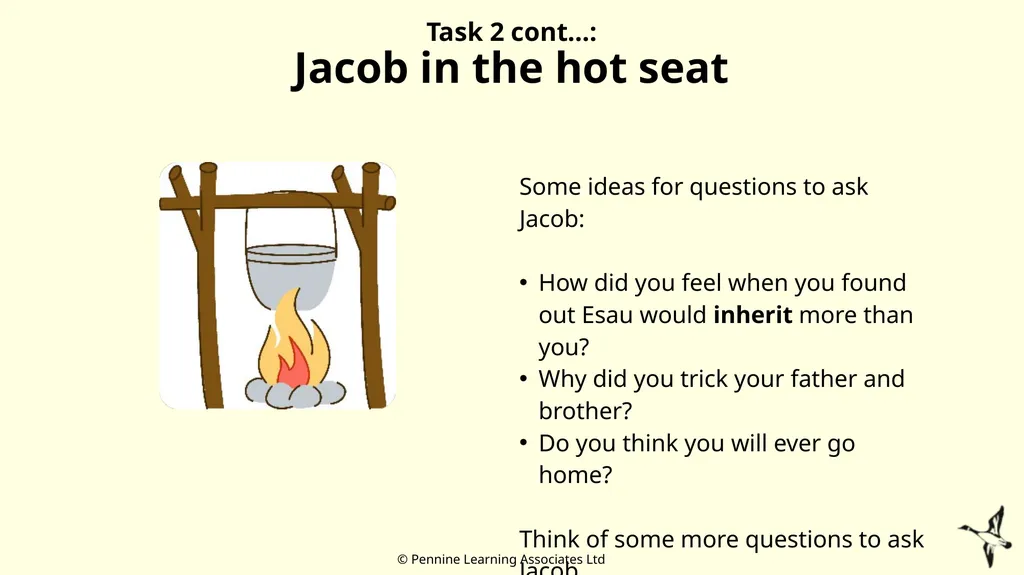
Some ideas for questions to ask Jacob:
How did you feel when you found out Esau would inherit more than you?
Why did you trick your father and brother?
Do you think you will ever go home?
Think of some more questions to ask Jacob. Task 2 cont…: Jacob in the hot seat<br>
22
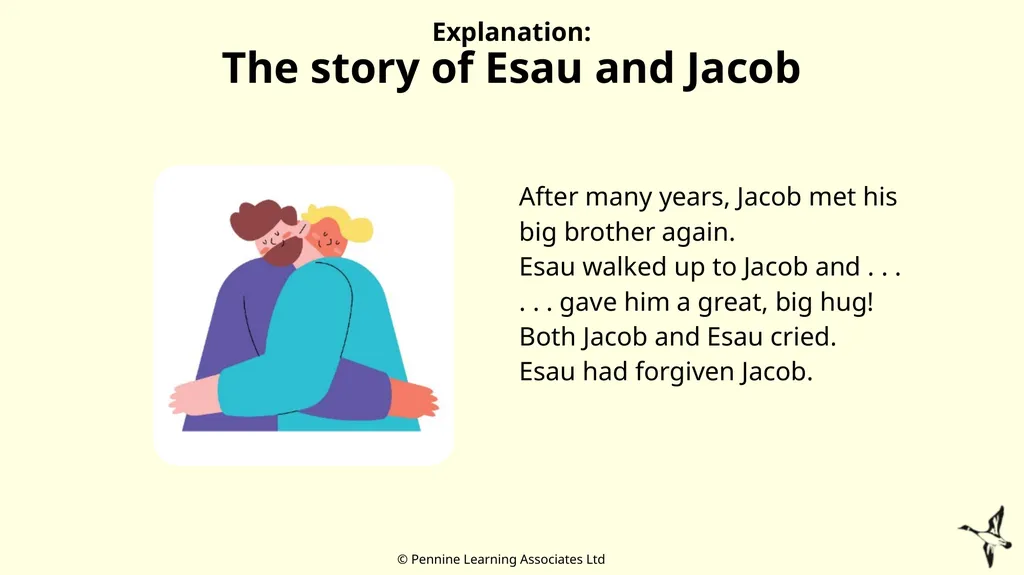
After many years, Jacob met his big brother again.
Esau walked up to Jacob and . . .
. . . gave him a great, big hug!
Both Jacob and Esau cried.
Esau had forgiven Jacob. Explanation: The story of Esau and Jacob<br>
23
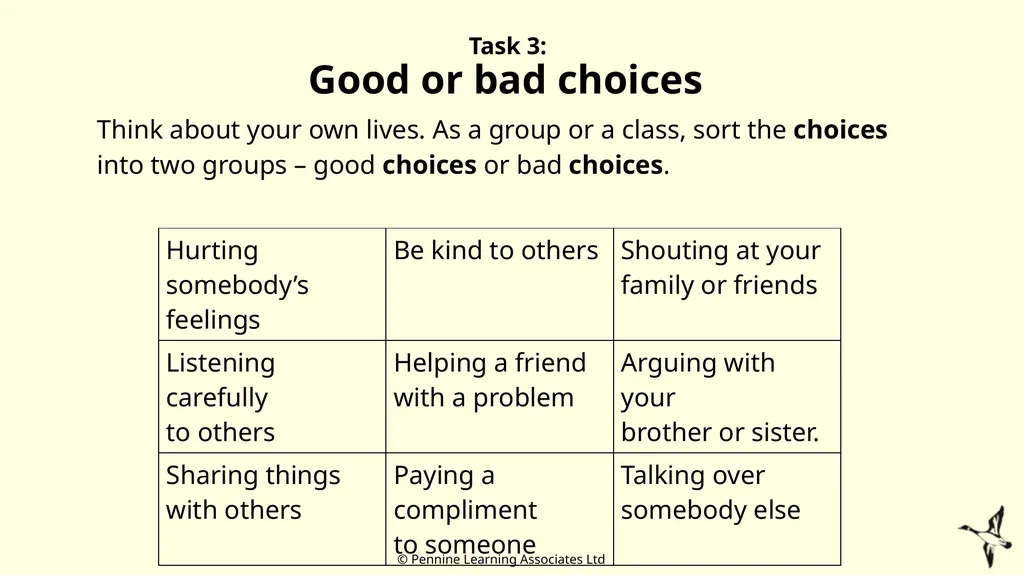
Think about your own lives. As a group or a class, sort the choices into two groups – good choices or bad choices. Task 3: Good or bad choices<br>
24
The choices in green are good choices. The ones in red are bad choices.
Whether good or bad, our choices bring consequences for ourselves and others. Task 3: Good or bad choices - answers<br>
25
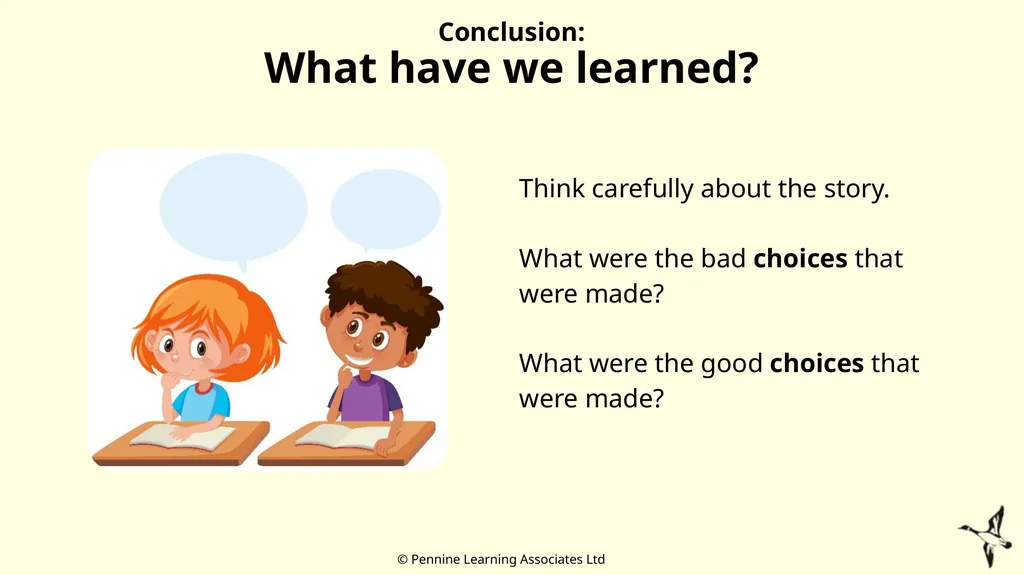
Think carefully about the story.
What were the bad choices that were made?
What were the good choices that were made? Conclusion: What have we learned?<br>
26
Esau wanted to kill Jacob and for many years they lived apart. Eventually they met up and Esau forgave Jacob. Both brothers made bad choices. Jacob received Esau’s blessing and inheritance from his father. God answered Isaac’s prayer and his wife had twins. The boys were very different and liked different things. Learning summary<br>
27
Think about a time when you have made a bad choice and fallen out with a friend.
How did you resolve your conflict and become friends again? Time to think<br>
28
Images reproduced under professional licence from Vecteezy. Acknowledgements<br>