
Thank you for using this resource. We hope it
YM
Published · 20 slides · 0 views

1 / 1


Description
Thank you for using this resource. We hope it helps you, and your pupils! This advice may help. PowerPoints cover more than one lesson The PowerPoint presentation matches a section in the planning provided for this unit of work. This is
Related Topics
Share
Embed code
Download this presentation From Below
"Thank you for using this resource. We hope it" is the property of its rightful owner. Permission is granted to download and print the materials on this website for personal, non-commercial use only, and to display it on your personal computer provided you do not modify the materials and that you retain all copyright notices contained in the materials. By downloading content from our website, you accept the terms of this agreement.
Presentation Transcript
01
Thank you for using this resource. We hope it helps you, and your pupils! This advice may help.
PowerPoints cover more than one lesson
The PowerPoint presentation matches a section in the planning provided for this unit of work. This is likely to contain material for more than one lesson. It is important not to speed through the slides without completing suggested activities or discussion. Most sections in the planning, and the matching PowerPoints, will cover two lessons.
Please make sure you prepare and plan with staff
It is critical that delivery, style and speed reflect the needs and responses of pupils. The resource has been designed to support teachers, not to replace you! If this resource is provided as supporting material for HLTAs, cover teachers or non-specialists, please ensure you prepare them carefully and plan with them.
We recommend you use the detailed planning as well as this PowerPoint
This PowerPoint is designed to be used with the detailed planning written to support the RE syllabus ‘Believing and Belonging’. We strongly recommend that you use the PowerPoint in conjunction with the planning. Please ask us how to access this if you do not have it.
To feed back and for further support and to access webinar training please email enquiries@penninelearning.com. Dear Teacher…<br>
PowerPoints cover more than one lesson
The PowerPoint presentation matches a section in the planning provided for this unit of work. This is likely to contain material for more than one lesson. It is important not to speed through the slides without completing suggested activities or discussion. Most sections in the planning, and the matching PowerPoints, will cover two lessons.
Please make sure you prepare and plan with staff
It is critical that delivery, style and speed reflect the needs and responses of pupils. The resource has been designed to support teachers, not to replace you! If this resource is provided as supporting material for HLTAs, cover teachers or non-specialists, please ensure you prepare them carefully and plan with them.
We recommend you use the detailed planning as well as this PowerPoint
This PowerPoint is designed to be used with the detailed planning written to support the RE syllabus ‘Believing and Belonging’. We strongly recommend that you use the PowerPoint in conjunction with the planning. Please ask us how to access this if you do not have it.
To feed back and for further support and to access webinar training please email enquiries@penninelearning.com. Dear Teacher…<br>
02
About this unit: This unit of work is based on Pathway 6 – The Big Picture. This unit will involve children exploring the outdoors and the wonders of nature during different seasons. It will give the opportunity for children to investigate, take an interest in and look after the natural world. Religious beliefs and stories about creation will be explored and children will explore how believers value and take care of the world due to their beliefs about creation.
This unit focuses solely on religious beliefs and creation however there are many interesting cultural stories about creation that teachers may wish to explore with children. EYFS teachers may wish to consider reading some simple creation stories from around the world – try creation stories from African, First Nation American, or Aboriginal cultures.
NB - it is up to each school as to how lessons from this RE unit are selected to fit in with long term plans/themes. Links can be made to other areas of learning in the Nursery and Reception phases of Development Matters, e.g. scientific and geographical knowledge of “The Natural World” and the prime area of Communication and Language – listening attentively and asking questions. Activities may be adapted to suit Reception and Nursery settings.
Religious Education in Early Years settings: Activities may be adapted to suit Reception and Nursery settings. See the full unit plan for links to Early Learning Goals and a full range of ideas for adult-led and independent activities. Further advice about planning for RE in EYFS can be found in the RE syllabus, Believing and Belonging (p 20–23)
Where this lesson fits: Early Learning Goals: People, Culture and Communities: Know some similarities and differences between different religious and cultural communities in this country drawing on their experiences and what has been read in class. The Natural World: Explore the natural world around them making observations and drawing pictures of animals and plants. Notes for teachers<br>
This unit focuses solely on religious beliefs and creation however there are many interesting cultural stories about creation that teachers may wish to explore with children. EYFS teachers may wish to consider reading some simple creation stories from around the world – try creation stories from African, First Nation American, or Aboriginal cultures.
NB - it is up to each school as to how lessons from this RE unit are selected to fit in with long term plans/themes. Links can be made to other areas of learning in the Nursery and Reception phases of Development Matters, e.g. scientific and geographical knowledge of “The Natural World” and the prime area of Communication and Language – listening attentively and asking questions. Activities may be adapted to suit Reception and Nursery settings.
Religious Education in Early Years settings: Activities may be adapted to suit Reception and Nursery settings. See the full unit plan for links to Early Learning Goals and a full range of ideas for adult-led and independent activities. Further advice about planning for RE in EYFS can be found in the RE syllabus, Believing and Belonging (p 20–23)
Where this lesson fits: Early Learning Goals: People, Culture and Communities: Know some similarities and differences between different religious and cultural communities in this country drawing on their experiences and what has been read in class. The Natural World: Explore the natural world around them making observations and drawing pictures of animals and plants. Notes for teachers<br>
03
Points to note: Sensitivity around different religious beliefs and non-religious ideas around creation with the children in class. When going on a senses walk – explain clearly to the children about the sense of taste – when it is/isn’t appropriate to taste new foods
Outdoor Learning: There are lots of opportunities for outdoor learning during this lesson/unit. Nature walks, senses walks, class trips to view plants and animals in the surrounding areas or a visit to a farm, zoo, nature park or wildlife park. Barefoot walks and seasonal observations throughout the year can help children to notice and connect with nature. Observing seasonal changes is EY Framework required learning for EY, so a necessary topic to include.
Other options might include creating a nature garden or insect house in school grounds and learning about how to care for and look after these. For this particular presentation there are barefoot walks and/or senses walk opportunities as well as the collection of materials for outdoor art activities.
Resources needed: Magnifying glasses, mirrors, pooters for the nature senses walk/trip. Pupils could bring into school or collect from the school grounds a range of natural materials to create a collaborative artwork depicting their learning.
Further lesson notes and additional ideas may be found in the notes section of some slides (normal or presenter view). Please refer to the full unit plan for more activities and resources. Notes for teachers<br>
Outdoor Learning: There are lots of opportunities for outdoor learning during this lesson/unit. Nature walks, senses walks, class trips to view plants and animals in the surrounding areas or a visit to a farm, zoo, nature park or wildlife park. Barefoot walks and seasonal observations throughout the year can help children to notice and connect with nature. Observing seasonal changes is EY Framework required learning for EY, so a necessary topic to include.
Other options might include creating a nature garden or insect house in school grounds and learning about how to care for and look after these. For this particular presentation there are barefoot walks and/or senses walk opportunities as well as the collection of materials for outdoor art activities.
Resources needed: Magnifying glasses, mirrors, pooters for the nature senses walk/trip. Pupils could bring into school or collect from the school grounds a range of natural materials to create a collaborative artwork depicting their learning.
Further lesson notes and additional ideas may be found in the notes section of some slides (normal or presenter view). Please refer to the full unit plan for more activities and resources. Notes for teachers<br>
04
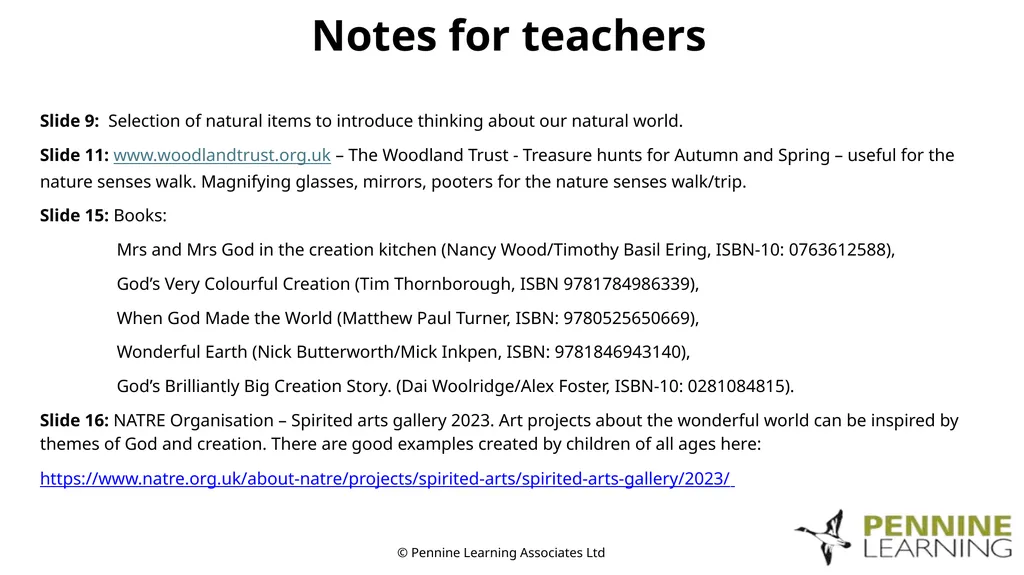
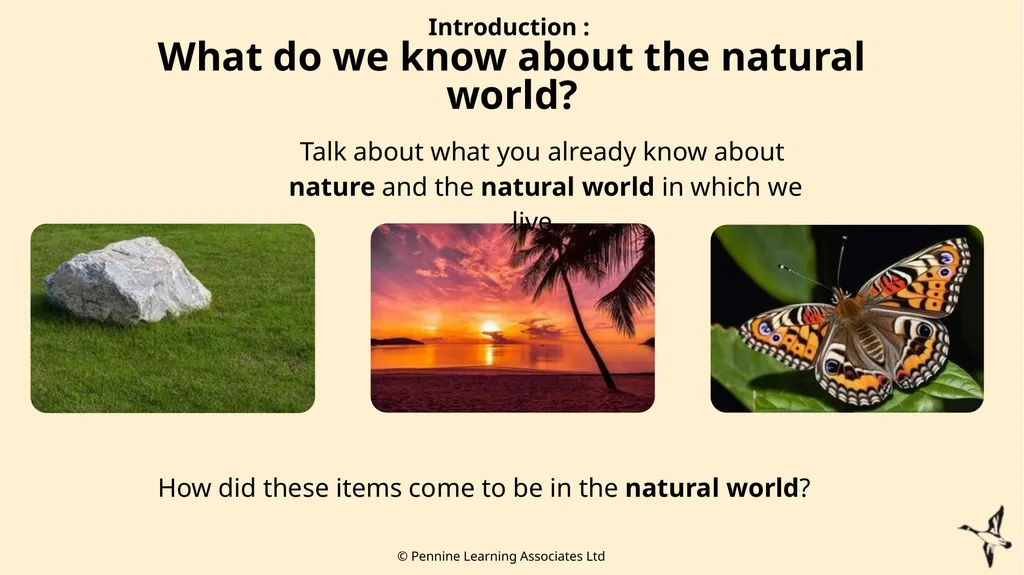
Slide 9: Selection of natural items to introduce thinking about our natural world.
Slide 11: www.woodlandtrust.org.uk – The Woodland Trust - Treasure hunts for Autumn and Spring – useful for the nature senses walk. Magnifying glasses, mirrors, pooters for the nature senses walk/trip.
Slide 15: Books:
Mrs and Mrs God in the creation kitchen (Nancy Wood/Timothy Basil Ering, ISBN-10: 0763612588),
God’s Very Colourful Creation (Tim Thornborough, ISBN 9781784986339),
When God Made the World (Matthew Paul Turner, ISBN: 9780525650669),
Wonderful Earth (Nick Butterworth/Mick Inkpen, ISBN: 9781846943140),
God’s Brilliantly Big Creation Story. (Dai Woolridge/Alex Foster, ISBN-10: 0281084815).
Slide 16: NATRE Organisation – Spirited arts gallery 2023. Art projects about the wonderful world can be inspired by themes of God and creation. There are good examples created by children of all ages here:
https://www.natre.org.uk/about-natre/projects/spirited-arts/spirited-arts-gallery/2023/ Notes for teachers<br>
Slide 11: www.woodlandtrust.org.uk – The Woodland Trust - Treasure hunts for Autumn and Spring – useful for the nature senses walk. Magnifying glasses, mirrors, pooters for the nature senses walk/trip.
Slide 15: Books:
Mrs and Mrs God in the creation kitchen (Nancy Wood/Timothy Basil Ering, ISBN-10: 0763612588),
God’s Very Colourful Creation (Tim Thornborough, ISBN 9781784986339),
When God Made the World (Matthew Paul Turner, ISBN: 9780525650669),
Wonderful Earth (Nick Butterworth/Mick Inkpen, ISBN: 9781846943140),
God’s Brilliantly Big Creation Story. (Dai Woolridge/Alex Foster, ISBN-10: 0281084815).
Slide 16: NATRE Organisation – Spirited arts gallery 2023. Art projects about the wonderful world can be inspired by themes of God and creation. There are good examples created by children of all ages here:
https://www.natre.org.uk/about-natre/projects/spirited-arts/spirited-arts-gallery/2023/ Notes for teachers<br>
05
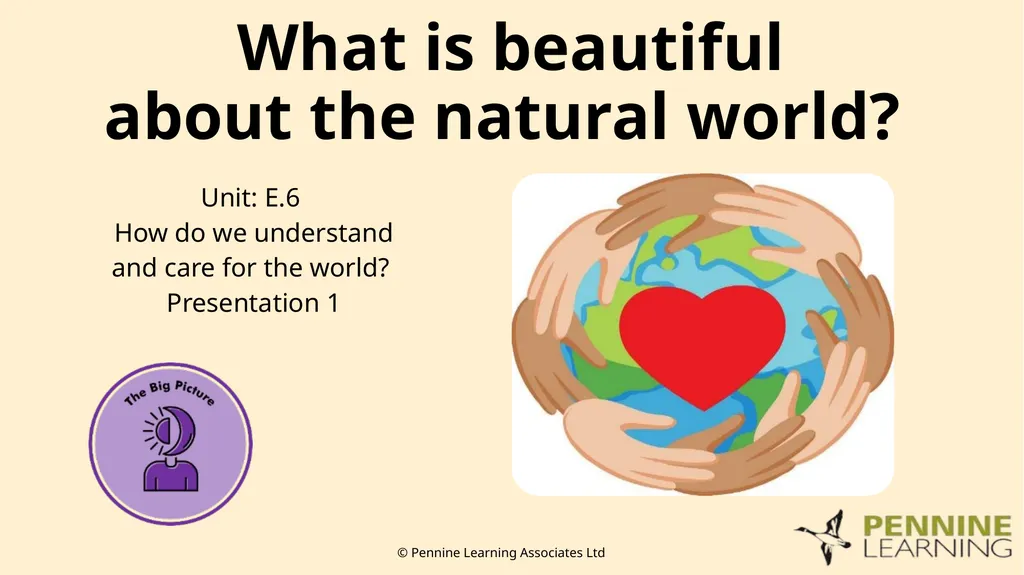
Unit: E.6
How do we understand and care for the world?
Presentation 1 What is beautiful about the natural world?<br>
How do we understand and care for the world?
Presentation 1 What is beautiful about the natural world?<br>
06
How this presentation links to the pathway:
This presentation is about looking at and observing the beauty of the natural world throughout the year, experiencing moments of wonder and awe, asking big questions about how these came to be in our world. Early Years
Through considering the Big Picture, children should learn that:
Stories, including religious stories, can help them to talk about some of the big questions of life.
Many of these stories are well-known as they have been handed down over generations. Pathway 6: The Big Picture<br>
This presentation is about looking at and observing the beauty of the natural world throughout the year, experiencing moments of wonder and awe, asking big questions about how these came to be in our world. Early Years
Through considering the Big Picture, children should learn that:
Stories, including religious stories, can help them to talk about some of the big questions of life.
Many of these stories are well-known as they have been handed down over generations. Pathway 6: The Big Picture<br>
07
Notice changes that occur throughout the seasons and create linked artwork
using natural resources Use your senses to explore and talk about the natural world around you Learning objectives<br>
using natural resources Use your senses to explore and talk about the natural world around you Learning objectives<br>
08
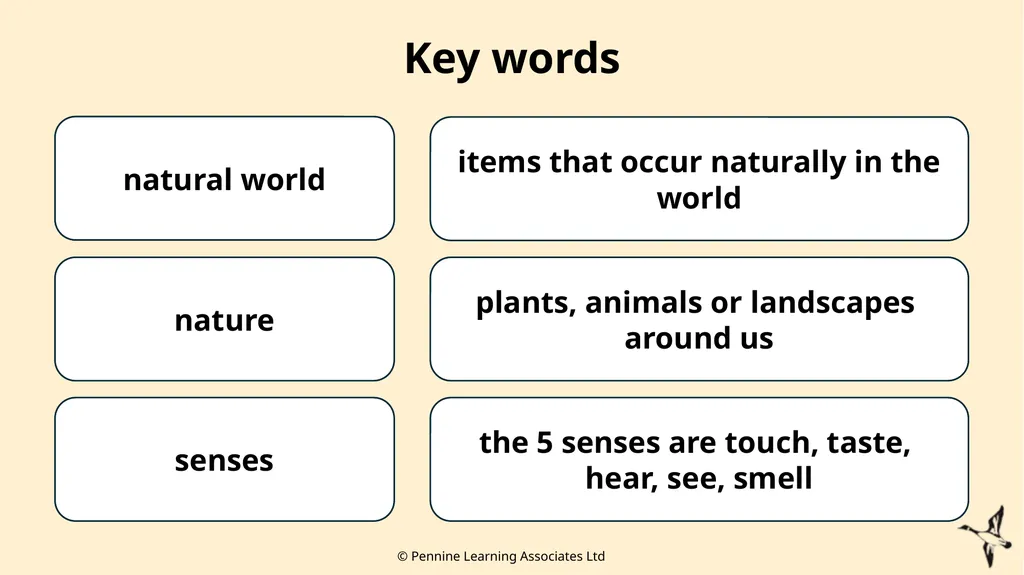
Key words<br>
09
How did these items come to be in the natural world? Talk about what you already know about
nature and the natural world in which we live. Introduction : What do we know about the natural world?<br>
nature and the natural world in which we live. Introduction : What do we know about the natural world?<br>
10
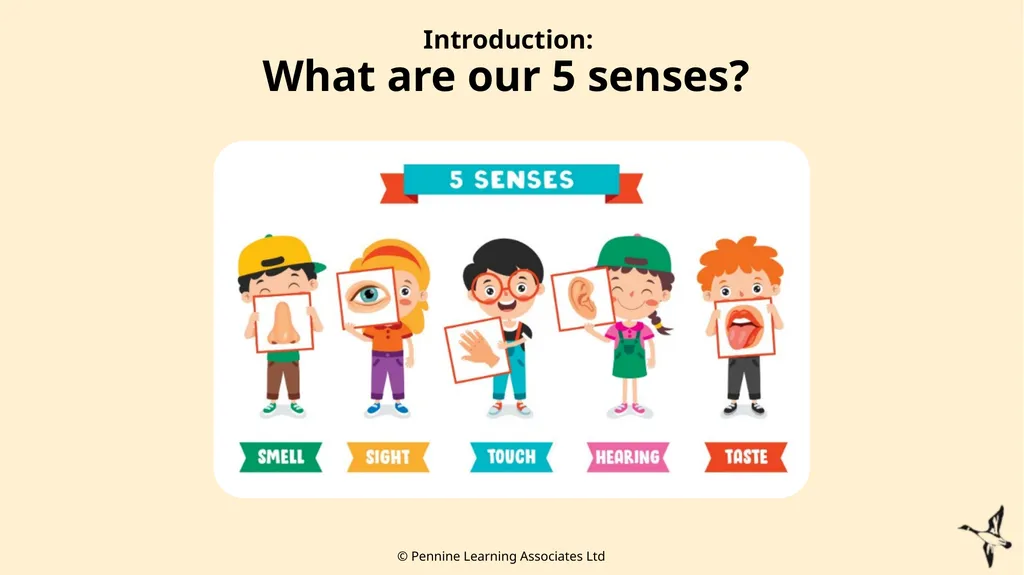
Introduction:
What are our 5 senses?<br>
11
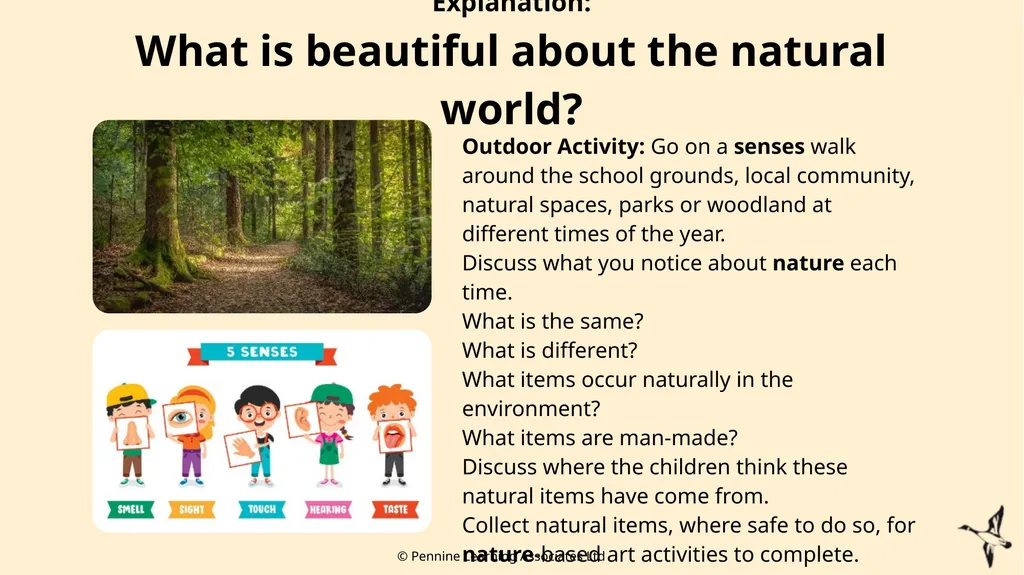
Outdoor Activity: Go on a senses walk around the school grounds, local community, natural spaces, parks or woodland at different times of the year.
Discuss what you notice about nature each time.
What is the same?
What is different?
What items occur naturally in the environment?
What items are man-made?
Discuss where the children think these natural items have come from.
Collect natural items, where safe to do so, for nature-based art activities to complete. Explanation: What is beautiful about the natural world?<br>
Discuss what you notice about nature each time.
What is the same?
What is different?
What items occur naturally in the environment?
What items are man-made?
Discuss where the children think these natural items have come from.
Collect natural items, where safe to do so, for nature-based art activities to complete. Explanation: What is beautiful about the natural world?<br>
12
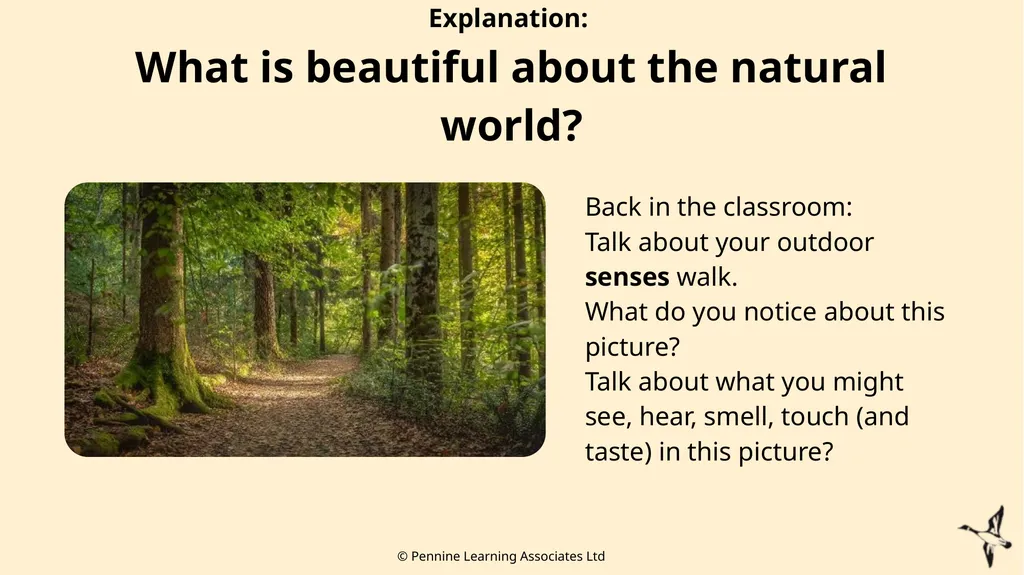
Back in the classroom:
Talk about your outdoor senses walk.
What do you notice about this picture?
Talk about what you might see, hear, smell, touch (and taste) in this picture? Explanation: What is beautiful about the natural world?<br>
Talk about your outdoor senses walk.
What do you notice about this picture?
Talk about what you might see, hear, smell, touch (and taste) in this picture? Explanation: What is beautiful about the natural world?<br>
13
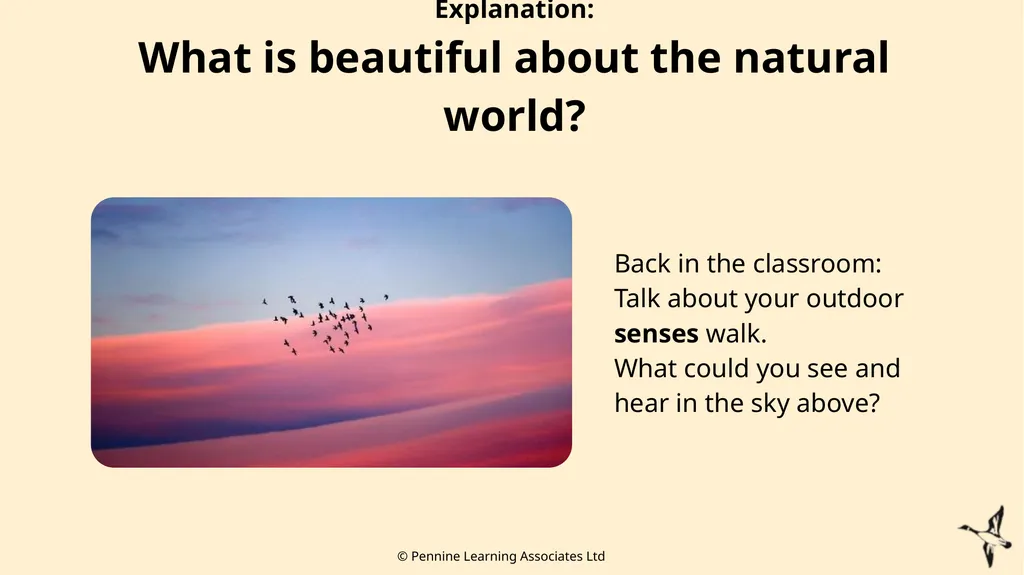
Back in the classroom:
Talk about your outdoor senses walk.
What could you see and hear in the sky above? Explanation: What is beautiful about the natural world?<br>
Talk about your outdoor senses walk.
What could you see and hear in the sky above? Explanation: What is beautiful about the natural world?<br>
14
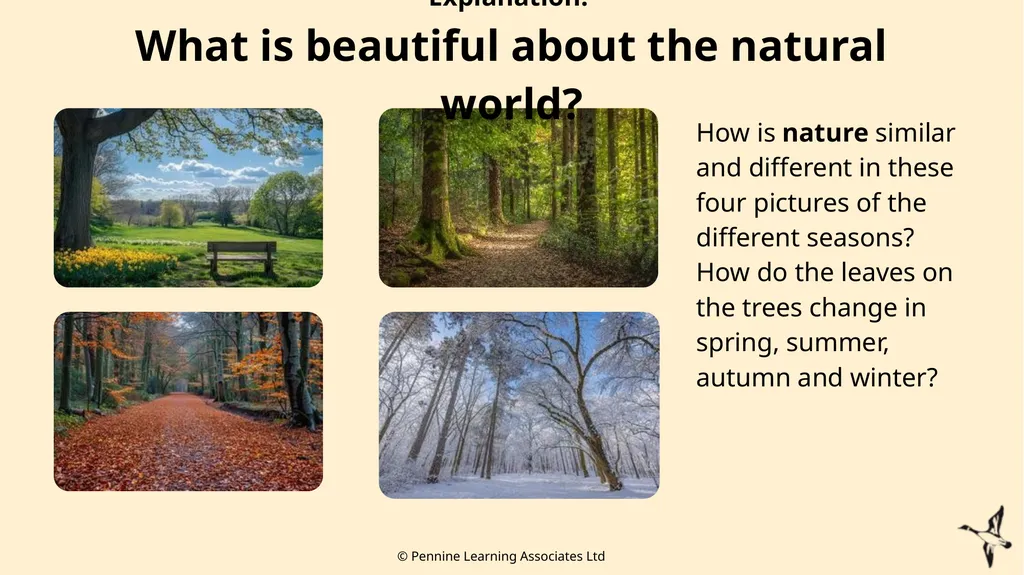
How is nature similar and different in these four pictures of the different seasons?
How do the leaves on the trees change in spring, summer, autumn and winter? Explanation: What is beautiful about the natural world?<br>
How do the leaves on the trees change in spring, summer, autumn and winter? Explanation: What is beautiful about the natural world?<br>
15
Go on a barefoot walk.
Read a story to introduce the concept that some people believe that God was responsible for creating our natural world
Mrs and Mrs God in the creation kitchen (Nancy Wood/Timothy Basil Ering, ISBN-10: 0763612588)
God’s Very Colourful Creation (Tim Thornborough, ISBN: 9781784986339)
When God Made the World (Matthew Paul Turner, ISBN: 9780525650669)
Wonderful Earth (Nick Butterworth/Mick Inkpen, ISBN: 9781846943140)
God’s Brilliantly Big Creation Story. (Dai Woolridge/Alex Foster, ISBN-10: 0281084815) Suggested tasks: Adult-led<br>
Read a story to introduce the concept that some people believe that God was responsible for creating our natural world
Mrs and Mrs God in the creation kitchen (Nancy Wood/Timothy Basil Ering, ISBN-10: 0763612588)
God’s Very Colourful Creation (Tim Thornborough, ISBN: 9781784986339)
When God Made the World (Matthew Paul Turner, ISBN: 9780525650669)
Wonderful Earth (Nick Butterworth/Mick Inkpen, ISBN: 9781846943140)
God’s Brilliantly Big Creation Story. (Dai Woolridge/Alex Foster, ISBN-10: 0281084815) Suggested tasks: Adult-led<br>
16
Draw or photograph a range of items from the natural world.
Create a role play travel agents with brochures, pictures and books about different places around the world with different natural environments. Use a globe or map of the world to identify where the places are.
Place a selection of pebbles, conkers, petals, twigs, leaves, pinecones etc. in the outside learning space so that children can use them to create artwork in the style of Andy Goldsworthy. Children can take photographs to record their artwork. Suggested tasks: Independent in provision<br>
Create a role play travel agents with brochures, pictures and books about different places around the world with different natural environments. Use a globe or map of the world to identify where the places are.
Place a selection of pebbles, conkers, petals, twigs, leaves, pinecones etc. in the outside learning space so that children can use them to create artwork in the style of Andy Goldsworthy. Children can take photographs to record their artwork. Suggested tasks: Independent in provision<br>
17
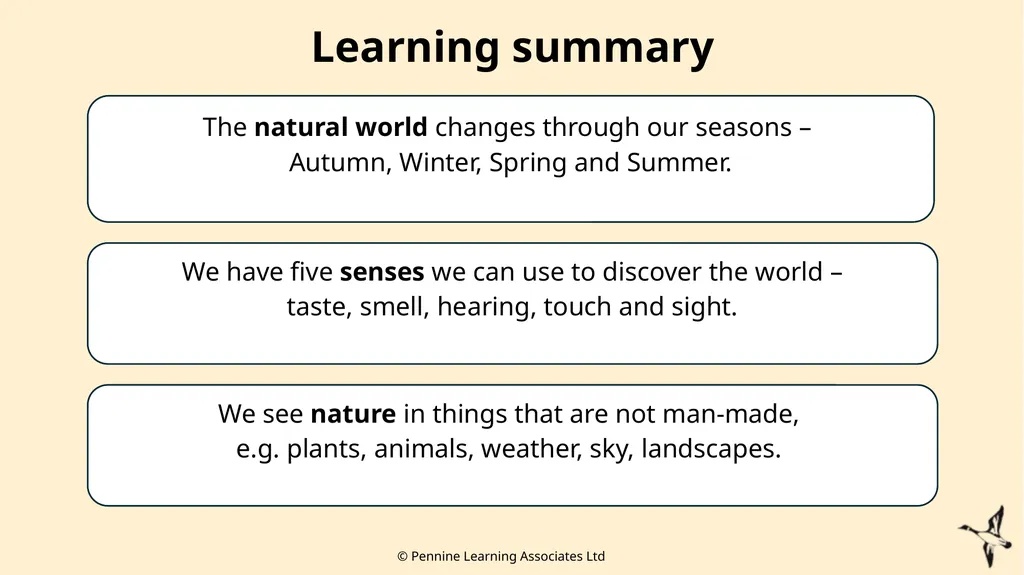
Learning summary<br>
18
Use the pictures as a prompt to talk about today's learning Conclusion:
What have we learned today?<br>
19
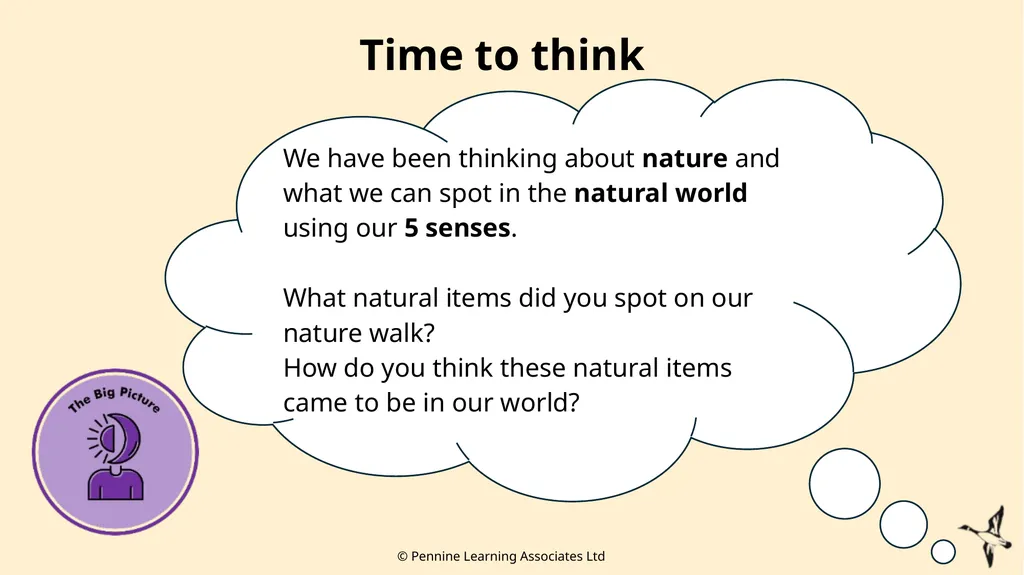
We have been thinking about nature and what we can spot in the natural world using our 5 senses.
What natural items did you spot on our nature walk?
How do you think these natural items came to be in our world? Time to think<br>
What natural items did you spot on our nature walk?
How do you think these natural items came to be in our world? Time to think<br>
20
All pictures reproduced under professional licence from Vecteezy. Acknowledgments<br>