Thank you for using this resource. We hope it helps you, and your pupils! This advice may help. PowerPoints cover more than one lesson The PowerPoint presentation matches a section in the planning provided for this unit of work. This is
"Thank you for using this resource. We hope it" is the property of its rightful owner. Permission is granted to
download and print the materials on this website for personal, non-commercial use only, and to display it
on your personal computer provided you do not modify the materials and that you retain all copyright
notices contained in the materials. By downloading content from our website, you accept the terms of this
agreement.
Presentation Transcript
01
Thank you for using this resource. We hope it helps you, and your pupils! This advice may help.
PowerPoints cover more than one lesson
The PowerPoint presentation matches a section in the planning provided for this unit of work. This is likely to contain material for more than one lesson. It is important not to speed through the slides without completing suggested activities or discussion. Most sections in the planning, and the matching PowerPoints, will cover two lessons. In particular, you may wish to spend one lesson looking carefully at the story and its meaning, and another with discussion, acting it out and follow up.
Please make sure you prepare and plan with staff
It is critical that delivery, style and speed reflect the needs and responses of pupils. The resource has been designed to support teachers, not to replace you! If this resource is provided as supporting material for HLTAs, cover teachers or non-specialists please ensure you prepare them carefully and plan with them.
We recommend you use the detailed planning as well as this PowerPoint
This PowerPoint is designed to be used with the detailed planning written to support the RE syllabus ‘Believing and Belonging’. We strongly recommend that you use the PowerPoint in conjunction with the planning. Please ask us how to access this if you do not have it.
To feed back and for further support and to access webinar training please email enquiries@penninelearning.com. Dear Teacher…<br>
02
About this unit: This is a Pathway 1 unit, looking at the nature of religion and belief. In this unit pupils will learn about what it means to belong to a community, including a religious community. They will learn what they might see in a religious building, and what people do when they go there. They will begin to understand that there are similarities and differences between places of worship, within and between faith communities. They will learn that places of worship are sacred places for the people who go there.
Where this presentation fits: This Pathway 1 presentation is the first of the unit. Pupils begin by considering what it means to belong and are then introduced to how symbols have meaning. The final part of this lesson moves on to explore symbols of faith.
Points to note: The teacher should spend some time exploring with pupils how symbols have meanings, using familiar ones to start with. This is an important precursor to the exploration of religious symbolism.
Enrichment ideas: Outdoor learning - Design a prayer flag with logo/symbols to represent your group. Use it to decorate an area outside.
Resources needed: A4 paper for the tasks on slides 11 and 14.
Further lesson notes and additional ideas may be found in the notes section of some slides (normal or presenter view). Notes for teachers<br>
03
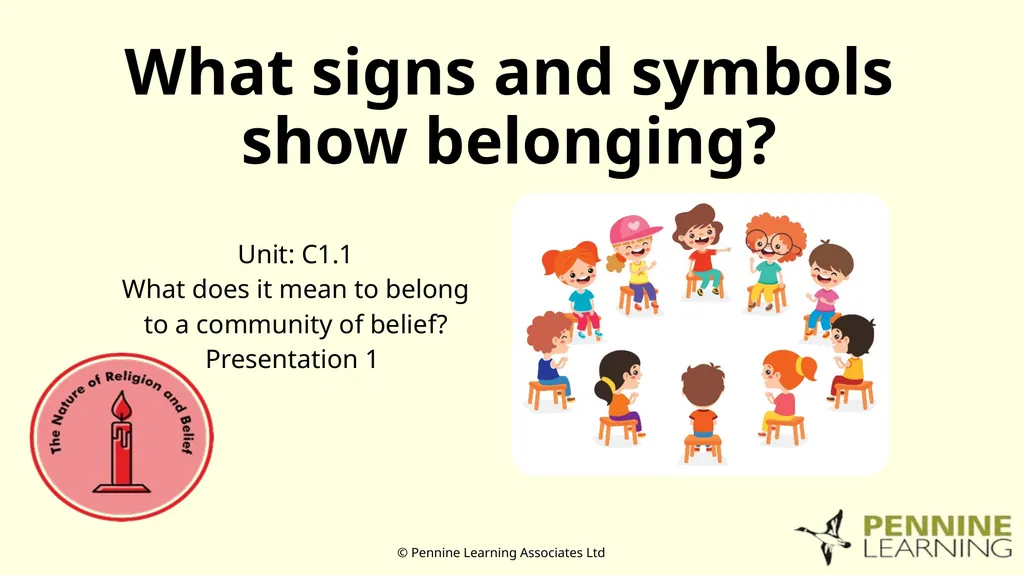
Unit: C1.1
What does it mean to belong to a community of belief?
Presentation 1 What signs and symbols show belonging?<br>
04
How this presentation links to the pathway:
This presentation encourages the pupils to talk about what it means to belong to a community, including a religious community. Key Stage 1
Through investigating the Nature of Religion and Belief, pupils should learn that:
We are surrounded by distinctive things that are very important. Some of these are called ‘precious’, 'sacred' or 'holy'.
People belonging to the same religion/worldview may have different 'holy' or important things and express their beliefs in different ways. Pathway 1: The Nature of Religion and Belief<br>
05
Design a symbol and say what it means Recognise and talk about
some religious symbols Talk about what it means to belong Learning objectives<br>
06
Key Words<br>
07
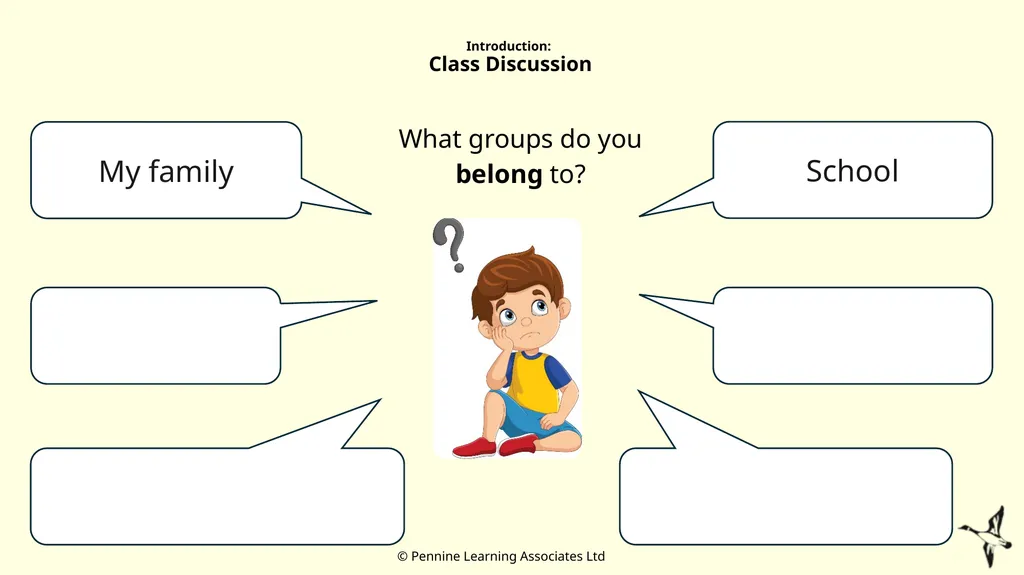
School My family What groups do you belong to? Introduction: Class Discussion<br>
08
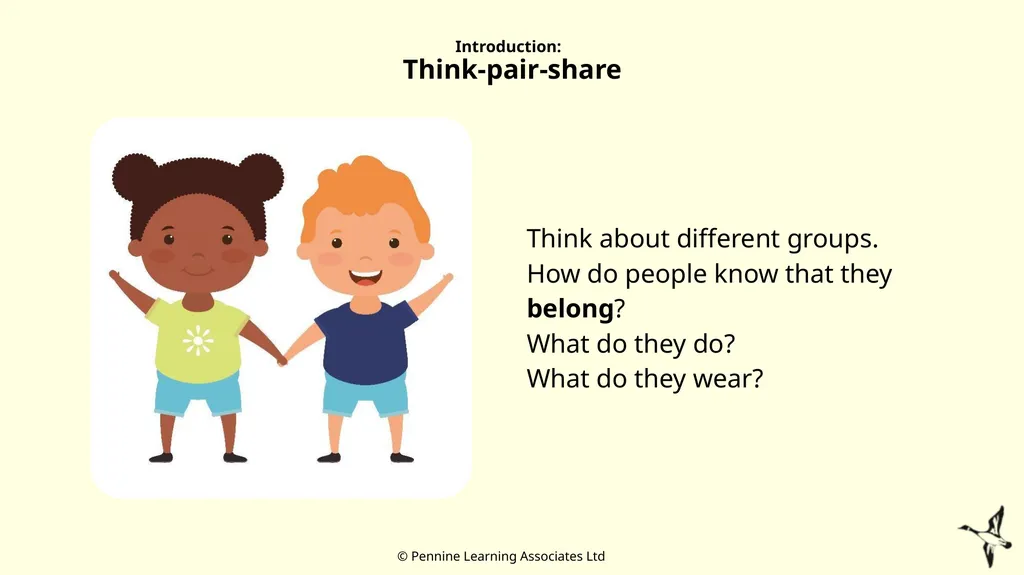
Think about different groups.
How do people know that they belong?
What do they do?
What do they wear? Introduction: Think-pair-share<br>
09
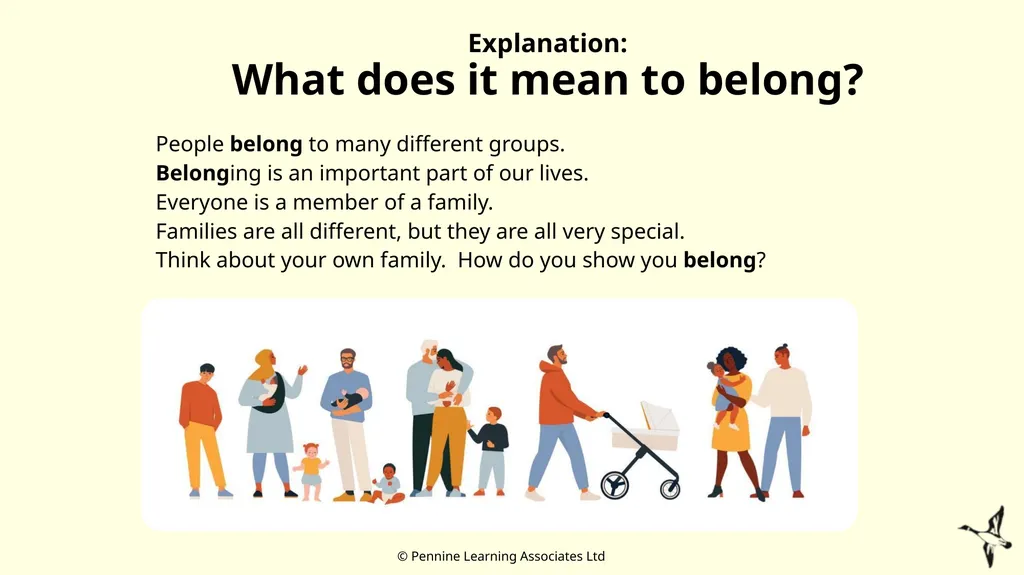
People belong to many different groups.
Belonging is an important part of our lives.
Everyone is a member of a family.
Families are all different, but they are all very special.
Think about your own family. How do you show you belong? Explanation: What does it mean to belong?<br>
10
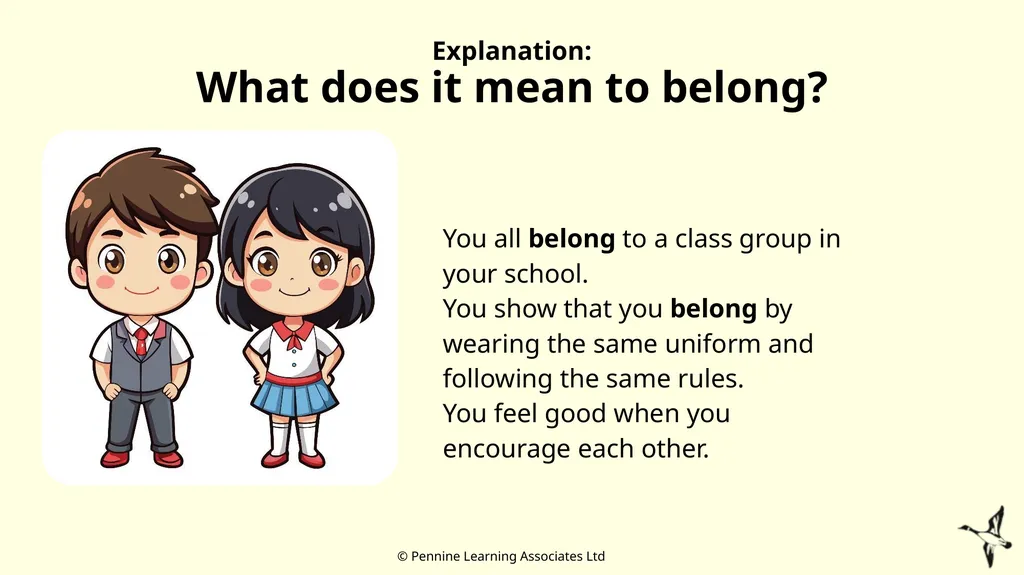
You all belong to a class group in your school.
You show that you belong by wearing the same uniform and following the same rules.
You feel good when you encourage each other. Explanation: What does it mean to belong?<br>
11
Some people are members of organisations such as Brownies and Cubs. They wear a special uniform to show that they belong. When they join, they make a special promise and everyone celebrates that they are now part of the group.
Some people belong to a sports club. They often wear a kit to show that they are part of the team. When they are cheered on by other team members it makes them feel like they belong. Explanation: What does it mean to belong?<br>
12
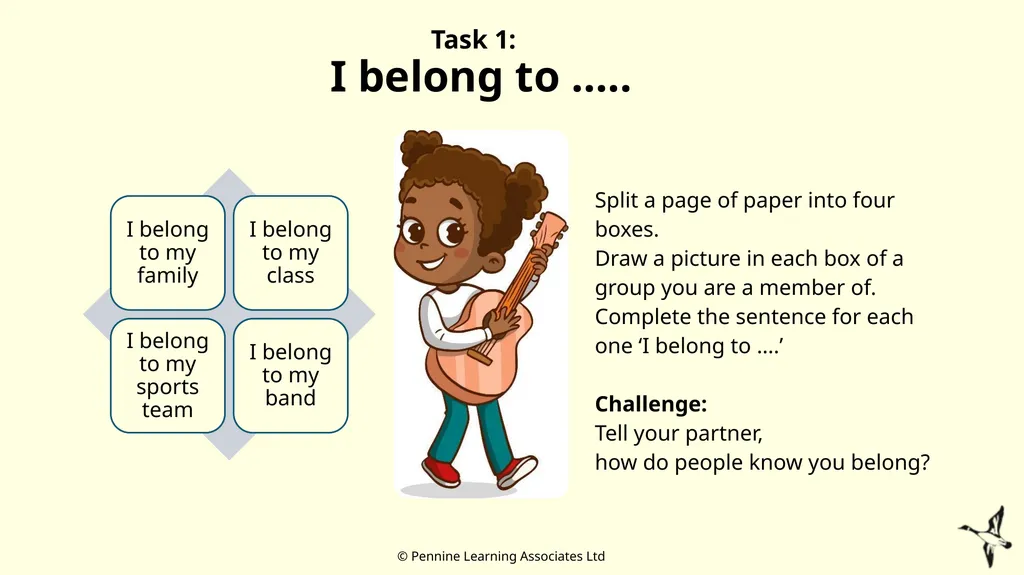
Split a page of paper into four boxes.
Draw a picture in each box of a
group you are a member of.
Complete the sentence for each
one ‘I belong to ….’
Challenge:
Tell your partner,
how do people know you belong? Task 1: I belong to …..<br>
13
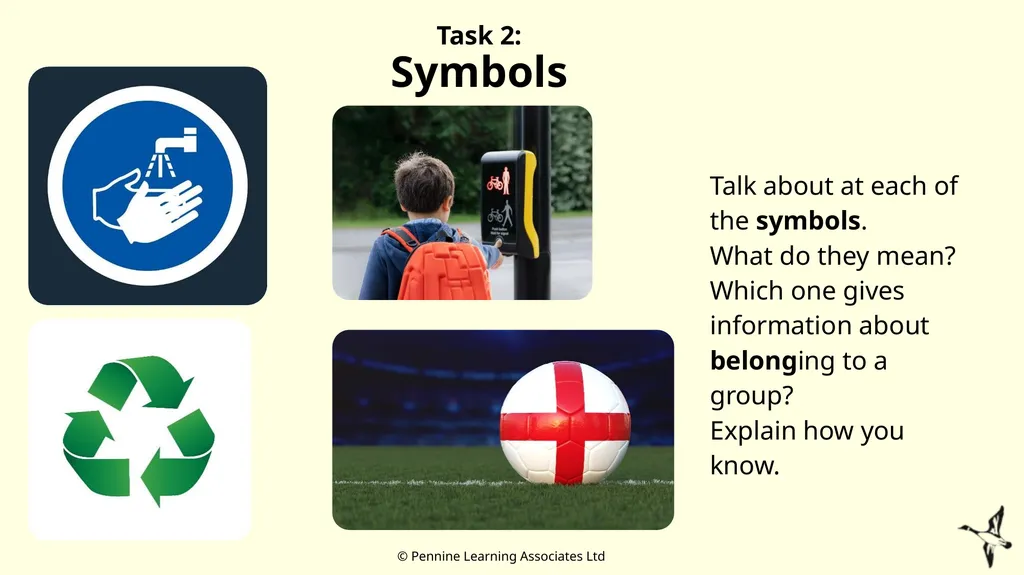
Talk about at each of the symbols.
What do they mean?
Which one gives information about belonging to a group?
Explain how you know. Task 2: Symbols<br>
14
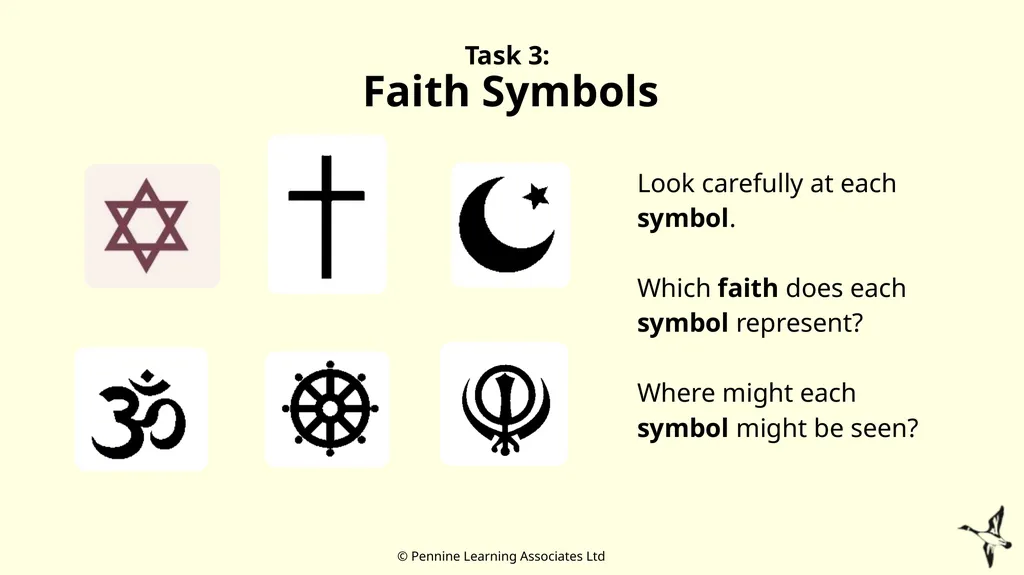
Look carefully at each symbol.
Which faith does each symbol represent?
Where might each symbol might be seen? Task 3: Faith Symbols<br>
15
The crescent moon and star is a symbol of Islam. It represents Islam as the way to God, just as the moon and stars show the way in the desert at night. The cross is a symbol of Christianity.
It represents the cross on which Jesus was crucified. The Star of David is a common symbol of Judaism. Task 3: Faith Symbols<br>
16
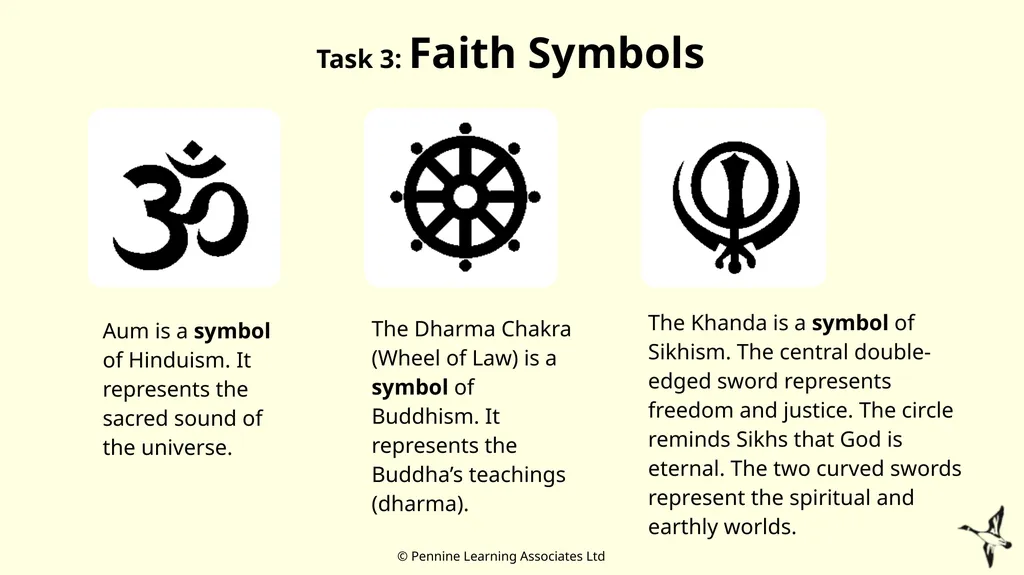
The Khanda is a symbol of Sikhism. The central double-edged sword represents freedom and justice. The circle reminds Sikhs that God is eternal. The two curved swords represent the spiritual and earthly worlds. The Dharma Chakra (Wheel of Law) is a symbol of Buddhism. It represents the Buddha’s teachings (dharma). Aum is a symbol of Hinduism. It represents the sacred sound of the universe. Task 3: Faith Symbols<br>
17
Design a symbol to represent everyone in your group.
Think carefully about what to include.
How does it show that you all belong? Task 4: Design a symbol<br>
18
Share your symbols as a class.
As a class, work out which symbol represents which group?
Can you explain why? Task 4: Design a symbol<br>
19
Some symbols give information about belonging to a group.
Each religion has a different symbol of faith. Often people wear uniforms, go to the same place or follow the same rules
to show they belong to a group. Many people feel as though they belong
to a range of different groups such as their family, school or team. Learning summary<br>
20
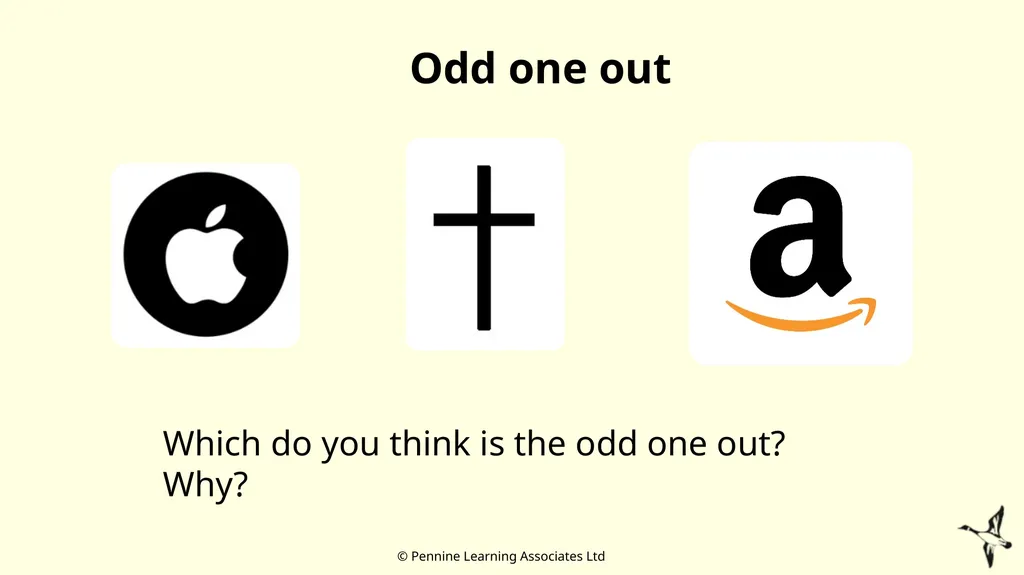
Which do you think is the odd one out? Why? Odd one out<br>
21
Is there anything that you like about belonging to a group? Time to think<br>