Thank you for using this resource. We hope it helps you, and your pupils! This advice may help. PowerPoints cover more than one lesson The PowerPoint presentation matches a section in the planning provided for this unit of work. This is
"Thank you for using this resource. We hope it" is the property of its rightful owner. Permission is granted to
download and print the materials on this website for personal, non-commercial use only, and to display it
on your personal computer provided you do not modify the materials and that you retain all copyright
notices contained in the materials. By downloading content from our website, you accept the terms of this
agreement.
Presentation Transcript
01
Thank you for using this resource. We hope it helps you, and your pupils! This advice may help.
PowerPoints cover more than one lesson
The PowerPoint presentation matches a section in the planning provided for this unit of work. This is likely to contain material for more than one lesson. It is important not to speed through the slides without completing suggested activities or discussion. Most sections in the planning, and the matching PowerPoints, will cover two lessons.
Please make sure you prepare and plan with staff
It is critical that delivery, style and speed reflect the needs and responses of pupils. The resource has been designed to support teachers, not to replace you! If this resource is provided as supporting material for HLTAs, cover teachers or non-specialists, please ensure you prepare them carefully and plan with them.
We recommend you use the detailed planning as well as this PowerPoint
This PowerPoint is designed to be used with the detailed planning written to support the RE syllabus ‘Believing and Belonging’. We strongly recommend that you use the PowerPoint in conjunction with the planning. Please ask us how to access this if you do not have it.
To feed back and for further support and to access webinar training please email enquiries@penninelearning.com. Dear Teacher…<br>
02
Where this lesson fits: This is the third presentation in this Pathway Two unit on expressing beliefs. Pupils have been introduced to symbols through looking at the symbols and routines in our school help us to feel welcomed. They have explored what a new baby needs and shared experiences of welcoming a new baby. They have started to look at the meaning of names and why they are important. In this session, pupils explore how names are chosen in the Sikh faith. They watch the symbolic events of a Naam Karan naming ceremony and sequence what happens.
Points to note: Although many Sikhs use their family name, some decide to use the names Kaur or Singh. This is to follow Guru Gobind Singh's practice of calling all men Singh and all women Kaur to remind Sikhs of the oneness of humanity. Many Sikhs choose to give their children these names at the naming ceremony. Children who are not given these names may adopt them later if they choose to undergo the Amrit Sanskar ceremony as adults.
Further lesson notes and additional ideas may be found in the notes section of some slides (normal or presenter view).
Enrichment ideas: lived experience- ideally, invite a Sikh person to share their experience of how they were given their name. This could be through a visit to a Gurdwara, a Sikh person in school or visitor.
Outdoor learning: Provide doll babies and prams for the outdoor area. Notes for teachers<br>
03
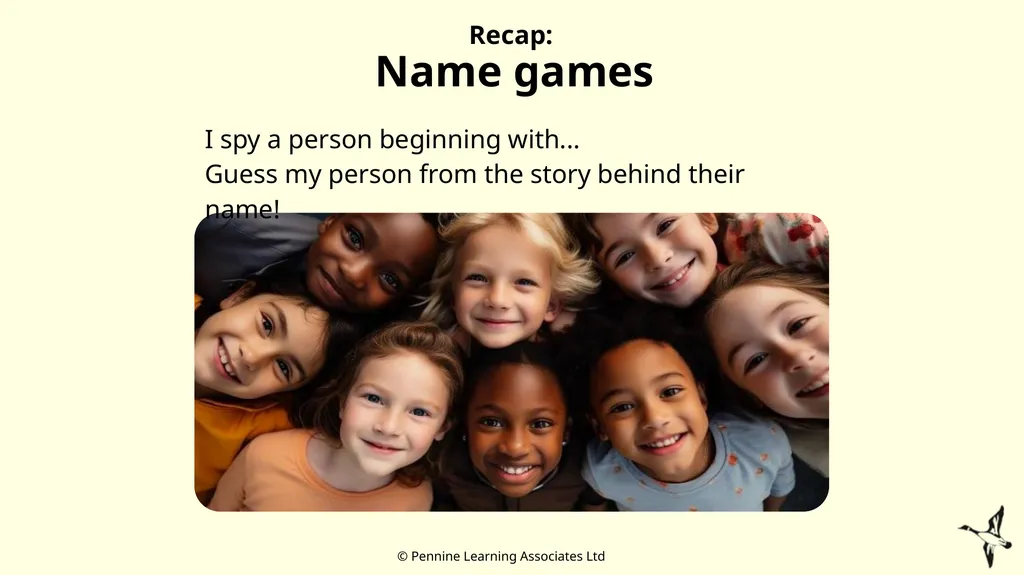
Slide 8: Play I spy. Start by playing as usual using the person's initial. Extend the game to include some of the meanings or stories behind children's names that you found out as a class last session, for example ' I spy a person named after their Grandad' or 'I spy a person whose name means...'
Slide 9: Ideally, interview a Sikh person to find out how they were given their name. Alternatively, watch the video The Sikh Naming Ceremony: Naam Karan on true tube which begins with Sikh people explaining the meaning of their name. Pause the video at 1.38 before looking at the next slide on the Naam Karan ceremony. https://www.youtube.com/watch?v=xH89kg1K0RQ
Slide 10: As the key parts of the Naam Karan are shown, pupils can wave if they spot a symbol or routine (ritual); and ask questions about it. Pause the video at 5.18 to discuss how babies are named. The granthi opens the Guru Granth Sahib at random. This is known as Hukam. As the page opens at random, the granthi reads the first line of the page. The first letter of the first word on that page decides the first letter of the child’s name. The parents then choose the name, which is announced by the granthi to the congregation.
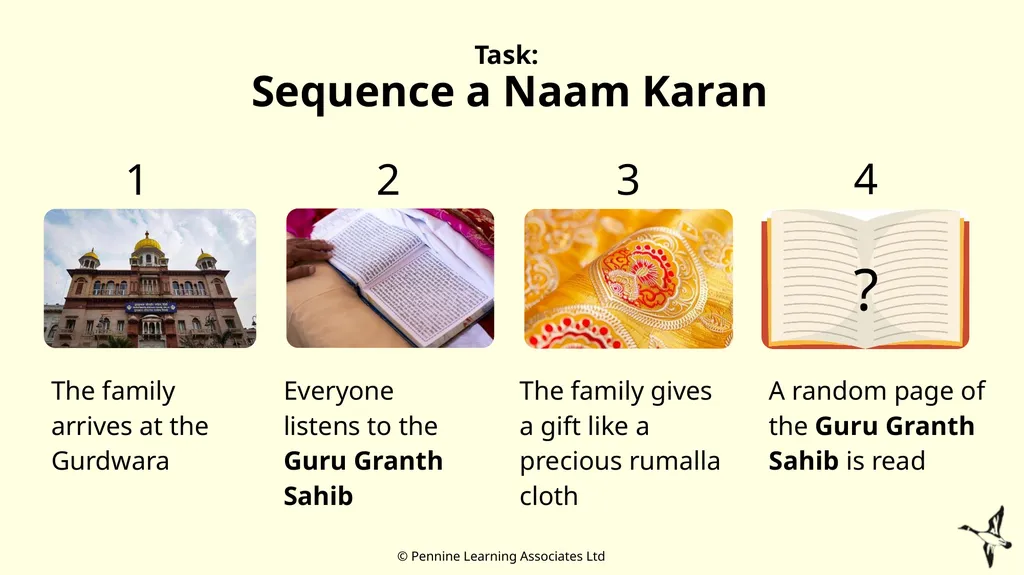
Slides 11 & 12: Recap the sequence of the Naam Karan together as a class. Use the animations to question what happened next and check. Re-watch sections of the video if needed.
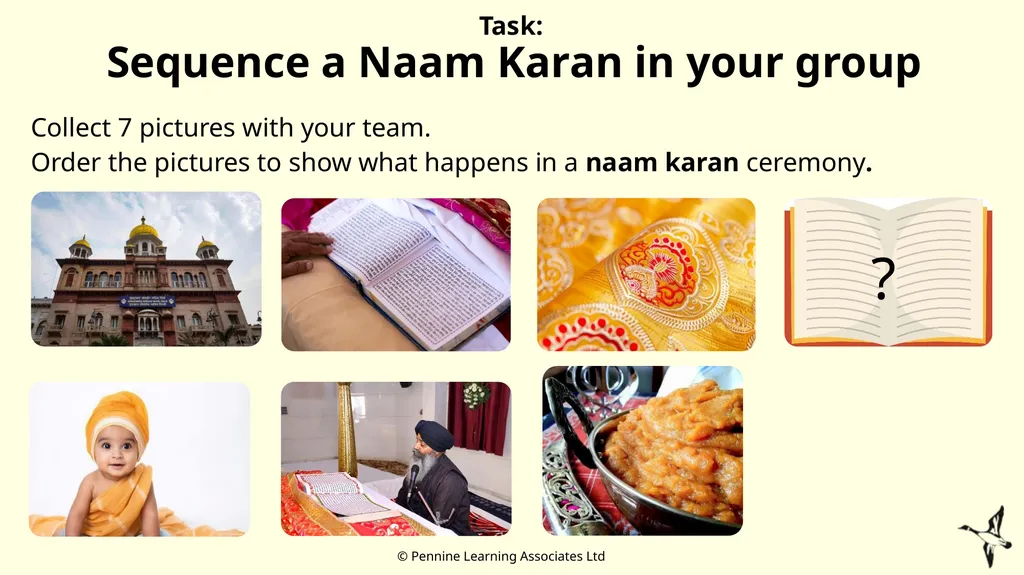
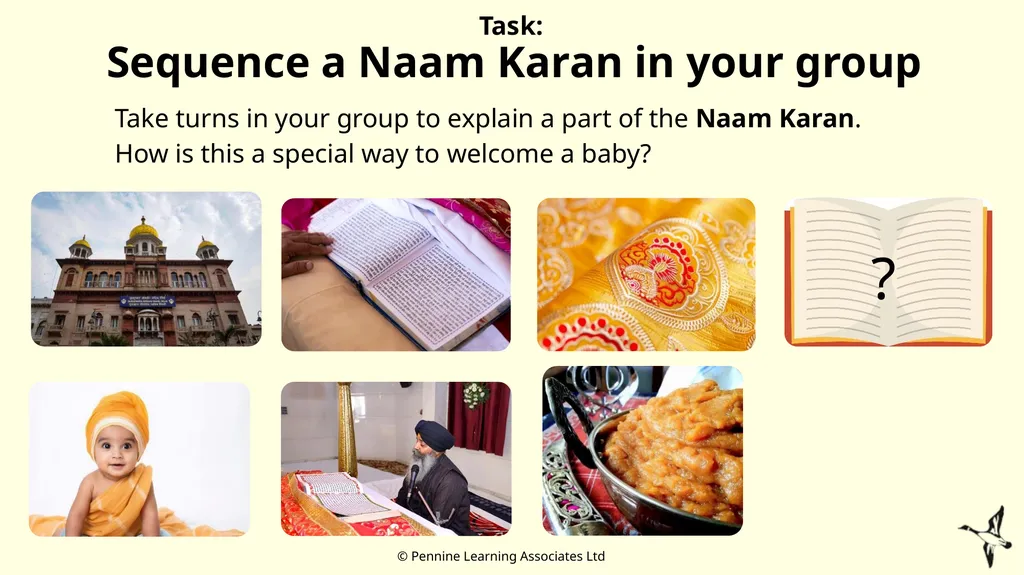
Slide 13: The photographs on this slide can be printed to A3 and mixed up for children to sequence in groups. Outdoors or in the hall, children can run in relay to collect photographs showing parts of the Naam Karan. As they collect the photographs they can sequence and explain the rituals to their group.
. Notes for teachers<br>
04
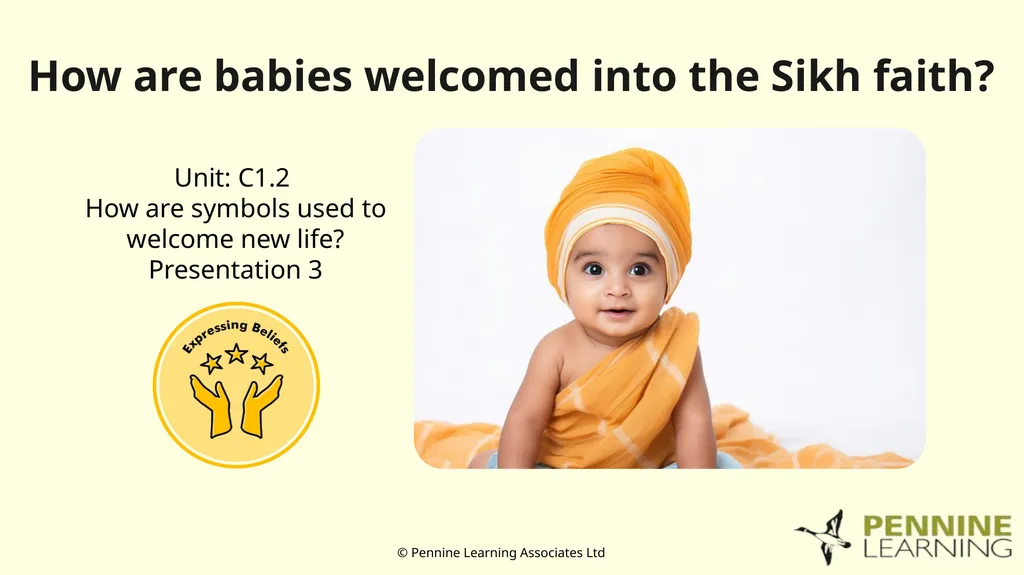
Unit: C1.2
How are symbols used to welcome new life?
Presentation 3 How are babies welcomed into the Sikh faith?<br>
05
How this presentation links to the pathway:
This presentation looks at how babies are welcomed into the Sikh faith. We sequence the symbolic events of a Naam Karan, Sikh naming ceremony and explore how names are chosen in the Sikh faith. Key Stage 1
Through investigating how beliefs are expressed, pupils should learn that:
people sometimes give different meanings to words when they are writing about their religious beliefs and feelings.
People have created stories, symbols, art and music with different meanings so that they can express their beliefs. Pathway 2: Expressing Beliefs<br>
06
Explore how names are chosen in the Sikh faith Sequence the symbolic events of
a Naam Karan, Sikh naming ceremony Learning objectives<br>
07
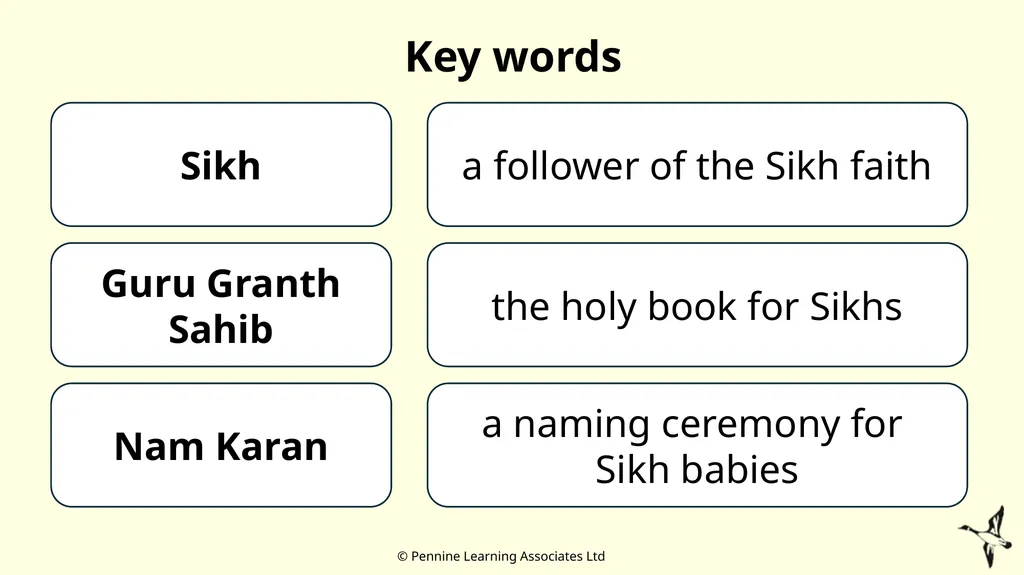
Key words<br>
08
I spy a person beginning with...
Guess my person from the story behind their name! Recap: Name games<br>
09
People who follow the Sikh faith have a special way to choose names.
Watch the video to find out how some Sikh people were given their name.
Many Sikhs add the name 'Singh' for a boy and 'Kaur' for a girl to show that they all belong to one big family. Introduction: Sikh names<br>
10
Sikh people believe that the birth of a child is a gift from God.
When the baby is about two weeks old, they have a Naam Karan; a naming celebration.
Naam Karam happens at the Gurdwara, the special place for Sikhs. Explanation: Naam Karan<br>
11
A random page of the Guru Granth Sahib is read ? 4 The family gives a gift like a precious rumalla cloth 3 Everyone listens to the Guru Granth Sahib 2 The family arrives at the Gurdwara 1 Task: Sequence a Naam Karan<br>
12
Everyone shares sweet food called karah parshad. 7 The baby's name is announced to everyone. 6 Parents choose the baby's name using the first letter from the first word on the page. 5 Task: Sequence a Naam Karan<br>
13
? Collect 7 pictures with your team.
Order the pictures to show what happens in a naam karan ceremony. Task: Sequence a Naam Karan in your group<br>
14
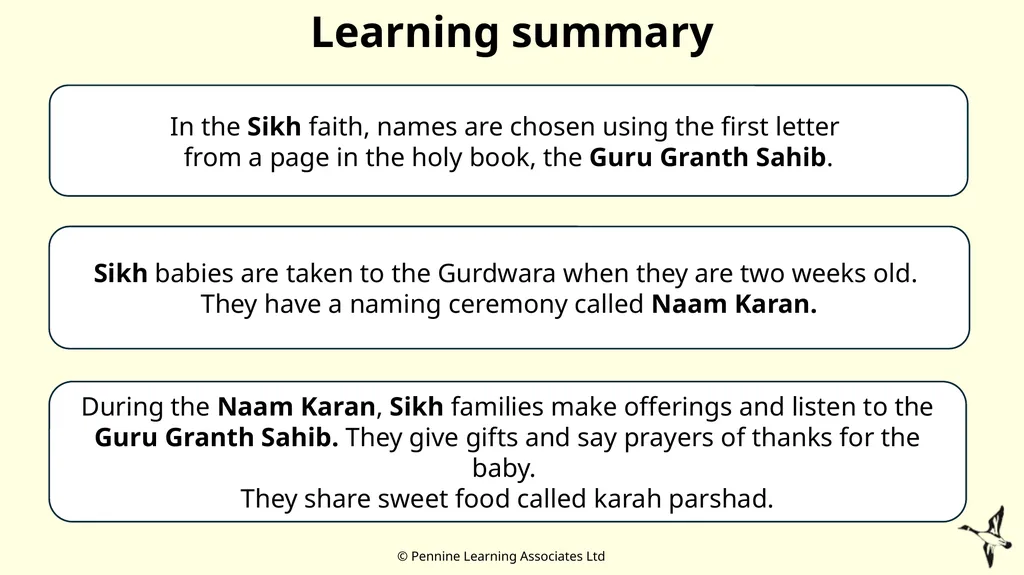
Learning summary<br>
15
? Take turns in your group to explain a part of the Naam Karan.
How is this a special way to welcome a baby? Task: Sequence a Naam Karan in your group<br>
16
Sikhs believe that we are all part of one big family and everyone is equally important. Names are carefully chosen to show that babies are welcome in the Sikh faith.
Think about your own name.
How does it feel when someone who cares about you says your name? Time to think<br>
17
All pictures reproduced under professional licence from Vecteezy.
Slide 12, 13, 15 : Image of parshad - Kitchentrystswithki, CC BY-SA 4.0 <https://creativecommons.org/licenses/by-sa/4.0>, via Wikimedia Commons Acknowledgments<br>