
Thank you for using this resource. We hope it
TF
Published · 24 slides · 0 views
1 / 1
Description
Thank you for using this resource. We hope it helps you, and your pupils! This advice may help. PowerPoints cover more than one lesson The PowerPoint presentation matches a section in the planning provided for this unit of work. This is
Related Topics
Share
Embed code
Download this presentation From Below
"Thank you for using this resource. We hope it" is the property of its rightful owner. Permission is granted to download and print the materials on this website for personal, non-commercial use only, and to display it on your personal computer provided you do not modify the materials and that you retain all copyright notices contained in the materials. By downloading content from our website, you accept the terms of this agreement.
Presentation Transcript
01
Thank you for using this resource. We hope it helps you, and your pupils! This advice may help.
PowerPoints cover more than one lesson
The PowerPoint presentation matches a section in the planning provided for this unit of work. This is likely to contain material for more than one lesson. It is important not to speed through the slides without completing suggested activities or discussion. Most sections in the planning, and the matching PowerPoints, will cover two lessons.
Please make sure you prepare and plan with staff
It is critical that delivery, style and speed reflect the needs and responses of pupils. The resource has been designed to support teachers, not to replace you! If this resource is provided as supporting material for HLTAs, cover teachers or non-specialists, please ensure you prepare them carefully and plan with them.
We recommend you use the detailed planning as well as this PowerPoint
This PowerPoint is designed to be used with the detailed planning written to support the RE syllabus ‘Believing and Belonging’. We strongly recommend that you use the PowerPoint in conjunction with the planning. Please ask us how to access this if you do not have it.
To feed back and for further support and to access webinar training please email enquiries@penninelearning.com. Dear Teacher…<br>
PowerPoints cover more than one lesson
The PowerPoint presentation matches a section in the planning provided for this unit of work. This is likely to contain material for more than one lesson. It is important not to speed through the slides without completing suggested activities or discussion. Most sections in the planning, and the matching PowerPoints, will cover two lessons.
Please make sure you prepare and plan with staff
It is critical that delivery, style and speed reflect the needs and responses of pupils. The resource has been designed to support teachers, not to replace you! If this resource is provided as supporting material for HLTAs, cover teachers or non-specialists, please ensure you prepare them carefully and plan with them.
We recommend you use the detailed planning as well as this PowerPoint
This PowerPoint is designed to be used with the detailed planning written to support the RE syllabus ‘Believing and Belonging’. We strongly recommend that you use the PowerPoint in conjunction with the planning. Please ask us how to access this if you do not have it.
To feed back and for further support and to access webinar training please email enquiries@penninelearning.com. Dear Teacher…<br>
02
Where this presentation fits: This presentation recaps the different creation stories and examines the difference between creation stories and scientific theories. Pupils are asked to discuss different meanings of looking after the world and investigate Christian ideas about stewardship, the Jewish concept of Tikkun Olam (healing the world) and Humanist ideas of environmental responsibilities.
Further enrichment: Lived experience: Interview a scientist from a faith community.
Possible misconceptions: Many people view scientific and religious views as incompatible, however some people of faith state that believers can accept both their beliefs and scientific theories and believe that creation can be interpreted alongside science.
Points to note: Creation stories and scientific theories are different types of knowledge. Scientists have different theories about how the world began. Religious believers might say that Science answers the question ‘How?’ and Religion answers the question ‘Why?’ Whilst many religious believers accept there are symbolic meanings behind the creation stories – that they do not have to be taken literally - some believers do accept the creation stories literally. Notes for teachers<br>
Further enrichment: Lived experience: Interview a scientist from a faith community.
Possible misconceptions: Many people view scientific and religious views as incompatible, however some people of faith state that believers can accept both their beliefs and scientific theories and believe that creation can be interpreted alongside science.
Points to note: Creation stories and scientific theories are different types of knowledge. Scientists have different theories about how the world began. Religious believers might say that Science answers the question ‘How?’ and Religion answers the question ‘Why?’ Whilst many religious believers accept there are symbolic meanings behind the creation stories – that they do not have to be taken literally - some believers do accept the creation stories literally. Notes for teachers<br>
03
Slides: 10 -14: Recap the creation stories. Please note that these slides refer to the stories from the resource pack.
Slides 15-19: contain the introduction and explanation of different theories and slides 20-21 are tasks as suggested in the planning. It is not necessary to include all of these. Please choose the most suitable tasks for your class.
Resources needed: creation stories – available in the resource pack. Images for the creation stories - Picturing Creation by Kate Neal (Photo and resource pack ;RE Today) ISBN: 9781904024583 or the slides may be copied. Further resources are referenced on the unit plan.
Further lesson notes and additional ideas may be found in the notes section of some slides (normal or presenter view). Please refer to the full unit plan for more activities and resources, if applicable.
Useful websites:
Further ideas and activities on this theme: REQuest: https://request.org.uk/ ‘Creation’.
Slide 15: https://kids.britannica.com/kids/article/big-bang/399364/https://kids.britannica.com/kids/article/evolution/353115
Slide 18: https://youtu.be/R4AfRkhseb4 Tikkun Olam
Slide 21: Interview a scientist from a faith community. E.g. https://www.faraday.cam.ac.uk/schools/overview/ You might enquire locally, as there may be a vicar/minister who is a scientist. There is a tradition of scientific thought in Sikhi and Islam too, so leaders from these faith communities may be prepared to answer questions. Notes for teachers<br>
Slides 15-19: contain the introduction and explanation of different theories and slides 20-21 are tasks as suggested in the planning. It is not necessary to include all of these. Please choose the most suitable tasks for your class.
Resources needed: creation stories – available in the resource pack. Images for the creation stories - Picturing Creation by Kate Neal (Photo and resource pack ;RE Today) ISBN: 9781904024583 or the slides may be copied. Further resources are referenced on the unit plan.
Further lesson notes and additional ideas may be found in the notes section of some slides (normal or presenter view). Please refer to the full unit plan for more activities and resources, if applicable.
Useful websites:
Further ideas and activities on this theme: REQuest: https://request.org.uk/ ‘Creation’.
Slide 15: https://kids.britannica.com/kids/article/big-bang/399364/https://kids.britannica.com/kids/article/evolution/353115
Slide 18: https://youtu.be/R4AfRkhseb4 Tikkun Olam
Slide 21: Interview a scientist from a faith community. E.g. https://www.faraday.cam.ac.uk/schools/overview/ You might enquire locally, as there may be a vicar/minister who is a scientist. There is a tradition of scientific thought in Sikhi and Islam too, so leaders from these faith communities may be prepared to answer questions. Notes for teachers<br>
04
Unit: FL2:11
How do creation stories help people understand the world?
Presentation 6 This Photo by Unknown Author is licensed under CC BY-SA-NC How How is looking after the environment linked to creation stories?<br>
How do creation stories help people understand the world?
Presentation 6 This Photo by Unknown Author is licensed under CC BY-SA-NC How How is looking after the environment linked to creation stories?<br>
05
Key Stage 2
Through considering the Big Picture, pupils should learn that:
People tell different stories to communicate important teaching and these stories often form part of longer narratives.
Groups of religious and non-religious people tell different stories, which reflect the different ways in which they view the world. How this presentation links to the pathway:
This presentation recaps the different creation stories and examines scientific theories about how the world began and evolution. The responsibilities of caring for the world are investigated from both religious and scientific viewpoints. Pathway 6: The Big Picture<br>
Through considering the Big Picture, pupils should learn that:
People tell different stories to communicate important teaching and these stories often form part of longer narratives.
Groups of religious and non-religious people tell different stories, which reflect the different ways in which they view the world. How this presentation links to the pathway:
This presentation recaps the different creation stories and examines scientific theories about how the world began and evolution. The responsibilities of caring for the world are investigated from both religious and scientific viewpoints. Pathway 6: The Big Picture<br>
06
Learning objectives Explain how creation stories are still important to people of faith . Explain that stories have different interpretations and meanings for different people<br>
07
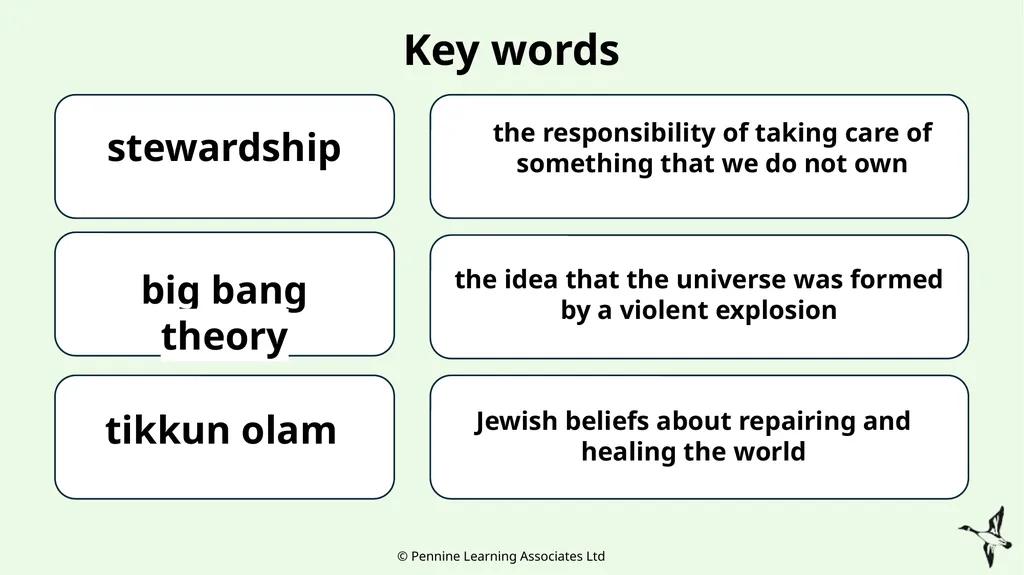
Key words Jewish beliefs about repairing and healing the world the responsibility of taking care of something that we do not own<br>
08
Introduction:
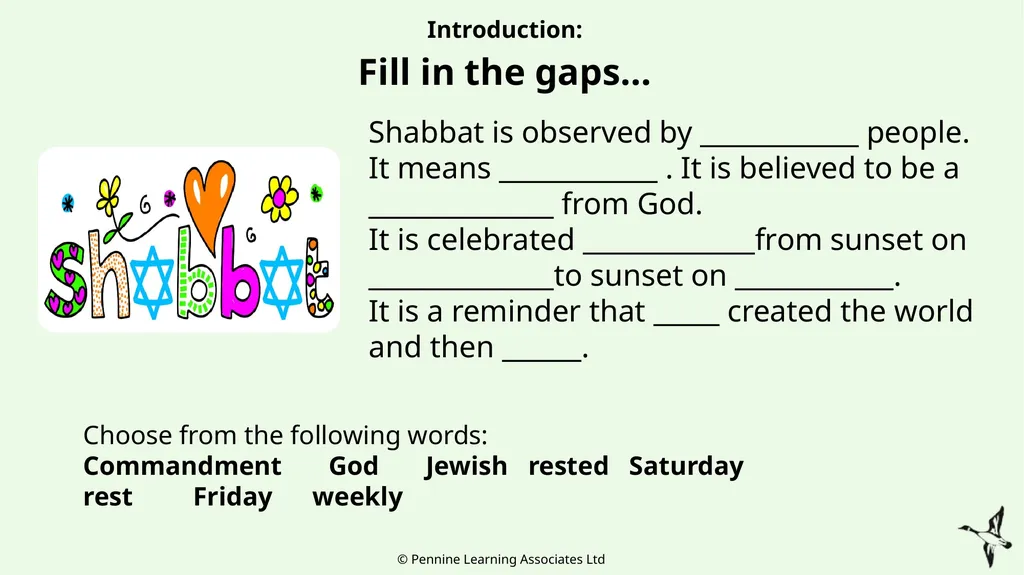
Fill in the gaps… Shabbat is observed by ____________ people. It means ____________ . It is believed to be a ______________ from God.
It is celebrated _____________from sunset on ______________to sunset on ____________.
It is a reminder that _____ created the world and then ______. Choose from the following words:
Commandment God Jewish rested Saturday rest Friday weekly<br>
It is celebrated _____________from sunset on ______________to sunset on ____________.
It is a reminder that _____ created the world and then ______. Choose from the following words:
Commandment God Jewish rested Saturday rest Friday weekly<br>
09
Introduction:
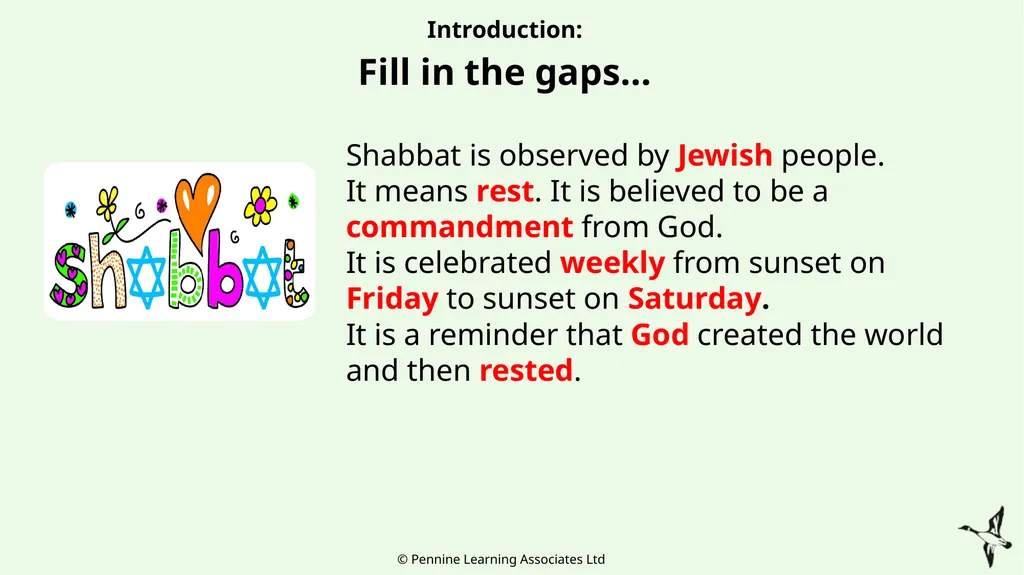
Fill in the gaps… Shabbat is observed by Jewish people.
It means rest. It is believed to be a commandment from God.
It is celebrated weekly from sunset on Friday to sunset on Saturday.
It is a reminder that God created the world and then rested.<br>
It means rest. It is believed to be a commandment from God.
It is celebrated weekly from sunset on Friday to sunset on Saturday.
It is a reminder that God created the world and then rested.<br>
10
Introduction:
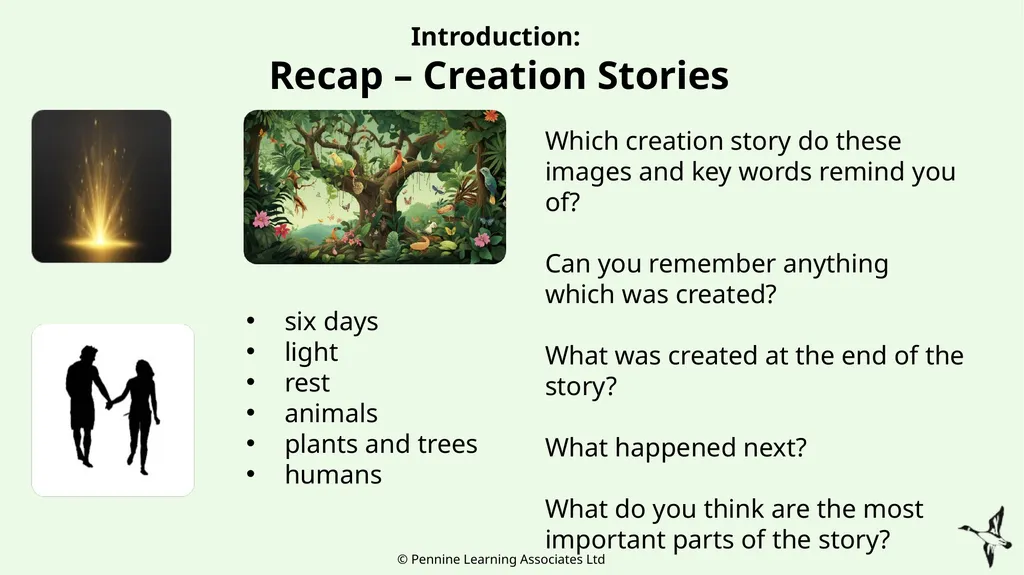
Recap – Creation Stories Which creation story do these images and key words remind you of?
Can you remember anything which was created?
What was created at the end of the story?
What happened next?
What do you think are the most important parts of the story? six days
light
rest
animals
plants and trees
humans<br>
Can you remember anything which was created?
What was created at the end of the story?
What happened next?
What do you think are the most important parts of the story? six days
light
rest
animals
plants and trees
humans<br>
11
Introduction:
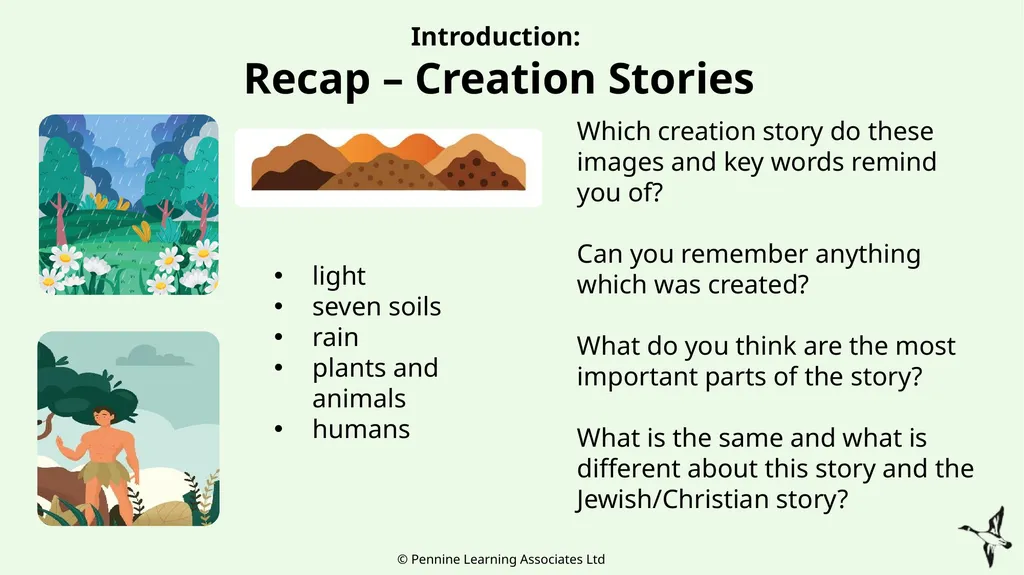
Recap – Creation Stories light
seven soils
rain
plants and animals
humans Which creation story do these images and key words remind you of?
Can you remember anything which was created?
What do you think are the most important parts of the story?
What is the same and what is different about this story and the Jewish/Christian story?<br>
seven soils
rain
plants and animals
humans Which creation story do these images and key words remind you of?
Can you remember anything which was created?
What do you think are the most important parts of the story?
What is the same and what is different about this story and the Jewish/Christian story?<br>
12
Introduction:
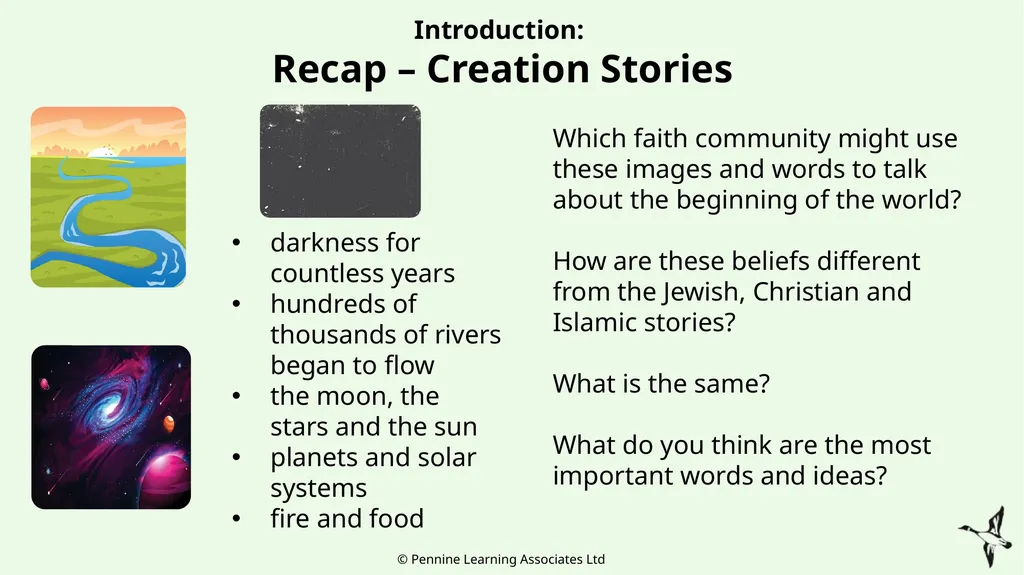
Recap – Creation Stories Which faith community might use these images and words to talk about the beginning of the world?
How are these beliefs different from the Jewish, Christian and Islamic stories?
What is the same?
What do you think are the most important words and ideas? darkness for countless years
hundreds of thousands of rivers began to flow
the moon, the stars and the sun
planets and solar systems
fire and food<br>
How are these beliefs different from the Jewish, Christian and Islamic stories?
What is the same?
What do you think are the most important words and ideas? darkness for countless years
hundreds of thousands of rivers began to flow
the moon, the stars and the sun
planets and solar systems
fire and food<br>
13
Introduction:
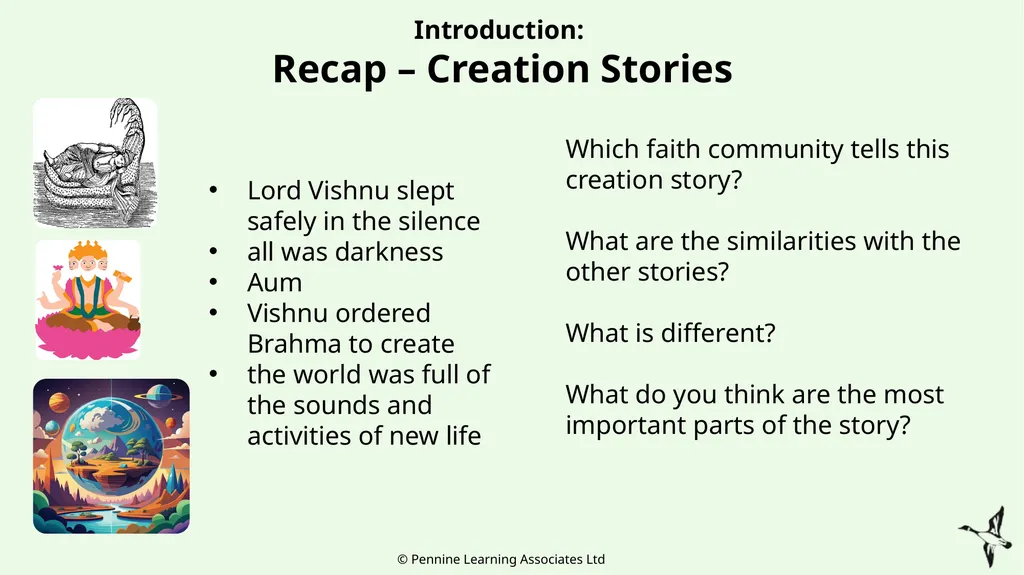
Recap – Creation Stories Which faith community tells this creation story?
What are the similarities with the other stories?
What is different?
What do you think are the most important parts of the story? Lord Vishnu slept safely in the silence
all was darkness
Aum
Vishnu ordered Brahma to create
the world was full of the sounds and activities of new life<br>
What are the similarities with the other stories?
What is different?
What do you think are the most important parts of the story? Lord Vishnu slept safely in the silence
all was darkness
Aum
Vishnu ordered Brahma to create
the world was full of the sounds and activities of new life<br>
14
Discussion:
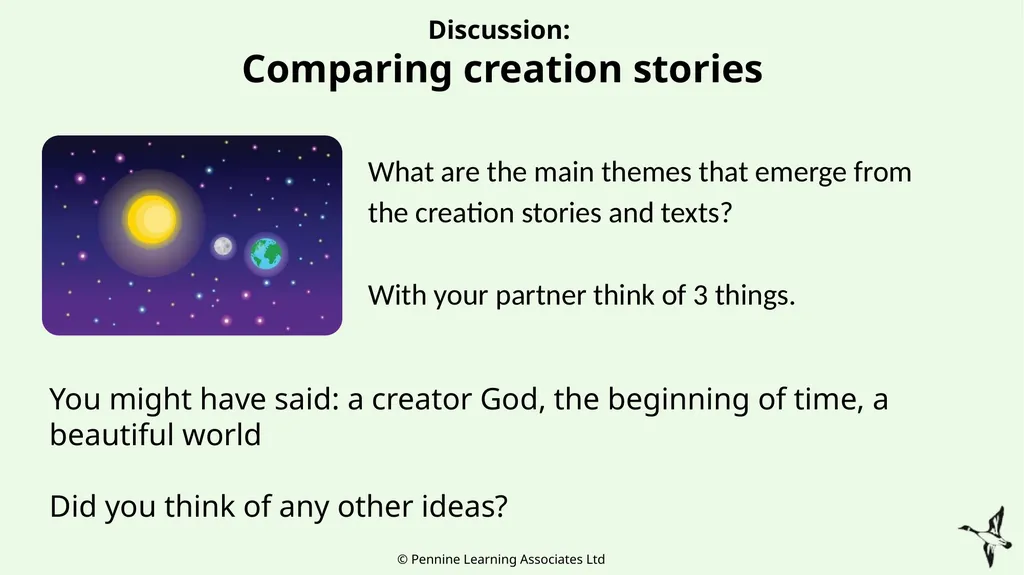
Comparing creation stories What are the main themes that emerge from the creation stories and texts?
With your partner think of 3 things. You might have said: a creator God, the beginning of time, a beautiful world
Did you think of any other ideas?<br>
With your partner think of 3 things. You might have said: a creator God, the beginning of time, a beautiful world
Did you think of any other ideas?<br>
15
Explanation:
Are there other explanations for the
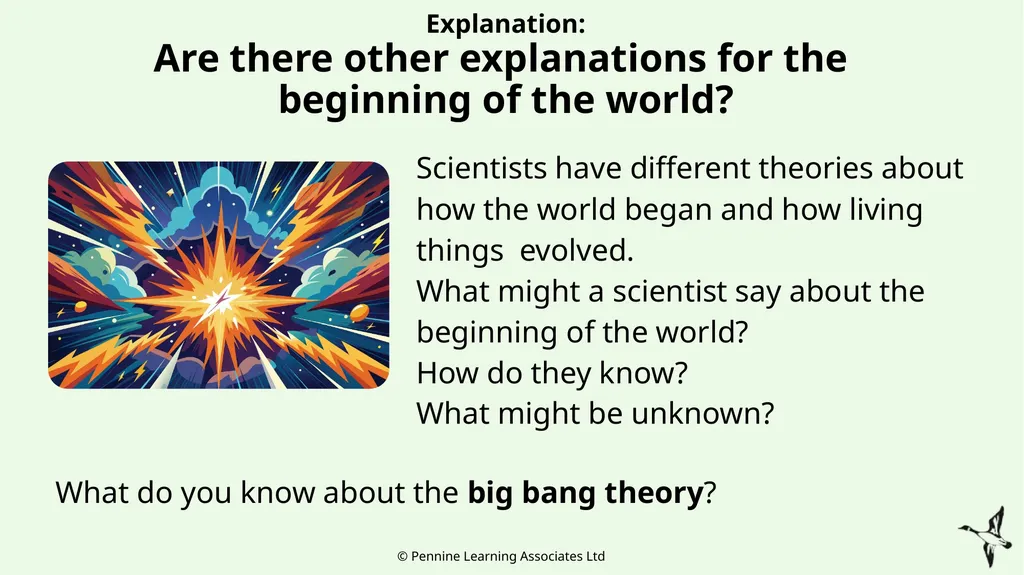
beginning of the world? Scientists have different theories about how the world began and how living things evolved.
What might a scientist say about the beginning of the world?
How do they know?
What might be unknown? What do you know about the big bang theory?<br>
What might a scientist say about the beginning of the world?
How do they know?
What might be unknown? What do you know about the big bang theory?<br>
16
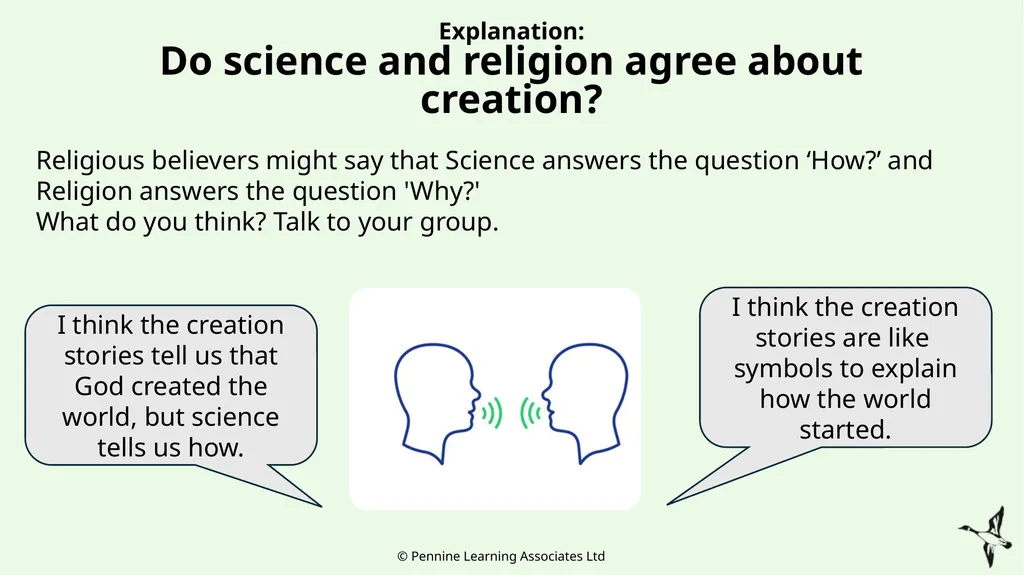
Religious believers might say that Science answers the question ‘How?’ and Religion answers the question 'Why?'
What do you think? Talk to your group. Explanation: Do science and religion agree about creation? I think the creation stories are like
symbols to explain how the world started. I think the creation stories tell us that God created the world, but science tells us how.<br>
What do you think? Talk to your group. Explanation: Do science and religion agree about creation? I think the creation stories are like
symbols to explain how the world started. I think the creation stories tell us that God created the world, but science tells us how.<br>
17
Explanation:
Looking after the world Creation stories teach that all living things are important. The creation story in the Bible teaches that everything was good. God tells Adam and Eve to care for creation. Christians believe in stewardship of the world and take it very seriously. A steward is someone who takes care of something that does not belong to them.
For a Christian, stewardship is about being responsible for God’s world.
Why might stewardship be so important to Christians?
What might Christians do to be good stewards of creation?<br>
For a Christian, stewardship is about being responsible for God’s world.
Why might stewardship be so important to Christians?
What might Christians do to be good stewards of creation?<br>
18
Explanation:
Looking after the world All faiths teach responsibility for the world and respect for others.
Jewish people believe that God expects them to care for the world. They believe in the practice of tikkun olam. Tikkun olam translates to “repairing the world.”
What might Jewish people do in their everyday lives to 'repair the world'?<br>
Jewish people believe that God expects them to care for the world. They believe in the practice of tikkun olam. Tikkun olam translates to “repairing the world.”
What might Jewish people do in their everyday lives to 'repair the world'?<br>
19
Humanists do not believe in a god. They believe it is possible to live a good and fulfilling life without following a traditional religion. Humanists rely on science to explain the origins of the world and the way things are.
How might belief in science help a Humanist to show responsibility for the world?
Is it only Humanists that believe in science and scientific theories? Explanation: Looking after the world<br>
How might belief in science help a Humanist to show responsibility for the world?
Is it only Humanists that believe in science and scientific theories? Explanation: Looking after the world<br>
20
Task 1:
Are the creation stories still worth reading today? Answer the title question, in a paragraph, as if you were Jewish, Muslim, Christian, Sikh, Hindu or Humanist.
Think about the creation stories that we have recapped today. Think about why people still read them and what they might learn from them.
Consider how different worldviews think of the origins of the world and their responsibilities to the environment.
Explain your reasons.<br>
Think about the creation stories that we have recapped today. Think about why people still read them and what they might learn from them.
Consider how different worldviews think of the origins of the world and their responsibilities to the environment.
Explain your reasons.<br>
21
Task 2:
Interview a scientist from a faith community If you could interview a scientist who is from a faith community, what would you ask?
Write down some questions that you could ask. Use the questions in the speech bubble as a starting point.
What would you like to know more about? Is science compatible with religion?
How did the world begin?<br>
Interview a scientist from a faith community If you could interview a scientist who is from a faith community, what would you ask?
Write down some questions that you could ask. Use the questions in the speech bubble as a starting point.
What would you like to know more about? Is science compatible with religion?
How did the world begin?<br>
22
Learning summary People with religious and non-religious worldviews believe they have a responsibility to care for the world. Christians might talk about stewardship. Jews might follow the practice of tikkun olam. Scientists might talk about the ‘big bang’ as a way of explaining how life began and evolved over millions of years. Some scientists might have a religious worldview.<br>
23
We have been investigating the link between stories of creation and caring for the environment.
Do you feel inspired by the creation stories? How? Pause for thought<br>
Do you feel inspired by the creation stories? How? Pause for thought<br>
24
Acknowledgments All pictures reproduced under professional licence from Vecteezy<br>