
Thank you for using this resource. We hope it
JO
Published · 22 slides · 0 views
1 / 1




Description
Thank you for using this resource. We hope it helps you, and your pupils! This advice may help. PowerPoints cover more than one lesson The PowerPoint presentation matches a section in the planning provided for this unit of work. This is
Related Topics
Share
Embed code
Download this presentation From Below
"Thank you for using this resource. We hope it" is the property of its rightful owner. Permission is granted to download and print the materials on this website for personal, non-commercial use only, and to display it on your personal computer provided you do not modify the materials and that you retain all copyright notices contained in the materials. By downloading content from our website, you accept the terms of this agreement.
Presentation Transcript
01
Thank you for using this resource. We hope it helps you, and your pupils! This advice may help.
PowerPoints cover more than one lesson
The PowerPoint presentation matches a section in the planning provided for this unit of work. This is likely to contain material for more than one lesson. It is important not to speed through the slides without completing suggested activities or discussion. Some sections in the planning, and the matching PowerPoints, may provide sufficient material for two or more lessons.
Please make sure you prepare and plan with staff
It is critical that delivery, style and speed reflect the needs and responses of pupils. The resource has been designed to support teachers, not to replace you! If this resource is provided as supporting material for HLTAs, cover teachers or non-specialists, please ensure you prepare them carefully and plan with them.
We recommend you use the detailed planning as well as this PowerPoint
This PowerPoint is designed to be used with the detailed planning written to support the RE syllabus ‘Believing and Belonging’. We strongly recommend that you use the PowerPoint in conjunction with the planning. Please ask us how to access this if you do not have it.
To feed back and for further support and to access webinar training please email enquiries@penninelearning.com. Dear Teacher<br>
02
Where this lesson fits: This lesson explores how Jesus healed and cared for others and what this teaches Christians about living a good life. It encourages pupils to think of personal qualities of kindness and caring.
Points to note: show sensitivity when discussing healing, as children may have personal experience of family members suffering from illness.
Enrichment ideas: Active Learning: For one of the stories, pupils retell the story using pictures. Divide the story into a number of scenes and allocate each scene to a small group of pupils. Use digital recorders, with some pupils acting as reporters and others being eyewitnesses. Compile the individual scenes into a PowerPoint, to which pupils add a commentary and sound effects.
Outdoor learning: Laminate teardrops with reflections/meditations and hang on trees.
Resources needed: You may wish to use the Beginners Bible – illustrated, simplified version.
Further lesson notes and additional ideas may be found in the ‘Notes’ section of some slides. Refer to the full unit plan for more activities and resources. (Useful websites are referenced in the unit plan). Notes for teachers<br>
03
Slide 10: This is one of many stories that you could read – should you wish to use an alternative: Read one of the Bible stories about how Jesus healed the sick, e.g. Jesus heals the blind. ‘Jesus Heals a Blind Beggar’ - The Beginners Bible, for illustrated, simplified version.
Jesus heals the Blind – Mark 10:46-10:52
The Paralysed Man – Mark 2:1-12
Story of the Healing of the Crippled Man (Mark 2:1-12).
The Deaf and Dumb man Mark 7:31-35
The Leper – Matthew 8:1-4
Bartimaeus – Mark 10:46-52
Mark 7:31-35 Jesus performs a private healing
https://www.biblegateway.com This site has other suggested translations including ones for children such as Easy-to-read version, International Children's Bible or Good News translation.
Slide 16: See resource pack for feelings graph
Pupils could write a poem or prayer for the sick. For other suggestions – see unit plan for outdoor/active learning. Resources to support this presentation<br>
04
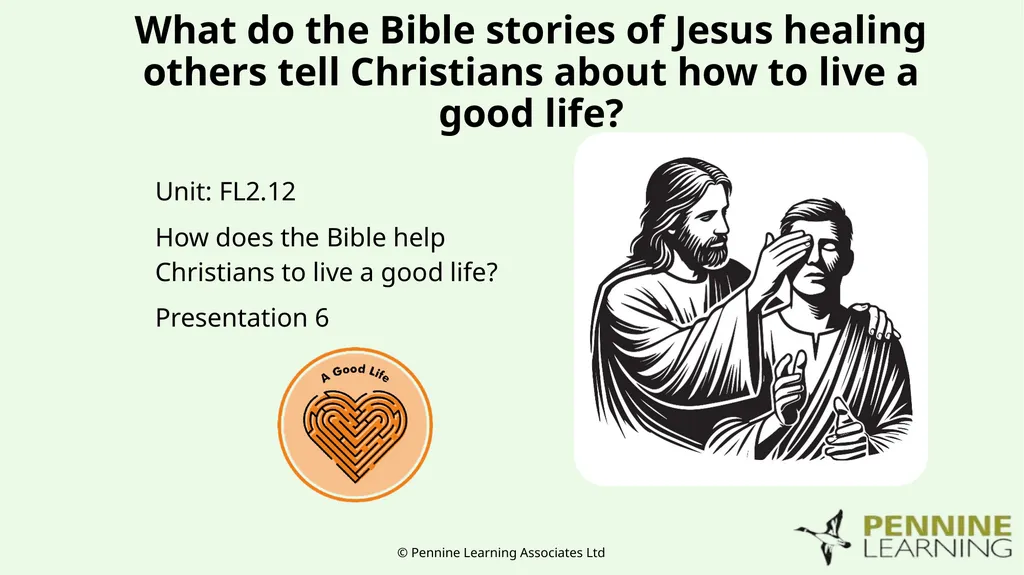
Unit: FL2.12
How does the Bible help Christians to live a good life?
Presentation 6 What do the Bible stories of Jesus healing others tell Christians about how to live a good life?<br>
How does the Bible help Christians to live a good life?
Presentation 6 What do the Bible stories of Jesus healing others tell Christians about how to live a good life?<br>
05
How this presentation links to the pathway:
This presentation encourages pupils to think about how Jesus cared for others and how Christians might be inspired by his example. Key Stage 2
Through investigating what is meant by a Good Life, pupils will learn that:
Most religions share stories of moral exemplars from the past and more recently, guiding followers on leading virtuous lives.
Religions/worldviews provide guidance for their followers on how to live a good life.
There are both differing opinions and agreement on what is meant by a ‘good life’ and what is right and wrong. Pathway 3: A Good Life<br>
06
Give reasons why Christians show care for others and give an example of personal qualities of kindness and caring Give an example of Jesus caring for and healing people Learning objectives<br>
07
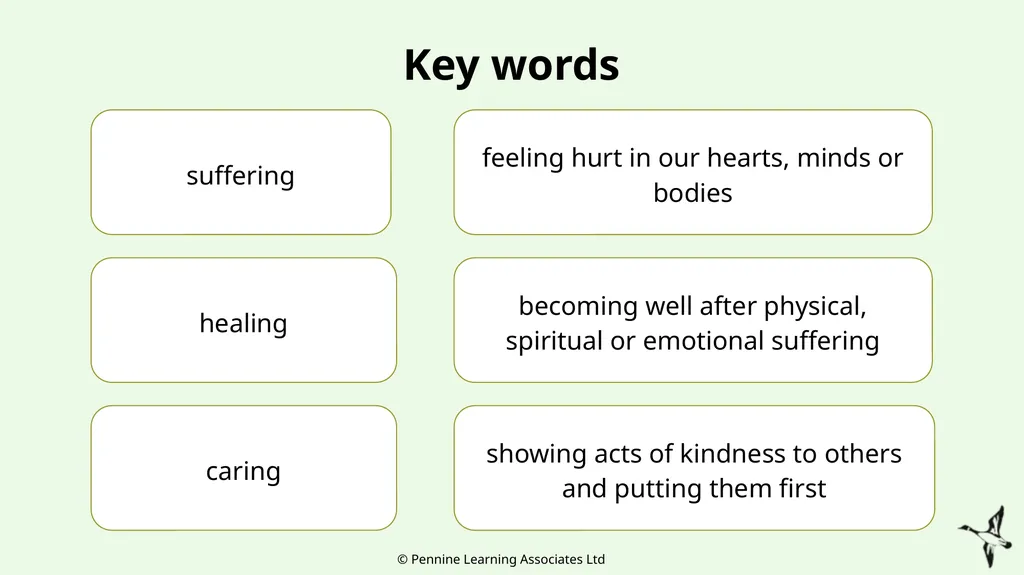
showing acts of kindness to others and putting them first caring becoming well after physical, spiritual or emotional suffering healing feeling hurt in our hearts, minds or bodies suffering Key words<br>
08
Talk to your partner…
Can you think of any Bible stories you may have heard where Jesus healed someone who was suffering in any way?
Do you think Jesus cared for others? Introduction: Jesus heals the sick<br>
Can you think of any Bible stories you may have heard where Jesus healed someone who was suffering in any way?
Do you think Jesus cared for others? Introduction: Jesus heals the sick<br>
09
Who do you go to if you are ill?
Usually, it’s the doctor or hospital and we trust them to help us get better.
Sometimes, all we need is loving care – from our families and friends.
Jesus cared for people, and he healed them. There are many stories of the people he healed.
As we read one of the stories together, think…
What did Jesus teach others by the way he lived? Introduction: Jesus heals the sick<br>
10
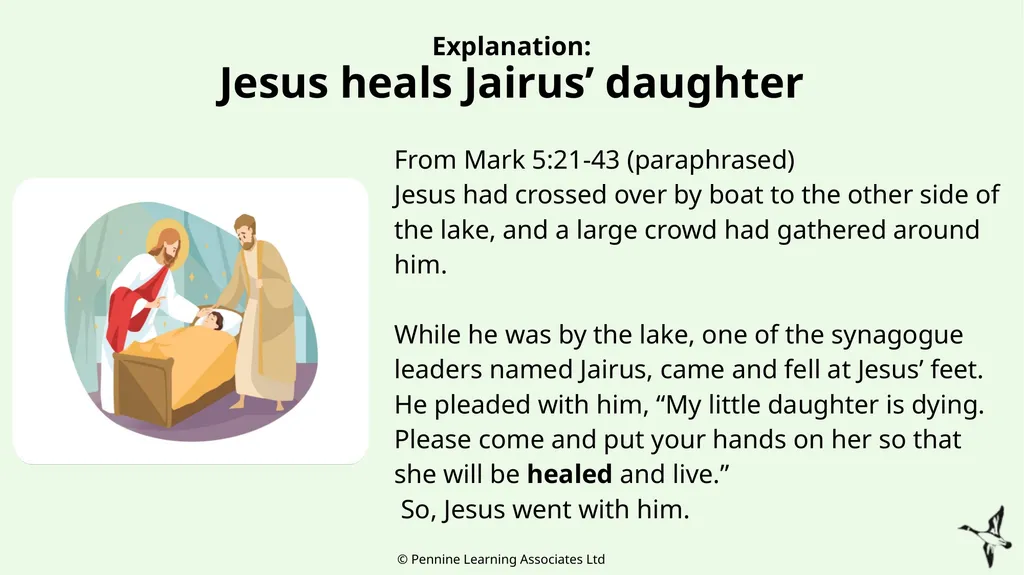
From Mark 5:21-43 (paraphrased)
Jesus had crossed over by boat to the other side of the lake, and a large crowd had gathered around him.
While he was by the lake, one of the synagogue leaders named Jairus, came and fell at Jesus’ feet.
He pleaded with him, “My little daughter is dying. Please come and put your hands on her so that she will be healed and live.”
So, Jesus went with him. Explanation: Jesus heals Jairus’ daughter<br>
11
Explanation:
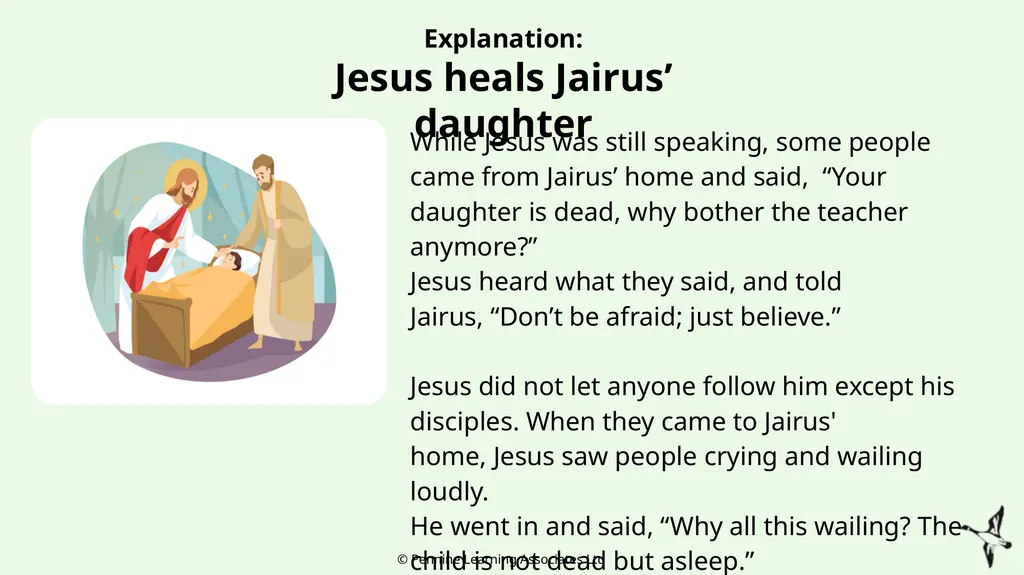
Jesus heals Jairus’ daughter While Jesus was still speaking, some people came from Jairus’ home and said, “Your daughter is dead, why bother the teacher anymore?”
Jesus heard what they said, and told Jairus, “Don’t be afraid; just believe.”
Jesus did not let anyone follow him except his disciples. When they came to Jairus' home, Jesus saw people crying and wailing loudly.
He went in and said, “Why all this wailing? The child is not dead but asleep.”
But they laughed at him.<br>
12
Explanation:
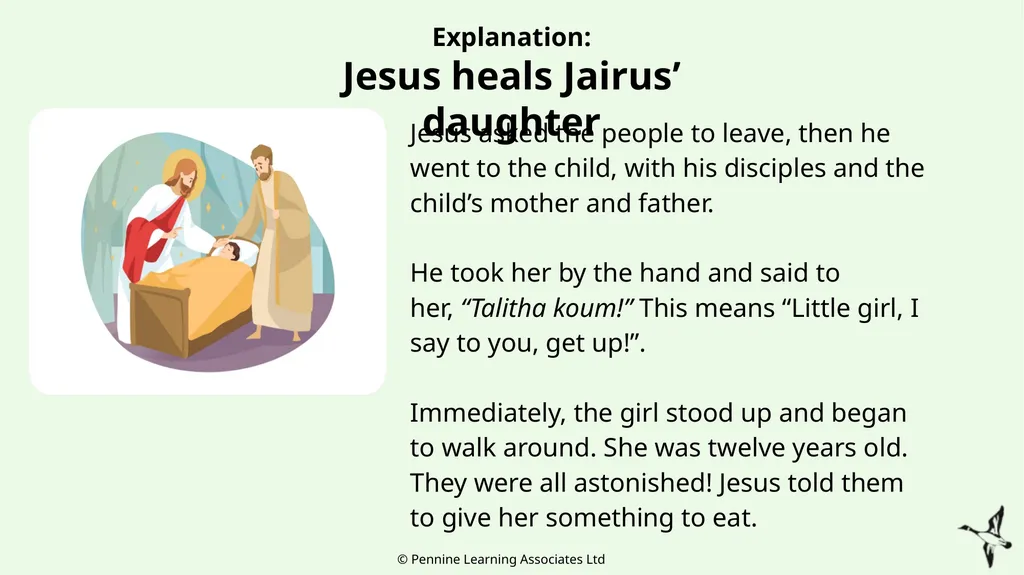
Jesus heals Jairus’ daughter Jesus asked the people to leave, then he went to the child, with his disciples and the child’s mother and father.
He took her by the hand and said to her, “Talitha koum!” This means “Little girl, I say to you, get up!”.
Immediately, the girl stood up and began to walk around. She was twelve years old.
They were all astonished! Jesus told them to give her something to eat.<br>
He took her by the hand and said to her, “Talitha koum!” This means “Little girl, I say to you, get up!”.
Immediately, the girl stood up and began to walk around. She was twelve years old.
They were all astonished! Jesus told them to give her something to eat.<br>
13
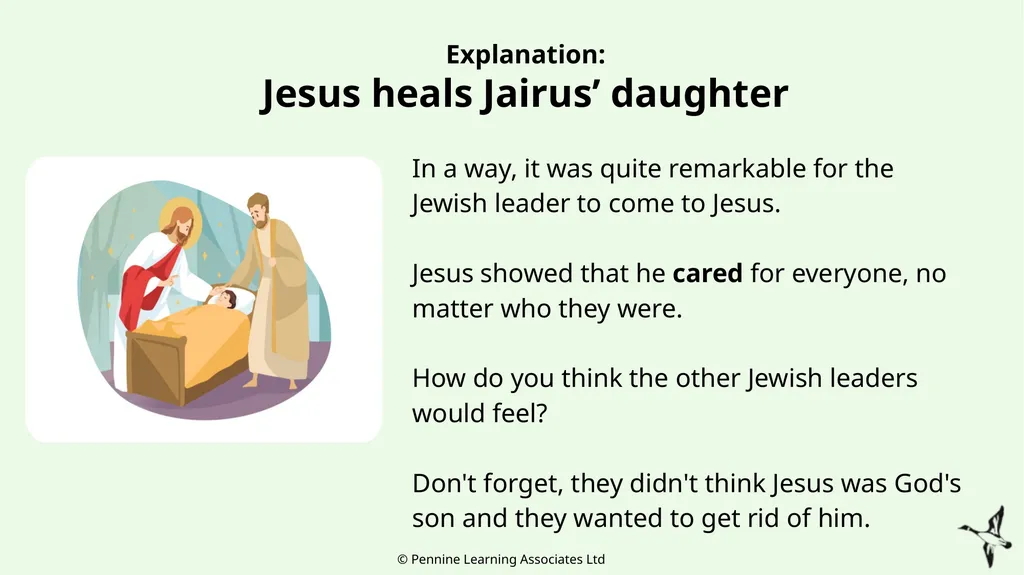
In a way, it was quite remarkable for the Jewish leader to come to Jesus.
Jesus showed that he cared for everyone, no matter who they were.
How do you think the other Jewish leaders would feel?
Don't forget, they didn't think Jesus was God's son and they wanted to get rid of him. Explanation: Jesus heals Jairus’ daughter<br>
Jesus showed that he cared for everyone, no matter who they were.
How do you think the other Jewish leaders would feel?
Don't forget, they didn't think Jesus was God's son and they wanted to get rid of him. Explanation: Jesus heals Jairus’ daughter<br>
14
Discussion:
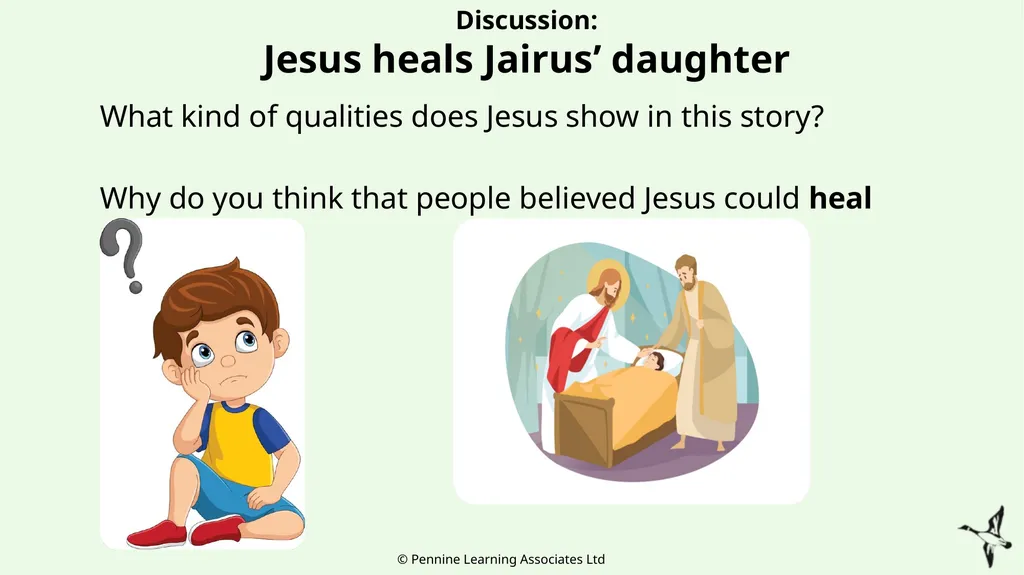
Jesus heals Jairus’ daughter What kind of qualities does Jesus show in this story?
Why do you think that people believed Jesus could heal them?<br>
Why do you think that people believed Jesus could heal them?<br>
15
Task:
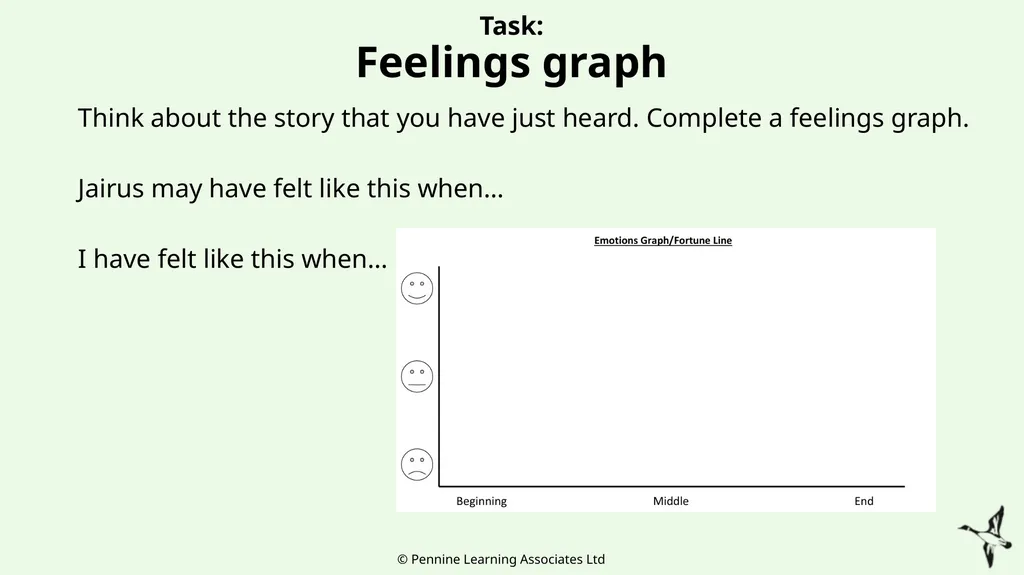
Feelings graph Think about the story that you have just heard. Complete a feelings graph.
Jairus may have felt like this when…
I have felt like this when…<br>
Jairus may have felt like this when…
I have felt like this when…<br>
16
Task:
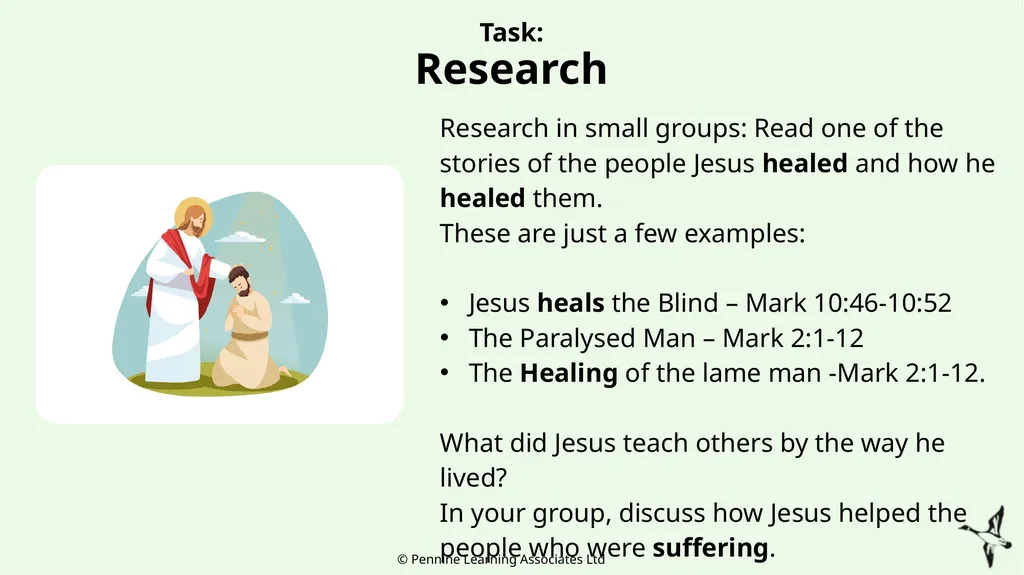
Research Research in small groups: Read one of the stories of the people Jesus healed and how he healed them.
These are just a few examples:
Jesus heals the Blind – Mark 10:46-10:52
The Paralysed Man – Mark 2:1-12
The Healing of the lame man -Mark 2:1-12.
What did Jesus teach others by the way he lived?
In your group, discuss how Jesus helped the people who were suffering.<br>
These are just a few examples:
Jesus heals the Blind – Mark 10:46-10:52
The Paralysed Man – Mark 2:1-12
The Healing of the lame man -Mark 2:1-12.
What did Jesus teach others by the way he lived?
In your group, discuss how Jesus helped the people who were suffering.<br>
17
Task:
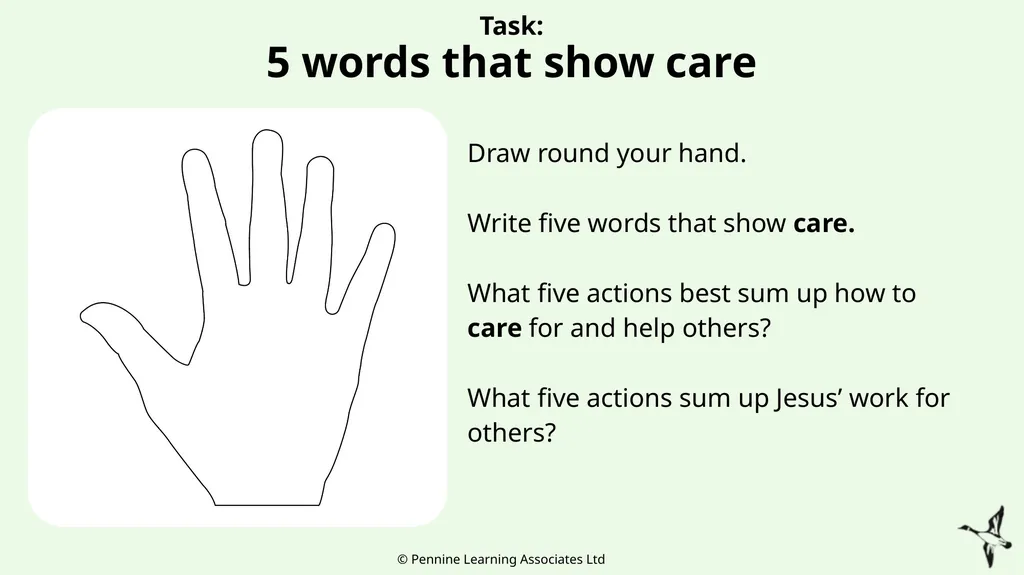
5 words that show care Draw round your hand.
Write five words that show care.
What five actions best sum up how to care for and help others?
What five actions sum up Jesus’ work for others?<br>
Write five words that show care.
What five actions best sum up how to care for and help others?
What five actions sum up Jesus’ work for others?<br>
18
Christians believe that the way Jesus healed others showed he was kind and caring. In the Bible, there are many stories of Jesus healing people in different ways. Many people who were sick or suffering came to Jesus because they believed that he could heal them. Learning summary<br>
19
Christians believe Jesus healed to show care and sympathy, as well as his power.
Christians believe that sharing, caring etc. are good qualities that Jesus showed.
What kinds of people help us when we are sick? Discussion<br>
Christians believe that sharing, caring etc. are good qualities that Jesus showed.
What kinds of people help us when we are sick? Discussion<br>
20
Give some reasons to explain how and why Christians follow Jesus' example by showing care for others. Conclusion<br>
21
How do you feel when someone cares for you, if you are sick?
How do you feel when you care for someone else? Pause for thought<br>
How do you feel when you care for someone else? Pause for thought<br>
22
Images reproduced under professional licence from Vecteezy. Acknowledgements<br>