
Thank you for using this resource. We hope it
NS
Published · 18 slides · 0 views
1 / 1




Description
Thank you for using this resource. We hope it helps you, and your pupils! This advice may help. PowerPoints cover more than one lesson The PowerPoint presentation matches a section in the planning provided for this unit of work. This is
Related Topics
Share
Embed code
Download this presentation From Below
"Thank you for using this resource. We hope it" is the property of its rightful owner. Permission is granted to download and print the materials on this website for personal, non-commercial use only, and to display it on your personal computer provided you do not modify the materials and that you retain all copyright notices contained in the materials. By downloading content from our website, you accept the terms of this agreement.
Presentation Transcript
01
Thank you for using this resource. We hope it helps you, and your pupils! This advice may help.
PowerPoints cover more than one lesson
The PowerPoint presentation matches a section in the planning provided for this unit of work. This is likely to contain material for more than one lesson. It is important not to speed through the slides without completing suggested activities or discussion. Some sections in the planning, and the matching PowerPoints, may provide sufficient material for two or more lessons.
Please make sure you prepare and plan with staff
It is critical that delivery, style and speed reflect the needs and responses of pupils. The resource has been designed to support teachers, not to replace you! If this resource is provided as supporting material for HLTAs, cover teachers or non-specialists, please ensure you prepare them carefully and plan with them.
We recommend you use the detailed planning as well as this PowerPoint
This PowerPoint is designed to be used with the detailed planning written to support the RE syllabus ‘Believing and Belonging’. We strongly recommend that you use the PowerPoint in conjunction with the planning. Please ask us how to access this if you do not have it.
To feed back and for further support and to access webinar training please email enquiries@penninelearning.com. Dear Teacher<br>
02
About this unit: This unit of work is based on Pathway 4 – Personal Journey. It introduces the concept of ‘belonging’ and establishes a sense of belonging to a family, school, community and the wider world. Pupils will be encouraged to talk about and describe where they live and who lives with them in their home, as well as learning about other aspects of belonging to different communities, including religious communities.
Where this lesson fits: This is the first session in the pathway 4 unit ‘Who belongs in my family and community?’. Children will explore the concept of belonging to our homes, families and local area. They will describe the features of their house and share their address.
Points to note: Discussions will take place over several sessions and as part of continuous provision. Be sensitive to children’s family settings. This is a good opportunity to respect the differences between families but that all should be treated equally. Discuss with parent/carer of a Looked After Child or an adopted child about how they would like to talk about this aspect of belonging to a family. Give them the opportunity to prepare their child before whole class discussion.
Enrichment ideas: A persona doll can be used to give children an example to relate to.
Outdoor learning: Add houses / buildings blocks to the outdoor area, for example wooden blocks with printed pictures of the children’s houses and local buildings.
Further lesson notes and additional ideas may be found in the ‘Notes’ section of some slides. Refer to the full unit plan for more activities and resources. Notes for teachers<br>
03
Slide 12: The short video Types of communities for kids - What is a community? [KS1 PSHE] Types of communities for kids - What is a community? [KS1 PSHE] by Muse Wellbeing explains communities in a simple way to match this slide.
Slide 13: Resources for adult led tasks:
‘Harry’s Home’ by Catherine and Laurence Anholt ISBN- 1-84121-603-8
Google maps: Google Maps
If taking children on a local walk, make sure all children have signed parental permission to leave school. Most schools now ask parents to sign a parental permission form at the start of every year for short walks around the area.
Slide 14: Resources for continuous provision:
Photographs from the local walk if selected as an adult led activity.
Provide children with map symbols of common features they will pass on their way to school such as houses, shops, parks, crossings etc.
Add real examples of day-to-day objects into the home corner, for example comics, recipe books, calendars, a working clock, a telephone, scales and TV remote. Add items to the home corner that reflect your children's cultural identities.
Slide 16: Swapping places game- call out ‘swap places if…’ and add on different features of families and homes. For example, if you have a brother, sister, cousin, pet; if you live in… (areas around school); if you live near school. End with a swap that will include all the children such as if you're part of the ____ school community. Resources to support this presentation<br>
04
Unit: E4
Who belongs in my family
and community?
Presentation 1 Where do we live and belong?<br>
Who belongs in my family
and community?
Presentation 1 Where do we live and belong?<br>
05
How this presentation links to the pathway:
In this presentation, children will think about how they belong to their families and to their community- the people who live around them. They will explore how families and homes are different. Early Years
Through exploring what is meant by a Personal Journey, children will learn that:
People in their family and community may have had important or life-changing experiences and encounters.
Some people have amazing, puzzling or mysterious experiences that make them ask big questions about life. Pathway 4: Personal Journey<br>
06
Describe the features of their house and state their address Recognise that we belong in our homes, families and local area Learning objectives<br>
07
a group of people that have something in common community feel like you’re in the right place belong Key words<br>
08
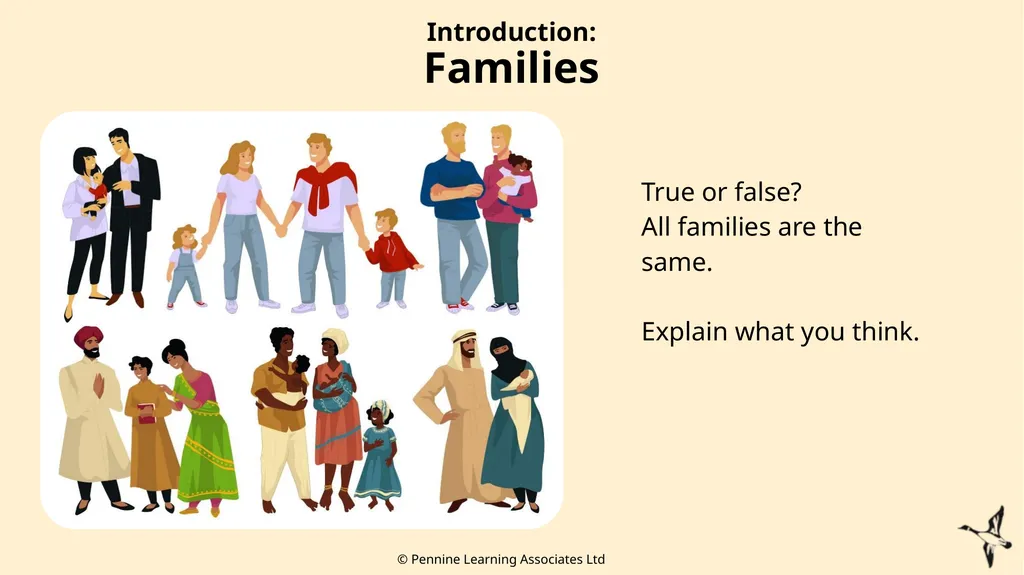
True or false?
All families are the same.
Explain what you think. Introduction: Families<br>
All families are the same.
Explain what you think. Introduction: Families<br>
09
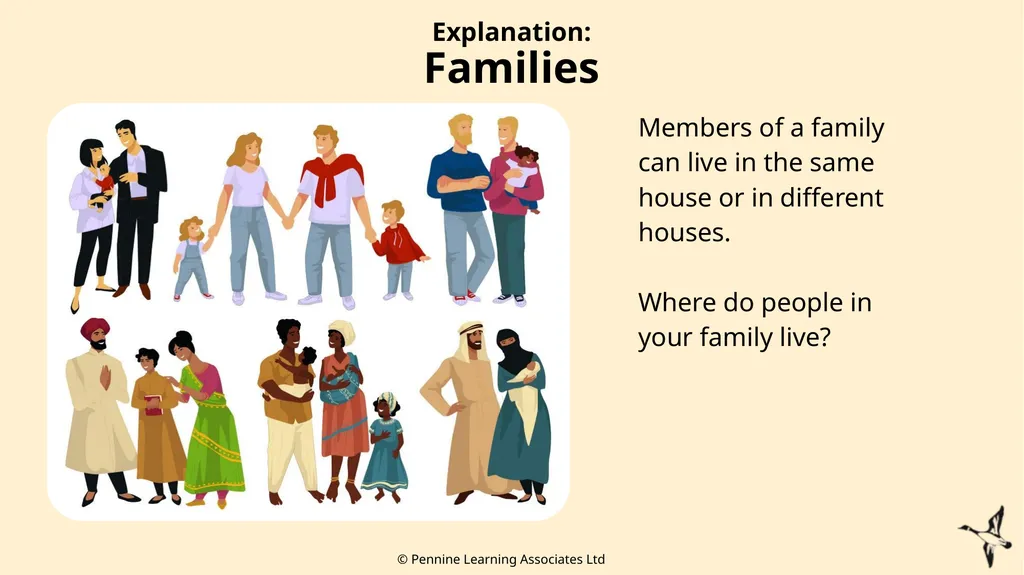
You belong to a family.
Who is in your family?
All families are different.
All families are as important as each other. Explanation: Families<br>
Who is in your family?
All families are different.
All families are as important as each other. Explanation: Families<br>
10
Members of a family can live in the same house or in different houses.
Where do people in your family live? Explanation: Families<br>
Where do people in your family live? Explanation: Families<br>
11
Think – pair – share;
Which street do you live on?
Do you live close to school or further away?
Who lives near to you in your community? Discussion: Where do you live?<br>
Which street do you live on?
Do you live close to school or further away?
Who lives near to you in your community? Discussion: Where do you live?<br>
12
We all belong to a community as well as a family.
Our community is the people around us in our local area. Explanation: Belonging<br>
Our community is the people around us in our local area. Explanation: Belonging<br>
13
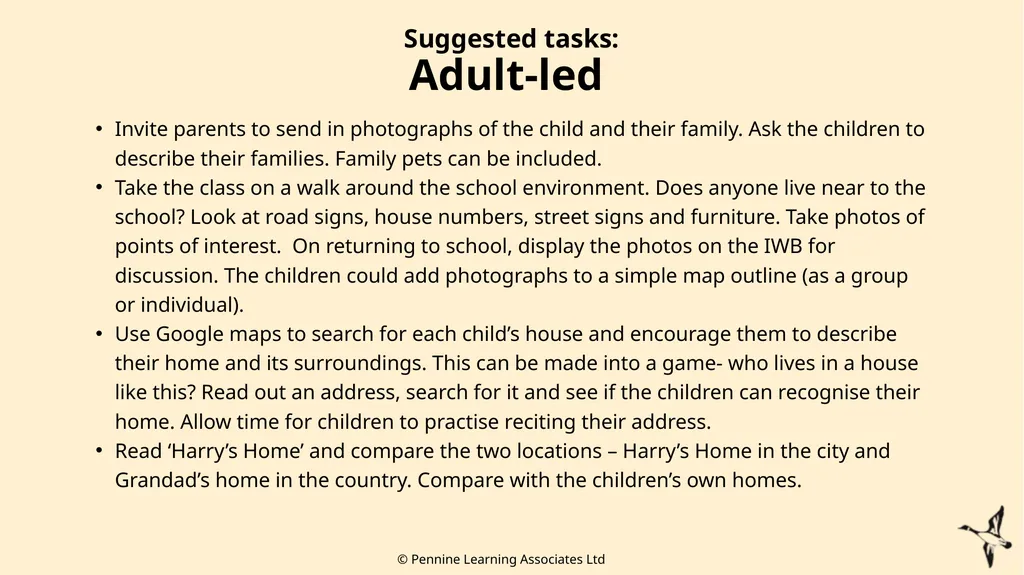
Invite parents to send in photographs of the child and their family. Ask the children to describe their families. Family pets can be included.
Take the class on a walk around the school environment. Does anyone live near to the school? Look at road signs, house numbers, street signs and furniture. Take photos of points of interest. On returning to school, display the photos on the IWB for discussion. The children could add photographs to a simple map outline (as a group or individual).
Use Google maps to search for each child’s house and encourage them to describe their home and its surroundings. This can be made into a game- who lives in a house like this? Read out an address, search for it and see if the children can recognise their home. Allow time for children to practise reciting their address.
Read ‘Harry’s Home’ and compare the two locations – Harry’s Home in the city and Grandad’s home in the country. Compare with the children’s own homes. Suggested tasks: Adult-led<br>
14
Add real examples of day- to- day objects into the home corner, for example comics, recipe books, calendars, a working clock, a telephone, scales and TV remote. Add items to the home corner that reflect your children's cultural identities.
Draw a picture of your own house. How do you know this is your house? How is your house different to the house next door? Or different to your friend’s house?
Look at and sort the photos from the local area walk.
Provide children with map symbols of common features they will pass on their way to school such as houses, shops, parks, crossings etc. Encourage children to create their own route to school using symbols and roads. Suggested tasks: Independent in provision<br>
15
We can feel like we belong in our home. Remembering our address helps us to learn where we belong. We also belong to a community. People in our community live around us. We belong in our families. All families are different; but all families are important. Learning summary<br>
16
Hold on to the parachute.
Swap places if what the adult says is true for you. Conclusion: Swapping places game<br>
Swap places if what the adult says is true for you. Conclusion: Swapping places game<br>
17
What do you love about your home?
What do you love about your family? Time to think<br>
What do you love about your family? Time to think<br>
18
Images reproduced under professional licence from Vecteezy. Acknowledgements<br>