
Thank you for using this resource. We hope it
LD
Published · 22 slides · 0 views
1 / 1
Description
Thank you for using this resource. We hope it helps you, and your pupils! This advice may help. PowerPoints cover more than one lesson The PowerPoint presentation matches a section in the planning provided for this unit of work. This is
Related Topics
Share
Embed code
Download this presentation From Below
"Thank you for using this resource. We hope it" is the property of its rightful owner. Permission is granted to download and print the materials on this website for personal, non-commercial use only, and to display it on your personal computer provided you do not modify the materials and that you retain all copyright notices contained in the materials. By downloading content from our website, you accept the terms of this agreement.
Presentation Transcript
01
Thank you for using this resource. We hope it helps you, and your pupils! This advice may help.
PowerPoints cover more than one lesson
The PowerPoint presentation matches a section in the planning provided for this unit of work. This is likely to contain material for more than one lesson. It is important not to speed through the slides without completing suggested activities or discussion. Most sections in the planning, and the matching PowerPoints, will cover two lessons.
Please make sure you prepare and plan with staff
It is critical that delivery, style and speed reflect the needs and responses of pupils. The resource has been designed to support teachers, not to replace you! If this resource is provided as supporting material for HLTAs, cover teachers or non-specialists please ensure you prepare them carefully and plan with them.
We recommend you use the detailed planning as well as this PowerPoint
This PowerPoint is designed to be used with the detailed planning written to support the RE syllabus ‘Believing and Belonging’. We strongly recommend that you use the PowerPoint in conjunction with the planning. Please ask us how to access this if you do not have it.
To feed back and for further support and to access webinar training please email enquiries@penninelearning.com. Dear Teacher…<br>
02
This is the third presentation in this unit on Hindu Dharma. It builds on what pupils will already have covered in KS1 And lower KS2. It focusses on Hindu belief in God and how Hindu people worship in different ways at home and in the Mandir. Pupils should be given the opportunity to identify similarities and differences in belief and worship in different traditions in Hindu Dharma and compare these to other beliefs.
Slides 3-6: The teacher will introduce the lesson, key words and objectives.
Slide 7: the teacher will guide pupils in a recall activity based on the previous lesson. An examples answer can be found on slide 7, but the teacher may choose to check learning using the board or visualiser.
Slides 9- 12: The teacher will read through the explanation slides to introduce the concept of puja. The teacher could choose to use an appropriate video here. There are some that we have suggested for later tasks.
Slide 13: The teacher could provide pupils with a Venn Diagram print out, or get students to draw one. As they watch the clip, students should add features to the left of the diagram. Clip is in the notes on the slide.
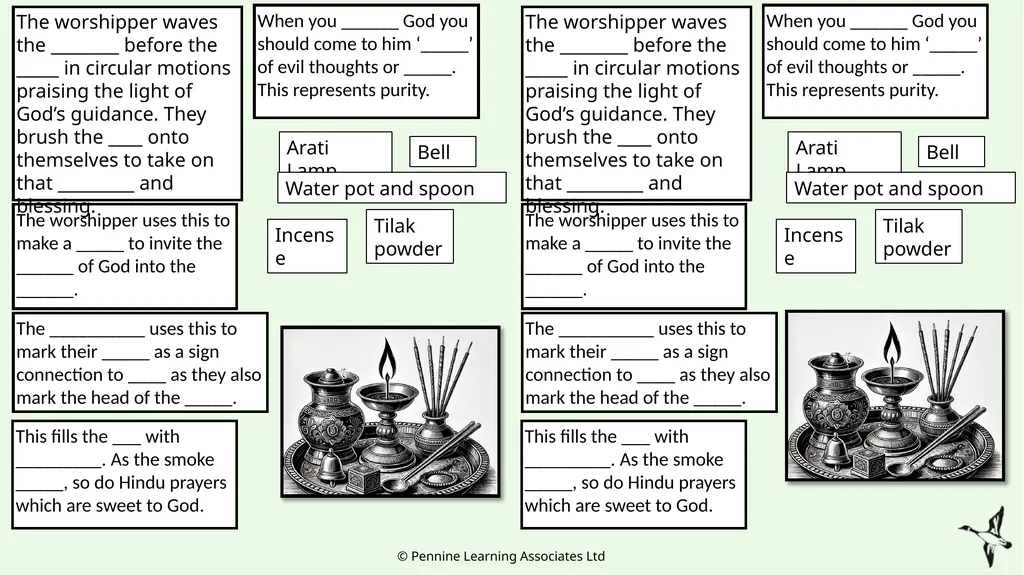
Slide 14: The teacher will introduce the labelling task for the puja tray. A printable version can be found on slide 21. This can be cut out by students who will use their understanding from the video to link each piece. The teacher could also decide to create a list of the words from the word fill to increase access. After the task, the teacher can use slide 14 to check learning.
Slide 16: Students will watch the video on worship at the mandir and add additional findings to their Venn Diagram. After this, students will be able to add similarities into the middle section of the diagram.
Slide 18: The teacher will sum up the learning before completing the wrap up activity on the next slide.
Slide 19: The learning will be completed with a reflection activity. Notes for teachers<br>
03
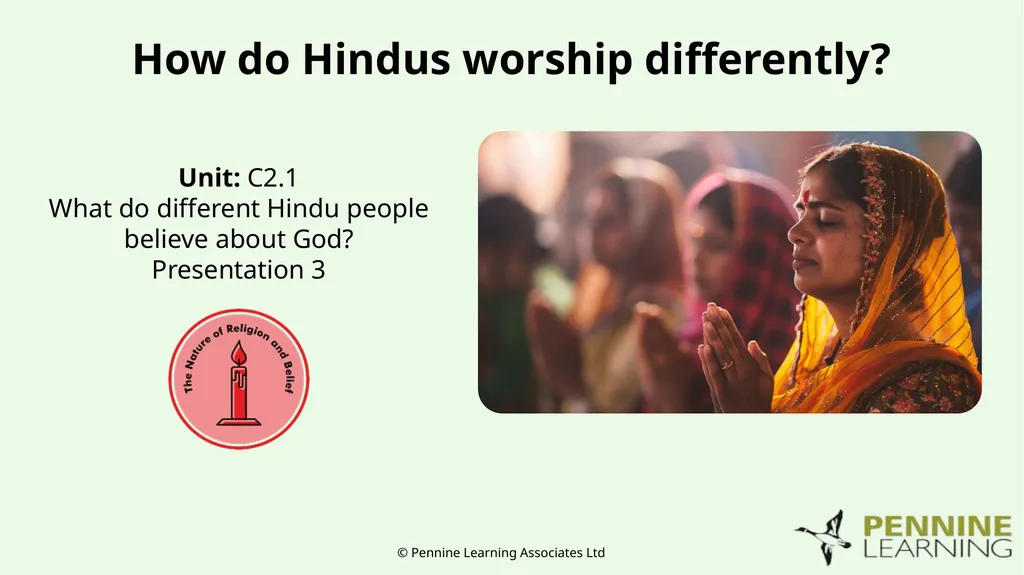
How do Hindus worship differently? Unit: C2.1
What do different Hindu people believe about God?
Presentation 3<br>
What do different Hindu people believe about God?
Presentation 3<br>
04
Key Stage 2
Through investigating the Nature of Religion and Belief, pupils should learn that:
The terms ‘religion' or 'worldview' represent an overall approach to life including beliefs, practices, values and identity.
Within each there is diversity in beliefs and practices.
There are reasons why some aspects have stayed the same and others have changed. How this presentation links to the pathway:
In this presentation you will learn how Hindus all worship differently and that there is diversity in worship, but some aspects stay the same. Pathway 1: The Nature of Religion and Belief<br>
05
Learning objectives To understand how Hindus worship at home To understand how Hindus worship at the mandir<br>
06
Key Words Mandir A Hindu place of worship (temple) Shrine An area with items for worship<br>
07
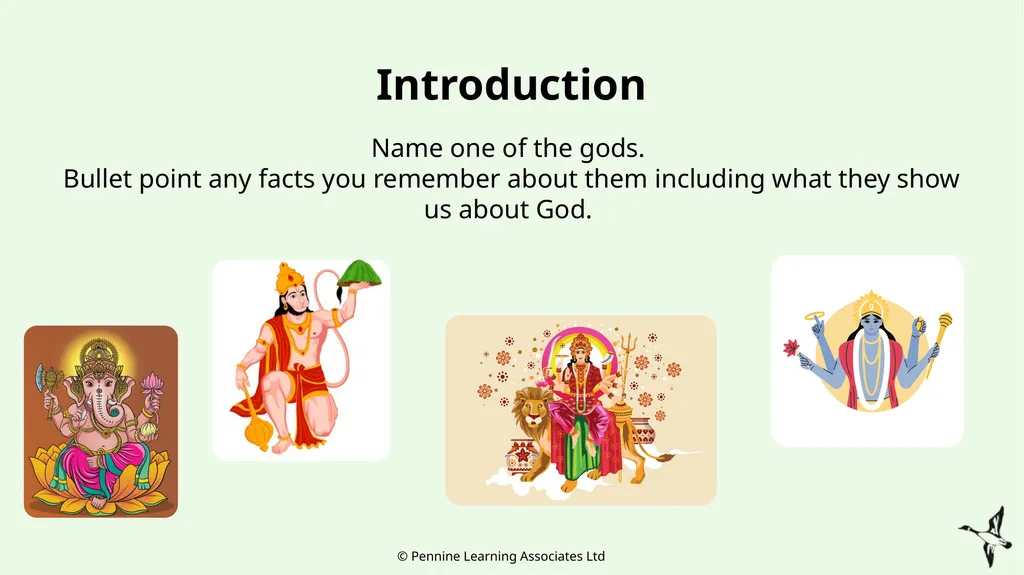
Introduction Name one of the gods.
Bullet point any facts you remember about them including what they show us about God.<br>
Bullet point any facts you remember about them including what they show us about God.<br>
08
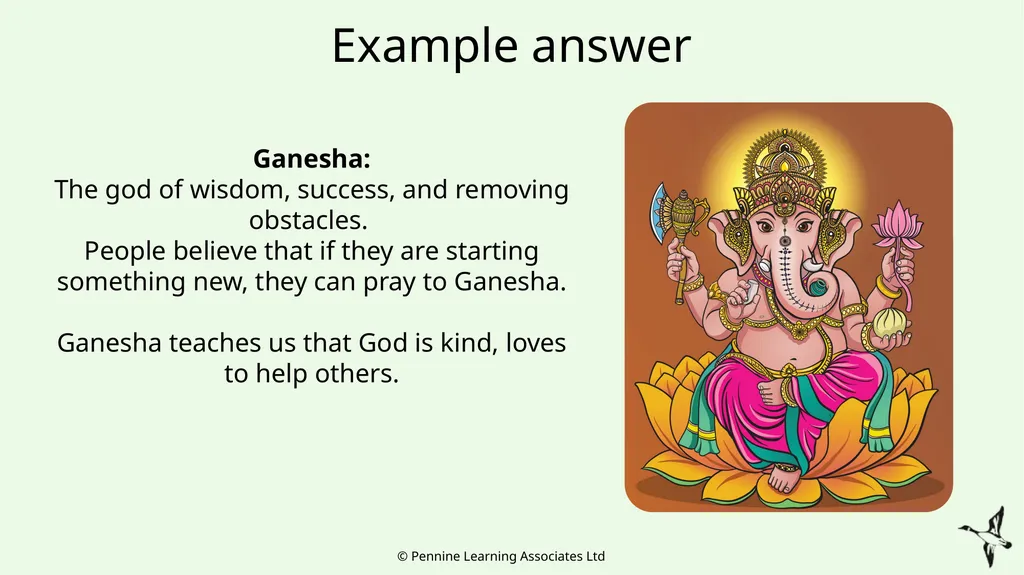
Example answer Ganesha:
The god of wisdom, success, and removing obstacles.
People believe that if they are starting something new, they can pray to Ganesha.
Ganesha teaches us that God is kind, loves to help others.<br>
The god of wisdom, success, and removing obstacles.
People believe that if they are starting something new, they can pray to Ganesha.
Ganesha teaches us that God is kind, loves to help others.<br>
09
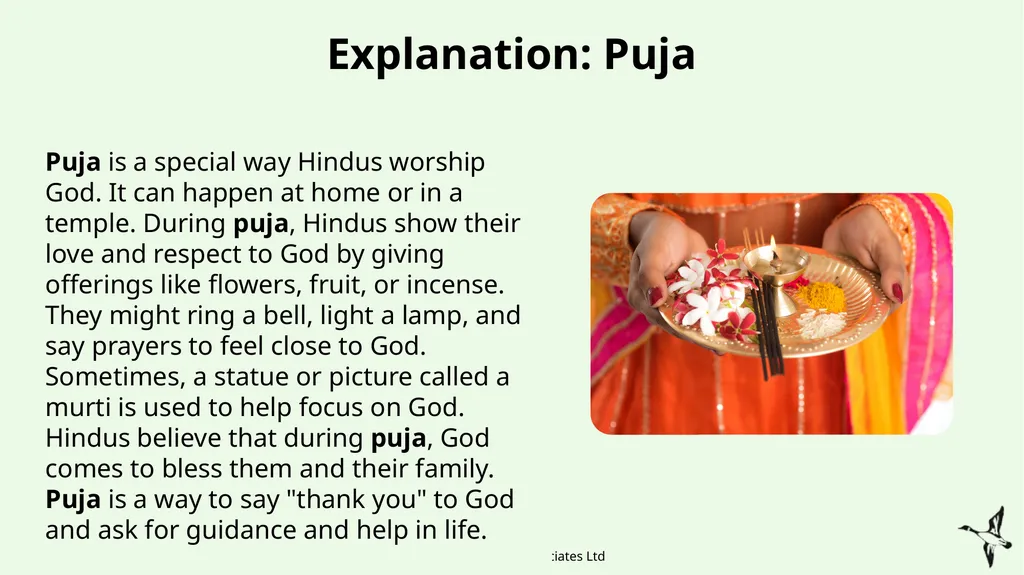
Explanation: Puja Puja is a special way Hindus worship God. It can happen at home or in a temple. During puja, Hindus show their love and respect to God by giving offerings like flowers, fruit, or incense. They might ring a bell, light a lamp, and say prayers to feel close to God. Sometimes, a statue or picture called a murti is used to help focus on God. Hindus believe that during puja, God comes to bless them and their family. Puja is a way to say "thank you" to God and ask for guidance and help in life.<br>
10
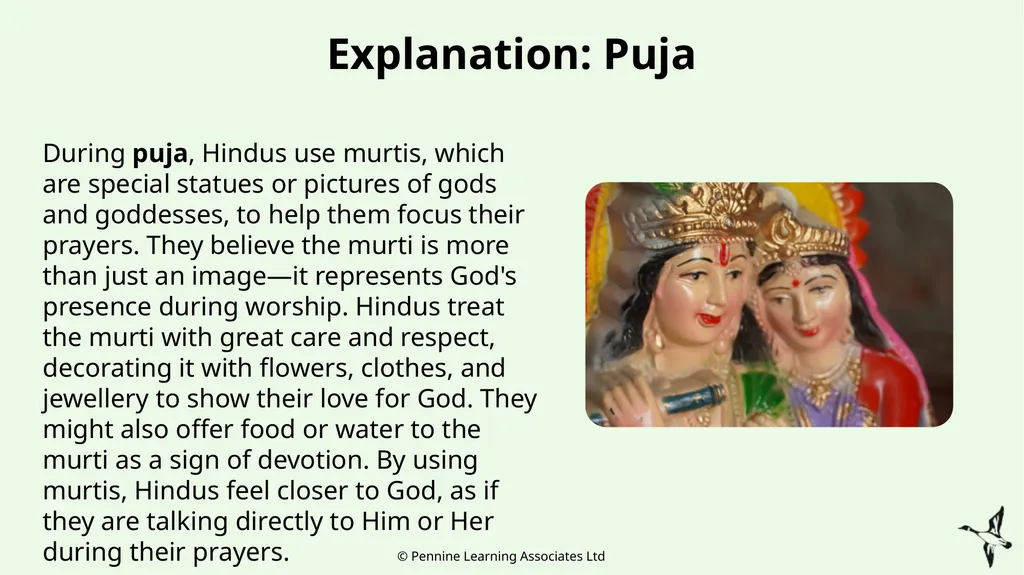
Explanation: Puja During puja, Hindus use murtis, which are special statues or pictures of gods and goddesses, to help them focus their prayers. They believe the murti is more than just an image—it represents God's presence during worship. Hindus treat the murti with great care and respect, decorating it with flowers, clothes, and jewellery to show their love for God. They might also offer food or water to the murti as a sign of devotion. By using murtis, Hindus feel closer to God, as if they are talking directly to Him or Her during their prayers.<br>
11
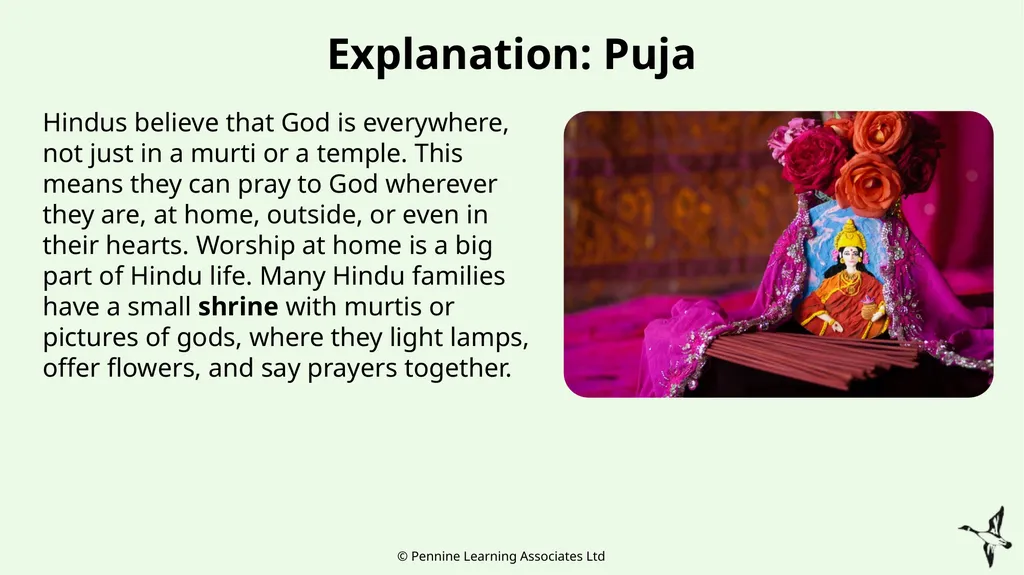
Explanation: Puja Hindus believe that God is everywhere, not just in a murti or a temple. This means they can pray to God wherever they are, at home, outside, or even in their hearts. Worship at home is a big part of Hindu life. Many Hindu families have a small shrine with murtis or pictures of gods, where they light lamps, offer flowers, and say prayers together.<br>
12
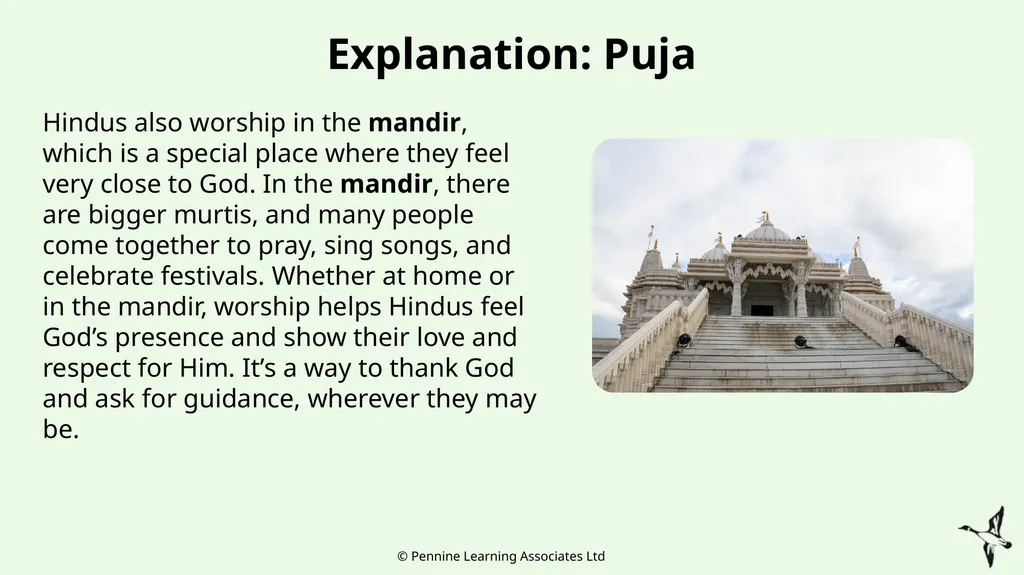
Explanation: Puja Hindus also worship in the mandir, which is a special place where they feel very close to God. In the mandir, there are bigger murtis, and many people come together to pray, sing songs, and celebrate festivals. Whether at home or in the mandir, worship helps Hindus feel God’s presence and show their love and respect for Him. It’s a way to thank God and ask for guidance, wherever they may be.<br>
13
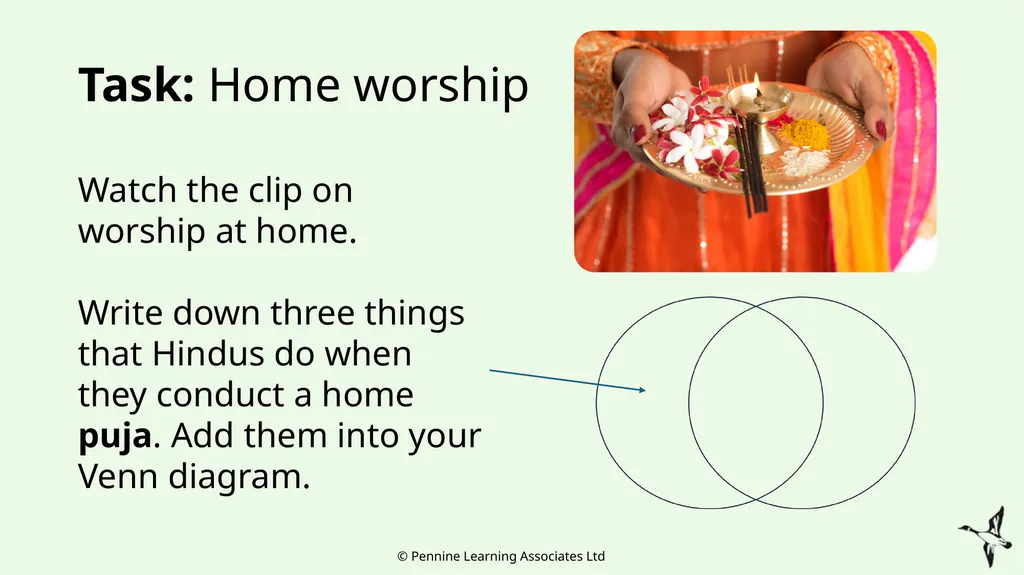
Task: Home worship Watch the clip on worship at home.
Write down three things that Hindus do when they conduct a home puja. Add them into your Venn diagram.<br>
Write down three things that Hindus do when they conduct a home puja. Add them into your Venn diagram.<br>
14
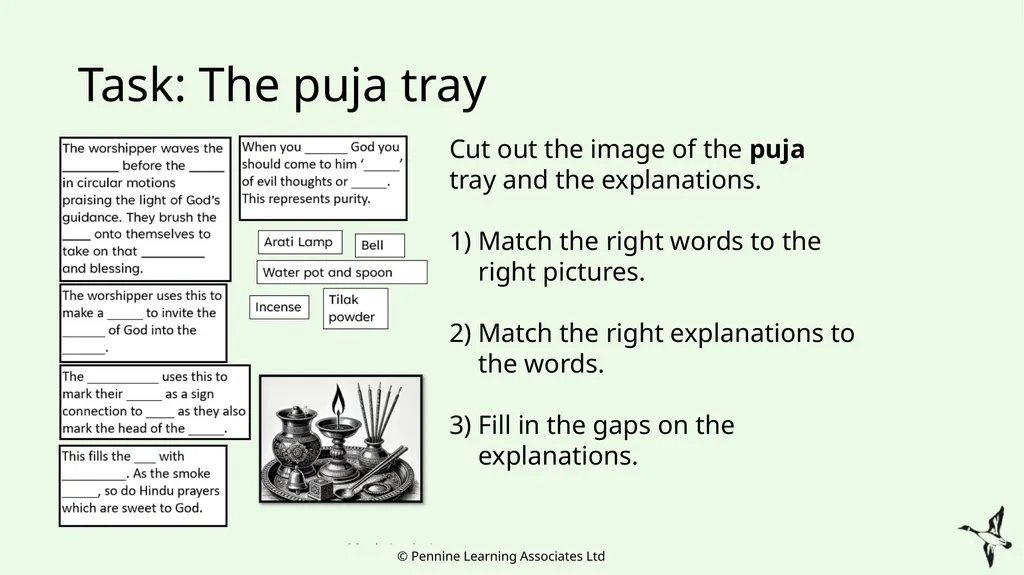
Task: The puja tray Cut out the image of the puja tray and the explanations.
Match the right words to the right pictures.
Match the right explanations to the words.
Fill in the gaps on the explanations.<br>
Match the right words to the right pictures.
Match the right explanations to the words.
Fill in the gaps on the explanations.<br>
15
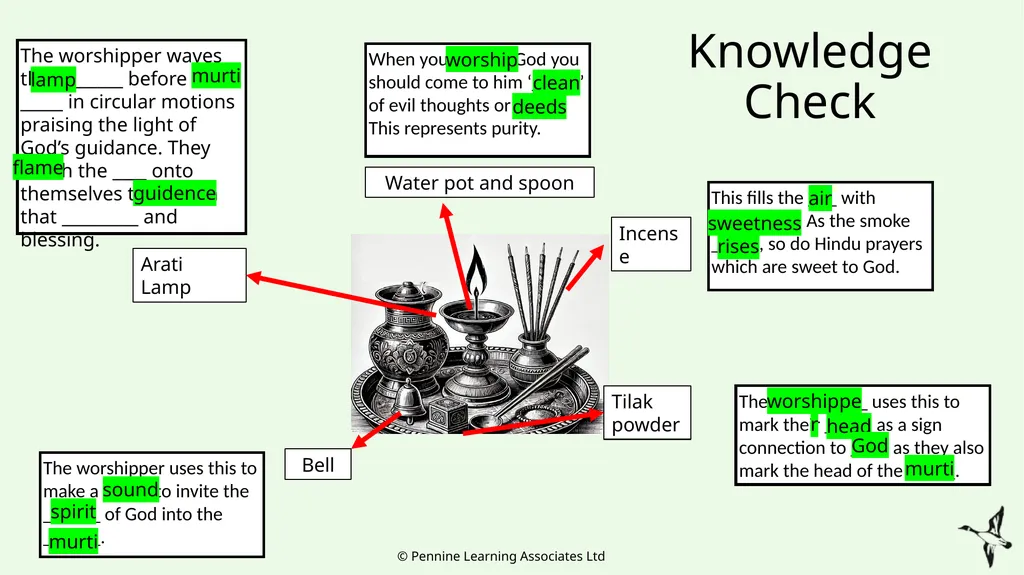
When you ______ God you should come to him ‘_____’ of evil thoughts or _____. This represents purity. The worshipper uses this to make a _____ to invite the ______ of God into the ______. The worshipper waves the ________ before the _____ in circular motions praising the light of God’s guidance. They brush the ____ onto themselves to take on that _________ and blessing. The __________ uses this to mark their _____ as a sign connection to ____ as they also mark the head of the _____. This fills the ___ with _________. As the smoke _____, so do Hindu prayers which are sweet to God. Bell Arati Lamp Water pot and spoon Incense Tilak powder lamp murti flame guidence sound spirit murti worship clean deeds air sweetness rises worshipper head God murti Knowledge Check<br>
16
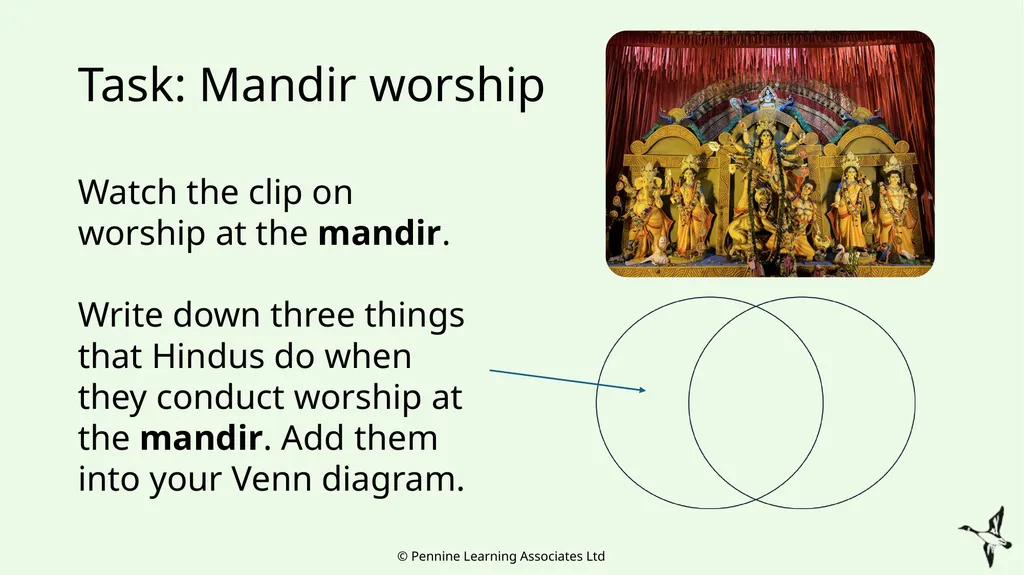
Task: Mandir worship Watch the clip on worship at the mandir.
Write down three things that Hindus do when they conduct worship at the mandir. Add them into your Venn diagram.<br>
Write down three things that Hindus do when they conduct worship at the mandir. Add them into your Venn diagram.<br>
17
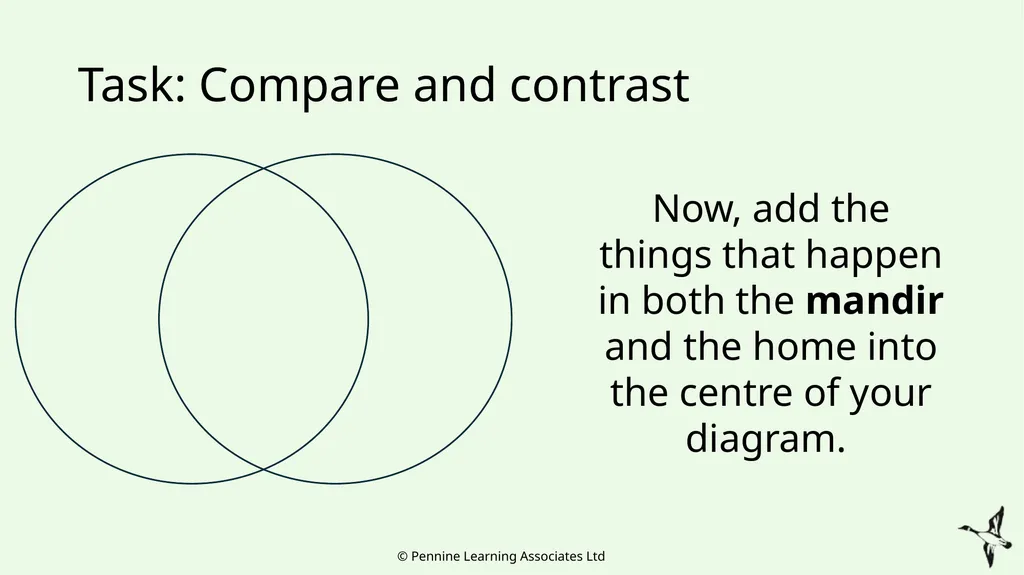
Task: Compare and contrast Now, add the things that happen in both the mandir and the home into the centre of your diagram.<br>
18
Learning summary Puja is a way of showing devotion to Brahman Hindus can worship God anywhere as God is everywhere There are similarities and differences between puja at home and at the mandir<br>
19
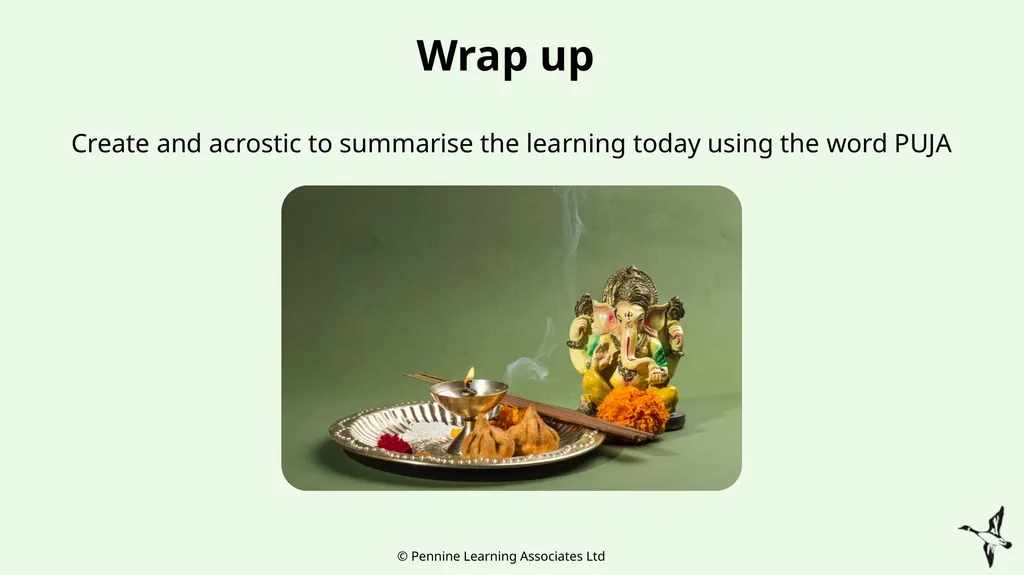
Wrap up Create and acrostic to summarise the learning today using the word PUJA<br>
20
What things are important to you in your life? How do you show this?<br>
21
Acknowledgments All images sources from Vecteezy<br>
22
When you ______ God you should come to him ‘_____’ of evil thoughts or _____. This represents purity. The worshipper uses this to make a _____ to invite the ______ of God into the ______. The worshipper waves the ________ before the _____ in circular motions praising the light of God’s guidance. They brush the ____ onto themselves to take on that _________ and blessing. The __________ uses this to mark their _____ as a sign connection to ____ as they also mark the head of the _____. This fills the ___ with _________. As the smoke _____, so do Hindu prayers which are sweet to God. Bell Arati Lamp Water pot and spoon Incense Tilak powder When you ______ God you should come to him ‘_____’ of evil thoughts or _____. This represents purity. The worshipper uses this to make a _____ to invite the ______ of God into the ______. The worshipper waves the ________ before the _____ in circular motions praising the light of God’s guidance. They brush the ____ onto themselves to take on that _________ and blessing. The __________ uses this to mark their _____ as a sign connection to ____ as they also mark the head of the _____. This fills the ___ with _________. As the smoke _____, so do Hindu prayers which are sweet to God. Bell Arati Lamp Water pot and spoon Incense Tilak powder<br>