Thank you for using this resource. We hope it helps you, and your pupils! This advice may help. PowerPoints cover more than one lesson The PowerPoint presentation matches a section in the planning provided for this unit of work. This is
"Thank you for using this resource. We hope it" is the property of its rightful owner. Permission is granted to
download and print the materials on this website for personal, non-commercial use only, and to display it
on your personal computer provided you do not modify the materials and that you retain all copyright
notices contained in the materials. By downloading content from our website, you accept the terms of this
agreement.
Presentation Transcript
01
Thank you for using this resource. We hope it helps you, and your pupils! This advice may help.
PowerPoints cover more than one lesson
The PowerPoint presentation matches a section in the planning provided for this unit of work. This is likely to contain material for more than one lesson. It is important not to speed through the slides without completing suggested activities or discussion. Most sections in the planning, and the matching PowerPoints, will cover two lessons.
Please make sure you prepare and plan with staff
It is critical that delivery, style and speed to reflect the needs and responses of pupils. The resource has been designed to support teachers, not to replace you! If this resource is provided as supporting material for HLTAs, cover teachers or non-specialists please ensure you prepare them carefully and plan with them.
We recommend you use the detailed planning as well as this PowerPoint
This PowerPoint is designed to be used with the detailed planning written to support the RE syllabus ‘Believing and Belonging’. We strongly recommend that you use the PowerPoint in conjunction with the planning. Please ask us how to access this if you do not have it.
To feed back and for further support and to access webinar training please email enquiries@penninelearning.com. Dear Teacher…<br>
02
Where this lesson fits: Festivals provide a useful starting point for RE in EYFS. This lesson offers a simple introduction to The Muslim festival of Eid al-Adha (Festival of sacrifice) which is a lunar festival that coincides with the Hajj pilgrimage to Makkah each year. See unit plan notes for more information.
Points to note: Sensitivity Note- On slides 15-17please take care if you decide to also share the story of Ibrahim and Ismaeel (a similar one can also be found in the Christian Bible and the Torah in Judaism as the story of Abraham and Isaac) as the concept of sacrifice and the story may upset younger children. It is key to understanding the sacrifices Muslims make at this time.
The date of Eid al-Adha moves back each year by 10 days. Between 2025 – 2029 it will be in June, May or April.
Key belief for pupils to understand at Eid al-Adha: Eid al-Adha explores the importance of sacrifice and giving to others. Zakat is one of the five pillars of Islam. It also coincides with the annual pilgrimage to Makkah, Hajj is another of the five pillars of Islam.
Religious Education in Early Years settings: Activities may be adapted to suit Reception and Nursery settings. See the full unit plan for links to Early Learning Goals and a full range of ideas for adult-led and independent activities.
Further lesson notes and additional ideas may be found in the notes section of some slides (normal or presenter view).
Enrichment ideas: Invite a Muslim visitor to talk about Eid al-Adha.
Resources needed: Tell the story of Ibrahim and Ismaeel using a story box with props. Notes for teachers<br>
Slide 17:
The story of Ibrahim
https://www.youtube.com/watch?v=YxaQS9rZNZg
A Faith Visits Directory for West Yorkshire can be found at https://www.penninelearning.com/resources/
It includes contacts such as Equilibria Experience, who offer workshops about Islam with artefacts. Notes for teachers<br>
04
How and why is Eid al-Adha celebrated? Unit: E.5
How do people celebrate special times?
Eid al- Adha<br>
05
Early Years
Through studying Influence and Authority, pupils should learn that:
People in our community have different beliefs and celebrate special times in different ways.
There are similarities and differences between different religious and cultural communities in our country. How this presentation links to the pathway:
Today we will be learning about a special time for Muslims called Eid al- Adha. Pathway 5: Influence and Authority<br>
06
Learning objectives Understand that Muslims celebrate by being thankful<br>
07
Key Words Kabah Thankful To be happy for the food, family and life you have<br>
08
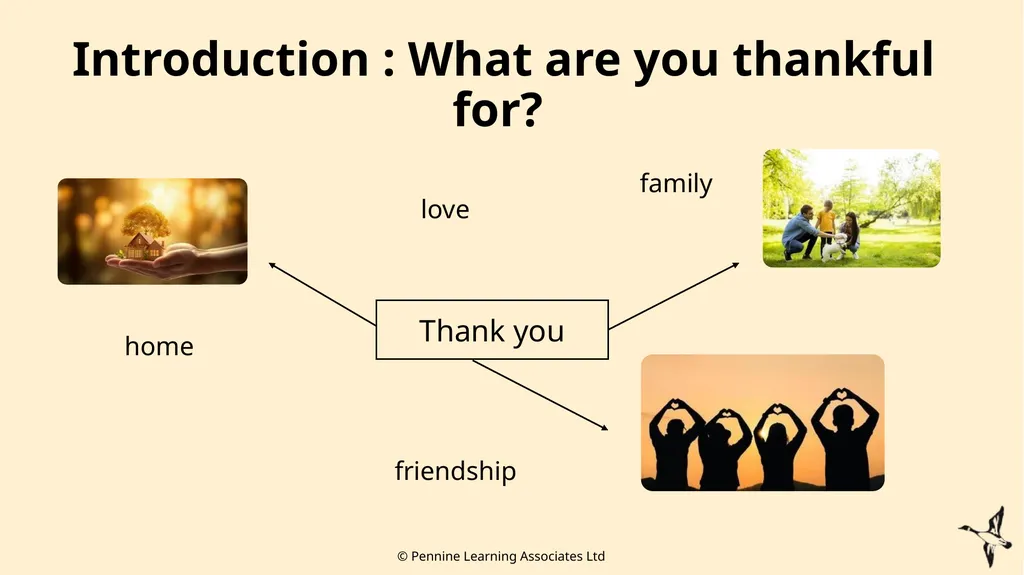
Introduction : What are you thankful for? home family friendship love<br>
09
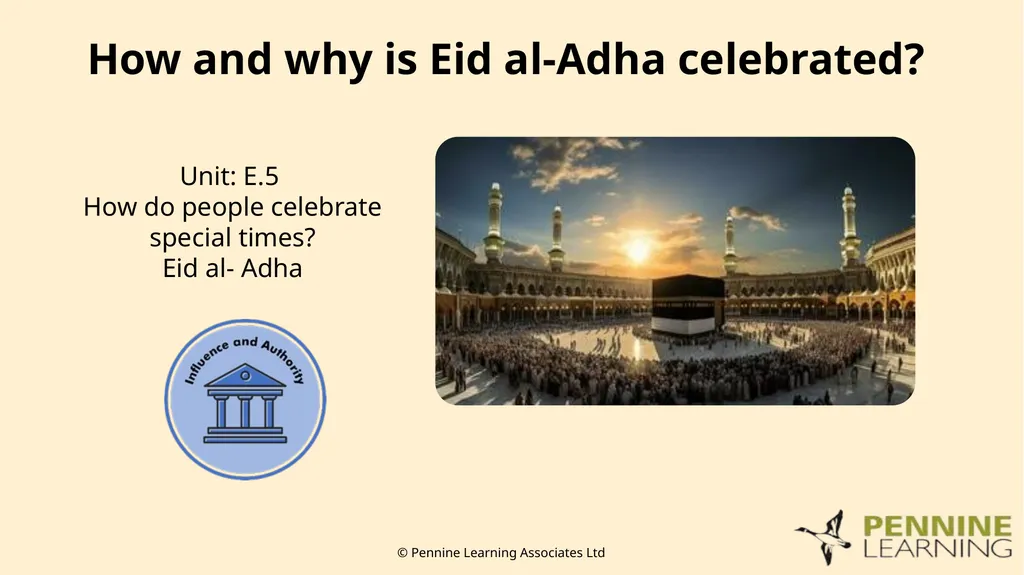
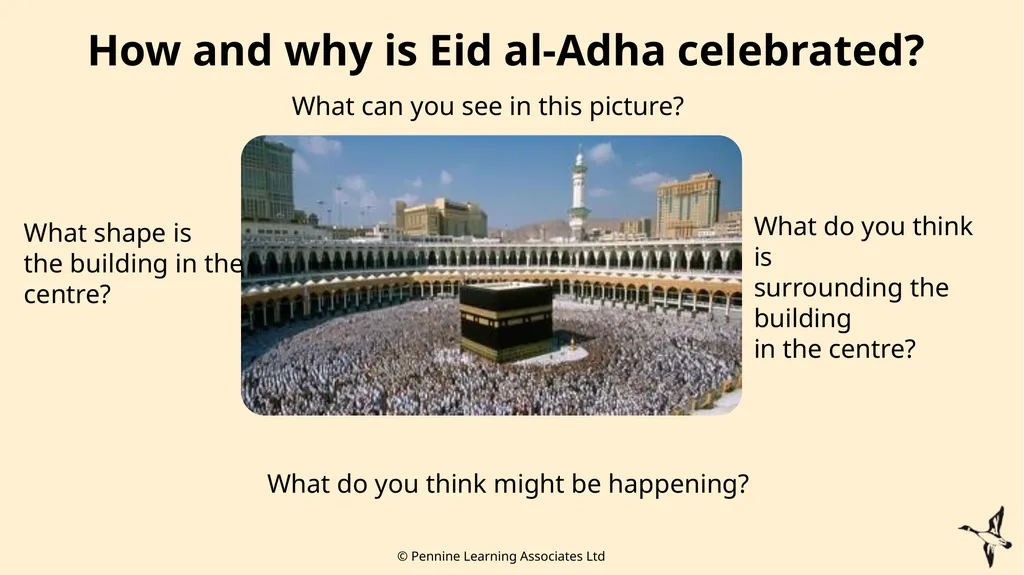
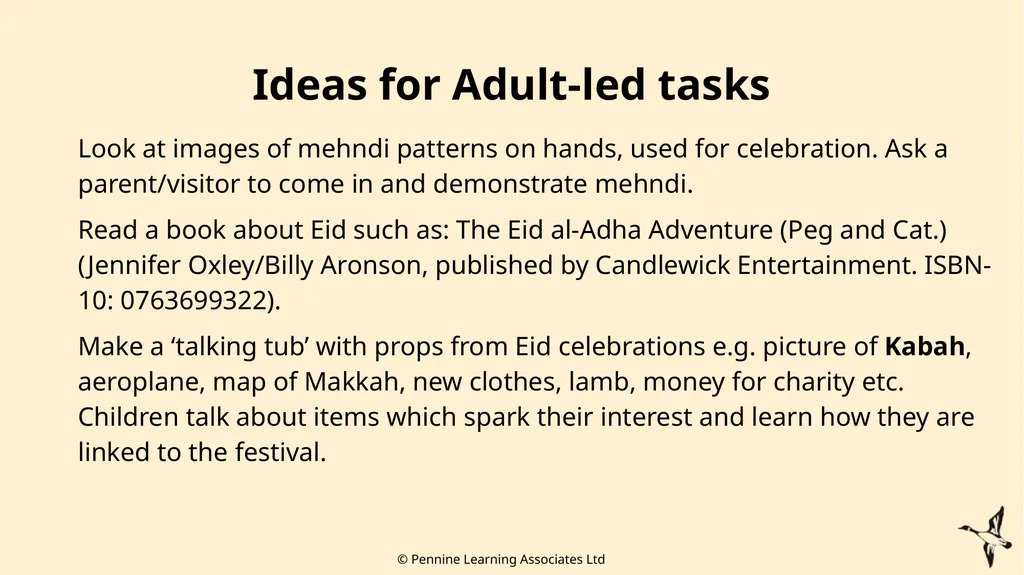
How and why is Eid al-Adha celebrated? What can you see in this picture? What shape is
the building in the
centre? What do you think is
surrounding the building
in the centre? What do you think might be happening?<br>
10
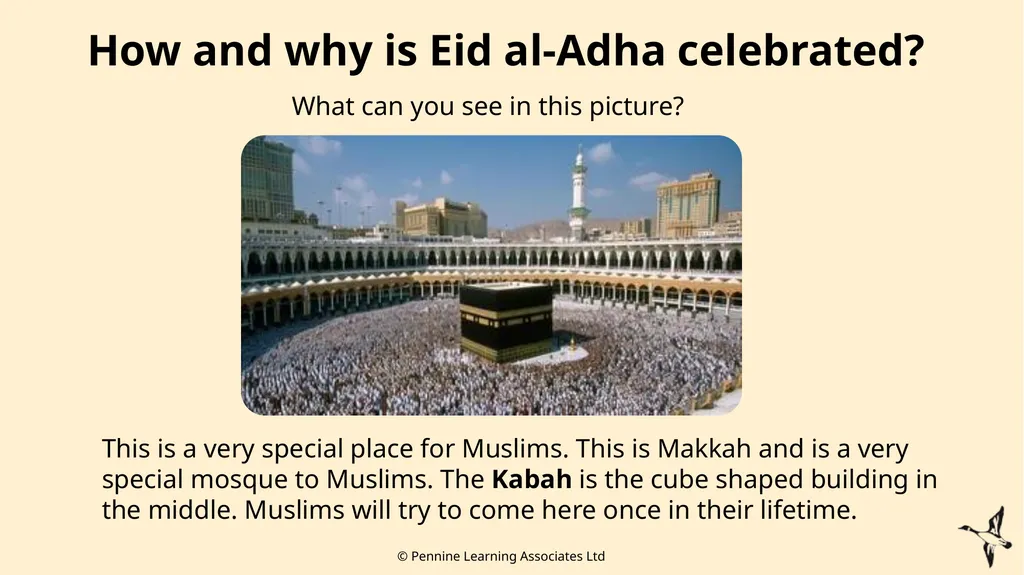
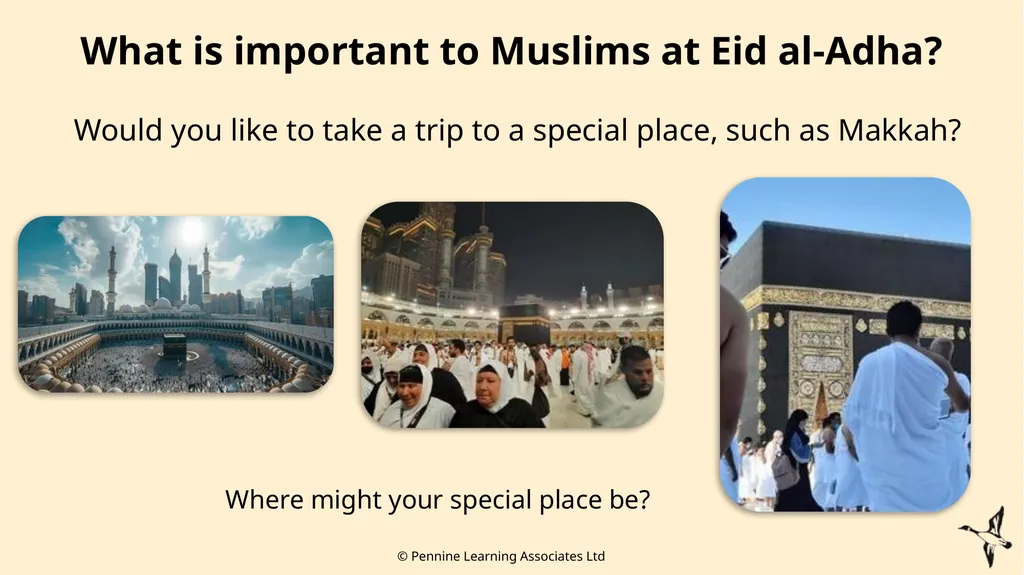
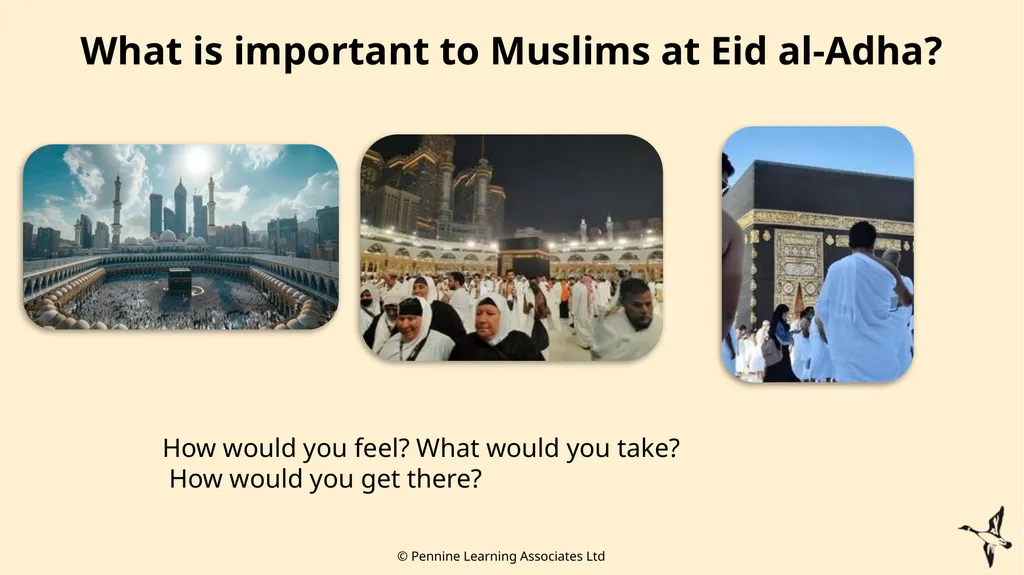
How and why is Eid al-Adha celebrated? This is a very special place for Muslims. This is Makkah and is a very special mosque to Muslims. The Kabah is the cube shaped building in the middle. Muslims will try to come here once in their lifetime. What can you see in this picture?<br>
11
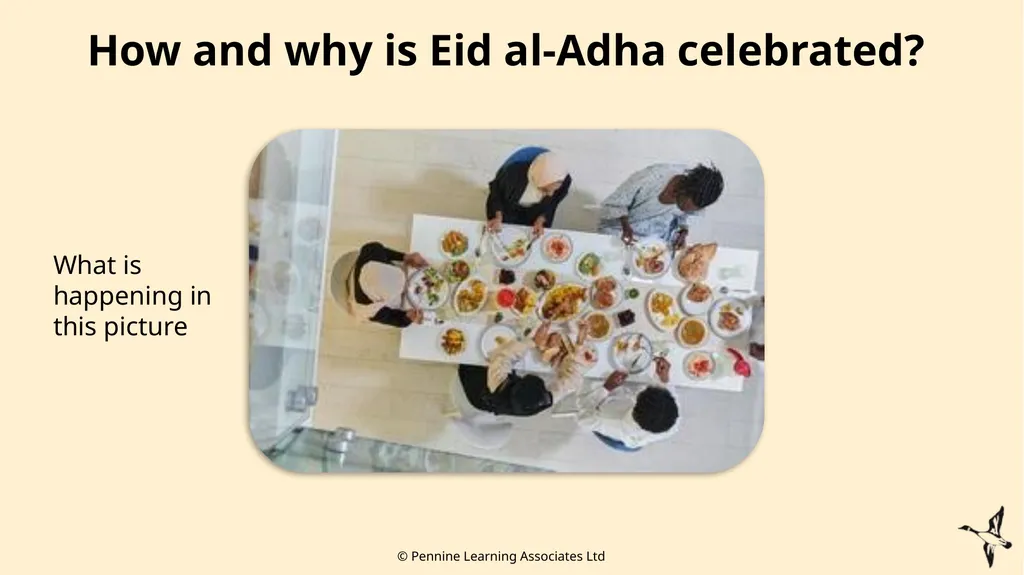
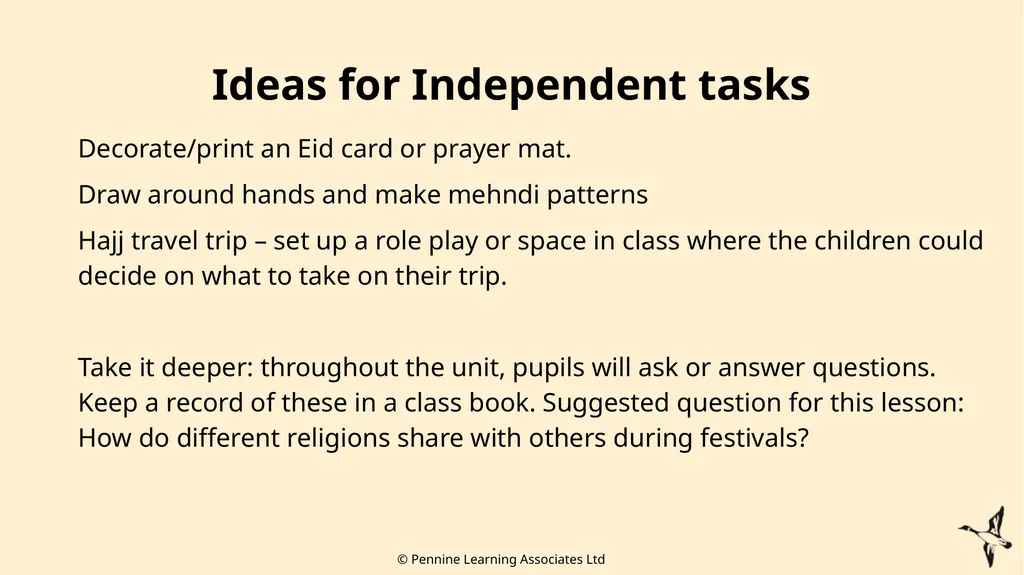
How and why is Eid al-Adha celebrated? What is happening in this picture<br>
12
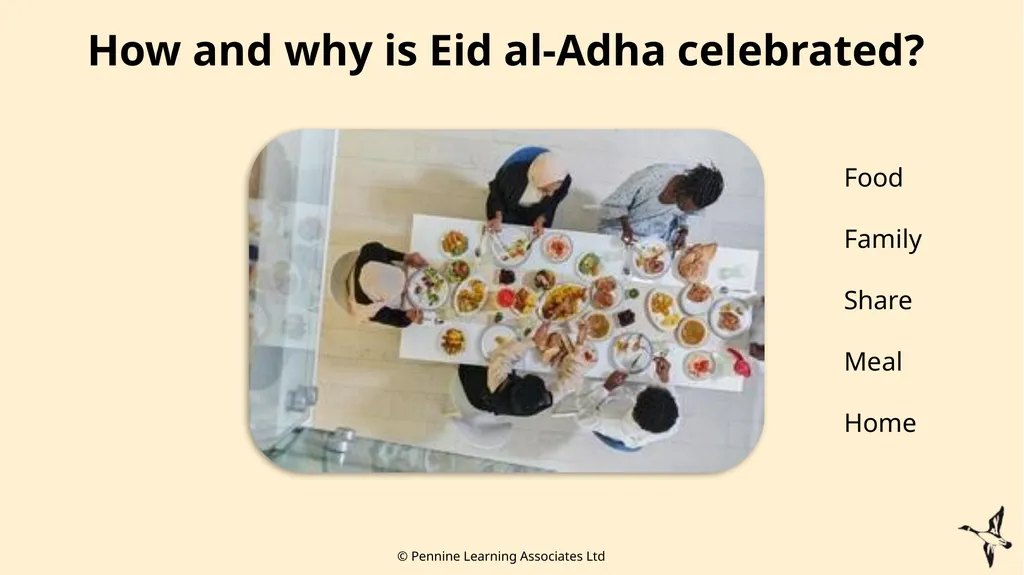
How and why is Eid al-Adha celebrated? Food
Family
Share
Meal
Home<br>
13
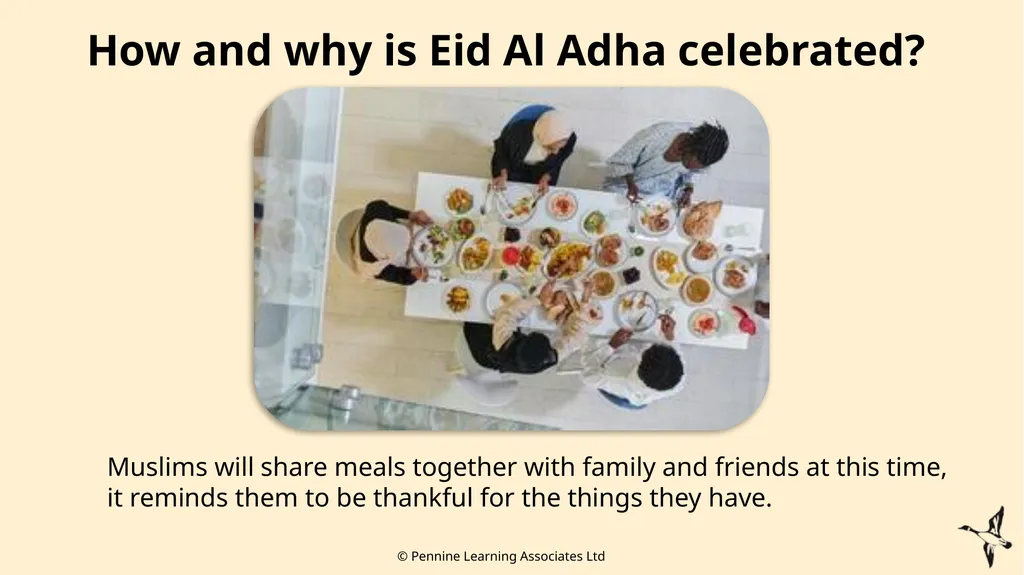
How and why is Eid Al Adha celebrated? Muslims will share meals together with family and friends at this time,
it reminds them to be thankful for the things they have.<br>
14
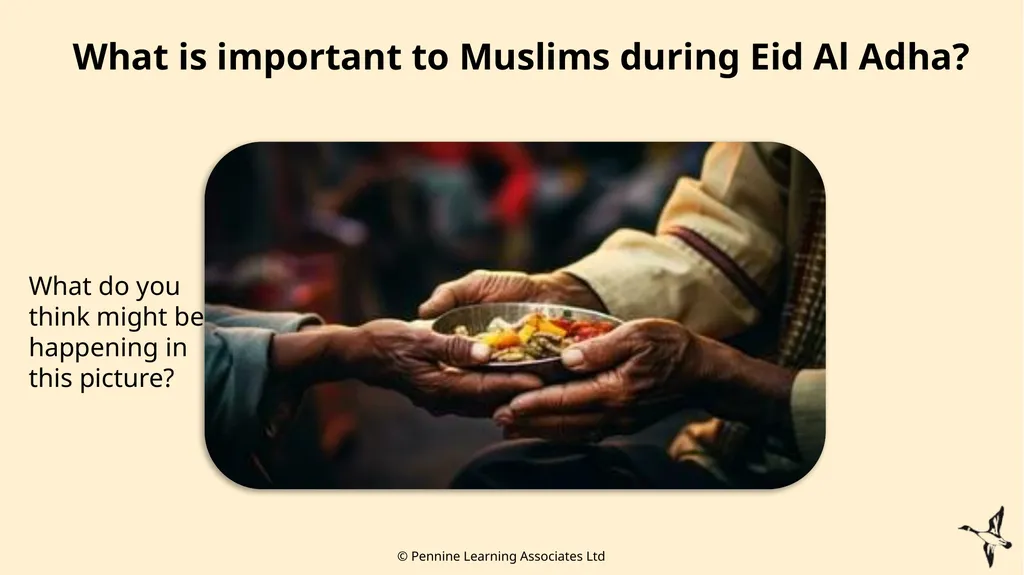
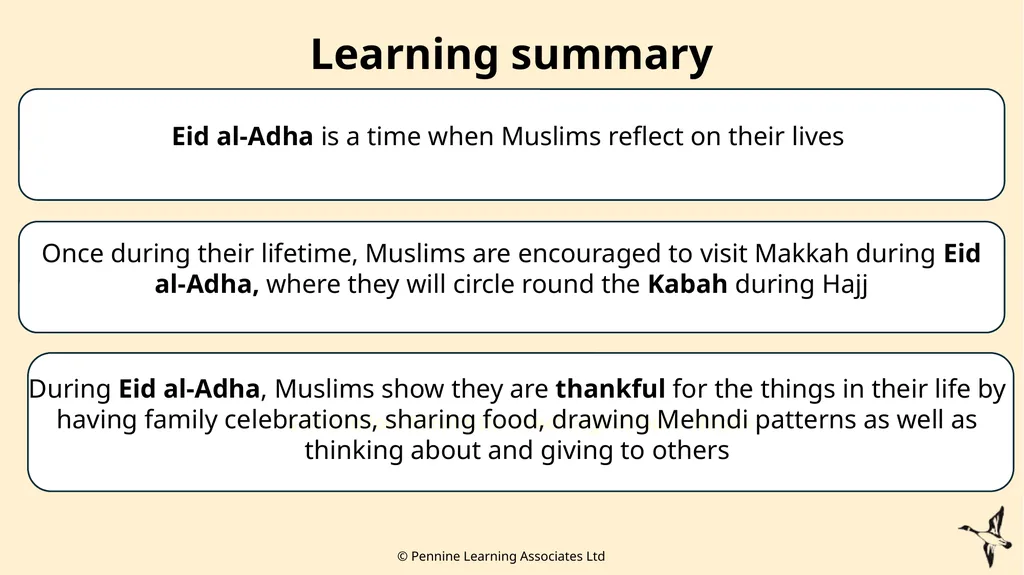
What is important to Muslims during Eid Al Adha? What do you think might be happening in this picture?<br>
15
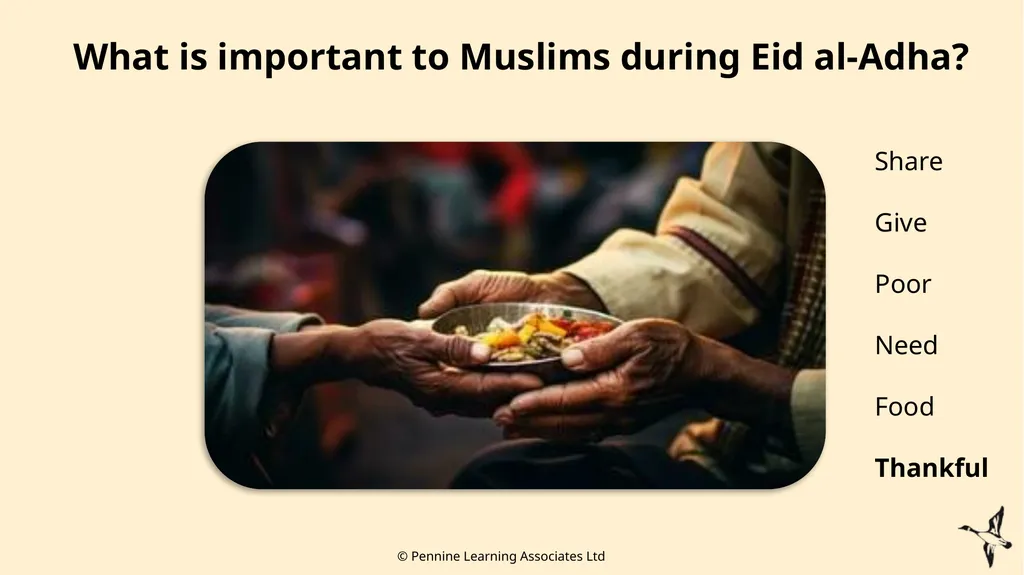
What is important to Muslims during Eid al-Adha? Share
Give
Poor
Need
Food
Thankful<br>
16
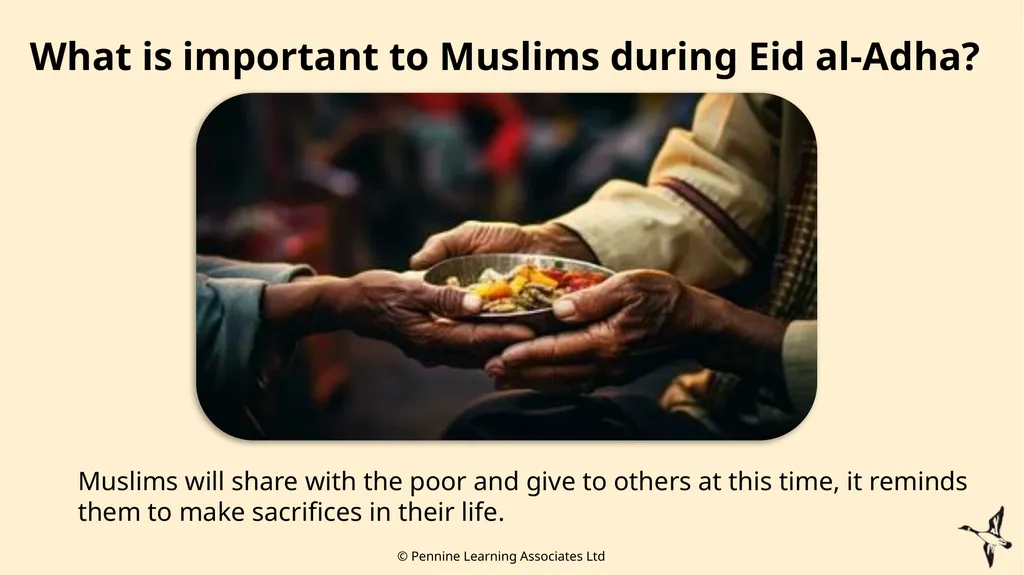
What is important to Muslims during Eid al-Adha? Muslims will share with the poor and give to others at this time, it reminds them to make sacrifices in their life.<br>
17
What is important to Muslims at Eid al-Adha? Would you like to take a trip to a special place, such as Makkah? Where might your special place be?<br>
18
What is important to Muslims at Eid al-Adha? How would you feel? What would you take?
How would you get there?<br>
19
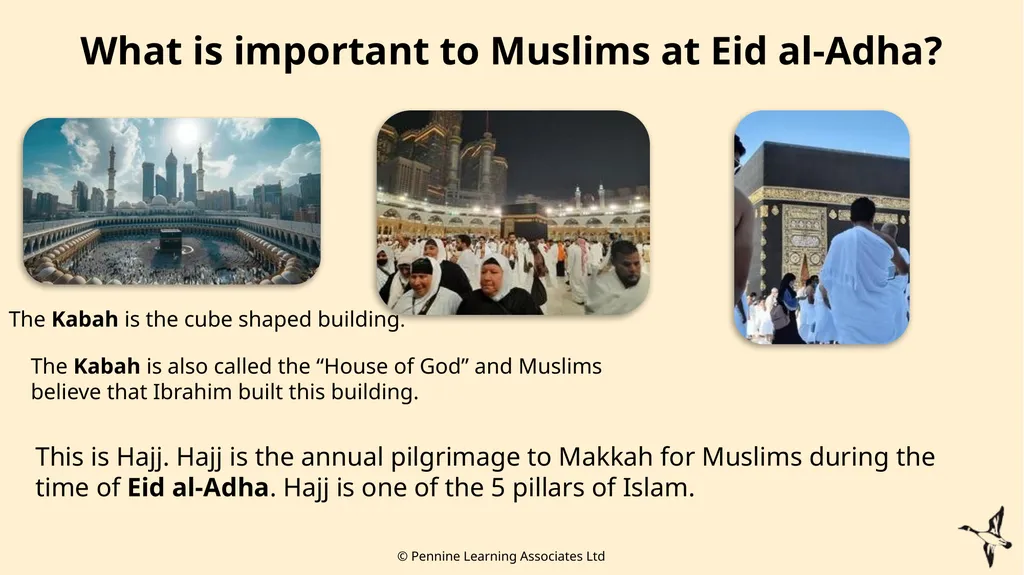
What is important to Muslims at Eid al-Adha? This is Hajj. Hajj is the annual pilgrimage to Makkah for Muslims during the time of Eid al-Adha. Hajj is one of the 5 pillars of Islam. The Kabah is the cube shaped building. The Kabah is also called the “House of God” and Muslims believe that Ibrahim built this building.<br>
20
Ideas for Adult-led tasks Look at images of mehndi patterns on hands, used for celebration. Ask a parent/visitor to come in and demonstrate mehndi.
Read a book about Eid such as: The Eid al-Adha Adventure (Peg and Cat.) (Jennifer Oxley/Billy Aronson, published by Candlewick Entertainment. ISBN-10: 0763699322).
Make a ‘talking tub’ with props from Eid celebrations e.g. picture of Kabah, aeroplane, map of Makkah, new clothes, lamb, money for charity etc. Children talk about items which spark their interest and learn how they are linked to the festival.<br>
21
Ideas for Independent tasks Decorate/print an Eid card or prayer mat.
Draw around hands and make mehndi patterns
Hajj travel trip – set up a role play or space in class where the children could decide on what to take on their trip.
Take it deeper: throughout the unit, pupils will ask or answer questions. Keep a record of these in a class book. Suggested question for this lesson: How do different religions share with others during festivals?<br>
22
Learning summary During Eid al-Adha, Muslims show they are thankful for the things in their life by
having family celebrations, sharing food, drawing Mehndi patterns as well as
thinking about and giving to others<br>
23
What have we learned today? Use this picture as a prompt to talk about today's learning<br>
24
We have been thinking about how Eid al-Adha is a Muslim celebration. It encourages Muslims to think about what they are thankful for in their lives and how they celebrate these things.
Think about what you are thankful for such as, the things you have in your life, the people in your life, the pets and animals in your life, the food and shelter you have. Time to think<br>