
Thank you for using this resource. We hope it
MT
Published · 18 slides · 0 views
1 / 1


Description
Thank you for using this resource. We hope it helps you, and your pupils! This advice may help. PowerPoints cover more than one lesson The PowerPoint presentation matches a section in the planning provided for this unit of work. This is
Related Topics
Share
Embed code
Download this presentation From Below
"Thank you for using this resource. We hope it" is the property of its rightful owner. Permission is granted to download and print the materials on this website for personal, non-commercial use only, and to display it on your personal computer provided you do not modify the materials and that you retain all copyright notices contained in the materials. By downloading content from our website, you accept the terms of this agreement.
Presentation Transcript
01
Thank you for using this resource. We hope it helps you, and your pupils! This advice may help.
PowerPoints cover more than one lesson
The PowerPoint presentation matches a section in the planning provided for this unit of work. This is likely to contain material for more than one lesson. It is important not to speed through the slides without completing suggested activities or discussion. Most sections in the planning, and the matching PowerPoints, will cover two lessons.
Please make sure you prepare and plan with staff
It is critical that delivery, style and speed reflect the needs and responses of pupils. The resource has been designed to support teachers, not to replace you! If this resource is provided as supporting material for HLTAs, cover teachers or non-specialists please ensure you prepare them carefully and plan with them.
We recommend you use the detailed planning as well as this PowerPoint
This PowerPoint is designed to be used with the detailed planning written to support the RE syllabus ‘Believing and Belonging’. We strongly recommend that you use the PowerPoint in conjunction with the planning. Please ask us how to access this if you do not have it.
To feed back and for further support and to access webinar training please email enquiries@penninelearning.com. Dear Teacher…<br>
02
Where this lesson fits: Children have explored the concept of 'precious' and what it means to different people. They have considered how we should handle special objects with respect. In this session we use the mezuzah as an example of how Jewish people express their beliefs at home. Children are encouraged to make links between the mezuzah and their own home or classroom.
Points to note: The Hebrew word ‘Mezuzah’ literally means ‘doorpost’. A small parchment is rolled up, placed in a case and fixed to the doorposts in Jewish homes. It contains the words of the first two paragraphs of the Shema (Deuteronomy 6:4-9 and 11:13-21). This follows the commandment ‘You shall write them on the doorposts of your house and on your gates’. The term Mezuzah is commonly used to refer to the case and the scroll together.
Religious Education in Early Years settings: Activities may be adapted to suit Reception and Nursery settings. See the full unit plan for links to Early Learning Goals and a full range of ideas for adult-led and independent activities. Further advice about planning for RE in EYFS can be found in the RE syllabus, Believing and Belonging (p 20 – 23).
Further lesson notes and additional ideas may be found in the notes section of some slides (normal or presenter view).
Enrichment ideas: If staff or helpers are willing to bring in and share a special object, use this as an in- depth example; encouraging the children to handle it carefully and to ask questions about it. These questions could be recorded in the style of an interview. Encourage children to ask their own questions and listen to the replies.
Outdoor learning: create a cosy den with special objects to explore. Notes for teachers<br>
03
Resources:
Ideally, pass a real mezuzah around the children to handle carefully and ask/ answer questions about it.
Set up a display of Jewish objects, pictures and story books for the children to explore and handle with care.
Provide pictures of doors for the children to collage and add sequins / glitter for making special boxes.
Slide 8: Rules for handling special objects; use the slide created together in the previous session to recap here.
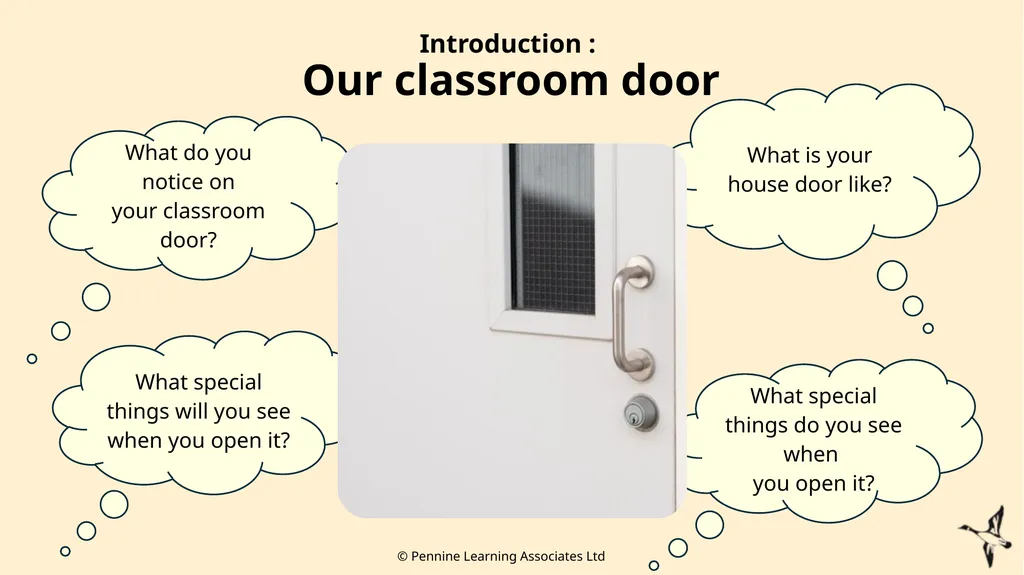
Slide 9: Stand outside the classroom door with the children. What features do they notice on the door? What are they for? How do they feel when they open the classroom door? What special things will they see? Ask the children to close their eyes. Can you see your own front door inside your head? What colour is it? Is it old or new? Are there any things on the door? Talk about the shape, colour and function of all the features of the door. What special things are behind their door? Explain how it is reassuring and calming to know that the secret message is something positive and something we share in our class.
Slides 11/12: Watch a Jewish family put a mezuzah in their new home on the sesame street clip Shalom Sesame: Making a Mezuzah
Slide 17: Play Chinese whispers using a positive comment about the class. This could be a rule about caring for each other. A voice recorder could be used to record the initial message before passing the whisper around the circle. If the children have decorated special boxes, demonstrate writing the message and rolling up the paper like a scroll inside a decorated box. Notes for teachers<br>
04
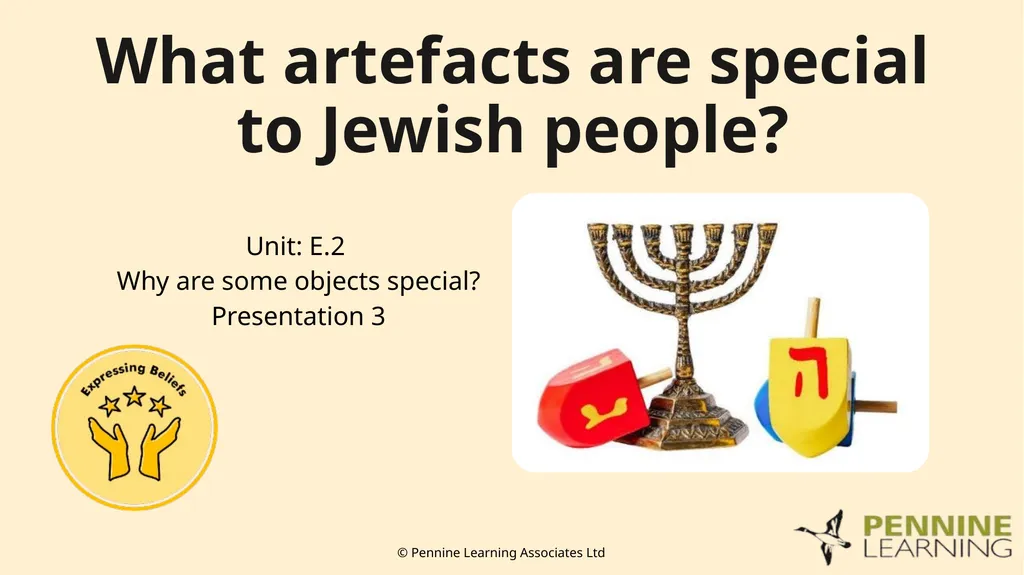
Unit: E.2
Why are some objects special?
Presentation 3 What artefacts are special to Jewish people?<br>
Why are some objects special?
Presentation 3 What artefacts are special to Jewish people?<br>
05
How this presentation links to the pathway:
This presentation focuses on special objects that a Jewish person might use to express their faith. Early Years
Through investigating how beliefs are expressed, children should learn that:
people with different religions or worldviews express their beliefs through special actions, objects and pictures
some special objects and pictures that people use to express their beliefs can be called 'sacred' or 'holy'. Pathway 2: Expressing Beliefs<br>
06
Talk about the scroll inside, recognising
the script as writing Recognise that touching a mezuzah
reminds Jewish people about God Learning objectives<br>
the script as writing Recognise that touching a mezuzah
reminds Jewish people about God Learning objectives<br>
07
a rolled-up piece of paper with writing on scroll people who follow the religion of Judaism Jewish a small box with a
special message written inside mezuzah Key words<br>
special message written inside mezuzah Key words<br>
08
Recap:
Our rules for holding special objects<br>
09
What special things do you see when
you open it? What is your house door like? What special things will you see when you open it? What do you notice on your classroom door? Introduction : Our classroom door<br>
you open it? What is your house door like? What special things will you see when you open it? What do you notice on your classroom door? Introduction : Our classroom door<br>
10
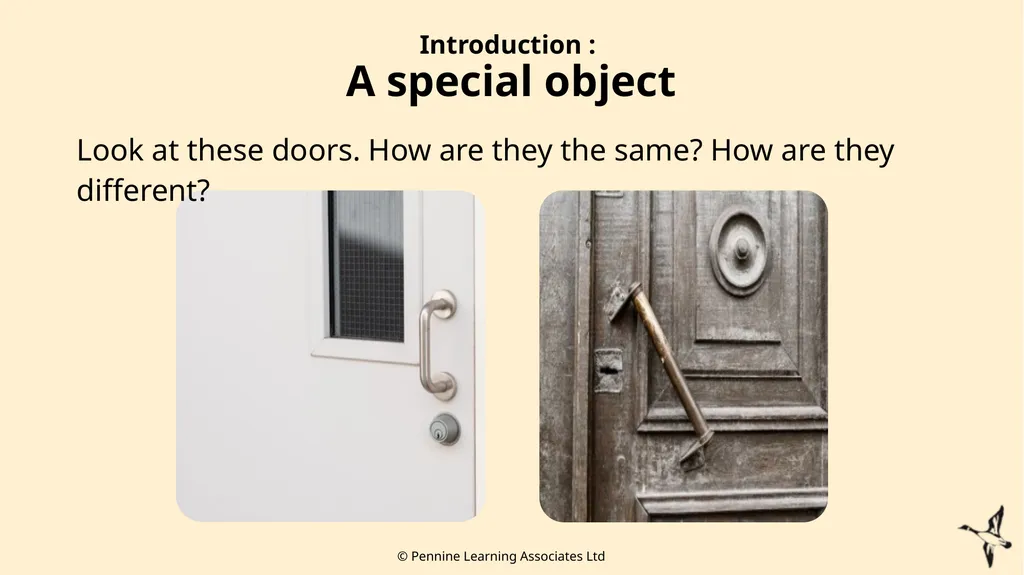
Look at these doors. How are they the same? How are they different? Introduction :
A special object<br>
11
A mezuzah is a small box with a piece of writing on a scroll inside.
A special kind of paper called parchment is used.
It is very important to some Jewish people.
They often have them on their doors. Explanation: A mezuzah<br>
A special kind of paper called parchment is used.
It is very important to some Jewish people.
They often have them on their doors. Explanation: A mezuzah<br>
12
Jewish people have a mezuzah to show that their home and their family belong to God.
The writing on the scroll inside helps Jewish people feel close to God.
Although the precious words are hidden, Jewish people know they are there. Explanation: A mezuzah<br>
The writing on the scroll inside helps Jewish people feel close to God.
Although the precious words are hidden, Jewish people know they are there. Explanation: A mezuzah<br>
13
Look at photographs of doorways and encourage the children to talk about them and imagine together what might be on the other side of the door; or go out together and look at real doors.
Write a message about their home and what they like about it and put their writing in a small container.
Write questions or email questions about the artefacts and the mezuzah to a member of the Jewish community; or invite them in to answer questions. Suggested tasks: Adult-led<br>
Write a message about their home and what they like about it and put their writing in a small container.
Write questions or email questions about the artefacts and the mezuzah to a member of the Jewish community; or invite them in to answer questions. Suggested tasks: Adult-led<br>
14
Set up a display of Jewish objects, pictures and story books for the children to explore and handle with care.
Make and decorate a special box.
Create a class collage of doorways using photos from magazines, or pictures of pupils’ own front doors.
Design and build doors and doorways in the model-making area.
Ask the children to role-play visiting each other, observing the conventions of knocking on and opening doors, greeting each other, etc. Suggested tasks: Independent learning in provision<br>
15
The scroll inside the mezuzah has special writing which helps Jewish people feel close to God when they are at home. Jewish people often have a mezuzah on their door.
They touch the mezuzah to remind them of God. A mezuzah is a special box with a scroll hidden inside. Learning summary<br>
They touch the mezuzah to remind them of God. A mezuzah is a special box with a scroll hidden inside. Learning summary<br>
16
Play a secret message game!
One person thinks of some kind words about our class.
Whisper the words to the next person and then pass the words around the class.
The last person says the secret message.
Now whisper something you've learned today to your friend! What have we learned today?<br>
One person thinks of some kind words about our class.
Whisper the words to the next person and then pass the words around the class.
The last person says the secret message.
Now whisper something you've learned today to your friend! What have we learned today?<br>
17
The scroll inside the mezuzah has special writing inside from God.
Touching the mezuzah makes Jewish people feel calm and close to God.
What message might you write to someone in your home? Time to think<br>
Touching the mezuzah makes Jewish people feel calm and close to God.
What message might you write to someone in your home? Time to think<br>
18
Pictures licensed under Vecteezy. Acknowledgments<br>