
Thank you for using this resource. We hope it
MJ
Published · 19 slides · 0 views
1 / 1



Description
Thank you for using this resource. We hope it helps you, and your pupils! This advice may help. PowerPoints cover more than one lesson The PowerPoint presentation matches a section in the planning provided for this unit of work. This is
Related Topics
Share
Embed code
Download this presentation From Below
"Thank you for using this resource. We hope it" is the property of its rightful owner. Permission is granted to download and print the materials on this website for personal, non-commercial use only, and to display it on your personal computer provided you do not modify the materials and that you retain all copyright notices contained in the materials. By downloading content from our website, you accept the terms of this agreement.
Presentation Transcript
01
Thank you for using this resource. We hope it helps you, and your pupils! This advice may help.
PowerPoints cover more than one lesson
The PowerPoint presentation matches a section in the planning provided for this unit of work. This is likely to contain material for more than one lesson. It is important not to speed through the slides without completing suggested activities or discussion. Most sections in the planning, and the matching PowerPoints, will cover two lessons.
Please make sure you prepare and plan with staff
It is critical that delivery, style and speed reflect the needs and responses of pupils. The resource has been designed to support teachers, not to replace you! If this resource is provided as supporting material for HLTAs, cover teachers or non-specialists, please ensure you prepare them carefully and plan with them.
We recommend you use the detailed planning as well as this PowerPoint
This PowerPoint is designed to be used with the detailed planning written to support the RE syllabus ‘Believing and Belonging’. We strongly recommend that you use the PowerPoint in conjunction with the planning. Please ask us how to access this if you do not have it.
To feed back and for further support and to access webinar training please email enquiries@penninelearning.com. Dear Teacher…<br>
02
Religious Education in Early Years settings: Activities may be adapted to suit Reception and Nursery settings. See the full unit plan for links to Early Learning Goals and a full range of ideas for adult-led and independent activities. Further advice about planning for RE in EYFS can be found in the RE syllabus, Believing and Belonging (p 20–23)
Where this lesson fits: Pupils will now have an understanding about the beauty of the natural world through an outdoor senses walk and will have been introduced to the Christian view of the creation of the world and how Christians help to look after our world. This lesson looks at the Jewish creation story.
Further enrichment: The unit may be enriched by various visitors into school detailing their beliefs about creation, being thankful for the world and how they help to look after our world. In this lesson a Jewish visitor could be invited into school to share their beliefs and stories about creation and how they look after our world.
Possible misconceptions: Sensitivity needed when teaching as different pupils and their families will have different beliefs and ideas about the creation of the world.
Points to note: The children will be learning about tolerance and understanding of different beliefs and ideas around creation.
Sensitivity point: Some Jewish people do not write or say ‘God’. In texts about Judaism the word is sometimes written as 'G_d'. Notes for teachers<br>
03
Resources needed:
Story of creation from the Bible (Genesis).
Book: Lion Storyteller Bible ISBN 978-0745964331
Books:
God’s Brilliantly Big Creation Story. (Dai Woolridge/Alex Foster, published by SPCK publishing. ISBN-10: 0281084815)
Wonderful Earth. (Nick Butterworth/Mick Inkpen, published by Hunt & Thorpe. ISBN-13: 978-1856080057)
General Judaism information
www.shalomsesame.org
Further lesson notes and additional ideas may be found in the notes section of some slides (normal or presenter view). Please refer to the full unit plan for more activities and resources. Notes for teachers<br>
04
Point to Note: teachers please be aware - if needed you can replace any photos/pictures that may be more appropriate for specific learning. For example, creation story pictures can be substituted for those that are more relevant/specific to each religion/worldview.
Slide 9: Creation Story books, pictures from the Creation story. Book resources can be found on previous slide (resources).
Story of creation from the Bible (Genesis).
Books:
Lion Storyteller Bible ISBN 978-0745964331
God’s brilliantly big Creation story. (Dai Woolridge/Alex Foster, published by SPCK publishing. ISBN-10: 0281084815)
Wonderful Earth. (Nick Butterworth/Mick Inkpen, published by Hunt & Thorpe. ISBN-13: 978-1856080057)
Slide 10-11: Have a Torah artefact available to show pupils. Alternatively have photos/pictures of a Torah scroll to show in class.
Slide 12: Sesame Shabbat gives a video clip of how the world was created and ends with “Shabbat Shalom”.
https://www.youtube.com/watch?v=lre-LLz-UzE
Slide 14: An Introduction to Shabbat. A family show us how they prepare for Shabbat. Starting on a Friday evening and ending on a Saturday evening, Shabbat means a day of rest.
https://www.bbc.co.uk/programmes/p0114xpt
Book to read: The Seventh Day: A Shabbat story (Deborah Cohen/Professor Melanie Hall, published by Kar-Ben Copies Ltd. ISBN-10: 1580131255) Notes for teachers<br>
05
Unit: E.6
How do we understand
and care for the world?
Presentation 3 What do Jewish people believe about creation?<br>
How do we understand
and care for the world?
Presentation 3 What do Jewish people believe about creation?<br>
06
How this presentation links to the pathway:
This presentation is about how Jewish people believe the world was created in 6 days by God. It looks at the importance of Shabbat and how this helps followers of Judaism remember God and the creation story. Early Years
Through considering the Big Picture, children should learn that:
Stories, including religious stories, can help them to talk about some of the big questions of life.
Many of these stories are well-known as they have been handed down over generations. Pathway 6: The Big Picture<br>
07
Talk about Shabbat as a day of rest in Judaism Listen to and talk about the
Jewish creation story Learning objectives<br>
Jewish creation story Learning objectives<br>
08
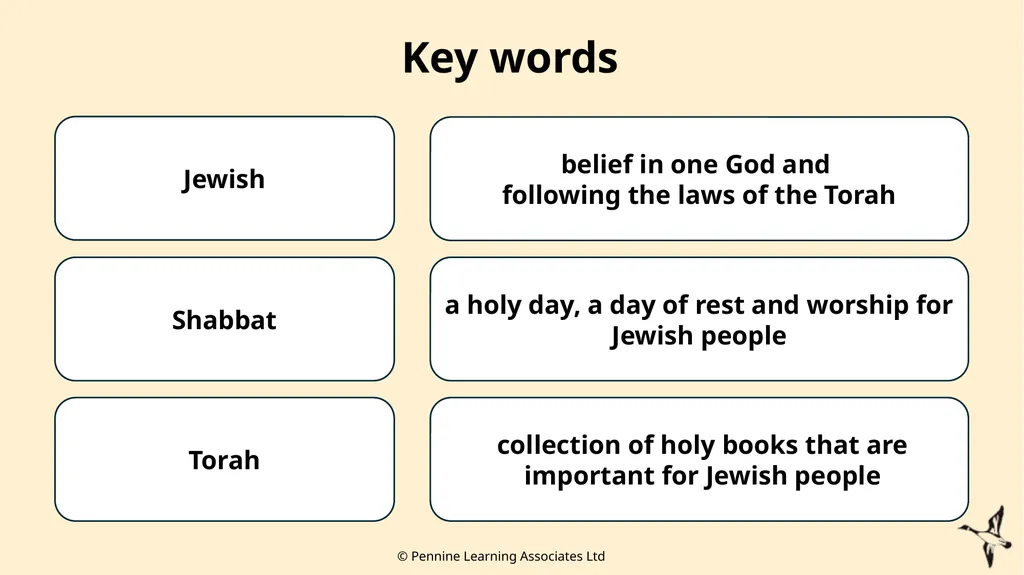
Key words<br>
09
Creating
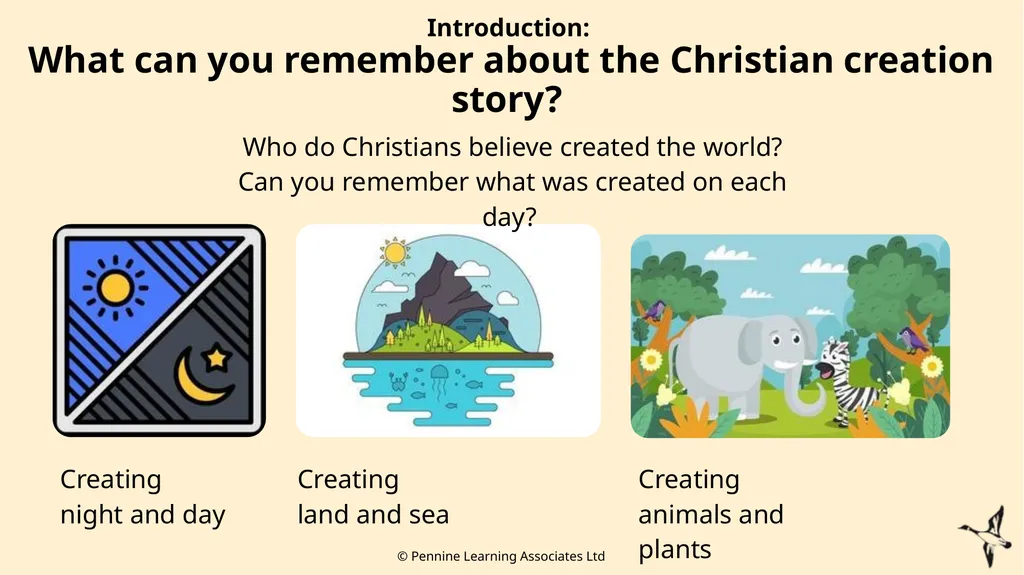
animals and plants Creating
land and sea Creating
night and day Who do Christians believe created the world?
Can you remember what was created on each day? Introduction: What can you remember about the Christian creation story?<br>
animals and plants Creating
land and sea Creating
night and day Who do Christians believe created the world?
Can you remember what was created on each day? Introduction: What can you remember about the Christian creation story?<br>
10
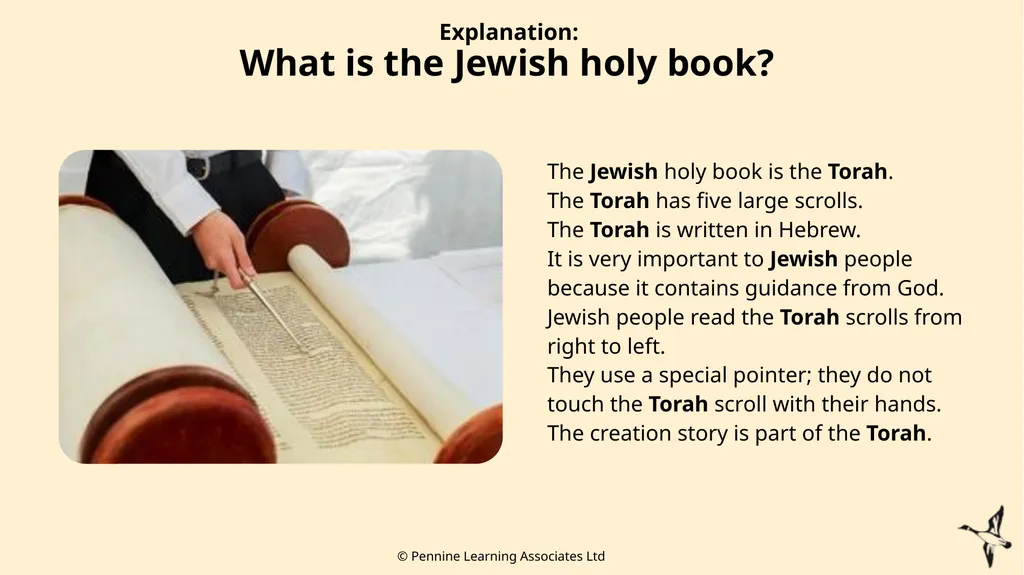
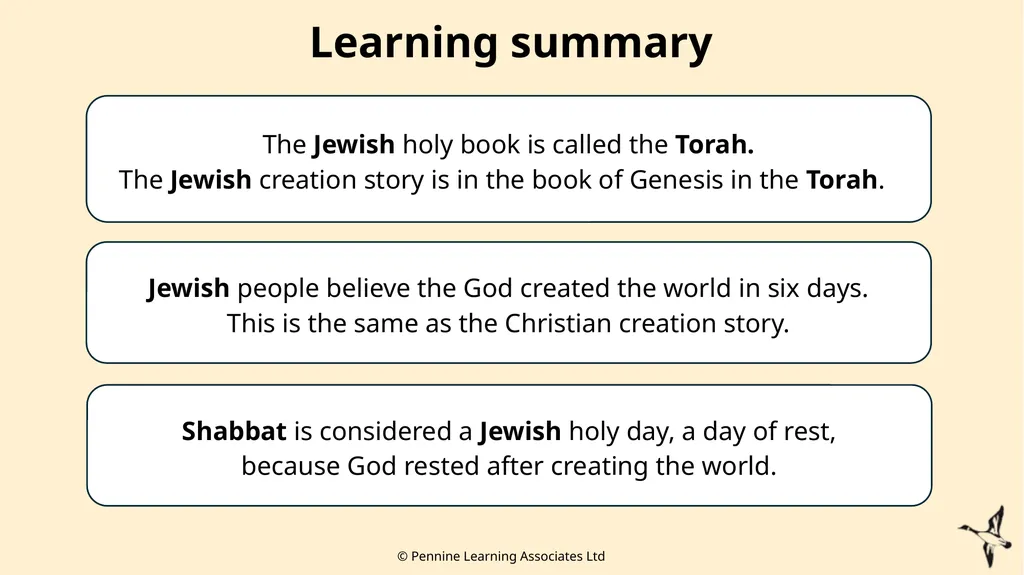
The Jewish holy book is the Torah.
The Torah has five large scrolls.
The Torah is written in Hebrew.
It is very important to Jewish people because it contains guidance from God.
Jewish people read the Torah scrolls from right to left.
They use a special pointer; they do not touch the Torah scroll with their hands.
The creation story is part of the Torah. Explanation: What is the Jewish holy book?<br>
11
Listen to the Jewish creation story from Shalom Sesame.
Discuss similarities and differences with other creation stories. Explanation: What do Jewish people believe about creation?<br>
Discuss similarities and differences with other creation stories. Explanation: What do Jewish people believe about creation?<br>
12
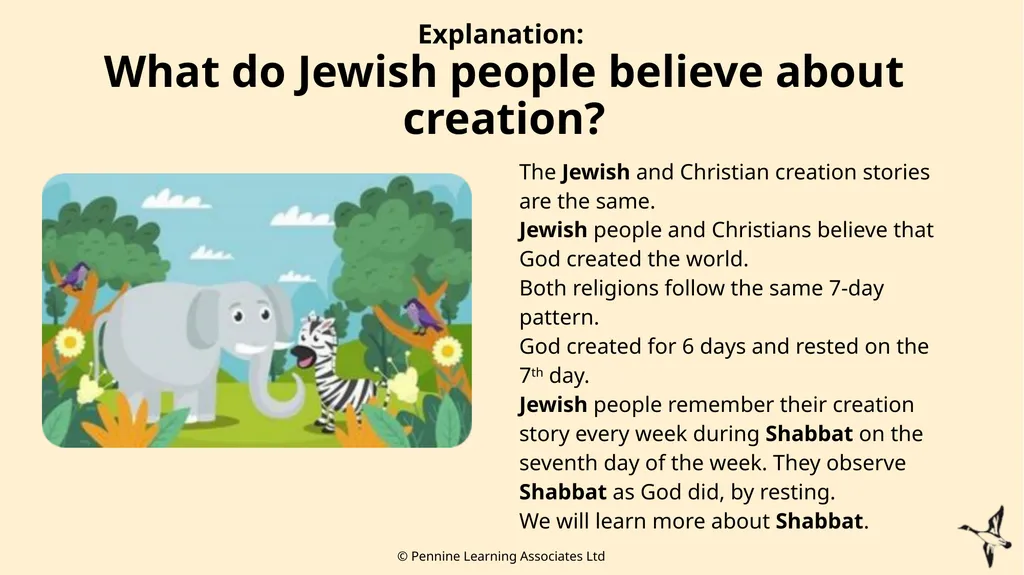
The Jewish and Christian creation stories are the same.
Jewish people and Christians believe that God created the world.
Both religions follow the same 7-day pattern.
God created for 6 days and rested on the 7th day.
Jewish people remember their creation story every week during Shabbat on the seventh day of the week. They observe Shabbat as God did, by resting.
We will learn more about Shabbat. Explanation: What do Jewish people believe about creation?<br>
13
Watch the film clip about Shabbat.
What happens before Shabbat starts?
How long does Shabbat last?
What happens during Shabbat?
What do Jewish people avoid during Shabbat?
Do you think it is easy or difficult for Jewish people to observe Shabbat? Explanation: Introduction to Shabbat<br>
What happens before Shabbat starts?
How long does Shabbat last?
What happens during Shabbat?
What do Jewish people avoid during Shabbat?
Do you think it is easy or difficult for Jewish people to observe Shabbat? Explanation: Introduction to Shabbat<br>
14
What might a Jewish child do at home on Shabbat without writing, driving out for daytrips or technology?
Can the children think of things they might do? Singing, spending time with family, eating together.
A Jewish family celebrates Shabbat: https://www.bbc.co.uk/programmes/p0114xpt
Use persona dolls, or meet a Jewish person, to find out about the key parts of Shabbat.
Read The Seventh Day: A Shabbat story (Deborah Cohen/Professor Melanie Hall, published by Kar-Ben Copies Ltd. ISBN-10: 1580131255)
Make a plan for a day of rest with no school; what would you like to do? Suggested tasks: Adult-led<br>
15
Shabbat-themed crafts e.g. candles, decorated plates for a special meal.
Make a list of what you would do on a day of rest with no school.
Use a big roll of paper and ask children to use felt-tips to draw and add things they can see in the world around.
Use clay or play dough to make animals and other things in the natural world.
Take it deeper: throughout the unit, pupils will ask or answer questions. Keep a record of these in a class book.
Suggested question for this lesson: How do Jewish families remember the story of creation? Suggested tasks: Independent in provision<br>
16
Learning summary<br>
17
Jewish people observe Shabbat, a day of rest, each week. This is to remember when God rested on the 7th day after creating the world. Jewish people believe
God created the world in 6 days. The Jewish creation story is written in the Torah, the Jewish holy book. Conclusion: What have we learned today?<br>
God created the world in 6 days. The Jewish creation story is written in the Torah, the Jewish holy book. Conclusion: What have we learned today?<br>
18
We have been learning that Jewish people believe God created the world in 6 days. This is written in the Torah, holy books.
Jewish people observe Shabbat every week.
Can you remember why?
Can you remember what Jewish people do, and do not do, during Shabbat?
How would you feel about observing a day of rest? Time to think<br>
Jewish people observe Shabbat every week.
Can you remember why?
Can you remember what Jewish people do, and do not do, during Shabbat?
How would you feel about observing a day of rest? Time to think<br>
19
Acknowledgments All pictures reproduced under professional licence from Vecteezy.<br>