
The ABCDE and SAMPLE History Approach Basic
CM
Published · 69 slides · 0 views
1 / 1

Description
The ABCDE and SAMPLE History Approach Basic Emergency Care Course Objectives By the end of this presentation, you will be able to: List the hazards and elements that must be considered when approaching an ill or injured person safely
Related Topics
Share
Embed code
Download this presentation From Below
"The ABCDE and SAMPLE History Approach Basic" is the property of its rightful owner. Permission is granted to download and print the materials on this website for personal, non-commercial use only, and to display it on your personal computer provided you do not modify the materials and that you retain all copyright notices contained in the materials. By downloading content from our website, you accept the terms of this agreement.
Presentation Transcript
01
The ABCDE and SAMPLE History Approach Basic Emergency Care Course<br>
02
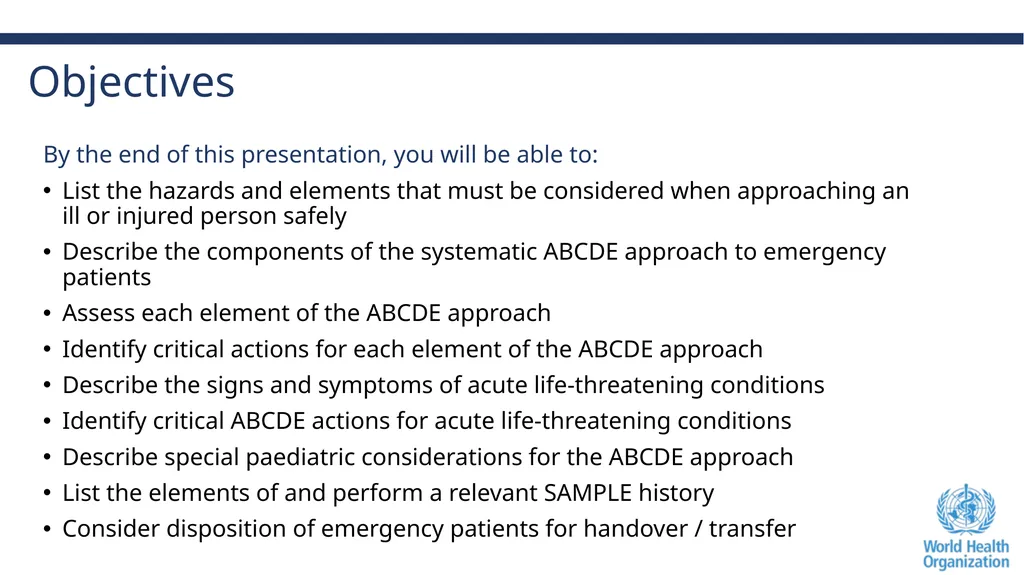
Objectives By the end of this presentation, you will be able to:
List the hazards and elements that must be considered when approaching an ill or injured person safely
Describe the components of the systematic ABCDE approach to emergency patients
Assess each element of the ABCDE approach
Identify critical actions for each element of the ABCDE approach
Describe the signs and symptoms of acute life-threatening conditions
Identify critical ABCDE actions for acute life-threatening conditions
Describe special paediatric considerations for the ABCDE approach
List the elements of and perform a relevant SAMPLE history
Consider disposition of emergency patients for handover / transfer<br>
List the hazards and elements that must be considered when approaching an ill or injured person safely
Describe the components of the systematic ABCDE approach to emergency patients
Assess each element of the ABCDE approach
Identify critical actions for each element of the ABCDE approach
Describe the signs and symptoms of acute life-threatening conditions
Identify critical ABCDE actions for acute life-threatening conditions
Describe special paediatric considerations for the ABCDE approach
List the elements of and perform a relevant SAMPLE history
Consider disposition of emergency patients for handover / transfer<br>
03
The ABCDE and SAMPLE history approach Part I: Introduction to the ABCDE approach<br>
04
Goals:
Identify life-threatening conditions rapidly
Ensure the airway stays open
Ensure breathing and circulation are adequate to deliver oxygen to the body Why the ABCDE approach? Approach every patient in a systematic way
Recognize life-threatening conditions early
DO the most critical interventions first; fix problems before moving on!
The ABCDE approach is very quick in a stable patient.<br>
Identify life-threatening conditions rapidly
Ensure the airway stays open
Ensure breathing and circulation are adequate to deliver oxygen to the body Why the ABCDE approach? Approach every patient in a systematic way
Recognize life-threatening conditions early
DO the most critical interventions first; fix problems before moving on!
The ABCDE approach is very quick in a stable patient.<br>
05
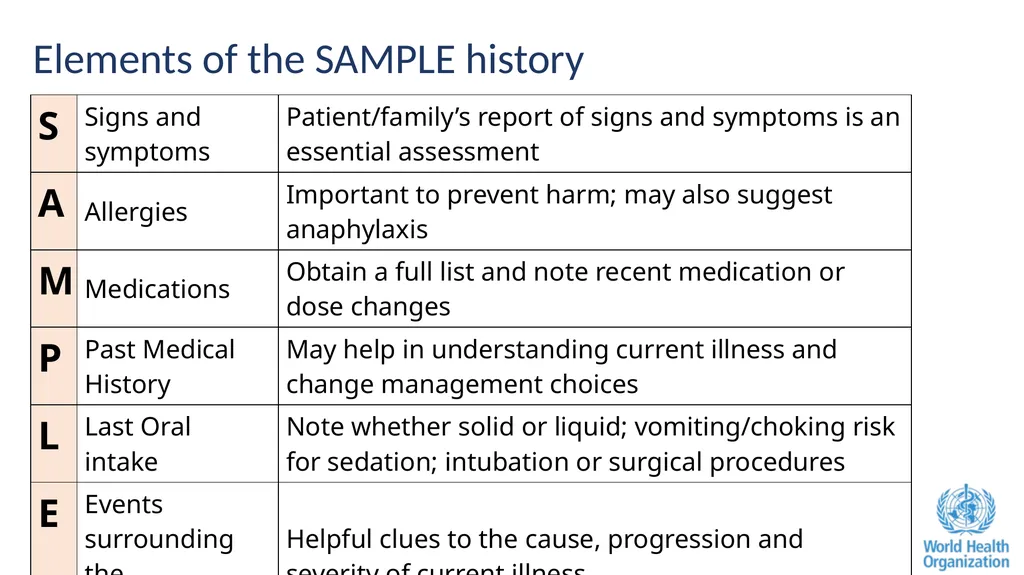
What is a SAMPLE history? Categories of questions to obtain a patient’s history
Signs and Symptoms
Allergies
Medications
Past medical history
Last oral intake
Events
Immediately follows the ABCDE approach
Allows providers to easily communicate Goal:
Rapidly gather history critical to the management of the acutely ill patient<br>
Signs and Symptoms
Allergies
Medications
Past medical history
Last oral intake
Events
Immediately follows the ABCDE approach
Allows providers to easily communicate Goal:
Rapidly gather history critical to the management of the acutely ill patient<br>
06
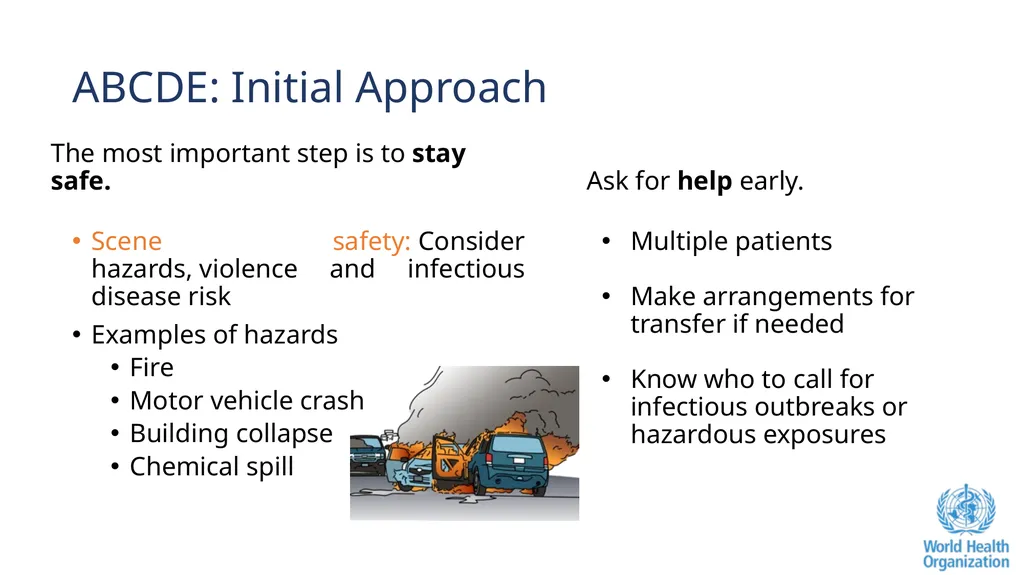
ABCDE: Initial Approach The most important step is to stay safe. Scene safety: Consider hazards, violence and infectious disease risk
Examples of hazards
Fire
Motor vehicle crash
Building collapse
Chemical spill Ask for help early. Multiple patients
Make arrangements for transfer if needed
Know who to call for infectious outbreaks or hazardous exposures<br>
Examples of hazards
Fire
Motor vehicle crash
Building collapse
Chemical spill Ask for help early. Multiple patients
Make arrangements for transfer if needed
Know who to call for infectious outbreaks or hazardous exposures<br>
07
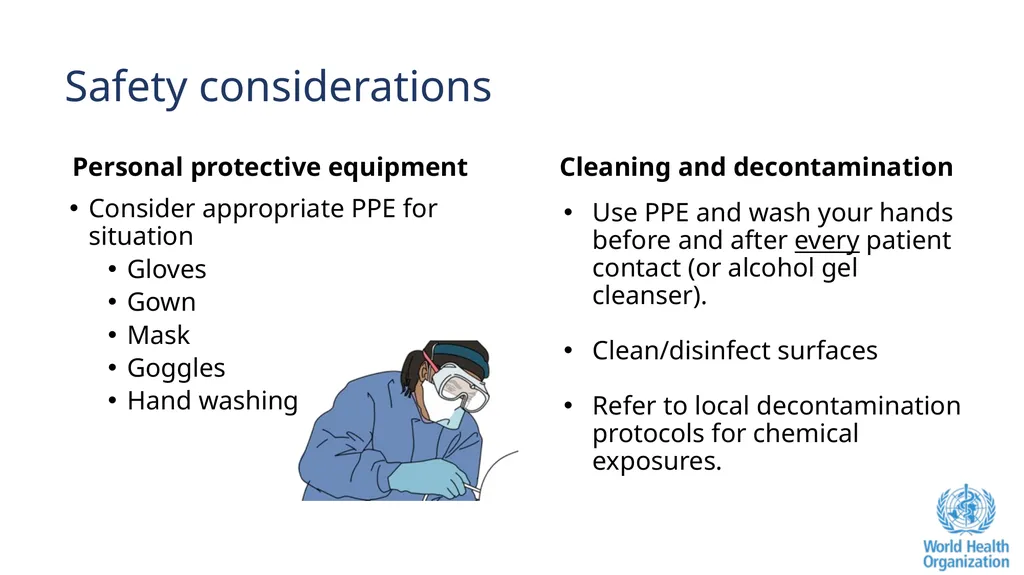
Safety considerations Personal protective equipment Consider appropriate PPE for situation
Gloves
Gown
Mask
Goggles
Hand washing Cleaning and decontamination Use PPE and wash your hands before and after every patient contact (or alcohol gel cleanser).
Clean/disinfect surfaces
Refer to local decontamination protocols for chemical exposures.<br>
Gloves
Gown
Mask
Goggles
Hand washing Cleaning and decontamination Use PPE and wash your hands before and after every patient contact (or alcohol gel cleanser).
Clean/disinfect surfaces
Refer to local decontamination protocols for chemical exposures.<br>
08
Workbook Question 1:
Safety A person walks into your health post vomiting, bleeding from the mouth and complaining of abdominal pain
Describe what is needed to safely approach this patient:<br>
Describe what is needed to safely approach this patient:<br>
09
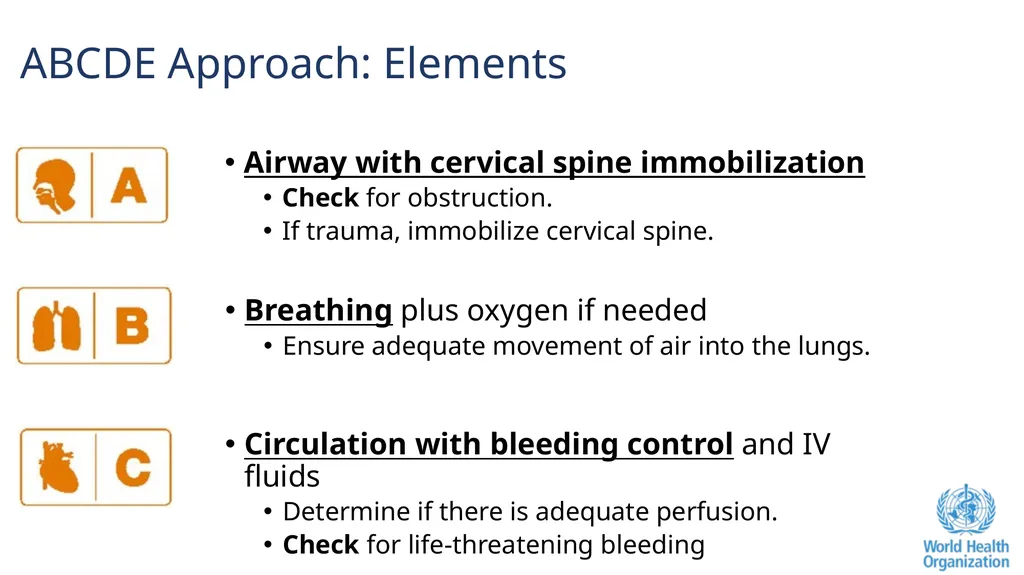
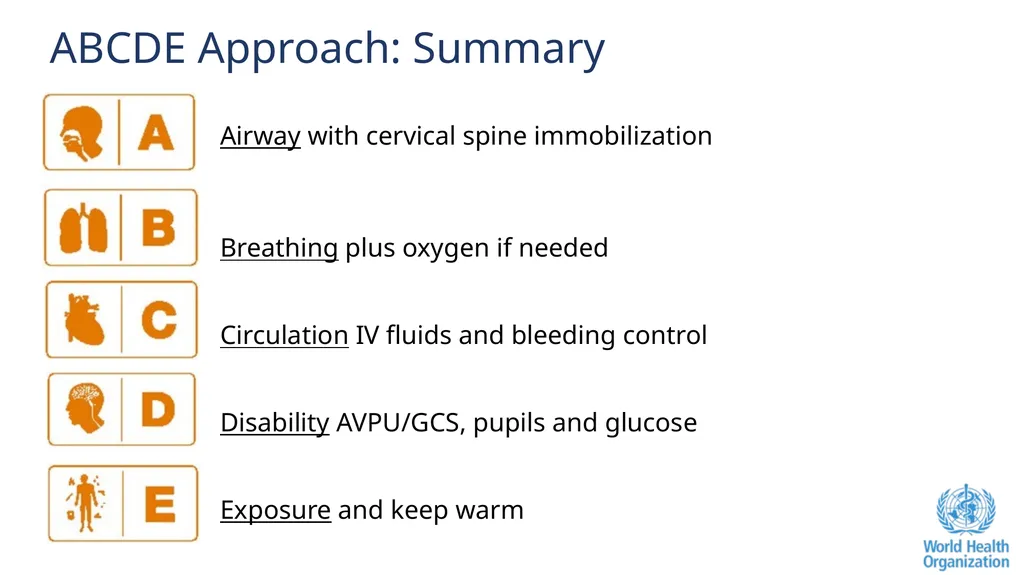
ABCDE Approach: Elements Breathing plus oxygen if needed
Ensure adequate movement of air into the lungs. Airway with cervical spine immobilization
Check for obstruction.
If trauma, immobilize cervical spine. Circulation with bleeding control and IV fluids
Determine if there is adequate perfusion.
Check for life-threatening bleeding<br>
Ensure adequate movement of air into the lungs. Airway with cervical spine immobilization
Check for obstruction.
If trauma, immobilize cervical spine. Circulation with bleeding control and IV fluids
Determine if there is adequate perfusion.
Check for life-threatening bleeding<br>
10
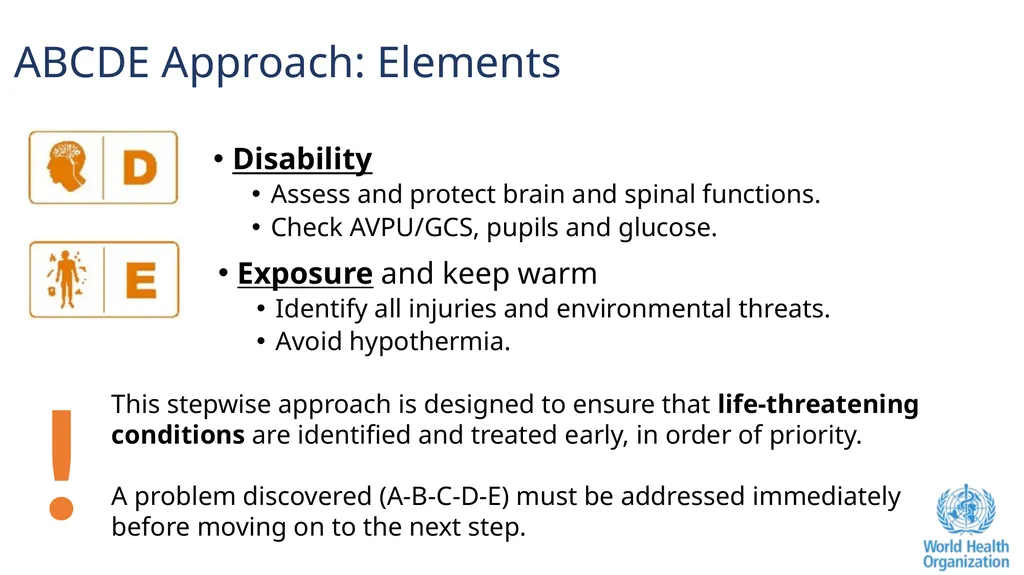
ABCDE Approach: Elements Disability
Assess and protect brain and spinal functions.
Check AVPU/GCS, pupils and glucose. Exposure and keep warm
Identify all injuries and environmental threats.
Avoid hypothermia. This stepwise approach is designed to ensure that life-threatening conditions are identified and treated early, in order of priority.
A problem discovered (A-B-C-D-E) must be addressed immediately
before moving on to the next step. !<br>
Assess and protect brain and spinal functions.
Check AVPU/GCS, pupils and glucose. Exposure and keep warm
Identify all injuries and environmental threats.
Avoid hypothermia. This stepwise approach is designed to ensure that life-threatening conditions are identified and treated early, in order of priority.
A problem discovered (A-B-C-D-E) must be addressed immediately
before moving on to the next step. !<br>
11
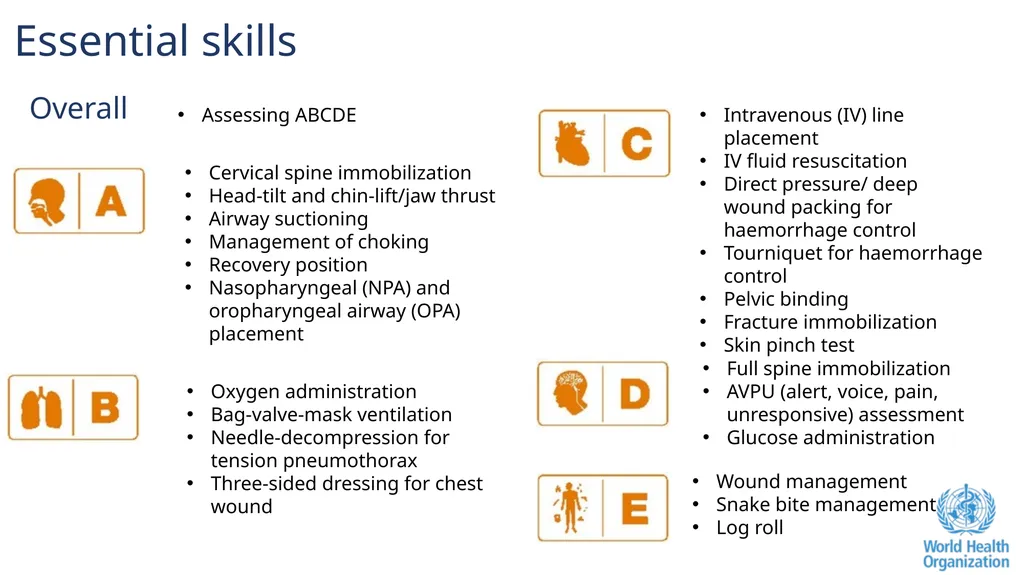
Essential skills Cervical spine immobilization
Head-tilt and chin-lift/jaw thrust
Airway suctioning
Management of choking
Recovery position
Nasopharyngeal (NPA) and oropharyngeal airway (OPA) placement Oxygen administration
Bag-valve-mask ventilation
Needle-decompression for tension pneumothorax
Three-sided dressing for chest wound Intravenous (IV) line placement
IV fluid resuscitation
Direct pressure/ deep wound packing for haemorrhage control
Tourniquet for haemorrhage control
Pelvic binding
Fracture immobilization
Skin pinch test Full spine immobilization
AVPU (alert, voice, pain, unresponsive) assessment
Glucose administration Wound management
Snake bite management
Log roll Overall Assessing ABCDE<br>
Head-tilt and chin-lift/jaw thrust
Airway suctioning
Management of choking
Recovery position
Nasopharyngeal (NPA) and oropharyngeal airway (OPA) placement Oxygen administration
Bag-valve-mask ventilation
Needle-decompression for tension pneumothorax
Three-sided dressing for chest wound Intravenous (IV) line placement
IV fluid resuscitation
Direct pressure/ deep wound packing for haemorrhage control
Tourniquet for haemorrhage control
Pelvic binding
Fracture immobilization
Skin pinch test Full spine immobilization
AVPU (alert, voice, pain, unresponsive) assessment
Glucose administration Wound management
Snake bite management
Log roll Overall Assessing ABCDE<br>
12
REMEMBER… Always check for signs of trauma in each of the ABCDE sections and reference the trauma module as needed. !<br>
13
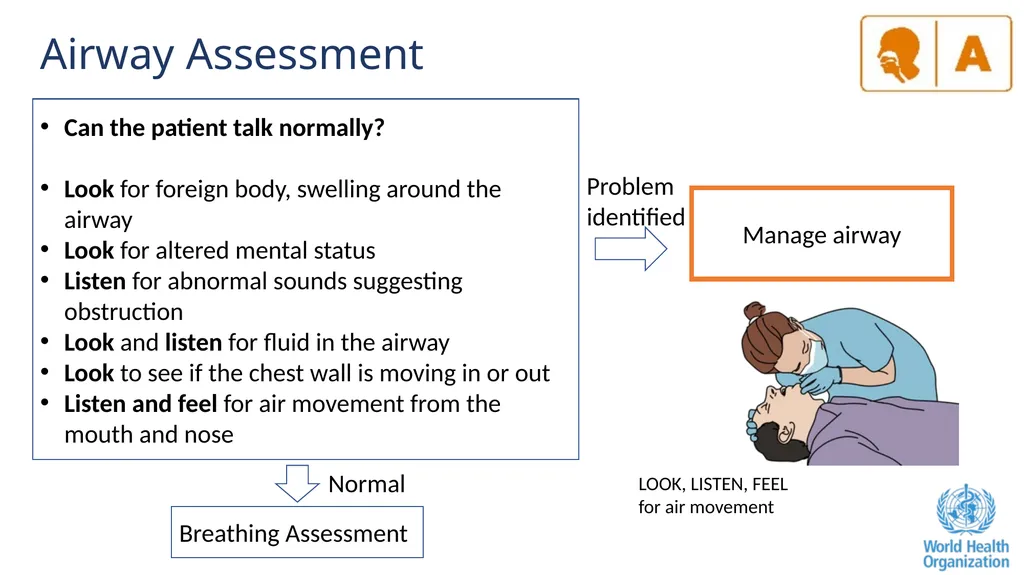
Airway Assessment Breathing Assessment Manage airway Can the patient talk normally?
Look for foreign body, swelling around the airway
Look for altered mental status
Listen for abnormal sounds suggesting obstruction
Look and listen for fluid in the airway
Look to see if the chest wall is moving in or out
Listen and feel for air movement from the mouth and nose Normal Problem identified LOOK, LISTEN, FEEL for air movement<br>
Look for foreign body, swelling around the airway
Look for altered mental status
Listen for abnormal sounds suggesting obstruction
Look and listen for fluid in the airway
Look to see if the chest wall is moving in or out
Listen and feel for air movement from the mouth and nose Normal Problem identified LOOK, LISTEN, FEEL for air movement<br>
14
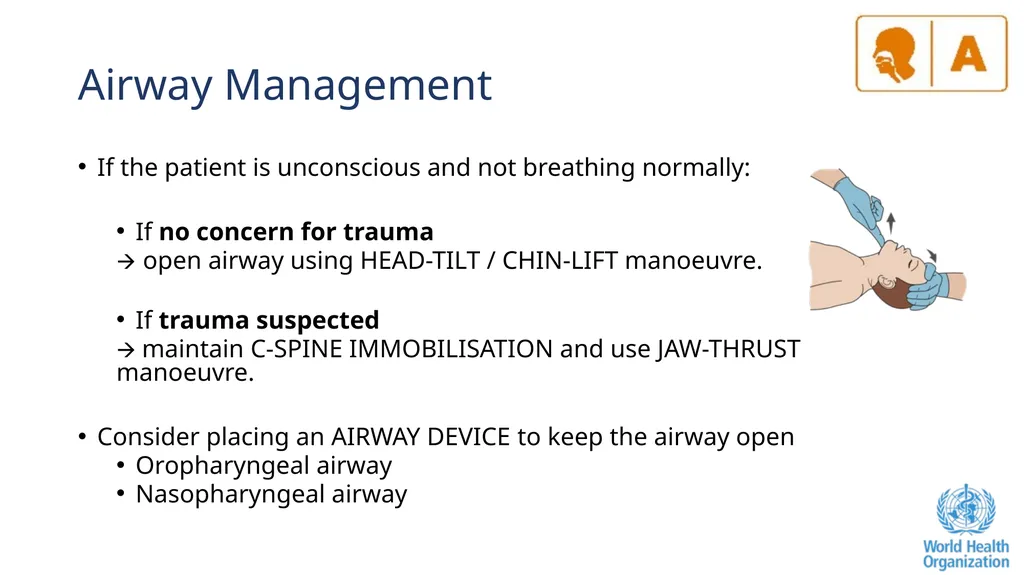
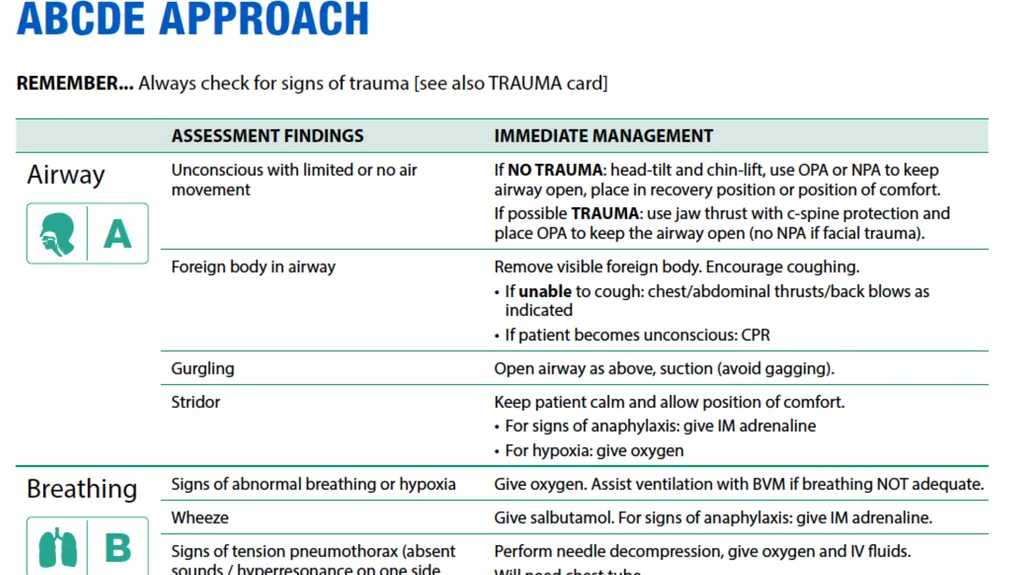
Airway Management If the patient is unconscious and not breathing normally:
If no concern for trauma
open airway using HEAD-TILT / CHIN-LIFT manoeuvre.
If trauma suspected
maintain C-SPINE IMMOBILISATION and use JAW-THRUST manoeuvre.
Consider placing an AIRWAY DEVICE to keep the airway open
Oropharyngeal airway
Nasopharyngeal airway<br>
If no concern for trauma
open airway using HEAD-TILT / CHIN-LIFT manoeuvre.
If trauma suspected
maintain C-SPINE IMMOBILISATION and use JAW-THRUST manoeuvre.
Consider placing an AIRWAY DEVICE to keep the airway open
Oropharyngeal airway
Nasopharyngeal airway<br>
15
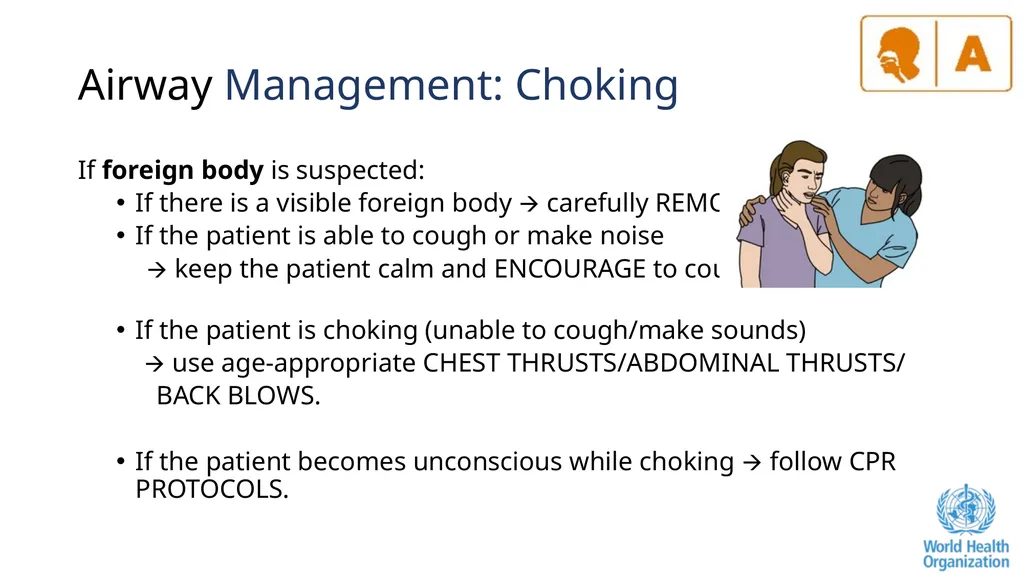
Airway Management: Choking If foreign body is suspected:
If there is a visible foreign body carefully REMOVE IT
If the patient is able to cough or make noise
keep the patient calm and ENCOURAGE to cough.
If the patient is choking (unable to cough/make sounds)
use age-appropriate CHEST THRUSTS/ABDOMINAL THRUSTS/
BACK BLOWS.
If the patient becomes unconscious while choking follow CPR PROTOCOLS.<br>
If there is a visible foreign body carefully REMOVE IT
If the patient is able to cough or make noise
keep the patient calm and ENCOURAGE to cough.
If the patient is choking (unable to cough/make sounds)
use age-appropriate CHEST THRUSTS/ABDOMINAL THRUSTS/
BACK BLOWS.
If the patient becomes unconscious while choking follow CPR PROTOCOLS.<br>
16
Airway Management If secretions are present:
SUCTION airway or wipe clean
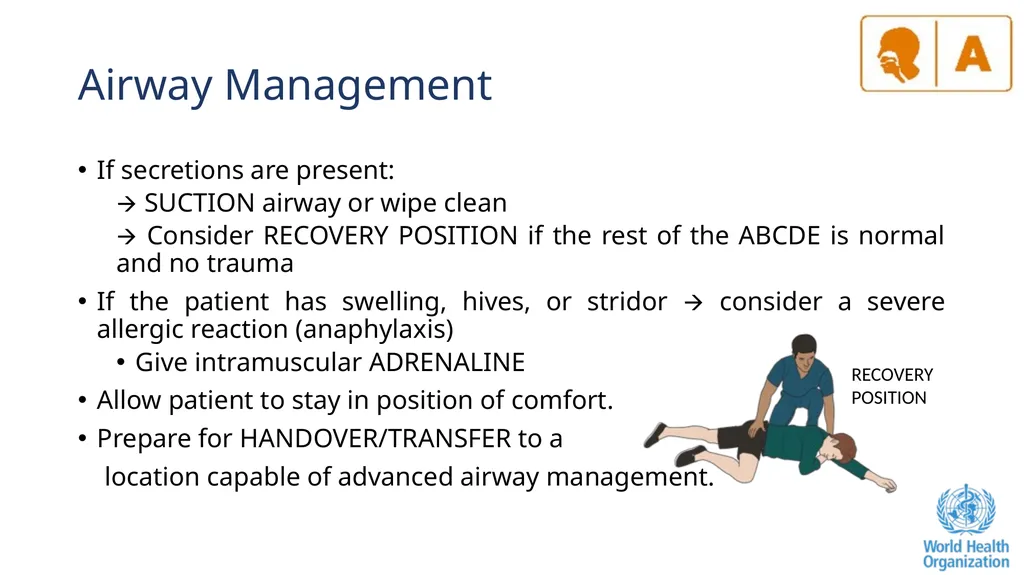
Consider RECOVERY POSITION if the rest of the ABCDE is normal and no trauma
If the patient has swelling, hives, or stridor consider a severe allergic reaction (anaphylaxis)
Give intramuscular ADRENALINE
Allow patient to stay in position of comfort.
Prepare for HANDOVER/TRANSFER to a
location capable of advanced airway management. RECOVERY POSITION<br>
SUCTION airway or wipe clean
Consider RECOVERY POSITION if the rest of the ABCDE is normal and no trauma
If the patient has swelling, hives, or stridor consider a severe allergic reaction (anaphylaxis)
Give intramuscular ADRENALINE
Allow patient to stay in position of comfort.
Prepare for HANDOVER/TRANSFER to a
location capable of advanced airway management. RECOVERY POSITION<br>
17
Questions Airway<br>
18
Breathing: Assessment Look, listen and feel to see if the patient is breathing
Assess if the breathing is very fast, very slow or very shallow.
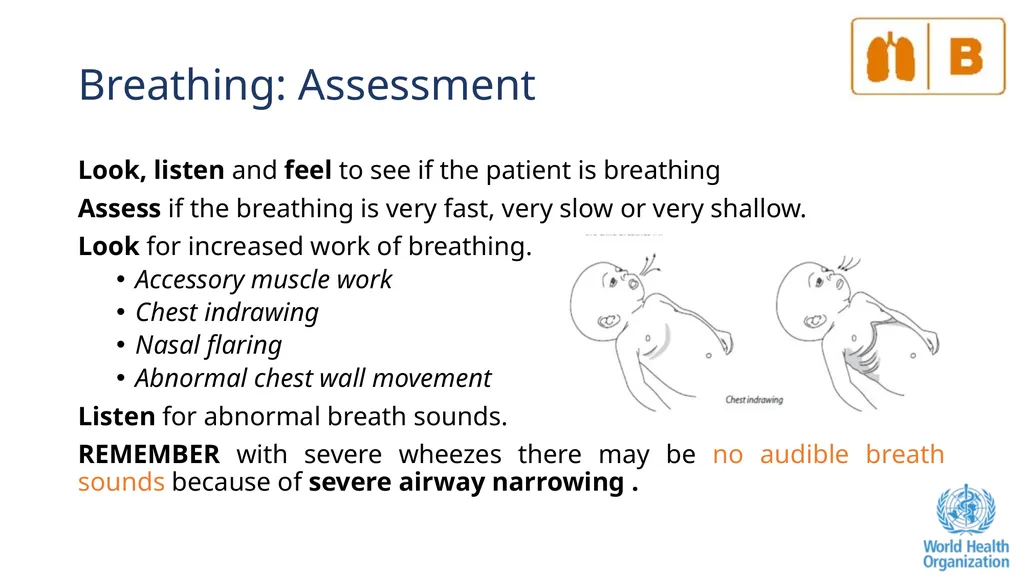
Look for increased work of breathing.
Accessory muscle work
Chest indrawing
Nasal flaring
Abnormal chest wall movement
Listen for abnormal breath sounds.
REMEMBER with severe wheezes there may be no audible breath sounds because of severe airway narrowing .<br>
Assess if the breathing is very fast, very slow or very shallow.
Look for increased work of breathing.
Accessory muscle work
Chest indrawing
Nasal flaring
Abnormal chest wall movement
Listen for abnormal breath sounds.
REMEMBER with severe wheezes there may be no audible breath sounds because of severe airway narrowing .<br>
19
Breathing: Assessment Listen to see if breath sounds are equal.
Check for the absence of breath sounds on one side.
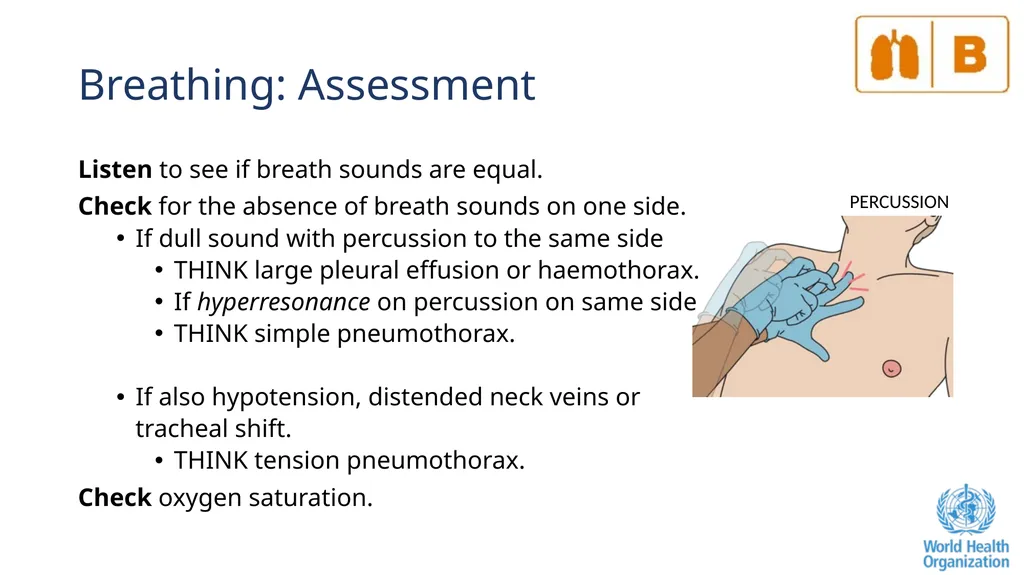
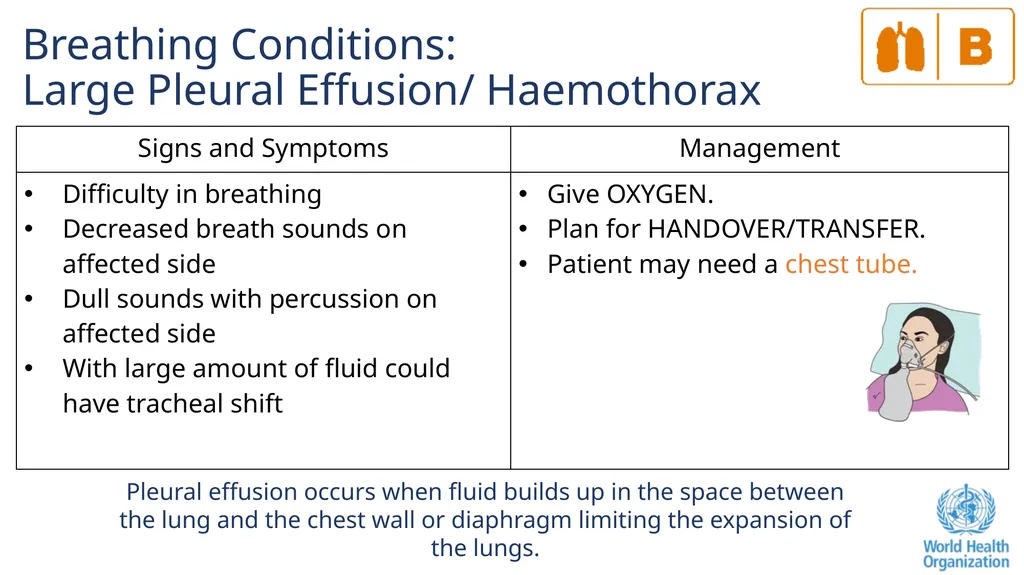
If dull sound with percussion to the same side
THINK large pleural effusion or haemothorax.
If hyperresonance on percussion on same side
THINK simple pneumothorax.
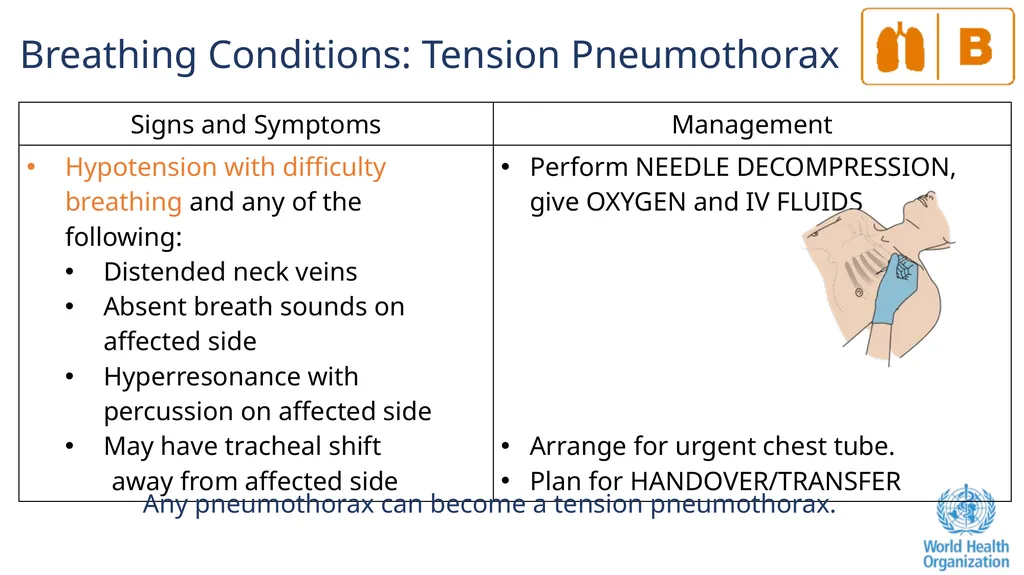
If also hypotension, distended neck veins or
tracheal shift.
THINK tension pneumothorax.
Check oxygen saturation. PERCUSSION<br>
Check for the absence of breath sounds on one side.
If dull sound with percussion to the same side
THINK large pleural effusion or haemothorax.
If hyperresonance on percussion on same side
THINK simple pneumothorax.
If also hypotension, distended neck veins or
tracheal shift.
THINK tension pneumothorax.
Check oxygen saturation. PERCUSSION<br>
20
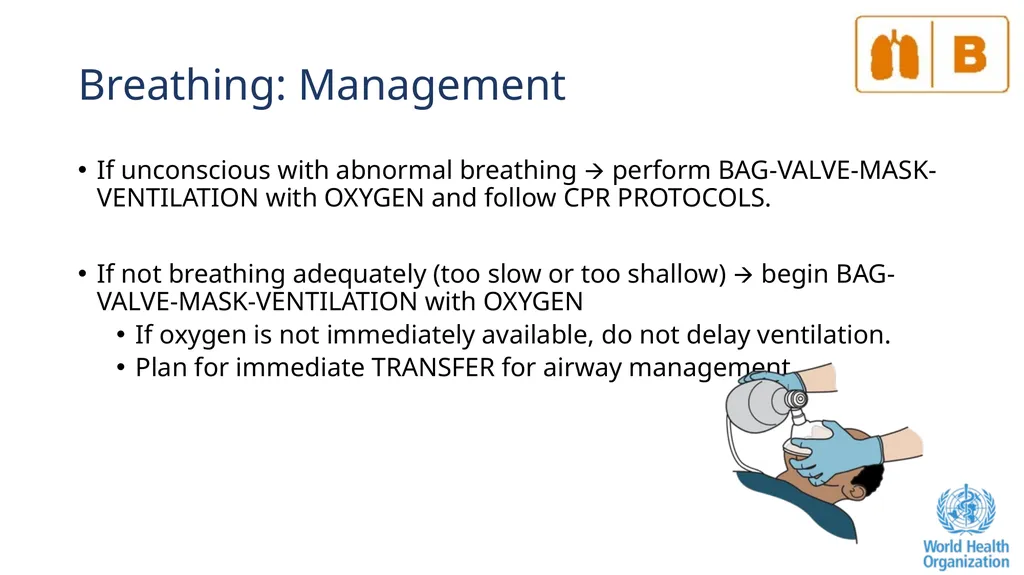
Breathing: Management If unconscious with abnormal breathing perform BAG-VALVE-MASK-VENTILATION with OXYGEN and follow CPR PROTOCOLS.
If not breathing adequately (too slow or too shallow) begin BAG-VALVE-MASK-VENTILATION with OXYGEN
If oxygen is not immediately available, do not delay ventilation.
Plan for immediate TRANSFER for airway management.<br>
If not breathing adequately (too slow or too shallow) begin BAG-VALVE-MASK-VENTILATION with OXYGEN
If oxygen is not immediately available, do not delay ventilation.
Plan for immediate TRANSFER for airway management.<br>
21
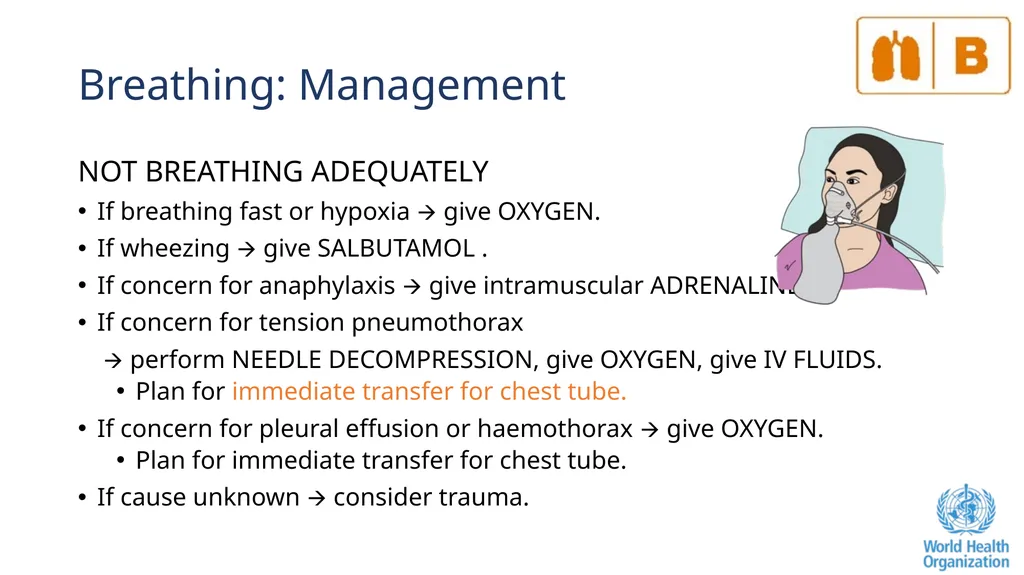
Breathing: Management NOT BREATHING ADEQUATELY
If breathing fast or hypoxia give OXYGEN.
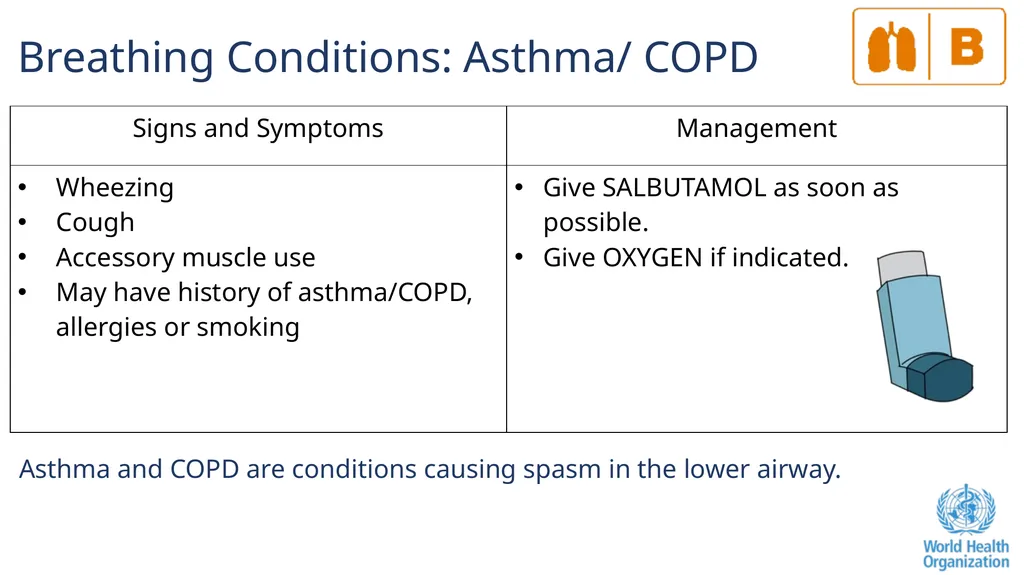
If wheezing give SALBUTAMOL .
If concern for anaphylaxis give intramuscular ADRENALINE.
If concern for tension pneumothorax
perform NEEDLE DECOMPRESSION, give OXYGEN, give IV FLUIDS.
Plan for immediate transfer for chest tube.
If concern for pleural effusion or haemothorax give OXYGEN.
Plan for immediate transfer for chest tube.
If cause unknown consider trauma.<br>
If breathing fast or hypoxia give OXYGEN.
If wheezing give SALBUTAMOL .
If concern for anaphylaxis give intramuscular ADRENALINE.
If concern for tension pneumothorax
perform NEEDLE DECOMPRESSION, give OXYGEN, give IV FLUIDS.
Plan for immediate transfer for chest tube.
If concern for pleural effusion or haemothorax give OXYGEN.
Plan for immediate transfer for chest tube.
If cause unknown consider trauma.<br>
22
Questions Breathing<br>
23
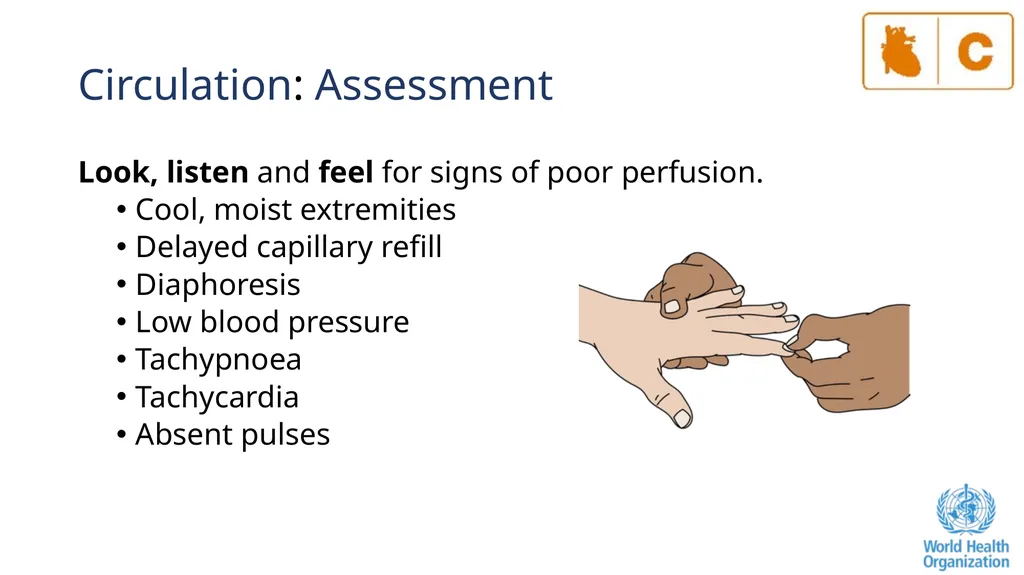
Circulation: Assessment Look, listen and feel for signs of poor perfusion.
Cool, moist extremities
Delayed capillary refill
Diaphoresis
Low blood pressure
Tachypnoea
Tachycardia
Absent pulses<br>
Cool, moist extremities
Delayed capillary refill
Diaphoresis
Low blood pressure
Tachypnoea
Tachycardia
Absent pulses<br>
24
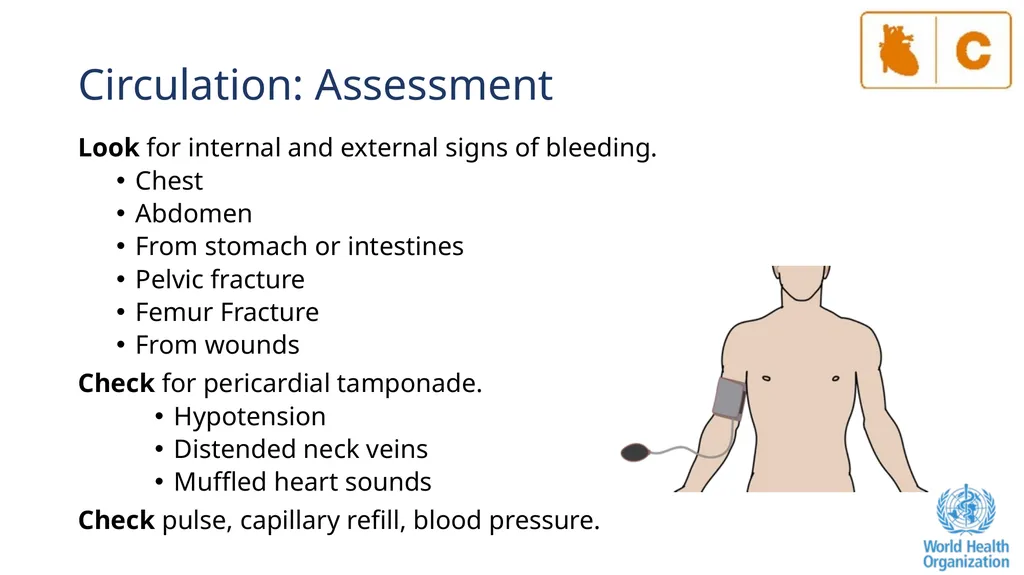
Circulation: Assessment Look for internal and external signs of bleeding.
Chest
Abdomen
From stomach or intestines
Pelvic fracture
Femur Fracture
From wounds
Check for pericardial tamponade.
Hypotension
Distended neck veins
Muffled heart sounds
Check pulse, capillary refill, blood pressure.<br>
Chest
Abdomen
From stomach or intestines
Pelvic fracture
Femur Fracture
From wounds
Check for pericardial tamponade.
Hypotension
Distended neck veins
Muffled heart sounds
Check pulse, capillary refill, blood pressure.<br>
25
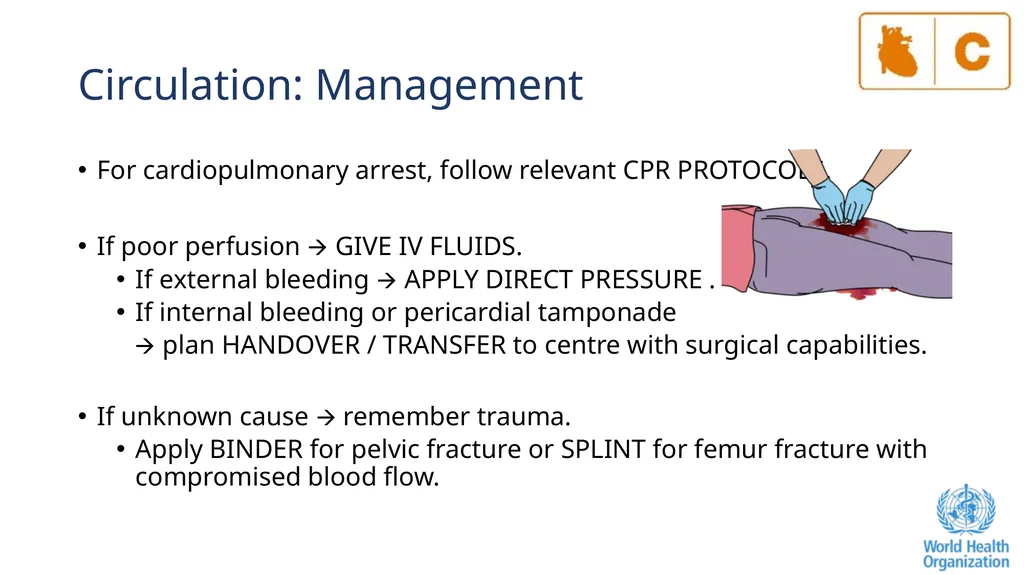
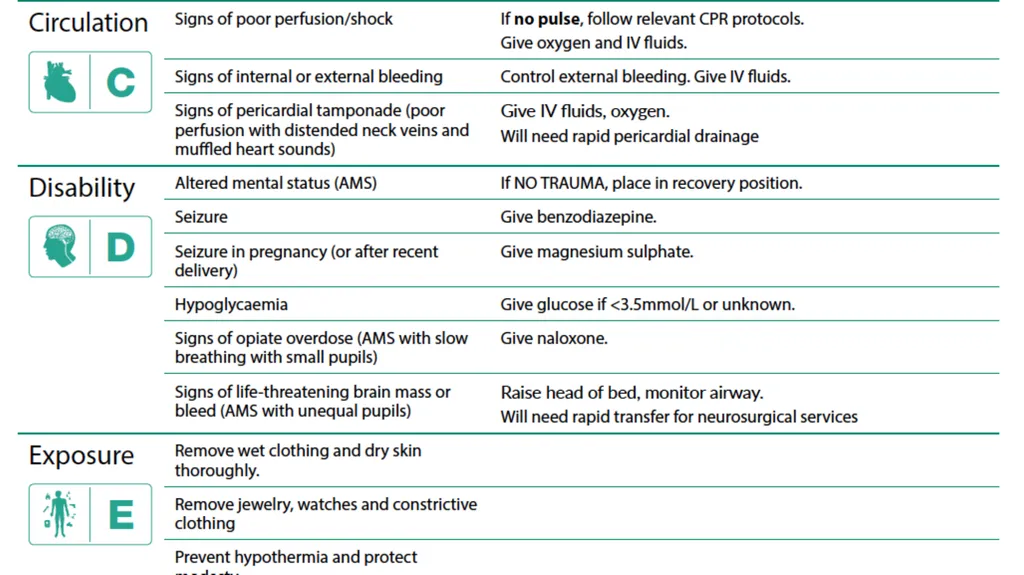
Circulation: Management For cardiopulmonary arrest, follow relevant CPR PROTOCOLS.
If poor perfusion GIVE IV FLUIDS.
If external bleeding APPLY DIRECT PRESSURE .
If internal bleeding or pericardial tamponade
plan HANDOVER / TRANSFER to centre with surgical capabilities.
If unknown cause remember trauma.
Apply BINDER for pelvic fracture or SPLINT for femur fracture with compromised blood flow.<br>
If poor perfusion GIVE IV FLUIDS.
If external bleeding APPLY DIRECT PRESSURE .
If internal bleeding or pericardial tamponade
plan HANDOVER / TRANSFER to centre with surgical capabilities.
If unknown cause remember trauma.
Apply BINDER for pelvic fracture or SPLINT for femur fracture with compromised blood flow.<br>
26
Questions Circulation<br>
27
Disability: Assessment Assess level of consciousness.
AVPU or GCS in trauma
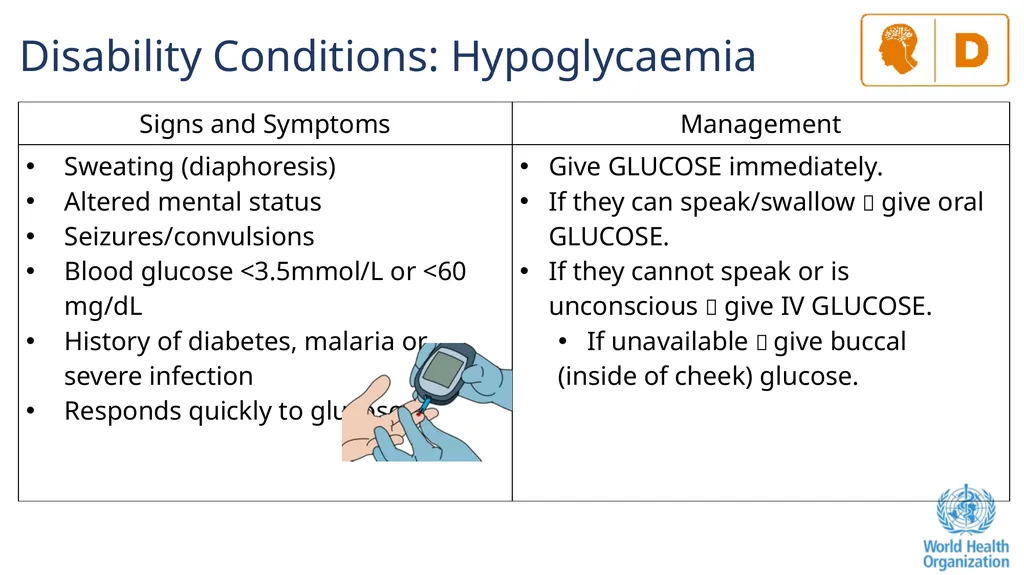
Check for low blood glucose (hypoglycaemia).
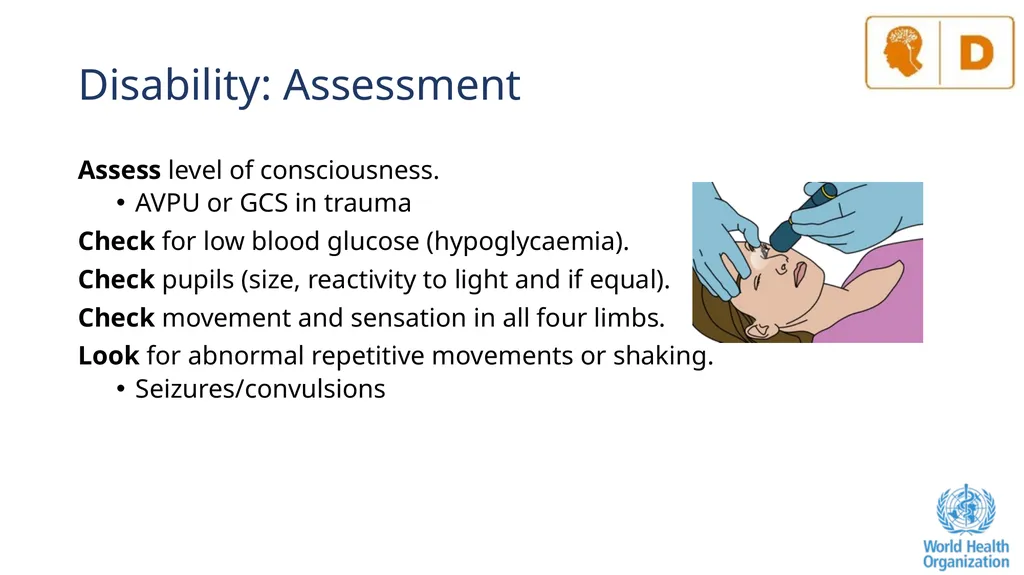
Check pupils (size, reactivity to light and if equal).
Check movement and sensation in all four limbs.
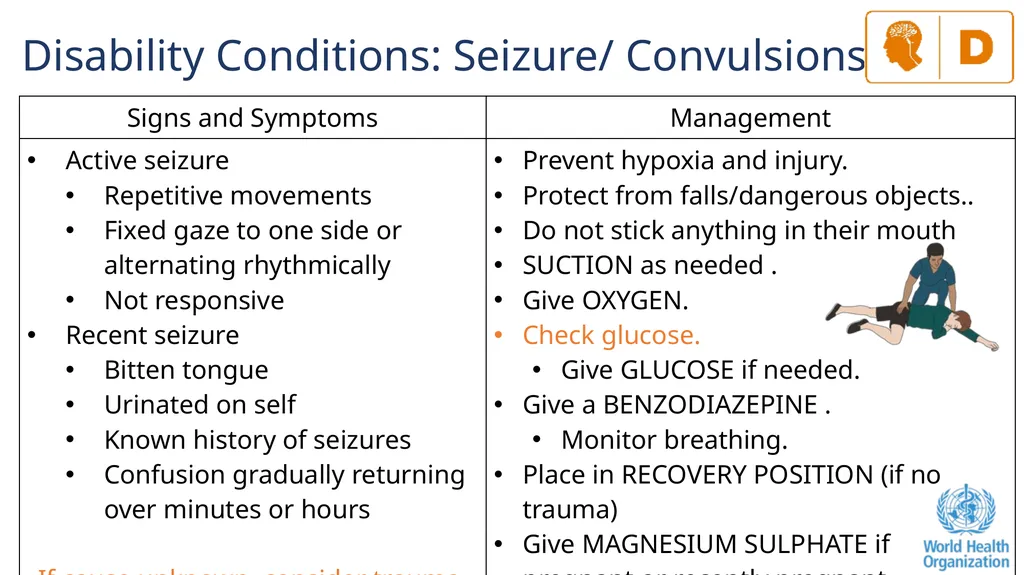
Look for abnormal repetitive movements or shaking.
Seizures/convulsions<br>
AVPU or GCS in trauma
Check for low blood glucose (hypoglycaemia).
Check pupils (size, reactivity to light and if equal).
Check movement and sensation in all four limbs.
Look for abnormal repetitive movements or shaking.
Seizures/convulsions<br>
28
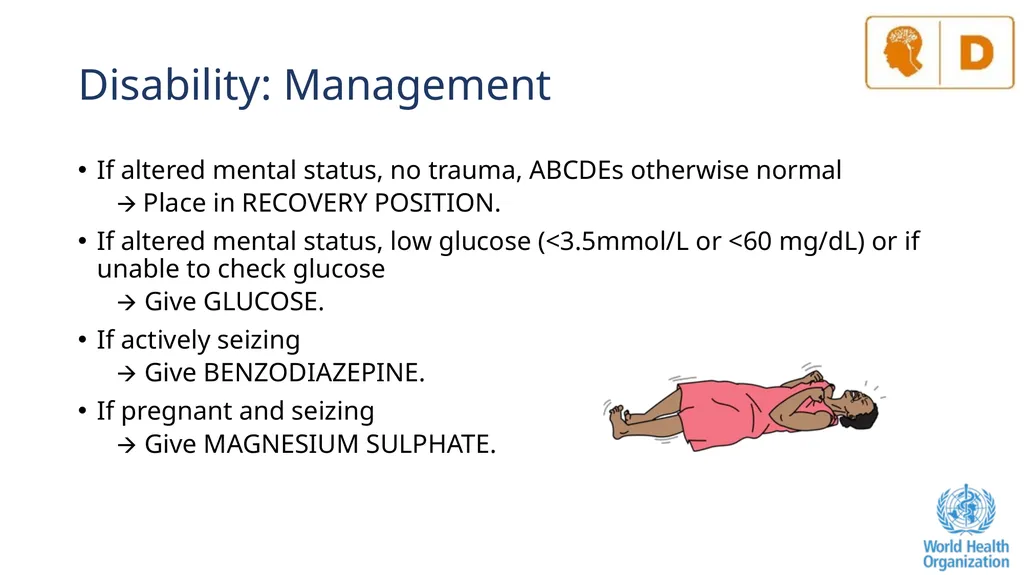
Disability: Management If altered mental status, no trauma, ABCDEs otherwise normal
Place in RECOVERY POSITION.
If altered mental status, low glucose (<3.5mmol/L or <60 mg/dL) or if unable to check glucose
Give GLUCOSE.
If actively seizing
Give BENZODIAZEPINE.
If pregnant and seizing
Give MAGNESIUM SULPHATE.<br>
Place in RECOVERY POSITION.
If altered mental status, low glucose (<3.5mmol/L or <60 mg/dL) or if unable to check glucose
Give GLUCOSE.
If actively seizing
Give BENZODIAZEPINE.
If pregnant and seizing
Give MAGNESIUM SULPHATE.<br>
29
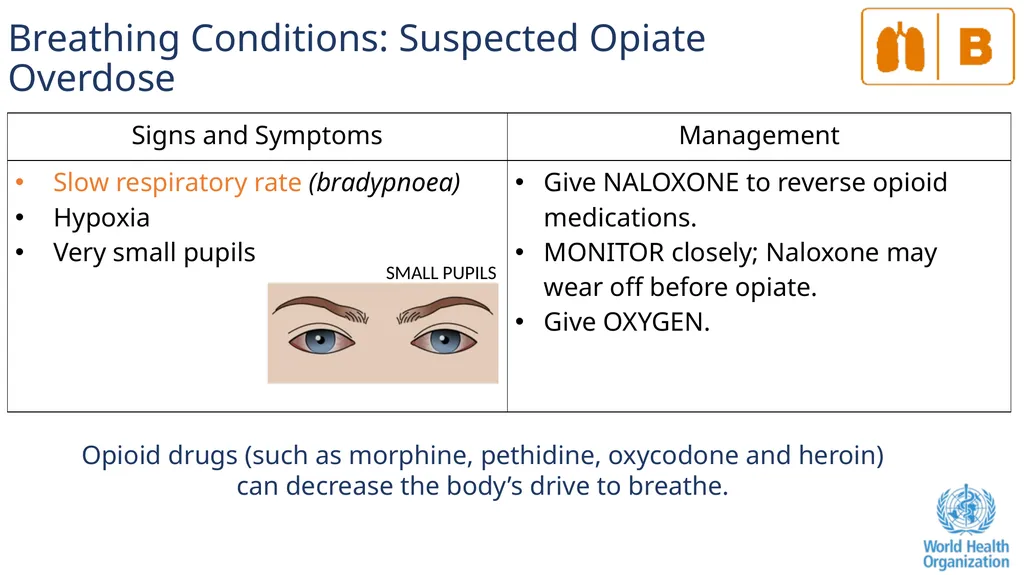
Disability: Management If small pupils and slow breathing, consider opioid overdose
Give NALOXONE.
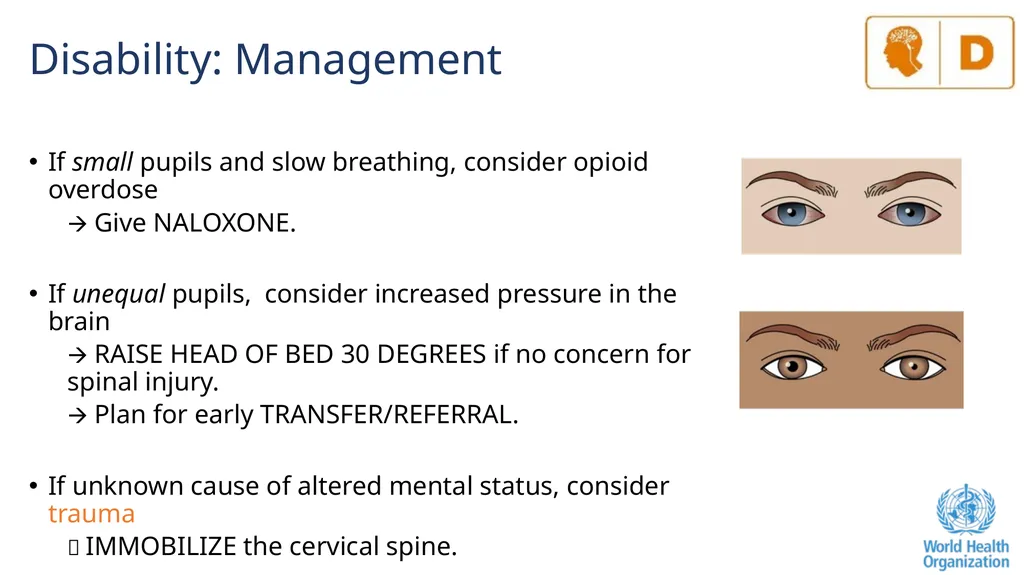
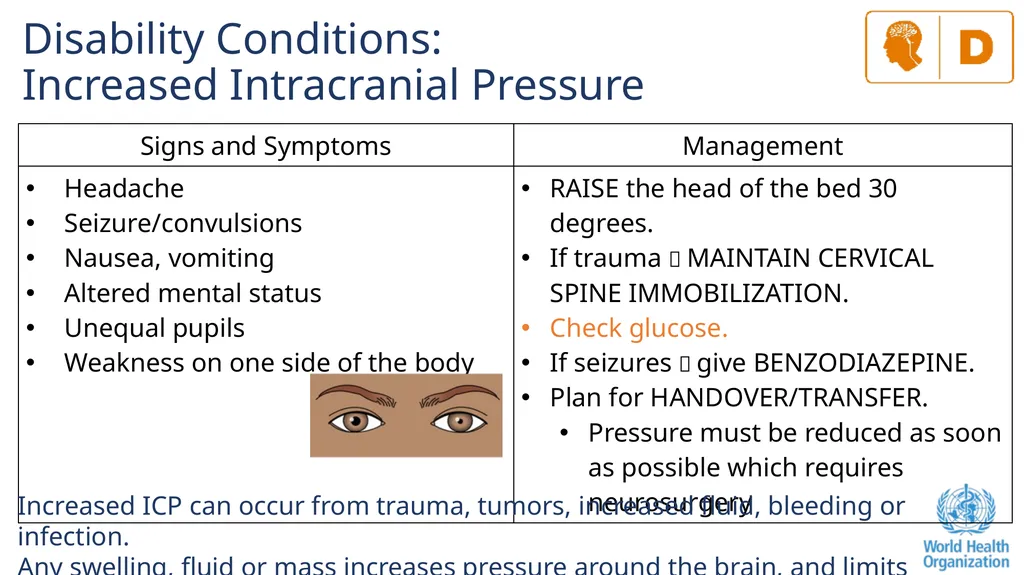
If unequal pupils, consider increased pressure in the brain
RAISE HEAD OF BED 30 DEGREES if no concern for spinal injury.
Plan for early TRANSFER/REFERRAL.
If unknown cause of altered mental status, consider trauma
IMMOBILIZE the cervical spine.<br>
Give NALOXONE.
If unequal pupils, consider increased pressure in the brain
RAISE HEAD OF BED 30 DEGREES if no concern for spinal injury.
Plan for early TRANSFER/REFERRAL.
If unknown cause of altered mental status, consider trauma
IMMOBILIZE the cervical spine.<br>
30
Questions Disability<br>
31
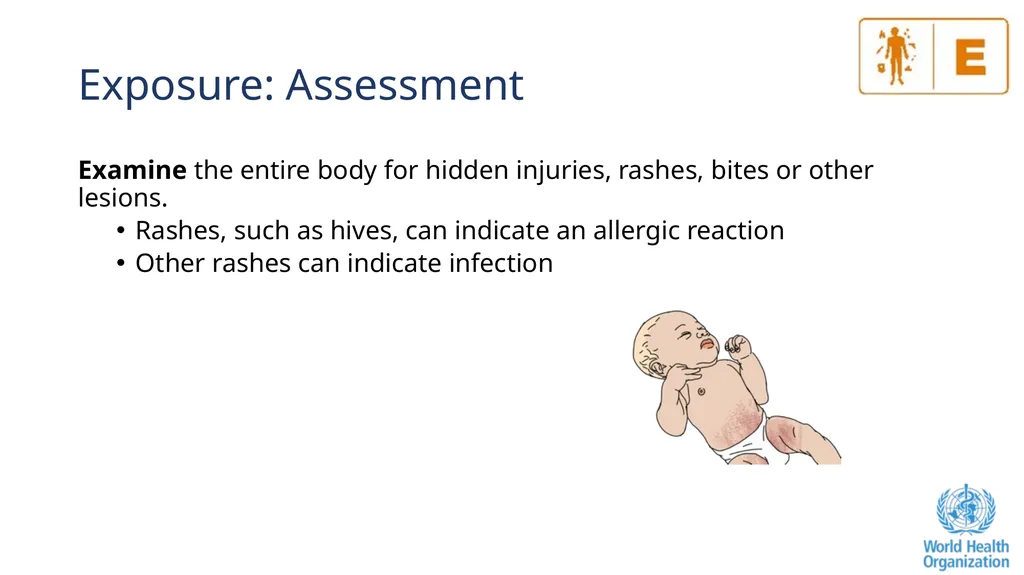
Exposure: Assessment Examine the entire body for hidden injuries, rashes, bites or other lesions.
Rashes, such as hives, can indicate an allergic reaction
Other rashes can indicate infection<br>
Rashes, such as hives, can indicate an allergic reaction
Other rashes can indicate infection<br>
32
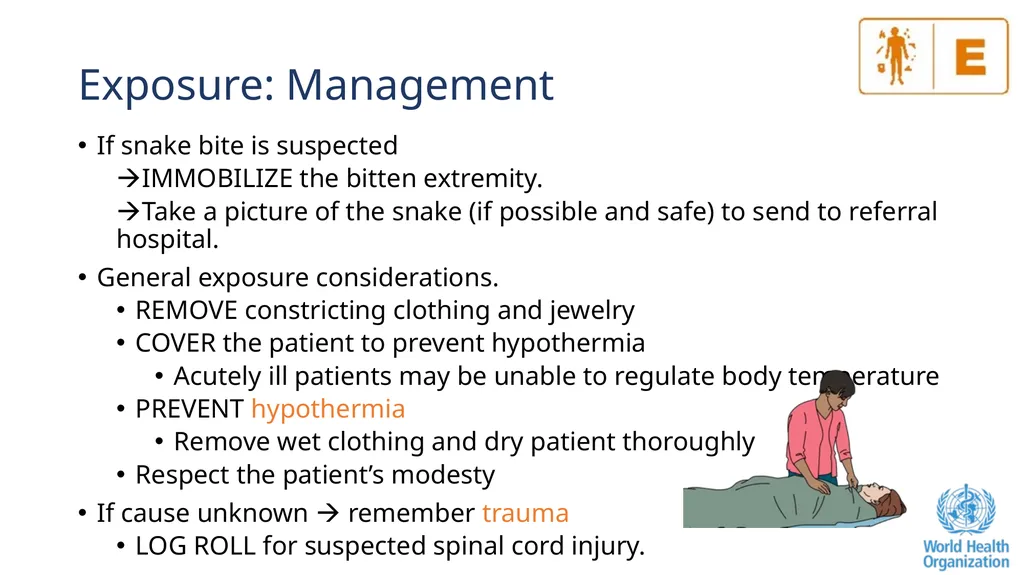
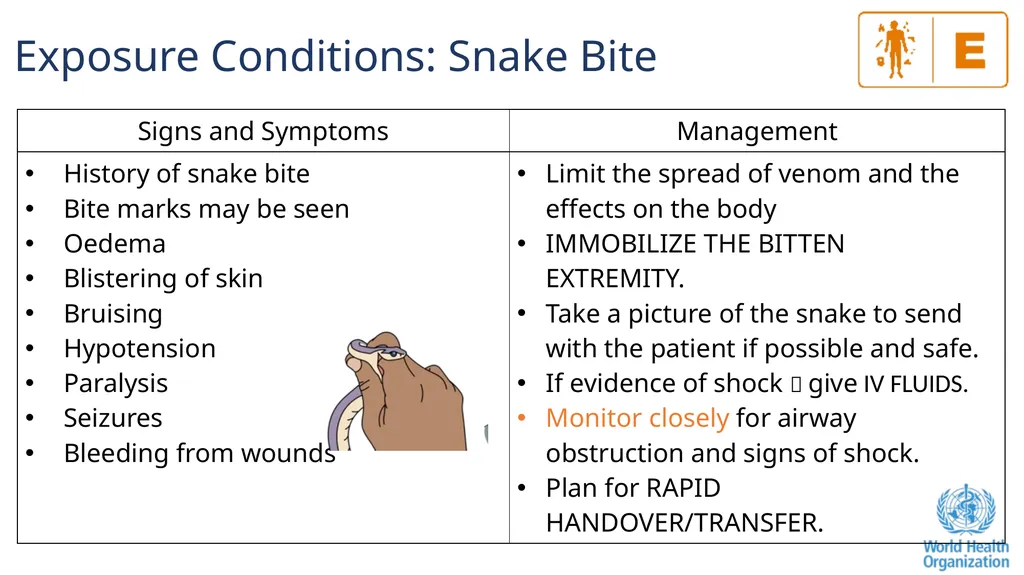
Exposure: Management If snake bite is suspected
IMMOBILIZE the bitten extremity.
Take a picture of the snake (if possible and safe) to send to referral hospital.
General exposure considerations.
REMOVE constricting clothing and jewelry
COVER the patient to prevent hypothermia
Acutely ill patients may be unable to regulate body temperature
PREVENT hypothermia
Remove wet clothing and dry patient thoroughly
Respect the patient’s modesty
If cause unknown remember trauma
LOG ROLL for suspected spinal cord injury.<br>
IMMOBILIZE the bitten extremity.
Take a picture of the snake (if possible and safe) to send to referral hospital.
General exposure considerations.
REMOVE constricting clothing and jewelry
COVER the patient to prevent hypothermia
Acutely ill patients may be unable to regulate body temperature
PREVENT hypothermia
Remove wet clothing and dry patient thoroughly
Respect the patient’s modesty
If cause unknown remember trauma
LOG ROLL for suspected spinal cord injury.<br>
33
Questions Exposure<br>
34
The ABCDE and SAMPLE history approach Part 2: In-depth Acute Life-Threatening Conditions<br>
35
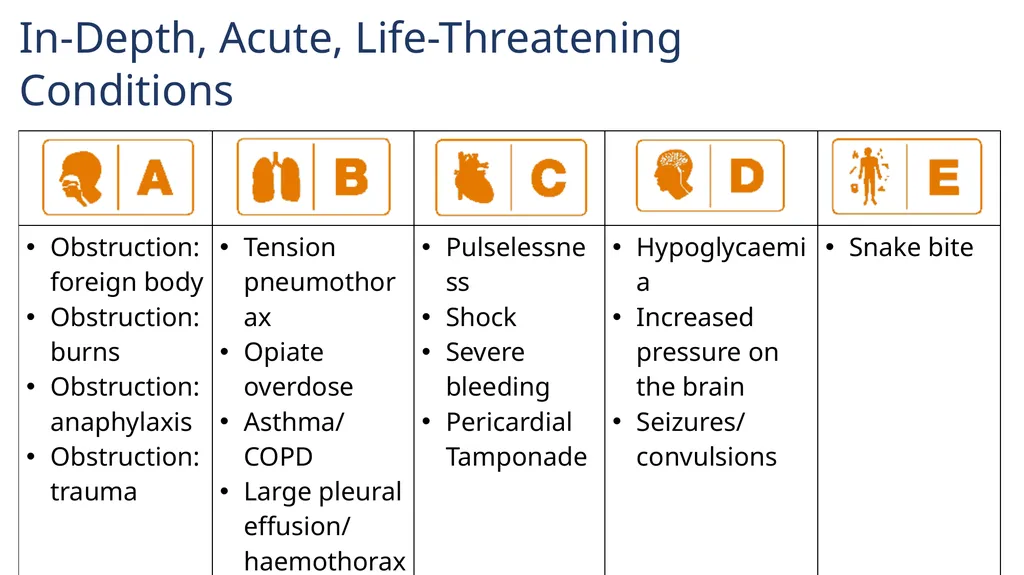
In-Depth, Acute, Life-Threatening Conditions<br>
36
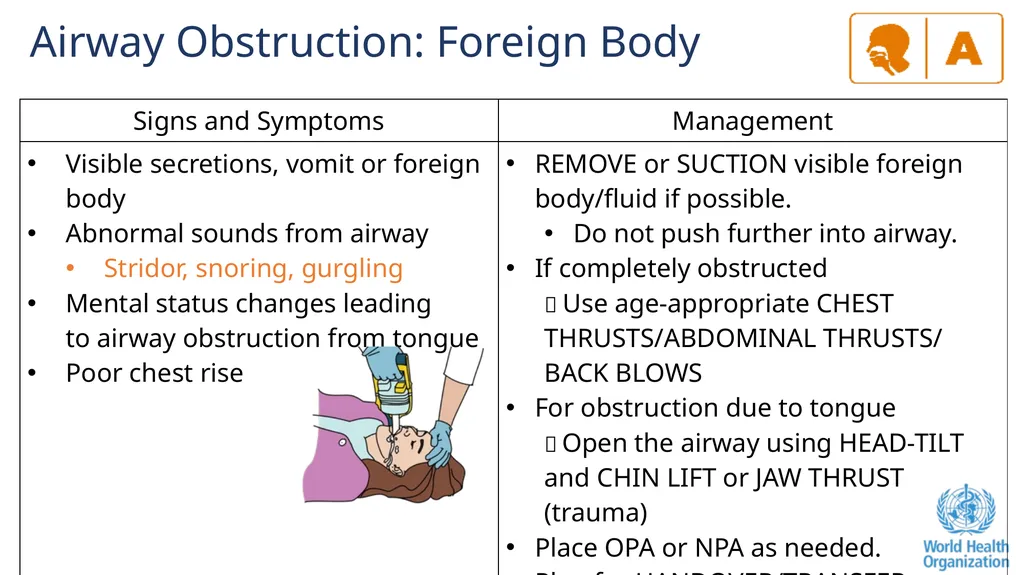
Airway Obstruction: Foreign Body<br>
37
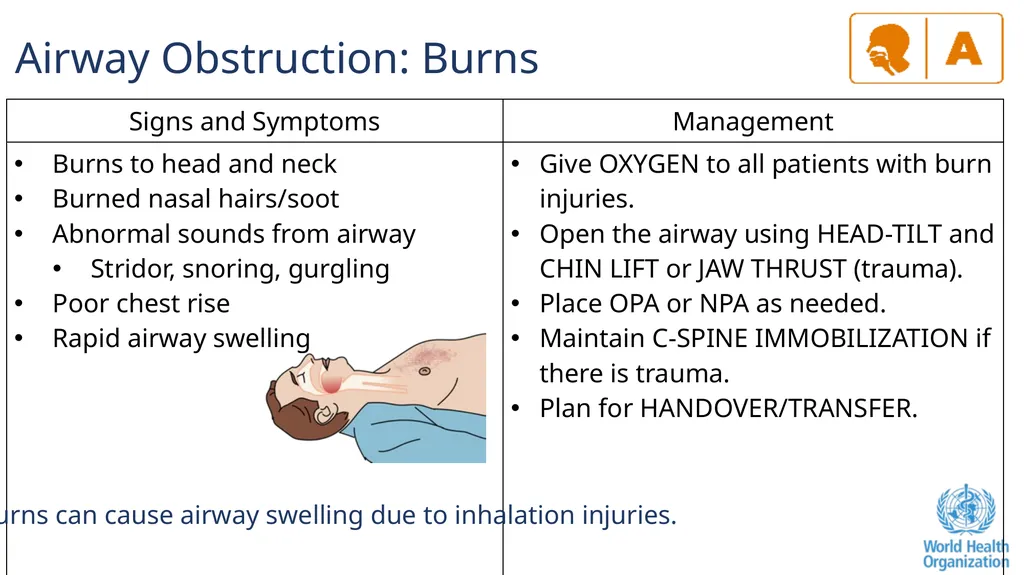
Airway Obstruction: Burns Burns can cause airway swelling due to inhalation injuries.<br>
38
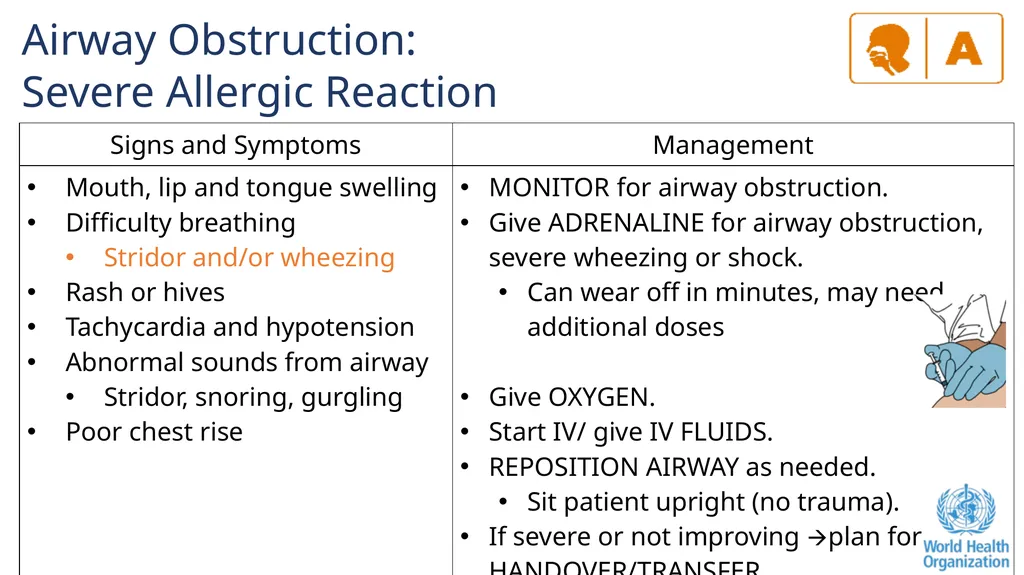
Airway Obstruction:
Severe Allergic Reaction<br>
39
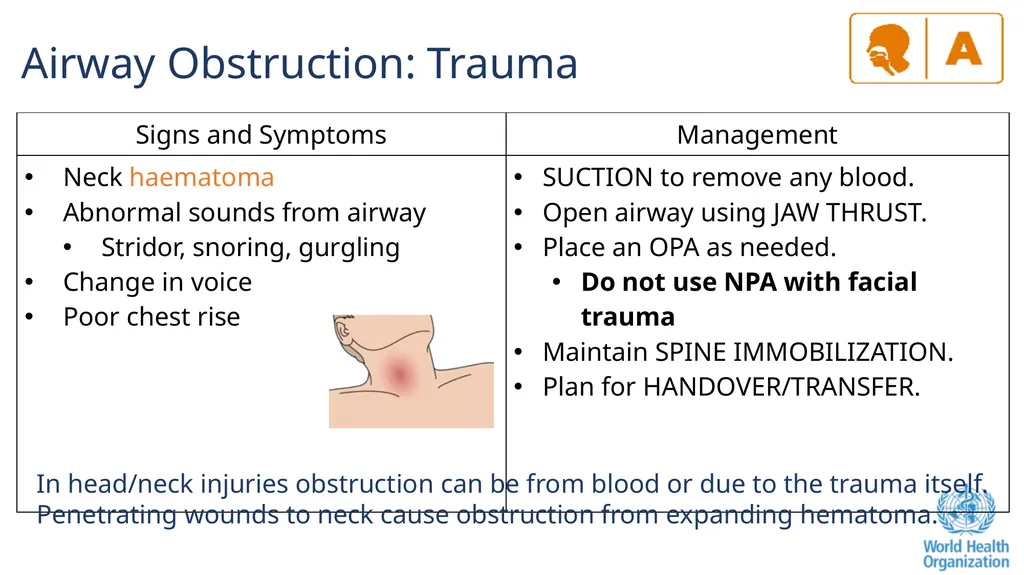
Airway Obstruction: Trauma In head/neck injuries obstruction can be from blood or due to the trauma itself.
Penetrating wounds to neck cause obstruction from expanding hematoma.<br>
Penetrating wounds to neck cause obstruction from expanding hematoma.<br>
40
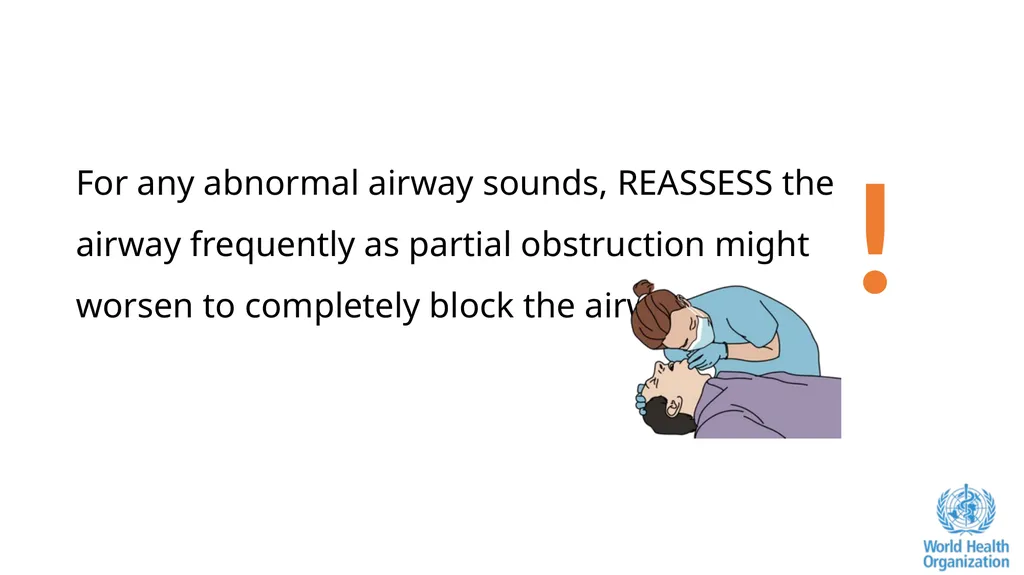
For any abnormal airway sounds, REASSESS the airway frequently as partial obstruction might worsen to completely block the airway. !<br>
41
Breathing Conditions: Tension Pneumothorax Any pneumothorax can become a tension pneumothorax.<br>
42
Breathing Conditions: Suspected Opiate Overdose Opioid drugs (such as morphine, pethidine, oxycodone and heroin) can decrease the body’s drive to breathe. SMALL PUPILS<br>
43
Breathing Conditions: Asthma/ COPD Asthma and COPD are conditions causing spasm in the lower airway.<br>
44
Breathing Conditions:
Large Pleural Effusion/ Haemothorax Pleural effusion occurs when fluid builds up in the space between the lung and the chest wall or diaphragm limiting the expansion of the lungs.<br>
45
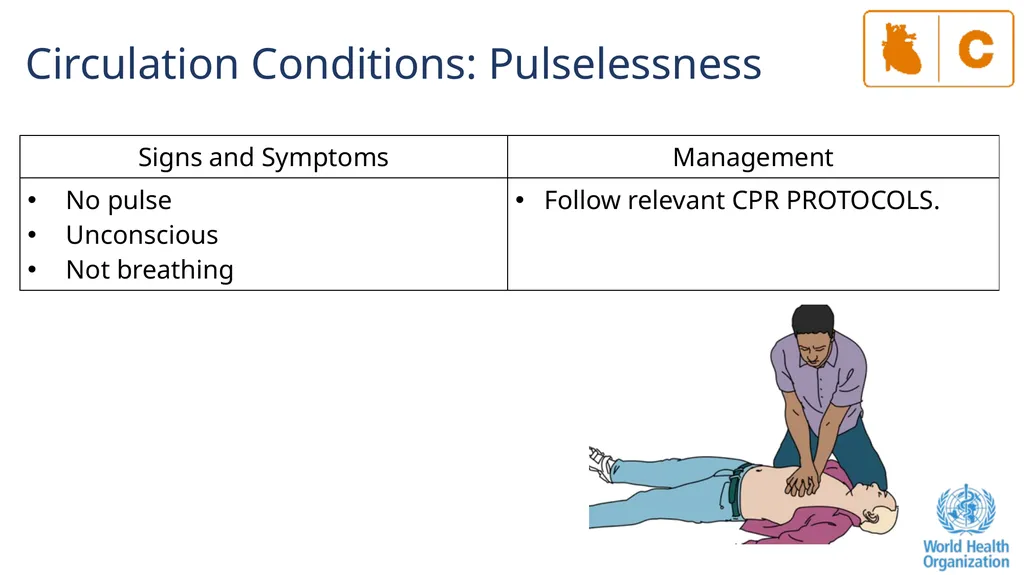
Circulation Conditions: Pulselessness<br>
46
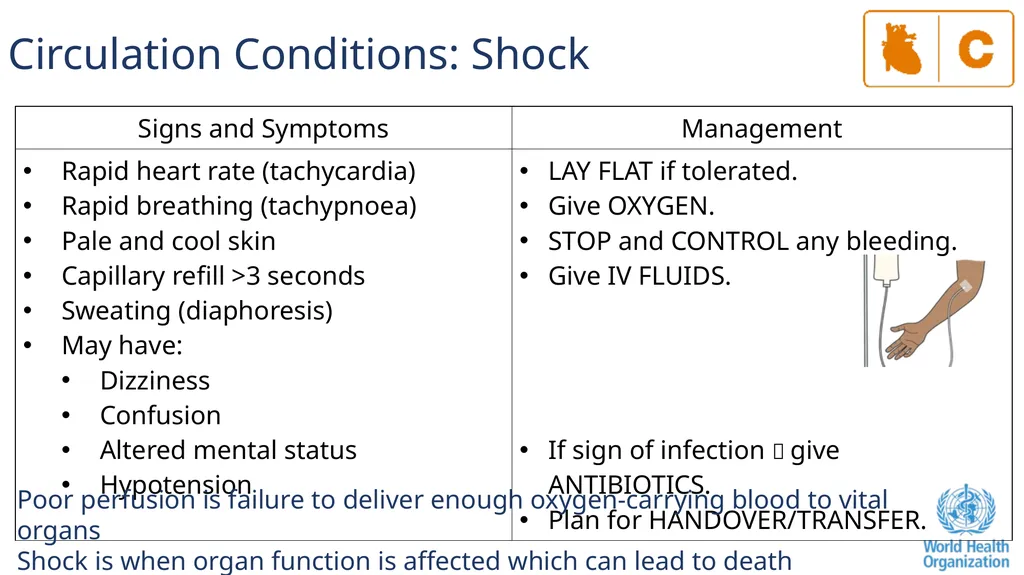
Circulation Conditions: Shock Poor perfusion is failure to deliver enough oxygen-carrying blood to vital organs
Shock is when organ function is affected which can lead to death<br>
Shock is when organ function is affected which can lead to death<br>
47
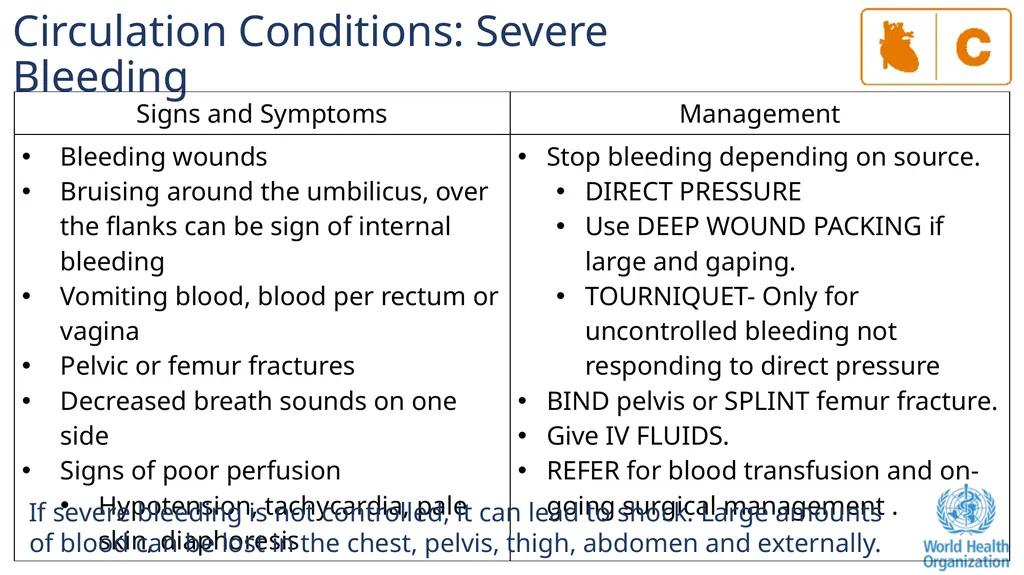
Circulation Conditions: Severe Bleeding If severe bleeding is not controlled, it can lead to shock. Large amounts of blood can be lost in the chest, pelvis, thigh, abdomen and externally.<br>
48
Circulation Conditions:
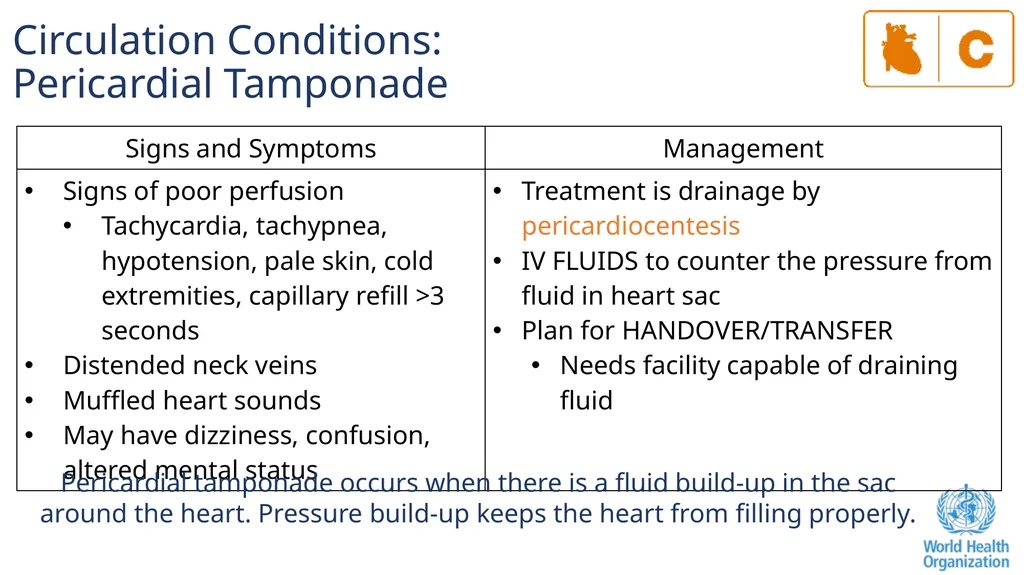
Pericardial Tamponade Pericardial tamponade occurs when there is a fluid build-up in the sac around the heart. Pressure build-up keeps the heart from filling properly.<br>
49
Disability Conditions: Hypoglycaemia<br>
50
Disability Conditions:
Increased Intracranial Pressure Increased ICP can occur from trauma, tumors, increased fluid, bleeding or infection.
Any swelling, fluid or mass increases pressure around the brain, and limits blood flow.<br>
Any swelling, fluid or mass increases pressure around the brain, and limits blood flow.<br>
51
Disability Conditions: Seizure/ Convulsions<br>
52
Exposure Conditions: Snake Bite<br>
53
Reassess ABCDEs Frequently
The ABCDE approach is designed to quickly identify reversible life-threatening conditions.
Vital signs should be checked at the end of the ABCDE approach.
Once you find an ABCDE problem and manage it, you need to GO BACK and repeat the ABCDE again to identify any new problems that have developed and make sure that the management provided worked.
Ideally, the ABCDE approach should be repeated every 15 minutes or with any change in condition. !<br>
The ABCDE approach is designed to quickly identify reversible life-threatening conditions.
Vital signs should be checked at the end of the ABCDE approach.
Once you find an ABCDE problem and manage it, you need to GO BACK and repeat the ABCDE again to identify any new problems that have developed and make sure that the management provided worked.
Ideally, the ABCDE approach should be repeated every 15 minutes or with any change in condition. !<br>
54
Workbook Question 2 Using the workbook section above, list the management for airway blocked by a foreign body.<br>
55
The ABCDE and SAMPLE history approach Part 3: Special Paediatric Considerations, SAMPLE history and Disposition This learning content has been developed in collaboration with the WHO Academy.<br>
56
Special Paediatric Considerations<br>
57
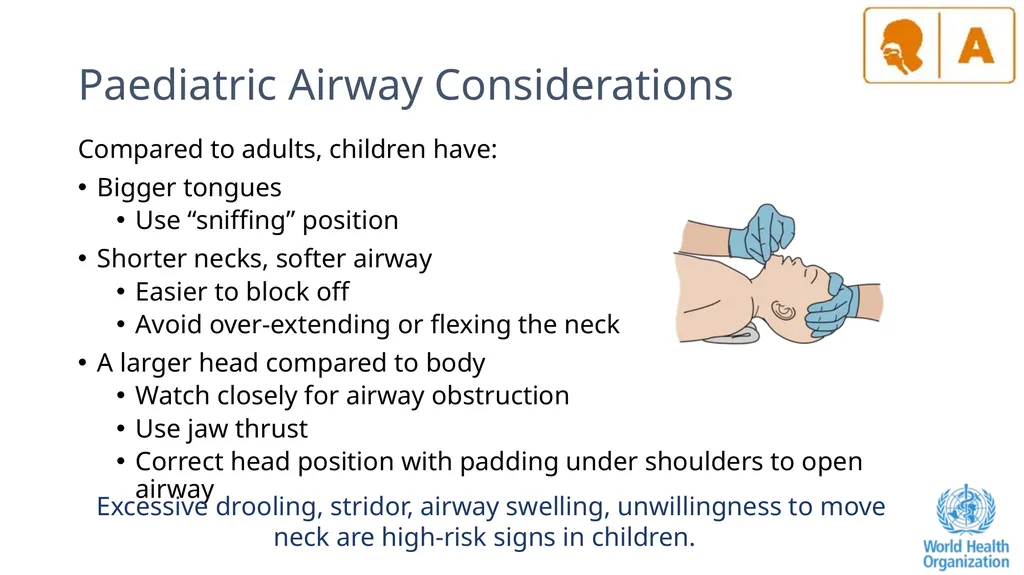
Paediatric Airway Considerations Compared to adults, children have:
Bigger tongues
Use “sniffing” position
Shorter necks, softer airway
Easier to block off
Avoid over-extending or flexing the neck
A larger head compared to body
Watch closely for airway obstruction
Use jaw thrust
Correct head position with padding under shoulders to open airway Excessive drooling, stridor, airway swelling, unwillingness to move neck are high-risk signs in children.<br>
Bigger tongues
Use “sniffing” position
Shorter necks, softer airway
Easier to block off
Avoid over-extending or flexing the neck
A larger head compared to body
Watch closely for airway obstruction
Use jaw thrust
Correct head position with padding under shoulders to open airway Excessive drooling, stridor, airway swelling, unwillingness to move neck are high-risk signs in children.<br>
58
Paediatric Breathing Considerations Look for signs of respiratory distress :
Nasal flaring
Head bobbing
Grunting
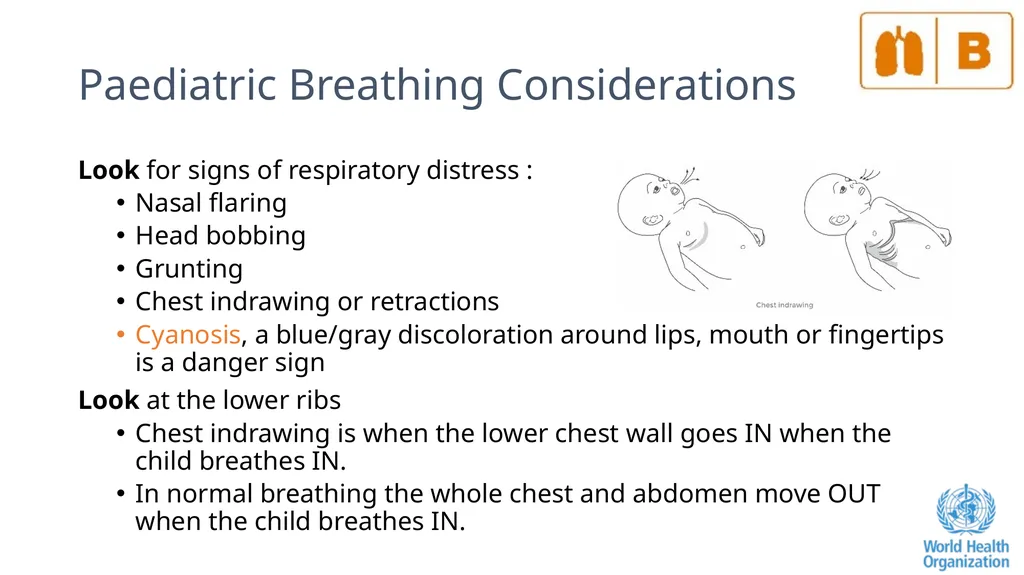
Chest indrawing or retractions
Cyanosis, a blue/gray discoloration around lips, mouth or fingertips is a danger sign
Look at the lower ribs
Chest indrawing is when the lower chest wall goes IN when the child breathes IN.
In normal breathing the whole chest and abdomen move OUT when the child breathes IN.<br>
Nasal flaring
Head bobbing
Grunting
Chest indrawing or retractions
Cyanosis, a blue/gray discoloration around lips, mouth or fingertips is a danger sign
Look at the lower ribs
Chest indrawing is when the lower chest wall goes IN when the child breathes IN.
In normal breathing the whole chest and abdomen move OUT when the child breathes IN.<br>
59
Paediatric Breathing Considerations Listen
Silent chest is a sign of severe distress in a child
Severe spasms and airway narrowing cause limited airway movement and few or no breath sounds may be heard.
Give SALBUTAMOL and OXYGEN.
Reassess frequently.
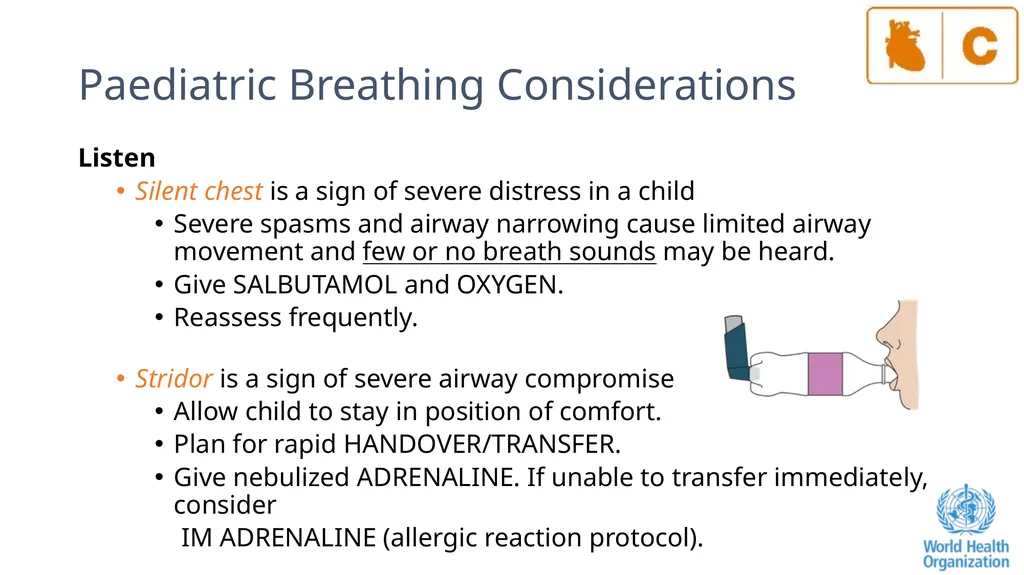
Stridor is a sign of severe airway compromise
Allow child to stay in position of comfort.
Plan for rapid HANDOVER/TRANSFER.
Give nebulized ADRENALINE. If unable to transfer immediately, consider
IM ADRENALINE (allergic reaction protocol).<br>
Silent chest is a sign of severe distress in a child
Severe spasms and airway narrowing cause limited airway movement and few or no breath sounds may be heard.
Give SALBUTAMOL and OXYGEN.
Reassess frequently.
Stridor is a sign of severe airway compromise
Allow child to stay in position of comfort.
Plan for rapid HANDOVER/TRANSFER.
Give nebulized ADRENALINE. If unable to transfer immediately, consider
IM ADRENALINE (allergic reaction protocol).<br>
60
Paediatric Circulation Considerations Low blood pressure in a child is a sign of severe shock.
Children will maintain a normal blood pressure longer than adults but then decompensate quickly.
Always monitor other signs of poor perfusion.
Decreased urine output
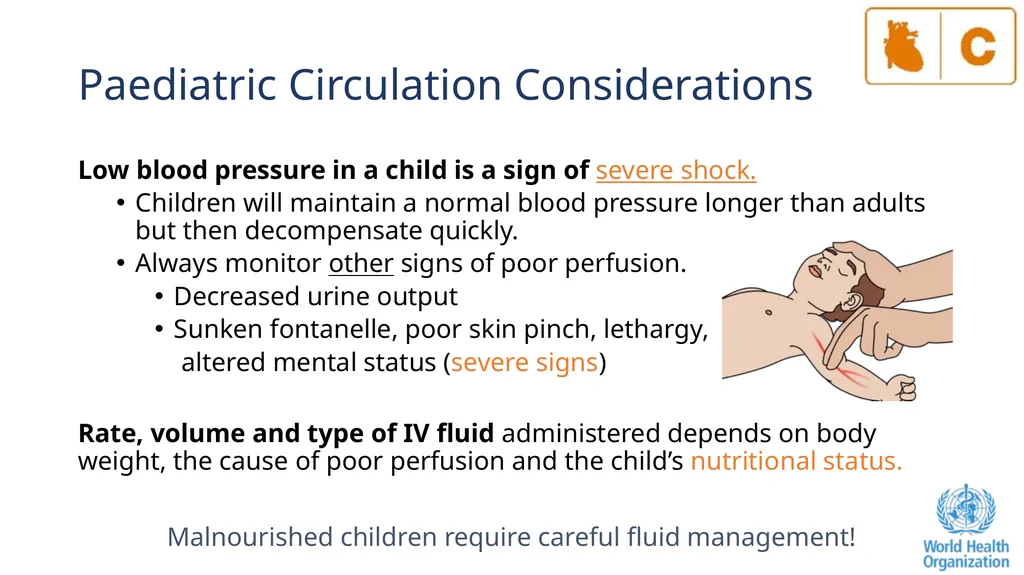
Sunken fontanelle, poor skin pinch, lethargy,
altered mental status (severe signs)
Rate, volume and type of IV fluid administered depends on body weight, the cause of poor perfusion and the child’s nutritional status.
Malnourished children require careful fluid management!<br>
Children will maintain a normal blood pressure longer than adults but then decompensate quickly.
Always monitor other signs of poor perfusion.
Decreased urine output
Sunken fontanelle, poor skin pinch, lethargy,
altered mental status (severe signs)
Rate, volume and type of IV fluid administered depends on body weight, the cause of poor perfusion and the child’s nutritional status.
Malnourished children require careful fluid management!<br>
61
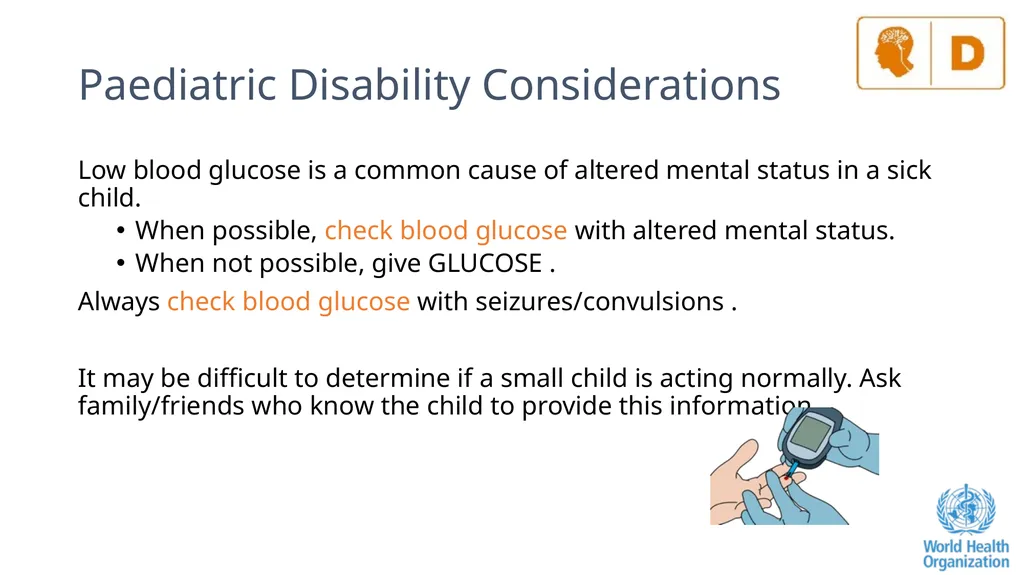
Paediatric Disability Considerations Low blood glucose is a common cause of altered mental status in a sick child.
When possible, check blood glucose with altered mental status.
When not possible, give GLUCOSE .
Always check blood glucose with seizures/convulsions .
It may be difficult to determine if a small child is acting normally. Ask family/friends who know the child to provide this information.<br>
When possible, check blood glucose with altered mental status.
When not possible, give GLUCOSE .
Always check blood glucose with seizures/convulsions .
It may be difficult to determine if a small child is acting normally. Ask family/friends who know the child to provide this information.<br>
62
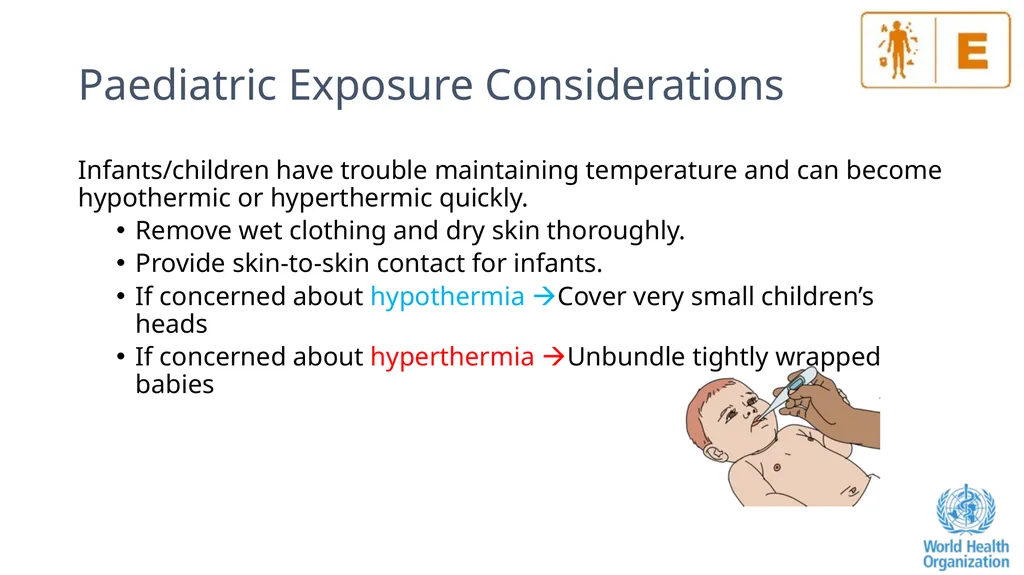
Paediatric Exposure Considerations Infants/children have trouble maintaining temperature and can become hypothermic or hyperthermic quickly.
Remove wet clothing and dry skin thoroughly.
Provide skin-to-skin contact for infants.
If concerned about hypothermia Cover very small children’s heads
If concerned about hyperthermia Unbundle tightly wrapped babies<br>
Remove wet clothing and dry skin thoroughly.
Provide skin-to-skin contact for infants.
If concerned about hypothermia Cover very small children’s heads
If concerned about hyperthermia Unbundle tightly wrapped babies<br>
63
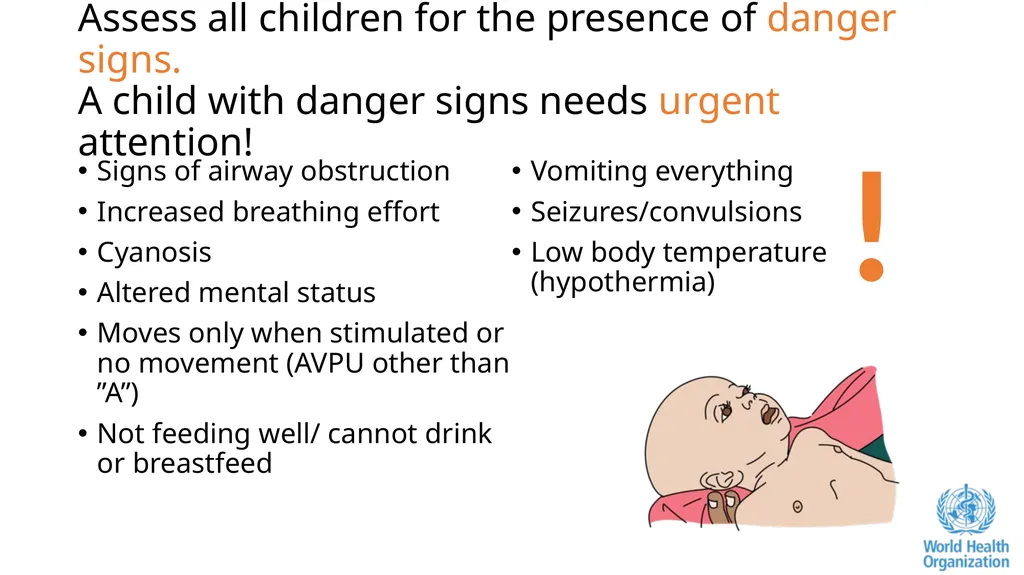
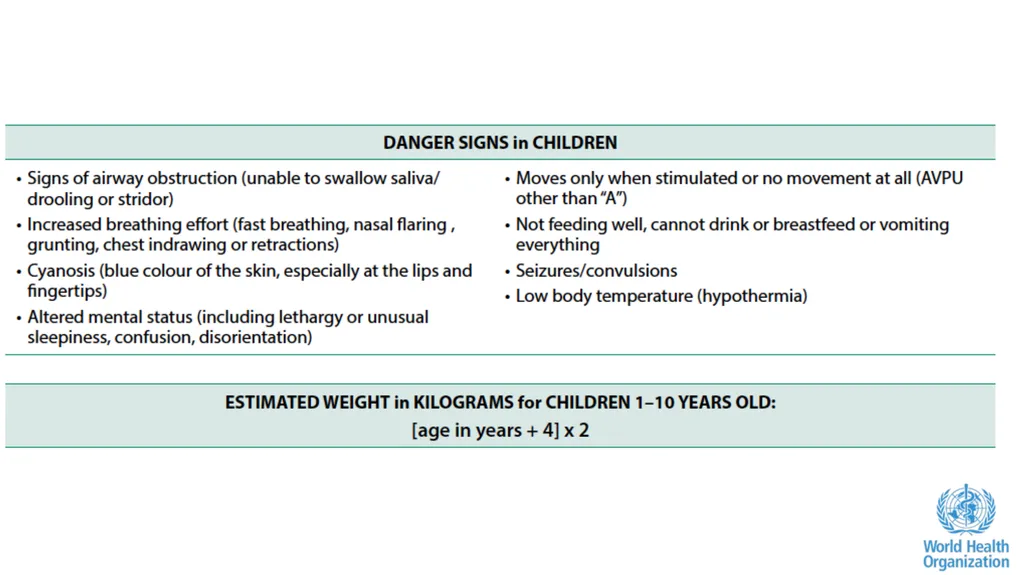
Assess all children for the presence of danger signs.
A child with danger signs needs urgent attention! Signs of airway obstruction
Increased breathing effort
Cyanosis
Altered mental status
Moves only when stimulated or no movement (AVPU other than ”A”)
Not feeding well/ cannot drink or breastfeed
Vomiting everything
Seizures/convulsions
Low body temperature (hypothermia) !<br>
Increased breathing effort
Cyanosis
Altered mental status
Moves only when stimulated or no movement (AVPU other than ”A”)
Not feeding well/ cannot drink or breastfeed
Vomiting everything
Seizures/convulsions
Low body temperature (hypothermia) !<br>
64
Workbook Question 3 Using the workbook section:
One paediatric airway consideration ______________________________
One paediatric breathing consideration ____________________________
One paediatric circulation consideration ___________________________
One paediatric disability consideration _____________________________
One paediatric exposure consideration ____________________________<br>
One paediatric airway consideration ______________________________
One paediatric breathing consideration ____________________________
One paediatric circulation consideration ___________________________
One paediatric disability consideration _____________________________
One paediatric exposure consideration ____________________________<br>
65
ABCDE Approach: Summary<br>
66
REMEMBER If you find a problem with any of the ABCDEs, STOP and CORRECT the problem.
Then, GO BACK and REASSESS the ABCDEs again to identify any new problems that have developed and make sure that the management provided worked. !<br>
Then, GO BACK and REASSESS the ABCDEs again to identify any new problems that have developed and make sure that the management provided worked. !<br>
67
Elements of the SAMPLE history<br>
68
Workbook Question 4 Using the workbook section above, list what the letters in SAMPLE stand for:
S
A
M
P
L
E<br>
S
A
M
P
L
E<br>
69
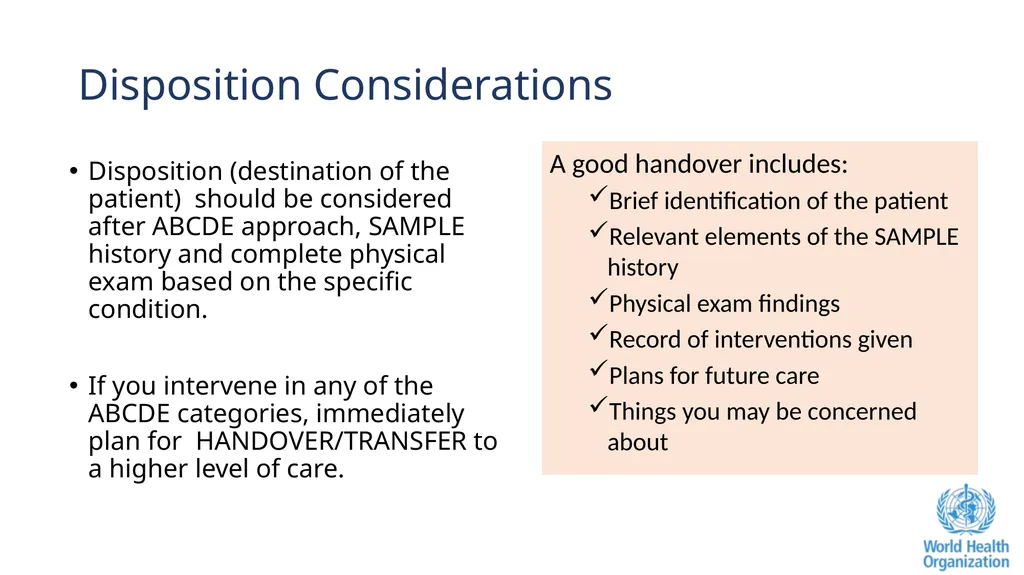
Disposition Considerations Disposition (destination of the patient) should be considered after ABCDE approach, SAMPLE history and complete physical exam based on the specific condition.
If you intervene in any of the ABCDE categories, immediately plan for HANDOVER/TRANSFER to a higher level of care. A good handover includes:
Brief identification of the patient
Relevant elements of the SAMPLE history
Physical exam findings
Record of interventions given
Plans for future care
Things you may be concerned about<br>
If you intervene in any of the ABCDE categories, immediately plan for HANDOVER/TRANSFER to a higher level of care. A good handover includes:
Brief identification of the patient
Relevant elements of the SAMPLE history
Physical exam findings
Record of interventions given
Plans for future care
Things you may be concerned about<br>
70
Questions<br>
71
Quick Cards<br>
72
Summary In this presentation, we have covered:
The hazards and elements that must be considered when approaching an ill or injured person safely
The components of the systematic ABCDE approach to emergency patient
Assessment of each element of the ABCDE approach
Critical management actions for each element of the ABCDE approach
The signs and symptoms of acute life-threatening conditions
The critical ABCDE actions for acute life-threatening conditions
Special paediatric considerations for the ABCDE approach
The elements of a relevant SAMPLE history and how to perform
Disposition considerations for handover/transfer of emergency patients<br>
The hazards and elements that must be considered when approaching an ill or injured person safely
The components of the systematic ABCDE approach to emergency patient
Assessment of each element of the ABCDE approach
Critical management actions for each element of the ABCDE approach
The signs and symptoms of acute life-threatening conditions
The critical ABCDE actions for acute life-threatening conditions
Special paediatric considerations for the ABCDE approach
The elements of a relevant SAMPLE history and how to perform
Disposition considerations for handover/transfer of emergency patients<br>