
The Basics of Supervision: A PowerPoint
A
Published · 45 slides · 0 views

1 / 1




Description
The Basics of Supervision: A PowerPoint Presentation For Practicum and Internship Supervisors Master of Arts in Counseling Lakeland University Dr. Deborah Bilzing Director of the Master of Arts in Counseling Program 1 Before you begin. Each
Related Topics
Share
Embed code
Download this presentation From Below
"The Basics of Supervision: A PowerPoint" is the property of its rightful owner. Permission is granted to download and print the materials on this website for personal, non-commercial use only, and to display it on your personal computer provided you do not modify the materials and that you retain all copyright notices contained in the materials. By downloading content from our website, you accept the terms of this agreement.
Presentation Transcript
01
The Basics of Supervision: A PowerPoint Presentation For Practicum and Internship Supervisors
Master of Arts in Counseling
Lakeland University
Dr. Deborah Bilzing
Director of the Master of Arts in Counseling Program 1<br>
02
Before you begin. Each slide in this presentation is accompanied by some additional notes. The notes have been added to provide more information to each slide. 2<br>
03
This presentation is delivered in Four (4) parts:
Part 1
Describes the purpose of the presentation, definitions of supervision, supervision requirements, approaches to supervision, and supervision goals.
Part 2
Describes the Three Most Common Styles of supervision.
Part 3
Provides more detail about a particular style of supervision that Lakeland believes works best with graduate students in counseling.
Part 4
Describes tips for giving feedback and asks for some additional information concerning the Internship experience. 3<br>
Part 1
Describes the purpose of the presentation, definitions of supervision, supervision requirements, approaches to supervision, and supervision goals.
Part 2
Describes the Three Most Common Styles of supervision.
Part 3
Provides more detail about a particular style of supervision that Lakeland believes works best with graduate students in counseling.
Part 4
Describes tips for giving feedback and asks for some additional information concerning the Internship experience. 3<br>
04
Purpose of this Presentation
This presentation covers the knowledge and skills basic to successful supervision. The goals of this PowerPoint are to:
Share the importance and content of good clinical supervision.
Increase the capacity of the on-site supervisor to provide quality and consistent supervision for our graduate students during their Practicum or Internship experience. 4<br>
Share the importance and content of good clinical supervision.
Increase the capacity of the on-site supervisor to provide quality and consistent supervision for our graduate students during their Practicum or Internship experience. 4<br>
05
PART 1
Supervision…..What is it? 5<br>
06
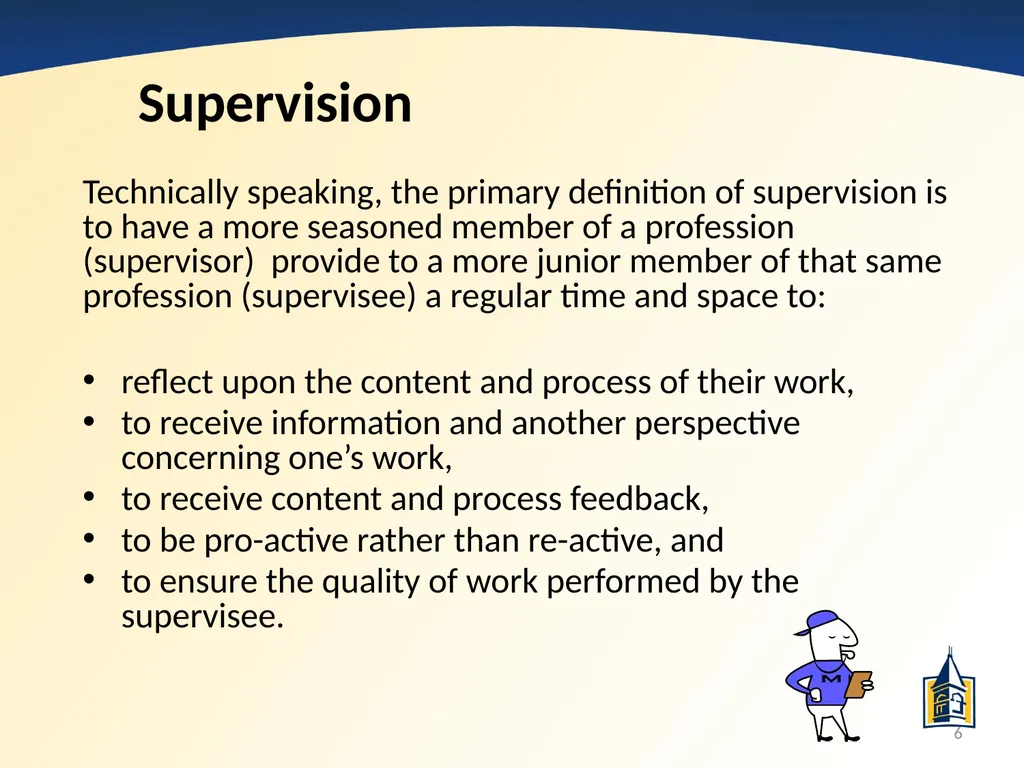
Technically speaking, the primary definition of supervision is to have a more seasoned member of a profession (supervisor) provide to a more junior member of that same profession (supervisee) a regular time and space to:
reflect upon the content and process of their work,
to receive information and another perspective concerning one’s work,
to receive content and process feedback,
to be pro-active rather than re-active, and
to ensure the quality of work performed by the supervisee. Supervision 6<br>
reflect upon the content and process of their work,
to receive information and another perspective concerning one’s work,
to receive content and process feedback,
to be pro-active rather than re-active, and
to ensure the quality of work performed by the supervisee. Supervision 6<br>
07
Supervisor-Supervisee Relationship This relationship between supervisor and supervisee is somewhat evaluative, extends over time, monitors service quality and acts as a gate-keeping process for those who are entering the profession. (Bernard and Goodyear, 2004) 7<br>
08
Supervisor or Coach
Each one of these terms include leadership and a process of either building skills or building upon already established skills. This presentation focuses on the supervisor in both an administrative leadership role and coaching role. 8<br>
Each one of these terms include leadership and a process of either building skills or building upon already established skills. This presentation focuses on the supervisor in both an administrative leadership role and coaching role. 8<br>
09
STOP and THINK:
Do you believe you have the skills and time to be an on-site supervisor?
Why have you decided to take on the role of an on-site supervisor? 9<br>
Do you believe you have the skills and time to be an on-site supervisor?
Why have you decided to take on the role of an on-site supervisor? 9<br>
10
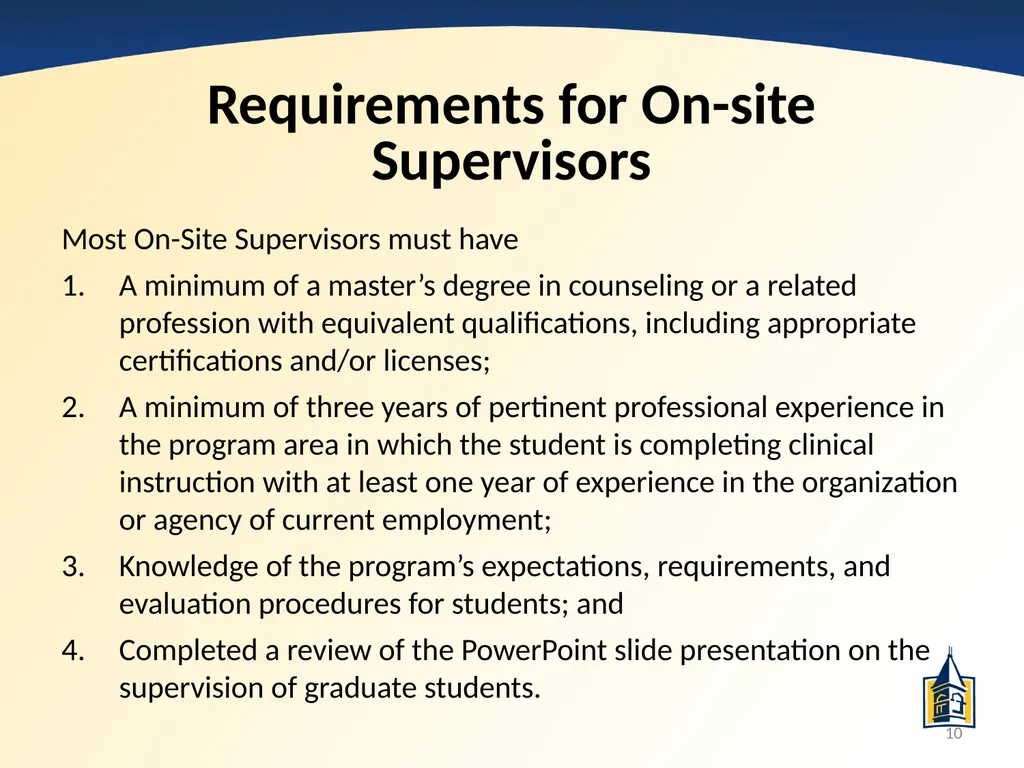
Requirements for On-site Supervisors Most On-Site Supervisors must have
A minimum of a master’s degree in counseling or a related profession with equivalent qualifications, including appropriate certifications and/or licenses;
A minimum of three years of pertinent professional experience in the program area in which the student is completing clinical instruction with at least one year of experience in the organization or agency of current employment;
Knowledge of the program’s expectations, requirements, and evaluation procedures for students; and
Completed a review of the PowerPoint slide presentation on the supervision of graduate students. 10<br>
A minimum of a master’s degree in counseling or a related profession with equivalent qualifications, including appropriate certifications and/or licenses;
A minimum of three years of pertinent professional experience in the program area in which the student is completing clinical instruction with at least one year of experience in the organization or agency of current employment;
Knowledge of the program’s expectations, requirements, and evaluation procedures for students; and
Completed a review of the PowerPoint slide presentation on the supervision of graduate students. 10<br>
11
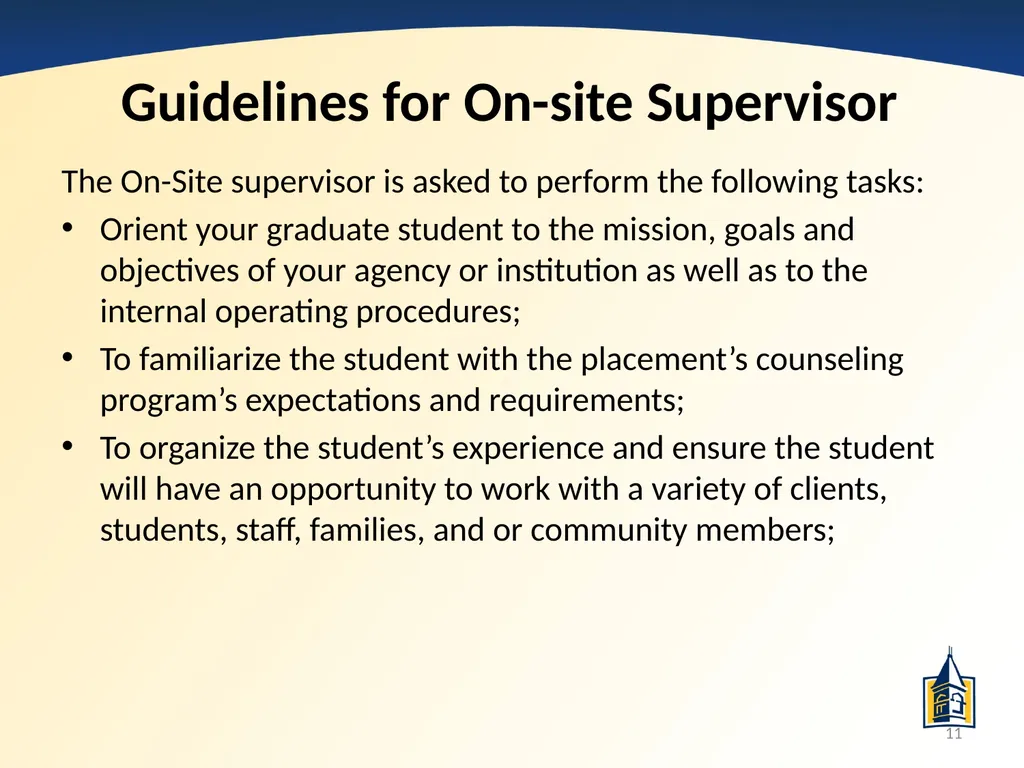
Guidelines for On-site Supervisor The On-Site supervisor is asked to perform the following tasks:
Orient your graduate student to the mission, goals and objectives of your agency or institution as well as to the internal operating procedures;
To familiarize the student with the placement’s counseling program’s expectations and requirements;
To organize the student’s experience and ensure the student will have an opportunity to work with a variety of clients, students, staff, families, and or community members; 11<br>
Orient your graduate student to the mission, goals and objectives of your agency or institution as well as to the internal operating procedures;
To familiarize the student with the placement’s counseling program’s expectations and requirements;
To organize the student’s experience and ensure the student will have an opportunity to work with a variety of clients, students, staff, families, and or community members; 11<br>
12
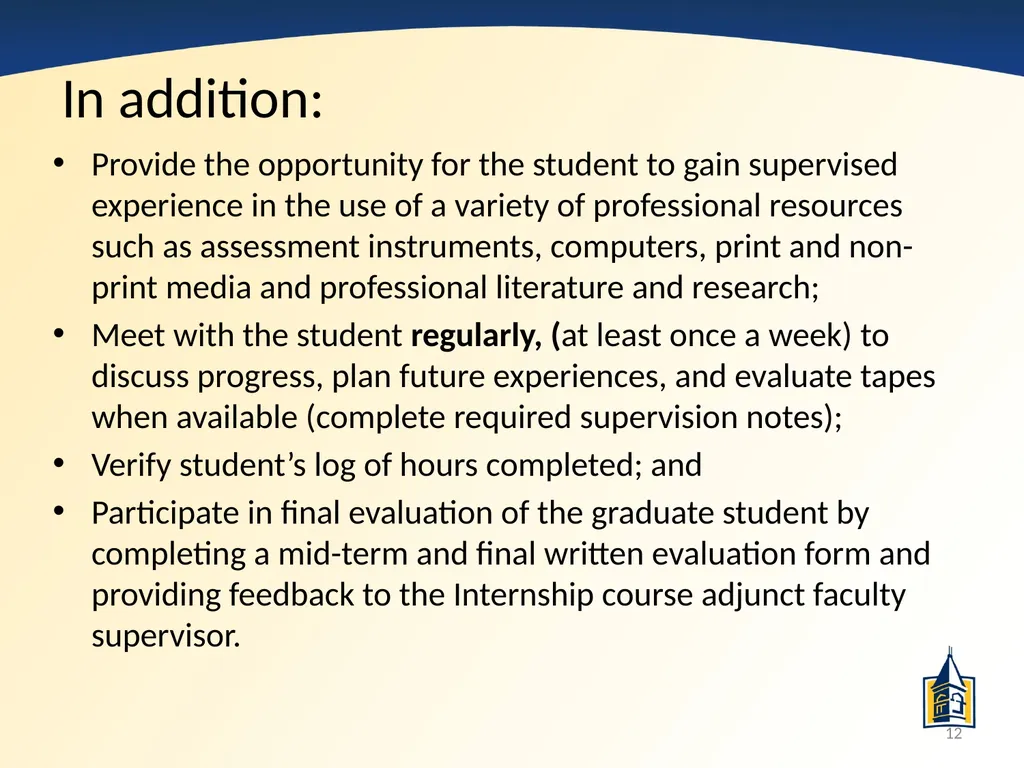
In addition: Provide the opportunity for the student to gain supervised experience in the use of a variety of professional resources such as assessment instruments, computers, print and non-print media and professional literature and research;
Meet with the student regularly, (at least once a week) to discuss progress, plan future experiences, and evaluate tapes when available (complete required supervision notes);
Verify student’s log of hours completed; and
Participate in final evaluation of the graduate student by completing a mid-term and final written evaluation form and providing feedback to the Internship course adjunct faculty supervisor. 12<br>
Meet with the student regularly, (at least once a week) to discuss progress, plan future experiences, and evaluate tapes when available (complete required supervision notes);
Verify student’s log of hours completed; and
Participate in final evaluation of the graduate student by completing a mid-term and final written evaluation form and providing feedback to the Internship course adjunct faculty supervisor. 12<br>
13
Successful On-Site Supervisors are Proactive Supervisors who use a proactive strategy seek to avoid major supervisory challenges through:
Planning
Communicating
Being involved
Being open and honest 13<br>
Planning
Communicating
Being involved
Being open and honest 13<br>
14
Approaches to Supervision Vision
Goals
Coaching
Support 14<br>
Goals
Coaching
Support 14<br>
15
Lakeland’s vision of supervision
As a Practicum or Internship supervisor you will enhance our graduate student’s personal and professional development. On-Site Supervisors will oversee and evaluate how well students integrate and apply the knowledge, skills, and dispositions learned in their previous program coursework. 15<br>
16
2. Goals
What goals would you set as an
On-site supervisor? 16<br>
17
1. Provide the student with regular supervision grounded in best practices. Challenge your student’s assumptions.
2. Assist the student in clarifying counseling theories helping to align the student’s practice with his/her chosen theory.
3. Provide specific activities and experiences for your student to engage in during his/her placement. 17 Six (6) goals for On-site Supervisors<br>
18
Six (6) goals continued 4. Assess and evaluate your student’s knowledge, skills, and disposition on a regular basis and complete the student’s evaluations at each point during and at the end of the “clinical” placement. (Gatekeeping responsibilities)
5. Adhere to agency, licensing, and accrediting requirements of your profession.
6. Support and monitor the legal, ethical, and cultural competency issues that are a part of the counseling field. 18<br>
19
Five (5) Activities that can support these goals Meeting one to one
Modeling
Suggestions to improve professional practice
Observations
Providing the opportunity for the student to meet with other agency or institutional staff 19<br>
Modeling
Suggestions to improve professional practice
Observations
Providing the opportunity for the student to meet with other agency or institutional staff 19<br>
20
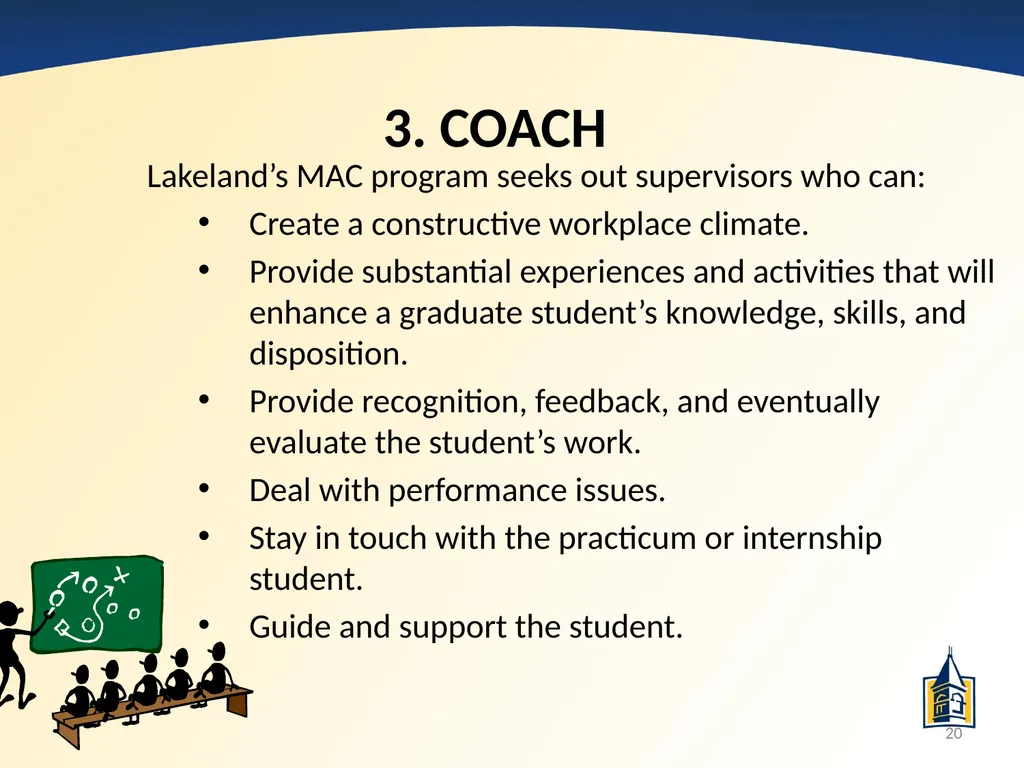
3. Coach Lakeland’s MAC program seeks out supervisors who can:
Create a constructive workplace climate.
Provide substantial experiences and activities that will enhance a graduate student’s knowledge, skills, and disposition.
Provide recognition, feedback, and eventually evaluate the student’s work.
Deal with performance issues.
Stay in touch with the practicum or internship student.
Guide and support the student. 20<br>
Create a constructive workplace climate.
Provide substantial experiences and activities that will enhance a graduate student’s knowledge, skills, and disposition.
Provide recognition, feedback, and eventually evaluate the student’s work.
Deal with performance issues.
Stay in touch with the practicum or internship student.
Guide and support the student. 20<br>
21
4. Support Before agreeing to supervise a graduate student, please consider these environmental issues:
Is your agency/institution agreeable to being a placement site?
Is your supervisor supportive of your aspiration to be an On-Site supervisor?
Do you feel you have the support of the Lakeland Course Instructor? 21<br>
Is your agency/institution agreeable to being a placement site?
Is your supervisor supportive of your aspiration to be an On-Site supervisor?
Do you feel you have the support of the Lakeland Course Instructor? 21<br>
22
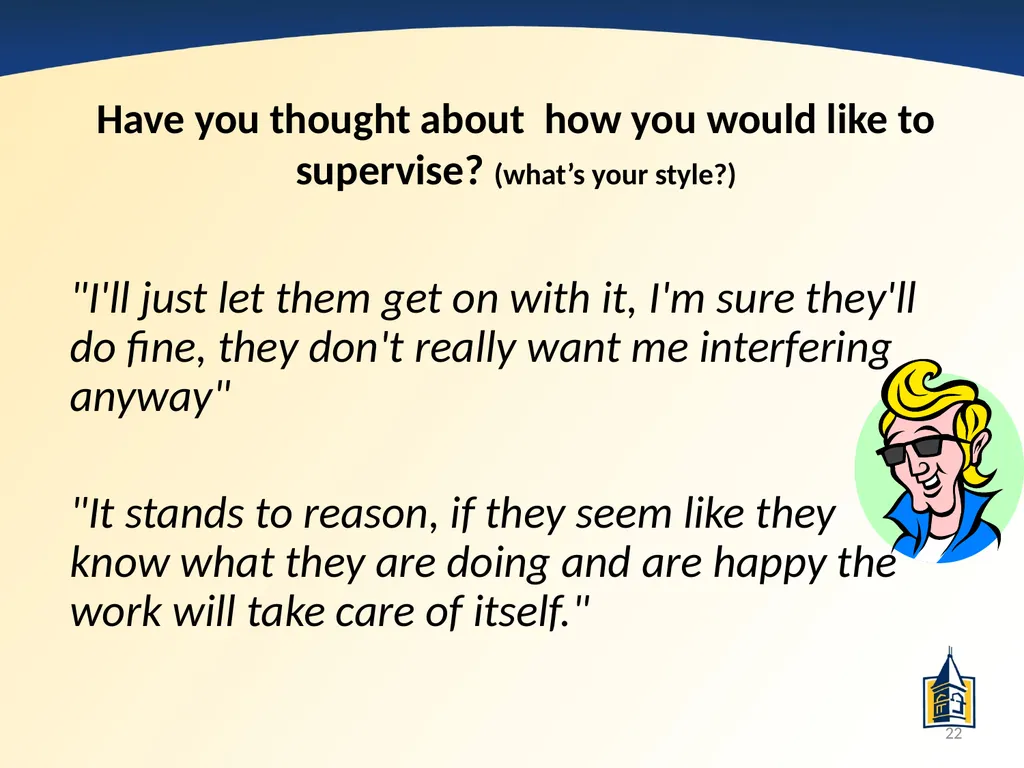
Have you thought about how you would like to supervise? (what’s your style?) "I'll just let them get on with it, I'm sure they'll do fine, they don't really want me interfering anyway"
"It stands to reason, if they seem like they know what they are doing and are happy the work will take care of itself." 22<br>
"It stands to reason, if they seem like they know what they are doing and are happy the work will take care of itself." 22<br>
23
Part 2 Styles of Supervision 23<br>
24
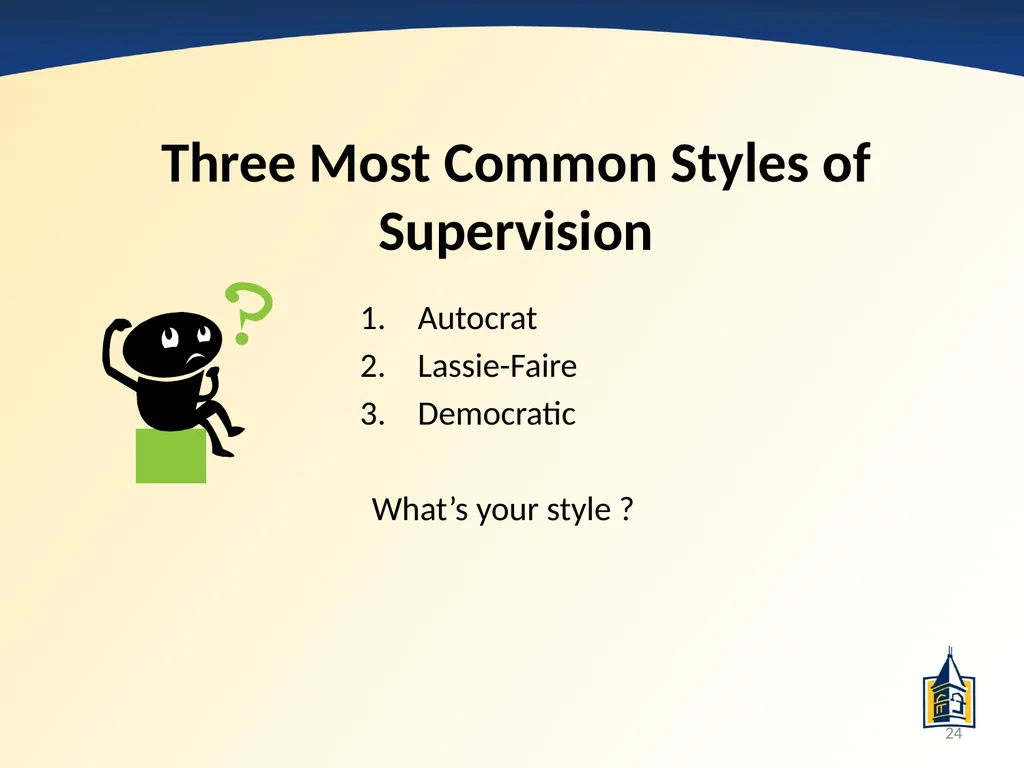
Three Most Common Styles of Supervision Autocrat
Lassie-Faire
Democratic
What’s your style ? 24<br>
Lassie-Faire
Democratic
What’s your style ? 24<br>
25
The Autocrat Supervisor
The autocratic supervisor dominates the practicum or internship student and doesn’t seem to trust the student’s skills or knowledge.
This approach to supervision generally results in passive resistance from the student and requires continual pressure and direction from the supervisor in order to get things done. 25<br>
The autocratic supervisor dominates the practicum or internship student and doesn’t seem to trust the student’s skills or knowledge.
This approach to supervision generally results in passive resistance from the student and requires continual pressure and direction from the supervisor in order to get things done. 25<br>
26
Instances where an autocratic style of supervision may be appropriate.
Some situations may call for urgent action and in these cases an autocratic style of supervision may be best. 26<br>
Some situations may call for urgent action and in these cases an autocratic style of supervision may be best. 26<br>
27
The Laissez-Faire Supervisor
The Laissez-Faire supervisor exercises little control over the practicum or internship student, leaving the student to sort out his/her roles and tackle their work without participating in the process. 27<br>
The Laissez-Faire supervisor exercises little control over the practicum or internship student, leaving the student to sort out his/her roles and tackle their work without participating in the process. 27<br>
28
There are also situations where the Laissez-Faire approach can be effective.
When supervising highly motivated and skilled individuals who have produced excellent work in the past.
By handing over ownership, a supervisor can empower their student to achieve their practicum or internship goals. 28<br>
When supervising highly motivated and skilled individuals who have produced excellent work in the past.
By handing over ownership, a supervisor can empower their student to achieve their practicum or internship goals. 28<br>
29
The Democratic Supervisor
The democratic supervisor makes decisions by consulting with the practicum or internship student while still maintaining some control over the placement experience. The democratic supervisor allows the student to be a part of deciding how and when the task will be tackled and provides input when needed. 29<br>
The democratic supervisor makes decisions by consulting with the practicum or internship student while still maintaining some control over the placement experience. The democratic supervisor allows the student to be a part of deciding how and when the task will be tackled and provides input when needed. 29<br>
30
A good democratic supervisor:
Encourages participation and delegates wisely and never loses sight of the fact that he/she bears the crucial responsibility of the placement experience.
Values discussion and input from the student and can be seen as drawing from a pool of the student’s strong skills in order to obtain the student’s best performance. 30<br>
Encourages participation and delegates wisely and never loses sight of the fact that he/she bears the crucial responsibility of the placement experience.
Values discussion and input from the student and can be seen as drawing from a pool of the student’s strong skills in order to obtain the student’s best performance. 30<br>
31
What style is the best to use for supervising counseling graduate students? 31<br>
32
You are right, the Democratic Style of Supervision 32<br>
33
Part 3 The Democratic Style of Supervision 33<br>
34
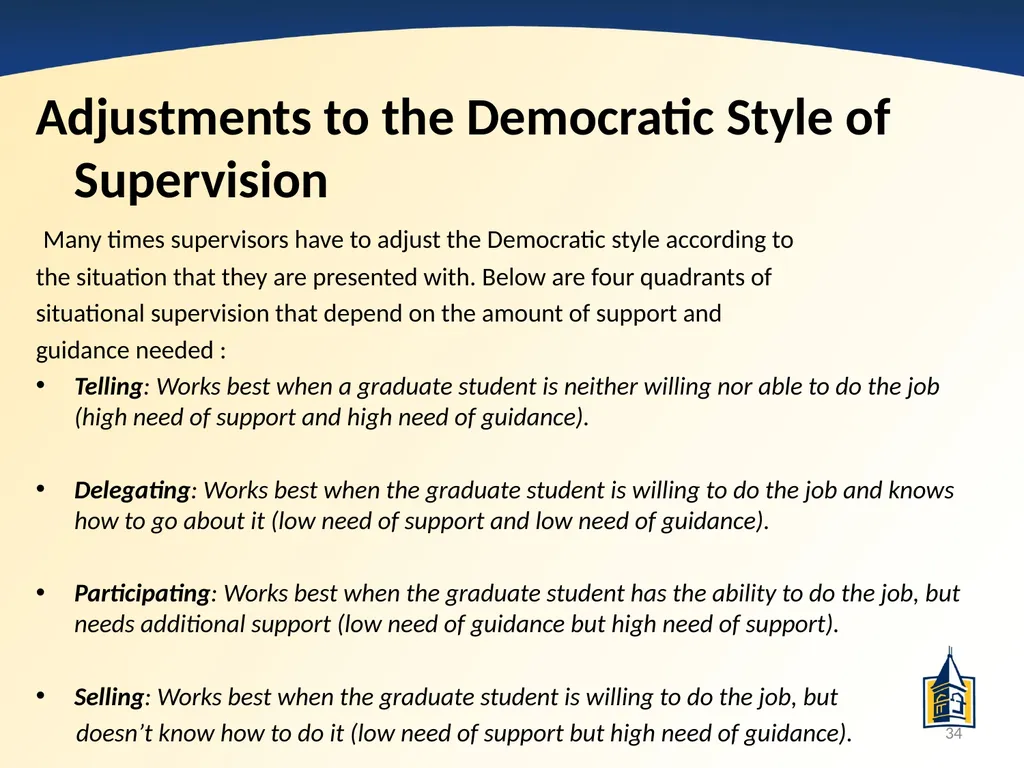
Adjustments to the Democratic Style of Supervision
Many times supervisors have to adjust the Democratic style according to
the situation that they are presented with. Below are four quadrants of
situational supervision that depend on the amount of support and
guidance needed :
Telling: Works best when a graduate student is neither willing nor able to do the job (high need of support and high need of guidance).
Delegating: Works best when the graduate student is willing to do the job and knows how to go about it (low need of support and low need of guidance).
Participating: Works best when the graduate student has the ability to do the job, but needs additional support (low need of guidance but high need of support).
Selling: Works best when the graduate student is willing to do the job, but
doesn’t know how to do it (low need of support but high need of guidance). 34<br>
Many times supervisors have to adjust the Democratic style according to
the situation that they are presented with. Below are four quadrants of
situational supervision that depend on the amount of support and
guidance needed :
Telling: Works best when a graduate student is neither willing nor able to do the job (high need of support and high need of guidance).
Delegating: Works best when the graduate student is willing to do the job and knows how to go about it (low need of support and low need of guidance).
Participating: Works best when the graduate student has the ability to do the job, but needs additional support (low need of guidance but high need of support).
Selling: Works best when the graduate student is willing to do the job, but
doesn’t know how to do it (low need of support but high need of guidance). 34<br>
35
Is one quadrant of the democratic style of supervision better than the other?
Practice Slides
Listed on the next couple of slides are some supervisory situations. If you have time and would like to, you are invited to read the situations and decide for yourself which of the four quadrants would work best in each situation. 35<br>
Practice Slides
Listed on the next couple of slides are some supervisory situations. If you have time and would like to, you are invited to read the situations and decide for yourself which of the four quadrants would work best in each situation. 35<br>
36
Situation 1
You are considering a major change in your counseling program. The graduate student has a fine record of accomplishment and a strong commitment to excellence. The student is supportive of the need for change and has been involved in the planning.
What quadrant of the democratic style would be best to use in this situation? 36<br>
You are considering a major change in your counseling program. The graduate student has a fine record of accomplishment and a strong commitment to excellence. The student is supportive of the need for change and has been involved in the planning.
What quadrant of the democratic style would be best to use in this situation? 36<br>
37
Situation 2
During the past few months the quality of work done by your graduate student has been outstanding. The student has met all of your performance expectations. You are very pleased with his/her knowledge, skills, and disposition as a counselor.
What quadrant of the democratic style would be best to use in this situation? 37<br>
During the past few months the quality of work done by your graduate student has been outstanding. The student has met all of your performance expectations. You are very pleased with his/her knowledge, skills, and disposition as a counselor.
What quadrant of the democratic style would be best to use in this situation? 37<br>
38
Situation 3
The graduate student appears to be having serious problems understanding his/her role and engaging in your counseling program. The student’s performance seems been going downhill rapidly and he/she has not responded to your efforts to be friendly or your expressions of concern for his/her welfare.
What quadrant of the democratic style would be best to use in this situation? 38<br>
The graduate student appears to be having serious problems understanding his/her role and engaging in your counseling program. The student’s performance seems been going downhill rapidly and he/she has not responded to your efforts to be friendly or your expressions of concern for his/her welfare.
What quadrant of the democratic style would be best to use in this situation? 38<br>
39
Situation 4
Performance and interpersonal relations among the graduate student, you, your faculty or staff, students, and parents or community members has been great. As a result, you have normally left the student alone. However, a new situation has developed and it appears that the student seems unable to address or solve the situation on their own.
What quadrant of the democratic style would be best to use in this situation? 39<br>
Performance and interpersonal relations among the graduate student, you, your faculty or staff, students, and parents or community members has been great. As a result, you have normally left the student alone. However, a new situation has developed and it appears that the student seems unable to address or solve the situation on their own.
What quadrant of the democratic style would be best to use in this situation? 39<br>
40
Answers Situation 1- Selling
Situation 2- Delegating
Situation 3- Telling
Situation 4- Participating
How would you carry out this particular quadrant? 40<br>
Situation 2- Delegating
Situation 3- Telling
Situation 4- Participating
How would you carry out this particular quadrant? 40<br>
41
Part 4 Tips for Giving Feedback
“there is no question that feedback may be one of the most difficult arenas to negotiate in our lives. We should remember though, that victory is not getting good feedback, avoiding giving difficult feedback, or avoiding the need for feedback. Instead it’s taking off the armor, showing up, and engaging.” -Brene Brown 41<br>
“there is no question that feedback may be one of the most difficult arenas to negotiate in our lives. We should remember though, that victory is not getting good feedback, avoiding giving difficult feedback, or avoiding the need for feedback. Instead it’s taking off the armor, showing up, and engaging.” -Brene Brown 41<br>
42
10 Tips for Giving Feedback Focus on the action or behavior not the person.
Feedback should describe the action or behavior rather than evaluate it.
Useful feedback is specific rather than general.
Feedback should be well timed, appropriate, and as immediate as possible.
Feedback should focus on the positive for the most part.
Feedback should be limited to what the person can use not all you can give.
Feedback should focus on alternatives rather than reaching one solution.
Check for understanding.
Focus on information not feelings.
Verbal feedback needs to be in alignment with non-verbal behavior. 42<br>
Feedback should describe the action or behavior rather than evaluate it.
Useful feedback is specific rather than general.
Feedback should be well timed, appropriate, and as immediate as possible.
Feedback should focus on the positive for the most part.
Feedback should be limited to what the person can use not all you can give.
Feedback should focus on alternatives rather than reaching one solution.
Check for understanding.
Focus on information not feelings.
Verbal feedback needs to be in alignment with non-verbal behavior. 42<br>
43
Finally and Almost to the End Hopefully you have found this PowerPoint presentation to be helpful as you begin your On-Site Supervisor role in our MAC program. Just a few more pieces of information that will help to ensure your success as a supervisor and the success of your practicum or internship student:
Make sure your graduate student has given you a copy of the MAC Supervisor Handbook- Review the Handbook during your first meeting and discuss any concerns that you or your student might have.
Ask the your student to provide you with a copy of his/her placement goals.
Ask your student to describe his/her strengths and challenges.
Review Contact information: yours, the student’s, and the instructor’s. 43<br>
Make sure your graduate student has given you a copy of the MAC Supervisor Handbook- Review the Handbook during your first meeting and discuss any concerns that you or your student might have.
Ask the your student to provide you with a copy of his/her placement goals.
Ask your student to describe his/her strengths and challenges.
Review Contact information: yours, the student’s, and the instructor’s. 43<br>
44
Websites Describing Various Supervision Models https://www.counseling.org/resources/library/ERIC%20Digests/94-08.pdf
http://www.marquette.edu/education/grad/documents/Brief-Summary-of-Supervision-Models.pdf
https://www.txca.org/images/tca/TheoriesofSupervision/TheoriesofSupervision9.html 44<br>
http://www.marquette.edu/education/grad/documents/Brief-Summary-of-Supervision-Models.pdf
https://www.txca.org/images/tca/TheoriesofSupervision/TheoriesofSupervision9.html 44<br>
45
THANK YOU! Once again, thank you for your willingness to supervise a MAC practicum or internship student and taking time to review this PowerPoint presentation.
Now that you have completed the training, please send an email message to;
Deborah Bilzing at
BilzingDJ@lakeland.edu
indicating that you have reviewed and completed the presentation. In addition, please feel free to include any feedback you think would enhance the presentation.
Fondly,
Deborah Bilzing, Ed.D.,NCC
Director of the Master of Arts in Counseling Program 45<br>
Now that you have completed the training, please send an email message to;
Deborah Bilzing at
BilzingDJ@lakeland.edu
indicating that you have reviewed and completed the presentation. In addition, please feel free to include any feedback you think would enhance the presentation.
Fondly,
Deborah Bilzing, Ed.D.,NCC
Director of the Master of Arts in Counseling Program 45<br>