"The Comprehensive Rapid Literacy Assessment CIES" is the property of its rightful owner. Permission is granted to
download and print the materials on this website for personal, non-commercial use only, and to display it
on your personal computer provided you do not modify the materials and that you retain all copyright
notices contained in the materials. By downloading content from our website, you accept the terms of this
agreement.
Presentation Transcript
01
The Comprehensive Rapid Literacy Assessment CIES 2022
April 20, 2022 Mitch Rakusin, Senior Education Research Analyst, RTI International
Email: mrakusin@rti.org
Janice Perez, Learning Resource Specialist, ABC+
Email: jperez@abcplus.rti.org Experience from the development and implementation of a teacher-led formative assessment in the Philippines<br>
02
Outline Overview and Rationale
Structure and content
Co-design/development process
Pilot experience
Scale and expansion
Lessons learnt and next steps 2<br>
03
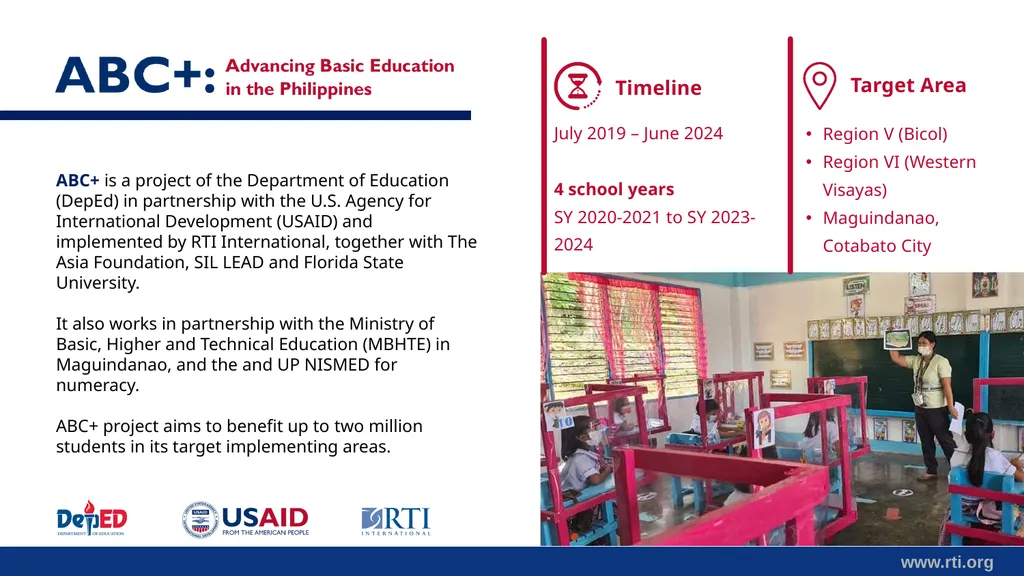
ABC+ is a project of the Department of Education (DepEd) in partnership with the U.S. Agency for International Development (USAID) and implemented by RTI International, together with The Asia Foundation, SIL LEAD and Florida State University.
It also works in partnership with the Ministry of Basic, Higher and Technical Education (MBHTE) in Maguindanao, and the and UP NISMED for numeracy.
ABC+ project aims to benefit up to two million students in its target implementing areas. Region V (Bicol)
Region VI (Western Visayas)
Maguindanao, Cotabato City Target Area Timeline July 2019 – June 2024
4 school years
SY 2020-2021 to SY 2023-2024<br>
04
The Genesis of the CRLA The Challenge
At the beginning of SY 2020-2021, children had 32 weeks of extended break due to the Pandemic.
Teachers needed a formative assessment tool to quickly identify their learners’ reading proficiency levels to target reading interventions at their level
Links to national guidance on assessment in the Pandemic Design Requirements
Valid and reliable
Rapid (10 minutes or less) and easy to administer
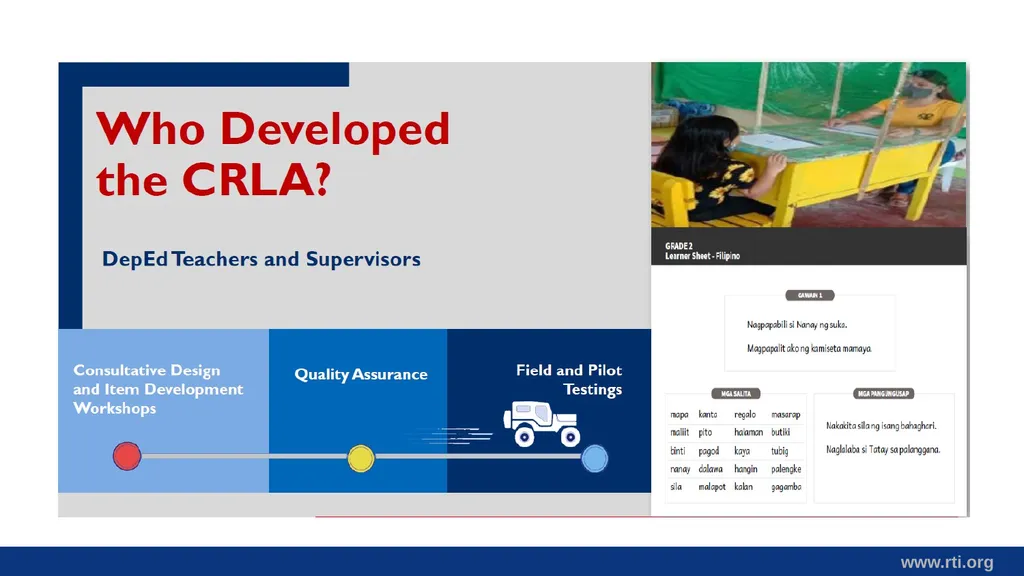
Teacher-led, teacher-scored
Low tech, multi-modal (online, face to face)
Standardized and Benchmarked against the most essential learning competencies (MELCs)
Replicable, scalable and sustainable<br>
05
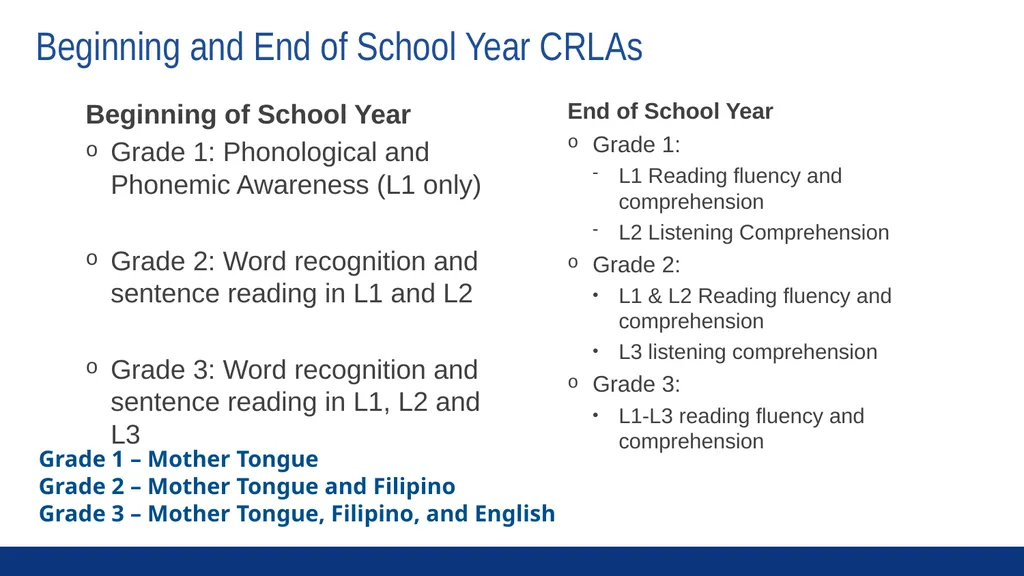
Beginning and End of School Year CRLAs Beginning of School Year
Grade 1: Phonological and Phonemic Awareness (L1 only)
Grade 2: Word recognition and sentence reading in L1 and L2
Grade 3: Word recognition and sentence reading in L1, L2 and L3 End of School Year
Grade 1:
L1 Reading fluency and comprehension
L2 Listening Comprehension
Grade 2:
L1 & L2 Reading fluency and comprehension
L3 listening comprehension
Grade 3:
L1-L3 reading fluency and comprehension Grade 1 – Mother Tongue
Grade 2 – Mother Tongue and Filipino
Grade 3 – Mother Tongue, Filipino, and English<br>
06
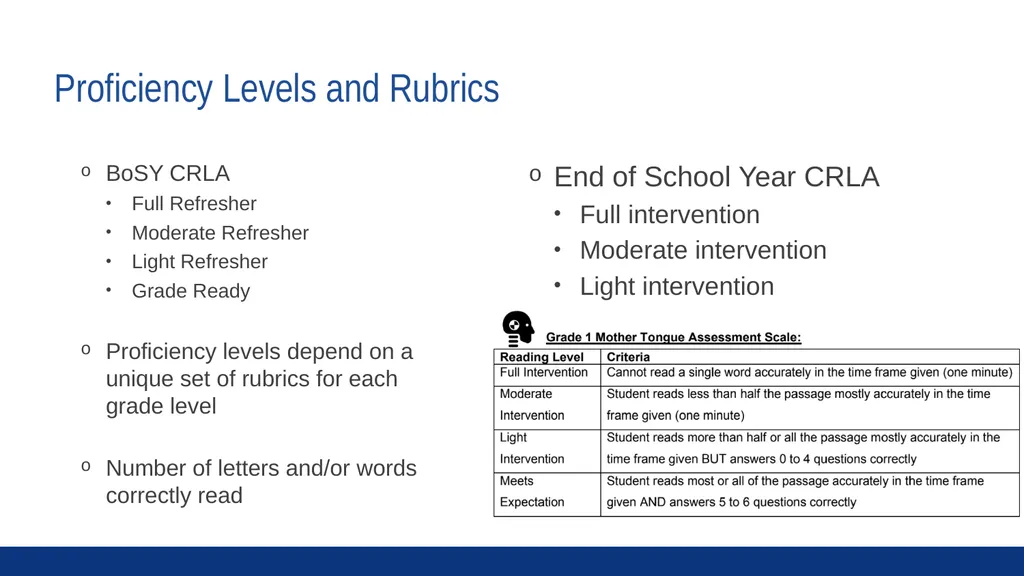
Proficiency Levels and Rubrics BoSY CRLA
Full Refresher
Moderate Refresher
Light Refresher
Grade Ready
Proficiency levels depend on a unique set of rubrics for each grade level
Number of letters and/or words correctly read End of School Year CRLA
Full intervention
Moderate intervention
Light intervention
Meets expectations<br>
07
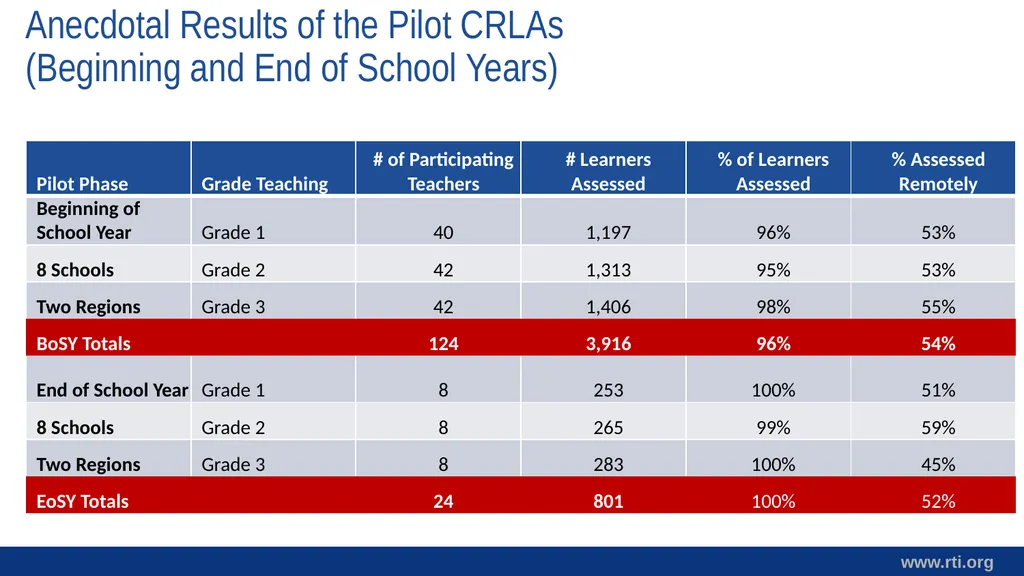
Anecdotal Results of the Pilot CRLAs (Beginning and End of School Years)<br>
08
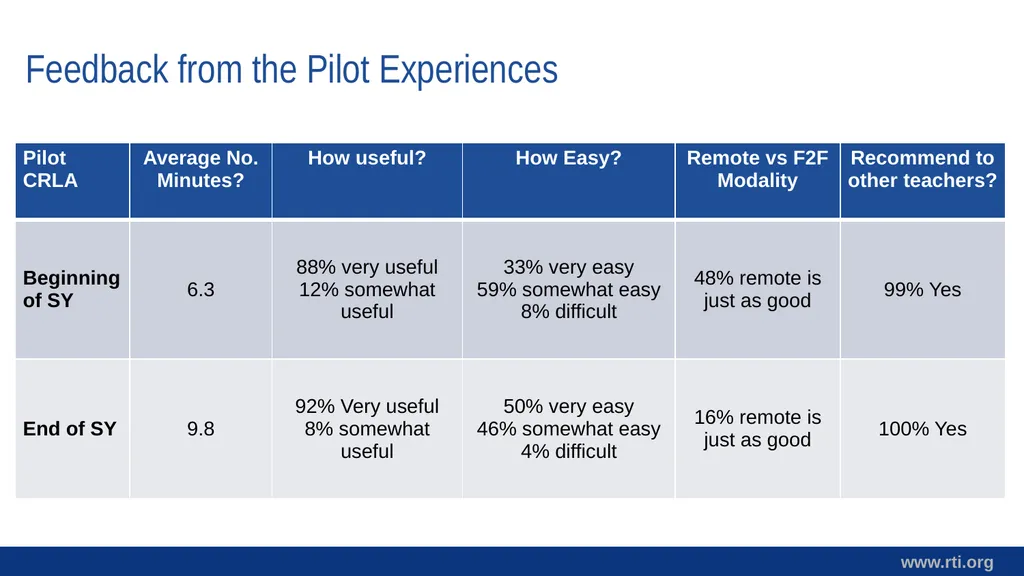
Feedback from the Pilot Experiences<br>
09
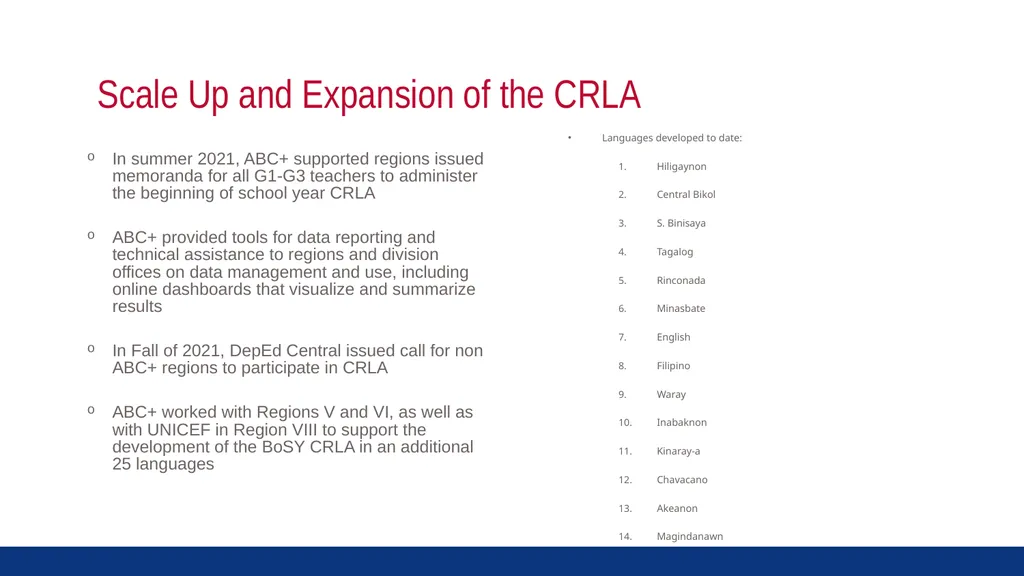
In summer 2021, ABC+ supported regions issued memoranda for all G1-G3 teachers to administer the beginning of school year CRLA
ABC+ provided tools for data reporting and technical assistance to regions and division offices on data management and use, including online dashboards that visualize and summarize results
In Fall of 2021, DepEd Central issued call for non ABC+ regions to participate in CRLA
ABC+ worked with Regions V and VI, as well as with UNICEF in Region VIII to support the development of the BoSY CRLA in an additional 25 languages Scale Up and Expansion of the CRLA Languages developed to date:
Hiligaynon
Central Bikol
S. Binisaya
Tagalog
Rinconada
Minasbate
English
Filipino
Waray
Inabaknon
Kinaray-a
Chavacano
Akeanon
Magindanawn<br>
10
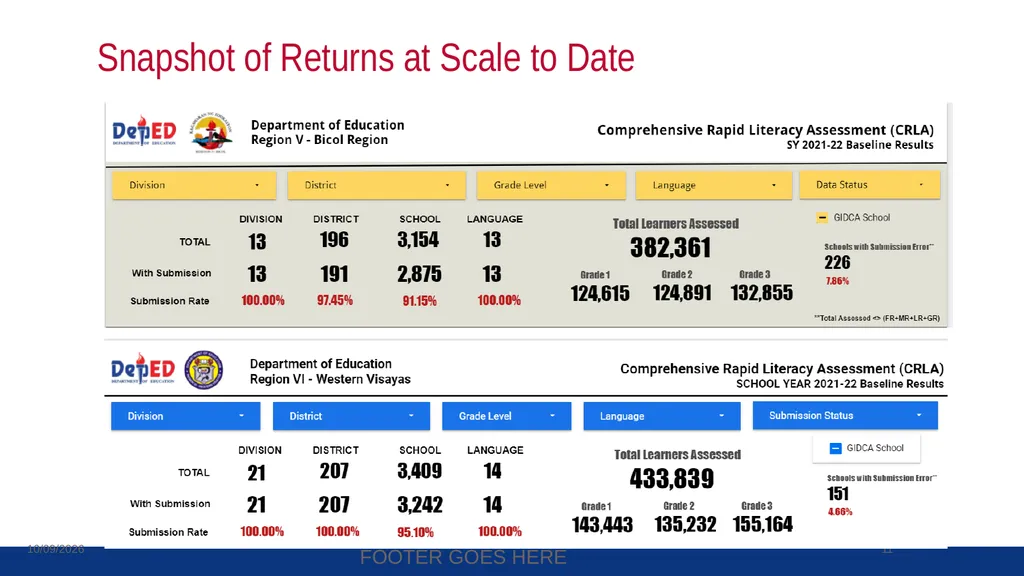
4/20/2022 FOOTER GOES HERE 11 Snapshot of Returns at Scale to Date<br>
11
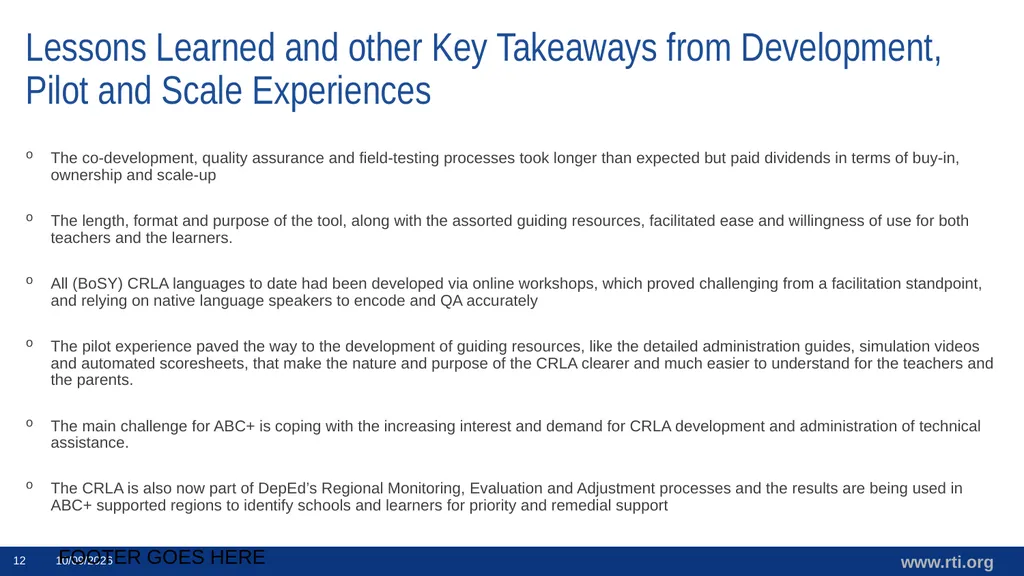
Lessons Learned and other Key Takeaways from Development, Pilot and Scale Experiences The co-development, quality assurance and field-testing processes took longer than expected but paid dividends in terms of buy-in, ownership and scale-up
The length, format and purpose of the tool, along with the assorted guiding resources, facilitated ease and willingness of use for both teachers and the learners.
All (BoSY) CRLA languages to date had been developed via online workshops, which proved challenging from a facilitation standpoint, and relying on native language speakers to encode and QA accurately
The pilot experience paved the way to the development of guiding resources, like the detailed administration guides, simulation videos and automated scoresheets, that make the nature and purpose of the CRLA clearer and much easier to understand for the teachers and the parents.
The main challenge for ABC+ is coping with the increasing interest and demand for CRLA development and administration of technical assistance.
The CRLA is also now part of DepEd’s Regional Monitoring, Evaluation and Adjustment processes and the results are being used in ABC+ supported regions to identify schools and learners for priority and remedial support 12 4/20/2022 FOOTER GOES HERE<br>
12
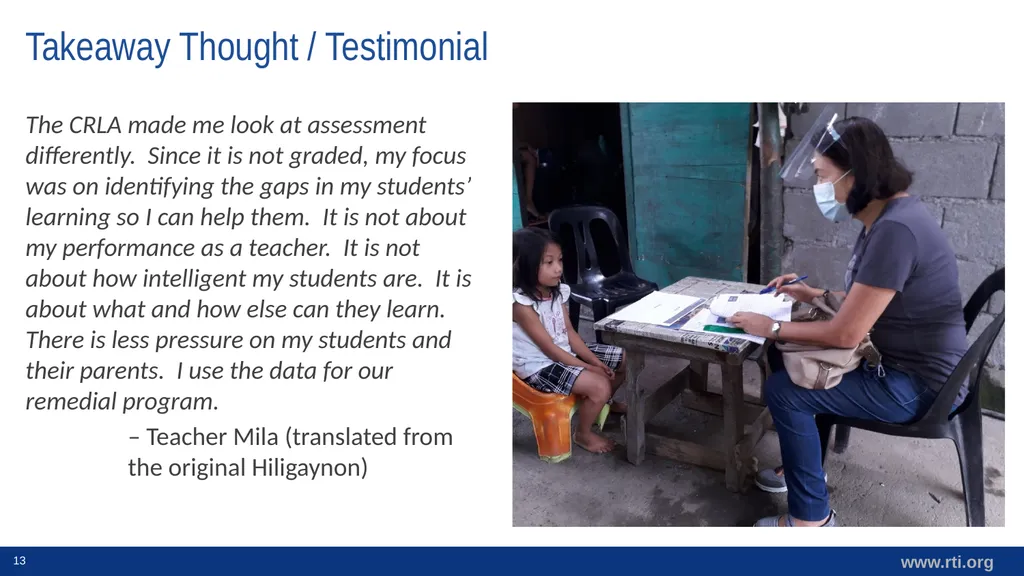
Takeaway Thought / Testimonial 13 The CRLA made me look at assessment differently. Since it is not graded, my focus was on identifying the gaps in my students’ learning so I can help them. It is not about my performance as a teacher. It is not about how intelligent my students are. It is about what and how else can they learn. There is less pressure on my students and their parents. I use the data for our remedial program.
– Teacher Mila (translated from the original Hiligaynon)<br>
13
Thank You!
Mitch Rakusin | Email: mrakusin@rti.org
Janice Perez| Email: jperez@abcplus.rti.org 14 Learn more about RTI’s work:<br>