The Creative Thesis: How to Develop a Creative Project Into an Untraditional Thesis or Dissertation Presented by Avery C. and James N. The Creative Thesis Creative Theses: Creative theses are projects that take on forms other than the
"The Creative Thesis: How to Develop a Creative" is the property of its rightful owner. Permission is granted to
download and print the materials on this website for personal, non-commercial use only, and to display it
on your personal computer provided you do not modify the materials and that you retain all copyright
notices contained in the materials. By downloading content from our website, you accept the terms of this
agreement.
Presentation Transcript
01
The Creative Thesis:
How to Develop a Creative Project
Into an Untraditional Thesis or Dissertation
Presented by
Avery C. and James N.<br>
02
The Creative Thesis Creative Theses:
Creative theses are projects that take on forms other than the standard ones for critical disciplinary or interdisciplinary work in the humanities. A creative thesis project might mean writing fiction or poetry; working in video and or other visual media; producing a musical composition; or making some other non-traditional intervention in a humanistic conversation.<br>
03
The Creative Thesis If you choose to do a creative project you might also produce a piece of critical writing to accompany your thesis. The critical accompaniment need not take the form of a standard essay, but it should offer an engaged and thoughtful response to your creative work.
The critical component might, for example, take the form of a piece of criticism appropriate your creative field such as a review essay or a book introduction. You should discuss what form your critical essay might take with your preceptor and with your advisor as well.<br>
04
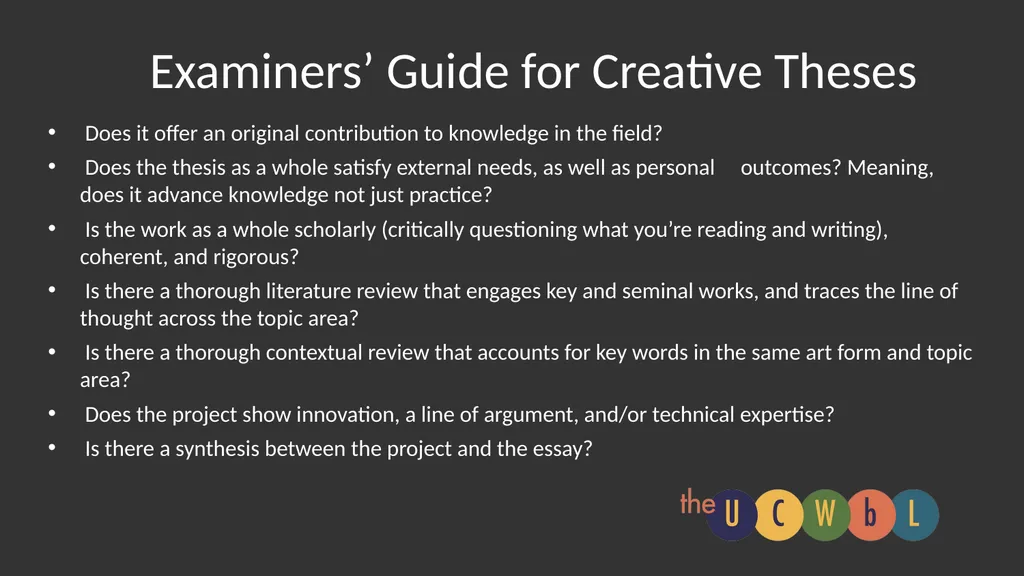
Examiners’ Guide for Creative Theses Does it offer an original contribution to knowledge in the field?
Does the thesis as a whole satisfy external needs, as well as personal outcomes? Meaning, does it advance knowledge not just practice?
Is the work as a whole scholarly (critically questioning what you’re reading and writing), coherent, and rigorous?
Is there a thorough literature review that engages key and seminal works, and traces the line of thought across the topic area?
Is there a thorough contextual review that accounts for key words in the same art form and topic area?
Does the project show innovation, a line of argument, and/or technical expertise?
Is there a synthesis between the project and the essay?<br>
05
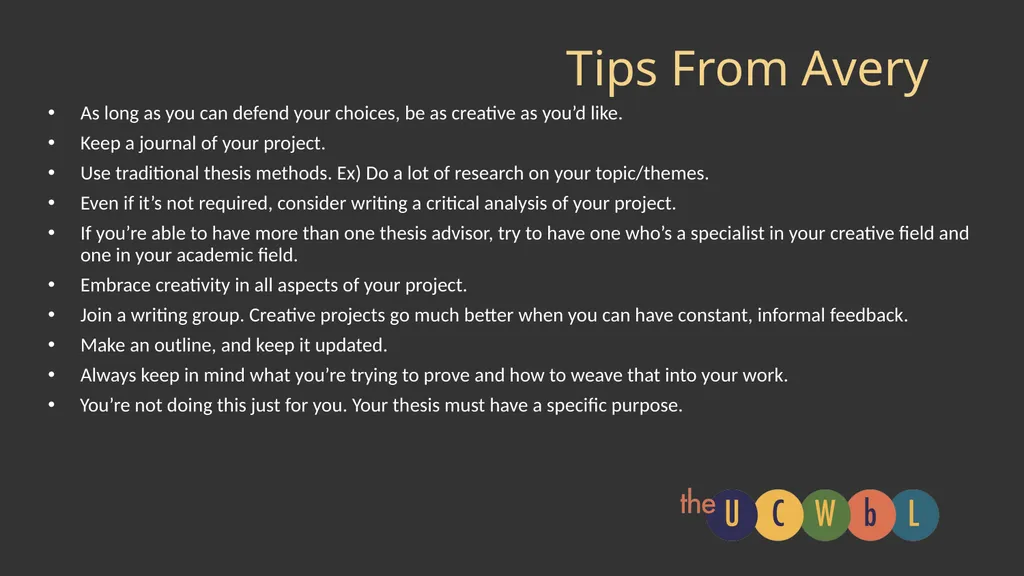
Tips From Avery As long as you can defend your choices, be as creative as you’d like.
Keep a journal of your project.
Use traditional thesis methods. Ex) Do a lot of research on your topic/themes.
Even if it’s not required, consider writing a critical analysis of your project.
If you’re able to have more than one thesis advisor, try to have one who’s a specialist in your creative field and one in your academic field.
Embrace creativity in all aspects of your project.
Join a writing group. Creative projects go much better when you can have constant, informal feedback.
Make an outline, and keep it updated.
Always keep in mind what you’re trying to prove and how to weave that into your work.
You’re not doing this just for you. Your thesis must have a specific purpose.<br>
06
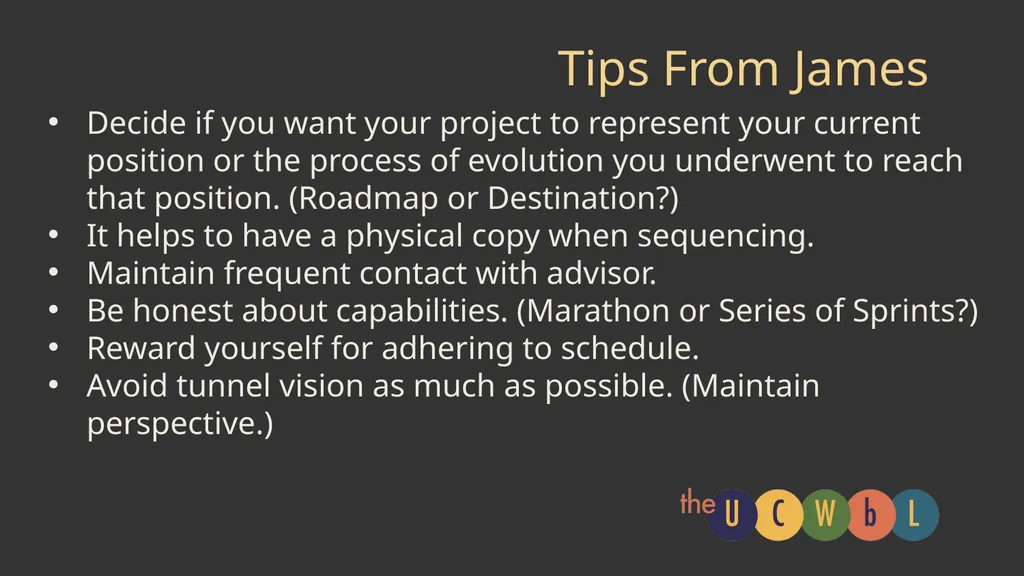
Tips From James Decide if you want your project to represent your current position or the process of evolution you underwent to reach that position. (Roadmap or Destination?)
It helps to have a physical copy when sequencing.
Maintain frequent contact with advisor.
Be honest about capabilities. (Marathon or Series of Sprints?)
Reward yourself for adhering to schedule.
Avoid tunnel vision as much as possible. (Maintain perspective.)<br>
07
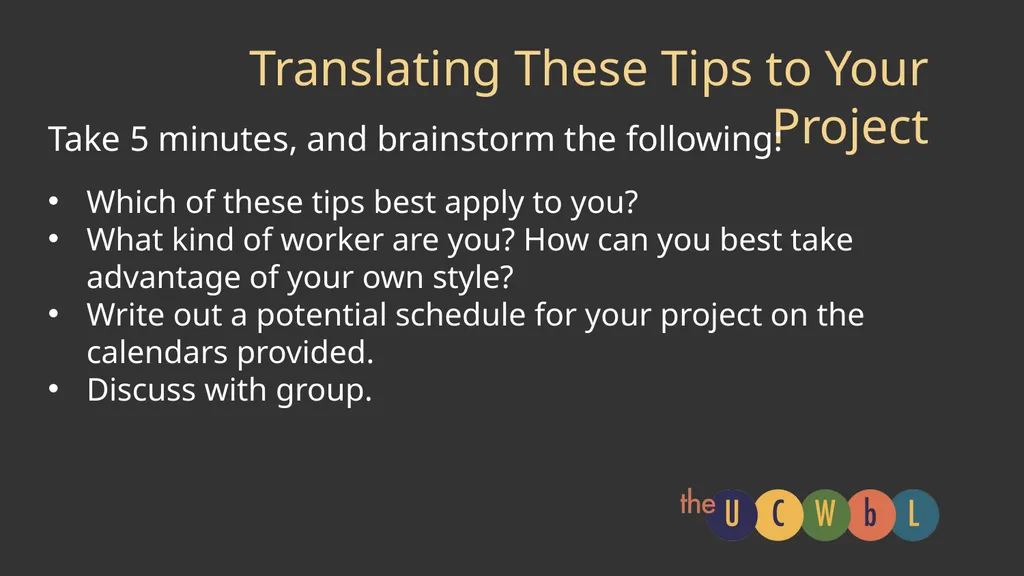
Translating These Tips to Your Project Take 5 minutes, and brainstorm the following:
Which of these tips best apply to you?
What kind of worker are you? How can you best take advantage of your own style?
Write out a potential schedule for your project on the calendars provided.
Discuss with group.<br>