The Criminalization of Mental Illness Chapter One

Published  . 0 views
↓ Download
The Criminalization of Mental Illness Chapter One
1 / 1
The Criminalization of Mental Illness Chapter One - slide 1 of 11 The Criminalization of Mental Illness Chapter One - slide 2 of 11 The Criminalization of Mental Illness Chapter One - slide 3 of 11 The Criminalization of Mental Illness Chapter One - slide 4 of 11 The Criminalization of Mental Illness Chapter One - slide 5 of 11 The Criminalization of Mental Illness Chapter One - slide 6 of 11 The Criminalization of Mental Illness Chapter One - slide 7 of 11 The Criminalization of Mental Illness Chapter One - slide 8 of 11 The Criminalization of Mental Illness Chapter One - slide 9 of 11 The Criminalization of Mental Illness Chapter One - slide 10 of 11 The Criminalization of Mental Illness Chapter One - slide 11 of 11
Description: The Criminalization of Mental Illness Chapter One Introduction Copyright 2013 Carolina Academic Press Ernest Hemingway said: The world breaks everyone and afterward many are strong at the broken places. Why might the beginning chapter

Related Topics

Download Presentation

"The Criminalization of Mental Illness Chapter One" is the property of its rightful owner. Permission is granted to download and print the materials on this website for personal, non-commercial use only, and to display it on your personal computer provided you do not modify the materials and that you retain all copyright notices contained in the materials. By downloading content from our website, you accept the terms of this agreement.

Presentation Transcript

slide1. The Criminalization of Mental Illness Chapter One Introduction Copyright © 2013 Carolina Academic Press<br>
slide2. Ernest Hemingway said: “The world breaks everyone and afterward many are strong at the broken places.”

Why might the beginning chapter of the book be started off with this quote? Copyright © 2013 Carolina Academic Press<br>
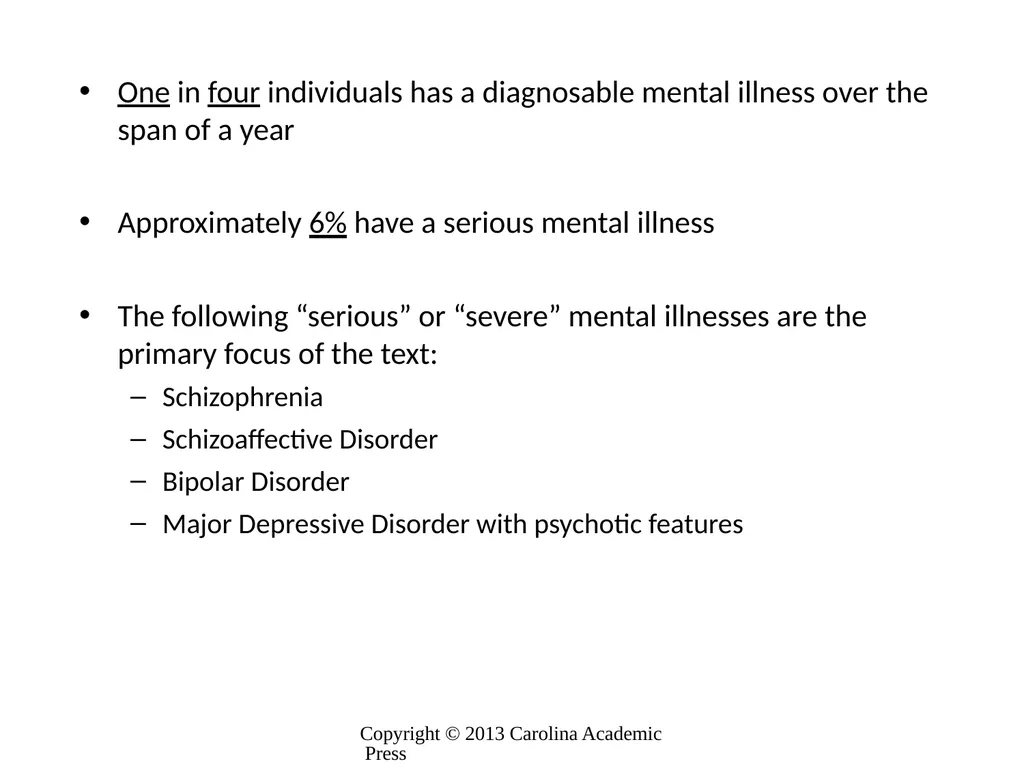
slide3. One in four individuals has a diagnosable mental illness over the span of a year

Approximately 6% have a serious mental illness

The following “serious” or “severe” mental illnesses are the primary focus of the text:
Schizophrenia
Schizoaffective Disorder
Bipolar Disorder
Major Depressive Disorder with psychotic features Copyright © 2013 Carolina Academic Press<br>
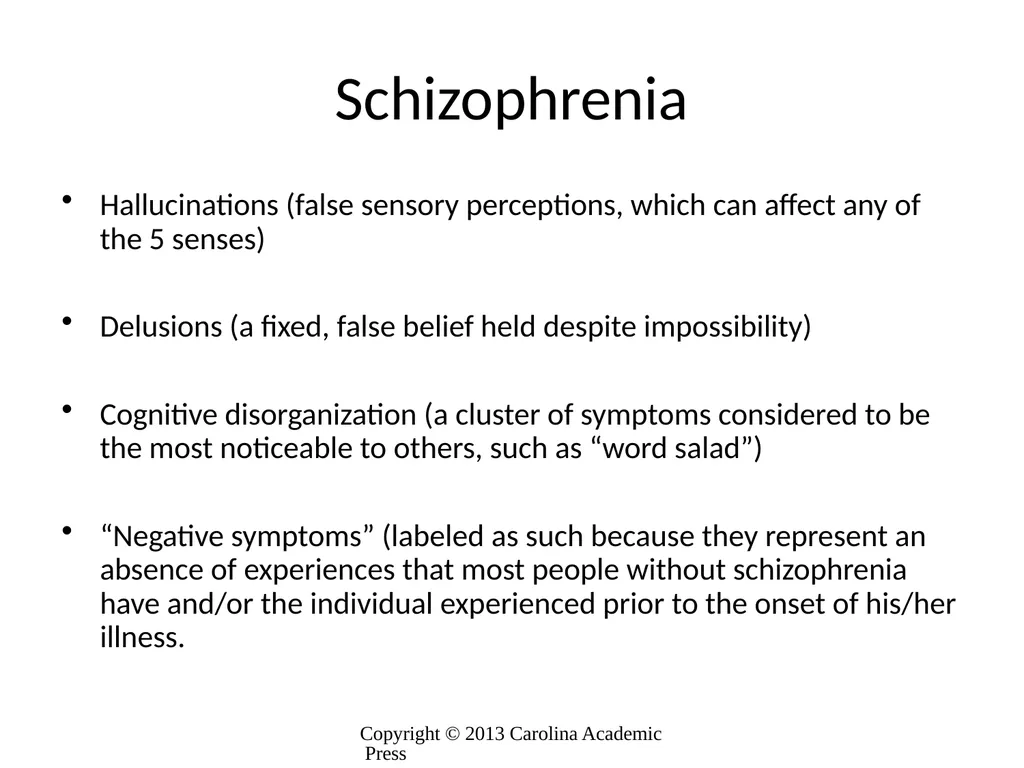
slide4. Schizophrenia Hallucinations (false sensory perceptions, which can affect any of the 5 senses)

Delusions (a fixed, false belief held despite impossibility)

Cognitive disorganization (a cluster of symptoms considered to be the most noticeable to others, such as “word salad”)

“Negative symptoms” (labeled as such because they represent an absence of experiences that most people without schizophrenia have and/or the individual experienced prior to the onset of his/her illness. Copyright © 2013 Carolina Academic Press<br>
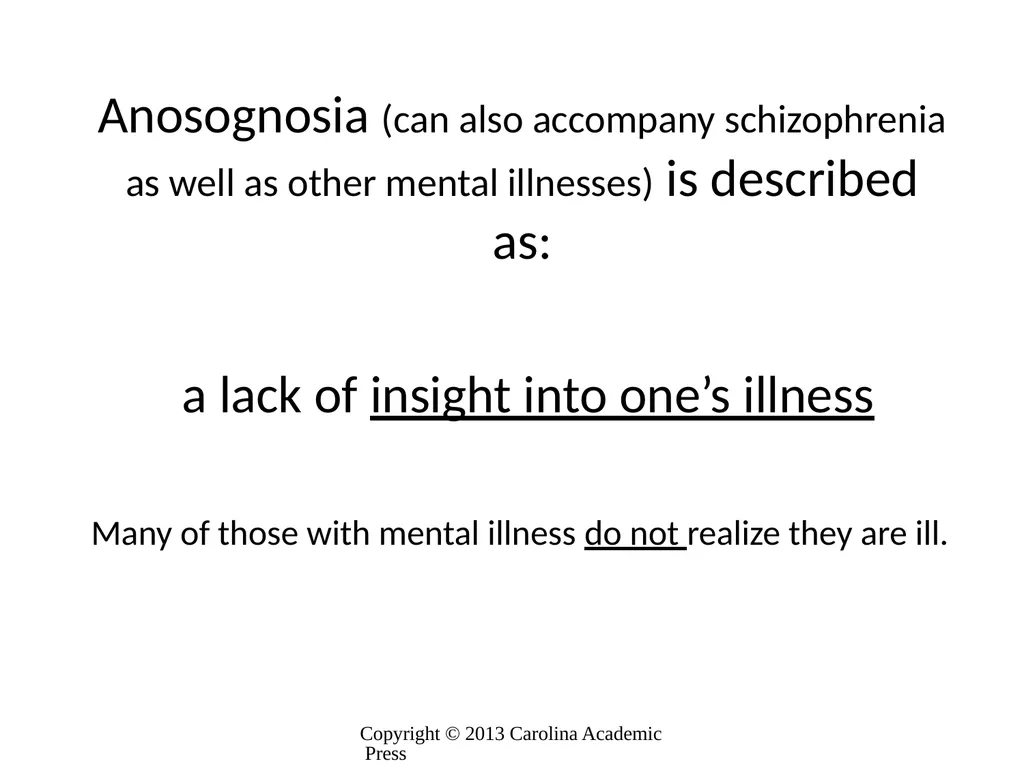
slide5. Anosognosia (can also accompany schizophrenia as well as other mental illnesses) is described as:

a lack of insight into one’s illness

Many of those with mental illness do not realize they are ill. Copyright © 2013 Carolina Academic Press<br>
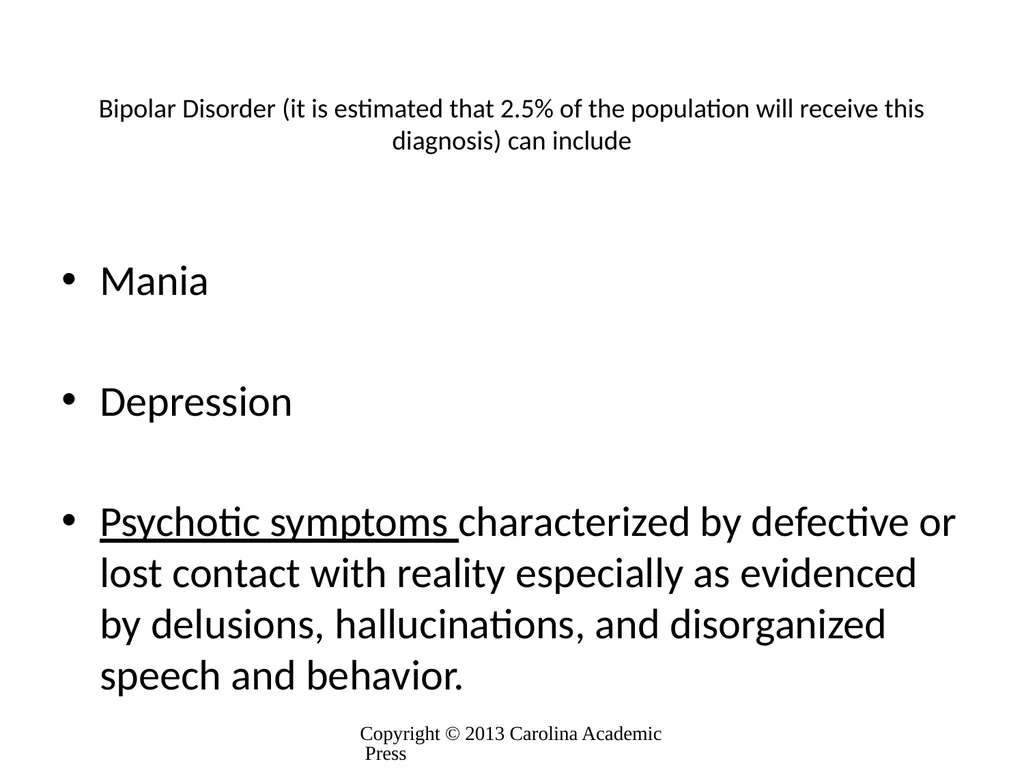
slide6. Bipolar Disorder (it is estimated that 2.5% of the population will receive this diagnosis) can include Mania

Depression

Psychotic symptoms characterized by defective or lost contact with reality especially as evidenced by delusions, hallucinations, and disorganized speech and behavior. Copyright © 2013 Carolina Academic Press<br>
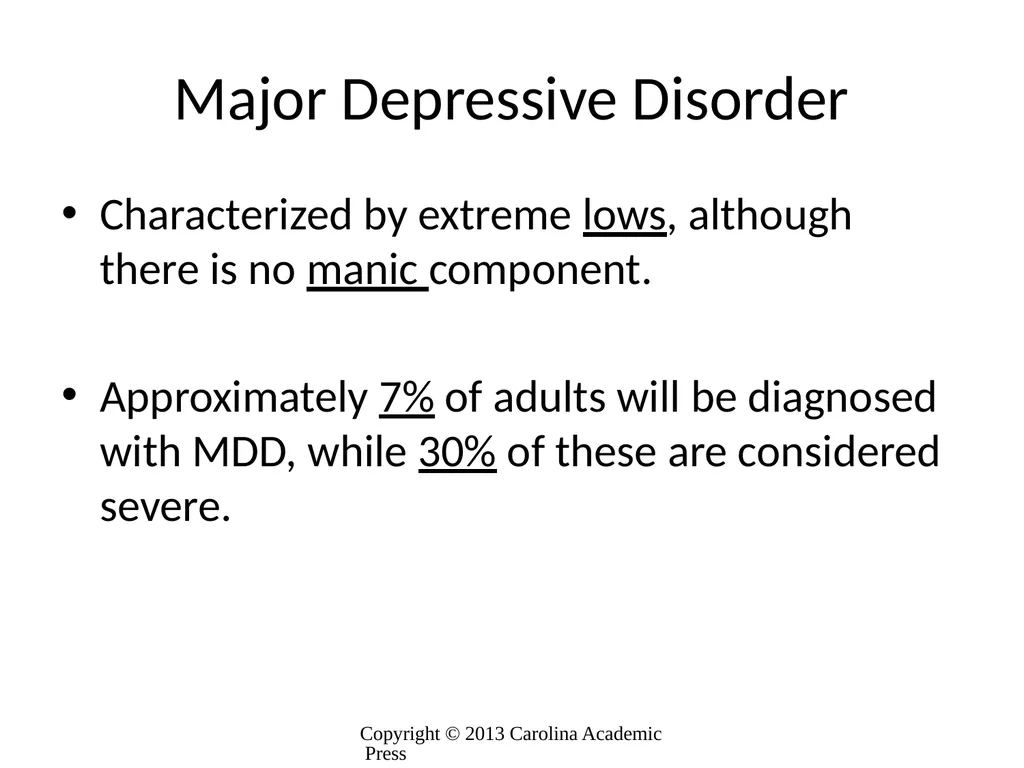
slide7. Major Depressive Disorder Characterized by extreme lows, although there is no manic component.

Approximately 7% of adults will be diagnosed with MDD, while 30% of these are considered severe. Copyright © 2013 Carolina Academic Press<br>
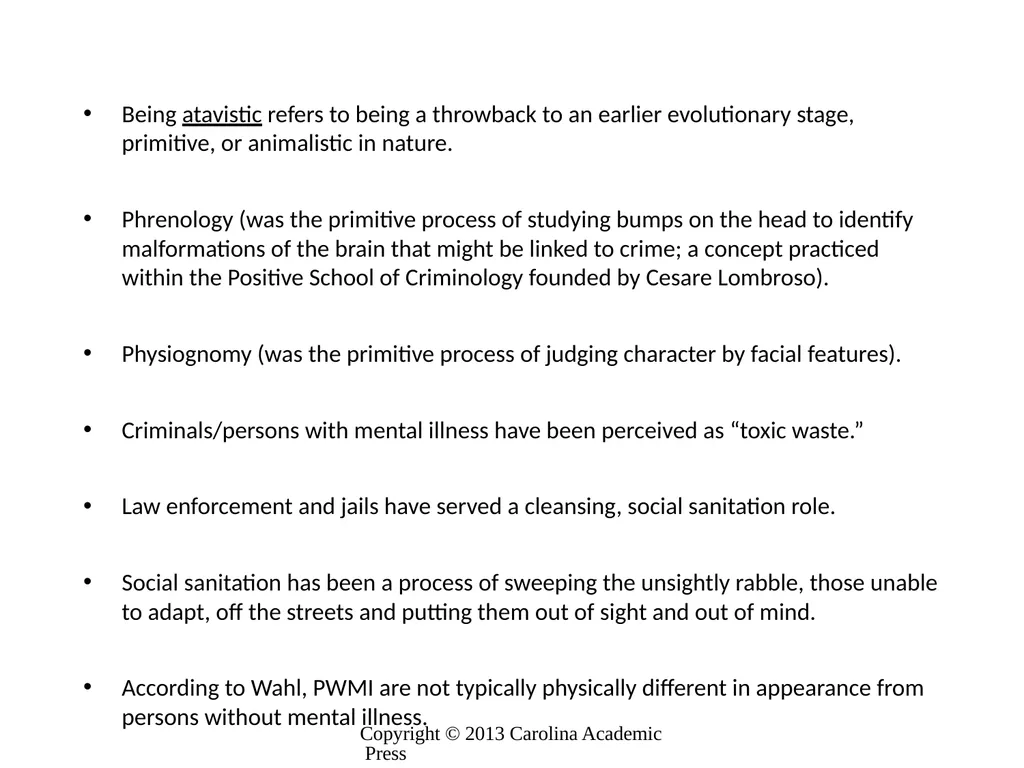
slide8. Being atavistic refers to being a throwback to an earlier evolutionary stage, primitive, or animalistic in nature.

Phrenology (was the primitive process of studying bumps on the head to identify malformations of the brain that might be linked to crime; a concept practiced within the Positive School of Criminology founded by Cesare Lombroso).

Physiognomy (was the primitive process of judging character by facial features).

Criminals/persons with mental illness have been perceived as “toxic waste.”

Law enforcement and jails have served a cleansing, social sanitation role.

Social sanitation has been a process of sweeping the unsightly rabble, those unable to adapt, off the streets and putting them out of sight and out of mind.

According to Wahl, PWMI are not typically physically different in appearance from persons without mental illness. Copyright © 2013 Carolina Academic Press<br>
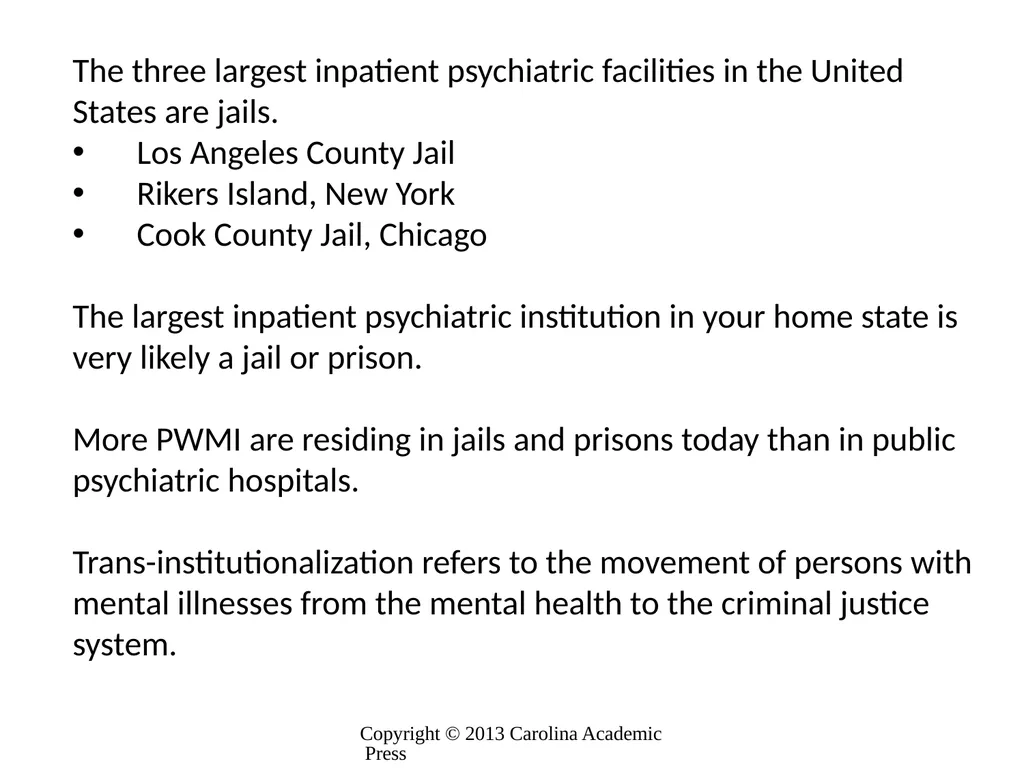
slide9. The three largest inpatient psychiatric facilities in the United States are jails.
Los Angeles County Jail
Rikers Island, New York
Cook County Jail, Chicago

The largest inpatient psychiatric institution in your home state is very likely a jail or prison.

More PWMI are residing in jails and prisons today than in public psychiatric hospitals.

Trans-institutionalization refers to the movement of persons with mental illnesses from the mental health to the criminal justice system. Copyright © 2013 Carolina Academic Press<br>
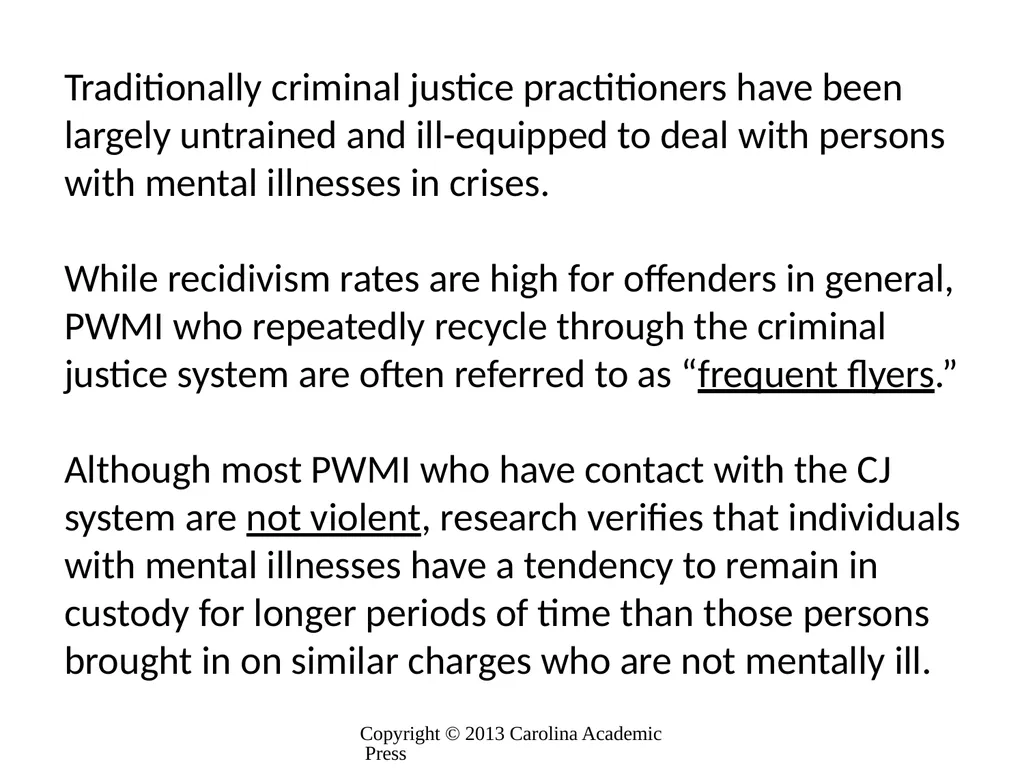
slide10. Traditionally criminal justice practitioners have been largely untrained and ill-equipped to deal with persons with mental illnesses in crises.

While recidivism rates are high for offenders in general, PWMI who repeatedly recycle through the criminal justice system are often referred to as “frequent flyers.”

Although most PWMI who have contact with the CJ system are not violent, research verifies that individuals with mental illnesses have a tendency to remain in custody for longer periods of time than those persons brought in on similar charges who are not mentally ill. Copyright © 2013 Carolina Academic Press<br>
slide11. The full set of PowerPoint slides is available upon adoption. Email bhall@cap-press.com for more information.<br>